




Abstract
The fallout from the 1986 Chernobyl accident caused dramatic and long-lasting consequences for parts of food production in Norway, and the indigenous Sámi reindeer-herding lifestyle and culture in central Norway was particularly threatened. Banning food production – or condemning food – was considered unacceptable in a long-term perspective, and huge efforts were made to develop mitigating options. Some of these are still in place, 35 years after the accident. This article describes some of the long-term efforts made by Norwegian authorities to attempt to alleviate the consequences for the reindeer herders. Every accident and crisis is unique, and this is true for the experiences in Norway. However, some of the experiences in Norway are likely to have universal value.
1. INTRODUCTION
The 1986 Chernobyl accident had significant consequences for Norway with high levels of contamination and long-lasting challenges in animal husbandry (cattle, sheep, goats, and semi-domestic reindeer) utilising unimproved forest and mountain pastures for grazing (Tveten et al., 1998; Liland and Skuterud, 2013). There were major consequences for producers in many areas, particularly the indigenous Sámi reindeer herders in central Norway. This article will therefore focus on experiences from work related to the Sámi reindeer herders. It should be mentioned that the situation was not unique to Norway, and that Sámis across the border in Sweden experienced similar consequences (e.g. Beach, 1990).
When talking about the roles of professionals and experts in a large crisis such as the Chernobyl accident, it may be useful to draw parallels with the coronavirus disease 2019 pandemic. From the start, the experts played important roles in assessing risk and suggesting solutions, while the politicians made the decisions trying to balance costs and benefits. Also, from the start, members of the public may have had strong opinions, and as restrictions last, many citizens may wish to influence and adjust their own situations, with experts continuously being important sources of advice. This article will illustrate that there are some commonalities with the Chernobyl experience.
The author has had a central position in Chernobyl consequence management in Norway since the mid-1990s, and a short summary of experiences will be biased by his views. The reader is referred to Liland and Skuterud (2013) and Skuterud et al. (2016) for more details and perspectives.
2. RESPONSES AND MITIGATING ACTIONS
When the Chernobyl accident happened in 1986, Norway had no operational nuclear emergency preparedness. It took weeks to gain overviews of the affected areas, and there was much uncertainty about the consequences. However, the vulnerability of reindeer herding to radioactive contamination was known from the time of nuclear weapons testing, and a monitoring programme of Sámi reindeer herders in northern Norway was still ongoing. It was quickly realised that reindeer husbandry could be particularly affected by the fallout from Chernobyl. In July 1986, high radiocaesium levels in samples led to national news headlines such as: ‘Lichens may be contaminated for decades. Reindeer husbandry is threatened’. A permissible level of 600 Bq kg−1 for radiocaesium in basic foodstuffs was established in June 1986, and the contamination levels in reindeer resulted in a ban on reindeer meat from central and southern Norway in autumn and winter 1986.
Further increases in radiocaesium levels in reindeer meat in autumn 1986 led the Norwegian health authorities to raise the permissible level for marketed reindeer meat to 6000 Bq kg−1 to reduce the challenges for the herders as producers. A part of the argument given in the press release announcing the change was: ‘A maintained intervention level of 600 Bq kg−1 will […] result in production for condemnation and uneasiness among reindeer herders in the coming years. A despondent atmosphere, apathy and defection of young people will come forward in reindeer husbandry and the Sámi community […]. If the limit is not raised, these problems will last for many years and can thereby threaten the Sámi lifestyle and culture, irrespective of monetary compensation’. From a radiation protection point of view, the increase was justified by low consumption of reindeer meat by the average consumer in Norway (approximately 0.6 kg year−1) and corresponding negligible radiation doses. However, the reindeer herders themselves were recommended not to eat meat with high radiocaesium levels, but to refer to the limit for basic foodstuffs of 600 Bq kg−1 as reindeer meat was a dietary staple for them. The authorities offered less-contaminated reindeer meat as a substitute for their own produce. The health authorities also distributed dietary advice with recommendations on how much could be consumed depending on radiocaesium levels, and advice on cooking and preparation methods to reduce radiocaesium levels of the consumed product. Later, compensation for an ‘alternative diet’ was established so that economic constraints should not be a reason for consumption of contaminated meat.
Restrictions on land use and grazing, or continued bans and condemnation of foods, were not seen as acceptable in Norway after the accident, and huge efforts were made for several years to develop countermeasures for animal husbandry. The efforts involved scientists, the authorities, and animal owners – often in cooperation – with important practical input from the animal owners. Most of the measures were much more cost-effective than condemning foods (Tveten et al., 1998).
3. SOCIOCULTURAL BACKGROUND
An official Norwegian report in 1986 concluded that the Chernobyl accident caused a general information crisis where the authorities lost trust and credibility due to cases of erroneous information etc. For many of the indigenous Sámi reindeer herders, this added to an already sceptical and tense relationship with the state due to a history of assimilation policies and programmes aiming to increase productivity in reindeer husbandry, and reduce the number of herders (Stephens, 1994).
The Chernobyl fallout created a dramatic change for the reindeer herders. Over a few days in spring 1986, their diet changed from being one of the healthiest and most sustainable to one of the most radioactive. From having a lifestyle where they were the masters with their local know-how and experience – and had reindeer husbandry and the culture as ‘boundary maintenance’ vis-à-vis the rest of society – they suddenly became dependent on the authorities and scientists (Stephens, 1994). Some were afraid that the Norwegian Government would use the Chernobyl fallout as an opportunity for rationalisation, and there was deep concern whether the state would continue to provide monetary compensation if it would take 20–30 years before contamination levels decreased (Stephens, 1994). The herders realised that they could not ‘surrender’ to the experts and the authorities (Paine, 1992). They therefore started searching for solutions (e.g. experiments with clean feeding during winter 1986/87, although some scientists warned about animal welfare issues and losses of 10–20% of the animals) (Paine, 1992). By 1988, much experience on countermeasures had been gained, and a memorandum was sent to the Norwegian Government demanding that ‘individual solutions be accepted’ (Paine, 1992).
The clean reindeer meat offered by the authorities in the first years after the Chernobyl accident solved an ingestion dose challenge but was not very popular (Stephens, 1994). It also deprived the herders of the other parts of the reindeers’ bodies (blood, organs, antlers, hooves, etc.) which they used in preparation of traditional meals or handicrafts. Furthermore, as the culture is based on learning through participation in traditional activities and own experience, parents feared that those customs would disappear, together with related words in their language. The various remedial actions (clean feeding, live monitoring of reindeer, whole-body monitoring etc.) together successfully averted the long-term catastrophe for reindeer herding culture that was feared initially, but increased the dependence of the Sámi reindeer herders on scientists and state subsidies (Stephens, 1994).
4. WHOLE-BODY MONITORING – ALSO AN ARENA FOR COMMUNICATION
In response to the consequences of the Chernobyl accident, the whole-body monitoring programme was extended to the South Sámi areas in central Norway. The aim was primarily to survey ingestion doses and time trends in internal radiocaesium levels, but also included dietary surveys and interviews about the reindeer herders’ efforts to reduce their radiocaesium intake. Together with monitoring of radiocaesium in foodstuffs, the results of the whole-body monitoring could thus also be used to estimate the effects of their efforts to reduce doses (Fig. 1).
Left: Ingestion doses to Sámi reindeer herders in the Snåsa region. The green area shows doses estimated from observed whole-body levels, while the red area shows the estimated doses if no countermeasures had been implemented [adapted from Skuterud and Thørring (2012)]. Right: A reindeer herder (left) being monitored in the Norwegian Radiation and Nuclear Safety Authority’s mobile laboratory (the author to the right). © Geir Tønset, Adresseavisen.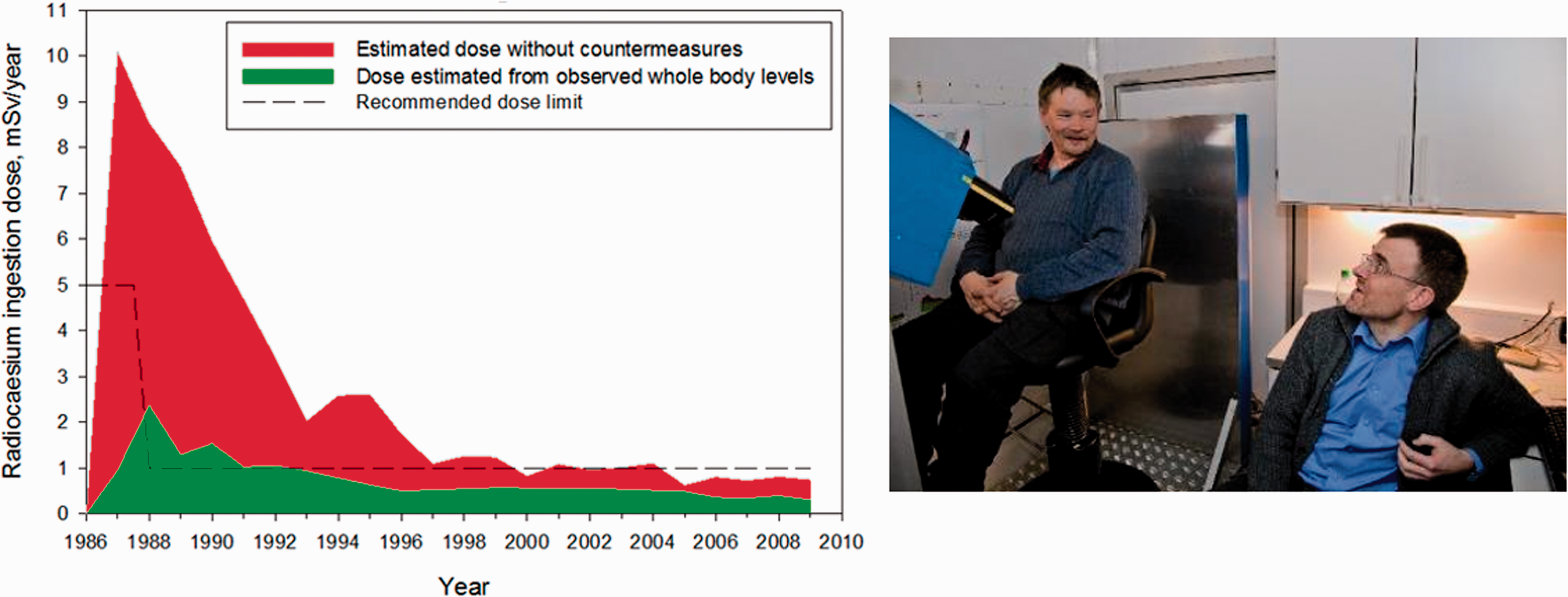
During the first years, the monitoring campaigns were carried out annually. However, as radiocaesium levels in reindeer and people decreased – and the scientific, technical, and practical challenges with remediation in reindeer herding were gradually solved – there was less contact between herders and experts. The author’s first encounter with the reindeer herders was during the monitoring campaign in 1996 – 3 years after the previous campaign. The herders’ frustrations about abandonment, lack of communication, and continuous concerns about health effects made a strong impression.
Invitations to participate in the whole-body monitoring programme have been distributed to all registered herders in the affected areas, and the monitoring takes place at central locations in the Sámi areas. There is no strict schedule; participants meet at their own convenience and are offered a light meal while queuing for the measurement or talking to friends, colleagues, or the experts. It is important to note that the monitoring has not just been a ‘technical’ happening resulting in a measurement result. The measurement allows time for communication with each individual (e.g. comparisons with previous year’s results and on their efforts to limit the radiocaesium intake). It is believed that this time for personal communication is important for the participants. Also, it is felt that a relatively comfortable measurement geometry (Fig. 1) facilitates conversation better than many more advanced measurement devices. Conversation topics and questions range widely (e.g. from understanding of risks related to measured levels, to questions on contamination in the environment and restrictions). Therefore, having a team of personnel with wide competence has been an advantage. The team must also be prepared to handle questions outside the responsibility of the Norwegian Radiation and Nuclear Safety Authority (DSA), as the public cannot be expected to know which topic belongs to which authority.
5. HEALTH CONCERNS
The permissible levels in foods; the monitoring, control, and countermeasures in reindeer husbandry; and the whole-body monitoring of people all refer to radiation doses and potential health effects. It is therefore natural that reindeer herders have concerns about health effects of the fallout. In 1990 and 2006, they sent letters to the Ministry of Health demanding more information and comprehensive health monitoring. The issue was also raised at a stakeholder meeting in 2008: ‘Why hasn’t there been a follow-up of health issues for the Sámi population after Chernobyl?’ ‘Where are the results? We are being researched on but learn nothing about the possible health effects’ (Oughton et al., 2008). These quotes partly refer to the whole-body monitoring campaigns and the fact that they do not answer their most basic question: ‘What risk does the radiocaesium in my body pose to my health?’ Early studies of potential effects gave equivocal results (e.g. Reitan et al., 1998). Further studies have been discussed among the authorities with involvement of Sámi representatives. None have been initiated as the doses are lower than those expected to induce health effects, and because of reservations against more studies with equivocal results; these might well increase the reindeer herders’ notions of being ‘guinea pigs’ in the large ‘Chernobyl experiment’.
Despite some critical voices as demonstrated above, DSA has continued the monitoring campaigns, partly because they are appreciated as arenas for communication. Some more in-depth interviews with reindeer herders about their risk perception in 2016 indicated that the monitoring programme was seen as a positive measure, even among those interviewees who did not participate in the programme (Svenningsen, 2016). The interviews by Svenningsen documented how the herders’ situations have changed over three decades. Gradually, they achieved positive response expectations due to increased knowledge, and perception of control and influence over the contamination and risks. In 2016, the herders had little focus on health risks and radioactivity (Svenningsen, 2016).
6. THE ROLE OF EXPERTS
As mentioned in the Introduction, during and after crises, professionals and experts have obvious roles in risk assessment and in developing and suggesting options for remediation. Much out of necessity, the consequences of the Chernobyl accident in Norway initiated extensive cooperation between scientists, the authorities, and affected people in solving the challenges. It was also obvious – from an early stage, as illustrated in this article – that the citizens also wanted to be involved when the consequences affected their daily lives. The experts’ contributions to developing a suite of actions, such that the herders could select what was appropriate for them, have been important for their coping. People are different, and have different preferences and attitudes, including towards experts; hoping for consensus is often futile.
The duration of the contamination problems has required long-term follow-up of affected people. Norwegian authorities have decided to offer whole-body monitoring as long as radiocaesium in reindeer meat is an issue; there is still an elevated permissible level of 3000 Bq kg−1 for reindeer meat, and reindeer are routinely live monitored prior to slaughter. Considering the experts’ roles in establishing the restrictions, it seems obvious that they should also contribute to managing the concerns they can cause. Furthermore, in a situation with long-lasting contamination, there will also be a continuous need for communication with newcomers and new generations of herders. The coronavirus disease 2019 pandemic is just one of the cases lately that have demonstrated the importance of providing science-based information; the potential for alternative voices on the consequences of radioactive fallout is huge.
Despite the initial challenges in 1986 related to trust and culture etc., the continued efforts by herders, scientists, and the authorities; joint experiences from applying different measures; and possibilities for communication have helped the affected population build competence on how to manage their personal contamination situation. And as the cooperation continues, we all maintain the competence we have gained – and acquire more.