




Abstract
This paper does not necessarily reflect the views of the International Commission on Radiological Protection.
1. INTRODUCTION
As a result of the accident at Chernobyl nuclear power plant (NPP) in 1986, 46,450 km2 of the territory of the Republic of Belarus was subjected to radioactive contamination, with 137Cs content in soil >37 kBq m−2. Decontamination and remediation activities in the affected areas resulted in >400,000 tons of remediation waste (RemW) contaminated with 137Cs and 90Sr in concentrations from 1 to 105 Bq kg−1, which were disposed in 91 ‘emergency’ storage sites (RemWSS). Only seven of the sites were specially built repositories, equipped with waterproof clay and film barriers; most of the other sites were occasional sites (ravines, sand pits, trenches, etc.) which created a potential danger of migration of radionuclides into groundwater.
The Law ‘On legal treatment of territories contaminated as a result of the Chernobyl NPP catastrophe’ enacted in 1991 differentiated between two types of waste in the contaminated area: waste with activity exceeding the exemption level (radioactive waste) and very low-level radioactive substances with activity that was 10-fold lower. The Law stipulated that the national regulatory authorities (Promatomnadzor and the Ministry of Health) should ensure regulation of the management of waste classified as radioactive, with very low-level radioactive substances being exempted from supervisory control. The strategy established by legislation for management of RemW specified that, in due time, the waste would be sorted and radioactive waste would be relocated into adequately equipped near-surface disposal facilities. The public, environment agencies, state authorities, mass media, and other stakeholders insisted on urgent measures for the relocation of RemW according to the adopted strategy, and in compliance with the regulatory requirements of the time for the management of institutional radioactive waste (SPORO-85). Application of these requirements to management of RemW was completely baseless given the huge volume and other specific features. In reality, RemW of both types had been mixed in the RemWSS, and there was very little possibility of separating them and relocating them separately.
The situation called for elaboration of an innovated regulatory approach and an advanced rational strategy for RemW management/regulation providing reasonable assurance that the RemW operating system would have a sufficient level of safety, and potential exposures of the population would be within the exposure limits given in the National Radiation Safety Standards. An important rationale for rethinking the existing approach was that the radiation impact of the RemWSS on the population had been assessed as insignificant in comparison with the exposure caused by contamination of the areas in which the RemWSS were located.
The process included detailed assessment of the potential radiological hazard of the RemWSS, which embraced adoption of the hazard assessment criteria and thorough examination of the RemWSS: the state of natural barriers, inventory, potential effect of the RemWSS on the environment, etc.
2. CRITERIA FOR HAZARD ASSESSMENT OF THE REMWSS
The proposed criteria for hazard assessment of the RemWSS were based on the notion that the risks posed by the RemWSS to human health should be consistent with the risks from the contaminated areas where the RemWSS were located. This approach was assumed to be reasonable because the RemWSS were placed in the exclusion zone where radionuclide activity in soil was similar to radionuclide activity in RemW. If essentially the same criteria were applied to the RemWSS and the contaminated areas, the two should be identical with regard to their impacts on human health and the environment.
In accordance with the above-stated notion, the following criteria for hazard assessment of the RemWSS for members of public were adopted:
the RemWSS should pose a risk to human health consistent with the risk from the contaminated areas in which the RemWSS are located; for members of the public beyond the boundary of the exclusive zone where active radiation monitoring is maintained, a limit on effective dose equivalent from all exposure pathways is 1 mSv year−1; releases of radioactivity from the RemWSS into the environment are as low as reasonably achievable; and protection of groundwater and surface water resources complies with the national standards established for radioactivity of water in public drinking water supplies (0.1 mSv year−1).
Applying drinking water standards to protection of groundwater or surface waters near contaminated sites, to the extent reasonably achievable, would help to avoid the need for costly clean-ups of drinking water if affected sources were ever to be used for this purpose.
3. Examination Of The Remwss
3.1. Inventory
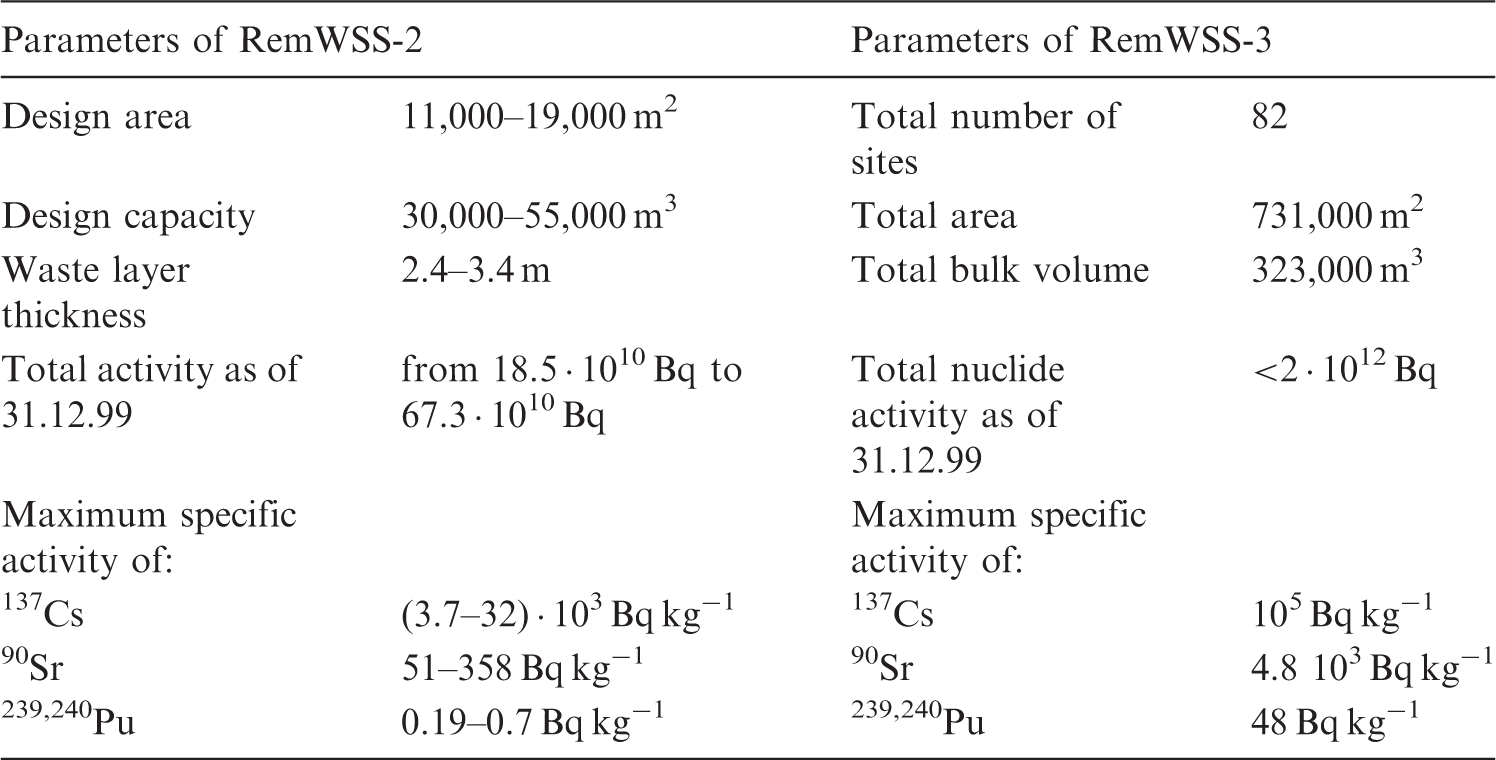
Parameters of remediation waste storage sites (RemWSS).
The distribution of radionuclides below the foundations of the RemWSS to a depth of 1.5 m of the natural barriers was studied. Radionuclide activity decreased abruptly with the depth of the layer, and at 1.5-m depth, the content of 137Cs was 18–32 Bq kg−1 and the content of 90Sr was 2.5–6.0 Bq kg−1.
3.2. Laboratory studies
The forms of existence of radionuclides in the RemW samples were analysed. The results showed that 80–95% of 137Cs was in a non-exchangeable form. The proportion of 90Sr non-exchangeable forms varied from 32% to 92% depending on the zone of origin of the RemW. The obtained data were used for calculation of the coefficients of mobility of radionuclides in the RemW. The coefficient values for 137Cs were in the range of 0.05–0.21; for 90Sr, the coefficients were 0.12–0.42 in the nearest zone and 1.0–2.4 in the distant zone.
The mobility coefficients and parameters of radionuclide washout due to atmospheric precipitation were applied in the mathematical models developed to predict the migration of radionuclides from the RemWSS.
3.3. Monitoring of groundwater
In 1993–1994, 11 RemWSS were equipped with a system of observation boreholes to control migration of radionuclides from the RemWSS. The 11 RemWSS were selected on account of observing radionuclide behaviour in most typical RemWSS, having the whole spectrum of natural and technological conditions (waste inventory, level of groundwater, thickness of natural barriers) prevalent in all 91 RemWSS.
The approach to the placement of monitoring boreholes, sampling methods, preparation, and measurement of samples made it possible to observe changes in the activity of radionuclides in groundwater with sufficient reliability. For most sites, the water samples from the boreholes located downstream of the groundwater showed a higher radionuclide concentration, which indicated the migration of radionuclides from the RemWSS. However, for all RemWSS examined, the radionuclide concentration in the groundwater did not exceed the permissible levels accepted in the Republic of Belarus for drinking water (10 kBq m−3 for 137Cs and 370 Bq m−3 for 90Sr).
3.4. Assessment results
A mathematical model was developed to assess whether a RemWSS represented a potential hazard based on the principle of a chamber model and using the examination results. Forecasting estimations of radionuclide migration from the RemWSS showed that migration of 137Cs is limited by the aeration zone, and in the case of a site flooding, it is limited by the region of mixing of radioactive contamination with groundwater directly beneath the site. The 90Sr concentration in the groundwater under the RemWSS could reach values from 0.2 to 75 kBq m−3. The RemWSS impact zone is a distance from 100 to 350 m, within which the 90Sr concentration decreases to the maximum permissible value.
Validation of the assessment results was achieved through comparison of the modelling outputs with the experimental data obtained from regular monitoring of the concentration of radionuclides in groundwater, and comparison with the results of calculations using other mathematical models.
The assessment results showed convincingly that any doses to the public associated with contamination of groundwater by radionuclide migration from the RemWSS were small compared with the doses from all pathways associated with the surrounding contaminated soil.
4. REGULATORY APPROACH
Although it involved unquantifiable uncertainties, demonstration of compliance with the criteria based on the results of detailed RemWSS examination was a key argument in achieving common understanding among stakeholders, including the public and regulators, of the feasibility and necessity of applying an advanced regulatory approach to the management of the RemWSS.
From a regulatory point of view, the waste disposed in the occasional sites of the exclusive Chernobyl zone was allocated to a special waste category, defined as substances with 137Cs activity concentration exceeding 0.96 kBq kg−1, formed as a result of activity to eliminate the consequences of the Chernobyl accident.
A special regulation, titled ‘Regulation for the Management of Remediation Waste Resulting from Works on Elimination of Consequences of Chernobyl NPP Catastrophe’ (SPOOD-98), was developed with due account of the waste peculiarities: location in a closed access control zone, huge volumes, low concentrations of 137Cs and absence of other radionuclides in notable concentrations, and variability of protection barriers.
The previously adopted strategy to redispose RemW from ‘emergency’ storage sites into dedicated near-surface facilities was abandoned. SPOOD-98 established mandatory preventive and protective measures that must be taken to maintain sites in a safe condition, and set regulatory requirements for organising technical and radiological control over the RemWSS, including requirements for handling RemW: waste collection, storage, transportation, inventory taking, and radiation protection of personnel.
In terms of engineering arrangement and considering the regulatory requirements, all the RemWSS were classified into one of three categories, each requiring a separate approach towards their maintenance and operating conditions, regulatory control, and selection of management technologies:
• RemWSS-1: engineering structure designed for waste with a specific activity of 137Cs in excess of 96 kBq kg−1, which ensures reliable isolation of waste with the help of concrete engineering protective barriers and hydraulic devices, equipped with a system of permanent monitoring of the impact on the environment. This type of repository should comply with the requirements for near-surface LLW disposal facilities.
• RemWSS-2: engineering structure for near-surface disposal of RemW with specific activity of 137Cs from 0.96 to 96 kBq kg−1, which is equipped with simple clay and film barriers, and systems to monitor the impact on the environment. The summary data of RemWSS-2 are given in Table 1.
• RemWSS-3: storage sites set in abandoned territories during the initial postaccident period, generally with no design and no hydrogeological restrictions taken into account. Depending on the natural location and existence/state of the engineering barriers, they require additional works on engineering arrangement and monitoring of their impacts on the environment. The summary data of RemWSS-3 are given in Table 1.
5. PRINCIPAL LESSONS LEARNT FROM THE REPORTED EXPERIENCE
The principal lessons learnt from the reported experience are as follows.
• Managing RemW that has arisen during remediation activities after a major accident may require a different approach from that used in the country to manage normal planned streams of radioactive waste.
• The success of achieving agreement on establishing a special approach to management of RemW is based primarily on the ability to understand the real hazard of the waste to public health, and the scale of the technical capabilities required to ensure the safety of RemW for the population.
• Agreement on establishing a rational strategy on management of RemWSS may be achieved through logical work with stakeholders, tending to bring the rationale of the decisions taken into line with the regulatory requirements based on the principle of optimisation of radiation protection and the specific features of the RemW.
• A major component of the RemW management strategy is connected to the establishment of regulatory requirements, which should, as far as possible, be based on the existing waste management regulations, but specifically modified to consider the specific factors associated with the prevailing circumstances arising due to the emergency situation.
• Specific factors include the need to set appropriate hazard criteria as well as special monitoring procedures, application of which should result in meeting the established criteria and the ability to demonstrate compliance with them.
• Use of science-based hazard criteria and common understanding among stakeholders of how these criteria have been or can be validated will contribute to the adoption of a sound and cost-effective RemW management strategy, despite opposition from the public, the media, and other factors.