




Abstract
The Nuclear Regulation Authority (NRA) of Japan invited comments from the public on a revised guide on measurement and evaluation for clearance in 2019, which included a strict decision on how to treat uncertainties in the measurement and the nuclide vector. To resolve the issue on the uncertainty in clearance, a probabilistic approach had been established previously in the Atomic Energy Society of Japan Standard and incorporated into International Atomic Energy Agency (IAEA) Safety Report No. 67. NRA’s new decision on the uncertainty in clearance was up to 10 times stricter than the probabilistic approach. This issue has been discussed at an international level in the framework of the ongoing revision of IAEA Safety Guide RS-G-1.7. This discussion on the uncertainty in clearance has raised serious concerns about its effects on other radiological protection regulations worldwide. This is because if we need strict treatment for the uncertainty in clearance, the same or even stricter treatment for conformity assessment may have to be applied to other radiological protection criteria for doses exceeding 10 µSv year−1. Radiological protection experts including regulators, professionals, and operators should be aware of the essential meaning of the radiological protection criteria by considering the background scientific basis on which they were established.
1. INTRODUCTION
The term ‘clearance’ is defined as ‘removal of regulatory control by the regulatory body from radioactive material or radioactive objects within notified or authorized facilities and activities’ in the International Atomic Energy Agency (IAEA) Safety Glossary. The Nuclear Regulation Authority (NRA) of Japan drafted a revised guide on measurement and evaluation for clearance on 5 June 2019 which included a decision on how to treat the uncertainties in the measurement and the nuclide vector [ratio of difficult-to-measure nuclides, such as beta and alpha emitters (e.g. Sr-90 and Pu-239), to easy-to-measure nuclides, such as gamma emitters (e.g. Co-60 and Cs-137)]. This draft guide was open to public comments until 5 July 2019. More than 20 radiological protection experts submitted their individual comments objecting to NRA’s strict decision on the uncertainties in the measurement and the nuclide vector in compliance with the clearance level. To resolve this issue on the uncertainty in clearance, a probabilistic approach had been established previously in the Atomic Energy Society of Japan (AESJ) Standard (AESJ, 2005) and incorporated into IAEA Safety Report No. 67 (IAEA, 2012). NRA’s new decision on the uncertainty in clearance is up to 10 times stricter than the probabilistic approach.
In this paper, to address the issue on the uncertainty and facilitate constructive international discussion on radiological protection regulation among radiological protection experts including regulators, professionals, and operators, the clearance regulation for the treatment of uncertainty in Japan is historically overviewed, and international standards associated with uncertainty in measurements are reviewed. In addition, treatment of the uncertainty to be achieved in clearance is discussed from the viewpoints of the methodology used to derive clearance levels, the balance in a radiological protection system with a graded approach, the difference between product control and radiological protection, and understanding of the health risk of radiation on the order of 10 µSv year−1 by both the public and the regulators.
2. Clearance regulation in JAPAN
2.1. Approval of clearance application with probabilistic approach in 2006
In Japan, the Reactor Regulation Law was amended in May 2005, giving new clearance levels and the procedure for monitoring their compliance. The relevant regulations have been in force since December 2005.
The Standards Committee of AESJ started examining non-governmental standards for judging clearance in May 2003, and finally released the standard entitled ‘Monitoring for compliance with clearance level’ (AESJ, 2005) in August 2005. To resolve the issue of how to treat the uncertainties in the measurement and the nuclide vector used in clearance, a probabilistic approach was established in this AESJ standard and incorporated into IAEA Safety Report No. 67 (IAEA, 2012). If the nuclide vector is very high, exceeding a level sufficient to select the difficult-to-measure nuclide as a target nuclide for judging clearance (e.g. in the case of a nuclear power plant with nuclear fuels damaged by an incident), this issue would be very serious. This probabilistic approach provides a method of judging whether the uncertainty of the nuclide vector is too large by giving a Monte Carlo calculation tool for free use that can be downloaded from the website of the Standards Committee of AESJ (http://criepi.denken.or.jp/en/nuclear/download/index.html). If it is too large, operators are required to set a safety factor for clearance judgement, which means a reduction in the clearance level for the easy-to-measure nuclides. If it is not too large, operators do not have to consider the uncertainty further in the clearance judgement.
In June 2006, the Japan Atomic Power Company (JAPC) submitted the first application regarding methods for the measurement and assessment of the radioactive concentration of waste from the decommissioning of the Tokai power station in accordance with the amended Reactor Regulation Law. The probabilistic approach in the AESJ standard was first used in the application for clearance from the Tokai power station. JAPC finally obtained approval from the Ministry of Economy, Trade and Industry/Nuclear and Industrial Safety Agency (METI/NISA) in September 2006.
2.2. New standard of examination for uncertainty in clearance in 2019
In September 2016, JAPC submitted an application for clearance regarding the decommissioning of Unit 1 of Tsuruga power station in Japan using the above-mentioned probabilistic approach. However, the regulatory organisation responsible for the approval of clearance was changed from METI/NISA to NRA in September 2012, and the probabilistic approach has not been approved as of September 2019. To justify not applying the probabilistic approach, NRA gave the reason that it was revising the guide for measurement and evaluation for clearance to give a clear requirement of the uncertainty, referring to ISO11929 (ISO, 2010). One of the clear requirements of the uncertainty was that when performing clearance measurements, the upper confidence level of the measurement and evaluation must be below the clearance level, taking relevant uncertainties into account.
NRA carried out a public consultation from 6 June to 5 July 2019 in accordance with the Administrative Procedure Act. Although more than 20 radiological protection experts submitted their individual comments objecting to NRA’s strict decision on the uncertainties in the measurement and the nuclide vector in compliance with the clearance level, NRA discussed the results of the public consultation (e.g. considering the occurrence of an event exceeding the clearance level cannot be sufficiently restricted to low probability by the AESJ standard’s approach), and finally decided to make the requirement of the uncertainty valid in the standard of examination established on 11 September 2019 (NRA, 2019), taking into consideration a precedent in Germany. The details of the precedent are described in the following section. NRA’s new decision on the uncertainty in clearance is up to 10 times stricter than the probabilistic approach. Regarding the term ‘stricter’, one may argue that from the perspective of ensuring the quality of the clearance measurement, it is natural to require that the measurement uncertainty should be considered in the conformity assessment, and it is not appropriate for this type of effort for ensuring the quality of clearance measurement to use the term ‘stricter’. However, the author considers that such arguments are not applicable because it is an important fact that radiation measurement has been well managed with sufficiently high quality to date, restricting the uncertainty of the measurement within approximately 30% by satisfying a detection limit set below the required activity level without using NRA’s approach. This is described in detail in Section 4.3.
It should be noted here that there are some aspects to be taken into account in NRA’s new decision. Prior to the establishment of the new standard of examination, NRA had approved clearance applications on the basis of the approach similar to the standard of examination regarding the uncertainty of measurement. This indicates that the new standard of examination was established for clarification of such a requirement for uncertainty already used in the experiences obtained from the past clearance approvals. In addition, NRA also revised the standard of examination for clearance regarding requirements other than the uncertainty (e.g. deletion of requirement for 10 important radionuclides to be selected mandatorily, increase in maximum mass of decision unit for clearance, and expansion of type of solid materials for clearance) on the basis of their own knowledge accumulated in the experiences from prior clearance approval and the result of communication with operators in a transparent way. Nevertheless, regarding the requirement for the uncertainty, it is very unfortunate that the discussions with radiological protection experts who were associated with establishment of the AESJ standard were not carried out officially prior to the public consultation.
3. INTERNATIONAL STANDARDS FOR UNCERTAINTY IN MEASUREMENTS
ISO11929 is an international standard entitled ‘Determination of the characteristic limits (decision threshold, detection limit and limits of the coverage interval) for measurements of ionizing radiation’. Although NRA referred to ISO11929 (ISO, 2010) for the requirement on uncertainty in the revised guide, neither ISO1129 in 2010 nor the newly revised ISO11929 (ISO, 2019a,b,c) include a description of conformity assessment using the upper confidence level of the measurement and evaluation data. ISO11929 simply provides a scientific foundation for the concepts of the decision threshold, the detection limit for measurements, and the coverage interval (called the ‘confidence interval’ in 2010).
JCGM106 (ISO/IEC Guide 98-4, 2012), entitled ‘Evaluation of measurement data – the role of measurement uncertainty in conformity assessment’ (JCGM, 2012), is an internationally used document providing standards or guidelines regarding conformity assessment considering the uncertainty of measurements. In this guide, the term ‘conformity assessment’ is defined as ‘activity to determine whether specified requirements relating to a product, process, system, person or body are fulfilled’. This guide provides general guidance and procedures for assessing the conformity of an item (entity, object, or system) with specified requirements. Examples of quantities intended to be measured for assessing the conformity are given in the scope of this guide (e.g. a gauge block, a grocery scale, or a blood sample). The scope of this guide seems to be mainly applied to the product control with a very severe requirement for accuracy (e.g. in the size or mass of the product). An example of the conformity assessment in this guide is shown in Fig. 1.
Relationship between a single upper tolerance limit TU and best estimate y of a conforming value, where u is associated standard uncertainty of normal probabilistic density function (blue curve). The conforming values lie in the interval η ≤ TU, where η is the variable describing possible values of a measurand (JCGM, 2012).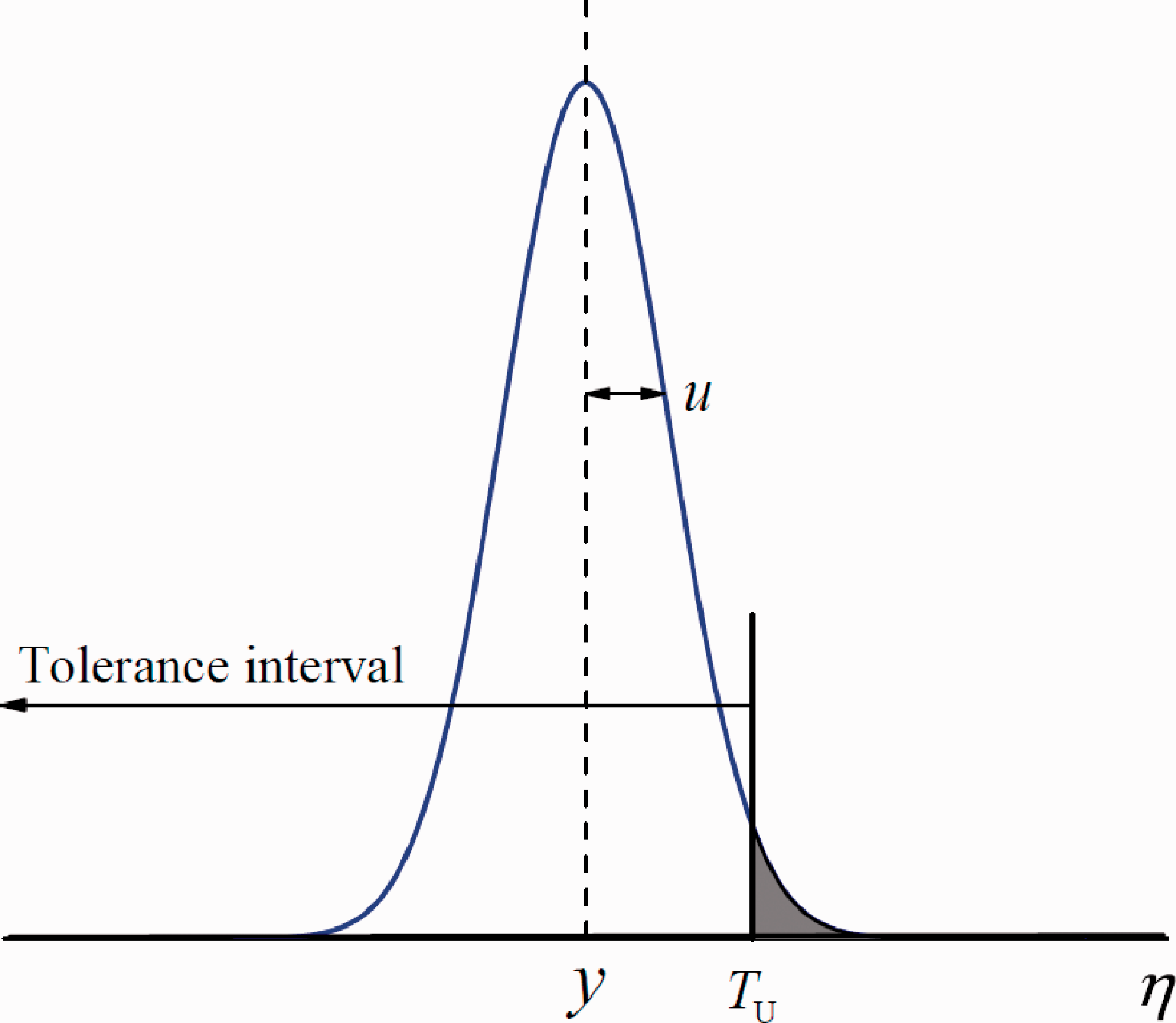
A measurement result can be summarised by giving a coverage interval with an associated coverage probability (e.g. 95%) for a measurand (conforming value) y. This guide shows as an example that if a coverage interval with a coverage probability of ≥95% lies within the tolerance interval, conformity can be decided.
This guide was adopted in a recommendation (SSK, 2016) by the German Commission on Radiological Protection (SSK) in September 2016 regarding the conformity assessment in radiation measurement. In addition, the same approach to the conformity assessment in clearance decisions using the upper limit of the 95% confidence interval can also be found in other documents [e.g. the German Institute for Standardization, Annex K.4 in DIN 25457-1 (DIN, 2014), Chapter 8 in SKB (Swedish Nuclear Fuel and Waste Management Company) Report R-17-05 (SKB, 2017), and Appendix 7.1 in A Nuclear Industry Code of Practice (CEWG, 2005)]. NRA’s approach to the uncertainty of measurement may be supported by these precedents in other countries, although a precedent in Germany, namely the SSK recommendation, was only cited in NRA’s new standard examination as mentioned in Section 2.2.
4. DISCUSSION
As mentioned above, according to the international guide ISO/IEC Guide 98-4: 2012 (JCGM, 2012), it seems to be justified for NRA in Japan and the above-mentioned precedents in the other countries to require that the upper confidence level of the measurement results must be below the clearance level, taking relevant uncertainties into account. However, this requirement should be discussed carefully from the viewpoint of radiological protection. As this issue has also been discussed at an international level in the framework of the ongoing revision of IAEA Safety Guide RS-G-1.7 (IAEA, 2004), there is a possibility that this requirement might be shared worldwide in due course, leading to worldwide effects on clearance regulations among the IAEA member states.
Also, this requirement on the uncertainty in clearance raises serious concerns about its effects on various other radiological protection regulations for natural and artificial radionuclides. This is because if we need strict treatment for uncertainty, even in the case of compliance with a trivial dose criterion for clearance, the same or a stricter treatment for conformity assessment may have to be applied to other radiological protection criteria for doses exceeding 10 µSv year−1 (e.g. dose limits for workers and the public, national regulatory levels for radon concentration, surface contamination criteria for daily radiation control using survey meters, ambient dose equivalent rates on an external surface and at 2 m distance from the surface of transport packages, etc.), derived discharge limits for liquid and gaseous natural and artificial materials, and on- and off-site measurements in Fukushima. Actually, this requirement on uncertainty has been applied to an example of the conformity assessment in the radiological legal limit for Cs-137 in foodstuffs, which shows that the measurement result does not conform to the requirement because the upper confidence level (95th percentile value 101.1 Bq kg−1) of the measurement exceeds the legal limit (100 Bq kg−1) (Michel, 2017). This example is not assumed to be in the existing exposure situation after the Fukushima Dai-ichi nuclear power plant accident. However, this may be a case that will affect the off-site management in Fukushima (e.g. methodology for assessing the conformities of legal limits of activity concentrations in agricultural and marine products and other foodstuffs, and of legal screening levels for contaminated wastes after the Fukushima Dai-ichi nuclear power plant accident).
There is a need for the international radiological protection community to review whether the strict requirement using the upper confidence level is justified for compliance with clearance levels and other radiological protection criteria, taking into consideration all discussions from various viewpoints given in the following sections (e.g. the methodology used to derive clearance levels, the balance in a radiological protection system with a graded approach, the difference between product control and radiological protection, and the understanding of the health risk of radiation on the order of 10 µSv year−1 by both the public and the regulators).
4.1. Methodology used to derive the clearance level
4.1.1. IAEA Safety Guide RS-G-1.7 and Safety Report Series No. 44
The exemption levels for bulk solid materials containing artificial radionuclides were provided in IAEA Safety Guide RS-G-1.7 (IAEA, 2004). This safety guide also provides the values of activity concentrations for radionuclides of natural origin, derived using the exclusion concept. These exemption and exclusion levels have been incorporated into the International Basic Safety Standards (BSS) as clearance levels (IAEA, 2014). Details of the assumptions used to derive clearance levels are provided by IAEA Safety Report No. 44 (IAEA, 2005).
In the derivation of clearance levels for artificial radionuclides, two dose criteria (10 µSv year−1 for realistic scenarios and 1 mSv year−1 for low-probability scenarios) were used in accordance with international agreements. This indicates that clearance levels have been determined while permitting the possibility of a dose exceeding 10 µSv year−1 in the case of low-probability situations. This permission can also be found in a procedure in which the clearance levels were selected as rounded values (e.g. 0.1, 1, 10, and 100 Bq g−1) from calculation results of the radioactivity concentration that is equivalent to the dose criterion for each scenario. One more important point is that many conservative assumptions are included in the derivation of clearance levels.
Taking into account all of the above methodologies used to derive clearance levels, practical application of the methodology of the conformity assessment provided by international standards [e.g. ISO/IEC Guide 98-4: 2012 (JCGM, 2012)] to clearance regulations would lead to a serious imbalance between the concepts (or assumptions) adopted in the derivation of clearance levels, and strict requirements for the uncertainty of measurements in accordance with the regulation.
4.1.2. Publication 104
Publication 104 provides a definition of the scope of radiological protection control measures through regulations (ICRP, 2007b). Para. 95 contains an important phrase regarding uncertainties in the measurement and the nuclide vector: In the case of a mixture of nuclides, it is generally only practical to measure easily measurable gamma emitters. To estimate the other alpha or beta emitters, most applicants of clearance use a previously assessed nuclide spectrum (namely, a nuclide vector) to ensure that the sum of the values obtained by dividing radioactivity concentrations by clearance levels is lower than 1 (
IAEA, 2004
). The Commission recognises that there may be uncertainty (or variation) in the radionuclide composition of a material. In such a case, there are some concerns that the public could be exposed to a dose above the dose criterion for exemption without further consideration (10 μSv/year), although this has quite a low probability of occurring. However, in the derivation of exemption levels in the BSS (IAEA, 1996) and in the safety guide on the application of the concepts of exclusion, exemption, and clearance (
IAEA, 2004
), which were agreed internationally, two dose criteria were used; 0.01 mSv/year for realistic scenarios and 1 mSv/year for low-probability scenarios. This indicates that the exemption levels agreed under the aegis of intergovernmental organisations allow the possibility of doses greater than 10 μSv/year in the case of low-probability situations. In this regard, the Commission considers that, in cases of uncertainty (or variation) in the radionuclide composition of a material, there is not usually a need to make clearance levels stricter. However, if the uncertainties in nuclide composition are very large, or if the presence of alpha- and beta-emitting nuclides cannot be adequately inferred through gamma measurements, the regulatory body may establish specific criteria for clearance, or may demand assessments involving radionuclide analysis in addition to, or in place of, gamma measurements’ (ICRP, 2007b).
As seen in the above paragraph in Publication 104 (ICRP, 2007b), ICRP considers that there is not usually a need for the activity concentration level for the measurable nuclide to be confirmed as lower and stricter, taking the uncertainties for radionuclide composition (or nuclide vector) into consideration. Instead, ICRP recommends the establishment of specific criteria for clearance if the uncertainty in the nuclide vector is too large. One of the specific criteria would be the probabilistic approach given in the AESJ standard (AESJ, 2005) and IAEA Safety Report No. 67 (IAEA, 2012). As ICRP recommended, if the uncertainty in the nuclide vector is judged to be smaller using specific criteria, there would be no need to apply a methodology of conformity assessment provided by international standards [e.g. ISO/IEC Guide 98-4: 2012 (JCGM, 2012)] to regulations for clearance.
4.2. Balance in radiological protection system with a graded approach
Regarding a graded approach, IAEA GSR Part 3 Requirement 6 states that:
The application of the requirements of these Standards in planned exposure situations shall be commensurate with the characteristics of the practice or the source within a practice, and with the likelihood and magnitude of exposures.
3.6. The application of the requirements of these Standards shall be in accordance with the graded approach and shall also conform to any requirements specified by the regulatory body (IAEA, 2014).
In addition, in a chapter defining the terminology in GSR Part 3, the graded approach is defined as: For a system of control, such as a regulatory system or a safety system, a process or method in which the stringency of the control measures and conditions to be applied is commensurate, to the extent practicable, with the likelihood and possible consequences of, and the level of risk associated with, a loss of control (IAEA, 2014).
As clearance and exemption are also addressed in Requirement 8 in GSR Part 3, the above-mentioned requirements can be summarised specifically for clearance in an easy-to-understand manner: the requirements for clearance shall be applied using a method in which the stringency of the control measures is commensurate with the level of risk associated with 10 µSv year−1.
In the process of derivation of the clearance levels, the procedure in which the clearance levels were selected as rounded values (e.g. 0.1, 1, 10, and 100 Bq g−1) may be a form of graded approach. One may argue that the margin which can be gained by the graded approach is already fully exhausted in derivation of the clearance levels, and any additional dose risks arising from remaining measurement uncertainty in the radioactive concentration measurement cannot be justified. Others may argue that the suggestion that serious measurements are not necessary is not an argument that comes out of the graded approach concept at all. However, the author considers that such arguments are not applicable because the stringencies between the derivation of clearance levels and conformity assessment for clearance levels should be well balanced. Moreover, the conformity assessment in compliance with such a rounded value to the nearest power of 10 using a near-logarithmic rounding approach does not require too much precision. For this reason, according to the graded approach, as the health risk of radiation on the order of 10 µSv year−1 is trivial, the use of a stringent method for clearance regulations [e.g. a methodology of conformity assessment provided by international standards (JCGM, 2012)] should obviously be avoided. IAEA has a peer review system – Integrated Regulatory Review Service (IRRS) – to review the regulatory framework for nuclear and radiation safety in the member states. The IRRS team carries out reviews in various areas in their regulatory frameworks, including clearance. To ensure the implementation of Requirement 6 in GSR Part 3 (IAEA, 2014), in the IRRS mission, it should be carefully reviewed whether the stringency of the control measures in the clearance process is commensurate with the level of risk associated with 10 µSv year−1.
4.3. Difference between product control and radiological protection
In the scope of ISO/IEC Guide 98-4: 2012, items used to demonstrate the assessment of conformity are, for example, ‘a gauge block, a grocery scale or a blood sample’ (JCGM, 2012). As shown in Section 3, the scope of this guide seems to be mainly applied to the product control with a very severe requirement for accuracy (e.g. in their size or mass control). On the other hand, radiological protection criteria were not originally established as the borderline between safety and danger. The effective dose criterion for clearance or exemption is a typical borderless case because it is not a single value of 10 µSv year−1, but is defined as a flexible value on the order of 10 µSv year−1. In addition, note that many conservative assumptions are included in the derivation of such radiological protection criteria.
When considering the meaning of conformity, we can easily find a significant difference between product control and radiological protection criteria including clearance levels. In the field of product control, there is no concept of the order of the dose criterion and radiation effects probabilistically occurring by gradation as a result of stochastic effects. Moreover, there is no similar rule in the accuracy control of products when applying a graded approach in the radiological protection system, as mentioned in the previous section.
In the field of radiological protection, the uncertainty in the measurement is always appropriately restricted provided that a measurement condition satisfies a detection limit defined in ISO11929. Section 5.1 of Safety Report No. 67 (IAEA, 2012) provides important knowledge about restriction of the uncertainty in the measurement while satisfying the concept of the detection limit:
The treatment of the uncertainty is strongly related to the detection limit. The uncertainty of measurement is generally expressed by a normal distribution. For example, in Japan, for a measurement to be considered as exceeding the detection limit, the net count must exceed by three times the net standard deviation of the measurement. In the case of the monitor checked on such a detection limit, the relative error of measurement results is always less than approximately 33.3%, since the measurement results are usually beyond the detection limit. This indicates that an uncertainty of less than approximately 30% is required in the measurement results.
In the United States of America, the concept of detection limit is expressed by the minimum detectable concentration. In this case, the detection limit cannot simply be expressed by a factor of the standard deviation, but approximately regarded as 3.29σ, which is twice the value of 1.645σ. This implies that an uncertainty of less than approximately 30.4% is required in the measurement results, which is the same conclusion drawn in the Japanese concept of the detection limit.
As described above, it can be ensured that the uncertainty of measurements is lower than approximately 30% by complying with the detection limit of measurement. On the other hand, there can be a large scattering of more than an order of magnitude of the radionuclide spectrum of target radionuclides, which can be expressed by a log normal distribution with two parameters, a geometric mean and a geometric standard deviation (IAEA, 2012).
As the minimum detectable concentration is equivalent to the concept of the detection limit in ISO11929, if the measurement method complies with a detection limit of a required measurement, it can be ensured that the uncertainty in the measurement is restricted to within approximately 30%.
In addition, Paras 7.43 and 7.45 of General Safety Guide No. GSG-7 (IAEA, 2018) provide important recommendations on the uncertainty in the measurement by personal dosimeters with reference to the relevant report (ICRU, 1992) and publication (ICRP, 1997), respectively:
7.43. For single measurements of the operational quantities, the ICRU [58] recommends that:
in most cases, an overall uncertainty of one standard deviation of 30% should be acceptable. …The error of instruments may substantially exceed this limit at some radiation energies and for certain angles of incidence, but conform to it when they occur in a radiation field with a broad energy spectrum and broad angular distribution.
7.45. Thus, the recommendations of the ICRP in Ref. [56] indicate acceptable levels of uncertainty at two dose levels:
(a) In the region near the relevant dose limit, a factor of 1.5 in either direction is considered acceptable. (b) In the region of the recording level, an acceptable uncertainty of ±100% is implied.
These recommendations indicate that the acceptable uncertainty for a dose of approximately 20 mSv year−1 up to 1.5 times the dose limit, and an uncertainty of up to twice the recording level is permissible for a dose of 1 (or 2) mSv year−1. As the upper limit of the acceptable uncertainty increases with decreasing dose criterion for conformity assessment, if this concept is applied to a dose of 10 µSv year−1, that is one-hundredth of 1 mSv year−1, an acceptable uncertainty for clearance of nearly 10 times the dose criterion for clearance might be recommended.
Taking into account the different meanings of the criteria for product control and radiological protection, if the uncertainty in the nuclide vector is judged to be smaller using specific criteria, there would be no need to use a methodology of conformity assessment provided by international standards [e.g. ISO/IEC Guide 98-4: 2012 (JCGM, 2012)] as regulations for clearance and other radiological protection criteria. In the case of borderless radiological protection criteria, especially at doses <100 mSv, the requirement for the detection limit is generally sufficient for restriction of the uncertainty. However, if the uncertainty in the nuclide vector is too large, a safety factor might be needed for clearance judgement, as shown in Section 2.1, which leads to a similar result when the upper tolerance limit in the methodology of ISO/IEC Guide 98-4: 2012 (JCGM, 2012) is below 10 times the clearance level (equivalent to 100 µSv year−1) rather than the clearance level (equivalent to 10 µSv year−1).
4.4. Understanding of health risk of radiation of 10 µSv year−1
Experiences in dialogue forums held in affected areas just after the Fukushima Dai-ichi nuclear accident found that an effective way to enhance public understanding of the radiation risk was to compare the radiation risk with the variation in individual dose due to natural background radiation and the lifetime background cancer risk in the 47 Japanese prefectures.
It is important that such understanding of the radiation risk should be shared not only by the public but also by the regulators. The regulators may sometimes require the operators to apply an excessively conservative clearance process simply to gain public acceptance. The regulators should clearly understand that radiation exposure of the order of 10 µSv year−1, which is a dose criterion for clearance or exemption, presents only a negligible health risk even if a precautional assumption of the linear non-threshold (LNT) model adopted for the purpose of radiological protection by ICRP (ICRP, 2007a) is used for risk prediction.
It should also be noted that clearance applicants and regulators should engage with interested parties in the public to discuss the various aspects of clearance, including the social, economic, and environmental benefits of clearance by increasing recycling, the derivation of clearance levels, application of the concepts of clearance, the national framework for clearance, and the approach to demonstrating compliance with clearance levels. To build confidence in the clearance process, this engagement should be carried out using clear terminology to avoid ambiguities, and should be carried out in a transparent manner.
The materials used in the dialogue forums are shown in the following two sections.
4.4.1. Map of natural background radiation
To increase public understanding of the radiation risk, a map of annual doses due to natural background radiation has been used frequently as a source of familiar knowledge on radiation (Abe, 1989). An example of the material used for public communication in the dialogue forum in Fukushima is shown in Fig. 2. This shows that the annual exposure from natural background radiation would be increased by 0.38 mSv year−1 for a person moving from Kanagawa Prefecture, with a natural radiation exposure of 0.81 mSv year−1, to Gifu Prefecture, with a natural radiation exposure of 1.19 mSv year−1.
Natural background radiation in Japan.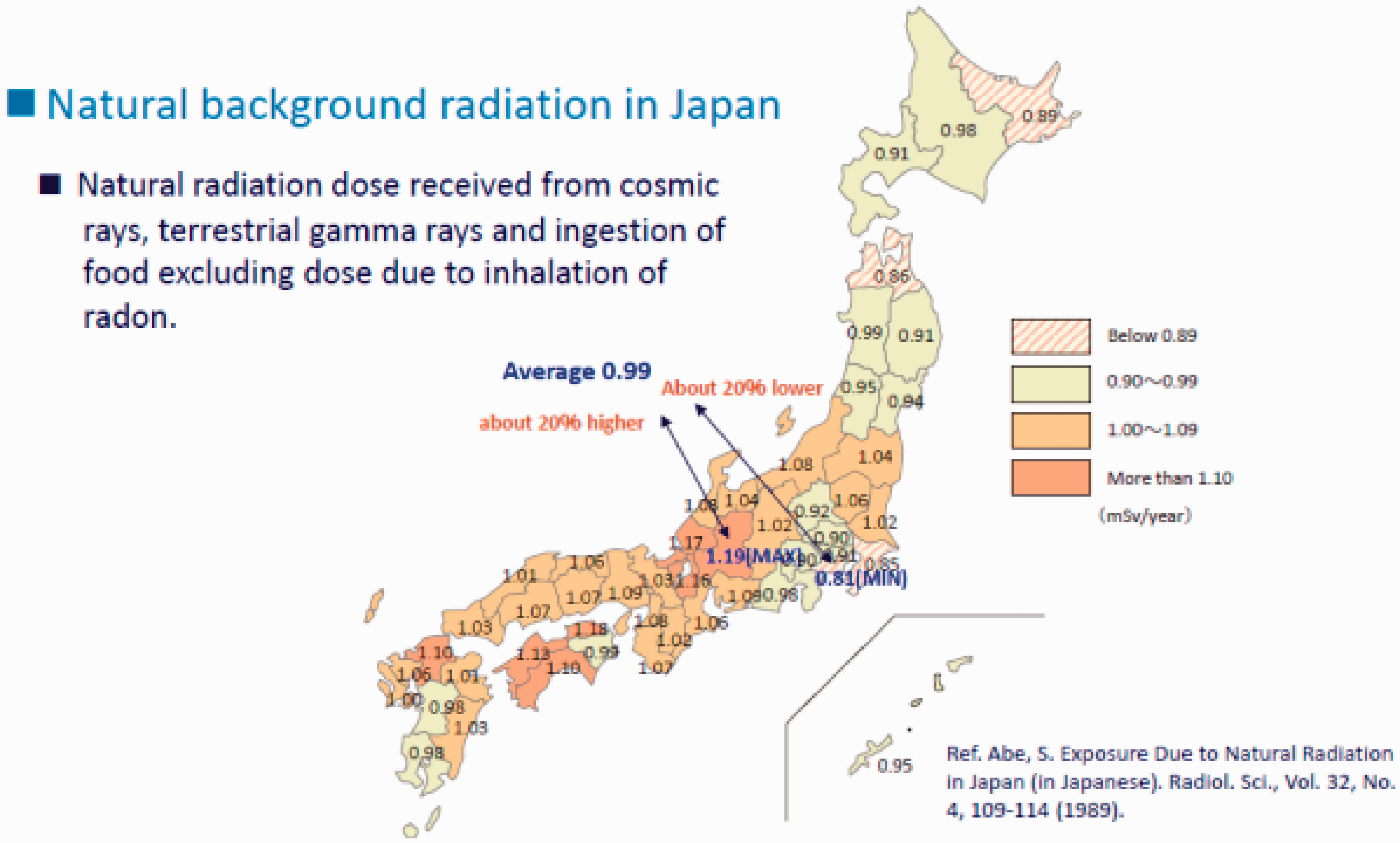
4.4.2. Map of lifetime background cancer risk
Another example of materials used for public communication in the dialogue forum in Fukushima is given in Fig. 3. Using the LNT model and a risk coefficient of 5% Sv−1 (ICRP, 2007a), radiation exposures of 20 mSv and 1 mSv will lead to increases in risk of 0.1% and 0.005%, respectively. This means that the national average lifetime cancer risk will increase from 25.4% to 25.5% and 25.405%, respectively. On the other hand, the lifetime background cancer risk in daily life without additional exposure varies between 23.7% and 28.3% among the prefectures of Japan, with this variation being due to differences in lifestyle such as diet (Ogino and Hattori, 2014). Fig. 3 shows that in the case of radiation exposure of 10 µSv year−1, the increase in the national average lifetime cancer risk is only 0.00005%, which is trivial compared with the variation in the lifetime background cancer risk among the 47 prefectures.
Variation in lifetime background cancer risk in Japan as of 2010. RP, radiological protection. Source: http://www.aesj.or.jp/en/about_us/ps/AESJ-PS004e_r2.pdf.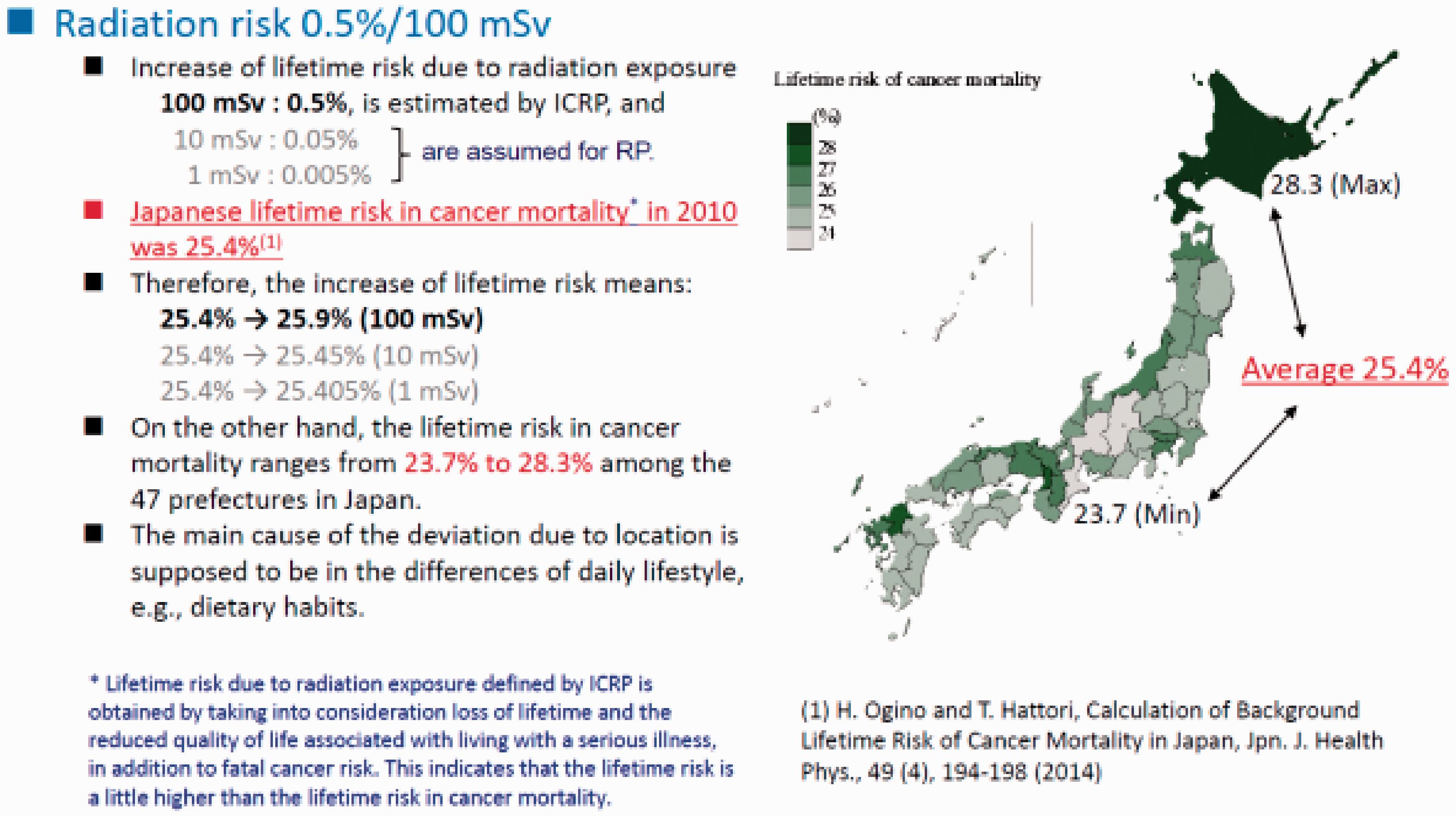
5. Conclusion
NRA proposed a new decision on the uncertainty in clearance using the upper confidence level, which is up to 10 times stricter than the probabilistic approach provided by IAEA Safety Report No. 67 (IAEA, 2012). A similar approach to NRA’s decision was found in an international guide for conformity assessment [ISO/IEC Guide 98-4: 2012 (JCGM, 2012)] and in some documents related to clearance in other countries. However, as a result of discussions from various viewpoints (e.g. the methodology used to derive clearance levels, the balance in a radiological protection system with a graded approach, the difference between product control and radiological protection, and understanding of the health risk of radiation on the order of 10 µSv year−1 by both the public and the regulators), it has been recommended that there is no need to apply a methodology of conformity assessment provided by international standards [e.g. ISO/IEC Guide 98-4: 2012 (JCGM, 2012)] to regulations for clearance and other radiological protection criteria.
There is a need for the international radiological protection community to review whether the strict requirement using the upper confidence level is justified for compliance with clearance levels and other radiological protection criteria. In the review process, radiological protection experts including regulators, professionals, and operators should be aware of the essential meaning of the radiological protection criteria by considering the background scientific basis on which they were established. Moreover, consideration should also be given to the extensive national resources that must be supplied by both private and governmental organisations with nuclear reactors and facilities handling radioactive isotopes or accelerators, including hospitals and universities, when strict regulations with excessive conservatism are imposed.