




Abstract
Japanese astronauts started staying at the International Space Station (ISS) in 2009, with each stay lasting for approximately 6 months. In total, seven Japanese astronauts have stayed at the ISS eight times. As there is no law for protection against space radiation exposure of astronauts in Japan, the Japan Aerospace Exploration Agency (JAXA) created its own rules and has applied them successfully to radiation exposure management for Japanese ISS astronauts, collaborating with ISS international partners. Regarding dose management, JAXA has implemented several dose limits to protect against both the stochastic effects of radiation and dose-dependent tissue reactions. The scope of the rules includes limiting exposure during spaceflight, exposure during several types of training, and exposure from astronaut-specific medical examinations. We, therefore, are tasked with calculating the dose from all exposure types applied to the dose limits annually for each astronaut. Whenever a Japanese astronaut is at the ISS, we monitor readings of an instrument in real-time to confirm that the exposed dose is below the set limits, as the space radiation environment can fluctuate in relation to solar activity.
Keywords
1. Exposure Management Overview For Japanese Iss Astronauts
1.1. History
In 1992, the first Japanese astronaut went into space in a space shuttle. At the time, there were no rules or guidelines regarding astronaut radiation protection in Japan, although the National Council on Radiation Protection and Measurement (NCRP) had released Report 98 entitled ‘Guidance on radiation received in space activities’ in 1989 (NCRP, 1989). Once Japanese participation in the International Space Station (ISS) programme was decided, meaning that astronauts would stay in space for longer periods than when in the space shuttle, guidelines were needed for radiation protection of Japanese ISS astronauts. The National Space Development Agency, the former name of the Japan Aerospace Exploration Agency (JAXA), established an advisory committee to formulate these guidelines. The committee created rules using the risk assessment method shown in Annex C of Publication 60 (ICRP, 1991). JAXA developed its own rules to manage radiation exposure of Japanese ISS astronauts based on these guidelines, and has continued to manage radiation exposure of Japanese ISS astronauts since then. In 2013, the committee revised the career effective dose limits according to the risk assessment method shown in Annex A of Publication 103 (ICRP, 2007).
1.2. Overview
Fig. 1 shows an overview of the exposure management for Japanese ISS astronauts. Exposure management starts during the astronaut selection phase and continues until the astronaut retires. Management of astronaut exposures consists of four categories: dose management, explanation of risk, monitoring and measurement, and medical countermeasures. Operations of each category link to other categories. As such, in this article, operations of dose management are introduced in the next section.
Overview of exposure management of Japanese International Space Station (ISS) astronauts.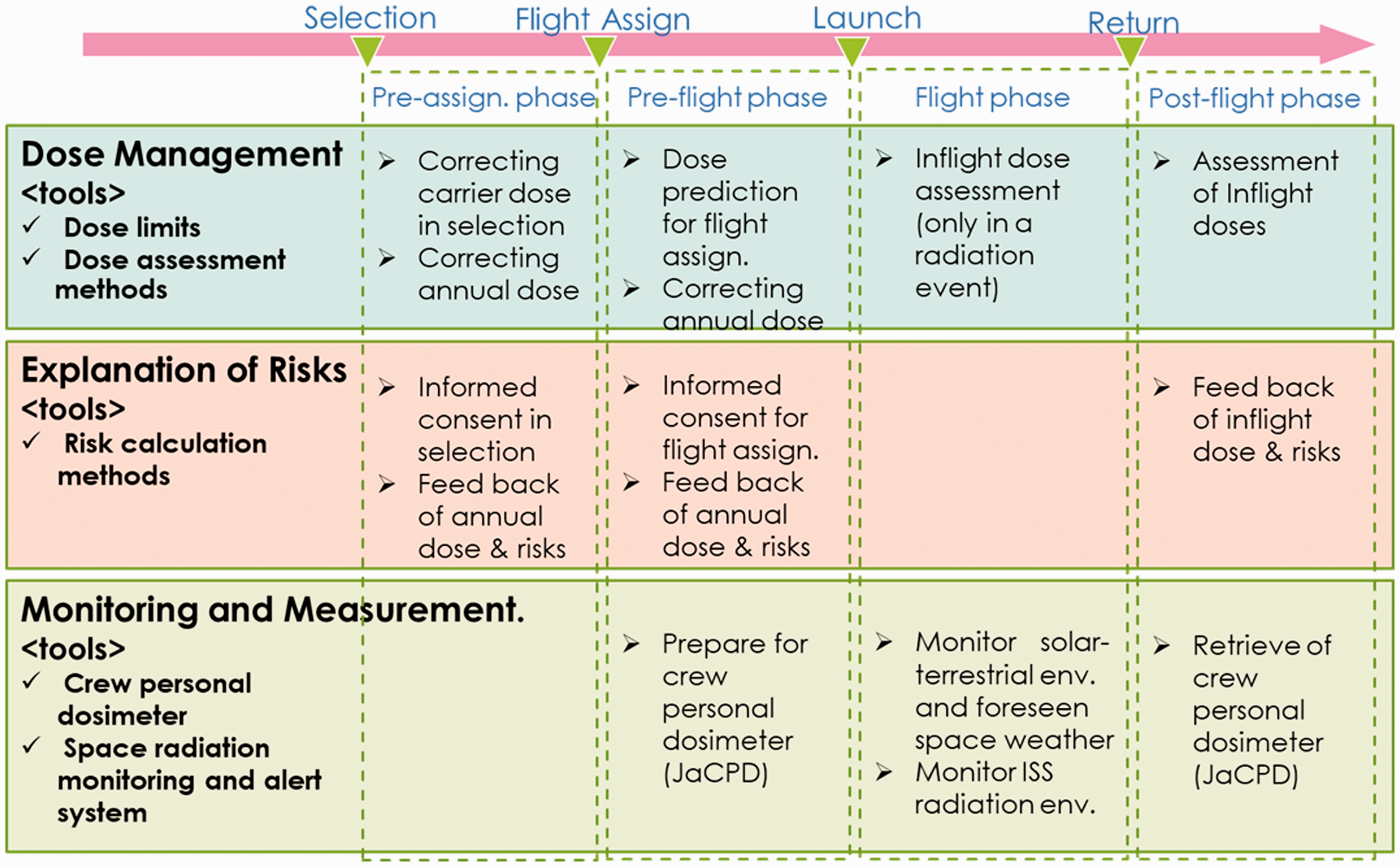
2. Dose Management For Japanese Iss Astronauts
2.1. Dose limits
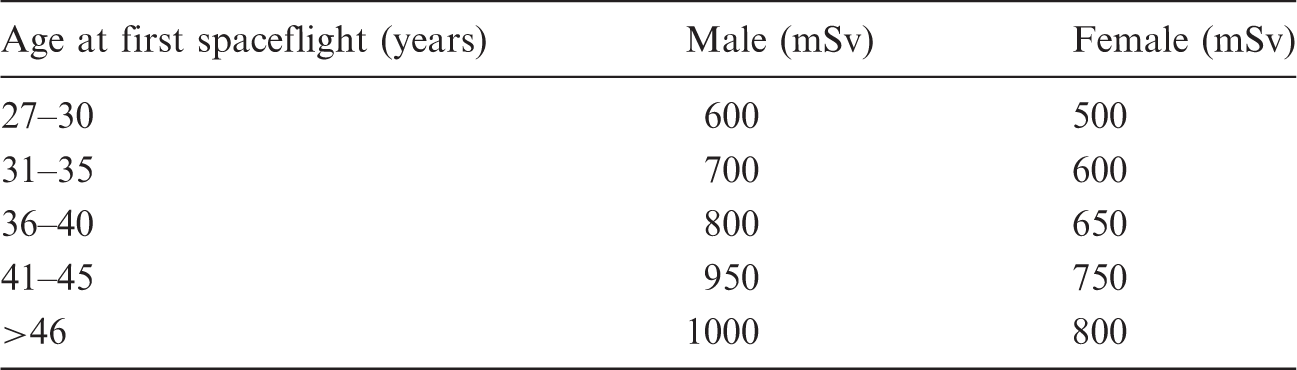
JAXA has its own dose limits for radiation protection of Japanese ISS astronauts, as do other ISS international partners (Cucinotta, 2010). These are fundamental tools for dose management for Japanese ISS astronauts. The JAXA dose limits consist of two types: one is related to the stochastic effects of radiation, and the other is for protection against tissue reactions (JAXA Space Radiation Health WG, Manned Mission Support Committee, 2001).
The Japan Aerospace Exploration Agency’s career effective dose limits.
The Japan Aerospace Exploration Agency’s tissue equivalent dose limits.

These dose limits are applied to occupational exposures of Japanese astronauts, which can occur as a result of spaceflight, exposure from training, and exposure from astronaut-specific medical examinations. Radiation exposure is unavoidable for some aspects of astronaut training. For example, flight operation training with aeroplanes at high altitude, during which an astronaut is exposed to space radiation; and behaviour training in a cave, during which an astronaut is exposed to radiation from radon. An astronaut should be annually certified as healthy by a medical professional, and even these evaluations lead to exposures that are considered among the types of occupational exposure for an astronaut. However, doses from these exposures are quite small compared with the doses experienced during spaceflight.
2.2. Operations
Practical operations of dose management can be divided into two types: regular activities for both non-mission-assigned and mission-assigned astronauts; and specific activities for mission-assigned astronauts alone.
2.2.1. Regular activities
All astronauts undergo medical examinations and receive an annual medical certification from a flight surgeon (i.e. a medical doctor who conducts astronauts’ medical operations, and gathers all information about radiation exposure for the astronaut to date). The information includes times of aeroplane flight operation training, radon concentration, duration of cave training, number of x-ray examinations, etc. A radiation exposure management specialist, certified by JAXA, calculates doses related to the dose limits and records the doses in a radiation exposure history file for the astronaut. The flight surgeon confirms that the cumulative doses are less than the dose limits. The radiation exposure management specialist uses this information to formulate a risk explanation report for the astronaut himself/herself.
2.2.2. Spaceflight-specific activities
When an astronaut is assigned a specific increment of time to spend at the ISS, the radiation exposure management specialist predicts doses, using the space environment model and radiation transportation code, to determine the effective dose and organ doses related to dose limits. She/he also makes a report for risk explanation and explains it to the astronaut to obtain informed consent.
Whenever a Japanese astronaut is at the ISS, we monitor readings of an instrument in real-time to confirm that the exposed dose is below the set limits, as the space radiation environment can fluctuate in relation to solar activity. As it is difficult to calculate doses related to dose limits in real-time, readings from on-board dose measurement instruments are used. JAXA uses absorbed dose values from the ISS tissue equivalent proportional counter provided by the National Aeronautics and Space Administration (NASA) as values to be monitored in real-time. In the ISS programme, the value is called the ‘mission reference exposure’ (MRE). An ‘action level’ has been set for MRE by consensus of all international partners of ISS, which is a value provided by NASA predictions. If MRE exceeds the action level, certain ‘positive’ actions would be required. These can include evacuation to a well-shielded area in the ISS, restriction of extravehicular activity etc., which would be required to reduce radiation exposure. Fig. 2 shows the relationship between MRE and JAXA-calculated doses related to dose limits during a specific increment of an ISS stay. Fig. 2(a) is an actual result during a solar maximum in 2012 and Fig. 2(b) is an actual result during a solar minimum in 2016. In both cases, cumulative doses remained much less than the dose limits, as MRE was kept under the action level.
(a) Relationship between mission reference exposure (MRE) and actual calculated cumulative doses related to dose limits during Exp. 32–33 in a solar maximum. (b) Relationship between MRE and actual calculated cumulative doses related to dose limits during Exp. 48–49 in a solar minimum.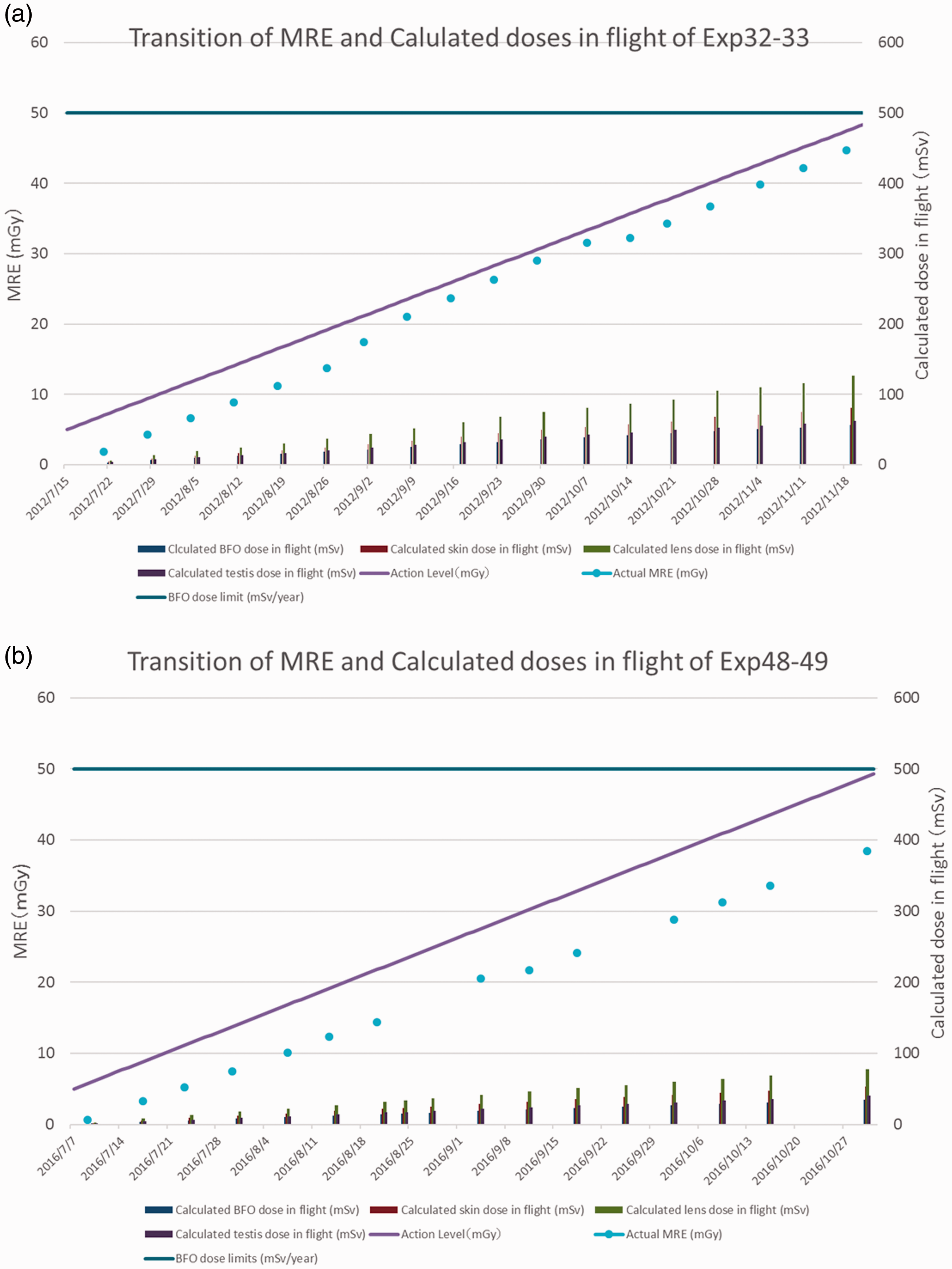
After the astronaut returns to earth, a JAXA passive individual dosimeter is retrieved and analysed to obtain the absorbed dose and linear energy transfer spectrum accumulated during the astronaut’s stay at the ISS. JAXA radiation exposure management specialists use the values to calculate doses relative to dose limits, known as the ‘effective dose’ and the ‘organ equivalent doses’. The doses are recorded and used to make a risk report for the astronaut.
3. Summary
JAXA created its own rules for radiation exposure management for Japanese ISS astronauts, and has conducted radiation management operations while cooperating with all international partners of the ISS programme for almost 10 years.
JAXA will contribute to developing new guidelines for radiation exposure management in future manned space missions with these experiences.
Footnotes
This paper does not necessarily reflect the views of the International Commission on Radiological Protection.