




Abstract
The International Commission on Radiological Protection (ICRP) recognises three types of exposure situations: planned, existing, and emergency. In all three situations, the release of radionuclides into the natural environment leads to exposures of non-human biota, as well as the potential for exposures of the public. This paper describes how the key principles of the ICRP system of radiological protection apply to non-human biota and members of the public in each of these exposure situations. Current work in this area within ICRP Task Group 105 is highlighted. For example, how simplified numeric criteria may be used in planned exposure situations that are protective of both the public and non-human biota. In emergency exposure situations, the initial response will always be focused on human protection; however, understanding the potential impacts of radionuclide releases on non-human biota will likely become important in terms of communication as governments and the public seek to understand the exposures that are occurring. For existing exposure situations, there is a need to better understand the potential impacts of radionuclides on animals and plants, especially when deciding on protective actions. Understanding the comparative impacts from radiological, non-radiological, and physical aspects is often important in managing the remediation of legacy sites. Task Group 105 is making use of case studies of how exposure situations have been managed in the past to provide additional guidance and advice for the protection of non-human biota.
1. INTRODUCTION
The International Commission on Radiological Protection (ICRP) is working towards integrating the approaches taken for radiological protection of humans and the environment to fully meet the recommendations set out in Publication 103 (ICRP, 2007). Task Group 105, ‘Considering the Environment when Applying the System of Radiological Protection’, has been set up to build on the approaches outlined in Publication 124 (ICRP, 2014), and to use case studies to illustrate how the radiological protection principles of justification and optimisation can be applied in the context of protection of both humans and the environment under the three exposure situations recognised by ICRP (2014):
Planned exposure situations – ‘exposure situations resulting from the operation of deliberately introduced sources. Planned exposure situations may give rise to exposures that are anticipated to occur (normal exposures) and exposures that are not anticipated to occur (potential exposures)’. Emergency exposure situations – ‘exposure situations resulting from a loss of control of a planned source, or from any unexpected situation (e.g. a malevolent event), that requires urgent action in order to avoid or reduce undesirable consequences’. Existing exposure situations – ‘exposure situations resulting from sources that already exist when a decision to control them is taken’.
In Publication 108 (ICRP, 2008), a schematic approach to the protection of both humans and the environment in relation to the three exposure situations was presented (Fig. 1), which demonstrated how the system of radiological protection can be integrated in support of decision making to ensure human and environmental protection. For example, while radiological protection for humans is subject to the application of dose limits, constraints, and reference levels according to the exposure situation, for the environment, there are 12 Reference Animals and Plants (RAPs) that have been used to define numeric criteria [derived consideration reference levels (DCRLs)]. DCRLs are defined as ‘a band of dose rate within which there is likely to be some chance of deleterious effects of ionising radiation occurring to individuals of that type of Reference Animal or Plant, derived from a knowledge of defined expected biological effects for that type of organism that, when considered together with other relevant information, can be used as a point of reference to optimise the level of effort expended on environmental protection, dependent upon the overall management objectives and the exposure situation’.
Schematic approach to the protection of both humans and the environment in relation to any exposure situation (ICRP, 2008).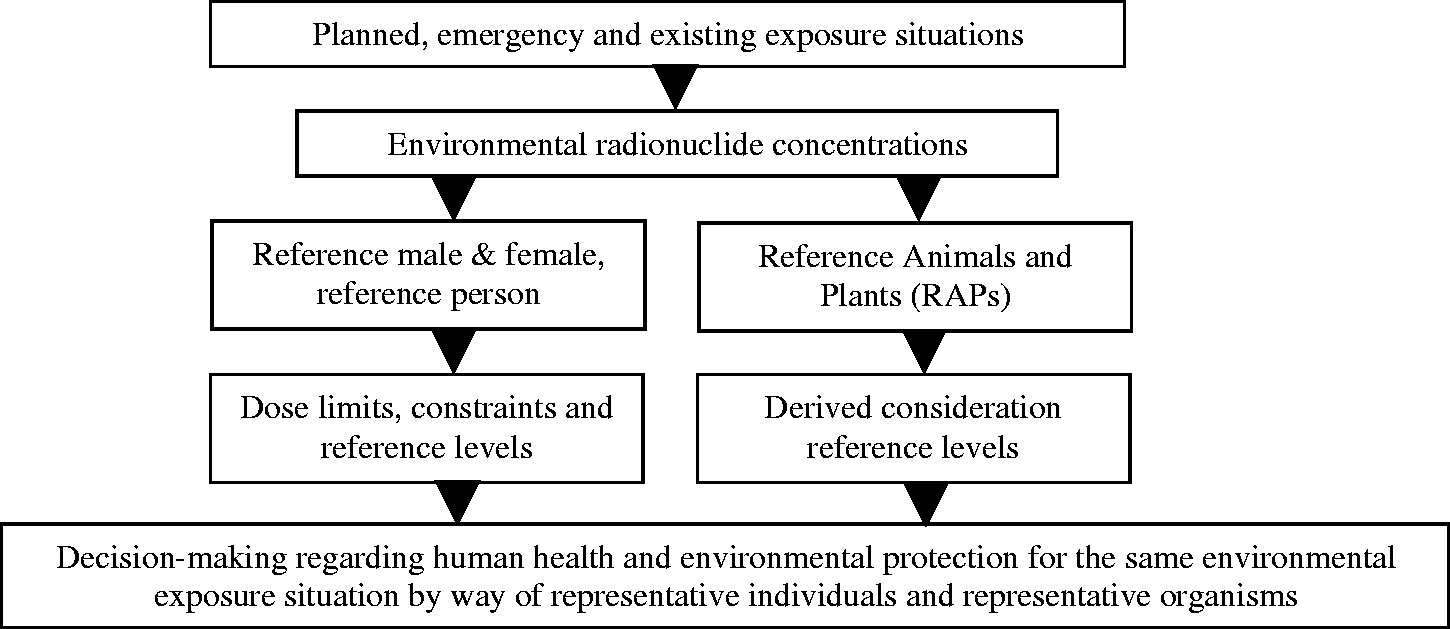
While the dose criteria are expressed differently for humans and the environment, their use within the system of radiological protection has the same purpose, namely to aid decision making on the appropriate level of protection to apply for both humans and the environment, while also addressing the fundamental ethical principle of doing more good than harm (ICRP, 2014). That said, it is recognised that applying all of these dose criteria when carrying out dose assessments and deciding on the implementation of a protection strategy is highly dependent upon factors such as the exposure situation and its prevailing circumstances, relevant endpoints for the management processes, and non-radiological factors. It is the aim of Task Group 105 to explore these issues further in order to be able to provide advice and recommendations on how to implement an integrated approach to radiological protection. The initial approach being considered for each exposure situation is outlined below.
2. PLANNED EXPOSURE SITUATIONS
In Publication 124 (ICRP, 2014), the Commission recommended that, for planned exposure situations, the lower boundary of the relevant DCRL band should be used as the appropriate reference point for the protection of the different types of non-human biota within a given area during the planning of controls to a source. It was also noted that cumulative impacts from multiple sources may need to be considered depending upon the prevailing circumstances being assessed. The concept here seems reasonable – that one should not ‘plan’ protection that could potentially lead to harm to non-human biota, in just the same way as one aims to prevent harm to humans, bearing in mind that the DCRL represents a ‘band of dose rate’ within which there is some chance of deleterious harm occurring. In practice, however, some of the DCRL bands are set on a precautionary basis due to lack of biological effect data in the literature, and this may lead to issues in the practical implementation of the approach. Task Group 99 is currently reviewing and updating the basic data underpinning the derivation of the DCRLs, and has developed new approaches that could be used to refine DCRLs which may address this problem.
In practice, there should be few, if any, occasions where planned exposure situations are likely to lead to situations where the protection of the environment/non-human biota is potentially compromised and additional protective measures are warranted. The emphasis instead is usually on demonstrating that the environment can be considered to be protected. Furthermore, the exposure pathways for non-human biota and humans in the environment are likely to be similar [e.g. inhalation of (re)suspended contaminated particles or gaseous radionuclides; contamination of external layers such as skin, fur, or hair; ingestion of contaminated food/prey/plant material/water; external exposure from contaminated surfaces (e.g. soil); or immersion in a plume of radioactive materials]. However, to be able to show in a simplified and consistent manner that both humans and the environment are protected, it should be possible to back-calculate environmental media activity concentrations based on human dose criteria (e.g. the 1 mSv dose limit or a suitable dose constraint for a site or source) and the appropriate reference criteria for the RAPs using the DCRLs as suggested above. Selecting the most restrictive of these environmental criteria, whether from the human or RAP calculations, would then demonstrate protection of both humans and the environment. This approach has been carried out already by the International Atomic Energy Agency (IAEA) for the London Convention (IAEA, 2015) and the OSPAR Commission (IAEA, 2013a).
The back-calculated values are termed ‘environmental assessment criteria’, and their generation is an example of an integrated assessment (OSPAR Commission, 2016). It should be noted, however, that it is assumed that the source of the human foodstuffs (e.g. fish) co-exist in the same locations as the non-human biota being used to estimate the environmental doses.
The above approaches are also consistent with the IAEA Safety Standards (IAEA, 2014) which set out that the protection of humans and the environment (in terms of non-human biota and resources) for the present and in the future should be protected in an integrated manner.
There are dose assessment tools that can be used for conducting human dose assessments for planned exposure situations [e.g. PC Cream (Smith and Simmonds, 2015) and the RESRAD suite of codes (Argonne National Laboratory, 1997)] and non-human biota [e.g. ERICA (Brown et al., 2016), RESRAD biota (USDOE, 2002)]. Furthermore, there are now tools that have been designed to consider humans and wildlife in an integrated manner [e.g. CROMERICA (Mora et al., 2015) and the planned updates to the SRS-19 models (Yankovich et al., 2014)]. These latter tools are useful because they address one of the most common shortcomings of the individual human/non-human biota tools as they use the same source term input. In all cases, however, it needs to be recognised that there are likely to be circumstances where humans and non-human biota are exposed in different places by different sources. In these circumstances, an ‘integrated approach’ needs to take both aspects into consideration.
To address these points, Task Group 105 is planning to work with IAEA to consider planned exposure situation scenarios such as radioactive discharges from hospitals, nuclear power plants, and other types of facilities to investigate what can be learned from the integration of human and non-human biota assessments.
3. EMERGENCY EXPOSURE SITUATIONS
In emergency exposure situations, communication of possible radiological effects is key. While priority needs to be focused on the protection and safety of humans in the event of an emergency, experience has shown that in such situations, questions regarding the state of the environment may also arise. Therefore, being able to say something on the implications of an emergency on the environment more generally could be useful. Fig. 2 shows the approach of using severe-effect reference levels that was described in Publication 124 (ICRP, 2014). The concept of a severe-effect reference level is often used in the chemical industry, and ICRP (2014) defined this as ‘approximately equivalent to a band of doses two orders of magnitude above the DCRL band’. These severe-effect reference levels may be used during the initial phase of the emergency to predict effects on non-human biota. Over time, as the radioactivity levels decline through radioactive decay, particularly of short-lived radionuclides, or through management action, it is also possible to predict the changing impact on non-human biota. However, improved and more detailed communication is not the only possible outcome of integrating the environment into the system of radiological protection for emergency exposure situations.
Potential use of severe-effects bands, relative to derived consideration reference levels (DCRLs), to relate exposure of non-human biota following an accidental or emergency release of radionuclides into the environment (ICRP, 2014).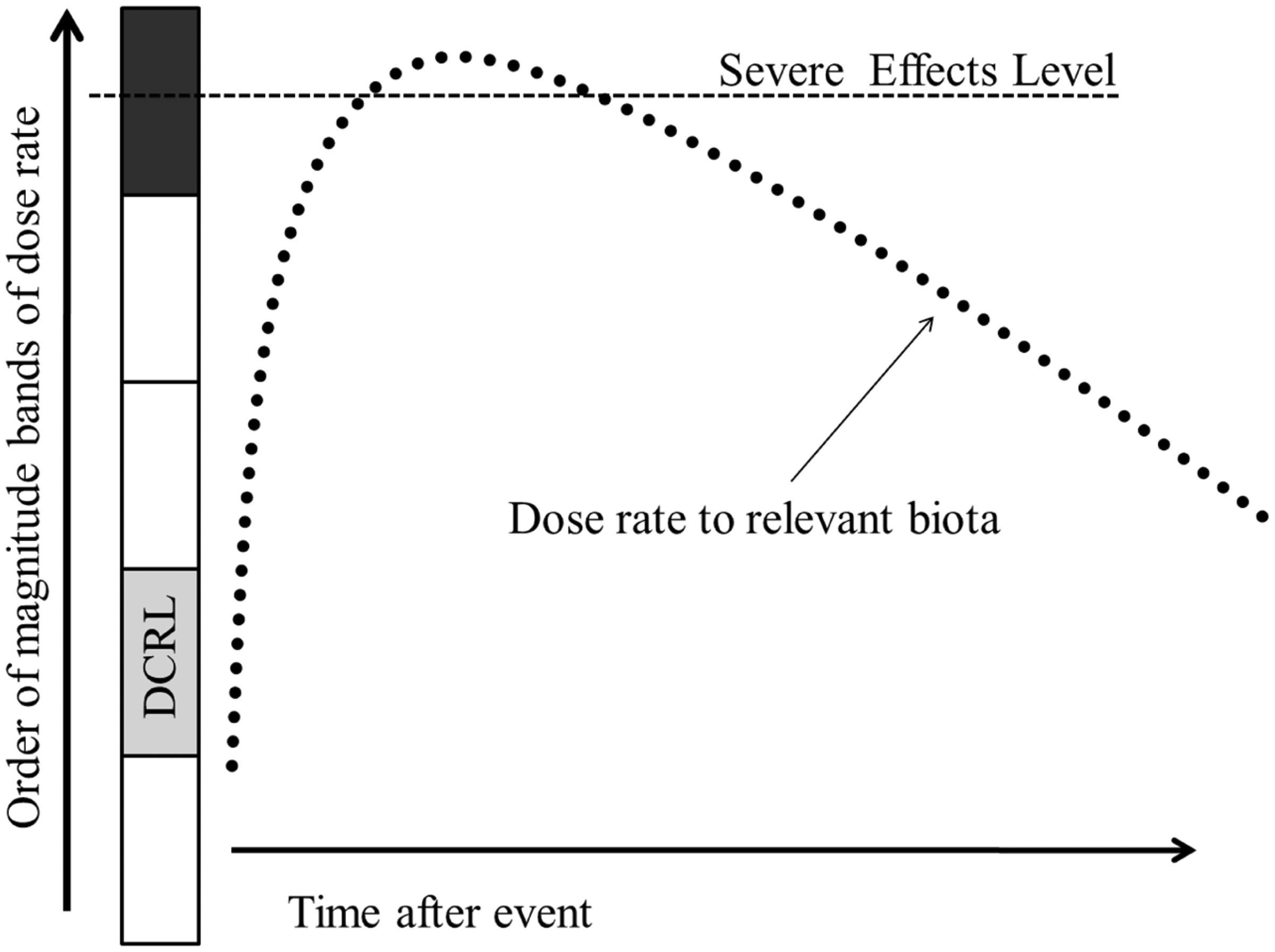
Better integration of the environmental considerations into protective action decisions may lead to early consideration of the environment in, for example, better planning in the longer term regarding where to place new facilities from the point of view of potential radiological impacts on non-human biota, or incorporating radiological considerations in the emergency preparedness planning and in the potential longer-term recovery options that might be applied. This approach should integrate and embed thinking about environmental protection issues as part of the optimisation for protection under all circumstances from the start of planning new facilities and uses of radioactive materials.
To explore these issues, Task Group 105 will evaluate past accidents (e.g. Chernobyl and Fukushima) and, using a systematic review approach, consider whether impact on the environment was included in decision making.
4. EXISTING EXPOSURE SITUATIONS
Existing exposure situations may occur following a nuclear or radiological emergency, or from the presence of historic contamination, past industrial practice [legacy sites (IAEA, 2002, 2014)], or as a result of naturally occurring radioactivity. The key point with existing exposure situations is the need to make a decision to bring the situation under improved radiological management based on the contamination levels and the associated radiation exposure (ICRP, 2007; IAEA, 2014). There are a range of protective actions for existing exposure situations that will optimise radiological protection. In the past, these options have primarily focused on optimising protection for humans, and there are examples where, in doing this, the ethical principle of doing more good than harm has not been adhered to with respect to demonstration of protection of the environment and non-human biota. Therefore, integrating environmental protection into the decision-making process should help to ensure that consideration will be given to the impacts on non-human biota. It should be noted that there are several aspects that should be considered; for example:
the radiological assessments (before and after remediation) of the exposure of humans and non-human biota (bearing in mind that the non-human biota may be present at the site for longer periods of time than humans); the area being impacted (and therefore the size of the potentially affected populations of non-human biota that may be of interest at the site); the presence of non-radiological hazards that might need to be addressed; and the consequences and impacts of the current situation and after the potential controls are put in place.
Copplestone et al. (2016) explored several case studies to determine what might happen when considering the environment and, more specifically, non-human biota in existing exposure situations for different approaches. On the basis of the evaluations conducted, several key points arose: (1) the international guidance on the remediation of areas with residual contamination was unclear, and further technical and practical guidance should be developed (IAEA, 2013b); (2) that decision making with regard to existing exposure situations can be strongly influenced by the prevailing circumstances, public opinion, and legal and political constraints; (3) that there are situations where the non-human biota are likely to be more impacted than humans by the radiological situation and/or the remediation plans; and (4) the use of DCRLs could usefully inform decisions, especially with regard to the consequences of different protective actions, although each situation needs to be examined on a case-by-case basis. However, some uncertainties still remain:
What should be done if the assessments suggest impacts above the DCRLs but there is no significant impact on humans? How should multiple hazards (e.g. radiological, non-radiological, and physical in nature) be considered? How can the DCRLs be applied effectively within the optimisation of radiological protection?
The last bullet point is important, bearing in mind that the overall aim is to achieve ALARA (as low as reasonably achievable) with consideration of social and economic costs. The key now is to consider how the environment should be included alongside social and economic costs, as indicated in Publication 111 (ICRP, 2009). Task Group 105 will use different case studies to evaluate what has happened in the past to address the ‘what if’ questions to determine if different decisions might have been made had the environment and non-human biota been considered specifically. These evaluations will be undertaken using a systematic review and through discussions with people who are/were involved in the decision-making processes regarding the case study sites.
5. CONCLUSIONS
A number of potential case studies covering the three exposure situations have been identified, including those described in Copplestone et al. (2016): Andreeva Bay waste storage site remediation, Little Forest radioactive waste burial ground, and impact of Mayak releases along the Techa river. Additionally, the radium and uranium contaminated sites (at Winterbeek in Belgium, Gunnar, and Midwest uranium mine and mill sites), former weapons testing sites (e.g. Maralinga, Montebello Islands, and the Marshall Islands), and areas affected by past accidents (Chernobyl and Fukushima) will be considered. These case studies will be used to explore the questions raised above.
Task Group 105 will be collating information on these case studies using a systematic review approach, and then exploring the decision-making approaches that were undertaken, how much the environment was considered, the social and cultural values of the environment, how values were placed on the environment, and the consequences for the environment of the recommended recovery strategies adopted. Some of the above case studies have had recent non-human biota assessments conducted which suggest that the non-human biota might be more exposed than humans, possibly as a consequence of the way in which people are using the sites. Other case studies contain non-radiological hazards (e.g. chemical contamination) or where the recovery strategy has the potential to cause significantly more harm to the environment than the radiological contamination.
Task Group 105 will generate advice and recommendations for further integrating the environment into decision making for radiological protection by incorporating fundamental ethical principles such as ‘do more good than harm’.
Footnotes
Acknowledgements
The authors gratefully acknowledge the input provided by Anne Nisbet, Public Health England.