




Abstract
Committee 4 of the International Commission on Radiological Protection (ICRP) is charged with the development of principles and recommendations on radiological protection of people and the environment in all exposure situations. For the term beginning in July 2017, the Committee has a total of 18 members from 12 countries. The programme of work includes a wide range of activities in five major thematic areas. The first is the consolidation and preparation of reports elaborating application of the system of protection in existing exposure situations. Second is the continuation of work on emergency exposure situations, and ICRP updates to recommendations in light of the accident at Fukushima Daiichi nuclear power plant. Third is examination of fundamentals of protection recommendations, including the ethical principles underlying the recommendations and application of those principles in practical decision making. Fourth is the new area of integration of protection of the environment into the system of protection. Finally, Committee 4 continues work to prepare specific topical reports on subjects in which additional information is useful to understand and apply the Commission’s recommendations in particular circumstances.
1. INTRODUCTION
Committee 4 of the International Commission on Radiological Protection (ICRP) is charged with the development of principles and recommendations on radiological protection of people and the environment in all exposure situations. In this term, Committee 4 expands its efforts to include the integration and application of the system of protection to protection of the environment. ICRP has moved to integrate protection of the environment, and the activities associated with it, within each of the appropriate committees. Thus, work on the biological effects will be undertaken with Committee 1, work on dosimetry will be undertaken with Committee 2, work on veterinary applications is undertaken by Committee 3, and work on applications will be undertaken with Committee 4. Committee 4 anticipates working closely with each of the committees, so that application of the Commission’s recommendations can be considered carefully in each report prepared by ICRP.
The Commission believes that a holistic and integrative view of all the benefits and impacts of the use of radiation and radioactive material should include appropriate consideration of protection for both people and the environment. In the previous three terms of ICRP, Committee 5 has worked to develop an initial approach to protection of the environment, including a set of Reference Animals and Plants (RAPs). That work has resulted in a consistent approach that allows protection of the environment to be considered in parallel with protection of humans. ICRP believes that it is now time to work on protection of the environment issues within each of the existing committees, so that expertise in effects, dosimetry, and applications can be applied to all aspects of protection. There remains much work to be done to bring to fruition a consistent and coherent approach to justification and optimisation in any particular exposure situation.
This paper will briefly describe the application of the system of protection, and then outline the current activities that are being undertaken by Committee 4.
2. THE SYSTEM OF PROTECTION
The objective of the work of ICRP is to contribute to an appropriate level of protection against the detrimental effects of ionising radiation without unduly limiting the benefits associated with the use of radiation. Since the discovery of the x ray and, shortly thereafter, the discovery of radium, the protection objectives have been evolving with our knowledge of radiation effects. This began with the prevention of deterministic effects, and has since come to encompass various stochastic effects such as cancer. More recently, non-cancer effects have been considered.
The system of protection is based on the foundations of social and ethical values, science, and experience (Fig. 1). Each of these areas is important in shaping the approach to exposures, and for decision making in any exposure situation and the particular circumstances of the exposure.
The convergence of values, science, and experience to support the system of protection.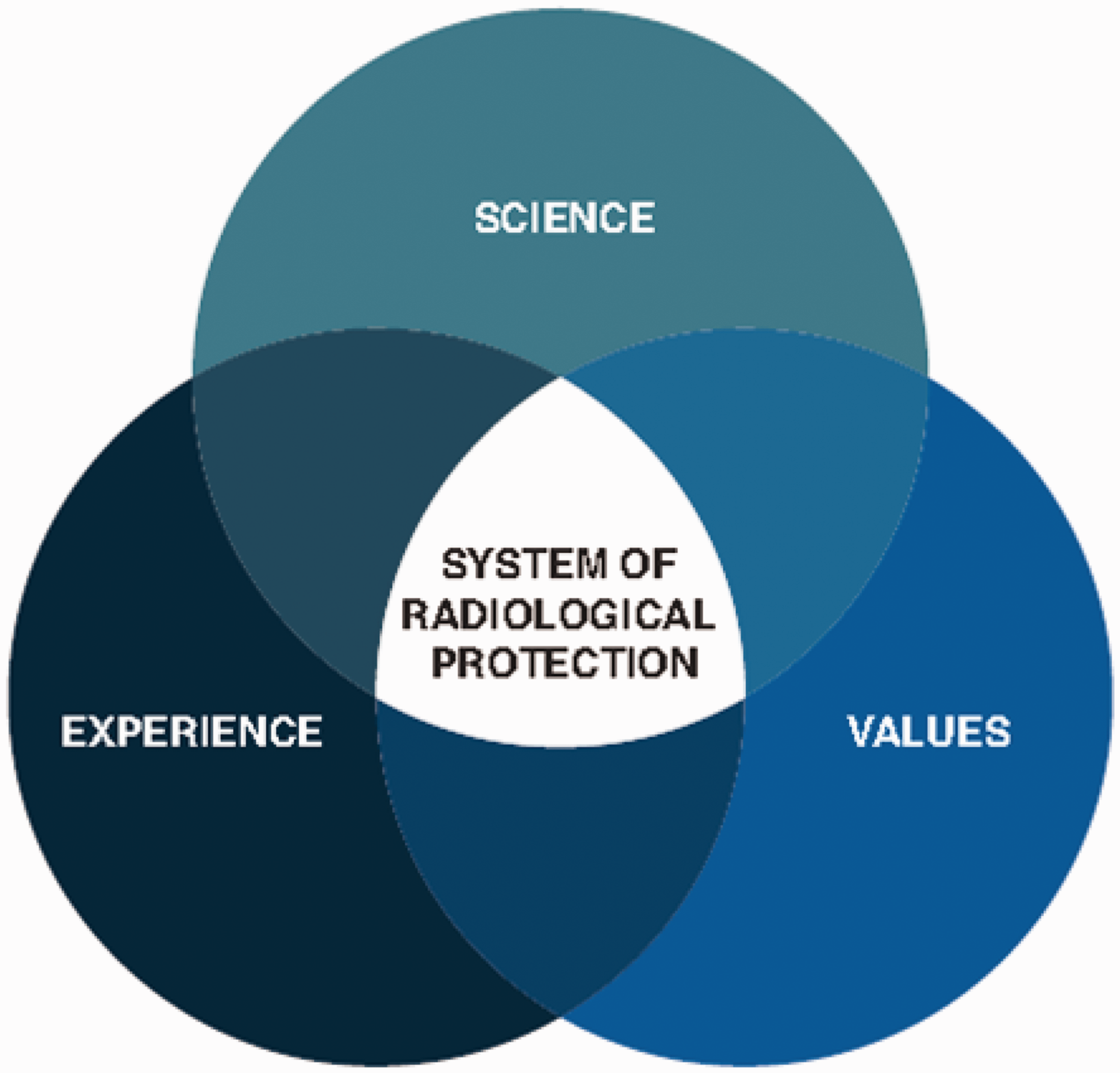
At the core of the system of protection are the principles of protection, namely justification, optimisation, and limitation. As shown in Fig. 2, these core principles are related to the three situations of exposure, the various categories of exposure, the dose criteria that are applied, and certain requisites for the effective implementation of protection. Protection of the environment fits within this system by being one category of exposed entity, and application of the principle of optimisation guided by the relevant derived consideration reference levels.
The system of protection, with the principles at the core, related to the exposure situations, the categories of exposure, dose criteria, and requisites for implementation. DCRLs, derived consideration reference levels.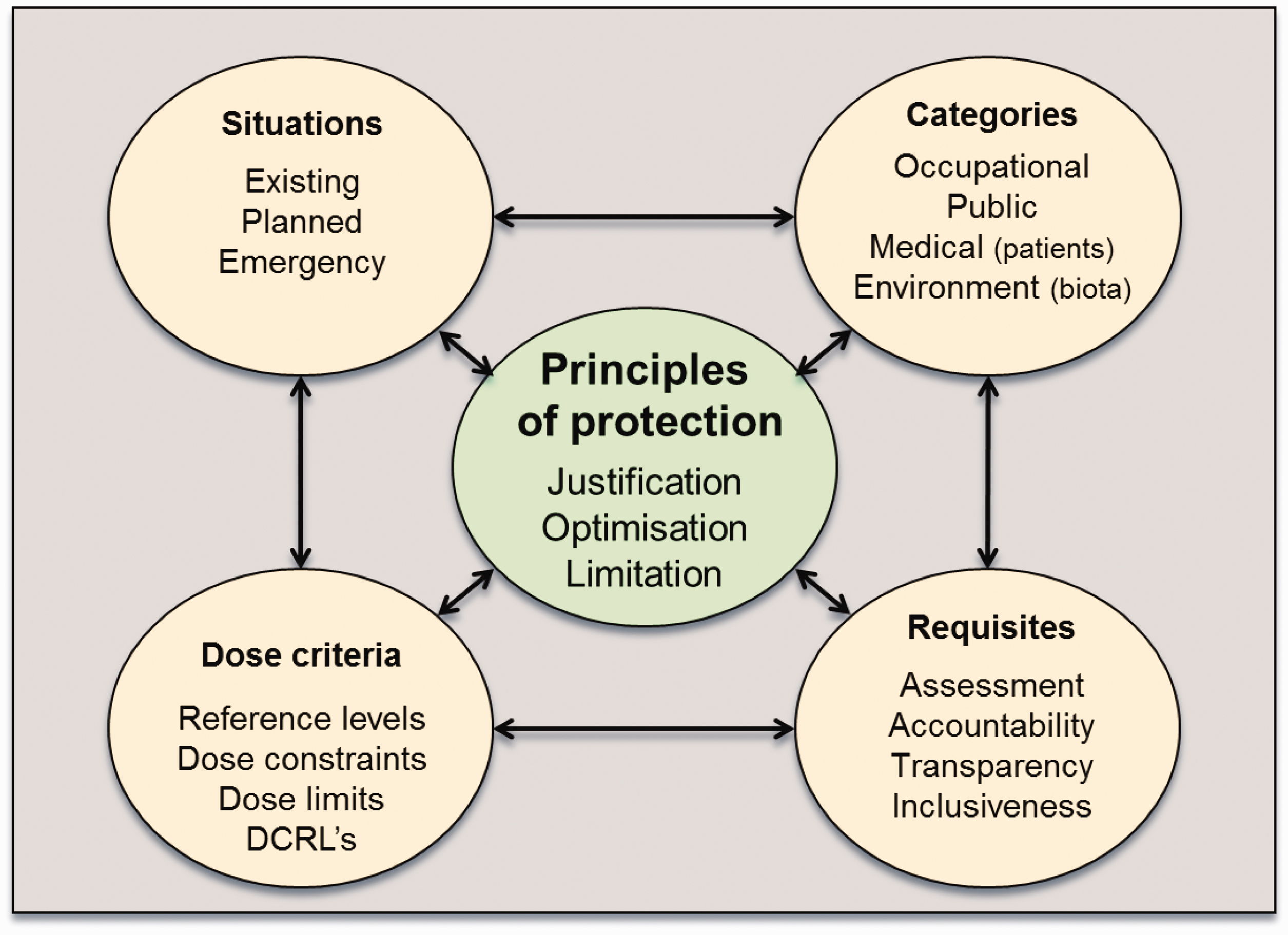
Protection is achieved in any exposure situation and particular circumstance by:
characterising the exposure, or the exposures that are expected to occur; justifying the taking of protective actions; identifying the exposures of individuals or populations in the environment that warrant specific attention; implementing an optimised protection strategy to influence the dose distribution, shift exposures towards lower values, and reduce inequity; and enabling stakeholder engagement and action.
Such an approach may be illustrated graphically, as shown in Fig. 3. In this case, the illustration is for exposure of human individuals, but the same process of characterisation, justification, identification of RAPs and representative animals and plants, and the implementation of an optimised protection strategy is equally applicable for the environment. The selection of relevant and appropriate dose criteria, whether for humans or RAPs, guides the optimisation process in the planning of the protection strategy, and in evaluating the effectiveness of protective actions taken. This function of the dose criteria is quite distinct from the establishment of limits, in that exposure levels greater than the dose criteria are not violations, but rather cause to consider if further actions can be taken to reduce exposures.
Graphical representation of changing individual dose distribution with the application of an optimised protection strategy. The blue oval indicates levels of exposure for individuals that warrant particular attention because they are greater than the selected individual dose criteria.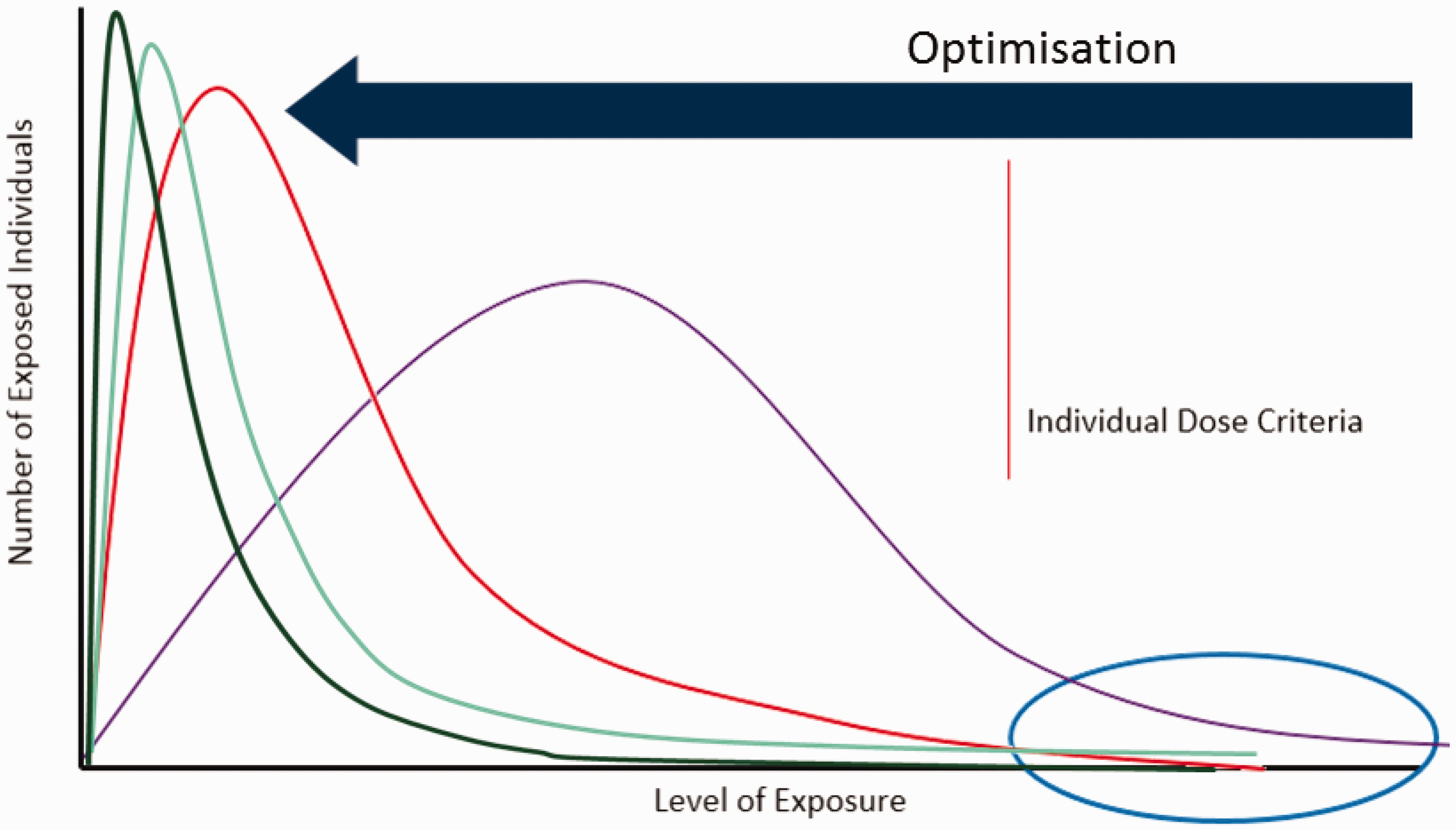
3. PROGRAMME OF WORK FOR COMMITTEE 4
The programme of work for Committee 4 during the 2017–2021 term comprises a number of areas of interest:
existing exposure situations; emergency exposure situations and the lessons learned from Fukushima; foundations and fundamentals of radiological protection; integration of protection of the environment; topical reports; and support to other ICRP committees.
3.1. Existing exposure situations
Committee 4 produced two reports in the previous term related to existing exposure situations. The first of these, Publication 126 (Radiological protection against radon exposure) was published in 2014 (ICRP, 2014b). This was followed by Publication 132 (Radiological protection from cosmic radiation in aviation), published in 2016 (ICRP, 2016).
In the 2017–2021 term of Committee 4, work will continue related to application of the Commission’s recommendations to naturally occurring radioactive material (Task Group 76), and application of the Commission’s recommendations to exposures resulting from contaminated sites from past industrial, military, and nuclear activities (Task Group 98).
3.2. Emergency exposure situations
Task Group 93 continues its work to update Publications 109 and 111 (ICRP, 2009a,b) related to protection of people in emergency exposure situations, and protection of people living in long-term contaminated areas. This effort has been assisted by numerous discussions with stakeholders in Japan, and has also benefited from the ICRP dialogue meetings that have been held in Japan since 2011.
Future work in this area includes consideration of emergencies other than large reactor accidents. This will include an update of Publication 96 (Protection of people against radiation exposure in the event of a radiological attack) (ICRP, 2005). In addition, several other topics have been raised that need to be addressed. For example, it has become increasingly apparent that information is needed for the handling of pets, livestock, and other animals during the response to an emergency. The Fukushima event has also pointed to the need to consider information for various business interests that may be impacted, both locally and globally. Finally, questions have arisen in the work of Task Group 93 and Task Group 76 on the treatment of occupational exposure. Committee 4 will further investigate whether additional information and recommendations are warranted to clarify the Commission’s position in these areas.
3.3. Foundations of radiological protection
The work of Task Group 94 on the ethical foundations of the system of radiological protection was available for public consultation on the ICRP website in the late spring of 2017. That report has been published as Publication 138 (ICRP, 2018). Looking forward, Committee 4 expects to initiate work with Committee 3 to begin to address ethics in the medical use of radiation, as a next step towards taking ethical values and making practical decisions. Committee 4 will also begin work looking specifically at the topics of reasonableness and tolerability, which are key components identified in the work by Task Group 94 that require additional consideration.
3.4. Protection of the environment
Committee 4, under its new mandate, will now consider application, harmonisation, and integration of the system of protection as it relates to environmental protection. Two task groups from Committee 5 in the previous term are nearly completed: Task Group 72 (Relative biological effectiveness and RAPs), which will be discussed by the Main Commission in Paris; and Task Group 74 (Dosimetry for non-human species), which has now been published as Publication 136 (ICRP, 2017).
Work continues for other topics that were previously started within Committee 5. First is Task Group 99 (RAP monographs), which will be a joint work with Committee 1. Task Group 105, on considering the environment when applying the system of radiological protection, has begun work focused on several case studies. Finally, Task Group 104 of the Main Commission (Integration of protection of people and the environment in the system of radiological protection) will initiate work to further the integration of the environment in the ICRP recommendations. Committee 4 will play a key role in this effort, examining practical ways in which environmental considerations can be considered in parallel with protection of humans in the decision-making process.
3.5. Topical reports
Starting in the 2013–2017 term of the Commission, Committee 4 initiated discussions with the organisations in formal relations to ICRP for the purpose of identifying specific topics in which there was a need for additional information and recommendations on the application of the system of protection. The first such report was Publication 125 (Radiological protection in security screening), published in 2014 (ICRP, 2014a).
Work is currently underway by Task Group 97 on surface and near-surface disposal of solid radioactive waste, and Task Group 106 on application of the Commission’s recommendations to activities involving mobile high-activity sources. Committee 4 plans to continue identification of topics and development of relevant reports moving forwards.
3.6. Support to other ICRP committees
Committee 4 continues to work closely and cooperatively with the other ICRP committees on topics related to effects, dosimetry, and medical applications. This includes the work of Task Group 79 (Use of effective dose as a risk-related radiological protection quantity); Task Group 89 (Occupational radiological protection in brachytherapy); Task Group 91 (Radiation risk inference at low dose and low dose rate exposure for radiological protection purposes); Task Group 100 (ICRP Reflection Group for National Council on Radiation Protection and Measurements Committee 1); Task Group 101 (Radiological protection in therapy with radiopharmaceuticals); and Task Group 102 (Detriment calculation methodology).
4. SUMMARY
For the 2017–2021 term, Committee 4 has 18 members from 12 countries, with a wide range of backgrounds and expertise. The Committee has six major areas of work, and eight active task groups at the start of the term. Additional work will be discussed and proposed moving forwards, looking ahead to issues to be clarified and elaborated for the system of radiological protection.