




Abstract
The accident at Fukushima Daiichi nuclear power plant in the wake of the Great East Japan Earthquake received considerable media coverage. However, a leaning towards sensationalism and a proclivity for denouncing those in power resulted in articles that were, in several instances, scientifically inaccurate, causing anxiety among disaster victims and delaying recovery efforts. Individuals working for the local media in Fukushima had the task of reporting the disaster while being victims of the disaster at the same time. Therefore, many individuals studied and deepened their knowledge about radiation and its effects, and were pained to see inaccurate media coverage of the disaster. Should they have been more forthright in opposing such false media coverage?
1. Gap between national television networks and local stations
As a journalist covering the accident at Fukushima Daiichi nuclear power plant for a local television station in Fukushima, one of the most compelling things experienced by the author was the gap in how news about Fukushima was presented by key national television networks and by local stations. For example, 1 year after the incident, a national television network broadcast a special programme on the discovery of mutant butterflies in Fukushima. At around the same time, a local station aired a programme showing progress in the recovery efforts undertaken in Fukushima.
The people of Fukushima were regularly measuring radioactivity with whole-body counters and taking thyroid screening tests, and were sensitive to radiation exposure levels. By 2012, the general feeling among the people of Fukushima was that radiation risk was less than anticipated immediately after the incident. The two television programmes with widely divergent views of the situation in Fukushima were broadcast at around this time, which would have deeply confused the viewers in Fukushima. This gap is expanding even today.
2. DISCUSSION OF AN ARTICLE
Fig. 1 shows the logic used in an article in a national newspaper on the reasoning for government policy.
Logic used in an article in a national newspaper to criticise government policy.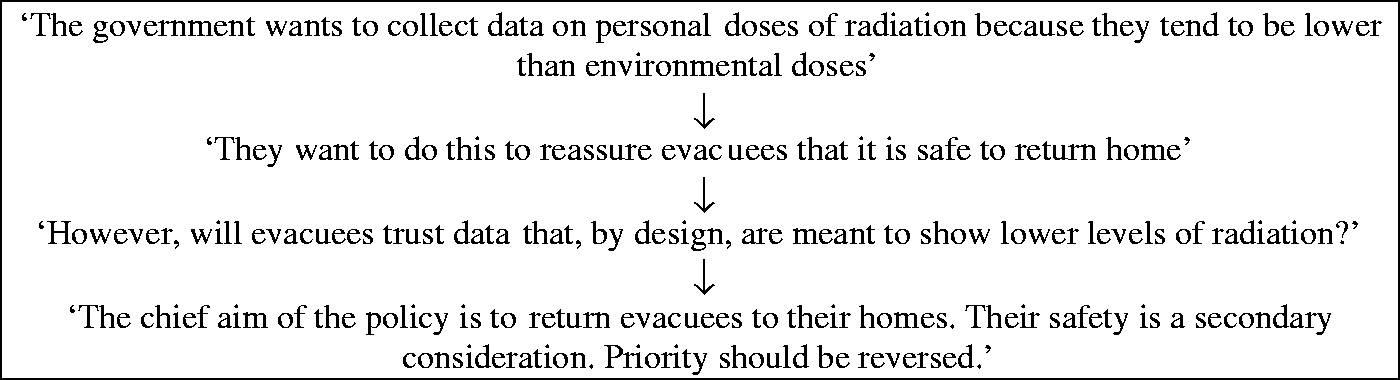
The problem with this article is complete misrepresentation of the concept of radiation dose assessment. The actual ambient dose differs from the effective dose. The ratio of ambient dose equivalent to effective dose is 1:0.7. As shown in a graph prepared by Associate Professor Tomohiro Endo of Nagoya University based on a study conducted at the High Energy Accelerator Research Organization (Hirayama et al., 2013), the amount of radiation that passes through a person from all directions, as in Fukushima, is the amount of radiation indicated on a personal dosimeter, and is equivalent to the effective dose. The environmental dose measured at a monitoring post differs from the personal dose due to people’s daily activities. Instead of being fixed at a monitoring post all day, people sleep in their homes, commute to work by car, work in an office, and return home. A person’s dose will differ depending on the physical shields encountered in their lifestyle. Therefore, a personal dosimeter will show a different reading from the ambient dose measured at a monitoring post.
What motivated this article? Although it is not clear whether the journalist lacked knowledge or was being arbitrary, it appears that the journalist intentionally chose to obliterate information that was true. Such articles are sometimes motivated by competition for a better audience rating or a larger circulation, or a tendency within the media to shirk responsibility by reporting on both sides of an argument. More essentially, the belief in the role of the media to ‘warn, enlighten, and guide the public’ has often led it to gain satisfaction from denouncing the Government and others in power. When this tendency is carried too far, it could result in articles such as the one mentioned above. This is not to say that the media should become a mouthpiece for the Government. The media should criticise where criticism is due and draw attention to errors. For example, the Ministry of the Environment originally set 0.23 µSv h−1, or 1 mSv year−1, as a reference level for evacuation. Now that the Government has set 20 mSv year−1 as a reference level for lifting evacuation orders, the Fukushima residents would be anxious about returning home unless the original reference level was explained as a ‘provisional guide’. The Government needs to explain the rationale for the new reference dose for lifting evacuation orders, and promote discussion with returnees. The media could pick up this issue to promote discussion and constructive criticism within the Government and in Fukushima.
However, an article such as the one mentioned above solves no problems and only serves to perpetuate residents’ distrust in the Government.
A reporter from a national media outlet told reporters from Fukushima, ‘We make our living by stirring up the public.’ Another journalist, also from a national media outlet, who had disparaged a person in power on the subject of radiation exposure dose in a television programme and who had written signed articles about radiation exposure dose for a national newspaper, apparently said, ‘I have little interest in radiation exposure.’ These cases, however, were relayed by one journalist who heard it through a third person.
3. PROVIDING ACCURATE DATA IS NOT ENOUGH TO DISPEL FALSE REPORTS
In hindsight, the media was not able to sufficiently communicate information and data about environmental radiation, exposure, and radiation dose to Fukushima residents. Whereas experts and others in communities succeeded in establishing good communication with residents, the media, as shown in Fig. 2, engaged in one-way communication that did not fully meet the needs of residents.
Information transmitted by the media.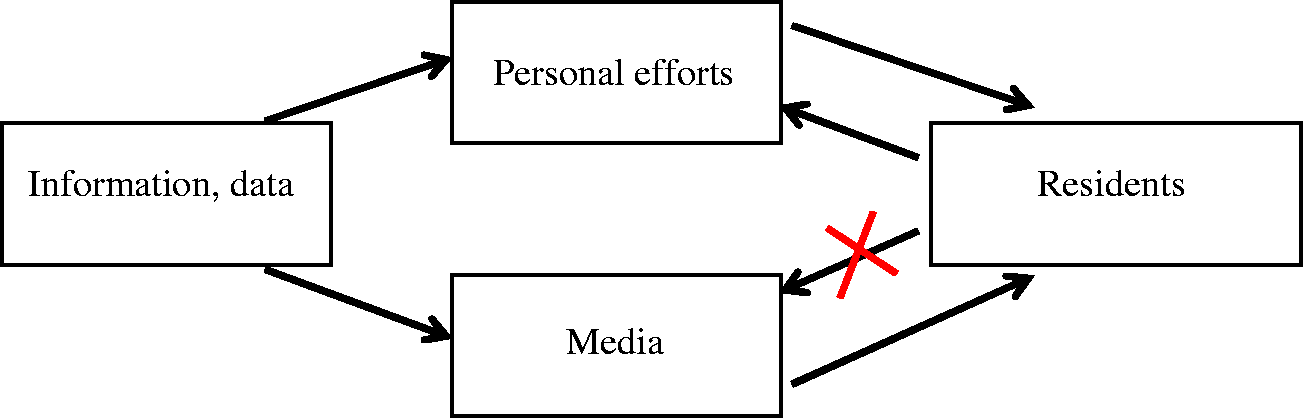
On the question of whether the media should have countered false reports, it had been considered that if residents were provided with detailed scientific data, they would make the right judgement; however, this assumption proved too optimistic. In the face of possible threats that residents felt to their lives and health in the wake of the accident at Fukushima Daiichi nuclear power plant, the value system and approaches in the media that have persisted since after the war could have been discarded. Frankly, the author has no clear answer regarding media coverage in the future, but hopes to advise young journalists to adopt new ways of reporting in the face of unprecedented events.