




Abstract
The protection quantities, equivalent dose in a tissue or organ and effective dose, were developed by the International Commission on Radiological Protection (ICRP) to allow quantification of the extent of exposure of the human body to ionising radiation. These quantities are used for the implementation of limitation and optimisation principles. Body-related protection quantities are not measurable in practice. Therefore, the International Commission on Radiation Units and Measurements (ICRU) developed a set of operational dose quantities for use in radiation measurements for external exposure that can assess the protection quantities. The current ICRU operational quantities were defined more than 30 years ago. ICRU Report Committee 26 examined the rationale for the operational quantities, taking account of changes in the definitions of the protection quantities in ICRP’s 2007 Recommendations. The considerations included the range of types and energies of particles contributing to exposure of workers and members of the public. ICRU Report Committee 26 investigated a set of alternative definitions for the operational quantities. The major change to the currently favoured set of quantities is redefinition of the operational quantities, from being based on doses at specific points in the ICRU sphere and soft tissue, to being based on particle fluence and conversion coefficients for effective dose and absorbed dose to the lens of the eye and local skin.
1. INTRODUCTION
Radiological protection requires quantification of the extent of exposure of the human body to ionising radiation. To this end, the International Commission on Radiological Protection (ICRP) developed the protection quantities, equivalent dose in a tissue or organ and effective dose (ICRP, 1977, 1991, 2007). The protection quantities are used for the implementation of limitation and optimisation principles.
Human-body-related protection quantities are not measurable in practice; therefore, they cannot be used directly as quantities in radiation monitoring. The International Commission on Radiation Units and Measurements (ICRU) developed a set of operational quantities for use in radiation measurements for external exposure to assess the protection quantities. The operational quantities in current use were defined in the 1980s (ICRU, 1985, 1988), which have been introduced into practice in many countries under radiological protection directives and regulations over the past 30 y. Nevertheless, the existing system has some limitations and needs further improvement to consider changes in the fields of application of the protection quantities and operational quantities (ICRP, 2007, 2010; ICRU, 2010).
ICRU established Report Committee 26 in 2010 to discuss the above-mentioned issues and propose an alternative system of operational quantities for external radiations. The Committee comprises co-chairs, David Bartlett and Nolan Hertel; members, Jean-Marc Bordy, Günther Dietze (deceased), Akira Endo, Gianfranco Gualdrini, and Maurizio Pelliccioni; consultants, Peter Ambrosi, Rolf Behrens, Jean-François Bottollier-Depois, Paolo Ferrari, Thomas Otto, Bernd Siebert, and Ken Veinot; and ICRU sponsors, David Burns, Elena Fantuzzi, Hans Georg Menzel, and Steve Seltzer. This paper presents an overview of ICRU Report Committee 26’s discussion on the definitions, deficiencies, and limitations of the current system, and its proposals for an alternative system of operational quantities.
2. GENERAL CONSIDERATION OF THE CURRENT SYSTEM
2.1. System of protection quantities and operational quantities
Fig. 1 shows the relationship between the protection quantities and operational quantities for use in radiological protection (ICRP, 1996; ICRU, 1998). The protection quantities and operational quantities are related to basic physical quantities which are generally used in radiation metrology and radiation dosimetry, and are obtained through primary standards at national standards laboratories. Reference conversion coefficients from the physical radiation field quantities, fluence and air kinetic energy per unit mass (kerma), to the protection and operational quantities are calculated using the definitions of the quantities. For the operational quantities, conversion coefficients are used for the calibration of radiological protection dosimeters.
Relationship between the protection quantities and operational quantities for use in radiological protection.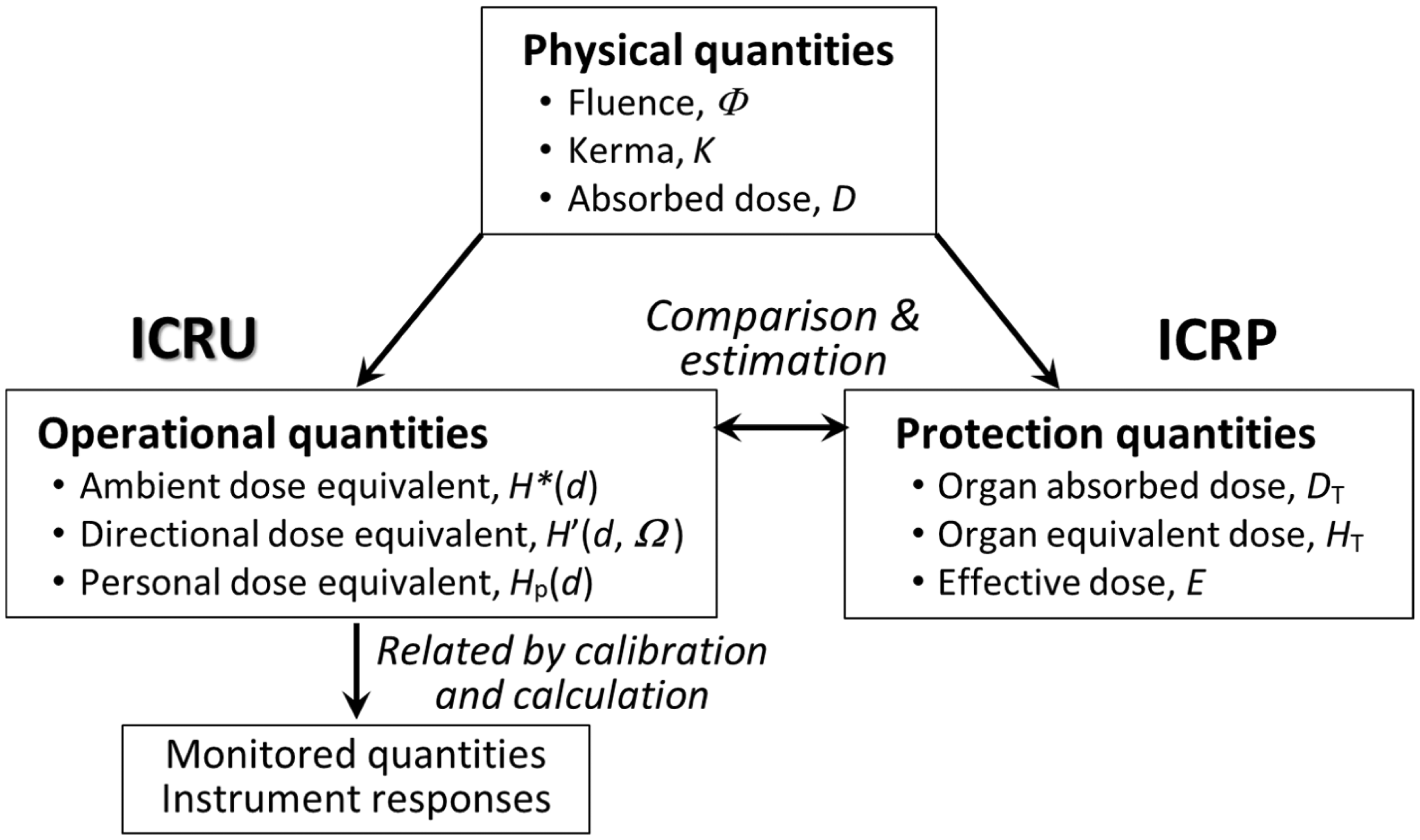
2.1.1. Protection quantities developed by ICRP
The protection quantities have been used to quantify the extent of exposure of the human body to ionising radiation from both whole- and partial-body irradiation (ICRP, 2007). The main uses of the protection quantities are the optimisation of protection and setting of control criteria: limits, constraints, and reference levels.
The protection quantities are defined based on the mean absorbed dose,
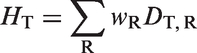
The effective dose, E, is defined as:

2.1.2. Operational quantities developed by ICRU
The operational quantities aim to provide a reasonable estimate of the values of the protection quantities relevant to exposure of humans to external radiation under most irradiation conditions (ICRU, 1985, 1988, 1993).
The operational quantities are defined using the quantity dose equivalent, H (ICRU, 1985). H is the product of Q and D at a point in tissue; thus,
For area monitoring, two quantities, namely, the ambient dose equivalent,
For individual monitoring, the personal dose equivalent,
The recommended values of d are chosen for the assessment of various doses:
2.2. Limitations of the operational quantities
The operational quantities in current use for external exposure were defined in the 1980s and have since been introduced successfully into legal metrology worldwide. Nevertheless, the existing system has some limitations.
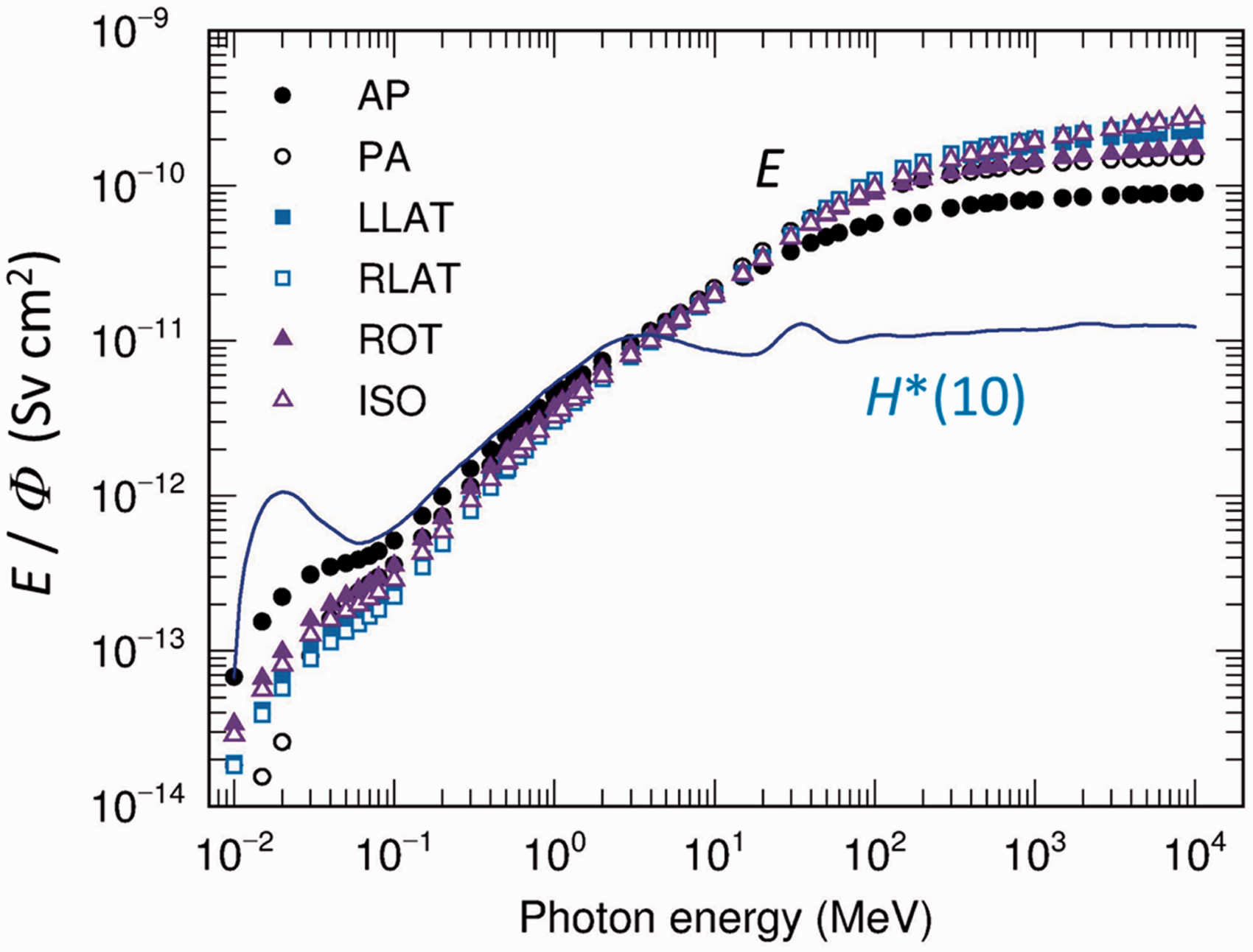
The definition of the operational quantities is based on the dose equivalent in ICRU 4-element tissue. The ICRU 4-element tissue has a density of 1 g cm−3, and a composition by mass of 76.2% oxygen, 11.1% carbon, 10.1% hydrogen, and 2.6% nitrogen. There is the fundamental problem that such tissue cannot be fabricated, and there are problems with a few aspects of strict metrology. The dose equivalent is defined as the product of Q and D at a point in tissue. This specific definition can never be realised experimentally and can, hence, only be calculated based on knowledge of the radiation field of secondary charged particles at the point of interest. The values of conversion coefficients for the operational quantities given in Publication 74 (ICRP, 1996) and ICRU Report 57 (ICRU, 1998) were calculated in some cases using the kerma approximation method for energies where this approximation is not appropriate. The particle types and energy ranges of radiation fields used in medical diagnosis, therapy, and scientific research have been extended. There is the inclusion of natural sources of radiation in ICRP recommendations (ICRP, 1991); aircraft crew are one of the most highly exposed occupational groups, and the radiation field at flight altitudes includes a large component of high-energy particles from cosmic radiation. To comply with the demands, conversion coefficients of the protection quantities were extended up to 10 GeV in Publication 116 (ICRP, 2010). The operational quantities are not always close estimates of the protection quantities in higher-energy fields, and the effective dose is underestimated, as shown in Fig. 2. Based on recent epidemiological studies, ICRP has recommended lowering the occupational equivalent dose limit to the lens of the eye (ICRP, 2012). There is now strong interest in better modelling of the lens of the eye (Behrens and Dietze, 2011) for the assessment of dose to the lens of the eye and in terms of determining the operational quantity, Comparison of conversion coefficients for effective dose in various photon incident directions (ICRP, 2010) and for H*(10). Note that the values for H*(10) are calculated with full transport of secondary particles in the ICRU sphere. AP, antero-posterior; PA, postero-anterior; LLAT, left lateral; RLAT, right lateral; ROT, rotational; ISO, isotropic.
3. NEW APPROACH BY ICRU
ICRU Report Committee 26 examined the rationale for the operational quantities considering updated definitions of the protection quantities by ICRP (2007, 2010), and investigated a set of alternative definitions for the operational quantities.
The operational quantities aim to provide reasonable estimates for the values of the protection quantities. Therefore, as a favoured approach, ICRU Report Committee 26 proposes to define the operational quantities based on the protection quantities. The approach is justified because the reference values of the conversion coefficients for the protection quantities (ICRP, 2010) are available. This concept can help avoid the use of different phantoms and different weighting factors for radiation quality between the protection quantities and the operational quantities, and simplifies the system of radiation monitoring and dose assessment.
Equivalent dose to the lens of the eye and local skin has been used to specify limits to prevent tissue reactions. The equivalent dose is the product of absorbed dose and
The propositions for area monitoring and individual monitoring are described below.
3.1. Area monitoring
The ambient dose equivalent,
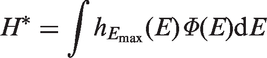

Fig. 3 shows Emax evaluated using conversion coefficients of effective dose (ICRP, 2010) for photons and neutrons.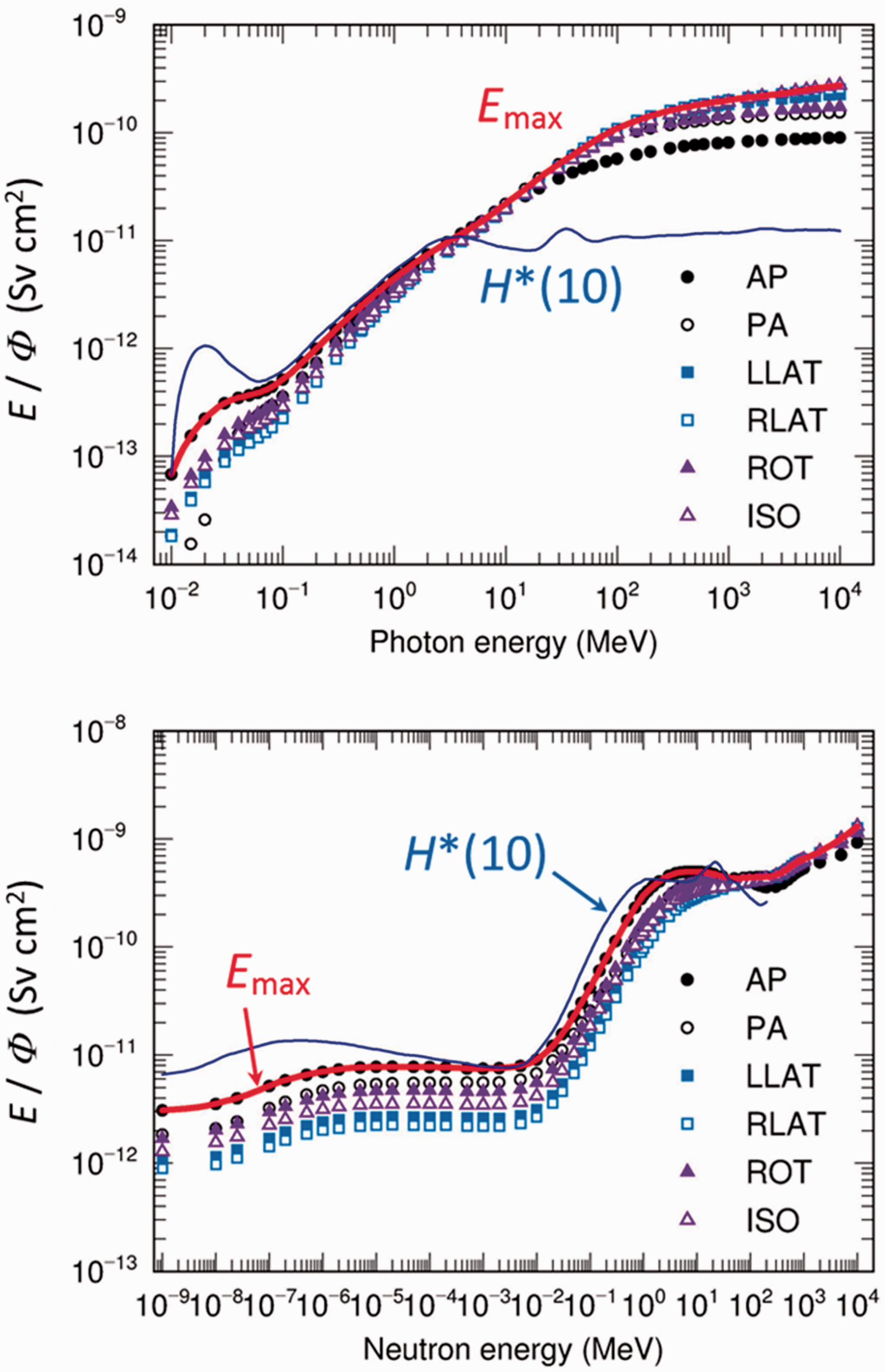
The measurement of
The directional absorbed dose to the lens of the eye,


Similarly, the directional absorbed dose to the local skin,


The measurement of
3.2. Individual monitoring
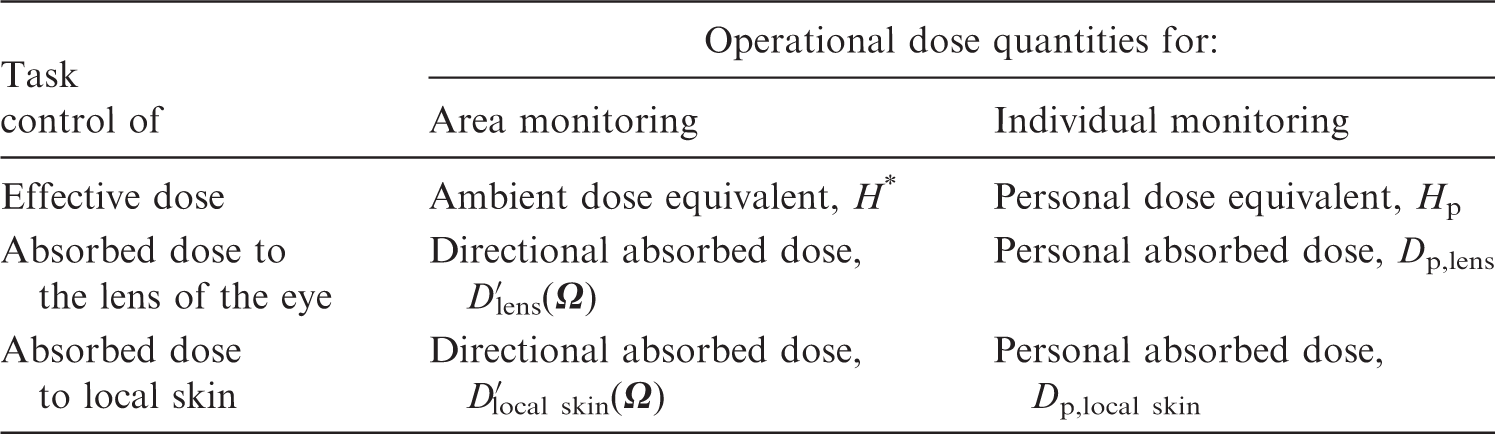
The operational quantities for individual monitoring are defined in terms of effective dose and absorbed dose to the lens of the eye and local skin. The personal dose equivalent to estimate the effective dose,
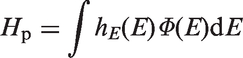
Personal absorbed doses for estimating absorbed doses to the lens of the eye,


Individual monitoring is performed with personal dosimeters worn on the body: therefore,
3.3. Summary of proposition
Proposed scheme of the operational quantities used for dose monitoring of external exposure.
4. IMPACT OF CHANGES
It is necessary to look at the impact of the changes and to consider the consequences for radiological protection practice, including calibration procedures and dosimeter design.
The values of the operational quantities should be traceable to a national or international standard. The calibration coefficient of an instrument is based on using the reference value of a fundamental radiation quantity, which can be well realised by a standard (e.g. fluence at the reference point) and applying reference conversion coefficients relating these quantities to the operational quantities.
Introduction of the proposed system requires a revision of conversion coefficients, and it is planned to include these conversion coefficients in the forthcoming ICRU/ICRP report on the operational quantities. Calibration phantoms for personal dosimeters remain unchanged, and there are a few minor changes to be made to the dosimetry of the International Organisation for Standardisation reference fields and calibration procedures. Therefore, the impact of adopting the proposed system on routine measurement practice is not significant as a whole.
Major changes by ICRP to the values of conversion coefficients of the protection quantities might cause reconsideration of the proposed system of the operational quantities. However, such changes are likely to occur very infrequently as they are the result of significant shifts in understanding of the relationships between exposure to radiation and its effects.
5. CONCLUSIONS
This paper reviewed discussion in ICRU Report Committee 26 on the operational quantities for protection against external radiations, and investigated the limitations of the current system. The Committee proposed new operational quantities for external exposures by considering changes in the definitions of the protection quantities, as well as changes in the fields of application of the protection quantities and operational quantities. A favoured set of operational quantities was defined using the values of conversion coefficients from particle fluence to effective dose and absorbed dose to the lens of the eye and local skin. This approach is now considered acceptable because ICRP has defined the reference values of dose conversion coefficients using the reference phantoms that are globally recognised. The new operational quantities provide reasonable estimates of the protection quantities, even at higher energies and for avoiding tissue reactions. The use of the proposed concept simplifies the systems of protection and operational quantities, and assists in the comprehension of radiological protection quantities by users.