




Abstract
Commission 1 of the International Commission on Radiological Protection considers the risk of induction of cancer and heritable disease (stochastic effects) together with the underlying mechanisms of radiation action. Committee 1 also considers the risks, severity, and mechanisms of induction of tissue/organ damage and developmental defects (deterministic effects). The Committee was significantly revamped in 2013 and last met in Abu Dhabi in October 2013. Committee 1 evaluated progress on two ongoing task groups: Task Group 64 ‘Cancer Risk from Alpha Emitters’ and Task Group 75 ‘Stem Cell Radiobiology’. Following approval from the Main Commission, Committee 1 established two new task groups: Task Group 91 ‘Radiation Risk Inference at Low Dose and Low Dose Rate Exposure for Radiological Protection Purposes’ and Task Group 92 ‘Terminology and Definitions’. This article presents a synopsis of the current status of Committee 1 and outlines the tasks that Committee 1 may undertake in the future.
1. Introduction
Committee 1 of the International Commission on Radiological Protection (ICRP) considers the risk of induction of cancer and heritable disease (stochastic effects) together with the underlying mechanisms of radiation action. Committee 1 also considers the risks, severity, and mechanisms of induction of tissue/organ damage and developmental defects (deterministic effects).
The Committee meets on an annual basis, and also meets in conjunction with the Main Commission every second year. For example, in 2011, the Main Commission met in Washington, DC, USA. This was followed by the 1st International Symposium on the System of Radiological Protection and the five subcommittees, Committees 1–5, met independently after the symposium. In 2013, the Main Commission and all five subcommittees met in Abu Dhabi, United Arab Emirates. At this meeting, there was also the highly successful 2nd International Symposium, where Committee 1 organised a session on ‘Tissue Reactions: the Road from Science to Protection’. Details can be found at http://www.icrp.org/page.asp?id=184. Manuscripts from each presenter in this session can be found in these proceedings.
In the intervening years between joint meetings with the Main Commission and the other subcommittees, a member of Committee 1 usually hosts the annual meeting. In 2010, the meeting was hosted by Fiona Stewart in Amsterdam, The Netherlands, and in 2012, Sisko Salomaa hosted the meeting in Helsinki, Finland. In 2014, Quanfu Sun and former member of Committee 1 Ping-Kun Zhou hosted the meeting in Beijing, China.
2. Committee 1
Following the open nominations process adopted by the Main Commission in 2012, Committee 1 underwent some significant changes in 2013 as a result of the subsequent elections. Prior to 2013, Committee 1 had only nine members; however, the Main Commission recognised the need for additional expertise on Committee 1 and increased the number of members to 16 (Fig. 1).
Committe 1 participants at the Abu Dhabi meeting. Back row left to right: Jolyon Hendry (former Committee 1 and Co-Chair of Task Group 75); Dan Stram (USA); Simon Bouffler (UK); Bill Morgan (USA, Chair of Committee 1); Sisko Salomaa (Finland); Wolfgang Dörr (Austria; Chair of Task Group 92); Quanfu Sun (China); Richard Wakeford (UK). Front row left to right: Ohtsura Niwa (former Committee 1 and Co-Chair of Task Group 75, Japan); Dominique Laurier (France); Preetha Rajaraman (India); Tamara Azizova (Russia); Nobuhiko Ban (Japan); Margot Tirmarche (France); Ranajit Chakraborty (USA); Werner Rühm (Germany, Secretary of Committee 1 and Chair of Task Group 91); Michael Hauptmann (Netherlands). Missing: Alice Sigurdson (USA, Vice-Chair of Committee 1).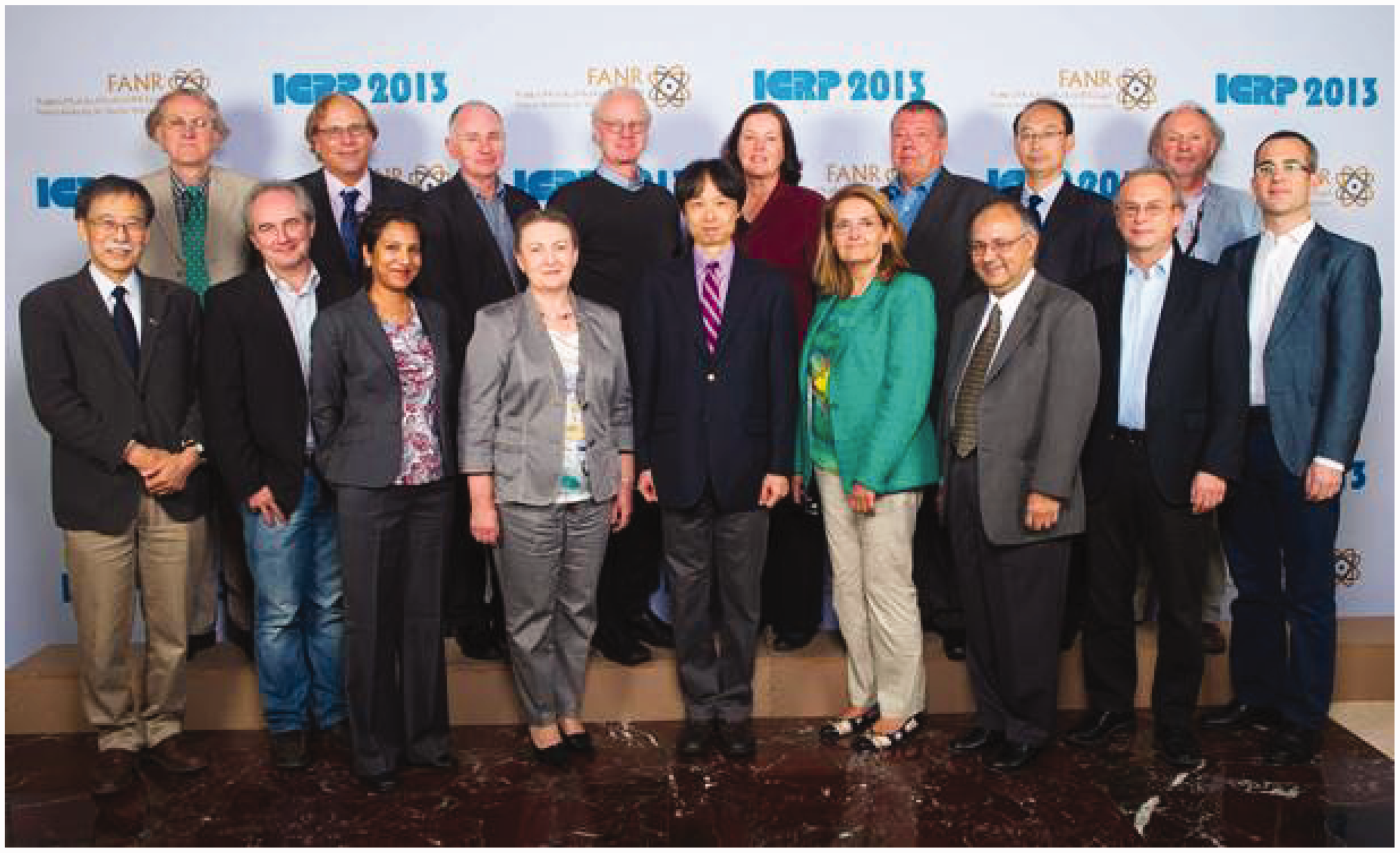
3. Responsibilities and Activities of committee 1
In addition to being aware of recent publications and issues in their own area of expertise, members of Committee 1 are also expected to be aware of publications of various bodies, e.g. the United Nations Scientific Committee on the Effects of Atomic Radiation (UNSCEAR) and the US National Council on Radiation Protection, as well as advances in high-profile research programmes, e.g. the outstanding European Union’s research programmes – Multidisciplinary European Low Dose Initiative and the Open Project for European Radiation Research Area, and the host of innovative programmes that have been, or are, supported by these over-site groups: the Radiation Effects Research Foundation that studies radiation effects in the atomic bomb survivors from Hiroshima and Nagasaki, the Southern Urals Biophysics Institute, and the US Department of Energy’s Low Dose Radiation Research Program to name a few. A useful example of how this works is the recent report on ‘Human Radiosensitivity’ published by researchers at Public Health England (PHE) in the UK (AGIR, 2013).
Individual radiosensitivity is a key issue, and as scientific advances in ‘omics’ technologies (transcript omics, genomics, proteomics, metabolomics, lipidomics, etc.) move forward at a rapid pace, it is conceivable that, in the future, it may be possible to predict an individual’s sensitivity, or resistance, to ionising radiation. The fiscal, legal, and ethical implications for medicine, employment etc. are enormous. A summary of this document was presented to Committee 1 by one of the authors, and the Committee felt that there was little need at this time for a specific task group to address this issue further beyond the PHE report.
Committee 1 is fortunate to include world-class experts from many of these organisations and/or committees among its members. In addition to monitoring publications from these various organisations and/or committees, Committee 1 considers the use of biologically based dose–response models for assessing the effects of low-dose ionising radiation exposures. In addition, Committee 1 monitors epidemiological data, non-cancer and potential hereditary effects, advances in radiation-induced DNA damage recognition, DNA repair, and the potential impact of epigenetic effects.
Committee 1 makes a judgement call given the facts and data available as to whether a block of research warrants a task group. An overview of the ‘Statement of Task’ is presented by the Chair of Committee 1 to the Main Commission; pending their approval, a task group will or will not be established. The task group will consider the evidence in detail and make recommendations based on scientific principles, philosophy, and policy. Any document prepared by a task group must be approved by the sponsoring committee and the Main Commission, and is subsequently sent out for external review. Since many task group members have ‘day jobs’ and task group membership is voluntary, this can sometimes be a complicated and protracted experience.
4. Ongoing Projects Under the Auspices of Committee 1
Please note: the Chair, membership, corresponding members, and consultants are listed on the Committee 1 website (http://www.icrp.org/icrp_group.asp?id=7) and will not be included here.
Committee 1’s most recent report (2012) was Publication 118, entitled ‘ICRP statement on tissue reactions and early and late effects of radiation in normal tissues and organs – threshold doses for tissue reactions in a radiation protection context’ (ICRP, 2012). This was the subject of the Committee 1 session at the 2nd International Symposium on the System of Radiological Protection, and the manuscripts summarising these presentations are included in these proceedings.
4.1. Task Group 64: Cancer risks from alpha emitters
This is a follow-up report complementing Publication 115 on ‘Lung cancer risk from radon and progeny and statement on radon’ (ICRP, 2010).
Task Group 64 will complement and extend Publication 115 and report on potential risks from the alpha emitters plutonium, uranium, thorotrast, and radium. This task group represents an excellent collaboration between ICRP Committees 1 and 2. Committee 2 is providing essential radiation dosimetry information. The project is a little behind schedule due to the closure of the West Lakes facility in the UK, which delayed the joint analysis of the Sellafield and Mayak worker cohorts. Nevertheless, the task group did meet in Paris in 2014, so this task group appears to be back on track.
4.2. Task Group 75: Stem cell radiobiology
This task group was established to review the current state of knowledge of stem cell radiobiology and the potential impacts on cancer risk. While there have been tremendous advances in understanding of stem cell biology in recent years, there is comparatively little information on radiation effects on stem cells. Task Group 75 is placing emphasis on stem cell radiobiology in relation to carcinogenic radiation risk. The document is in the final stages of preparation, and it is anticipated that it will be submitted to the Main Commission and subsequently sent out for external review in late 2014.
4.3. Task Group 91: Radiation risk inference at low dose and low-dose rate
The detriment-adjusted nominal risk coefficients recommended by ICRP have been based, to a large extent, on data obtained from the atomic bomb survivors in Japan. As their exposure was a single acute exposure, it was thought that the most plausible biological model for the dose–response relationship should be linear quadratic (which implies a larger slope at high doses than at low doses). Many internationally and nationally relevant bodies, such as UNSCEAR, Board on the Effects of Ionizing Radiation (BEIR), and ICRP, have used a dose and dose-rate effectiveness factor (DDREF) for the estimates of coefficients at low doses and protracted dose rates. A value of 2 was used by ICRP for low-dose and low-dose-rate exposures, which are typical in radiation protection. With more epidemiological information becoming available and using Bayesian analysis, UNSCEAR has recently re-evaluated all the available information and has estimated risk coefficients that are similar to the ICRP estimates using high doses and a DDREF value of 2. However, in their 2006 report, the BEIR Committee (NRC, 2006), also using a Bayesian approach, recommended a DDREF of 1.5.
The task group will review the current available information on the estimation of risk coefficient and recommend:
whether it is desirable to continue to estimate risk at low doses by assessing the slope of the dose response at high doses and then applying a DDREF reduction factor. The alternative is to adopt the UNSCEAR approach of inferring the risk coefficients at low doses by using all available information and the Bayesian analysis to estimate the best expert judgement; whether the currently inferred values of the detriment-adjusted nominal risk coefficients recommended by ICRP for an adult and a whole population, namely, values of around 5% Sv−1 of effective dose, requires revision; and whether such coefficients are applicable to acute, protracted, and prolonged exposure or need a particular correction.
Task Group 91 had its inaugural meeting in Munich in December 2013.
4.4. Task Group 92: Terminology and definitions
Over many years, the terminology and definitions of specific terms used in ICRP publications have evolved, and in some instances, have been used inconsistently. Task Group 92 will review the terminology and definitions from Publication 103 (ICRP, 2007) onwards and revise as required. This will occur in two phases:
terminology and definitions where there is consistency within ICRP documents and general agreement that they are correct; and terminology and definitions where there is inconsistency between and within ICRP reports, and/or where investigators do not agree that the terminology and definition accurately reflect the scientific message being conveyed.
ICRP interns have prepared both documents and the first phase is currently underway. It is envisaged that the updated terminology and definitions will be a web-based resource for future use.
5. Future Directions
A major dilemma for radiation protection is the scientific basis for radiation standards to protect the public from exposures to low levels of ionising radiation (<100 mSv), where there are considerable uncertainties in the epidemiological data. Research in this dose range is important and essential (Morgan and Bair, 2013), and a comprehensive analysis of all scientific data might resolve the controversies in the shape of the radiation dose–response profile at radiation doses <100 mSv.
Additionally, progress in the radiation sciences is moving rapidly. With new techniques and technologies available in radiology and radiation oncology departments, the increasing use of computed tomography scans, threats of radiological terrorism, the increased use of ionising radiation in industry and various security strategies, and concerns over nuclear accidents (e.g. Fukushima) demand that Committee 1 remains diligent and aware of scientific advances in the radiation sciences. To this end, Committee 1 has identified a number of further areas where work may be initiated and where a priority watch will be maintained:
individual radiosensitivity to ionising radiations (with Committee 3); radiation detriment (with Committee 2); shape of the dose–response for cancer; uncertainties in dosimetry (with Committee 2); late effects from particle therapy (with Committee 3); relative biological effectiveness for low-energy vs high-energy gammas; radiation weighting factors for tritium; radiation risk in relation to chemical risk; tissue banking, archival tissues, and the use and value of these resources; and transgenerational effects.
Footnotes
Acknowledgements
The author acknowledges interactions and the hard work of all members of Committee 1, and the support of the Main Commission, the Scientific Secretary, and the various members of his support staff. In addition, the author would like to acknowledge the numerous contributions of the previous Chair of Committee 1, R. Julian Preston. The author would also like to thank him for his support, encouragement, and mentorship over many years.