




Abstract
Created agents are a staple of fiction but technological advances are making them increasingly viable as a reality. These creations introduce thorny questions about their moral standing, including questions about whether they can be owned. In seven preregistered experiments (N = 2,499), we investigated whether created agents are more likely to be seen as owned if they cause harm. This prediction was suggested by the hypothesis that ownership is sometimes used to express moral responsibility, though it runs against the tendency for harm to introduce restrictions on ownership. In all experiments, participants more often judged that created agents belonged to their inventors when they caused harm than when they did good. The final experiment then showed that these judgments do not strongly align with assessments of rights over created agents. Overall, the findings suggest that harmfulness changes the moral standing of created agents in a novel way, increasing perceptions of them as property.
Introduction
People have long envisioned creating artificial agents. We see this in works of science fiction, starting with Frankenstein (Shelley, 1998), which itself referenced real-world occultists who described how to create new agents (LaGrandeur, 2014). Earlier still, creating artificial agents comes up in folklore and Talmudic discussion of golems (Krause, 1995), in versions of the story The Sorcerer’s Apprentice (Ogden, 2004), and in Greek mythology (e.g., Pygmalion and Galatea; the automaton Talos).
In recent years, the prospect of creating artificial agents has introduced questions about their moral standing—for example, whether they should have rights or even the high moral status normally ascribed to humans (Gordon, 2020; Grigoreva et al., 2024; Gunkel, 2017). People are sensitive to many factors when assigning moral standing to different entities. They assign greater moral standing to humans than to animals or robots (Caviola et al., 2022; Reinecke et al., 2025), to beautiful animals than to unattractive ones (Klebl et al., 2021), and to entities with greater mental capacities than lesser capacities (Caviola et al., 2025; Sytsma & Machery, 2012). People also consider whether the entities are harmful. For instance, they more strongly agree that animals and fictional aliens deserve to be protected if they are harmless rather than dangerous (Piazza et al., 2014).
In this paper, we examine a novel way that harmfulness might affect judgments of moral standing and one especially relevant for created agents. Specifically, we examine whether harmfulness brings people to see created agents as owned property. Ownership matters for moral standing because owned entities are typically seen as lacking autonomy and having limited rights. Dogs are restrained on leashes, and farm animals are caged in stalls. And ownership is particularly relevant for created agents because created things are typically seen as the property of their creators (Burgmer et al., 2019; Levene et al., 2015). The idea that creation confers ownership operates in many cultures (Barnard & Woodburn, 1988) and is even held by preschool-aged children (Davoodi et al., 2020; Kanngiesser et al., 2010, 2014; Li et al., 2018; Rochat et al., 2014). It is not a foregone conclusion, though, that created agents will always be seen as owned, since they could have countervailing features that remove them from consideration as property. Consistent with this, participants in one line of experiments were less likely to see created agents as owned if they were described as having the capacity to make decisions, and also if they were composed of mechanical rather than biological parts (Starmans & Friedman, 2016).
The idea that harm might increase perceptions of ownership is suggested by people’s intuitions about things like dumped waste and hazardous materials. Participants in one recent study read a vignette where a mining project left a chemical byproduct on an island (Stonehouse & Friedman, 2022). When this byproduct was toxic, participants said it was owned by the head of the mining company. By contrast, when the byproduct was described as beneficial, participants denied it was owned. That is, judgments of ownership were subject to a positive-negative asymmetry, reminiscent of the side-effect effect for judgments of intentionality (Knobe, 2010). With ownership, though, this effect might be restricted to things akin to litter and dumped waste—things which have ended up where they do not belong and which need to be cleaned up. If so, harmfulness might not increase judgments about the ownership of created agents.
Besides advancing knowledge about people’s judgments of moral standing, investigating this question can also expand understanding of the psychology of ownership. It may expand understanding of how people judge whether things are owned. People often judge that something is owned when they know that a person created it, took physical possession of it, or improved it (Merrill, 2009), and when they see that a person has control over the thing (Espinosa & Starmans, 2020; Neary et al., 2009; Scorolli et al., 2017). The harmfulness of the thing, however, is not one of these factors. On the contrary, harmfulness generally works against ownership: Ownership judgments are shaped by legal rules and social conventions (Nichols & Thrasher, 2023), and the hazards posed by narcotics, firearms, and pit bull terriers have motivated laws forbidding people from possessing or owning them. More gravely, the harms and immorality of enslavement might help explain why people are no longer seen as property. With created agents, though, harm could have the opposite effect of increasing ownership.
This investigation may also inform us about the functions of ownership. One function is regulating access to desirable resources (Boyer, 2022; Morewedge, 2021; Nancekivell & Friedman, 2018; Pesowski & Powell, 2023). For instance, owners are typically entitled to use resources and to exclude others from them (Merrill, 1998; Snare, 1972), and even young children recognize this (Kanngiesser et al., 2019; Neary & Friedman, 2013; Ross, 1996). Ownership is also connected with responsibility. Owners are obligated to keep their property from causing harm (Dan-Cohen, 1992; Waldron, 1985), and laypeople see owners as liable for harm caused by their property (Bowman-Smith et al., 2018; Gantman et al., 2020; Nadler & McDonnell, 2011; Washington & Friedman, 2025). If people see creations as more owned when they are harmful, this might suggest a further connection between ownership and responsibility: Attributing ownership may sometimes serve to mark people as responsible for harm.
We ran seven experiments. Our first experiments examined whether created agents are more likely to be seen as owned if they cause harm. In the first five experiments, participants read Frankenstein-like stories in which an inventor created a living creature. The creature harmed or helped others, and participants judged both whether the creature was owned by the inventor and whether the inventor was responsible for its actions. The fourth and fifth experiments also examined whether ownership ratings depended on the inventor’s control over the created agent and other factors (i.e., the risks she ran in creating it, and her intentions). In the sixth experiment (and two further experiments in Supplemental Materials), participants read similar vignettes about other kinds of created entities, including ones unlikely to be perceived as agentic.
Our final experiment then turned to a different question: Whether increased ownership attributions for harmful agents correspond with increase in perceptions of the creator’s rights. This increase might be expected if ownership chiefly functions to dictate who can access and use resources. But an increase is not necessarily expected if ownership also serves other functions, such as marking liability for harm. To test between these possibilities, participants in this experiment again read a Frankenstein-like story and then judged whether the inventor owned the created agent. But after this, they also judged whether the inventor had rights linked with ownership over the created agent.
General Methods
Preregistrations, data, Supplemental Materials, and code for all experiments are available at https://osf.io/t7xy3/. We disclose all measures, manipulations, and exclusions.
In each experiment, we sought to recruit approximately 100 participants per between-subject condition. Participants were residents of the United States. In all but one experiment, we recruited them using CloudResearch, requiring a HIT approval rate of 95% to 100% over at least 100 prior HITS, using the “block low quality participants” option and restricting access to individuals who had not completed a prior experiment in the series. Experiment 5 was conducted after all other experiments, and used Prolific with similar settings. In each experiment, the main task was followed by multiple-choice attention checks and questions about participants’ age and gender.
We ran analyses in R, using “afex” (Singmann et al., 2023) for analysis of variance and “emmeans” (Lenth, 2023) to run post hoc tests. We ran sensitivity power analyses using G*Power 3.1.9.7 (Faul et al., 2007).
Experiments 1 and 2
Methods
Participants
Experiment 1 was successfully completed by 211 participants (mean age = 39.39 years, SD = 10.82; 85 women, 124 men, and 2 indicating other or preferring not to answer); an additional 21 participants were excluded. Experiment 2 was successfully completed by 218 participants (mean age = 39.90 years, SD = 10.90; 77 women, 137 men, and 4 indicating other or preferring not to answer); an additional 19 were excluded. Sensitivity analyses revealed we had 80% power to detect moderate-to-small effects of condition in Experiment 1, Cohen’s d = 0.39, and in Experiment 2, Cohen’s d = 0.38.
Procedure
In both experiments, participants read a vignette where an inventor produced a creature using body parts from dead people (see Starmans & Friedman, 2016). In one between-subjects condition, the creature was composed of body parts from prison inmates, and it ends up causing harm. In another between-subjects condition, the creature’s body parts came from people who donated their organs to science, and it ends up doing good.
After reading the vignette, participants rated their agreement with a statement affirming that the inventor owns the creature (“Eliza owns Krugon”). After this, they moved to another screen and rated their agreement with a statement affirming that the inventor was morally responsible for the creature’s actions. This statement was about deserved blame in the bad condition, and about deserved praise in the good condition (“Eliza should be [blamed/praised] for Krugon’s action”). Participants gave both ratings on 7-point scales ranging from “strongly disagree” (scored 1) to “strongly agree” (scored 7).
Experiments 1 and 2 used the same procedure but slightly different vignettes. Here is the vignette from Experiment 1 (text in square brackets shows wording differing across the two conditions):
Eliza is a brilliant biologist and inventor. For years she collected the organs from people who [were prison inmates/donated their organs to science]. Then she combined the parts and created a living creature that she calls Krugon. One day, when Eliza is away, Krugon leaves the lab and goes to a nearby park. While at the park, Krugon [attacks someone’s pet dog and badly injures it/plays with someone’s pet dog and pets it].
In Experiment 2, the created agent was described as physically and mentally resembling a human. Also, the bad and good outcomes were more consequential. The creature either drowned a dog (bad) or saved a dog from drowning (good). Here is the vignette:
Eliza is a brilliant biologist and inventor. For years she collected the organs from people who [were prison inmates/donated their organs to science]. Then she combined the parts and created a living creature that she calls Krugon. Krugon looks like a human male, and has mental abilities similar to the average human. One day, when Eliza is away, Krugon leaves the lab and goes to a nearby pond. Someone’s pet dog is swimming there [and is having fun in the water/but is struggling to get back to shore]. Krugon sees the dog and rushes into the pond. He [holds the dog underwater, drowning it/pulls the drowning dog to shore, saving its life].
Results
Figure 1 shows participants’ mean ratings. Participants more strongly agreed the creation was owned when it was harmful than helpful: Experiment 1,
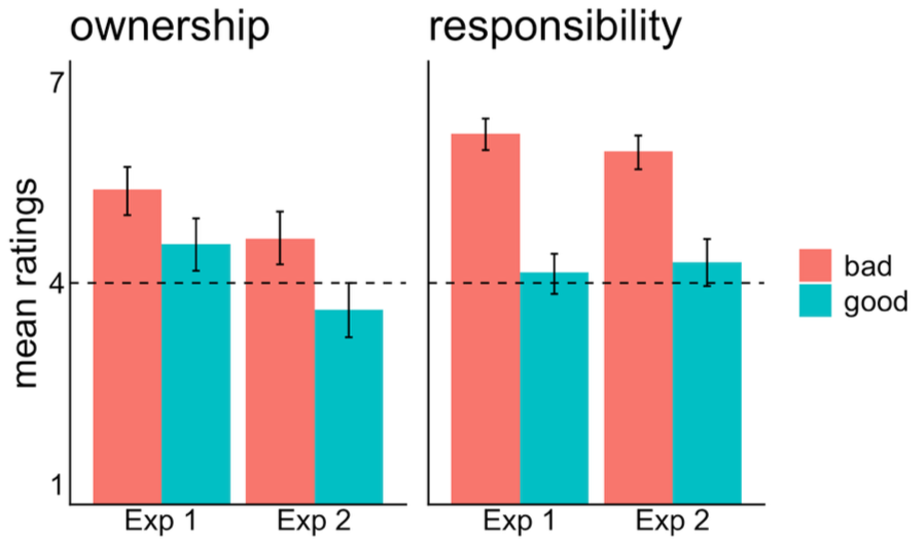
Mean ratings and 95% CI in Experiments 1 and 2. Participants read a vignette where a created agent caused bad or good outcomes. They then rated whether the creation was owned and whether the person who created it was morally responsible (i.e., blameworthy for bad outcomes, praiseworthy for good ones).
Discussion
Participants more strongly agreed that the created agent was owned when it was harmful compared with when it was helpful. In Experiment 1, ownership ratings were quite high across both kinds of outcomes; as Figure 1 shows, the means and 95% CI for both bad and good outcomes were above the scale midpoint. This may have been because the scenario said little about what the created agent was like. In Experiment 2, it was described as resembling a person both physically and in intellectual ability (following Starmans & Friedman, 2016), and ownership ratings were somewhat lower. Participants also saw the inventor as blameworthy when the agent caused harm.
Experiment 3
When participants in the first experiments were asked about ownership, they did not yet know they would also be asked about blame or praise. This raises a concern. When the created agent caused harm, participants might have seen attributing ownership as their only way of expressing that the inventor was blameworthy. If so, maybe they wouldn’t have attributed ownership if they had another way of expressing blame. This kind of concern has been raised about other asymmetries in people’s judgments about negative versus positive outcomes. For example, people are more likely to see the foreseeable side-effect of a decision as intentional if the side-effect is negative rather than positive (Knobe, 2003, 2010). But some researchers have suggested these attributions of intentionality arise only because people have no other way of expressing their condemnation for the agent producing the negative side-effect (Adams & Steadman, 2004a, 2004b; Lindauer & Southwood, 2021; for evidence against this view see Cova et al., 2016; Nichols & Ulatowski, 2007).
To address this concern, we had participants assess ownership and responsibility at the same time (also see Stonehouse & Friedman, 2022). If participants previously said harmful agents were owned only because they had no other way of expressing blame, they should now be less likely to rate these agents as owned. For instance, they should instead affirm Eliza is to blame for harm caused by her creation while denying she owns it.
Methods
Participants
We tested 216 participants (mean age = 39.67 years, SD = 11.11; 88 women, 127 men, and 1 indicating other or preferring not to answer). An additional 16 participants were excluded for failing comprehension questions. A sensitivity analysis revealed we had 80% power to detect a moderate interaction, Cohen’s f = 0.23.
Procedure
Participants read the vignette from Experiment 2 where Eliza creates Krugon, who leaves her lab and either goes on to drown a dog, or to save one from drowning (manipulated between-subjects). Participants then rated their agreement with four statements yielded by factorially crossing two factors: (a) whether Eliza owns Krugon, and (b) whether she is responsible for Krugon’s actions. In the bad condition, the statements specified whether Eliza should be blamed for Krugon’s actions, while in the good condition, they specified whether she should be praised.
The four statements were shown in a matrix grid in this fixed order: “Eliza owns Krugon and should be [blamed/praised] for Krugon’s actions,” “Eliza doesn’t own Krugon but should be [blamed/praised] for Krugon’s actions,” “Eliza owns Krugon but shouldn’t be [blamed/praised] for Krugon’s actions,” and “Eliza doesn’t own Krugon and shouldn’t be [blamed/praised] for Krugon’s actions.” Participants responded on the same 7-point Likert scale used in the previous experiments, ranging from “strongly disagree” (1) to “strongly agree” (7).
Results
Figure 2 shows participants’ responses. There was a main effect of outcome,
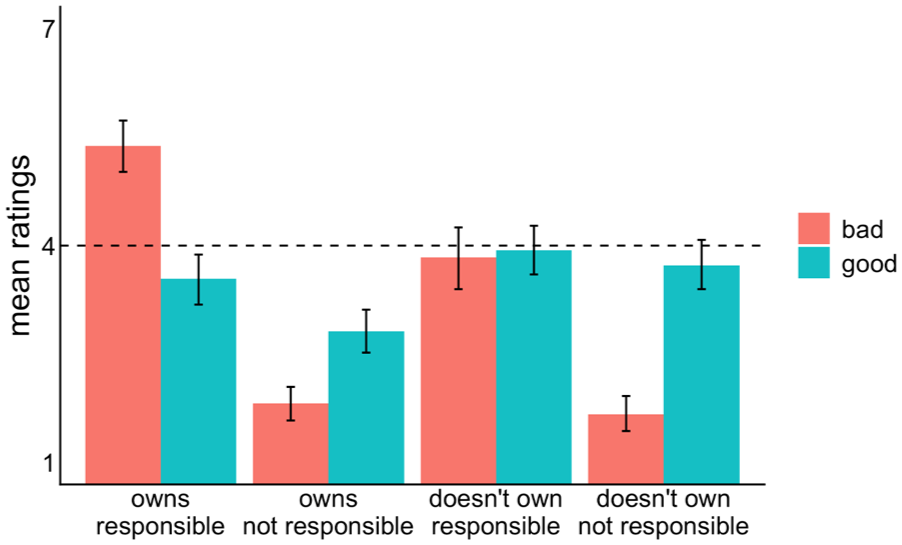
Mean ratings and 95% CI in Experiment 3. Participants read a vignette where a created agent caused bad or good outcomes. They then rated their agreement with four statements about whether the created agent was owned and about whether its creator was responsible for the outcome (i.e., blameworthy for bad outcomes, praiseworthy for good ones).
We followed up on this interaction by separately examining ratings when the outcome was bad and good (adjusting p values for 12 tests). When the creation was harmful, participants most strongly agreed with the statement asserting the creation was owned and that the inventor deserved blame for the harm. They endorsed this statement more strongly than the other three: owns but not blameworthy,
By contrast, when the creation was helpful, ratings did not differ between three statements. The statement affirming ownership and praiseworthiness did not differ from both statements denying ownership—one affirming the creator deserved praise,
Discussion
Participants saw the created agent as owned when it was harmful but not when it was helpful. They likewise saw the inventor as blameworthy when the created agent caused harm. Because participants rated ownership and responsibility simultaneously, these findings rule out the concern that participants saw attributing ownership as their only means of blaming the inventor.
Experiment 4
The findings so far suggest that people are more likely to see created agents as owned if they are harmful rather than helpful. These findings fit the responsibility hypothesis, which posits that ownership attributions sometimes function to mark individuals as responsible for negative outcomes.
However, the findings might also be explained by a motivated reasoning account, which has been used to explain other good–bad asymmetries in moral judgment (Ditto et al., 2009; but see Knobe, 2010). On this account, when people want to blame an individual for harm, this motivation causes them to adjust other judgments to help justify the blame. For instance, people are more likely to blame a speeding driver for a car accident if he was rushing home to hide cocaine rather than a gift for his parents (Alicke, 1992)—presumably, the link to cocaine motivated people to blame him and so they adjusted other judgments accordingly. On this account, participants felt the inventor deserved blame for the negative outcomes, and increased ownership to help justify this blame. 1
In this experiment, we attempted to test the motivated reasoning account. Motivated moral reasoning is often demonstrated by showing that people more strongly connect an individual with negative outcomes if extraneous features of the individual invite blame (e.g., the cocaine in the example of the speeding driver). In our experiments, the body parts used by Eliza could have served as this kind of feature: In the condition with bad outcomes, Eliza made the creature using body parts from prison inmates. Participants might have seen this as reckless and risky since people sometimes see organs as retaining the nature or essence of their original possessors (Hood et al., 2011; Horne & Cimpian, 2019; Meyer et al., 2013). To examine whether this did increase blame, we manipulated whether Eliza used body parts with morally charged histories (as in the previous experiments) or ones with more neutral histories.
We also added a question about the inventor’s control over the creation. If the desire to blame distorts other judgments, as predicted by the motivated reasoning account (Alicke, 2000), participants might see Eliza as having greater control when the creation is harmful. We also made one other procedural change. We asked about ownership using a yes/no question. We wanted to be sure the effect of harmfulness would replicate with a binary measure, since this is how people normally express ownership in daily life (e.g., “That’s his,” “It’s not mine”).
Methods
Participants
We tested 370 participants (mean age = 41.77 years, SD = 13.04; 164 women, 204 men, and 2 indicating other or preferring not to answer). An additional 51 participants were excluded for failing comprehension questions. A sensitivity analysis revealed we had 80% power to detect a moderate-to-small interaction, Cohen’s f = 0.15.
Procedure
Participants again read a vignette where Eliza creates Krugon who then leaves her lab. This experiment used a 2 × 2 between-subjects design. As before, we manipulated the outcome of Krugon’s actions: Krugon either drowns a dog or saves one from drowning. The other factor was the origin of the body parts used to generate Krugon: The body parts either came from prison inmates or organ donors (moralized history) or they were simply described as coming from a morgue (neutral history).
After reading the vignette, participants indicated their agreement with the statement “Eliza owns Krugon” by choosing either “yes” or “no.” Participants then moved to another screen with two questions. One question asked about the inventor’s responsibility for the bad or good outcome (“How much praise does Eliza deserve for what Krugon did?”). The other question asked about the inventor’s control over the agent (“How much control does Eliza have over Krugon?”). Participants answered both questions on 7-point scales ranging from “none” (scored 1) to “a lot” (scored 7).
Results
Figure 3 shows participants’ mean ratings. We first examined ownership judgments using an Outcome × Origin generalized linear model for binomial data. There was a main effect of outcome,
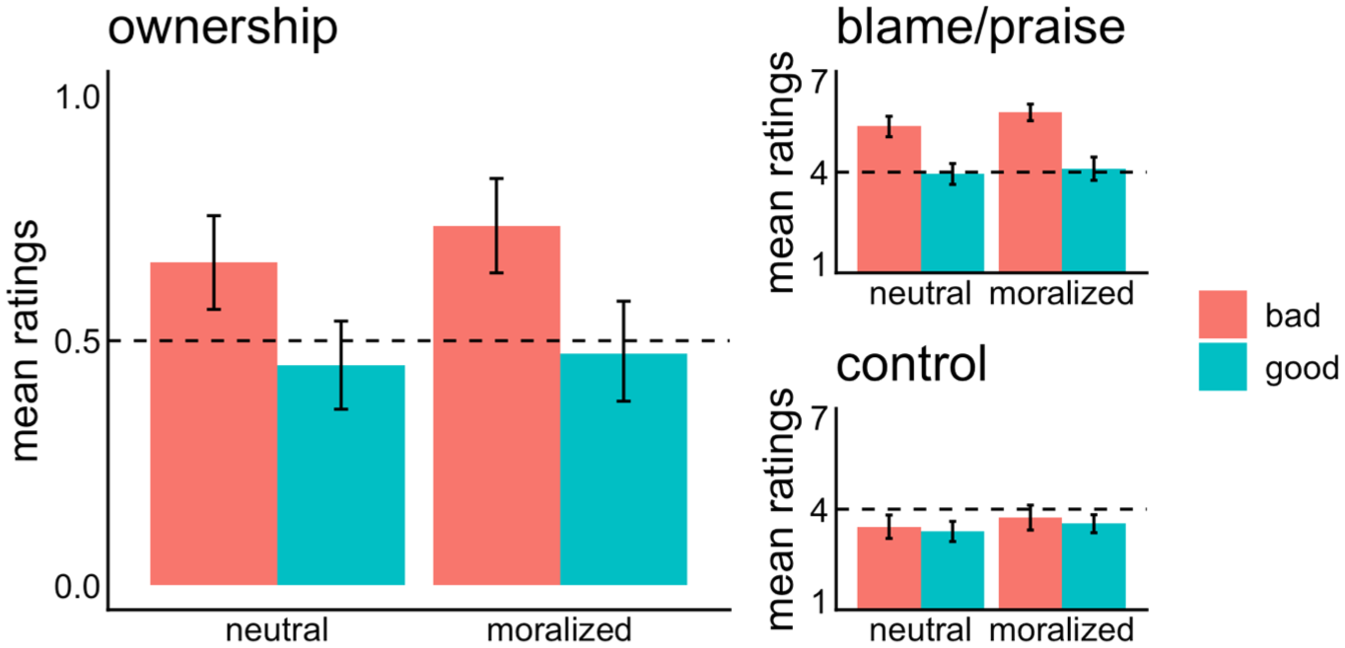
Mean responses and ratings and 95% CI in Experiment 4. Participants read a vignette where a created agent caused bad or good outcomes; the creation was either formed from materials with moralized histories or morally neutral ones. Participants then answered a yes/no question about whether the agent was owned. They also rated whether the creator was morally responsible for the outcome and how much control the creator had over the agent.
We also ran separate outcome × origin ANOVAS to examine ratings of Eliza’s responsibility for the creature’s actions, and her control over it. With responsibility, there was a main effect of outcome,
Discussion
Participants were more likely to say the created agent was owned when it caused harm than when it did good. Their responses were not significantly influenced by the origins of its body parts, and they saw the inventor as having similar control over it across all conditions.
These results cast some doubt on the motivated reasoning account, as it might have predicted a bigger effect of the bad-good manipulation when Eliza made the creation from body parts with moralized histories, and greater attributions of control when the created agent produced harmful outcomes.
Experiment 5
Although the results of the previous experiment cast some doubt on the motivated reasoning account, the results are not decisive. For instance, participants might have been strongly motivated to see the inventor as blameworthy for negative outcomes regardless of whether the body parts had moralized histories—creating a Frankenstein-like agent may seem maximally reckless and risky regardless of whose organs are used. Related to this, caution is warranted because the evidence came from null findings (e.g., the lack of effect of whether the body parts had moralized histories) rather than from significant effects.
To further examine the motivated reasoning account, we next tried a different approach. Participants read vignettes that disclosed the inventor’s intent. Eliza either hoped the created agent would be harmful or that it would be helpful, and this manipulation was factorially crossed with outcome. If participants distort judgments to help justify blame, they should attribute more strongly when bad outcomes result from bad intentions rather than from good ones. In this experiment, we returned to probing ownership using a Likert scale.
Methods
Participants
We tested 402 participants (mean age = 43.84 years, SD = 13.12; 205 women, 190 men, and 7 indicating other or preferring not to answer). An additional 28 participants were excluded for failing comprehension questions. A sensitivity analysis revealed we had 80% power to detect a moderate-to-small interaction, Cohen’s f = 0.14.
Procedure
Participants read a vignette about Eliza and Krugon, with details varying in a 2 × 2 between-subjects design. One factor was outcome: Krugon either drowns a dog or saves one from drowning. The other factor combined Eliza’s intention with the origins of the body parts used to generate Krugon: Eliza either hoped that Krugon would be violent, and used body parts from murderers and robbers, or else she hoped he would be peaceful and used body parts of people who donated their organs to science).
After reading the vignette, participants first rated their agreement with the statement “Eliza owns Krugon” on a 7-point scale ranging from “Strongly disagree” (1) to “Strongly agree” (7). They then rated how much praise or blame (depending on outcome) Eliza deserved, and her control over Krugon. These follow-up questions appeared on separate screens, and participants responded to each on a 7-point scale ranging from “None” (1) to “Complete” (7).
Results
Figure 4 shows participants’ mean ratings. We first examined ownership. An outcome × intention ANOVA revealed a main effect of outcome,
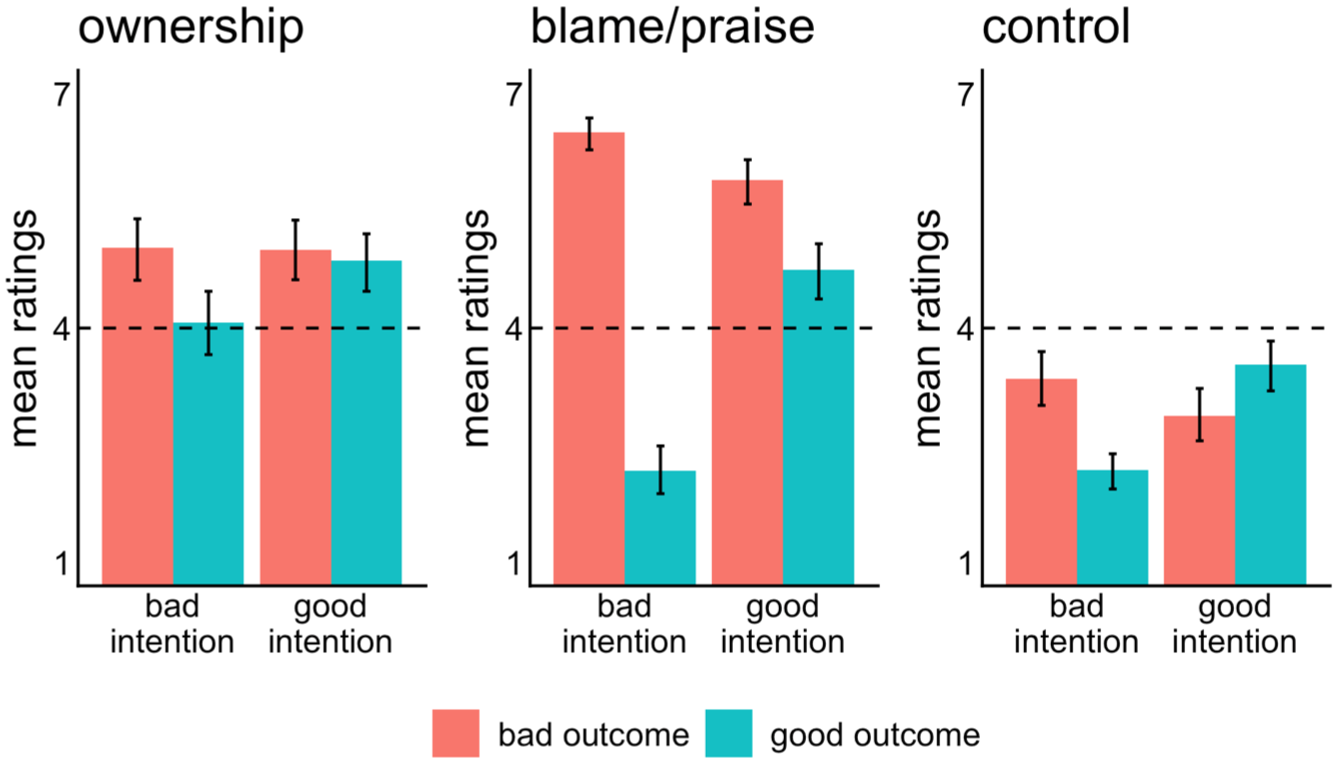
Mean responses and ratings and 95% CI in Experiment 5. Participants read a vignette where a created agent caused bad or good outcomes; the creation was either formed from materials with moralized histories or morally neutral ones. Participants then answered a yes/no question about whether the agent was owned. They also rated whether the creator was morally responsible for the outcome and how much control the creator had over the agent.
Corresponding ANOVAS examined ratings of Eliza’s responsibility for the creatures’ actions, and her control over it. With responsibility, there were main effects of both outcome,
With ratings of control, there was no main effect of outcome,
Discussion
Ownership judgments depended not only on whether the agents produced good or bad outcomes but also on the inventor’s intentions in creating it. When she intended the creation to be harmful, participants attributed ownership more strongly when it was bad rather than good. But when she intended it to be helpful, outcome did not matter and participants generally agreed she owned it.
We manipulated the inventor’s intention to test the motivated reasoning account for the effects of outcome in the previous experiments. On this account, participants attributed ownership for negative outcomes to help justify blaming the inventor. The findings, though, do not fit with the account. It predicted that ownership attributions should be stronger when bad outcomes followed from bad than good intentions, since bad intentions would increase the motivation to blame her. For the same reason, participants’ ratings of control also do not fit with the motivated reasoning account. The account would be supported if control ratings were highest when the motivation to blame the inventor was highest (i.e., when a bad outcome resulted from bad intentions). But we did not find this, and moreover, ratings of control were generally low.
We must acknowledge, though, that we were surprised by the pattern of ownership ratings, and they do not follow in a straightforward way from the responsibility account. We consider potential explanations in the “General Discussion.”
Experiment 6
We next wanted to see if the effect of outcome generalizes to other kinds of creations, including life forms unlikely to be seen as agentic (e.g., a plant or a variety of mold). To this end, we asked participants about four kinds of created entities. Rather than probing ownership judgments using a single question, we instead used three separate questions (for a similar approach with ownership, see Demaree-Cotton & Sommers, 2022). Our goal with this was again, to check whether the effects of outcome on attributions on ownership generalize across different ways of asking about it.
Two earlier experiments in Supplemental Materials also looked at judgments about other kinds of creations. The first found no effect of outcome for robots. In the “General Discussion,” we suggest that this result could stem from people categorizing robots (but not other artificial agents) as human-made artifacts. The second experiment then looked at robots plus other creations and found mixed evidence for effects of outcome. It used a within-subjects design where each participant considered several kinds of creations. This could have focused participants on differences between creations, reducing attention to their actions. For this reason, the present experiment used a fully between-subjects design.
Methods
Participants
We tested 893 participants (mean age = 43.15 years, SD = 13.68; 485 women, 398 men, and 10 indicating other or preferring not to answer). An additional 31 participants were excluded for failing comprehension questions. A sensitivity analysis revealed we had 80% power to detect a small interaction, Cohen’s f = 0.10.
Procedure
Each participant read a vignette in which Eliza produces a new life form, which goes on to leave her lab. The experiment used a 2 × 4 between-subjects design: The creature either did bad or good, and it was either a creature that looked like a cross between a bear and a gorilla, a mold, a land-roving octopus, or a vine. As an example, here is the vignette from the condition where the bear-gorilla causes harm:
Eliza is a brilliant biologist and inventor. After years of work, she produces a new life form. It looks like a cross between a bear and a gorilla. The bear-gorilla is hostile and lacks empathy. One day, an accident allows the bear-gorilla to escape from Eliza’s lab. The bear-gorilla ends up in a small town, where it continues to be hostile. The bear-gorilla does many bad things and harms many people.
After reading the vignette, participants rated their agreement with three statements: “Eliza owns the [creature],” “The [creature] does not belong to anyone” (reverse-coded), and “The [creature] is Eliza’s property.” These statements appeared together in a matrix grid, and participants responded on a 6-point scale ranging from “strongly disagree” (1) to “strongly agree” (6).
Results
The three ownership ratings were averaged to form a single ownership score (Cronbach’s alpha = 0.94); see Figure 5. An Outcome × Creature ANOVA revealed a main effect of outcome,
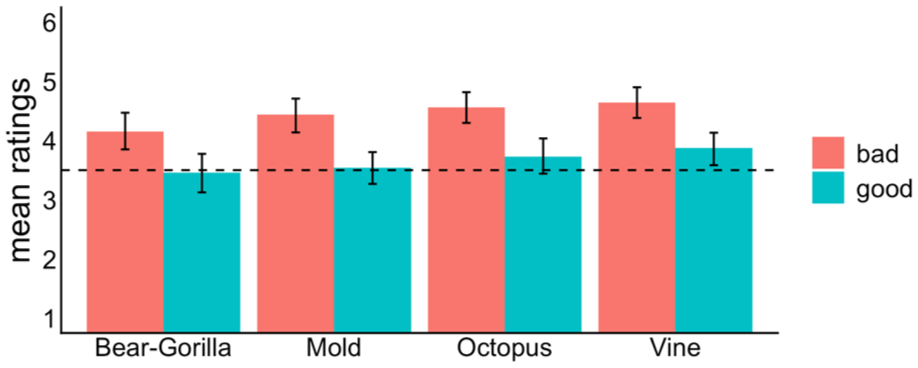
Mean ratings and 95% CI in Experiment 6. Participants read a vignette where a created entity caused a good or bad outcome. Participants then rated three statements about whether the creation was owned. The bars in the graph show responses averaged across these three ratings.
Discussion
Participants more strongly affirmed that creations were owned when they caused harm than when they did good. This effect did not vary across the four kinds of creations.
Experiment 7
The experiments so far focused on people’s judgments of whether created agents and entities are owned. But the experiments did not look at the consequences of ownership, such as whether participants see the inventor as having rights over her creation. We explored this question in our final experiment. Although ownership normally implies rights over possessions, this might not hold for harmful property and also might not hold when ownership serves to convey moral responsibility.
Methods
Participants
We tested 189 participants (mean age = 43 years, 101 women, 88 men, and 0 indicating other or preferring not to answer). An additional 39 participants were excluded for failing comprehension questions or not answering all test questions. A sensitivity analysis revealed we had 80% power to detect moderate-to-small effects of condition, Cohen’s d = 0.41.
Procedure
Participants first read a vignette similar to the ones from the first experiments.
Eliza is a brilliant biologist and inventor. For years she collected the organs from people who [were prison inmates/donated their organs to science]. Then she combined the parts and created a living creature that she calls Krugon. One day, when Eliza is away, Krugon leaves the lab and goes to a nearby pond. Someone’s pet dog is swimming there but is struggling to get back to shore. Krugon sees the dog and rushes into the pond. He [holds the dog underwater, drowning it/pulls the drowning dog to shore, saving its life].
After reading this vignette, they rated their agreement with the statement “Eliza owns Krugon” on a 7-point scale ranging from “strongly disagree” (scored 1) to “strongly agree” (scored 7).
The vignette then continued on a new screen. It described how a circus captured the created agent and featured it in their shows, and that the inventor learned about this.
After saving the dog from drowning, Krugon roams around the park. He continues to [attack and harm the people and animals he encounters/be friendly and kind to the people and animals he encounters]. But soon after, a circus finds Krugon and captures him. They display Krugon to their audiences. Eliza finds out that the circus has Krugon and gets in contact with them.
This was followed by three questions intended to probe beliefs about the inventor’s rights over the created agent. The first question mentioned that the circus made huge profits by showing the created agent and asked if they should share the profits with the inventor. The next question asked if whether the circus should return the created agent if the inventor wanted it back. And the final question asked if the circus would have to compensate the inventor if the created agent died in an accident involving one of their circus trucks. Participants responded to these questions on 7-point scales ranging from “definitely no” (1) to “definitely yes” (7).
Results
Figure 6 shows participants’ mean ratings. In line with the previous experiments, participants more strongly agreed the creation was owned when it was harmful than helpful,
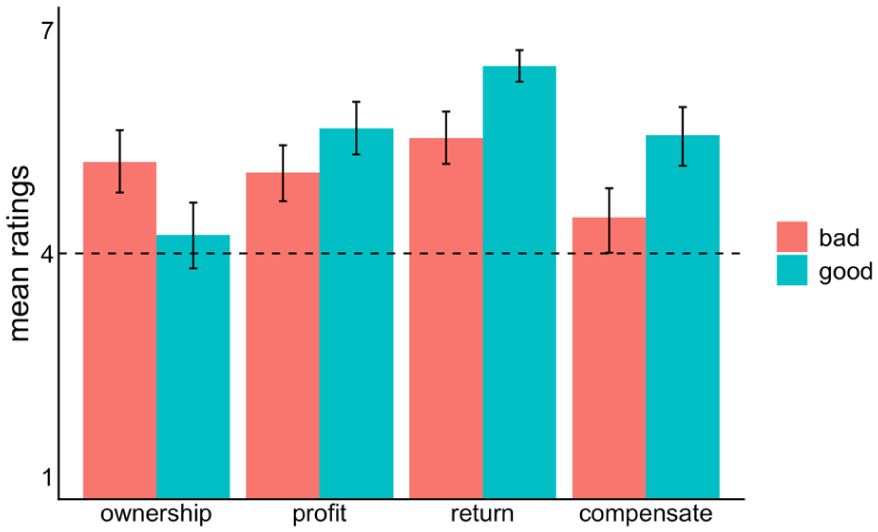
Mean ratings and 95% CI in Experiment 7. Participants read a vignette where a created entity caused a good or bad outcome. Participants then rated whether the creation was owned, and whether the creator had rights over it.
Exploratory Analyses
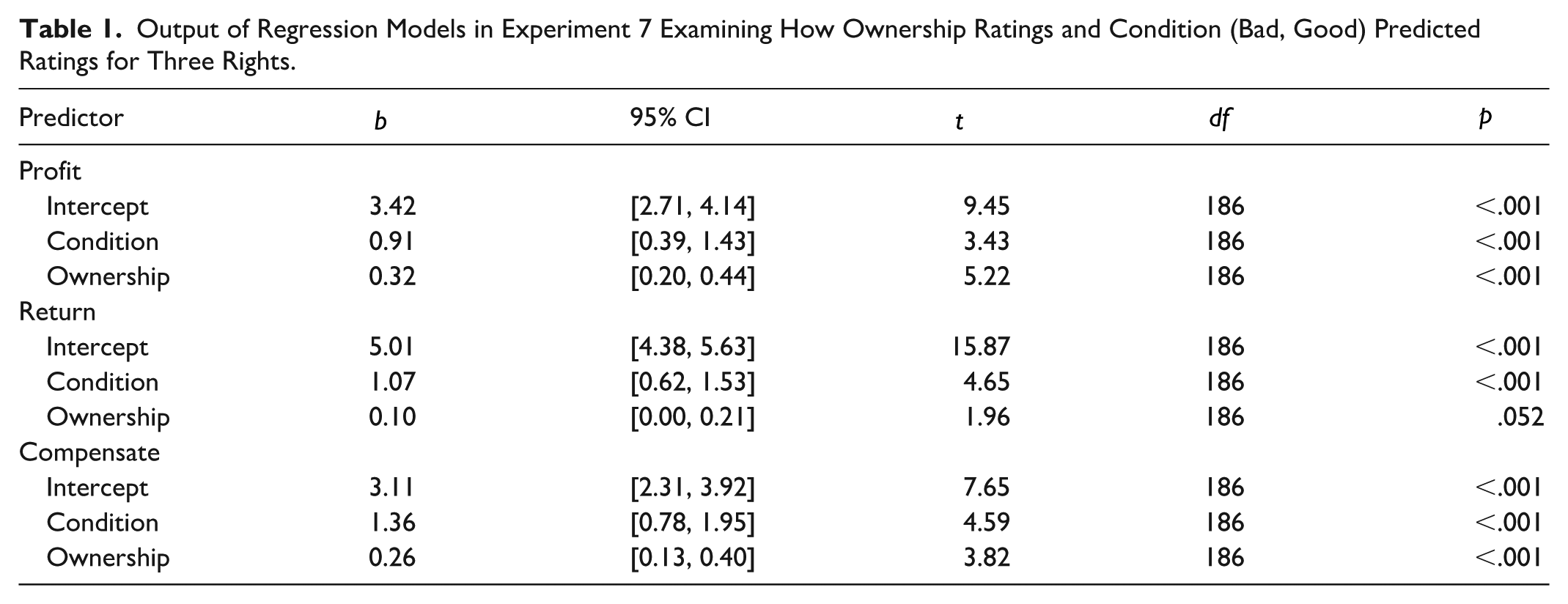
This initial analysis has a major limitation: It does not give a sense of how participants’ ratings of the creator’s rights relate to their ownership judgments. To look at this, we conducted three exploratory regression models to examine how ratings for each right (profit, return, compensate) were predicted by participants’ ownership ratings and by whether the outcome was bad or good. We initially included interaction terms but all were non-significant and so we reran the models without them. Table 1 shows the outputs of the models and Figure 7 shows plots of these results. With each model, there was a significant main effect of condition, all ps < .001. Also, with the rights to profit and compensation there was a significant effect of ownership resulting, ps < .001, because participants who gave higher ownership ratings more strongly endorsed the creators rights. Moreover, as the figure shows, with good outcomes participants endorsed the creator as having rights even when they fully denied her ownership (e.g., when ownership ratings were at floor).
Output of Regression Models in Experiment 7 Examining How Ownership Ratings and Condition (Bad, Good) Predicted Ratings for Three Rights.
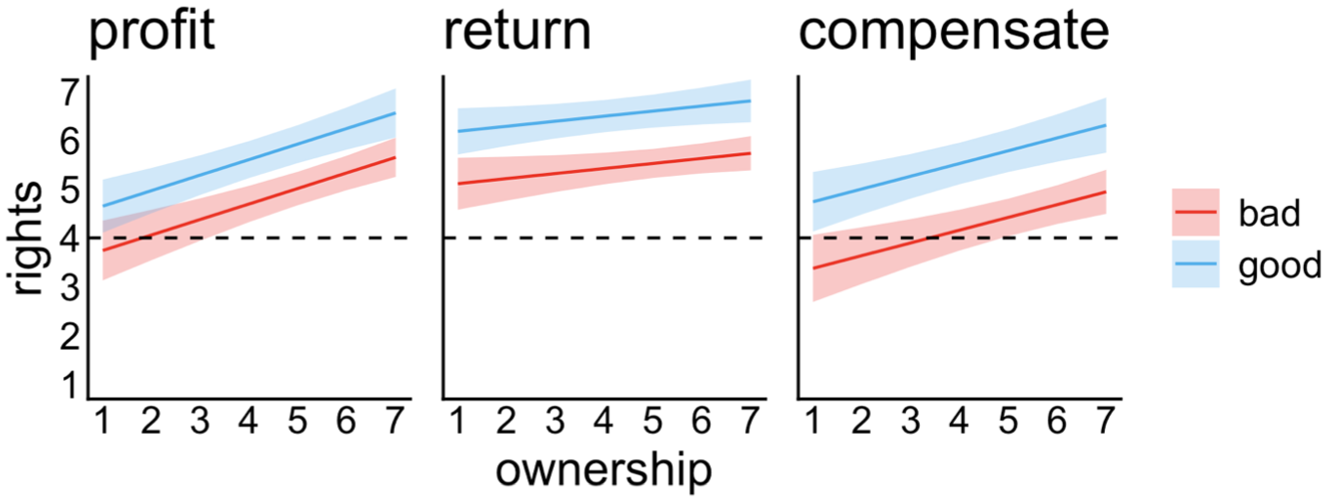
Plots of the exploratory multiple regression models in Experiment 7. These plots show how participants’ ratings of the creator’s rights are predicted by their corresponding ownership ratings and by whether the outcome was bad or good.
Discussion
Participants were again more likely to see the creation as owned when it did harm than good. In this experiment, we also asked about the inventor’s rights over the creation, and participants overall saw the creator as having some rights. For example, they mostly indicated that the inventor was entitled to profits the circus earned by displaying the created agent. This said, participants more strongly endorsed these rights when the creature was helpful rather than harmful, and our exploratory analyses showed this difference across conditions held regardless of whether ownership ratings were high or low.
General Discussion
We examined whether people are more likely to see created agents as owned if they cause harm. In the first five experiments, participants generally showed this pattern when responding to Frankenstein-like stories where an inventor made a humanoid creation from the body parts of dead people. Participants in these experiments also thought the inventor deserved blame for harms caused by the creation, and assigned more blame for harm than praise for good outcomes. The next experiment explored judgments about other kinds of created entities, including non-agentic ones. Participants were again more likely to see these entities as owned when they caused harm, though supplementary experiments suggested that the effect does not extend to robots. In our final experiment, we also asked about the inventor’s rights over the created agent. Overall, participants attributed rights to the inventor and endorsement of these rights was predicted by ownership ratings. But, surprisingly perhaps, participants more strongly affirmed the inventor’s rights when the creation was helpful rather than harmful—that is, they assigned the inventor greater rights in the condition where they were less likely to see the inventor as owning the creation.
Our findings suggest a novel way that harmfulness affects the moral standing of created agents: It increases perceptions that they are property and owned by their creators. This is broadly consistent with previous findings showing that people accord lower moral standing to harmful agents, for instance seeing them as less deserving of protection than other agents (Klebl et al., 2021; Piazza et al., 2014). However, the effect we observed likely reflects a different mechanism. Whereas the earlier findings might be explained by stripping harmful agents of their rights, the effect we observed even applied to non-agentic entities (e.g., vine and mold), which are not normally accorded rights. So while the findings suggest that harmfulness does change moral standing—by increasing the perception that created entities are owned property, the primary mechanism may be more general.
The findings are also informative about the psychology of ownership. Participants’ judgments contrasted with the tendency for harmfulness to work against ownership—as in the restrictions on owning things that can cause harm (weapons) and things whose ownership would be harmful (e.g., endangered species). Some earlier findings suggested that harmfulness increases judgments about the ownership of things akin to litter and dumped waste (Stonehouse & Friedman, 2022). With those results, one concern was that judgments might be restricted to things that resemble litter and dumped waste—things that need to be cleaned up. The present findings show the effect of harm on ownership is more widespread. The findings of the final experiment likewise provide preliminary evidence that ownership status may sometimes only partially align with rights often linked with ownership. This is noteworthy because accounts of ownership often center on the idea that ownership chiefly serves to dictate who can access what (Merrill, 1998; Snare, 1972). Part of the explanation here, though, could be that participants based their assessments of rights on factors besides ownership. For example, when judging whether the inventor deserved profits derived using the creation, participants might have considered what might be called creator’s rights. In line with this, people sometimes see artists as retaining certain rights over their creations even after these are purchased by other people (Boyle et al., 2009; Spellman & Schauer, 2008).
Why Does Harm Increase Judgments of Ownership?
One explanation for the effect of harm on ownership relates to functions of ownership. Besides dictating who can access valued resources (Merrill, 1998; Snare, 1972), ownership also brings responsibility since owners are accountable when their property causes harm (Dan-Cohen, 1992; Waldron, 1985). Discussions of this form of responsibility are even found in ancient legal texts from both the Near East and China (Sznycer & Patrick, 2020; Yaron, 1966). In itself, the idea that owners are responsible for their property does not imply greater ownership for harmful things. But attributing ownership might serve the additional function of marking or tagging individuals as blameworthy or liable for harm. This account might help explain why judgments of ownership status and rights were only partially aligned. Based on the kind of property under consideration, different functions or aspects of ownership may come to the fore. With desirable things, people may focus on rights; with undesirable or even dangerous things, responsibility and perhaps even stewardship may dominate. Consistent with this, the law often allows both officials and even sometimes regular individuals to destroy owned property that poses serious harm to others (e.g., destroying infected plants to avoid the spread of disease; killing escaped rodents to prevent them from damaging crops), typically without requiring owners to be compensated (Alstyne, 1968; Hall, 1906; Shauer, 2022).
Not all findings, however, were consistent with this account. Most notably, in the conditions, in the fifth experiment, where the inventor had good intentions, participants attributed ownership at similarly high rates regardless of whether the outcome was bad or good. This finding surprised us and warrants further investigation. For now, one entirely speculative explanation is that the combination of good intentions and good outcome counteracted participants’ misgivings about viewing created agents as owned. Also, clearer support for the responsibility account would require looking at situations where the created agent is neither helpful nor harmful. This would help determine if harmfulness is really what drives the effect (as opposed to helpfulness reducing attributions of ownership).
Other accounts might also explain the effect of harmfulness on ownership. One alternative we considered is that when people are motivated to blame someone for harm, this leads them to adjust other judgments to help justify and increase the blame (Alicke, 1992). So perhaps motivation to blame the inventor led people to increase their attributions of ownership. We cannot conclusively rule out this account but several findings cast doubt on it. Although harmfulness increased judgments of ownership, it did not correspondingly increase ratings of the inventor’s control over the creation, even though greater control would make the inventor seem more blameworthy (Alicke, 2000). Also, motivated moral reasoning is often thought to be driven by extraneous features which invite blame. But we did not find increased attributions of ownership when we manipulated whether the scenarios included such features. Ownership ratings did not vary based on whether the inventor used body parts with moralized histories or not, and were not greater when harmful outcomes result from bad rather than good intentions.
Another explanation is inspired by work showing that people say that agents produced outcomes (in comparison with good ones) intentionally (Knobe, 2003, 2010), freely (Feldman et al., 2016; Phillips & Knobe, 2009; Young & Phillips, 2011), and with foresight (Beebe & Buckwalter, 2010). Although participants did not see the inventor as having more control over the creation when it was bad than good, they might have seen her as more of a cause of its nature (see Hitchcock & Knobe, 2009). Future work could follow up on this possibility by probing judgments of both causal and moral responsibility, alongside judgments of blame (as in Lagnado & Channon, 2008). This account also raises the more general question of whether and how our findings relate to other good–bad asymmetries in people’s judgments (Anderson et al., 2020; Koch et al., 2016; Newman et al., 2013; Sussman & Oppenheimer, 2020).
Scope
Across the experiments, we probed judgments of ownership in varied ways. Participants rated agreement with statements on Likert scales, including statements about ownership alone (e.g., “Eliza owns Krugon”) and statements simultaneously about ownership and moral responsibility (e.g., “Eliza doesn’t own Krugon but should be blamed for Krugon’s actions”). They also responded to yes/no questions about ownership, and in one experiment we derived ownership scores by averaging ratings for three different statements, including ones using other terms (e.g., “The [creature] is Eliza’s property”). The main motivation behind probing judgments about ownership in these different ways was to be sure that the results were not an artifact of one particular method of probing judgments. One concern was that participants might see the question about ownership as their only opportunity to express the inventor’s responsibility. Against this concern, though, participants continued to judge that harmful creations were owned even when they could blame the creator while denying ownership.
The effect of harmfulness on ownership also held across a broad range of created entities, though with some exceptions. Harmfulness affected judgments for creations resembling humans and animals, and for non-agentic creations like the vine and mold (at least when we used a between-subjects design). But the experiments in the supplementary experiments did not find an effect for robots. This difference could come down to the distinction between artifacts and natural kinds. Robots are typically made of metal and are made by people, and participants might have seen them as straightforward artifacts. The other creations, despite being the products of human labor, looked like natural kinds. So participants might have seen them as natural kinds, or as blurring the distinction between artifacts and natural kinds (Sperber, 2007).
But why should this distinction between artifacts and natural kinds matter? One reason is that people may be more likely to assume things are owned if they are artifacts rather than natural kinds (Neary et al., 2012). On this account, categorizing robots as natural kinds might have produced a ceiling effect in ownership ratings for robots, leaving no room for harmfulness to sway their ratings. Another explanation, though, connects to people’s tendency to see artifacts as mutable, but natural kinds as having comparatively immutable inner natures or essences—as when people affirm that a coffee pot can be physically transformed into a bird feeder, but deny that a raccoon can be physically transformed into a skunk (Keil, 1989). Given this background, participants might have attributed negative moral natures or essences to the biological created agents but without seeing the harmful robots as inherently bad. If so, greater ownership for harmful creations could relate to moral essentialism (Martin & Heiphetz, 2021): People might only attribute increased ownership for inherently bad or harmful creations (i.e., and not ones that just happen to cause harm).
Regardless, this difference across agents raises questions about how harmfulness could affect ownership judgments for other potential creations, including generative AI systems. Although these require computer hardware, they might not be perceived as artifacts in the same way as robots, since they are not normally localized in a particular object or body. Indeed, their seeming disembodiment (combined with their abilities) could potentially reduce the impression that they can be owned at all. Many discussions of generative AI systems in relation to ownership focus on the different question of whether they have any ownership of the intellectual content they create or help create (Bozkurt, 2024; Brown, 2020). So besides the question of whether harmfulness will affect judgments of whether they are owned, a further question is whether the harmfulness of the content they create might increase perceptions of these systems as owners.
Our findings also raise more general questions about the extent to which harmfulness affects judgments of ownership. This effect is unlikely to arise in situations where ownership is clear-cut, and all other factors suggest something is either owned or not owned. But ambiguity about whether things are owned, and by who is common, since ownership often depends on conflicting cues and principles (Demaree-Cotton & Sommers, 2022; DeScioli & Karpoff, 2015; DeScioli et al., 2017; Friedman et al., 2010; Nichols & Thrasher, 2023; Zhang et al., 2024; see Boyer, 2022 for related discussion), which are weighted differently across cultures (Haynie et al., 2023; Rudmin, 1992) and across the lifespan (Noles & Keil, 2011; Olson & Shaw, 2011; Starmans & Friedman, 2023). So further work will be needed to see if these other kinds of ambiguity also make room for harmfulness to increase ownership.
Supplemental Material
sj-docx-1-psp-10.1177_01461672261439251 – Supplemental material for The Moral Standing of Created Agents: Bad Is More Owned Than Good
Supplemental material, sj-docx-1-psp-10.1177_01461672261439251 for The Moral Standing of Created Agents: Bad Is More Owned Than Good by Emily E. Stonehouse and Ori Friedman in Personality and Social Psychology Bulletin
Footnotes
Funding
The authors disclosed receipt of the following financial support for the research, authorship, and/or publication of this article: This research was funded by a grant from the Social Sciences and Humanities Research Council of Canada awarded to OF.
Declaration of Conflicting Interests
The authors declared no potential conflicts of interest with respect to the research, authorship, and/or publication of this article.

Data Availability Statement
Supplemental Material
Supplemental material is available online with this article.
Notes
References
Supplementary Material
Please find the following supplemental material available below.
For Open Access articles published under a Creative Commons License, all supplemental material carries the same license as the article it is associated with.
For non-Open Access articles published, all supplemental material carries a non-exclusive license, and permission requests for re-use of supplemental material or any part of supplemental material shall be sent directly to the copyright owner as specified in the copyright notice associated with the article.
