




Abstract
Whose welfare and interests matter from a moral perspective? This question is at the center of many polarizing debates, for example, on the ethicality of abortion or meat consumption. A widely cited hypothesis holds that attributions of moral standing are guided by which mental capacities an entity is perceived to have. Specifically, perceived sentience (the capacity to feel pleasure and pain) is thought to be the primary determinant, rather than perceived agency (the capacity to navigate the world and social relationships) or other abilities. This has been described as a general feature of moral cognition, but the evidence for this is mixed and overwhelmingly based on Western participants. Here, we examined the link between attributions of mind and moral standing across six culturally diverse countries—Brazil, Nigeria, Italy, Saudi Arabia, India, and the Philippines—using a sample of 1,255 participants (aged 18–74 years old) who were recruited via the online platform Toloka. In every country, entities’ moral standing was most strongly related to their perceived sentience.
Does a 1-month-old embryo have the right to live? Is it wrong to slaughter a chicken? What is the moral status of advanced artificial intelligence systems? The question of whose welfare and interests matter from a moral perspective is at the center of many contentious debates. In the present study, we examine in a cross-cultural study with participants from six diverse cultures (N = 1,255) how people attribute moral standing.
Moral Standing and Mind Perception
If we think it is our moral obligation to take an entity’s welfare and interests into account, then this entity is said to have moral standing (Jaworska & Tannenbaum, 2021; Singer, 1981). Entities that are perceived to have greater moral standing are generally granted more rights, freedoms, and protections. In moral philosophy, two viewpoints dominate the debate about what determines whether an entity should have moral standing (Jaworska & Tannenbaum, 2021). Utilitarian philosophers usually focus on how actions affect people’s happiness and other affective states. Many therefore argue that sentience (i.e., the capacity to experience pleasure, pain, and other valenced affective states) is a necessary and sufficient condition for moral standing (Bentham, 1789; Singer, 1981). Deontologists and contractualists, on the other hand, view morality as “a system of rules to govern the actions of rational agents within society” (p. 98, Carruthers, 1992; also see Kant, 1785). Therefore, only entities that possess agency and rationality (i.e., entities who are able to form relationships and pursue goals) are deemed morally relevant.
Although philosophers have debated the normative question (what should determine moral standing?) for centuries, the descriptive question (what determines laypeople’s attributions of moral standing?) has received less attention. In their seminal study, H. M. Gray et al. (2007) asked participants to what extent 13 entities (e.g., a baby, a robot) possess different mental capacities. Two factors emerged, which broadly captured the two primary viewpoints in moral philosophy and which the authors labeled “experience” and “agency.” Experience includes the capacities to feel pain and pleasure—we use the term “sentience” here—and agency includes the capacities for communication, planning, and morality. Crucially, participants also rated the moral standing of the entities (e.g., how wrong it would be to harm the entity). Attributions of moral standing were significantly correlated with both mind dimensions, but the association was much stronger for perceived sentience (r = .82) than for perceived agency (r = .22; H. M. Gray et al., 2007).
Later studies provided additional support for the idea that people attribute greater moral standing to entities if they are perceived to have more complex minds (K. Gray et al., 2011, 2012; Klebl et al., 2021; Piazza et al., 2014). Similar results were found in experimental studies, in which real animals, fictitious animals, or robots were described as having or lacking different mental capacities (Jack & Robbins, 2012; Ladak et al., 2023; Nijssen et al., 2019; Piazza et al., 2014; Sytsma & Machery, 2012). These findings have been used to build general theories of (and make general claims about) the basic structure and function of morality, including the strong claim that “mind perception is the essence of morality” (K. Gray & Schein, 2012; K. Gray et al., 2012). We see such a strong conclusion as premature for three reasons.
First, virtually all studies that examined the relation between mind perception and moral standing were conducted with participants from North America or Europe (e.g., H. M. Gray et al., 2007; Klebl et al., 2021; Ladak et al., 2023; Piazza et al., 2014; Sytsma & Machery, 2012). Moral beliefs and values—and the factors that are believed to shape them, such as ecological variables, political institutions, and religious beliefs—vary considerably across different cultures (Atari et al., 2023; Graham et al., 2016). Studies with more diverse participant samples are needed to test whether the link between mind perception (and perceived sentience in particular) and attributions of moral standing truly is a general feature of moral cognition that emerges across cultures.
Second, although evidence for a general association between mind perception and attributions of moral standing appears strong, evidence on the relative importance of perceived sentience and agency is less consistent. Although perceived agentic capacities were positively related to attributions of moral standing in some studies (Jack & Robbins, 2012; Piazza & Loughnan, 2016; Piazza et al., 2014; Sytsma & Machery, 2012), this association did not replicate in others (Jack & Robbins, 2012; Nijssen et al., 2019; Piazza et al., 2014; Sytsma & Machery, 2012). In contrast to H. M. Gray et al.’s (2007) earlier work, some studies found a significant association for perceived agency, but not perceived sentience (Henseler Kozachenko & Piazza, 2021; Wilks et al., 2021). Others found significant associations for both dimensions, but the association for perceived agency was stronger (Piazza et al., 2014; Sytsma & Machery, 2012).
Third, studies that sampled much larger sets of mental capacities found evidence for a three-dimensional model of mind perception (Malle, 2019; Weisman et al., 2017, 2021). The first dimension (Malle, 2019; Weisman et al., 2017, 2021) mapped onto the first dimension of H. M. Gray et al.’s (2007) model and captured capacities for affective experiences (which we call sentience). However, capacities that were included in H. M. Gray et al.’s (2007) agency dimension separated into two distinct factors that were characterized by more basic agentic capacities necessary for sensing and navigating the world, which we call perceptual-cognitive agency (e.g., seeing, remembering, reasoning), and the social-cognitive capacities necessary for interacting with others, which we call sociomoral agency (e.g., empathy, feeling guilt, telling right from wrong). 1 Distinguishing between these factors is also relevant from a theoretical perspective. In moral philosophy, nonutilitarian views often focus on agentic capacities as the grounds for moral standing (Jaworska & Tannenbaum, 2021). Whereas some accounts focus specifically on sociomoral capacities that allow entities to set up, monitor, follow, and enforce the rules that govern social interactions (Carruthers, 1992), others also focus on nonsocial capacities, such as an entity’s basic capacity to have goals and to reason rationally (Kant, 1785).
The Present Study
In short, it remains unclear (a) whether perceived agency influences attributions of moral standing, (b) whether results diverge for perceptual-cognitive and sociomoral agentic capacities, (c) whether perceived sentience is more strongly associated with attributions of moral standing than other dimensions, and (d) how consistently these patterns emerge across different (non-Western) cultures. To address these questions, we conducted a cross-cultural study (N = 1,255) with participants from six countries: Brazil, India, Italy, Nigeria, the Philippines, and Saudi Arabia. We did not have specific hypotheses regarding how the relation between perceived mental capacities and moral concern would differ between these countries. Rather, our goal was to select a relatively diverse set of countries to explore how large cross-cultural differences can be, and to provide a contrast to the largely culturally homogenous participant sampling in previous work. We measured perceived mental capacities (sentience, perceptual-cognitive agency, and sociomoral agency) and attributions of moral standing for a relatively large and diverse set of entities. This allowed us to test how strongly each mind dimension is associated with moral standing and how consistent these associations are across culturally diverse samples.
Research Transparency Statement
General disclosures
Study 1 disclosures
Method
We used the participant recruitment platform Toloka (https://toloka.ai/), which offers access to participants from various countries. Our selection of countries was guided by three considerations. First, as the size of the participant pool on the platform was unclear, we selected countries with relatively large populations. Second, given that there is little cross-cultural data on the phenomena tested here, we selected countries with considerable geographical and cultural differences. Following this “maximum variation sampling” approach (Suri, 2011) allowed us to conduct a stronger test of whether considerable cross-cultural differences exist and how large such differences can be. For example, finding few differences between Italy and India would be more surprising than finding few differences between Italy and Spain. Third, we selected countries that were geographically and culturally distant from the United States in particular (where most prior work was conducted).
We recruited participants from six countries: Brazil, India, Italy, Nigeria, the Philippines, and Saudi Arabia. Ecological factors, religious beliefs, and political institutions have been shown to explain cross-cultural differences in moral values and behavior (Graham et al., 2016). We therefore selected countries from four continents (South America, Africa, Europe, and Asia) with very different ecologies. We included one country with a nondemocratic political system (Saudi Arabia), and we sampled at least one country in which one of the three major world religions is most prevalent (Christianity in the Philippines, Islam in Saudi Arabia, Hinduism in India). The percentage of participants who identified as religious also varied across the six countries (from 35% in Italy to 83% in India). Descriptive statistics are reported in Table 1. Although our samples were not nationally representative, they were more diverse than (and culturally very different from) participant samples in previous studies on this topic.
Demographic Characteristics of Participants in Our Entire Sample and Within Each Country-Specific Sample
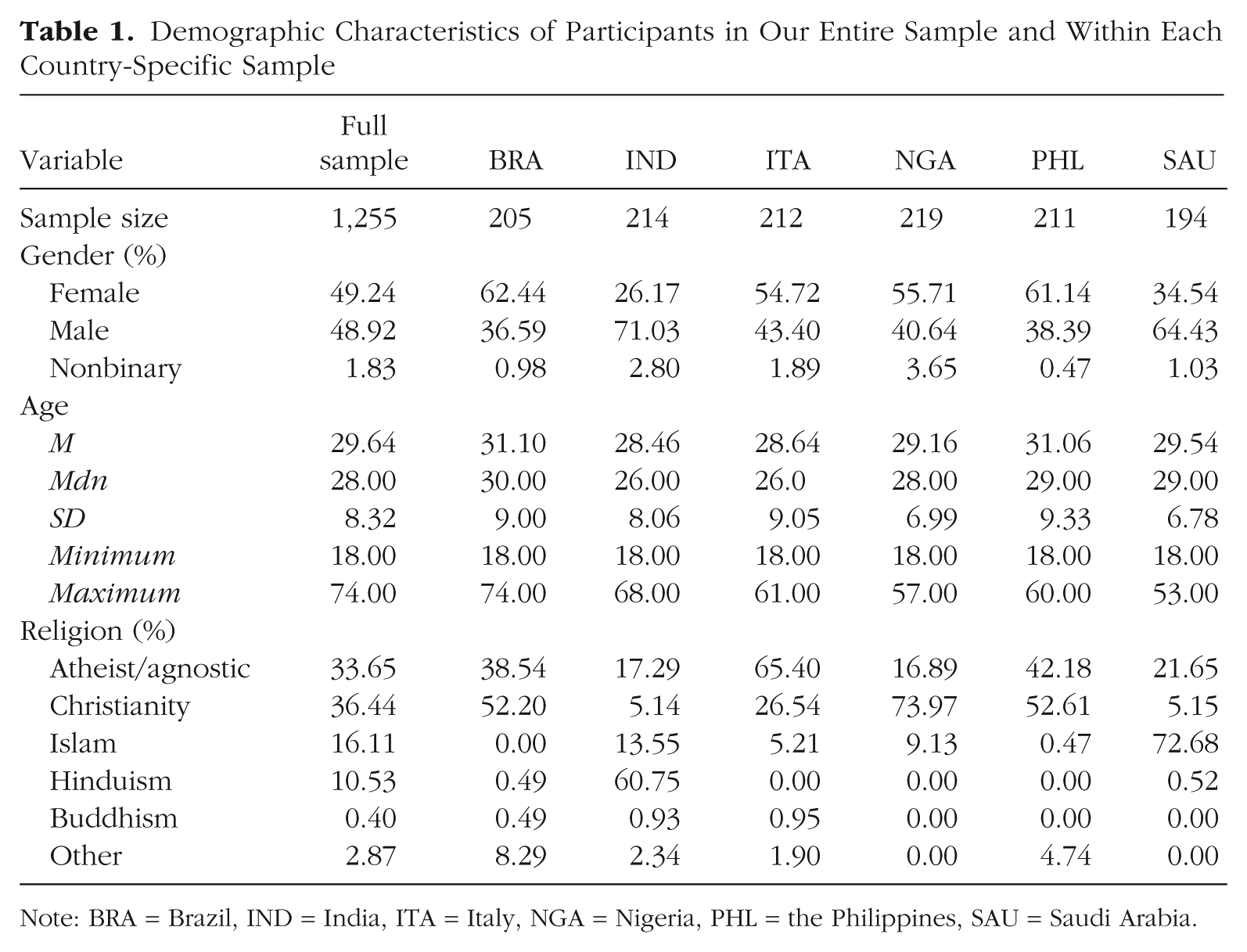
Note: BRA = Brazil, IND = India, ITA = Italy, NGA = Nigeria, PHL = the Philippines, SAU = Saudi Arabia.
According to the multidimensional cultural-distance metric developed by Muthukrishna et al. (2020), the sampled countries had moderate-to-high distance scores to the United States (Italy: 0.063, Brazil: 0.074, India: 0.083, the Philippines: 0.116, Saudi Arabia: 0.129, Nigeria: 0.157). For comparison, the estimated cultural distance score is 0.019 for the United States and Canada and 0.152 for the United States and China.
We planned to recruit 200 participants per country. Even though this sample size was requested on the platform, we received slightly more responses from five countries. Data collection for Saudi Arabia took significantly longer, suggesting a smaller available participant pool. We stopped data collection after 20 weeks after not receiving data from any additional participant for 7 days, which resulted in a final sample size that was slightly below our target (n = 194). A total of 1,336 participants completed the study (305 additional participants opened the study but did not complete it, and their data was deleted). We excluded from analysis data from 41 participants (3.07%) who indicated that they are not living in one of the six countries that were targeted, 28 participants (2.10%) who indicated having only poor English proficiency, 13 participants (0.97%) who indicated being younger than 18 (even though we targeted only participants above the age of 18 via the platform), and 5 participants (0.37%) who did not pledge at the beginning of the study to complete it in a careful way. Some participants failed multiple inclusion criteria, leaving a final sample of 1,255 participants (Mage = 29.64 years, SDage = 8.32; 49.24% female, 48.92% male, 1.83% nonbinary; 33.65% atheist/agnostic, 36.44% Christian, 16.11% Muslim, 10.53% Hindu, 0.40% Buddhist, and 2.87% from another religion). All participants provided informed consent prior to participation. The study design was reviewed and approved by the local ethics review board (code: TSB_RP1173).
Target Entities
Participants rated perceived mental capacities and moral standing for a diverse set of 14 entities: a typical human adult, a human adult in a coma, a 1-month-old human embryo, a 1-week-old human baby, a 1-year-old human child, a chimpanzee, a dog, a pig, a bird, a fish, a fly, Siri (Apple’s artificial intelligence), a tree, and a rock. Many previous studies had examined the relation between mind perception and morality for one specific target (e.g., artificial intelligence, a fictitious alien species, a specific animal) or a group of animals (Ladak et al., 2023; Nijssen et al., 2019; Potocka & Bielecki, 2023a, 2023b; Sytsma & Machery, 2012). However, our goal was to sample a wider range of entities that included humans, nonhuman animals, plants, a nonliving entity, and artificial intelligence. We sampled entities that were expected to score very high (e.g., a typical human adult) and very low (e.g., a rock) on mental complexity. We also explicitly sampled entities that were expected to score relatively high on sentience but relatively low on agency (e.g., a 1-week-old baby) or vice versa (e.g., artificial intelligence). We also included entities for which many people have conflicting intuitions, or which are at the center of moral debates (i.e., a human embryo, a human in a coma, an artificial-intelligence system). Thus, similar to the study by H. M. Gray et al. (2007), we employed a relatively large and diverse set of targets.
Measures and procedure
Mind perception
Studies that sampled the largest number of mental capacities—40 in the study by Weisman et al. (2017), and 42 in the study by Malle (2019)—found evidence for a three-dimensional structure. One dimension showed strong overlap with the experience dimension found by H. M. Gray et al. (2007), including capacities for feelings of pleasure, pain, and other affective states. The other two dimensions represent capacities for perceptual-cognitive agency (e.g., memory, communication, sound detection), and sociomoral agency (e.g., morality, perspective-taking, embarrassment). These capacities were often combined in a single agency dimension in prior work (H. M. Gray et al., 2007; Piazza et al., 2014).
In the present study, we therefore measured perceptions of three dimensions of perceived mental capacities, which differ in their moral relevance according to different normative theories in moral philosophy and which emerged as separate factors in the largest factor-analytic studies on mind perception (Malle, 2019; Weisman et al., 2017). We selected three mental capacities to capture each of the dimensions: the capacities to feel pain, to experience fear, and to feel pleasure capture perceived sentience; the capacities to remember things, to detect sounds, and to communicate with others capture perceived perceptual-cognitive agency; and the capacities to tell right from wrong, to understand how others are feeling, and to feel embarrassed capture perceived sociomoral agency.
Previous studies varied considerably in which mental capacities they examined and which capacities showed the strongest factor loadings on each dimension. We selected these specific capacities on the basis of five theoretical and empirical considerations. We prioritized capacities that (a) were measured in multiple prior studies and that (b) were among the capacities that loaded most strongly on the intended dimension. Because of the larger samples of mental capacities and target entities, we (c) prioritized results from Weisman et al. (2017) over those of Malle (2019), which were prioritized over those of H. M. Gray et al. (2007). We selected capacities that (d) clearly map onto the theoretical construct of interest, but we also (e) avoided redundant items and selected capacities that cover different aspects of a theoretical dimension (our selection procedure is outlined in more detail in the Supplemental Material available online).
On a given trial, participants were asked to picture one of the 14 entities and then rate the entity on the nine mental capacities (the order in which the entities and mental capacities were displayed was randomized). Specifically, they were asked to indicate their agreement with nine statements, such as “An [entity] can feel pain” on a 7-point Likert scale that ranged from 1 (strongly disagree) to 7 (strongly agree). We averaged the items to create three composite scores for perceived sentience (McDonald’s ω = .92), perceptual-cognitive agency (ω = .89), and sociomoral agency (ω = .90). Internal consistency estimates for the three measures were also high when analyzing each country separately (see the Supplemental Material). Correlations between the three dimensions, averaged across the 14 entities, were relatively strong (sentience and perceptual-cognitive agency:
Moral standing
There is no widely agreed-upon standard for measuring attributions of moral standing. Sometimes participants are prompted to place entities in a moral circle (Crimston et al., 2016) or to allocate a fixed budget of “moral units” among entities (Waytz et al., 2019). Most commonly, participants are asked to rate the moral standing of entities on a continuous scale, but the content of the question varies a lot. Some studies used abstract terms and asked how much an entity “deserves moral treatment” or how obligated participants feel to “show moral concern for the welfare and interest” of an entity (Jaeger & Wilks, 2023; Loughnan et al., 2010). Others used narrower and more concrete examples of moral transgressions, asking participants to rate how wrong or unpleasant it would be to harm the entity (H. M. Gray et al., 2007; Piazza et al., 2014). Here, we opted for the latter approach. As our primary measure, we asked participants to rate their agreement with the statement, “It is morally wrong to harm [entity]” on a 7-point Likert scale that ranged from 1 (strongly disagree) to 7 (strongly agree). We reasoned that abstract questions might be difficult to understand for some participants (most of the participants were not native English speakers). Although there are other moral rights and freedoms that may be infringed upon for an entity with moral standing, harm (and the moral obligation to not cause unnecessary harm) is a central aspect of moral cognition and behavior (Atari et al., 2023; Schein & Gray, 2018). Previous work has also suggested that questions like the one used here correlate strongly with more abstract questions (Piazza et al., 2014).
We also included a secondary measure of moral standing (analyses are reported in the Supplemental Material) to test whether we would find converging results. Participants read: “In some difficult situations, one cannot help everyone. Sometimes one can only save the life, treat the illness, or relieve the pain of some, but not others. For example, imagine a situation in which you could only help one of two beings. You could either save the life of a cat or a mosquito. Which one would you save?” Participants then saw a randomly ordered list of the 14 entities, and they were asked to rank the entities in the order in which participants would save them. Thus, the entity that was dragged to the highest position would be saved first, and the entity that was dragged to the lowest position would be saved last. We reverse-coded the values so that higher values correspond to a stronger prioritization of the entity. Participants completed the two measures of moral standing in a random order, and we also randomized whether participants first completed the mental-capacity questions and then the moral-standing questions or the other way around.
Analysis approach
All analyses were conducted in R (R Core Team, 2024). We estimated a series of cross-classified multilevel regression models with random intercepts per participant and entity using the lme4 (Bates et al., 2015) and lmerTest packages (Kuznetsova et al., 2017). When analyzing the pooled data across all six countries, we also included random intercepts per country. We also estimated models that included random slopes for the fixed effects, but the models did not converge. Because some participants may on average give higher mind ratings, we participant-centered and then z-standardized these variables. Thus, our models show the change in moral standing that is associated with a 1-SD increase in perceived mind for a given participant.
In general, our goal was to examine associations between mind perception and attributions of moral standing in our entire sample and in each of the six countries. Table 2 provides an overview of the seven tests that we conducted in each country and in the full sample. We first examined the association between general mental complexity (i.e., a higher score across the three mind dimensions) and attributions of moral standing. Considering previous work, we expected to find a positive association. Then, we predicted moral standing with scores on the three mind dimensions. We tested whether the link between perceived sentience and moral standing would emerge consistently across our samples, as predicted by previous work (H. M. Gray et al., 2007; Nijssen et al., 2019; Potocka & Bielecki, 2023a; Sytsma & Machery, 2012). Finally, we also tested whether the association for sentience was significantly stronger than the associations for the other two mind dimensions (perceptual-cognitive agency and sociomoral agency).
Overview of Key Hypothesis Tests and the Extent to Which They Were Supported
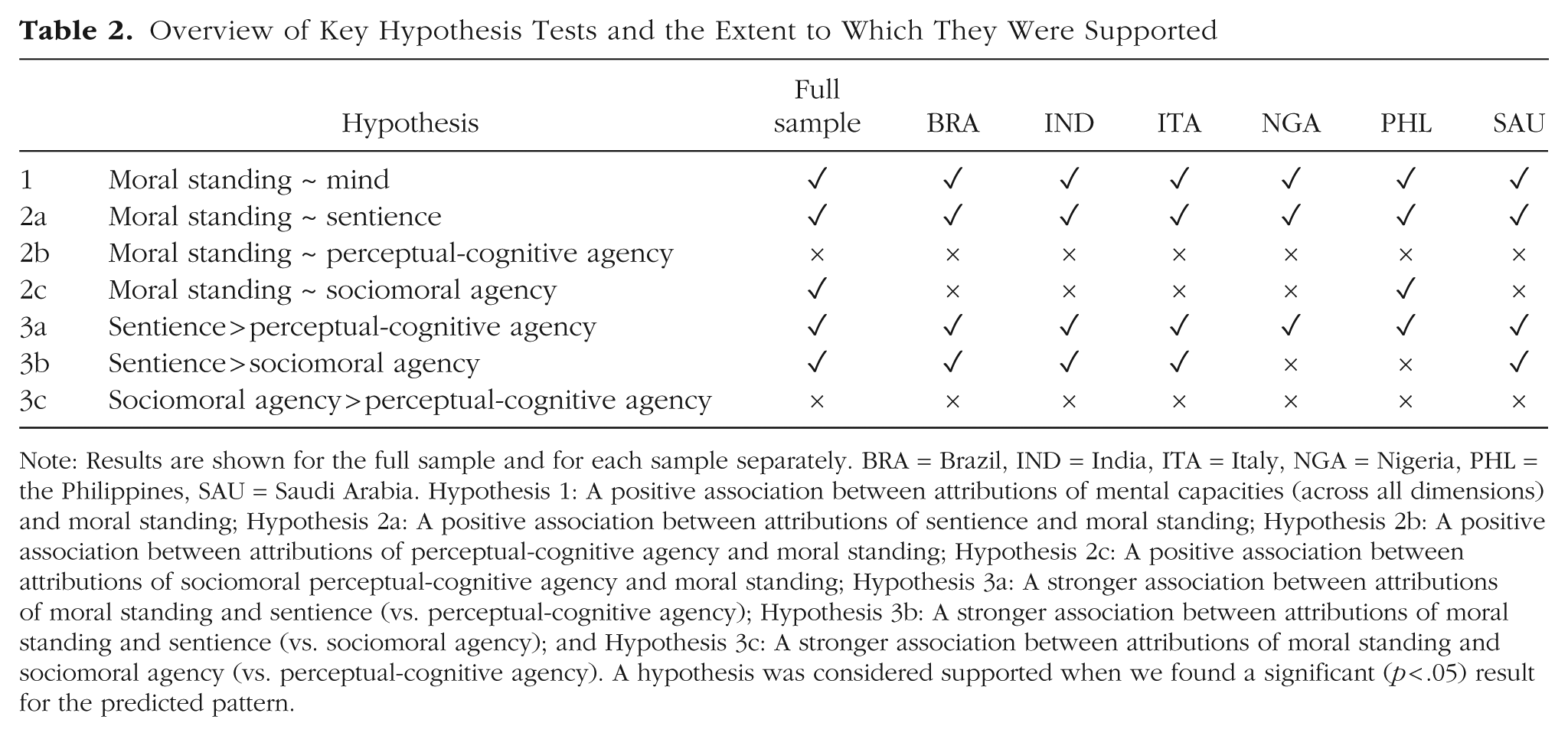
Note: Results are shown for the full sample and for each sample separately. BRA = Brazil, IND = India, ITA = Italy, NGA = Nigeria, PHL = the Philippines, SAU = Saudi Arabia. Hypothesis 1: A positive association between attributions of mental capacities (across all dimensions) and moral standing; Hypothesis 2a: A positive association between attributions of sentience and moral standing; Hypothesis 2b: A positive association between attributions of perceptual-cognitive agency and moral standing; Hypothesis 2c: A positive association between attributions of sociomoral perceptual-cognitive agency and moral standing; Hypothesis 3a: A stronger association between attributions of moral standing and sentience (vs. perceptual-cognitive agency); Hypothesis 3b: A stronger association between attributions of moral standing and sentience (vs. sociomoral agency); and Hypothesis 3c: A stronger association between attributions of moral standing and sociomoral agency (vs. perceptual-cognitive agency). A hypothesis was considered supported when we found a significant (p < .05) result for the predicted pattern.
Results
Cultural-difference attributions of moral standing
We first examined cultural differences in attributions of moral standing. Note that these analyses were purely exploratory. (Detailed results are reported in the Supplemental Material.) A one-way analysis of variance comparing the average level of moral standing that participants attributed to the entire set of entities revealed significant differences across countries, F(5, 1249) = 6.36, p < .001. Participants from India expressed the highest level of moral concern (M = 5.61, SD = 1.05), whereas participants from Nigeria expressed the lowest level of moral concern (M = 5.19, SD = 0.82). Participants from Saudi Arabia (M = 5.52, SD = 1.01), Brazil (M = 5.43, SD = 0.77), Italy (M = 5.34, SD = 0.84), and the Philippines (M = 5.30, SD = 0.70) showed intermediate levels of moral concern.
We also found significant differences across religious affiliations, F(3, 1209) = 10.95, p < .001; participants who self-identified as Buddhist or who had an affiliation with a religion that was not included in our list were excluded because of small sample sizes. Hindu participants expressed the highest level of moral concern (M = 5.70, SD = 0.98), whereas nonreligious participants expressed the lowest level of moral concern (M = 5.26, SD = 0.86). Muslim (M = 5.54, SD = 0.99) and Christian participants (M = 5.37, SD = 0.80) showed intermediate levels of moral concern.
Figure 1 shows the average moral standing of entities in each country, with entities sorted by their average moral standing score across the six countries (see Fig. S1 in the Supplemental Material for a version that facilitates cross-country comparisons for a specific entity). There were several patterns that reliably emerged in each country, pointing to substantial cross-cultural similarities in how people think about the moral standing of different entities. Participants from all six countries attributed the highest moral standing to a human child and a human baby. In fact, across the entire sample, a wide majority of participants attributed full moral standing (i.e., the highest score on our scale) to these entities (85% for the human baby and 86% for the human child). These percentages were high in every country, ranging from 81% in Italy to 89% in Nigeria for the human baby and from 80% in Italy to 90% in Nigeria for the human child.
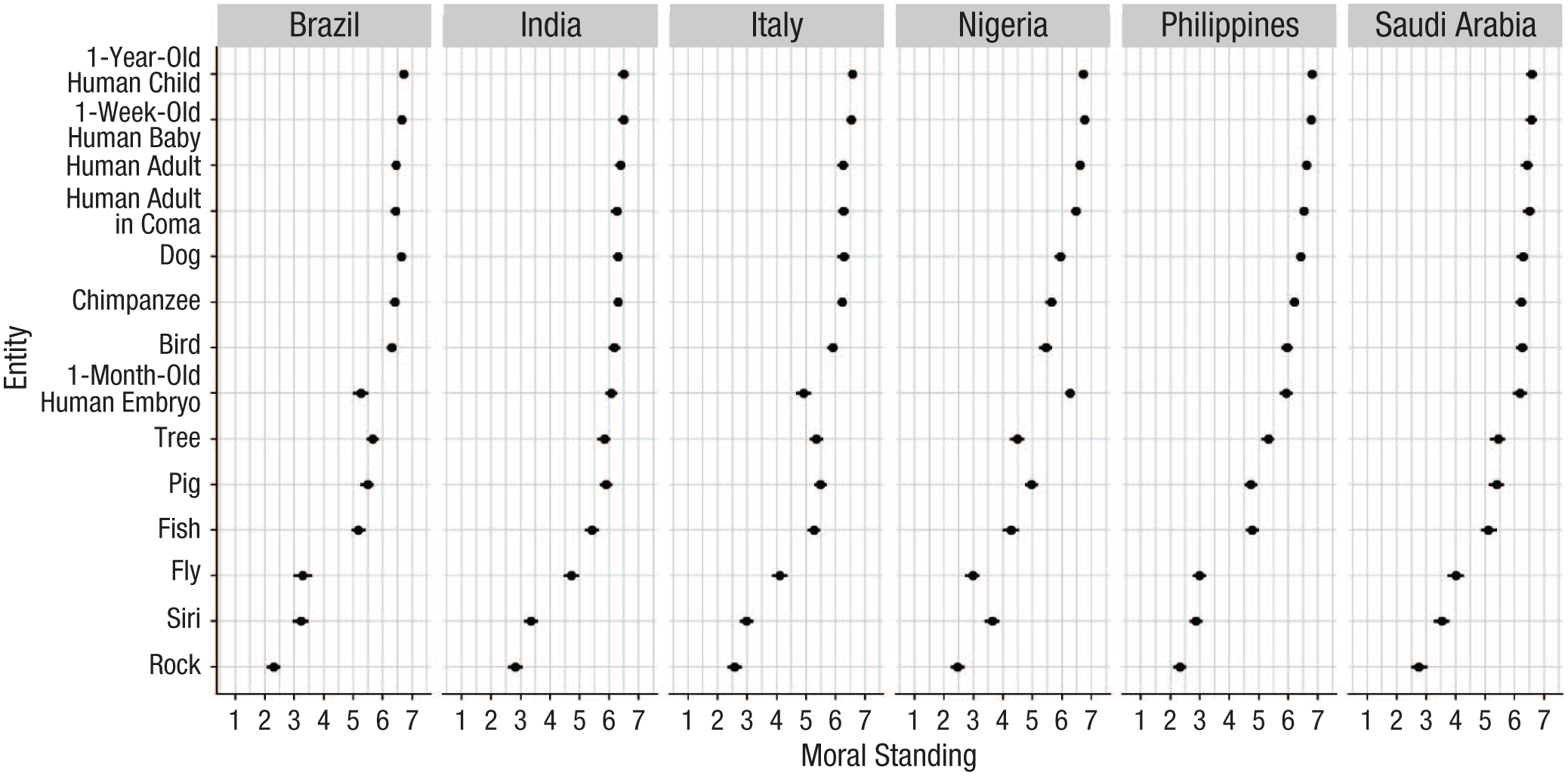
Average attributions of moral standing per entity in each of the six countries. Error bars indicate bootstrapped 95% confidence intervals.
In line with previous work (Caviola et al., 2019, 2022), we found that participants attributed greater moral standing to typical humans (i.e., a human baby, child, and adult; M = 6.58, SD = 1.01) compared with nonhuman animals (i.e., a chimpanzee, a dog, a bird, a pig, a fish, and a fly; M = 5.41, SD = 1.16), t(1254) = 36.56, p < .001, d = 1.07, 95% confidence interval (CI) = [1.00, 1.14] (paired-samples t test). Nonhuman animals were assigned greater moral standing than plants and nonliving entities (i.e., Siri, a tree, and a rock; M = 3.71, SD = 1.32), t(1254) = 46.49, p < .001, d = 1.36, 95% CI = [1.28, 1.44]. These differences were replicated in each of the six countries (see the Supplemental Material).
For many entities, country differences were relatively small. For example, the average moral standing of a human adult in a coma was lowest in India (M = 6.26, SD = 1.45) and highest in the Philippines (M = 6.54, SD = 1.07), amounting to only a 0.28-point difference on the 7-point scale. The most notable difference in attributions of moral standing emerged for participants’ evaluations of a human embryo, which showed more variance. Italian participants assigned the lowest level of moral standing (M = 4.91, SD = 1.89), whereas Nigerian participants assigned the highest level of moral standing (M = 6.27, SD = 1.34)—a 1.36-point difference on the 7-point scale.
To quantify similarities and differences in the relative moral standing of entities more systematically, we computed rank correlation coefficients for the average moral standing of the entities between pairs of countries. For example, we observed a correlation of ρ = .899 (p < .001) between the average moral standing of entities in Nigeria and Brazil, suggesting that there are strong similarities in the relative moral standing of the 14 entities between the two countries. We ran a random-effects meta-analysis on the correlations from all 15 country pairs, which yielded an average correlation of ρ = .958, p < .001. These results show that the relative moral standing of entities was very similar across the six countries.
Mind perception and moral standing
We then tested our key hypotheses, examining the association between mind perception and attributions of moral standing (see Table 2 for an overview). Given the nested nature of our data with multiple participants from different countries rating multiple entities, we estimated a series of cross-classified multilevel regression models with random intercepts per participant and entity using the lme4 (Bates et al., 2015) and lmerTest packages (Kuznetsova et al., 2017) in R (R Core Team, 2024). When analyzing the pooled data across all six countries, we also included random intercepts per country. Because some participants may give higher mind ratings on average, we participant-centered and then z-standardized these variables. Our model results therefore show the change in moral standing that is associated with a 1-SD increase in perceived mind for a given participant.
We first tested for a relation between attributions of moral standing and perceived mental complexity (averaging mind-attribution scores across all nine mental capacities). Pooling data across all countries, we regressed attributions of moral standing on perceived mind in a multilevel regression model with random intercepts per country, participant, and entity. This revealed a positive association, β = 0.403, SE = 0.018, 95% CI = [0.367, 0.439], p < .001. When analyzing data from each country separately, we found a significant positive association in each sample (Brazil, β = 0.583, SE = 0.043, 95% CI = [0.499, 0.669], p < .001; India, β = 0.280, SE = 0.040, 95% CI = [0.202, 0.360], p < .001; Italy, β = 0.491, SE = 0.046, 95% CI = [0.402, 0.582], p < .001; Nigeria, β = 0.286, SE = 0.049, 95% CI = [0.190, 0.384], p < .001; the Philippines, β = 0.330, SE = 0.043, 95% CI = [0.246, 0.416], p < .001; and Saudi Arabia, β = 0.359, SE = 0.044, 95% CI = [0.274, 0.445], p < .001; see Fig. 2). Thus, participants attributed greater moral standing to entities when entities were perceived as having more complex minds, and this association emerged in all six countries.
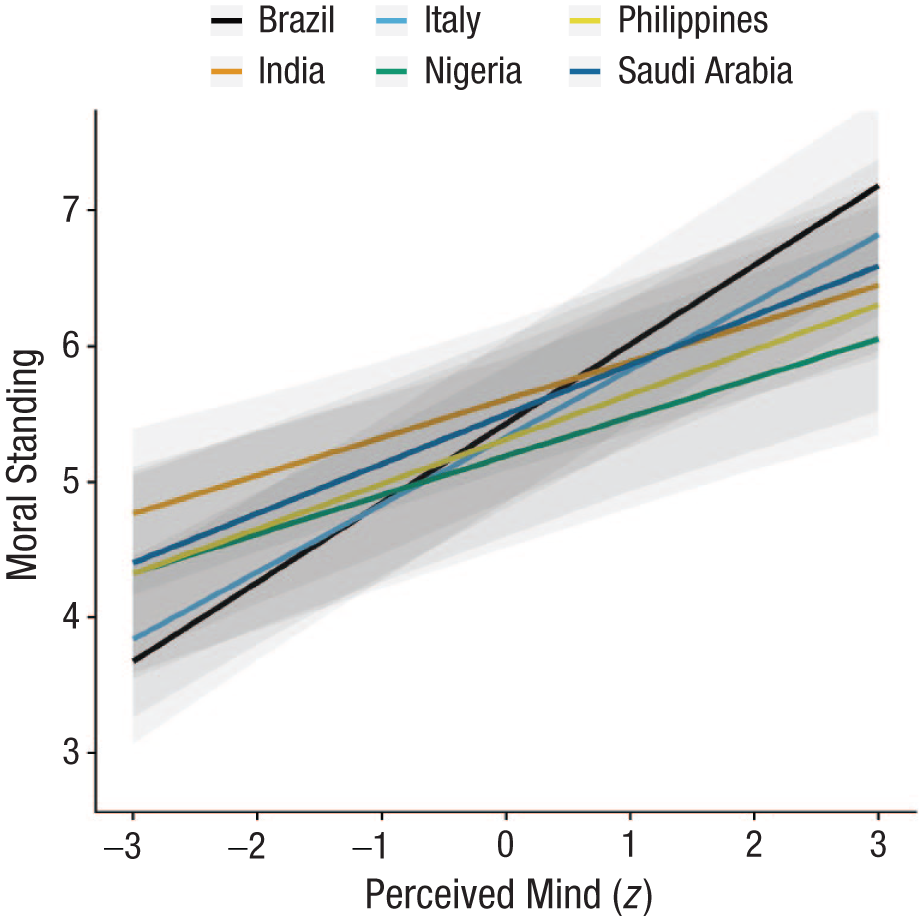
The relation between perceived mental capacities, averaged across the three dimensions, and attributions of moral standing (measured on a scale ranging from 1–7) across the six countries. Gray ribbons represent the 95% CIs.
Differences Between Mind Dimensions
Next, we examined our primary research question, testing for associations between the three mind dimensions and moral standing. We first analyzed the pooled data across all countries, regressing attributions of moral standing on entities’ perceived capacity for sentience, perceptual-cognitive agency, and sociomoral agency. In line with H. M. Gray et al.’s (2007) study, we found a positive association between perceived sentience and moral standing, β = 0.403, SE = 0.025, 95% CI = [0.355, 0.451], p < .001 (see Fig. 3, left). There was no significant association for perceived perceptual-cognitive agency, β = 0.012, SE = 0.024, 95% CI = [−0.036, 0.059], p = .628, but we did observe a significant positive association for perceived sociomoral agency, β = 0.063, SE = 0.020, 95% CI = [0.023, 0.103], p = .002.
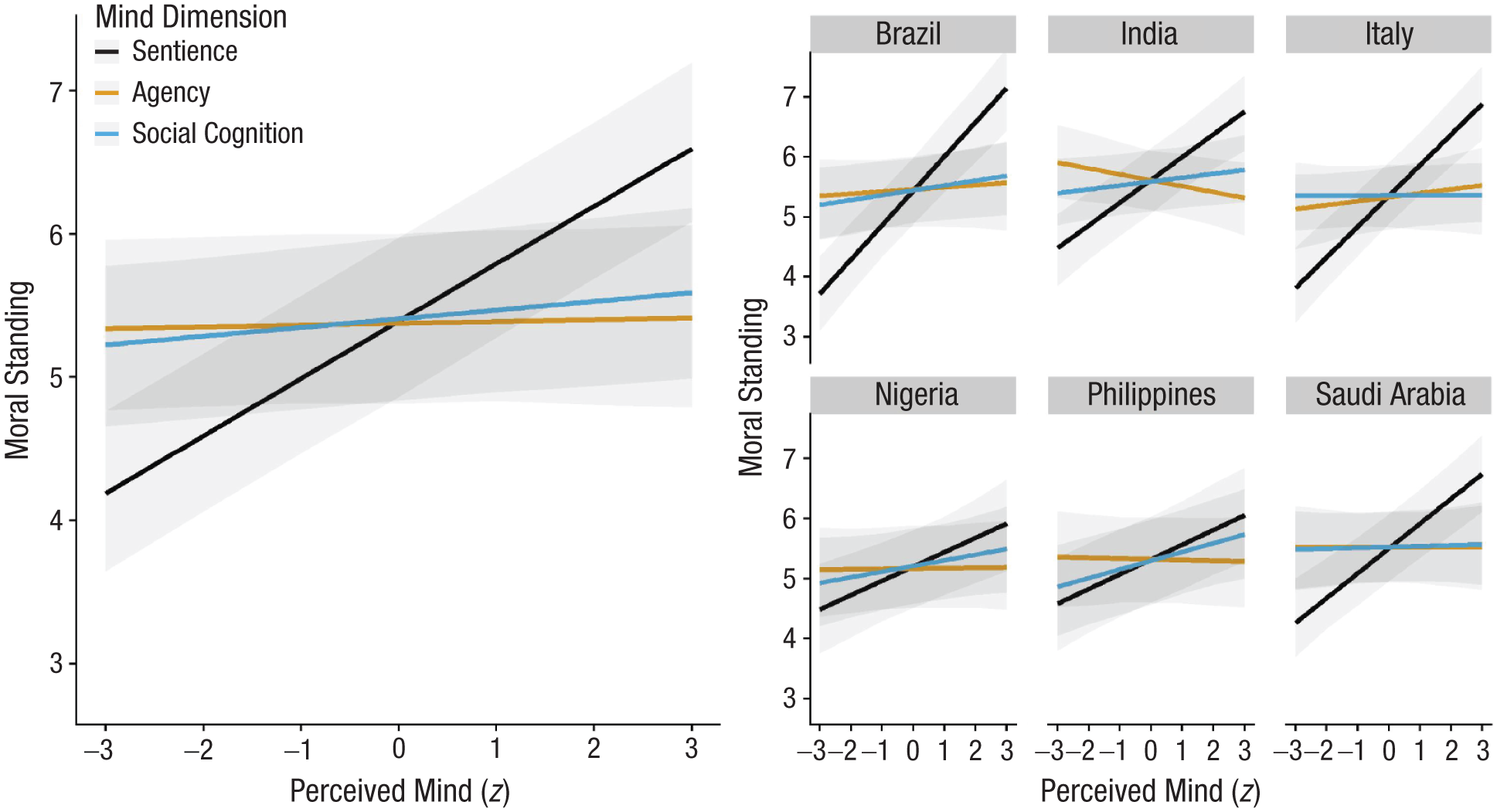
The relation between attributions of moral standing of entities (measured on a scale ranging from 1–7) and perceived mental capacities in the full sample (left) and in each country-specific sample (right). Gray ribbons represent the 95% CIs.
We then ran separate analyses per country to examine the cross-cultural stability of these results (see Fig. 3, right). The positive relation between perceived sentience and moral standing emerged for all six countries (Brazil: β = 0.576, SE = 0.058, 95% CI = [0.462, 0.691], p < .001; India: β = 0.378, SE = 0.053, 95% CI = [0.275, 0.482], p < .001; Italy, β = 0.508, SE = 0.061, 95% CI = [0.390, 0.629], p < .001; Nigeria, β = 0.239, SE = 0.062, 95% CI = [0.117, 0.362], p < .001; the Philippines, β = 0.245, SE = 0.061, 95% CI = [0.127, 0.365], p < .001; Saudi Arabia, β = 0.414, SE = 0.060, 95% CI = [0.296, 0.533], p < .001).
Similarly, the association between perceptual-cognitive agency and moral standing was not significant in any of the six countries (Brazil: β = 0.039, SE = 0.059, 95% CI = [−0.076, 0.154], p = .502; India: β = −0.099, SE = 0.055, 95% CI = [−0.207, 0.009], p = .072; Italy, β = 0.074, SE = 0.059, 95% CI = [−0.042, 0.188], p = .211; Nigeria, β = 0.008, SE = 0.061, 95% CI = [−0.111, 0.128], p = .890; the Philippines, β = −0.018, SE = 0.058, 95% CI = [−0.132, 0.096], p = .758; Saudi Arabia, β = −0.001, SE = 0.061, 95% CI = [−0.119, 0.118], p = .993).
Associations between sociomoral agency and moral standing were less consistent. Although we found a positive association in the aggregate sample, the same was observed only in our Filipino sample, β = 0.155, SE = 0.049, 95% CI = [0.059, 0.251], p = .002. Results were nonsignificant for the other samples (Brazil: β = 0.072, SE = 0.047, 95% CI = [−0.020, 0.165], p = .126; India: β = 0.067, SE = 0.045, 95% CI = [−0.021, 0.155], p = .139; Italy, β < 0.001, SE = 0.048, 95% CI = [−0.094, 0.095], p = .999; Nigeria, β = 0.094, SE = 0.052, 95% CI = [−0.008, 0.197], p = .071; Saudi Arabia, β = 0.013, SE = 0.053, 95% CI = [−0.090, 0.116], p = .807).
We also tested whether the observed associations of the three mind dimensions with attributions of moral standing significantly differed from each other. In line with H. M. Gray et al.’s (2007) study, a z-test comparing the coefficients showed that the association between perceived sentience and moral standing was significantly stronger than the association between perceptual-cognitive agency and moral standing when analyzing the pooled data across all countries, z = 11.28, p < .001. This significant difference was also observed in each of the six countries (see the Supplemental Material for the country-specific results). Comparing sentience with sociomoral agency yielded a significant difference in the pooled data, z = 10.65, p < .001, and also in each separate sample except for Nigerian and Filipino participants. Comparing the sociomoral agency dimension and the perceptual-cognitive agency dimension did not yield a significant difference in the pooled data, z = 1.61, p = .107, or in any of the country-specific samples.
Finally, we conducted four additional sets of analyses to test the robustness of our results. We estimated series of models where (a) we included participants’ gender, age, and religiosity as control variables; (b) we used a binary variable indicating whether participants attributed full moral standing to an entity (i.e., a 7 on our 7-point scale) as the outcome variable; (c) we estimated the hypothesized associations with Bayesian ordinal regression models; and (d) we used an alternative rank-based measure of moral standing as the outcome variable. The analyses are reported in full in the Supplemental Material (see Tables S7–S10 for an overview of the results). Across the different analyses, results were generally similar to the ones reported here. Perceived sentience was positively related to attributions of moral standing, whereas results were much more mixed for perceptual-cognitive agency and sociomoral agency, and this pattern emerged in most countries. These results suggest that our main findings do not only emerge with the specific analysis approach that we deemed to be best, but also with other valid analysis approaches.
Discussion
The question of whose welfare and interests matter from a moral perspective is at the center of many contentious debates. A popular explanation of how laypeople attribute moral standing focuses on the role of mind perception: Entities are perceived to have (or lack) various mental capacities, and entities that score higher on perceived sentience in particular (the capacity for valenced experiences, such as pain and pleasure) are afforded greater moral standing (H. M. Gray et al., 2007). Evidence supporting this hypothesis has been cited to make broad claims about the general structure and function of morality (K. Gray & Schein, 2012; K. Gray et al., 2012). However, evidence for the primary role of sentience is mixed (Piazza et al., 2014; Sytsma & Machery, 2012), and the available data overwhelmingly reflect the views of people from North America and Europe (e.g., H. M. Gray et al., 2007; Klebl et al., 2021; Leach et al., 2022; Nijssen et al., 2019). Here, we tested whether the link between perceived sentience and moral standing is a general feature of moral cognition with participants from six culturally diverse countries: Brazil, India, Italy, Nigeria, the Philippines, and Saudi Arabia.
We examined the link between core dimensions of mind perception and attributions of moral standing for a diverse set of entities (e.g., a 1-month-old human embryo, a chimpanzee, an artificial intelligence system). Next to perceived sentience, we examined the roles of perceptual-cognitive agency (e.g., memory, communication) and sociomoral agency (e.g., empathy, embarrassment), which emerged as separate dimensions in factor-analytic studies on mind perception (Malle, 2019; Weisman et al., 2017), but were often treated as a single dimension in previous work. Thus, our study provides an arguably stronger and more comprehensive test of the hypothesized primacy of sentience in predicting attributions of moral standing.
We found that, in each of the six countries, perceived sentience was positively related to moral standing, whereas associations for perceptual-cognitive agency and sociomoral agency were generally nonsignificant. The association between perceived sentience and moral standing was also significantly stronger than the association for perceptual-cognitive agency (in all six countries) and the association for perceived sociomoral agency (in four out of the six countries). Similar findings emerged when employing alternative measures of moral standing and different analytic approaches (see the Supplemental Material). Thus, our results support the hypothesized primacy of perceived sentience and its cross-cultural generalizability.
Limitations and Future Directions
One limitation of the current study is that, although we sampled countries for cultural diversity, our participant samples were not nationally representative. All participants were proficient in English, which suggests that they may have been more exposed to Western culture than the typical person in that country. We sampled countries with a relatively large percentage of English speakers (all countries except Brazil), which means that English proficiency is not necessarily an indication of a lack of representativeness. In the Supplemental Material (see Table S1), we compare our samples with the general population of each country on selected characteristics. On the one hand, these data confirm that our samples differed from the general population in nontrivial ways (e.g., our Italian participants were much younger). On the other hand, the data also suggest that our samples were more diverse (and different from) participant samples in previous studies on this topic. For example, the religious affiliation of our Indian participants was broadly in line with the general Indian population.
We sampled participants from countries that differed on many dimensions, which allowed us to conduct a stronger test of potential cross-country differences. However, our data are less suited for revealing whether specific factors (e.g., religious affiliation) influence attributions of mind and moral standing, which remains an important open question for future research. Moreover, it is possible that some differences between countries reflect differences in response styles, rather than differences in moral reasoning.
It is possible that diverging results in previous studies can be partly explained by the different sets of entities that were sampled and judged by participants. We therefore sampled a very diverse set of targets that included human, nonhuman, and nonliving entities, including targets whose moral standing is actively debated (e.g., embryos, AI systems). Whether attributions of moral standing are guided by different characteristics for different entities remains a question for future research.
The same reasoning applies to which mind dimensions were examined and how they were operationalized. Previous studies used different sets of mental capacities to measure different higher-order mind dimensions, which complicates comparisons across studies and may explain diverging results. The current operationalization was an attempt to capture key commonalities that emerged across what we judged to be the strongest studies on the structure of mind perception (H. M. Gray et al., 2007; Malle, 2019; Weisman et al., 2017; our reasoning is described in detail in the Supplemental Material). However, these studies also showed substantial differences, and there is no clear consensus on what the core dimensions of mind perception are or how they should be defined and measured. Different operationalizations of mind perception—such as a stronger focus on cognitive capacities like self-control, reasoning, and planning when conceptualizing agency—might lead to different associations with attributions of moral standing. Future studies could test the robustness of the current results across alternative measures of perceived sentience, agency, and other mind dimensions. Future studies should also expand on previous factor-analytic work, using large samples of mental capacities, participants, and targets, to explore the structure of mind perception.
We focused on the role of mind perception in moral cognition because of its central role in psychological and philosophical theorizing (Goodwin, 2015; K. Gray & Schein, 2012). Future work should expand this focus and test which attributes best predict attributions of moral standing. Previous studies have examined the role of various features, such as beauty (Klebl et al., 2021) and harmfulness (Piazza et al., 2014). Rather than testing the effect of single attributes, future studies should take a more integrative approach to examine which of the many attributes that are currently studied are most important for predicting moral standing.
Supplemental Material
sj-docx-1-pss-10.1177_09567976261425576 – Supplemental material for The Relation Between Attributions of Mental Capacities and Moral Standing Across Six Diverse Cultures
Supplemental material, sj-docx-1-pss-10.1177_09567976261425576 for The Relation Between Attributions of Mental Capacities and Moral Standing Across Six Diverse Cultures by Bastian Jaeger and Maarten Bosten in Psychological Science
Footnotes
Transparency
Action Editor: Yoel Inbar
Editor: Simine Vazire
Author Contributions

Notes
References
Supplementary Material
Please find the following supplemental material available below.
For Open Access articles published under a Creative Commons License, all supplemental material carries the same license as the article it is associated with.
For non-Open Access articles published, all supplemental material carries a non-exclusive license, and permission requests for re-use of supplemental material or any part of supplemental material shall be sent directly to the copyright owner as specified in the copyright notice associated with the article.
