




Abstract
Despite growing efforts to improve intergroup relations, the effectiveness of psychological intergroup interventions is often limited. We argue this modest impact stems from a one-size-fits-all approach that overlooks targeted outcomes and individual psychological profiles. Through a large-scale intervention tournament (N = 3,685) examining Jewish-Israeli attitudes toward Palestinian citizens of Israel, we discovered that interventions show distinct strengths depending on targeted outcomes: social norms interventions excel at fostering support for social change, while meta-perceptions correction interventions effectively reduce prejudice. Using machine learning, we identified systematic variations in intervention effectiveness based on individual differences, with some interventions showing potential backfire effects among specific subgroups while delivering substantial benefits for others. These results underscore the potential of tailoring interventions to align with both the desired outcomes and the unique characteristics of target populations, paving the way for a new era of precision in intergroup interventions.
Introduction
Intergroup prejudice, discrimination, and inequality remain persistent global challenges that shape intergroup relations. These dynamics appear across racial, ethnic, and national lines, perpetuating disparities in resources, opportunities, and social status (Roberts & Rizzo, 2021). Beyond overt hostility, such inequalities often manifest in everyday interactions through subtle biases, systemic discrimination, and entrenched societal hierarchies (Dixon et al., 2016). These patterns are evident globally, from racial disparities in educational achievement and employment opportunities (Reardon & Owens, 2014), to persistent gender-based wage gaps across sectors (Blau & Kahn, 2017), to systematic barriers faced by immigrant communities in accessing healthcare and social services (Esses, 2021).
In response to these challenges, social and political psychologists have shifted in recent years from descriptive research toward developing evidence-based interventions across multiple subfields (e.g., Walton & Wilson, 2018). To better integrate these diverse scholarly efforts, Halperin et al. introduced the umbrella term “psychological intergroup interventions,” encompassing all theoretically-grounded attempts to “alter attitudes, emotions, perceived norms, or behavior that constitute barriers to—or that can facilitate the promotion of—tolerant, peaceful, and equal relations between members of different social groups” (Halperin et al., 2023). These interventions have targeted various psychological mechanisms, from changing beliefs and feelings toward outgroups (Cohen-Chen et al., 2023; Halperin et al., 2013), to shifting social norms (Murrar & Brauer, 2023; Tankard & Paluck, 2016) and addressing meta-perceptions about other groups (Mernyk et al., 2022; Moore-Berg & Hameiri, 2024; Nir et al., 2023).
While the field of psychological intergroup interventions has shown considerable progress and promising findings, recent meta-analyses have uncovered relatively modest effect sizes (Paluck et al., 2021; Reimer & Sengupta, 2023). To understand why these effects remain modest, we can draw insights from the field of medicine. When a patient experiences pain, over-the-counter painkillers can, on average, provide some relief to all individuals. However, a physician’s ability to help the patient, and address the root cause rather than the symptom, often depends on matching the specific treatment to both the particular condition causing the pain and the patient’s individual characteristics. Modern medicine has embraced this dual consideration of both the condition and the patient, moving from standardized protocols toward more precise, tailored, treatment approaches (Collins & Varmus, 2015).
Continuing the over-the-counter painkiller analogy, psychologists today often approach improving intergroup relations as a singular challenge, applying the same interventions—such as contact-based programs (Pettigrew & Tropp, 2006) and perspective-taking exercises (Todd & Galinsky, 2014)—across different manifestations of negative intergroup relations like prejudice, discrimination, and violent conflicts. While these interventions demonstrate positive modest effects on average, we argue that their impact could be enhanced by distinguishing between different types of intergroup challenges (e.g., prejudice, discrimination, or violent conflict) and considering the unique characteristics of the individuals involved (Halperin & Schori-Eyal, 2020). This need for more nuanced approaches is not unique to our field. Indeed, the value of tailored interventions has been well-demonstrated across multiple disciplines, from clinical psychology (Hirsh et al., 2012), marketing (Teeny et al., 2021), health psychology (Rothman et al., 2020), and environmental psychology (Goldberg et al., 2022) (for a recent review, see Petty et al., 2025).
Two Approaches for Tailoring Psychological Intergroup Interventions
Desired Outcome
As we alluded to above, we suggest that in order to create effective tailored psychological intergroup interventions we need to draw attention to two fundamental aspects: the desired outcomes of the intervention and the distinct characteristics of those taking part (Hebel-Sela et al., 2025). A desired outcome represents the specific changes and measurable impacts we seek to achieve through psychological intergroup interventions. These outcomes serve as the concrete goals that guide intervention development and implementation (Čehajić-Clancy & Halperin, 2024). The importance of clearly defining desired outcomes becomes evident when we consider that different psychological interventions often achieve distinct and sometimes even conflicting results. For example, recent research has shown that interventions successful in reducing affective polarization (measured by a “feeling thermometer”: a scale measuring how cold or warm a participant feels towards out-partisans) did not mitigate anti-democratic attitudes (Voelkel et al., 2022). This divergence underscores why tailoring interventions to specific outcomes is crucial—different outcomes require different intervention approaches.
To illustrate this broader argument, we focus on a significant debate in the intergroup relations literature: the distinction between prejudice reduction and support for social change (Dixon & Levine, 2012; Paluck et al., 2021). Prejudice reduction approaches aim to improve interpersonal attitudes by addressing psychological barriers like negative meta-perceptions (Moore-Berg et al., 2020) and fixed beliefs about groups (Rattan & Georgeac, 2017). While these interventions effectively improve interpersonal relationships, they can inadvertently reduce awareness of systemic inequalities (Čehajić-Clancy et al., 2011). In contrast, interventions promoting social change often focus on reducing psychological barriers to acknowledging systemic inequalities. These include strategies to decrease defensive responses through self-affirmation (Sherman et al., 2023) and correcting misperceptions about social norms regarding support for reform (Murrar et al., 2020). However, these approaches can sometimes exacerbate intergroup hostility (Reimer & Sengupta, 2023). This tension underscores the importance of explicitly defining desired outcomes when designing interventions, as each goal demands distinct strategies that may involve trade-offs. Having established this framework, we now turn to tailoring interventions to individual characteristics.
Individual Characteristics
We argue that tailoring interventions to individual characteristics can be achieved through two complementary approaches: deductive, theory-driven frameworks and inductive, data-driven methods. Deductive approaches use established theories to predict how specific traits or characteristics (e.g., openness to change, empathy) influence the effectiveness of an intervention. Inductive approaches, on the other hand, rely on data to uncover unexpected patterns of responsiveness, identifying characteristics or trends that may not have been anticipated (Petty et al., 2025). In the current research, we combine these approaches by first applying Halperin and Schori-Eyal’s (2020) theoretical framework, on which we elaborate below, as a deductive lens for personalization of psychological intergroup interventions. We then conduct exploratory data analyses to inductively identify patterns of intervention responsiveness across participant characteristics. In the general discussion, we consider how our empirical findings inform the broader challenge of tailoring interventions based on personality measures.
Building on Halperin and Schori-Eyal’s (2020) framework for tailoring interventions, we identify three key dimensions—political ideology, personality traits, and demographic characteristics—that are particularly relevant to understanding variation in intervention responses. These dimensions provide distinct but complementary lenses for exploring how individual characteristics shape the effectiveness of psychological intergroup interventions. Below, we elaborate on each dimension and discuss its implications for tailoring intervention strategies.
Political Ideology
Political ideology can be understood as an organized set of beliefs, attitudes, and preferences that shape how individuals interpret social and political issues (Jost et al., 2009). Constructs such as Right-Wing Authoritarianism (RWA), emphasizing order and authority (Altemeyer, 1981), and Social Dominance Orientation (SDO), focusing on hierarchy and power (Pratto et al., 1994), reflect distinct motivations: norm-based interventions may appeal to high-RWA individuals, while framing social change as enhancing efficiency can resonate with high-SDO individuals (Duckitt & Sibley, 2010). Ideology is also expressed through core values (e.g., benevolence, universalism, power [Schwartz, 2012]); and moral intuitions (e.g., care, loyalty, fairness [Graham et al., 2013]). Furthermore, group glorification, which is tied to ideology through its emphasis on a group’s inherent moral superiority (Leidner et al., 2010), poses unique challenges by fostering resistance to narratives that critique the group. Effective interventions must balance maintaining group esteem while gradually introducing alternative perspectives to reduce resistance (Castano, 2008).
Personality Traits
Individual differences in personality traits, defined as enduring patterns of thoughts, feelings, and behaviors, may significantly influence intervention effectiveness (Matthews et al., 2003). For example, the Big Five personality traits—Openness to Experience, Conscientiousness, Extraversion, Agreeableness, and Neuroticism—are key dimensions of personality and might shape how individuals respond to interventions. Openness could enhance receptiveness to novel and intellectually stimulating approaches, while conscientiousness may support engagement with structured, goal-oriented strategies. Extraverts might thrive in social, interactive interventions, agreeable individuals could respond well to empathy-building and cooperative efforts, and those high in neuroticism might benefit from interventions that to reduce threat such as emotion regulation or self-affirmation (Halperin & Schori-Eyal, 2020).
Demographic Characteristics
Demographic factors, encompassing fundamental social and economic characteristics, can play a crucial role in determining intervention effectiveness through multiple pathways. Socioeconomic status (SES), which reflects an individual’s economic and social position relative to others, serves as a foundational determinant of intervention outcomes (Adler & Ostrove, 1999). This interacts closely with educational level, defined as the extent of formal learning an individual has completed, which significantly influences one’s ability to engage with complex concepts and abstract reasoning (Cutler & Lleras-Muney, 2010). Together, these factors create a web of influences that affect both access to and engagement with interventions. For instance, highly educated individuals may respond more effectively to interventions involving abstract reasoning and complex problem-solving, while individuals from lower socioeconomic backgrounds might benefit from interventions that are accessible and concrete (Durand et al., 2014).
The Current Research
As discussed earlier, psychological intergroup interventions have advanced efforts to improve intergroup relations but often are limited in scope and effectiveness. The current research aims to prepare the groundwork for future tailored approaches by examining how intervention’s effect differ based on outcomes and individual characteristics. Specifically, we investigated how different interventions reduce prejudice and foster support for social change. Rather than assuming universal effectiveness, we hypothesized that different interventions would demonstrate distinct strengths depending on the desired outcome. Furthermore, using machine learning techniques, we explored systematic variations in intervention effectiveness across the three dimensions of individual characteristics mentioned above.
We conducted our research in the context of Jewish-Israelis and Palestinian Citizens of Israel (PCI) relations, which are characterized by deep-rooted prejudices, structural inequalities, and pronounced power asymmetries (Sultany, 2012). PCIs make up 21% of Israel’s population. While they hold Israeli citizenship and formal democratic rights, PCIs experience systematic discrimination and inequality across multiple domains of life. They face substantial barriers in employment and education, discriminatory housing policies, and limited political representation (Smooha, 2016). The regular interactions between Jewish-Israelis and PCIs in shared spaces like workplaces and universities, coupled with the substantial inequalities that PCIs face, provide an important setting for studying interventions that aim to both reduce prejudice and promote social change (Maoz, 2011).
To fulfill our goal, we conducted a large-scale study employing an intervention tournament methodology to systematically compare validated video interventions against both a no-intervention control and an active control. This tournament approach enabled direct comparison of multiple interventions within a single study framework (for a similar approach, see Bruneau et al., 2022; Voelkel et al., 2024; for a review on intervention tournaments, see Hameiri & Moore-Berg, 2022). By measuring outcomes before and after intervention exposure, we could assess intervention effectiveness while accounting for baseline levels. Additionally, as mentioned above, via an exploratory analysis using advanced computational methods, we also examined whether the effectiveness of different interventions varied based on individual characteristics.
Interventions Development
Interventions were developed through a series of collaborative meetings by our research team. The team began by reviewing relevant research on psychological intergroup interventions to identify approaches most established in the literature (Halperin et al., 2023). From this process, we selected six interventions. Specifically, we aimed to include interventions that previous research has shown to be effective for either reducing prejudice or increasing support for social change or for both, based on the psychological mechanisms they target.
For prejudice reduction, we included, first, a meta-perception correction intervention, since it was found to reduce exaggerated perceptions of outgroup prejudice and hostility, correspondingly decreasing prejudice toward the outgroup (Mernyk et al., 2022; Moore-Berg & Hameiri, 2024; Nir et al., 2023). Second, we included two malleability interventions, targeting either beliefs about the potential for individuals, or groups, to change, which were found to reduce stereotyping and increase positive intergroup attitudes, making them well suited for prejudice reduction (Cohen-Chen et al., 2023; Halperin et al., 2011; Wohl et al., 2015).
For social change, we included, first, a self-affirmation intervention that aims to decrease defensiveness by affirming personal values, which was found to increase willingness to acknowledge inequality and thus foster support for social change (Sherman & Cohen, 2006; Shuman et al., 2023). Second, we included a social norm intervention that aims to shift perceptions of ingroup consensus, a mechanism known to motivate action when people realize their peers support reform, which was found to make it a powerful driver of social change (Tankard & Paluck, 2016; Murrar et al., 2020). Finally, we included a paradoxical thinking intervention that aims to challenge entrenched attitudes by presenting exaggerated ingroup views, which was found to increase cognitive flexibility, a process that can disrupt rigid prejudice and potentially foster broader societal change (Hameiri et al., 2018; Hebel-Sela et al., 2023).
To ensure standardization and to omit confounds as much as possible, we intended to create all intervention in the form of a 2-min video. This standardization addressed a notable limitation of previous intervention tournaments, where varying delivery formats across interventions made it difficult to distinguish between the effects of the psychological mechanisms and those of their presentation formats (Hameiri & Moore-Berg, 2022). As such, after the scripts were developed, we transformed these interventions into videos (see Table 1 for description of the interventions). This involved a collaborative effort to ensure that the psychological mechanisms were effectively conveyed through engaging and impactful visual content. Each video was produced with the goal of maintaining the integrity of the psychological principles while making the interventions more engaging to the target audience. This rigorous development process ensured that the interventions were both theoretically sound and practically applicable. 1
Summaries of Interventions.
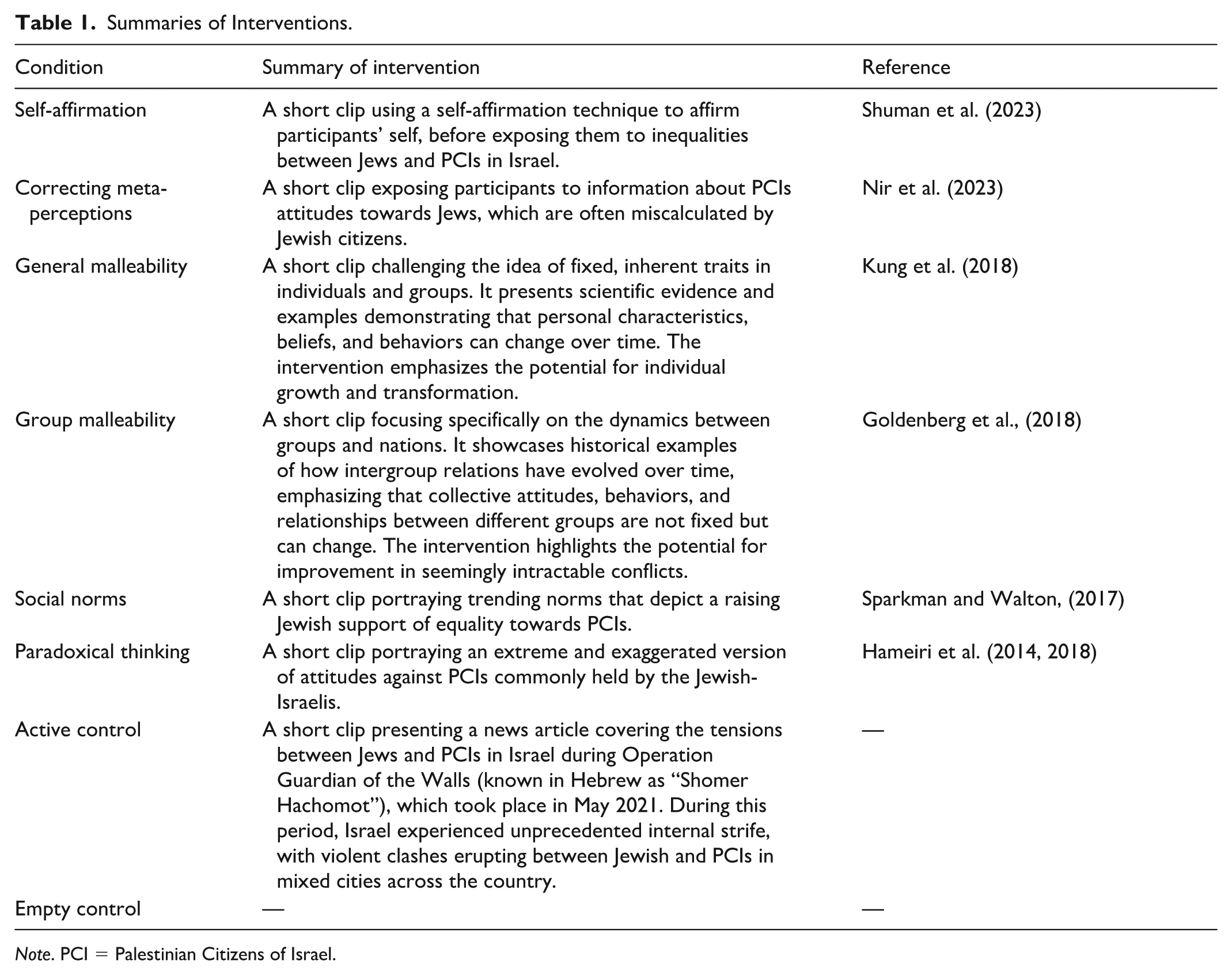
Note. PCI = Palestinian Citizens of Israel.
Following the development of the interventions, we distributed two surveys. The first was an experts’ survey, which we distributed to 15 experts in the field of psychological intergroup interventions. We sent each expert a survey including all six videos without indicating the psychological mechanism behind them. Following each video, the experts were asked to indicate which psychological mechanism was related to the video they just watched. Most experts successfully identified all six psychological mechanisms correctly. We report the results of this survey in the Supplemental Materials.
To further validate that each video effectively conveyed its intended psychological mechanism, we conducted a second survey. The goal of this survey was to examine whether each intervention activated or changed the specific psychological mechanism we were interested in manipulating. This survey was distributed by “iPanel” (a widely used Israeli survey company) via their virtual platform to 1,500 online participants (57% women; ages 18–84, Mage = 47.65, SDage = 17.66) who received monetary compensation for their participation. Participants were randomly assigned to one of the six interventions or to an empty control. After watching the video, participants answered a manipulation check question followed by demographic questions. Participants in the control condition answered all six manipulation check questions, one for each intervention (see Table 2).
Summary of Manipulation Measurement and Results (p-Values and Effect Sizes) of Each Intervention Compared to the Control.
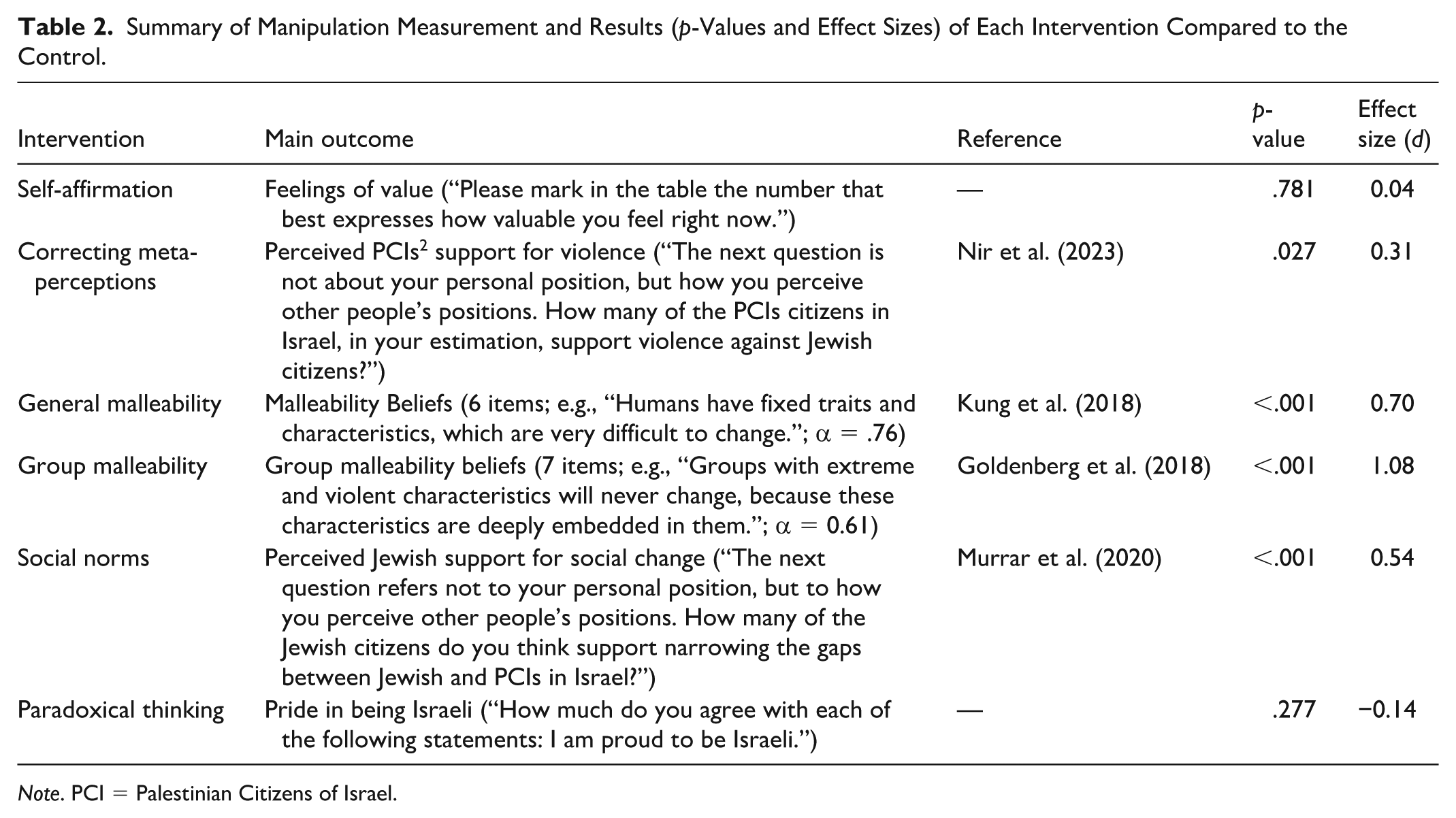
Note. PCI = Palestinian Citizens of Israel.
Measures and Results
The results presented in Table 2 reveal that the interventions influenced the desired psychological mechanisms to varying degrees. The correcting meta-perception intervention reduced perceptions of Palestinian citizens’ support for violence, the general and group malleability interventions increased beliefs in the potential for change in humans and intergroup conflicts, and the social norms intervention shifted perceptions of Jewish citizens’ support for PCIs-Jewish relations. The self-affirmation and paradoxical thinking interventions showed effects in the intended direction, though not reaching statistical significance.
This pattern is not unexpected, as these interventions target deeper constructs like identity and self-worth, which previous research has shown are less likely to show immediate changes in manipulation checks (Hebel-Sela et al., 2023; Sherman et al., 2023). Such interventions often operate through more subtle psychological processes that may not be captured by direct manipulation checks. Notably, compared to the other interventions discussed above, research on self-affirmation and paradoxical thinking interventions also typically does not employ manipulation checks to assess their effectiveness (e.g., Hameiri et al., 2018; Shuman et al., 2023).
Interventions Tournament
Considering the results of the manipulation checks and the fact that expert reviewers correctly identified the underlying psychological constructs across all intervention types, including self-affirmation and paradoxical thinking, we included all six interventions in the current study: self-affirmation, correcting meta-perceptions, general and group malleability, social norms, and paradoxical thinking.
Methods
Participants
In March of 2022, we distributed a survey among participants who would later take part in the intervention tournament. For the purpose of the exploratory analysis of tailoring interventions based on personality measures, we collected data on participants’ ideology, personality traits and demographics, as well as baseline measures of prejudice and support for social change before any intervention exposure (see all measures in Supplemental Materials). A total of 6,068 Jewish Israeli participants completed this initial survey, which was distributed by “iPanel” via their virtual platform and received monetary compensation for their participation. For the intervention phase, which took part in May 2023, we re-contacted all participants, of whom 3,950 returned to complete the second part of the study. 3
After removing 116 participants who failed the two embedded attention check questions (“This is an attention check question. Please answer 3 for this question” and “This is an attention check question. Please answer 2 for this question”), a final sample of 3,685 participants remained (54.1% women; ages 18–84, Mage = 46.25, SDage = 15.96), with at least 300 participants per condition (see Table 3 for sample size and demographics for each condition). 4 We conducted a sensitivity power analysis to determine the smallest effects our design could detect. Using the observed sample size (N = 3,865; ≈483 per condition), we calculated the minimum detectable effect sizes with 95% power at α = .05 (two-tailed). To account for the potential influence of covariates, we varied assumed R² values from 0 (no variance explained) to .30 (covariates explain 30% of variance). Across this range, the detectable effect sizes ranged from d = 0.22 to d = 0.18, indicating sufficient power to detect small effects. For moderation tests, power is necessarily reduced because of subgroup estimation. With the full sample, we had 80% power to detect interaction effects explaining about 0.2% of the variance. These sensitivity results show that the study was well powered for main effects, while moderation findings should be interpreted with caution, given limited sensitivity.
Sample Characteristic by Condition.
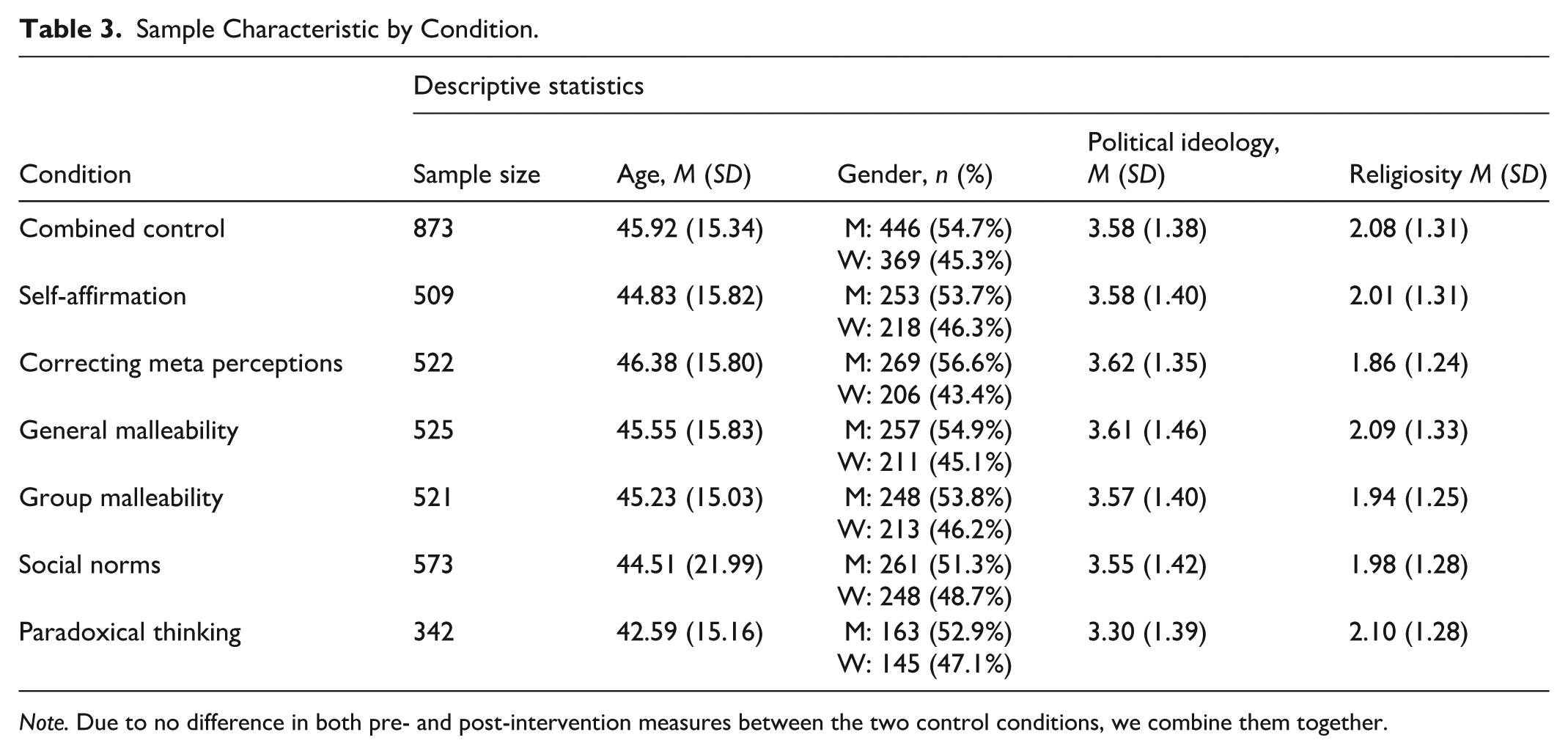
Note. Due to no difference in both pre- and post-intervention measures between the two control conditions, we combine them together.
Measures and Procedure
Participants were randomly assigned to either one of six intervention conditions, the active control or the empty control. Participants were asked to complete the intervention, that is, watch a short video (or not in the empty control). Following exposure to the intervention, all participants (including those in the empty control) completed a survey including our outcome measures and demographics. While the survey included additional dependent variables beyond the scope of the current research, we focused our analyses on measures that were collected both pre and post intervention to enable examination of intervention effects while controlling for baseline attitudes (for a similar approach see Costello et al., 2024; Shuman et al., 2023), (see supplementary materials for results of additional measures).
In contrast to the preliminary pre-intervention survey conducted 14 months earlier, the post-intervention survey included more comprehensive and detailed measures specifically aligned with the study’s objectives. These enhanced measures were designed to provide a deeper and more accurate and reliable assessment of the key variables that the pre-intervention survey could not fully capture.
Along with our primary outcomes of stereotypes and support for social change, we gathered measures that capture other forms of prejudice and additional intergroup outcomes. Prejudice can take various forms, including cognitive stereotypes, affective hostility, and behavioral indicators such as social distance (Cuddy et al., 2009; Esses, 2021; Fiske et al., 2002). We chose stereotypes and support for social change as our main outcomes because they reflect the two central constructs motivating our study. At the same time, prior work has noted both overlap and tension between these domains, raising the possibility that interventions could reduce prejudice without necessarily increasing support for social change (Dixon et al., 2016; Mazur, 2015). Including both outcomes, therefore, enabled us to examine potential differential effects across these theoretically related but distinct constructs.
In addition, stereotypes and support for social change were included both before and after the intervention, allowing us to model change over time. Hostility and social distance reflect affective and behavioral expressions of prejudice that complement the stereotype-based measure used in our main analyses. We also measured political cooperation, political tolerance, and support for violence, expanding the scope of outcomes to different aspects of intergroup attitudes and behaviors. These measures, including their items and psychometric details, are provided in the Supplemental Materials.
Prejudice
Pre-Intervention
Prejudice was assessed using stereotypes, which included eight items adapted from Esses (2021). Participants were asked to indicate to what extent each characteristic represents the PCIs as a group (Violent, Stupid, Primitive, Dangerous, Cruel, Untrustworthy, pitiful, acting from emotion) on a scale of 1 (Does not represent any PCIs) to 7 (Represents all PCIs citizens) (α = .88).
Post-Intervention
We expanded the prejudice scale to assess positive traits, which were not included in the pre-intervention survey. This addition was guided by research suggesting that prejudice encompasses both negative and positive stereotype attribution, and that including both dimensions provides a more valid and reliable measure of intergroup attitudes (Cuddy et al., 2009; Fiske et al., 2002). We used the same eight items adapted from Esses (2021) as in the pre-intervention survey while adding two new positive traits: Friendly and Wise (α = .88).
Support for Social Change
Pre-Intervention
We assessed support for social change using two items adapted from Shuman et al. (2023). Each item was presented on a scale of 1 (not at all agree) to 7 (strongly agree). The first item measured support in policy aimed at advancing social change (i.e., “Resources and infrastructure must be invested in localities where PCIs live, to compare make them as the level of infrastructure and resources in localities where Jewish citizens of Israel live”), while the second item measured support for social change action (i.e., “I am willing to take action to reduce the inequality between Jewish Israelis and PCIs (e.g., share or write a post about inequality, share an article that deals with inequality between Jews and PCIs, sign a petition to increase equality between Jews and PCIs, etc.)”; r = .50, p < .001).
Post-Intervention
We developed a more comprehensive measure for support for social by adding a second item to each component: support for policy and support for social change action (i.e., “Reducing the gaps and inequality between Jewish Israelis and PCIs should be one of the most important goals of the Israeli government,” and “I am willing to take action to reduce the inequality between Jewish Israelis and PCIs (e.g., donate or volunteer in an organization that promotes equality between Jews and PCIs, participate in a demonstration that calls for the reduction of the gaps between Jewish and PCIs, respectively”). This expanded 4-item measure provided a more comprehensive assessment of participants’ support for social change, which was not fully possible in the pre-intervention survey (α = .88).
Additional Outcomes
As mentioned above, additional outcomes—including hostility, social distance, political cooperation, political tolerance, and support for violence—were added as secondary measures to complement the main constructs of stereotypes and support for social change (see Supplemental Materials for full details).
Results and Discussion
All analyses were conducted in R Version 4.4.0, and the relevant data files and code can be found at the Open Science Framework (https://osf.io/6ys9c/?view_only=6c59c4ab2593415e93b1884ab3251c52). Prior to conducting our main analyses, we examined potential differences across conditions in demographic characteristics (age, gender, religiosity, and political ideology; see Table 3) and found no significant differences (ps > .05), indicating that there was no need to control for demographics. We also examined potential differences between our two control conditions (empty control and active control) in pre- and post-intervention assessments of prejudice and support for social change. Finding no significant differences between these control groups, we proceeded to analyze them together (see full analyses comparing the two conditions in the Supplementary Materials). Analyses conducted separately for each control condition yielded highly similar results to the combined analysis (see full analyses in the Supplemental Materials). We analyzed the effect of the interventions on our outcome variables using ANCOVAs with post-intervention scores as the dependent variable, condition (7 levels) as the between-subjects factor, and pre-intervention scores as a covariate. 5 We then used post hoc comparisons using Bonferroni correction to compare each intervention to the combined control condition. Following standard intervention tournament designs (Hameiri & Moore-Berg, 2022), we focused on evaluating the effectiveness of each intervention relative to the control condition, rather than conducting direct comparisons between interventions.
Prejudice
We found a significant effect of condition on post-intervention prejudice after controlling for pre-intervention scores, F(6, 3455) = 4.29, p < .001, partial η² = .007 (see Figure 1). Post-hoc analysis showed that participants in the meta-perception correction intervention evidenced significantly lower prejudice compared to control (p < .001, d = −0.22). No other interventions differed significantly from the control (all ps > .065). 6
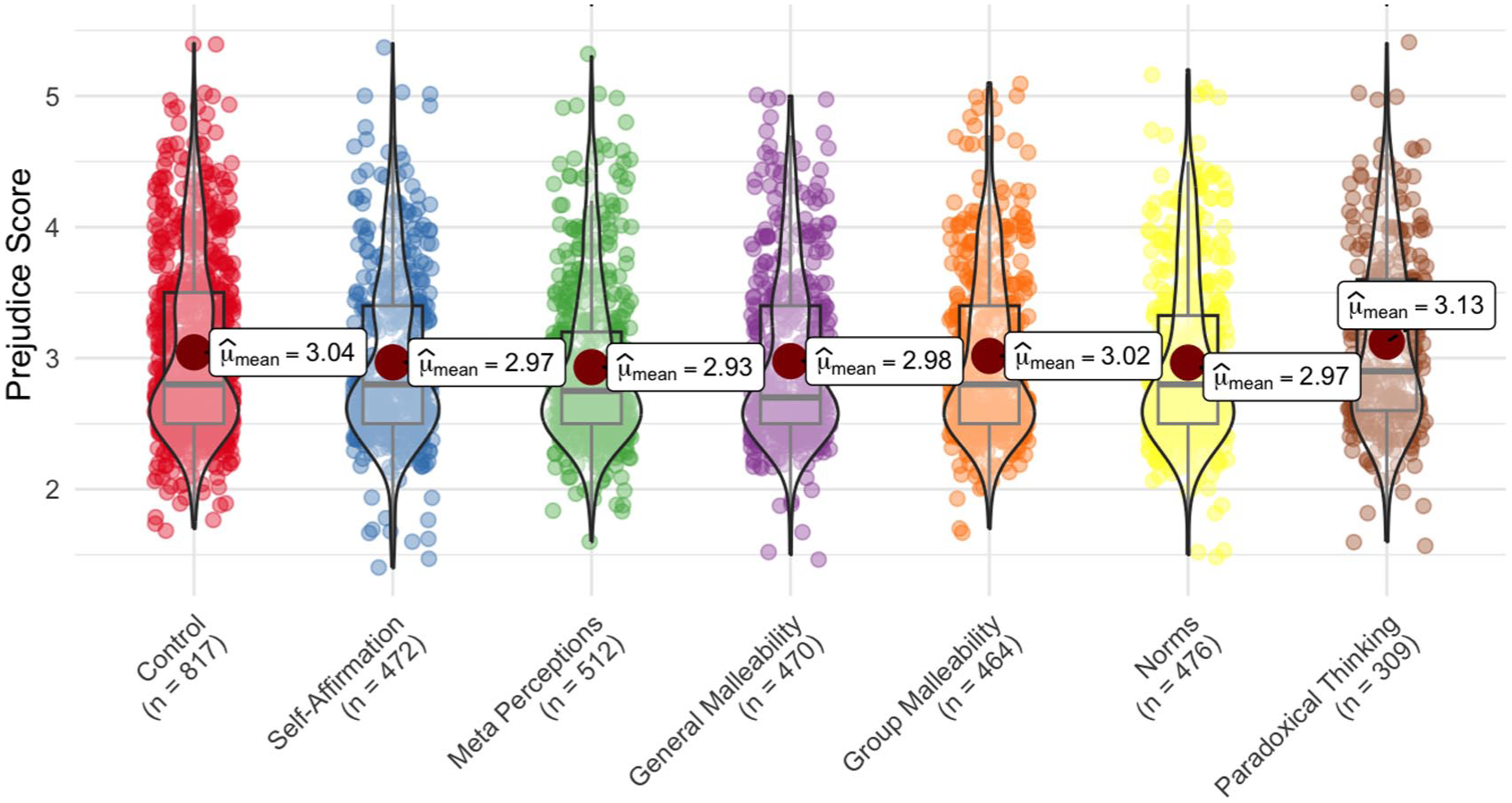
Effect of interventions (vs. control) on prejudice score.
Support for Social Change
We found a significant effect of condition on post-intervention support for social change after controlling for pre-intervention scores, F(6, 3497) = 7.49, p < .001, partial η² = .010 (see Figure 2). Post-hoc comparisons showed that the social norms intervention led to significantly higher support for social change compared to the control (p = .001, d = 0.21). The meta-perception correction intervention showed a slightly smaller significant positive effect (p = .002, d = 0.20). No other interventions differed significantly from the control (all ps > .244). 7
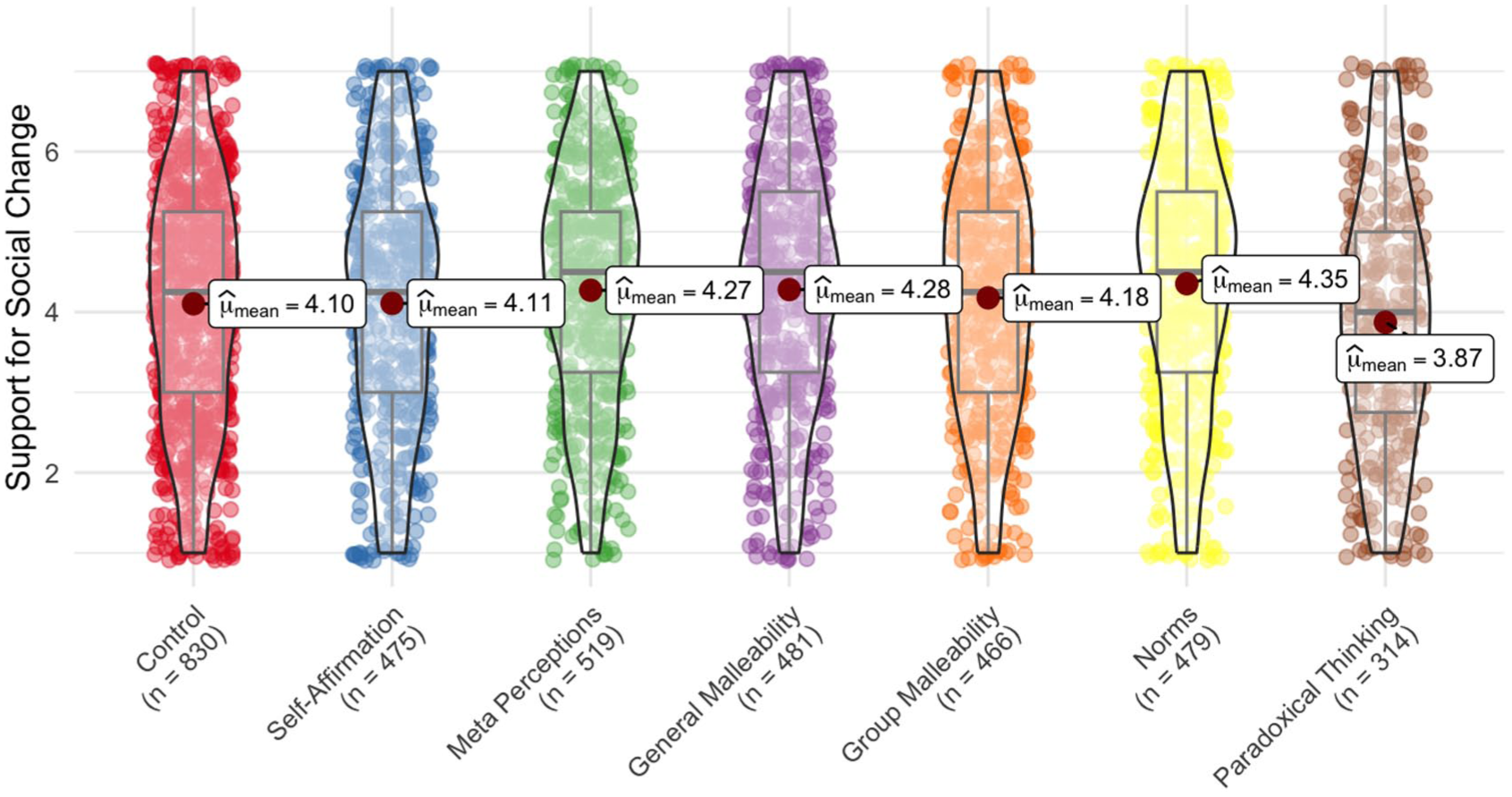
Effect of interventions (vs. control) on support for social change.
Additional Outcomes
Analyses showed that the social norms intervention lowered hostility and support for violence, while boosting political cooperation. Correcting meta-perceptions reduced prejudice and support for violence, and also promoted social change. Self-affirmation and general malleability decreased support for violence, whereas paradoxical thinking lessened political cooperation. These results emphasize the wider effects of some interventions across multiple areas. For a concise overview, Table 4 summarizes intervention effects across all outcome measures.
Effects of Interventions on Main and Additional Outcomes Compared to Control.
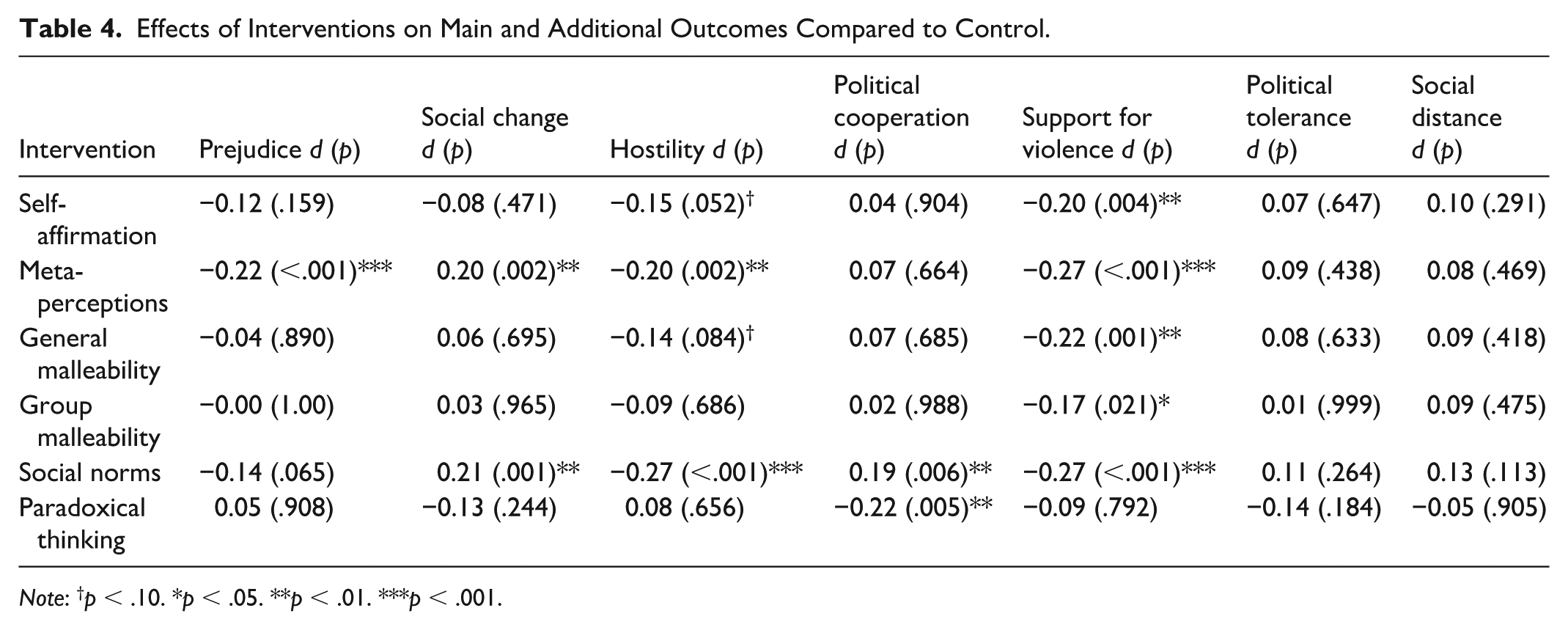
Note: †p < .10. *p < .05. **p < .01. ***p < .001.
Our findings show that psychological intergroup interventions have different, and only partially overlapping, effects on our outcomes. The social norms intervention was most effective at increasing support for social change, reducing hostility and support for violence, and promoting political cooperation. The meta-perception correction intervention was most successful in lowering prejudice while also boosting support for social change and decreasing hostility and support for violence. Self-affirmation and malleability interventions caused smaller but consistent reductions in support for violence, whereas paradoxical thinking had no significant positive effects and, in some cases, even backfired by decreasing political cooperation. Overall, these additional results reveal a more complex pattern than our primary measures alone suggest, but one that continues to support our main argument: interventions need to be evaluated based on the specific outcomes they target. These diverse profiles reinforce our point that psychological interventions should not be seen as universally effective but rather tailored to the specific goals and contexts in which they are used.
Since our intervention tournament study involved multiple comparisons—testing and comparing several interventions at once—we took extra steps to ensure our findings’ robustness. The tournament method, while efficient for evaluating multiple interventions, raises the risk of Type I errors (false positives) due to numerous pairwise comparisons (Hameiri & Moore-Berg, 2022). To address this issue and boost the validity of our results, we used a Bayesian analysis approach, which naturally manages multiple comparisons through its hierarchical structure and offers direct probability estimates of intervention effects (Kruschke & Liddell, 2018). This analysis provided posterior probabilities and evidence ratios for each intervention’s effectiveness, confirming our original findings with solid uncertainty estimates (see full analysis in the Supplemental Materials).
Exploratory Analysis of Individual Characteristics
As we mentioned above, we were also interested in exploring whether intervention effects were moderated by individual characteristics. Moreover, given that several interventions that had previously demonstrated effectiveness showed no significant overall effects in our study, we explored the possibility that rather than being ineffective altogether, these interventions might have been effective only for specific subgroups of participants. To test this, we conducted an exploratory analysis to examine whether the influence of interventions was conditional on participants’ ideological, personality, or demographic characteristics.
Analysis Strategy
We used honest causal tree analysis (Athey & Imbens, 2016; Jawadekar et al., 2023). This machine learning approach identifies meaningful subgroups by recursively splitting the data based on participant characteristics in order to maximize differences in treatment effects. Unlike traditional moderation analyses that test a small number of pre-specified moderators, causal trees allow for a systematic search across many possible moderators simultaneously while controlling for multiple comparisons and avoiding overfitting. The procedure occurs in two stages. First, the sample is randomly divided into a training set and an estimation set. The training set is used to grow the tree by identifying participant characteristics (e.g., high vs. low RWA) that maximize differences in treatment effects. The estimation set is then used to calculate unbiased treatment effects for each resulting subgroup, or “leaf,” with pruning retaining only the most reliable splits. For each subgroup, we estimate the difference between intervention and control participants while adjusting for baseline scores. The reported coefficients reflect these subgroup-specific treatment effects, and the associated p-values indicate whether each effect differs significantly from zero.
For example, a split on RWA might show that the meta-perceptions intervention reduced prejudice among low-RWA individuals but had no effect among high-RWA individuals. The split itself is selected because the difference in effects across the subgroups is relatively large, but the reported p-values pertain to the intervention effect within each subgroup. Since causal trees test multiple potential splits, results should be viewed as exploratory. Subgroup sizes are smaller than in the full sample, results can vary depending on random splits, and findings should be seen as patterns generating hypotheses for future confirmatory studies rather than definitive subgroup effects.
We conducted separate analyses for each of our two primary outcome measures: prejudice and support for social change. Similar to our main analysis, for each outcome, we analyzed each treatment condition separately in comparison to the combined control condition, resulting in multiple causal trees that identified the participant characteristics most relevant for moderating the effectiveness of each specific intervention on each outcome. Because causal trees test many potential splits, results should be viewed as exploratory. Subgroup sizes are smaller than in the full sample, results can vary depending on random splits, and findings should therefore be interpreted as patterns that generate hypotheses for future confirmatory studies rather than definitive subgroup effects.
Results and Discussion
The coefficients reported below represent the average treatment effect of each intervention compared to control within the subgroup identified by the tree, controlling for pre-intervention outcomes. Positive values indicate that the intervention increased the outcome relative to control, while negative values indicate it decreased the outcome. The direction of the effect should be interpreted in relation to the construct: for example, a negative effect on prejudice or support for violence represents a desirable reduction, whereas a negative effect on support for social change represents an undesirable decrease. Only in cases where the effect worsens the outcome relative to its intended direction (e.g., increasing prejudice or decreasing support for social change) should it be interpreted as a backfire effect.
The machine learning analyses systematically explored how the effectiveness of interventions varied across combinations of individual differences. Through the causal tree analysis, we identified characteristics that emerged as significant moderators within each category of personalization variables (ideological factors, personality traits, and demographics). This approach revealed that while some subgroups showed improvements, others demonstrated backfire effects, and results should be interpreted as exploratory given the smaller subgroup sizes. While we present these findings by focusing on individual variables for clarity, this is a deliberate simplification of more complex patterns. In reality, intervention effects depended on constellations of traits (e.g., high universalism combined with left-wing orientation, high SES, and low RWA) rather than single factors alone. The full analysis of these interaction patterns, including their prevalence and detailed statistics, is provided in the Supplemental Materials (S17).
To illustrate these dynamics, we summarize below the main subgroup patterns observed for each intervention. The meta-perception correction intervention showed backfire effects for participants high in RWA (β = .709, p = .022), and for older adults (β = .903, p = .030), indicating increased prejudice among groups motivated by stability and crystallized attitudes. The group malleability intervention produced mixed results: it backfired on prejudice for participants high in neuroticism (β = .643, p = .048) but was more effective at increasing support for equality among highly educated participants (β = 2.72, p = .002). The self-affirmation intervention was beneficial for those high in trait victimhood, who showed increased support for equality (β = 1.39, p = .040). Finally, the social norms intervention was especially effective at increasing support for equality among younger participants (β = 1.80, p = .048). Together, these findings demonstrate that intervention effects varied systematically across subgroups, highlighting the potential of personalized approaches while also cautioning that some strategies may backfire for particular populations.
While this approach highlights meaningful variation in effects across subgroups, it also carries important limitations. Subgroup estimates are based on small samples, which reduces their stability and precision. In addition, results can vary across random splits, making them sensitive to sampling variability and model specification. For these reasons, findings should be considered exploratory rather than definitive. At the same time, the approach has notable strengths: it generates interpretable hypotheses about how interventions may work differently across individuals, providing insights into heterogeneity of effects that can guide future confirmatory studies.
General Discussion
The current research deepens our understanding of psychological intergroup interventions by emphasizing the importance of systematic tailoring along two dimensions: desired outcomes and individual characteristics. Rather than viewing interventions as universally effective tools, our findings highlight the need for a more nuanced approach that accounts for both what an intervention aims to achieve and who receives it. Specifically, the evidence points to complex patterns of effectiveness, suggesting that different interventions may yield distinct yet overlapping effects depending on the targeted outcomes and participant characteristics.
Our results indicate that the relationship is not clear-cut. The meta-perception correction intervention most strongly reduced prejudice, while the social norms intervention most strongly increased support for social change, but both also influenced additional outcomes such as hostility, support for violence, and political cooperation. This pattern suggests partial overlap between interventions while also highlighting their differential strengths, providing initial support for the argument that interventions do not have a uniform effect across different outcomes.
Beyond the two leading interventions, other approaches showed either narrower, but nevertheless meaningful, effects, or, in the case of paradoxical thinking, even backfired. The self-affirmation and malleability interventions primarily reduced support for violence but did not consistently affect other outcomes. Their weaker impact may reflect the difficulty of shifting entrenched attitudes through brief, light-touch formats in the context of a protracted conflict.
In contrast, paradoxical thinking did not produce positive effects and even decreased political cooperation. One possible explanation is that the intervention may have missed the ‘sweet spot’ identified in prior work (Hameiri et al., 2020): paradoxical messages are most effective when they are provocative enough to prompt reflection but not so extreme that they are rejected outright. The video format we used conveyed a very blatant, exaggerated message that may have overshot this sweet spot, reducing its effectiveness. More broadly, the entrenched asymmetry of Jewish–Arab relations may dampen receptivity to such interventions compared to other contexts (Dixon & Levine, 2012; Maoz, 2011). These considerations suggest that weaker or backfiring effects should not be seen as simple failures to replicate but as reflections of how message design, audience, and conflict context shape intervention impact. However, we also acknowledge that the present null effects represent failures to replicate prior findings, and that the current results cannot distinguish contextual moderation from the absence of reliable intervention effects.
Taken together, our results point to the variability in how different interventions operated. Some, like meta-perception correction and social norms, produced consistent effects across multiple outcomes, while others, such as malleability beliefs and self-affirmation, had narrower impacts. Paradoxical thinking even produced unintended negative effects. Rather than viewing these results as failures, they highlight that interventions may be sensitive to contextual factors such as message framing, audience, and conflict dynamics, and that their effectiveness can vary depending on the specific outcomes being targeted.
At the same time, our findings speak to questions of generalizability and format. Interventions that rely on concise social information may be well-suited for light-touch formats and can be scaled across diverse contexts, including societies in conflict, post-conflict, and those at peace. In contrast, interventions that target deeper psychological processes, such as malleability or self-affirmation, may require more sustained or intensive delivery to achieve impact, particularly in settings where conflict hardens defensive or rigid attitudes, as suggested by evidence from multi-session interventions that produced significant effects (e.g., Goldenberg et al., 2018; Halperin et al., 2011). These distinctions suggest that weaker or null effects should not be read as simple replication failures but as evidence of the importance of matching mechanism, delivery format, and societal context when designing and implementing interventions.
Our findings also add to the ongoing debate in social psychology about how reducing prejudice affects support for social change. Some experts believe that cutting prejudice naturally boosts support for social change (Tropp & Dehrone, 2023), while others think these outcomes might work independently or even clash (Dixon et al., 2016; Dixon & Levine, 2012). Our results show that this relationship is complex and varies depending on the intervention used. The meta-perception correction intervention had the strongest impact on reducing prejudice, while the social norms intervention had the greatest effect on increasing support for social change, which are the two outcomes for which we collected pre- and post-intervention data. At the same time, both interventions also influenced other outcomes, such as hostility, support for violence, and political cooperation. These broader findings complicate the idea that interventions can be neatly categorized and suggest that their effects can spread across multiple areas of intergroup relations. This highlights the importance of not only identifying an intervention’s most clear and consistent effects but also recognizing its potential impact on related areas, which helps deepen our understanding of how different pathways shape intergroup dynamics.
These distinctions also align with broader theoretical frameworks that differentiate between attitudinal and behavioral outcomes (Brauer, 2024). Interventions mainly aimed at stereotypes or perceptions of the outgroup tend to influence core attitudes. In contrast, interventions that target norms or perceived efficacy are more successful at driving behavioral intentions because they shape people’s sense of social approval and the feasibility of collective action, both of which are central predictors of willingness to act (Tankard & Paluck, 2016; van Zomeren et al., 2008). This distinction clarifies why the meta-perception correction intervention most significantly decreased prejudice, while the social norms intervention most reliably increased support for social change.
Individual-based tailoring represents another crucial dimension revealed by our machine learning analyses. The systematic variation in responses across ideological factors, personality traits, and demographic characteristics suggests that considering individual differences is not just about optimization; rather, it is about ensuring interventions do not inadvertently cause harm to certain subgroups (Petty et al., 2025).
This pattern highlights how the same intervention can produce markedly different effects depending on who receives it, underscoring the importance of considering individual characteristics in intervention design. The relationship between outcome specificity and individual characteristics provides crucial groundwork for future intervention design. By mapping both intervention effectiveness and individual differences in responses, our research establishes the empirical foundation needed for future tailored approaches. For example, meta-perception correction interventions demonstrated robust effects on prejudice reduction across participants, though some variation existed among specific subgroups. Similarly, social norms interventions effectively increased support for social change while showing some demographic differences in magnitude of impact. While our research does not implement tailoring directly, it provides the systematic understanding of what works best for whom that will be essential for developing targeted interventions in the future.
For practitioners, our findings provide several clear recommendations for developing interventions. The process should start with defining clear outcome priorities, as trying to address multiple goals at once can lower effectiveness. Instead of taking a broad approach, practitioners should pinpoint primary desired outcomes and choose psychological mechanisms proven to work for those specific goals. After this initial prioritization, a careful assessment of the population’s characteristics becomes essential, especially regarding the distribution of relevant individual differences that might influence intervention effectiveness. Practitioners must then evaluate potential trade-offs, balancing the benefits of outcome-specific interventions with the need for broad applicability and considering whether a more tailored approach could exclude or harm certain subgroups.
Tailoring does not always require detailed psychological profiling, which may be unrealistic in field settings. Readily available demographic indicators can sometimes suffice. At the same time, advances in AI and the kinds of data available through social networks make it possible to approximate psychological dispositions such as authoritarianism, SDO, or personality traits from the Big Five—even from short conversations. This creates real opportunities to match interventions to the variables most relevant to their success. Yet these same possibilities demand careful ethical reflection. Any move toward psychological tailoring must be accompanied by strong safeguards around privacy, informed consent, and responsible use (Zettler & Strandsbjerg, 2025). A responsible path forward would combine coarse, accessible indicators with cautious exploration of psychologically informed tailoring, always embedded within transparent and ethical practice.
Moreover, some interventions may require specific attention. For example, for social norms interventions, effectiveness depends not only on the content of the norm but also on how it is presented. Highlighting dynamic norms (shifts in attitudes or behaviors over time) can promote constructive change even when existing norms are mixed or negative (Sparkman & Walton, 2017; Tankard & Paluck, 2016). At the same time, practitioners must take care to avoid exaggerating or inventing norms, as doing so raises serious ethical concerns and could erode trust in interventions. In cases where norms are strategically exaggerated, it is essential to provide appropriate debriefing so that participants understand the intervention’s purpose and evidence base.
Several limitations of the current research should be considered. First, while our research provides foundational insights into how interventions work differently for different outcomes and people, we did not implement actual tailored approaches. This crucial next step remains for future research. Second, our interventions were brief, single-exposure videos. Yet, rather than seeing this as purely a limitation, we view this methodology as an important stepping stone. Specifically, intervention tournaments (Hameiri & Moore-Berg, 2022) can efficiently test and compare multiple approaches to inform the development of more comprehensive, long-term campaigns with interactive formats. Third, when examining specific combinations of interventions and individual characteristics through machine learning analyses, our subgroups were relatively small, potentially limiting the reliability and robustness of our moderation findings. Fourth, since our participants were all Jewish–Israeli adults, direct generalizability to other cultural contexts and intergroup settings is limited. Finally, our measures focused primarily on explicit attitudes and self-reported behavioral intentions, leaving questions about effects on implicit attitudes and actual behaviors.
In conclusion, going back to the medical analogy we started with, just as modern medicine has moved beyond treating all pain with the same over-the-counter medication, psychological intergroup interventions must evolve beyond a one-size-fits-all approach. Like physicians who consider both conditions and patient characteristics, those working to improve intergroup relations must match interventions to specific outcomes and recipient characteristics. The differential effectiveness of the social norms and meta-perception correction interventions, along with varying individual responses, demonstrates how some interventions may benefit certain groups while causing backfire effects in others. Moving forward, researchers and practitioners should embrace this complexity while balancing intervention specificity with practical considerations - marking an important step toward more personalized approaches to social change.
Supplemental Material
sj-docx-1-psp-10.1177_01461672261434701 – Supplemental material for One Size Might Not Fit All: A Tailored Approach to Psychological Intergroup Interventions
Supplemental material, sj-docx-1-psp-10.1177_01461672261434701 for One Size Might Not Fit All: A Tailored Approach to Psychological Intergroup Interventions by Shira Hebel-Sela, Nimrod Nir, Adva Gruenwald, Boaz Hameiri and Eran Halperin in Personality and Social Psychology Bulletin
Footnotes
Acknowledgements
The authors would like to thank Ariel Karlinsky from the Center for Interdisciplinary Data Science Research (CIDR), Hebrew University, Israel, for data analysis and consultation on the personalization analysis.

Ethical Considerations
The institutional review board of The Hebrew University of Jerusalem approved all study procedures.
Consent to Participate
Participants provided informed consent prior to participation.
Funding
The authors disclosed receipt of the following financial support for the research, authorship, and/or publication of this article: A European Research Council grant (number 864347) to the last author.
Declaration of Conflicting Interests
The authors declared no potential conflicts of interest with respect to the research, authorship, and/or publication of this article.
Data Availability Statement
AI Disclosure
During the preparation of this manuscript, the authors used ChatGPT by OpenAI and Claude by Anthropic to assist with improving the clarity and flow of the writing, shortening the manuscript to meet word count requirements, and supporting the development of code for data analysis. All AI-generated content was carefully reviewed and edited by the authors, who take full responsibility for the final content of the publication.
Supplemental Material
Supplemental material is available online with this article.
Notes
References
Supplementary Material
Please find the following supplemental material available below.
For Open Access articles published under a Creative Commons License, all supplemental material carries the same license as the article it is associated with.
For non-Open Access articles published, all supplemental material carries a non-exclusive license, and permission requests for re-use of supplemental material or any part of supplemental material shall be sent directly to the copyright owner as specified in the copyright notice associated with the article.
