



Abstract
Although historical negation—the ideologically-based denial of the contemporary relevance of colonial injustices—sustains inequities between settler colonisers and Indigenous peoples, few studies explore the psychological processes underlying historical negation among settler colonisers. In this pre-registered study, we examine whether perceived group-based relative deprivation (GRD) fosters historical negation among New Zealand Europeans. To do so, we use seven annual waves of data from a nationwide panel sample of New Zealand European adults (N = 26,759) and random intercept cross-lagged panel modelling to predict within-person changes in historical negation over time. Contrary to our hypotheses, no significant within-person associations emerged between GRD and historical negation. GRD did, however, have a positive between-person association with historical negation among sole-identifying New Zealand Europeans. These results indicate that GRD among settler colonisers correlates with—but does not drive—the minimisation of the present-day relevance of colonial injustices.
Introduction
The politics of post-colonial 1 nations are marked by discussions of the contemporary relevance of injustices perpetrated by settler colonisers against Indigenous peoples. For instance, Māori (the Indigenous peoples of Aotearoa, New Zealand) were colonised by British settlers in the 19th century, resulting in the forced seizure of Māori land and resources, as well as the brutal suppression of te reo Māori (the Māori language; Orange, 2011; Walker, 2004). Although political activism has revitalised Māori culture and yielded some resource-based reparations in contemporary New Zealand (see Moon, 2009), many people still minimise the continual impacts of colonialism and oppose policies designed to redress ongoing discrimination (Craymer, 2023; Newton et al., 2018; Sibley et al., 2005). Similar patterns emerge in other post-colonial nations, including Australia (Augoustinos & LeCouteur, 2004; Maddison, 2012), Canada (Herkimer et al., 2025; Warry, 2008), Chile (Figueiredo et al., 2019), and South Africa (Park, 2022). Narratives positioning colonialism as irrelevant to contemporary society are thus a pervasive, global barrier to Indigenous peoples’ rights.
Sibley (2010) describes this phenomenon as historical negation—a culture-specific ideology that forms in response to discourses about inequality between Indigenous peoples and settler colonisers. Given that Indigenous peoples have an undeniable claim to the nation and experienced objective historical injustices, justifying race-based inequalities in post-colonial nations requires distinct belief systems compared to other racial contexts (for discussion, see Sibley & Osborne, 2016). Indeed, ideologies that justify ethnic inequalities by asserting ethnic minority groups are foreign and “do not belong” are unintelligible when the minority group has an objective claim to the land. Likewise, it is difficult to (completely) reject well-documented historical injustices, particularly in societies with established treaty and reconciliation policies (such as New Zealand). Instead, settler colonisers may acknowledge past historical injustices but deny their relevance to contemporary society. Historical negation thus absolves contemporary settler colonisers of wrongdoing by separating the past from the present and minimising the intergenerational impacts of colonialism. Critically, historical negation minimises the responsibility of settler colonisers to equally distribute resources and make reparations towards Indigenous peoples, and thus foments opposition to resource-based reparative policies (e.g., Bertenshaw et al., 2023) and Māori political mobilisation (Osborne et al., 2017).
Given the marked effects of historical negation on Indigenous progress, understanding how and why settler colonial groups endorse such ideologies is essential to identifying—and redressing—barriers to equity for Indigenous peoples (see González et al., 2022, for a recent review). In the current study, we test whether historical negation emerges in response to settler colonisers’ perceptions of their contemporary societal status—that is, how settler colonisers perceive their ingroup’s position compared to other ethnic groups. In post-colonial nations, narratives of colonialism and subsequent reparations (or lack thereof) shape how people perceive contemporary society and, in turn, how they perceive the present-day impacts of colonialism (Freel & Bilali, 2022; Lastrego et al., 2022). This process requires a thorough examination of how settler colonisers perceive and respond to present-day social conditions, as well as how these assessments may impact the perceived relevance of historical colonial injustices to contemporary society. Such an approach aligns with wider calls to integrate history into studies of social psychological processes (Atari et al., 2025; Dovidio et al., 2012; Gergen, 1973), particularly in post-colonial contexts (e.g., Liu & Hilton, 2005; Pihama et al., 2014).
The current pre-registered study meets this call by examining the role of ethnic group-based relative deprivation (GRD)—the feeling that one’s ethnic group is unfairly disadvantaged compared to other groups—in fostering historical negation among settler colonisers. Specifically, we examine whether GRD predicts changes in historical negation over time using a nationwide panel sample of New Zealand Europeans (the majority, settler coloniser group in New Zealand). Below, we first provide an overview of the New Zealand context, as well as past research examining the antecedents of historical negation. We then introduce GRD as a potential motivator of historical negation among settler colonisers before introducing our approach and hypotheses.
The New Zealand Context
New Zealand is a small Pacific nation with a population of approximately 5.3 million. New Zealand Europeans are New Zealand’s largest ethnic majority group (62.1% of the population), while Māori are the largest ethnic minority group (17.8%; Statistics New Zealand, 2024). Despite New Zealand’s ostensibly egalitarian reputation (see OECD, 2023), its colonial history is relatively recent; Māori were colonised by British settlers following the signing of Te Tiriti o Waitangi in 1840 (The Treaty of Waitangi; Orange, 2011). Although the Māori translation of Te Tiriti, signed by over 500 Māori chiefs, promised Māori the right to tino rangatiratanga (self-determination and self-sovereignty) and land governance (Coxhead et al., 2014, 2022), these promises were not met. Before the end of the 19th century, the Crown had stripped Māori of most of their land and material resources, and assimilation policies suppressed Māori culture, including te reo Māori (Thomas & Nikora, 1996). These generational losses continue to impact Māori today (Thom & Grimes, 2022; Wirihana & Smith, 2014).
The latter half of the 20th century saw a proliferation of political activism to challenge the Crown’s subjugation of Māori and revitalise Māori language and culture (coined the “Māori renaissance”; Moon, 2009; Paterson, 2010). Critically, Māori activism challenged the Crown’s interpretation of Te Tiriti, leading to the formation of the Waitangi Tribunal in 1975 (a commission where Māori can make claims for breaches of their Treaty rights; see Walker, 2004). In 1985, the Waitangi Tribunal was granted retrospective power to investigate claims of Te Tiriti breaches from the date of signing in 1840 (Waitangi Tribunal, 2025). Subsequent treaty settlements have facilitated some land and resource reparations for Māori iwi (tribes), with further activism resulting in the recognition of te reo Māori as an official language of New Zealand in 1987 (Moon, 2009; Walker, 2004). Other initiatives have sought to redress the intergenerational impacts of colonialism on Māori health, including the 2017 to 2023 Labour government’s establishment of the Māori Health Authority (Future of Health, 2022). Critically, recent research suggests the general population reports high and increasing support for teaching te reo Māori in schools (Matika et al., 2019) and increasing support for (symbolic) inclusion of Māori culture in New Zealand’s national identity among New Zealand Europeans (Bertenshaw et al., 2025a). In short, the past 50 years have seen a rise in (a) the acknowledgement of the undeniable harms of colonialism and (b) attempts to redress these harms. Nonetheless, the effects of colonisation are ongoing, and colonial systems and power structures continue to be reproduced today (see Reid et al., 2019, for discussion). These processes sustain inequities between Māori and settler colonisers, including across health (Reid et al., 2019) and socioeconomic domains (Marriott & Alinaghi, 2021).
Historical Negation Among New Zealand Europeans
Despite increasing acknowledgement of the historical harms of colonialism, there is significant heterogeneity in perceptions of the contemporary relevance of colonisation among New Zealand Europeans. Indeed, some New Zealand Europeans recognise that colonisation continues to shape New Zealand society and support both symbolic and resource-based reparations (Bertenshaw et al., 2025; Sibley et al., 2005). However, recent research suggests that a greater proportion of New Zealand Europeans support the symbolic inclusion of Māori culture while simultaneously perceiving colonial injustices as irrelevant to present-day society (see Bertenshaw et al., 2025). In other words, many New Zealand Europeans express surface-level support for Indigenous progress while denying the need for continued reparations towards Māori. Understanding and addressing the motivators of historical negation is thus crucial to continuing Indigenous progress in New Zealand—and other post-colonial nations (e.g., see Castro et al., 2022).
Psychological Motivators of Historical Negation
Prior research integrating post-colonial ideologies into the Dual Process Model of Ideology (Duckitt, 2001; Duckitt & Sibley, 2016) suggests that historical negation among New Zealand Europeans is motivated by goals to maintain group hierarchies (social dominance orientation [SDO]) and protect traditional norms (right-wing authoritarianism [RWA]; Osborne et al., 2021; Satherley & Sibley, 2018; Sibley & Liu, 2012). Recent research also suggests that RWA, system justification, and binding moral foundations, including loyalty/betrayal and authority/subversion, motivate historical negation towards the Mapuche people in Chile (Castro et al., 2022). Perhaps unsurprisingly, these findings demonstrate that the desire to maintain ingroup dominance and authority broadly motivates historical negation among settler colonisers.
Group identity processes also foster historical negation. Given colonial injustices threaten a positive representation of coloniser groups (Bell, 2006, 2009), group members may use historical negation to maintain a positive ingroup identity. For instance, recent research suggests that patriotism—that is, pride and commitment to one’s nation—predicts historical negation among settler colonisers (and vice versa; Bertenshaw et al., 2025b). More broadly, historical negation protects settler colonisers’ resources by negating any reparative responsibilities and, accordingly, settler colonisers may leverage historical negation in response to perceived material threats to group resources (see Sibley, 2010). In short, scholars theorise that historical negation is motivated by desires to (a) maintain ingroup dominance, (b) restore positive ingroup identity, and (c) alleviate material threats.
GRD and Historical Negation
The motivators of historical negation suggest that perceived group threats could also foster historical negation among settler coloniser groups. Consistent with this possibility, we propose that perceived ethnic GRD (Runciman, 1966) motivates historical negation. GRD describes the perception that one’s ethnic group is unfairly disadvantaged relative to other salient ethnic groups (for a meta-analytic review, see Smith et al., 2012). More specifically, GRD emerges when one (a) compares their ingroup to other groups, (b) cognitively appraises their ingroup as disadvantaged, (c) perceives this disadvantage as illegitimate, and (d) exhibits an affective response (e.g., anger or frustration) at the perceived injustice (Pettigrew, 2016; Smith et al., 2012). Over 70 years of research demonstrates the predictive power of GRD in explaining how and when people respond to inequality, irrespective of one’s objective conditions (Smith et al., 2012, 2020). For instance, GRD is strongly associated with collective action, radicalisation, and intergroup attitudes across both minority and majority groups (e.g., Lilly et al., 2024a; Osborne et al., 2025; Thomas et al., 2020) and independently of other psychological constructs such as SDO or intergroup contact (Pettigrew, 2016).
The form and function of GRD among majority groups suggest its potential relevance to historical negation among settler colonisers. GRD is a subjective appraisal of societal status and, accordingly, both ethnic minority and majority groups can feel deprived. However, the psychological meaning of GRD differs across groups; although GRD among ethnic minorities reflects (albeit imperfectly) their objective societal position, ethnic majority groups are objectively more advantaged than ethnic minorities. Rather than reflecting their objective conditions, scholars argue that GRD among ethnic majorities stems from perceived challenges to their societal position by minority groups (Blumer, 1958; Taylor, 2002). Indeed, prior work suggests ethnic majorities see racial progress as “zero-sum” whereby increasing the rights of one group invariably decreases the rights of another (Norton & Sommers, 2011). GRD among majority groups thus reflects concerns that their group is “losing” its advantage over other groups (Sengupta et al., 2019; Taylor, 2002). To reconcile this (perceived) status loss, ethnic majorities seek to regain their advantage via racial discourses that discount the experiences of minority groups (for discussion, see Roediger, 1991; Taylor, 2002). For example, right-wing political leaders like Donald Trump capitalise on concerns that ingroup privileges can be “lost” to attract support (Mols & Jetten, 2016) and justify reversing anti-discrimination and Diversity, Equity, and Inclusion initiatives (for discussion, see Ng et al., 2025).
In post-colonial nations, these narratives should emerge via historical negation, as positioning colonial injustices as irrelevant to contemporary society provides a justification to oppose contemporary social change for Indigenous peoples and maintain hierarchies that privilege settler colonisers. In doing so, settler colonisers can address their feelings of GRD and reaffirm their advantaged societal position. Indeed, recent sociopolitical events support this possibility. Indigenous progress in New Zealand has been challenged with narratives of “reverse discrimination” among New Zealand Europeans that frame contemporary policies to redress colonial injustices as “racist” (RNZ, 2021), reflecting the longstanding myth of Māori “privilege” (Meihana, 2023). Similar to the United States, the current right-wing government has used these narratives to justify reviewing the principles of Te Tiriti and advancing “colour-blind” policies (see Guenzler, 2024). Recent research also suggests that perceived discrimination among New Zealand European men correlates with greater perceptions that “discrimination towards Māori is no longer a problem in New Zealand” (Lilly, Kimberley, et al., 2025). In short, GRD among settler colonisers should evoke historical negation in an attempt to resolve the (perceived) threat Indigenous progress poses to their ingroup’s advantaged position.
Although no research to date empirically examines the relationships between GRD and historical negation, research examining the denial of discrimination against ethnic minorities indirectly supports our predictions. Indeed, early relative deprivation research suggests that GRD among White Americans correlates with the denial of discrimination and resentment of affirmative action targeting African Americans (Vanneman & Pettigrew, 1972). Similarly, the relationship between GRD and overt prejudice among German majority group members is partially explained by the denial that the Turkish minority group encounters discrimination (see Pettigrew et al., 2008). More broadly, GRD among majority groups predicts prejudice towards (Gheorghiu et al., 2022; Pedersen & Walker, 1997), and resentment of (Taylor, 2002; Vanneman & Pettigrew, 1972), minority groups. Together, these findings suggest that GRD fosters “whitelash” (see Lippard et al., 2020; Sengupta et al., 2019) and the denial of objective injustices faced by ethnic minorities among majority group members. That said, the minimisation of current injustices is distinct from denying the relevance of past injustices. Thus, studies directly assessing the relationship between GRD and historical negation are needed to determine whether GRD’s effects on discrimination narratives extend to narratives of historical intergroup relations.
Overview of the Present Study
In this pre-registered study, we investigate the longitudinal effects of GRD on historical negation across seven annual assessments of a large, nationwide sample of New Zealand Europeans. More specifically, we examine whether within-person changes in GRD predict within-person changes in historical negation over time using random intercept cross-lagged panel modelling (RI-CLPM; see Hamaker et al., 2015; Osborne & Little, 2024). The RI-CLPM disentangles the stable, “trait-like” differences between people from changes within individuals over time. As such, we can test whether (a) New Zealand Europeans higher in GRD generally report higher levels of historical negation (a between-person effect) and (b) changes from an individual’s “typical” levels of GRD predict changes in an individual’s usual levels of historical negation over time (and vice-versa; within-person effects). The latter test allows us to assess the temporal ordering of GRD and historical negation and focus on the psychological processes underlying historical negation at the individual level of analysis (for discussion, see Curran & Bauer, 2011).
Our analyses focus on fiscal ethnic GRD—that is, the perception that Europeans are unfairly financially disadvantaged compared to other ethnic groups. Although other forms of relative deprivation exist (see Smith et al., 2012; Tyler & Lind, 2002), fiscal GRD is particularly relevant because Europeans are objectively financially advantaged compared to Māori and other non-Indigenous ethnic minority groups in New Zealand (Marriott & Alinaghi, 2021; Ministry of Social Development, 2019). Moreover, fiscal GRD involves perceptions of one’s (financial) resources—an appropriate focus given the relationship between historical negation and opposition to resource-based reconciliation policies (Bertenshaw et al., 2023). That said, different forms of GRD have similar effects on intergroup attitudes (Smith et al., 2012), and GRD related to (perceived) unfair treatment (see Tyler & Lind, 2002) also reflects status threat concerns relevant to historical negation. Thus, although we focus on fiscal ethnic GRD in our analyses, we expect ethnic GRD in general will foster historical negation among settler colonisers.
To identify the unique effects of GRD on historical negation, our analysis includes two key covariates: SDO and individual-based relative deprivation (IRD). As mentioned, historical negation is partly motivated by a desire to maintain group-based social hierarchies (Osborne et al., 2021; Satherley & Sibley, 2018). Given that feelings of disadvantage among majority groups motivate a desire to maintain (or reestablish) a high social status, GRD correlates positively with SDO (Lilly et al., 2024a) and related ideologies (e.g., nationalism; Sengupta et al., 2019). Thus, adjusting for SDO ensures that any identified effects of GRD on historical negation represent the effects of perceiving one’s group as disadvantaged rather than a general desire to maintain group-based hierarchies. Relatedly, prior research suggests that IRD can “spill over” into GRD over time (Lilly et al., 2023). Accordingly, studies of relative deprivation should include both IRD and GRD where possible (see also Schmitt et al., 2010).
Overview of Hypotheses
The present study tests three focal hypotheses. First, within-person increases in SDO should predict subsequent within-person increases in historical negation (Hypothesis 1). This merely replicates prior analyses of our data (Osborne et al., 2021) with a different number of waves (and different covariates) but allows us to include SDO as a covariate. Second, we expect within-person changes in IRD to be unassociated with within-person changes in historical negation (Hypothesis 2). Indeed, relative deprivation theory posits that IRD is a stronger correlate of intrapersonal (rather than intergroup) outcomes (Smith et al., 2012). Thus, IRD is unlikely to impact the extent to which New Zealand Europeans deny the continued relevance of historical injustices experienced by Māori. Nonetheless, we include IRD in our analysis to control for the established, longitudinal relationship between IRD and GRD (Lilly et al., 2023).
Finally, we expect within-person increases in GRD to predict subsequent within-person increases in historical negation over time (Hypothesis 3). By examining our hypothesis while adjusting for the within-person effects of SDO, we assess the extent to which historical negation is driven by the perception that New Zealand Europeans are disadvantaged (GRD) versus an underlying motivation to maintain inequality (SDO).
Method
Transparency and Openness
Our analyses and hypotheses were pre-registered on the Open Science Framework: https://osf.io/adpqk/. We report all measures, exclusions, and pre-registered analyses in the manuscript. Our supplementary analyses are robustness checks of our results and were not pre-registered. The data described here are part of the New Zealand Attitudes and Values Study (NZAVS)—an ongoing, nationwide panel study of New Zealand adults. The NZAVS data are not available publicly due to ethics restrictions. However, a de-identified dataset containing the variables analysed in this manuscript is available upon request from the corresponding author, or any member of the NZAVS advisory board for the purposes of replication. Materials and the data dictionary for the NZAVS, as well as the syntax for all models reported in this manuscript, are available via OSF: https://osf.io/75snb/overview.
Sampling Procedure
We use all available data from Time 3 (2009) to Time 9 (2017) of the NZAVS, the first and last consecutive waves to include all our focal variables. Participants were initially sampled from the electoral roll, which is compulsory in New Zealand (Time 1 [2009] N = 6,518; response rate = 16.6%). Subsequent booster sampling occurred at Time 3 (2011; nbooster = 2,966), Time 4 (2012; nbooster = 5,107), Time 5 (2013; nbooster = 7,579), and Time 8 (2016; nbooster = 7,667) to diversify the sample and increase sample size. By Time 9 (2017), 17,072 participants remained in the study (retention from Time 8 = 72.0%), and a total of 31,545 participants completed at least one of the nine waves. Further information about the sampling procedure, retention rates, and ethics approvals for the NZAVS is available via the OSF.
Participants
Given our data stem from an ongoing longitudinal study, our sample size was determined by our ability to retain participants. Accordingly, we focused on the 26,759 participants who self-identified as New Zealand European and provided responses to our focal variables at one or more assessment occasions (Mwaves = 3.64, SD = 2.05, range: 1–7). Of these participants, most were born in New Zealand (81.8%) and the average age of participants at Time 3 (2011) was 44.49 (SD = 14.35). Concerning gender, 62.1% were women, 37.2% were men, and 0.7% were non-binary or gender diverse. Although all participants identified as New Zealand European, only 83.3% reported solely European affiliations. The remainder reported Māori (13.7%), Pasifika (1.8%), and Asian (1.2%) ethnic affiliations. 2 Table 1 displays further sample characteristics at each assessment occasion.
Sample Demographics Across the Seven Annual Assessments.
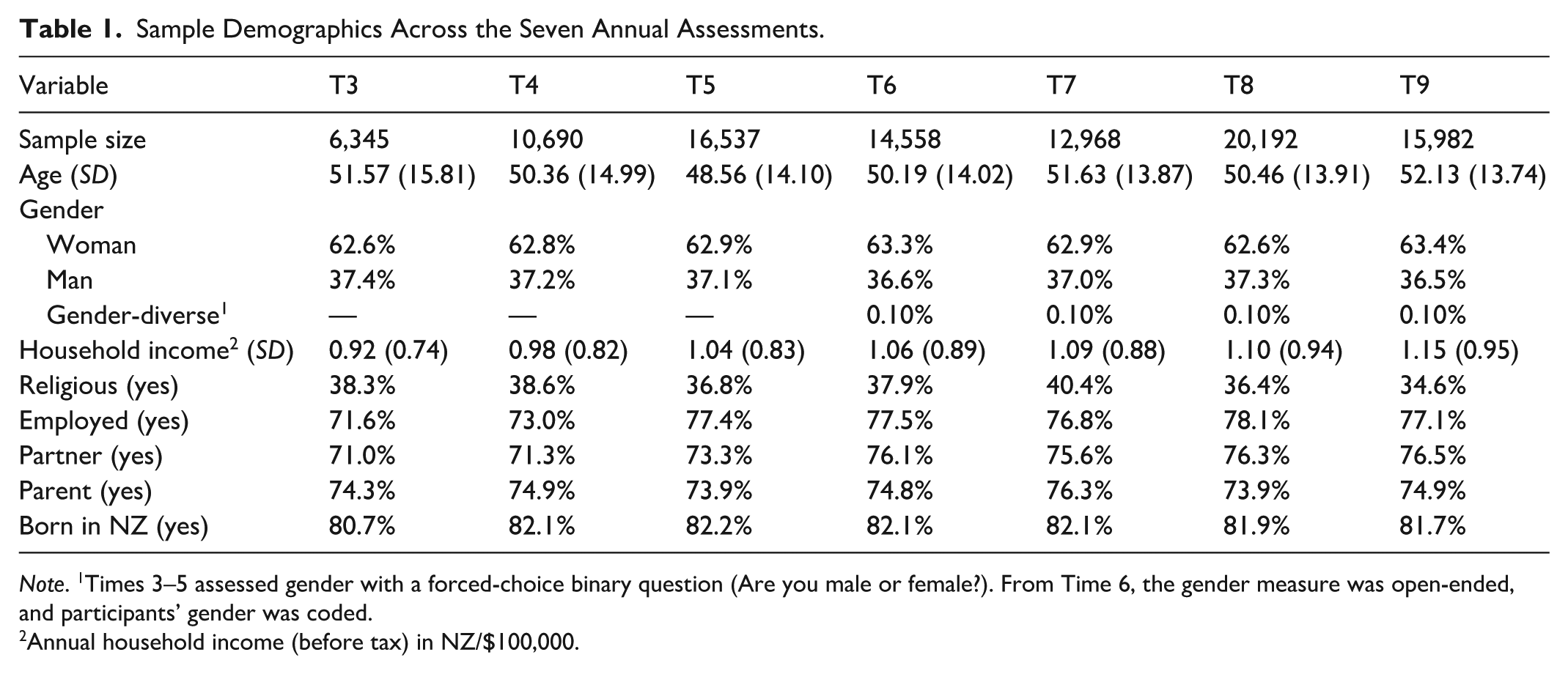
Note. 1Times 3–5 assessed gender with a forced-choice binary question (Are you male or female?). From Time 6, the gender measure was open-ended, and participants’ gender was coded.
Annual household income (before tax) in NZ/$100,000.
Measures
Due to space constraints associated with a large omnibus survey, our focal measures are short-form scales of their respective constructs. However, where applicable, measures were validated against their full-form counterparts and displayed acceptable reliability (see Sibley et al., 2024). All items were rated on a 1 (strongly disagree) to 7 (strongly agree) scale and averaged at each assessment occasion. Table S1 displays the descriptive statistics and bivariate correlations between our focal variables at each wave.
Group-Based Relative Deprivation
We assessed GRD using two items adapted from Abrams and Grant (2012): (a) “I’m frustrated with what my ethnic group earns relative to other groups in New Zealand” and (b) “People from my ethnic group generally earn less than other groups in New Zealand” (rs = 0.38–0.43, ps < .001).
Individual-Based Relative Deprivation
We assessed IRD using two items adapted from Abrams and Grant (2012): (a) “I’m frustrated by what I earn relative to other people in New Zealand”; and (b) “I generally earn less than other people in New Zealand” (rs = 0.41–0.44, ps < .001).
Social Dominance Orientation
We assessed SDO using six items from Sidanius and Pratto’s (1999) 16-item SDO scale: (a) “It is OK if some groups have more of a chance in life than others”; (b) “Inferior groups should stay in their place”; (c) “To get ahead in life, it is sometimes okay to step on other groups”; (d) “We should have increased social equality” (reverse-scored); (e) “It would be good if groups could be equal” (reverse-scored); and (f) “We should do what we can to equalise conditions for different groups” (reverse-scored; ωs = .69–.79).
Historical Negation
We assessed historical negation using three items from Sibley et al. (2008): (a) “We should all move on as one nation and forget about past differences and conflicts between ethnic groups”; (b) “We should not have to pay for the mistakes of our ancestors”; and (c) “People who weren’t around in previous centuries should not feel accountable for the actions of their ancestors” (ωs = .83–.85). Sibley et al. (2008) historical negation scale was developed from New Zealand political speeches, qualitative responses from earlier studies of “race talk” in New Zealand, and research on collective guilt and perceptions of history. This scale is thus particularly relevant to historical negation in New Zealand, although the scale has been successfully adapted in other nations (e.g., Castro et al., 2022; Rivera Pichardo et al., 2023).
Analytic Approach
To test the within-person associations between GRD, IRD, SDO, and historical negation among New Zealand Europeans, we estimated an RI-CLPM in Mplus v.8.11 (Muthén & Muthén, 1998–2024). Although there are several methods to separate between- and within-person effects, including trait-state modelling (Kenny & Zautra, 2001) and dynamic structural equation modelling (DSEM; Asparouhov et al., 2018), the RI-CLPM is a flexible approach well-suited to our data and hypotheses. Notably, approaches such as DSEM require intensive longitudinal data (at least 10 assessments, but often more; Schultzberg & Muthén, 2018). Yet RI-CLPMs can be conducted with as few as three waves of data. Moreover, the RI-CLPM is the least likely to encounter convergence issues (compared to other alternatives to traditional CLPMs; Orth et al., 2021). These advantages—coupled with the model’s conceptual similarities to the traditional CLPM (although see Usami, 2021)—make the RI-CLPM ideally suited to examining within-person processes in our study.
To estimate the RI-CLPM, we first specified four correlated, time-invariant random intercepts using the seven assessments of each variable (see Hamaker et al., 2015; Osborne & Little, 2024). The correlations between random intercepts reflect between-person effects (e.g., the extent to which individual differences in GRD are associated with individual differences in historical negation across all waves). After adjusting for these between-person associations, the lagged estimates of an RI-CLPM reflect within-person effects. For instance, these effects reflect the extent to which within-person deviations from a person’s typical levels of GRD predict subsequent within-person deviations in both GRD (an autoregressive effect) and historical negation (a cross-lagged effect) over time. Because we had no theoretical reason to expect these effects to differ over time, we assumed a stationary process where all congeneric paths were constrained to equality (see Orth et al., 2021). We thus report the average annual within-person associations between our focal constructs across the seven assessments.
Results
Fit indices for the stationary RI-CLPM indicate good model fit (χ2(310) = 2808.13, p < .001; RMSEA = .017 [0.017, 0.018]; CFI = 0.99; SRMR = .032). As shown in Figure 1 (see also Table 2), the correlations between the random intercepts reveal that New Zealand Europeans higher (versus lower) on SDO also tended to report higher IRD (b = 0.05, SE = 0.01, 95% CIs [0.032, 0.060], p < .001), GRD (b = 0.12, SE = 0.01, [0.109, 0.134], p < .001), and historical negation (b = 0.37, SE = 0.01, [0.354, 0.385], p < .001). Europeans higher on IRD also tended to report higher GRD (b = 0.50, SE = 0.01, [0.484, 0.525], p < .001) and historical negation (b = 0.18, SE = 0.01, [0.153, 0.199], p < .001). Unexpectedly, Europeans higher on GRD tended to score lower on historical negation (b = −0.13, SE = 0.01, [−0.155, −0.113], p < .001).
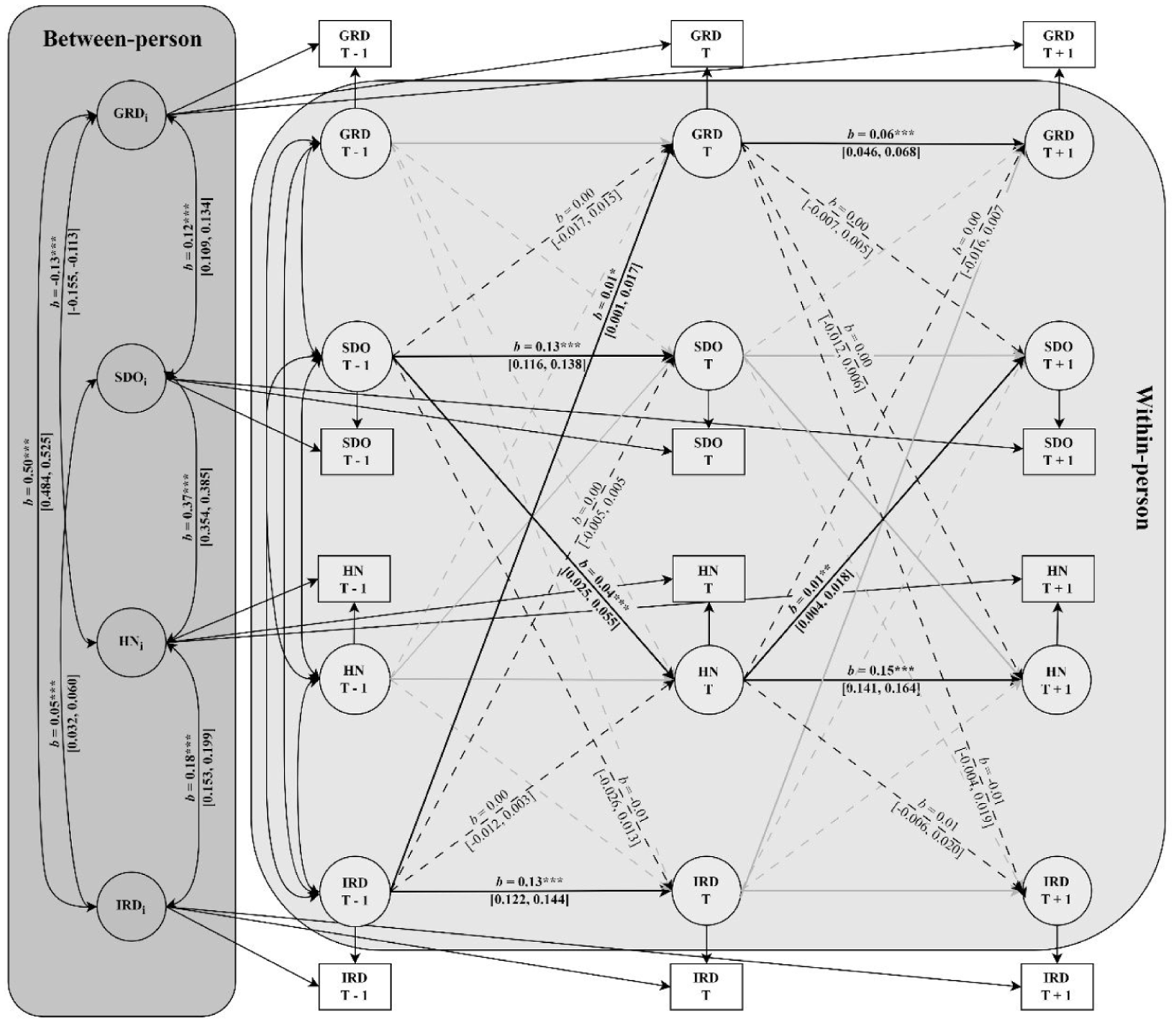
Stationary RI-CLPM of the relationships between IRD, GRD, SDO, and HN.
Between-Person Coefficients for an RI-CLPM of GRD, IRD, SDO, and HN.
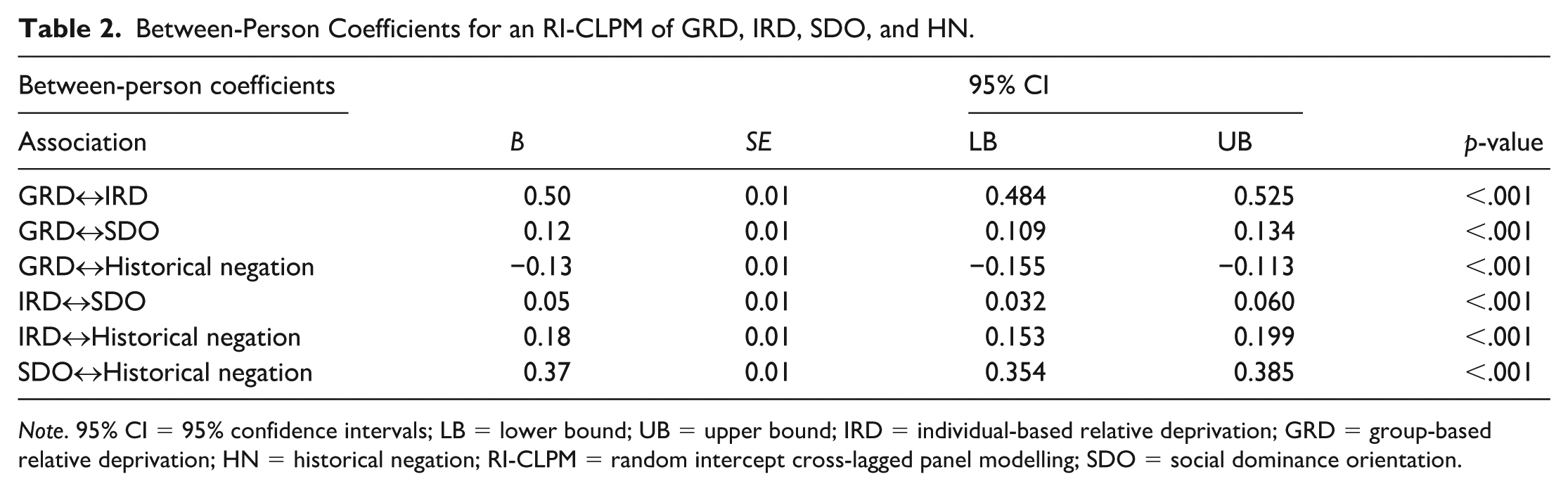
Note. 95% CI = 95% confidence intervals; LB = lower bound; UB = upper bound; IRD = individual-based relative deprivation; GRD = group-based relative deprivation; HN = historical negation; RI-CLPM = random intercept cross-lagged panel modelling; SDO = social dominance orientation.
Turning to the within-person autoregressive effects, Table 3 reveals that within-person changes in GRD (b = 0.06, SE = 0.01, 95% CIs [0.046, 0.068], p < .001), IRD (b = 0.13, SE = 0.01, [0.122, 0.144], p < .001), SDO (b = 0.13, SE = 0.01, [0.116, 0.138], p < .001) and historical negation (b = 0.15, SE = 0.01, [0.141 0.164], p < .001) predicted subsequent within-person changes in these same constructs over time. With respect to the cross-lagged associations, within-person changes in SDO were unassociated with within-person changes in IRD (ps ≥ .508) and GRD (ps ≥ .711) over time. However, consistent with Hypothesis 1, within-person changes in SDO predicted subsequent within-person changes in historical negation over time (b = 0.04, SE = 0.01, [0.025, 0.055], p < .001). Although within-person changes in historical negation also predicted within-person changes in SDO (b = 0.01, SE = 0.003, [0.004, 0.018], p < .001), the within-person effects of SDO on historical negation were stronger than the effects of historical negation on SDO (Wald(1) = 14.69, p < .001). These results suggest that within-person changes in SDO are a stronger predictor of historical negation among Europeans than vice versa.
Within-Person Coefficients for an RI-CLPM of GRD, IRD, SDO, and HN.
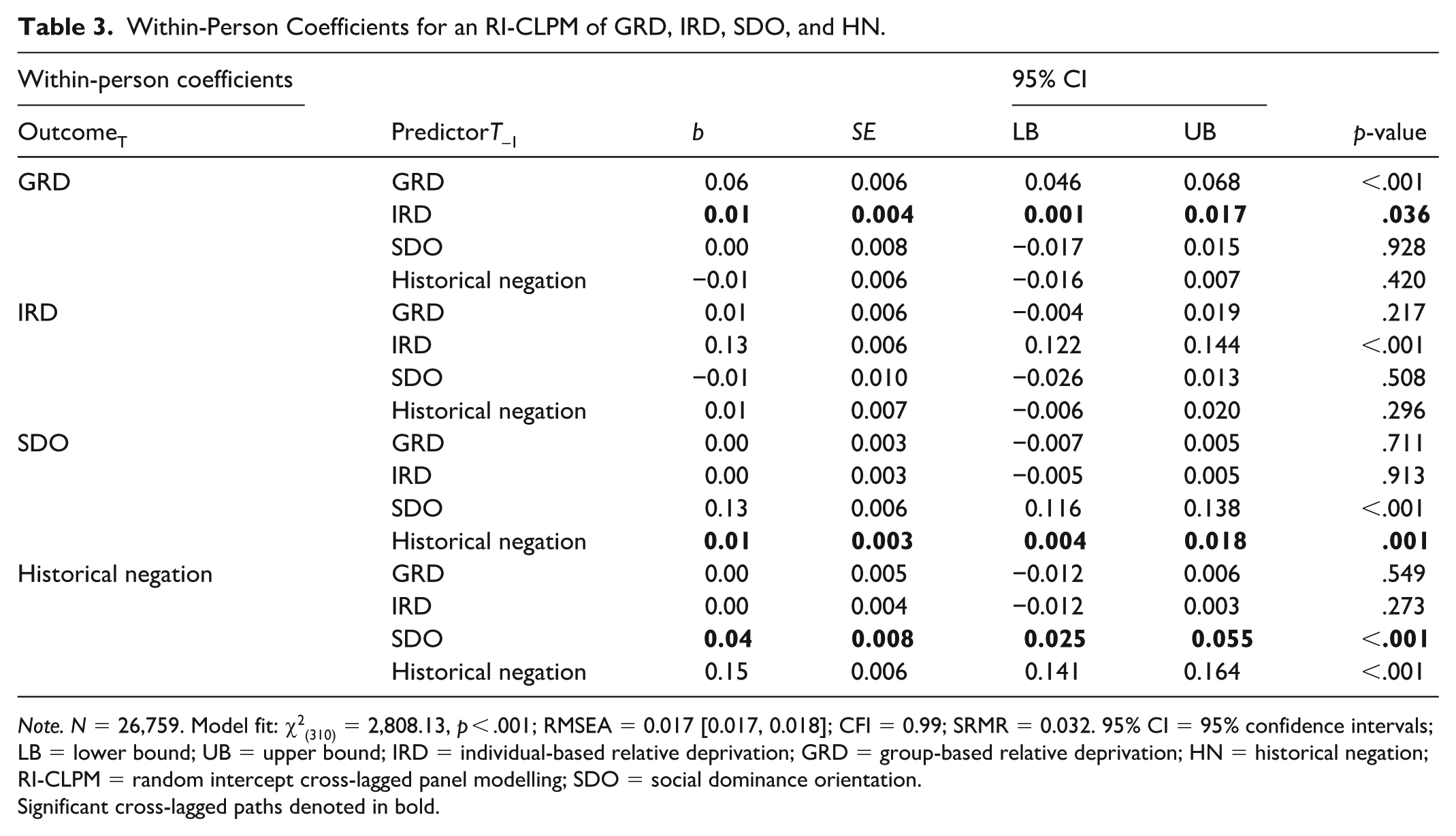
Note. N = 26,759. Model fit: χ2(310) = 2,808.13, p < .001; RMSEA = 0.017 [0.017, 0.018]; CFI = 0.99; SRMR = 0.032. 95% CI = 95% confidence intervals; LB = lower bound; UB = upper bound; IRD = individual-based relative deprivation; GRD = group-based relative deprivation; HN = historical negation; RI-CLPM = random intercept cross-lagged panel modelling; SDO = social dominance orientation.
Significant cross-lagged paths denoted in bold.
Turning to the within-person effects of IRD, within-person changes in IRD predicted (small) within-person changes in GRD in the same direction (b = 0.01, SE = 0.004, 95% CIs [0.001, 0.017], p = .036), whereas within-person changes in GRD did not significantly predict within-person changes in IRD (b = 0.01, SE = 0.006, [−0.004, 0.019], p = .217). Within-person changes in IRD were not, however, significantly associated with within-person changes in historical negation at the next time point (b = 0.00, SE = 0.004, [−0.012, 0.003], p = .273). Likewise, within-person changes in historical negation did not predict subsequent changes in IRD (b = 0.01, SE = 0.01, [−0.006, 0.020], p = .296). Consistent with Hypothesis 2, these results suggest that changes in Europeans’ feelings of being personally disadvantaged do not affect their denial of the contemporary relevance of historical injustices faced by Māori (or vice versa).
Contrary to Hypothesis 3, within-person changes in GRD were also unassociated with within-person changes in historical negation at the next timepoint (b = 0.00, SE = 0.01, 95% CIs [−0.012, 0.006], p = .549). Likewise, within-person changes in historical negation did not predict within-person changes in GRD (b = 0.00, SE = 0.01, [−0.016, 0.007], p = .420). Similar to our results for IRD (but contrary to our hypothesis), these results suggest that changes in Europeans’ feelings of being collectively disadvantaged did not affect their endorsement of historical negation (or vice versa).
Sole-European Versus Multiracial Identity
Our pre-registered analyses focused on participants who identified as New Zealand European. Some participants, however, also identified with ethnic minority groups. Although the attitudes of bi/multiracial people can mirror that of the dominant ethnic group (Houkamau & Sibley, 2014)—including endorsement of post-colonial ideologies (Bertenshaw et al., 2023)—ethnic minorities experience greater rates of discrimination and inequality than sole-identifying Europeans (Houkamau & Sibley, 2014; Statistics New Zealand, 2018). Moreover, our largest ethnic minority group comprises Māori, whose perceptions of colonial injustices will likely differ from those of settler coloniser groups. Thus, the longitudinal associations between GRD and historical negation may differ between sole-identifying Europeans and multiracial people.
To assess this possibility, we conducted a multigroup RI-CLPM (Mulder & Hamaker, 2021) to examine potential differences between sole-identifying (N = 22,296) and multiracial (N = 4,463) Europeans. Although these analyses were not pre-registered, they provide a robustness check of our results. We first estimated a multigroup RI-CLPM in which there were no constraints on the within-person estimates across groups (χ2(620) = 3277.54, p < .001; RMSEA = 0.018 [0.017, 0.019]; CFI = 0.99; SRMR = 0.034). We then estimated a model where the lagged estimates were constrained to equality (χ2(636) = 3297.30, p < .001; RMSEA = 0.018 [0.017, 0.018]; CFI = 0.99; SRMR = 0.034). The chi-square difference test of these two models was not statistically significant (Δχ2(16) = 19.76, p = .231), suggesting that the within-person estimates do not differ depending on whether participants were sole-identifying or multiracial (see Table S2 for the full results).
We did, however, identify group differences in the between-person associations between our focal constructs (see Table S3). First, the between-person associations historical negation had with IRD and SDO were stronger for sole-identifying Europeans, whereas the association between GRD and IRD was stronger for multiracial people. The relationship between IRD and SDO was also non-significant for multiracial people (p = .080). Moreover, whereas our primary analyses suggest that Europeans higher on GRD tend to be lower on historical negation (see Table S2), this was only true for multiracial Europeans. Specifically, multiracial people higher on GRD tended to be lower on SDO and historical negation; sole-identifying Europeans higher on GRD tended to be higher on SDO and historical negation. Although GRD was more strongly associated with historical negation among sole-identifying Europeans than IRD (bdiff = 0.18, SE = 0.01, 95% CIs [0.094, 0.141], p < .001), SDO was more strongly associated with historical negation than GRD (bdiff = 0.28, SE = 0.01, [0.263, 0.305], p < .001). Taken together, these results suggest the (expected) positive between-person associations GRD had with ideologies that perpetuate inequality (i.e., SDO and historical negation) were unique to sole-identifying Europeans, but that SDO was more strongly associated with historical negation than GRD.
Discussion
Historical negation undermines progress towards reconciliation and reparations for Indigenous peoples (Bell, 2006; Bertenshaw et al., 2023; Kidman et al., 2017). Understanding the motivators of historical negation is therefore necessary to advance Indigenous rights. In our pre-registered study, we examined whether feeling unfairly disadvantaged compared to other ethnic groups (GRD) fosters historical negation among settler colonisers. To do so, we conducted an RI-CLPM using seven annual waves of a nationwide sample of New Zealand Europeans. Critically, we controlled for the established effects of SDO on historical negation (e.g., Osborne et al., 2021), and IRD on GRD (Lilly et al., 2023) to determine the extent to which GRD independently predicts historical negation among settler colonisers. Below, we outline our results, as well as directions for future research.
Social Dominance Orientation
As expected, within-person changes in SDO predicted positive within-person changes in historical negation over time (Hypothesis 1). Although this relationship was bidirectional, the within-person effects of SDO were stronger than the corresponding effects of historical negation, suggesting that within-person increases in SDO foster historical negation among settler coloniser groups. These results are consistent with the Dark Duo Model of Colonial Ideology (Satherley & Sibley, 2018) and replicate prior research using our dataset (Osborne et al., 2021), albeit using a different number of waves and different covariates.
Although our results corroborate the literature on the Dark Duo, we also extend prior work by identifying these effects among multiracial Europeans. Indeed, our supplementary analyses revealed that within-person changes in SDO predicted comparable within-person changes in historical negation among sole-identifying and multiracial Europeans. These results corroborate prior work suggesting that (some) multiracial people adopt similar ideologies to the dominant group, despite their objective socioeconomic disadvantage (e.g., Houkamau & Sibley, 2014). Recent research also suggests that the relationships between historical negation and socio-political attitudes, such as resource policy opposition, generalise across settler colonisers and ethnic minority groups (Bertenshaw et al., 2023). Our results further this work by identifying how the general tendency to endorse traditional group-based hierarchies and inequality (i.e., SDO) promotes historical negation over time among both sole-majority and multiracial groups. Educators and policymakers should thus target SDO among sole-identifying and multiracial groups in efforts to improve reconciliation practices and increase recognition of the continued relevance of colonial injustices.
Relative Deprivation
Although we obtained support for our hypotheses for SDO, the results for relative deprivation were mixed. Consistent with Hypothesis 2, within-person changes in IRD did not significantly predict within-person changes in historical negation (or vice versa). These results corroborate the assertion that IRD affects interpersonal, rather than intergroup, outcomes (Smith et al., 2012). Contrary to Hypothesis 3, however, within-person changes in GRD also did not significantly predict within-person changes in historical negation (nor vice versa). These results suggest that changes in the extent to which New Zealand Europeans felt collectively deprived did not predict their denial of the contemporary relevance of colonial injustices over time.
This is an encouraging finding in the wake of rising (perceived) status threat (Simi et al., 2024), reactionary social movements (Lilly, González, et al., 2025), and racial discourses (Craymer, 2023; RNZ, 2021) among majority and settler coloniser groups. Indeed, the right-leaning New Zealand government has targeted biculturalism and Indigenous rights, using concerns of Europeans “losing out” to justify disestablishing the Māori Health Authority and reviewing Principles of Te Tiriti (Paewai & Stewart, 2023). That GRD does not lead to historical negation among New Zealand Europeans alleviates concerns that similar narratives undermine the perceived contemporary relevance of colonial injustices in the general population. Nonetheless, these results are surprising given the established relationships between GRD and the denial of discrimination towards minority groups (e.g., Pettigrew et al., 2008; Taylor, 2002; Vanneman & Pettigrew, 1972)—including Indigenous peoples (Pedersen & Walker, 1997).
One possible explanation is that different domains of GRD are more predictive of historical negation than fiscal GRD. Certainly, fiscal GRD is relevant to understanding how perceived material threats may promote historical negation among settler coloniser groups. For instance, our results at the between-person level of analysis demonstrate that sole-identifying Europeans generally higher on GRD also score higher on historical negation, and prior studies suggest fiscal GRD correlates with prejudicial ideologies and opposition to progressive social change among settler colonisers (Lilly et al., 2024b; Sengupta et al., 2019). However, narratives of settler coloniser disadvantage often stem from myths of Māori “privilege”—the erroneous belief that New Zealand Europeans are disadvantaged by policies designed to support Māori (see Meihana, 2023). Accordingly, equity or treatment-based GRD assessing the extent to which Europeans feel unfairly disadvantaged in specific socioeconomic domains (such as education or employment) may yield support for the hypothesis that within-person changes in GRD precede historical negation. Moreover, prior work suggests that temporal GRD—perceived disadvantage compared to an earlier time point—is a strong predictor of right-wing and populist attitudes (Ferwerda et al., 2025; Versteegen, 2024). Thus, temporal GRD may be relevant to studies of historical negation, particularly given the relevance of temporal comparisons to studies of colonialism (see Lastrego et al., 2022). Finally, our GRD measure compares one’s ethnic group to “other groups in New Zealand”; further specifying comparisons between New Zealand Europeans and Māori may identify specific feelings of GRD surrounding Indigenous-settler coloniser relations. Although beyond the scope of our study, we encourage future research to explore how distinct forms of relative deprivation may contribute to historical negation.
Caveats and Future Directions
Our study has several strengths, including the use of large-scale longitudinal data and an analytic approach designed to appropriately examine within-person processes (Hamaker et al., 2015). Coupled with our robustness checks across sole-identifying and multiracial Europeans, these strengths increase confidence in our results. There are, however, limitations worth noting. First, the (significant) effects reported in this study are relatively small. That said, small effect sizes are typical of RI-CLPMs, as participants’ responses are partitioned into between- and within-person variances (see Orth et al., 2022; Osborne & Little, 2024). Moreover, historical negation is multiply determined beyond the variables assessed in this study (e.g., Castro et al., 2022; Sibley & Liu, 2012). Although caution towards small effect sizes is warranted (but see Götz et al., 2022), our effect sizes are unsurprising given the complexity of both historical negation and our analytic approach.
We also caution against overgeneralising our results from New Zealand to all post-colonial contexts. Indeed, although some processes underlying historical negation (and Indigenous-settler coloniser relations more broadly) emerge across contexts (González et al., 2022), how post-colonial ideologies manifest differs across historical and contemporary colonial structures. For instance, Castro et al. (2022) found that RWA, but not SDO, predicted historical negation of injustices faced by the Mapuche people, suggesting some variation in the effects of SDO across post-colonial nations. Moreover, motivators of historical negation may differ in nations with ongoing movements to establish treaty and reconciliation policies (e.g., Australia; see O’Sullivan, 2021). Mainstream political movements towards independence may uniquely impact how colonial ideologies are expressed (see Rivera Pichardo et al., 2022). Finally, historical negation is just one ideology formed in post-colonial nations and requires acknowledgement of the unjust harms of colonisation. Our results may not generalise to other post-colonial ideologies, nor to broader system-justifying beliefs about the perceived “fairness” of colonial events. Future research should thus consider how different historical and contemporary narratives of colonial injustices manifest and further interrogate the roles of SDO and relative deprivation in different (post-)colonial contexts.
Conclusion
The advancement of Indigenous rights requires acknowledgement of past (and present) colonial injustices, signalling the need to understand the drivers of historical negation among settler colonisers. This pre-registered study examined the extent to which perceived GRD fosters historical negation across seven annual waves of data from a nationwide random sample of New Zealand Europeans. Although trait-level GRD correlated positively with historical negation among (sole-identifying) New Zealand Europeans, within-person changes in GRD were unassociated with within-person changes in historical negation. These results suggest that feeling financially disadvantaged may contribute to, but does not drive, the minimisation of the contemporary relevance of colonial injustices among New Zealand Europeans. We encourage future work to continue examining the psychological processes underlying historical negation to increase awareness of—and ultimately redress—colonial inequities between settler colonisers and Indigenous peoples.
Supplemental Material
sj-docx-1-psp-10.1177_01461672261419543 – Supplemental material for Deprivation or Dominance? Examining the Psychological Antecedents of Historical Negation Among Europeans Over Time
Supplemental material, sj-docx-1-psp-10.1177_01461672261419543 for Deprivation or Dominance? Examining the Psychological Antecedents of Historical Negation Among Europeans Over Time by Kieren J. Lilly, Zoe Bertenshaw, Chantelle Kimberley, Tamino Konur, Chris G. Sibley and Danny Osborne in Personality and Social Psychology Bulletin
Footnotes
Ethical Considerations
The NZAVS is reviewed by the University of Auckland Human Participants Ethics Committee every 3 years. The most recent ethics application was approved on May 26, 2021 until May 26, 2024 and renewed on May 02, 2023 until May 26, 2027 (Ref: UAHPEC22576).
Author Contributions
Funding
The authors disclosed receipt of the following financial support for the research, authorship, and/or publication of this article: The preparation of this manuscript was supported by a Templeton Religion Trust grant (TRT-2021-10418) awarded to the New Zealand Attitudes and Values Study.
Declaration of Conflicting Interests
The authors declared no potential conflicts of interest with respect to the research, authorship, and/or publication of this article.
Data Availability Statement
The present study was pre-registered: https://osf.io/adpqk/. The data described in the paper are part of the New Zealand Attitudes and Values Study (NZAVS). Full copies of the NZAVS data files are held by all members of the NZAVS management team and advisory board. The NZAVS data are not available publicly due to ethics restrictions. However, a de-identified dataset containing the variables analysed in this manuscript is available upon request from the corresponding author, or any member of the NZAVS advisory board for the purposes of replication or checking of any published study using NZAVS data. The Mplus syntax used to test all models reported in this manuscript is available via the Open Science Framework:  .
.
Supplemental Material
Supplemental material is available online with this article.
Notes
References
Supplementary Material
Please find the following supplemental material available below.
For Open Access articles published under a Creative Commons License, all supplemental material carries the same license as the article it is associated with.
For non-Open Access articles published, all supplemental material carries a non-exclusive license, and permission requests for re-use of supplemental material or any part of supplemental material shall be sent directly to the copyright owner as specified in the copyright notice associated with the article.
