




Abstract
People tend to judge those who perform good deeds, such as donating money, as moral. Yet, prosocial actors are not equally appraised. In this article, we explore how moral judgment varies based on the donation distribution strategy—that is, the extent to which donors distribute resources across recipients. In seven studies (N = 1,495), we show that distributing help is considered by observers to be more moral than concentrating help on a single recipient. Furthermore, this effect is driven by observers perceiving the donors distributing their help to be more committed toward the charitable cause. We extend the generalizability of our results by showing that the effect replicates across three populations considered culturally distant along the WEIRD dimensions. The article ends with a discussion of the theoretical relevance of the findings.
Introduction
Helping others in need is highly valued by society and often considered a key factor reflecting one’s moral character (Berman & Silver, 2022). However, helping behavior can take many forms. Consider two donors, each donating £100 to a children’s welfare cause: one donor dedicates the entire amount to a single charitable organization, while another spreads the same sum across several organizations. Although the overall contribution to the cause of both donors is identical, they pursue different donation strategies. The difference in these two donation strategies raises an important question in moral psychology: how does society judge different helping strategies? All else being equal, does society consider concentrating or distributing help as more moral?
In this research, we examine how the donation distribution strategy—that is, the extent to which donations are distributed across charities—affects moral judgments.
On the one hand, it could be argued that the “size of the drop” (e.g., MacAskill, 2015) matters the most, since the impact of the donation is measured by the amount of help each charity receives. Accordingly, dedicating help to a single charity makes the greatest impact on that charity and would therefore be morally valued the most. On the other hand, according to the proportion dominance theory (e.g., Erlandsson et al., 2015; Mata, 2016), choosing to help one recipient over many may be perceived as less impactful. Furthermore, people tend to value equal treatment across potential recipients (Ein-Gar et al., 2021; Van Prooijen et al., 2008). Following this logic, spreading help to many charities, even if each receives relatively less, would be morally valued.
We investigate how observers judge the morality of donation strategies by comparing distributed help strategy—that is, spreading donations across more than one charity, to concentrated help strategy—that is, dedicating all the donations to a single charity.
Donation strategies have recently gained attention in research; however, most studies thus far have focused on temporal distribution (one lump sum vs. partitioning) toward the same charity (e.g., Basu, 2021; Henderson et al., 2021; Schaumberg & Lin, 2025). This research moves beyond the scope of single charity strategies to distributing help across charities. This distinct focus on donation strategies enables us to identify a novel effect on moral judgments and uncover a new psychological mechanism underlying these judgments, namely commitment toward the charitable cause. We theorize and show that, controlling for the total amount donated, distributed help across charities is perceived as more moral than concentrated help on a single charity. Central to our theoretical framework is that distributing donations serves as a signal of the donor’s commitment to the charitable cause. Specifically, we propose that helpers who distribute their donations across several charities are perceived as demonstrating a stronger commitment to the cause and therefore judged more morally praiseworthy.
Theoretical Background
Donation Distribution Strategies and Moral Judgment
People generally strive to maintain both a positive self-concept and a social reputation regarding their moral character (Kouchaki & Anderson 2023; Sachdeva et al., 2009). A person’s moral image can vary significantly from one individual to another; and from one context to another (Shen et al., 2025); however, certain elements of moral perception are consistent across self and other evaluations (Aquino & Reed, 2002; Blasi, 2005). Prosocial behaviors—such as donating money, volunteering, and helping strangers—are often used as proxies to assess the level of good character and morality (e.g., Nai et al., 2018; Yudkin et al., 2019). Good doers are generally evaluated favorably by others (Bostyn & Roets, 2016), yet moral judgments of helping behaviors can vary substantially (Berman & Silver, 2022). For example, people tend to ascribe greater moral worth to those who donate to distant others rather than kin (McManus et al., 2020) and to those who donate time rather than money (Brown et al., 2019; Johnson & Park, 2021). In some cases, individuals’ moral reputations can even be penalized for prosocial actions, for example, when donors brag after helping others (Berman et al., 2015) or when they violate social norms (Law et al., 2022). Exploring what determines moral judgments is particularly important since they shape moral behaviors (Haidt & Bjorklund, 2008) and serve as social regulators (Anderson et al., 2020, 2024).
Research has drawn attention to donors’ donation strategy as an important factor in shaping observers’ judgments. These studies explore the distribution of donations over time (one lump sum vs. partitioning) to a single charity. They find that spreading the total amount to one charity is perceived as less moral. That is, donating $10 per month to a given charity is less moral than donating $120 per year. The argument being that the one lump sum increases perception of the magnitude of help and sacrifice; hence, those spreading help seem to help less and are therefore less moral (Basu, 2021). Similar results were found for time donations, such that volunteering 4 hr in 2 days seems less effortful than volunteering 8 hr in 1 day and, therefore, is judged as less moral (Henderson et al., 2021). Contrary to these studies, a more recent study has found a different directional effect for monetary donations (Schaumberg & Lin, 2025). This research found that donors (individuals or companies) who partition their donations (compared to those who give the entire amount at one point in time) are perceived as having greater commitment to support the charity, and greater desire to connect to the charity’s social cause. Their reasoning goes beyond effort perception, arguing that when donors choose to make multiple donation payments over time rather than make a single payment, it says something about who they are and what is important to them (Schaumberg & Lin, 2025).
Building on this growing body of research, we shift the scope of investigation from donation strategies focused on a single charity to donation strategies targeted at multiple charities. Specifically, we compare distributed help strategy—that is, spreading donations across more than one charity, to concentrated help strategy—that is, dedicating all donations to a single charity. Focusing on a charitable cause that may be addressed by either a single charity or by many charities allows us to unravel a new mechanism that drives observers’ moral judgments, namely, cause commitment. In alignment with the general notion that how one decides to help reflects something about who they are and what they care about (Berman & Silver, 2022), we propose that donors who distribute help across charities, compared to those dedicating all their help to one charity, are perceived as more committed to the charitable cause and, as a result, more moral. Next, we discuss the concept of cause commitment and how the donation strategy influences observers’ evaluations of donors’ cause commitment.
Donation Distribution Strategies and Perceived Commitment
We define commitment to a charitable cause as a genuine and enduring dedication to improving a specific social issue, reflected in sustained time and effort, as well as behaviors that directly benefit the intended recipients of the cause. There are many ways to do good and give back, which may reflect commitment to one’s community or commitment to a specific charity one is personally involved in (e.g., Schaumberg & Lin, 2025). Cause commitment reflects dedication to a broad social issue, which may be addressed by a single charity or by multiple charitable organizations.
Similar to other forms of commitment—such as personal goal commitment (Oettingen et al., 2001), relationship commitment (Arriaga & Agnew, 2001), organizational commitment (Allen & Meyer, 1990), or brand commitment (Hollebeek & Macky, 2019)—cause commitment has emotional (e.g., empathy) and cognitive (e.g., knowledge) underpinnings that manifest in sustained, effortful behaviors (e.g., investing time) aimed at promoting the social cause.
When observers witness a prosocial act, they often infer the actor’s level of effort and personal sacrifice (Berman & Silver, 2022). Society usually values effort (Kruger et al., 2004), and prior research shows that acts requiring greater effort or self-investment tend to elicit higher moral evaluations (e.g., Bigman et al., 2016; Celniker et al., 2023). These signals of effort and dedication are more strongly inferred from distributing help to many charities than from concentrating help on a single charity. A donor who supports multiple charities must engage in a more complex and effortful decision-making process—considering not only which charities to support but also other decisions, for instance, what is the best combination and how to allocate resources across them. Just as assessing a higher number of attributes increases choice difficulty (Garbarino & Edell, 1997), choosing many charities reflects a higher level of effort and engagement.
Costly behaviors serve as credible signals of commitment (Johnson, 2019); when donors voluntarily take on the complexity of supporting multiple charities (when they could simply give to one), observers infer that the donor is genuinely dedicated to the broader cause of these charities. Therefore, we propose that distributing help signals greater donor commitment to the charitable cause. In line with past reasoning showing that inferences from the donors’ strategy, regarding the donor’s effort invested (e.g., Henderson et al., 2021) may influence moral perception, we argue that inferences regarding donors’ commitment to the cause increase perception of morality as they reflect the donors’ genuine motivation to act prosocially.
To conclude, we hypothesize:
The current research advances the literature in several ways. First, it contributes to the research on moral psychology and moral judgments. While previous studies have focused on different forms of help toward a single beneficiary (e.g., temporal distribution; perceived neediness), our research examines the effect of distribution strategies across different beneficiaries. Specifically, we show that observers ascribe a higher moral significance to donors who allocate their donations across many (i.e., distributed help) rather than dedicating their help to a single charity (i.e., concentrated help). Additionally, these findings are relevant to the literature on charitable giving. Most of the prior work has investigated the distribution strategy from the donor perspective (e.g., Sharps & Schroeder, 2019). We extend this work by assessing the moral impressions of observers.
Second, we offer a novel theoretical mechanism explaining why the donation distribution strategy influences moral judgments. We identify observers’ inferences about donors’ commitment to the charitable cause as the underlying mechanism through which the distribution of help shapes moral judgments. This finding contributes to the moral psychology literature as well as the prosocial literature by extending the understanding of how observers infer moral character from prosocial behavior. While prior research on charitable giving has studied donor commitment in the context of organizational loyalty (e.g., Sargeant & Lee, 2004), we uncover another facet of commitment that can affect the decision-making strategy—that is, the commitment toward the charitable cause.
Finally, we explore whether our proposed effect holds in different cultures. Cross-cultural studies became more common over the years (e.g., Joo et al., 2025). Our research adds to cross-cultural work in providing early evidence that moral judgment, driven by the distribution strategy of donations and associated cause commitment, generalizes across culturally distant populations.
Methodology
Overview of the Studies
We examine how donation distribution affects moral judgment across seven studies with a total of 1,495 participants. Studies 1a and 1b establish the main effect of donation distribution on moral judgment using different morality measures (1a) and controlling for possible scale bias (1b). Study 2 demonstrates the robustness of the effect in a paradigm that entails temporal distribution, and tests perceived commitment to a charitable cause as the mediator of the effect. Study 3 extends the findings of Study 2 by manipulating (rather than measuring) commitment. Studies 4a, 4b, and 4c test the generalizability of the findings across different cultures, specifically by studying participants from nations that are considered culturally distant on WEIRD dimensions (Muthukrishna et al., 2020).
Design of the Studies
All studies employ the same paradigm. We use a joint evaluation design in which participants evaluate two donation strategies presented side by side (distributed help vs. concentrated help) and decide which one is more moral. This design is appropriate for our research question because both donation strategies represent prosocial behavior and might appear similarly moral when viewed in isolation (Hsee, 1996). The side-by-side comparison increases the evaluability of the key attribute—distribution strategy—which is critical for detecting differences in moral judgments (e.g., Caviola et al., 2014; Kogut & Ritov, 2005). This design is also recommended for increasing statistical power (Meyvis & Van Osselaer, 2018).
Participants were introduced to two donor profiles, labeled 1 “Donor A” and “Donor B.” The only difference between the two donors was the information regarding our independent variable—namely, the donation distribution strategy. We counterbalanced the representation of the donors’ profiles, thus creating two conditions that serve as our independent variables for the donation strategy (paradigm adapted from Acar et al., 2021, Studies 1b and 1c). Each participant was randomly assigned to one of two conditions. In one condition, labeled the distributed help condition, Donor A was presented with the distributed help profile, and Donor B was presented with the concentrated help profile. In another condition, labeled concentrated help condition, this assignment was reversed: Donor A was presented with the concentrated help profile and Donor B with the distributed help profile. Thus, while each participant saw both donation strategies simultaneously, the strategy assigned to our focal donor (Donor A) varied between participants, creating independent groups for comparison. Participants evaluated Donor A relative to Donor B, and we expected the relative morality judgment of Donor A to differ between the two conditions based on which donation distribution strategy they employed.
Transparency and Openness
All studies were approved by an ethical review committee (ETH1819-0722; ER/ML761/5). We preregistered all studies, except Study 1a, and the protocols include the study design, planned sample size, exclusion criteria, and planned primary analyses. The datasets, syntaxes, and preregistration protocols are available at the following link https://osf.io/ca2qp/overview?view_only=1db1b06bf3f64e4ea1255f1ede1a78f5. In the article, we report the core analyses and results. In the Supplemental Materials, we report the secondary analyses (e.g., manipulation checks) and the complete study materials.
Studies 1a and 1b
The goal of Studies 1a and 1b is to provide initial evidence that the donor’s donation distribution strategy influences moral judgment. In both conditions, participants judged the morality of Donor A compared to Donor B. We predicted (H1) that participants would judge Donor A (compared to Donor B) as more moral in the distributed help condition than in the concentrated help condition. Study 1a employs two distinct morality scales to establish the robustness of this effect and explore personal preference for donation strategies. Study 1b replicates the findings of Study 1a and addresses potential scale-anchoring effects (Hartley & Betts, 2010).
Method
Participants
In Study 1a, we recruited 100 participants, a sufficient sample to detect a moderate effect size (d = .60) with a statistical power of α > .90 calculated by G*Power (Faul et al., 2007). We omitted 10 participants who failed the attention check, resulting in a sample of 90 participants. In Study 1b, we recruited 201 participants, accounting for the size effect found in Study 1a and participants’ dropouts (G*Power: α > .95, d = .60). We omitted 17 participants who failed the preregistered attention check, resulting in a final sample of 184 (Study 1a, Prolific, Mage = 32.1, female 38.9 %; Study 1b, Prolific sample, Mage = 30.6, female 45.7 %).
Procedure
In both studies, participants were introduced to two donor profiles labeled Donor A and Donor B in a hypothetical crowdfunding platform. Both donors contributed the same total amount (£75) during the past year, yet differed in donation distribution strategy. In the distributed help condition, Donor A has spread donations across 15 charities supporting the same cause, whereas Donor B donated the entire amount to a single charity (1 of the 15 charities from Donor A’s list). In the concentrated help condition, Donor A donated the entire amount to the single charity, while Donor B spread donations across the 15 charities. Participants rated the morality of Donor A’s behavior relative to that of Donor B. In Study 1a, we also explored individuals’ preferences for distribution strategies. Specifically, we asked participants whether they would have preferred distributing their help across multiple projects or concentrating their help on a single one. Finally, participants reported demographics and were debriefed.
Measures
Moral Judgment
In Study 1a, we measured moral judgments of the donors’ behaviors using two scales. One scale, adapted from Reed et al. (2007), consisted of four items: “moral,” “caring,” “socially responsible,” and “heartfelt” averaged to create morality index 1 (α =.91). The other scale, adapted from Barasch et al. (2014), consisted of six items: “moral,” “altruistic,” “sincere,” “good,” “pure,” and “nice” averaged to create morality index 2 (α =.92). In both scales, participants reported the morality of the Donor A’s behavior relative to Donor B’s behavior on a 9-point scale, anchored by the two donor profiles, with Donor A being the upper limit.
Given that the two measures were highly correlated (r = .886, p < .001) and yielded similar results, in Study 1b we only used morality index 1 (Reed et al., 2007; α =.77). To control for possible scale anchoring bias (Hartley & Betts, 2010), in Study 1b we counterbalanced the scale endpoints: half the participants received Donor A as the upper limit and Donor B as the lower limit, while the other half received the opposite scale orientations.
Results
Moral Judgment
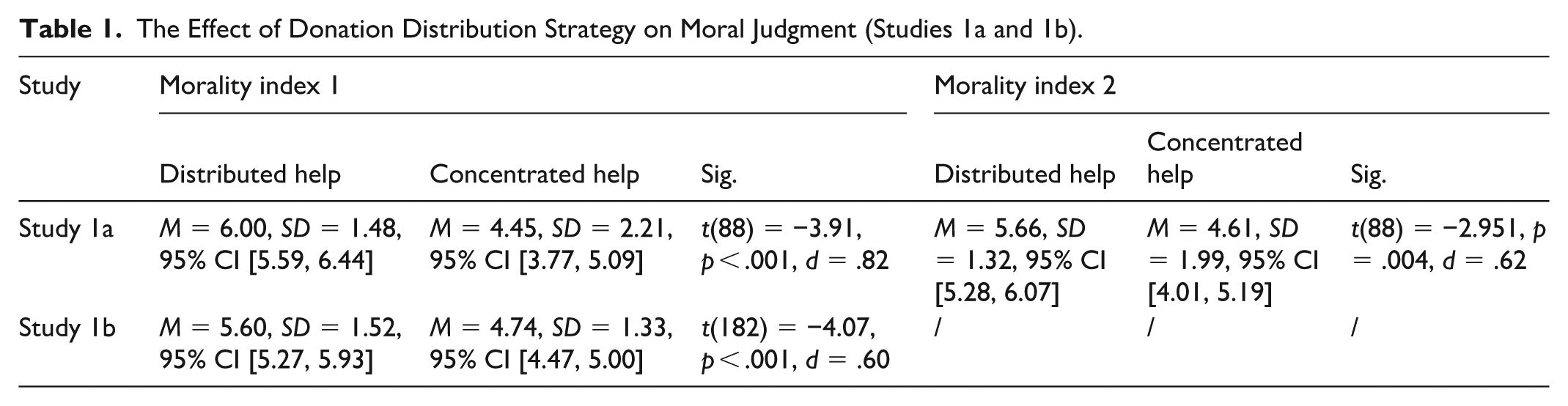
The Effect of Donation Distribution Strategy on Moral Judgment (Studies 1a and 1b).
Personal Donation Preferences
In Study 1a, 59.1% of participants reported a preference for distributing their help rather than concentrating it on a single charity (40.9%); however, this difference is not significant (χ2(1) = 3.108, p = .078).
Scale Anchoring Effect
The design of Study 1b allowed us to control for a scale anchoring bias—that is, whether the direction of the upper and lower limits of the moral judgment scale influenced the results. We conducted a two-way ANOVA with donors’ distribution strategy and scale anchoring order as independent variables and moral judgment as the dependent variable. As expected, the main effect of scale anchoring (p = .545) and the interaction of donation distribution strategy by scale anchoring (p = .642) were not significant.
Discussion
The findings of Studies 1a and 1b provide initial evidence for our first hypothesis that contributing to multiple charities (distributed help) is considered more moral than dedicating all donations to a single charity (concentrated help). In Study 1a, we showed the consistency of the effect across two different moral judgment scales. In Study 1b, we replicated the findings of Study 1a and ruled out a possible scale anchoring bias by counterbalancing the extremeness direction of the scale.
Study 2
Study 2 has three objectives. First, we test the robustness of the effect in a different paradigm. In Studies 1a and 1b, we did not specify the temporal pattern of giving, leaving open to interpretation whether donations were partitioned or aggregated in a lump sum. This could represent a confound as observers might have judged donors’ morality by inferring two different temporal distributions—that is, concentrated donor giving in one lump while the distributed donor in periodic payments or vice versa. Since past research shows that temporal distribution can influence the perception of donors (e.g., Basu, 2021), in this study, we specified the temporal pattern. We compared two donors who each made three separate donations over time: one who directed all three donations to the same charity (concentrated help) and another who distributed across multiple charities (distributed help). Second, in Studies 1a and 1b, observers judged the morality of the donors’ action. Given that research shows that judgments of an act may differ from judgments of the actor (e.g., Tannenbaum et al., 2011), especially in the case of moral judgments (e.g., Cushman, 2008), and the importance of the latter in the context of moral praise (Anderson et al., 2020), we extend our exploration to judgments of the actor. Finally, we test the psychological mechanism underlying this effect. We hypothesized that donors who distribute their help would be perceived as more committed to the charitable cause than those who concentrate their giving. Furthermore, we hypothesized that this greater cause commitment perception will, in turn, positively mediate the effect of donation distribution strategy on moral judgment (H2).
Method
Participants
We recruited 301 participants on Prolific (G*Power: d = .60, estimating and combining the effects sizes of both the “a” path and the “b” path, with a statistical power of α > .95). Following the preregistration protocol, we excluded participants who failed the attention check (N = 40), resulting in a final sample of 261 (Mage = 59.4% between 25 and 44 years old, female 49.8%).
Procedure
Participants were presented with two donor profiles of a hypothetical crowdfunding platform. Both donors showed identical yearly donations of £75 and engaged in three separate transactions: June 2023, August 2023, and February 2024. However, they differed in how they distributed their donations. In the distributed condition, Donor A made donations at three points in time, and each time the donations were allocated to several charities—that is, donating to four charities in June, five charities in August, and three charities in February. Thus, in this condition, Donor A donated over a year to twelve different charities, all supporting the same cause—that is, protecting children’s human rights. Donor B made donations at the same three points in time (June’ 23, August’23, and February’24). However, all donations were dedicated to the same charity (1 of the 12 listed in Donor’s A profile). In the concentrated condition, we reversed the donors’ profiles such that Donor A donated to one charity across three points in time, while Donor B donated overall to twelve charities across the same three points in time. Participants rated how moral they perceived Donor A to be relative to Donor B.
We then asked participants to evaluate two types of donor commitment: commitment to the charitable cause and commitment to one of the charitable organizations (the single charity displayed in the concentrated help profile). We reason that some participants may consider the commitment to the cause the same as the commitment to the charity. When donating to a single charity, this may be the case, but when donating to many charities, it is not. By measuring both, we drew participants’ attention to the difference between being committed to a general charitable cause and a specific charitable organization, thus ensuring that all participants had in mind the difference between the two types of commitment. The order of the two commitment measures was counterbalanced. Finally, participants reported demographics and were debriefed.
Measures
Moral Judgment
We measured moral judgment of the donors with three 7-point scales items (“moral,” “caring,” and “socially responsible,” adapted from Reed et al., 2007) averaged to create a morality index (α = .81).
Perceived Commitment
The extent to which participants perceived Donor A to be committed to the charitable cause, relative to Donor B, was measured with three items “Truly committed to the Protecting Children’s Human Rights cause,” “Highly emotionally engaged with the Protecting Children’s Human Rights cause,” and “Very serious about the Protecting Children’s Human Rights cause”, averaged to a cause commitment index (α = .91).
The extent to which participants perceived Donor A to be committed to one charitable organization, relative to Donor B, was measured with three items: “Truly committed to the Hand in Hand charity,” “Highly emotionally engaged with Hand in Hand charity,” and “Very serious about the Hand in Hand charity,” averaged to a charity commitment index (α = .98). Items in both scales were rated on a 7-point scale.
Results
Moral Judgment
To test H1, we conducted an independent samples t-test with the donor’s distribution strategy conditions (distributed vs. concentrated) as the independent variable and moral judgment the dependent variable. In line with the previous findings, participants rated Donor A as more moral when they employed distributed help (M = 4.51, 95% CI [4.31, 4.69], SD = 1.12) than when they employed concentrated help (M = 3.65, [3.49, 3.82], SD = 0.93, t(259) = −6.73, p < .001, d = .79).
Mediation Analysis
An independent samples t-test revealed a significant effect of distribution strategy on perceived cause commitment. Participants rated Donor A as more committed to the cause when they employed distributed help (M = 4.37, 95% CI [4.16, 4.58], SD = 1.25) than when they employed concentrated help (M = 3.67, [3.43, 3.91], SD = 1.41, t(259) = −4.24, p < .001, d = .52).
Next, we conducted a mediation analysis using Hayes’ (2017) PROCESS procedure (Model 4 with 5,000 bootstrapping). In the model, donation distribution strategy condition (concentrated = 0, distributed = 1) served as the independent variable, perceived cause commitment as the mediator, perceived charity commitment as a covariate, and moral judgment as the dependent variable (see Figure 1). The total effect of donors’ distribution strategy on moral judgment is significant (B = 1.48, SE = 0.20, t(259) = 7.18, p < .001, 95% CI [1.07, 1.89]). Both the indirect effect via perceived cause commitment (b = 0.27, BootSE = 0.10, [0.092, 0.49]) and the direct effect (b = 1.21, SE = 0.20, t(259) = 5.90, [0.80, 1.61], p < .001) are significant, indicating a partial mediation. Thus, H2 was supported.
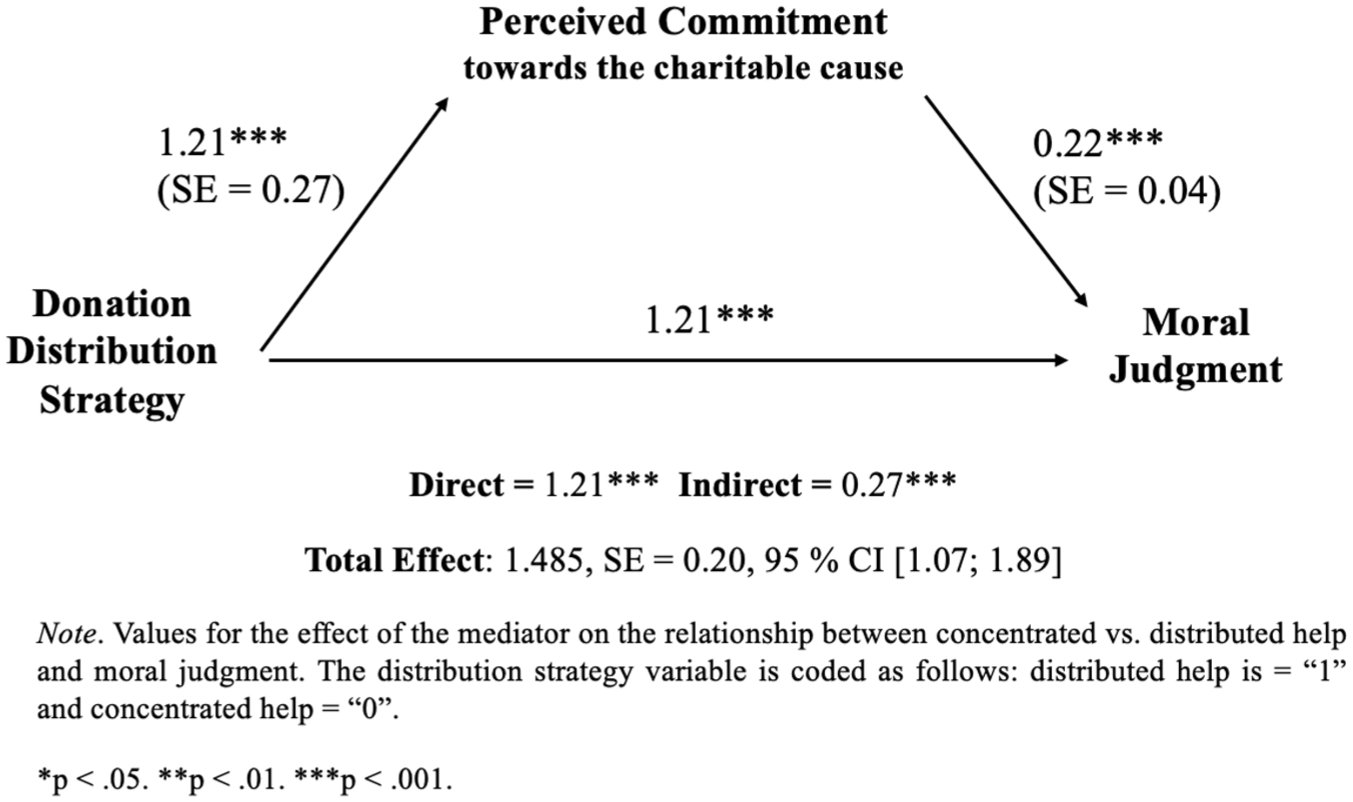
The Effect of Donation Distribution Strategy on Moral Judgment via Perceived Cause Commitment (Study 2).
We note that charity commitment, included in the model as a covariate, was significant (b = 0.13, SE = 0.041, BootLLCI = 0.050, BootULCI = 0.211, p = .0016; for detailed results, see the Supplemental Materials).
Discussion
Study 2 tests the robustness of the findings by showing that the effect of donation distribution strategy on moral judgment occurs even when the giving is partitioned throughout several points in time. Furthermore, the effect occurs even when observers judge the actor rather than the act itself, as in Studies 1a and 1b. We reason that divergence between actor and action perspectives may be more likely to emerge for behaviors reflecting negatively on the actor, such as those associated with shame, blame, or guilt. However, behaviors reflecting positively on the actor, such as prosocial behaviors, may produce more aligned judgments. Finally, Study 2 illuminates the psychological mechanism underlying this effect. Observers perceived a donor who distributed their giving across multiple charities relatively to a donor dedicating help to a single charity as more committed to the charitable cause, and this in turn positively contributed to their moral judgment.
Study 3
The main goal of Study 3 is to provide causal evidence for the underlying mechanism by experimentally manipulating, rather than measuring, commitment to the cause. To this end, in this study, we entangle the association between commitment and donation distribution strategy by reversing the link between the two; the concentrated donor was presented as highly committed, while the distributed donor was presented as less committed. We reasoned that if the donation distribution strategy drives moral evaluation via other drivers, which are not cause commitment, then the effect should remain unchanged—namely, that the distributed donor would continue to be judged as more moral than the concentrated donor. However, if cause commitment is the main mechanism that ties the distribution strategy to moral evaluations, then by untangling the two, the effect would reverse. In this case, we would expect the distributed donor, who in this study is less committed, to be judged as less moral.
Method
Participants
We recruited 300 participants on Prolific (G*Power d = .40; α > .95), and, following the preregistration protocol, we excluded participants who failed the attention check (N = 52), resulting in a final sample of 248 (Mage = 55.7% between 35 and 54 years old, female 51.2%).
Procedure
The stimuli were the same as those used in Study 2. However, in addition to describing the giving behavior of the two donors, we also provided information regarding their commitment level. The distributed help donor was conveyed as less committed to the charitable cause, and this was reflected by investing little time and cognitive effort in selecting charities to support. Conversely, the concentrated help donor was depicted as highly committed, reflected by investing time and cognitive resources in selecting the best charity to donate to. Participants rated how moral they perceived the distributed donor profile to be relative to the concentrated donor profile. Participants evaluated the cause commitment of the donors, as a manipulation check. Finally, participants reported demographics and were debriefed.
Measures
Moral Judgment
The same used in Study 2.
Commitment Toward the Cause
The extent to which participants perceived the distributed donor committed to the charitable cause, relative to the concentrated donor, was measured with one 7-point scale item “Truly committed to the Protecting Children’s Human Rights cause.” This served as a manipulation check.
Results
Moral Judgment
We conducted an independent sample t-test with the donor’s distribution strategy conditions (distributed vs. concentrated) as the independent variable and moral judgment as the dependent variable. As predicted, participants rated Donor A as less moral when they employed distributed help with low commitment (M = 3.2, SD = 1.25, 95% CI [2.99, 3.43]) than when they employed concentrated help with high commitment (M = 4.78, SD = 1.31, [4.55, 5.01]), t(246) = 9.67, p < .001, d = 1.25).
Discussion
Study 3 provides further evidence for the role of commitment as the key mediating mechanism. We found that when the distributed help donor was presented as less committed to the cause than the concentrated help donor, the effect reversed, such that the distributed donor was perceived as less moral.
Studies 4a, 4b, and 4c
The goal of Studies 4a, 4b, and 4c is to test the generalizability of the main effect and mediation mechanism across three culturally distinct populations. Prior research offers mixed expectations: some research has documented behavioral differences in the prosocial context across cultures (e.g., Kogut et al., 2015), while other studies have highlighted substantial cross-cultural commonalities (Saucier et al., 2015) and noted that within-society variations (Graham et al., 2016) may equal or even exceed those observed between societies (e.g., Klein et al., 2015; Strombach et al., 2014).
Given this ambiguity, we adopted an exploratory approach to examine the generalizability of our proposed model across culturally distant contexts. To this end, Study 4a was based on a U.S. sample and Studies 4b and 4c on Sweden and Mexico samples, which are considered culturally distant from the United States along WEIRD dimensions (Muthukrishna et al., 2020). The values of the cultural distance scale range from 0 to 1, with higher values indicating a higher distance from the United States (no value is higher than 0.3). Specifically, for our samples, Sweden scores 0.115 and Mexico 0.077 (Muthukrishna et al., 2020). The metric, grounded in evolutionary theory and widely adopted in the literature (e.g., Medvedev et al., 2024 ), reflects values and psychological differences across populations, and it correlates with other established cultural indexes (e.g., Hofstede’s cultural dimensions, 1991).
Method
Participants
We aimed to recruit from Prolific 300 participants per country (G*Power analysis follows the procedure of Study 2) with three selection criteria: nationality, country of residence, and fluency in English. We ended up collecting 301 (Study 4a, United States), 300 (Study 4b, Mexico), and 214 (Study 4c, Sweden) participants, respectively. Overall, 100 participants failed the preregistered attention check, resulting in a final sample of 712 3 participants (Study 4a, United States: N = 254; Mage = 59.4% between 25 and 44 years old, female 55.9%; Study 4b, Mexico: N = 271; Mage = 74.9%, between 25 and 44 years old, female 44.6%; Study 4c, Sweden: N = 187; Mage = 82.4% between 25 and 44 years old, female 26.7%).
Procedure
The design and procedure were identical to the ones used in Study 2.
Measures
The measures were the same as those used in Study 2.
Results
Moral Judgment
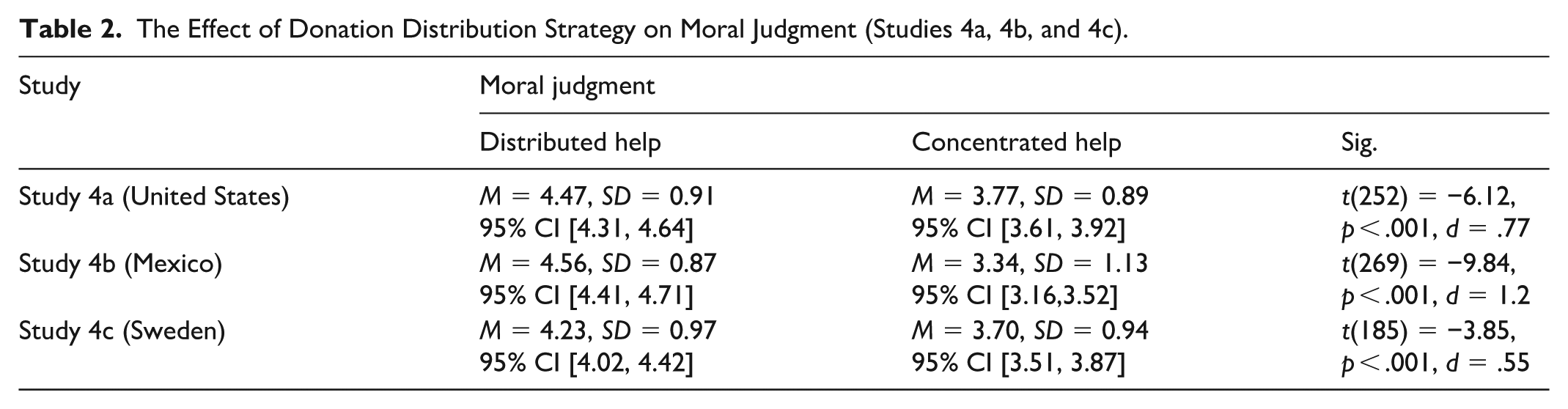
To test H1, we conducted three independent samples t-tests comparing participants’ moral judgments of Donor A between conditions (distributed vs. concentrated) across the three samples. Consistent with the previous findings, participants rated Donor A as more moral when they employed distributed help than concentrated help across all samples (Study 4aUnited States: t(252) = −6.12, p < .001, d = .77; Study 4bMexico: t(269) = −9.84, p < .001, d = 1.2; Study 4cSweden: t(185) = −3.85, p < .001, d = .55). Thus, H1 was confirmed across different cultures (see means and SD in Table 2).
The Effect of Donation Distribution Strategy on Moral Judgment (Studies 4a, 4b, and 4c).
Mediation Analyses
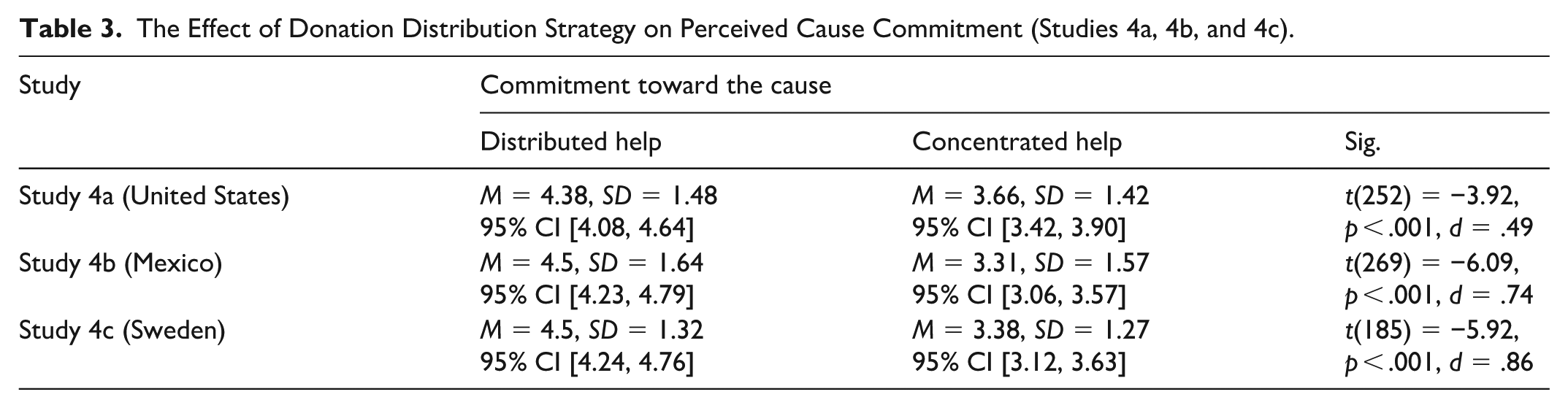
Independent samples t-tests revealed a significant effect of donation distribution strategy on perceived cause commitment consistently across the three populations. In the distributed condition, Donor A’s relative cause commitment was judged higher compared to the concentrated condition (Study 4aUnited States: t(252) = −3.92, p < .001, d = .49; Study 4bMexico: t(269) = −6.09, p < .001, d = .74; Study 4cSweden: t(185) = −5.92, p < .001, d = .86). Table 3 summarizes the results.
The Effect of Donation Distribution Strategy on Perceived Cause Commitment (Studies 4a, 4b, and 4c).
To test the mediating role of perceived cause commitment on moral judgment, we conducted three mediation analyses adopting the same procedure as in Study 2 (see Figure 2). The findings are consistent across samples: United States (Study 4a: direct effect: b = 0.377, SE = 0.19, 95% CI [−0.002, 0.75], t(252) = 1.95, p < .051; indirect effect of perceived cause commitment: b = 0.22, SE = 0.08, [0.07, 0.40]; perceived charity commitment: b = −0.04, SE = 0.038, [−0.11, 0.03]), Mexico (Study 4b: direct effect: b = 2.00, SE = 0.25, [1.51, 2.5], t(269) = 9.02, p < .001; indirect effect of perceived cause commitment: b = 0.27, SE = 0.1, [0.08, 0.48]; perceived charity commitment: b = 0.20, SE = 0.04, [0.11, 0.29]), and Sweden (Study 4c: direct effect: b = 1.07, SE = 0.30, [0.46, 1.67], t(185) = 3.49, p < .001; indirect effect of perceived cause commitment: b = 0.31, SE = 0.14, [0.05, 0.61]; perceived charity commitment: b = 0.16, SE = 0.05, [0.05, 0.28]). Thus, H2 was supported across all samples.
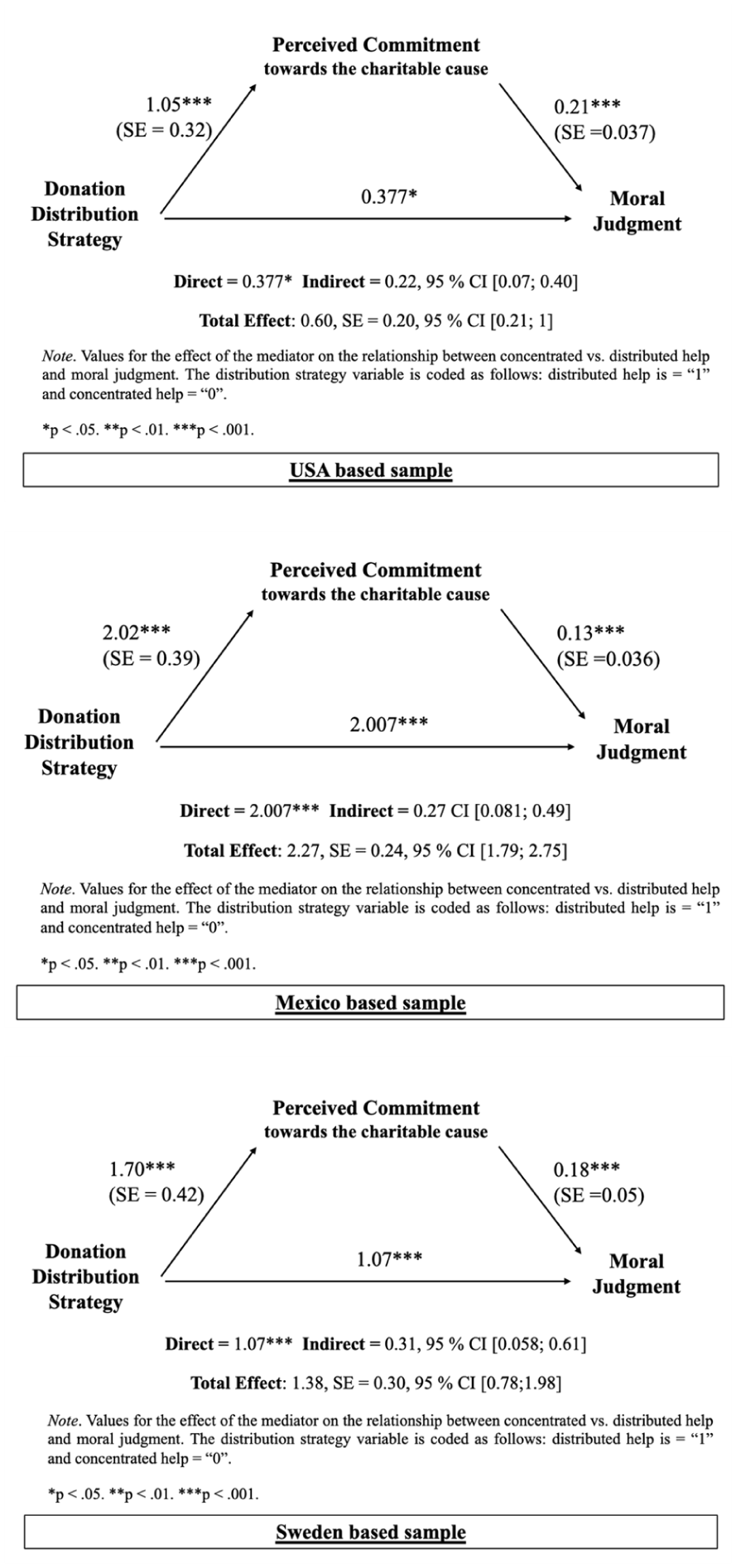
The effect of Donation Distribution Strategy on Moral Judgment via Perceived Cause Commitment across cultures (Studies 4a, 4b, and 4c).
Discussion
In Studies 4a, 4b, and 4c, we extended the generalizability of the findings by showing that donors distributing help compared to the ones concentrating help are perceived as more moral, and this is due to an enhanced perceived commitment of the donors toward the charitable cause. Specifically, we showed that the effect holds across samples that are distant on the WEIRD cultural dimensions (Muthukrishna et al., 2020). Our findings reveal a consistent cross-cultural pattern: the effect was observed in both hierarchical—collectivistic societies like Mexico and egalitarian—individualistic societies like Sweden. These findings are consistent with previous research that shows that nations have more commonalities than differences (Graham et al., 2016; Saucier et al., 2015).
General Discussion
Across seven studies, we consistently show that moral judgment varies as a function of donation distribution. Specifically, we demonstrate that observers perceive donors to be more moral when they distribute their donations across charities than when they concentrate their help on a single charity. The robustness of the effect is demonstrated using different moral judgment scales (Study 1a), controlling for scale anchoring bias (Study 1b), when donations are distributed over time (Study 2), when observers judge the act (Studies 1a and 1b) or the actor (Study 2, Study 3, Studies 4a–4c), and across different cultures, namely United States, Sweden, and Mexico (Studies 4a, 4b, and 4c). Furthermore, we show that this effect is mediated by observers’ perceptions of the donors’ commitment to the charitable cause, both when manipulating (Study 3) and measuring (Studies 2, 4a, 4b, and 4c) the donor commitment.
This research makes several important contributions. First and foremost, to the best of our knowledge, this work is the first to identify donation distribution strategy across charities as a determinant of moral judgment. In doing so, it advances the research in moral psychology. Prior work has primarily shown how morality is driven by the type of recipients that are helped (e.g., McManus et al., 2020), or by how help to a single charity is spread over time (e.g., Basu, 2021). Our findings go beyond prior research’s single-charity focus, demonstrating that how resources are divided across charities—concentrated versus distributed help—affects the moral perceptions of donors.
Exploring donors’ distribution strategy also contributes to the literature on charitable giving by shifting focus from the donor’s internal decision-making (e.g., Sharps & Schroeder, 2019) to the observer’s external evaluations. This point is particularly relevant given prior evidence of “self–other” asymmetry (e.g., Slote, 1984; Wojciszke, 2005). Our findings show that distributing donations is morally valued by others. Interestingly, when we asked participants about their own distribution preferences (Study 1a), the preference for distributing help over concentrating help was not significantly stronger. These results may suggest a self–other asymmetry of donors versus observers’ perspectives on donation strategy, commitment, and morality evaluations.
Second, we offer a novel theoretical mechanism explaining why the donation distribution strategy influences moral judgments. By expanding the focus of investigation from a single beneficiary to many, we identified commitment to the charitable cause as the mechanism through which the distribution of help affects moral judgments. We reason that observers assume distributed donors invested time and effort identifying multiple charities to maximize their support for the cause—a dedication that reflects genuine commitment. Building on prior research (e.g., Schaumberg & Lin, 2025), we show that while donors may be dedicated to a specific charity, it is commitment to a general social cause that drives perception of morality above and beyond charity commitment. This finding contributes to the moral psychology literature by extending the understanding of how observers infer moral character from prosocial behavior (Carlson et al., 2022) based on ascribed motives (Berman & Silver, 2022; Brotzeller et al., 2024). Furthermore, these findings are relevant to the charitable giving literature. While previous research has studied donor commitment in the context of organizational loyalty (e.g., Sargeant & Lee, 2004), we uncover another facet of commitment that can affect prosocial behavior—that is, commitment toward the charitable cause.
Finally, this work contributes to cross-cultural research by examining donation distribution strategy effects across diverse cultural contexts. While cross-cultural studies are becoming more common (e.g., Klein et al., 2015), moral psychology research remains heavily reliant on WEIRD samples (Rad et al., 2018). Given that cultural factors can shape moral perceptions and prosocial behavior, identifying patterns that generalize beyond WEIRD samples is particularly important in an increasingly globalized world. We contribute to this understanding by showing that the effect of the donation distribution strategy on moral judgment—mediated by perceived cause commitment—is generalizable across countries that exhibit culturally heterogeneous characteristics (Muthukrishna et al., 2020). These findings are consistent with prior work documenting cross-cultural convergence in prosocial evaluations (e.g., Strombach et al., 2014).
Limitations and Future Directions
Observers may draw additional inferences beyond cause commitment when evaluating donors, which opens several promising avenues for future research. One direction is examining whether the distribution strategy is perceived as counter-normative, and whether such perceptions impact commitment inferences. Another direction is exploring inferences specific to concentrated help. For example, whether observers assume a personal connection between the donor and a single charity, and how this shapes moral evaluation. Our data offer some insight into this: concentrated donations positively affected perceptions of charity commitment, though this effect was inconsistent across studies—unlike cause commitment, which emerged as a robust mediator throughout (see Supplemental Materials). This pattern suggests that while observers may infer a special bond between concentrated donors and their chosen charity, it is commitment to the broader cause that reliably drives moral judgment. Study 3 reinforces this interpretation: when concentrated help was explicitly framed as reflecting high cause commitment, moral perceptions increased, suggesting that cause commitment information overrides other default inferences. Nevertheless, directly investigating these additional inferences can contribute to a more comprehensive understanding of how observers construct moral judgments from donation strategy.
This research is only the first step toward unraveling how distribution strategies across charities impact morality. Future researchers could investigate when and how the morality perceptions diverge. Prior work (Yudkin et al., 2019) shows judgments may differ when observers focus on the act itself (e.g., the effort the act demands) or the outcome of the act (e.g., the number of recipients being helped). It is possible that in our paradigm, participants focused on the act and how it signals donors’ commitment, but if they were instructed to focus on the outcome — that is, what each charity is getting – the effect would change. Furthermore, the outcome of the act can vary independently of the distribution strategy. A single charity may have a greater reach than four charities taken together. Thus, focusing on a single high-reach charity may be more moral than spreading donations across many charities. Furthermore, we did not vary the total or the divided amounts donated by each donor. For example, there could be a difference between equal and unequal donation allocation (Sharps & Schroeder, 2019). The total number of recipients could matter, such that the relative impact on each recipient changes the perception of morality. The relationship may be inverted U-shaped: moving from one to multiple charities signals broader engagement, but distributing trivial amounts across hundreds of charities may dilute the commitment signal and be perceived as random or performative rather than genuine commitment to help. Finally, researching and selecting a thoughtful subset of charities or merely opting for a “select all” option may yield the same total number of charities helped, yet signal different commitment levels. Exploring these boundary effects would help identify when distributed giving is perceived as reflecting genuine commitment versus superficial or ineffective generosity.
Another future research avenue regards the type of giving. Our research investigates the effect of distribution strategy within the context of monetary donations. Prior research has found that donations of time and money are judged differently, such that time donation is perceived as more virtuous and moral (Johnson & Park, 2021; Reed et al., 2007). Furthermore, research on donation strategies targeting a single charity returned inconsistent results. Some studies show a positive effect for the distribution of time (Henderson et al., 2021) and money (Basu, 2021), while others show a negative effect (Schaumberg & Lin, 2025). Hence, it is worthwhile in future research to explore whether distributing time donations across charities influences moral perception in the same way as it does for donating money. Furthermore, the shift to donation time strategies can open an avenue of research that builds on prior work exploring the link between prosocial behavior, effort, and morality (Berry & Lucas, 2024). Future research can expand the scope of investigation from the context of money and charities to other prosocial behaviors demanding different forms of effort such as helping one friend with one big task versus helping many friends with small tasks; providing one long, detailed piece of advice versus many brief pieces of advice; and volunteering for a grand-challenging public pro-environmental act or volunteering for several ongoing public pro-environmental small weekly acts.
The type of beneficiary is another avenue for research expansion. For example, one future research direction could test whether the effect differs when recipients are individuals rather than organizations, since prior work suggests that individuals trigger higher empathy levels than groups (Gordon-Hecker et al., 2024) or organizations (Ein-Gar & Levontin, 2013). Furthermore, distributing donations to many individuals raises fairness concerns (Ein-Gar et al., 2021). It is therefore interesting to learn if fairness concerns arise when distributing to charities, and whether they hinder moral perceptions. Another direction could explore the donors’ gender. While we note that we did not observe a donor gender effect in our studies (see Supplemental Materials), our data do not allow us to fully answer this question. Given prior evidence on the influence of gender on prosocial decisions (e.g., Andreoni & Vesterlund, 2001), we encourage researchers to further investigate this aspect in the context of moral perceptions.
A potential limitation of our empirical package is the exclusive use of a joint evaluation paradigm in which participants compared two donors directly. While this design effectively isolates the variable of interest (Caviola et al., 2014), it does not capture all contexts in which moral judgments of donors occur. In some situations, people likely evaluate donors without explicit comparison to others; at the same time, the rise of digital giving platforms is shifting this. For example, fundraising sites increasingly display donor lists, giving patterns, and contribution histories. Likewise, social media exposes users to friends’ charitable behaviors. As these technologies grow in prevalence (e.g., Charity Navigator, GlobalGiving), comparative evaluation of donors may become increasingly common. Nevertheless, we encourage future research to test whether the effect unfolds differently under separate evaluation. On a related note, this design cannot determine whether the effect is driven by distributed donations elevating moral perceptions, concentrated donations diminishing them, or both. However, given that both strategies involve voluntary giving to benefit others, it is reasonable to expect that both are viewed as moral in absolute terms. As such, it is plausible that distributing donations enhances moral perception rather than concentration diminishing it.
Conclusions
In sum, our research sheds new light on how moral judgments are construed and motivated by identifying donation distribution strategy as a key determinant. Specifically, we show that distributed help is consistently perceived as more moral than concentrated help due to higher levels of commitment toward the cause attributed to the donor. This effect generalizes across culturally distant populations. These findings contribute to both moral psychology and charitable giving literature by illuminating a donation behavior that is increasingly prevalent due to evolving fundraising methods (e.g., https://www.charitynavigator.org/donor-basics/tools-for-giving/giving-basket/) and donor preferences (NP source, 2024).
Supplemental Material
sj-docx-1-psp-10.1177_01461672251414772 – Supplemental material for Distributing Help Enhances Moral Judgment
Supplemental material, sj-docx-1-psp-10.1177_01461672251414772 for Distributing Help Enhances Moral Judgment by Matilde Lucheschi, Danit Ein-Gar and Oguz A. Acar in Personality and Social Psychology Bulletin
Footnotes

Ethical Considerations
Studies were approved by the City, University of London (ETH1819-0722) and by the University of Sussex Research Ethics Committee (ER/ML761/5).
Consent to Participate
Respondents gave written consent before starting the study.
Funding
The authors received no financial support for the research, authorship, and/or publication of this article.
Declaration of Conflicting Interests
The authors declared no potential conflicts of interest with respect to the research, authorship, and/or publication of this article.
Data Availability Statement
Supplemental material
Supplemental material is available online with this article.
Notes
References
Supplementary Material
Please find the following supplemental material available below.
For Open Access articles published under a Creative Commons License, all supplemental material carries the same license as the article it is associated with.
For non-Open Access articles published, all supplemental material carries a non-exclusive license, and permission requests for re-use of supplemental material or any part of supplemental material shall be sent directly to the copyright owner as specified in the copyright notice associated with the article.
