




Abstract
Important scientific contributions regarding intersectional marginalization are often advanced by researchers who, themselves, hold the relevant intersecting identities. But how are these researchers perceived? In an experiment gauging the perspective of a demographically representative sample of U.S. Americans (N = 385), we found that research on Black women’s marginalization was perceived as equivalently trustworthy and meritorious whether it was conducted by a Black woman, Black man, White woman, or White man. Our data suggested this was because a Black woman conducting this work was perceived ambivalently—positively due to her perceived standing and expertise, but negatively due to her perceived vested interest. In three follow-up experiments examining perceptions of Black American women, specifically (N = 243, 139, 182), we found a different pattern—Black women consistently evaluated this research more favorably if it was conducted by a fellow Black woman, prioritizing her standing, expertise, and commitment to the community.
Introduction
The need to acknowledge and better understand intersectional experiences of marginalization has become increasingly central to academic discourse in psychology (Bowleg, 2017; Cole, 2009; Rosenthal, 2016). “Intersectionality” is a term used to describe how different axes of identity intersect to produce unique forms of privilege and marginalization (Cole, 2009; Crenshaw, 1989). Crenshaw (1989) illustrated the concept of intersectionality by highlighting how Black women’s experiences of marginalization could not be fully understood by examining their racial identity or gender in isolation—although they are affected by racism and sexism, the nature of the marginalization they face is qualitatively distinct from that experienced by Black men and White women (Crenshaw, 1989).
The implications of intersectionality for social and psychological science are clear—a comprehensive account of discrimination and marginalization cannot be gleaned from frameworks that only consider single dimensions of identity in isolation (e.g., racism, sexism). Scholars have increasingly called for more nuanced, intersectional approaches that acknowledge the unique experiences of individuals who occupy distinct positions at the intersection of multiple social identities (Cole, 2009; McCormick-Huhn et al., 2019; Rosenthal, 2016; Settles, 2006; Settles et al., 2022; Warner et al., 2016). Much of the research on intersectional populations emerging from these calls has been advanced by researchers belonging to such populations, who carry with them the “insider” knowledge of what that specific intersectional group membership entails (Thomas, 2004). Despite these epistemological advantages, however, this personal stake may undermine the public’s trust in their scholarship, constraining the potential of such research to effect change (Thai et al., 2021).
In the present article, we aim to explore U.S. Americans’ evaluations of research on intersectional marginalization as a function of whether the researcher’s own identity aligns with the intersectional group they are researching. Across four experiments, we gauge these perceptions from both a representative sample of the general U.S. population (Study 1) and a subset of the population who are themselves part of the intersectional group under empirical investigation (Studies 2–4).
Ambivalent Perceptions of Researchers Studying Their Own Marginalization
Scholars have noted that researching one’s own group offers a unique insider perspective that can facilitate significant theoretical advancement. Having a personal and deep familiarity with one’s ingroup can enhance the research process, expediting academic inquiry into phenomena that are relevant, valid, and central to the lived experience of that group (Thomas, 2004). It would be remiss not to acknowledge that the concept of intersectionality is itself rooted in Black feminist thinking, pioneered through the intellectual work of scholars and activists who are, themselves, Black women (e.g., Bowleg, 2008; Collins, 1990; Crenshaw, 1989; Settles, 2006). Beyond the intellectual contributions that intersectionally marginalized researchers can offer, being part of marginalized communities can also grant access to populations that might otherwise be underrepresented in research (Dwyer & Buckle, 2009; Kanuha, 2000; LaSala, 2003; Zinn, 1979). Despite these benefits, the literature shows that public perceptions of researchers who conduct self-relevant research are mixed.
In some ways, researchers who have a personal stake in the topic of their scholarship are perceived positively. For example, they are generally perceived to have greater expertise in the research area compared to those who do not (Altenmüller et al., 2021; Wallace et al., 2024). That is, they are considered to be more informed about, and have a deeper understanding of, the subject matter they are scientifically investigating (Thai et al., 2021). Indeed, when it comes to the study of marginalization, marginalized group researchers are deemed more expert than non-marginalized group researchers (Meral et al., 2025; Thai et al., 2021). Beyond being perceived as more knowledgeable, researchers studying the marginalization of their group are also perceived to have the greatest psychological standing to conduct the work (Thai et al., 2021). In other words, they are believed to be the most appropriate and legitimate people to do this research.
But although they are considered both well-informed and well-positioned, this does not automatically elicit greater trust in their research. One reason for this is that researchers who conduct self-relevant research are simultaneously perceived to have more to personally gain from their research. These heightened perceptions of vested interest may be deemed a potential source of bias, dampening trust and enthusiasm in their work and offsetting any potential benefit of having psychological standing or “insider” expertise (Thai et al., 2021; Wallace et al., 2024). This is indeed true of researchers who study their own marginalization, whose capacity to engage in rigorous, objective, and bias-free scientific inquiry is regularly questioned, and whose work is frequently devalued and dismissed as “mesearch” (Harris, 2021; LaSala et al., 2008; Meral et al., 2025; Torrez et al., 2024).
What results from the mixed evaluations above is a general ambivalence towards researchers who study their own marginalization. People evaluate such researchers as having the requisite standing and expertise to conduct research on their own communities, but these positive perceptions are tainted by countervailing negative perceptions that their work is biased and guided by vested interests (Thai et al., 2021).
Perceptions of Researchers Studying Intersectional Marginalization
To date, the research examining perceptions of researchers studying their own marginalization has only considered research topics that involve single axes of marginalization (e.g., Black vs. White researchers conducting research on racial discrimination; women vs. men conducting research on gender discrimination; Thai et al., 2021). We extend this work by examining people’s evaluations of research on intersectional marginalization. Here, it is possible that similar processes to those described above come into play. The intersectional nature of such research, however, raises additional questions that remain unanswered. For example, when it comes to research on intersectional marginalization, researchers can vary in the degree to which their own identities align with the intersectional population of interest (Haw, 1996). To illustrate, research on the marginalization of Black women may be conducted by researchers who are themselves Black women (whose identities are completely aligned with the research), White men (whose identities are completely misaligned with the research), or Black men and White women (whose identities are partially aligned with the research).
It is possible that researchers’ degree of alignment with any given intersectional population matters, such that each relevant identity may exert an additive effect on their perceived standing, expertise, and vested interest when conducting research on that population. Alternatively, in accordance with the concept of intersectionality, evaluators may take an all-or-nothing approach in their evaluations, such that only researchers whose identities are completely aligned with the research focus would be perceived as having higher perceived standing, expertise, and vested interest. Yet another possibility is that partially aligned researchers may be deemed best suited to conduct the work—their aligned identity with the population of focus may be perceived to give them the requisite standing and expertise, but their non-aligned identity may render them personally removed enough to protect them from ascriptions of vested interest. The present research seeks to test these, and other possibilities by examining how researchers studying intersectional marginalization are perceived as a function of the specific configuration of identities they hold.
Who is Evaluating the Research?
Another important consideration when investigating public evaluations of research on intersectional marginalization is who is doing the evaluating. Examining the perspective of the broader population is important for pragmatic reasons—research can only generate social change if it is trusted and believed to hold merit by society at large (Fiske & Dupree, 2014; Hendriks et al., 2016). These views may influence the decision-making processes that ultimately determine who gets access to research funding and whose research informs changes to systems and policy. Thus, it is valuable to gauge how members of these broader populations evaluate research on intersectional marginalization as a function of the identity of the researchers conducting it.
At the same time, it is crucial to understand the perspective of the intersectional community central to the research. Given their distinct positionality in relation to the research, it is possible that members of the focal intersectional community prioritize different considerations compared to the broader public when evaluating who is best suited to conduct research on their marginalization. For example, we might expect that the general population would perceive researchers who conduct self-relevant research into intersectional marginalization ambivalently, replicating the mixed perceptions that have been previously documented in the literature (Altenmüller et al., 2021; Thai et al., 2021). In contrast, members of the intersectional community of focus may evaluate ingroup researchers more positively.
Often times, systematically marginalized communities who are the focus of scientific investigation exhibit distrust toward researchers and their work for various reasons—these include the perception that the research would unilaterally benefit the researcher without reciprocal benefit to the community, the stigmatization and harm resulting from research findings, or the irrelevance of the research questions or approaches to the community of focus (Macaulay et al., 1998; Scharff et al., 2010). These concerns are exacerbated when researchers are outsiders to the communities they aim to study (Bridges, 2016; Thomas, 2004). Conversely, they may be assuaged when the work itself is advanced by researchers whose own identities align with those of the community. Here, the ingroup researcher’s ostensible vested interest in the research may even carry a different meaning, potentially signaling that they would conduct their work in alignment with the community’s needs and priorities. The present work tests these possibilities.
The Present Research
The present research aimed to investigate whether evaluations of research examining intersectional marginalization vary as a function of whether the researcher holds identities that are relevant to the intersectional community they are researching. Leveraging Crenshaw’s (1989) original example of intersectionality, four studies interrogated people’s evaluations of research on Black women’s experiences of discrimination, specifically. We assessed how such research is perceived by both a representative sample of the general public as well as individuals who belong to the marginalized group whose experiences are being researched (i.e., Black women). In line with past work (e.g., Thai et al., 2021), we made the broad prediction that researchers studying the marginalization of Black women would be perceived as having greater psychological standing, expertise, and vested interest if they are Black women themselves, compared to if they are not.
We further proposed that these perceptions would have implications for the extent to which their research is trusted and perceived as having merit. Across all studies, we hypothesized that greater perceived psychological standing and expertise would increase trust and perceived merit in the research. Although we initially hypothesized that greater perceived vested interest would reduce trust and perceived merit from Studies 1–2, the pattern of findings from Study 2 onwards indicated this may not be true when considering the perspective of members of the intersectional community of focus (we updated our hypotheses to reflect this, accordingly).
Study 1
Study 1 provided an initial test of people’s perceptions of research on intersectional marginalization as a function of the researcher’s identity. Participants evaluated a researcher studying discrimination against Black women. The researcher was a Black woman, Black man, White woman, or White man. We hypothesized that the researcher would be perceived as having greater psychological standing, expertise, and vested interest if they are a Black woman themselves, compared to if they are not (but made no predictions about differences across the other targets). We further hypothesized two countervailing processes: (a) through heightened perceptions of psychological standing and expertise, research conducted by a Black woman would be trusted more and considered to have greater merit, however (b) through heightened perceptions of vested interest, research conducted by a Black woman would be trusted less and considered to have less merit. As we proposed countervailing processes, we did not hypothesize any direct effects of researcher identity on trust or merit perceptions.
The methodology, hypotheses, and analysis plan for Study 1 were preregistered at: https://osf.io/x7vfa/
Method
Data and Materials
We report all manipulations, measures, and exclusions for every study in this article. Data and materials for all studies can be accessed at: https://osf.io/zert9/
Participants
Power analysis conducted in G*Power (Faul et al., 2007) determined around 100 participants per condition would be required for 80% power to detect an effect size of d = 0.40 for the difference between two groups (to test for the simple effects of researcher identity; based on the smallest effect size of interest found in Thai et al., 2021). A representative sample from the United States was recruited using settings on Prolific and reimbursed with ₤1.00. A total of 401 participants completed the study. Sixteen participants were removed for failing any combination of the researcher identity manipulation checks or the attention check 1 , leaving a final sample of 385 (Mage = 45.7, SD = 16.1; 194 women, 185 men, 4 non-binary, 2 other-specifying).
Design and Procedure
The study used a one-way between-groups design with four conditions. Adapting an experimental paradigm used by Thai et al. (2021), participants were presented with one of four mock research profiles depicting a researcher conducting research on discrimination against Black women. The research profile included a name, photograph, short biography, and representative publications.
Researcher Identity Manipulation
The researcher’s identity was manipulated across conditions, such that they were a Black woman, Black man, White woman, or White man. The photograph and names were manipulated. The faces of the researchers were sourced from the Chicago Face Database (Ma et al., 2015) and were matched on perceived age and attractiveness.
Measures
Participants evaluated the researcher and their research on a series of dependent measures. Responses to all multi-item scales were averaged to form an index of that variable. 2
Psychological Standing (α = .83)
Four items adapted from Thai et al. (2021) measured participants’ perceptions of the degree to which the researcher had the psychological standing to conduct their research (e.g., “Do you feel that it is this researcher’s place to conduct this research?”; 1 = not at all, 7 = very much).
Expertise (α = .95)
Three items adapted from Thai et al. (2021) and Wallace et al. (2024) measured participants’ perceptions of the researcher’s degree of expertise in their research area (i.e., “How knowledgeable do you think this researcher is on the issue they are researching?”; 1 = not at all, 7 = very much).
Vested Interest (α = .80)
Four items adapted from Thai et al. (2021) measured participants’ perceptions of the degree to which the researcher had a vested interest in their research (e.g., “How much do you think this researcher has to gain from conducting this research?”; 1 = not at all, 7 = very much).
Trust in the Research (α = .93)
Seven items adapted from Thai et al. (2021) measured participants’ trust in the research and perceived integrity of the research practice (e.g., “To what extent do you trust the research produced by this researcher?”; 1 = not at all, 7 = very much).
Merit Perceptions (α = .96)
Six items adapted from Thai et al. (2021) measured the degree to which participants perceived that the research had merit (e.g., “To what extent do you think that policy makers should pay attention to the results of the research conducted by this researcher?”; 1 = not at all, 7 = very much).
Researcher Identity Manipulation Checks
Two items verified the manipulation of researcher identity by testing whether participants remembered the researcher’s race (i.e., “What was the race of the researcher depicted in the research profile?”; 1 = White, 2 = Black) and gender (i.e., “What was the gender of the researcher depicted in the research profile?”; 1 = Woman, 2 = Man).
Attention Check
One item tested whether participants paid attention to the research focus (i.e., “What was the research focus of the researcher?”).
Other Measures
A number of other exploratory scales were included in the survey, including a measure of the perceived personal relevance of the issue to the researcher, and perceived suitability of the researcher to be conducting their research. These are omitted from the manuscript because we (a) did not preregister hypotheses for them across any of the studies, and (b) ultimately considered them redundant due to their conceptual overlap with the other variables in our proposed model (e.g., psychological standing, vested interest).
Results
Between-Groups Differences
The effect of researcher identity on all dependent variables was analyzed using one-way between-groups analysis of variance (ANOVA). Significant omnibus tests were followed up with Tukey-corrected post-hoc comparisons across all the groups. Cell means and F-statistics are presented in Table 1, and results of pairwise comparisons are presented in Table 2. The reporting of results for each variable are grouped by similarity of the patterns observed.
Cell Means and Standard Deviations as a Function of Researcher Identity, With Omnibus Tests (Study 1).

Note. Means within each row that do not share a subscript are significantly different at p < .05. Standard deviations are presented in parentheses.
Mean Difference Tests Comparing Researcher Identity (Study 1).

Note. Tukey corrections applied. 95% confidence intervals for effect sizes (d) are presented in brackets.
Psychological Standing, Vested Interest
There was a significant effect of researcher identity on perceived standing and vested interest. The Black woman was perceived to have greater standing and vested interest than all other targets. The Black man was perceived to have greater standing and vested interest than the White woman and White man. There was no significant difference in perceived standing or vested interest between the White woman and White man.
Expertise
There was a significant effect of researcher identity on perceived expertise. The Black woman was perceived to have greater expertise than all other targets. The Black man and White woman were perceived to have greater expertise than the White man. There was no significant difference in perceived expertise between the Black man and White woman.
Trust, Merit
There was no significant effect of researcher identity on trust or merit perceptions.
Path Analysis
Preliminary bivariate correlations demonstrated that perceived psychological standing and expertise were positively associated with trust and merit perceptions, whereas perceived vested interest was negatively associated with trust 3 .
Path analysis was conducted to test the indirect effects of researcher identity (using three dummy-codes with Black women as the reference group) on trust and merit perceptions, via the proposed mediators (i.e., psychological standing, expertise, vested interest). Indirect effects were estimated using 5,000 bootstrapped samples and were considered significant if the 95% confidence intervals did not include zero. Indirect effects are presented in Table 3.
Indirect Effects of Researcher Identity on Trust and Merit Perceptions Through Expertise, Psychological Standing, and Vested Interest (Study 1).

Note. Significant indirect effects bolded.
A Black woman researcher’s greater perceived standing and expertise (vs. all other researcher identities) predicted greater trust and merit perceptions, whereas a Black woman researcher’s greater perceived vested interest (vs. all other researcher identities) predicted lower trust and merit perceptions. All indirect effects were significant.
Discussion
Study 1 found that a representative U.S. sample evaluated research on the intersectional marginalization of Black women as similarly trustworthy and meritorious, irrespective of whether it was conducted by a Black woman, Black man, White woman, or White man. Although a Black woman was recognized as having the greatest psychological standing to conduct the research and the highest expertise in the subject matter, this did not translate into the most favorable perceptions of the research, overall. Evidence suggested this was because Black women were perceived to have the greatest vested interest in this research, which undermined participants’ trust and perceived merit. These countervailing effects are consistent with past work demonstrating ambivalent perceptions of marginalized researchers whose identities align with their research focus (Thai et al., 2021).
Extending upon past work, we found that the degree of identity alignment was a relevant cue that people used when evaluating researchers studying intersectional marginalization. For example, Black men and White women (for whom at least one identity was aligned with the intersectional community of Black women) were perceived to have greater expertise than a White man (for whom no identity was aligned with this community). Our findings suggested, however, that racial identity alignment was more powerful than gender identity alignment in determining the researchers’ “fit” with the research. It was seen as more appropriate for a Black man to conduct research on Black women’s experiences of discrimination than for either a White woman or White man to do the same. A Black man was also believed to have more to personally gain from the work than a White woman or White man. This suggests that, from the perspective of the broader population, race-based marginalization may be more salient or may be expected to be more relevant to the experience of Black women. This reflects lay assumptions that align with the ethnic-prominence hypothesis when considering perceived discrimination in the context of multiple group memberships (Levin et al., 2002). Study 2 was designed to further explore these perceptions from the perspective of Black women, themselves.
Study 2
Study 2 sought to explore whether the effects of researcher identity uncovered in Study 1 would be reflected in the perceptions of participants who were themselves members of the intersectional community under investigation (i.e., Black women). Previous research indicates that individuals’ group memberships influence their evaluations of science (Morton et al., 2006; Nauroth et al., 2017). For example, Thai et al. (2021) found that Black participants tended to trust racism research more when it was conducted by a Black researcher than when it was conducted by a White researcher. They still found, however, that Black participants’ trust in the Black researcher’s work was partially suppressed by their perception that the Black researcher would have a vested interest in the work.
In the present study, we aimed to test whether similar patterns would emerge in perceptions of research on intersectional marginalization. It is possible that members of intersectional communities would show even greater trust in ingroup-relevant research if it is conducted by an ingroup member, given the more specific, targeted focus of the research on their specific intersectional subpopulation. They may place greater faith in the work if they know it is driven by someone with a deep, genuine, and “lived” understanding of the experiences and problems faced by the community (Thomas, 2004). Given the absence of data to make firm hypotheses regarding any potential differences when interrogating the perspective from within the intersectional community itself, we made identical hypotheses to those observed in Study 1. In addition to testing the effects of researcher identity on trust and merit perceptions, we also included another index capturing attitudes toward the research that mirrored relevant real-world decision-making processes—the amount of funding participants would hypothetically allocate to the researcher.
The methodology, hypotheses, and analysis plan for Study 2 were preregistered at: https://osf.io/w4uha/
Method
Participants
Power analysis determined around 64 participants per condition would be required for 80% power to detect an effect size of d = 0.50 for the difference between two groups (to test for the simple effects of researcher identity; based on the smallest effect size of interest found in Study 1). Black women from the United States were recruited using filters on Prolific and reimbursed with ₤1.00. A total of 260 participants completed the study. Fourteen participants were removed for failing any combination of the researcher identity manipulation checks or the attention check. A further three participants were removed for specifying a race other than Black, or a gender other than female/woman. This left a final sample of 243 Black women (Mage = 39.8, SD = 11.7; 4 mixed race).
Design and Procedure
The design, procedure, and manipulations were identical to Study 1. Participants evaluated a research profile depicting a researcher studying discrimination against Black women. The researcher was a Black woman, Black man, White woman, or White man.
Measures
Participants completed all the measures from Study 1: psychological standing (α = .90), expertise (α = .97), vested interest (α = .80), trust (α = .88), and merit perceptions (α = .90). They also responded to the new measure below.
Funding Allocation
Participants were asked to imagine they were a decision-maker for a funding body with a budget of $100,000 USD to fund research on issues facing Black women. Participants were required to indicate how much of this money they would allocate to this researcher from $0 to $100,000 (given a hypothetical pool of other researchers also conducting work in this area).
Results
Between-Groups Differences
The effect of researcher identity on all dependent variables was analyzed using one-way between-groups ANOVA. Significant omnibus tests were followed up with Tukey-corrected comparisons across all the groups. Cell means and F-statistics are presented in Table 4, and results of pairwise comparisons are presented in Table 5.
Cell Means and Standard Deviations as a Function of Researcher Identity, With Omnibus Tests (Study 2).

Note. Means within each row that do not share a subscript are significantly different at p < .05. Standard deviations are presented in parentheses.
Mean Difference Tests Comparing Researcher Identity (Study 2).

Note. Tukey corrections applied. 95% confidence intervals for effect sizes (d) are presented in brackets.
Psychological Standing, Expertise, Vested Interest, Trust
There was a significant effect of researcher identity on perceived standing, expertise, vested interest, and trust. The Black woman was perceived to have greater standing, expertise, and vested interest than all other targets, and also elicited the greatest trust. The Black man was perceived to have greater standing, expertise, and vested interest than the White woman and White man, and participants also trusted his research more. There was no significant difference on any of these variables between the White woman and White man.
Merit
There was a significant effect of researcher identity on merit perceptions. The research was perceived to have greater merit if it was conducted by either a Black woman or Black man than either a White woman or White man. No other differences were significant.
Funding Allocation
There was a significant effect of researcher identity on funding allocation. Participants allocated the most funding to the research if it was conducted by a Black woman, which was significantly higher than that allocated to either a White woman or White man (who did not significantly differ in the amount of funding they were allocated). Research conducted by a Black man was allocated the second-highest amount of funding, but this amount did not significantly differ from that allocated to any other target.
Path Analysis
Preliminary bivariate correlations demonstrated that perceived psychological standing, expertise, and vested interest were all positively associated with trust, merit perceptions, and funding allocation.
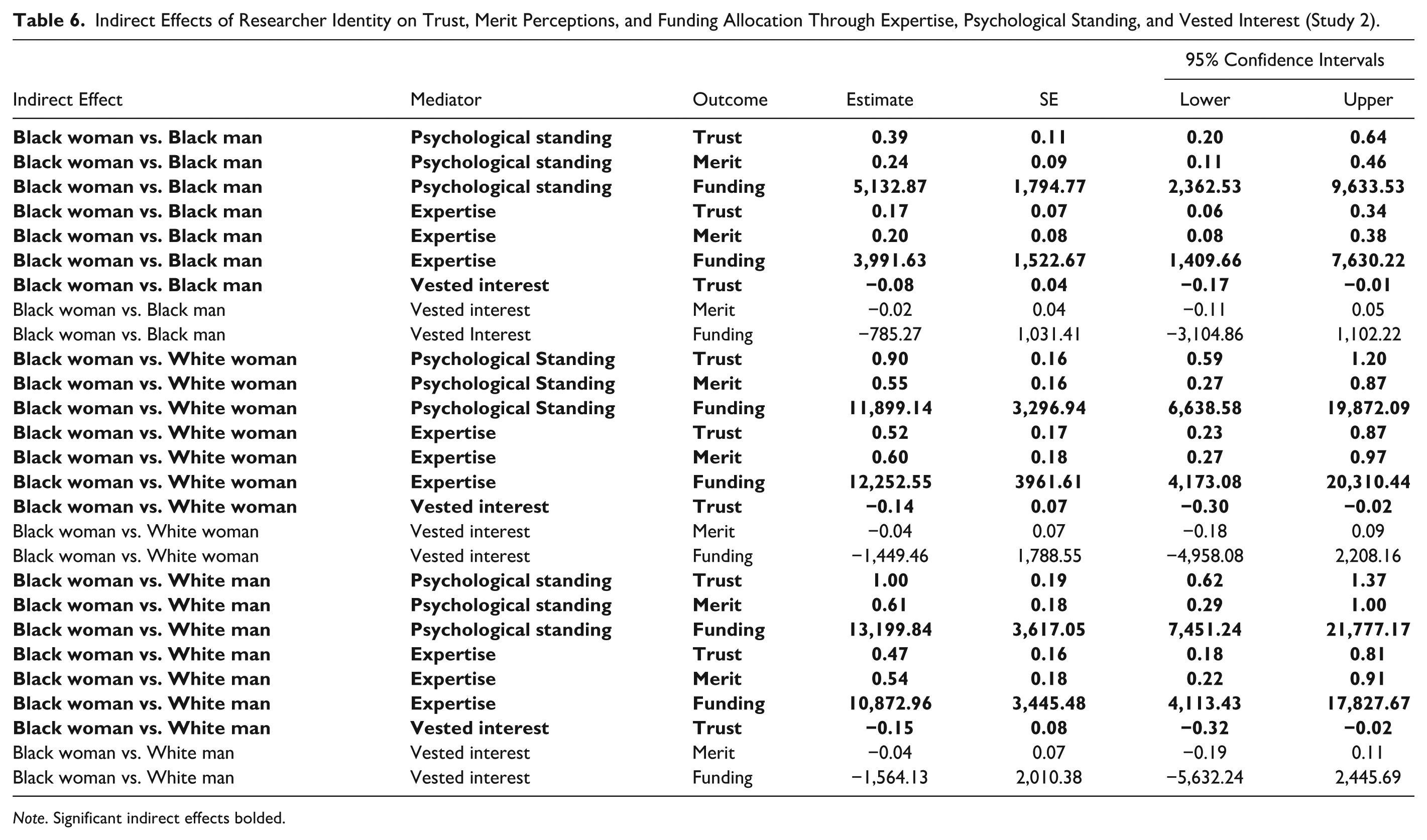
Path analysis was conducted to test the indirect effects of researcher identity (using three dummy-codes with Black women as the reference group) on trust, merit perceptions, and funding allocation, via the proposed mediators (i.e., psychological standing, expertise, vested interest). Indirect effects are presented in Table 6.
Indirect Effects of Researcher Identity on Trust, Merit Perceptions, and Funding Allocation Through Expertise, Psychological Standing, and Vested Interest (Study 2).
Note. Significant indirect effects bolded.
A Black woman researcher’s greater perceived standing and expertise (vs. all other researcher identities) predicted greater trust, merit perceptions, and funding allocation, whereas a Black woman researcher’s greater perceived vested interest (vs. all other researcher identities) only predicted lower trust (weakly), but not merit perceptions or funding allocation, with standing and expertise controlled for.
Discussion
Among a sample of Black women, Study 2 revealed that a Black woman researching the intersectional marginalization of Black women was perceived as having the greatest psychological standing and expertise, which predicted more positive perceptions of trustworthiness and merit. Although Black women also recognized that a Black woman researching discrimination against Black women would have greater vested interest in the work, this did not subsequently undermine their evaluations of the research as it did for the representative sample in the previous study. In fact, Black women trusted the research most, perceived it as having the most merit, and allocated the most funding to it if it was conducted by a Black woman.
On a bivariate level, vested interest perceptions were, unexpectedly, positively associated with trust, merit perceptions, and funding allocation. This suggests that perceived vested interest may not always undermine trust in research, at least from the perspective of the intersectional community central to the research focus. It is possible that having a personal stake in the research may be a meaningful cue of a researcher’s presumed allegiance or obligation to the community (Thomas, 2004). By virtue of their “shared fate” with the intersectional community they are researching, they may be expected to conduct their research in a way that best serves, not only their own potential vested interests, but the collective interests of the group. Thus, members of intersectional communities may place greater trust in research conducted by ingroup researchers, assuming that these researchers would do their best to facilitate positive outcomes while guarding against harm and exploitation (Bridges, 2016; Macaulay et al., 1998). This theorizing is consistent with work identifying benevolence—the degree to which a target is believed to be acting for the good of a trusting party—as a key antecedent of trust (Mayer et al., 1995). We therefore introduce a measure of community commitment in Study 3 to assess this as a potential explanatory variable.
Similar to the representative sample from Study 1, we found that Black women also perceived a Black man to be a more legitimate researcher into the marginalization of Black women than either White women or White men. The fact that Black women seemingly believe their experiences of marginalization may be better understood by Black men suggests that they consider the nature of the marginalization they face to be more racialized than gendered, in line with work on ethnic-prominence (Levin et al., 2002). Study 3 was designed to examine whether having personal experience with racial discrimination may imbue a researcher with similar credibility, even if they do not belong to the same intersectional category as the focal community of their research (e.g., a woman researcher from another racially minoritized group).
Study 3
Study 3 sought to extend upon Study 2 in two ways. First, we sought to test community commitment as an additional exploratory dependent variable that may contribute additional explanatory power to explain why Black women evaluate research on the marginalization of Black women more favorably if the researcher is a Black woman. Second, we also sought to test whether Black women would evaluate a researcher belonging to another intersectionally marginalized group (i.e., Asian women) more favorably than a researcher holding both a marginalized and a privileged intersectional identity (i.e., White women), given that the former would conceivably have more personal experience with marginalization across both dimensions of race and gender.
The methodology, hypotheses, and analysis plan for Study 3 were preregistered at: https://osf.io/x8bw6/
Method
Participants
Power analysis determined around 45 participants per condition would be required for 80% power to detect an effect size of d = 0.60 for the difference between two groups (to test for the simple effects of researcher identity; based on the smallest effect size of interest found in Study 2). Black women from the United States were recruited using filters on Prolific and reimbursed with ₤1.00. A total of 150 participants completed the study. Nine participants were removed for failing any combination of the researcher identity manipulation check or the attention check. A further two participants were removed for specifying a race other than Black. This left a final sample of 139 Black women (Mage = 38.8, SD = 12.4).
Design and Procedure
The study used a one-way between groups design with three levels. All other aspects of the procedure and manipulation were identical to Study 2. Participants evaluated a researcher conducting research on discrimination against Black women who was depicted as a Black woman, Asian woman, or White woman.
Measures
Participants completed all the measures from Study 2: psychological standing (α = .88), expertise (α = .96), vested interest (α = .72), trust (α = .87), merit perceptions (α = .92), and funding allocation. They also responded to the new measure below.
Community Commitment (α = .97)
Six items measured the degree to which participants perceived the researcher was committed to the community (e.g., “To what extent do you feel that this researcher has the best interests of the community they are researching at heart?”; 1 = not at all, 7 = very much).
Results
Between-Groups Differences
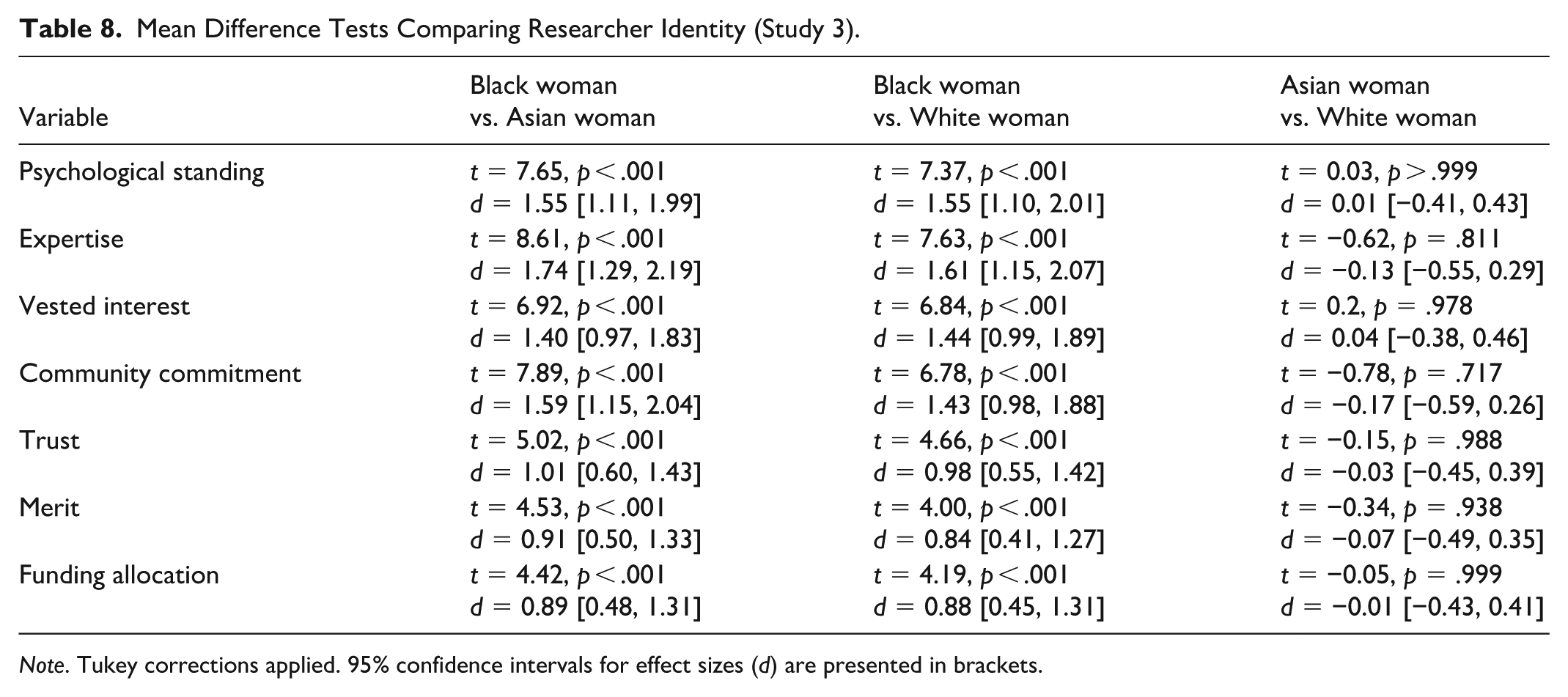
The effect of researcher identity on all dependent variables was analyzed using one-way between-groups ANOVA. Significant omnibus tests were followed up with Tukey-corrected comparisons across all the groups. Cell means and F-statistics are presented in Table 7, and results of pairwise comparisons are presented in Table 8.
Cell Means and Standard Deviations as a Function of Researcher Identity, With Omnibus Tests (Study 3).

Note. Means within each row that do not share a subscript are significantly different at p < .05. Standard deviations are presented in parentheses.
Mean Difference Tests Comparing Researcher Identity (Study 3).
Note. Tukey corrections applied. 95% confidence intervals for effect sizes (d) are presented in brackets.
There was a significant effect of researcher identity on all dependent variables, and the pattern of results was consistent across these variables. Evaluations of psychological standing, expertise, vested interest, community commitment, trust, merit perceptions, and funding allocation were significantly higher when the researcher was a Black woman compared to either an Asian woman or White woman. There was no significant difference on any of the dependent variables between the Asian woman and White woman.
Path Analysis
Preliminary bivariate correlations demonstrated that perceived psychological standing, expertise, vested interest, and community commitment were all positively associated with trust, merit perceptions, and funding allocation.
Path analysis was conducted to test the indirect effects of researcher identity (using two dummy-codes with Black women as the reference group) on trust, merit perceptions, and funding allocation via the proposed mediators (i.e., psychological standing, expertise, vested interest) and exploratory mediator (i.e., community commitment). Indirect effects are presented in Table 9.
Indirect Effects of Researcher Identity on Trust, merit perceptions, and Funding Allocation Through Expertise, Psychological Standing, Vested Interest, and Community Commitment (Study 3).

Note. Significant indirect effects bolded.
A Black woman researcher’s greater perceived standing (vs. all other researcher identities) predicted greater trust and merit perceptions. Extending on Studies 1–2, a Black woman researcher’s greater perceived community commitment (vs. all other researcher identities) predicted greater trust, merit perceptions, and funding allocation. No indirect effects emerged through expertise or vested interest.
Discussion
Study 3 revealed, consistent with Study 2, that a Black woman researching the intersectional marginalization of Black women was perceived as having the greatest psychological standing, expertise, and vested interest in the work. Black women trusted the research most, perceived it as having the most merit, and allocated the most funding to it if it was conducted by a Black woman. Whereas perceived standing predicted greater trust and more positive perceptions of merit, expertise and vested interest were not associated with these perceptions after accounting for perceptions of community commitment. Compared to the Asian and White researchers, a Black woman researcher was perceived to be most genuinely invested in the community, and this was expected to be reflected in all aspects of her research engagement with the community (e.g., care, minimization of harm, advocacy). These perceptions of community commitment were positively associated with all research evaluation indices.
Extending from the previous study, we found that an Asian woman was not evaluated more favorably than a White woman on any dimension, albeit also belonging to a group experiencing marginalization at the intersection of race and gender. This suggests that it is not enough for a researcher to have ostensible experience with other forms of intersectional marginalization to earn the confidence of the intersectional community they wish to study. Rather, communities may only be receptive to researchers who possess direct and specific knowledge of their unique intersectional experiences (Thomas, 2004). Another possibility is that Black women may not perceive the nature of the marginalization Asian women face as similar to that which their own community experiences. Future research may wish to explore Black women’s perceptions of other intersectionally marginalized researchers who may be perceived as experiencing more comparable forms of marginalization (e.g., Latina researchers; Warren & Valentino, 2025; Zou & Cheryan, 2017). In any case, the universally positive evaluations of the Black woman researcher in this and the previous study raises questions regarding whether this researcher was simply favored because she shared an intersectional group membership with the participants. Study 4 was designed to rule out this possibility.
Study 4
To test whether Black women’s favorable evaluations of Black woman researchers simply reflected ingroup preference rather than the relevance of the researcher’s group membership to the research focus, Study 4 manipulated the research focus of the researcher. Participants evaluated a researcher depicted as a Black woman or White woman, conducting research on discrimination against Black women or on an identity-irrelevant topic. We expected a Black woman to be rated more favorably than a White woman (as observed in Studies 2–3) when the research focus was identity-relevant. However, when the research focus was identity-irrelevant, we expected either a weaker effect or no effect of researcher identity.
The methodology, hypotheses, and analysis plan for Study 4 were preregistered at: https://osf.io/6yr85/
Method
Participants
Power analysis determined around 45 participants per condition would be required for 80% power to detect an effect size of d = 0.60 for the difference between two groups (to test for the simple effects of researcher identity, as in Study 3). Black women from the United States were recruited using filters on Prolific and reimbursed with ₤1.00. A total of 200 participants completed the study. Fourteen participants were removed for failing any combination of the researcher identity or research focus manipulation checks, or the attention check. A further four participants were removed for specifying a race other than Black, or a gender other than female/woman. This left a final sample of 182 Black women (Mage = 38.9, SD = 11.8; 1 mixed race).
Design and Procedure
The study used a 2 (researcher identity: Black woman vs. White woman) × 2 (research focus: identity-relevant, identity-irrelevant) between groups design. Participants were asked to evaluate a research profile.
Researcher Identity Manipulation
The researcher’s identity was manipulated across conditions, such that she was a Black woman or White woman.
Research Focus Manipulation
The researcher’s research focus was also manipulated, through the short biography and representative publications, to be about discrimination against Black women (identity-relevant) or body image issues in young people (identity-irrelevant).
Measures
Participants completed all the measures from Study 3: psychological standing (α = .87), expertise (α = .97), vested interest (α = .79), community commitment (α = .96), trust (α = .88), merit perceptions (α = .90), and funding allocation. They also responded to a new manipulation check for research focus.
Research Focus Manipulation Check
One item verified whether participants paid attention to the manipulation of research focus (i.e., “What was the research focus of the researcher?”; 1 = discrimination against Black women, 2 = body image issues in young people).
Results
Between-Groups Differences
The effect of researcher identity on all dependent variables was analyzed using 2 × 2 between-groups factorial ANOVA. Significant interactions were followed up by examining the simple effects of researcher identity at each level of research focus. Cell means and F-statistics are presented in Table 10, and results of pairwise comparisons are presented in Table 11.
Cell Means and Standard Deviations as a Function of Researcher Identity and Research Focus, With Omnibus Tests (Study 4).

Note. Standard deviations are presented in parentheses.
Mean Difference Tests Comparing Researcher Identity (Black woman vs. White woman) at Each Level of Research Focus (Study 4).

Note. 95% confidence intervals for effect sizes (d) are presented in brackets.
A significant researcher identity × research focus interaction on all dependent variables (except for funding allocation 4 ) showed that evaluations of psychological standing, expertise, vested interest, community commitment, trust, and merit perceptions were significantly higher when the researcher was a Black woman compared to a White woman, only when the research focus was identity-relevant. There were no differences as a function of researcher identity when the research focus was identity-irrelevant.
Path Analysis
Preliminary bivariate correlations demonstrated that perceived psychological standing, expertise, vested interest, and community commitment were all positively associated with trust, merit perceptions, and funding allocation.
Path analysis was conducted to test the indirect effects of researcher identity (using a dummy-code comparing Black women with White women) on trust, merit perceptions, and funding allocation via the proposed mediators (i.e., community commitment, psychological standing, expertise, vested interest). This path analysis was only run for participants exposed to researchers conducting identity-relevant research on discrimination against Black women. Indirect effects are presented in Table 12.
Indirect Effects of Researcher Identity on Trust, Merit Perceptions, and Funding Allocation Through Expertise, Psychological Standing, Vested Interest, and Community Commitment (Study 4).

Note. Significant indirect effects bolded. Indirect effects only calculated for identity-relevant research focus.
A Black (vs. White) woman researcher’s greater perceived expertise predicted greater merit perceptions and funding allocation, whereas a Black (vs. White) woman researcher’s greater perceived community commitment predicted greater trust and merit perceptions. No indirect effects emerged via psychological standing. A Black (vs. White) woman researcher’s greater vested interest predicted lower trust and funding allocation; however, these negative indirect effects via vested interest were weaker than the positive indirect effects via expertise and community commitment.
Discussion
Study 4 confirmed that Black women largely only evaluated a Black woman more positively than a White woman if the research topic was relevant to Black women. These researchers were otherwise evaluated equivalently when the research topic was identity-irrelevant. Thus, Black women did not indiscriminately favor researchers sharing their intersectional group membership; this shared identity only held weight if it was relevant to the work being conducted. This pattern of findings once again supports the assertion that research on intersectional marginalization is best received by members of these marginalized communities if advanced by researchers within those communities. We show that higher perceptions of expertise and community commitment were key drivers of this preference.
General Discussion
The present work aimed to examine how research on intersectional marginalization is evaluated—by both the general public as well as the intersectional community of focus—as a function of the identities of the researcher. In an initial study, we found that a representative sample of U.S. Americans held ambivalent perceptions of Black women conducting research on Black women’s marginalization. On one hand, they perceived that a Black woman would have the greatest standing and expertise to conduct this research, relative to researchers holding other identities. Despite these positive appraisals, their trust in this research was dampened by the simultaneous perception that a Black woman would also have a greater vested interest in this work.
When we narrowed our focus to examine the perspective of Black women, however, we found a strong preference that research on their marginalization should be conducted by a researcher who was, herself, a Black woman. Like the broader population, they recognized the psychological standing and expertise a Black woman would bring to the research. Although they also recognized that a Black woman would have the greatest vested interest in this work, this did not dilute their faith in the work in the same way that it did for the broader population. Instead, having a personal stake in the work led Black women to believe that a Black woman researcher would be genuinely committed to the community, conducting her research in a way that honored their interests and protected them from harm. Our final study showed that this was not simply due to ingroup favoritism—the Black woman researcher was evaluated more favorably only if her intersectional identity aligned with the research focus.
Theoretical Contributions
The present research contributes to the literature on evaluations of researchers who conduct self-relevant research by showing that these evaluations depend on the positionalities of both the researchers and those evaluating the research. We demonstrate that members of the intersectional communities implicated in such research prioritize different qualities to the general population, which leads them to evaluate ingroup researchers comparatively more favorably. This extends upon previous work that has explored how perceiver-related factors such as ideological alignment or opposition with the research topic can qualify perceivers’ judgments about researchers who conduct self-relevant research (Altenmüller et al., 2021).
Our findings also advance the literature on trust in science by illustrating that certain perceptions may not always have a singular or fixed meaning across audiences. Previous work has assumed, for example, that holding a vested interest inevitably exerts a negative effect on how researchers and their scholarship are evaluated (Thai et al., 2021). Our work instead paints a more nuanced picture, demonstrating that the very same vested interests that raise concerns about research integrity for some members of the general public may function as a marker of community commitment, and therefore trustworthiness, for those most directly implicated in the research. Again, this highlights the importance of considering the intersectional positionality of perceivers when examining judgments of research on marginalization.
Our experimental paradigm allowed us to assess perceptions of researchers who held configurations of identities that both aligned and misaligned with the intersectional population being researched. This illuminated whether researchers’ identities had more of an additive or intersectional effect on how they were perceived. In some ways, participants’ perceptions reflected additive effects. For example, Black men were considered to have less expertise, standing, or vested interest relative to Black women when it came to research on Black women’s marginalization, but more expertise, standing, or vested interest relative to either of the White researchers. There was also evidence, however, of intersectional effects. For example, White women were largely rated equivalently to White men across a number of measures, despite holding a gender identity aligned with the intersectional community of focus. These findings highlight the complexities in perceptions of researchers who investigate intersectional marginalization, showing that different dimensions of identity may be disproportionately weighted in impression formation.
The present work also deepens our understanding of intersectional invisibility (Purdie-Vaughns & Eibach, 2008). Due to androcentric and ethnocentric norms, the perspectives and experiences of Black women are often systematically overlooked, ignored, or otherwise rendered invisible in broader narratives and cultural representations of racism (which center on Black men) and sexism (which center on White women). The finding that Black women assume Black men would have a better grasp on Black women’s marginalization than White women suggests that Black women may feel that they experience greater intersectional invisibility when it comes to women’s issues compared to racial issues. Indeed, mainstream feminism has long been critiqued as ill-equipped to speak meaningfully to the marginalization of Black women, owing to its historic centering of whiteness (Lewis & Hemmings, 2019).
Collectively, the present work contributes theoretical insight into lay-understandings of intersectionality. Although past research shows that individuals may sometimes consider prejudice to be “monolithic” in nature (e.g., when they use one type of discrimination to infer the existence of another; Sanchez et al., 2017, 2018), we find that they intuitively recognize that the marginalization of people from different intersectional backgrounds is distinct. For example, our participants did not automatically assume that Black men (through their ostensible experience with racism), White women (through their ostensible experience with sexism), or Asian women (through their ostensible experience with racialized sexism and gendered racism) would have equivalent expertise to a Black woman when it came to Black women’s experiences of discrimination. This demonstrated nuanced lay-understandings of intersectional marginalization.
Practical Implications
Practically, the key implication of our findings is clear—members of intersectional communities evaluate research on their communities most positively when the researcher is themselves a member of the ingroup. They not only value the epistemic authority that intersectional ingroup researchers bring in terms of their “insider” knowledge but are also comforted by a perception that such ingroup researchers would have the community’s best interests at heart. For them, the fact that the researcher has a personal stake in their work may not be a detriment, but a critical component of context-sensitive scholarship (Thomas, 2004). This highlights the importance of providing opportunities and support for intersectionally marginalized researchers to pursue research on issues relevant to their communities.
The barriers to such inclusive practices, however, must be acknowledged. Within psychology, the epistemic exclusion of marginalized voices has manifested in dominant perspectives that primarily and narrowly reflect the experiences and viewpoints of privileged groups (Dupree & Boykin, 2021; Dupree & Kraus, 2022; Settles et al., 2020, 2021, 2022). The contributions of marginalized group researchers, particularly when their research topics focus on marginalized communities, are often devalued and dismissed as niche or less rigorous “mesearch.” These assumptions that their research lacks objectivity or broad relevance may lead to greater scrutiny and rejection, which can have negative downstream implications for publication and access to funding as well as impact and translation (Fiske & Dupree, 2014; Settles et al., 2024; Torrez et al., 2023).
Indeed, there was some evidence that such processes were at play in the present research—although White researchers were considered deficient in the requisite standing or expertise to conduct research on Black women’s experiences of marginalization, their research was still trusted and assigned merit to the same extent as that conducted by a Black woman researcher by the general population (Study 1). Thus, beyond empowering intersectionally marginalized researchers to pursue research on their own communities, the epistemic exclusion that is embedded into contemporary academic practice should also be addressed.
In saying this, it is also important to critically challenge the automatic belief that intersectionally marginalized researchers are inherently epistemologically qualified to conduct research on their intersectional communities. Blanket assumptions that any intersectionally marginalized researcher would necessarily possess superior expertise on their marginalization, or even heightened commitment to their intersectional community, may collapse over vast heterogeneity in lived experience, professional training, identification or engagement with community, political ideology, and a range of other factors that may play a heavier role in cultivating researcher competencies or determining researcher motivations. These expectations may also place undue pressure on intersectionally marginalized scholars.
Although it is important to center the voices of researchers who study their own marginalization, the weight of researching systemically embedded intersectional marginalization should not be carried solely on the shoulders of researchers who belong to the community of focus. Indeed, studying one’s own marginalization may even come at a psychological cost for researchers. There is also a risk of pigeonholing or tokenizing such researchers when their research interests may extend beyond studying their own marginalization. Here, allied outgroup researchers have a key role to play—they can contribute meaningfully to the study of marginalized communities, helping to distribute the responsibility more equitably. It is therefore crucial to explore how researchers from outside a community can ensure faith in their work from the communities they seek to engage for research purposes.
Scholars have long emphasized the utility of collaborative models of research practice that work to involve marginalized communities with lived experience in the design and implementation of research focused on their communities, particularly for researchers who would otherwise be considered outsiders (Dimopoulos-Bick et al., 2019; Gerrard et al., 2025). Future work could extend upon the present studies by testing whether outgroup researchers who engage in such participatory research practices like co-design are evaluated more positively, given these could be alternative avenues to derive psychological standing, expertise, community commitment, and ultimately, trust.
Limitations and Future Directions
The present work should be interpreted in light of its limitations. For example, to test our research questions on perceptions of research on intersectional marginalization, we focused our investigations exclusively on Black women. This allowed us to honor Crenshaw’s (1989) original example of intersectionality and provided a clear framework to develop our experimental designs and answer our research questions. However, this limited focus raises a number of issues. First, it is unclear whether the effects we have uncovered are generalizable across a range of intersectional populations or simply a unique reflection of Black women’s preferences (see Taylor et al., 2012). Future research should assess our research questions across a range of intersectional identities, including dimensions beyond race and gender.
Relatedly, by focusing on research on Black women’s marginalization, we only examined marginalization at the intersection of two dimensions of identity (race and gender). Although this allowed us to provide a clean experimental test of our research questions, we must acknowledge that this approach collapses across multiple, potentially meaningful, identities. In reality, both researchers and research participants hold complex configurations of privileged and marginalized identities. Intersectional categories such as “Black women” may be further split by countless other identities (e.g., sexual orientation, age, disability). Thus, for any given research participant, researchers may simultaneously hold any number of aligned and misaligned identities (Bridges, 2001). Although it is difficult for traditional quantitative paradigms to capture such complexity (Bauer et al., 2021; Bowleg, 2008; Bowleg & Bauer, 2016; Else-Quest & Hyde, 2016), future research could employ alternative methods (e.g., qualitative) to gauge individuals’ perceptions of who is best suited to conduct research on the experiences of their communities.
We tested perceptions of the researcher’s community commitment, psychological standing, expertise, and vested interest as mediators of the link between researcher group membership and trust, merit perceptions, and funding allocation. Although these models were theoretically viable, the cross-sectional nature of the data precludes causal inferences about the relationships between the proposed mediators and outcome variables. Future work could employ “manipulation-of-mediator” designs to further test the causal roles of the mediators in impacting the outcome variables (Pirlott & MacKinnon, 2016). In any case, the path analyses were secondary in the present work, which provided experimental causal evidence for the effects of researcher identity on all of the variables above.
Conclusions
Research on intersectional marginalization is often advanced by researchers who themselves belong to the intersectional group of focus. We find that broader public perceptions of these researchers are ambivalent—reflecting both an acknowledgment that they are well-positioned and well-informed to conduct this research, but a countervailing concern that their vested interest in the research might reduce the quality of their scholarship. People within the intersectional communities central to the research focus, however, much prefer the work to be conducted by an ingroup member. We demonstrate that this is because they believe that a researcher who belongs to the community will, not only have the requisite standing and expertise, but will conduct their research in a way that best serves the community. These preferences are best encapsulated by the ethos “Nothing about us, without us”—one that has traditionally reflected marginalized communities’ desire for empowerment, autonomy, and self-determination when it comes to research examining their lived experiences.
Supplemental Material
sj-docx-1-psp-10.1177_01461672251412997 – Supplemental material for From “Mesearch” to “Wesearch”: Perceptions of Researchers Studying Their Own Intersectional Marginalization
Supplemental material, sj-docx-1-psp-10.1177_01461672251412997 for From “Mesearch” to “Wesearch”: Perceptions of Researchers Studying Their Own Intersectional Marginalization by Michael Thai and Audrée Grand’Pierre in Personality and Social Psychology Bulletin
Footnotes

Ethical Considerations
This research had human subjects ethical approval from the University of Queensland Ethics Committee.
Consent to Participate
All participants gave their informed consent prior to their inclusion in this research.
Funding
The authors received no financial support for the research, authorship, and/or publication of this article.
Declaration of Conflicting Interests
The authors declared no potential conflicts of interest with respect to the research, authorship, and/or publication of this article.
Data Availability Statement
Supplemental material
Supplemental material is available online with this article.
Notes
References
Supplementary Material
Please find the following supplemental material available below.
For Open Access articles published under a Creative Commons License, all supplemental material carries the same license as the article it is associated with.
For non-Open Access articles published, all supplemental material carries a non-exclusive license, and permission requests for re-use of supplemental material or any part of supplemental material shall be sent directly to the copyright owner as specified in the copyright notice associated with the article.
