




Abstract
Four longitudinal studies (N = 1,035) examined whether telling others about personal goals enhances goal support received, goal pursuit effort, and goal progress. In Study 1, participants nominated a personal goal and 1 week later reported whether they had shared this goal during the week. Goal disclosure predicted more support received from others and greater goal pursuit effort. In Studies 2 and 3, participants assigned to share a goal in the coming week later reported receiving more support from others, which in turn was linked to greater goal pursuit effort and progress. In Study 4, participants were assigned either to share a goal with a person accompanying them at that moment or to keep it private; goal disclosure was again linked to goal pursuit effort, though not to support received. Together, these studies reveal the benefits of sharing goals and highlight the importance of considering the audience and manner of goal disclosure.
Introduction
The goals that people set for themselves serve to motivate and guide their plans and behavior. Following through on personal goals can be difficult, however, in the face of temptations, obstacles, and distractions that inevitably arise. Thus, researchers continue to explore strategies and psychological processes that may help people stay on track. Indeed, among the central tenets of self-regulation and goal theories (Austin & Vancouver, 1996; Duckworth et al., 2016; Hennecke & Bürgler, 2020) are the dynamic processes by which people select and adjust strategies that support their goal pursuit. One such strategy might be telling others about a goal. Goal disclosure in lab settings has been linked to greater goal commitment (Burn & Oskamp, 1986; Hollenbeck et al., 1989; McCaul et al., 1987) and could extend to facilitate goal pursuit. Goal disclosure in conversations outside the lab might also enable close others to provide goal support through reminders or encouragement (Fitzsimons et al., 2015; Orehek & Forest, 2016). The present research examines whether telling close others about a personally important goal is linked to receiving more support toward the goal and thus benefits goal pursuit. Is Anne, who tells her spouse about her goal to run a marathon, more likely to make progress on this goal than Eva, who has the same goal but keeps it to herself? Is Anne’s spouse more likely to remind her and support her in her running goal than Eva’s? Across four studies, we examine the consequences of goal disclosure on support received from others and goal pursuit effort, hypothesizing that telling others about one’s goals is advantageous.
Goal Disclosure: Making Goals Public
Goal disclosure can take many forms, such as having a conversation with a close other, sending a letter or message referencing the goal, posting publicly about the goal on social media, or announcing or displaying the goal in some other way. Extant research on goal disclosure has focused on isolating the aspect of publicness by contrasting a condition where a goal is made known to the experimenter or confederates with one where the goal is kept anonymous or private (Burn & Oskamp, 1986; Gollwitzer et al., 2009; S. C. Hayes et al., 1985; Hollenbeck et al., 1989; Jiao & Cole, 2020; Klein et al., 2020; McCaul et al., 1987). Across most of these studies, announcing goals to others within the experimental setting increased goal commitment compared to a control condition (cf. Gollwitzer et al., 2009). For example, when students’ goals for a reading comprehension test were publicly displayed on a poster board, goal commitment was higher than when performance goals were kept private (McCaul et al., 1987).
Extending this paradigm to the publicness of goals outside the lab, research comparing a regular savings account with one where savings goals and weekly saving was displayed to other account holders revealed benefits of making goals public to goal pursuit efforts (i.e., higher savings contributions; Kast et al., 2012). Similarly, just imagining disclosing fitness goals (Singh & Sharma, 2022) or tourism goals (Su et al., 2022) on social media increased goal commitment compared to imagining keeping these goals private. Note however, that another study in which participants were asked to actually share self-nominated goals on Facebook (vs. a control group that simply updated their status) showed no effect on goal commitment (Layton, 2014).
Across the extant work on goal disclosure, only one study examined goal disclosure to specific close others (Klein et al., 2020, Study 1): Participants who reported having shared a career goal with close others (mostly parents, spouses, and other family members) reported more goal commitment than participants who reported not having shared their goal. Moreover, Klein and colleagues showed that audience matters: Across multiple studies, disclosing goals to higher status audiences increased goal commitment to a greater degree. Along with other theoretical accounts of the mechanisms of goal disclosure (Salancik, 1977; Singh & Sharma, 2022), this pattern suggests that goal disclosure increases individual accountability, such that slacking on or failing on goals creates embarrassment, which goal setters are motivated to avoid.
Goal Disclosure in Ongoing Relationships
Although the research to date has yielded valuable insights into the consequences of goal disclosure, it has been almost exclusively focused on how announcing experimenter-nominated goals to virtual strangers (e.g., research assistants, confederates, and other participants) affects goal commitment (Burn & Oskamp, 1986; Hollenbeck et al., 1989; Klein et al., 2020, Study 2a and b; McCaul et al., 1987; Singh & Sharma, 2022; Su et al., 2022) and goal pursuit efforts within the experimental context (Gollwitzer et al., 2009; Jiao & Cole, 2020; Kast et al., 2012). We contend there is a need for research that explores the dynamics of personally important goals shared in a more natural manner within ongoing interpersonal relationships. After all, in daily life, it seems that goals are more often shared spontaneously in conversations with close others rather than posted publicly on blackboards or social media pages, yet little is known about the dynamics of such goal disclosures and whether they are beneficial for goal pursuit.
It is entirely possible that sharing goals more spontaneously with close others outside the lab may not facilitate goal pursuit efforts and progress. For example, intimate conversations with trusted loved ones might have less potential to create the risk of embarrassment that has been argued to fuel goal pursuit (Klein et al., 2020; Salancik, 1977; Singh & Sharma, 2022). Moreover, in more conversational forms of goal disclosure, the other person might raise information that is counter-productive, such as vague fantasies instead of concrete plans for implementation (Oettingen et al., 2001) or might dwell on potential obstacles to goal pursuit that could be discouraging.
Nevertheless, despite these possible negative consequences, we hypothesize that sharing personal goals with close others will generally be advantageous. We expect that telling close others about a goal will elicit interpersonal processes that support goal pursuit effort. For example, being reminded of a goal increases the likelihood of working toward the goal (Rogers et al., 2015). Close others are in a position to provide goal reminders, as well as encouragement, emotional support, or even resources such as information about the goal, and we contend that such interpersonal goal support is more likely if close others have recently been told about the goal. Overall, the present research will provide practical guidance on whether sharing goals with close others might help or hinder goal pursuit.
The Role of Interpersonal Goal Support
Our hypotheses build upon a body of work suggesting that close others are often integrated in the goal regulation process (Fitzsimons et al., 2015; Fitzsimons & Shah, 2008; Nielsen & Bauer, 2019; Orehek & Forest, 2016). Receiving support from close others may be helpful for goal pursuit; a responsive partner (e.g., encouraging and affirming) may enhance one’s goal progress, commitment, and self-efficacy (Vowels & Carnelley, 2022). Whereas existing work on interpersonal goal regulation has examined how others can effectively support goals and on the role of relationship quality in goal support, the present studies examine goal disclosure to others as an antecedent of goal support. Notably, sharing a goal with a close other is a relatively straightforward way to involve others in goal regulation, as it does not require extensive relationship improvements or a partner who can read your mind.
Once told about a goal, close others might remind the goal holder of their goal, coach or encourage the goal holder, or provide resources toward goal pursuit, all of which have been linked to increased goal pursuit or better goal progress (Davydenko et al., 2021; Karlan et al., 2016; Nielsen & Bauer, 2019; Orehek & Forest, 2016). For example, individuals aiming to control their spending reported relying on their partner to remind them of their financial goal during shopping trips (Davydenko et al., 2021). Similarly, perceiving others to be supportive of one’s goals predicted more goal-directed behavior when in the presence of these others (Nielsen & Bauer, 2019). Indeed, close others can promote goal-directed behavior in the domain of physical health goals by increasing self-efficacy (e.g., forming more detailed action plans), self-monitoring (e.g., by being reminded of the goal and action steps), social modeling (e.g., by providing advice or resources), and via emotional support in case of setbacks (Riccio et al., 2019). In sum, there are multiple avenues by which interpersonal goal support can motivate more goal-pursuit effort. Importantly, we focus on indirect goal support such as reminders, encouragement, and providing resources rather than outsourcing part of the goal pursuit (Fitzsimons et al., 2015). Whereas outsourcing might replace individual’s own effort, support in the former sense should increase the individual’s effort toward the goal (e.g., Nielsen & Bauer, 2019; Rogers et al., 2015).
Overview of Studies
The present research extends the study of goal disclosure consequences to personal goals disclosed outside of the lab in a manner of individuals’ own choosing. We examine whether this type of goal disclosure is linked to receiving increased goal support from others, which may boost goal pursuit efforts. Although previous studies have focused on goal commitment rather than goal pursuit effort (Hollenbeck et al., 1989; Klein et al., 2020; McCaul et al., 1987), these studies focused on goals imposed in an experimental situation (e.g., improvement on a reading test, McCaul et al., 1987); in contrast, we expect goal commitment to be already very high for personally important, self-nominated goals. Thus, we primarily focused on reported time, effort, and progress on goals rather than commitment.
In the first three longitudinal studies, participants described a current personal goal, and then one week later reported on whether they had shared this goal with someone in the last week, on how much support they had received, and on their own goal pursuit. In Study 1, we compared goals that had been shared spontaneously with those that had not been shared. In Study 2, we assigned participants to share their goal with someone during the week of the study or to a no-instruction control group. In Study 3, we assigned participants to share their goal or to keep it private during the week of the study. In a fourth longitudinal study (Study 4), we assigned participants to tell their goal immediately to the person who accompanied them at that moment, again following up a week later to assess goal support received and goal pursuit.
Data in Studies 1 to 3 were collected online from the recruitment platform Prolific Academic (Douglas et al., 2023), and data in Study 4 were collected in person on a university campus. All studies were approved by the Carleton University Research Ethics Board and followed APA guidelines and Helsinki ethical guidelines for ethical conduct in research. We report all manipulations, measures, and exclusions in these studies. The full materials and data are available on the Open Science Framework: https://osf.io/dpygb/files/osfstorage.
Study 1
In this study, participants first nominated a personal goal in a baseline survey. In a second survey 1 week later, they reported whether they had told someone about the goal in the past week. Thus, this study left the decision to share the goal, the timing, and the audience for goal sharing up to participants. We expected that participants who had told someone about their goal would report receiving more goal support and would report exerting more effort toward the goal than participants who did not tell anyone about their goal. The data collection plan was preregistered (https://osf.io/tpv8f/). No specific analyses were preregistered.
Method
Participants
Two hundred twenty US participants were recruited from Prolific for the baseline survey. One week later, 153 participants completed the second survey, which became available seven days after the baseline survey for 36 hours. Participants were compensated with US$1.50 and US$1 for the two surveys, respectively. Participants who completed both surveys did not differ on any of the baseline measures from those who only completed the initial survey (see Table S1 for survivor bias analyses in online supplements). Goal descriptions were used as attention and bot checks in this and subsequent studies. In line with preregistered criteria, five participants were excluded because they did not describe a current goal. The final sample included 148 participants and had 80% power to detect medium effect size differences (d = .46) between two groups. Sample demographics for all studies are presented in Table 1.
Demographic Statistics Across Studies.
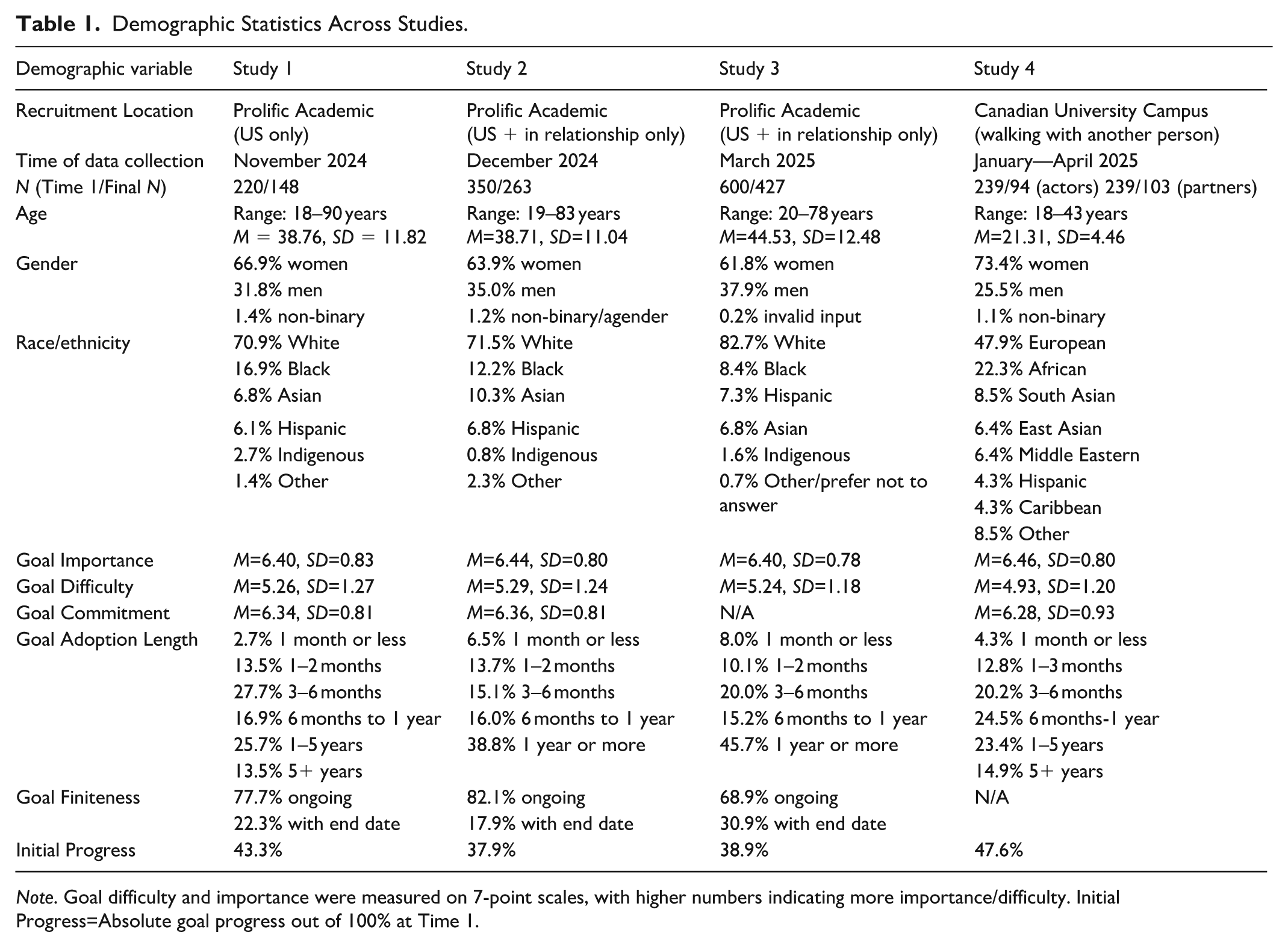
Note. Goal difficulty and importance were measured on 7-point scales, with higher numbers indicating more importance/difficulty. Initial Progress=Absolute goal progress out of 100% at Time 1.
Procedure
Time 1 (baseline)
After providing informed consent and demographic information, participants were asked to identify and describe a goal (“Please take a moment to think of a goal that you have been interested in for a month or longer and that you are currently working toward.”). Participants listed goals such as “getting to under 230 lbs,” “learning to do electronic soldering,” “. . . finish my Computer Science Degree and begin a career in the tech field within the next 2 years.” Participants reported whether they had ever told someone about this goal (Yes, No, I don’t know/I don’t remember).
Participants also rated the goal on a number of goal characteristics: goal importance from Not at all important (1) to Extremely important (7), goal difficulty from Very easy (1) to Very difficult (7), length of time they had had the goal (1 month or less, 1–2 months, 3–4 months, 5–6 months, 6 months to 1 year, 1 year to 5 years, and more than 5 years), whether the goal had an end date (1) or was ongoing (0), absolute goal progress out of 100%, and goal commitment (4 items on a 7-point scale, Klein et al., 2014). See Table 1 for goal characteristics means. Notably, goal commitment was very high at baseline, leaving little room for further increase.
Time 2
When returning to complete the second survey, participants were first reminded of their goal by reading their own verbatim goal description from the baseline survey. Participants then reported whether they told someone about the goal in the past week (Yes, No, I don’t know/I don’t remember). Those who shared their goals also reported who they told their goal to (“Who did you tell? Check off all that apply”) on 10 categories: My romantic partner, A friend, A parent, A sibling, Another family member, A colleague, A stranger, A group of people, Several people at different times, Non-specific (e.g., social media update), Not applicable. They also reported in what way they shared their goal: Had a conversation about it, Told them my goal without further conversation, Told them via text/direct message, or Wrote about it on social media.
Participants reported whether someone reminded them of the goal last week (“In the last week, has someone reminded you of the goal?”) and whether someone helped them with the goal (“In the last week, has someone helped you pursue this goal in any way?”) on scales from Never (1) to All the time (7). These two items correlated positively, r(146)=.59, p<.001, and were averaged into one scale assessing goal support. Then, participants rated their goal pursuit effort in the previous week on two items (“How much effort did you put into pursuing your goal in the past week?”; “How much time did you put into pursuing your goal in the past week?”; Peetz & Milyavskaya, 2021) on scales from No effort/time at all (1) to A lot of effort/time (7). These two items correlated highly positively, r(148)=.91, p<.001, and were averaged into one scale assessing goal pursuit effort.
Results
Most participants (85.1%) reported having told someone about their goal before the study began. Of all participants who completed the second survey, 56.1% (n=83) reported that they had told someone about their goal in the last week, and 43.9% (n=65) reported they had not told anyone; no participant reported not remembering. Participants reported telling their romantic partner (79.5%), a friend (37.3%), a family member (44.7%), a colleague (12%), a stranger (3.6%), or a group of people (3.6%); 4.8% reported posting about the goal on social media. The majority reported having a conversation about the goal (86.7%) rather than telling someone via text or email (9.6%) or writing about it on social media (3.6%).
Participants who told someone about their goal in the past week received more frequent goal support from others (M=3.71, SD=1.80) than participants who did not tell anyone about their goal (M=2.43, SD=1.81), t(146)=4.29, p<.001, d=.71. Participants who told someone about their goal in the past week also reported having invested more effort into goal pursuit that week (M=4.94, SD=1.58) than participants who did not tell anyone about their goal (M=3.95, SD=1.95), t(146)=3.41, p<.001, d=.57.
It could be that people chose to share a specific type of goal more than others and that this difference drives links with goal pursuit experiences. 1 Accordingly, we conducted multiple regression analyses with goal support and goal pursuit effort as the outcome variables; the variable indicating whether the goal had been shared during the week of the study and all goal characteristics were entered as covariates. Goals that were shared vs. not shared differed significantly even when controlling for goal characteristics (see Table 2 for coefficients).
Regression Coefficients Predicting Consequences of Goal Sharing Decision (Study 1).
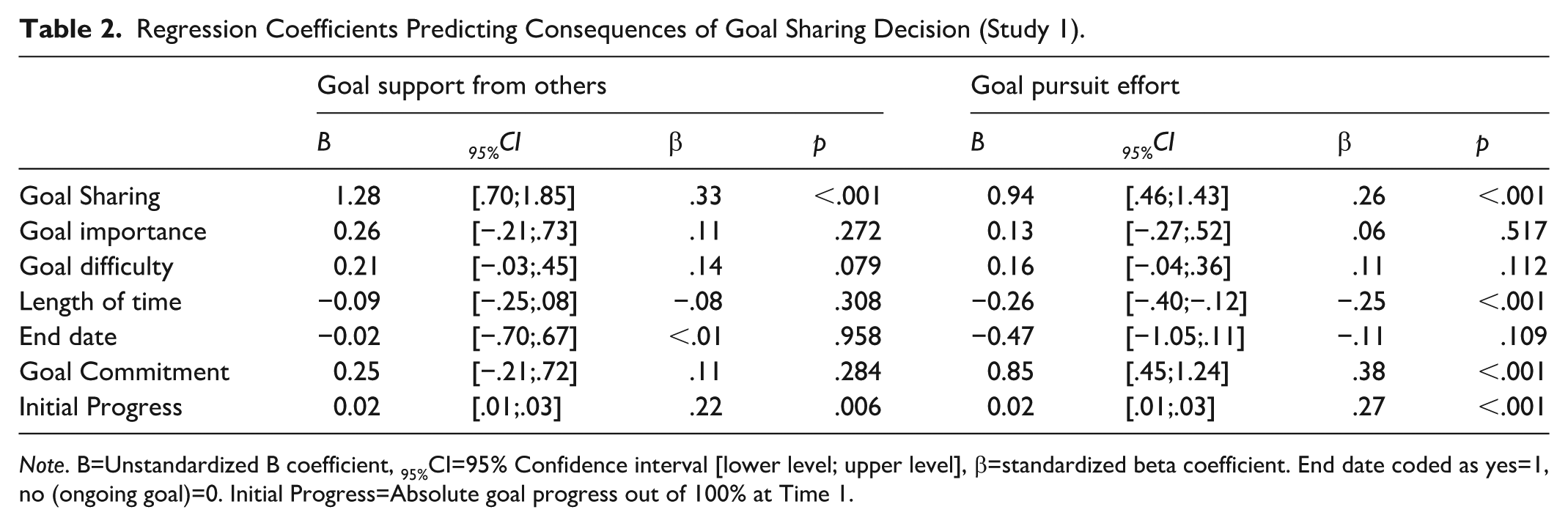
Note. B=Unstandardized B coefficient, 95%CI=95% Confidence interval [lower level; upper level], β=standardized beta coefficient. End date coded as yes=1, no (ongoing goal)=0. Initial Progress=Absolute goal progress out of 100% at Time 1.
Discussion
This initial study supports the notion that telling others about a goal is linked to more interpersonal goal support and more goal pursuit effort. However, this study cannot establish causal direction. Perhaps telling someone about a goal is more likely as goal pursuit effort ramps up and as others support the goal, indirectly or directly. Thus, in the next study, we assigned participants to a condition where they were encouraged to tell their goal to someone and compared outcomes to participants who did not receive such instructions.
Study 2
In the next study, we prospectively instructed half of participants to share their goals. Thus, although the study again left the timing and audience for goal sharing up to participants, it attempted to control the decision of whether to share the goal. We expected that participants in the share goal condition (vs. the control condition) would report exerting more goal pursuit effort and receiving more support from other people for their goal. As this condition is an intent-to-treat condition and we had no control over whether participants actually shared goals or not in either condition, we preregistered not only the comparison of condition differences but also the comparison between those who did end up sharing their goal and those who did not. We also explored whether the persons with whom participants shared their goal were those who helped with goal pursuit. To reduce variance in the potential goal audience, we specifically recruited participants with a romantic partner, thereby ensuring that all participants had at least one close other person they could tell their goal to. The data collection plan and main analyses were preregistered: https://osf.io/tsz63/.
Method
Participants
Participants were recruited on the platform Prolific, with the criteria that they were in the United States and in a relationship. Based on power analyses, we aimed to recruit at least 100 participants per condition and overrecruited to account for attrition. Of an initial sample of 350 participants who completed the first survey, 266 participants also completed the second survey, which was available for 36 hours starting seven days after the baseline survey. Participants were compensated with US$1.50 and US$1 for the two surveys, respectively. Attrition was not different across conditions (see Table S2 for survivor bias analyses in online supplements). An additional three participants were excluded in line with preregistered criteria, as they did not list a current goal. The final sample of N=263 had 80% power to detect medium effect size differences (d=.34) between two conditions.
Procedure
Time 1
After providing informed consent and reporting age, gender, ethnicity, and relationship status, participants were asked to identify a goal. Participants rated goal characteristics (goal importance, goal difficulty, length held, whether the goal had an end date or was ongoing, absolute goal progress out of 100%, and goal commitment), as in Study 1. Participants were then randomly assigned to the share goal condition (n=131) or control condition (n=132). In the share goal condition, they were instructed to “Share your goal! Now, we would like you to consider telling someone close to you about this goal in the next week. This could be someone who already knows about this goal or not. Have a conversation about what you’d like to achieve.” In the control condition they received no additional instructions.
Time 2
When returning to complete the second survey, participants were reminded of their goal by reading their own verbatim goal description. Participants then reported whether they told someone about the goal in the past week (Yes, once; Yes, multiple times; No; I don’t know/Unsure). The first two responses were coded as having told someone about the goal, the third response was coded as not having shared the goal, and those who could not remember were coded as missing values (n=4). Participants who reported having told someone their goal also reported who they had told, using the same social categories as in Study 1.
Then, all participants reported how much effort and time they invested in goal pursuit the previous week on two items, as in Study 1, r(261)=.89, p<.001, which were averaged into one scale assessing goal pursuit effort. Participants then reported whether someone supported their goal on two items, as in Study 1, r(261)=.56, p<.001, which were averaged into one measure of goal support. 2 Participants who reported goal support then reported who helped them on the same social categories used previously.
Results
First, we examined whether the manipulation was successful (preregistered). A chi-square test indicated that more participants told someone about their goal during the week in the share goal condition (78.3%) than in the control condition (53.8%), X2(df=1, N=259)=17.25, p<.001. Notably, although this condition difference was significant, a substantial proportion of people in the control condition shared goals spontaneously.
We examined the condition effect in independent t-tests (preregistered). Participants reported receiving more support from others in the share goal condition (M=3.13, SD=1.84) than in the control condition (M=2.64, SD=1.75), t(261)=2.20, p=.029, d=.27. Participants also reported having invested marginally more goal pursuit effort in the share goal condition (M=4.60, SD=1.73) than in the control condition (M=4.20, SD=1.74), t(261)=1.86, p=.064, d=.23. We also examined the indirect effect of condition on goal pursuit effort via the mediator of interpersonal goal support (not preregistered; PROCESS v.4, A. F. Hayes, 2018, 5000 bootstraps, 95%CI). The indirect effect of condition on goal pursuit effort via receiving support from others was significant, B=0.21, SE=.10, 95%CI[0.02;0.42], β=.12. Figure 1 presents standardized coefficients. However, because the mediator and the outcome variable in this model were assessed at the same time, this analysis must be interpreted with caution.
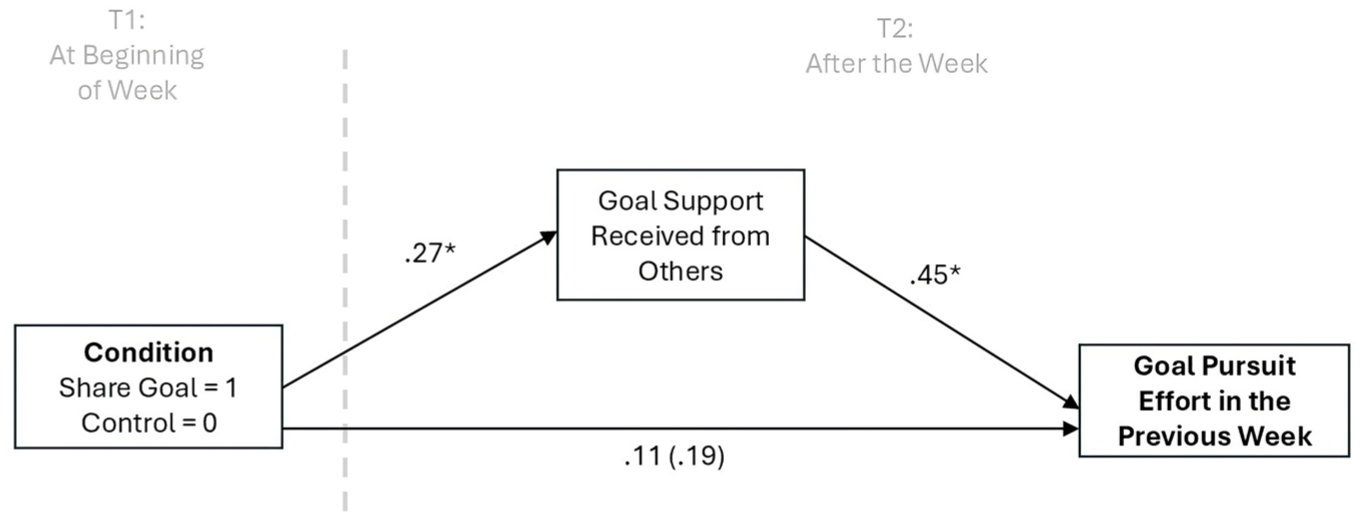
Mediation Model Predicting Goal Pursuit Effort (Study 2).
Next, we conducted analyses based on whether participants actually told someone about their goal (preregistered). We regressed goal pursuit in the last week on the variable indicating whether goals were shared with someone in the last week (0=no, 1=yes), controlling for condition. Having shared the goal with someone was linked to more goal pursuit effort, B=0.65 95%CI [0.20;1.11], β=.18, p=.005, and to receiving more support from others, B=1.34 95%CI [0.89;1.80], β=.35, p<.001. The effect on goal support held when controlling goal characteristics as covariates, though the effect on effort became nonsignificant (see Table 3).
Regression Coefficients Predicting Consequences of Goal Sharing Condition and Goal Sharing Decision (Study 2).
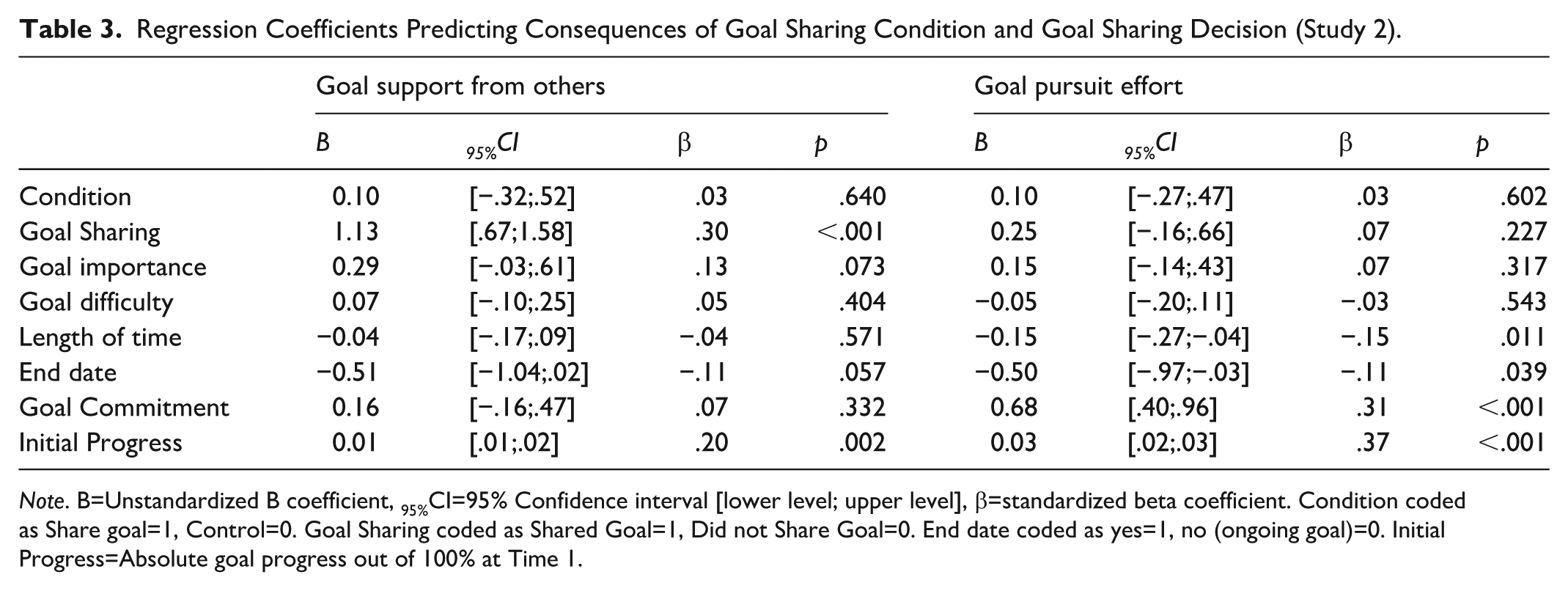
Note. B=Unstandardized B coefficient, 95%CI=95% Confidence interval [lower level; upper level], β=standardized beta coefficient. Condition coded as Share goal=1, Control=0. Goal Sharing coded as Shared Goal=1, Did not Share Goal=0. End date coded as yes=1, no (ongoing goal)=0. Initial Progress=Absolute goal progress out of 100% at Time 1.
In exploratory analyses we also examined whether the people who supported participants’ goal pursuit were those who were told about the goal (not preregistered). Participants reported sharing their goal with their romantic partner (64.9%), a friend (42.1%), a family member (44.8%), a colleague (12.9%), a stranger (4.7%), and 1.8% posted on social media. When reporting on goal supporters, 34.6% reported receiving no help, 43.7% reported that one person helped them, and 21.7% reported receiving help from multiple people. Across all social categories, participants reported receiving support most often from their romantic partner (54.4%), but also from friends (15.6%), family members (21.7%), colleagues (5.7%), and strangers (1.9%).
In binary logistic regressions, each social category of potential supporters was entered as the outcome (1=helped, 0=did not help), with all social categories of potential persons who might have been told about the goal as predictors (1=was told, 0=was not told). Having told one’s romantic partner about the goal tripled the odds of the romantic partner supporting the goal, B=1.28, SE=0.40, p=.002, exp(B)=3.60, but having told the goal to a parent, sibling, family member, colleague, or stranger did not affect the odds of the romantic partner supporting the goal. The same effect occurred for the remaining categories: Participants were more likely to report receiving support from those they reported telling about their goal (see Table S4 in online supplements). This exploratory analysis suggests that the interpersonal goal support stems directly from those with whom the goal is shared.
Discussion
Overall, this study replicated Study 1’s finding that shared goals were linked to receiving more interpersonal goal support and greater goal pursuit efforts. Importantly, being assigned to a condition that increased the likelihood that goals were shared also increased the extent to which participants received goal support from others and marginally increased goal pursuit effort. It is notable that the manipulation only modestly shifted participants’ sharing behavior, as more than half of the control participants reported spontaneously sharing their goal. Thus, the study was limited in creating distinct groups of participants who had either shared or not shared their goals.
Study 3
The next study replicated Study 2 with a more stringent control condition. We randomly assigned participants to conditions where they were instructed either to share their goal or to keep it private. We again analyzed both this intent-to-treat manipulation and the self-reports of actual goal sharing. To test the hypothesized indirect effect in a more rigorous way, we temporally separated the measures of model components. Participants completed a baseline survey with condition assignment at the beginning of the week, reported the support they received from others at multiple check-in surveys during the week of the study, and reported goal pursuit effort and subjective progress on the goal at the end of the week.
We also tested a second potential mediator. It is possible that the benefits of goal disclosure stem, at least in part, from having to describe the goal clearly. When a goal is disclosed in conversation with another person, describing and explaining the goal could prompt one to develop a clearer understanding of the goal (e.g., individual steps needed and potential obstacles), and this increased goal clarity could facilitate goal pursuit (Gollwitzer, 1999; Oettingen et al., 2001). To address this possibility, we added a measure of goal clarity that assessed the extent to which participants had a clear sense of the desired outcome, the steps needed to accomplish it, and possible obstacles they might encounter.
We expected that participants in the share goal condition would report receiving more support from other people for their goal and more goal clarity than participants in the private goal condition, and that the increased support and clarity would be linked to greater goal pursuit effort and progress over the week. This hypothesis, the data collection plan and main analyses (direct and indirect effects of condition) were preregistered: https://osf.io/rg9wp/.
Method
Participants
Participants were recruited on the platform Prolific, with the criteria that they were in the US and in a relationship. We aimed to recruit at least 200 participants per condition based on a power analysis to detect effects of the size found in Study 2 and overrecruited to account for attrition. Of an initial sample of 600 participants who completed the first survey, 468 participants completed at least one of the three check-in surveys during the week and the final survey, which became available seven days after the baseline survey for 36 hours. Participants were compensated with US$1, 3×US$0.40, and US$0.80 for the surveys, respectively. Attrition was not different across conditions (see Table S5 for survivor bias analyses in online supplements). Of this sample, two participants were excluded because they did not list a current goal, and 40 participants were excluded because they failed a check on their intentions. 3 This sample had 80% power to detect a small to medium effect size difference (d=.27) between conditions.
Procedure
Time 1
After providing informed consent and reporting age, gender, race, and relationship status, participants were asked to identify a goal and to rate it on goal characteristics as in Study 1 and 2. Participants were then randomly assigned to the share goal condition (n=217) or private goal condition (n=210). In the share goal condition, they received the same instructions as in Study 2. In the private goal condition, they were instructed, “Keep this goal to yourself for the next week. Keep your goal private..” Finally, participants were asked, “Will you tell someone about your goal in the next week?,” with response options Yes, No, I do not know yet.
Time 2 (Check-in Surveys)
At two, four, and six days after the initial survey, check-in surveys became available on the recruitment platform and remained available until the next survey opened. In each check-in survey, participants were reminded of their goal by reading their own verbatim goal description. They then rated support received from others on three items (“In the last 48 hours, has someone [or more than one person] helped you pursue this goal in any way? . . . reminded you of the goal? . . . provided resources (information, money, time) to you that help with this goal?”) on 7-point scales as in Studies 1 and 2. The three items were internally consistent (Cronbach’s alpha=.94) and were averaged across check-ins.
Participants also rated goal clarity on three items (“I have a clear sense of the goal’s end result”; “I have a clear sense of the steps I need to take to accomplish the goal”; “I have a clear sense of the challenges or possible obstacles I might encounter”) on scales from Not at all (1) to Very much (7) which were averaged across check-ins (Cronbach’s alpha=.90).
Time 3
When returning to complete the final survey seven days after the baseline survey, participants were reminded of their goal by reading their own verbatim goal description. Participants then reported whether they told someone about the goal in the past week (Yes, once; Yes, multiple times; No; I don’t know/Unsure). The first two responses were coded as having told someone about the goal, the third response was coded as not having shared the goal, and those who could not remember were excluded from analyses (n=2), as in Study 2.
Participants reported how much effort and time they invested in goal pursuit in the previous week on two items, as in Studies 1 and 2, r(422)=.87, p<.001, which were averaged into one scale assessing goal pursuit effort. In addition, they reported subjective goal progress on a single item: “How much progress have you made on this goal in the last week?” on a scale from No progress at all (1) to A lot of progress (7).
Finally, participants specified the person(s) they told their goal to and the person(s) who helped with their goal (My romantic partner, A friend, A family member, A colleague, A stranger, A group of people, Non-specific [e.g., social media update], Not applicable). In addition, they specified the type of goal support they received by selecting all categories that applied from a list of categories (Table 4). The categories were based on previously identified types of help (McGuire, 1994; Peetz & Howard, 2022), which distinguished casual, direct, indirect, and emotional types of help.
Percentage of Social Categories That Participants Reported Supported the Goal and Percentage of Types of Support According to Follow-Up Reports by the Participant (Study 3).
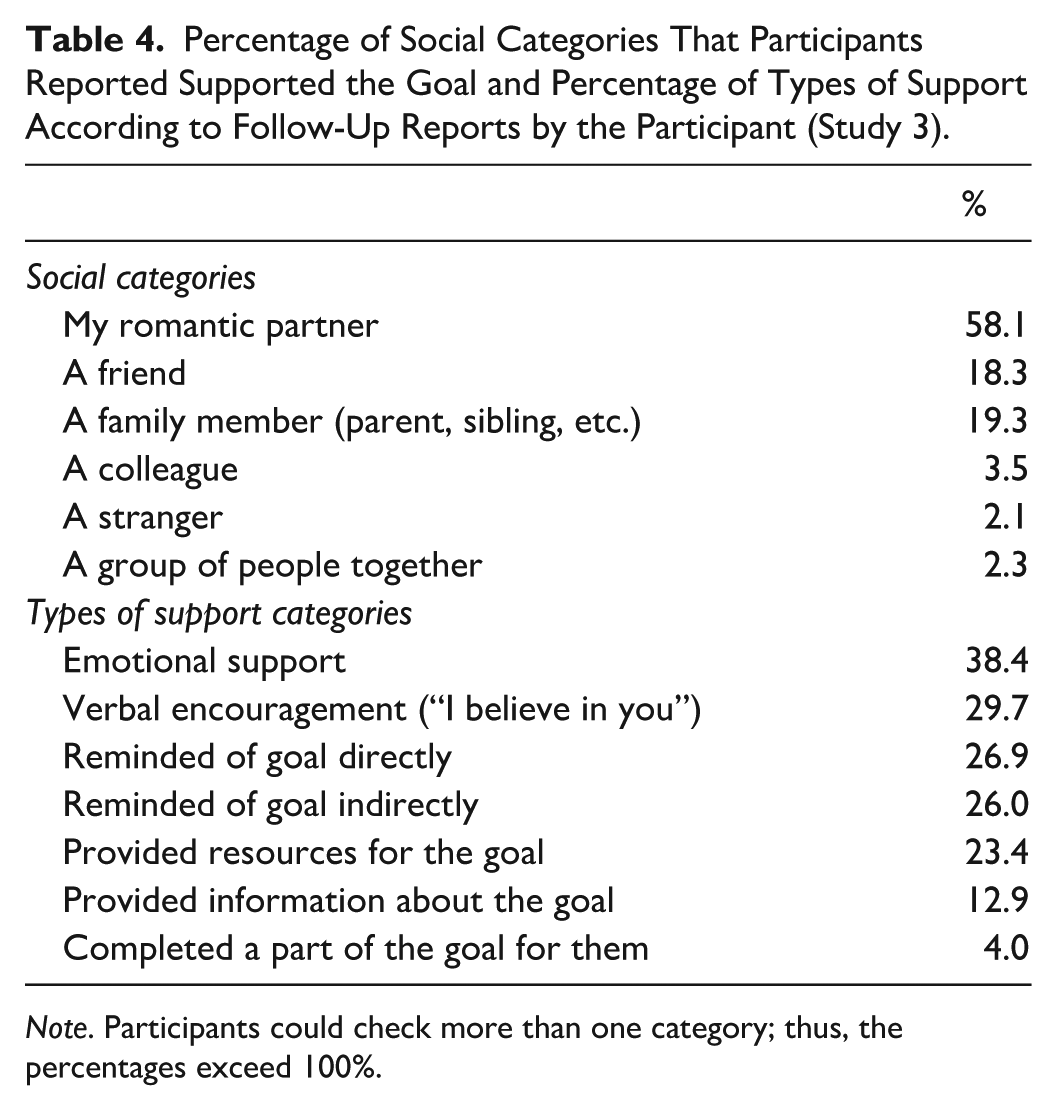
Note. Participants could check more than one category; thus, the percentages exceed 100%.
Results
First, we examined whether the manipulation was successful (preregistered). More participants told someone about their goal in the week of the study in the share goal condition (77.5%) than in the private condition (59.4%), X2(df=1, N=425)=16.18, p<.001. However, a substantial proportion of participants in the private condition reported sharing their goals, and it is possible that others shared their goals but biased their reports to appear compliant.
We examined the condition effect in independent t-tests (preregistered). Participants reported receiving more frequent support from others during the week in the shared goal condition (M=3.13, SD=1.74) than in the private goal condition (M=2.74, SD=1.73), t(425)=2.33, p=.020, d=.23. Conditions did not differ in goal clarity, t(425)=1.20, p=.229, d=.12 (Mshare=6.22, SD=0.77; Mprivate=6.13, SD=0.79), goal pursuit effort, t(422)=0.84, p=.403, d=.08 (Mshare=4.56, SD=1.73; Mprivate=4.42, SD=1.70), or subjective progress, t(422)=−0.10, p=.920, d=.01 (Mshare=3.96, SD=1.75; Mprivate=3.98, SD=1.83).
We next examined the indirect effect of condition on goal pursuit effort via goal support and goal clarity (preregistered; PROCESS v.4, A. F. Hayes, 2018, 5000 bootstraps, 95%CI). The indirect effect via goal support was significant, B=0.17, SE=0.08, 95%CI[0.02;0.32], β=.10. The indirect effect via goal clarity was not significant, B=0.06, SE=0.04, 95%CI[−0.02;0.15], β=.03. Figure 2 presents standardized coefficients in this model. 4
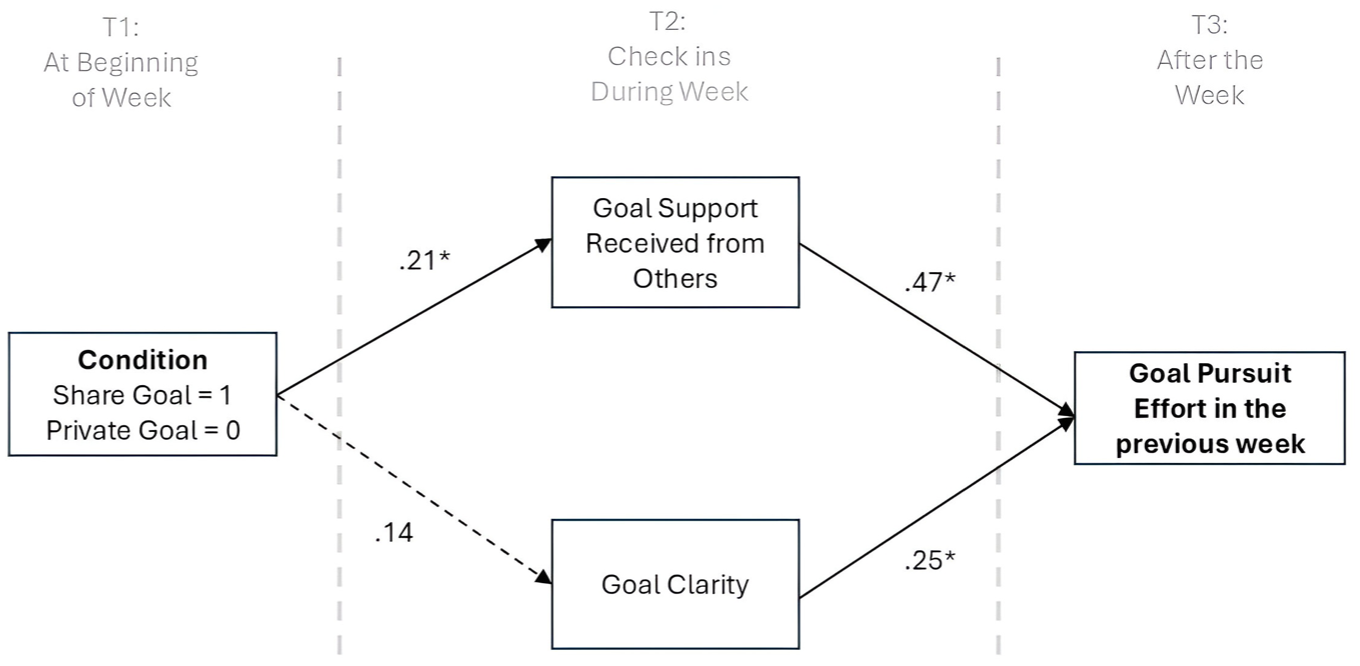
Mediation Model Predicting Goal Pursuit Effort (Study 3).
As in Study 2, we also conducted analyses based on participants’ self-reports of whether they had shared their goal during the week of the study (not preregistered).Participants who shared their goal reported receiving more support from others during the week, more goal pursuit effort, and more subjective goal progress, but did not report significantly more goal clarity, than participants who did not share their goal (see Table 5 for regression coefficients).
Regression Coefficients Predicting Consequences of Goal Sharing Condition and Goal Sharing Decision (Study 3).
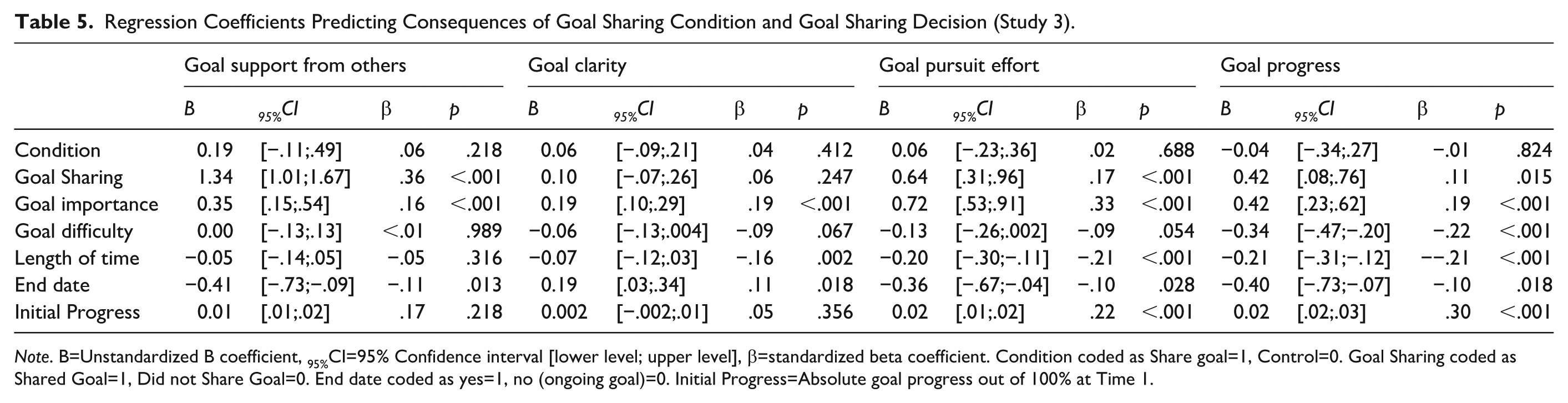
Note. B=Unstandardized B coefficient, 95%CI=95% Confidence interval [lower level; upper level], β=standardized beta coefficient. Condition coded as Share goal=1, Control=0. Goal Sharing coded as Shared Goal=1, Did not Share Goal=0. End date coded as yes=1, no (ongoing goal)=0. Initial Progress=Absolute goal progress out of 100% at Time 1.
In exploratory analyses, we also examined who provided support and the form of goal support (not preregistered). As in Study 2, participants were more likely to report receiving support from those they reported telling about their goal (see Table S6 in online supplements for coefficients). For example, having told one’s romantic partner about the goal increased the odds of the romantic partner helping with the goal by an order of magnitude, B=2.51, SE=0.25, p<.001, exp(B)=12.29. Table 4 presents the types of support that participants reported receiving. Participants in the share goal condition reported receiving a greater variety of support (i.e., checked more categories from the list) (M=1.78, SD=1.54) than participants in the private goal condition (M=1.44, SD=1.45), t(425)=2.35, p=.019, d=.23. This exploratory analysis suggests that the instruction to share goals increased not only the extent of support received during the week but also the variety of ways in which participants felt supported in their goal.
Discussion
This study again demonstrated benefits of being instructed to share a goal with others rather than to keep it private. Being instructed to share one’s goal resulted in receiving more support for the goal during the week, which in turn led to greater effort toward the goal. The study also assessed goal clarity as a second potential mediator, but found little evidence for goals becoming more clearly developed after telling others about them. This finding suggests that the benefits of goal disclosure reflect interpersonal processes and are not explained simply by having to clearly describe the goal.
Study 4
In this study, we again assigned participants to either a private goal or a share goal condition—but in this case, participants were asked to tell someone they knew about their goal on the spot. We recruited pairs of university students walking together on campus. In each pair, one person was asked to tell the other about a goal in the moment. Thus, this study fully controlled the timing and audience choice, as well as the decision to share the goal. This design is closer to previous lab-based experiments where goals were shared on the spot (Burn & Oskamp, 1986; S. C. Hayes et al., 1985; Hollenbeck et al., 1989; Jiao & Cole, 2020; Klein et al., 2020; McCaul et al., 1987), though goals were personally generated and goal disclosure was a conversation with another person rather than a public announcement to experimenters or confederates. We expected that participants in the share goal condition would exhibit more goal pursuit effort, more goal progress, and would report receiving more support for their goal 1 week later than participants in the private condition. These hypotheses, the data collection plan, and analyses were preregistered: https://osf.io/qdyah/.
Method
Participants
Participants were recruited on the campus of a large Canadian University. Pairs of students walking together were invited to participate on the spot, with a chocolate bar as an enticement. They also were entered into a $200 lottery if they completed the online follow-up survey one week later. We aimed to recruit 200 dyads based on a priori power analysis and expected attrition, but to replace those who did not provide email addresses to be contacted for the follow-up survey, we recruited 239 dyads. Of this initial sample, 210 participants (95 Actors and 105 Partners) completed an online follow-up survey 1 week later. Attrition was not different across conditions (see Table S7 for survivor bias analyses in online supplements). Of this sample, no additional participants were excluded. The final sample of 95 actors had 80% power to detect a medium effect size difference between two groups (d=.58).
Procedure
Time 1
Participants walking in pairs were flagged down by research assistants stationed on campus thoroughfares. Participants completed the survey via an internet browser on their own phone, either while seated at individual tables or standing together at a bar table. After providing informed consent and reporting age, gender, and ethnicity, participants specified the nature of the relationship with the person they were participating with (81.9% were friends, 11.7% were romantic partners, 3.2% were siblings, and 3.2% specified another type of relationship), how well they knew the person they were participating with (1=Extremely well, 2=Very well, 3=Fairly well, 4=A little well, 5=Not at all well; M=2.10, SD=0.93) and how long they had known each other (M=3 years, SD=3.25 years). Participants in each dyad were randomly assigned to be either the “Actor” or the “Partner.” Actors were asked to identify a goal and rated goal characteristics as in previous studies (goal importance, goal difficulty, length of time they had had the goal, and absolute goal progress out of 100%). Partners completed a personality scale as a time filler.
Actors were then randomly assigned to the share goal condition (n=43) or the private goal condition (n=52). In the share goal condition, actors were instructed, “Now, we would like you tell the person you are participating with about this goal. Have a conversation and discussion about what you’d like to achieve! Take as long as you need. Share only what you are comfortable sharing.” Their partners were instructed, “The person you are participating with has been asked to tell you about one of their goals in their survey. Please listen carefully and feel free to ask questions as you would in a regular conversation.” The two participants then had a conversation about their goal. In the private goal condition, actors were instructed “For the next week, please keep this goal to yourself.” and partners received no additional instructions.
Time 2
A week after the initial session, participants were emailed a link to a follow-up survey. Actors were first reminded of their goal via their own verbatim goal description. Actors reported whether they had told someone about this goal in the last week and, if so, how often they had talked about the goal with someone in the past week (Never, Once, A couple of times, Several times, Often, Very often). The actors in the share goal condition were more likely to report that they had told someone about the goal (76.2% yes, 23.8% no, 0% I don’t remember) than were the actors in the private goal condition (53.8% yes, 40.4% no, 5.8% I don’t remember), X2(df=2, N=94)=6.18, p=.046, though frequency did not significantly differ between conditions, t(92)=1.71, p=.090, d=.36. Thus, the share goal condition increased the likelihood of goal sharing past the experimental session, albeit as a small effect.
Actors rated how much effort and time they had invested in goal pursuit in the last week on two items as in previous studies, r(92)=.84, p<.001, which were averaged. They rated subjective goal progress on a single 7-point scale as in Study 3. Actors also reported how often they had been indirectly or directly reminded of their goal by someone and how often they had been helped in their pursuit of their goal by someone on 7-point scales, as in Studies 1 and 2. These two items correlated highly, r(92)=.54, p<.001, and were averaged. 5 Finally, actors rated the extent to which they had a clear sense of the goal’s desired end result, next steps, and possible challenges on three items as in Study 3, which were averaged (α= .68).
Partners of those in the share goal condition were more likely to report that the person they participated with had told them about a goal (82% yes, 18% no, 0% I don’t remember) than partners of those in the private goal condition (52% yes, 32% no, 16% I don’t remember), X2(df=2, N=100)=8.72, p<.001. Partners also reported how often they had reminded and helped the person they participated with in their pursuit of their goal on 7-point scales. These two items correlated highly, r(97)=.74, p<.001, and were averaged.
Results
We first examined the condition effect in independent t-tests (preregistered). Actors assigned to the share goals condition reported greater goal pursuit effort during the week following their goal conversation (M=4.51, SD=1.59) than those assigned to the private goal condition (M=3.63, SD=1.63), t(93)=2.64, p=.010, d=.55. Conditions did not differ in goal clarity, t(89)=0.56, p=.580, d=.12 (Mshare= 5.66, SD=0.94; Mprivate= 5.54, SD=1.02), frequency of help received, t(93)=−0.05, p=.961, d=.42 (Mshare= 3.46, SD=1.68; Mprivate= 3.48, SD=1.62), or subjective goal progress, t(79)=1.10, p=.276, d=.25 (Mshare= 3.97, SD=1.57; Mprivate= 3.56, SD=1.69). Conditions also did not differ in the amount of support the partner reported providing, t(94)=0.89, p=.374, d=.18 (Mshare= 2.81, SD=1.69; Mprivate= 2.40, SD=1.63).
When examining the indirect effect of condition on goal pursuit effort via goal support and goal clarity (not preregistered; PROCESS v.4, A. F. Hayes, 2018, 5000 bootstraps, 95%CI), the indirect effect of condition on goal pursuit effort via receiving support from others was not significant, B=−0.06, SE=0.11, 95%CI[−0.29;0.14], β=−.03; similarly, the indirect effect of condition on goal pursuit effort via goal clarity was not significant, B=0.05, SE=0.10, 95%CI[−0.16;0.23], β=.03 (Figure 3).
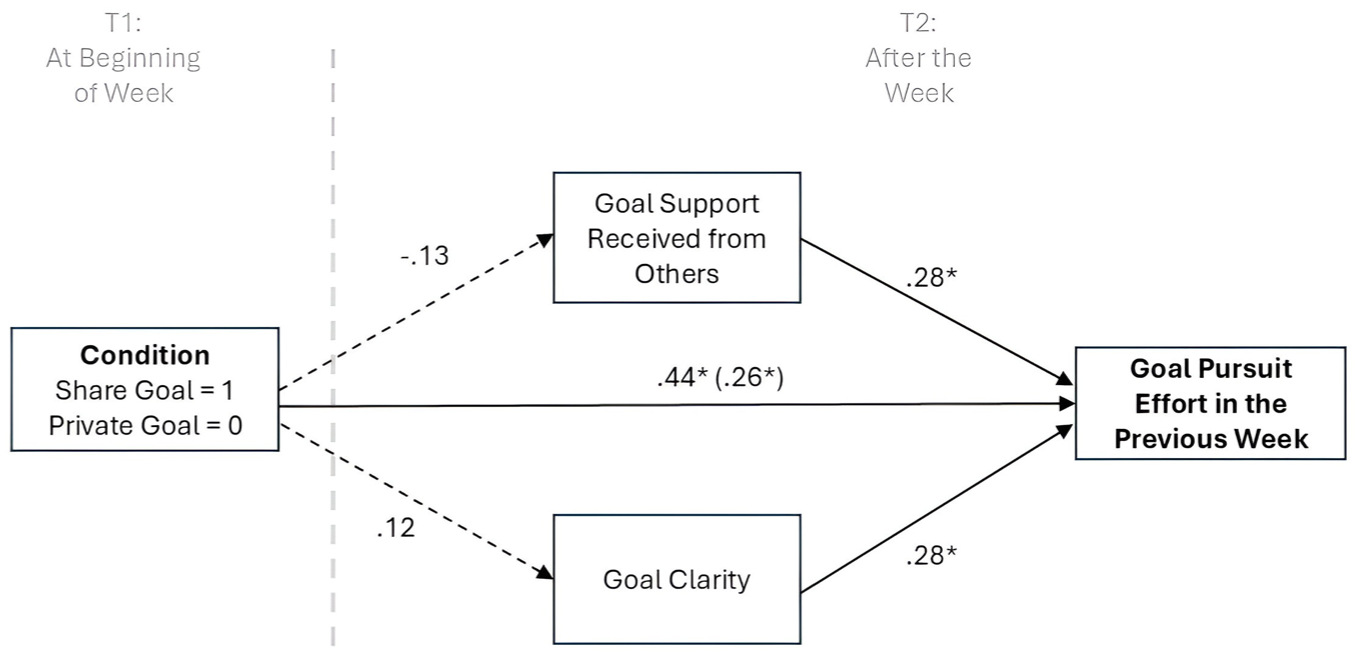
Mediation Model Predicting Goal Pursuit Effort (Study 4).
We next examined the condition effect in multiple regressions, controlling for how long the participants participating together had known each other, whether the actor had shared the goal with someone before the study, goal importance, goal difficulty, and goal recency, and how often the actor reported talking about the goal during the week with anyone (preregistered). Condition remained a significant predictor of goal pursuit effort with these covariates in the model and remained a nonsignificant predictor of goal clarity and goal support (Table 6). The more often participants reported talking about their goal in the previous week, the more support they reported receiving from others, which is in line with prior studies (Table 6).
Regression Coefficients Predicting Consequences of Goal Sharing Condition (Study 4).
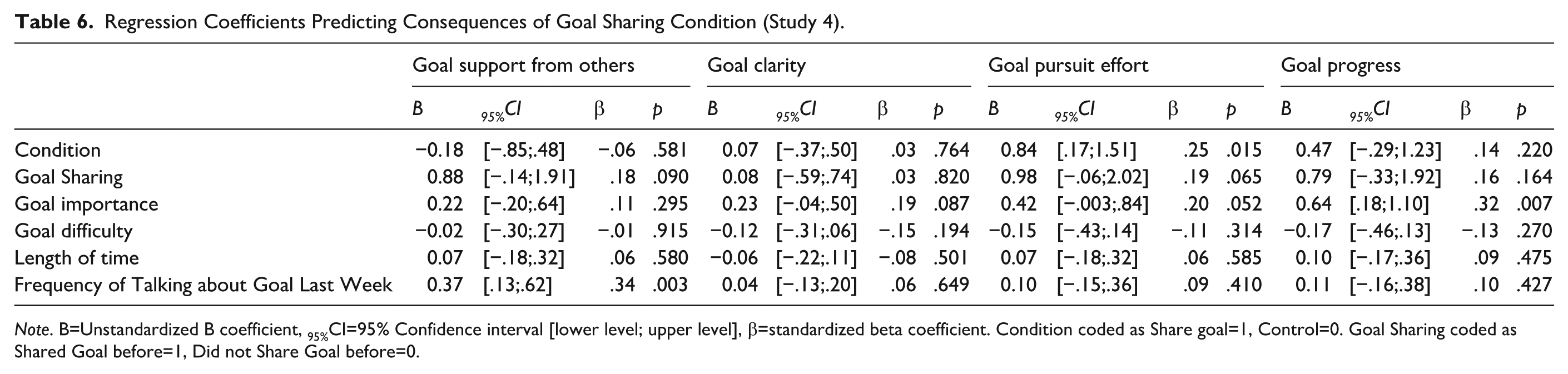
Note. B=Unstandardized B coefficient, 95%CI=95% Confidence interval [lower level; upper level], β=standardized beta coefficient. Condition coded as Share goal=1, Control=0. Goal Sharing coded as Shared Goal before=1, Did not Share Goal before=0.
Discussion
In this study, participants could not choose when or with whom to share their goal but instead were asked to share it with someone they happened to be with at the moment of recruitment (or to keep the goal private). Although sharing one’s goal in this manner increased goal-pursuit effort during the week after the goal conversation, unlike all previous studies, it did not increase the support participants received from others for their goal. This might reflect the importance of the goal disclosure audience: The person who happened to accompany the participant when they were prompted to share a goal might not have been willing or able to provide goal support. When the goal disclosure audience is left up to the goal holder (as in Studies 1–3), they might choose to tell their goal to those who are more likely to provide effective support.
Internal Meta-Analysis
The results across four studies revealed a consistent pattern of differences by self-reported goal sharing but weaker and less consistent effects of the experimental conditions prompting participants to share vs. not share. To further summarize and evaluate results, we conducted an internal mini meta-analysis (Goh et al., 2016), presented in Table 7. Across Studies 1 to 4, the average direct effects of goal sharing on receiving more support and investing more effort were significant, and the average indirect effect of goal sharing on effort via support was also significant. Across Studies 2 to 4, the average direct effects of the share goal condition on receiving more support and investing more effort were significant, and the average indirect effect of the condition on effort via support was also significant.
Internal Meta-Analysis of Direct and Indirect Effects (Studies 1–4).
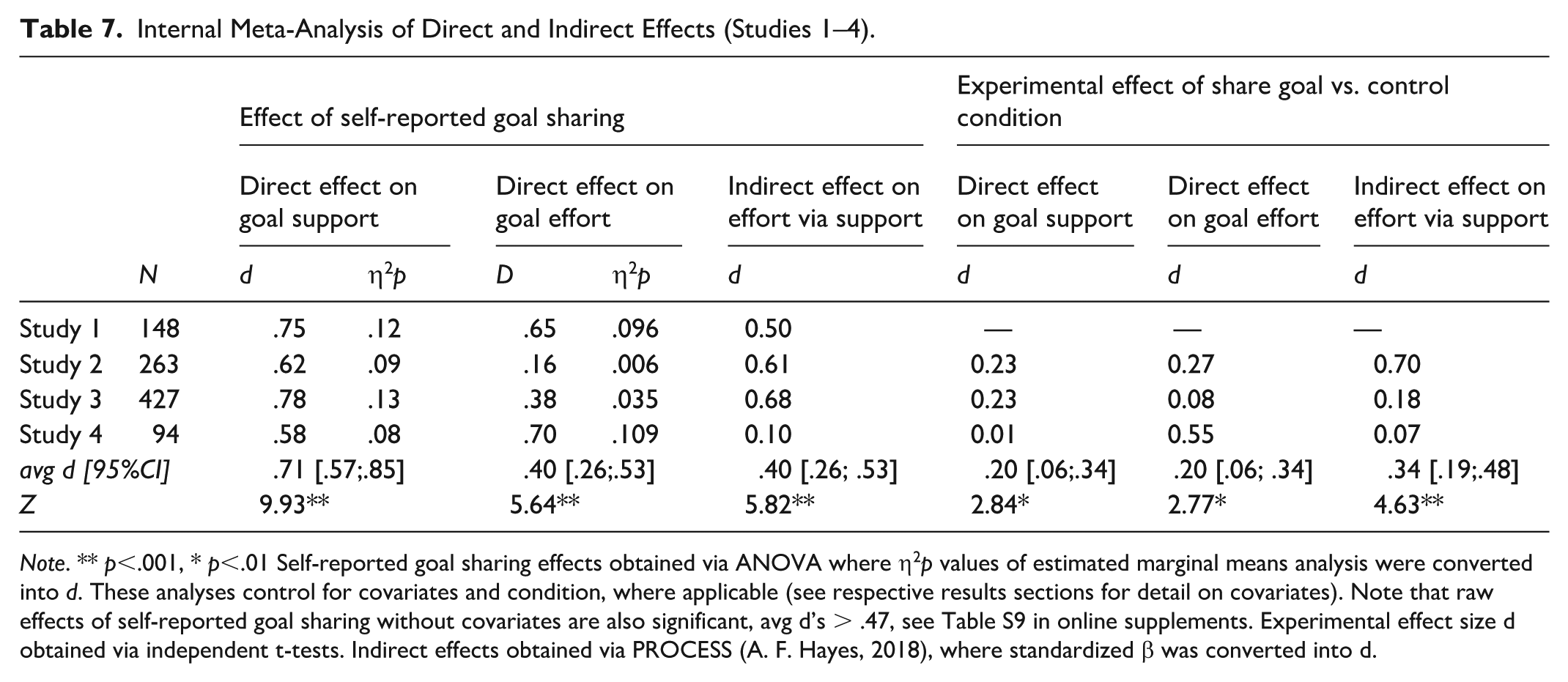
Note. ** p<.001, * p<.01 Self-reported goal sharing effects obtained via ANOVA where η2 p values of estimated marginal means analysis were converted into d. These analyses control for covariates and condition, where applicable (see respective results sections for detail on covariates). Note that raw effects of self-reported goal sharing without covariates are also significant, avg d’s > .47, see Table S9 in online supplements. Experimental effect size d obtained via independent t-tests. Indirect effects obtained via PROCESS (A. F. Hayes, 2018), where standardized β was converted into d.
General Discussion
Taken together, four studies largely supported the hypothesized benefits of sharing goals with others. In Study 1, participants who had spontaneously told someone about an existing personal goal in the past week reported receiving more support from others and exerting greater effort toward the goal. In Studies 2 and 3, instructing participants to tell someone about their goal in the next week led them to receive more support, which in turn was linked to greater goal pursuit effort. In Study 4, participants were assigned to share a goal immediately with someone they happened to be with in that moment or to keep the goal private. In this study, goal disclosure was not linked to increased support, although the study once again revealed heightened goal pursuit efforts as a result of sharing the goal. Overall, the findings suggest that our hypothetical athlete Anne (who shared her running goal with her husband) is likely to receive more support from her husband and train harder for the upcoming marathon than Eva (who kept her goal to herself).
This research extends a body of work on goal disclosure (e.g., Burn & Oskamp, 1986; Hollenbeck et al., 1989; Jiao & Cole, 2020; Klein et al., 2020) and goal instrumentality (e.g., Fitzsimons et al., 2015; Orehek & Forest, 2016). Whereas research on goal disclosure has focused on the effects of announcing experimenter-nominated goals to virtual strangers within the experimental context, our studies capture goal-sharing processes in a more ecologically valid manner. As in daily life, participants in Studies 1 to 3 could set their own goals and choose when, how, and with whom to share them. The value of this approach is highlighted by descriptive data in Study 1. Spontaneous goal disclosures were widespread (85% of participants had shared their goal, and 56% shared it within the week of the study) and most often took the form of a conversation with a close other, rather than a one-sided announcement. Clearly, research on goal disclosure would be incomplete if it fails to consider the impact of conversations within ongoing relationships. Moreover, by focusing on the role of interpersonal goal support, our studies draw upon and extend work on goal instrumentality (Fitzsimons et al., 2015; Orehek & Forest, 2016; Vowels & Carnelley, 2022). Work in this area highlights the multitude of ways in which close others are integrated in the goal regulation process; our studies target the process of making goals known to others in the first place and thus shed light on an essential but understudied antecedent of interpersonal goal support.
In addition to these theoretical contributions, our research has practical implications. The findings, when further refined and replicated, could be applied by educators, coaches, advisors, and therapists to support others’ goal pursuit. Interventions could harness the power of interpersonal support processes by encouraging people to identify their goals and discuss them with close others, especially for goals that are not on top of people’s minds and that their close others do not (yet) know about. The present research clearly highlights the importance of communication in relationships, suggesting that simply telling others about goals can kickstart the goal support process. Although others may not be able to directly contribute to achieving goals like weight loss or improved finances, which were frequently described by participants, receiving encouragement or reminders may foster goal-directed behaviors such as exercising or making saving decisions. For instance, someone who is aware of their partner’s goal to save for a large expense might gently remind them of this goal when faced with small spending temptations or might provide assistance such as looking up budgeting apps.
Our findings underline the importance of the goal disclosure audience. Klein and colleagues (2020) already showed that the relative status of audience members can play a role, though their work focused on mechanisms of accountability and embarrassment in the experimental context. Given that our studies focus on goal sharing conversations with close others, and the role of interpersonal support, it may be that audience factors such as closeness or perceived ability and motivation to encourage and support are most pertinent. Indeed, it is plausible that participants in Studies 1 to 3 who could choose who to tell their goal would select someone supportive. Notably, in Study 4, where participants could not choose who to tell, goal disclosures did not elicit increased support. Future research should explore how people decide who to tell their goals to and whether perceived ability and motivation to support them are deciding factors.
Another potential mechanism, goal clarity, did not emerge as a mediator when tested in Studies 3 and 4, though this may have been due to a ceiling effect of nominated goals being already very clear. The null effects for goal clarity help to allay potential concerns that the benefits of goal disclosure are fully explained by having to clearly describe the goal, and that the interpersonal aspect is not critical. That said, we still suspect that discussing goals with others may sometimes lead people to consider the goal pursuit process more carefully (e.g., concrete steps, potential obstacles, and how to overcome them), which could facilitate goal pursuit, especially when target goals are more vague, distant, or abstract than those in the present studies. Future research could explore whether goal disclosure can sometimes elicit purely intrapersonal processes that benefit goal pursuit apart from the interpersonal support processes we observed.
Although the findings overall supported the hypotheses (see Table 7 for average effects), effects were stronger and more consistent for self-reported sharing than for the experimental conditions. Notably, the effect of condition on effort was not significant in Studies 2 and 3 (though the indirect effect via support was significant) and the effect of condition on support was not significant in Study 4. One likely reason for these weaker condition effects is that our intent-to-treat design could not guarantee that participants followed instructions. Many participants reported sharing their goal despite instructions not to do so (and still others in this condition may have shared but denied it to appear compliant). This pattern of responses is intriguing, as it suggests that individuals are often willing and even eager to share goals with close others; however, it does blur the distinction between experimental conditions. In addition, some aspects of the research that we see as strengths for generalizability (e.g., allowing participants to choose their goal, the audience, and how to disclose) create variability across participants that might have masked experimental effects. In practical terms, the relatively modest effects of the condition suggest that interventions encouraging goal sharing may have smaller benefits than the naturally occurring effects of spontaneous goal sharing in everyday life.
There are also limitations to the generalizability of our conclusions. Although participants nominated a wide range of goals, they tended to be goals that were ongoing, long-standing, and very high in importance, and thus future research is needed to generalize the findings across these dimensions. Also, although our samples included a diversity of participants in terms of demographics, they did tend to oversample women and White participants. Moreover, the studies were all conducted in Western societies that are high in independence. Conceivably, people in more interdependent cultures may be even more inclined to share their goals with each other and be even more engaged in interpersonal support.
Conclusion
Following through on personal goals is notoriously difficult; thus, the present research tested a strategy that might facilitate goal pursuit, namely sharing goals with others. Our studies extend previous work by examining personal goals shared in a natural manner with romantic partners, family members, and friends outside of the experimental context. The findings suggest that sharing such goals motivates greater goal pursuit effort, and that this is partly due to receiving increased support from others. Thus, to increase their chances of following through on a personal goal, people may be well advised to take a moment and chat about their goal with someone special.
Supplemental Material
sj-docx-1-psp-10.1177_01461672251382271 – Supplemental material for Goals Out Loud: Telling Others About a Goal Increases Support Received and Facilitates Goal Pursuit
Supplemental material, sj-docx-1-psp-10.1177_01461672251382271 for Goals Out Loud: Telling Others About a Goal Increases Support Received and Facilitates Goal Pursuit by Johanna Peetz, Roger Buehler and Tayler Wells in Personality and Social Psychology Bulletin
Footnotes
Acknowledgements
We thank Maude Boivin, Carter Newman, and Dylan Ntemgwa for help with data collection.

Ethical Considerations
All studies were approved by the Carleton University Research Ethics Board (Clearance #122237 on November 1, 2024 and #122636 on January 1, 2025).
Consent to Participate
Respondents gave written consent prior to participation in all studies.
Funding
The authors disclosed receipt of the following financial support for the research, authorship, and/or publication of this article: This research was supported by the Social Sciences and Humanities Research Council of Canada.
Declaration of Conflicting Interests
The authors declared no potential conflicts of interest with respect to the research, authorship, and/or publication of this article.
Data Availability Statement
Supplemental Material
Supplemental material is available online with this article.
Notes
References
Supplementary Material
Please find the following supplemental material available below.
For Open Access articles published under a Creative Commons License, all supplemental material carries the same license as the article it is associated with.
For non-Open Access articles published, all supplemental material carries a non-exclusive license, and permission requests for re-use of supplemental material or any part of supplemental material shall be sent directly to the copyright owner as specified in the copyright notice associated with the article.
