




Abstract
Social anxiety (SA) entails perceiving interactions as threatening and is linked to detrimental social outcomes. This study tested whether individuals scoring higher on SA navigate interactions better when believing the impressions people form of others are relatively fixed (fixed mindset), thereby making interactions feel more controlled and less demanding. A Preliminary Study established that holding a fixed mindset attenuates how demanding interactions feel among individuals higher on SA. Three experiments manipulated impression formation mindsets. In Study 1, higher SA was associated with making a negative impression in a self-presentation task following a growth mindset induction (belief that impressions are malleable) but not following a fixed mindset induction. This pattern was repeated in Study 2 involving a stress-inducing self-presentation task. In Study 3, following a fixed mindset induction, SA predicted better real-life social experiences. In conclusion, a fixed model of impression formation may improve social functioning among individuals predisposed to SA.
The dynamics, intensity, and uncertainty that often accompany social interactions are a sought-after experience for some, but an intimidating experience for others (Uziel, 2007, 2021). The extent to which social interactions threaten individuals is often expressed in their level of social anxiety (SA), with high scorers frequently preferring to avoid certain social interactions altogether (Stein & Stein, 2008). A generally consensual description of individuals with SA is of individuals who hold dual contrasting motives concerning (real or imagined) social interactions, expressed in need for acceptance alongside evaluation apprehension and expectation of being mocked and rejected (Clark & Wells, 1995; Leary & Kowalski, 1995; Rapee & Heimberg, 1997; Schlenker & Leary, 1982). Often onsetting at an early age and partially attributable to heritability, estimations of the prevalence of SA vary between 2% and 18%, depending on the diagnostic criteria, age group, and population sampled, signaling SA as one of the most common mental health disorders globally (Fehm et al., 2008; Salari et al., 2024; Stein & Stein, 2008).
SA is a source of discomfort, despair, and, for some, a notable enduring disturbance to normal functioning. In a world where social interactions are frequent and unavoidable, SA seriously cripples one’s ability to adjust and thrive (Alonso et al., 2004; Stein & Stein, 2008). Individuals high on SA tend to avoid speaking in public, meeting new people, and entering unfamiliar social settings. Even after interactions end, higher SA is associated with increased rumination and negatively biased “post-event” processing (Brozovich & Heimberg, 2008; Clark, 2001). Alas, the excessive efforts at adjusting often end in dismay, and individuals higher on SA are frequently perceived as unappealing or inadequate (Bielak et al., 2018; Gee et al., 2012; Weisman et al., 2011).
Cognitive models suggest that the social functioning of individuals with SA is guided by negatively distorted perceptions and expectations, which lead to maladjustment. These models describe a cascade of debilitating processes (Clark, 2001; Clark & Wells, 1995; Hofmann, 2007; Rapee & Heimberg, 1997). Specifically, individuals high on SA approach social situations with a debilitating set of assumptions about themselves and about the social world. They assume that others will be critical of them and evaluate them negatively, and that they will fail at self-presentation. Importantly, during social interaction, their attention shifts inward, actively monitoring for indications of inadequacy (Spurr & Stopa, 2002). As noted by Clark (2001, p. 408), “They become trapped in a closed system in which most of their evidence for their fears is self-generated.” Because their inward focus is on inadequacies, they find themselves caught in a cycle of self-criticism. Rapee and Heimberg (1997) emphasized the dynamic nature of these reflections, which are not only characterized by mounting negativity but are also highly demanding in resources. Individuals high on SA exert much effort toward regulating their responses—their attention (Spurr & Stopa, 2002), emotions (Kashdan, 2007), cognitions (Clark & Wells, 1995), and behaviors (McManus et al., 2008)—at the expense of attending the task at hand (Lambert et al., 2003). Consequently, high-SA individuals need to multitask while interacting, dividing their resources between internal turmoil and external demands, limiting their ability to effectively address ongoing social activities.
The emphasis on cognitive processes and distorted beliefs as core elements in SA has sparked attention to the role that mindsets play in it and to ways to harness shifts in mindsets to reduce SA (Burnette et al., 2020; Daniel et al., 2020; De Castella et al., 2014; Howell, 2017; Roberto & Busseri, 2025; Schroder, Kneeland, et al., 2019; Valentiner et al., 2013). Mindsets (sometimes referred to as implicit theories or lay theories) reflect naïve models about the way information about the self and others is processed (Dweck et al., 1995). They are focused on the assumptions that people make about the mailability of human attributes, contrasting two opposites: A fixed mindset (entity theory) reflects the belief that attributes tend not to change, whereas a growth mindset (incremental theory, emphasizing malleability) suggests that attributes can develop and change. A central implication of adopting each mindset is in the approach to change: A growth mindset involves embracing malleability and change, whereas a fixed mindset—embracing stability. Although most research has emphasized the benefits of growth mindsets (e.g., Kyler & Moscicki, 2024), neither approach is inherently positive, and each mindset carries different implications on a wide array of attitudes, motivations, and performance (Dweck et al., 1995; Dweck & Yeager, 2019).
Originally focusing on cognitive abilities (i.e., beliefs about the stability of intelligence), the model has expanded to other human attributes such as personality, morality, self-regulation, emotions, and well-being (e.g., Chiu et al., 1997; Daniel et al., 2020; Dweck et al., 1995; Job et al., 2010; Kyler & Moscicki, 2024). Especially relevant in the present context are theories people develop in the context of mental health (Burnette et al., 2020). Howell et al. (2016) found that endorsing a growth mindset about well-being (i.e., that well-being is malleable) was associated with improved hedonic and eudaimonic well-being. Relatedly, in Tamir et al. (2007), a growth mindset about emotions was associated longitudinally with improved well-being and emotional and social adjustment. Among individuals struggling with mental health problems, research showed that holding a growth mindset was associated with improved health and better response to treatment (Schroder, Callahan et al., 2019), with improved recovery from depression (Kneeland & Simpson, 2022), and overall lower levels of pathological distress (Kneeland et al., 2016).
A few studies have explored the impact of mindsets in the realm of shyness and social anxiety. Research showed that (a measured) growth mindset about the malleability of shyness was associated with more competent social behavior in self and observer reports (Beer, 2002). A similar positive association between a growth mindset approach about shyness and (self-reported) social functioning was reported in a longitudinal study on college freshmen (Valentiner et al., 2011). Among patients diagnosed with anxiety disorders, (measured) growth mindset about shyness was associated with more effective treatment outcomes (Valentiner et al., 2013). Comparable results were reported for (measured) anxiety growth mindset among hospitalized patients with a range of psychiatric disorders (Reffi et al., 2020; Schroder, Kneeland et al., 2019; but see Daniel et al., 2020). Adopting a more active approach to mindset induction, Schleider and Weisz (2016) showed that among youth at risk, a single-session growth mindset intervention (about personality) was associated with an increase in sense of control and faster recovery from social stress. However, later studies showed that such an intervention may not be effective for anxiety disorders beyond the immediate context (Schleider et al., 2019; Schleider & Weisz, 2018).
Recent reviews and meta-analyses indicate that the effects are highly variable and show only for some people in certain contexts (Burnette et al., 2020, 2022). Moreover, the evidence for a positive effect of a growth mindset on distress exists mostly in correlational designs, but not when mindsets were manipulated (Burnette et al., 2020), thus limiting the ability to establish causality and attest to positive effects of interventions. Furthermore, some studies suggest that in certain conditions, a growth mindset could undermine progress and even act as a double-edged sword: Individuals adopting a growth mindset experience greater responsibility for their condition, may experience self-blame and develop counter-productive pessimistic evaluation of the prospect of a positive change (Burnette et al., 2022; Orvidas et al., 2020; Roberto & Busseri, 2025).
How a Fixed Mindset About Impression Formation May Improve Social Outcomes
Several cognitive biases characterize individuals high on SA (Rapee & Heimberg, 1997): a sense of lack of control, inward attention, and a vicious cycle of self-criticism. In inducing individuals to believe that the impressions people form do not change easily, these processes are addressed: First, crucially, the situation is more controlled because major shifts in the way one is being perceived are not expected to occur, thereby reducing uncertainty. A fixed mindset about impression formation does not necessarily mean that individuals with SA expect interactions to unfold positively, but rather that they will unfold in a predictable and familiar manner (even if negative). Research shows the immense benefits that controlled, self-perception-consistent, experiences present (Swann et al., 1992; Gallagher et al., 2014). Lack of control and uncertainty are a heavy burden on individuals with SA, intensifying their symptoms (Beard & Amir, 2009; Boelen & Reijntjes, 2009; Carleton et al., 2010; Gallagher et al., 2014). Findings show that anxious individuals often prefer predictable negative experiences (Howarth & Forbes, 2015; Vanderlind et al., 2021) and even utilize such emotions to be in their best mental form (Tamir, 2005). In contrast, the prospect of inconsistent-to-self positive social interaction is often a source of stress among individuals higher on SA (Howarth & Forbes, 2015; Wallace & Alden, 1995).
Second, a fixed mindset about impression formation assists in diverting attention outward to the surrounding environment. When the perspective changes and the focus is on the behavior of others, one becomes less critical of oneself (Duval & Wicklund, 1972, 1973). This holds the potential to reduce self-blaming tendencies, which were documented previously when individuals adopt mindsets that are focused on their personal qualities (e.g., Roberto & Busseri, 2025).
Third, when the situation is experienced as more predictable and controlled, and attention is directed outward, chances increase that the vicious cycle of negativity would subside (Clark, 2001). Jointly, these processes promise to free energy and resources to naturally be in the situation (Rapee & Heimberg, 1997), and as a result, social contexts should feel and actually be less mentally demanding (Lambert et al., 2003; Uziel & Baumeister, 2012).
The Present Study
Cognitive models of SA emphasize debilitating beliefs, expectations, and appraisals of the self and the social situations as core elements in the creation and maintenance of SA (Rapee & Heimberg, 1997). Changing destructive thinking patterns has since been a focal point for interventions (Clark, 2001). A recent development derives from the literature on mindsets, which focused on perceptions of the malleability of human traits. Believing that one’s traits may change was espoused as a starting point for recovery and adjustment (Dweck & Yeager, 2019). Alongside indications for the viability of this approach, accumulated evidence indicates that existing mindset interventions are not as effective as hoped (Burnette et al., 2022), suggesting that alternative approaches should be tested.
The present study sought to assess a different approach to a mindset intervention for SA. The approach departs from existing approaches about the malleability of one’s traits to a theory about the malleability of the process of impression formation—namely, whether the impression people form of others is fixed or malleable. It is suggested that by holding a fixed mindset about impression formation, individuals high on SA may experience social situations as more controlled and predictable, and consequently, some of the burden of impression management would be taken off their shoulders, making the situation less mentally demanding, contributing to an overall better performance.
The present article reports four studies testing these premises. A Preliminary Study establishes that holding a fixed mindset helps attenuate the association between SA and how mentally demanding self-presentation is experienced. Three experiments explored the effect of an originally developed mindset manipulation about the stability of impression formation. Participants were induced to adopt a mindset whereby impression formation is either fixed (i.e., once an impression is formed, it does not change) or malleable (i.e., impression formation is a continuous process). Studies 1 and 2 focused on social performance from the perspective of objective observers in laboratory settings, and Study 3 on the subjective experience of the actors in real-life settings.
Power Analysis and Open Science Declaration
The focal interest was on how SA affects self-presentation and social behavior following the fixed versus the growth mindset manipulations. SA was expected to be associated with better outcomes in the fixed mindset condition than in the growth mindset condition. Building on previous studies with a similar design (Valentiner et al., 2011), a small to medium effect size was expected for the interaction between SA and mindset (
Preliminary Study
Overview
In a Preliminary Study, we sought to check whether individuals high on SA perceive the process of impression management as less mentally demanding when holding a fixed mindset, a process expected to take place if such a mindset offers greater predictability, control, and a reduction in self-criticism. To this end, participants completed a social anxiety scale, a mindset scale about impression formation, and a questionnaire about the toll of impression management.
Method
Participants and Procedure
Participants (N = 198) were recruited online to a study about personality and attitudes through the Prolific platform (www.prolific.com). Sixteen participants who failed attention checks were excluded. Of the remaining sample (N = 182), 91 were females, and 90 were males (one nonbinary), Mage = 45.40 (SD = 13.68), and all were British. Participants started the study by completing a social anxiety scale, followed by the mindset scale and the “impression management as taxing resources” scale. They were then debriefed and thanked.
Materials
Social Anxiety
Social anxiety was measured as a continuous measure (cf. Oren-Yagoda et al., 2024), using the Liebowitz Social Anxiety Scale–Self Report version (LSAS-SR; Fresco et al., 2001). The LSAS-SR measures social anxiety by asking participants about their levels of anxiety and avoidance of potentially stressful social situations (e.g., “Meeting strangers” or “Being the center of attention”). For each statement, participants rate how anxious or fearful they feel in the situation on a 0 (not at all) to 3 (severe) scale, and how often they avoid the situation on a never (0) to usually (3) scale. The scale’s reliability was high (Cronbach’s α = .96).
Impression Formation Mindset
Participants completed an originally developed six-item scale, developed following a similar approach in the literature of creating variations of the original mindset measures (Dweck et al., 1995) by adapting them to the new subject (see, for example, Job et al., 2010; Rudolph, 2010; Tamir et al., 2007). Three items stressed a fixed mindset (e.g., “Once formed, people tend not to change their impression of other people”) and three items stressed the opposite mindset (i.e., growth mindset; for example, “Even when people think certain things about someone else, they change their opinion from time to time”). Participants expressed their agreement with each item on a 1 (strongly disagree) to 6 (strongly agree) scale. Their scores were averaged to create a single score reflecting the adoption of a fixed mindset. The reliability of the scale was fair (Cronbach’s α = .74). 1
Impression Management as Taxing Resources
Participants rated their agreement with three statements concerning the extent to which they experience the process of impression management as taxing their resources (“I find it depleting to present myself to others,” “Presenting myself to other people is a heavy burden,” and “I wish people could form an opinion of me without requiring me to engage in self-presentation”). Ratings were made along a 1 (strongly disagree) to 5 (strongly agree) scale. Reliability was high (Cronbach’s α = .87).
Results and Discussion
Table 1 presents descriptive statistics and correlations. Results show that SA was strongly associated with a feeling that impression management is depleting resources. No other correlations were significant.
Descriptive Statistics and Correlations (Preliminary Study).
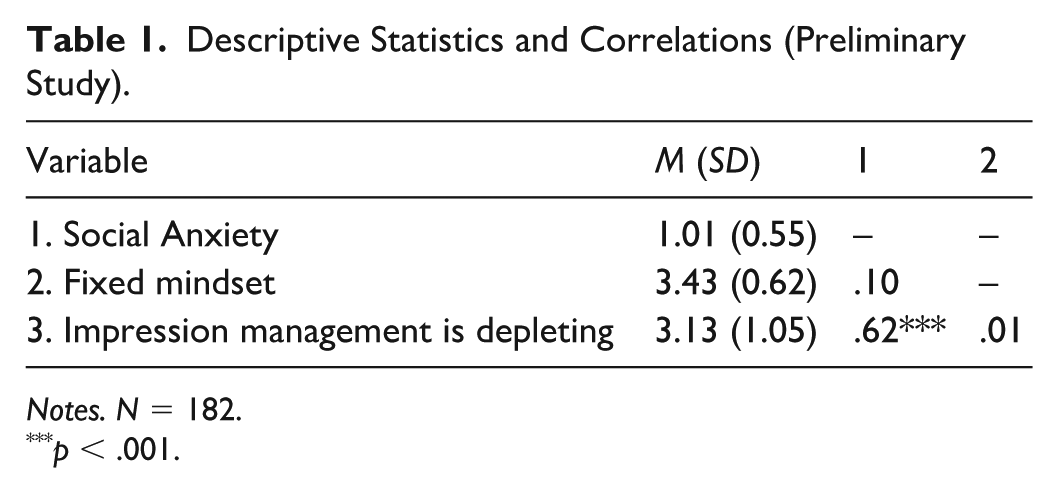
Notes. N = 182.
p < .001.
Importantly, a regression analysis revealed an interaction between SA and mindset in predicting how depleting impression management is perceived to be, b = –0.503, SE = 0.192, 95% CI = [–0.883, –0.123], β = –.163, t(178) = –2.61, p = .010,
Probing the interaction—see Figure 1—showed that among individuals leaning toward a fixed mindset (+1SD), SA was associated with a sense that impression management is depleting significantly less strongly, b = 0.900, SE = 0.158, 95% CI = [0.589, 1.211], β = .468, t(178) = 5.71, p < .001,
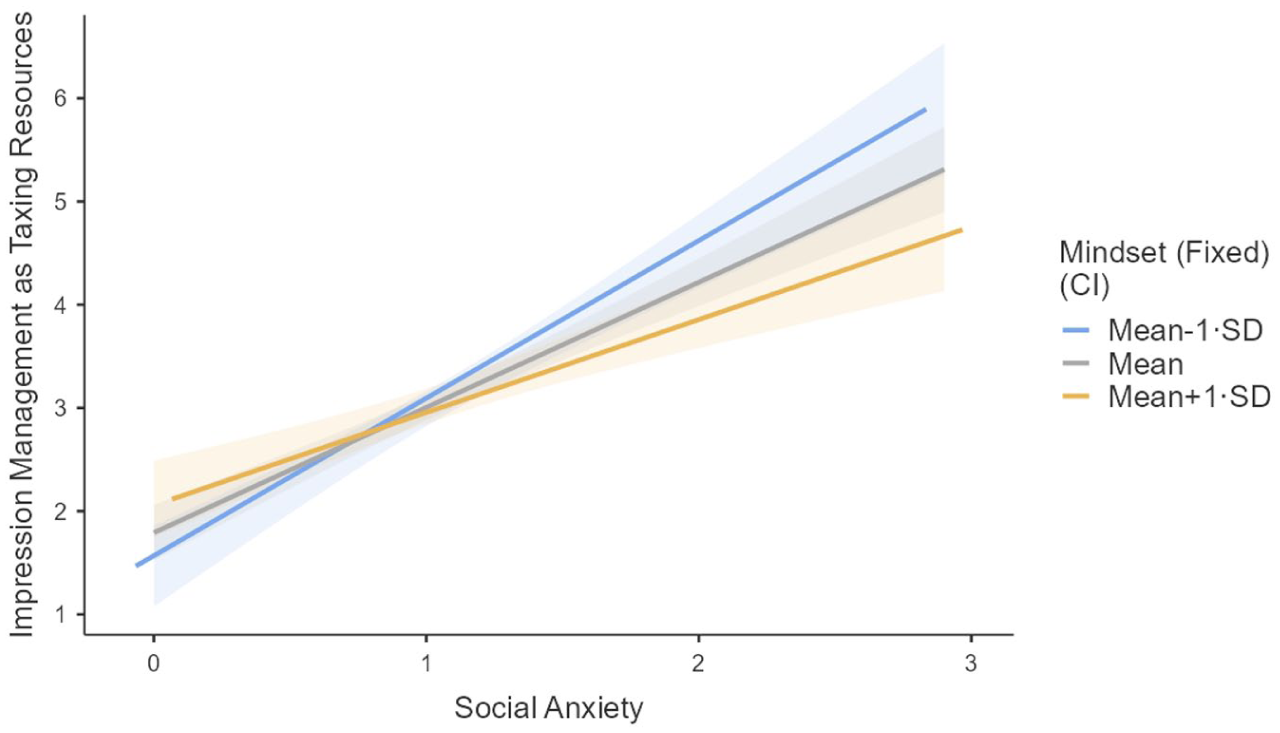
The Association Between Social Anxiety (SA) and a Sense That Impression Management is Depleting Among Individuals Adopting a Fixed (+1SD) and a Growth (–1SD) Mindset About Impression Formation (Preliminary Study).
Probing the interaction from the alternative perspective showed that among individuals higher on SA (+1SD), adopting a fixed mindset was associated with a sense that impression management is significantly less depleting than adopting a growth mindset, b = –0.307, SE = 0.153, 95% CI = [–0.609, –0.004], β = –.182, t(178) = –2.00, p = .047,
Study 1
The results of the Preliminary Study indicated that among individuals who adopted a fixed mindset about impression formation, there was a weaker association between SA and experiencing impression management as depleting than among individuals adopting a growth mindset. Studies 1 and 2 tested whether adopting a fixed mindset also helps in the behavioral expressions of impression management. Participants in Study 1 were asked to present themselves in writing while expecting to meet another student, and participants in Study 2 performed a self-presentation task in a videotaped session. In both studies, the quality of self-presentation was evaluated by objective judges.
Method
Participants
Participants (N = 216) were Israeli undergraduate students recruited for a laboratory study about personality and personal expression. Sixteen participants who failed attention checks or wrote nonsense responses (or left empty) open answers were excluded. The remaining sample (N = 200) comprised 163 females and 37 males, Mage = 22.45 (SD = 2.96).
Materials
Social Anxiety
Akin to the Preliminary Study, social anxiety was measured as a continuous scale using the Liebowitz Social Anxiety Scale–Self Report version (LSAS-SR; Fresco et al., 2001; Cronbach’s α = .92).
Mindset Manipulation
Participants were induced to adopt a fixed or a growth mindset about impression formation using a procedure adapted from previous studies (e.g., Haimovitz & Dweck, 2016; Job et al., 2010; Rattan et al., 2018, Vohs et al., 2012), whereby participants complete questionnaires biased in the direction of the manipulation. In the present adaptation of this method, participants in the fixed mindset condition (n = 100) rated their agreement with eight statements biased toward a fixed model of impression formation (e.g., “People tend to form solid and relatively durable impressions of other people”). In the growth mindset condition (n = 100), participants rated their agreement with eight statements biased toward a growth model of impression formation (e.g., “Impression that people form about other people can be changed”). In both conditions, ratings were along a 1 (strongly disagree) to 6 (strongly agree) scale. Reliabilities were high (Cronbach’s αs = .91 and .84 for the fixed mindset scale and the growth mindset scale, respectively).
Self-Presentation Task
Participants were informed that at a later stage in the study, they may be assigned to meet with another student for a joint task. To this end, they were asked to introduce themselves in writing so that the other person gains an understanding of who they are. They were allowed to work for as long as they wished. The written texts were then analyzed by two judges blind to experimental conditions. Ratings were made along three dimensions: friendliness, dominance, and anxiety. These dimensions were chosen to reflect the two fundamental dimensions of social behavior and social perception based on the Interpersonal Circumplex model (e.g., Gurtman, 2009; Wiggins & Trapnell, 1996) and related models (sometimes using the terms Agency and Communion; for example, Abele et al., 2021; Abele & Wojciszke, 2014; Cuddy et al., 2008; Fiske, 2018; Paulhus & Trapnell, 2008). “Friendliness” was defined to raters as “nice and friendly” and has a straightforward desirability meaning. “Dominance” was defined to the raters as “dominant and self-assured.” Individuals who score higher on this dimension are considered to present a more desirable social profile (reflecting higher status and self-esteem) than individuals who are submissive and hesitant (Abele et al., 2021; Cuddy et al., 2008; Paulhus & Trapnell, 2008), especially in the context of social anxiety (Gilboa-Schechtman et al., 2014; Sadikaj et al., 2015). Anxiety was added to these basic dimensions to emphasize this aspect in the total score, given the focus of the present investigation. For each dimension, the judges rated each response on a 1 (not at all) to 5 (very much) scale. After making their independent ratings, the judges met to discuss and resolve any large discrepancies, reaching very good agreement (ICCs = .80, .81, and .90 on their ratings of friendliness, dominance, and anxiety, respectively). Ratings by each judge for each of the three scales were averaged (after reversing the scores on the anxiety scale), and each participant received an “impression desirability” score (Cronbach’s α = .74).
Procedure
Participants started the experiment by signing a consent form and were taken to an experimental room, where they were alone, facing a computer screen. They started the experiment by completing the social anxiety scale. Next, they were randomly assigned to the fixed or growth mindset condition and completed the biased questionnaire. They were then informed that at a later stage, they might be asked to work with another participant on a joint task and that their task now is to write a relatively comprehensive self-introduction paragraph for the other participant to get to know them. In practice, all participants were later informed that they were in a no-meeting condition, and thus, after the writing task, they completed a demographic questionnaire, were debriefed, and thanked.
Results
Manipulation Check
For the manipulation check, we tested the extent to which participants adopted the mindset they were primed to adopt by comparing their mean rating with the scales’ neutral mean point (of 3.5; see Haimovitz & Dweck, 2016; Job et al., 2010, for a similar procedure). Results showed that the manipulation was successful. Participants in the fixed mindset (M = 3.83, SD = 0.97) tended to adopt fixed-biased statements, t(99) = 3.41, p < .001, Cohen’s d = 0.341, 95% CI = [0.139, 0.542], and participants in the growth mindset (M = 4.71, SD = 0.73) adopted growth-biased statements, t(99) = 16.61, p < .001, Cohen’s d = 1.661, 95% CI = [1.356, 1.962]. An additional set of tests found no difference between the two conditions in participants’ sex, age, or level of SA (ps > .29), indicating that the random assignment of participants to conditions was successful.
Main Analysis
On average, participants wrote paragraphs of 94.63 words (SD = 52.16). No difference was found in the number of words written between fixed (M = 97.17, SD = 53.91) and the growth (M = 92.09, SD = 50.49) mindset conditions, t(198) = –0.69, p = .492, Cohen’s d = –0.097, 95% CI = [–0.375, 0.180]. SA scores (M = 0.95, SD = 0.40) were not related to the number of words written, r(198) = –.093, p = .191.
Our main interest was in the desirability of the impression that participants made in their written self-presentations, as rated by the independent judges. To this end, we regressed impression desirability scores on SA (centered), condition (0 = growth, 1 = fixed), and their interaction term. Results revealed a significant effect for SA, such that higher SA was associated with lower impression desirability score, b = –0.689, SE = 0.155, 95% CI = [–0.994, –0.384], β = –.406, t(196) = –4.46, p < .001,
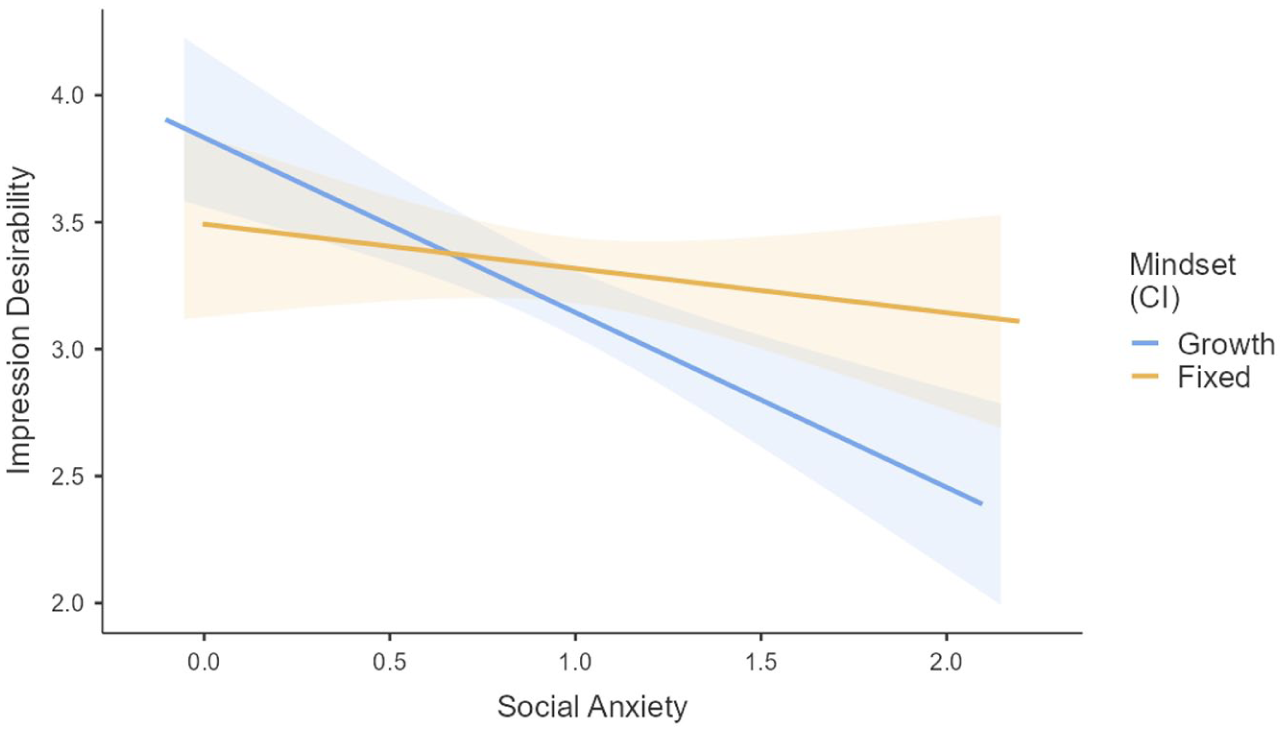
The Association Between Social Anxiety (SA) and Impression Desirability Following a Growth Mindset and a Fixed Mindset Manipulation (Study 1).
Probing the interaction from the alternative perspective showed that among individuals higher on SA (+1SD), a fixed mindset led to a significantly better impression desirability score than a growth mindset, b = 0.309, SE = 0.131, 95% CI = [0.051, 0.566], β = .454, t(196) = 2.37, p = .019,
Discussion
Study 1 introduced a relatively low-stress social context and tested how SA affects the desirability of written self-presentation following fixed/growth mindset manipulation. Results showed that participants adopted the mindset they were primed to hold and that overall, as expected, SA was associated with making a less desirable impression. Importantly, this negative association did not show when participants were primed to hold a fixed mindset about impression formation. That is, compared with adopting a belief that the impression people form is malleable, adopting a belief that it is fixed helped individuals higher on SA to present a more desirable image of themselves, possibly because they believed that the process was relatively quick and that they could concentrate their effort and pay more attention to the message than to their insecurities. Study 2 takes this process one step further, involving a potentially more stressful self-presentational task.
Study 2
Study 1 showed that in a relatively low-stress social context, participants higher on SA presented themselves more poorly when believing that impression management is malleable (i.e., a growth mindset). However, adopting a fixed mindset about impression formation significantly reduced this negative effect. Study 2 was aimed at testing this effect under a potentially more stressful situation. Participants in this study were required to present themselves while being videotaped. The desirability of the impression that they formed was again the main dependent variable.
Method
Participants
Participants (N = 160) were Israeli undergraduate students recruited for a laboratory study about personality and thinking patterns. Five participants were excluded because of technical issues with the video recording, setting the final sample at N = 155, composed of 111 females and 43 males (one participant did not disclose demographic information), Mage = 22.94 (SD = 3.26).
Materials
Social Anxiety
Akin to our previous studies, social anxiety was measured as a continuous measure using the Liebowitz Social Anxiety Scale–Self Report version (LSAS-SR; Fresco et al., 2001; Cronbach’s α = .93).
Mindset Manipulation
To induce participants to adopt a fixed (n = 78) or a growth (n = 77) mindset about impression formation, we used the same biased questionnaire method described in Study 1. Reliabilities were high (Cronbach’s αs = .92 and .83 for the fixed mindset scale and the growth mindset scale, respectively).
Self-Presentation Task
Participants were asked to present themselves for 2 min while being videotaped, a procedure known to induce social stress (Savitsky & Gilovich, 2003; Schmid & Schmid Mast, 2013; Uziel & Baumeister, 2012). They were instructed to describe themselves as thoroughly as possible so that observers could gain a comprehensive acquaintance with them. After a brief preparation time, an experimenter turned on the video camera and left the room for 2 min before returning to turn it off. Following Harb et al. (2003), the recordings were rated by two objective observers blind to experimental conditions using an adaptation of the Social Performance Rating Scale (SPRS; Fydrich et al., 1998) suggested by Harb et al. (2003) to fit for a self-presentation task. Specifically, ratings were made on the following four dimensions along a 1 (not at all) to 5 (very much) scale: gaze (the extent to which the participant was attentively looking at the camera), voice quality (the extent to which the participant talked loudly and clearly), comfort (how comfortable the participant appeared to be), and flow (the extent to which the self-presentation was fluent). Raters started with a joint session of training and calibrating and then proceeded to make their personal ratings (ICCs = .65, .55, .72, .68, .75, on the rating of gaze, voice, comfort, flow, and, importantly, mean overall rating, respectively. These agreement levels are consistent with reports on this task in the literature; for example, Gallego et al., 2021; Harb et al., 2003; Thompson et al., 2019). Ratings were combined to produce a single score of impression positivity (Cronbach’s α = .79).
Procedure
On arriving at the lab, after signing a consent form, participants were taken to an experimental room, where they were alone, facing a computer screen. They started the experiment by completing the social anxiety scale and were then randomly assigned to the fixed or growth mindset condition by completing the biased questionnaire. Next, they were informed about the self-presentation task and were instructed to call the experimenter into the room to start the video recording. The experimenter set the camera, started the recording, left the room, and returned after 2 min to stop the recording. The participants continued alone to complete a demographic questionnaire, were debriefed, and thanked.
Results
Manipulation Check
Like in Study 1, we tested the extent to which participants adopted the mindset they were primed to adopt by comparing their mean rating with the scale’s neutral mean point (of 3.5). Results showed that the manipulation was successful. Participants in the fixed mindset (M = 3.93, SD = 0.82) tended to adopt fixed-biased statements, t(77) = 4.64, p < .001, Cohen’s d = 0.525, 95% CI = [0.287, 0.761], and participants in the growth mindset (M = 4.37, SD = 0.72) adopted growth-biased statements, t(76) = 10.56, p < .001, Cohen’s d = 1.203, 95% CI = [0.907, 1.495]. An additional set of tests found no difference between the two conditions in participants’ sex, age, or level of SA (ps > .33), indicating that the random assignment of participants to conditions was successful.
Main Analysis
In our main analysis, we tested the positivity of the impression that participants made in their videotaped self-presentation task. We regressed impression positivity on SA (M = 0.84, SD = 0.40 ; centered), mindset condition (0 = growth, 1 = fixed), and their interaction term. Results revealed a significant effect for SA, such that higher SA was associated with a less positive impression, b = –0.722, SE = 0.186, 95% CI [–1.090, –0.353], β = –.462, t(151) = –3.87, p < .001,
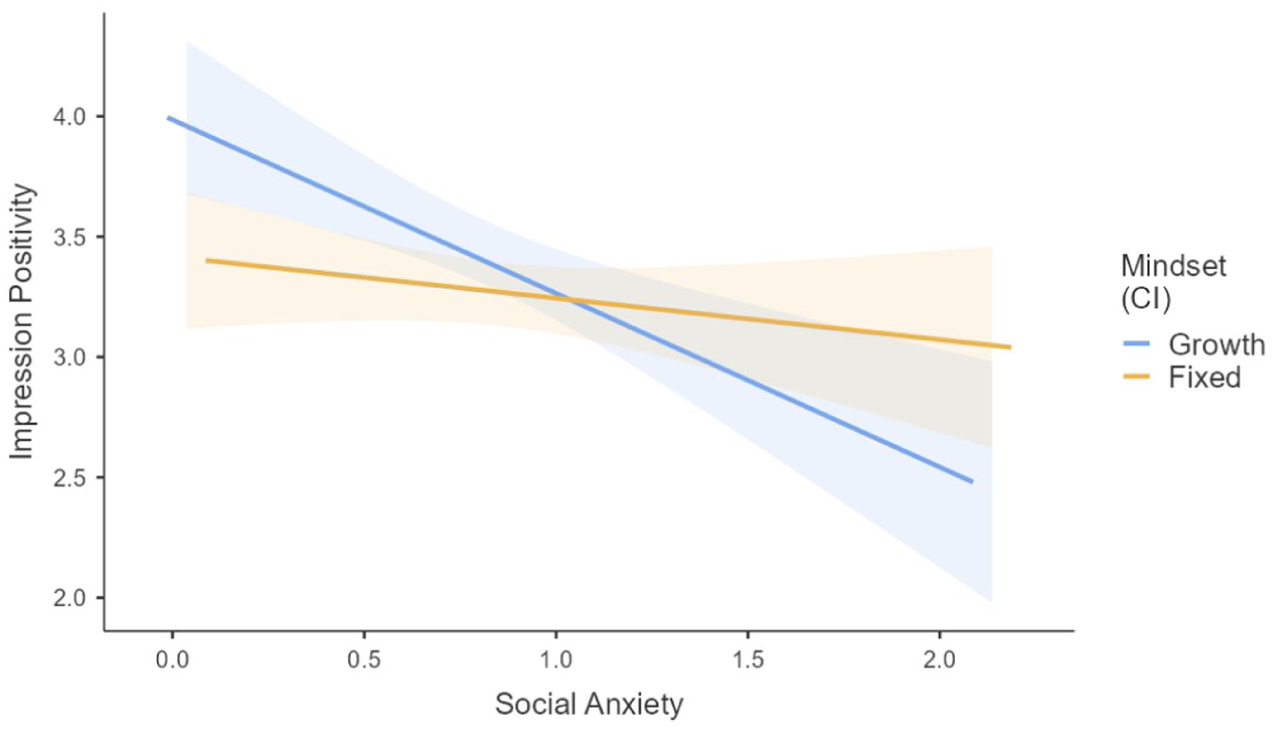
The Association Between Social Anxiety (SA) and Impression Positivity Following a Growth Mindset and a Fixed Mindset Manipulation (Study 2).
Probing the interaction from the alternative perspective showed that whereas among individuals lower on SA (–1SD), adopting a fixed mindset led to a significantly worse impression positivity score than adopting a growth mindset, b = –0.372, SE = 0.135, 95% CI [–0.639, –0.106], β = –.600, t(151) = –2.76, p = .007,
Discussion
Participants in Study 2 were placed under relatively high stress by being asked to present themselves in a one-take videotaped session. Their performance was judged by two independent judges along four dimensions that jointly created a positivity of impression score. Replicating the finding from Study 1, there was a significant interaction effect, whereby holding a fixed mindset about impression formation resulted in a less negative association between SA and impression positivity scores than holding a growth mindset. That is, like in Study 1, a fixed mindset about impression formation attenuated the (generally negative) impact of social anxiety on social behavior. The final study tested whether this effect manifests in real-life experiences.
Study 3
The previous two studies were focused on the perspective of external observers in the context of relatively brief laboratory settings. Study 3 adds to this evidence a focus on the subjective experience of the participants in the context of their real-life social interactions. Specifically, participants were induced to adopt either a fixed or a growth mindset about impression formation and were approached again 3 days later to report on the quality of their social interactions during this period.
Method
Participants
Participants (N = 162) were Israeli undergraduate students recruited for a two-stage study about personality and life experiences. Four participants were dropped because of not completing the second stage of the study, setting the final sample at N = 158, comprising 122 females and 36 males, Mage = 23.68 (SD = 3.02).
Materials
Social Anxiety
Akin to our previous studies, social anxiety was measured as a continuous measure using the Liebowitz Social Anxiety Scale–Self Report version (LSAS-SR; Fresco et al., 2001). The scale’s reliability was high (Cronbach’s α = .96).
Mindset Manipulation
To induce participants to adopt a fixed (n = 80) or a growth (n = 78) mindset about impression formation, we used the same biased questionnaire method described in Study 1 (Cronbach’s αs = .91 and .77, for the fixed mindset scale and the growth mindset scale, respectively). Unlike Studies 1 and 2, in the present version of the manipulation, immediately following the biased questionnaire, participants were asked to answer an open question aimed at consolidating its impact. This question required them to describe in their own words an important experience in their lives that demonstrates that people tend not to change their opinion about others once they have formed an opinion (fixed mindset) or that people tend to change their opinion about others even after they have formed an opinion (growth mindset).
Quality of Social Experience
Participants were asked to think about the past 3 days and compare them with their previous social experiences. They then answered five questions: How stressful their social experiences were on a 1 (very stressful) to 7 (very calm) scale, how satisfying their social experiences were on a 1 (less satisfying) to 7 (more satisfying) scale, how positive their social experiences were on a 1 (depressive) to 7 (exciting) scale, whether their social experiences were better than they usually are on a 1 (much worse) to 7 (much better) scale, and finally, to what extent they felt like wanting to meet new people on a 1 (not at all) to 7 (very much) scale. An exploratory factor analysis revealed that all items load on a single factor, and thus ratings were averaged to create a total score representing the quality of the recent social experiences (Cronbach’s α = .78).
Procedure
Participants took part in the study online. After signing up for the study, they received a link to complete the first part of the study, which included the SA scale, the mindset manipulation, and a demographic questionnaire. Three days later, they were contacted again and completed the second part of the study online, which included their report on the quality of their social experience. On completion, they were debriefed and thanked. The method and main analysis of this study were pre-registered. 2
Results
Manipulation Check
We tested the extent to which participants adopted the mindset they were primed to adopt by comparing their mean rating with the neutral mean point of the scale (of 3.5). Results showed that the manipulation was successful. Participants in the fixed mindset (M = 3.83, SD = 0.82) tended to adopt fixed-biased statements, t(79) = 3.55, p < .001, Cohen’s d = 0.397, 95% CI = [0.168, 0.623], and participants in the growth mindset (M = 4.64, SD = 0.58) adopted growth-biased statements, t(77) = 17.38, p < .001, Cohen’s d = 1.968, 95% CI = [1.584, 2.347]. An additional set of tests found no difference between the two conditions in participants’ sex, age, or level of SA (ps > .08), indicating that the random assignment of participants to conditions was successful.
Main Analysis
The main analysis tested the quality of social experience that participants reported having over the 3 days since Time 1. Experience quality was regressed on SA (M = 0.88, SD = 0.49; centered), mindset condition (0 = growth, 1 = fixed), and their interaction term. Results revealed a significant effect for SA, such that higher SA was associated with a reduced quality of social experiences, b = –0.408, SE = 0.180, 95% CI [–0.764, –0.052], β = –.246, t(154) = –2.26, p = .025, = .032. In addition, no effect was found for the mindset condition, b = 0.122, SE = 0.130, 95% CI [–0.135, 0.379], β = .147, t(154) = 0.94, p = .350,
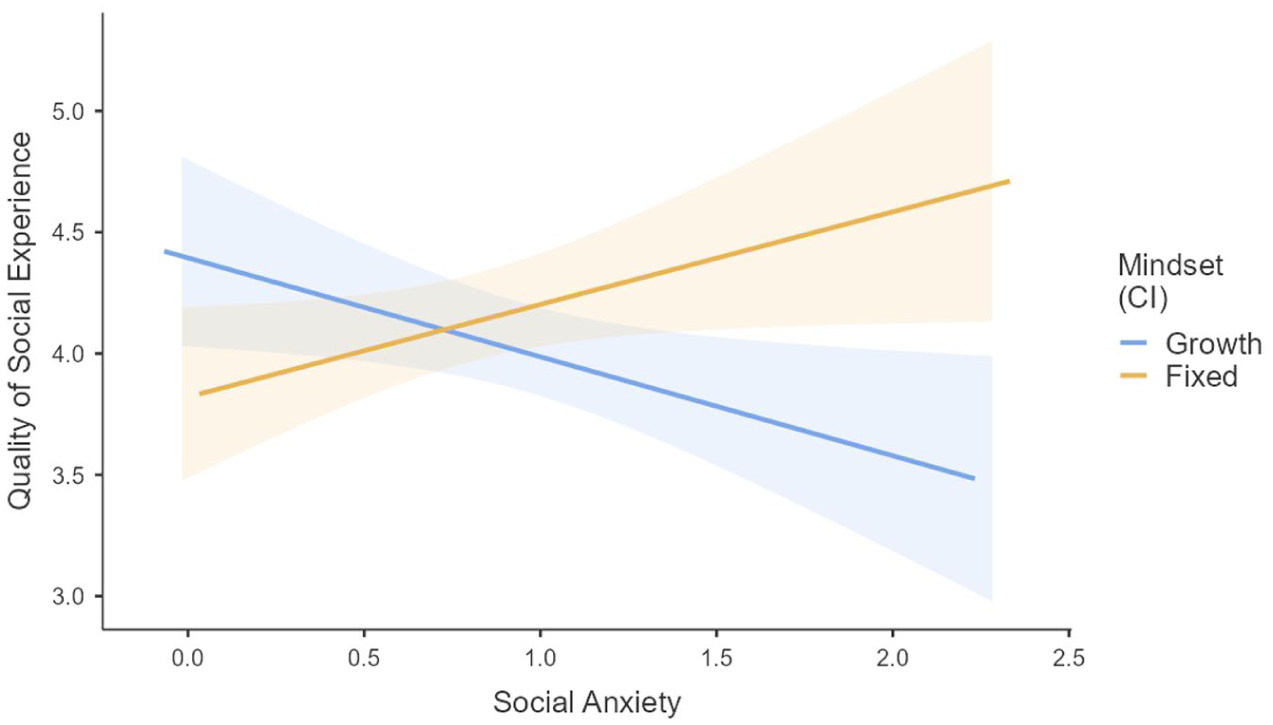
The Association Between Social Anxiety (SA) and Quality of Real-Life Social Experiences Following a Growth Mindset and a Fixed Mindset Manipulation (Study 3).
Probing the interaction from the alternative perspective showed that among individuals higher on SA (+1SD), adopting a fixed mindset led to significantly better social experiences than adopting a growth mindset, b = 0.516, SE = 0.185, 95% CI = [0.151, 0.881], β = .624, t(154) = 2.79, p = .006,
Discussion
Study 3 extends Studies 1 and 2 by looking at participants’ subjective experiences following real-life social interactions. Adopting a fixed mindset about impression formation has helped participants higher on SA to experience more positive and satisfying social experiences, whereas adopting a growth mindset was associated with negative effects. Compared with Studies 1 and 2, effects were somewhat stronger in this study, and this can be attributed to three factors: (a) a stronger manipulation, (b) a focus on the subjective experience of participants (vs. ratings by external judges), and (c) the extended timespan that allowed for the effects to show more clearly. Taken together, it appears that not only when judged by others but also in one’s subjective experience, a fixed mindset about impression formation was effective in curbing some of the negative effects of social anxiety.
General Discussion
Social anxiety is a severe disability for a non-negligible portion of the population. It limits one’s ability to live life to its full potential and may lead to loneliness and depression (Alonso et al., 2004; Stein & Stein, 2008). The present study was aimed at testing whether a change in mindset may affect some of the immediate negative implications of social anxiety. The Preliminary Study found that higher SA was strongly associated with a feeling that impression management taxes resources, but this effect was attenuated among individuals holding a fixed mindset about impression formation (compared with those holding a growth mindset). The following three experimental studies tested whether a fixed mindset may improve, to some extent, behavioral expressions associated with SA.
Study 1 tested the effect of mindsets in a relatively low-stress social context. Participants were asked to write self-descriptions in preparation for a future social interaction. Their self-descriptions were rated by objective judges for desirability. Results showed that when participants were induced to adopt a growth mindset, higher SA was associated with less favorable evaluations. However, following a fixed mindset induction, higher SA was not associated with unfavorable evaluations. In Study 2, we tested this idea in a potentially more stress-inducing social context. Participants were asked to present themselves in a single-take video recording session. Results showed the same pattern of effects: In the growth mindset condition, higher SA was associated with a low-quality self-presentation, whereas in the fixed mindset condition, individuals scoring higher on SA performed as well as individuals scoring lower on SA. Finally, in Study 3, SA was associated with better real-life social experiences under a fixed mindset than under a growth mindset. Jointly, the studies show that a relatively simple shift in mindset can make a substantial difference in the social behavior of individuals inclined to experience SA.
Cognitive models of SA describe a cascade of processes that exacerbate the negative experience of individuals with SA (Clark & Wells, 1995; Hofmann, 2007; Rapee & Heimberg, 1997). Individuals high on SA approach social situations with a negative outlook, expecting to be mocked and ridiculed. Consequently, during social interactions, they focus their attention inward, monitoring their inadequacies, aggravating the impact of their perceived imperfections, and find themselves trapped in a cycle of self-criticism (Clark, 2001), which drains their resources and diverts their attention from social interactions (Rapee & Heimberg, 1997). A fixed mindset about impression formation breaks this cycle by shifting attention from the self to the environment. Importantly, it allows individuals to concentrate their impression management efforts and condense them to a relatively brief period, believing that the impression they make lasts. Arguably, this reduces the need for constant monitoring, which frees resources to act naturally. Under a growth mindset about impression formation, individuals believe that there is a constant need to manage the impression they make. Among individuals high on SA, this belief and ensuing effort taxed their resources and reduced their ability to perform well. This finding joins existing research on the growth mindset about SA (i.e., a belief that SA is malleable), which showed that it may cause high-SA individuals to experience self-blame for their performance (Roberto & Busseri, 2025).
Recent advances in the research on mindsets have expanded the applicability of the model to areas beyond cognitive process (Dweck & Yeager, 2019), and the application of this model to mental disorders has gained momentum (e.g., Burnette et al., 2020). Evidence in favor of the benefits of a growth mindset in the realm of social anxiety is inconsistent, and alongside indication for a positive effect (Schleider & Weisz, 2016), some studies show that the effects are small (Schleider et al., 2019) and that in some contexts, a growth mindset may lead to unwanted outcomes (Roberto & Busseri, 2025; see also Burnette et al., 2020, 2022). Surely, more research is required. The present approach sought to add to this literature a new perspective on mindset, which departs from a focus on the individual to a focus on the surrounding social environment. In that sense, the greater controllability that an inward-directed growth mindset induces (Schleider & Weisz, 2016) is achieved differently, through a fixed mindset about the social environment, making the two approaches complementary and not contrasting. Another important addition to this literature is the present focus on experimental procedures, which help substantiate causality for the mindset intervention. Most of the current literature on mindsets in the context of SA is based on correlational designs (Burnette et al., 2020), limiting the ability to isolate and assess the true impact of this intervention.
There are several limitations to the present study that warrant acknowledgment and further investigation. First, the study was not focused on samples of clinically diagnosed individuals with SA but on the normal variability of SA in the general population. The present findings show the potential of a fixed mindset intervention about impression formation to alleviate some of the negative effects of SA on social behavior, but more studies are needed to test it with clinical samples. Second, the effects studied were relatively brief, especially in Studies 1 and 2, which were focused on a limited expression of social behavior (albeit in stressful conditions). Study 3 had a longer time span, but more research is needed to test how this mindset intervention can be implemented for longer periods and to test its effectiveness on a wider range of behaviors. Third, the studies included only two experimental conditions, and it cannot be completely ruled out that a growth mindset exacerbates the impact of SA more than a fixed mindset reduces it. Still, given the strong and consistent evidence about the negative implications of SA on social behavior (Stein & Stein, 2008), the present evidence showing that a fixed mindset can significantly reduce (and even nullify or reverse) the association of SA with negative social outcomes is an indication that the fixed mindset carries a remedial effect. Finally, the manipulation of the growth mindset proved stronger than the manipulation of the fixed mindset (based on the manipulation checks of Studies 1–3), implying that the observed association of SA with social behavior outcomes in the fixed mindset condition is a conservative estimate of its effect.
Taken together, the present research offers a new cognitive approach to address and reduce the impact of SA, showing that a mindset that allows individuals to believe in a stable and predictable social world helps to soothe the negative effects of SA.
Footnotes

Funding
The authors disclosed receipt of the following financial support for the research, authorship, and/or publication of this article: Preparation of this manuscript was supported by a grant from the Israel Science Foundation (ISF grant No. 133/23) to Liad Uziel.
Declaration of Conflicting Interests
The authors declared no potential conflicts of interest with respect to the research, authorship, and/or publication of this article.