




Abstract
Hostile sexism evokes women’s resistance necessitating benevolent sexism to promote cross-gender cooperation. Addressing inconsistent, primarily self-report evidence for ambivalent sexism theory principles, we test the actor and partner effects of sexist attitudes on behaviors exhibited within heterosexual couples’ interactions (N = 855 dyadic interactions). Showing that men’s hostile sexism likely incites resistance, men’s hostile sexism predicted more hostile and less responsive behavior by men and their women partners. Providing new behavioral evidence that benevolent sexism may promote heterosexual cooperation, men’s benevolent sexism predicted less hostile and more responsive behavior by men and their partners. Illustrating that benevolent sexism is also likely to have costs for women and men, women’s benevolent sexism predicted more hostile behavior by women and their partners, particularly when men partners were low in benevolent or high in hostile sexism. We emphasize the importance of examining how sexist attitudes influence actor and partner behavior across different contexts.
Men hold more economic and political power than women (United Nations, 2022; World Economic Forum, 2022), but men and women are mutually dependent on each other within intimate heterosexual relationships (Rudman & Glick, 2021). Ambivalent sexism theory (Glick & Fiske, 1996, 2001) highlights that the tension between societal power asymmetries and intimate interdependence produces two forms of sexism. Hostile sexism—antagonistic attitudes toward women who challenge men’s power—undermines men’s intimacy needs by evoking resistance from women in close relationships. These costs necessitate benevolent sexism—attitudes that romanticize traditional gender roles to facilitate cooperation and intimacy between men and women while continuing to support broader power differentials (Glick & Fiske, 1996, 2001). Support for these key principles requires testing how sexist attitudes shape behavior within intimate relationships, including whether hostile sexism undermines intimacy by evoking resistance or whether benevolent sexism promotes intimacy by enhancing cooperation (Hammond & Overall, 2017).
Despite growing research showing that sexist attitudes influence intimate relationships (Bareket & Fiske, 2023; Hammond et al., 2020), key weaknesses in the research base limit evidence for central tenets of ambivalent sexism theory. First, most research relies on self-report methods without examining whether sexist attitudes shape actual behaviors between men and women in relevant dyadic interactions (Bareket & Fiske, 2023). Rather than simply reflecting what people think about their relationships, attitudes must be expressed in behavior to evoke resistance or facilitate cooperation by partners (Karney & Bradbury, 1995; Reis et al., 2000; also see Baumeister et al., 2007). As reviewed below, the five studies (four unique samples) that have gathered behavioral assessments during couples’ interactions provide inconsistent, weak evidence that sexist attitudes—particularly benevolent sexism—are associated with relationship behavior in theory-critical ways (Cross et al., 2017, 2019; Hammond & Overall, 2015; Overall et al., 2011, 2025). Second, with rare exception, research has focused on how sexist attitudes relate to a person’s own behavior (actor effects), but key principles of ambivalent sexism theory require understanding whether hostile sexism prompts resistance and benevolent sexism promotes cooperative behavior from partners (partner effects). Third, women’s sexist attitudes are equally consequential in supporting gender inequality (Glick & Fiske, 1996, 2001; Zawisza et al., 2025) and shaping intimate relationships between men and women (Bareket & Fiske, 2023; Hammond et al., 2020), but the behavioral effects of women’s sexist attitudes is theoretically and empirically unclear.
To demonstrate the importance of examining how hostile and benevolent sexism predict behavior during dyadic interactions, we discuss key tenets of ambivalent sexism theory that involve the way men and women should behave toward one another (summarized in Table 1) and outline inconsistencies and gaps in evidence for the related actor and partner behavioral effects. We then present a dyadic behavioral observation study assessing behaviors central to power and resistance (hostility) and intimacy and cooperation (responsiveness) within man-woman couples’ discussions of relationship conflicts and strengths (855 dyadic interactions). We test whether men’s hostile versus benevolent sexism predicts men’s hostile versus responsive behavior and, critically, hostile versus responsive behavior in women partners. We also examine whether women’s sexism is associated with hostile or responsive behavior by women and men partners, including whether the combination of sexist attitudes across women and men predict observed behavior.
Current Tests of Principles of Ambivalent Sexism Theory Applied to Intimate Relationships.
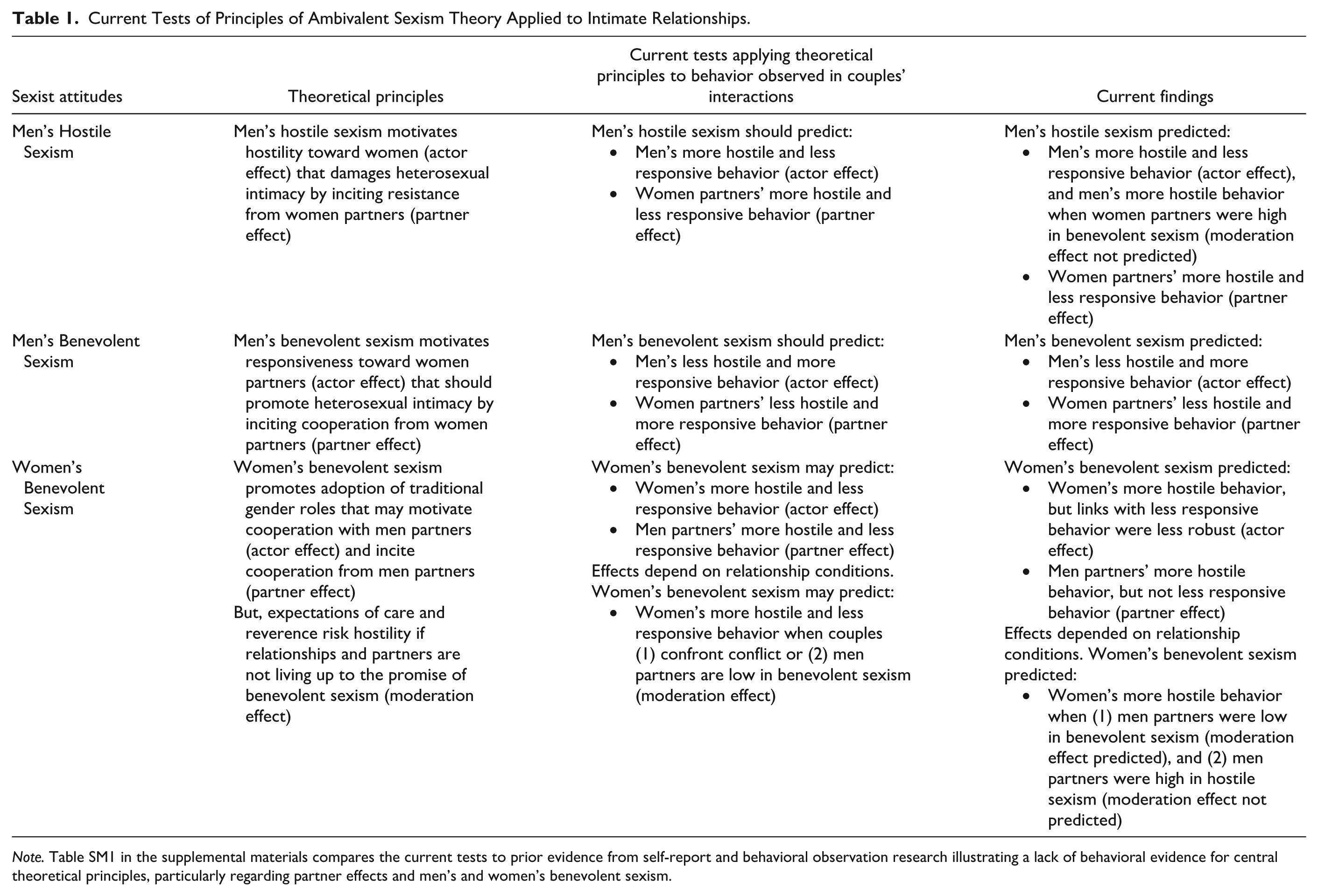
Note. Table SM1 in the supplemental materials compares the current tests to prior evidence from self-report and behavioral observation research illustrating a lack of behavioral evidence for central theoretical principles, particularly regarding partner effects and men’s and women’s benevolent sexism.
Men’s Hostile Sexism: Motivating Hostility and Inciting Resistance From Women Partners
Hostile sexism stipulates that men should possess social power and women are unjustifiably competing to take men’s power (Glick & Fiske, 1996). Men’s hostile sexism is theorized to sustain gender inequality by restricting and punishing women who challenge men’s social power, such as through bias, discrimination, and harassment of women in the workplace (Bareket & Fiske, 2023). However, dependence on women in intimate relationships also motivates aggression to protect men’s power (Hammond et al., 2020). The bulk of evidence connecting men’s hostile sexism with aggression toward intimate partners involves self-reports or responses to hypothetical scenarios (Agadullina et al., 2022; Gutierrez & Leaper, 2024), but there is some support from behavioral data. Men’s hostile sexism predicts men’s greater hostile behavior observed in couples’ relationship conflict discussions (Cross et al., 2017, 2019; Overall et al., 2011) and less cooperative, responsive behavior in coparenting interactions (Overall et al., 2025).
We expected to replicate this well-supported actor effect by showing that men’s hostile sexism predicts greater hostile and lower responsive behavior observed within couples’ interactions (see Table 1). However, unlike most prior studies, we also tested the effect of men’s hostile sexism on their partner’s behavior. A key premise of ambivalent sexism theory is that hostile sexism is counterproductive because it will elicit resistance from women whom men depend on for fundamental needs (Glick & Fiske, 1996, 2001). Indeed, men high in hostile sexism experience less fulfilling relationships, partly because they experience more conflict and struggles for power (Cross & Overall, 2019; Leaper et al., 2022; Waddell et al., 2025). This self-report evidence provides indirect support that men’s hostile sexism produces resistance rather than compliance by women partners. Only one study, however, has examined behavioral partner effects: Men’s hostile sexism predicted greater observed hostility by women partners during conflict discussions (Overall et al., 2011). We aimed to provide additional evidence for this once-tested, theory-critical partner effect by testing whether men’s hostile sexism predicted greater hostile and less responsive behavior by women partners (see Table 1).
Men’s Benevolent Sexism: Motivating Responsiveness and Inciting Cooperation From Women Partners?
Ambivalent sexism theory specifies that the costs of hostile sexism necessitate benevolent attitudes that both sustain gender inequality and promote cooperative mixed-gender relationships (Glick & Fiske, 1996, 2001). Benevolent sexism achieves both by providing a romantic justification for men’s high-status societal roles versus women’s low-status domestic roles: men should use their competence, agency, and status to provide for and protect women whose warmth and purity make them special, natural caregivers. Benevolent sexism helps to sustain gender inequality by promoting traditional gender roles and associated beliefs and behaviors that limit women’s career and political progress outside the home (Bareket & Fiske, 2023; Zawisza et al., 2025). Benevolent sexism helps to generate cooperative relationships, however, by prescribing that men should care for and cherish women partners (Glick & Fiske, 1996). Thus, men high in benevolent sexism should exhibit less hostility and more responsiveness in couple relationships.
Self-report evidence does suggest that men’s benevolent sexism promotes more positive, less conflictual heterosexual relationships, such as men higher in benevolent sexism viewing their partner’s behavior more positively (Hammond & Overall, 2013a), deferring to their partner’s expertise in the home (Bareket et al., 2021), reporting less power struggles (Cross & Overall, 2019) and aggressive behavior (Agadullina et al., 2022; Cross et al., 2019), and experiencing less conflictual and more satisfying relationships (Leaper et al., 2022; Waddell et al., 2025). However, studies observing actual behavior have produced inconsistent effects. One study found that men’s benevolent sexism was associated with lower hostile behavior during couples’ conflict discussions (Overall et al., 2011; also see Goh & Hall, 2015, for evidence of more affiliative behavior in initial cross-gender interactions). However, in three other studies, men’s benevolent sexism was not significantly associated with their hostile behavior during conflict (Cross et al., 2017, 2019) or responsiveness toward partners in coparenting interactions (Overall et al., 2025). Men’s benevolent sexism also predicts autonomy-undermining rather than need-responsive behavior when discussing women partner’s personal goals (Hammond & Overall, 2015). Thus, beyond men’s self-reports, there exists very little behavioral evidence that men’s benevolent sexism promotes less hostile and more responsive behavior toward women partners.
In addition, a crucial missing test is whether men’s benevolent sexism is associated with less hostility and greater responsiveness by women partners. A central tenet of ambivalent sexism theory is that benevolent sexism plays an essential role in sustaining gender inequality by inciting women’s cooperation. Self-report evidence suggests that perceiving men partners to be high in benevolent sexism bolsters women’s views that their partners can be relied upon to be caring and invested, alleviating women’s relationship insecurity (Cross et al., 2016). Recent self-report studies also show that men’s benevolent sexism predicts women partners experiencing less relationship conflict and parenting strain (Leaper et al., 2022; Waddell et al., 2024). These partner effects suggest that men’s benevolent sexism confers cooperative advantages, but do not directly test whether men’s benevolent sexism predicts more cooperative and responsive behavior by women partners. Moreover, the one prior study that examined links between men’s benevolent sexism and women’s behavior during dyadic interactions revealed null associations (Overall et al., 2011). Thus, in the current study, we conduct theory-critical tests of whether men’s benevolent sexism is associated with less hostile and more responsive behavior by both men and their women partners (see Table 1).
Women’s Benevolent Sexism: Motivating Responsiveness or Risking Hostility?
Another key way benevolent sexism is theorized to motivate heterosexual cooperation is by encouraging women to endorse benevolent sexism (Glick & Fiske, 1996, 2001). Women are attracted to benevolent sexism because it promises they will be cherished and protected by men partners. Women agree more with benevolent sexism when they need the security benevolent sexism offers (Fisher & Hammond, 2019) or when they gain security from their partner’s benevolent sexism (Hammond et al., 2016). In exchange for this security, women’s benevolent sexism is theorized to support both gender inequality and men’s intimacy needs via conformity to traditional gender roles. Supporting gender inequality, for example, women higher in benevolent sexism express lower education/career aspirations and prioritize their family roles which likely hinders their careers (Bareket & Fiske, 2023; Zawisza et al., 2025). Supporting men’s intimacy needs, women higher in benevolent sexism provide more responsive support for men partner’s personal goal pursuit (Hammond & Overall, 2015), shoulder more responsibility for domestic tasks (Bareket et al., 2021), and alleviate men’s parenting strain (Waddell et al., 2024), boosting men’s relationship and personal wellbeing.
This theorized function of women’s benevolent sexism implies greater cooperation and responsiveness by women toward men partners. However, benevolent sexism sets up a trade-off for women: conform to gender roles that support men’s and sacrifice women’s power outside the home for the promise of being revered and cherished by invested partners (Glick & Fiske, 1996). Thus, women high in benevolent sexism do not simply cooperate without expecting or feeling entitled to their partner’s care and reverence. Such expectations may explain why women’s benevolent sexism is not reliably associated with greater responsiveness or lower hostility, and instead may risk poorer responsiveness and hostility. Self-report evidence indicates that women’s benevolent sexism often is unassociated with conflict, hostility, and aggression in relationships (e.g., Cross et al., 2019; Cross & Overall, 2019; Leaper et al., 2022), but sometimes predicts greater conflict (Waddell et al., 2025) and hostility toward partners (Overall et al., 2021). Behavioral evidence also is mixed: women’s benevolent sexism was not associated with hostility during couples’ conflict discussions in two studies (Cross et al., 2019; Overall et al., 2011), but predicted lower responsiveness within coparenting interactions in one of two samples (Overall et al., 2025).
These inconsistent links likely arise because the behavioral implications of women’s benevolent sexism depend on whether women are receiving the benefits that benevolent sexism promises—a secure relationship in which partners agree women should be cherished and revered (Hammond et al., 2020). Some self-report evidence, for example, suggests that women higher in benevolent sexism experience greater dissatisfaction when they confront greater relationship problems or their partners do not meet ideals (Hammond & Overall, 2013b, 2014; also see Casad et al., 2015). Similarly, despite null main effects, Overall et al. (2011) found that women higher in benevolent sexism exhibited greater hostility when men partners reported low benevolent sexism and thus did not agree that women should occupy a prized position in relationships. Thus, rather than promoting cooperation and responsiveness, women’s benevolent sexism may motivate hostility within conflictual contexts that emphasize their relationships are less idyllic than expected or when partners do not also agree with and thus enact benevolent sexism. Based on this prior research and theorizing, in addition to examining the direct associations between women’s sexism and behavior, we test whether the links between women’s benevolent sexism and hostility and responsiveness vary according to whether (a) couples’ were discussing conflictual versus nonconflictual issues, or (b) men partner’s benevolent sexism is low versus high (see Table 1).
We also test whether women’s benevolent sexism has behavioral partner effects. No prior studies have reported associations between women’s benevolent sexism and men partners’ observed behavior. Yet, these partner effects are equally important in understanding whether benevolent sexism operates as theorized or, as the analysis above suggests, has differential effects across men’s and women’s endorsement. On one hand, if benevolent sexism is effective in promoting cooperative intimate relationships for men, and women’s agreement with benevolent sexism contributes to this function, then men should exhibit less hostile and more responsive behavior when their partners endorse these attitudes. On the other hand, if women’s benevolent sexism creates pressure for relationships to consistently live up to benevolent ideals, men partners also may be susceptible to hostility. For example, greater hostile or demanding behavior typically incites hostility and a lack of responsiveness in partners (Gottman, 1998). Partners also react with hostility when partners hold unreasonable, entitled expectations (Lamkin et al., 2017). We provide the first tests of the associations between women’s benevolent sexism and men partner’s behavior (see Table 1).
Present Research
Key principles of ambivalent sexism theory relate to whether hostile and benevolent sexism elicit resistance or cooperation in heterosexual intimate relationships (see Table 1). Prior studies provide consistent evidence that men’s hostile sexism predicts more hostile behavior toward intimate partners, but understanding whether hostile sexism incites resistance requires assessing whether men’s hostile sexism is associated with the behavioral responses of women partners. Moreover, there is a lack of behavioral evidence for the central tenet that men’s benevolent sexism should promote cooperation in intimate relationships: men’s benevolent sexism has not been reliably linked to less hostile or more responsive behavior by men or women partners. Finally, null effects in prior studies indicate that women’s benevolent sexism does not promote cooperative satisfying relationships for women or men, and instead some prior findings indicate that women’s benevolent sexism may be associated with hostility in relationships, especially when relationships do not provide the benevolence expected.
Our first aim was to address inconsistent, mixed evidence by providing the strongest test to date of the links between men’s and women’s sexist attitudes and their own hostile and responsive behavior (actor effects) using a much larger sample than prior studies (285 couples, 855 dyadic interactions). Our second aim was to test key principles of ambivalent sexism theory, including whether hostile sexism incites partner resistance and benevolent sexism enhances partner cooperation, by conducting the first systematic examination of the links between men’s and women’s hostile and benevolent sexism and their partner’s hostile and responsive behavior (partner effects). Our third aim was to assess whether the links between women’s benevolent sexism and hostile behavior were more likely to emerge in the context of (a) conflictual versus nonconflictual discussions, or (b) when men partners’ benevolent sexism is low versus high (see Table 1).
The results of these tests will provide essential support or notable challenges to the theorized operation of hostile and benevolent sexism. We did not pre-register the current study or predictions. As summarized in Table 1, if men’s hostile sexism motivates hostility and incites resistance from women partners, then men’s hostile sexism should not only be associated with more hostile and less responsive behavior by men (as established in prior studies) but also be associated with more hostility and less responsiveness by women partners. If men’s benevolent sexism counteracts these costs by motivating responsiveness and inciting cooperation, then men’s benevolent sexism should be associated with less hostile and more responsive behavior by men as well as women partners. If women’s benevolent sexism promotes cooperation, then women’s benevolent sexism should be associated with less hostile and more responsiveness behavior by women and their men partners. However, if women’s benevolent sexism sets up rigid expectations for care and reverence that are difficult to meet, as we expect, women’s benevolent sexism will likely be associated with more hostile and less responsive behavior by women and their men partners, particularly when couples confront conflict or men partners express low endorsement of benevolent sexism.
Dyadic models to test the actor and partner effects outlined in Table 1 necessarily include women’s hostile sexism. Although typically evidencing low levels, women nonetheless vary in their hostility toward women who challenge men’s power (Zawisza et al., 2025). Women’s hostile sexism may reflect resignation of power to men (Overall & Hammond, 2026), which motivates guarding their relationships from threatening women (Bareket & Fiske, 2023; Hammond et al., 2020). Providing evidence that women’s hostile sexism involves resigning power, women high in hostile sexism report lower desire for relationship power (Cross et al., 2019) and their men partners report less power struggles and conflict (Cross & Overall, 2019; Waddell et al., 2025). Yet, in the studies reviewed above, null associations have emerged between women’s hostile sexism and observed behavior, perhaps because women’s hostile sexism and resignation of power produces behavioral inhibition (Overall & Hammond, 2026). Thus, although we modeled the actor and partner effects of women’s hostile sexism, these did not test current principles of ambivalent sexism theory and we expected null associations as in prior research.
Finally, as summarized above, sexist attitudes are connected to relationship dynamics that undermine or promote relationship satisfaction, which shapes the way couples behave toward each other (Woodin, 2011). Sexist attitudes also are associated with attachment insecurities (Fisher & Hammond, 2019) that are central determinants of couples’ behavior (McNulty et al., 2021). Thus, to ensure that any associations between sexist attitudes and behavior were not due to general relationship evaluations or relationship insecurities, we controlled for relationship satisfaction and attachment insecurity in additional analyses.
Anonymized constructed variables and syntax to replicate the analyses are available on https://osf.io/3w5gr/. Additional data (scale items, demographics) are available from the corresponding author.
Method
Participants
A large-scale study involving couples and their 4- to 5-year-old child was collected for multiple aims, including testing how sexist attitudes relate to couple functioning and how parent–child dynamics relate to children’s socio-emotional competence during the transition to primary school. Participants included 285 man–woman couples (N = 570) with at least one child who were recruited from advertisements posted in a parenting magazine and at early childhood centers, or from a database of parents who had expressed interest in contributing to studies investigating children’s development. This sample size is over two times larger than prior studies assessing links between sexist attitudes and dyadic interactions. Our analytic strategy maximizes statistical power by nesting repeated interactions within dyads to test the effects across 855 dyadic interactions. Given no prior studies match this design to provide estimates for power analyses, we conducted Monte Carlo simulations (1,000 repetitions) for repeated assessments within distinguishable dyads (Bolger & Laurenceau, 2013) based on the means, variances, and covariances of the current data and the actor and partner effects shown in Table 6 (see SM for MPlus code, input values, and model results). Power estimates for all actor and partner effects were >.80, providing confidence that replicating the study would reveal the same significant actor and partner effects of men’s hostile sexism (100), men’s benevolent sexism (.870–.997), and women’s benevolent sexism (.801–.993).
Couples who had been cohabiting for at least 1 year, spoke fluent English, and who had a child between 4 and 5 years old were eligible for the larger study. Couples were married (84%) or cohabiting (16%), with an average relationship length of 11.70 years (SD = 4.36) and an average of 2.4 children (SD = 0.82). Table 2 presents additional demographic information. The majority of the sample had some form of education beyond secondary school. Most men were employed full-time, whereas around two thirds of women were primary caregivers and not employed full-time. This sample is particularly relevant to the traditional gender roles promoted and maintained by sexist attitudes given the breadwinning and caregiving pressures associated with coparenting young children. Additional analyses revealed the effects of actors’ and partners’ sexist attitudes were independent from and stronger than any effects of education, employment, income, and caregiver status (see SM). Couples completed online questionnaires before attending a 3-hr lab-based session with one of their children. The session involved couples completing a series of questionnaire assessments and dyadic interactions while their child completed independent tasks in a separate room. We detail the assessments relevant to the current aims below. See SM for information about the broader study and additional assessments. Families received NZD$180 for participating.
Demographic Information.
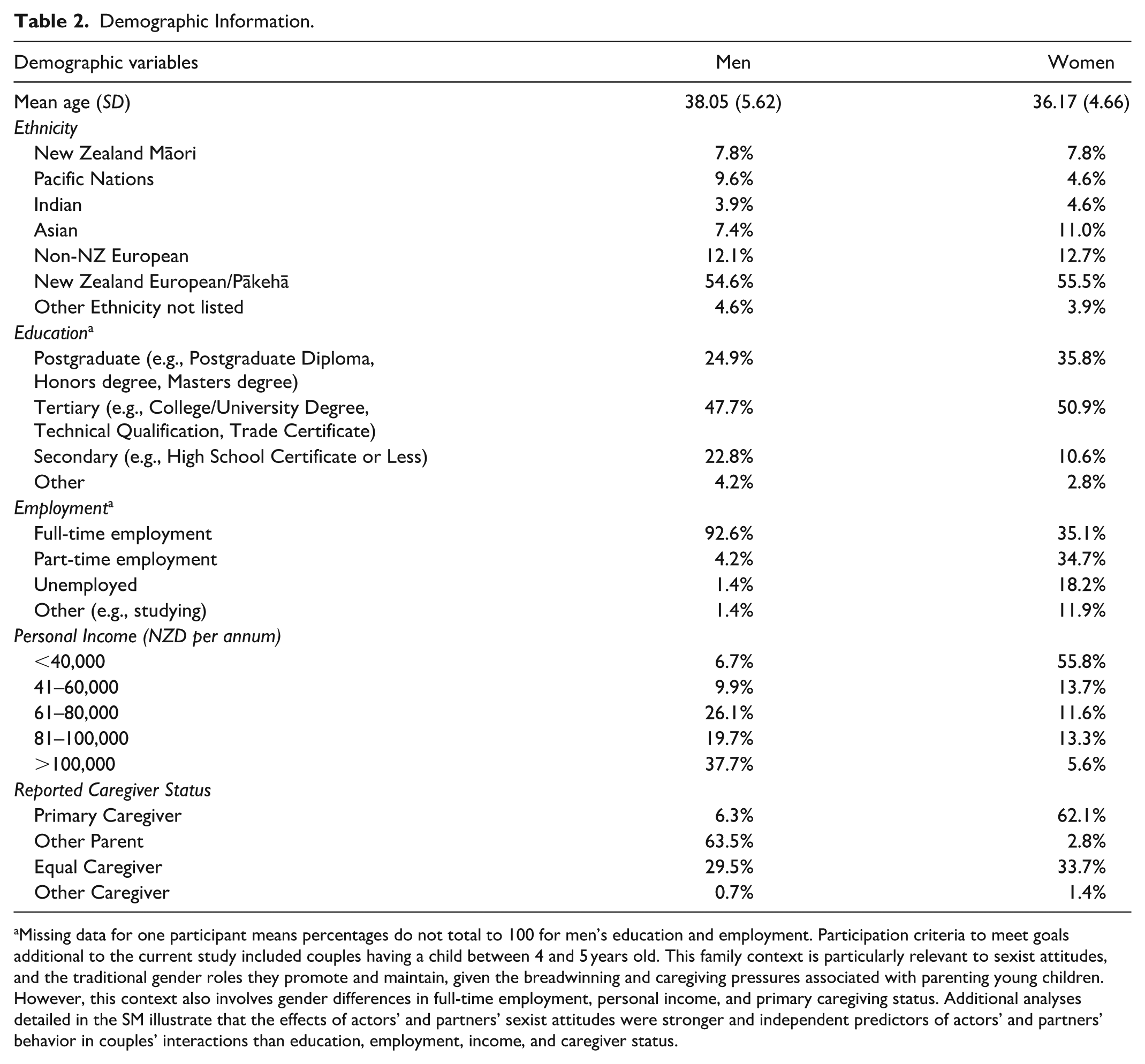
Missing data for one participant means percentages do not total to 100 for men’s education and employment. Participation criteria to meet goals additional to the current study included couples having a child between 4 and 5 years old. This family context is particularly relevant to sexist attitudes, and the traditional gender roles they promote and maintain, given the breadwinning and caregiving pressures associated with parenting young children. However, this context also involves gender differences in full-time employment, personal income, and primary caregiving status. Additional analyses detailed in the SM illustrate that the effects of actors’ and partners’ sexist attitudes were stronger and independent predictors of actors’ and partners’ behavior in couples’ interactions than education, employment, income, and caregiver status.
Procedure and Measures
Both partners independently completed questionnaire assessments measuring sexist attitudes, relationship satisfaction, and attachment insecurity. Each partner also identified, and ranked according to severity, three areas of ongoing relationship conflict involving wanting change in the way their partner thought, felt, or behaved. This procedure is designed to identify the most serious areas of disagreements across partners (Crenshaw et al., 2021; Overall et al., 2011). The experimenter selected the most serious, nonoverlapping area of conflict listed by each partner as a basis for couples to discuss in the observational procedure that followed. The topics represented common issues couples confront and discuss in studies investigating relationship conflict, including communication, intimacy and relationship maintenance, and managing household responsibilities and finances, with less frequent topics focused on parenting or other family challenges and stress/health (see SM).
See SM for detailed procedure. To familiarize couples with the observational procedures, couples had a warm-up discussion about nonconflictual events over the past week. Couples then engaged in three video-recorded dyadic interactions. The first and third interaction involved 7-min discussions about the areas of conflict identified by each partner as selected by the experimenter (order counterbalanced across gender). Before each conflict interaction, couples were presented with the selected topic and asked to discuss the topic as they normally would. For the second 5-min interaction that occurred between the two conflict discussions, couples were asked to identify and discuss areas of strengths with each other, such as what makes their relationship work and helps them feel satisfied. This context assesses whether partners can be responsive toward each other versus critical and rejecting when given the opportunity to connect (see SM for further details). Representative topics included sharing similar/complimentary values/beliefs, working as a team, communicating and problem-solving well, being invested and caring for each other, and prioritizing family/coparenting. Trained observational coders blind to the current aims rated each person’s hostile and responsive behavior in each discussion (see Table 3).
Descriptions and Examples of Hostile and Responsive Behavior Coded During Couples’ Interactions.
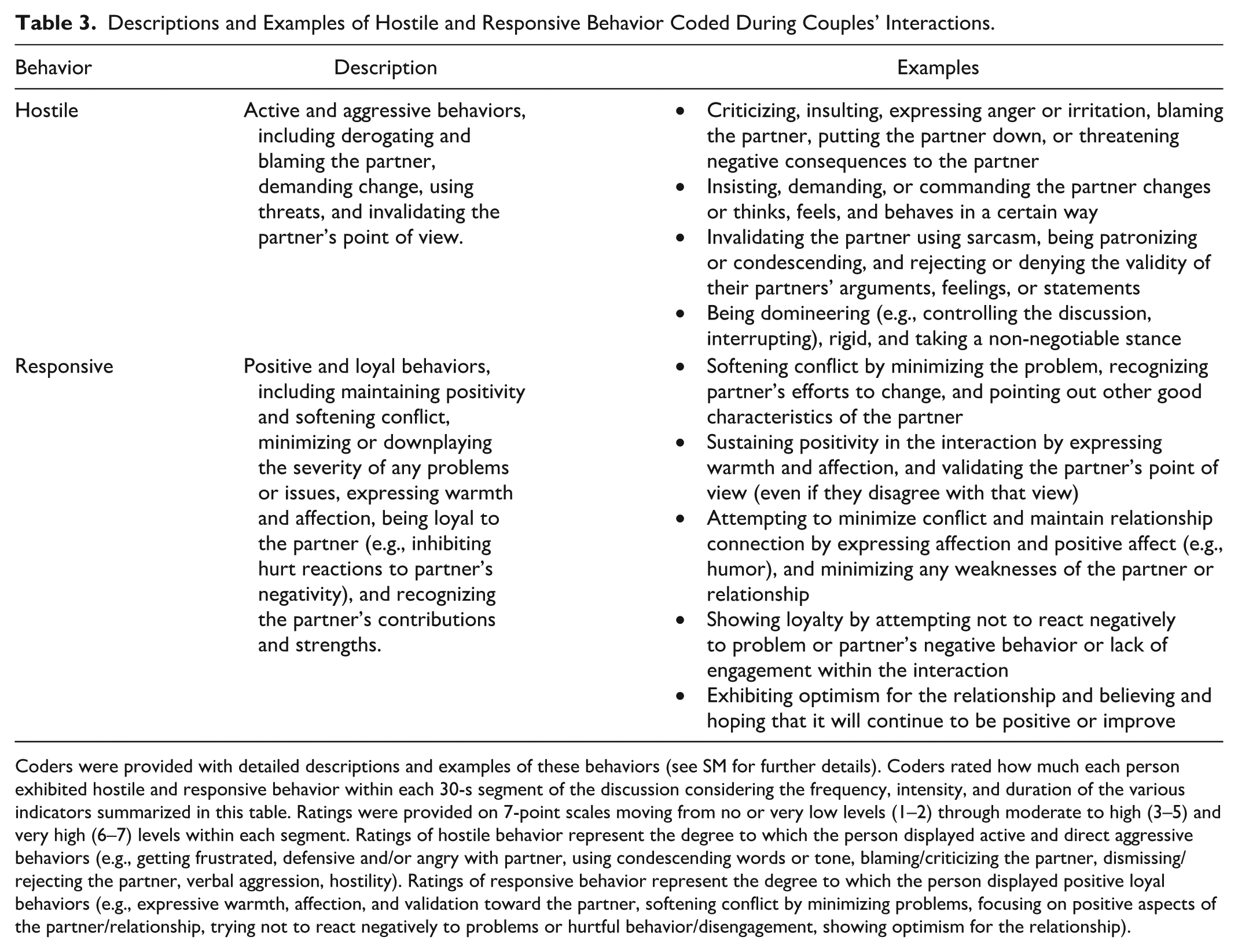
Coders were provided with detailed descriptions and examples of these behaviors (see SM for further details). Coders rated how much each person exhibited hostile and responsive behavior within each 30-s segment of the discussion considering the frequency, intensity, and duration of the various indicators summarized in this table. Ratings were provided on 7-point scales moving from no or very low levels (1–2) through moderate to high (3–5) and very high (6–7) levels within each segment. Ratings of hostile behavior represent the degree to which the person displayed active and direct aggressive behaviors (e.g., getting frustrated, defensive and/or angry with partner, using condescending words or tone, blaming/criticizing the partner, dismissing/rejecting the partner, verbal aggression, hostility). Ratings of responsive behavior represent the degree to which the person displayed positive loyal behaviors (e.g., expressive warmth, affection, and validation toward the partner, softening conflict by minimizing problems, focusing on positive aspects of the partner/relationship, trying not to react negatively to problems or hurtful behavior/disengagement, showing optimism for the relationship).
Sexist Attitudes
Parents completed the Ambivalent Sexism Inventory (Glick & Fiske, 1996). Eleven items assessed hostile sexism (e.g., “Women seek to gain power by getting control over men”), and 11 items assessed benevolent sexism (e.g., “Women should be cherished and protected by men”; −3 = strongly disagree, 3 = strongly agree). See SM for full measures. As shown in Table 4, on average, men expressed higher hostile and benevolent sexism than women (ts = 3.60 and 12.74, ps < .001), aligning with the typical pattern in New Zealand and other Western nations (Zawisza et al., 2025).
Descriptive Statistics and Reliabilities.
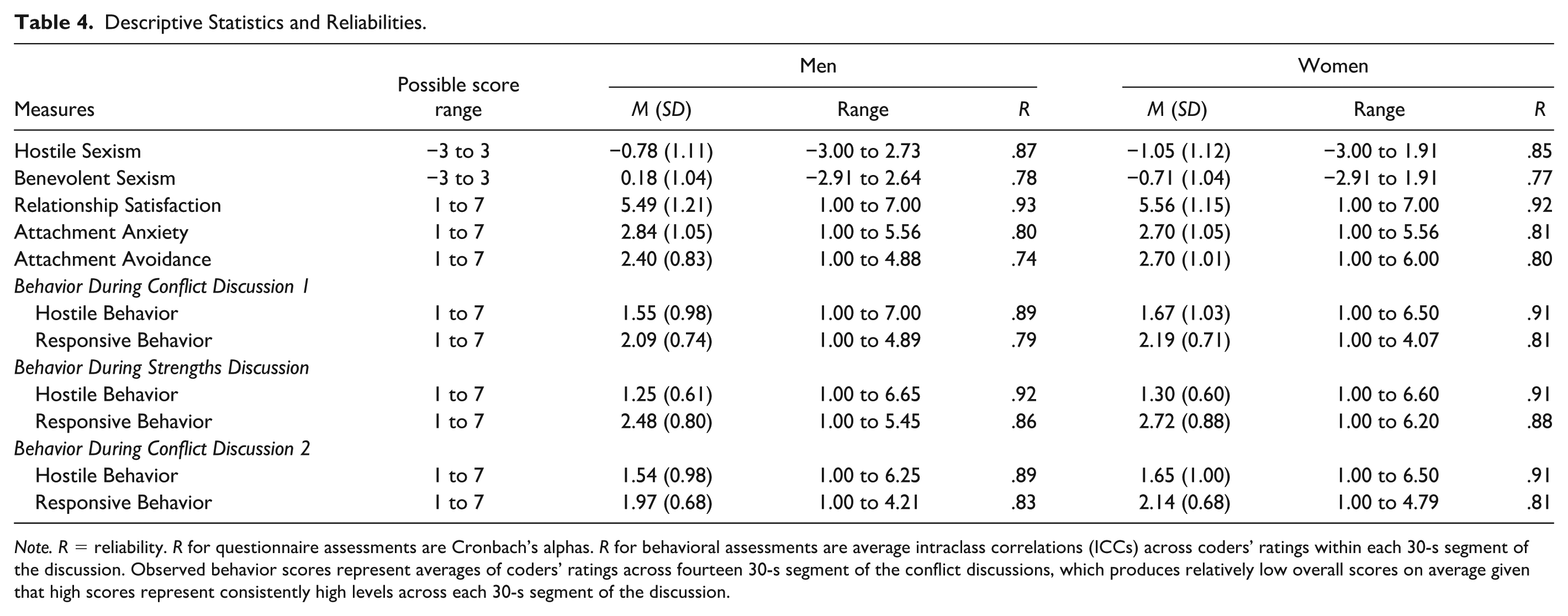
Note. R = reliability. R for questionnaire assessments are Cronbach’s alphas. R for behavioral assessments are average intraclass correlations (ICCs) across coders’ ratings within each 30-s segment of the discussion. Observed behavior scores represent averages of coders’ ratings across fourteen 30-s segment of the conflict discussions, which produces relatively low overall scores on average given that high scores represent consistently high levels across each 30-s segment of the discussion.
Relationship Satisfaction
Participants rated five items developed by Rusbult et al. (1998) (e.g., “I feel satisfied with our relationship”; 1 = strongly disagree, 7 = strongly agree).
Attachment Insecurity
Participants completed the Adult Attachment Questionnaire (Simpson et al., 1996), which measures attachment avoidance (e.g., “I’m not very comfortable having to depend on romantic partners”) and anxiety (e.g., “I often worry that my romantic partners don’t really love me”; 1 = strongly disagree, 7 = strongly agree).
Behavior During Couples’ Interactions
Three coders independently rated the degree to which each participant exhibited hostile and responsive behavior in each of the discussions using an established coding scheme (Overall, 2018, 2020; see SM). Coders were provided with detailed descriptions and examples as summarized in Table 3. Hostile behavior captured antagonistic and actively aggressive behavior toward the partner (e.g., derogating, blaming or threatening the partner, invalidating the partner, being demanding). Responsive behavior captured cooperative behavior that was responsive to the partner’s relational needs (e.g., expressing affection and care, softening conflict by validating the partner and being loyal, and conveying commitment by restraining negativity and expressing optimism for the future).
Coders were first extensively trained to rate the intensity of behavior using examples of low, medium, and high levels of hostile and responsive behaviors from prior samples of couples’ conflict discussions. Coders then reviewed each conflict discussion to rate on 7-point scales how much each person exhibited hostile and responsive behavior for each 30-s segment of the discussion considering the frequency, intensity, and duration of the various behaviors summarized in Table 3 (1 = low, 7 = high). Men and women were coded in separate reviews (order of coding men and women were counterbalanced across the sample). After coding the conflict discussions, two coders were trained to apply the same scheme and subsequently rate equivalent behaviors in the strengths discussion (see SM for further details). Coder reliability was excellent for all three discussions (see intraclass correlations [ICCs] in Table 4). Coders’ ratings were averaged to produce a score for each 30-s segment, and then the segment scores were averaged to produce a final score of hostile and responsive behavior for each person in each discussion (see Table 4). Averaging across 30-s segments inevitably creates lower scores than would be produced from global ratings across the discussion (see Table 4 note).
The behavior examined in prior studies assessing the links between sexist attitudes and behavior have been inconsistent: two studies assessed hostile and not responsive behavior in conflict interactions (Cross et al., 2017, 2019), one study examined an overall composite of hostility and responsiveness in conflict interactions (Overall et al., 2011), and two studies assessed responsive behavior within support or coparenting interactions (Hammond & Overall, 2015; Overall et al., 2025). Because these measurement inconsistencies may explain previous mixed findings, we tested the effects of sexist attitudes on hostile and responsive behavior in separate analyses. This decision was supported by only moderate correlations between hostile and responsive behavior (average r = −.45/−.44 for women/men; see Table 5), consistent with distinctions in prior research (Kanter et al., 2022; Woodin, 2011).
Correlations Across Measures.
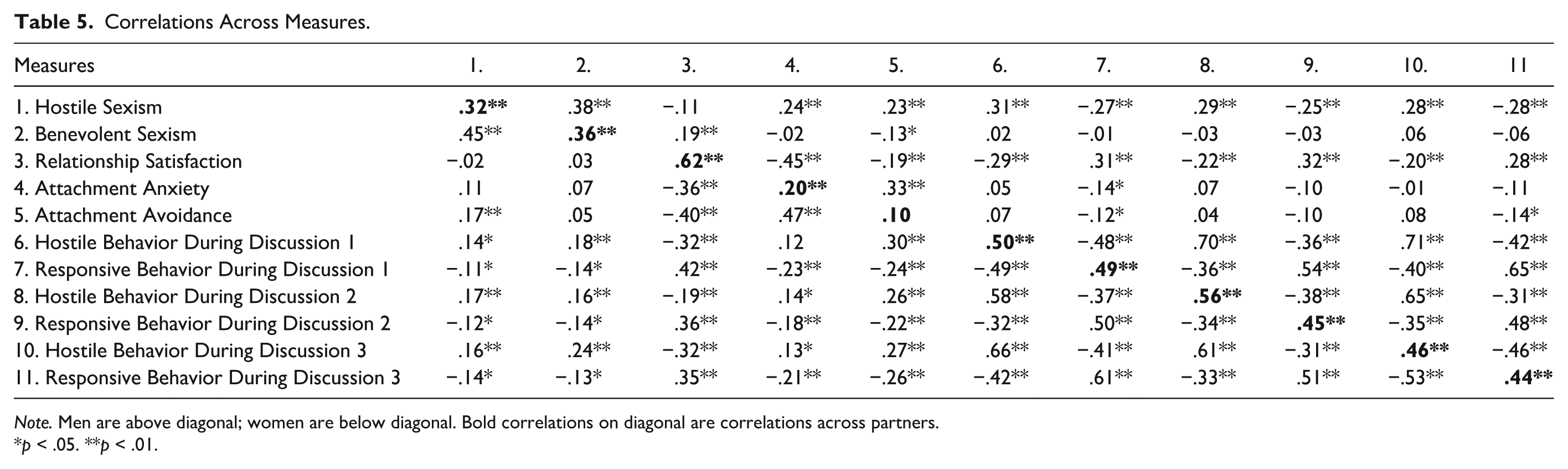
Note. Men are above diagonal; women are below diagonal. Bold correlations on diagonal are correlations across partners.
p < .05. **p < .01.
Results
Our primary analysis tested the effects of men’s and women’s own hostile and benevolent sexism (actor effects) and their partner’s hostile and benevolent sexism (partner effects) on their hostile or responsive behavior. These analyses followed the guidelines and SPSS syntax by Kenny et al. (2006) for modeling Actor Partner Interdependence Models for distinguishable dyads with repeated measures data (see SM for annotated syntax). Figure 1 displays the structure of the model and the actor and partner effects estimated. The multilevel dyadic models treated each person’s behavior within each of the three discussions as repeated measures, which has the advantages of maximizing power by predicting behavior estimated across all discussions while accounting for dependence in behavior across discussions (see right side of Figure 1). Men’s and women’s own hostile and benevolent sexism were entered as predictors of behavior (actor effects; see Figure 1 HSActor and BSActor). Partner’s sexism also were entered as predictors of behavior (partner effects; see HSPartner and BSPartner). Partner effects test, for example, whether men partner’s hostile sexism predicts women’s behavior (HSPartner from men’s hostile sexism to women’s behavior) independent of women’s own hostile sexism and accounting for behavioral dependence within dyads. The actor and partner effects were calculated controlling for the associations between hostile and benevolent sexism within individuals and between partners (see Table 5) and accounting for the statistical dependence in behavior across discussions within individuals and between dyad members (see Figure 1 note).
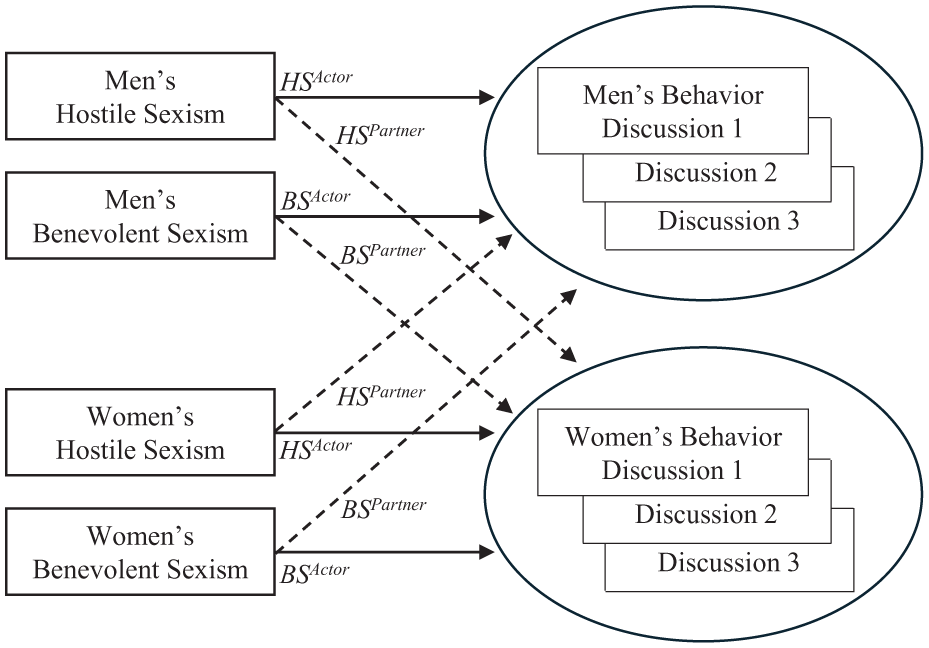
Actor Partner Interdependence Models Testing the Effects of Men’s and Women’s Own Hostile and Benevolent Sexism (Actor Effects) and Their Partner’s Hostile and Benevolent Sexism (Partner Effects) on Behavior During Couples’ Discussions.
To test whether the effects significantly differed across men and women, we ran a pooled model that estimated the actor and partner effects across all participants and tested the main and interaction effects of gender (coded −1 women, 1 men). These tests are presented in the final column of Table 6. Significant gender interactions confirmed that the actor and partner effects of hostile and benevolent sexism significantly differed across men and women (ts > 4.07, ps < .001). We thus focus on the distinct effects for men and women.
Associations Between Men’s and Women’s Own and their Partner’s Hostile and Benevolent Sexism and Hostile and Responsive Behavior Within Couples’ Discussions.
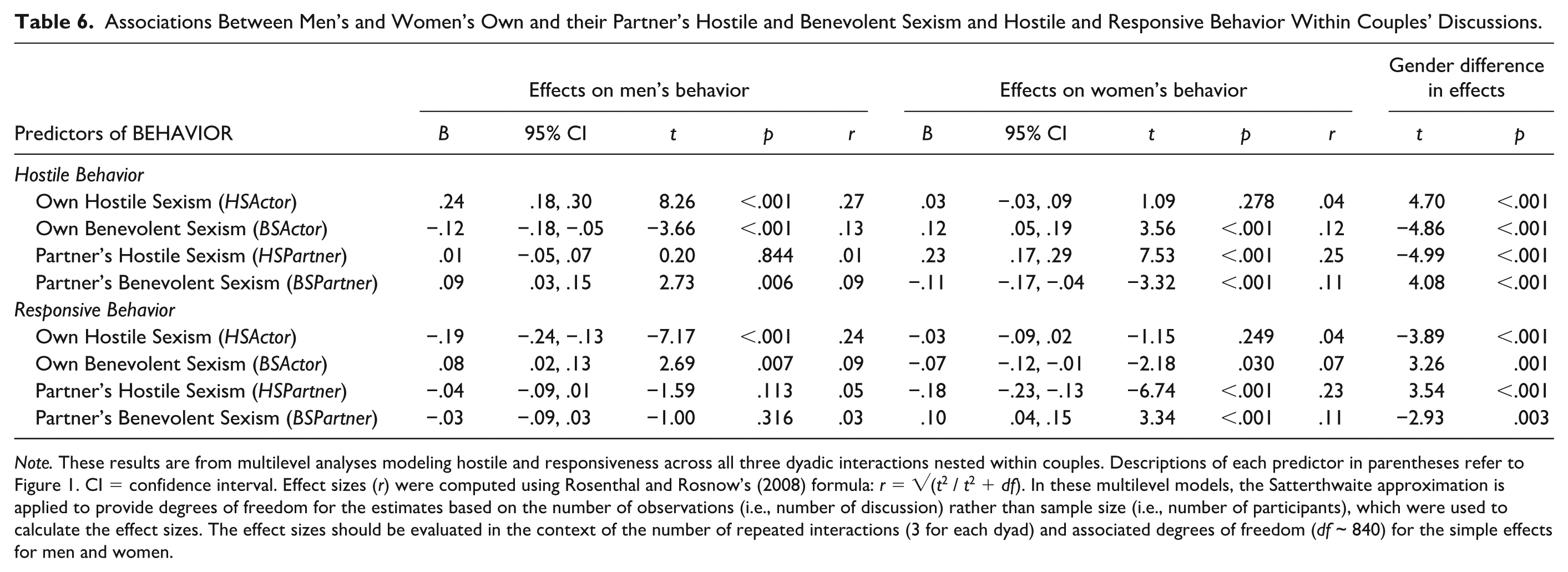
Note. These results are from multilevel analyses modeling hostile and responsiveness across all three dyadic interactions nested within couples. Descriptions of each predictor in parentheses refer to Figure 1. CI = confidence interval. Effect sizes (r) were computed using Rosenthal and Rosnow’s (2008) formula: r = √(t2 / t2 + df). In these multilevel models, the Satterthwaite approximation is applied to provide degrees of freedom for the estimates based on the number of observations (i.e., number of discussion) rather than sample size (i.e., number of participants), which were used to calculate the effect sizes. The effect sizes should be evaluated in the context of the number of repeated interactions (3 for each dyad) and associated degrees of freedom (df ~ 840) for the simple effects for men and women.
Table 6 presents the results for hostile (top section) and responsive (bottom section) behavior. We repeat effect size estimates here to clarify the relative size of actor and partner effects across hostile and benevolent sexism. Replicating prior studies, the significant actor effects of men’s own hostile sexism on men’s behavior showed that men higher in hostile sexism exhibited more hostile behavior (r = .27) and less responsive behavior (r = .24). Extending prior studies, the significant effects of partner’s hostile sexism on women’s behavior also showed that partners of men higher in hostile sexism exhibited more hostile (r = .25) and less responsive (r = .23) behavior. The size of the actor and partner effects were very similar.
Providing new evidence that benevolent sexism may enhance cooperation between men and women, the results illustrated that men’s benevolent sexism had the opposite actor and partner effects, although these effects were half the size of hostile sexism. The actor effects of men’s own benevolent sexism on men’s behavior revealed that men higher in benevolent sexism exhibited less hostile (r = .13) and more responsive (r = .09) behavior. The significant effects of partner’s benevolent sexism on women’s behavior also revealed that partners of men higher in benevolent sexism exhibited less hostile (r = .11) and more responsive (r = .11) behavior.
The results also addressed prior inconsistent evidence by indicating that women’s benevolent sexism may risk hostile behavior. The significant effects of women’s own benevolent sexism on women’s behavior revealed that women higher in benevolent sexism exhibited greater hostile (r = .12) and lower responsive (r =.07) behavior. The partner effects linking women’s benevolent sexism to men’s behavior also revealed that men partners of women higher in benevolent sexism exhibited greater hostile behavior (r = .12) but not less responsive behavior (r = .03). Thus, the small actor and partner effects were more consistent for hostile behavior. Finally, as in prior studies, no significant effects emerged for women’s hostile sexism.
Most of the significant actor and partner effects were p < .001 and thus remain robust to any adjustments for multiple comparisons, except for the smallest effect: women’s own benevolent sexism on women’s responsive behavior. To rule out the possibility that the effects of sexist attitudes are accounted for by relationship satisfaction or insecurity, we reran the models controlling for women’s and men’s own and their partner’s (a) relationship satisfaction and (b) attachment anxiety and avoidance (see SM for full results). The actor and partner effects in Table 6 were unaltered with one exception: the link between men’s own benevolent sexism and men’s responsive behavior was no longer significant when controlling for relationship satisfaction even though the partner effect linking men’s benevolent sexism to women’s responsive behavior remained. Notably, the effects of men’s hostile sexism were larger, and the effects of benevolent sexism were equal or larger (with the exception noted above), than any actor and partner effects of relationship satisfaction and attachment insecurity.
Sexism and Behavior Across Conflict versus Nonconflict Discussions
Our first secondary analyses tested whether the links between sexist attitudes and behavior varied across conflict versus nonconflict discussions. We reran the primary analyses in Table 6 adding the main and interaction effects of discussion context: −1 = conflict (discussing relationship conflicts), 1 = nonconflict (discussing relationship strengths). The results are shown in Tables 7 and 8. Main effects of discussion context revealed that men and women exhibited more hostile (Table 7) and less responsive (Table 8) behavior during the conflict versus non-conflict discussions. Nonetheless, controlling for average differences in behavior across the type of discussions, the actor and partner effects of sexist attitudes remained, and there were no significant interactions indicating that these differed according to whether couples were discussing relationship conflicts or strengths (SM presents specific effects for conflict vs. nonconflict discussions).
Testing Whether the Associations Between Men’s and Women’s Own and Their Partner’s Hostile and Benevolent Sexism and Hostile Behavior Within Couples’ Discussions Differ Across Discussion Context.
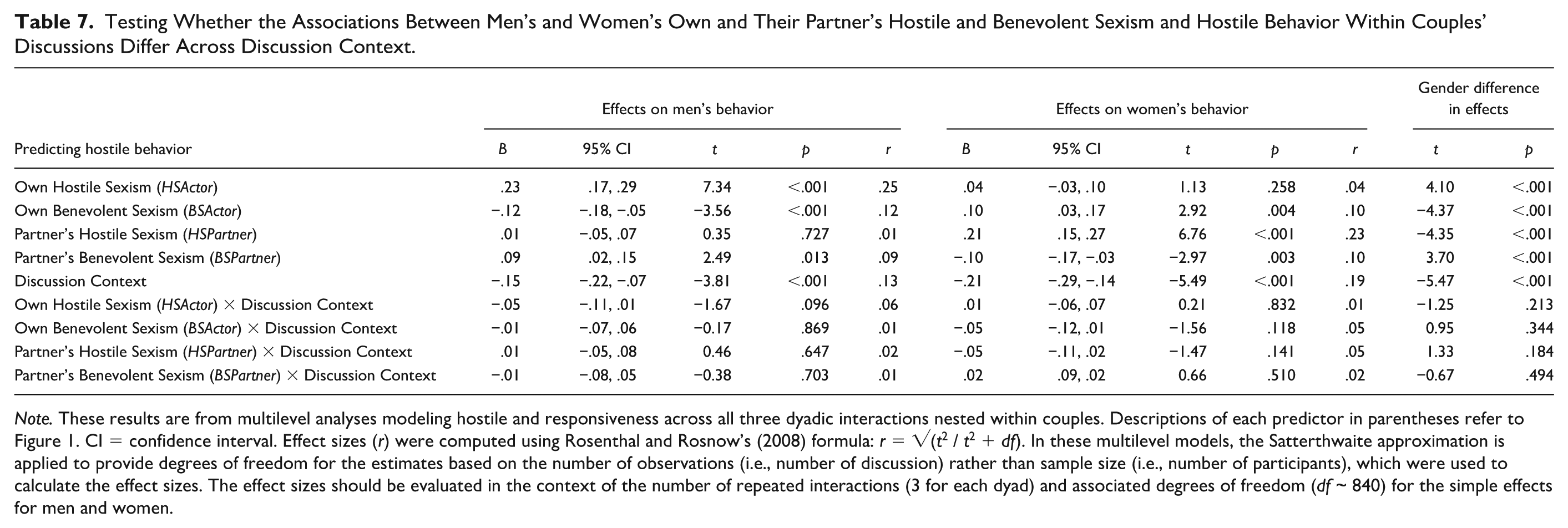
Note. These results are from multilevel analyses modeling hostile and responsiveness across all three dyadic interactions nested within couples. Descriptions of each predictor in parentheses refer to Figure 1. CI = confidence interval. Effect sizes (r) were computed using Rosenthal and Rosnow’s (2008) formula: r = √(t2 / t2 + df). In these multilevel models, the Satterthwaite approximation is applied to provide degrees of freedom for the estimates based on the number of observations (i.e., number of discussion) rather than sample size (i.e., number of participants), which were used to calculate the effect sizes. The effect sizes should be evaluated in the context of the number of repeated interactions (3 for each dyad) and associated degrees of freedom (df ~ 840) for the simple effects for men and women.
Testing Whether the Associations Between Men’s and Women’s Own and Their Partner’s Hostile and Benevolent Sexism and Responsive Behavior Within Couples’ Discussions Differ Across Discussion Context.
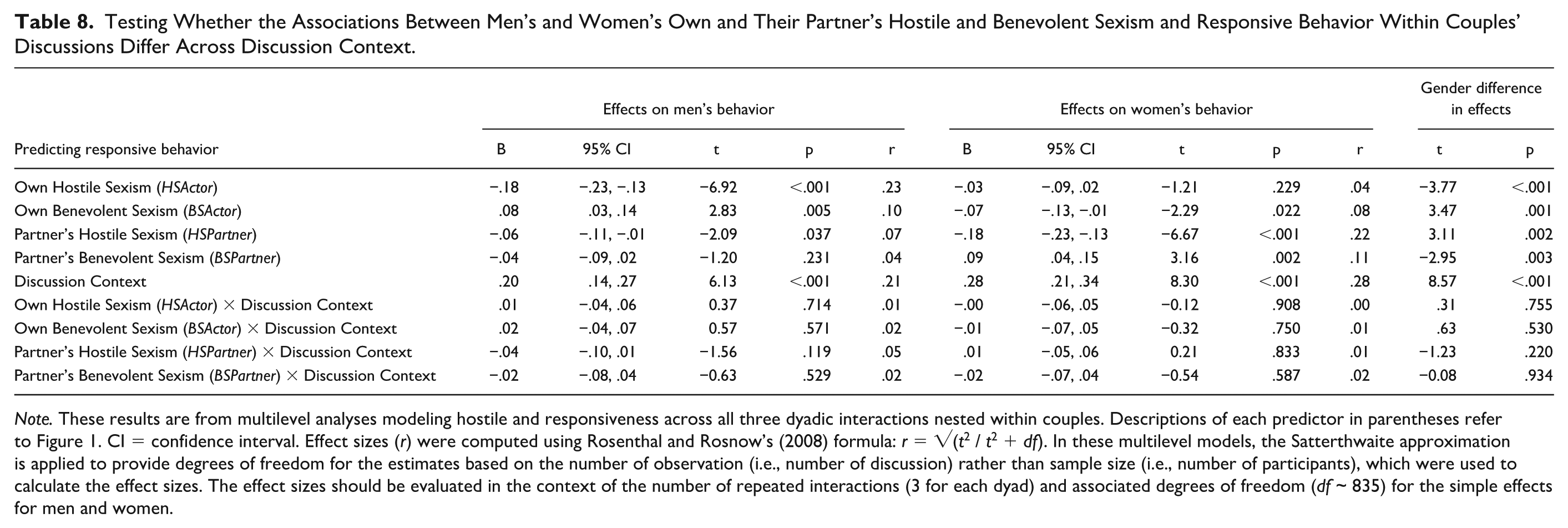
Note. These results are from multilevel analyses modeling hostile and responsiveness across all three dyadic interactions nested within couples. Descriptions of each predictor in parentheses refer to Figure 1. CI = confidence interval. Effect sizes (r) were computed using Rosenthal and Rosnow’s (2008) formula: r = √(t2 / t2 + df). In these multilevel models, the Satterthwaite approximation is applied to provide degrees of freedom for the estimates based on the number of observation (i.e., number of discussion) rather than sample size (i.e., number of participants), which were used to calculate the effect sizes. The effect sizes should be evaluated in the context of the number of repeated interactions (3 for each dyad) and associated degrees of freedom (df ~ 835) for the simple effects for men and women.
Combinations of Women’s and Men’s Sexist Attitudes on Behavior
Our next secondary analyses tested whether combinations of sexist attitudes across women and men contributed to predicting women’s or men’s behavior. Modest correlations across partners indicate that couple members often differ in their levels of hostile and benevolent sexism (r = .32 and .36, respectively, Table 5). Our specific aim was to replicate initial evidence that the actor effect of women’s benevolent sexism on hostile behavior would be more pronounced when their men partners did not endorse benevolent sexism (Overall et al., 2011; see Table 1). However, for completeness we also tested the possibility of all other combinations. We reran the primary models shown in Table 6 but added four interaction terms: own hostile sexism and partners’ hostile sexism, own hostile sexism and partners’ benevolent sexism, own benevolent sexism and partners’ benevolent sexism (the interaction we aimed to replicate), and own benevolent sexism and partners’ hostile sexism.
Three significant interactions emerged when predicting hostile behavior (Table 9), but not responsive behavior (Table 10). First, replicating Overall et al. (2011) with a much larger sample of couples and dyadic interactions, the links between women’s own benevolent sexism and hostile behavior was moderated by partners’ benevolent sexism (Own Benevolent Sexism × Partner Benevolent Sexism on Women’s Behavior, Table 9). As shown in Figure 2, women’s higher benevolent sexism predicted greater hostile behavior when partners’ benevolent sexism was low (−1SD; b = .23, 95% confidence interval [CI] = [.10, .35], t = 3.49, p = .001), but not high (+1SD; b = .03, 95% CI = [−.06, .11], t = 0.67, p = .501).
Testing Interactions Between Men’s and Women’s Own and Their Partner’s Hostile and Benevolent Sexism Predicting Hostile Behavior Within Couples’ Discussions.
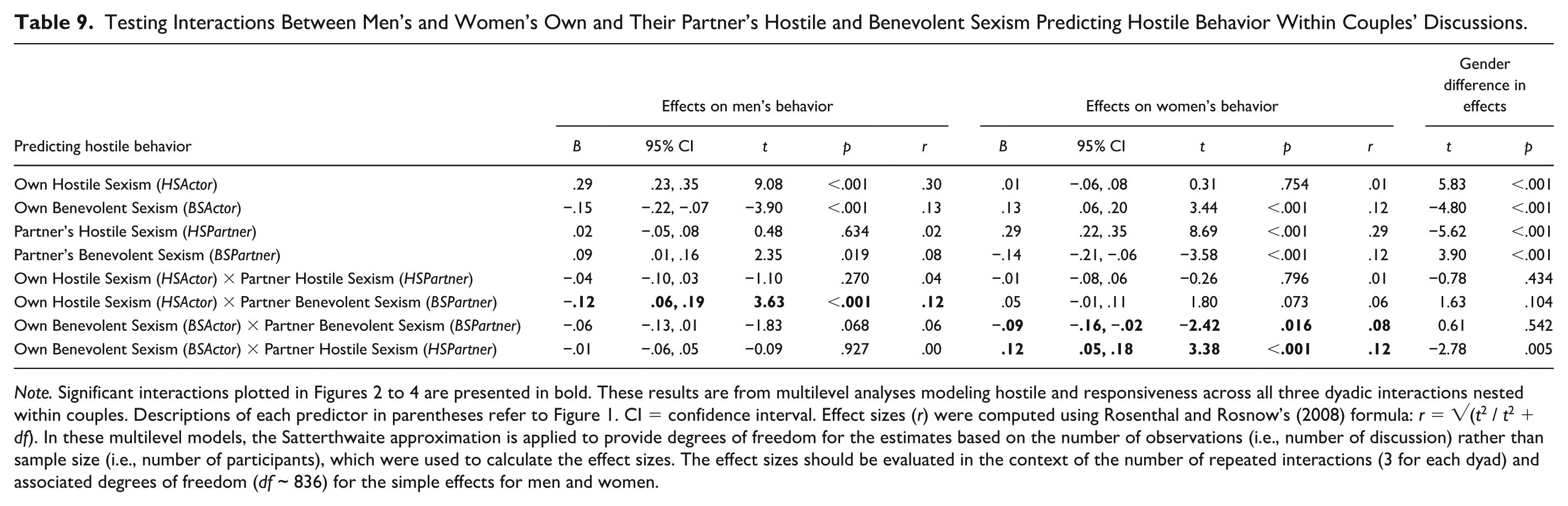
Note. Significant interactions plotted in Figures 2 to 4 are presented in bold. These results are from multilevel analyses modeling hostile and responsiveness across all three dyadic interactions nested within couples. Descriptions of each predictor in parentheses refer to Figure 1. CI = confidence interval. Effect sizes (r) were computed using Rosenthal and Rosnow’s (2008) formula: r = √(t2 / t2 + df). In these multilevel models, the Satterthwaite approximation is applied to provide degrees of freedom for the estimates based on the number of observations (i.e., number of discussion) rather than sample size (i.e., number of participants), which were used to calculate the effect sizes. The effect sizes should be evaluated in the context of the number of repeated interactions (3 for each dyad) and associated degrees of freedom (df ~ 836) for the simple effects for men and women.
Testing Interactions between Men’s and Women’s Own and Their Partner’s Hostile and Benevolent Sexism Predicting Responsive Behavior Within Couples’ Discussions.
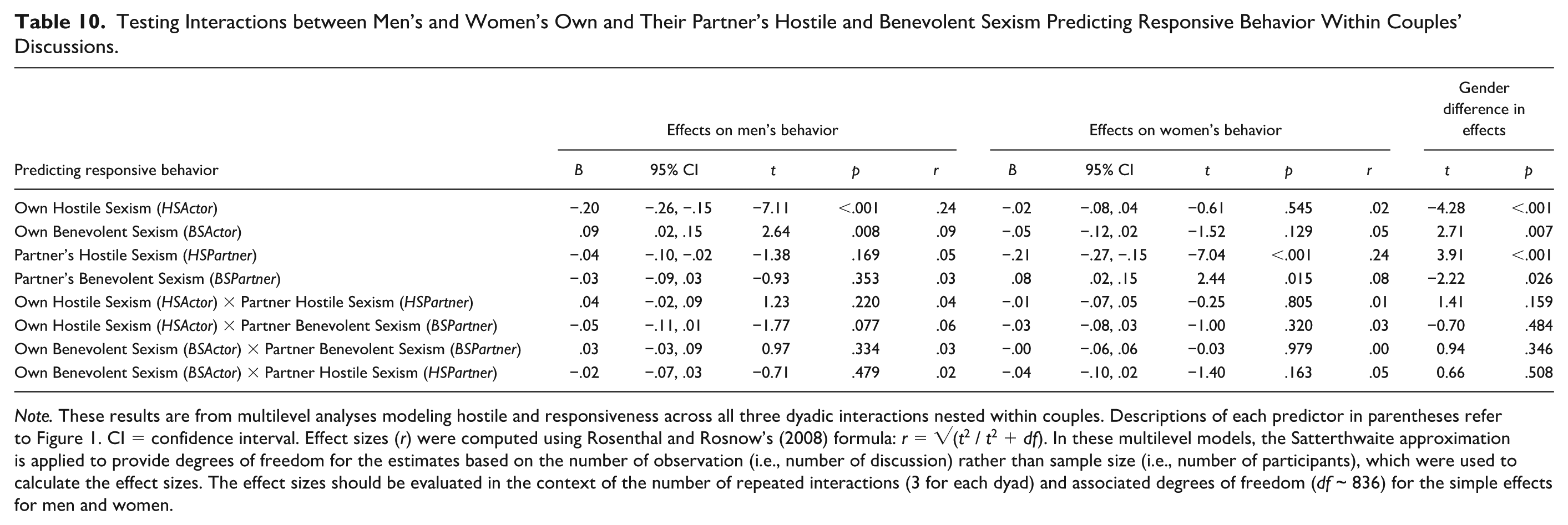
Note. These results are from multilevel analyses modeling hostile and responsiveness across all three dyadic interactions nested within couples. Descriptions of each predictor in parentheses refer to Figure 1. CI = confidence interval. Effect sizes (r) were computed using Rosenthal and Rosnow’s (2008) formula: r = √(t2 / t2 + df). In these multilevel models, the Satterthwaite approximation is applied to provide degrees of freedom for the estimates based on the number of observation (i.e., number of discussion) rather than sample size (i.e., number of participants), which were used to calculate the effect sizes. The effect sizes should be evaluated in the context of the number of repeated interactions (3 for each dyad) and associated degrees of freedom (df ~ 836) for the simple effects for men and women.
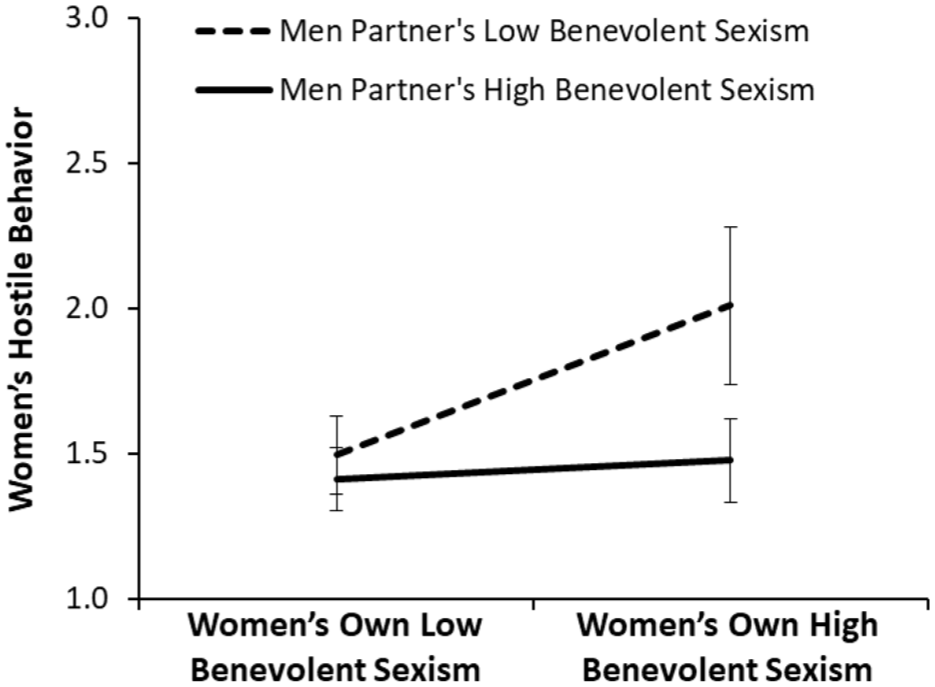
Interaction Between Women’s Own Benevolent Sexism and Their Men Partner’s Benevolent Sexism Predicting Women’s Hostile Behavior During Couples’ Discussions.
Second, two significant interactions indicated that the combinations of women’s benevolent sexism and men’s hostile sexism may increase the risk of hostile behavior by both women and men. Although these interactions were exploratory, both interactions effects were p < .001 and thus would remain robust to a lower criterion to adjust for multiple tests. As shown in Figure 3, a significant own Benevolent Sexism × Partner Hostile Sexism interaction on women’s behavior (see Table 9) revealed that women’s higher benevolent sexism predicted more hostile behavior when men partners were high in hostile sexism (+1 SD; b = .26, 95% CI = [.16, .36], t = 4.95, p < .001) but not low in hostile sexism (−1 SD; b = −.002, 95% CI = [−.11, .11], t = −0.37, p = .970). As shown in Figure 4, a significant Own Hostile Sexism × Partner Benevolent Sexism interaction on men’s behavior (see Table 9) revealed that the links between men’s hostile sexism and hostile behavior was more pronounced when women partners were high in benevolent sexism (+1 SD; b = .43, 95% CI = [.32, .54], t = 7.42, p < .001) versus low in benevolent sexism (−1 SD; b = .15, 95% CI = [.08, .23], t = 3.87, p < .001). 1
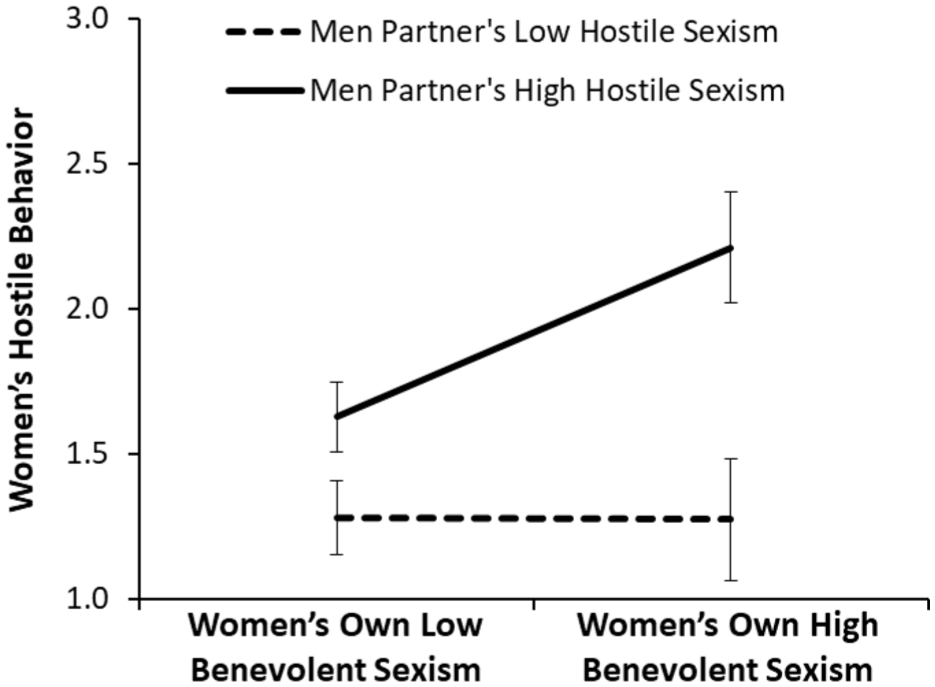
Interaction Between Women’s Own Benevolent Sexism And Their Men Partner’s Hostile Sexism Predicting Women’s Hostile Behavior During Couples’ Discussions.
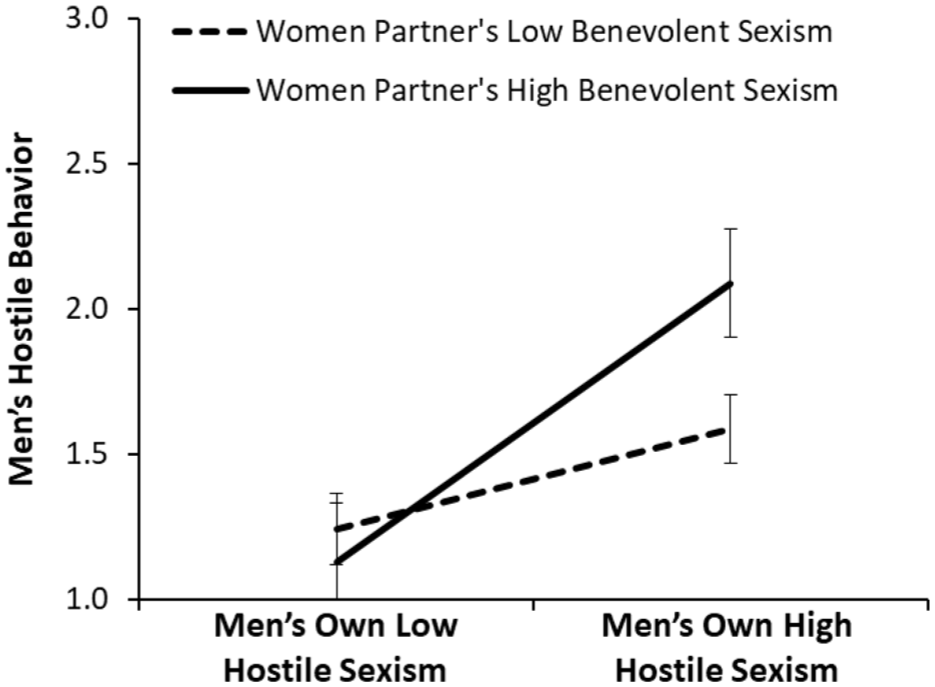
Interaction Between Men’s Own Hostile Sexism and Their Women Partner’s Benevolent Sexism Predicting Men’s Hostile Behavior During Couples’ Discussions.
Discussion
The current study provides key behavioral support for principles of ambivalent sexism theory, overcoming inconsistencies within prior research heavily reliant on self-reports and focused on actor effects. Table 1 summarizes the findings. Providing behavioral evidence that men’s hostile sexism incites resistance, men’s hostile sexism was associated with more hostile and less responsive behavior by men and also their women partners. Providing new behavioral evidence that benevolent sexism likely promotes heterosexual cooperation, men’s benevolent sexism was associated with less hostile and more responsive behavior by men and their women partners. Illustrating that benevolent sexism nonetheless likely has relationship costs for women and men, women’s benevolent sexism was associated with more hostile behavior by women and their men partners, and specific combinations of sexist attitudes across women and men were associated with amplified risk of women’s hostile behavior. In the following sections, we describe how each set of actor and partner behavioral effects advance evidence for central tenets of ambivalent sexism theory, and outline the importance of future behavioral studies examining how men’s and women’s sexism influence behavior across different intimate and non-intimate relationship contexts.
Men’s Hostile Sexism: Generating Hostility Between Men and Women
Replicating a well-established actor effect, men higher in hostile sexism exhibited more hostile and less responsive behavior toward women across couples’ interactions. These behaviors most likely emerge because dependence on women partners challenges men’s power. Men higher in hostile sexism exhibit greater hostile behavior when they lack relationship power (e.g., Cross et al., 2019; Overall et al., 2021) and when low partner commitment amplifies the vulnerability of their dependence (Cross et al., 2017). A new unpredicted finding in the current study advances this evidence. The link between men’s hostile sexism and hostile behavior was even stronger when women partners were high in benevolent sexism. Benevolent sexism promises women will be cherished and revered by men partners who should prioritize women’s preferences and desires. Given their biased perceptions, such as viewing women partners as more manipulative and uncaring than justified (Hammond & Overall, 2013a, 2020), men higher in hostile sexism likely experience women’s expectations of benevolence as demanding, exploiting their dependence, and challenging their “rightful” relationship power.
An equally strong partner effect provided important evidence that hostile sexism also likely damages relationships by generating resistance from women: men’s hostile sexism was associated with more hostile and less responsive behavior by women partners. It is possible that hostile sexism produces differential effects in work-based contexts or stranger interactions where sexist remarks and expressions of dominance and hostility may produce submissiveness (a consequential possibility yet to be tested behaviorally). But, men’s dependence in intimate relationships provides women dyadic power to actively express discontent and fight for their needs. Critically, women partners’ hostile, unresponsive reactions will likely amplify conflict and reduce the degree to which men high in hostile sexism experience satisfying relationships (Leaper et al., 2022; Waddell et al., 2025). And, this dyadic process provides critical support for the foundational premise of ambivalent sexism theory. Hostile sexism alone is ineffective at protecting men’s power because it is likely to damage relationships with women whom men depend on for fundamental relationship needs. These relational costs are theorized to underpin the emergence and more widespread adoption of benevolent sexism.
Men’s Benevolent Sexism: Promoting Cooperation Between Men and Women
The findings for men’s benevolent sexism provide a critical advance given mixed, inconclusive evidence for a central principle of ambivalent sexism theory. Benevolent sexism is theorized to resolve the tensions between men’s greater societal power and mutual dependence in intimate relationships via romantic depictions of traditional roles: men are valued for cherishing and providing for women partners justifying their higher societal status while sustaining intimate relationships (Glick & Fiske, 1996, 2001). To effectively fulfill this function, however, men’s benevolent sexism must create the promised relational benefits, including (a) promoting reliable care by men to women (an actor effect of men’s benevolent sexism) and (b) eliciting responsiveness by women to men (a partner effect of men’s benevolent sexism). Yet, self-report evidence likely biased by self-serving and romantic motives is not matched by behavioral data; only one of five behavioral studies provided support for the actor effect and no studies examined or supported the partner effect (Cross et al., 2017, 2019; Hammond & Overall, 2015; Overall et al., 2011, 2025).
The current results provide key evidence that men’s benevolent sexism is associated with lower hostile and greater responsive behavior by men and their women partners. The actor and partner effects of men’s benevolent sexism, however, were half the size than those for men’s hostile sexism. The large number of dyadic interactions in the current study provided a stronger test of small effects than prior studies, in which smaller samples may have contributed to inconsistent and null findings. Moreover, the actor and partner effects of men’s benevolent sexism were robust to alternative explanations, with only one exception: the actor (but not partner) effect of men’s benevolent sexism on responsive (but not hostile) behavior was removed when controlling for relationship satisfaction (but not insecurity).
The small effect sizes may reflect men’s benevolent sexism having mixed effects depending on the relational context. The links between men’s benevolent sexism and men’s or women’s hostile or responsive behavior were not moderated by the conflictual nature of couples’ discussions (conflict vs. non-conflict) or women’s agreement with sexist attitudes. However, the current study involved couples discussing relationship conflicts or strengths. Men’s benevolent sexism may not have the same actor or partner effects within support contexts in which women are disclosing challenges and aspirations regarding their personal goals or career. Rather than responsive support, reverence of women as warm caretakers versus men as competent providers prompts autonomy-impeding overhelping in these domains (Hammond & Overall, 2015; Shnabel et al., 2016; also see Oliveira Laux et al., 2015). Relatedly, the current sample involved married/cohabiting coparents of young children (see Table 2) who may most need or benefit from the cooperative roles benevolent sexism promotes (Waddell et al., 2024). Younger, less established couples (typically included in prior studies) may be more focused on career goals creating challenges from benevolent sexism that may counteract the cooperative responsiveness exhibited in the current study (potentially explaining prior null effects).
Clarifying the contexts in which men’s benevolent sexism facilitates cooperation between men and women is a principal direction for future research. The actor and partner effects may be more likely in intimate contexts where men and women are heavily dependent on each other, but men’s benevolent sexism also might generate cooperative behavior within workplace settings. Consistent with ambivalent sexism theory, support of women’s caretaker role and relational attributes may elicit responsiveness from women while nonetheless limiting their career progression (Bareket & Fiske, 2023; Hideg & Shen, 2019). Generating stronger evidence for these processes in workplace contexts should involve assessing behaviors expressed between men and women in dyadic interactions. For example, a rare experimental behavioral study illustrated that men’s expressions of women’s low competence delivered with warmth elicited a more submissive posture in women (de Lemus et al., 2012). In addition, to test the central process by which these apparent cooperative responses function to sustain power differentials alongside positive relations between men and women, future studies should assess how men’s and women’s behaviors affect relationship and career outcomes over time.
Women’s Benevolent Sexism: Risking Hostility by Women and Men
The findings for women’s benevolent sexism provide equally valuable contributions. There are theoretical and empirical reasons to think that women’s benevolent sexism will not only motivate warm role-congruent caregiving and thus responsiveness toward men partners (e.g., Bareket et al., 2021; Hammond & Overall, 2015; Waddell et al., 2024) but also involve expectations of reverence that risk conflict and hostility (e.g., Overall et al., 2021; Waddell et al., 2025). The current results advance prior inconsistent effects by providing new evidence that women’s benevolent sexism is associated with greater hostile and lower responsive behavior toward men partners. Although these effects were robust throughout control analyses, the effect sizes were small, particularly for responsive behavior which did not survive adjustments for multiple tests. As with men’s benevolent sexism, these small effects are likely an indicator that the effects of benevolent sexism vary across contexts. Although the links between women’s benevolent sexism and hostile behavior were not significantly greater when couples discussed conflicts versus relationship strengths, we replicated an important moderation effect shown by Overall et al. (2011): women high in benevolent sexism exhibited greater hostile behavior when their men partner was low in benevolent sexism and thus did not agree that women should be particularly cherished and revered. Extending Overall et al. (2011), we also found an additional, previously untested, moderation pattern: women high in benevolent sexism exhibited more hostile behavior when their partner had near average and higher levels of hostile sexism and thus held opposing antagonistic views of women. These interaction effects provide important evidence that women’s benevolent sexism likely risks greater hostile behavior when relationships do not provide the benevolence and reverence expected.
Novel tests of partner effects also revealed that women’s benevolent sexism predicted more hostile behavior but not less responsive behavior by men partners indicating that women’s benevolent sexism can produce poor outcomes for men (also see Waddell et al., 2025). This small partner effect was robust to control analyses. Moreover, this partner effect was not moderated by men’s benevolent sexism suggesting that women’s benevolent sexism may create demands that can risk reactive hostility even when men agree that women should receive special treatment. Combined, the actor and partner effects illustrate the precarious nature of benevolent sexism for women and their partners. Benevolent sexism is appealing because it promises the security of a reliable cherishing provider, encouraging women to trade-off broader power differentials for a special revered position in intimate relationships (Glick & Fiske, 1996; Hammond et al., 2020). Yet, the results indicate that women’s benevolent sexism does not promote greater responsiveness by women or their men partners (as evident by null effects or small effects in the reverse direction). Instead, such trade-offs make it all the more vital that women receive the relationship benefits promised, which only occur if men partners endorse benevolent sexism and disagree with hostile sexism to provide the reverence expected. Thus, women who agree with benevolent sexism are likely vulnerable to discontent and hostility when these conditions are not satisfied, which also can affect their men partners (also see Bareket & Fiske, 2025).
The results emphasize that understanding the consequences of women’s benevolent sexism requires assessing whether relationship conditions match expectations. Inconsistent prior findings may be due to women’s benevolent sexism generating positive outcomes when matched couples are functioning well, but negative outcomes when mismatched couples are faring poorly. Such conditional effects also might occur within domains in which women’s benevolent sexism may promote responsiveness rather than hostility toward men. For example, in contrast to relationship-focused discussions that likely activate expectations of reverence, coparenting interactions focused on children or support interactions focused on men’s personal goals and careers may activate valued role-based identities that motivate cooperation and responsiveness (Bareket et al., 2021; Hammond & Overall, 2015; Waddell et al., 2024). Even in these domains, however, women’s responses may depend on whether men are living up to role-based expectations, including men respecting women’s parenting expertise or showing competence and commitment in their role as provider. Such conditional effects also may operate outside relationship contexts. For instance, women’s benevolent sexism might promote cooperative behavior toward men in the workplace, but only if male colleagues exhibit both the competence and warmth benevolent sexism prescribes. These possibilities again stress the importance of examining how sexist attitudes differentially shape behavior across different role-relevant domains and contexts.
Additional Caveats and Constraints to Generality
Despite the contributions of the dyadic behavioral design, the correlational nature of the data precludes causal conclusions. Perhaps relationship behaviors, particularly by partners, influence sexist attitudes. Women’s hostile behavior may reinforce men’s hostile sexism, men’s hostile behavior may push women toward benevolent sexism, and reciprocal processes may be at play. Experimental methods priming own and partner’s sexist attitudes or behavior could provide initial causal evidence, followed by longitudinal and intervention designs to test how sexist attitudes influence changes in relationship behaviors and vice versa.
Levels of sexism and hostile behavior were low on average, consistent with studies collected in relatively egalitarian nations showing that sexist attitudes (Bareket & Fiske, 2023) and behaviors within couple interactions (Kanter et al., 2022; McNulty et al., 2021) are consequential. In addition, although the behavioral effects of sexist attitudes were small, they were independent of, and often greater, than established vulnerabilities in relationships (i.e., attachment insecurity), illustrating the need for sexist attitudes to be incorporated into relationship theories and interventions. Moreover, small differences in these observed behaviors predict important relationship outcomes across time (Kanter et al., 2022; McNulty et al., 2021). Finally, women’s hostile sexism had null effects as in many prior studies. We suspect that women’s hostile sexism involves resignation of power that leads to behavioral inhibition and nonreactivity (Overall & Hammond, 2026). More research is needed to understand the sources and consequences of women’s hostile sexism.
Our discussion of each set of results highlighted several constraints to generalizability. The pressures to enact the traditional gender roles underpinning sexist attitudes are particularly relevant to married/cohabiting coparents of young children. Younger, dual-earner, career-focused, and/or child-free couples may reveal less cooperative and more hostile reactions to men’s and women’s benevolent sexism. The actor and partner effects of sexist attitudes also may differ across different role-relevant domains (e.g., goal/career support or coparenting interactions) and be differentially expressed across social contexts (intimate relationship versus work-based interactions). Examining behavior across relational domains and contexts is crucial to advance understanding of how sexist attitudes can sometimes help but ultimately harm women and men within intimate and nonintimate relationships.
In addition, the behavioral effects of sexist attitudes may be stronger in the context of couple-level or societal-level power differentials. Despite many breadwinner-caregiver couples and gender differences in employment and income in the current sample (see Table 2 and SM), most women held a higher education qualification which may produce lower levels of sexist attitudes and counteract any power-constraining effect of men’s greater financial power. The behavioral effects and consequences also may be greater in countries in which greater inequality leaves men’s hostile sexism unchecked and it is even more crucial to obtain the security and cooperation offered by men’s benevolent sexism. In such contexts, however, women’s lower societal power may restrict women’s expression of hostility or resistance to men’s hostility in intimate relationships, potentially prompting more submissive acceptance. Nonetheless, showing that men’s and women’s hostile and benevolent sexism is associated with consequential behavior in relatively high functioning, educated couples living in an egalitarian nation illustrates the pervasive effects of sexist attitudes.
Conclusion
The current study provides important evidence and qualifications for principles of ambivalent sexism theory applied to intimate relationships (see Table 1). Beyond replicating the harmful effects of men’s hostile sexism on men’s own behavior, the results illustrate that men’s hostile sexism will likely incite hostile, unresponsive behavior by women partners. Providing new evidence that men’s benevolent sexism may promote heterosexual cooperation, men’s benevolent sexism was associated with lower hostility and greater responsive behavior by men and women partners, although these effects were half the size of those for hostile sexism. The results also highlight that men’s sexism plays a key role in the relational consequences of women’s benevolent sexism. Women higher in benevolent sexism exhibited greater hostile behavior when men partners were low in benevolent or high in hostile sexism. These actor and partner behavioral effects provide a foundation for future tests examining how antagonistic versus cooperative behavior between men and women within and outside relationships maintain and challenge men’s and women’s sexist attitudes.
Supplemental Material
sj-docx-1-psp-10.1177_01461672251372669 – Supplemental material for Resistance or Cooperation? Actor and Partner Effects of Hostile and Benevolent Sexism on Observed Behavior in Couples’ Interactions
Supplemental material, sj-docx-1-psp-10.1177_01461672251372669 for Resistance or Cooperation? Actor and Partner Effects of Hostile and Benevolent Sexism on Observed Behavior in Couples’ Interactions by Nickola C. Overall, Nina Waddell, Eri Sasaki, Myfanwy Christensen and Valerie T. Chang in Personality and Social Psychology Bulletin
Footnotes

Declaration of Conflicting Interests
The authors declared no potential conflicts of interest with respect to the research, authorship, and/or publication of this article.
Funding
The authors received no financial support for the research, authorship, and/or publication of this article.
Supplemental Material
Supplemental material is available online with this article.
Notes
References
Supplementary Material
Please find the following supplemental material available below.
For Open Access articles published under a Creative Commons License, all supplemental material carries the same license as the article it is associated with.
For non-Open Access articles published, all supplemental material carries a non-exclusive license, and permission requests for re-use of supplemental material or any part of supplemental material shall be sent directly to the copyright owner as specified in the copyright notice associated with the article.
