




Abstract
Previous research attributes differences in working styles (e.g., diligence, excessive hours) primarily to individual traits or values, such as workaholism, neglecting cultural context. This research introduces cultural work ideals—subjective perceptions of societal expectations about work—and distinguishes between perceived cultural values of (a) hard work (i.e., efficiency, high quality, wise time use) and (b) excessive work (i.e., long hours, high quantity, constant work prioritization). We develop and validate the
Keywords
The way in which people engage with their work can vastly differ. On the one hand, many work relentlessly with complete dedication, prioritizing work over other life goals (Acker, 1990). Indeed, large numbers of professionals accept that working weekends and evenings is necessary to make career progress, and it is not uncommon for organizations to reward only those who embrace excessive working habits (Reid, 2015). On the other hand, many others adopt a more efficient approach, putting in effort when needed but regularly taking breaks and ending the workday on time—in line with organizations’ increasingly widespread recognition of the importance of work–life balance and sustainable work practices (Sonnentag et al., 2022).
Scholars have repeatedly pointed out the risks of working excessively, including impaired well-being (Ganster et al., 2018) and lower work performance (ten Brummelhuis et al., 2025). Therefore, efforts have been made to better understand what causes some employees to work excessively. Emerging research suggests that such differences primarily lie in individual traits, including workaholism (Clark et al., 2020), work ethics (Eisenberger & Shank, 1985), and conscientiousness (Wilmot & Ones, 2019). To illustrate, traits like workaholism may lead individuals to adopt an intensive work style, dedicating long hours, prioritizing tasks, and making personal sacrifices (e.g., family) to achieve professional goals (which we label as excessive work). This contrasts with someone who values a more balanced approach, diligently and efficiently managing their workload within standard working hours and placing emphasis on quality work (labeled as hard work)—a distinction whose underlying causes have yet to be fully unpacked.
Recently, scholars have highlighted that how much time individuals invest in work and how they schedule work are highly influenced by their social context (see Feldman et al., 2020 for a review). For example, perceived organizational environment/climate has been shown to shape work patterns (Parker et al., 2003). However, initial qualitative insights suggest that this may originate from how workers perceive their broader cultural context (Kirrane et al., 2018), which includes societal norms on work hours (average of 32.3 and 36.1 weekly hours in Canada and the United States; World Population Review, 2025) and vacation practices (30% Canadians and 55% Americans with unused vacation days; Baluch, 2023). Accordingly, variations in work styles between employees are unlikely to be exclusively due to individual differences or organizational perceptions. The differences may also be driven by societal- or cultural-level forces that shape individuals’ perceptions of what work behavior is encouraged, expected, and even demanded in their sociocultural environments.
Therefore, we advance a contextual perspective that illuminates how individuals engage with work. Specifically, we adopt a cultural lens that highlights the degree to which individuals perceive their societies to value and appreciate certain work behavior. These perceived cultural work norms are crucial to study (Burke & Cooper, 2008) because, according to Morris et al. (2015), it is the subjective perception of context rather than the objective reality of cultural work ideals that shapes behaviors in personal and organizational life.
For a greater understanding of why people vary in the degree and ways in which they work intensely, the current research breaks new ground by introducing personal beliefs about cultural work ideals, defined as the extent to which individuals perceive that their culture
1
values (a) hard work and (b) excessive work. Hard work focuses on efficiency, quality, and wise use of time, whereas excessive work concerns duration, quantity, and prioritizing work at all times. Although these two phenomena can co-occur, they reflect different aspects of work: one centers on (effectively) getting a lot of work done, while the latter centers on working a lot. This distinction is critical, both theoretically and empirically, because hard work and excessive work likely have profoundly different consequences. Whereas working at all times at the expense of anything has been related to various harmful outcomes, some research now suggests working hard but not excessively does not necessarily impair health and well-being (ten Brummelhuis et al., 2017). Conflating working hard and working excessively, as has often been done in extant research on work ethic, work hours, and workaholism (Blau & Ryan, 1997; Meriac et al., 2013) may therefore yield an incomplete or even inaccurate picture of their respective consequences. Against that backdrop, we develop and validate the
Defining Perceived Cultural Ideals of Hard and Excessive Work
As Porter (2010) laid out, “[e]very culture has a unique history and set of conditions that influence the meaning given to work in people’s lives” (p. 535). We center our research on (perceived) cultural ideals, defined as “conceptions of the desirable [values] that guide the way social actors (e.g., organizational leaders, policy-makers, individual persons) select actions, evaluate people and events, and explain their actions and evaluations [in society]” (Schwartz, 1999, pp. 24–25). Cultural work ideals thus encapsulate individuals’ perceptions of the work values upheld in their culture.
To better understand how work patterns develop, our study differentiates between perceived cultural ideals of hard work and excessive work. We submit that the former underscores the merit of hard work (also known as efficient work), 2 which we view as putting in a great deal of effort and endurance at work to meet work requirements in an efficient and productive manner. In contrast, excessive work refers to putting in excessive effort at work that goes beyond requirements and involves spending a great deal of time at work. The difference lies in the use of time (Feldman et al., 2020)—whether time is used as efficiently as possible with employees putting in lots of effort during that period to deliver good work (working hard), or is used for the sake of working with work encroaching on other life domains (working excessively). Working hard is thus a measure of work quality, whereas working excessively is a measure of work quantity.
Values of hard work and excessive work originate from a long history of two streams of research, including the work ethic and workaholism literatures. Weber (1930), in his book The Protestant Ethic and the Spirit of Capitalism, first coined the term “Protestant work ethic,” which emphasizes values of diligence, discipline, and frugality based on Protestant doctrines of asceticism. A few researchers expanded and elaborated upon this notion, henceforth referred to as contemporary work ethic (Buchholz, 1978). Though multiple components and operationalizations of work ethic were proposed (Furnham, 1990), they seem to converge on at least two overarching work beliefs. The first postulates that increased levels of effort should be exerted for effective task accomplishment and that time should be used efficiently. The second belief values (non)leisure, asceticism, and abstinence from activities that bring hedonic pleasure, including taking time off for holidays or leisure. Prior studies often conflated and combined these different notions as a single indicator of an individual’s work ethic (Blau & Ryan, 1997; Meriac et al., 2013).
Such conflation also continues in more recent discussions on workaholism. Organizational scholars (Spence & Robbins, 1992) have used “working hard” as one of the defining features of workaholism without specifying how “hard” is hard. Recently, the terms “excessive work” and “working to excess” (ten Brummelhuis et al., 2017) have been used as an umbrella term for working long hours (behavior) and working obsessively (cognition). These terms describe work patterns that go beyond the 9 to 5 workday (i.e., excessive work), but do not necessarily identify a work pattern in which individuals work efficiently and with effort within the standard workday boundaries (i.e., hard work).
Differentiation From Related Constructs
We begin our psychometric study by distinguishing perceived cultural ideals of hard and excessive work from constructs that may share conceptual overlap. While our focal analyses are at the individual level, we identify four constructs across three hierarchical layers (i.e., individual, organizational, and cultural) that exhibit some similarity to our proposed constructs. To further clarify our conceptualization, hard and excessive work ideals are constructs that operate at the societal/cultural context. Work ideals reflect values shared by so many members of a society that we can say they have become characteristics of a society or culture. We capture individuals’ perceptions of their culture’s appreciation for hard and excessive work, which are “perceived injunctive norms” (Morris et al., 2015)—expectations based on social (dis)approval—that guide workplace behaviors.
Individual Constructs
Workaholism
Workaholism is a multidimensional individual difference construct comprised of motivation (inner pressure to work intensively), cognition (uncontrollable thoughts about work), emotion (negative emotions when not working), and behavior (excessive working; Clark et al., 2020). A key component of workaholism is the cognitive compulsion that is often compared to an addiction. Workaholics have an inner drive to work that they often cannot control, which results in working excessively. This cognitive component is different from a society’s (perceived) appreciation for working excessively. Even though an employee can perceive that a strong excessive work style is valued in their culture, it is possible that they do not manifest patterns of workaholism (e.g., not constantly thinking about work) themselves. Similarly, a person residing in a weak excessive work culture can still show symptoms of workaholism (e.g., compulsive thoughts about work). Thus, despite some conceptual overlaps (with excessive work), workaholism is an individual trait that is characterized by motivations, emotions, cognitions, and behaviors, whereas we aim to capture how individuals perceive their culture’s tendency to praise working hard versus excessively, respectively.
Work Ethic
Work ethic refers to “a set of beliefs and attitudes reflecting the fundamental value of work” (Meriac et al., 2010, p. 316) with a strong emphasis on dedication to work and non-leisure. Several measures have been developed to capture this construct (Blau & Ryan, 1997; Meriac et al., 2013). While some research suggests this personal value also has cultural roots (Giorgi & Marsh, 1990), work ethic mostly measures individual-level differences in general beliefs and attitudes toward work. In contrast, cultural work ideals are individual beliefs describing how much working efficiently and/or working excessively is valued in society or culture. Moreover, work ethic is a broader concept than the cultural ideals of hard work and excessive work, as work ethic has multiple components reflecting different work beliefs. For example, in addition to a diligent attitude, Meriac et al. (2013) also captured individual values toward morality and self-reliance at work, which are unrelated to hard and excessive work.
Altogether, the individual perceptions of cultural ideals of hard and excessive work are a reflection of the cultural context that is perceived, not just of the person who is perceiving. However, we do not preclude the possibility that some personal attributes might color the perceptual process of culture. Individuals who score high on work ethic or workaholism may be more likely to endorse cultural ideals of hard and/or excessive work in society. At the same time, personal characteristics may be shaped in part by perceived cultural ideals of hard work and/or excessive work, suggesting the potential for bidirectional or reinforcing influences (Flannery et al., 2001).
Organizational Constructs
Overwork Climate
Overwork climate refers to employee perceptions of a work environment characterized by expectations to perform overwork without receiving any rewards for this extra effort (Mazzetti et al., 2014). Overwork climate and cultural values of hard and excessive work differ in at least three fundamental ways. First, the locus of the surrounding environment is different (organization vs. society); whereas workplace climates are primarily created by managers and executives in organizations, cultural work ideals are shared by society at large. Second, overwork climate addresses how excessive work is valued in the organizational environment, without referencing hard work. Third, by definition, overwork climate specifies that excessive work is unpaid. Our conceptualization does not specify whether excessive work is (un)paid, but rather emphasizes whether a society is believed to appreciate an employee working beyond what is reasonably expected at the expense of other aspects of their life.
Cultural Constructs
Performance Orientation
Performance orientation refers to the degree to which “a community encourages and rewards innovation, high standards, and performance improvement” (Javidan, 2004, p. 239). A high-performance orientation society (a) tends to evaluate people based on how they perform duties and produce results and (b) endorses that one can succeed if one tries hard. Similar to hard work, performance orientation emphasizes striving and productivity. However, a key distinction between performance orientation and a cultural ideal of hard work is that the former heavily focuses on the outcome, whereas the latter considers the process. Specifically, working hard is about putting in effort in an efficient manner, but this is not a requirement for performance orientation—one can reach a high-performance goal through several means (e.g., employing strategic shortcuts or innovative tools such as AI; H.-C. Huang, 2025). Furthermore, the constructs we propose distinguish between work styles that focus on efficiency (hard work) versus working a lot (excessive work). This distinction is absent in performance orientation.
Development of the I-CHEW Scale
As none of the aforementioned constructs reflect what we purport to capture, and the existing measures often do not separate hard versus excessive work, we develop and validate, in four distinct stages, a measure of I-CHEW following the empirical scale development and validation process outlined by Hinkin (1998) and Zickar (2020). Stage 1 relied on subject-matter experts and leveraged advanced psychometric techniques such as item response theory (IRT) and exploratory structural equation modeling (ESEM), in addition to exploratory factor analysis (EFA), to arrive at a content-valid measure. Stage 2 tested the I-CHEW’s psychometric properties, in particular, reliability and structural validity, based on methods including (multigroup) confirmatory factor analysis (CFA), and test–retest reliability. Stage 3 constructed a nomological network and examined convergent validity, discriminant validity, and criterion validity of the I-CHEW. Finally, Stage 4 focused on incremental validity by showing how the I-CHEW scale predicts outcomes above and beyond existing measures. We provide all data, code, and study materials on OSF: https://bit.ly/CHEWscale.
Samples and Measures
Overall, we recruited six diverse samples (N = 1,902), including full-time employees, business school students, and current MBA students as well as alumni in North America. Table 1 provides an overview of our four stages and six samples (including sociodemographic composition).
Overview of the Four-Stage Development of the Individual Perceptions of Cultural Hard and Excessive Work Scale.
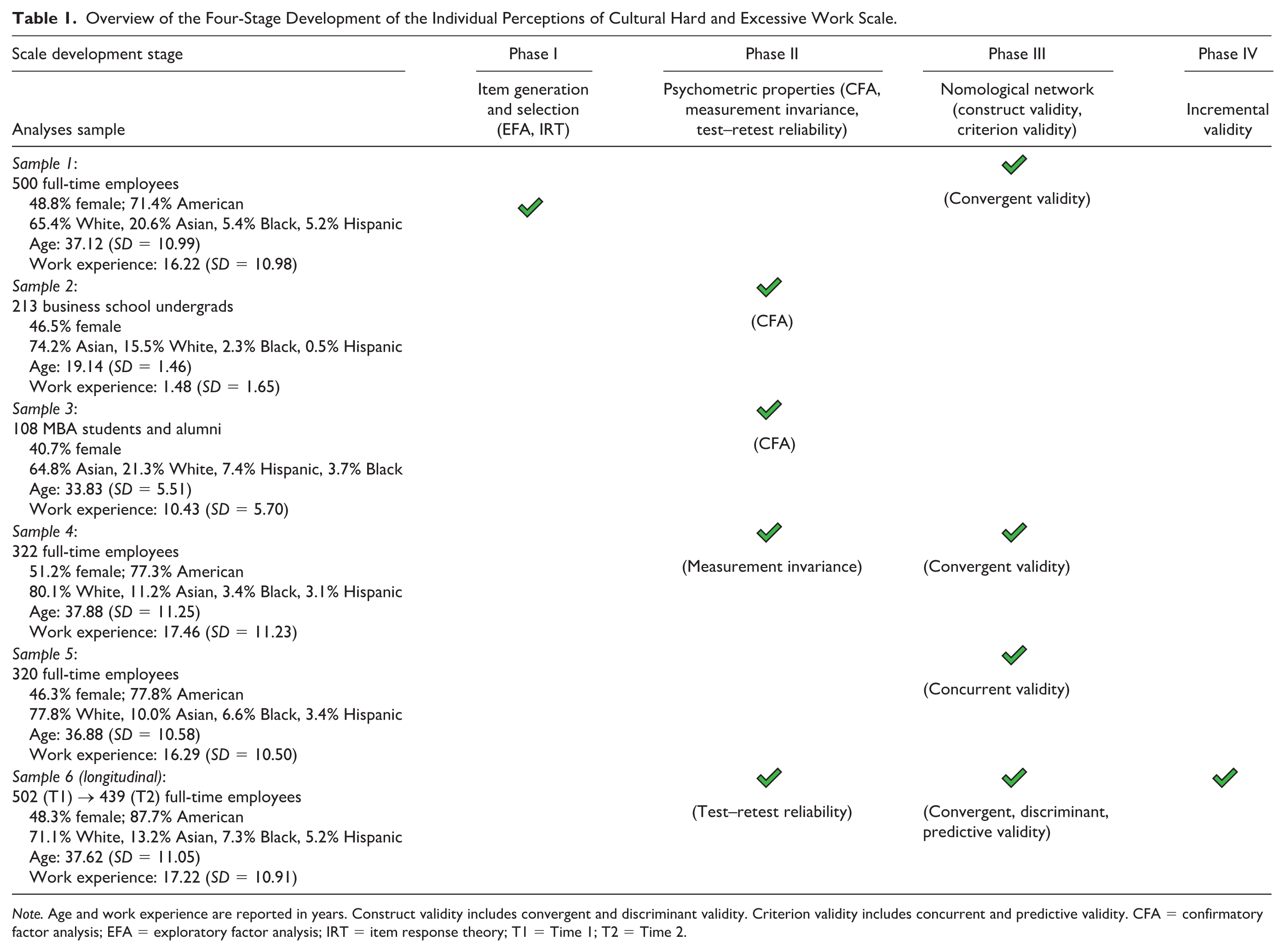
Note. Age and work experience are reported in years. Construct validity includes convergent and discriminant validity. Criterion validity includes concurrent and predictive validity. CFA = confirmatory factor analysis; EFA = exploratory factor analysis; IRT = item response theory; T1 = Time 1; T2 = Time 2.
Sample 1: Full-Time Employees
A total of 500 full-time employees 3 (working 35+ hr/week) residing in Canada or the United States were recruited via Prolific. We administered the full I-CHEW candidate item pool (55 items) and relevant individual, organizational, and cultural measures (see Table 2).
Measures Used in Each Sample.
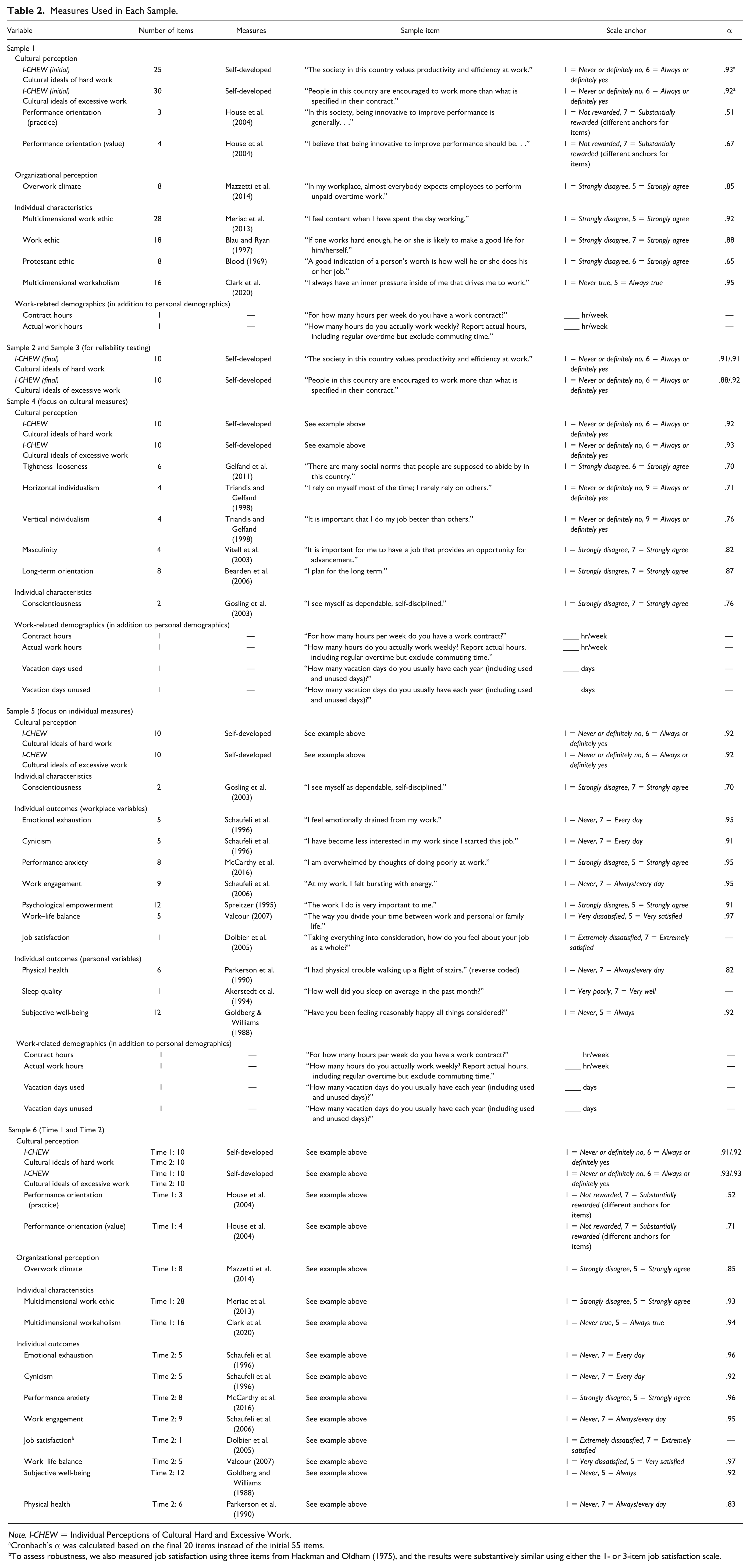
Note. I-CHEW = Individual Perceptions of Cultural Hard and Excessive Work.
Cronbach’s α was calculated based on the final 20 items instead of the initial 55 items.
To assess robustness, we also measured job satisfaction using three items from Hackman and Oldham (1975), and the results were substantively similar using either the 1- or 3-item job satisfaction scale.
Sample 2: Business School Undergraduates
Sample 2 consisted of 213 business students 4 from a large public university in Western Canada. They completed the 20 final I-CHEW items (I-CHEW-20). We chose this sample to probe its generalizability beyond working populations. According to evidence that values promoting hard work are instilled early and evident in university students (Eisenberger & Shank, 1985), we argue that if a society has shared cultural ideals of hard work and/or excessive work, they should also manifest in attitudes toward schoolwork.
Sample 3: MBA Students and Alumni
Sample 3 was composed of 108 participants who were either current MBA and professional leadership master’s students or alumni from a North American university. Participants responded to a survey containing the final 20-item I-CHEW scale.
Sample 4: Full-Time Employees
We recruited 322 full-time employees residing in Canada or the United States from Prolific. This sample completed the I-CHEW-20 and several cultural measures (Table 2).
Sample 5: Full-Time Employees
A total of 320 full-time employees 5 residing in Canada or the United States were recruited via Prolific. Sample 5 responded to the I-CHEW-20 and several individual-level measures (Table 2).
Sample 6: Full-Time Employees
A total of 502 full-time employees residing in Canada or the United States were recruited via Prolific to take part in a two-wave survey. Of the 502 participants who completed the Time 1 survey, 439 completed the Time 2 survey 6 (87.5% retention rate; consistent with retention rates in prior scale development studies, e.g., Götz, Maertens, et al., 2024). Table 2 presents our measures. We measured predictors at Time 1 and outcomes at Time 2 (i.e., 1 week later) to reduce common method bias.
Phase I: Item Generation and Selection (Sample 1)
In line with best practices in psychometric guidelines and prior research (Maertens et al., 2024), all authors formed a double-blind item/expert committee (hereafter, the team) and adopted a four-pronged item generation and selection strategy. The team consisted of personality, social/cultural, and organizational psychologists originally from three different cultural backgrounds (Taiwan, Germany, and the Netherlands), all currently working in North America.
First, according to the jointly derived definition of cultural ideals of hard work and excessive work, the author team developed a pool of 98 items. Second, the team then conducted an independent review and classified each of the 98 items as either indicative of perceived cultural ideals of hard work or excessive work. Third, after several iterations of team discussions to reconcile inconsistencies, we agreed on 41 items capturing cultural ideals of hard work and 57 items capturing excessive work. Fourth, each expert member then independently ranked all items (based on representativeness and redundancy). Through this process, we reached consensus on 25 items for hard work and 30 items for excessive work, resulting in a total of 55 items for validation. Specifically, the 55-item pool contained seven reverse-coded items (one for hard work and six for excessive work), designed to mitigate response biases (e.g., acquiescence; Clifton, 2020). Content relevance of the initial 55-item scale was further vetted by asking six judges to assign each item to the best-fitting dimension or “non-applicable” (with four or more judges agreeing per item; Anderson & Gerbing, 1991), 7 and to assess item fluency. This judging panel consisted of three trained researchers in psychology and three in business/management from diverse cultures (Canada, China, New Zealand, Panama, United States), all of whom were uninvolved in this research. With our group representing diverse cultural backgrounds, our process was designed to ensure that our item pool of perceived work ideals would not be biased toward a particular (Western) ideology, thereby avoiding “home-field disadvantage” (Medin et al., 2010) in capturing values that are culturally imposed on individuals. In Sample 1, we further assessed content validity to consolidate items.
Sample 1 employees received instructions that the study was about “work beliefs”—which we defined for them as “commonly held opinions and feelings about work”—in their country. Participants read a brief definition of hard work (“putting in a great deal of effort with a focus on efficiency and quality at work”) and excessive work (“putting in excessive effort that goes beyond requirements with a focus on duration and quantity at work”), and subsequently answered all 55 items from our original pool. The items measuring how hard work and excessive work were valued in their society were presented in random order on a 6-point scale (1 = never or definitely no, 6 = always or definitely yes). This response anchor was chosen based on the widely used scale by Singelis et al. (1995) and to eliminate potential issues of midpoint responding (van de Vijver & Leung, 2021). Participants also completed existing scales on performance orientation, overwork climate, work ethic, and workaholism.
Analytical Strategy and Results
To guide item selection, a two-pronged analysis strategy was adopted, wherein we combined (a) classic EFA with (b) IRT allowing for detailed assessments of individual item performance and functioning.
To guide factor extraction, multiple criteria were employed. As recommended by Henson and Roberts (2006), we based our decision on empirical results from parallel tests and scree plots as well as theoretically-derived assumptions regarding the structure of cultural work ideals. Parallel tests identified four factors with eigenvalues larger than 1, surpassing those of the matching simulated factors based upon randomly generated data (eigenvalues: F1 = 21.76, F2 = 7.05, F3 = 2.35, F4 = 1.68). Of note, the two biggest factors explained more than 52% of the overall variance and the corresponding scree plot exhibited a steep bend after the second factor, followed by a flat curve, thereby suggesting a two-factor solution (see Figure S1 in the Supplemental Materials). This aligned well with our a priori theoretical model of two distinct cultural work ideal factors (hard and excessive work). We hence conducted EFAs with a two-factor structure. In so doing, we adopted a multi-method, multi-criterion item selection process, featuring a conservative set of six EFA- and IRT-based exclusion criteria: (a) factor loadings < 0.40 (Rosellini & Brown, 2021), (b) cross-loadings > 0.30 (Costello & Osborne, 2005), (c) communalities < 0.40 (Fabrigar et al., 1999), (d) Cronbach’s α reliability analysis, (e) differential test functioning (DTF) analysis (Meade, 2010), and (f) item information analysis.
Following the criteria mentioned above, 25 items were removed by applying our six criteria (see Figure 1). In the first two steps, 20 items were removed due to low factor loadings and high cross-loadings. The third step of communality analysis concerned whether the amount of original information contained in each variable can be extracted from a common latent factor. Five items indicated that only a small amount of information would be extracted and were thus removed. In the fourth step, Cronbach’s α reliability analysis was applied to remove items that had diminishing effects (|∆α| > .001) on the overall reliability of the test. All remaining 30 items passed this threshold.
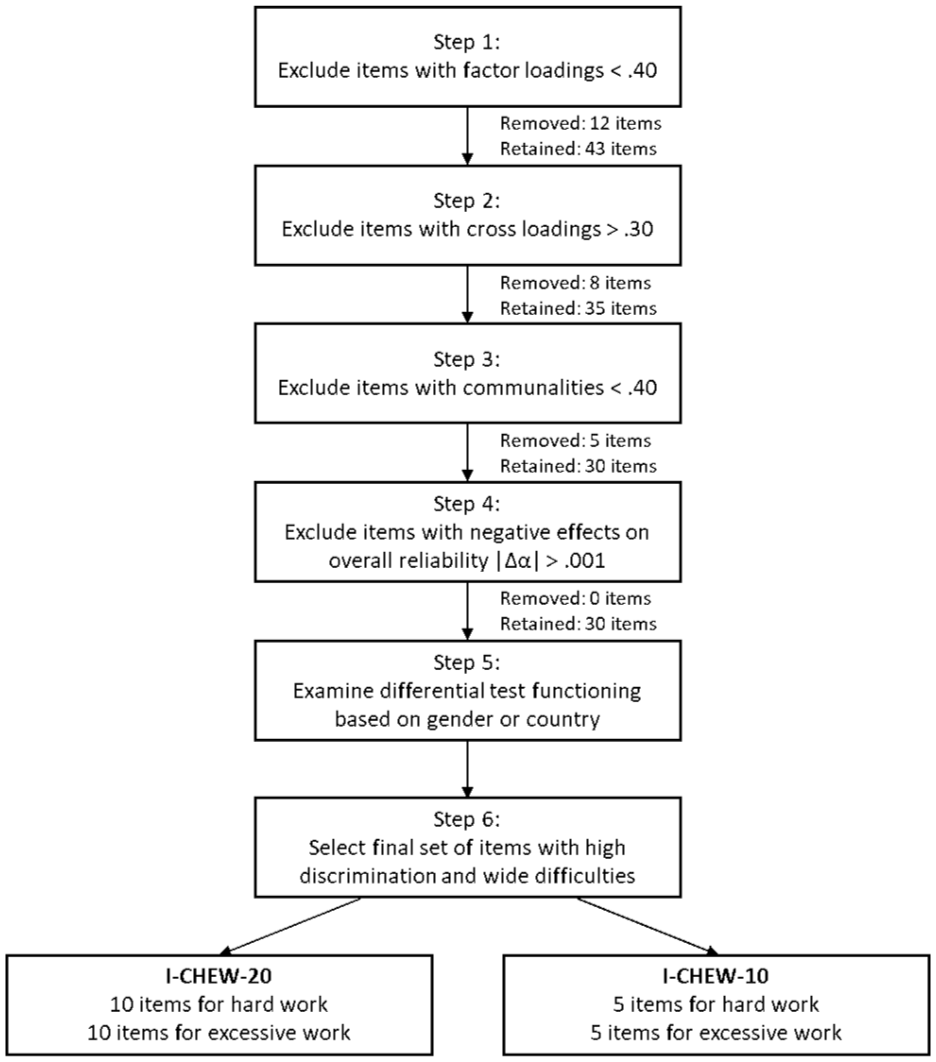
Item selection decision tree for exploratory factor analysis and item response theory.
We conducted DTF analysis before proceeding to item-level IRT analysis to ensure that the remaining set of items functioned equivalently across key demographic groups. In this fifth step, no meaningful DTF was detected for sex (male vs. female) or country (United States vs. Canada). Specifically, the comparison between constrained model (where item parameters were assumed to be equal across groups) and unconstrained model (where item parameters were allowed to vary across groups) did not reach conventional significance at p < .05 for remaining hard work items between sexes, Δ∆χ2 (20) = 26.65, and between countries, Δ∆χ2 (20) = 29.49, and for excessive work items between sexes, Δ∆χ2 (10) = 18.32, and between countries, Δ∆χ2 (10) = 11.80 (see Table S1 in the Supplemental Materials). 8
Eventually, for each of the two latent factors, we fitted a unidimensional (i.e., single latent factor) graded response IRT model to account for the polytomous structure of our items. This helped inform the selection of the 20 best-performing items (10 hard work, 10 excessive work) that would ultimately make up the I-CHEW. IRT was chosen for this task as—unlike classical test theory—IRT calibrations offer nuanced information on individual item performance and allow for more granular item selection (Edelen & Reeve, 2007). Accordingly, we aimed for a diverse set of items that would not merely offer high discrimination (i.e., be able to distinguish well between different levels of cultural ideals for hard, excessive work, respectively) but also cover a broad range of difficulties (i.e., work well across the entire spectrum of cultural ideals for hard, excessive work, respectively). Inspecting individual item information functions of all 30 items, we selected those that offered high overall information utility as well as unique information utility (i.e., covering parts of the ability spectrum that would not already be covered by other items). The goal was to coalesce the 30-item pool into a 20-item scale that would offer high test information across the whole range of different levels of cultural endorsement of hard, and excessive work, respectively. Individual item information function curves (Figure S2a) as well as test information curves for the cultural ideals of hard work (Figure S2b) and excessive work (Figures S3a and S3b) are exhibited in the Supplemental Materials.
In sum, we arrived at the I-CHEW-20, with 10 items on both dimensions. For soundness, beyond our described EFA and IRT approaches, we not only leveraged ESEM 9 but followed traditional methods outlined by Hinkin and Tracey (1999) (ANOVA) and Colquitt et al. (2019) (htc, htd)—incorporating a new sample (N = 99) for an item sorting task—as multi-method verification for content validity. Participants rated each of the 20 items as fitting significantly better with the correct dimension than with the other dimension (Table S3).
We further created a short scale, the I-CHEW-10, with five items per dimension, following the same set of procedures. The final items that constitute the I-CHEW-20 and I-CHEW-10 are presented in Table 3. Importantly, the 10-item and 5-item versions of hard work in I-CHEW-20 and I-CHEW-10 are strongly correlated (Samples 1–6: rs ≥ .94, ps < .001), as are the 10-item and 5-item versions of excessive work (rs ≥ .94, ps < .001). Below, we report the validation of the I-CHEW-20 (for the I-CHEW-10, refer to Figures S4–S5 and Tables S4–S10 in the Supplemental Materials).
Standardized Factor Loadings From Exploratory Structural Equation Modeling of Sample 1 and Confirmatory Factor Analyses of Sample 2 to Sample 6.
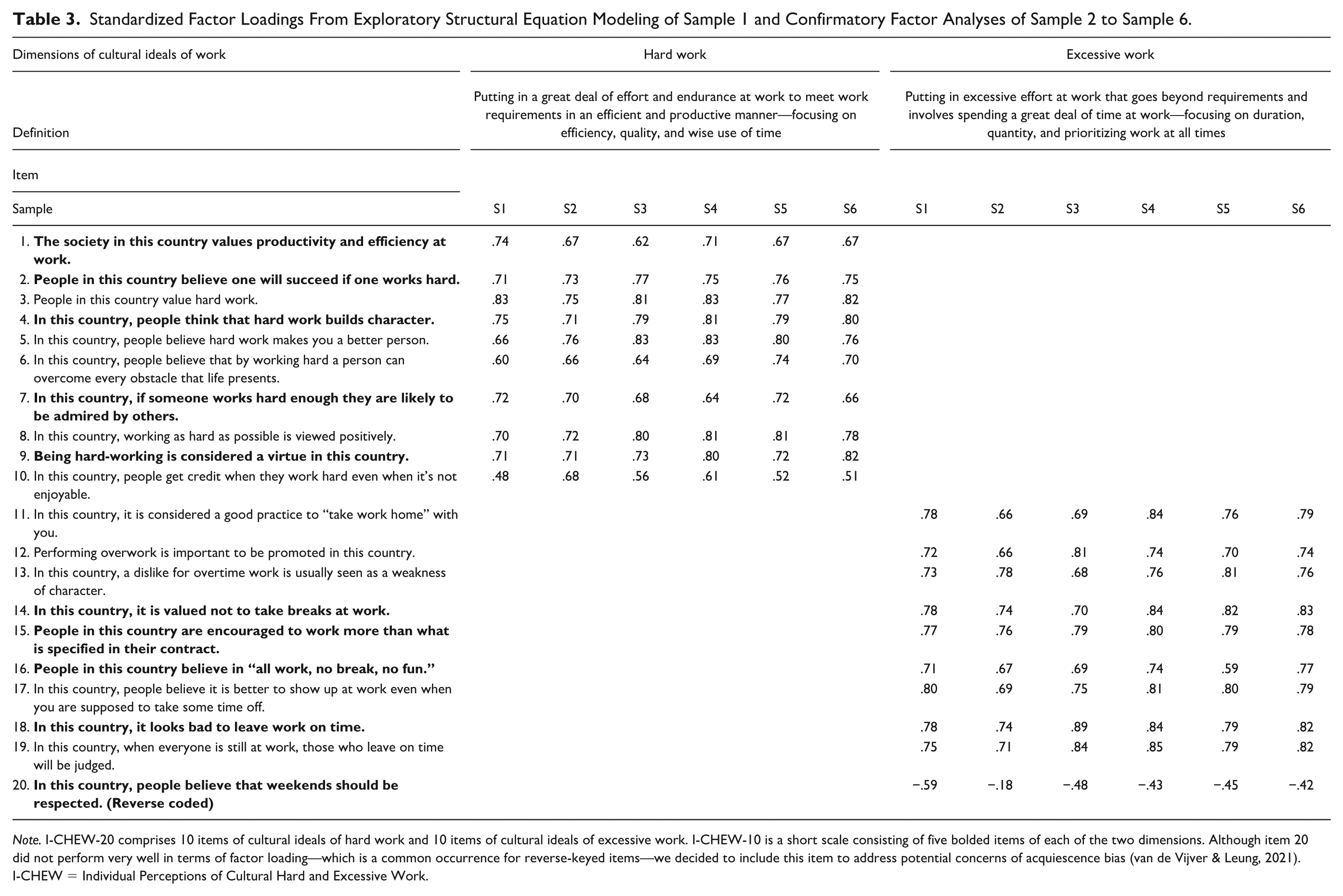
Note. I-CHEW-20 comprises 10 items of cultural ideals of hard work and 10 items of cultural ideals of excessive work. I-CHEW-10 is a short scale consisting of five bolded items of each of the two dimensions. Although item 20 did not perform very well in terms of factor loading—which is a common occurrence for reverse-keyed items—we decided to include this item to address potential concerns of acquiescence bias (van de Vijver & Leung, 2021).
I-CHEW = Individual Perceptions of Cultural Hard and Excessive Work.
Phase II: Psychometric Properties of the I-CHEW (Samples 2, 3, 4, and 6)
Next, we aimed to affirm the two-factor structure and (test–retest) reliability of the I-CHEW across Samples 2, 3, 4, and 6.
Confirmatory Factor Analysis
We ran CFAs on the 20 items of the I-CHEW using Samples 2 and 3 (CFI ≥ 0.90 = acceptable, ≥ 0.95 = excellent; RMSEA/SRMR ≤ 0.10 = acceptable, ≤ 0.06 = excellent; Hu & Bentler, 1999). Sample 2 (business undergraduate students) results showed that a two-factor model fit the data adequately, χ2 (169, 213) = 370.13, p < .001, CFI = 0.90, RMSEA = 0.07, SRMR = .07, and outperformed a one-factor solution, ∆χ2 (1) = 811.72, p < .001. Our scale also showed excellent reliability for each dimension (Hard work: α = .91, ω = .91; Excessive work: α = .88, ω = .89).
Sample 3 (MBA students and alumni) again supported a two-factor model as a sufficient fit to the data, χ2 (169, 108) = 241.24, p < .001, CFI = 0.94, RMSEA = 0.06, SRMR = 0.07, and better than a one-factor solution, Δ∆χ2 (1) = 532.36, p < .001. Our scale demonstrated great reliability (Hard work: α = .91, ω = .91; Excessive work: α = .92, ω = .92). Item-level CFA results based on these two samples are reported in Table 3, along with those for Samples 4, 5, and 6—all of which confirmed the two-factor structure.
Measurement Invariance
We performed multigroup CFAs 10 (Luong & Flake, 2023) on the I-CHEW to determine measurement invariance—whether our constructs are measured equivalently across countries (Canada vs. United States). According to Milfont and Fischer (2010), configural, metric, and scalar invariance represent three necessary models for group testing. Sample 4 (employees) results confirmed configural invariance, indicating the same factor structure between two countries, χ2 (338, 319) 11 = 725.03, p < .001, CFI = 0.91, RMSEA = 0.09, SRMR = 0.07. Metric invariance was also supported, χ2 (356, 319) = 748.18, p < .001, CFI = 0.91, RMSEA = 0.08, SRMR = 0.08, with the metric model not significantly different from the configural model, Δ∆χ2 (18) = 23.15, p = .18, Δ∆CFI = 0.001, Δ∆RMSEA = −0.002, suggesting equal factor loadings across countries. However, intercepts of some items differed across countries, χ2 (374, 319) = 794.16, p < .001, CFI = 0.90, RMSEA = 0.08, SRMR = 0.08, with the scalar model different from the metric model, Δ∆χ2 (18) = 45.99, p < .001, Δ∆CFI = 0.006, Δ∆RMSEA = 0.001; freeing 3 (out of 20) item intercepts 12 achieved partial scalar invariance, χ2 (371, 319) = 771.92, p < .001, CFI = 0.91, RMSEA = 0.08, SRMR = 0.08, showing no significant difference from the metric model, Δ∆χ2 (15) = 23.74, p = .07, Δ∆CFI = 0.002, Δ∆RMSEA = −0.001. In conclusion, measurement invariance results validate I-CHEW as a sufficiently fair and comparable scale across Canada and the United States.
Test–Retest Reliability
Using Sample 6 (employees), we examined the test–retest reliability of the I-CHEW measured 1 week apart. The results suggest a satisfactory test–retest reliability (Hard work: r = .65, p < .001; Excessive work: r = .83, p < .001).
Phase III: Nomological Network (Samples 1, 4, 5, and 6)
In Stage 3, we established and evaluated the nomological network of the I-CHEW to gauge construct validity (convergent [Samples 1, 4, and 6], discriminant validity [Sample 6]), and criterion validity (concurrent [Sample 5], predictive validity [Sample 6]).
Convergent Validity
We first explored whether cultural ideals of hard work and excessive work are related to certain characteristics in an organization, culture, and individual that are expected to be associated with such cultural ideals, based on theoretical grounds. All predictions are summarized in Table 4.
Overview of Assessed Constructs, Expected and Empirical Relationships With Cultural Ideals of Hard and Excessive Work.
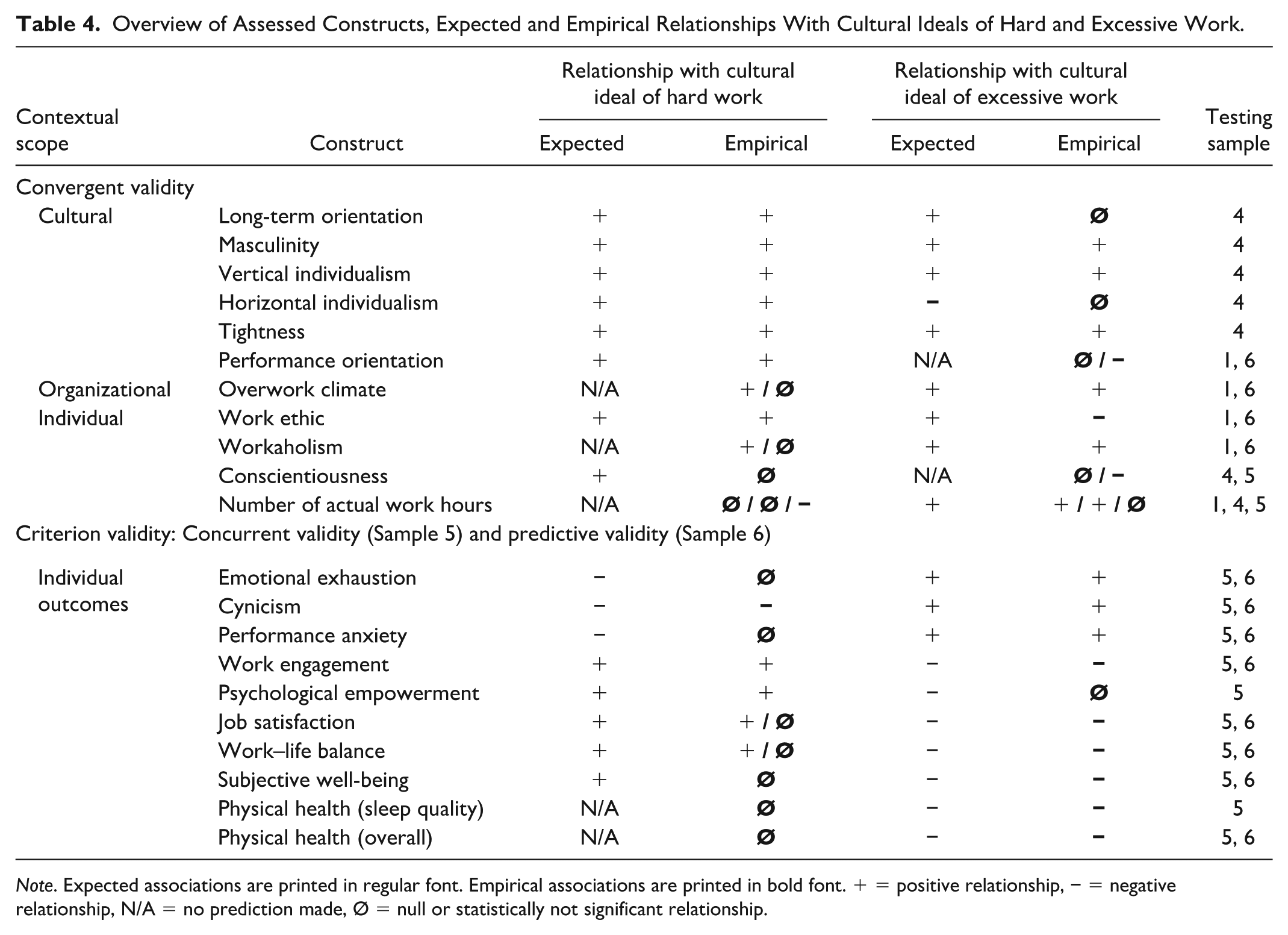
Note. Expected associations are printed in regular font. Empirical associations are printed in bold font. + = positive relationship, − = negative relationship, N/A = no prediction made, Ø = null or statistically not significant relationship.
Cultural Constructs
We expected that both hard work and excessive work would be positively associated with cultural values that emphasize perseverance, achievement, (material) success, and self-reliance, which drive individuals to put effort into meeting work requirements, and go the extra mile to reach personal work aspirations. These cultural values include long-term orientation (i.e., prioritization of planning and future benefits vs. short-term gratification; Bearden et al., 2006), masculinity (i.e., preference for competition and achievement; Vitell et al., 2003), and vertical individualism (i.e., importance of personal pursuit/success including high status; Triandis & Gelfand, 1998). We also predicted that both dimensions of the I-CHEW would relate positively to cultural tightness. Tight cultures are characterized by a low degree of permissiveness (strict rules) and strong sanctioning (for rule violation; Gelfand et al., 2011), which may reinforce a strong sense of duty and self-control among citizens. Additionally, we anticipated hard work to be positively related to performance orientation, which often emphasizes efficiency and productivity leading to high performance (Javidan, 2004), and horizontal individualism (i.e., importance of autonomy and self-reliance; Triandis & Gelfand, 1998). Conversely, we made no predictions between excessive work and performance orientation, because high-performance cultures do not equate success with excessive time commitment; and we expected a negative relationship between excessive work and horizontal individualism as excessive work ideals encroach on non-work lives, suggesting reduced personal autonomy.
Organizational Construct
We expected cultural ideals of excessive work to relate positively to overwork climate in the workplace (Mazzetti et al., 2014), as cultures that highly regard excessive work could establish norms that organizations must work extended hours with additional effort. No prediction was made between hard work and overwork climate as the former focuses on quality and therefore does not fit with overtime (quantity).
Individual Constructs
For individual traits, both cultural ideals of excessive and hard work were expected to correlate positively with work ethic. In cultures valuing hard work and excessive work, individuals are motivated to put in effort and achieve productivity. These components are important features of existing measures of (Protestant) work ethic (Blau & Ryan, 1997; Meriac et al., 2013). In addition, we expected a positive association between (perceived) excessive work and individual workaholism; workaholism should be more encouraged in societies valuing long work hours. However, we did not make predictions regarding the association between hard work and workaholism as such ideals (efficient, productive working styles) are not a hallmark of being obsessed with work (Clark et al., 2020). We also posited that societies appreciating hard work would likely foster greater levels of individual conscientiousness, marked by being organized, responsible, and diligent (Gosling et al., 2003); but not necessarily in the case of excessive work ideals, as being conscientious is not synonymous with overcommitting or lacking work–life boundaries. Last, we expected strong endorsement of excessive work to be manifested in the number of actual work hours reported, whereas we made no such predictions for hard work ideals (see Table 4).
Results
Based on a small-to-medium effect size (r = .20, typically observed in the organizational literature; Bosco et al., 2015) and .80 power, a total sample size of 193 was required. Samples (S) 1, 4, 5, and 6 exceeded this target. Tables 5 to 8 report correlations among all variables for construct validity and Table 4 summarizes our results. As predicted, results showed that the perceived cultural ideal of hard work was positively related to long-term orientation (S4: r = .38, p < .001), masculinity (S4: r = .32, p < .001), vertical individualism (S4: r = .12, p < .05), horizontal individualism (S4: r = .20, p < .001), tightness (S4: r = .35, p < .001), and performance orientation (S1 and S6: rspractice ≥ .40, pspractice < .001; rsvalue ≥ .19, psvalue < .001). Meanwhile, excessive work was associated with masculinity (S4: r = .12, p < .05), vertical individualism (S4: r = .20, p < .001), and tightness (S4: r = .23, p < .001). Contrary to our predictions, the perceived cultural ideal of excessive work was not related to long-term orientation (S4: r = −.03, p = .64) and horizontal individualism (S4: r = .10, p = .07). In addition, whereas we predicted excessive work to be unrelated to performance orientation, excessive work was in fact negatively correlated with performance orientation in one of the two samples (S1: rpractice = −.001, ppractice = .98; rvalue = −.08, pvalue = .08; S6: rpractice = −.10, ppractice < .05; rvalue = −.10, pvalue < .05).
Means, Standard Deviations, and Correlations in Sample 1.
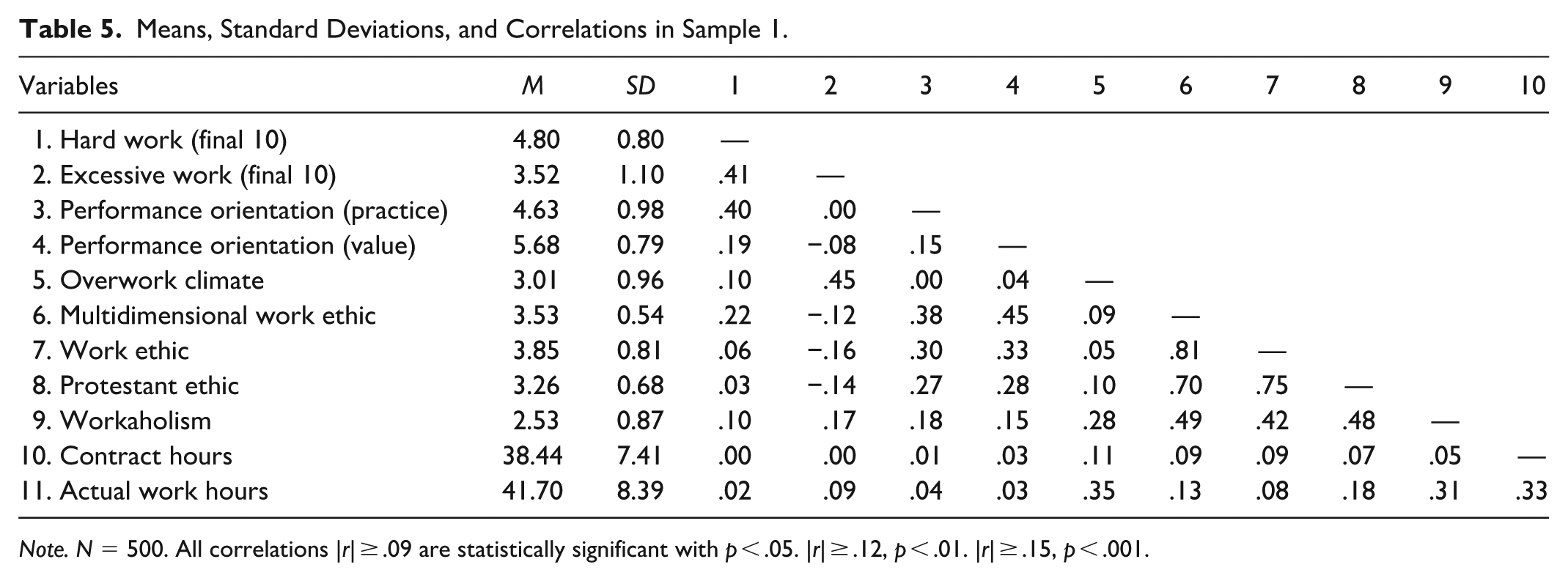
Note. N = 500. All correlations |r| ≥ .09 are statistically significant with p < .05. |r| ≥ .12, p < .01. |r| ≥ .15, p < .001.
Means, Standard Deviations, and Correlations in Sample 4.
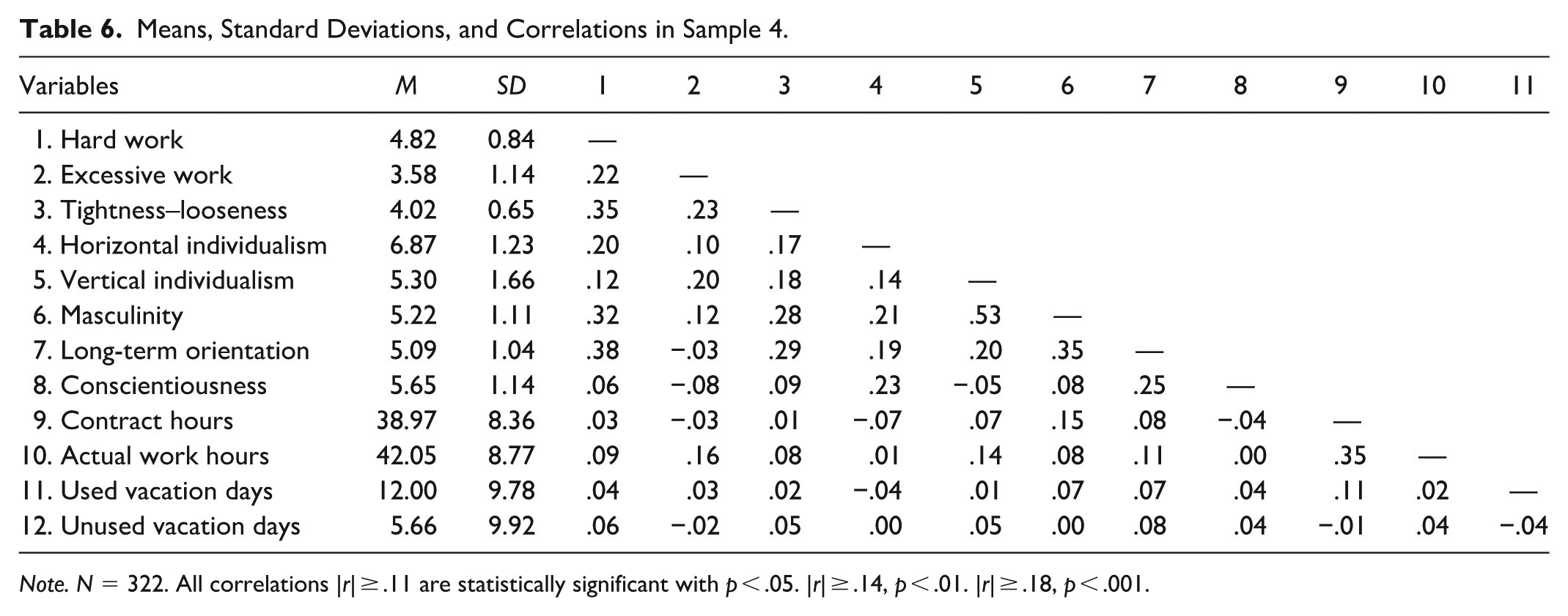
Note. N = 322. All correlations |r| ≥ .11 are statistically significant with p < .05. |r| ≥ .14, p < .01. |r| ≥ .18, p < .001.
Means, Standard Deviations, and Correlations in Sample 5.
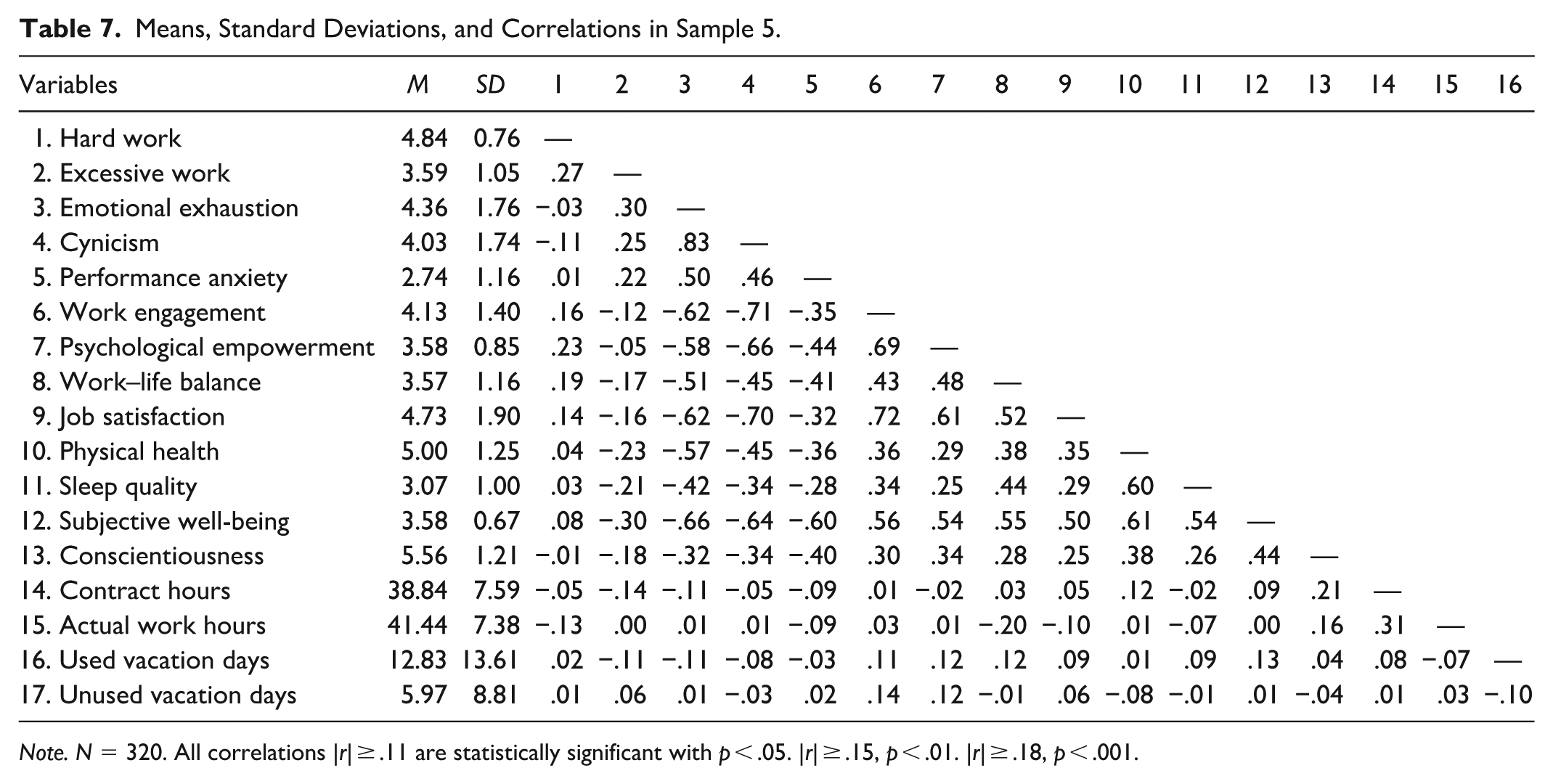
Note. N = 320. All correlations |r| ≥ .11 are statistically significant with p < .05. |r| ≥ .15, p < .01. |r| ≥ .18, p < .001.
Means, Standard Deviations, and Correlations in Sample 6.
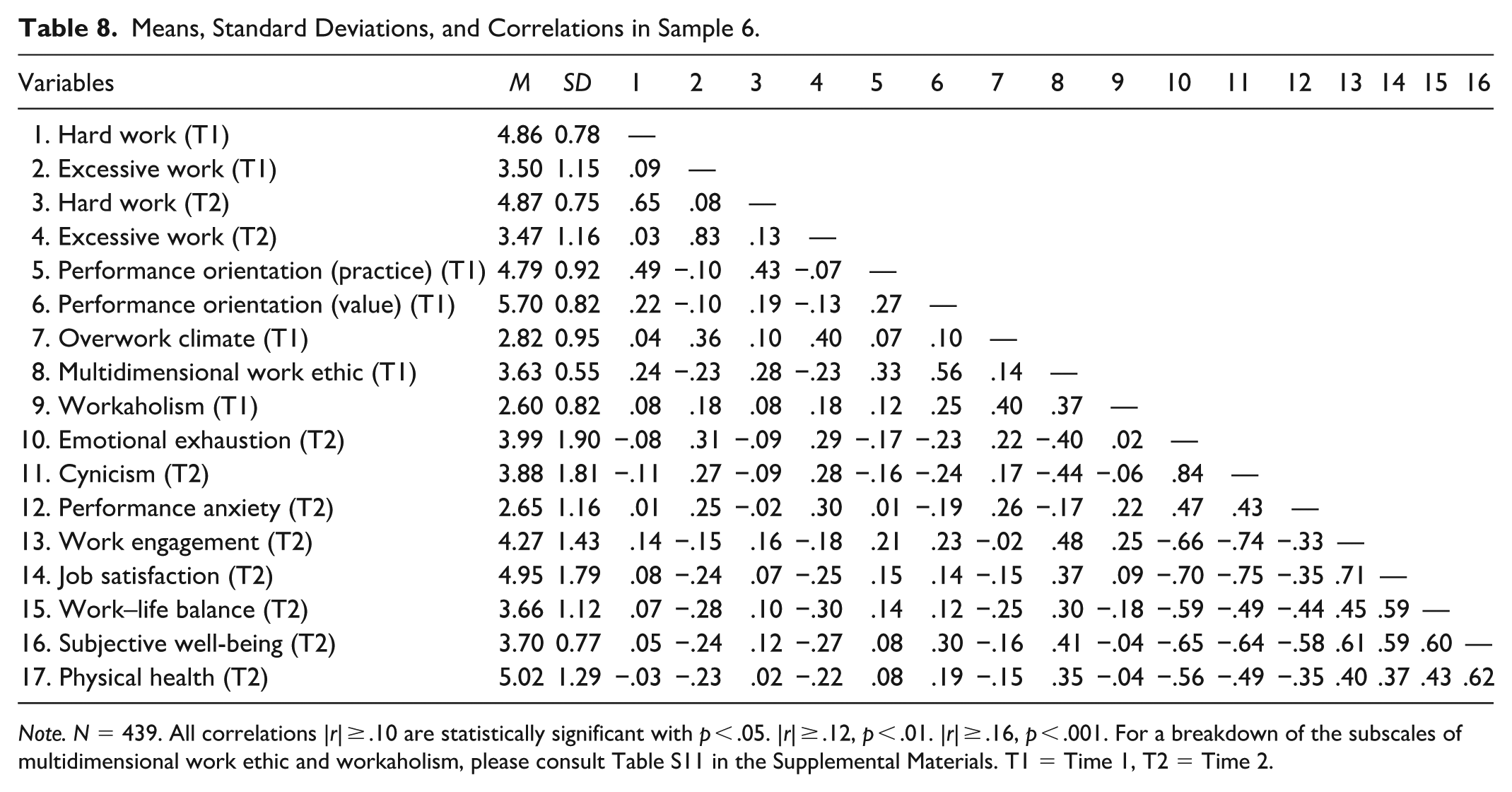
Note. N = 439. All correlations |r| ≥ .10 are statistically significant with p < .05. |r| ≥ .12, p < .01. |r| ≥ .16, p < .001. For a breakdown of the subscales of multidimensional work ethic and workaholism, please consult Table S11 in the Supplemental Materials. T1 = Time 1, T2 = Time 2.
For organizational constructs, we found a positive association between overwork climate and excessive work (S1 and S6: rs ≥ .36, ps < .001). We also found a positive correlation between overwork climate and hard work in one of the samples (S1: r = .10, p < .05; S6: r = .04, p = .45), counter to our expectation.
Regarding individual characteristics, we found positive relationships between hard work and multidimensional work ethic (S1 and S6: rs ≥ .22, ps < .001). Contrary to our expectations, hard work was also positively correlated with workaholism in one of the two samples (S1: r = .10, p < .05; S6: r = .08, p = .09), and we did not find positive relationships between conscientiousness and hard work (S4 and S5: −.01 ≤ rs ≤ .06, ps ≥ .25). Whereas we had not expected associations between work hours and hard work, we found a negative correlation in one of the three samples (S1: r = .02, p = .60; S4: r = .09, p = .11; S5: r = −.13, p < .05). For the excessive work dimension, we observed consistent positive relationships with workaholism (S1 and S6: rs ≥ .17, ps < .001) as expected. However, we found negative associations of excessive work with all work ethic variables (S1 and S6: rsmultidimensional work ethic < −.12, psmultidimensional work ethic < .01; S1: rwork ethic = −.16, pwork ethic < .001; rProtestant ethic = −.14, pProtestant ethic < .01), as well as—on one occasion—conscientiousness (S4: r = −.08, p = .13; S5: r = −.18, p < .001). Finally, as expected, actual work hours were positively correlated with excessive work in all but one sample (S1 and S4: rs ≥ .09, ps < .05; S5: r = .004, p = .94).
Discriminant Validity
Following Rönkkö and Cho (2022), we conducted a series of CFAs to test discriminant validity between the I-CHEW and the most related constructs noted earlier: performance orientation (practice or value), overwork climate, work ethic, and workaholism. To clarify, in our analyses—particularly discriminant validity and incremental validity—we followed the original scale developers in separating performance orientation practice and value, while treating work ethic and workaholism holistically despite their multidimensionality, on conceptual and empirical grounds. 13
Results
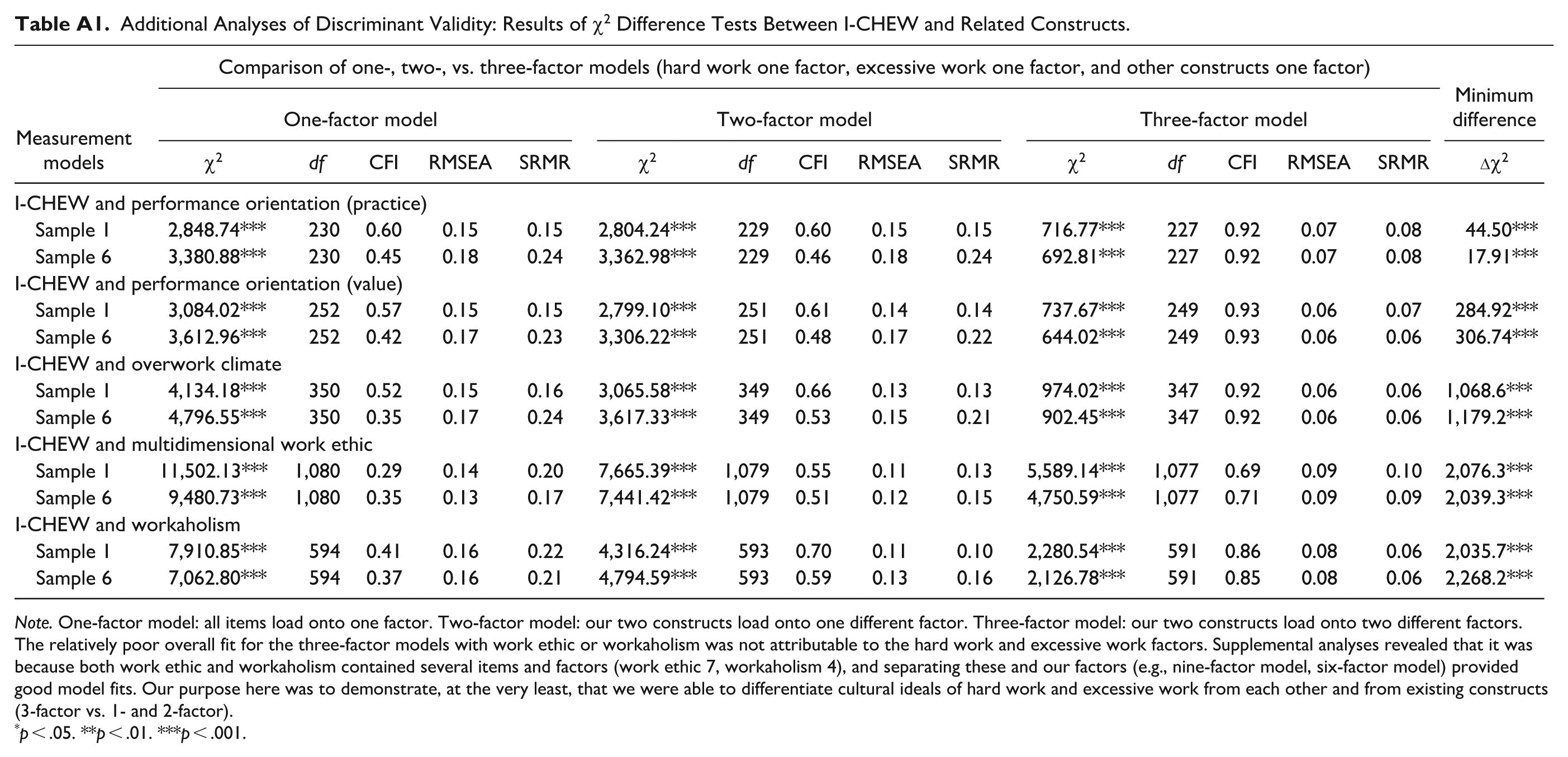
Using Sample 6 (as well as Sample 1), we compared one-factor models (hard work and the related construct combined) to two-factor models (hard work and the related construct separated). We repeated this procedure for the excessive work scale (see Tables 9 and 10). Loading all items onto one factor fit the data significantly worse than the two-factor models when modeling hard work with practice (Δ∆χ2 (1) = 17.64, p < .001 for S6) or value of performance orientation (Δ∆χ2 (1) = 303.52, p < .001), overwork climate (Δ∆χ2 (1) = 1,184.7, p < .001), work ethic (Δ∆χ2 (1) = 2,142.3, p < .001), or workaholism (Δ∆χ2 (1) = 3,649.8, p < .001). The same was true for excessive work results when modeling with practice (Δ∆χ2 (1) = 76.77, p < .001) or value of performance orientation (Δ∆χ2 (1) = 318.66, p < .001), overwork climate (Δ∆χ2 (1) = 945.83, p < .001), work ethic (Δ∆χ2 (1) = 2,544.3, p < .001), or workaholism (Δ∆χ2 (1) = 2,602.6, p < .001). Additional analyses in Appendix A of loading each related construct and I-CHEW as one-, two-, and three-factor models reaffirmed construct separation. Cumulatively, the results support the notion that the I-CHEW dimensions can be differentiated from each other and similar cultural (performance orientation), organizational (overwork climate), and individual constructs (work ethic and workaholism).
Discriminant Validity for Cultural Ideal of Hard Work: Results of χ2 Difference Tests With Related Constructs.
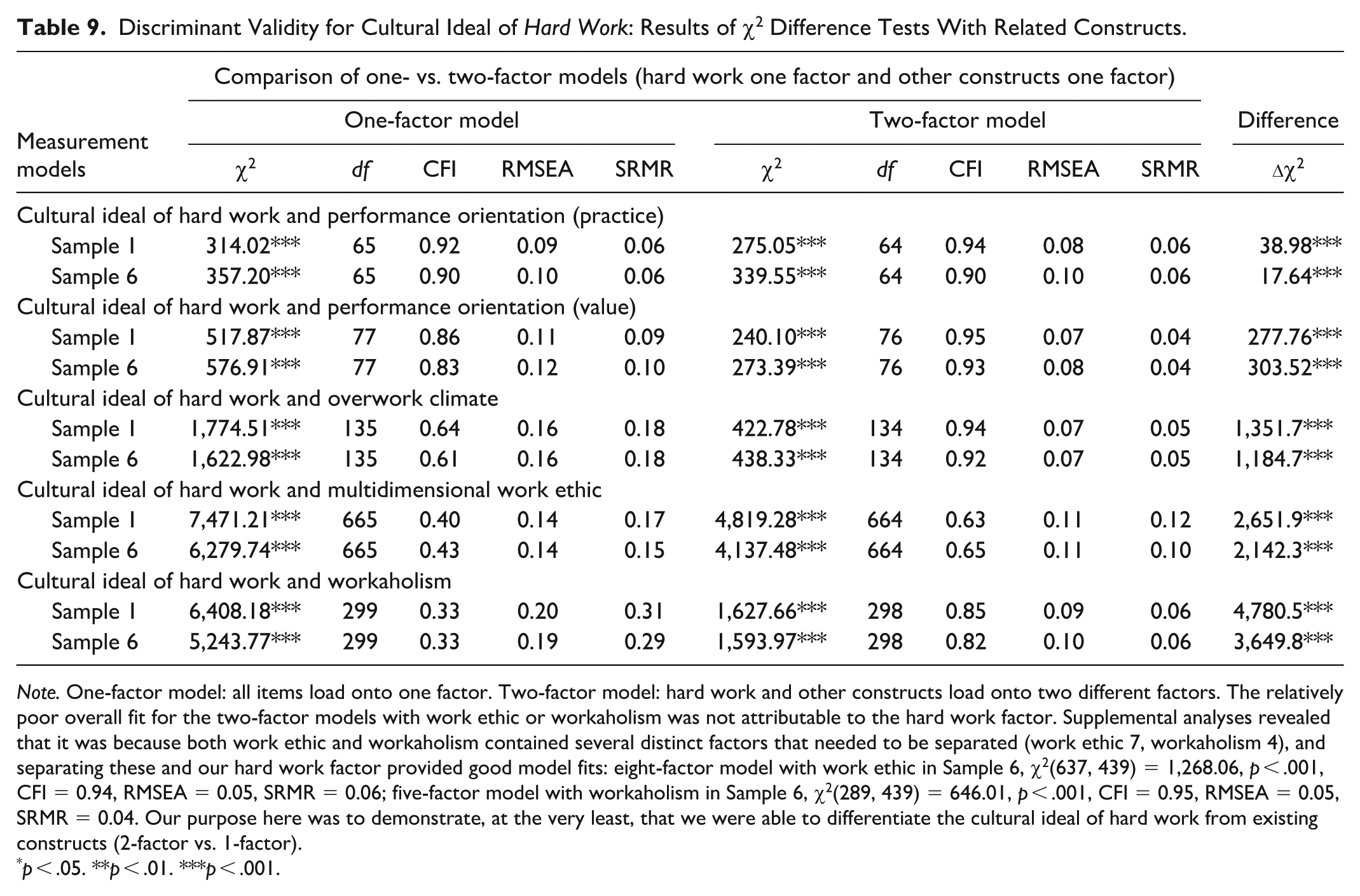
Note. One-factor model: all items load onto one factor. Two-factor model: hard work and other constructs load onto two different factors. The relatively poor overall fit for the two-factor models with work ethic or workaholism was not attributable to the hard work factor. Supplemental analyses revealed that it was because both work ethic and workaholism contained several distinct factors that needed to be separated (work ethic 7, workaholism 4), and separating these and our hard work factor provided good model fits: eight-factor model with work ethic in Sample 6, χ2(637, 439) = 1,268.06, p < .001, CFI = 0.94, RMSEA = 0.05, SRMR = 0.06; five-factor model with workaholism in Sample 6, χ2(289, 439) = 646.01, p < .001, CFI = 0.95, RMSEA = 0.05, SRMR = 0.04. Our purpose here was to demonstrate, at the very least, that we were able to differentiate the cultural ideal of hard work from existing constructs (2-factor vs. 1-factor).
p < .05. **p < .01. ***p < .001.
Discriminant Validity for Cultural Ideal of Excessive Work: Results of χ2 Difference Tests with Related Constructs.
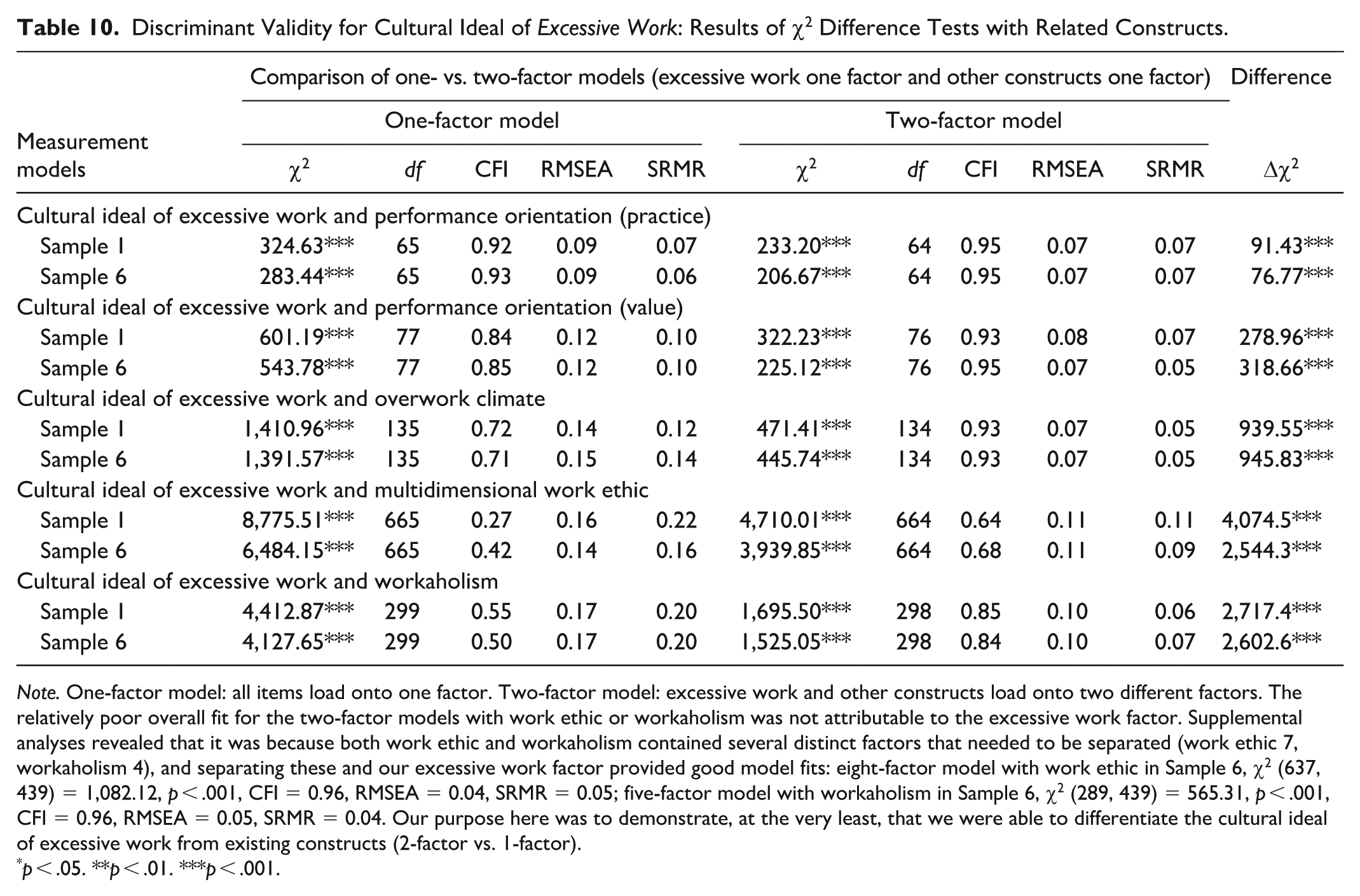
Note. One-factor model: all items load onto one factor. Two-factor model: excessive work and other constructs load onto two different factors. The relatively poor overall fit for the two-factor models with work ethic or workaholism was not attributable to the excessive work factor. Supplemental analyses revealed that it was because both work ethic and workaholism contained several distinct factors that needed to be separated (work ethic 7, workaholism 4), and separating these and our excessive work factor provided good model fits: eight-factor model with work ethic in Sample 6, χ2 (637, 439) = 1,082.12, p < .001, CFI = 0.96, RMSEA = 0.04, SRMR = 0.05; five-factor model with workaholism in Sample 6, χ2 (289, 439) = 565.31, p < .001, CFI = 0.96, RMSEA = 0.05, SRMR = 0.04. Our purpose here was to demonstrate, at the very least, that we were able to differentiate the cultural ideal of excessive work from existing constructs (2-factor vs. 1-factor).
p < .05. **p < .01. ***p < .001.
Criterion Validity
Next, we examined how both dimensions of the I-CHEW relate to personal and work outcomes (Table 4). Our analyses reveal concurrent validity evidence from Sample 5, where predictors (I-CHEW) and criterion variables were measured at the same time, and predictive validity evidence from Sample 6, where the I-CHEW was measured at Time 1 and criterion variables at Time 2 (i.e., 1 week later).
Specifically, we expected those working in a culture perceived as valuing hard work to have a healthier working style. If so, workers perceiving hard work ideals should be less emotionally drained and hold less cynical attitudes at work (emotional exhaustion and cynicism; Schaufeli et al., 1996), be less worried about performance (performance anxiety; McCarthy et al., 2016), be more engaged (work engagement; Schaufeli et al., 2006), report a greater sense of control and meaning in their work (psychological empowerment; Spreitzer, 1995), be more satisfied with their job (job satisfaction; Dolbier et al., 2005), maintain a better boundary between work and life (work–life balance; Valcour, 2007), and experience higher overall happiness (subjective well-being; Goldberg & Williams, 1988). Given that the efficient use of work time allows for recovery after work, we did not expect perceived cultural ideals of hard work to have detrimental effects on physical health (Parkerson et al., 1990).
Conversely, in cultures that emphasize excessive work, pernicious outcomes may be more prevalent due to norms and practices promoting overwork and relentless working styles that prevent recovery. Thus, we expected that perceiving a cultural ideal of excessive work would be positively related to emotional exhaustion, cynicism, performance anxiety, and negatively related to work engagement, job satisfaction, work–life balance, subjective well-being, and physical health.
Results
The correlations are summarized in Tables 7 and 8. Overall—consistent with our expectations—we observed that the cultural ideal of hard work predicted many beneficial outcomes, including lower cynicism (rs = −.11, ps < .05), greater work engagement (rs ≥ .14, ps < .01), higher psychological empowerment (S5: r = .23, p < .001), increased job satisfaction (S5: r = .14, p < .05; S6: r = .08, p = .08), and better work–life balance (S5: r = .19, p < .001; S6: r = .07, p = .12), but was not significantly related to emotional exhaustion (rs ≤ −.03, p ≥ .09), performance anxiety (rs = .01, ps ≥ .91), or subjective well-being (rs ≥ .05, ps ≥ .14). Finally, hard work had no relationships with physical health (S5: rsleep quality = .03, p = .55; S5 and S6: −.03 ≤ rsoverall physical health ≤ .04, ps ≥ .45).
As predicted, the perceived cultural ideal of excessive work had far-reaching adverse effects: increased emotional exhaustion (rs ≥ .30, ps < .001), cynicism (rs ≥ .25, ps < .001), and performance anxiety (rs ≥ .22, ps < .001), and decreased work engagement (rs ≤ −.12, ps < .05), job satisfaction (rs ≤ −.16, ps < .01), work–life balance (rs ≤ −.17, ps < .01), subjective well-being (rs ≤ −.24, ps < .001), and physical health (S5: rsleep quality = −.21, p < .001; S5 and S6: rsoverall physical health = −.23, ps < .001). We did not find negative impacts on psychological empowerment (S5: r = −.05, p = .35).
In summary, the nomological network shows that the perceived ideal of excessive work consistently impaired individual outcomes, whereas the perceived ideal of hard work was linked to various beneficial outcomes. Although most of our predictions were supported, offering strong construct and criterion validity evidence, we revisit noteworthy deviations in the discussion.
Phase IV: Incremental Validity (Sample 6)
Testing incremental validity via the longitudinal Sample 6, Phase IV investigated whether hard and excessive work (at Time 1) could predict outcomes (at Time 2) above and beyond existing measures.
Results
We conducted sequential multiple regressions (Tabachnick & Fidell, 2013) to examine the incremental validity of the I-CHEW (see Figure 2). In the first step, we entered one of the related constructs (performance orientation value or practice, overwork climate, work ethic, workaholism) as control, and in the second step, we tested whether the two dimensions of the I-CHEW predicted individual outcomes above and beyond this control. In line with scale development standards (Clark et al., 2020), we repeated these steps five times for a precise comparison between each construct and the I-CHEW dimensions. This approach provides information about each variable’s unique contributions and minimizes potential multicollinearity. If all variables are entered at once, there is a risk of overcontrolling, as “the addition of control variables can distort the effect of a variable of theoretical interest” (Kalnins, 2018, p. 2375).
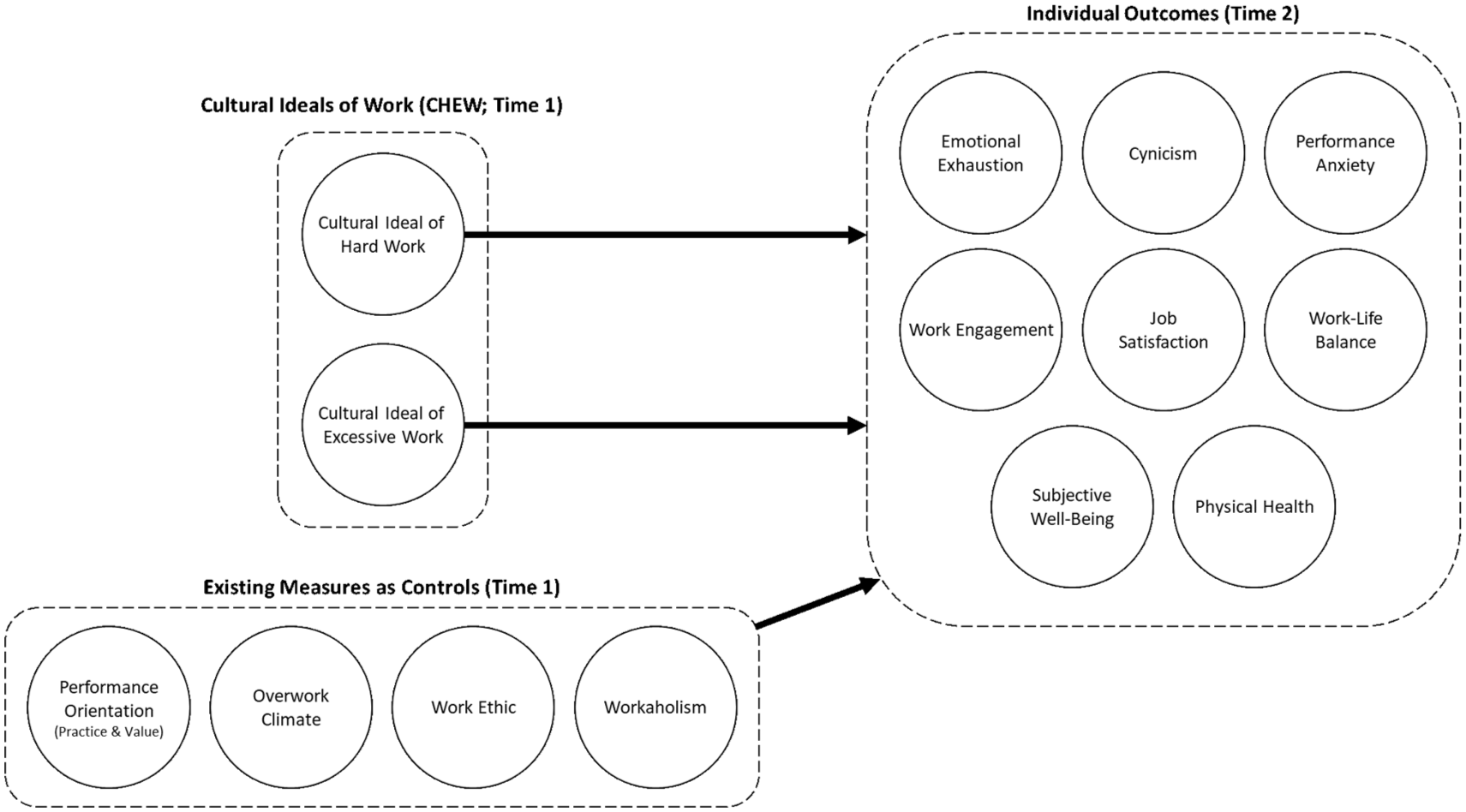
Approach to examination of incremental validity in Sample 6.
As illustrated in Table 11, when controlling for the respective construct, entering the two dimensions of the I-CHEW demonstrated significant incremental differences in the prediction of all outcomes (performance orientation practice as control: Δ∆Rs2 ≥ .02, ps < .01; performance orientation value: Δ∆Rs2 ≥ .03, ps < .01; overwork climate: Δ∆Rs2 ≥ .04, ps < .001; work ethic: Δ∆Rs2 ≥ .02, ps < .01, except for predicting work engagement after controlling work ethic Δ∆R2 = .003, p = .47; workaholism: Δ∆Rs2 ≥ .05, ps < .001). An overview of the findings is exhibited in Table 12. 14
Standardized Regression Analyses for Incremental Validity Relative to Other Work Values Measures.
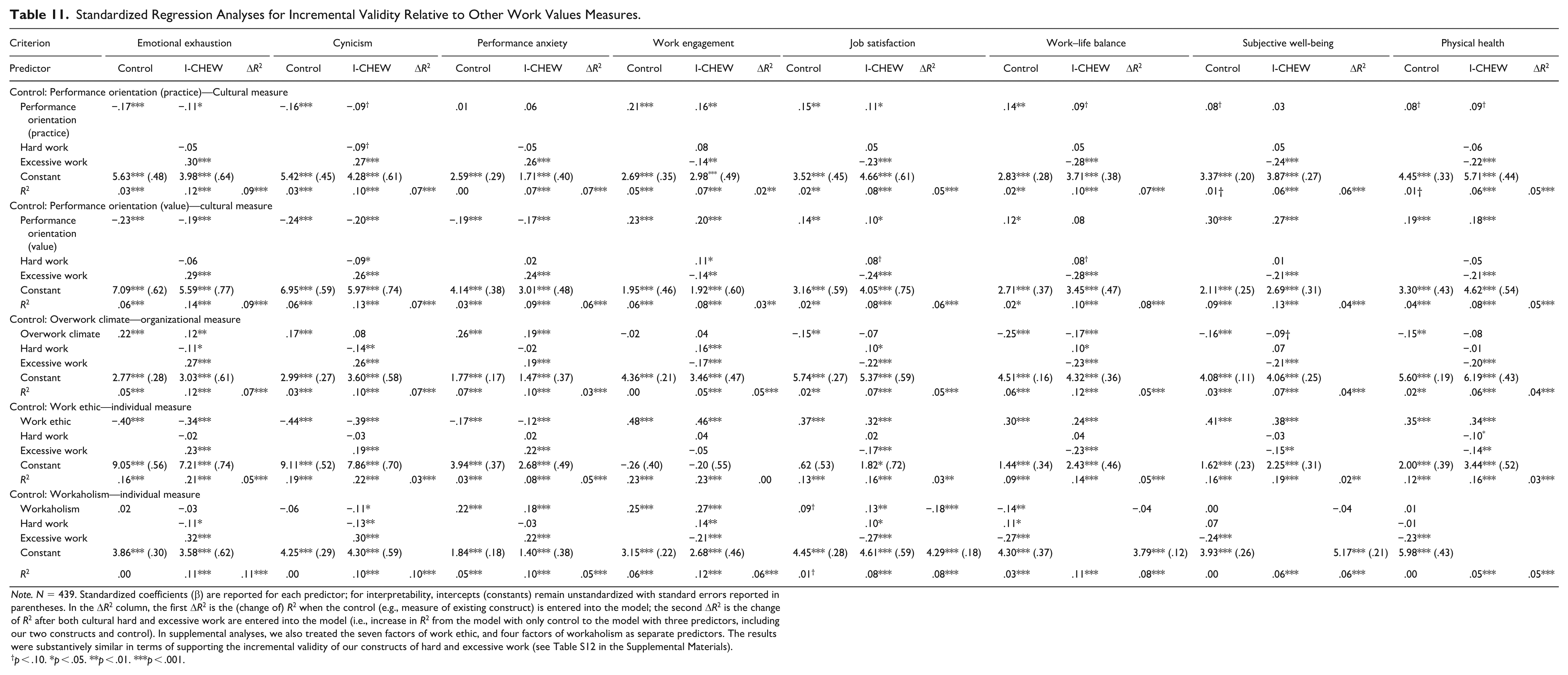
Note. N = 439. Standardized coefficients (β) are reported for each predictor; for interpretability, intercepts (constants) remain unstandardized with standard errors reported in parentheses. In the Δ∆R2 column, the first Δ∆R2 is the (change of) R2 when the control (e.g., measure of existing construct) is entered into the model; the second Δ∆R2 is the change of R2 after both cultural hard and excessive work are entered into the model (i.e., increase in R2 from the model with only control to the model with three predictors, including our two constructs and control). In supplemental analyses, we also treated the seven factors of work ethic, and four factors of workaholism as separate predictors. The results were substantively similar in terms of supporting the incremental validity of our constructs of hard and excessive work (see Table S12 in the Supplemental Materials).
p < .10. *p < .05. **p < .01. ***p < .001.
Overview of Incremental Validity Findings.
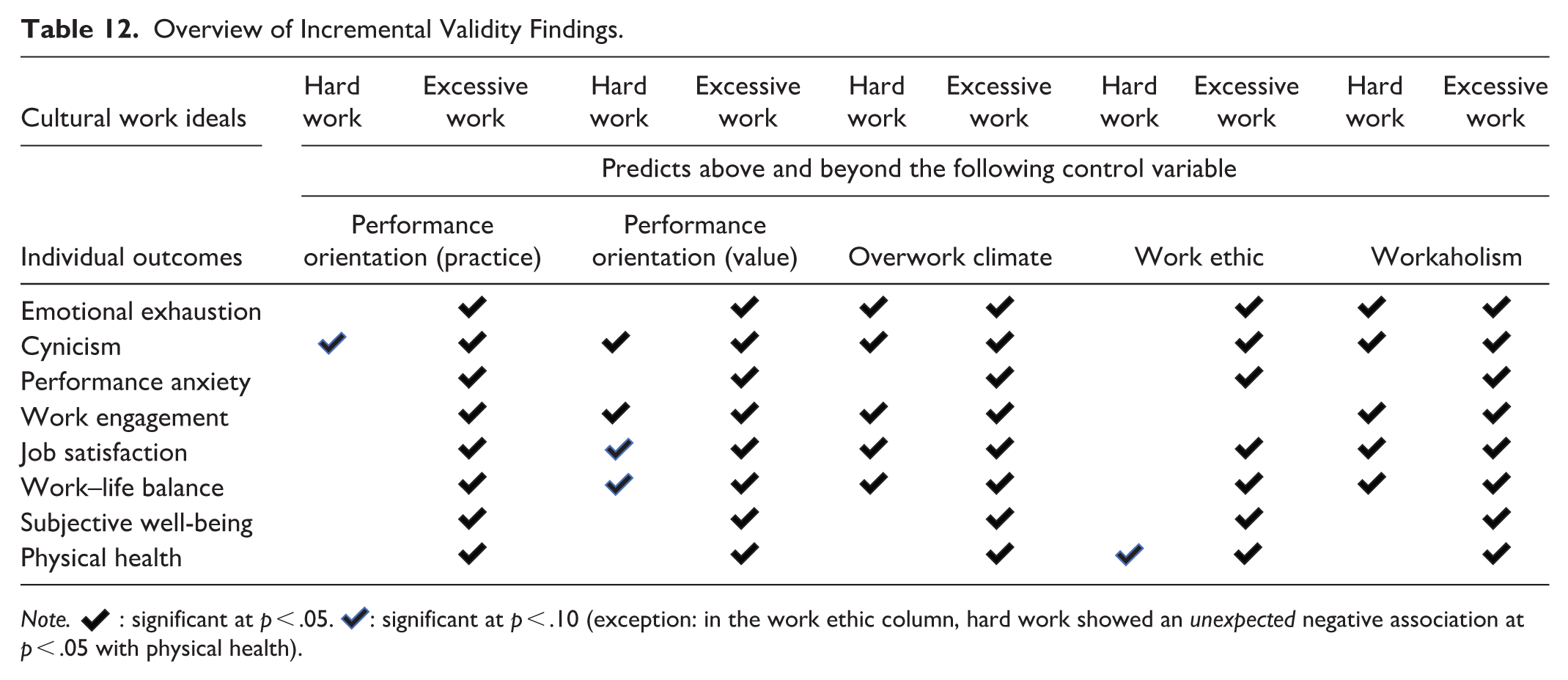
Note.
 : significant at p < .05.
  : significant at p < .10 (exception: in the work ethic column, hard work showed an unexpected negative association at p < .05 with physical health).
Discussion
We developed a measure for perceived cultural work ideals to offer a contextual explanation for differences in employees’ work styles and work outcomes. If an employee tends to bite off more than they can chew by working extremely long work hours, this behavior has traditionally been attributed to individual (e.g., workaholism) and organizational factors (e.g., overwork climate). We propose—and demonstrate—that cultural factors (e.g., individual understanding of a society’s appreciation for working efficiently vs. excessively) also drive this behavior, in particular, through specific work-related cultural ideals. As a novel contribution, the newly developed I-CHEW scale differentiates two influential cultural work ideals: hard work, which emphasizes individual perceptions of a society’s appreciation for efficiency, effort, and dedication to work while at work, versus excessive work, which captures a society’s appreciation for working long hours and prioritizing work at the expense of other life domains. We discuss below general trends observed in our findings, and explain some idiosyncratic mixed results which beg for further investigation in the future directions section.
Comprehensive tests of convergent, discriminant, and criterion validity showed that hard work ideals and excessive work ideals are unique perceptual constructs, each linked to distinct working styles as manifested in a diverse array of work values, attitudes, drive, and outcomes. The work values endorsed by hard work ideals (but not—or substantially less—by excessive work ideals) include quality and innovation (high performance orientation), self-reliance (strong horizontal individualism), and sustainability (long-term orientation). Hard work ideals are related to a diligent (strong work ethic) and efficient (no excessive hours) work attitude, whereas excessive work ideals focus more on being present, regardless of whether one works diligently or conscientiously during extended work hours. Hard work ideals seem to foster an intrinsically motivated work drive (Sheldon & Elliot, 1998), given their association with enhanced work engagement, empowerment, intrinsic motivation (see https://bit.ly/41ajfcE), and reduced cynicism. Excessive work ideals, on the other hand, may go together with an externally regulated drive (Kasser & Ryan, 1996), given their associations with enhanced cynicism, performance anxiety, extrinsic motivation, and reduced work engagement. Finally, the pattern of work outcomes related to hard work ideals can be labeled as healthy, or at least harmless, given its positive associations with job satisfaction and work–life balance and the absence of harmful impacts on physical health. On the contrary, the work outcomes related to excessive work ideals are unhealthy, as indicated by impaired physical health, subjective well-being, work–life balance, and job satisfaction.
Extending prior work, this research underscored that, according to discriminant and incremental validity checks, the I-CHEW dimensions capture perceived cultural values not measured by previous scales of work values or traits, organizational environments, and cultural dimensions, and predict a variety of outcomes over and above existing concepts in the literature, such as performance orientation, overwork climate, work ethic, 15 and workaholism. Indeed, the I-CHEW dimensions account for an additional 2% to 11% of explained variance beyond these well-established and widely used measures and do so across a broad range of consequential outcomes. As a relatively short (20 items), free-to-use, openly accessible scale that does not suffer from strong social desirability biases or demand characteristics (e.g., overwork climate, work ethic, and workaholism), this suggests not only theoretical but also practical utility of the I-CHEW, as a new scale (Hunsley & Meyer, 2003). Of note, while 2% to 11% of incrementally explained variance may not seem like a lot to some readers, it is important to bear in mind that (a) this refers to the unique variance explained on top of what existing gold standards in the field capture, (b) small effects are common in psychological science in general (organizational psychology in particular; Bosco et al., 2015), and (c) small effects can exert relevant practical impact, especially when considered at scale (e.g., over time and across populations) and when predicting critically important outcomes, such as burnout, happiness, and personal health, as in the current study (Götz et al., 2022).
Theoretically, the differentiation between hard work and excessive work ideals clarifies a long-standing debate in the work hours and workaholism literatures on what exact part of excessive work (i.e., working long hours, or working obsessively) is healthy versus unhealthy (Ganster et al., 2018). As described, cultural work ideals that support hard work are associated with a diligent and intrinsically motivated work style—dedication, efficiency—that does not impair employee health and well-being, in stark contrast to excessive work ideals that cultivate work behavior characterized by long hours without devotion—overwork due to external pressure. Practically, our findings spotlight a sustainable and constructive approach to work: one that emphasizes productivity and efficiency, rather than duration, which could offer many competitive advantages associated with a strong commitment, without the downsides or immense personal costs that come with the latter.
Potential Applications and Extensions of Cultural Scholarship
Although developed here as a measure of how individuals perceive their culture, our measure is settled at the societal context (e.g., in this country, people value hard/excessive work) and, therefore, the I-CHEW can potentially be applied as a cross-cultural construct. More specifically, it may be used to measure the extent to which hard versus excessive work values differ between countries or societies. Indeed, previous research has shown that—when measured at scale—aggregating individual perceptions of social norms provides a meaningful reflection of culture at both national (Gelfand et al., 2011) and regional levels (Chua et al., 2019), which can, in turn, be associated with diverse important downstream consequences. Applying this approach, we used our samples to explore whether the two countries present in our North American datasets (United States and Canada) differ in I-CHEW scores. Given that the cultures of these two neighboring and economically, socially, and historically closely related countries have been classified as very similar across diverse empirically-informed cultural psychology frameworks (Muthukrishna et al., 2020), this represents a rigorous and conservative test of the I-CHEW’s ability to detect even very small cultural differences (Götz, Gosling, & Rentfrow, 2024). Indeed, as shown in Appendix B, perceived work ideals of hard and excessive work are significantly higher in the United States than in Canada, suggesting that members of the two cultures hold discrepant attitudes toward work, as expressed by their ideals of hard work and excessive work—and that the I-CHEW is sensitive enough to identify them.
In this regard, the present study on work ideals might be seen as a possible extension of longstanding research on cultural dimensions (Hofstede, 1984). This cultural factor—individual-level values with culture as a powerful contextual force—differs from existing broad dimensions such as long-term orientation (e.g., planning for the future), power distance (e.g., acceptance of hierarchy), and masculinity (e.g., valuing achievement and competition) and provides a more precise description of how work is valued in a culture, what role work plays in one’s life, and what working styles are appreciated and encouraged, ultimately capturing prevalent yet disparate societal work norms.
In addition, the I-CHEW could be used to understand why work diseases appear systemic in certain countries. For instance, in Japan, it is not uncommon for employees to die at work because of work intensity (“karoshi”). The cultural work dimensions introduced here (i.e., excessive work ideal) may shed light on why work-related stress is extremely high in East Asia. While burnout, depression, and even karoshi are often ascribed to individual traits or organizational characteristics, if societal factors are—at least partially—underlying excessive work behavior, those work diseases will not go away if attempts to fix them rely on individual- or organization-level solutions (H.-C. Huang et al., 2023). Consequently, these insights offer a starting point to guide practitioners and policymakers toward possible, effective change at the societal level (Twenge & Kasser, 2013), including policy interventions. At a minimum, awareness of this cultural factor may help those who suffer from strong cultural norms thrive, such as by motivating them to explore options to move to cultures that endorse work values aligned with their working preferences.
Limitations and Future Directions
Most of our data were cross-sectional, limiting our ability to establish causality or explore longitudinal relationships between cultural work ideals and individual outcomes. Extending the multi-wave survey design in Sample 6 (which minimizes common method bias), we encourage future research to implement rigorous longitudinal designs that can track changes and control for baseline effects.
To advance beyond the individual level of analysis in our study, scholars could explore through large cross-cultural data collections whether four typologies of cultural work ideals exist: hard and excessive work, hard but not excessive work, excessive but not hard work, and neither hard nor excessive work cultures. National surveys (K.-J. Huang, 2025) or online employee conversations, for instance, on Reddit (Sajjadiani et al., 2024), may provide an additional valuable source of large-scale data.
As listed in Table 4, there were some inconsistencies in our findings that warrant further investigation. For example, work ethic was negatively related to the perceived cultural ideal of excessive work. This suggests that individuals with strong work ethics value purposeful effort but may reject compulsive overwork as inefficient. Workaholism correlated positively with the hard work ideal in Sample 1 (but not Sample 6), which had slightly more non-White participants. As racial minority employees often feel greater pressure to perform (Desante, 2013), this might turn internalized hard work values into workaholism as a result of constant scrutiny. Conscientiousness showed weak to no associations with both work ideals, possibly because of the use of a (validated) short scale due to survey space constraints that introduced more variability and limited construct coverage (Clifton, 2020). Lastly, in Sample 5 (unlike in Samples 1 and 4), actual work hours showed a non-hypothesized negative (null) relationship with the hard (excessive) work ideal. Given this sample’s somewhat younger age, participants may prioritize work–life balance (Twenge, 2010), resisting perceived pressures from society to overwork and instead channeling hard effort into efficiently reducing overall hours. Taken together, future studies could take these into account by modeling demographic differences and/or leveraging more comprehensive personality scales.
Finally, one noteworthy caveat is that, while the present research treats culture and country interchangeably to provide an overall view of potential patterns detectable by the I-CHEW, many scholars caution that culture may not always be synonymous with country (Kirkman et al., 2006; Muthukrishna et al., 2020). Meaningful variation in work ideals may exist within countries—for instance, between rural and urban regions (Chua et al., 2019). Researchers extending this work could therefore examine granular cultural (geographic) dynamics to build a nuanced understanding of how work ideals vary both across and within societies (Erez & Gati, 2004).
Supplemental Material
sj-docx-1-psp-10.1177_01461672251368648 – Supplemental material for Biting Off More Than You Can Chew at Work: Measuring Individual Perceptions of Cultural Hard and Excessive Work (I-CHEW)
Supplemental material, sj-docx-1-psp-10.1177_01461672251368648 for Biting Off More Than You Can Chew at Work: Measuring Individual Perceptions of Cultural Hard and Excessive Work (I-CHEW) by Hsuan-Che (Brad) Huang, Friedrich M. Götz and Lieke L. ten Brummelhuis in Personality and Social Psychology Bulletin
Footnotes
Appendix A
Additional Analyses of Discriminant Validity: Results of χ2 Difference Tests Between I-CHEW and Related Constructs.
| Measurement models | Comparison of one-, two-, vs. three-factor models (hard work one factor, excessive work one factor, and other constructs one factor) | |||||||||||||||
|---|---|---|---|---|---|---|---|---|---|---|---|---|---|---|---|---|
| One-factor model | Two-factor model | Three-factor model | Minimum difference | |||||||||||||
| χ2 | df | CFI | RMSEA | SRMR | χ2 | df | CFI | RMSEA | SRMR | χ2 | df | CFI | RMSEA | SRMR | Δχ2 | |
| I-CHEW and performance orientation (practice) | ||||||||||||||||
| Sample 1 | 2,848.74*** | 230 | 0.60 | 0.15 | 0.15 | 2,804.24*** | 229 | 0.60 | 0.15 | 0.15 | 716.77*** | 227 | 0.92 | 0.07 | 0.08 | 44.50*** |
| Sample 6 | 3,380.88*** | 230 | 0.45 | 0.18 | 0.24 | 3,362.98*** | 229 | 0.46 | 0.18 | 0.24 | 692.81*** | 227 | 0.92 | 0.07 | 0.08 | 17.91*** |
| I-CHEW and performance orientation (value) | ||||||||||||||||
| Sample 1 | 3,084.02*** | 252 | 0.57 | 0.15 | 0.15 | 2,799.10*** | 251 | 0.61 | 0.14 | 0.14 | 737.67*** | 249 | 0.93 | 0.06 | 0.07 | 284.92*** |
| Sample 6 | 3,612.96*** | 252 | 0.42 | 0.17 | 0.23 | 3,306.22*** | 251 | 0.48 | 0.17 | 0.22 | 644.02*** | 249 | 0.93 | 0.06 | 0.06 | 306.74*** |
| I-CHEW and overwork climate | ||||||||||||||||
| Sample 1 | 4,134.18*** | 350 | 0.52 | 0.15 | 0.16 | 3,065.58*** | 349 | 0.66 | 0.13 | 0.13 | 974.02*** | 347 | 0.92 | 0.06 | 0.06 | 1,068.6*** |
| Sample 6 | 4,796.55*** | 350 | 0.35 | 0.17 | 0.24 | 3,617.33*** | 349 | 0.53 | 0.15 | 0.21 | 902.45*** | 347 | 0.92 | 0.06 | 0.06 | 1,179.2*** |
| I-CHEW and multidimensional work ethic | ||||||||||||||||
| Sample 1 | 11,502.13*** | 1,080 | 0.29 | 0.14 | 0.20 | 7,665.39*** | 1,079 | 0.55 | 0.11 | 0.13 | 5,589.14*** | 1,077 | 0.69 | 0.09 | 0.10 | 2,076.3*** |
| Sample 6 | 9,480.73*** | 1,080 | 0.35 | 0.13 | 0.17 | 7,441.42*** | 1,079 | 0.51 | 0.12 | 0.15 | 4,750.59*** | 1,077 | 0.71 | 0.09 | 0.09 | 2,039.3*** |
| I-CHEW and workaholism | ||||||||||||||||
| Sample 1 | 7,910.85*** | 594 | 0.41 | 0.16 | 0.22 | 4,316.24*** | 593 | 0.70 | 0.11 | 0.10 | 2,280.54*** | 591 | 0.86 | 0.08 | 0.06 | 2,035.7*** |
| Sample 6 | 7,062.80*** | 594 | 0.37 | 0.16 | 0.21 | 4,794.59*** | 593 | 0.59 | 0.13 | 0.16 | 2,126.78*** | 591 | 0.85 | 0.08 | 0.06 | 2,268.2*** |
Note. One-factor model: all items load onto one factor. Two-factor model: our two constructs load onto one different factor. Three-factor model: our two constructs load onto two different factors. The relatively poor overall fit for the three-factor models with work ethic or workaholism was not attributable to the hard work and excessive work factors. Supplemental analyses revealed that it was because both work ethic and workaholism contained several items and factors (work ethic 7, workaholism 4), and separating these and our factors (e.g., nine-factor model, six-factor model) provided good model fits. Our purpose here was to demonstrate, at the very least, that we were able to differentiate cultural ideals of hard work and excessive work from each other and from existing constructs (3-factor vs. 1- and 2-factor).
p < .05. **p < .01. ***p < .001.
Appendix B
Acknowledgements
For acknowledgment, we express our gratitude to Pascale Frické for her developmental feedback on the scale development process.
Declaration of Conflicting Interests
The author(s) declared no potential conflicts of interest with respect to the research, authorship, and/or publication of this article.
Funding
The author(s) disclosed receipt of the following financial support for the research, authorship, and/or publication of this article: This research was supported by Insight Grant (#435-2024-0071) from the Social Sciences and Humanities Research Council of Canada (SSHRC).
Supplemental Material
Supplemental material is available online with this article.
Data Availability Statement
To implement practices that promote transparency and accessibility of our research to the highest degree possible, we have made all data, code, and study materials available at the Open Science Framework:  . Additional results, including the validation of the short scale I-CHEW-10, are reported in the Supplemental Materials.
Notes
References
Supplementary Material
Please find the following supplemental material available below.
For Open Access articles published under a Creative Commons License, all supplemental material carries the same license as the article it is associated with.
For non-Open Access articles published, all supplemental material carries a non-exclusive license, and permission requests for re-use of supplemental material or any part of supplemental material shall be sent directly to the copyright owner as specified in the copyright notice associated with the article.
