




Abstract
Public perceptions of whistleblowers are polarized: While some praise them as heroes, others view them as traitors. We argue that such perceptions are rooted in motives attributed to whistleblowers and tested this idea in three studies. A first qualitative study (N = 201) revealed four main motives attributed in whistleblowing situations: prosocial, competitive, individualistic, and deontic. In two subsequent scenario studies (total N = 867), we manipulated how an actor responded to an organizational wrongdoing (type of whistleblowing: no, internal, external, or public whistleblowing) and measured motive attributions and judgments of the actor’s moral character. The type of whistleblowing impacted moral character judgments, mediated by motive attributions. Specifically, the type of whistleblowing impacted all four motive attributions and, in turn, prosocial, competitive, and deontic attributions were associated with moral character judgments.
“Edward Snowden—Hero or Traitor?” (Segal, 2019)—such headlines illustrate the polarized public perception of whistleblowers’ moral characters. While many praise whistleblowers for courageously sacrificing their own interests for the greater good, others condemn them for betraying their employers and colleagues for personal gain (Friedman, 2015; Hardy & Williams, 2014; Pacilli et al., 2022).
In the present article, we aim at explaining polarized perceptions of whistleblowers’ moral characters. We argue that whistleblowing is an ambiguous behavior and that people therefore intuitively tend to attribute motives to the whistleblower to make sense of a whistleblowing episode. These motive attributions should then shape perceptions of the whistleblower’s moral character. We further argue that—because whistleblowing intentions are often ambiguous—context features such as to whom the organizational misconduct is disclosed shape moral character judgments by influencing the motives attributed to the whistleblower. In the current research, we aim for a fine-grained analysis of the psychological mechanisms that contribute to positive or negative moral judgments of whistleblowers.
To investigate our ideas empirically, we first developed a taxonomy of the most relevant motive attributions in whistleblowing situations using a qualitative survey approach. We then developed a self-report scale that captures these motive attributions quantitatively. Finally, we investigated how judgments of a whistleblower’s character vary as a function of the type of whistleblowing and whether motive attributions account for this variation.
Conceptualizing Whistleblowing
According to current definitions (Jubb, 1999), whistleblowing means the disclosure of information regarding an organizational wrongdoing made by a person with “privileged access to data or information of an organization” (p. 78). This typically means that the whistleblower is an employee of the respective organization (Near & Miceli, 1985). This constellation—the fact that the whistleblower belongs to the organization in which the wrongdoing has occurred—is psychologically interesting because it implies a moral dilemma: Whistleblowing may be beneficial to those negatively affected by the wrongdoing (e.g., customers or the public) but detrimental to the organization and its members (e.g., management, employees; Dungan et al., 2015; Jubb, 1999; Waytz et al., 2013).
Another crucial feature of the definition by Jubb (1999) is that information about a wrongdoing is disclosed to an external party. This external recipient of the disclosure could for example be the media (“public whistleblowing”) or the authorities (e.g., the tax authorities in case of accounting fraud, “external whistleblowing”; Abazi, 2020; Vandekerckhove, 2010). Internal reports about a wrongdoing (e.g., reports to the compliance department, the management, or the HR department) would not qualify as whistleblowing according to Jubb’s (1999) definition. However, other definitions also subsume internal reports under the concept of whistleblowing (Near & Miceli, 1985). In the present research, we use the term “internal whistleblowing” to denote all kinds of internal reports of organizational wrongdoing. Furthermore, we use the term whistleblowing reporting channel for denoting to whom a wrongdoing is reported (i.e., internal, external, or public whistleblowing).
Another fundamental aspect of the definition by Jubb (1999) is that whistleblowing is conceptualized as a behavior (i.e., an act of disclosure)—specific motives for this behavior are not part of the definition. Thus, even when the whistleblower’s ultimate goal is to benefit themselves through disclosing information about a wrongdoing, this would count as whistleblowing. In other words, “doing good” does not have to be the (only) motivation for whistleblowing. The fact that there are different potential motives for blowing the whistle that cannot be directly observed, however, invites others to infer which motives the whistleblower might have pursued to make sense of their behavior (Carlson et al., 2022; Malle, 2011).
Motive Attributions in Whistleblowing Situations
Imagine a scenario in which a person discovers that their company has been selling dangerous products to its customers. To prevent further customers from buying the products, the person decides to blow the whistle by giving an interview to a nationwide media channel. In this case, the whistleblower’s motive was prosocial as their goal was to prevent others from suffering further harm. Observers such as the person’s colleagues might, however, assume that the whistleblower’s goal was to become a person of public interest. Or, alternatively, the person’s colleagues might perceive the whistleblowing behavior as threatening to their own moral identity, as it might raise the question of why they did not blow the whistle themselves. This might lead them to devalue the whistleblower by attributing more malevolent, less benevolent motives to them (do-gooder derogation; Minson & Monin, 2011). In both cases, these malevolent motive attributions might then provoke more negative perceptions of and reactions to the whistleblower.
This scenario illustrates that the motives attributed to a whistleblower do not necessarily have to match the motives this person actually pursues. This differentiation is important because, as researchers have emphasized, responses to a person’s actions are often driven not primarily by the motives the person actually pursued, but by the motives others attribute to the person (Carlson et al., 2022; Gollwitzer & Okimoto, 2021). In other words, a behavior can elicit quite different motive attributions, which then lead to different responses to the behavior. Forgiveness, for example, has been found to elicit mainly positive (i.e., pro-relational) responses toward the transgressor. However, this seems to be only the case if the motives for forgiving are perceived as benevolent rather than selfish (Adams et al., 2015; Mooney et al., 2016; Twardawski et al., 2023). Given that there are several possible motives a whistleblower could pursue, it seems plausible to assume that responses to whistleblowing also hinge on motives attributed to the whistleblower and that these motive attributions might help explain polarized perceptions of whistleblowers.
To the best of our knowledge, there are currently no published studies investigating which motives observers attribute to whistleblowers. Therefore, we build on motive attribution research in a related domain, more specifically, motive attributions after responses to interpersonal transgressions (e.g., forgiveness or punishment). According to Gollwitzer and Okimoto (2021), motive attributions after responses to interpersonal transgressions can be organized into three categories: prosocial (i.e., other-oriented), competitive (i.e., harm-oriented), and individualistic (i.e., self-oriented) motive attributions.
While we know of no research investigating motives observers attribute to whistleblowers, research on the motives whistleblowers actually pursue has discussed motives that closely resemble the three motive categories identified by Gollwitzer and Okimoto (2021). First, whistleblowers have been argued to pursue prosocial motives by wanting to benefit people other than themselves (Dozier & Miceli, 1985; Roberts, 2014). This could, for example, mean that a whistleblower wants to compensate those who suffered from the organizational wrongdoing, wants to prevent future harm, or wants to help the organization to improve their policies. Second, some scholars have argued that whistleblowers might pursue competitive motives, for example in wanting to retaliate against their employer or to punish their colleagues (Miceli & Near, 1997). Third, researchers have argued that whistleblowers might pursue individualistic motives and act in self-interest (Bosupeng, 2017). Although whistleblowers often experience severe negative consequences from their actions (e.g., retaliation, mental health problems; Rehg et al., 2008; van der Velden et al., 2019), blowing the whistle might also have positive consequences such as reputation gains, financial benefits, or the reduction of unpleasant states such as cognitive dissonance (Roberts, 2014).
Additionally, a fourth motive category has been discussed: Whistleblowing may be understood as an attempt to “do the right thing.” In other words, whistleblowers may blow the whistle simply because it is morally imperative (Bosupeng, 2017; Bouville, 2008). We will refer to this category as deontic motives for whistleblowing. The essence of this motive category is that whistleblowing is considered to be morally demanded, independent of its consequences for oneself or others or oneself (e.g., for the whistleblower, the employer, or those who suffer from the organizational wrongdoing; Bouville, 2008). Such a category is not part of Gollwitzer and Okimoto’s (2021) framework—however, work on deontic motive attributions has shown that the attributions of such motives to another person can affect judgments of that person (Cramwinckel et al., 2013; O’Connor & Monin, 2016).
It is important to note that these four motive categories (i.e., prosocial, competitive, individualistic, and deontic) have been discussed in the whistleblowing literature as motives for blowing the whistle. Yet, the extent to which observers actually attribute these motives to agents in whistleblowing situations has not yet been conclusively empirically established. Furthermore, whistleblowing situations differ in many regards, which might impact which motives people attribute to these different situations. One important factor differentiating whistleblowing situations is whether or not the agent learning about a wrongdoing decides to blow the whistle and if so, whom they report the wrongdoing to (i.e., the reporting channel). As previously mentioned, observers cannot directly observe the agent’s motives. They might therefore use information about what the agent does to infer their motives for doing so. For example, blowing the whistle internally might be more likely understood as an attempt to correct the wrongdoing or minimize the harm done to the victims than as an attempt to harm the organization’s reputation. The first goal of the present research therefore was to empirically investigate which motives people attribute to agents in whistleblowing situations, taking into account whether and to whom the agent decides to report the wrongdoing—we did so in Study 1, see below. Our findings from Study 1 suggest that prosocial, competitive, individualistic, and deontic motive attributions are indeed the most relevant motive attributions in whistleblowing situations.
Having identified the most relevant motive attributions in whistleblowing situations, our second goal was to develop a self-report scale assessing these motive attributions. More specifically, we aimed at creating a scale that enables us to assess the degree to which an observer attributes each of the four motive attribution categories to an agent in a whistleblowing situation.
Predicting Moral Character Judgments via Motive Attributions
As a third goal, we sought to investigate whether and how situational circumstances account for polarized perceptions of whistleblowers through differences in motives people attribute to their behavior. We conceptualize such perceptions of whistleblowers as the judgments others make of their moral character (i.e., their moral traits). It has been shown that when forming impressions of others, people predominantly rely on moral character judgments (Goodwin et al., 2014). Such moral character judgments also reflect the polarized public perceptions of whistleblowers as “heroes” or “traitors.” While motive attributions focus on the motives others perceive a person to have in a specific situation, we argue that such perceptions might impact judgments they make about a person’s moral traits. We developed and ran two experimental studies (Studies 2 and 3) to address these latter goals.
More specifically, we wanted to examine how the decision to blow the whistle (vs. not to blow the whistle) as well as the decision of whom to inform about the wrongdoing affect judgments of whistleblowers’ moral characters, and whether this effect is mediated by deontic, prosocial, individualistic, and competitive motive attributions. We delineate the specific comparisons we were interested in as well as our hypotheses for these comparisons in the following paragraphs.
First, we aimed at examining differences in moral character judgments for whistleblowers compared to people who witness an organizational wrongdoing but decide not to report it. Interestingly, the decision to blow the whistle (vs. not to blow the whistle) could have positive as well as negative effects on moral character judgments: On the one hand, people might judge the moral characters of whistleblowers (vs. non-whistleblowers) more favorably. Our motive attribution perspective offers multiple explanations for this effect. Whistleblowers might, for example, be perceived as taking a moral stance against a wrongdoing or trying to help those who suffer from it, resulting in more positive judgments of the whistleblower’s moral character. We therefore predicted that whistleblowing (vs. no whistleblowing) has a positive effect on moral character judgments (Hypothesis 1a). On the other hand, whistleblowers might be judged less favorably than non-whistleblowers. Again, there are multiple explanations for this effect. A whistleblower might, for instance, be perceived as wanting to cause negative consequences to their organization (e.g., financial or legal consequences) or wanting to benefit personally, which should lead to more negative perceptions compared to a non-whistleblower. We therefore also formulated a competing hypothesis which predicted that whistleblowing (vs. no whistleblowing) has a negative effect on moral character judgments (Hypothesis 1b). 1
Second, we wanted to investigate the idea that judgments of whistleblowers’ moral characters vary as a function of the specific channel they use to report their concerns. Specifically, we sought to compare the effects of internal whistleblowing (i.e., reporting wrongdoing to someone inside of the respective organization), external whistleblowing (i.e., reporting wrongdoing to the authorities), and public whistleblowing (i.e., reporting to the media) on judgments of whistleblowers’ moral characters. Comparing internal to external or public whistleblowing, we expected internal whistleblowers to be viewed more favorably than external and public whistleblowers. Again, this can be explained using our motive attribution perspective. For example, internal whistleblowers might be viewed as wanting to cause less damage to the organization’s reputation than external or public whistleblowers. We therefore hypothesized that external/public whistleblowing (vs. internal whistleblowing) has a negative effect on judgments of the whistleblower’s moral character (Hypothesis 2). Contrasting external with public whistleblowers, we expected more favorable judgments of external (vs. public) whistleblowers. One explanation via the motive attributions is that external whistleblowers are likely perceived as wanting to produce fewer negative consequences for the organization than public whistleblowers (i.e., reputation loss). We consequently predicted that public (vs. external) whistleblowing has a negative effect on judgments of the whistleblower’s moral character (Hypothesis 3).
As indicated above, our motive attribution perspective provides several explanations for the hypothesized effects via motive attributions. In the absence of solid theoretical arguments regarding which specific category should be relevant for which of the postulated direct effects (Hypotheses 1–3), we did not specify hypotheses for the potential indirect effects. Instead, we planned on conducting a mediation analysis to examine which of the motive attributions mediate the hypothesized effects and whether they do so fully or partially.
Study 1
Study 1 was a qualitative online study aimed at identifying the most relevant motives people attribute to agents in whistleblowing situations. We presented participants with a scenario describing a person who witnesses organizational wrongdoing and varied whether this person decided to and if so, whom they reported the wrongdoing to. Subsequently, we asked participants to describe which motives they attribute to this person in an open response format. Study materials, data sets, and analysis scripts for all quantitative analyses for this and all following studies are available at https://osf.io/q4rsn/. Qualitative data containing open-ended responses from Study 1 are accessible at https://doi.org/10.23668/psycharchives.16219. 2
Method
Procedure and Measures
After providing informed consent and basic demographic information, participants were asked to imagine a scenario in which several employees of an insurance company miscounseled potential customers on the risks and benefits of the insurance’s products (see Supplemental Materials for the verbatim scenario). To increase variety in the motives attributed to the whistleblower, participants were randomly assigned to one of four conditions in which the endings to the scenario varied: no, internal, external, or public whistleblowing. Participants in the no whistleblowing condition read the following ending: “When another employee of the company, Stephan, learned about this, he decided to keep the information to himself.” In the internal whistleblowing condition, participants read: “When another employee of the company, Stephan, learned about this, he passed on information about it to your company’s compliance department. This department monitors compliance with all legal requirements in the company.” In the external whistleblowing condition, participants read: “When another employee of the company, Stephan, learned about this, he passed on information about it to the German Federal Financial Supervisory Authority (BaFin). BaFin monitors compliance with all legal regulations in German insurance companies.” In the public whistleblowing condition, participants read: “When another employee of the company, Stephan, learned about this, he passed on information about it to a daily newspaper that is distributed throughout Germany.” 3 We did not have specific predictions regarding the frequency of motive attributions depending on the condition.
Participants were then asked which motives they attributed to Stephan in an open response format. Specifically, we asked: “What do you think: Why did Stephan act the way he did? What were his motives for acting like this? What did he want to achieve?” Subsequently, participants completed one attention check item in which they were asked to identify the company that had been described in the scenario. This attention check was used to exclude inattentive participants. Furthermore, participants responded to one use me-item by indicating whether we should use their data for our analyses (Meade & Craig, 2012). 4
Participants
We recruited participants through university mailing lists. We raffled two vouchers worth 50€ each as an incentive for participation. The only eligibility criterion was a minimum age of 18 years. The study was online for a period of 9 days in which we aimed at collecting data from as many participants as possible.
A total of 205 individuals completed our survey. Four participants were excluded, either because they indicated that their data should not be used at the end of the survey or because they gave an incorrect response to the attention check item. The final sample thus comprised 201 participants (Mage = 42.83 years, SDage = 14.89 years; 143 female, 57 male, one “other”; 12.94% students).
Coding Strategy
Each participant provided an answer to our open-ended question regarding the motives they attributed to the person described in the scenario, resulting in 201 responses. We developed a codebook to categorize these responses. Based on the guidelines by Boyatzis (1998), codes in the codebook were classified with a label, definition, examples, and, where applicable, further descriptions, qualifications, or exclusions. Aiming to determine whether the three types of motive attributions differentiated by Gollwitzer and Okimoto (2021) are relevant in and sufficient for describing motives attributed to whistleblowers, we included four main categories in our codebook: Prosocial, competitive as well as individualistic motive attributions and a rest category. 5 The fourth category served as a repository for all responses that could not be sorted into any of the first three categories. 6
Two independent coders (who were not involved in the development of the codebook and were blind to our research question) were instructed on how to code the responses according to the codebook. As one response could contain several different motives, they could assign more than one category per response. After the coders had coded the first 40 responses, they clarified open questions before coding the remaining responses. After all responses had been coded by each of the two coders, we applied a data-driven approach to derive additional motive categories from the segments sorted into the rest category following the approach delineated by DeCuir-Gunby et al. (2011): Each of the coders individually derived additional categories based on the first 35 segments within the rest category. The only instruction they received was that the additional categories should refer to motives not covered by the three existing motive attribution categories. The coders then discussed and agreed on several additional categories. Finally, they coded all segments that were previously assigned to the rest category into the additional categories. In doing so, we aimed to determine whether there are any motive attribution categories that are relevant in whistleblowing situations but not covered in the framework by Gollwitzer and Okimoto (2021).
Apart from prosocial, competitive, and individualistic motive attributions, the two raters agreed on five additional categories that they derived from the rest category in a bottom-up approach: deontic motive attributions, feelings, retribution/vengeance/revenge, removing/preventing deficiencies, and disclosure/transparency. They coded the responses that did not fit into any of these categories either into a category for leftover motive attributions (e.g., “they wanted to do something quickly, no matter how”) or into a category containing all non-motive attributions (e.g., “I think they saw no other option for solving the problem”).
Results and Discussion
We determined the frequency of each category by dividing the number of responses that were coded into the respective category by at least one coder by the total number of responses (i.e., 201 responses). As each response could be assigned more than one category, the sum of these percentages exceeds 100%. The motive attributions differentiated by Gollwitzer and Okimoto (2021) were among the most frequently used categories (prosocial: 52%, κ = .80; individualistic: 36%, κ = .84; competitive: 12%, κ = .81). One additional category describing a single motive attribution was attributed in more than 10% of the cases: deontic motive attributions (31%, κ = .76). According to Landis and Koch’s (1977) guideline for judging the strength of agreement between raters, the agreement between our two raters is substantial or better for these four categories. Thirty-one percent of all responses were (additionally) assigned to the “leftover” category (κ = .47). All other motive attribution categories were used for less than 10% of the total responses (κ’s varied between −0.01 and 0.68).
We further examined how frequent the four most frequent categories describing a single motive attribution were depending on the whistleblowing condition. The frequencies per condition are shown in Figure 1. In the internal, external, and public whistleblowing conditions, prosocial motives were attributed most frequently, followed by deontic, individualistic, and competitive motive attributions. In the no whistleblowing conditions, individualistic motives were attributed most frequently, followed by prosocial and competitive motive attributions. Deontic motives were not attributed in this condition, indicating that for such attributions to be made, the actor observing a wrongdoing has to decide to take action. Importantly, motive attributions were ambivalent in the sense that one participant might attribute several different motives to the actor in the scenario.
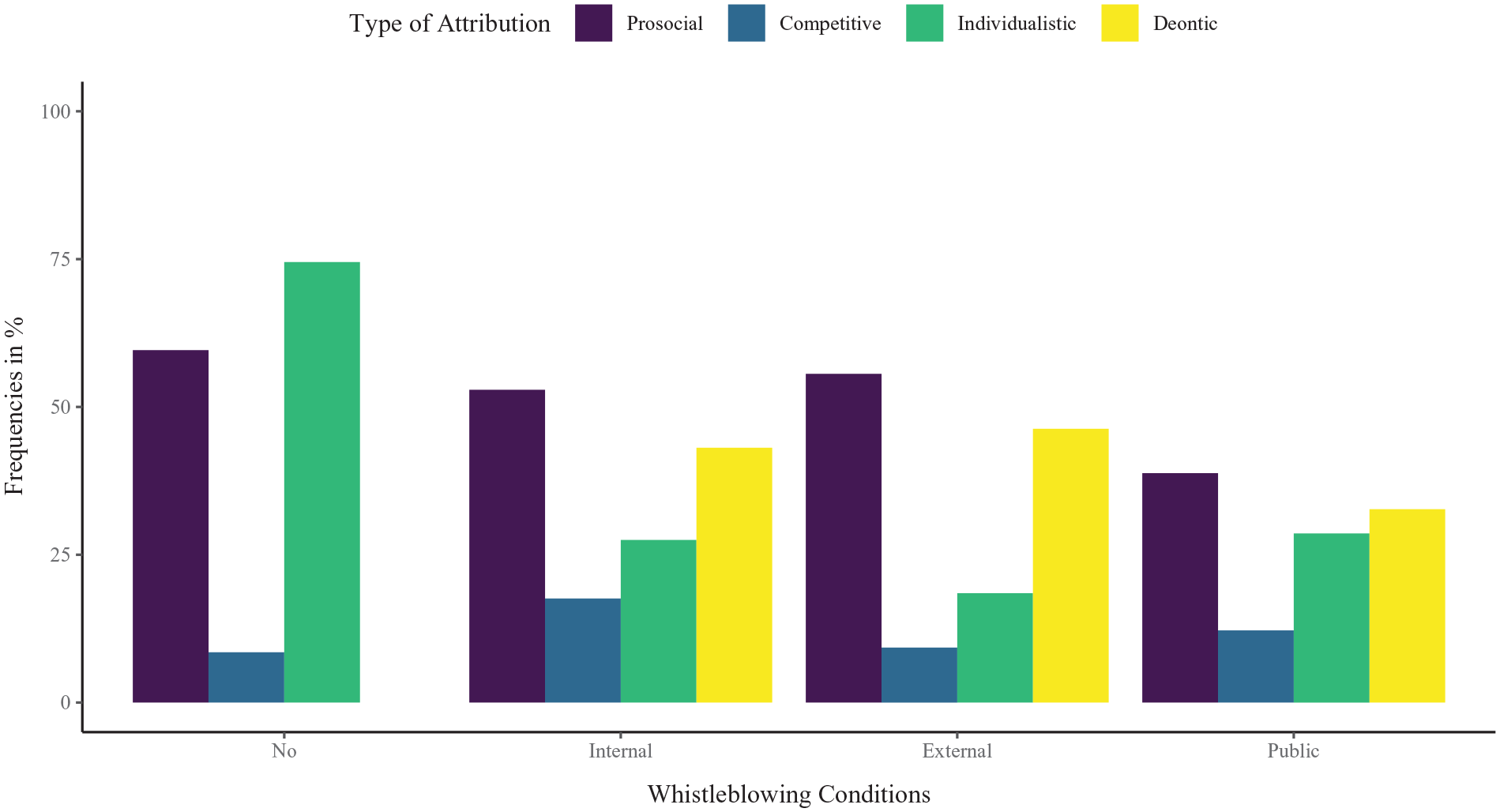
Frequency of motive attributions per whistleblowing condition in Study 1.
Based on the frequencies of the categories overall as well as per condition, we concluded that in addition to the three motive attributions consistent with those relevant in post-transgression responses—prosocial, individualistic, and competitive motive attributions (Gollwitzer & Okimoto, 2021)—deontic motive attributions are relevant in whistleblowing situations. Identifying the most relevant motive attributions in whistleblowing situations is a first step toward examining whether motive attributions can explain polarized perceptions of whistleblowers’ moral characters.
Study 2
Study 1 established a taxonomy of four relevant motive attributions in whistleblowing situations: prosocial, competitive, individualistic, and deontic motive attributions. As a next step toward examining the role of motive attributions in whistleblowers’ moral character judgments, we developed a self-report scale assessing the four motive attributions identified in Study 1. A scale by Twardawski et al. (2023) assessing prosocial, competitive, and individualistic motive attributions in the context of forgiveness served as a starting point for the development of our items. We adapted and shortened this scale to fit our purposes. We then developed further items to measure deontic motive attributions. To do so, we examined the open-ended responses from Study 1 that were coded into the deontic motive attributions category for commonalities. We identified three common and easily understandable ways of phrasing deontic motive attributions. Then, we rephrased them to be consistent with the way the other items were worded (i.e., to continue the sentence “[The whistleblower] wanted to. . .”). The resulting scale consisted of 3 items per subscale or 12 items in total.
Testing the psychometric properties of this scale was one goal of Study 2. A second goal was to test our hypotheses on the effects of the decision of whether and to whom to blow the whistle on the moral character judgments. Similar to Study 1, we presented participants with a scenario describing an organizational wrongdoing and experimentally varied the actor’s response to the wrongdoing. Subsequently, we assessed motive attributions toward the actor quantitatively using our new self-report scale.
Method
Procedure
After providing informed consent and demographic information, participants were asked to imagine themselves in a scenario in which they were a physician in a hospital. They were further asked to imagine that one of the physicians in their team, Dr Schmitt, billed the health insurance company for more service than were provided for some patients. The full scenario can be accessed in the Supplemental Materials.
We then randomly assigned participants to one of four whistleblowing conditions (no, internal, external, public whistleblowing; between-subjects) and varied the ending of the scenario according to the respective conditions. Participants in the no whistleblowing condition read: “When one of her colleagues, Dr Bauer, learned about this, he did not pass on information about it.” Participants in the internal whistleblowing condition read: “When one of her colleagues, Dr Bauer, learned about this, he passed on information about it to the hospital’s compliance department, which is responsible for ensuring that all legal requirements in the hospital are met.” Participants in the external whistleblowing condition read: “When one of her colleagues, Dr Bauer, learned about this, he passed on information about it to the relevant authorities.” Finally, participants in the public whistleblowing condition read: “When one of her colleagues, Dr Bauer, learned about this, he passed on information about it to a newspaper that is distributed throughout Germany.” 7 After reading the scenario, participants were asked to rate the motives they attributed to Dr Bauer on our new motive attribution scale. We also measured judgments of Dr Bauer’s moral character. Participants furthermore completed several other items, among them several attention and comprehension checks.8,9
To mirror the comparisons formulated in our hypotheses, we created three Helmert-coded contrasts. Contrast 1 was coded −3 for the no whistleblowing condition and 1 for all other conditions. Contrast 2 was coded 0 for the no whistleblowing condition, −2 for the internal whistleblowing condition, and 1 for the external whistleblowing condition as well as the public whistleblowing condition. Finally, Contrast 3 was coded 0 for the no whistleblowing condition and the internal whistleblowing condition, −1 for the external whistleblowing condition, and 1 for the public whistleblowing condition. As such, Contrast 1 mirrors the independent variable in our first hypothesis, Contrast 2 the one in our second hypothesis, and Contrast 3 the one in our third hypothesis.
Measures
Motive Attributions
We measured the four motive attributions identified in Study 1 with three self-developed items each (see Supplemental Materials for all items) on a 6-point scale ranging from 1 = strongly disagree to 6 = strongly agree. Example items for the four motive attributions were “Dr Bauer wanted to help others” (prosocial motive attributions; α = .89), “Dr Bauer wanted to harm others” (competitive motive attributions; α = .88), “Dr Bauer wanted to gain an advantage for themselves” (individualistic motive attributions; α = .83), and “Dr Bauer wanted to do the right thing” (deontic motive attributions; α = .97).
Moral Character Judgment
We assessed participants’ moral character judgment using 16 items developed based on Goodwin et al.’s (2014) high morality traits on a 6-point scale ranging from 1 = strongly disagree to 6 = strongly agree. An example item reads “Dr Bauer is honest” (α = .95).
Participants
Participants were recruited through a university mailing list and via the website of a major magazine on popular psychology in Germany. As in Study 1, we raffled two vouchers worth 50€ each. The study was online for 3 weeks and our sampling strategy was to collect as many data as possible during this period. One hundred twenty-nine individuals completed our survey. Four participants were excluded from our analysis, either because they indicated that their data should not be used at the end of the survey or because they gave incorrect responses to at least one attention or comprehension check item. Consequently, the final sample comprised 125 participants (Mage = 33.69 years, SDage = 11.76 years; 97 female, 28 male; 30.40% students). 10
Results and Discussion
Descriptives
We used R to conduct all quantitative analyses (R Core Team, 2023), mainly using the lavaan package (Rosseel, 2012). The correlations between the motive attribution and moral character judgment scales across all four conditions are shown in Table 1. All four motive attributions correlated substantially with the moral character judgment. The highest association we found was the one between deontic motive attributions and the moral character judgment, r = .75. The strength of this association is presumably explicable by the fact that both scales relate to morality and that participants had no other information about the whistleblower than the short description in the scenario. In real life, observers typically have more information they can use to evaluate the moral character of a whistleblower; thus, we would expect weaker associations between these constructs when studying real-life whistleblowing cases.
Means, Standard Deviations, and Correlations of Motive Attributions and Moral Character Judgment in Study 2.
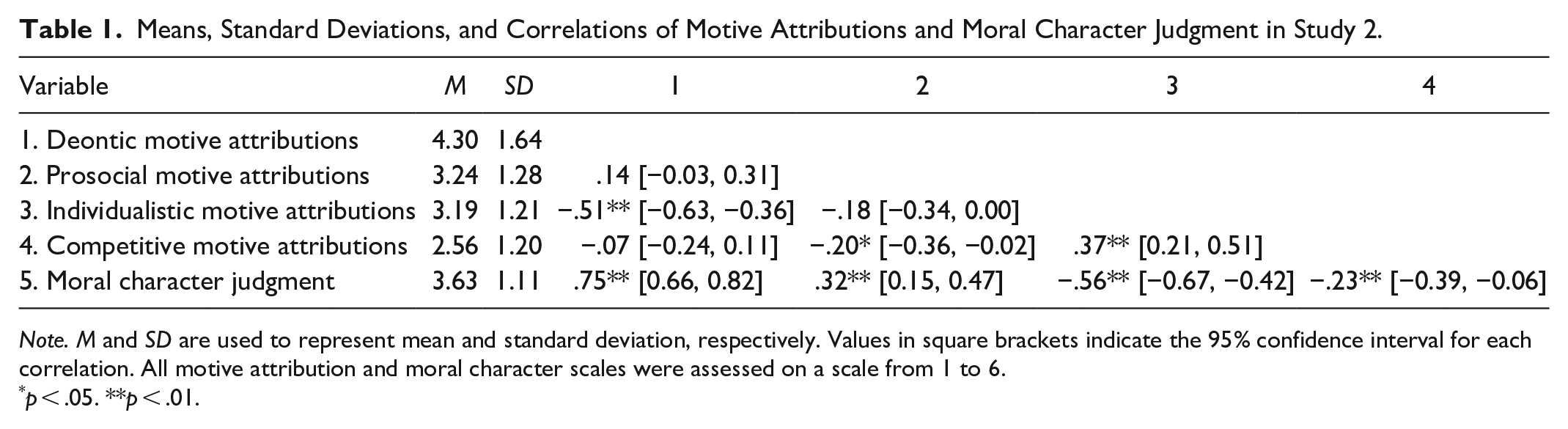
Note. M and SD are used to represent mean and standard deviation, respectively. Values in square brackets indicate the 95% confidence interval for each correlation. All motive attribution and moral character scales were assessed on a scale from 1 to 6.
p < .05. **p < .01.
The means of all motive attributions per whistleblowing condition are displayed in Figure 2. Participants judged the moral character of the actor learning of the wrongdoing most favorably in the internal whistleblowing condition (M = 4.34, SD = 0.75), followed by the external whistleblowing condition (M = 4.05, SD = 0.92). Their moral character was viewed less favorably in the public whistleblowing condition (M = 3.38, SD = 1.12) and in the no whistleblowing condition (M = 2.70, SD = 0.84).
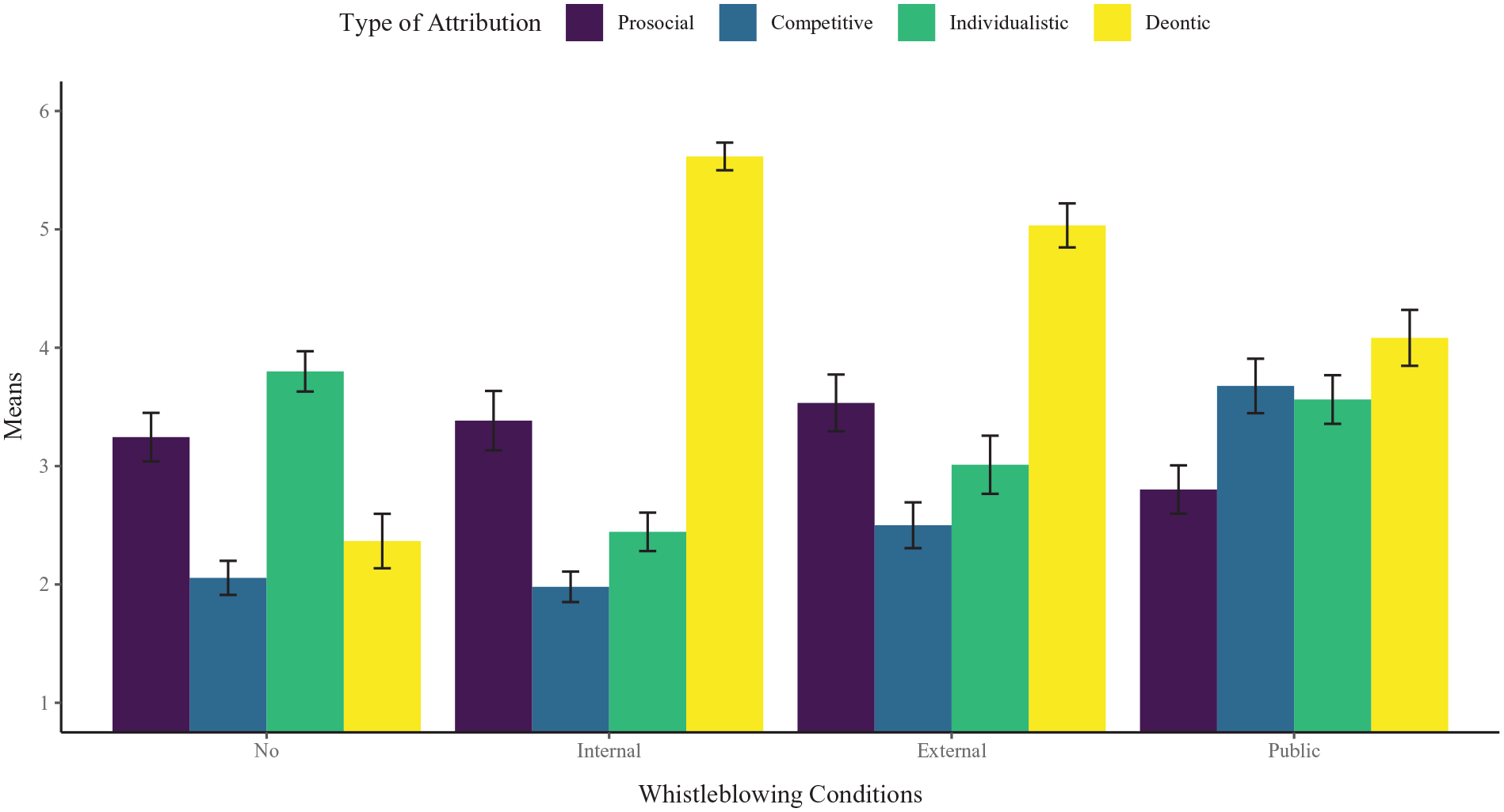
Mean motive attributions per whistleblowing condition in Study 2.
Measurement Properties of the Motive Attribution Scale
We conducted a confirmatory factor analysis (CFA) to examine the properties of our newly developed scale measuring motive attributions in whistleblowing situations. All items showed significant positive loadings on their respective latent factor (i.e., three items loaded on each factor). A table with the factor loadings can be found in the Supplemental Materials.
We examined several model fit indices to evaluate the goodness of the model fit. The chi-squared test of model fit was significant, χ2(48, 125) = 105.51, p < .001, indicating that the model did yet not fit the data sufficiently well. We further applied the cut-off criteria proposed by Hu and Bentler (1999). The model fit of the CFA was satisfactory regarding the Comparative Fit Index (CFI), CFI = 0.95. The Root Mean Square Error of Approximation (RMSEA) and the Standardized Root Mean Square Residual (SRMR), however, yielded values above their cut-off values (0.06 and 0.08, respectively), suggesting a non-satisfactory fit, RMSEA = 0.10, 95% CI for RMSEA [0.07, 0.13], and SRMR = 0.09.
We concluded that small adaptations were necessary to ensure satisfactory model fit. Therefore, we adjusted one item with a relatively low factor loading (see Supplemental Materials, Appendix B2, Item 8) for the next study. The original item may have appeared vague to participants and they might have found it difficult to apply it to the given scenario (“[The whistleblower] wanted to pursue their own interest”). For the new item, we therefore used a more precise wording: “[The whistleblower] wanted to achieve the best possible outcome for themselves.”
Effects of the Type of Whistleblowing on Moral Character Judgments
To test our three hypotheses, we entered all three contrasts into a regression analysis predicting mean moral character judgment. 11 Overall, the model explained a significant amount of variance in moral character judgment, F(3, 121) = 19.66, p < .001, R2 = .33, 95% CI [0.18, 0.43]. We had predicted that internal, external, and public whistleblowing (as compared to no whistleblowing) might increase (H1a) or decrease (H1b) moral character judgments. Our findings support H1a: The first contrast was significantly positively related to moral character judgment, B = 0.31, t(121) = 6.36, p < .001, sr2 = 0.22, 95% CI for B [0.21, 0.40]. Furthermore, we had predicted that external and public should yield a more negative moral character judgment than internal whistleblowing (H2). This prediction was supported: Contrast 2 was significant and negative, B = −0.21, t(121) = −3.14, p = .002, sr2 = 0.05, 95% CI for B [−0.34, −0.08]. In addition, we had hypothesized that external whistleblowing should lead to more positive moral character judgments than public whistleblowing (H3). As predicted, Contrast 3 was indeed significant and negative, B = −0.33, t(121) = −2.86, p = .005, sr2 = 0.05, 95% CI for B [−0.57, −0.10]. These results from Study 2 demonstrate that judgments of a whistleblower’s moral character vary depending on the decision of whether and to whom to report the wrongdoing in line with our Hypotheses 1a, 2, and 3.
Study 3
In Study 2, we developed a self-report scale measuring the four most relevant motive attributions in whistleblowing situations. Furthermore, we produced first evidence regarding Hypotheses 1 to 3. In Study 3, we wanted to further test our hypotheses in a highly powered, preregistered experiment. Furthermore, we aimed at examining whether motive attributions mediate the effects delineated in our hypotheses. In Study 3, we again manipulated the type of whistleblowing (no, internal, external, public whistleblowing) and measured motive attributions as well as moral character judgments. The preregistration for this study can be found at https://osf.io/rvty4/.
Method
Procedure
The procedure in Study 3 was largely equivalent to Study 2, except for some minor changes concerning the wording (but not the content) of the scenario and the additional constructs assessed in this study. 12 Like in Study 2, participants read that they were a physician at a hospital and that one other physician in their team, Dr Schmitt, billed the health insurance company for more services than were actually provided. Participants then read one of four endings to the scenario based on one of four randomly chosen whistleblowing conditions (no, internal, external, public). Participants in the no whistleblowing condition read: “You also learned that one of your colleagues, Dr Bauer, learned about it and subsequently did not pass on any information about it,” those in the internal whistleblowing condition read: “You also learned that one of your colleagues, Dr Bauer, learned about it and subsequently passed on information about it to the hospital’s compliance department, which is responsible for ensuring that the hospital complies with all legal requirements.” Participants in the external whistleblowing condition read: “You also learned that one of your colleagues, Dr Bauer, learned about it and subsequently passed on information about it to the responsible authorities.” Finally, participants in the public whistleblowing condition read: “You also learned that one of your colleagues, Dr Bauer, learned about it and subsequently passed on information about it to a newspaper that is distributed throughout Germany.” 13 Participants further completed several attention and comprehension check items as well as a use me-item.
Like in Study 2, we used the whistleblowing conditions to create three Helmert-coded contrasts mirroring the independent variables in our hypotheses.
Measures
Motive Attributions
Like in Study 2, we measured the four motive attributions with three self-developed items each (see Supplemental Materials for the full scale) on a 6-point scale from 1 = strongly disagree to 6 = strongly agree. As mentioned in the results section for Study 2, the second item from the individualistic motives scale was changed from “Dr Bauer wanted to pursue their own interests” to “Dr Bauer wanted to achieve the best possible outcome for themselves.” All other items remained unchanged (αprosocial = .89, αcompetitive = .91, αindividualistic = .82, αdeontic = .95).
Moral Character Judgment
We assessed participants’ moral character judgment using the same items as in Study 2 (α = .95). 14
Participants
We conducted an a priori power analysis for a linear regression with three predictors (i.e., the three contrasts). To detect a small effect of f2 = .02 with α = .05 and 1 − β = .80, a minimum sample size of 550 participants was required. We added a buffer of 10% to account for potential exclusions, resulting in a total required sample size of 605.
Participants were recruited through the PsyWeb panel (see https://psyweb.uni-muenster.de/). As per our preregistered stopping rule, we collected data for 4 weeks after the study had been distributed via the mailing list. In this period, we collected data from a total of 766 individuals. Data from n = 24 individuals were excluded, either because they indicated that their data should not be used in the use me-item or because they gave an incorrect response to one of our attention or comprehension check items. The final sample thus comprised 742 participants (Mage = 49.43 years, SDage = 15.06 years; 477 female, 258 male, seven “other”; 5.66% students).
Results and Discussion
Descriptives
The correlations between the motive attribution and the moral character judgment scales across all four conditions are shown in Table 2. Again, all four motive attributions correlated substantially with the moral character judgment.
Means, Standard Deviations, and Correlations of Motive Attributions and Moral Character Judgment in Study 3.
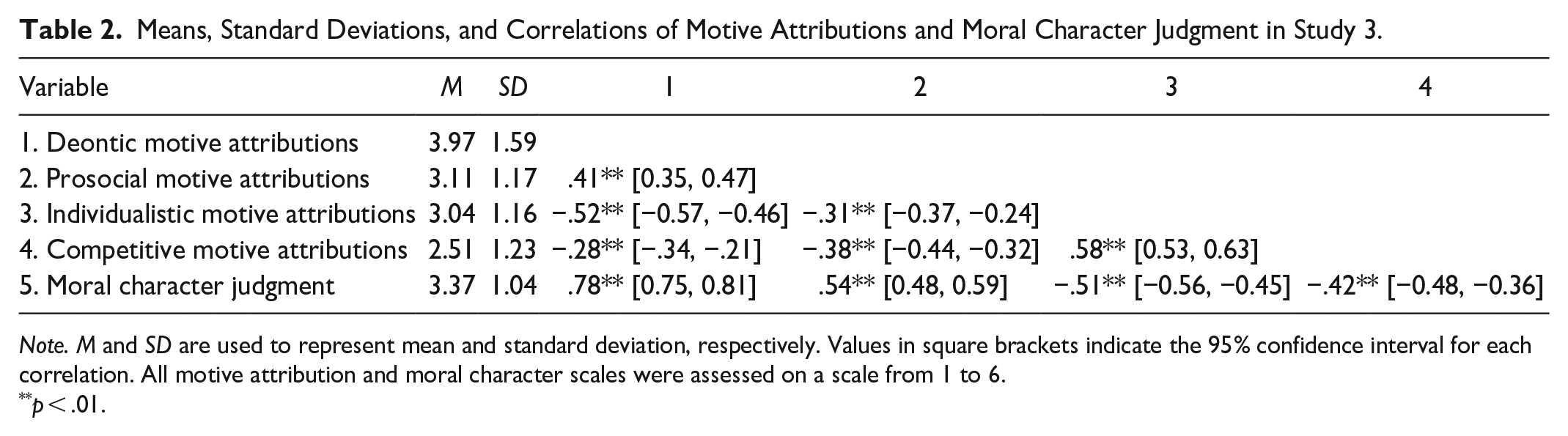
Note. M and SD are used to represent mean and standard deviation, respectively. Values in square brackets indicate the 95% confidence interval for each correlation. All motive attribution and moral character scales were assessed on a scale from 1 to 6.
p < .01.
The mean prosocial, competitive, individualistic, and deontic motive attributions per whistleblowing condition are displayed in Figure 3. Again, participants judged the moral character of the actor learning of the wrongdoing most favorably in the internal whistleblowing condition (M = 4.07, SD = 0.66) and the external whistleblowing condition (M = 3.87, SD = 0.80). Moral character judgments were less favorable in the public whistleblowing condition (M = 2.83, SD = 1.01) and in the no whistleblowing condition (M = 2.64, SD = 0.85).
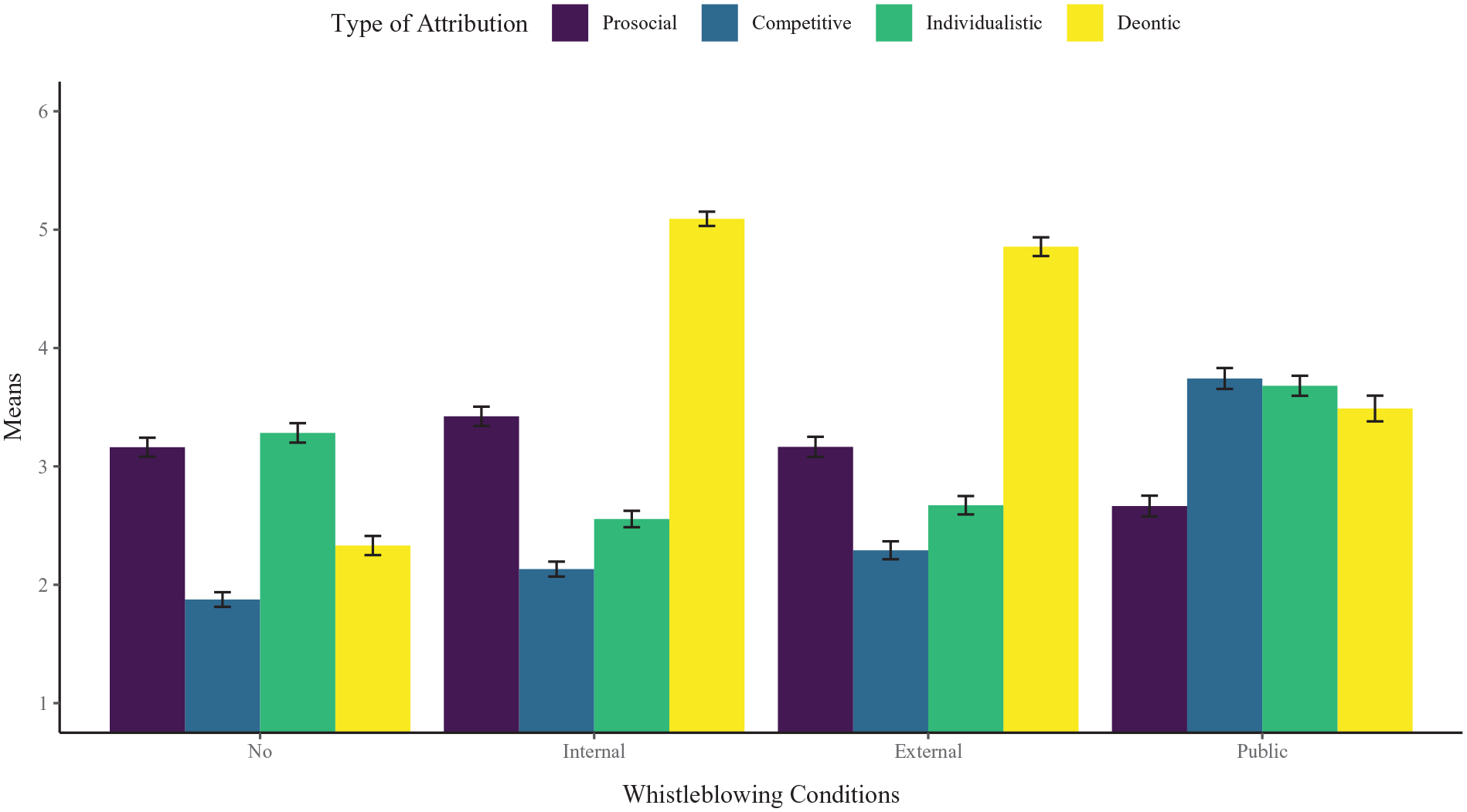
Mean motive attributions per whistleblowing condition in Study 3.
Measurement Properties of the Motive Attribution Scale
We examined the properties of our (slightly revised) motive attributions scale. By conducting a CFA for our adapted scale in an independent sample, we follow recommendations for scale development, particularly regarding the generalizability of our measure (Hinkin, 1998). The chi-squared test produced a significant result, χ2(48, 742) = 163.80, p < .001. As the test is sensitive to sample size, our large sample might have resulted in a significant result despite a generally acceptable fit (Babyak & Green, 2010). Therefore, we focused on other fit indices for evaluating the model fit. According to the cut-off values by Hu and Bentler (1999), the model fit was now satisfactory, CFI = 0.98; RMSEA = 0.057, 95% CI for RMSEA [0.05, 0.07]; SRMR = 0.04. This underscores that our scale reflects the intended four-dimensional structure well.
Main Analyses
Effects of the Type of Whistleblowing on Moral Character Judgments
For our main analyses, we conducted a regression analysis with the three whistleblowing contrasts as predictors of the mean moral character judgment. Overall, the model explained a significant amount of variance in moral character judgment, F(3, 734) = 135.10, p < .001, R2 = .36, 95% CI [0.30, 0.40]. Again, our findings support H1a: Contrast 1 was significant and positive, B = 0.24, t(734) = 13.10, p < .001, sr2 = 0.15, 95% CI for B [0.20, 0.27], indicating that internal, external, and public whistleblowing led to more positive moral character judgments than no whistleblowing. Consistent with the results from Study 2, both our predictions for H2 and H3 were supported. More specifically, the significant negative effect of Contrast 2 indicates that external or public whistleblowing led to more negative moral character judgments than internal whistleblowing, B = −0.24, t(734) = −9.51, p < .001, sr2 = 0.08, 95% CI for B [−0.29, −0.19]. In addition, Contrast 3 was significantly negatively related to the moral character judgment, B = −0.52, t(734) = −11.96, p < .001, sr2 = 0.13, 95% CI for B [−0.60, −0.43], showing that public whistleblowing led to more negative moral character judgments than external whistleblowing.
Mediation via Motive Attributions
To investigate whether motive attributions mediate the effects of the type of whistleblowing on moral character judgments, we calculated a mediation model, predicting moral character judgment from the three whistleblowing contrasts via motive attributions. We included all four motive attributions as parallel mediators. We used lavaan to conduct the analysis (Rosseel, 2012). The results are displayed in Figure 4.
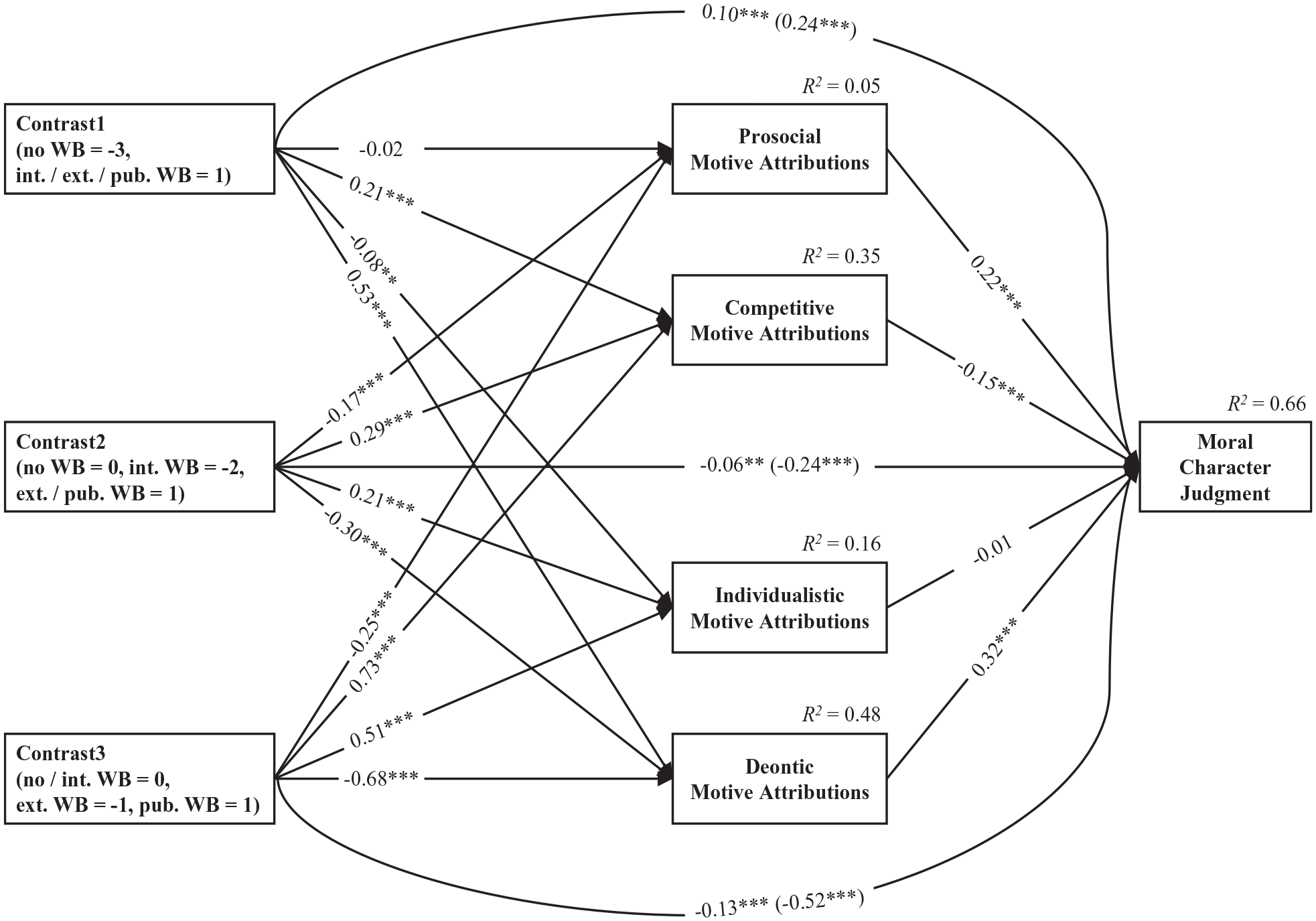
Effects of the whistleblowing contrasts on moral character judgments via motive attributions in Study 3.
First, we investigated whether motive attributions mediate the effect of Contrast 1 (no vs. internal/external/public whistleblowing) on moral character judgments while controlling for the other contrasts. We found significant indirect effects via competitive, B = −0.03, 95% CI [−0.04, −0.02], and deontic, B = 0.17, 95% CI [0.15, 0.20], but not prosocial, B = −0.01, 95% CI [−0.02, 0.01], or individualistic attributions, B = 0.00, 95% CI [−0.00, 0.00]. The direct effect remained significant, B = 0.10, 95% CI [0.07, 0.13], p < .001, indicating that the motive attributions mediate this relationship only partially.
Second, we investigated whether motive attributions mediate the effect of Contrast 2 (internal vs. external/public whistleblowing) on moral character judgments while controlling for the other contrasts. Indirect effects were significant for prosocial, B = −0.04, 95% CI [−0.05, −0.02], competitive, B = −0.04, 95% CI [−0.06, −0.03], and deontic, B = −0.10, 95% CI [−0.12, −0.07], but not for individualistic attributions, B = −0.00, 95% CI [−0.01, 0.01]. Again, the direct effect remained significant, B = −0.06, 95% CI [−0.10, −0.02], p = .002, indicating that motive attributions partially mediate the relationship between Contrast 2 and moral character judgments.
Third, we investigated whether motive attributions mediate the effect of Contrast 3 (external vs. public whistleblowing) on moral character judgments while controlling for the other contrasts. Indirect effects were significant for prosocial, B = −0.05, 95% CI [−0.08, −0.03], competitive, B = −0.11, 95% CI [−0.14, −0.07], and deontic, B = −0.22, 95% CI [−.26, −.18], but not for individualistic attributions, B = −0.01, 95% CI [−0.03, 0.01]. The direct effect was again significant, B = −0.13, 95% CI [−0.20, −0.06], p < .001, indicating that motive attributions partially mediate the relationship between Contrast 3 and moral character judgments.
In conclusion, Study 3 provides further evidence that the type of whistleblowing impacts whistleblower’s moral character judgments and shows that this effect is partially mediated by prosocial, competitive, and deontic but not individualistic motive attributions.
General Discussion
Why are whistleblowers sometimes praised and sometimes vilified? Building on the notion that the intentions for blowing the whistle are ambiguous, the present research aimed at developing a taxonomy of motives people attribute in whistleblowing situations and at showing that motive attributions shape judgments of whistleblowers’ moral characters. Using a qualitative survey design in Study 1, we identified four motive attribution categories: prosocial, competitive, individualistic, and deontic motive attributions. The first three motive attributions (i.e., prosocial, competitive, and individualistic) are consistent with motive attributions relevant for post-transgression responses such as revenge or forgiveness in interpersonal conflicts (Gollwitzer & Okimoto, 2021). Deontic motive attributions, however, seem to be uniquely relevant in whistleblowing situations.
In two quantitative scenario studies, we then developed a short self-report scale that enables researchers to assess these four motive attributions in whistleblowing situations. Furthermore, we tested antecedents and consequences of motive attributions in whistleblowing situations. The key results were the following: First, participants judged the moral character of agents blowing the whistle more favorably than of those remaining silent. This effect was mediated by competitive and deontic motive attributions. Second, the moral character of internal whistleblowers was judged more favorably than that of external/public whistleblowers, mediated by prosocial, competitive, and deontic motive attributions. Third, the moral character of external whistleblowers was judged more favorably than that of public whistleblowers, which was again mediated by prosocial, competitive, and deontic motive attributions. As such, prosocial, competitive, and deontic, but not individualistic motive attributions, were relevant for predicting moral character judgments of whistleblowers. All in all, the four motive attributions and the type of whistleblowing manipulation jointly accounted for 66% of variability in moral character judgments in Study 3, demonstrating their importance for understanding the psychological consequences of whistleblowing.
Theoretical and Practical Implications
Contributing to our understanding of polarized perceptions of whistleblowers, the present research demonstrates the importance of motive attributions for explaining the effect of the type of whistleblowing on a whistleblower’s moral character. Previous research has discussed polarized judgments of a whistleblower’s character and investigated which situational features of the whistleblowing episode shape such judgments (Dungan et al., 2015; Pacilli et al., 2022). We contribute to this literature by identifying motive attributions that are relevant in whistleblowing situations and developing a scale measuring these attributions. In doing so, we show that these motive attributions are ambivalent and that several motives can be attributed to an actor in a whistleblowing situation at the same time. Furthermore, we empirically demonstrate that the motive attributions are associated with moral character judgments in whistleblowing situations. This suggests that polarized perceptions of whistleblowers have their cognitive roots in such motive attribution processes. Our research also shows that the type of whistleblowing shapes such motive attributions. Even though options can be restricted in real life, the type of whistleblowing is a feature that whistleblowers can exert some control over, thereby influencing which motives are attributed to them.
In identifying motive attributions in whistleblowing situations as a pathway to moral character judgments, our research also offers a novel perspective on previous research findings. Recent research by Pacilli et al. (2022), for example, showed that the whistleblower’s group membership plays a role in shaping moral character judgments. In their study, a whistleblower was viewed more negatively when they were part of the ingroup as compared to the outgroup of the person judging the whistleblower. This is consistent with research on the black sheep effect showing that deviant ingroup members are judged more negatively than deviant outgroup members (Marques & Paez, 1994; Pinto et al., 2010). We argue that different motive attributions might be the missing link for explaining why this is the case: For a whistleblower from one’s own group, observers might focus on the potential harm the whistleblower causes to the ingroup, eliciting competitive motive attributions. For a whistleblower from a different group, observers might perceive benefits of the whistleblowing behavior for the victims of the organizational wrongdoing as more salient, which should lead to the perception of more prosocial motive attributions.
More generally, our research reiterates the importance of taking motive attributions into account when examining outcomes of morally ambiguous behaviors. This is supported by theoretical arguments made in research on moral character judgments in other contexts claiming that motive attributions shape judgments of an actor’s moral character. These studies, however, have often not measured motive attributions (Bigman & Tamir, 2016; Johnson, 2018). In their review on the topic, Carlson et al. (2022) therefore called for measuring inferred motives when studying moral judgments. Our research supports this by showing one context in which motive attributions are powerful predictors of moral character judgments.
Methodological Considerations
Across the three studies presented here, we used a mix of qualitative and quantitative survey designs. This mixed-methods approach allowed us to base our conclusions on both the richness of open-ended text responses as well as on highly standardized self-report measures. Moreover, we used experimental designs that allow drawing causal conclusions regarding the effects of the type of whistleblowing on motive attributions and moral character judgments. Furthermore, Study 3 had high statistical power to detect even small effects, thereby minimizing the risk of false-negative findings.
However, an important limitation is that we measured motive attributions but did not experimentally manipulate them. Therefore, we cannot draw causal conclusions regarding the effects of motive attributions on moral character judgments. Future research should experimentally manipulate motive attributions in whistleblowing contexts. Such experimental manipulations could, for example, imply a certain motivation for blowing the whistle by describing stable individual characteristics of the whistleblower or certain features of the situation. Inspiration for such an experimental approach could be drawn from studies conducted in related fields (Alcala et al., 2022; Cramwinckel et al., 2013; de Vel-Palumbo et al., 2023; Dhaliwal et al., 2022; Newman & Cain, 2014). Specifically, in the whistleblowing context, it may be feasible to use descriptions of the whistleblower’s reputation as being, for example, caring and compassionate (to manipulate prosocial motive attributions) or as selfish and egoistic (to manipulate individualistic motive attributions; for a similar manipulation see de Vel-Palumbo et al., 2023). Combining such a manipulation of the motivation for blowing the whistle with a manipulation of the whistleblowing reporting channel could provide interesting insights into the processes affecting motive attributions as well as moral judgments of whistleblowers.
Furthermore, our manipulation of the type of whistleblowing in scenario studies contained limited information and condensed complex whistleblowing situations to include only the few factors relevant to our studies. In real-life whistleblowing cases, for example, whistleblowers often do not choose to directly blow the whistle publicly (e.g., to the media). Instead, they often first report the whistleblowing internally and only go public if internal reports did not yield the desired outcome (Vandekerckhove et al., 2013). Future research should expand on our research by investigating motive attributions toward whistleblowers who reported the wrongdoing externally or publicly after one or multiple internal reports failed to rectify the situation.
Future Research
We focused on one relevant predictor of motive attributions in whistleblowing situations—the channel the whistleblower used to report the wrongdoing—but this is arguably not the only relevant factor in that regard. Specifically, characteristics of the whistleblower, the organization, the wrongdoing, or the observer might shape motive attributions in whistleblowing situations as well. For instance, it seems plausible that colleagues of a whistleblower who reports a form of “pro-organizational unethical behavior” (i.e., unethical behavior that benefits the organization; Umphress & Bingham, 2011) attribute more competitive motives toward them as compared to the motives they attribute to a whistleblower who reports other forms of unethical behavior. Another relevant factor could be the moral values or “foundations” (Graham et al., 2013) of the observer in a whistleblowing situation: Individuals who strongly value loyalty toward an ingroup should attribute more malevolent motives toward a whistleblower. Similarly, observers who strongly value fairness should attribute more benevolent motives to a whistleblower. Another observer characteristic of interest might be gender as previous research has found gender differences in moral judgments (Fumagalli et al., 2010). In additional analyses that can be found in the Supplemental Materials, we therefore explored whether there were gender differences in deontic motive attributions and moral character judgments in our Studies 2 and 3. We do not find such differences in our studies. However, it might be interesting for future research to examine under which conditions gender plays a role in our context. Moreover, the phenomenon of do-gooder derogation might also apply here. It refers to people devaluing others who behave morally (Monin et al., 2008). The anticipated moral reproach is seen as one mechanism behind this phenomenon: Anticipating that a morally motivated individual condemns an observer for not behaving the same way threatens the observer’s own moral standing. This leads the observer to devalue the other individual (Minson & Monin, 2011). This could also apply to the context of whistleblowing: When one organization member observes another member of the same organization blowing the whistle on a wrongdoing that was known to both, this raises the question of why they did not report the wrongdoing themselves. Following the anticipated moral reproach reasoning (Minson & Monin, 2011), this would then threaten the moral identity of the person who remained silent and might elicit more malevolent, less benevolent motive attributions toward the reporting person as a means to cope with the moral identity threat.
Motive attributions in whistleblowing situations could also be useful to understand and predict other outcome variables of a whistleblowing episode. In our studies, we were mainly interested in judgments about the whistleblowers’ moral character in order to explain polarized perceptions of whistleblowers. However, from a practical perspective, outcome variables such as retaliation against whistleblowers are currently not yet sufficiently understood. We propose that especially observers who attribute malevolent (i.e., individualistic or competitive motives) to a whistleblower should be willing to retaliate against them. As such, our motive taxonomy provides a useful tool for future research on the aftermath of whistleblowing situations.
Conclusion
Our research shows that people attribute four categories of motives to agents in whistleblowing situations: prosocial, competitive, individualistic, and deontic motives. We found that these motive attributions help explain polarized judgments of whistleblowers’ moral characters stemming from the type of whistleblowing: The type of whistleblowing affected motives attributed to whistleblowers, which, in turn, accounted for a substantial amount of variance in moral character judgments. More specifically, competitive motive attributions were negative and prosocial as well as deontic motive attributions were positively related to moral character judgments. In conclusion, our motive-attribution approach enables a systematic investigation of consequences resulting from whistleblowing for the involved individuals, teams, and organizations.
Supplemental Material
sj-pdf-1-psp-10.1177_01461672251340111 – Supplemental material for Motive Attributions Shape Judgments of Whistleblowers’ Moral Characters
Supplemental material, sj-pdf-1-psp-10.1177_01461672251340111 for Motive Attributions Shape Judgments of Whistleblowers’ Moral Characters by Franziska Brotzeller, Gijs van Houwelingen, Mario Gollwitzer and Moritz Fischer in Personality and Social Psychology Bulletin
Footnotes
Declaration of Conflicting Interests
The author(s) declared no potential conflicts of interest with respect to the research, authorship, and/or publication of this article.
Funding
The author(s) received no financial support for the research, authorship, and/or publication of this article.
Research Ethics Statement
In all studies reported in this manuscript, we adhered to the Ethical Guidelines of the American Psychological Association (APA) and the German Association of Psychologists (DGPs). All participants gave informed consent before starting the surveys.
Research Transparency Statement
Study materials for all studies can be found on the Open Science Framework (OSF) via the following link: https://osf.io/q4rsn/. We also provide data sets and analysis scripts for all quantitative analyses on the OSF. Qualitative data from Study 1 are accessible at  . We report how we determined our sample size, all data exclusions, all manipulations, and all measures for all studies reported in this manuscript.
Data Availability Statement
Study materials, data sets, and analysis scripts are openly available at the project’s Open Science Framework page https://osf.io/q4rsn/, with the exception of the qualitative data for Study 1, which is accessible at https://doi.org/10.23668/psycharchives.16219. The preregistration for Study 3 including the study design, a pre-planned stopping rule, and exclusion criteria can be found at . As Studies 1 and 2 were qualitative and/or exploratory, they were not preregistered. Studies 1 and 3 were presented at the 19th General Meeting of the European Association of Social Psychology in 2023 in Kraków.
Supplemental Material
Supplemental material is available online with this article.
Notes
References
Supplementary Material
Please find the following supplemental material available below.
For Open Access articles published under a Creative Commons License, all supplemental material carries the same license as the article it is associated with.
For non-Open Access articles published, all supplemental material carries a non-exclusive license, and permission requests for re-use of supplemental material or any part of supplemental material shall be sent directly to the copyright owner as specified in the copyright notice associated with the article.
