




Abstract
Sharing messages about group-based disparities is an important strategy for raising awareness. However, not all messengers are evaluated alike. We predict that perceived motivations of messengers depend on who they are and how they speak up. Across one pilot and three pre-registered experiments (N = 2,240), we show that when messengers present group-based disparities in the workplace, their demographic identity and their message content jointly influence how they are perceived regarding self-interest and other-interest motives. We find a negative messenger–message discordance effect: White men are generally viewed as less other-interested and more self-interested than Black and female messengers when presenting statistics-only messages on workplace disparities. However, incorporating explicit personal advocacy against inequality mitigates less favorable interest perceptions for White men and boosts perceived other-interest for all messengers. The study further explores qualitative responses on motivation and provides insights into the nuanced dynamics of messenger perceptions considering demographic identities and message content.
Introduction
Voicing on the state of race- and gender-based group disparities, ranging from salary and wages to employment and promotions, is an important strategy for raising awareness in the workplace. Voicing, which takes the form of presenting and sending verbal or written messages, can raise awareness, call attention to the messages at hand, enable employees to publicly represent issues, and call for action in advocacy or allyship efforts, such as changing the status quo or addressing group-based disparities (LePine & Van Dyne, 1998; Morrison, 2011). Voicing to raise awareness is a more accessible or trainable tool for potential allies and advocates in many organizational contexts, compared with relatively high-cost means such as boycotting and protesting (Farh & Chen, 2018; Fisher & Spiro, 2010; Morrow et al., 2016). However, there is often tension between different types of voicing approaches, specifically between the efficacy of speaking up with informational and “objective” facts versus speaking up with personal and “subjective” narratives (Callaghan et al., 2021; Haaland et al., 2023; Peters, 2001; Tilcsik, 2021).
In addition to the tension of the presented content, the potential effect of who is delivering the message on group-based workplace disparities has been understudied in psychological and organizational literature. The concerns around who should speak up and what content they should present may cause potential allies to keep quiet and not voice themselves as advocates out of fear of being seen as using the wrong voicing approach, speaking inappropriately, or receiving unfavorable evaluations and perceptions from others (Imran et al., 2023; Morrow et al., 2016; Premeaux & Bedeian, 2003; Schwappach & Gehring, 2014).
On the one hand, some research suggests that dominant group members (i.e., individuals who belong to groups with greater societal power and advantage, such as White men in the U.S. workplace) are perceived as being impartial and treated more favorably when they promote diversity at the workplace. Recent studies examining racial disparities in the workplace found that White advocates are perceived as less self-interested than Black advocates (Gardner & Ryan, 2020), that White journalists are seen as less biased than Black journalists (Torrez et al., 2024), and that White male leaders are the least penalized in performance ratings for promoting workplace diversity compared with non-white and female leaders (Hekman et al., 2017). Furthermore, researchers from marginalized groups who study group-based prejudice or other topics related to their own social identity are perceived to have a personal agenda and to be less trustworthy or legitimate (Altenmüller et al., 2021; Thai et al, 2021).
On the other hand, research suggests that individuals who can speak about issues in which they have domain-specific knowledge (e.g., individuals of minority identities speaking about their own group-based disadvantages) are perceived to have more expertise, to be more persuasive, and to have greater legitimacy or psychological standing than those speaking about issues not related to their personal experience (e.g., White speakers talking about Black individuals’ disadvantage) (Cialdini & Trost, 1998). For instance, recent work has shown that racial minorities are seen as having higher expertise in the domain of race and prejudice (Thai et al., 2021; Torrez et al., 2024), that individuals with stigmatized identities are perceived as more persuasive than non-stigmatized identities in identity-relevant contexts (Wallace et al., 2024), and that men report lower subjective legitimacy in gender-parity issues while marginalized individuals are seen to have greater psychological standing when working on identity-relevant prejudice (Sherf et al., 2017; Thai et al., 2021).
Thus, there is evidence supporting hypotheses in both directions regarding who might be perceived in a more favorable light (e.g., more legitimate and less biased) when speaking up against group-based workplace disparities.
In our research, we augment past work that examined differences in general perceptions of messengers by focusing our scope on messengers’ perceived motivation. We seek to better understand the perceived motivation of messengers who voice up on group-based disparities in the workplace. Two primary motives for speaking up about group-based disparities are self-interest and other-interest, which have broad behavioral implications such as altruism, cooperation, and competition (Gerbasi & Prentice, 2013). Investigating messengers’ motivation and underlying interests is needed and might clarify any differences in the perceptions of demographically varying messengers who present on group-based disparities. Understanding whether a messenger is seen as voicing up for the interest of the self or for the interest of others can advance research on the holistic motivational perceptions associated with race- and gender-based advocacy in the workplace.
In the present work, we conduct a series of pre-registered experiments to study how different identities of the messenger (i.e., White/Black, male/female) and different ways of voicing (i.e., statistical information vs. explicit personal advocacy) affect our perceptions of self-interest and other-interest for those who speak up on group-based disparities.
Social Identity and Person Perceptions: Self-Interest and Other-Interest
As social beings, we are constantly observing, interpreting, and sense-making about the people who occupy the space or speak up around us (Maitlis, 2005; Weick et al., 2005; Wu & Cai, 2023). We make inferences and attributions about other people when we observe them behaving. As such, when an individual shares a message on a highly charged issue, many of us will inevitably wonder, care, or think about why this person is sharing this message: Are they doing it out of interest for themselves? Are they doing it to promote the welfare of others?
Self-interest and other-interest are fundamental motives that have been demonstrated to be independent constructs with distinct predictions of self-values and behaviors (Gerbasi & Prentice, 2013; Howell et al., 2015; Li et al., 2021; Stoeber, 2015). An individual may be high in both self-interest and other-interest, higher in one over the other, or low in both in any given behavior or scenario. Previous research generally holds an implicit assumption that high self-interest implies low other-interest, such that high self-interest is considered the opposite of altruism. However, according to the theory that self-interest and other-interest are distinct constructs, it is possible to have relatively high levels of both self-interest and other-interest in the sense that an individual can care about themselves and others to an equal extent. Moreover, self-interest and other-interest predict behaviors in distinctive ways. For example, higher self-interest scores predict more competitive behaviors that benefit the self, while higher other-interest scores predict more cooperative choices that benefit others (Gerbasi & Prentice, 2013). Overall, being high in other-interest may lead to favorable perceptions of an individual, while being high in self-interest and low in other-interest typically leads to unfavorable perceptions.
Self-interest and other-interest as underlying motivations can be conveyed through behaviors meant to persuade. It is possible that socially dominant individuals—namely, White men—may receive more favorable or higher other-interest motivational attributions due to their position in society and relation to group-based disparity. Past research on the attributional analysis of persuasion suggests that message expectancy influences persuasiveness, such that the less expected a messenger’s position given their personal and situational characteristics (e.g., a White man advocating for diversity), the stronger the subsequent persuasiveness (Eagly & Chaiken, 1998; Eagly et al., 1978). Recent work has shown that non-dominant employees (i.e., women and racial minorities) are penalized more severely compared to White male employees in situations wherein the individual advocates for diversity programming (Gardner & Ryan, 2020; Hekman et al., 2017), presumably because the White male employee is seen to be other-serving while the non-dominant employees are seen to be self-serving when it comes to promoting diversity.
Similarly, research on racial minority advocates has shown that non-dominant individuals fear being perceived as biased or exhibiting favoritism when considering speaking up or advocating for demographically similar others (Duguid et al., 2012; Loyd & Amoroso, 2018), and that they are indeed perceived as less objective, less trustworthy, and more biased (Thai et al., 2021; Torrez et al., 2024). Further, because White men are typically considered high-status and socially dominant group members (Berger et al., 1977), they are accordingly attributed higher warmth and competence ratings (Fiske et al., 2002), as well as higher persuasiveness abilities when advocating for a cause that extends beyond their direct benefit (Trump-Steele, 2015). Overall, this would suggest that non-dominant individuals, compared to socially dominant individuals, will be rated more unfavorably and higher in self-interest when advocating against group-based disparities. Given that self-interest and other-interest act as driving motivations for behavior (Gerbasi & Prentice, 2013; Ratner & Miller, 2001), this suggests that when demographic concordance exists between an individual and the subject of their message (as is the case when women and racial minorities share statistics on gender- and race-based workplace disparities), then the concordant messenger may be perceived less favorably in terms of motivation—specifically, the messenger may be perceived to be more self-interested and less other-interested.
However, demographic concordance may conversely afford more favorable motivational attributions—specifically, higher other-interest and lower self-interest perceptions—of the non-dominant messenger. Non-dominant individuals are more likely to have had direct experience with disparity or inequality and thus are more likely to be seen as an insider or expert on group-based disparities. Research on influence and persuasion finds that individuals sharing a message in which they have domain-related knowledge or experience are considered to be authority figures and are evaluated as being more credible and effective (Cialdini & Trost, 1998). Accordingly, since non-dominant employees are more likely to have personal experience related to the adversities of group-based disparities, such as harassment, subtle discrimination, lower earnings, and employment disadvantages (Berdahl & Moore, 2006; Deitch et al., 2003; U.S. Bureau of Labor Statistics, 2020; U.S. Census Bureau, 2020), they are more likely to be seen as relevant experts or insiders of inequality (e.g., Thai et al., 2021; Torrez et al., 2024, Wallace et al., 2024). Subsequently, non-dominant employees might benefit from these positive knowledge and expertise attributions when voicing race- and gender-based disparities at the workplace and when being evaluated on underlying motivations. If non-dominant employees frame their messages around disadvantage, then they may garner greater support for equality from outsiders (Dietze & Craig, 2021) and may be perceived as being more other-interested, more in pursuit of addressing greater inequality, and less narrowly self-interested.
Alternatively, socially dominant employees have the least experience in inequality and would therefore be less trustworthy or persuasive when speaking up against inequality. Previous research shows that individuals who lack first-hand experience in a certain domain—such as men considering the discrimination faced by female employees—are lower in psychological standing (i.e., the subjective legitimacy to perform an action) (Miller & Effron, 2010; Sherf et al., 2017). Regarding race- and gender-based group disparities, the White male coworker (vs. non-dominant Black and female counterparts) would have less insider knowledge or first-hand experience of discrimination, and thus would be as perceived as less legitimate in voicing these issues at the workplace. When White male coworkers do indeed voice on inequality issues, they may be seen as disingenuous, acting in a manner that appears other-interested despite primarily being self-interested. Taken together, this suggests an alternative hypothesis: more demographic concordance between messenger and message affords more favorable perceptions of the messenger’s motivation, whereas less demographic concordance (i.e., demographic discordance) between messenger and message results in more unfavorable perceptions of the messenger’s motivation.
Therefore, due to the breadth and depth of competing literature in the field, the direction in which we expect messenger demographics to differentially affect perceived motivation is mixed. Thus, we are relatively more confident about the existence of a main effect (i.e., dominant and non-dominant messengers will be perceived differently) than the directionality of the main effect. Consequently, we predict two alternative hypotheses:
Hypothesis 1a (H1a): Non-dominant messengers will be perceived more
Hypothesis 1b (H1b): Non-dominant messengers will be perceived more
Attenuating Messenger–Message Discordance Using Explicit Advocacy Narratives
We posit that who voices what content matters for motivational attributions. How might self-interest and other-interest perceptions change when altering these factors? Hypotheses 1a and 1b predict the effects of manipulating messengers’ racial and gender identity on motivational attributions. Next, we focus on changing the message content presented by the messengers. We investigate what the messengers say, predicting that altering the content of their message on group-based disparities will affect perceived other-interest and self-interest. We hypothesize that adding explicit personal advocacy 1 into the informational message will boost the perceived motivation of discordant dominant messengers, but will have a minimal effect on the perceived motivation of concordant non-dominant messengers. Thus, if there are more unfavorable effects of messenger–message discordance for the dominant messenger compared with messenger–message concordance for the non-dominant messenger (i.e., if we find support for H1b), then we expect that the injection of explicit personal advocacy will mitigate the unfavorable low other-interest and high self-interest perceptions of the dominant messenger, thus bringing the motivational attributions of the socially dominant messengers closer to those of the non-dominant messengers.
Our hypothesized positive effect of injecting advocacy narratives aligns with past work of interdisciplinary scholars, who have argued and demonstrated that active anti-racism through narrative personal advocacy is effective not only in countering unfavorable attributional outcomes but also in promoting issues on disparity and inequality (Kendi, 2019; Michie et al., 2018; Moyer et al., 2020; Trevisan, 2017). We theorize that injecting explicit personal advocacy will indicate and clarify the messenger’s intention. Whereas the statistical and purely informational baseline message (as specified in H1a–b) carries some ambiguity about the messenger’s intention and motivation, the explicit advocacy injection into the baseline statistics-only message more clearly conveys advocacy intentions and motivations from the messengers. Reading the baseline informational message, a viewer may wonder and be unsure of why the messenger is sending such a neutral or “objective” message, whereas a viewer receiving an advocacy-injected message may be more likely to find the messenger’s intention clearly expressed.
While genuine advocacy injection may perhaps be a generally effective strategy for all messengers, we expect that its positive effect on other-interest and self-interest ratings for White men will be particularly strong, as it is these socially dominant messengers that have the messenger–message discordance to bridge. For White men voicing on group-based workplace disparities, we predict that providing additional context in the form of explicit personal advocacy will lead to more positive perceptions and enhanced other-interest and self-interest ratings. By adding personal advocacy, White men are effectively reducing the messenger–message discordance because they are making the message more relevant to their otherwise discordant messenger identity. As such, we hypothesize:
Hypothesis 2a (H2a):
Meanwhile, for non-dominant messengers who already have inherent messenger–message concordance, we predict that there will be no clear effect of adding explicit personal advocacy on other-interest and self-interest ratings. In fact, from previous literature, adding explicit advocacy against group-based disparities might imply a vested interest for minority group members (Thai et al., 2021). Taken together, we pre-registered a null effect of adding explicit advocacy on other-interest and self-interest ratings for non-dominant messengers:
Hypothesis 2b (H2b): Non-dominant messengers who include explicit personal advocacy on top of the informational message on group-based workplace disparities will receive no significant changes in other-interest and self-interest ratings compared to non-dominant messengers who share purely informational messages.
The present work investigates how socially dominant versus non-dominant messengers are perceived in terms of motivational attributions—namely, self-interest and other-interest—when sharing purely informational versus advocacy-injected content on race- and gender-based workplace disparities. In Study 1, we test for a main effect of messenger dominance on perceived self-interest and other-interest (H1a and H1b), in the context of sharing a purely informational message containing statistics on group-based workplace disparities. In Study 2, we present the advocacy-injected condition, which incorporates a firm personal stance on top of the statistical information on race- and gender-based disparities. We compare how different message content changes the perceptions of messenger self-interest and other-interest (H2a and H2b). In Study 3, we replicate the effectiveness of the advocacy-injection condition and conduct a qualitative analysis of motivational attributions with a field sample of executive MBAs. In each study, we report how we decided on sample sizes using a priori power calculations accompanied by sensitivity analyses. No statistical analyses were conducted during data collection. For each study, all manipulations, measures, and exclusions are reported. All data and materials are either reported in this manuscript or can be found in the pre-registered OSF project directory (https://osf.io/y3bks/).
Pilot Study
We created messenger profiles in which the race and gender of the messenger were manipulated in a workplace context, for a 2 (Messenger Race: White, Black) × 2 (Messenger Gender: Male, Female) factorial between-subjects design. We conducted the Pilot Study with 138 full-time U.S. employees on TurkPrime to test the messenger profile stimuli that would be used in our subsequent experiments; these profile stimuli were pre-tested for equivalence on attractiveness and perceived age by independent research assistants (RAs). We selected employee profiles that were equivalent in terms of the main dependent variables in the following studies—other-interest and self-interest ratings—to rule out the possibility that any observed differences in interest ratings were driven by artifacts. See Supplemental Appendix A and Figure S1 for full pilot results.
Study 1
Study 1 tested our primary research question of whether non-dominant individuals (i.e., Black and/or female individuals) will be perceived differently in self-interest and other-interest compared to their socially dominant counterpart (i.e., White males) when delivering the same informational message on group-based disparities in the workplace. We showed participants a constant email newsletter that provided a message of race- and gender-based workplace disparities. We manipulated the race and gender of the messenger who volunteered to author and send the email newsletter, using the employee profiles tested and found to have no significantly different ratings in the Pilot Study.
Methods
Participants
We recruited U.S. adults on TurkPrime who had not participated in the previous Pilot Study. As pre-registered, participants were removed from data analysis if they did not pass any attention or manipulation check questions. A total of 662 participants were recruited and the final sample consisted of 582 individuals (75.3% White, 9.8% Black, 7.4% Asian, 5.2% Hispanic, 0.3% American Indian or Alaska Native, 0.2% Native Hawaiian or Pacific Islander, 1.9% Other; 44.3% Female; Mage = 39.2 years, SDage = 11.8 years, Rangeage: 18–77 years). The final sample size of 582 meets the required a priori sample size needed for a one-way analysis of variance (ANOVA) with four groups to detect a minimum effect of f = 0.25 (partial η2 = .06) with 95% power under a .05 alpha error probability (Faul et al., 2009). Given our sample size, a one-way ANOVA with four groups would be sensitive to effects of Cohen’s f = 0.14 (partial η2 = .02) with 80% power (a = .05). We used a mini meta-analysis approach for Study 1, merging two identical pre-registered studies into a single study to improve statistical power and readability (Goh et al., 2016). 2 The separate studies yielded consistent results when analyzed alone (see Supplemental Appendix E).
Procedure
Participants were asked to imagine that they worked at a company with many other colleagues. They were told that their company sends company-wide email newsletters, entitled “Community Newsletters,” to every employee each month and that each monthly newsletter was written by a hypothetical coworker who had volunteered to write any message of their choosing. We selected company-wide email newsletters as our channel to share workplace disparity messages given how commonplace email newsletters are as an intra-firm communication channel for announcements and information sharing—analogous to the use of workplace bulletin boards, company blogs, employee forums, and the like. Additionally, the increased popularization of digital communication in pandemic-driven remote work and increased attention given by employees and firms to socioeconomic and sociopolitical issues over the past few years lend enhanced external validity to the newsletter stimuli.
Participants were randomly assigned to one of the four messenger conditions: White Male (WM), While Female (WF), Black Male (BM), or Black Female (BF). They were shown the Employee Profile of their assigned condition (as tested in Pilot Study) and the same Community Newsletter on workplace disparities and inequalities. The Community Newsletter included real workforce statistics conveying race- and gender-based inequality. For the statistical information, we presented two side-by-side figures illustrating a recent race-disparity finding from the Bureau of Labor Statistics (“According to the Bureau of Labor Statistics, unemployment breakdown by race is as follows: Whites (3.3%) and Blacks (6.1%) (for the year 2019)”) and a gender-disparity finding from the U.S. Census Bureau (“According to the U.S. Census Bureau, households headed by men have an average yearly income of $88,182 and households headed by women have an average yearly income of $64,470) (for the year 2019)”). All Community Newsletters presented the same statistical information on race and gender disparities, differing only in email signature (name and fictional email address) (see Table S1 for study stimuli).
Measures
Other-Interest and Self-Interest
After exposure to stimuli, participants responded to pre-registered survey measures on self-interest and other-interest of the messenger who shared the Community Newsletter.
Specifically, participants were asked to report their perceptions of the messenger’s concern for others (other-interest) and concern for themselves (self-interest) based on a first impression reading the Community Newsletter. We adapted a total of 21 items from previous work and existing self-interest and other-interest scales (Clary et al., 1998; Gardner & Ryan, 2020; Gerbasi & Prentice, 2013; Tseng & Fan, 2011). For example, items for self-interest include “[Name] is keeping an eye out for [his/her] interests” and “[Name] prioritizes [himself/herself] over others”; items for other-interest include “[Name] is actively concerned about other’s interests” and “[Name] feels compassion toward people in need.” A 6-point Likert scale was used (1 = not at all to 6 = extremely). See Supplemental Materials for the full scale (Appendices S1 and S2 and Table S2) and for correlations among key measures (Table S3). At the end of the survey, participants were asked for their demographic information, including race, gender, age, and highest level of education achieved. 3
Analysis Plan
To test our hypotheses in Study 1, we first evaluated main effects. We ran confirmatory one-way ANOVAs to test for differences in other-interest and self-interest by messenger condition. As pre-registered, we analyzed messenger conditions as four distinct messengers (i.e., White Male, White Female, Black Male, Black Female); this distinction of four messenger conditions was also preregistered in Study 2, while in Study 3 we pre-registered analyzing messenger conditions as two groups (i.e., Non-Dominant, Dominant). We followed up on our confirmatory one-way ANOVAs with Tukey’s Honest Significant Differences (Tukey HSD) pairwise difference tests. In Study 1 and Study 2, we also reported exploratory independent t-tests using two messenger conditions distinguishing non-dominant messenger versus dominant messenger. Then, we evaluated interactions. For Study 1, we conducted an exploratory two-way factorial ANOVA to examine the interaction effect of messenger race and messenger gender on our dependent variables. We followed up on these interaction results with simple effects analyses. The exploratory two-way factorial ANOVA for Study 1 is reported in the Supplemental Appendix B.
We adhered to this streamlined analysis plan for all studies in the current work. As such, in Study 2 and Study 3, we first explored interaction effects in two-way factorial ANOVAs (Messenger Condition × Newsletter Type) and then examined interaction effects in exploratory three-way factorial ANOVAs (Messenger Race × Messenger Gender × Newsletter Type). We followed up on all interaction results with simple effects analyses. The exploratory three-way factorial ANOVAs for Study 2 and Study 3 are reported in the Supplemental Appendices C and D, respectively.
Results
Confirmatory One-Way ANOVAs
To test Hypothesis 1a and 1b, we conducted a pre-registered one-way ANOVA to examine whether the four messenger conditions would receive different other-interest and self-interest perceptions. We separately analyzed participants’ other-interest and self-interest ratings of the messengers, using the 11-item index on other-interest (α = .83) and the 10-item index on self-interest (α = .79).
Other-Interest Measure
We found significant differences in other-interest perceptions between our four conditions (MBF = 4.96, SDBF = 0.85; MBM = 4.99, SDBM = 0.72; MWF = 4.92, SDWF = 0.74; MWM = 4.57, SDWM = 0.89; F(3, 577) = 8.66, p < .001, partial η2 = .04). See Figure 1A for a mean plot of other-interest perceptions for each messenger condition.
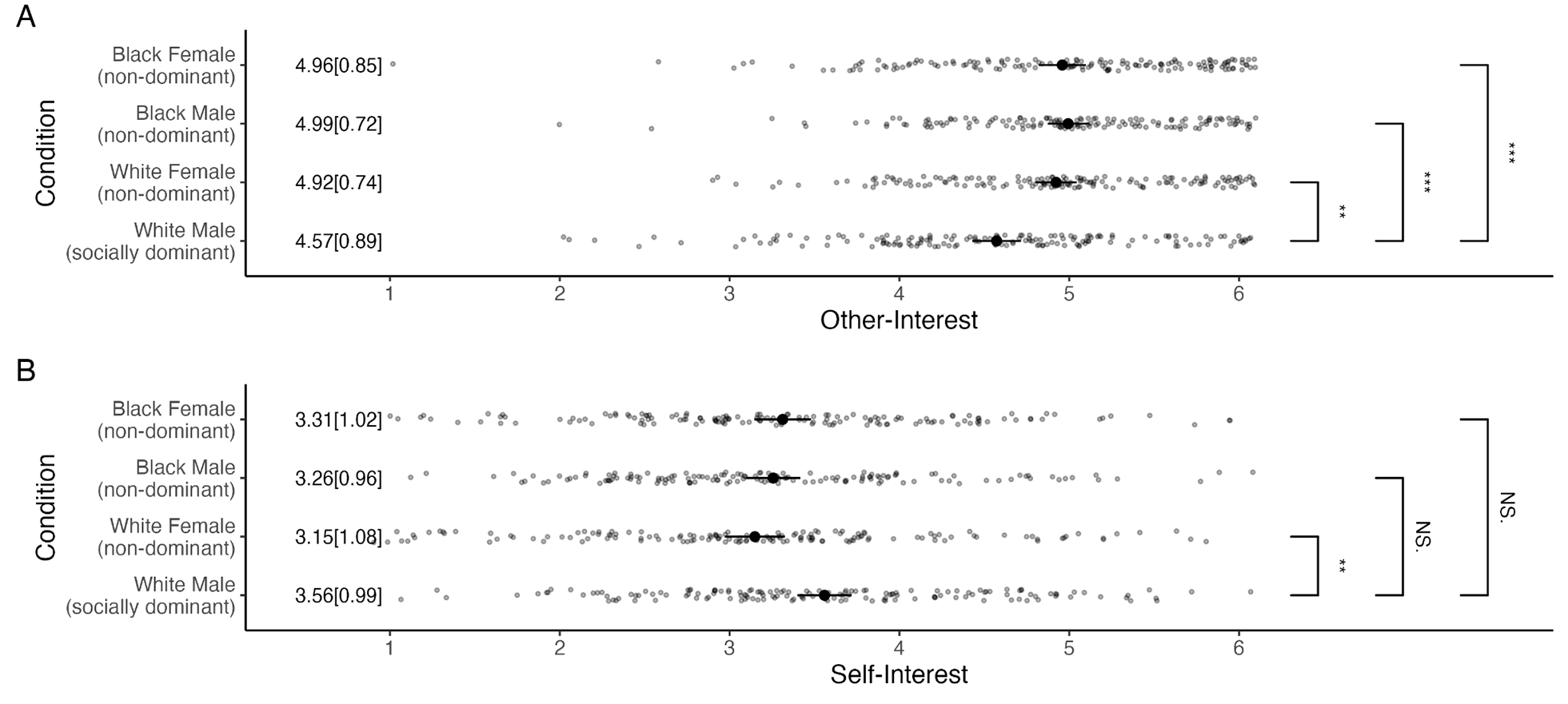
Other-Interest and Self-Interest Mean Plots (Study 1, n = 582). This figure shows the mean other-interest (A) and mean self-interest scores (B) from each messenger condition. We found that the socially dominant White male messenger is evaluated as less other-interested and more self-interested than his non-dominant peers, and that the non-dominant messengers were not statistically different from each other in other-interest or self-interest.
To further understand the difference between conditions on perceptions of messengers’ other-interest, we conducted a post-hoc Tukey HSD multiple pair-wise difference test. The Tukey HSD test indicated that the White Male condition was rated much less other-interested than the non-dominant messenger conditions (p’s < .01). Specifically, we found significant differences in other-interest between White Male and Black Female (p < .001, d = 0.44), between White Male and Black Male (p < .001, d = 0.52), and between White Male and White Female (p = .001, d = 0.43). There were no differences between the three non-dominant messengers’ other-interest ratings in any pairwise comparisons (p’s > .10).
Further, we conducted an exploratory independent t-test in which we compared the dominant White Male condition to a merged Non-Dominant (ND) messengers condition (i.e., a merged group of Black Male, Black Female, and White Female conditions). 4 We found that the dominant White Male messenger was rated significantly less other-interested than the Non-Dominant messengers (MWM = 4.57, SDWM = 0.89, MND = 4.96, SDND = 0.77; t(233) = 4.73, p < .001, d = 0.48).
Self-Interest Measure
We also found significant differences in self-interest perceptions (MBF = 3.31, SDBF = 1.02; MBM = 3.26, SDBM = 0.96; MWF = 3.15, SDWF = 1.08; MWM = 3.56, SDWM = 0.99; F(3, 577) = 4.36, p = .005, partial η2 = .02) between the four conditions. See Figure 1B for a mean plot.
To probe our findings on self-interest, we conducted a post-hoc Tukey HSD test and found that the dominant White Male messenger was rated more self-interested than the White Female messenger (p = .003, d = 0.40). There was no significant difference between White Male and Black Female (p = .155) or between White Male and Black Male messengers (p = .055); and no significant differences were detected between Black Female and Black Male (p = .966), Black Female and White Female (p = .509), or Black Male and White Female (p = .803) conditions. In an exploratory independent t-test wherein we compared the White Male condition to the merged Non-Dominant condition, we found that the dominant White Male messenger was rated significantly more self-interested than Non-Dominant messengers (MWM = 3.56, SDWM = 0.99, MND = 3.24, SDND = 1.02; t(267) = 3.38, p < .001, d = 0.32).
Exploratory Factorial ANOVAs
We also conducted exploratory two-way ANOVAs examining the effect of messenger race (Black, White) and messenger gender (female, male) on our dependent measures. The results were consistent in that the While Male messenger was rated significantly lower in other-interest and higher in self-interest than his non-dominant counterparts. We report these results in Supplemental Appendix B.
Study 1 Results and Discussion
Overall, results from our pre-registered (i.e., confirmatory) one-way ANOVA that compared four messenger conditions on other-interest are consistent with additional exploratory factorial ANOVAs such that we found a robust pattern wherein the White male messenger is perceived lower in other-interest than his counterparts.
Study 1 finds that messengers’ perceived motivation varies based on their demographic identities when they share purely statistical or “objective” information on group-based disparities. Counter to Hypothesis 1a and in support for Hypothesis 1b, we find that the White male messenger is perceived as significantly less other-interested and more self-interested than messengers with non-dominant social identities. Specifically, White male messengers are seen as less interested in other people’s welfare, less altruistic, and less concerned about workplace justice than socially non-dominant messengers in the context of sharing statistical information on group-based disparities. This story largely carries over into the self-interest perceptions, in that the White male messenger was rated as the most self-interested out of all messengers. We did not find that individuals from non-dominant social identity groups faced less favorable ratings in terms of other-interest and self-interest perceptions. Because other-interested orientations place the goals, achievements, happiness, and general consideration of others before oneself, other-interest has a highly positive and favorable connotation to it (Gerbasi & Prentice, 2013). In short, our findings from Study 1 suggest that White male messengers are perceived as being lower in other-interest, implying less favorable motivational attributions, compared to non-dominant messengers in the context of sharing and disseminating messages of group-based workplace disparity.
Following these findings, we propose that there may exist a messenger–message discordance effect wherein different messengers are attributed different perceptions based on the concordance (or lack thereof) between their social identity and the focal group in their message. Study 1 shows support for a negative messenger–message discordant effect: the White male messenger whose identity is discordant with the disadvantaged groups in the statistics-only inequality newsletter is given a lower other-interest perception compared to all other messengers whose identity overlaps with some component of the disadvantaged groups in the disparity statistics. Our next study aims to replicate the negative messenger–message discordance effect and to examine a potential strategy to mitigate the discordance.
Study 2
We conduct Study 2 to replicate the messenger–message discordance effect established in Study 1 and to test what might mitigate the negative consequences of such an effect (i.e., unfavorable motivational attributions in the form of reduced other-interest perceptions and increased self-interest perceptions for While male messengers). In Study 2, we test Hypotheses 2a and 2b and propose that discordant messengers who explicitly state their advocacy intentions will reduce the lowered other-interest perceptions attributed to them. The more discordant (i.e., the more distant) an individual’s identity demographics are from those they advocate for, the more important it is for that speaker to explicitly state their advocacy intentions in order to reduce the negative effects of discordance and to be seen in a favorable light. Study 2 adopts an independent factorial design, manipulating both the social group identity of the messengers (i.e., White male vs. Black and/or female) and the content of the messages (i.e., statistics-only vs. advocacy-injected message).
Methods
Participants
We recruited 1,533 U.S. adult participants who had not participated in previous studies. As pre-registered, participants were excluded from data analysis if they did not pass any attention or manipulation check questions. The final sample consisted of 1,334 adults from TurkPrime (73.2% White, 9.4% Black, 7.9% Asian, 7.0% Hispanic, 0.5% American Indian or Alaska Native, 0.1% Native Hawaiian or Pacific Islander, 1.9% Other; 52.1% Female; Mage = 41.5 years, SDage = 12.8 years, Rangeage: 18–84 years), which meets the minimum sample size we required from our 95% power analysis for an effect of f = 0.25 (partial η2 = .06) under a .05 alpha error probability for a one-way ANOVA with four conditions (Faul et al., 2009). Given our sample size, a factorial ANOVA with a 4 (messenger condition: White Male vs. White Female vs. Black Male vs. Black Female) × 2 (newsletter type: statistics-only vs. advocacy-injected) eight-cell design would be sensitive to effects of Cohen’s f = 0.08 (partial η2 < .01) for main effects with 80% power (a = .05), and sensitive to effects of Cohen’s f = 0.09 (partial η2 < .01) for interaction effects with 80% power (a = .05). Additionally, a factorial ANOVA with a 2 (messenger dominance: White Male vs. Non-Dominant) × 2 (newsletter type: statistics-only vs. advocacy-injected) four-cell design would be sensitive to effects of Cohen’s f = 0.08 (partial η2 < .01) for main effects with 80% power (a = .05), and sensitive to effects of Cohen’s f = 0.08 (partial η2 < .01) for interaction effects with 80% power (a = .05).
Procedure
Study 2 follows a similar procedure as in Study 1. To test Hypotheses 2a and 2b, we varied the Community Newsletter from Study 1 to feature a version that contained a firm personal stance against disparity. In other words, we crossed the messenger identity (i.e., White Male, White Female, Black Male, Black Female) with message content (i.e., statistics-only vs. advocacy-injected statistics). Specifically, for half of the Community Newsletters, we added the hypothetical coworker’s personal commentary and explicit advocacy for workplace equity after the same statistical information on workplace inequity: “As some of you may know, inequality is an issue near and dear to my heart” and “. . . addressing group-based disparity is one of my personal missions.” See Figure S2 for the full advocacy-injected newsletters.
Measures
Study 2 focused on the same other-interest and self-interest measures as previous studies. Correlations among key measures are described in Table S4.
Results
Exploratory Two-Way Factorial ANOVAs
We first ran exploratory two-way factorial ANOVAs investigating the main effects and interaction effects of messenger condition (four levels) and newsletter type (two levels) on other-interest and self-interest measures.
Other-Interest Measure
On our other-interest index measure (11 items, α = .96), we found a significant main effect of messenger condition (MBF = 4.85, SDBF = 1.00; MBM = 4.94, SDBM = 0.86; MWF = 4.89, SDWF = 0.85; MWM = 4.73, SDWM = 0.99; F(3, 1,325) = 3.52, p = .015, partial η2 < .01) showing that there was an overall difference in other-interest ratings by messenger condition. Tukey HSD tests reveal a significant difference between the White Male messenger and the Black Male messenger conditions, wherein the White Male messenger received lower other-interest ratings than the Black Male messenger (p = .014, d = 0.23). No other pairwise differences between other conditions were significant (p’s > .05).
We also found a significant main effect of newsletter type (F(1, 1,325) = 83.39, p < .001, partial η2 = .06), showing that the advocacy-injected (Adv) newsletter conditions (MAdv = 5.02, SDAdv = 0.90) were rated significantly higher in other-interest than the statistics-only (Stat) newsletter conditions (MStat = 4.56, SDStat = 0.90) overall.
Next, we found a significant interaction effect of messenger condition and newsletter type on other-interest ratings (F(3, 1,325) = 5.81, p < .001, partial η2 = .01). Probing the significant interaction effect, simple effects analyses evaluating the effect of messenger condition at each level of newsletter type revealed no significant contrasts between any messenger conditions sending advocacy newsletters (p’s > .10), but showed significant contrasts between the White Male messenger and each of the three non-dominant counterparts when presenting statistical newsletters; in each case, the White Male messenger was rated significantly lower in other-interest than the non-dominant messengers: comparing White Male and Black Female messenger (t(1,325) = 3.50, p = .003, d = 0.40), White Male and Black Male messenger (t(1,325) = 4.98, p < .001, d = 0.67), and White Male and White Female messenger (t(1,325) = 3.07, p = .012, d = 0.38).
In simple effects analyses investigating the effect of newsletter type at each level of messenger condition, we found significant contrasts between advocacy-injected and statistics-only newsletters for the Black Female messenger (t(1,325) = 3.11, p = .002, d = 0.36), the White Female messenger (t(1,325) = 4.20, p < .001, d = 0.59), and the White Male messenger (t(1,325) = 7.23, p < .001, d = 0.84); in each case, messengers delivering the advocacy-injected newsletter received higher other-interest ratings than those delivering the statistics-only newsletter. There was no simple effect of newsletter type for the Black Male messenger (t(1,325) = 1.58, p = .114).
Messenger Dominance
Further, given that our main hypotheses are on social dominance identities (i.e., White male vs. Black and/or female messengers) and we did not find significant differences among the three non-dominant groups, 5 we collapsed the three Non-Dominant group identities into one group. This enabled us to conduct exploratory analyses that are directly relevant to our research questions and hypotheses but were not explicitly mentioned as pre-registered analyses.
As such, we ran an exploratory 2 (White Male vs. Non-Dominant) × 2 (Statistics-Only vs. Advocacy-Injected) factorial ANOVA on our other-interest index measure (11 items, α = .96). Replicating Study 1, we found a significant main effect of messenger dominance on other-interest ratings comparing socially dominant White Male and Non-Dominant messengers, which showed that the White Male received lower other-interest ratings than Non-Dominant messengers overall (MWM = 4.73, SDWM = 0.99; MND = 4.89, SDND = 0.91; F(1, 1,329) = 8.73, p = .003, partial η2 < .01). We also found a significant main effect of newsletter type on other-interest comparing statistics-only (Stat) and advocacy-injected (Adv) newsletters, showing that advocacy-injected newsletters received higher other-interest ratings than statistics-only newsletters overall (MAdv = 5.02, SDAdv = 0.90; MStat = 4.56, SDStat = 0.90; F(1, 1,329) = 83.65, p < .001, partial η2 = .06). Further, we found a significant interaction effect between messenger dominance and newsletter type on other-interest ratings (F(1, 1,329) = 13.72, p < .001, partial η2 = .01). See Figure 2 for mean plots.
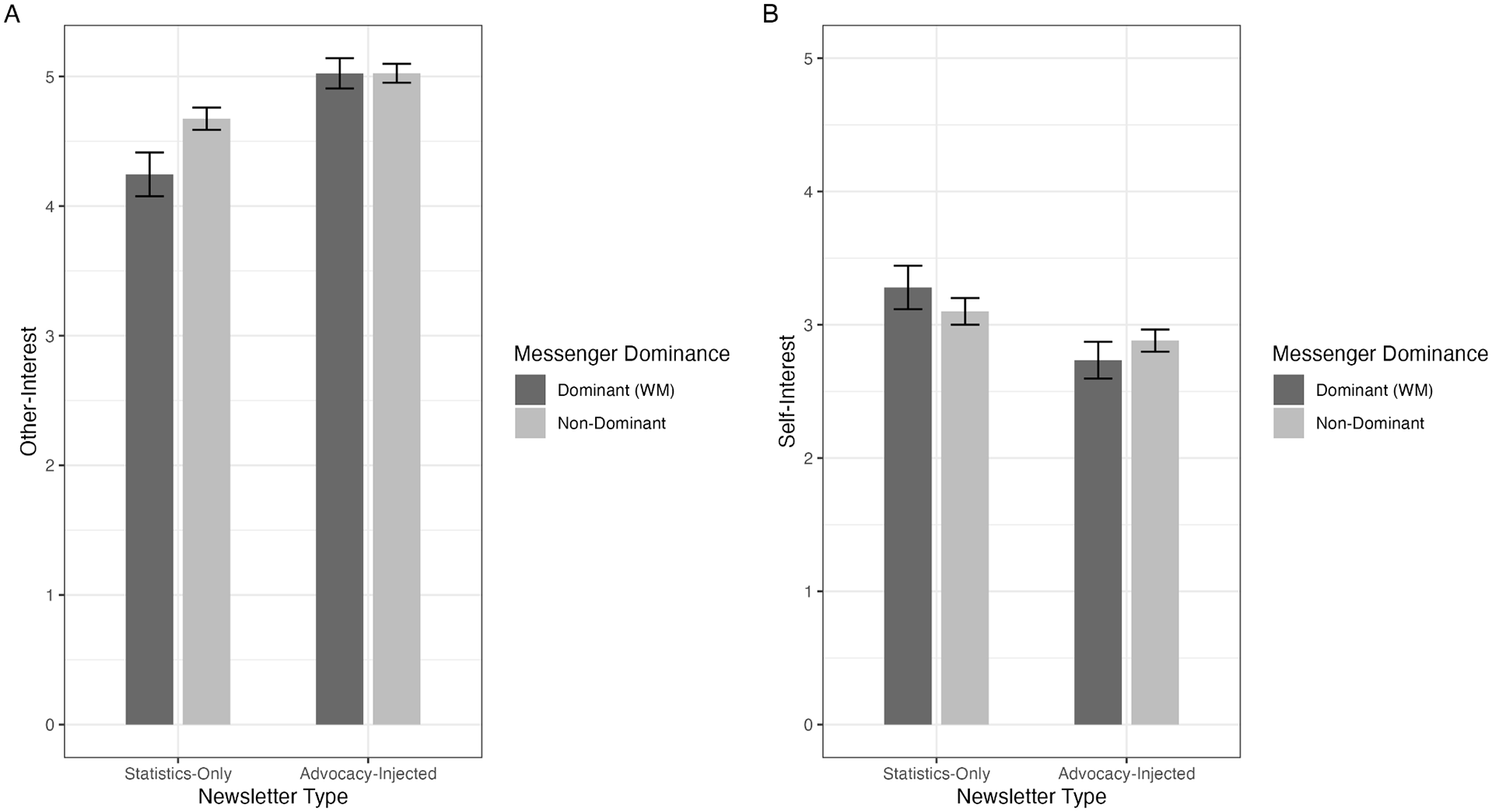
Other-Interest and Self-Interest Ratings by Messenger Dominance and Newsletter Type Conditions (Study 2, n = 1,334). (A) Shows the significant interaction effect between Messenger Dominance and Newsletter Type on other-interest ratings for Study 2 (n = 1,334). We find that all messengers, but especially the socially dominant WM messenger, receive a boost in other-interest ratings when sending the advocacy-injected newsletter as opposed to the statistical information newsletter (A). For self-interest ratings, there was a marginally significant interaction (B).
Simple effects analyses showed no significant contrast between dominant and non-dominant messengers sending advocacy-injected newsletters (t(1,329) = 0.04, p = .972), but revealed a significant contrast between dominant and non-dominant messengers sending statistics-only newsletters such that the White Male messenger was rated lower in other-interest than Non-Dominant messengers (t(1,329) = 4.74, p < .001, d = 0.47); respectively, these findings provide further support for H2a and H1b. Evaluating the effect of newsletter type at each level of messenger dominance, we found significant contrasts between advocacy-injected and statistics-only newsletters sent by White Male (t(1,329) = 7.22, p < .001, d = 0.84) and sent by Non-Dominant messengers (t(1,329) = 4.91, p < .001, d = 0.40), thus supporting H2a; for both sets of messengers, the advocacy-injected newsletters were rated higher in other-interest than the statistics-only newsletters. Interestingly, even though we hypothesized a null effect in H2b for non-dominant messengers, we found that injecting advocacy increased other-interest perceptions for non-dominant messengers.
Self-Interest Measure
Next, we examined our self-interest index measure (10 items, α = .94). We conducted an exploratory 4 × 2 factorial ANOVA to investigate the effects of messenger condition and newsletter type on self-interest.
First, we found a significant main effect of messenger condition on self-interest ratings (F(3, 1,325) = 8.52, p < .001, partial η2 = .02). Tukey HSD tests showed that there were significant pairwise differences between the Black Female condition (MBF = 3.38, SDBF = 1.14) and each of the other messenger conditions (MBM = 3.04, SDBM = 1.17, MWF = 2.97, SDWF = 1.13, MWM = 3.08, SDWM = 1.13; p’s < .003); overall, the Black Female messenger received higher self-interest ratings than other messengers, regardless of newsletter type. Pairwise differences between the Black Male, White Female, and White Male messenger conditions were not significant (p’s > .05).
Second, we found a significant main effect of newsletter type on self-interest ratings (F(1, 1,325) = 21.49, p < .001, partial η2 = .02), illustrating that advocacy-injected newsletters were rated significantly lower in self-interest than statistics-only newsletters, regardless of the messenger identity (MAdv = 3.01, SDAdv = 1.18; MStat = 3.31, SDStat = 1.08).
Third, we found no significant interaction effect of our two factors on self-interest (F(3, 1,325) = 1.62, p = .182).
Messenger Dominance
Following our analysis plan, we examined conditions distinguished by social dominance. We conducted an exploratory 2 × 2 factorial ANOVA investigating the effect of messenger dominance and newsletter type on self-interest. We did not find a significant main effect of messenger dominance on self-interest comparing socially dominant White Male and Non-Dominant messengers (MWM = 3.08, SDWM = 1.13; MND = 3.14, SDND = 1.16; F(1, 1,329) = 0.67, p = .412). However, we did find a significant main effect of newsletter type on self-interest comparing statistical and advocacy-injected newsletters, which showed that messengers sending advocacy-injected newsletters received lower self-interest ratings than those sending statistics-only newsletters (MAdv = 3.01, SDAdv = 1.18; MStat = 3.31, SDStat = 1.08; F(1, 1,329) = 21.71, p < .001, partial η2 = .02). Furthermore, we found a marginally significant interaction effect of messenger and newsletter factors on self-interest (F(1, 1,329) = 3.60, p = .058, partial η2 < .01) (see Figure 2).
Exploratory Three-Way Factorial ANOVAs
As an exploratory analysis, we conducted three-way factorial ANOVAs (Messenger Race × Messenger Gender × Newsletter Type) on other-interest and self-interest. We report these analyses in Supplemental Appendix C.
Study 2 Results and Discussion
Study 2 replicates and extends the findings from Study 1: White male messengers are consistently perceived as significantly less other-interested than non-dominant messengers (i.e., female or racial minority) when sending purely informational messages, thus providing support for H1b. We also find that the lower other-interest perception of the White male messenger is attenuated when the purely informational message is modified to include an explicit personal stance advocating for social equity, providing support for H2a. The simple act of adding explicit personal advocacy benefits not only the socially dominant yet message-discordant messenger, but also the non-dominant messengers who have more message concordance with the issue at hand. While the advocacy-injection mechanism confers the largest boost to messengers with wider messenger–message demographic discordance (i.e., White male), the advocacy-injected newsletter leads to enhanced other-interest ratings for all messengers, including those with messenger–message concordance. This is a notable finding, as we had originally hypothesized a null effect in H2b for non-dominant messengers; indeed, our null hypothesis seems to undervalue the effect of advocacy-injection as we instead found that injecting advocacy increases even non-dominant messengers’ other-interest perceptions.
Furthermore, the findings from Study 2 reveal a discrepancy between other-interest and self-interest ratings both in terms of main effects and interaction effects. Specifically, White male messengers consistently received the lowest other-interest ratings, while the results in self-interest ratings were inconsistent and variable. In addition, while we find a significant interaction effect of messenger identity and newsletter type on other-interest ratings, we find a null interaction effect on self-interest ratings. These divergent results reveal an emerging pattern that while the effects of messenger identity and message content on other-interest ratings are consistent across studies, we do not observe consistent effects on self-interest ratings. Our results further suggest that other-interest and self-interest perceptions may diverge and move independently of each other, rather than being opposing or inverse constructs.
Using a sample of participants with extensive managerial experience and who are familiar with company newsletters from peer employees, the next study aims to replicate both the messenger–message discordance effect wherein the discordant White male who shares information about inequality receives lower other-interest perceptions, as well as the advocacy-injection intervention wherein the White male messenger’s lower other-interest ratings are attenuated when he adds unambiguous expressions of a personal advocacy against inequality on top of the informational message. In our next study, we also include additional analyses that explore participants’ open responses regarding the messengers’ underlying motivations for sending a company newsletter on race- and gender-based workplace disparities. We identify various themes raised by the experienced managerial sample.
Study 3
In Study 3, we conducted a field survey (sometimes known as a lab-in-the-field study) with Executive MBAs to further strengthen the findings that: (a) the socially dominant messenger was rated significantly lower in other-interest compared to non-dominant messengers and (b) this unfavorable rating given to the White male messenger was attenuated when the message explicitly includes personal advocacy. We also explore participants’ qualitative open responses about messengers’ motivations that provide additional insights into the messenger–message discordance effect.
Methods
Participants
We recruited business school students enrolled in fully employed and executive MBA programs. Most participants had extensive managerial experience. We collected data from 298 participants and, as pre-registered, we excluded participants who did not finish the study or did not pass any attention check questions. Our final sample consisted of 186 participants (38.2% White, 38.2% Asian, 8.1% Latino/Hispanic, 2.2% Black, Hispanic, 0.5% Native Hawaiian or Pacific Islander, 12.9% Other/Decline; 37.6% Female; Mage = 34.6 years, SDage = 6.2 years, Rangeage: 24–53 years). The sample size was constrained by the size of the MBA cohorts that voluntarily participated in the study. Given our sample size, a sensitivity test shows that a factorial ANOVA with a 2 (messenger dominance: White Male vs. Non-Dominant) × 2 (newsletter type: statistics-only vs. advocacy-injected) four-cell design would be sensitive to effects of Cohen’s f = 0.21 (partial η2 = .04) for the main effects with 80% power (a = .05), and would be sensitive to effects of Cohen’s f = 0.21 (partial η2 = .04) for interaction effects with 80% power (a = .05).
Procedure
Consistent with previous studies, we randomly assigned participants to experimental conditions that varied in messengers’ demographic identity (i.e., White male vs. Black and/or female) and newsletter type (i.e., statistics-only vs. advocacy-injected statistics). Participants followed a procedure similar to those used in previous studies.
Measures
This study focused on the same other-interest and self-interest measures as Studies 1 and 2. Correlations among key measures are described in Table S5.
Furthermore, participants provided open-ended qualitative responses about the perceived motivation of the messenger for voicing up on group-based workplace disparities in each condition (i.e., “In your own words and in as much detail as possible, what do
Results
Exploratory Two-Way Factorial ANOVAs
We conducted exploratory two-way factorial ANOVAs (Messenger Dominance × Newsletter Type) on our other-interest (α = .96) and self-interest (α = .91) index measures.
Other-Interest
First, we found a significant main effect of messenger dominance on other-interest ratings (MWM = 3.73, SDWM = 1.06; MND = 4.35, SDND = 0.86; F(1, 182) = 21.38, p < .001, partial η2 = .11), showing that the White Male messenger was perceived as less other-interested than Non-Dominant messengers overall. We also found that the main effect of newsletter type was significant (MStat = 3.80, SDStat = 1.01; MAdv = 4.33, SDAdv = 0.93; F(1, 182) = 15.39, p < .001, partial η2 = .08), with advocacy-injected newsletters receiving higher other-interest ratings than statistics-only newsletters overall.
We did not find a significant interaction effect of messenger dominance and newsletter type factors on other-interest (F(1,182) = 1.79, p = .182), potentially due to a lack of statistical power to detect a meaningful interaction. See Figure 3A for the interaction plot.
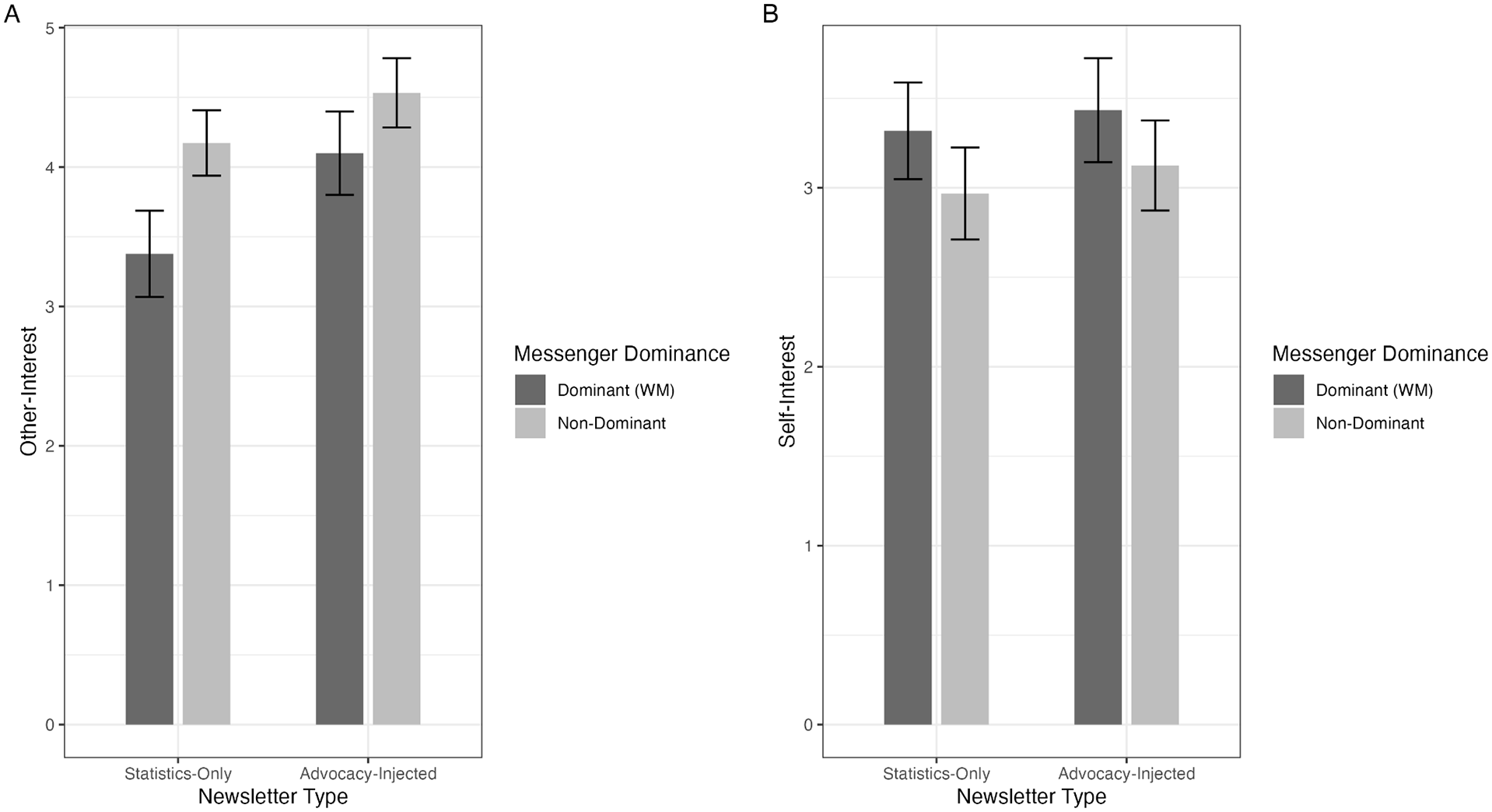
Other-interest and self-interest ratings by messenger dominance and newsletter type conditions (Study 3, n = 186). (A) Depicts our finding that the dominant White Male messenger was rated significantly worse in other-interest ratings than Non-Dominant messengers regardless of newsletter type, and that advocacy-injected newsletters improved all messengers’ other-interest ratings compared to statistics-only newsletters. (B) Shows that the White Male messenger was rated significantly more self-interested than Non-Dominant messengers regardless of newsletter type, and that advocacy-injected newsletters lowered self-interest perceptions compared to statistics-only newsletters regardless of dominance. We found no significant interaction effect on other-interest or on self-interest.
Self-Interest
Second, for self-interest, we found a significant main effect of messenger dominance identity (MWM = 3.37, SDWM = 0.91; MND = 3.05, SDND = 0.89; F(1,182) = 6.12, p = .014, partial η2 = .03) such that the White Male messenger received significantly higher self-interest ratings than Non-Dominant messengers, but found no main effect of newsletter type (F(1,182) = 1.08, p = .301).
We also found no interaction effect of messenger dominance and newsletter on self-interest ratings (F(1,182) = 0.02, p = .878). See Figure 3B for the interaction plot. We interpret this in line with the theory that self-interest and other-interest may function as independent constructs. This is supported by our data, which suggests that self-interest and other-interest do not necessarily bear the same patterns.
Exploratory Three-Way Factorial ANOVAs
As an exploratory analysis, we conducted three-way factorial ANOVAs (Messenger Race × Messenger Gender × Newsletter Type) on other-interest and self-interest. It is worth noting that the current sample size would be underpowered for this analysis. Thus, we leave the result, which should be interpreted with caution, to the Supplemental Appendix D.
Qualitative Results on Messenger’s Motivation
Respondents shared their open-ended perspectives on the messenger’s motivation. To better understand the nature of these qualitative responses, we conducted an exploratory qualitative content coding analysis. We followed a three-step process in this analysis.
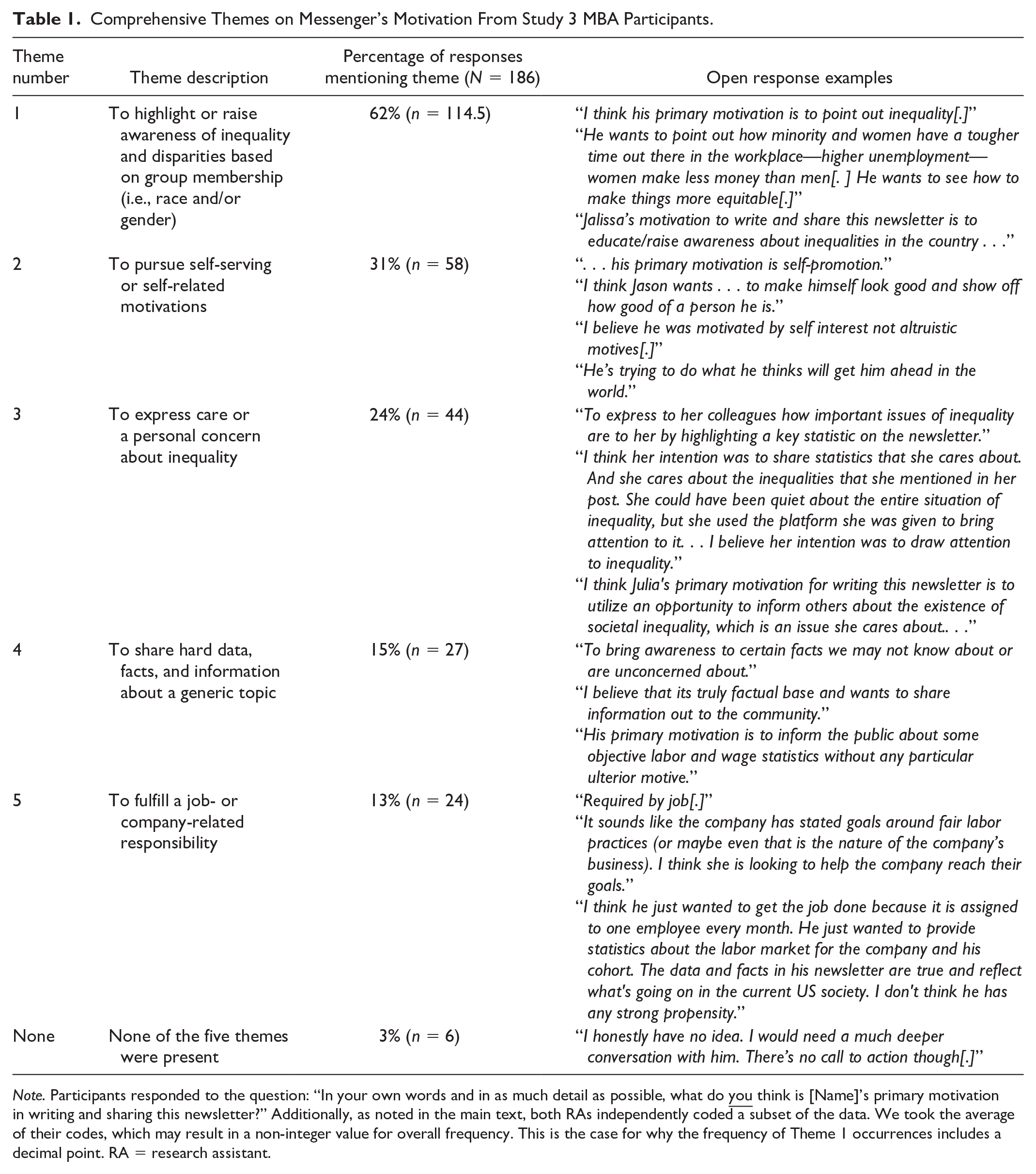
First, two independent readers read through the full set of open responses multiple times and identified a list of five comprehensive motivation-related themes that participants frequently mentioned in their answers. This first step was followed by the first author and a RA, who independently identified and then collaboratively termed the five themes, which were frequently mentioned by participants (by at least 10%) and are largely distinctive categories. The comprehensive themes on motivation included: (a) to highlight or raise awareness of inequality and disparities based on group membership (i.e., race and/or gender), (b) to pursue self-serving or self-related motivations, (c) to express care or a personal concern about inequality, (d) to share hard data, facts, and information about a generic topic, and (e) to fulfill job- and/or company-related responsibilities. Please see Table 1 for the comprehensive list of themes, frequency of mentions in responses, and example responses from participants.
Comprehensive Themes on Messenger’s Motivation From Study 3 MBA Participants.
Note. Participants responded to the question: “In your own words and in as much detail as possible, what do
Second, we trained two undergraduate RAs blind to the research hypotheses and study design to code participants’ responses along the five identified themes (0 = theme is not present in participant response, 1 = theme is present in participant response). We used a small subset of the data to synchronously train the RAs. The RAs were told that a single participant’s response can contain multiple of these distinct themes. We then had the RAs independently code a larger subset of the data, on which we conducted inter-rater reliability (IRR) calculation; the IRR between the two RAs was 96.6%. We took the average of the two RAs’ codes for this subset of the data. Given the high IRR, we then split up the rest of the data for each RA to code.
Third, using the coded data, we conducted an exploratory binomial logistic regression to investigate whether there were significant differences in how frequently a certain theme was mentioned between conditions. 6 We found that messenger dominance significantly predicted Theme 1 mentions, showing that participants assigned to non-dominant messenger conditions were significantly more likely to perceive the messenger as being motivated to share group-based inequalities and disparities so as to highlight and raise awareness of such disparities (b = 0.80, SE = 0.31, p = .010). The odds of expressing Theme 1 were 2.24 times higher for participants assigned to non-dominant messenger conditions compared to those in dominant messengers (95% CI [1.22, 4.15]). No other themes were significantly predicted by dominance condition, newsletter type, or the interaction of the two factors (p’s > .05). We report additional exploratory t-tests on these themes, which showed consistent results, in Supplemental Appendix D.
Study 3 Results and Discussion
This final study replicates and provides support for the messenger–message discordance effect from Studies 1-2 using a sample of executive MBAs with extensive managerial experience and who are familiar with similar company newsletters from peer employees. White male messengers are consistently perceived as significantly less other-interested than non-dominant messengers. Additionally, messengers delivering purely statistical information are perceived as significantly less other-interested than messengers delivering advocacy-injected statistics.
Furthermore, Study 3 included an open-ended question asking participants to write what they thought the messenger’s primary motivation was in sending the Community Newsletter. Through content coding analysis, we identified five major themes. These themes were unique and largely non-overlapping, suggesting that participants were able to infer complex and non-singular motivations from a messenger. Of these motivations, Theme 1, which is the motivation to highlight or raise awareness of inequality and disparities based on group membership, such as race and/or gender, was raised by more than 60% of the participants. In binomial logistic regressions, we find that non-dominant messengers are significantly more likely than dominant messengers to be perceived as motivated by Theme 1. In other words, non-dominant messengers were more frequently perceived as being genuinely motivated to highlight or raise awareness of group-based inequalities than dominant messengers.
General Discussion
Across one pilot study and three pre-registered experiments, our results show that when an individual presents a message about gender and race disparities in the workplace, who they are and what they speak up matters for motivational attributions. Demographic differences between messengers interact with message content to affect how individuals are perceived by others in terms of self-interest (i.e., the motivation to act in one’s own interest) and other-interest (i.e., the motivation to act in another’s interest).
In Study 1, which features a purely information-sharing context, we find that a messenger’s demographic identity affects motivational and interest-related perceptions of the messenger. Socially dominant White male messengers who deliver statistical and purely informational messages about race- and gender-based workplace disparities were seen to have less favorable motivational intentions and perceived to be less other-interested and more self-interested. Meanwhile, Black or female messengers who deliver the same factual information are seen as having more favorable motivations and perceived to be more other-interested and less self-interested. In other words, White men are seen as acting out less in other people’s interest and more in one’s own interest when delivering a purely informational message on race- and gender-based workplace disparity.
In Study 2, we test how injecting explicit personal advocacy into an informational message might change the other-interest and self-interest perceptions of messengers. First, we replicate the negative messenger–message discordance effect and find that the White male messenger is perceived as less other-interested and more self-interested than their non-dominant counterparts when presenting a statistics-only newsletter. Second, we find that injecting explicit personal advocacy into the statistical workplace newsletter increases other-interest ratings and reduces self-interest ratings for both socially dominant and non-dominant messengers. Furthermore, we find that there exists an interaction effect between the messenger’s demographic identity and the message content, such that the socially dominant White male messenger mitigates his lower other-interest perceptions when adding explicit personal advocacy into the informational message. In short, sharing purely statistical information, objective and impartial as it appears, may unexpectedly lower the perceived other-interest of the socially dominant White male messengers. However, adding explicit personal advocacy against disparity mitigates such negative motivational attributions and improves all groups’ perceived motivations.
Finally, in Study 3, we recruited a sample of executive MBA students with extensive managerial experience to further replicate the messenger–message discordance effect and to explore potential motivations underlying messengers’ decision to write and disseminate the company newsletter on group-based disparities. Our results show, firstly, that the negative messenger–message discordance effect for the White male messenger’s motivational attributions holds in terms of other-interest ratings under the statistics-only newsletter condition and, secondly, that adding personal advocacy to the message improves other-interest ratings. We also conducted a review of qualitative open response data and identified five distinct motivational themes mentioned by participants. Our qualitative results show that one of these themes—the motivation to highlight or raise awareness of group-based disparities—was mentioned by more than 60% of participants. Furthermore, for this particular theme, we found significant differences in mentions by messenger dominance, which suggests that participants in non-dominant messenger conditions were more likely to perceive that the messenger was motivated by the desire to highlight or raise awareness of group-based disparities than participants in the dominant messenger condition.
The current research opens more questions than it solves. Our experimental design allows for stronger causal identifications and internal validity, but may be limited in external validity or contextual richness. Our designs do not feature a study that includes only subjective advocacy content with no informational statistics. Future work may consider conducting a study that tests for differences in messenger self-interest and other-interest when delivering an advocacy-only newsletter.
Furthermore, we believe it is important to expand messenger demographics and disparity domains to include additional race and gender identities beyond White/Black and male/female. We also recognize the need for future research that considers cross-cultural contexts or organizational settings in which the socially dominant ally is not White or male. Relatedly, surveying participants who themselves have demographic overlap with the messengers or are predominantly in-group members of a marginalized or minority group social identity may be interesting and reveal different motivational attributions. For instance, in our work, we survey White-majority samples with participants who on average reveal an unfavorable other-interest and self-interest perception of the White male messenger. Although we did not find a moderating effect from participants’ own gender or racial identities in the current study, future work should consider sampling predominantly Black or other minority populations—who themselves may be potential downstream beneficiaries of the advocacy message—to evaluate whether or not motivational attributions of messengers would shift based on sample composition.
Finally, identifying and testing mechanisms would strengthen this work. Though we try to explore potential underlying motives through participants’ qualitative responses, our work does not directly test mechanisms underlying the relationship between messenger identity and motivation attributions. We include exploratory mediation analyses in Supplemental Appendix D (i.e., specifying motivation to highlight or raise awareness of group-based disparities, concern for inequality, and white supremacy as three separate mediators). However, these mediation models are highly speculative, and we acknowledge that highlighting group-based disparities and concern for inequality are constructs that conceptually overlap with items that mention inequality within our other-interest measure. 7 We encourage future work to expand upon this initial investigation and explore other mediators that are theoretically driven. In future work, we will consider these extensions.
Theoretical and Practical Implications
The finding that the socially dominant White male messenger is perceived as less other-interested than his non-dominant peers updates the evidential base regarding the way demographic identities impact how an individual’s motivations or interests are perceived and evaluated. Our findings add to the large body of literature suggesting that those who are subject matter experts, insiders, or otherwise closer to the target for which they are advocating are perceived more positively in terms of knowledge, persuasiveness, and legitimacy (Cialdini & Trost, 1998; Sherf et al., 2017; Thai et al., 2021; Torrez et al., 2024; Wallace et al., 2024). We advance this broad field of work on identity-based person perceptions by focusing specifically on two essential motivational attributions: other-interest and self-interest. Our work shows that messengers with demographic concordance to messages of group-based disparities (i.e., Black and/or female messengers who have faced lower employment and salary outcomes) were granted more favorable motivational attributions in the form of higher other-interest and lower self-interest ratings.
Given the U.S. organizational context in which the socially dominant group consists of White men, and non-socially dominant groups consist of women and racial minorities who are more likely to directly experience race- and gender-based disadvantages, our findings suggest that non-dominant messengers are perceived as more other-interested where messenger–message concordance exists (i.e., wherein non-dominant individuals speak out about race- and gender-based inequality). Indeed, it is the White male, the discordant messenger, who receives an unfavorable motivational attribution in terms of self-interest and other-interest when speaking up on inequality without explicit personal advocacy.
Furthermore, we propose the importance of a messenger–message discordance effect in driving different other-interest and self-interest attributions. Rather than the perceptions of motivation shifting on the basis of messenger identity alone, it is the gap or discordance between a messenger’s identity and the message’s subject that contributes to trait and interpersonal evaluations. We build upon the messenger–message discordance effect by examining and proposing a simple intervention to mitigate the unfavorable other-interest and self-interest ratings attributed to the White male messenger. We find that inserting personal narration of explicit advocacy can reduce the negative effect of messenger–message discordance. By sharing a clearly supportive, anti-disparity, and mission-oriented perspective, the White male messenger positions himself more as an advocate and reduces his discordance with the message’s subject of group-based disparity. In turn, his previously lower other-interest and higher self-interest ratings were attenuated, and the White male messenger showed no difference in these measures when compared to other messengers. By including a strong personal stance against disparities, the negative effect of messenger–message discordance on motivational attributions is weakened.
Interestingly, we found that this advocacy-injection not only attenuates the White male messenger’s poor other-interest ratings, but also boosts non-dominant messengers’ other-interest ratings. This finding is notable both because it highlights how we had underestimated the power of advocacy-injection for non-dominant messengers in our own hypothesis, and because it deviates from what previous literature may have predicted for non-dominant messengers regarding other types of person perceptions. Past work has shown that, for marginalized and non-dominant individuals or messengers, providing additional personal details about oneself in a presentation and voicing context enhances perceptions of warmth-related trustworthiness but decreases perceptions of competence-related trustworthiness (Altenmüller et al., 2023). While this work is on person perception more broadly and not on motivational attributions, such as other-interest and self-interest specifically, it sheds light into an alternative hypothesis that non-dominant messengers may be generally perceived less favorably when adding in personal narratives or advocacy statements. We encourage future work to investigate this potential pattern of results. Indeed, while our work suggests the practice of explicit personal advocacy in general for all messengers, we qualify this recommendation by more strongly encouraging the use of this intervention for socially dominant individuals than for non-dominant individuals, as it is possible that the other-interest perception boosts for non-dominant messengers may vary depending on the participants and contexts (e.g., Altenmüller et al., 2021).
Another theoretical contribution of the current work is to the domain of motivation, other-interest, and self-interest research. Specifically, we provide additional empirical evidence to the theory that other-interest and self-interest outcomes are indeed distinct and vary independently to each other (Gerbasi & Prentice, 2013; Howell et al., 2015; Li et al., 2021; Stoeber, 2015). Furthermore, we find the effects of our messenger and newsletter manipulations were stronger and more consistent along our other-interest outcome than along our self-interest outcome. This finding extends the theory that other-interest and self-interest measures move differently rather than in sync or in complementary ways. Moreover, this pattern of results could speak to an underlying conceptualization that other-interest is more predictive of altruism and is thus a more positive construct. Since other-interest inherently places the consideration of others over the self, it has a highly positive and favorable connotation (Gerbasi & Prentice, 2013). Concern, care, or interest in others outside of the self is more clearly positive across contexts and thus may be a stronger foundation to form impressions or perceptions on, whereas self-interest is less clearly of positive or negative valence and may be more dependent on the scenario. Indeed, each of the messengers featured in this study is seen as somewhat self-interested, but perhaps these are all for unique and distinct reasons; it is possible that the socially dominant White male messenger may be seen as being performative or virtue signaling for his own reputational promotion, whereas non-dominant messengers may be seen as motivated to advance their in-group members’ and perhaps their own well-being. Related is the construct of vested interests, or a motivation to advance the interests of one’s in-group (i.e., Thai et al., 2021). Vested interests may be conceptualized as “group-interest,” and accordingly, occupy an overlapping area or the center of a Venn diagram depicting other-interest and self-interest. While the current work does not investigate group-interest, it is possible that, using these same messenger identity and newsletter type conditions, group-interest perceptions may be in between other-interest ratings and self-interest ratings, may be higher than both, lower than both, or closer to one over the other. Future research is needed to examine and discern the extent to which other-interest, self-interest, and perhaps even group-interest vary independently and show varying strength in effects.
Nevertheless, our findings on other-interest and self-interest perceptions show that they are distinct constructs and, indeed, our intervention influenced them in different ways with different predictive power. Future work should build upon our findings on these fundamental motivation attributions and expand into broader downstream outcomes or implications that other-interest and self-interest perceptions may have on messengers in presentation and voicing contexts. As noted previously, altruism perceptions are related to other-interest perceptions. Additionally, bias, persuasion, credibility, legitimacy, expertise, and impact have all been shown to vary based on social identity (e.g., Cialdini & Trost, 1998; Moser et al., 2024; Thai et al., 2021; Torrez et al., 2024; Wallace et al., 2024), but a clearer connection of these constructs to motivations, other-interest, and self-interest is of high importance to the field. Of particular interest may be quasi-behavioral outcomes that stem from these motivational attributions, such as workplace collaboration with the messenger or monetary donations to combat workplace disparities. Perhaps messenger conditions receiving higher other-interest would, in turn, solicit greater collaboration requests or monetary donations. Investigating these downstream implications and related person perception constructs would be of great interest for future work.
Overall, by testing the addition of explicit personal advocacy and finding that it increased other-interest perceptions for all demographically varying messengers, we contribute evidence in favor of an active personal advocacy approach. Active personal advocacy has been previously demonstrated by scholars from different fields (Kendi, 2019; Michie et al., 2018; Moyer et al., 2020; Trevisan, 2017), and our work expands these arguments to the workplace and organizational context with motivational attributions as a focus. We propose that the simple, low-cost intervention of including personal advocacy intentions when speaking up about disparities and inequality is, particularly from the dominant group members, a necessary and important first step in the long march toward organizational justice and equity.
Practically, we believe our findings shed light on the reality that who speaks up and how they do so matters for motivational attributions in the context of voicing group-based disparity. Instead of solely relying on purely statistical or “objective” information as the basis of presenting on inequality or disparities, our findings encourage individuals and allies, particularly those from the dominant group, to incorporate explicit personal advocacy when presenting on and voicing up against inequality. Doing so seems to improve other-interest perceptions for all advocates, and in particular for those who are socially dominant. So long as the messengers are indeed acting from a place of genuine advocacy, firmly sharing one’s stance may alleviate the concern that their speaking up about inequity comes across as performative, more self-interested, and less other-interested.
While messengers and other workplace advocates should take stock of their social identity in voicing up against inequality, our findings offer accessible and trainable solutions that encourage all potential advocates—and particularly those with socially dominant identities—to voice up, rather than shy away from the act of voicing or fear backlash from sharing their personal perspective in advocacy.
Conclusion
Across one pilot and three main studies (N = 2,240), we assess the effect of individual demographics and message content on self-interest and other-interest perceptions when speaking up about group-based workplace disparities. We show that a messenger–message discordance effect exists and that a simple advocacy-injection intervention may mitigate the unfavorable motivational attribution effects of discordance. We find that socially dominant messengers (i.e., White male individuals who have demographic discordance with the disadvantaged groups they present on) receive unfavorable motivational attributions (i.e., higher self-interest ratings and lower other-interest ratings) when sharing information on group-based disparity, but that this unfavorable perception is attenuated when they add explicit personal advocacy on top of the informational message. We also find that non-dominant messengers (i.e., female and/or Black individuals who have demographic concordance with the disadvantaged groups they present on) gain a boost in motivational attributions (i.e., higher other-interest ratings) from adding personal advocacy. These findings highlight the existence of a messenger–message discordance effect and the importance of including personal advocacy in addition to statistical information when presenting and speaking up about workplace disparities.
Supplemental Material
sj-docx-1-psp-10.1177_01461672251338679 – Supplemental material for Messenger–Message Discordance: When Presenting Workplace Disparities, Who Speaks Up (and How) Matters for Other-Interest and Self-Interest Attributions
Supplemental material, sj-docx-1-psp-10.1177_01461672251338679 for Messenger–Message Discordance: When Presenting Workplace Disparities, Who Speaks Up (and How) Matters for Other-Interest and Self-Interest Attributions by Elizabeth Q. Jiang and Sherry J. Wu in Personality and Social Psychology Bulletin
Footnotes
Acknowledgements
We thank Helen Zhang for her research assistance and the Social and Identity Lab (SAIL) at UCLA Anderson for their friendly feedback.
Declaration of Conflicting Interests
The author(s) declared no potential conflicts of interest with respect to the research, authorship, and/or publication of this article.
Funding
The author(s) received no financial support for the research, authorship, and/or publication of this article.
Ethics Approval
Data collection for all studies was approved by the University of California, Los Angeles (UCLA)’s Office of the Human Research Protection Program (OHRPP; Institutional Review Board Number #20-000319).
Data Availability

Open Practices
Supplemental Material
Supplemental material is available online with this article.
Notes
References
Supplementary Material
Please find the following supplemental material available below.
For Open Access articles published under a Creative Commons License, all supplemental material carries the same license as the article it is associated with.
For non-Open Access articles published, all supplemental material carries a non-exclusive license, and permission requests for re-use of supplemental material or any part of supplemental material shall be sent directly to the copyright owner as specified in the copyright notice associated with the article.
