




Abstract
In several highly publicized hearings, Dr. Christine Blasey Ford and Judge Brett Kavanaugh presented two opposing accounts of an alleged sexual assault. In the wake of these proceedings, partisans appeared similarly divided in how they regarded this political event. Using a U.S. national sample (N = 2,474) and a mixed-methods design, we investigated partisans’ perceptions of, and responses to, the Ford-Kavanaugh hearings. Respondents reported their views of the hearings soon after they occurred. We used topic modeling to analyze these open-ended responses and found uniquely partisan topics emerged, including judicial impartiality and due process. Acute stress (AS) responses to the hearings were also related to partisan identities and perceptions; both Republicans (incidence rate ratio [IRR] = 0.81, 95% confidence interval [CI] = [0.78, 0.84]) and individuals who wrote more about Republican topics (IRR = 0.72, 95% CI = [0.56, 0.92]) reported lower AS than their Democratic counterparts. Results demonstrate different partisan perceptions with implications for mental health outcomes.
Introduction
On September 27, 2018, Dr. Christine Blasey Ford and Judge Brett Kavanaugh appeared before the United States Senate Judiciary Committee to testify regarding Ford’s allegations that Kavanaugh sexually assaulted her in high school. More than 20 million viewers tuned into broadcasts of this landmark event, which came at a critical cultural juncture as the United States grappled with unprecedented political polarization and animosity, political stress, shifting norms, ongoing national conversations about sexual violence in the wake of the MeToo movement, and a looming midterm election in a fraught political climate (American Psychological Association, 2017; Pew Research Center, 2014, 2016, 2018; Richwine, 2018).
Although billed as an impartial investigation of the facts, the Ford-Kavanaugh proceedings were instead a display of adversarial partisanship (Ellis, 2018). In his opening statement, Judge Kavanaugh proclaimed his innocence and accused Democrats of using the allegations to discredit him (Shabad, 2018). Republican politicians echoed these charges and claimed Democrats strategically waited until the eleventh hour to bring forth the allegations (Kirby, 2018). Democrats, in turn, condemned Kavanaugh’s comportment during his testimony and accused Republicans of undermining the FBI investigation into the allegations (Breuninger, 2018; Relman, 2018). Although politicians on both sides of the aisle witnessed the same events, they appeared to interpret the situation in fundamentally different ways, according to the interests of their respective parties.
Perceiving intergroup situations through the lens of group affiliation is a well-established psychological phenomenon, dating back to the classic study of football fans who saw dramatically different versions of the same rivalry game (Hastorf & Cantril, 1954). This identity-consistent perception has been best understood within the framework of social identity theory, which argues that individuals derive their self-concepts in part from their membership in social groups and are fundamentally motivated to maintain a positive social identity as part of their need for a positive self-concept (Tajfel & Turner, 1979). Of the processes that uphold favorable sentiments about social identities, identity-consistent differences in perception may be most likely to inspire division, given the challenge of finding common ground without first sharing a common reality (Stern & Ondish, 2018; Turner et al., 1994; Van Bavel & Pereira, 2018; Xiao et al., 2016). In a time of political sectarianism (Finkel et al., 2020), disagreement over the basic facts of an event could thwart bipartisan compromise and further entrench partisan divisions.
Despite limited empirical work examining differences in partisan perceptions, preliminary evidence suggests that partisans construe actions or events in ways that affirm their groups’ worldviews. For example, people label identical political acts differently depending on the identity of the actor; what is considered “legitimate political discourse” (Dawsey & Sonmez, 2022) when committed by a member of one’s own faction becomes terrorism when performed by an opponent (Shamir & Shikaki, 2002). Moreover, people attribute motives and assign blame for political tragedies along ideological lines, offering exculpatory explanations for actors with whom they are politically aligned (Hulsizer et al., 2004; Noor et al., 2019). While this work has demonstrated partisan differences in perceptions of real-world events, its quantitative design limits the variety and richness of information that is provided. To address this methodological limitation, researchers have increasingly adopted narrative and text analytic approaches to examine partisans’ organic perceptions of political events. For example, partisans’ written reactions to learning of the 2016 Presidential election results reflected divergent responses: Clinton supporters expressed dread and despair and Trump supporters described triumph, hope, and redemption (Dunlop et al., 2018). Similarly, an analysis of Twitter data on mass shootings found that partisans focused on aspects of the events that aligned with their party’s platform. That is, Republicans concentrated more on the shooter and news updates, whereas Democrats focused on the victims and advocated for policy changes (Demszky et al., 2019). Using text-based approaches, these studies have provided deeper insight into how partisans naturally frame political events, finding convergent evidence that they perceive these situations through the lens of their political identities.
Prior work demonstrates identity-consistent partisan interpretations, but no work has yet addressed whether adopting identity-consistent narratives is associated with different emotional responses to these significant events, despite research suggesting this link. Appraisal theories of emotion have long asserted that construal plays an important role in shaping emotions (Frijda, 1993) such that the same event can elicit different emotional responses, in part due to differing perceptions of the event (Moors et al., 2013). Mounting evidence has documented how, in recent years, politics has become a significant source of stress for the U.S. population (American Psychological Association, 2017, 2022), finding that partisans show changes in physical and mental well-being in response to both major and minor political events. For example, following U.S. presidential elections, supporters of the losing candidate experienced elevated levels of the stress hormone cortisol in the ensuing days and diminished subjective well-being and happiness for up to 6 months (Hoyt et al., 2018; Lench et al., 2019; Stanton et al., 2010). The public demonstrates similar patterns of responding to daily politics that serve as a chronic stressor, evoking negative emotion and, consequently, worse psychological well-being as political events unfold on a day-to-day basis (Ford et al., 2023). Furthermore, research suggests that people’s narratives about political events can predict their psychological well-being in their aftermath (Adler & Poulin, 2009). Given the drive to maintain positive views of one’s in-group and view political events in an identity-consistent manner, as well as the significance of political outcomes for partisans, we believe stronger identification with political parties and their partisan narratives partially explains the resilience of victors, and the distress of losers, following political contests.
Building on this prior work, the present study examined how partisans viewed the Ford-Kavanaugh hearings among a U.S. national sample in the days following the hearings up until the confirmation vote. Using a mixed-methods design and natural language processing, we identified topics emerging from text responses recorded as these events unfolded, investigated whether there were partisan differences in topic use, and tested whether engagement in partisan topics was related to psychological responses to the event above and beyond partisanship. We hypothesized that Democrats and Republicans would focus on topics that most aligned with their party’s position to oppose and support Kavanaugh’s confirmation, respectively, and that individuals who endorsed more of the winning Republican, and fewer of the losing Democratic, topics would be less distressed by the event. The study and analyses reported were not preregistered.
Method
Design and Data Collection
To examine American adults’ perceptions of and responses to the Ford-Kavanaugh hearings, a representative national sample was drawn from the NORC AmeriSpeak Panel, which uses address-based probability sampling to recruit individuals within U.S. households. Participants were Web-enabled panelists who were invited to complete a confidential, self-administered online survey starting 5 days following the Ford-Kavanaugh hearings between October 2 and October 12, 2018. To maximize statistical power for this and other studies using these data, the authors sought to sample as many participants as possible with the available funding. The full sample contained 4,894 individuals (59.4% completion rate) who were compensated for their participation with credits redeemable for merchandise. Due to the political nature of the event being studied, Republicans were oversampled to ensure adequate representation and numbers for comparison. All procedures for this study were approved by the Institutional Review Board of the University of California, Irvine, and all materials, code, data, and codebooks for this study can be found at https://osf.io/fvtqr/. We report all measures and exclusions used in this study. 1
Measures
Acute Stress Response to the Ford-Kavanaugh News Story
Acute stress responses related to the Ford-Kavanaugh news story were assessed using the Primary Care PTSD Screen for Diagnostic and Statistical Manual of Mental Disorders (5th ed.; DSM-5; American Psychiatric Association, 2013; PC-PTSD-5; Prins et al., 2016), which was modified to allow responses from 1 (never) to 5 (all the time) to describe how often respondents experienced five early stress symptoms, such as “been constantly on guard, watchful, or easily startled,” “as a result of the Judge Kavanaugh-Dr. Ford news story.” Items were recoded to 0-4 to transform the lowest possible score (representing a total lack of symptoms) from a one to a “true zero” for analytic purposes. Ratings were summed and ranged from 0 to 20.
Thoughts on Ford-Kavanaugh News Story
After completing the closed-ended survey items, participants were asked if they had anything that they would like to share about their reaction to the Ford-Kavanaugh news story and were provided with an unlimited text box in which they could write as much or as little as they wished. Those participants who responded to this item with an open-ended response were included in the analyses reported in this paper.
Demographics and Political Party Affiliation
Upon entry into the AmeriSpeak panel and prior to data collection for the current study, participants reported demographic information, including age, gender, ethnicity, education level, and income, along with political party affiliation. Participants indicated their political party affiliation on a 7-point Likert-type scale ranging from 1 (Strong Democrat) to 7 (Strong Republican) with a midpoint that representing no affiliation (Don’t Lean/Independent/None). Three variables for political party affiliation were used in analyses: (a) one continuous, as described above, to capture strength of affiliation with either the Democratic or Republican party on a bipolar continuum, (b) one dichotomous (1–3 = Democrat, 5–7 = Republican), where having no affiliation was excluded, and (c) one recoded to capture unipolar strength of affiliation with either political party (0 = Don’t Lean/Independent/None, 1 = Lean Democrat/Republican, 2 = Moderate Democrat/Republican, 3 = Strong Democrat/Republican).
Timing of Survey Completion
Because data were collected as events around the Ford-Kavanaugh hearings and confirmation process were unfolding, survey timing completion was included as a covariate in statistical analyses to account for variations in perceptions of and responses to the event as Kavanaugh’s confirmation shifted from a possibility to a reality (e.g., Laurin, 2018). Participants were dichotomously coded based on whether they completed the survey prior to the Senate cloture vote on October 5, 2018 (0) or following the Senate confirmation vote on October 6, 2018 (1).
Media Exposure Related to the Ford-Kavanaugh Hearings
Given prior work documenting media exposure as a powerful predictor of distress in response to a collective stressor (e.g., Holman et al., 2014), we measured media exposure to the hearings to control for this variance and assess the extent of respondents’ indirect exposure to this event. Participants reported the average number of hours per day over the prior week they spent consuming media related to the Ford-Kavanaugh news story from five different sources (TV, radio or podcasts, online news sources, updates on social media, print news sources). Ratings for each source were made on a 13-point scale (0 = 0 hours to 12 = 11+ hours) and then summed across all items. Outliers (1.4%) were capped at 3 SDs above the mean, with a range of 0 to 25.
Sexual and/or Interpersonal Violence
Because hearing others’ personal accounts of sexual and interpersonal violence can be distressing to survivors of sexual and/or interpersonal violence (SIV; Dworkin et al., 2014), we included SIV in our statistical analyses as a covariate. To assess prior experience with sexual and/or interpersonal violence, respondents were asked to indicate whether they had experienced sexual assault (“Has anyone ever touched or felt private areas of your body under force or threat or forced you to touch or feel someone else’s private areas?”), rape (“Have you ever had sexual relations under force or threat?”), and intimate partner violence (“Have you ever been hit or pushed by a partner or spouse?”). Occurrences of each experience were dummy-coded and summed, with scores ranging from 0 to 3.
Qualitative Analysis
To examine the text responses for partisan differences in perception and framing, we combined natural language processing techniques with standard thematic analytic methods. We conducted a form of unsupervised topic modeling known as latent Dirichlet allocation (LDA) to identify the central themes from the entire corpus of text responses. LDA is a cluster analytic approach that examines similarities and differences in word distributions to generate latent topics (Chen & Wojcik, 2016). After the topics are produced, each text response, referred to as a document, is assigned a value indicating the probability that each document belongs to each of the topics (Kosinski et al., 2016). The number of topics produced by these unsupervised models must be specified by the researcher prior to analysis. To determine the number of topics for our model, two human coders reviewed a random subset of the text responses to identify and count how many major themes emerged. Data-driven, rather than theory-driven, fields traditionally rely on model fit statistics to select the number of topics that yield the best-fitting model, but this method tends to yield models with unwieldy numbers of topics (e.g., 70), limiting its interpretability and practical utility (see Kosinski et al., 2016). Therefore, we developed this novel approach to avoid this issue and to incorporate more theory-driven practices to guide this data-driven method.
Thematic Analysis
To determine a numeric range of topics to specify in our unsupervised topic model, we conducted a thematic analysis on a portion of the open-ended responses. Following practices prescribed by grounded theory (Corbin & Strauss, 1990), two researchers independently read a randomly selected subset of 300 open-ended responses (150 responses from Democrats and Republicans, respectively) and compiled a list of major themes that emerged among each party. The researchers then compared their respective lists and jointly agreed upon a final set of 11 themes that best represented different topics that arose in response to the Ford-Kavanaugh hearings (see Supplemental Online Materials). However, because the coders recognized that there were several ways that the themes could be recategorized (i.e., by combining subordinate or dividing superordinate themes), we decided to test models with a range of 10 to 14 topics to account for these possible alternate structures.
Topic Modeling
After performing standard text preprocessing procedures (e.g., removing punctuation), data were manipulated using the tidytext package and analyzed using the topicmodels package in R (Grün & Hornik, 2011; Silge & Robinson, 2016). Based on the results from the theme extraction, we created 5 topic models with a range of 10 to 14 topics (one model for each number of topics), the output of which was then independently reviewed by three researchers to select the best model and label each topic in that model, in accordance with standard model selection practices (Sangalang et al., 2019). Once the researchers completed this process, they jointly discussed their respective results and collaboratively agreed upon the final model and its respective topic labels. In this case, the researchers selected the 13-topic model as the most coherent and meaningful. All topics were discussed and collectively labeled; when topic output was too ambiguous to label with the model results alone, the researchers reviewed the top 10 most representative text responses for that topic to better determine the most appropriate label, which is a practice used in previous research (Sangalang et al., 2019).
Analytic Strategy
Analyses were conducted using Stata Version 14.2 (College Station, TX). We first examined whether Democrats and Republicans focused on different topics when discussing the Ford-Kavanaugh hearings. After the researchers agreed upon the final topic model and labels for all its topics, 13 Mood’s median tests with Bonferroni-corrected significance thresholds were performed using the dichotomized political party affiliation variable to identify partisan topics—that is, topics that were used more by Democrats than Republicans or vice versa. This nonparametric test was chosen because the topic usage data were highly skewed and, thus, violated the normality assumption of traditional parametric tests. Given that these analyses compared topic usage among participants who identified as either Democrats or Republicans, participants who indicated no affiliation with either political party (n = 321) were not included in these analyses. Once partisan topics were identified, topic modeling probability scores were then summed for Democratic and Republican topics, respectively, as appropriate. Next, a negative binomial regression model was used to test whether partisan construals of the Ford-Kavanaugh events were related to acute stress responses above and beyond partisanship, measured continuously. This statistical approach is appropriate when analyzing data that are highly positively skewed with a high prevalence of zero values, as were the scores for our outcome variable (Green, 2021). Covariates included age, gender, ethnicity, income, education, media exposure related to the Ford-Kavanaugh hearings, personal history of sexual and/or interpersonal violence, and timing of survey completion (i.e., before or after the confirmation vote).
Results
Current Sample
Of the 4,894 participants in the full sample, more than half (n = 3,098) provided some response to the optional open-ended question but only 2,474 of those participants provided meaningful optional open-ended responses and thus qualified for the present study. This final subsample did not include participants (n = 624) who provided nonsense responses (e.g., “0,” “??”) or responses that represented nonresponses (e.g., “no,” “none,” “no comment”). To assess whether and how participants who chose to meaningfully respond to the open-ended question differed from those who did not, two multiple logistic regressions using sample weights compared responders with nonresponders (n = 2,420) on demographics, political party affiliation, exposure to media coverage of the hearings, previous history of sexual and/or interpersonal violence, and acute stress. The two models differed only in how the political party affiliation variable was coded; in one model, this variable captured bipolar strength of affiliation with either Democrats or Republicans and, in the other, it was recoded to capture unipolar strength of affiliation with either political party. The results from the first model indicated that participants in the present study did not differ from those excluded in terms of gender, political party affiliation, or acute stress. However, individuals included in the sample comprised proportionately fewer African Americans (OR [odds ratio] = 0.70, p = .016), and were older (OR = 1.03, p < .001), wealthier (OR = 1.04, p = .001), more educated (OR = 1.31, p = .002), consumed more media coverage about the Ford-Kavanaugh news story (OR = 1.06, p < .001), and reported experiencing more sexual and/or interpersonal violence (OR = 1.23, p < .001) than non-responders. In the second model, the results were identical except that strength of affiliation with either political party significantly differed between the samples, such that responders reported stronger identification with a political party (OR = 1.16, p < .001) than non-responders.
The final subsample included in the current study was limited to respondents who provided open-ended responses and completed the survey either before or after the Senate cloture and confirmation votes. A small number of participants (n = 97) completed the survey between these two votes and were excluded from analyses because of the low statistical power of this small subgroup and limited interpretability of results from underpowered analyses (Button et al., 2013). The final sample (N = 2,377) was 49.8% female, ranged in age from 19 to 90 (M = 53.64, SD = 16.34), and was 72.78% non-Hispanic White, 8.83% non-Hispanic Black, 11.11% Hispanic, and 7.28% other non-Hispanic ethnicities. About 57% were married, 50.44% had at least some college education, and 56.21% had an annual income of US$60,000 or more. Almost 60% of the sample was currently employed, either as a paid employee or self-employed. Participants were roughly evenly divided between Democrats (45.01%) and Republicans (42.03%), with a small percentage identifying with neither party or as Independents (12.96%). On average, participants reported exposure to a total of 7.72 (SD = 5.46) hours of news coverage of the hearings per day from a combination of several media sources (e.g., TV, social media, internet), an estimate consistent with prior research on exposure to media coverage of recent acute collective stressful events (e.g., Thompson et al., 2019). About 52% of the sample had experienced at least one instance of sexual and/or personal violence, with 11.02% reporting up to three experiences.
Topic Modeling Results
The output and labels for the 13-topic model are presented in Figure 1, presented in the form of word clouds. The topics covered a diverse array of issues similar to those identified by the thematic analysis (see Supplemental Online Materials), capturing the multifaceted nature of this event. Many topics appeared to align with Kavanaugh’s position, defending the allegations against Kavanaugh as politically motivated (topic 8) and directly questioning aspects of Ford’s testimony, such as her credibility (topic 13), memory (topic 7), and timing for bringing these allegations forward now after all these years (topic 9). Only one topic portrayed the opposite position and directly criticized Kavanaugh by emphasizing his emotionality and allegedly false statements (topic 4). In addition to the emphasis on Ford and Kavanaugh specifically, many topics addressed other political actors as well. Some topics spoke of politicians on both sides, acknowledging President Trump’s involvement as Kavanaugh’s nominator (topic 2) and Democrats as the original presenters of these allegations (topic 10). There were also topics discussing various aspects of the political process itself, from the politicization of the purportedly apolitical judicial branch (topic 5), the presumption of innocence and need for corroborating evidence (topic 11), and the limited scope of the FBI investigation (topic 12) to the general media spectacle that these events precipitated (topic 1). Finally, two topics focused primarily on the sexual nature of the allegations, centering the issue of sexual assault (topic 3) and its victims who tend primarily to be women (topic 6).
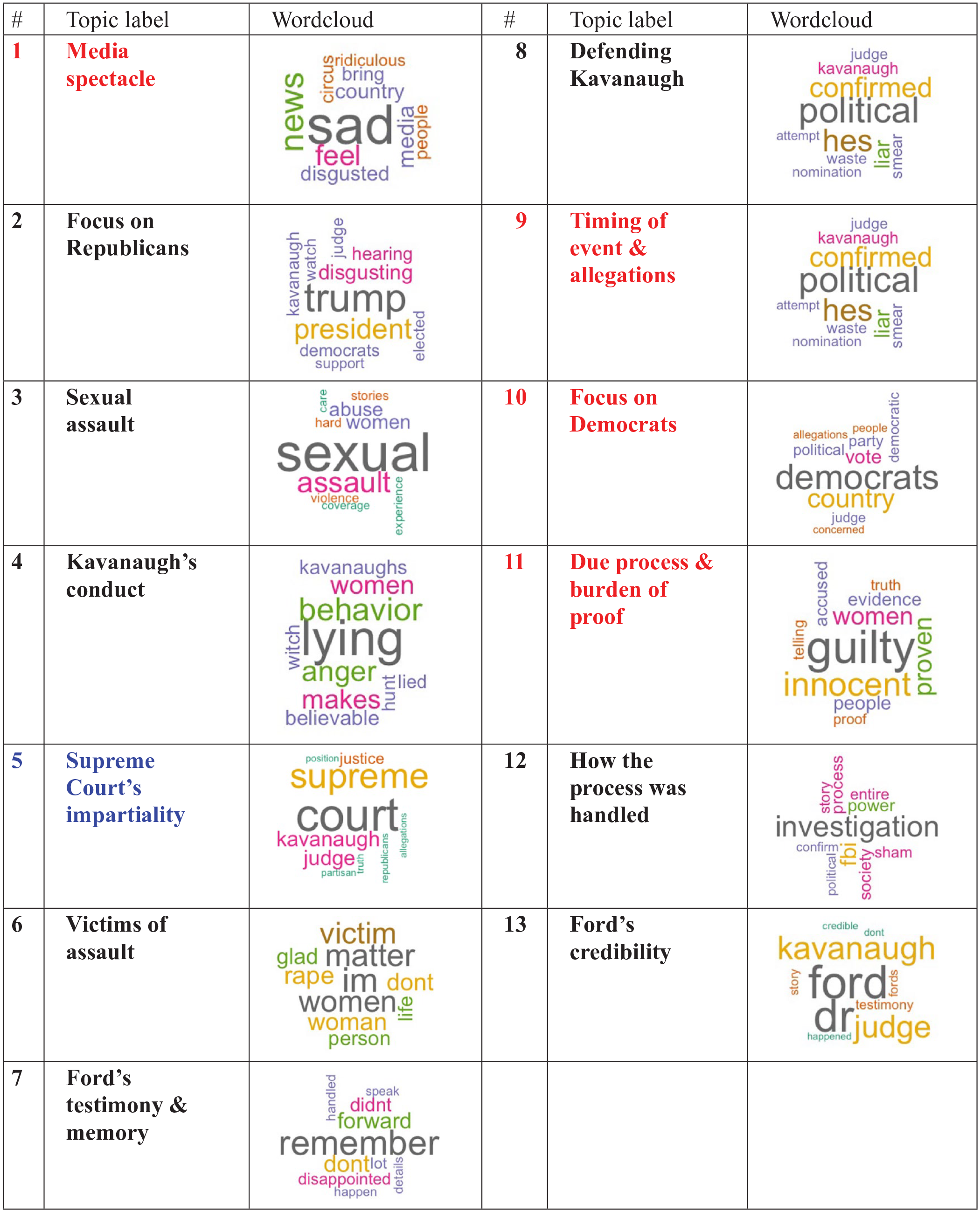
Topic Model Output.
Identification of Partisan Topics
The results of Mood’s median tests and topic classifications can be found in Table 1. Of the 13 topics, 5 were identified as more prevalent in one partisan group than the other: 1 topic was used primarily by Democrats and 4 topics were used primarily by Republicans. The Democratic topic concerned the Supreme Court’s impartiality (topic 5), while the Republican topics were focused on the media spectacle of the hearings (topic 1), the timing of the alleged assault and of when the allegations were brought forward (topic 9), the Democrats’ involvement in this event (topic 10), and issues regarding due process and burden of proof (topic 11). Thus, consistent with our hypotheses, Democrats and Republicans were more likely to endorse topics that related to their political group’s interests. Compared with Republicans, Democrats wrote more about the politicization of the Supreme Court, χ2(1, 2069) = 45.02, p < .001, φ = .15, which served as an argument against Kavanaugh’s appointment. Conversely, Republicans were more likely to provide responses that defended Kavanaugh’s nomination by painting the event as a media spectacle, χ2(1, 2069) = 8.81, p = .003, φ = .07, questioning the timing of Ford’s allegations, χ2(1, 2069) = 19.16, p < .001, φ = .10, criticizing the Democrats, χ2(1, 2069) = 17.65, p < .001, φ = .09, and emphasizing the importance of due process and corroborating evidence when considering accusations of this nature, χ2(1, 2069) = 36.59, p < .001, φ = .13. This pattern of findings held when these analyses were also conducted using the continuously, rather than dichotomously, coded variable for political party affiliation in generalized linear models for gamma distributed data.
Mood’s Median Test Results and Topic Classifications by Partisanship Use.
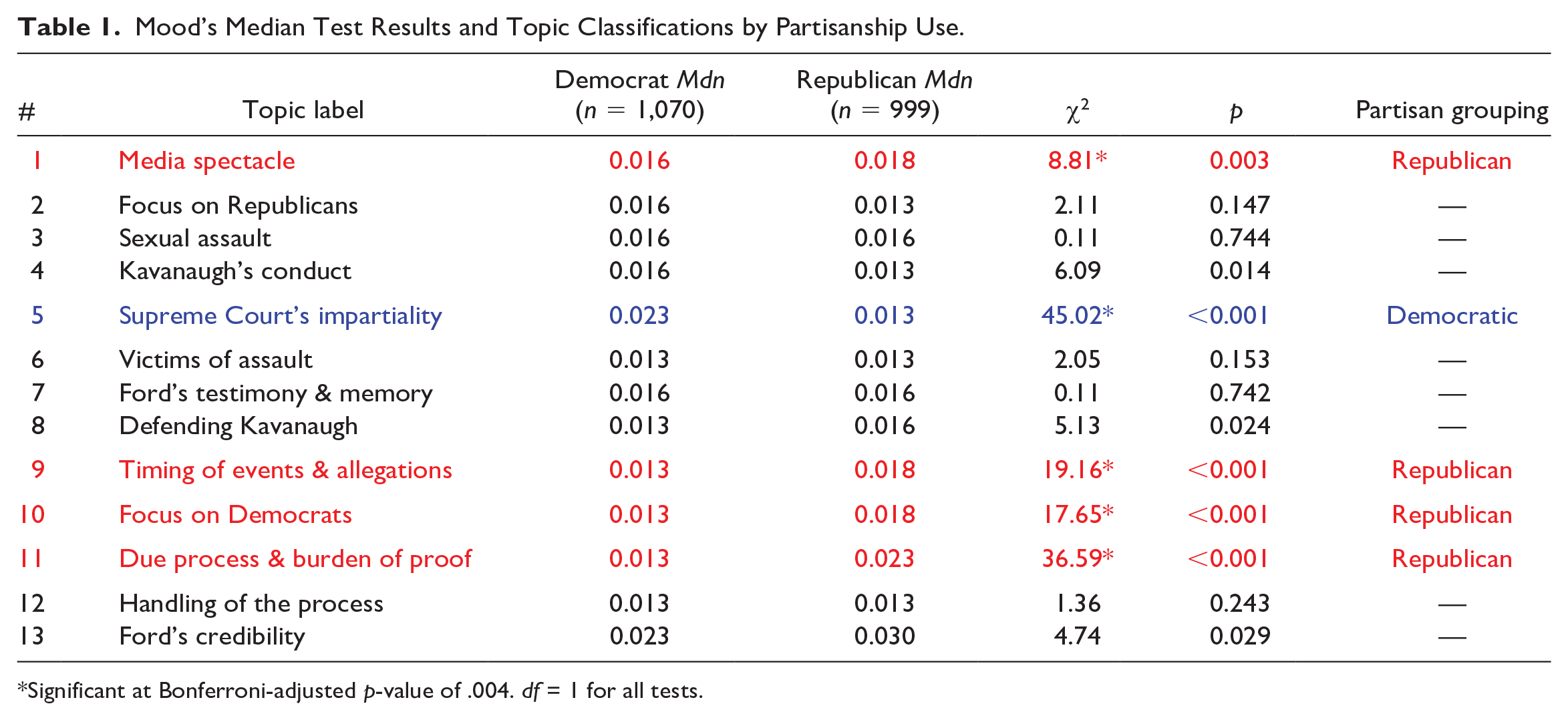
Significant at Bonferroni-adjusted p-value of .004. df = 1 for all tests.
Predictors of Acute Stress
The correlations between the variables in the model and the results for the negative binomial regression model can be found in Tables 2 and 3, respectively. Consistent with prior work (e.g., Lench et al., 2019), partisanship was significantly associated with acute stress responses to the Ford-Kavanaugh hearings; Democrats reported more distress in response to the Ford-Kavanaugh hearings than did Republicans (incidence rate ratio [IRR] = 0.81, 95% confidence interval [CI] = [0.78, 0.84], p < .001, Cohen’s d = −0.13 [−0.14, −0.11]). Also as predicted, we found that participants who wrote more using Republican topics had lower rates of acute stress, regardless of their party affiliation (IRR = 0.72, 95% CI = [0.56, 0.92], p = .009, Cohen’s d = −0.19 [−0.29, −0.05]). However, Democratic topic use was not significantly associated with acute stress responses above and beyond partisanship and Republican topic use (IRR = 0.94, 95% CI = [0.65, 1.34], p = .72, Cohen’s d = −0.04 [−0.23, 0.24]).
Correlations Between Variables in the Negative Binomial Model
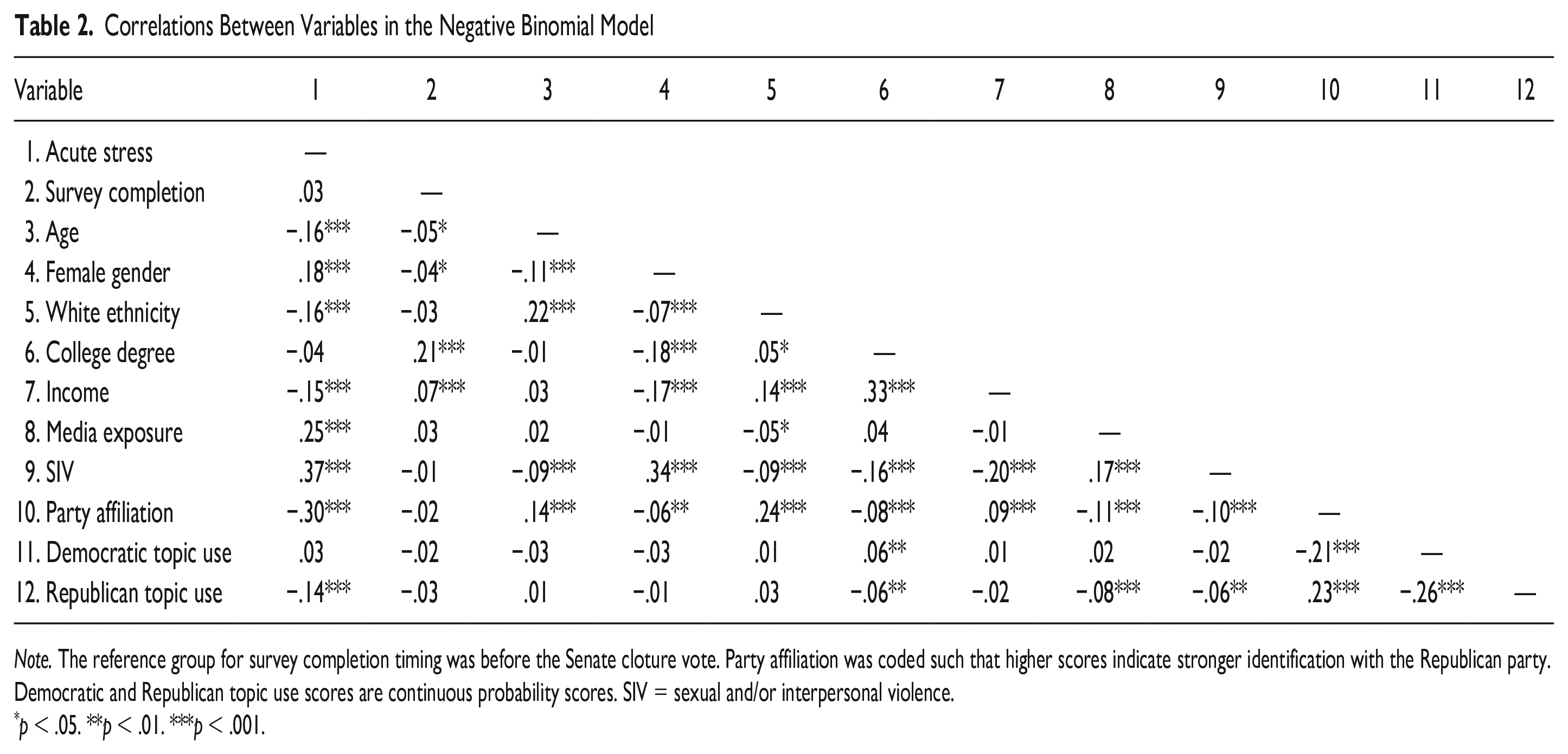
Note. The reference group for survey completion timing was before the Senate cloture vote. Party affiliation was coded such that higher scores indicate stronger identification with the Republican party. Democratic and Republican topic use scores are continuous probability scores. SIV = sexual and/or interpersonal violence.
p < .05. **p < .01. ***p < .001.
Negative Binomial Regression Model Predicting Acute Stress (N = 2,377)
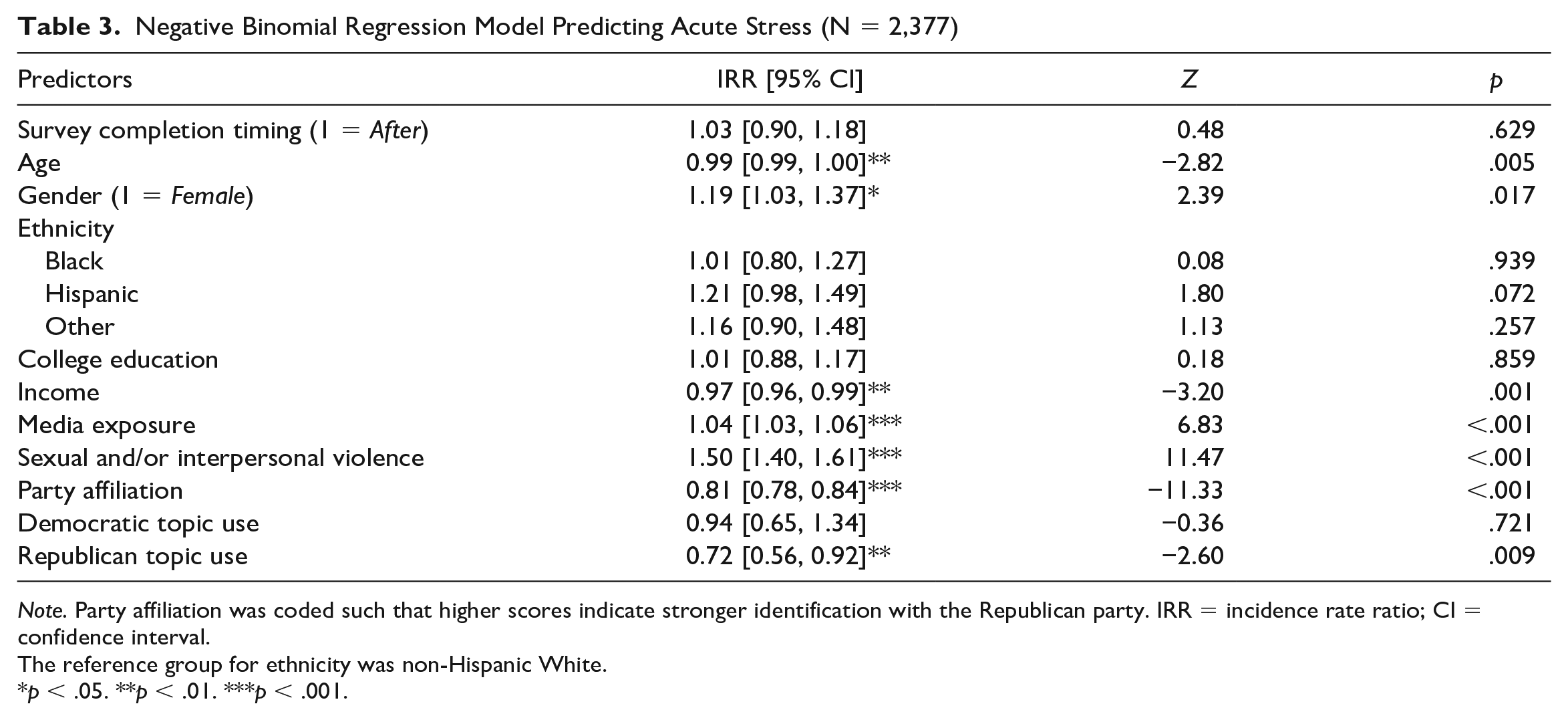
Note. Party affiliation was coded such that higher scores indicate stronger identification with the Republican party. IRR = incidence rate ratio; CI = confidence interval.
The reference group for ethnicity was non-Hispanic White.
p < .05. **p < .01. ***p < .001.
Discussion
Using a mixed-methods design, text analysis machine learning techniques, and data from a national sample, we found that partisans viewed the same political event in divergent, but identity-consistent, ways. Democrats emphasized judicial impartiality, whereas Republicans focused on the role of Democrats and the media, the timing of the alleged assault and publicization, and due process and the burden of proof. These divergent perspectives of the same real-world political event are consistent with related emerging work on partisan bias in basic sensory perception and information processing (Demszky et al., 2019; cf. Tappin et al., 2021; Van Bavel & Pereira, 2018; Xiao et al., 2016).
We also found that psychological responses to the hearings were related to both partisanship and partisan narratives. Democrats reported higher levels of event-related acute stress than did Republicans, a finding consistent with prior work showing that partisans experience adverse psychological responses following political outcomes that disfavored their ingroup (Hoyt et al., 2018; Lench et al., 2019; Stanton et al., 2010). Moreover, partisan topic usage was related to acute stress in response to the hearings: Regardless of their partisan identity, individuals who focused on topics disproportionately used by Republicans reported lower levels of acute stress related to this political event compared to those who referenced fewer Republican topics. These findings provide initial support for the link between partisan perceptions and emotional responses, suggesting that both belonging to the winning political group and adopting the political winners’ narrative (regardless of one’s political affiliation) might be protective against adverse psychological consequences.
Limitations
Despite our large national sample and integrative statistical approach, we acknowledge several limitations. Although Republican topic use was significantly associated with acute stress responses, the effect was relatively small compared with the association between partisanship and acute stress. We suspect that this small effect may be the result of the limited ability of automated text analysis methods to detect shared latent meaning across dissimilar wordings. Therefore, despite the advantage of its speed and processing power, this approach may have failed to fully capture mention of themes and thereby lowered statistical power.
This statistical limitation may also explain why Democratic topic use was not significantly associated with acute stress. Comprised of only one topic (see Table 1), Democratic topic use may have lacked the precision and statistical power for a relationship to be detected, especially above and beyond the more robust Republican topic use that combined four topics. Future studies should integrate these machine learning techniques with more traditional text analytic strategies, for example, by using independent human coders to validate the themes derived from topic models and their partisan lean, to balance methodological tradeoffs.
Although we identified five partisan topics, there were no significant differences between Democrats and Republicans in the use of the remaining eight topics. This finding could suggest that partisans’ perceptions were more similar than different. However, an alternative explanation is that partisans discussed the same topics in different ways or with different emotional valence, or that partisans referenced their opponent’s positions, which are levels of nuance not easily detected by automated methods used in our study. Given these plausible explanations, we advise caution in interpreting these null results and encourage future research to explore how partisans differentially discuss and emotionally respond to the same topics.
Finally, we acknowledge the limited generalizability of the current study. Our subsample is a self-selected group of respondents who provided open-ended text responses, drawn from a representative national sample, so it is not itself representative of U.S. adults. Participants who chose to respond also differed from nonresponders in ways that may have introduced bias. For example, responders were more strongly politically identified and more likely to report experiencing sexual and/or interpersonal violence. Thus, the Ford-Kavanaugh hearings may have been more personally relevant and distressing to our subsample of participants. It is not surprising that panelists who were more political and more likely to have experienced sexual and/or interpersonal violence were also more likely to share their thoughts on a major political event that concerned an alleged sexual assault. However, these sample characteristics may have inflated the strength of our findings and, as such, some caution is warranted when drawing conclusions from these data more broadly.
Furthermore, this study only examined partisan perceptions in the context of a single U.S. political event. To better understand the implications of these findings for contexts beyond the Ford-Kavanaugh hearings, these issues should be examined in the context of other political events.
Implications and Future Directions
This study documents different partisan perceptions of a major political event and the link between partisan narratives and event-related emotional responses. These findings add to an understudied but growing literature illustrating how partisanship and other social identities may shape how individuals process and respond to information about their social environments (e.g., Xiao et al., 2016). The extant literature has largely focused on partisan bias in higher-order cognitive processes (e.g., motivated reasoning), but accumulating evidence finds that partisanship may also shape the basic perceptions on which this complex processing relies (e.g., vision; Van Bavel & Pereira, 2018). Differing partisan perceptions may significantly challenge bipartisanship; if partisans cannot agree on the facts, then they are unlikely to interpret those facts similarly, much less to agree on a solution. By deepening our understanding of differences in partisan perception, future research on this phenomenon may ultimately aid efforts to combat political polarization by identifying factors that support and/or obstruct the development of a shared bipartisan reality.
A first step in advancing our understanding in this domain is to examine whether and how partisans’ perceptions of major political events evolve over time, particularly comparing perceptions before and after events that can be anticipated like presidential or congressional elections. Using this approach, the research could assess the link between perceptions and mental health responses more dynamically by testing whether shifts in partisan perceptions correspond to fluctuations in distress about the event. This approach would deepen our understanding of both the fluidity (or stagnancy) of partisans’ political event perceptions and the potential mental health consequences of partisan-aligned views of impactful events in a polarized political climate.
Future studies should also examine factors that compound or reinforce partisan perceptions. For example, motivated perception likely plays a role in explaining divergent political perceptions. Given that partisan identities and their corresponding motivations, interests, and desires are both salient and relevant for political events, future work should experimentally test whether activating political identities and motivations changes how people perceive the same event (Dunning & Balcetis, 2013). Research on political communication suggests that engagement with the news media may be another such factor, given its key role in shaping and disseminating political narratives. In fact, editorial choices by media outlets on how to cover an event and weave a cohesive story result in framing the event in ways that audiences can adopt (e.g., Iyengar & Kinder, 1987). By tailoring their messaging to align with the political leanings of their audiences, outlets like CNN and Fox News may contribute to vastly different political perceptions of the same event by producing or reiterating distinct partisan narratives. Therefore, future research should also explore the role of different news media sources in driving partisan perceptions, as well as its potential consequences for mental health, given the known link between media exposure and event-related distress (e.g., Holman et al., 2014).
Finally, the present study is the first to our knowledge to link partisan perceptions to mental health outcomes. Our findings demonstrate that partisan perceptions of a real-world political event are associated with distress; in a society where contemporary events, such as mass shootings, the COVID-19 pandemic, and climate-related natural disasters are increasingly politicized, adhering to a political take on these events could contribute to a cycle of worsening mental health as these events continue to occur. Future research should further elucidate the role of differing partisan perceptions in exacerbating or attenuating stress in the face of these increasingly politicized threats. A greater understanding of the partisan perception-mental health link could inform interventions designed to ameliorate psychological maladjustment following future politicized events.
Supplemental Material
sj-docx-1-psp-10.1177_01461672231185605 – Supplemental material for They Saw a Hearing: Democrats’ and Republicans’ Perceptions of and Responses to the Ford-Kavanaugh Hearings
Supplemental material, sj-docx-1-psp-10.1177_01461672231185605 for They Saw a Hearing: Democrats’ and Republicans’ Perceptions of and Responses to the Ford-Kavanaugh Hearings by Emma L. Grisham, Pasha Dashtgard, Daniel P. Relihan, E. Alison Holman and Roxane Cohen Silver in Personality and Social Psychology Bulletin
Footnotes
Acknowledgements
The authors would like to thank the NORC AmeriSpeak team of J. Michael Dennis and Stephanie Jwo for their survey research and sampling guidance, and Stephanie Jwo for preparation of the online surveys, data files, and project reports.
Author contributions
Conceptualization: E.L.G., P.D., D.P.R., E.A.H., and R.C.S.; Methodology: E.L.G., P.D., D.P.R., E.A.H., and R.C.S.; Formal Analysis: E.L.G., P.D., D.P.R.; Data Curation: E.L.G., D.P.R.; Writing—Original Draft: E.L.G.; Writing—Review & Editing: E.L.G., P.D., D.P.R., E.A.H., and R.C.S.; Visualization: E. L. Grisham; Supervision: E.A.H. and R.C.S.; Project Administration: E.L.G., E.A.H., and R.C.S.; Funding Acquisition: E.A.H., and R.C.S.
Declaration of Conflicting Interests
The author(s) declared no potential conflicts of interest with respect to the research, authorship, and/or publication of this article.
Funding
The author(s) disclosed receipt of the following financial support for the research, authorship, and/or publication of this article: Project funding was provided by the School of Social Ecology and the Sue & Bill Gross School of Nursing at the University of California, Irvine.

Supplemental material
Supplemental material is available online with this article.
Notes
References
Supplementary Material
Please find the following supplemental material available below.
For Open Access articles published under a Creative Commons License, all supplemental material carries the same license as the article it is associated with.
For non-Open Access articles published, all supplemental material carries a non-exclusive license, and permission requests for re-use of supplemental material or any part of supplemental material shall be sent directly to the copyright owner as specified in the copyright notice associated with the article.
