




Abstract
Greed, the insatiable and excessive desire and striving for more even at the expense of others, may be directed toward various goods. In this article, we propose that greed may be conceptualized as a domain-specific construct. Based on a literature review and an expert survey, we identified 10 domains of greed which we operationalized with the DOmain-SPEcific Greed (DOSPEG) questionnaire. In Study 1 (N = 725), we found support for the proposed structure and convergent validity with related constructs. Bifactor-(S-1) models revealed that generic greed is differentially related to the greed domains, indicating that generic greed primarily captures a striving for money and material things. In the second study (N = 591), we found that greed domains had incremental validity beyond generic greed with regard to corresponding criteria assessed via self- and other-reports. We conclude that greed can be conceptualized as a domain-specific construct and propose an onion model reflecting this structure.
Several scholars have suggested that greed may be directed toward many different objects, ranging from a hot fight at an all-inclusive buffet to investment bankers’ excessive risk-taking (Krekels & Pandelaere, 2015; Lambie & Stickl Haugen, 2019; Mussel & Hewig, 2016; Seuntjens, Zeelenberg, Van de Ven, et al., 2015). However, such notions are not without criticism. In the consulting and management literature, for example, greed is equated with, and therefore restricted to, the striving for money and material possessions (Bruhn & Lowrey, 2012; Haynes et al., 2015). In general, however, it is unknown to which domains greed pertains, and to which degree generic greed reflects these domains. Conceptualizations of greed in terms of greed domains have implications regarding the definition of trait greed, its operationalization in measures of trait greed, and the interpretation of the scores obtained with these measures. In the current study, we adopt a—so far largely untested—domain-specific notion of greed. Conceptualizing and measuring greed within distinctive domains enables us to empirically investigate the greed construct’s nature in depth, has the potential to provide a fine-grained intraindividual profile of trait greed, and to enhance the prediction of related criteria over domain-general scales.
Trait Greed
The construct of greed can be defined as the excessive, insatiable desire and striving for more even at the expense of others (Krekels & Pandelaere, 2015; Lambie & Stickl Haugen, 2019, Merriam-Webster, 2013; Mussel & Hewig, 2016; Seuntjens, Zeelenberg, Van de Ven, et al., 2015). Thus, at the core of the construct is the excessive striving for more, thus indicating that not any striving for more would qualify as greed, but only striving that goes beyond what one needs (Balot, 2001; L. Wang et al., 2011)—even though it is difficult to define how much is needed. In addition, greed is characterized by insatiability, indicating that the desire for more is never satisfied, no matter how much has been obtained (Krekels & Pandelaere, 2015; Seuntjens, Zeelenberg, Van de Ven, et al., 2015). Finally, a person’s greed may come at the expense of others. Although greedy individuals do not necessarily intend to harm others, they accept that their striving for more may have negative consequences for others (Lambie et al., 2022; Mussel & Hewig, 2016; Mussel & Hewig, 2019).
Regarding its nomological net, trait greed has been found to be related to the constructs of acquisitiveness, low agreeableness, meanness, risk-taking propensity, approach motivation, entitlement, materialism, envy, and miserliness (Krekels & Pandelaere, 2015; Lambie & Stickl Haugen, 2019; Mussel & Hewig, 2016; Seuntjens, Zeelenberg, Van de Ven, et al., 2015). While sharing variance with these constructs, greed is distinct with regard to its definitional elements (i.e., excessiveness, insatiability, and acceptance of costs to others).
The construct of greed has received considerable research attention since the 2008–2009 financial crisis, which was allegedly initiated by the greedy behavior of investment bankers and other protagonists in the financial sector (but see Hoyer et al., 2021). Since then, such notions have sparked several lines of research with the goal of reaching more profound knowledge regarding its definition, antecedents, and behavioral as well as neural correlates (Lambie & Stickl Haugen, 2019; Mussel et al., 2015; Mussel & Hewig, 2019; Seuntjens, Zeelenberg, Van de Ven, et al., 2015; Q. Wang et al., 2021; L. Wang & Murnighan, 2011).
Regarding measurement, several self-report instruments have been developed to assess greed: The Greed Trait Measure (Mussel et al., 2015), the subscale Greed from the Vices and Virtues Scales (Veselka et al., 2014), two instruments both labeled Dispositional Greed Scale (Krekels & Pandelaere, 2015; Seuntjens, Zeelenberg, Van de Ven, et al., 2015), the Multidimensional Dispositional Greed Assessment (Lambie et al., 2022), and the GR€€D scale (Mussel & Hewig, 2016). These measures have been shown to exhibit good psychometric properties, including the prediction of theoretically related criteria, and to converge on a single latent factor (Mussel et al., 2018). Interestingly, these scales diverge, nonetheless, regarding assumed and measured domain-specificity.
Some scholars developed the view that greed can be related to any object. Such a generic view of greed is, for instance, reflected in the 6-item Dispositional Greed Scale by Krekels and Pandelaere (2015). In line with their conceptualization, their measure contains only generic items, that is, items that are formulated on an abstract and general level (e.g., “One can never have enough,” p. 226). This is in line with Seuntjens, Zeelenberg, Van de Ven, et al. (2015) and Lambie et al. (2022) who also considered greed to be generic (although their measures of greed, the 7-item Dispositional Greed Scale and the 20-item Multidimensional Dispositional Greed Assessment include only items relating to money and not to other domains). Other authors have explicitly adopted the view that greed mainly reflects a materialistic desire. For instance, Mussel and Hewig (2016) noted that greed is “mainly seen as a materialistic type of desire and associated with the acquisition of money, as a value by itself or for its instrumental value for obtaining material goods” (p. 53). Consequently, their 12-item GR€€D scale, like other greed scales (e.g., the 10-item Greed subscale from the Vices and Virtues Scales; Veselka et al., 2014), contains items such as “I will always try to increase my income and my assets.” A narrow view on the materialistic aspect of greed has also been adopted in the organizational and management literature (Bruhn & Lowrey, 2012; Haynes et al., 2015). Thus, there is a lack of consensus concerning the conceptualization of greed (generic vs. specific for money and material things). Moreover, current operationalizations of greed do not enable researchers to explicitly examine the nature of greed, as the only domains that are explicitly included are money and material things.
It is important to note that even generic items may not necessarily assess the construct in general. Rather, several scholars have argued that generic items leave room for interpretation regarding the frames of reference to consider in the judgment process (e.g., Lievens et al., 2008; Schulze et al., 2021). Lay theories about a trait (e.g., “a greedy person is someone who wants as much money as possible”) influence how generic items (e.g., “I am kind of greedy”) are interpreted and answered. As a result, the score obtained from generic items may differentially reflect certain domains over others. Whether this actually occurs is an empirical question which, thus far, could not be investigated due to a lack of models and measures describing and assessing domains of greed beyond money.
In the present research, and in line with the prototype analysis by Seuntjens, Zeelenberg, Breugelmans, et al. (2015), we started with a broad view, assuming that greed may pertain to a wide array of objects. We investigate whether objects to which greed may pertain can be aggregated into a wieldy number of broad domains. Thus, we propose that the construct of trait greed can be conceptualized as domain-specific. This assumes that individuals have distinct levels of trait greed across a certain number of domains, which would result in a multidimensional latent factor structure according to greed domains. Given that such a latent structure is supported, it would enable us to investigate the degree to which generic greed reflects individual differences in domain-specific greed and, as such, give an empirical answer to the debate regarding the definition of trait greed. Such knowledge contributes to our understanding of this construct in terms of construct validity and advances definitions of trait greed. To advance toward this goal, we developed a working model of domains to which greed may pertain.
Domains of Greed
Domain-specific traits are traits that primarily relate to a certain class of entities, tasks, subjects, or situations (see American Psychological Association, 2022). They are usually assessed by explicating the class in addition to the item (e.g., “at work,” “with friends”). A domain-specific approach has been shown to be fruitful across many areas and applications. For example, domain-specific self-esteem (e.g., relating to academic, social, parent and peer relationships, or physical attractiveness) was found to predict depression (Steiger et al., 2014), aggression among adolescents (Descartes et al., 2019), and childhood overweight (Danielsen et al., 2012). Domains relating to achievement motivation (usually educational subjects such as math, physics, science, English) showed incremental validity over generic indicators for predicting academic success (Michel et al., 2022). Contextualized personality measures with a reference to work-specific behaviors have been found to be better predictors of job performance (Shaffer & Postlethwaite, 2012). Domains relating to identity processes (best friend, education, occupation, and partner) have been shown to have unique links to identity processes in emerging adulthood (Vosylis et al., 2018). Similar approaches can be found for constructs such as optimism-pessimism (Chang et al., 2011), locus of control (Tong & Wang, 2012), knowledge (Muis et al., 2006), ability self-concept (Steinmayr & Spinath, 2007), consideration of future consequences (Murphy et al., 2020), need for cognition (Keller et al., 2019), risk-taking (Blais & Weber, 2006), creativity (Kaufman, 2012), or narcissism (Grosz et al., 2021).
From this discussion it also becomes clear that domains vary strongly from one construct to the other. To date, a systematic investigation of potential domains of greedy behavior and their measurement does not exist (Mussel et al., 2018). However, according to our review of the literature and in line with the first empirical step (expert interviews; see “Scale Development”), there are a number of different domains to which greed may potentially pertain.
As mentioned above, greed has been frequently associated with the concept of money. For example, the Merriam-Webster (2013) dictionary defines greed as “a selfish and excessive desire for more of something (such as money) than is needed.” Seuntjens, Zeelenberg, Breugelmans, et al. (2015) conducted a prototype analysis to investigate lay conceptions of greed. Among the most often mentioned domains were money and materialism, which were also rated as being among the central aspects of greed. Mussel and Hewig (2016) found that individuals high on greed showed more positive affect after winning money and more negative affect after losing money than individuals low on greed. Thus, on one hand, greed can be associated with the acquisition and valuing of money as a value by itself, labeled as “love for money” by Tang (1992). On the other hand, money has instrumental value for obtaining material goods (Bruhn & Lowrey, 2012), which is related to the literature on materialism, defined as the propensity to enjoy buying things above what would be necessary and to appreciate one’s property and belongings (Richins & Dawson, 1992).
However, greed may also pertain to the domains of acknowledgment, power, performance, or knowledge. Greed in acknowledgment describes an excessive striving for recognition and acceptance and may be related to the concept of excessive reassurance seeking (Joiner & Metalsky, 2001; Schwennen & Bierhoff, 2014; Shaver et al., 2005). Greed in the domain of power can be described as an intense striving for influence and is related to the concept of excessive power-seeking (Charny, 1997). Excessive power-seeking has also been related to ruthlessness and a lack of empathy, which corresponds to the striving for more even at the expense for others (Charny, 1997; Mussel & Hewig, 2016). The link between power and greed has also been supported by Machiavellianism research, which has indicated that there is a connection between power and money in the context of self-serving behavior (Christie & Geis, 1970; Rauthmann, 2012). Greed in the domain of performance is related to the construct of achievement motivation (McClelland, 1985) and describes the excessive and insatiable desire for self-achieved success. This excessive striving might be related to concepts such as workaholism (Spence & Robbins, 1992) or perfectionism (Hewitt & Flett, 1991). In sports, excessive striving for success was found to be related to addiction and exercise dependence (McNamara & McCabe, 2012). Zhu et al. (2019) showed that, in workers, higher greed was associated with higher performance levels. These performance levels referred to self-related task performance as well as to other-related contextual performance and were mediated by the striving for a higher social status. This finding is also consistent with the result that greedier people are more productivity-oriented (in addition to having a desire for profits; Krekels & Pandelaere, 2015). Greed in the domain of knowledge is related to an excessive striving for information, comparable to an extreme form of curiosity (Litman, 2019; Mussel, 2010) and is possibly related to constant checking (e.g., of email clients, social networking systems, news websites; Gerlach & Cenfetelli, 2020). Thus, a striving for status, power, performance, or knowledge may take place in the form of excessive, insatiable, and selfish striving (Kim, 1976).
In addition, greedy behavior may also pertain to sex, food, friendship, or substances. One of the first references to sex in relation to greed was noted by Countryman (1988). Against the backdrop of Christian ethics, he related adultery to theft and incest to violating the hierarchy of the family. More generally, greed in the domain of sex can be related to excessive sexual desire and hypersexuality (Kafka, 2010; Kuhn et al., 2014). An excessive striving for food describes eating behavior beyond what is needed and thus pertains to the hedonic rather than metabolic component of appetite (Berthoud, 2011). It can be related to food craving (White et al., 2002), eating habits, eating disorders, and obesity (Drewnowski, 1997) and an excessive consumption of palatable food (Kenny, 2011). Striving for a large number of friends is related to the affiliation motive (Depue & Collins, 1999; McClelland, 1985). It is associated with preferences regarding the size of one’s personal network, both online and offline, and can be related to an excessive form of the need for popularity (Utz et al., 2012). Seuntjens, Zeelenberg, Van de Ven, et al. (2015) explicitly stated that striving for sex, food, and social status pertains to the construct of greed. In line with their reasoning, these authors found positive correlations between trait greed and self-reports of greedy eating behavior, desiring as many casual sex partners as possible, and striving for as many friends as possible on social network sites. Finally, greed in the domain of substances pertains to the excessive desire for intoxication. It may be related to craving (Robinson & Berridge, 1993), substance abuse (Hawkins et al., 1992), and addiction proneness (Flagel et al., 2009). Thus, there is evidence that the domains of sex, food, friendship, and substances may be relevant regarding greedy striving.
As this brief literature review suggests, each of the domains of greed can be expected to show a unique nomological net that overlaps with existing, theoretically related constructs. For example, greedy striving for friendship can be expected to be related to the affiliation motive. At the same time, domains of greed should be distinct from existing constructs regarding the definitional elements of greed (i.e., excessiveness, insatiability, and striving for more even at the expense of others). Thus, domains of greed should be related to generic greed after accounting for the variance that is shared with related constructs. Such evidence is necessary to show that the proposed domains of greed reflect unique constructs that go beyond existing ones or, in other words, to preclude what Block (1995) labeled a jangle fallacy.
To sum up, greedy behavior may be found in different domains, and the extent to which such behavioral propensities generalize from one domain to another is unknown.
Research Questions
In the current research, we investigated the construct of trait greed with regard to domains. In a first step, we investigated whether greed can be conceptualized as a domain-specific construct. Based on domains derived from the literature and from an expert study, (a) we propose a working model of domains to which greed may pertain, (b) operationalize this model by a newly developed scale, (c) test the fit of the model regarding the proposed multidimensional structure, and (d) investigate the construct- and (e) criterion-related validity of the model. We summarize this attempt by the following broad research question:
Our second research question is related to the nature of generic greed. Generic greed is conceptualized as the excessive, insatiable desire and striving for more even at the expense of others in general. Thus, generic greed does not specify the desired object that is strived for, as illustrated in the item “I always want more” (Seuntjens, Zeelenberg, Van de Ven, et al., 2015, p. 921). Based on the results regarding the domain-specific structure of greed according to RQ1, we investigate whether generic greed is equally or differentially related to greed domains. Such knowledge informs about the nature of trait greed including its definition and how to properly interpret scores derived from generic greed scales. We summarize these queries by the following research question:
The Present Research
With the present research, we first investigate whether greed can be conceptualized as a domain-specific construct. Using a literature review and a qualitative expert survey, we propose several domains to which greed may pertain. Next, we developed a measure to assess these greed domains. In a prestudy, we refined the measure according to its psychometric properties and report results on reliability and factor structure. In Study 1, we replicated these results and additionally investigated our measure’s construct-related validity. We related each greed domain, on one hand, to generic greed, and, on the other, to a corresponding measure that reflects preferences for the respective domain. Finally, we investigated potential differences in the extent to which each greed domain is saturated by generic greed to arrive at a deeper understanding of the nature of trait greed regarding its domain-specificity. In Study 2, we addressed the criterion-related validity of greed domains according to self- and peer-ratings of the corresponding criteria from each greed domain. We also investigated the incremental contribution of a domain-specific approach beyond a generic approach. Across all studies, we addressed the issue of whether generic greed is differentially related to different domains by comparing the relation between a generic subscale with the domain-specific subscales of the newly developed greed measure.
Scale Development
We conducted a literature review to identify the domains of greed as summarized above. In addition, we used a bottom-up approach to generate the domains empirically. In this preliminary study, we asked 25 experts to name as many greed domains as possible. Experts were students attending a university course who had received at least 8 h of training on the topic of greed. This procedure resulted in 133 statements which are depicted as a word cloud in Figure 1. We had three independent research assistants’ cluster statements according to similarity. The cluster solutions were compared, and discrepancies were resolved by discussion. As a result, 10 separate domains evolved that adequately captured all 133 statements. The 10 domains were labeled as follows: acknowledgment, food, friendship, knowledge, material things, money, performance, power, sex, and substances. Next, the literature, as cited in the introduction, was scanned for additional domains that were suggested in the context of greedy behavior. We found that all concepts referred to in the literature could be categorized within these 10 domains. Thus, these domains reflect our working model for domains of greed.
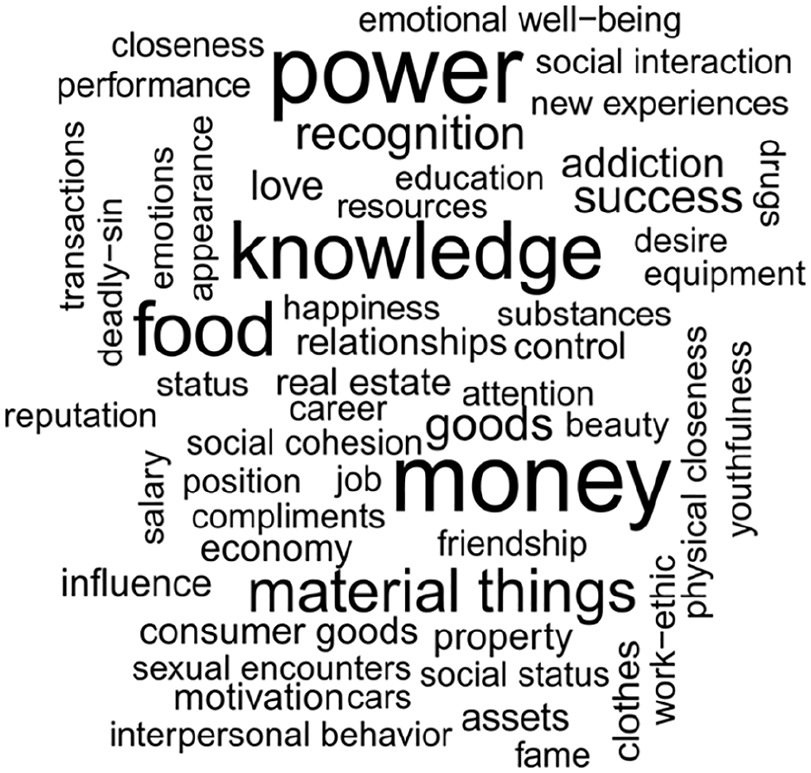
Word Cloud of Domains Associated With the Term “Greed,” as Derived From 133 Terms Provided by 25 Experts (Created With the R Package “Wordcloud”).
We developed our domain-specific greed questionnaire (DOSPEG: DOmain-SPEcific Greed) according to these domains. In sum, we developed 57 German items for the 10 domains with between five and nine items per domain. In addition, we used and rephrased six generic greed items from existing scales (Mussel & Hewig, 2016; Seuntjens, Zeelenberg, Van de Ven, et al., 2015) that lacked any reference to a domain (e.g., “I always want more”). All items can be found on Open Science Framework (OSF; https://osf.io/t98mc).
A prestudy (N = 171; for details see OSF) was conducted to pretest the items. Based on results from item analysis, four items per scale were selected (see Supplemental Material online for details). Items are depicted in Table 1. According to our theorizing, we expected the internal structure of the newly developed DOSPEG questionnaire to be characterized by a general generic greed factor and 10 factors.
Items for the DOSPEG Scale (English Translations).
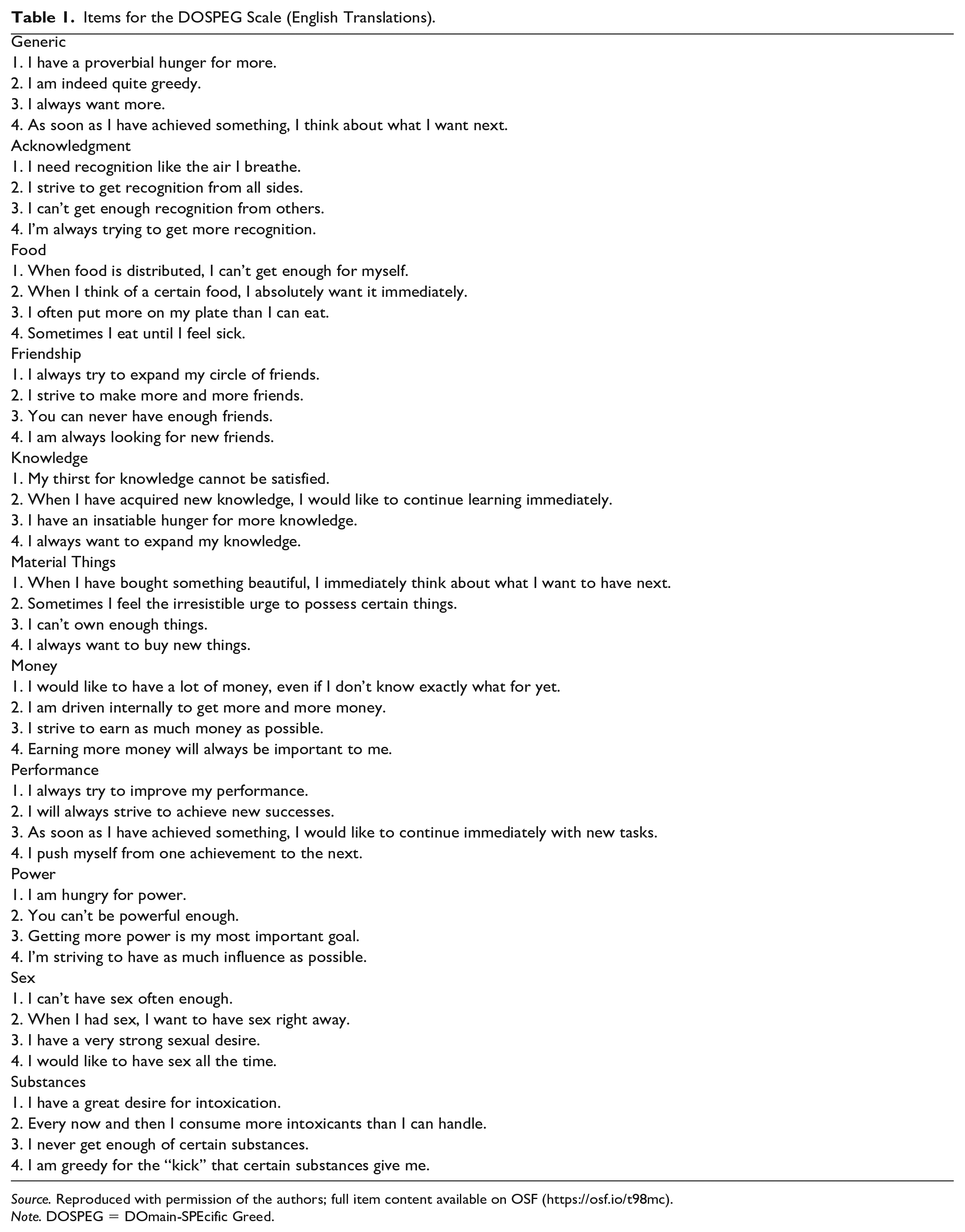
Source. Reproduced with permission of the authors; full item content available on OSF (https://osf.io/t98mc).
Note. DOSPEG = DOmain-SPEcific Greed.
Study 1
Study 1 aimed at estimating the psychometric properties of the DOSPEG scale, including a cross-validation of the results obtained in the prestudy (see Supplemental Material online). This is important because in the prestudy, the scale optimization and the investigation of the scales’ psychometric properties were based on the same data. In addition, we investigated the relations between generic greed and the greed domains, thereby also investigating the difference in correlation coefficients to further contribute to our understanding of the nature of trait greed. Finally, we provided construct-related evidence for the 10 domains by relating each of the domains to a corresponding measure that did not measure greed but referred to the respective domain.
Method
Data Collection and Participants
In a first wave (Sample 1a), 209 participants were recruited online and completed the DOSPEG and other self-report questionnaires for convergent validity (see below). We excluded two participants with missing data (N = 207, age: M = 23.96, SD = 6.75, 79% women). To obtain sufficient power for the bifactor model (see analysis section below), we recruited another 518 participants answering only the DOSPEG (Sample 1b, age: M = 35.57, SD = 11.69, 39% women) to meet the criteria suggested by Westland (2010). With a small-to-medium expected effect size of r = .2, 11 latent variables (generic greed + 10 facets), 44 observed variables (i.e., the DOSPEG items), power = .95, and a probability level of .05, the recommended sample size is N = 694. The final sample of Study 1 consists of 725 participants (age: M = 32.26, SD = 11.75, 51% women). The study was conducted according to APA Standards and Ethical Principles. The university ethics committee approved the study protocol. Written informed consent was obtained for all participants. They were informed about possible consequences, and their rights were protected.
Measures
The participants were asked to fill out our newly developed DOSPEG scale online (Samples 1a and 1b) along with 10 other questionnaires (only Sample 1a; one questionnaire corresponding to each of the 10 domains, respectively) in a randomized order. Questionnaires were answered on a Likert-type scale ranging from 1 (I totally disagree) to 7 (I totally agree). The following German version of the questionnaires were assigned to validate the greed domains: acknowledgment (excessive search for confirmation; Schwennen & Bierhoff, 2014; ω = .85, four items, e.g., “I often seek reassurance from people close to me that I mean something to them”), food (food craving questionnaire; Meule et al., 2014; ω = .93, 15 items, e.g., “I can’t stop thinking about eating no matter how hard I try”), friendship (unified motives scales—affiliation; Schönbrodt & Gerstenberg, 2012; ω = .71, 2 items, e.g., “Have a wide circle of friends”), knowledge (curiosity scale; Mussel et al., 2011; ω = .88; 10 items, e.g., “I am eager to learn”), material things (material values scale; Müller et al., 2013; ω = .83, 15 items, e.g., “I like a lot of luxury in my life”), money (attitude toward money; Barry & Breuer, 2012; ω = .84, 4 items, e.g., “I value money very highly”), performance (unified motives scales—achievement; Schönbrodt & Gerstenberg, 2012; ω = .91, 8 items, e.g., “Continuously improve myself”), power (unified motives scales—power; Schönbrodt & Gerstenberg, 2012; ω = .80, 5 items, e.g., “Be able to exert influence”), sex (sexual desire inventory; Kuhn et al., 2014; ω = .88, 10 items, e.g., “When you have sexual thoughts, how strong is your desire to engage in sexual behavior with a partner? ”), and substances (Mannheim craving scale; Nakovics et al., 2009; ω = .90, 12 items, e.g., “How strong is your urge to use addictive substances?”).
Analyses
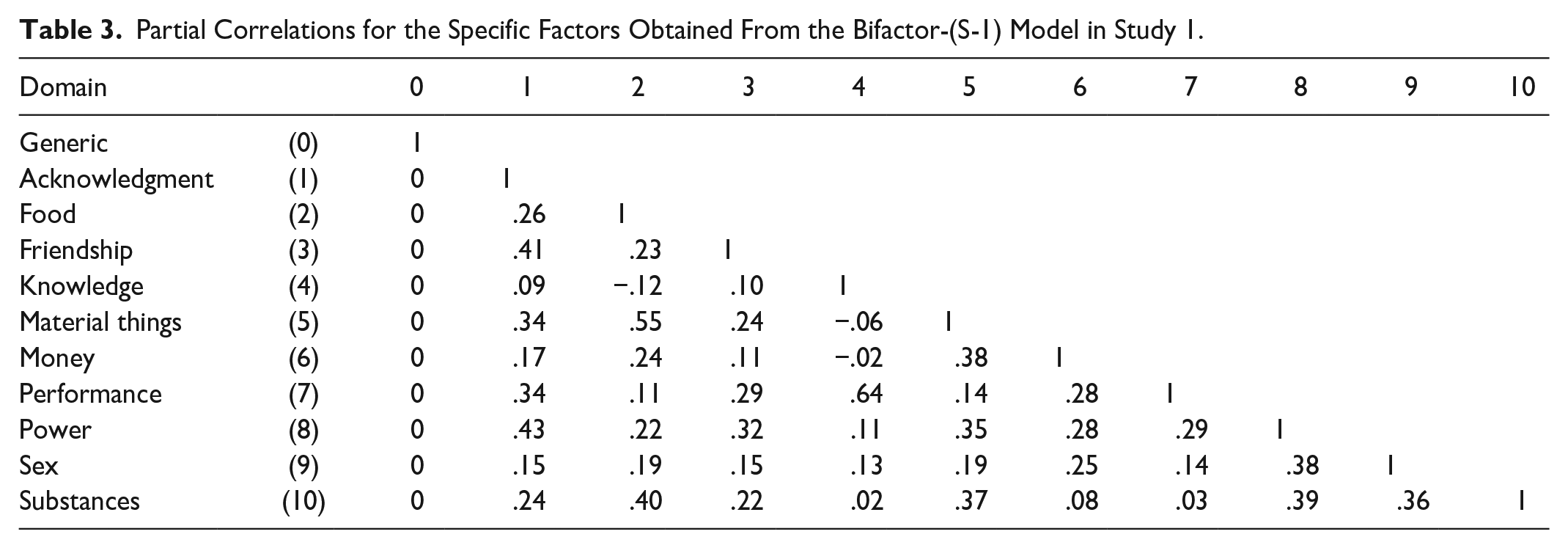
A bifactor-(S-1) model (Eid et al., 2017) was specified for the 11 factors (10 domains plus generic greed) of the DOSPEG, each represented by four indicators. According to Eid et al., the classical bifactor model should only be used for interchangeable domains. However, the DOSPEG domains in our study should be treated as structurally different and not interchangeable. The bifactor-(S-1) model in contrast to the classical bifactor model is particularly useful in the context of structurally different domains (for details, see Eid et al., 2017). A bifactor-(S-1) model affords specification of a reference domain. The model allows to compare this reference domain against other relevant domains (also called “specific” factors; Eid et al., 2017). If available, “a theoretically outstanding facet” can be chosen as the reference (Eid, 2020, p. 898). In the context of the current study, generic greed was defined as this outstanding facet because it is the only facet that is not explicitly framed to a specific domain. It is of interest of how much true-score variance in domain-specific greed is accounted for by the generic factor. No correlations between the nonreference factors and the reference factor are allowed, but intercorrelations between nonreference factors are permitted and can be interpreted as partial correlations (Eid et al., 2017). After fitting the model using maximum likelihood estimation, we computed consistency and specificity coefficients according to Eid et al. (2003). The consistency coefficient reflects how much true-score variance in a nonreference greed domain is explained by generic greed. By contrast, the specificity coefficient reflects the true-score variance of the nonreference greed domain that cannot be explained by generic greed. It should be noted that there are currently debates about the usefulness of different latent variable models (e.g., Heinrich et al., 2021). With regard to the current research, we believe that the bifactor-(S-1) model is a suitable tool to test our hypotheses for the following reasons. In our case, the meaning of the “anchor” facet in the bifactor-(S-1) is very clear and based on theoretical arguments: It is the latent variable for generic greed. We intentionally use generic greed as an anchor facet to predict variance in the domain-specific greed facets in the bifactor-(S-1) model. As a substantive argument for the correlations between the factors, we do not assume that the covariance between the specific factors is exclusively due to the g-factor. Rather, we can assume other reasons why some factors might be correlated (e.g., money and material things have in common that money can buy material things).
Coefficient omega was calculated as a reliability estimator (omega according to Dunn et al., 2014). In addition, we compared the bifactor-(S-1) model with a correlated factors model and a full exploratory structural equation model (ESEM; Marsh et al., 2014) solution, calculated using the R-package esemComp (Silvestrin & de Beer, 2022). The model fit indices can be found in Table S5.
In addition, we investigated whether generic greed was differentially related to the 10 domains (combined Samples 1a and 1b) using the test by Meng et al. (1992), which simultaneously tests a series of correlation coefficients on equality. Construct-related validity was investigated by calculating convergent and divergent validities with regard to corresponding measures. To address the jangle fallacy (Block, 1995), we calculated partial correlations between generic greed and the greed domains while controlling for each corresponding validation questionnaire (Sample 1a). If not otherwise stated, we used the R software (R Core Team, 2019) as well as the lavaan (Rosseel, 2012) and psych (Revelle, 2018) packages for statistical analyses in all studies.
Results
We investigated the reliability and adjusted item-scale correlations within each of the 10 domains of the DOSPEG questionnaire. The scales showed good psychometric properties (ω between .78 and .94, see Table 2).
Results for the Bifactor-(S-1) Models in Study 1 (S1), and Study 2 (S2).
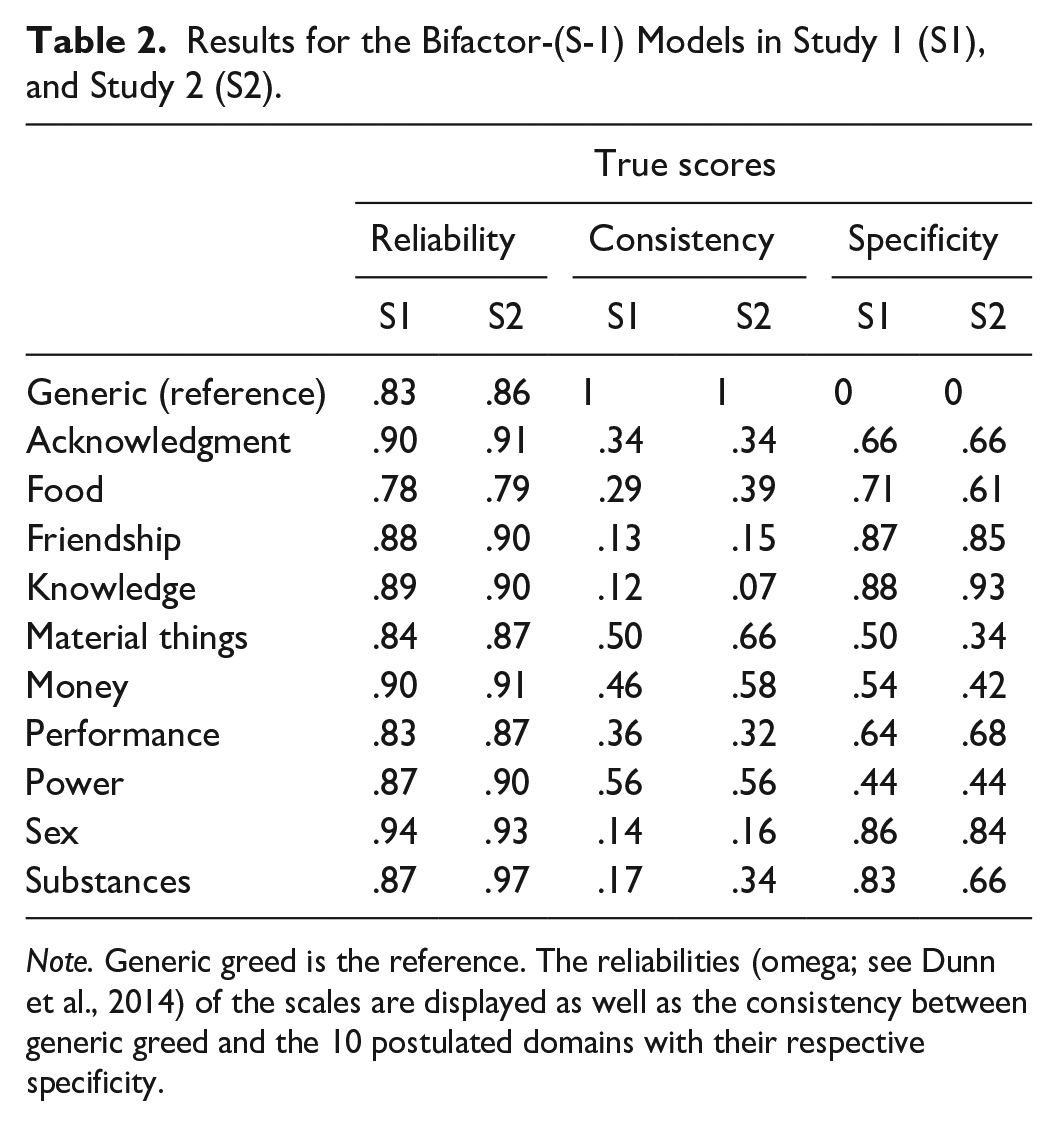
Note. Generic greed is the reference. The reliabilities (omega; see Dunn et al., 2014) of the scales are displayed as well as the consistency between generic greed and the 10 postulated domains with their respective specificity.
All criteria in the specified bifactor-(S-1) model exhibited at least acceptable model fit (
Partial Correlations for the Specific Factors Obtained From the Bifactor-(S-1) Model in Study 1.
Model fit for the full ESEM and the confirmatory factor analysis (CFA) are reported in the supplement (see Table S5). The full ESEM showed improved model fit compared with the CFA and the bifactor-(S-1) model (see Table S5). However, there were only three cross-loadings >.30 in the full ESEM, and the median of the cross-loadings was .01. Regarding latent correlations, the median of the absolute difference between the CFA and the ESEM was .07; only one correlation difference was > .30 (power and sex). The median latent correlation between one domain and all other domains (excluding generic greed) in the CFA ranged from .23 (knowledge) to .56 (material things) and in the ESEM from .21 (knowledge) to .41 (material things).
On a manifest level, the DOSPEG domains were correlated with each other, ranging from r = −.01 to r = .63 (see Table S2 in Electronic Supplementary Material 1). The correlations between generic greed and the DOSPEG domains ranged from r = .30 to r = .60 (all ps < .001, see second column in Table 4), indicating that all 10 domains shared substantial variance with generic greed. We used the procedure proposed by Meng et al. (1992) to test whether the domains were differentially related to generic greed. The results indicated that the correlation coefficients were not equal (
Correlations Between the DOSPEG Generic Greed Scale and the DOSPEG Domains in Study 1.
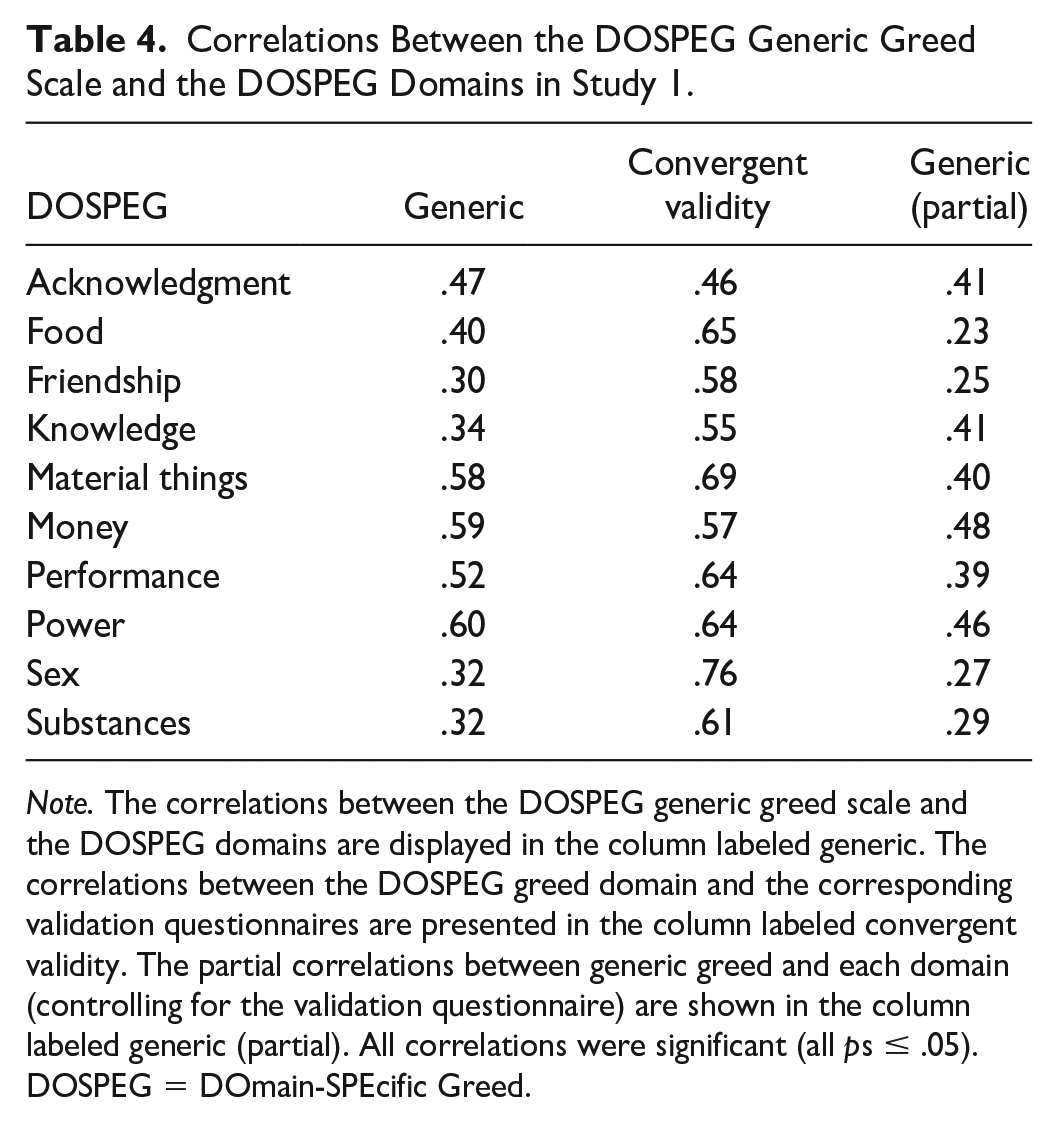
Note. The correlations between the DOSPEG generic greed scale and the DOSPEG domains are displayed in the column labeled generic. The correlations between the DOSPEG greed domain and the corresponding validation questionnaires are presented in the column labeled convergent validity. The partial correlations between generic greed and each domain (controlling for the validation questionnaire) are shown in the column labeled generic (partial). All correlations were significant (all ps ≤ .05). DOSPEG = DOmain-SPEcific Greed.
The convergent validities between the DOSPEG scales and the corresponding validation questionnaires are reported in the third column of Table 4. On average, the correlation between the DOSPEG domains and the corresponding measures was .62. On the level of individual domains, all 10 domains were significantly correlated with their corresponding measure. Conversely, the discriminant validities were .22, on average (see Table S7 in Electronic Supplementary Material 1). Thus, the results provide support for the construct validity of the DOSPEG domains. At the same time, the convergent validities were far from equivalent, indicating that the proposed greed domains are not the same as the corresponding constructs.
To further sound out the uniqueness of the DOSPEG, we investigated whether the domains (e.g., greed for knowledge) were correlated with generic greed after accounting for the variance shared with the corresponding measures (e.g., curiosity). As can be seen from the last column in Table 4, the partial correlations showed that the greed domains were still significantly related to generic greed after accounting for the variance shared with the corresponding measures (all ps ≤ .001). Thus, the DOSPEG domains are domain-specific measures of greed, rather than merely reflecting preferences for the respective domain (e.g., greedy striving for performance, rather than merely reflecting achievement motivation), indicating that the newly developed scale does not provide “old wine in new skins” in terms of the jangle fallacy.
Study 2
In Study 2, we provided a replication of the bifactor-(S-1) model identified in Study 1. Furthermore, we investigated the convergent validity of our generic greed scale by relating it to an established generic measure of greed (Krekels & Pandelaere, 2015). The scale was chosen as it conceptualizes and operationalizes greed as generic, that is, none of the six items refer to a domain such as money or luxury goods. The main purpose in Study 2 was to investigate criterion-related validity for the greed domains. We investigated convergent and divergent validities with corresponding criteria, obtained via self- and other-ratings, thereby providing further evidence of the validity of the postulated 10-dimensional model of domain-specific greed. Building on these results, we investigated the benefit of a domain-specific over a generic approach by testing the incremental validity of the DOSPEG domains with respect to corresponding criteria beyond generic greed.
Method
Participants
We preregistered the second study (https://osf.io/t98mc) and determined the sample size a priori using G*Power (version 3.1.9.6; Faul et al., 2007) for the main analysis, that is, the incremental validity of domain-specific greed over generic greed. We expected the correlation between generic greed and the criterion to be .30 (see Seuntjens, Zeelenberg, Van de Ven, et al., 2015, p. 925) and tested for whether a minimum of 3% of the variance could be explained by domain-specific greed over generic greed, which represents a small, yet substantial increase. Accordingly, the effect size f2 was .034. We set the alpha level to .005 (thereby adjusting for 10 separate significance tests with a familywise alpha of .05) and the 1-beta to .95. The total sample size required was N = 586. In sum, 591 participants completed the self-assessment and recruited at least one other person (1.67 peers on average) to complete the peer assessment (age: M = 40.72, SD = 14.54, 55% women).
Data Collection
We collected data from three different sources: the WiSo Panel (N = 220; Göritz, 2009), mailing lists from a German university (N = 60), and the Splendid panel (N = 311). The study was conducted according to APA Standards and Ethical Principles. All participants gave their consent to participate. Participants received a small financial compensation or course credit.
First, participants answered the DOSPEG and the Dispositional Greed Scale (Krekels & Pandelaere, 2015), followed by the 10 criterion items in the self-version in randomized order. Afterward, the participants were instructed to send a link to at least one friend or relative. This person was asked to answer the 10 criterion items in the peer version about the person who had sent them the link, not about themselves.
Measures
The DOSPEG questionnaire was applied, as described above. In addition, we applied the generic six-item Dispositional Greed Scale (Krekels & Pandelaere, 2015).
For the development of the self- and peer-versions of the criterion items, we used 10 items, one for each domain, each assessing the prototypical behavior for a greedy individual. Four of these items (food, friendship, material things, and sex) were adapted from Seuntjens, Zeelenberg, Van de Ven, et al. (2015) who also used these as behavioral criteria; the items for the remaining six domains were newly developed. An example for the self-version of the criterion item targeting material things is: “When I see a newer model of my phone, I immediately want to have it.” and the corresponding criterion item for the peer-version is: “When this person sees a newer model of her phone, she immediately wants to have it.”
Statistical Analyses
We reran the bifactor-(S-1) model, as specified in Study 1, to replicate the factor structure of the DOSPEG. We used the same fit indices and cut-offs as before.
To validate the generic greed subscale, we calculated its correlation with the Dispositional Greed Scale (Krekels & Pandelaere, 2015). As in Study 1, we also report correlations between the DOSPEG domains and DOSPEG generic greed.
Regarding the peer-rated criteria, we computed the intraclass coefficients (ICCs) for the participants with more than one peer rating. After averaging multiple peer ratings, we used bivariate correlations to measure the consistency between the self- and peer-ratings on the criterion items.
We calculated bivariate correlations between each of the 10 greed domains and its corresponding criterion to investigate convergent validity. Next, we performed 10 separate multiple regressions; for each of the one-item peer-rated criteria, we first regressed generic greed (Krekels & Pandelaere, 2015) and subsequently investigated the incremental validity of the corresponding domain-specific greed subscale.
Results
All criteria in the specified bifactor-(S-1) model exhibited at least an acceptable model fit (
The generic greed subscale from the DOSPEG was strongly correlated with the Dispositional Greed Scale (r = .81, p < .001). Correlations between the DOSPEG subscales (for reliabilities, see Table S1 in Electronic Supplementary Material 1) and the Dispositional Greed Scale were high (on average r = .44, see Table 5).
Results of Study 2 Targeting the Criterion-Related Validity of the DOSPEG.
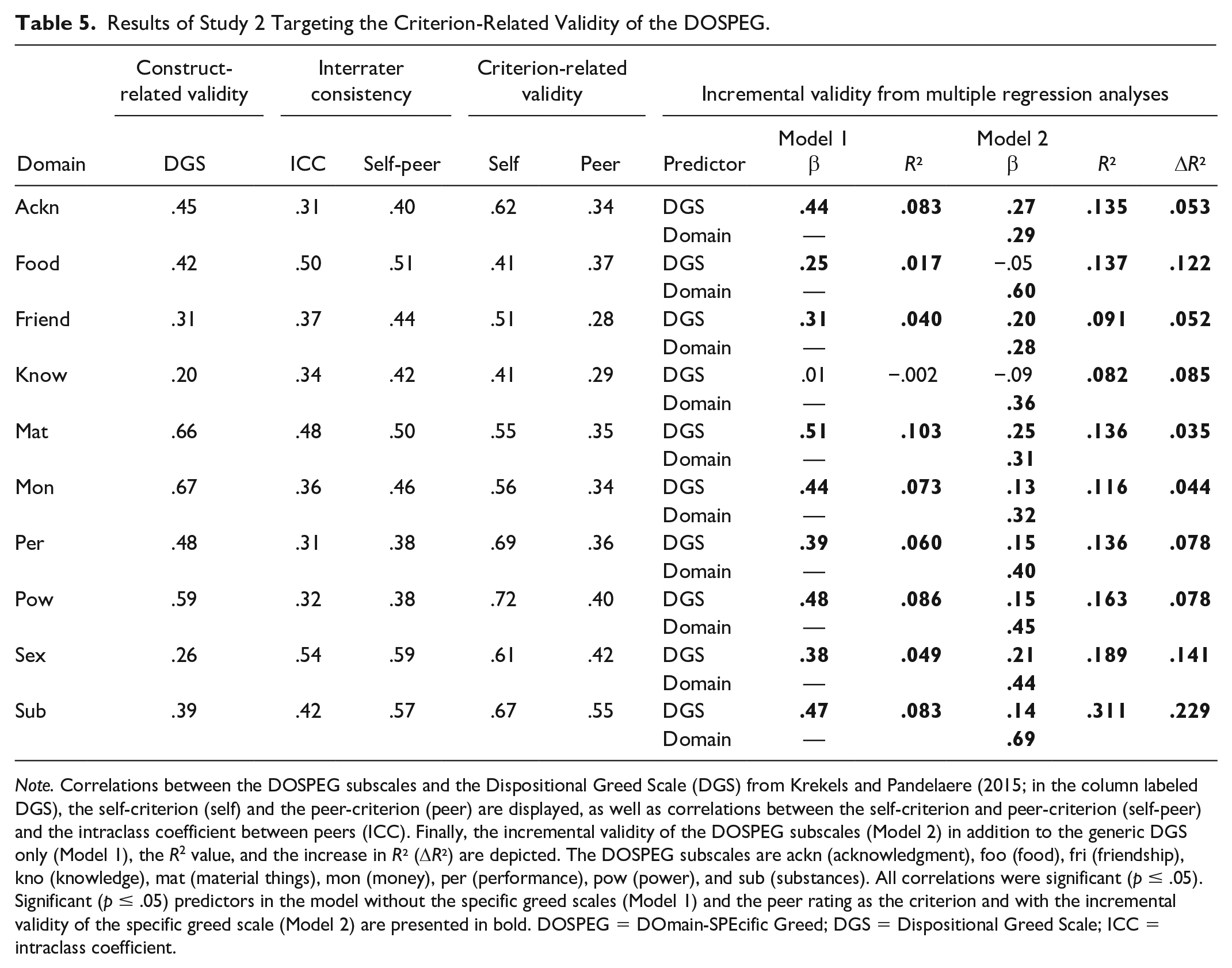
Note. Correlations between the DOSPEG subscales and the Dispositional Greed Scale (DGS) from Krekels and Pandelaere (2015; in the column labeled DGS), the self-criterion (self) and the peer-criterion (peer) are displayed, as well as correlations between the self-criterion and peer-criterion (self-peer) and the intraclass coefficient between peers (ICC). Finally, the incremental validity of the DOSPEG subscales (Model 2) in addition to the generic DGS only (Model 1), the R2 value, and the increase in R² (ΔR²) are depicted. The DOSPEG subscales are ackn (acknowledgment), foo (food), fri (friendship), kno (knowledge), mat (material things), mon (money), per (performance), pow (power), and sub (substances). All correlations were significant (p ≤ .05). Significant (p ≤ .05) predictors in the model without the specific greed scales (Model 1) and the peer rating as the criterion and with the incremental validity of the specific greed scale (Model 2) are presented in bold. DOSPEG = DOmain-SPEcific Greed; DGS = Dispositional Greed Scale; ICC = intraclass coefficient.
For the peer-rated criteria, the ICC for n ≥ 2 peer ratings was moderate (.31 ≤ ICC ≤ .54), showing that different peers evaluated the same target person somewhat heterogeneously regarding the criterion items. The average correlation between the self-ratings and peer-ratings was r = .46 (.38 ≤ r ≤ .59), indicating moderate agreement on the criteria between the self-perception and peer ratings, see Table 5.
Regarding criterion-related validity, correlations between the DOSPEG subscales and the self-rated criterion were high (.41 ≤ r ≤ .72). The correlations between the DOSPEG and the peer-rated criterion were all significant but moderate (.28 ≤ r ≤ .55), as reported in Table 5.
Finally, we investigated the incremental validity of the DOSPEG domains over DOSPEG generic greed on the corresponding criteria in separate multiple regression analyses. In Model 1, the DOSPEG generic greed subscale was a significant predictor of all peer-rated criteria, apart from knowledge (β = 0.01, p = .94). When comparing the predictive validity of DOSPEG generic greed (column “Model 1 β” in Table 5) with the construct-related validity (column “construct-related v. DGS”), there is a clear correspondence: The stronger a domain is reflected in generic greed, the stronger the validity of generic greed with the corresponding criterion (r = .71 across the 10 coefficients). Note that the criteria were measured using peer-ratings, ruling out the explanation of a common method effect.
Regarding the incremental validity of the DOSPEG subscales, all domain-specific predictors were significant (all ps ≤ .001). Importantly, there was a significant increase in explained variance when we added the domain-specific measure for all 10 criteria (.04 ≤ ΔR² ≤ .23), supporting the additional value of domain-specific greed beyond generic greed.
General Discussion
Personality psychology is moving from the description of broad personality traits (Goldberg, 1990) to the investigation of underlying processes (Dweck, 2017), influences of situational characteristics (Parrigon et al., 2017), personality states (Horstmann & Ziegler, 2020), and differential effects of facets (Judge et al., 2013) and nuances (Mottus et al., 2019), thereby providing a finer-grained understanding of personality. The research described in the current article contributes to this advancement by providing a differentiated approach to the construct of greed. Specifically, we investigated whether the propensity for greedy behavior could be differentiated according to the domain toward which the excessive striving for more is directed.
On the basis of a literature review and an expert survey, we identified different domains to which greedy behavior may pertain. We developed and validated a new personality measure, the DOSPEG scale, which assesses these greed domains and, additionally, generic greed. The scale showed adequate psychometric properties. Furthermore, we found support for the convergent and discriminant validity of the 10 domains in Study 1 and for criterion-related validity in Study 2. Accordingly, we consider the DOSPEG scale a reliable and valid scale for the assessment of domain-specific greed.
A domain-specific approach to the assessment of greed has the potential to provide a fine-grained intraindividual profile of trait greed and to enhance the prediction of related criteria over and above domain-general scales. Based on a domain-specific conceptualization, future research may investigate whether developmental trajectories found for trait greed (Mussel et al., 2022) are different according to domain, maybe reflecting changes in personal values as proposed by the theory of socioemotional selectivity (Carstensen, 1995). In addition, the DOSPEG provides a detailed intraindividual profile of greedy behavior in different domains, which has additional value for feedback, self-reflection, and personal development. Finally, prediction of specific criteria such as trading behavior (Hoyer et al., 2021), leadership (Haynes et al., 2015), hoarding of food (Yoshino et al., 2021), or eating behavior (De Backer et al., 2015) will likely benefit from using a domain-specific predictor that corresponds to the criterion. In line with this reasoning, we showed in Study 2 that for all 10 domains, domain-specific greed had incremental validity in predicting corresponding criteria over generic greed. Given that for such specific predictions only the relevant domain is needed, the DOSPEG, with only four items per scale, is a highly economic measure.
A Structural Model of Domain-Specific Greed
We integrated the findings from our studies into a structural model of domain-specific greed, as depicted in Figure 2. First, this model postulates that in addition to generic greed, 10 domains can be differentiated according to the respective target to which greedy striving may pertain. These domains have been proposed according to a thorough review of the literature, a qualitative study with 25 experts, and structural analyses across samples. Whereas it cannot be ruled out that other greed domains exist, we believe that these 10 domains include the majority of objects that greedy individuals strive for. Exploratory and confirmatory factor analyses across all three studies showed that these 10 domains can be differentiated. In addition, we demonstrated convergent and discriminant validity with corresponding constructs as well as criteria. Moreover, we showed that all 10 domains were significantly correlated with generic greed after accounting for the variance they shared with constructs that reflect a preference for the respective domain (e.g., striving for achievement) but not the excessiveness that is characteristic of greed (e.g., greedy striving for performance). This result was important for showing that all dimensions pertain to the construct domain of trait greed and may be labeled accordingly, rather than reflecting a different construct that erroneously goes under a false name in terms of the jangle fallacy (Block, 1995).
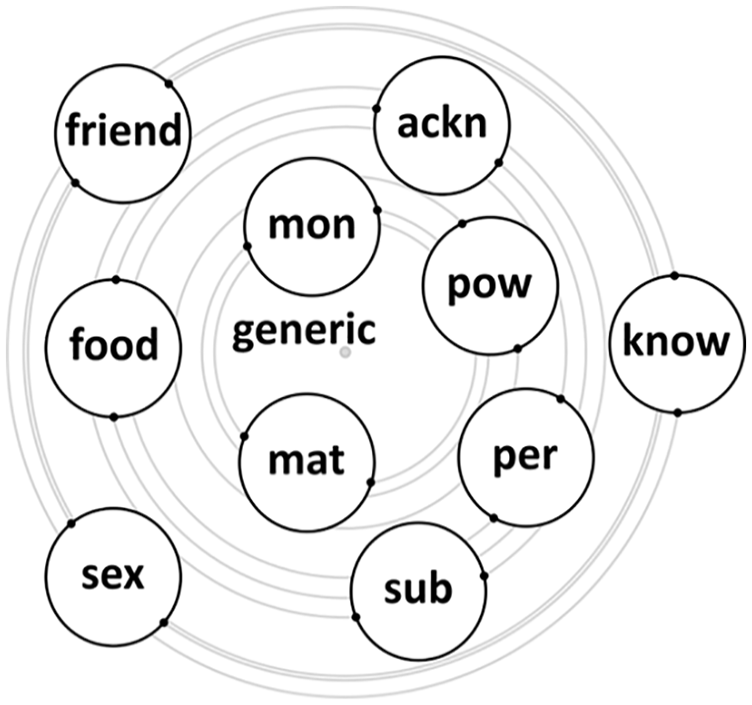
Onion Model of Domain-Specific Greed.
Second, the model reflects our observation that some domains are more central than others: Generic greed was significantly related to all domains, but the correlations differed significantly from each other. Similarly, the results of the bifactor-(S-1) models have shown that generic greed shares more variance with domains such as money, material things, performance, and power and less variance with domains such as friendship, knowledge, sex, and substances. Differences in centrality may reflect lay conceptions of greed. As such, even though there are many domains to which greed pertains, some might be more important or readily available to lay persons than others. This reasoning is in line with the prototype analyses by Seuntjens, Zeelenberg, Breugelmans, et al. (2015), who found that terms relating to money, material things, and power were often associated with greed, whereas food or sex were only rarely or never associated with greed. Thus, when answering generic greed items (e.g., “I always want more”), individuals seem to relate the statement more strongly to greedy behavior in certain domains over others (Schulze et al., 2021).
We conclude that, as a response to RQ1, greed can be conceptualized as a domain-specific construct. The onion model in Figure 2 shows 10 domains to which greed pertains and additionally illustrates their centrality with regard to generic greed.
Further Theoretical Implications
The model and the corresponding DOSPEG measure will allow researchers to address research questions that can advance the understanding of the nature of greed. We addressed one such question by investigating the degree to which generic greed reflects greed domains (RQ2). Note that several scholars have proposed that greed may pertain to any object (e.g., Krekels & Pandelaere, 2015; Seuntjens, Zeelenberg, Van de Ven, et al., 2015). This notion is reflected in scales using only generic items and is supported by empirical findings, which showed that generic greed predicts behavior across different domains. However, presenting generic items does not imply that respondents relate the item content equally to all potential domains (Schulze et al., 2021). Rather, lay conceptions of greed may systematically influence how items are interpreted, changing their meaning and ultimately the meaning of the construct that is being assessed. Thus, construct validity cannot be deduced from mere content validity, but has to be inferred empirically.
Our newly developed DOSPEG scale allows for answering the research question pertaining to the degree that generic greed is saturated by greed domains. At first glance, our results favor a broad conceptualization of trait greed according to which greed may pertain to any domain. We found that generic greed was significantly related to all domains of our DOSPEG model. This pattern held true even when controlling for measures that reflect mere preferences for a specific domain.
However, this is only part of the story as it neglects significant differences between domains with regard to saturation by generic greed, as shown by the test according to Meng et al. (1992). As such, the variance explained by generic greed varied across studies and domains from 6.8% to 49.7%. Similar results were found for the bifactor-(S-1) model. Thereby, the domains most strongly associated with generic greed were related to money and material things, followed by power, whereas the lowest saturation was observed for friendship, sex, and knowledge. Thus, with regard to RQ2, we conclude that there are large differences in the extent to which generic greed reflects greed domains. Scores from a generic greed scale mainly reflect greed for money and material things.
These results imply an important aspect on the nature of greed that should be reflected in a comprehensive definition. Therefore, we suggest defining greed more precisely as the excessive, insatiable desire and striving for more (especially money and material things) even at the expense of others. This definition contains and emphasizes the domains to which greed is mainly associated, while acknowledging that greed may also pertain to other domains. The emphasis on money has previously been proposed in a similar way by the Merriam-Webster (2013) dictionary as well as in several scientific definitions (Krekels & Pandelaere, 2015; Mussel & Hewig, 2016).
Such, seemingly small, refinements in definitions are important. Using a generic scale does not mean that greed, as assessed with this scale, refers to any object. When answering an item that lacks a frame of reference, test-takers do not necessarily generalize the item to an abstract level and average over a broad array of domains but may relate the item content to a specific domain, situation, or context of their idiosyncratic understanding (Schulze et al., 2021). As such, lay conceptions of greed influence what generic items measure. Such “hidden” frames of reference in generic items likely have consequences for the predictive power of generic greed scales: Criteria that are situated in the domains that are central to generic greed (e.g., financial/material criteria) might be more predictable than criteria that are more peripheral to the definition (e.g., criteria related to knowledge-specific greed). This can be explained by the principle of symmetry (Wittmann, 1988): Criteria that focus on a domain that is central to the definition of the generic greed measure are conceptually more similar to each other and are thus more symmetrical. In turn, this may impact their intercorrelations. Thus, researchers need to be careful when interpreting results from studies that use generic scales. With our revised definition, we describe the construct of greed more accurately and ensure that results from greed scales are interpreted more appropriately.
Limitations and Outlook
The present research is not without limitations. There were some indications for parameter mis-estimation in our CFA solutions that could be identified by the ESEM solution, but we focused on the CFA and S-1 solutions without cross-loadings because of their parsimony and because of the relatively small effect sizes of the parameter mis-estimation.
Our bottom-up approach aimed at identifying as many domains as possible toward which greed may be directed. However, exhaustiveness is impossible to prove, and future research may lead to a narrowing or extension of the 10 DOSPEG domains (e.g., the domain of love, in addition to sex and friendship; the domain of status, in addition to power; the greedy striving for adventure, in addition to substances). In addition, domains are likely hierarchically organized; therefore, alternative structures that differentiate single domains on a lower level or aggregate domains on a higher level (e.g., aggregating across money and material things) are likely to exist and may be useful for certain applications. Future research investigating the nomological net of the domains will be beneficial in determining the uniqueness of the ten domains. That being said, our proposed structure with ten domains is a reasonable structure on an intermediate level of specificity that, on one hand, provides a more detailed analysis of trait greed in different domains while being, on the other, parsimonious and theoretically meaningful (Ajzen, 2005). Results from our qualitative research as well as from our in-depth literature review can be meaningfully integrated in this framework, and the structure was confirmed in both exploratory and confirmatory analyses.
We investigated the validity of the DOSPEG with regards to behavioral indicators obtained via self- and other-reports. Future research should investigate the validity with regards to additional behavioral indicators, including economic games such as Dictator game (Güth et al., 1982), public good dilemmas (Eek & Biel, 2003), or tasks assessing risky decision making (Lejuez et al., 2003).
Regarding future applications, the DOSPEG scale with its 44 items is a fairly economic measure that takes participants approximately 5 to 7 min to complete, thereby providing a full profile of generic greed and 10 domains. Nonetheless, whenever a full profile is not needed, it is possible to apply only the items for one or several domains that are crucial to the research question or application at hand. As some of the items may be considered mildly intrusive (e.g., items pertaining to substance abuse or sexual contact), we recommend the partial application of only those items that are needed as the preferred method.
The DOSPEG scale extends the range of instruments that have thus far neglected domains beyond money and material things. There was a disparity between existing scales as well as between the conceptualizations and operationalizations of these scales: Some scales were developed to measure generic greed, whereas others conceptualize greed as pertaining mainly to money; and for some scales, the item content does not reflect the underlying conceptualization. The DOSPEG scale may be helpful for future research to substantiate the construct validity of these existing scales.
Our findings have also practical implications regarding the application of generic greed scales. Generic greed scales can be successfully applied to predict behavior in more central domains according to our onion model but may be less suitable for more distant domains. In line with this reasoning, the criterion-related validity of generic greed in Study 2 declined across domains as construct saturation with a corresponding domain dropped. For the most distant domain, knowledge, generic greed even lost its predictive power. For predicting behavior in such domains, using domain-specific greed according to the DOSPEG model is particularly useful.
As an alternative to the present approach, future research may pursue a qualitative approach to investigate the domain-ladenness of generic greed. Therefore, researchers might make use of qualitative methods, such as the think-aloud technique or probing questions (Jobe, 2003) to identify the domains that individuals consider when responding to generic greed items (Schulze et al., 2021).
Our results showed that domain-specific greed had incremental validity above generic greed when predicting corresponding criteria, thereby paralleling research for other constructs such as risk-taking or achievement motivation. Future research is needed to better understand where this enhanced predictive power originates from. For example, Michel et al. (2022) compared domain-specific with generic achievement motivation measures and found that the domain-specific variance components can be attributed to self-concept and self-esteem on domain-specific level. Corresponding future research is needed to investigate the domain-specific variance components for trait greed. A potential avenue for such an investigation might be the assessment of things that people find desirable in terms of values or attitudes. Following this reasoning, individuals’ level of greed would manifest in the excessive and insatiable striving for goods that are desirable for the individual.
The consistency coefficients between the generic greed and the domain-specific greed scales showed some variation across the studies we conducted. Although the heterogeneity in the composition of participants in both samples might be responsible for this result, alternative explanations could be investigated in future studies. For instance, studies might investigate whether generic greed shows greater consistency with money-specific greed in people who work in the financial sector (e.g., investment bankers) compared with people who work in less money-affiliated working sectors. Therefore, consistency coefficients across different subgroups could be compared using multigroup bifactor-(S-1) models as another potential source of variability. Such analyses would help in identifying moderators of consistency coefficients and provide evidence of differential domain-specificity (i.e., frames of reference) across groups of respondents (Lievens et al., 2008; Schulze et al., 2021).
Conclusion
In the present research, we revealed that greed can be conceptualized as a domain-specific construct and propose an onion model reflecting this structure. We also proposed and validated a comprehensive personality measure according to a newly developed model of domains to which greed may pertain. As illustrated, this opens up the possibility to address exciting new research questions.
Supplemental Material
sj-docx-1-psp-10.1177_01461672221148004 – Supplemental material for Domain-Specific Greed
Supplemental material, sj-docx-1-psp-10.1177_01461672221148004 for Domain-Specific Greed by Martin Weiß, Julian Schulze, Stefan Krumm, Anja S. Göritz, Johannes Hewig and Patrick Mussel in Personality and Social Psychology Bulletin
Footnotes
Author Contributions
Author contributions according to CRediT are as follows:
■ Martin Weiß: Conceptualization, Data curation, Formal analysis, Investigation, Methodology, Visualization, Writing—original draft
■ Julian Schulze: Methodology, Writing—review and editing
■ Stefan Krumm: Methodology, Supervision, Writing—review and editing
■ Anja Göritz: Investigation, Data curation, Writing—review and editing
■ Johannes Hewig: Methodology, Supervision, Writing—review and editing
■ Patrick Mussel: Conceptualization, Funding acquisition, Investigation, Methodology, Visualization, Writing—original draft
Declaration of Conflicting Interests
The author(s) declared no potential conflicts of interest with respect to the research, authorship, and/or publication of this article.
Funding
The author(s) received no financial support for the research, authorship, and/or publication of this article.
Ethical Approval
The study was conducted according to the APA Ethical Principles and all participants gave their consent to participate. The university ethics committee approved the study protocol.
Data Availability
The Prestudy and Study 1 were exploratory; Study 2 was preregistered prior to collecting the data under  . The newly developed DOSPEG questionnaire and all data are available at https://osf.io/t98mc.
Supplemental Material
Supplemental material is available online with this article.
References
Supplementary Material
Please find the following supplemental material available below.
For Open Access articles published under a Creative Commons License, all supplemental material carries the same license as the article it is associated with.
For non-Open Access articles published, all supplemental material carries a non-exclusive license, and permission requests for re-use of supplemental material or any part of supplemental material shall be sent directly to the copyright owner as specified in the copyright notice associated with the article.
