




Abstract
This research challenges the idea that teams from more collectivistic cultures tend to perform better. We propose that in contexts in which there are tradeoffs between group goals (i.e., what is best for the group) and relational goals (i.e., what is best for one’s relationships with specific group members), people in less collectivistic cultures primarily focus on group goals but those in more collectivistic cultures focus on both group and relational goals, which can lead to suboptimal decisions. An archival analysis of 100 years of data across three major competitive team sports found that teams from more collectivistic nations consistently underperformed, even after controlling for a number of nation and team characteristics. Three follow-up studies with 108 Chinese soccer players, 109 Singapore students, and 119 Chinese and the U.S. adults provided evidence for the underlying mechanism (i.e., prioritizing relational goals over group goals). Overall, this research suggests a more balanced view of collectivism, highlighting an important context in which collectivism can impair team performance.
Individualism–collectivism is one of the most studied dimensions of cultural variation (Hofstede, 1980; Triandis, 1989). In individualistic cultures, people tend to focus on their personal preferences, beliefs, values, and goals, whereas, in collectivistic cultures, people tend to focus on the preferences, beliefs, values, and goals of the group as a whole (Triandis, 1996). In addition, people in collectivistic cultures tend to emphasize group membership as a central aspect of their identity and subordinate their personal interests to the goals of the collective (Triandis, 1989, 1996) Indeed, a defining feature of collectivism is “cooperation so as to attain team goals and safeguard team welfare” (Earley, 1989, p. 567). Consistent with this idea, researchers have found that more collectivistic individuals or people in more collectivistic cultures were more likely to prioritize group goals over individual goals (Dierdorff et al., 2011; Yamaguchi, 1994), to cooperate with others in social dilemmas (e.g., prisoner’s dilemma and public goods game) (Parks & Vu, 1994), and to engage in citizenship behaviors (Jackson et al., 2006). Furthermore, more collectivistic individuals were less likely to engage in counterproductive behavior (Jackson et al., 2006), such as social loafing (Earley, 1989; Karau & Williams, 1993) and free riding (Wagner, 1995). Thus, the consensus in the literature is that collectivism improves team performance (Triandis, 1996).
Although the positive association between collectivism and team performance might appear intuitive, are there contexts in which it might not hold or even be reversed? Specifically, all the above-cited findings have been obtained in contexts in which individuals’ goals and group goals conflict. However, in the above contexts, group goals and individuals’ relational goals were aligned (e.g., acting in the group’s interest would strengthen individuals’ relationship with other group members). In the current research, we ask whether, in contexts where group goals and relational goals conflict, collectivism might impair team performance. In organizational contexts, for example, an employee might opt to work on a project with a colleague whom they like but who might not necessarily be the most qualified person for that project. In competitive soccer, for example, players frequently have to decide whether to pass the ball to a better-positioned player to score a goal or to another player who is not as well-positioned but with whom they have a closer relationship.
Research on the relational self (Brewer & Gardner, 1996) and the collective self (Triandis, 1989) offers an explanation for this counterintuitive phenomenon. The relational self refers to aspects of the self in relation to significant others, such as romantic partners, friends, and relatives. The collective self refers to aspects of the self in relation to memberships in social groups, such as one’s organization or one’s community. Although both the relational self and the collective self are more important for people in prototypically collectivistic cultures (e.g., Japan, China) than in individualistic cultures (e.g., the United States, the United Kingdom), the relational self often takes precedence over the collective self in collectivistic cultures (Brewer & Yuki, 2007; Kavanagh & Yuki, 2017; Yuki & Takemura, 2013). Indeed, Yamagishi’s influential theory of culture and trust posits that compared to individualistic cultures, such as the United States, people in collectivistic cultures, such as Japan prefer “dealing with others through personal relations” (Yamagishi & Yamagishi, 1994, p. 130).
A number of empirical findings are consistent with this thesis. Across cultures, the more employees identified with the organization (i.e., a collectivistic concern), and the more employees perceived that their colleagues and supervisor would disapprove of their departure (i.e., a relational concern), the lower their likelihood of quitting the company; however, the relational concern was a stronger predictor of Japanese employees’ turnover decisions than the British employees (Abrams et al., 1998). Similarly, the relational self is more important for Japanese students than for American students—Japanese students have more knowledge of the relationships between members of the social groups to which they belong, and view group members as more heterogeneous (Yuki, 2003). Furthermore, in a trust game, compared to Americans, Japanese were more likely to trust an out-group member with whom they might have a personal connection (Yuki et al., 2005). In addition, compared to managers in individualist cultures, managers in collectivist cultures were less trusting of external parties with whom they did not have a pre-existing relationship, but more trusting of members of their extended family and ethnic group (Huff & Kelley, 2003). These findings suggest that beyond an intergroup orientation, people in collectivistic cultures also have an intragroup orientation focusing on their relationships with specific members of the in-group. Summarizing the importance of the relational self in collectivistic cultures, Kitayama et al. (1997) remarked, “the self is made meaningful primarily in reference to those social relations of which the self is a participating part” (p. 1247).
Indeed, whereas, Triandis’s (1989) distinction between individualism and collectivism emphasized the distinction between individual versus group goals, Markus and Kitayama’s (1991) distinction between independence and interdependence emphasized the importance of close interpersonal relationships. Of course, the two go together, such that, people in more collectivist cultures tend to be more interdependent and vice-versa, and the findings from the two literatures are largely in accordance with each other. However, scholars have primarily studied contexts in which the group’s interest conflict with self-interest, not in which the group’s interest conflict with relational interests (e.g., Hofstede, 1980; Triandis, 1989).
We propose that when the group’s interest and relational-interests are in conflict, as interpersonal relationships are more important than group memberships in collectivistic cultures (Yuki et al., 2005), people in more collectivistic cultures would compromise between group and relational goals. Specifically, we propose that when individuals are determining the best course of action in a team setting, people in less collectivistic cultures would be primarily concerned with achieving the group’s goal and ignore the relational implications of their actions. In other words, people in less collectivistic cultures would not mind cooperating with a teammate whom they have a weaker relationship with as long as the action maximizes the group’s interest, and in turn, their personal interest. In contrast, we propose that people in more collectivistic cultures would be mindful of both the group’s interests and the relational implications of their actions. Therefore, when the two are in conflict, these people might engage in behaviors that compromise group goals because they are concerned with both group goals and their relationships.
In sum, we hypothesize that, in contexts where there are frequent tradeoffs between group and relational goals, collectivism would be associated with worse team performance. We tested this hypothesis in an archival study examining 100 years of data from three competitive team sports: soccer, basketball, and volleyball (Study 1). We followed up this archival study with three lab studies (Studies 2–4), in which we recruited participants from across a wide range of cultures (China, Singapore, and the United States) and occupations (semi-professional soccer players, students, and online participants).
Across all studies, we report all participants, conditions, and measures. The data and code are available at https://osf.io/8we32. Studies 1 and 3 were not pre-registered; Studies 2 and 4 were pre-registered.
Study 1: An Archival Study of Competitive Team Sports Performance
Study 1 tested whether cross-national variation in collectivism is associated with team performance in three of the world’s most popular team sports: soccer, basketball, and volleyball. We chose these three sports because they all present players with decisions between maximizing the group goal versus maximizing a relational goal. Furthermore, they are played across a large number of nations varying in collectivism. A critical characteristic of these sports is the prerequisite of passing the ball to other players in one’s team to score and win games. As players frequently need to pass the ball to another player, they oftentimes might need to decide whether to pass the ball to a better placed player or a player with whom they have a better relationship with. Here, more collectivistic players might sometimes pass the ball to a player with whom they have a better relationship, thereby reducing their team’s chances of scoring a goal. Thus, we predicted that teams from more collectivistic nations would underperform even after accounting for several national and team characteristics.
Method
International associations for soccer (Fédération Internationale de Football Association [FIFA]), basketball (Fédération Internationale de Basketball [FIBA]), volleyball (Federation Internationale de Volleyball [FIVB]) give each nation’s team a performance score annually, based on how well the nation’s team performed against other nations in the past year.
For soccer, we obtained the annual performance data of 215 nations from 1992 to 2018 for men, and of 182 nations from 2003 to 2018 for women. For basketball, we obtained the annual performance data of 180 nations from 2004 to 2018 for men, and of 88 nations from 2005 to 2018 for women. For volleyball, we obtained the annual performance data of 181 nations from 2005 to 2018 for men, and of 169 nations from 2005 to 2018 for women. Past research has suggested that competitive sports data provide an objective measure for performance (Kakkar et al., 2019), and thus is a valid operationalization of team performance in our context. Complete details about the dependent variable are presented in the Supplemental Material .
To maximize statistical power, we analyzed all available archival data for the three competitive sports across all countries and all years. This ranged from 14 years of women volleyball data across 169 nations to 27 years of men soccer data across 215 nations. In other words, we have exhaustively sampled available data.
We obtained our independent variable–collectivism from Hofstede’s (1980) national indices, which are commonly used in cross-cultural research (Anicich et al., 2015; Chua et al., 2015). Hofstede’s individualism–collectivism index consists of scores on a 100-point scale, ranging from 6 for Guatemala to 91 for the United States (Hofstede, 1980). We reverse-scored this index so that larger numbers indicate higher collectivism. The collectivism score for 96 nations was collated.
To rule out potential alternative explanations, we controlled for multiple economic and demographic indicators at the nation level, including gross domestic product (GDP) per capita, population size, birth rate, net inflow of foreign direct investment (FDI) as a percentage of GDP, unemployment rate, and linguistic diversity. All of these data were obtained from the World Bank and United Nations Educational, Scientific, and Cultural Organization (UNESCO), and they can all potentially explain why a particular nation does well on competitive team sports. For example, a higher GDP per capita indicates that the nation is wealthier which lead to more resources to devote to sports and training facilitates; a larger population means that there is more potential talent within the nation. Moreover, we also controlled for three other Hofstede’s well-researched cross-cultural values at the nation level, including power distance, masculinity, and uncertainty avoidance because past research has demonstrated that they correlate with collectivism (Hofstede, 1980; Oyserman & Lee, 2008).
Teams with physically stronger players are obviously more likely to win. To account for this variation, for men’s soccer, we also controlled for team-level variables that are related to team performance, including team average age, height, and weight. We were unable to control for team-level variables for the other sports because the data were not available. For example, it was virtually impossible for us to obtain the rosters of smaller nations in the other sports, as these nations do not publish such records. Complete details about the control variables are presented in the Supplemental Material .
Furthermore, as a robustness check, we also conducted supplementary analyses using Pelham et al.’s (2022) newly developed global collectivism index. Although this index is new, it has many strengths. It covers 188 countries, many more than other measures, which is based on representative national samples, and addresses the oversampling of Western countries in past research. Most of the results were comparable when we replaced Hofstede’s index with the global collectivism index. Complete details about these supplementary analyses are presented in the Supplemental Material (see Tables S2-S4).
Results
The unit of observation was the worldwide ranking of a given country in a given year. As we had multiple years within each country, we analyzed the data using hierarchical linear regressions. We included the year as a covariate in all models. The results are reported in Table 1. In odd-numbered models, we regressed nations’ team performance on nations’ collectivism score. In even-numbered models, we included country-level control variables. We found that more collectivistic nations performed worse in men’s soccer, b = –3.962, SE = 1.224, p = .001, t(2,303) = –3.238, 95% confidence interval (CI) [–6.361, –1.564], Model 2; all statistical analyses reported are two-sided tests, women’s soccer, b = –5.007, SE = 1.606, p = .002, t(1,158) = –3.117, 95% CI [–8.155, –1.859], Model 4; men’s basketball, b = –3.744, SE = 1.118, p = .001, t(648) = –3.348, 95% CI [–5.936, –1.552], Model 6; women’s basketball, b = –4.285, SE = 1.619, p = .008, t(378) = –2.647, 95% CI [–7.457, –1.112], Model 8; and men’s volleyball, b = –1.482, SE = 0.356, p < .001, t(1,035) = –4.161, 95% CI [–2.180, –0.784], Model 10; but only weakly so in women’s volleyball, b = –0.489, SE =0.346, p = .157, t(905) = –1.415, 95% CI [–1.166, 0.188], Model 12. No other cultural values consistently predicted team performance across all six sports.
National Team’s Performance in Soccer, Basketball, and Volleyball Among Men and Women in Study 1.
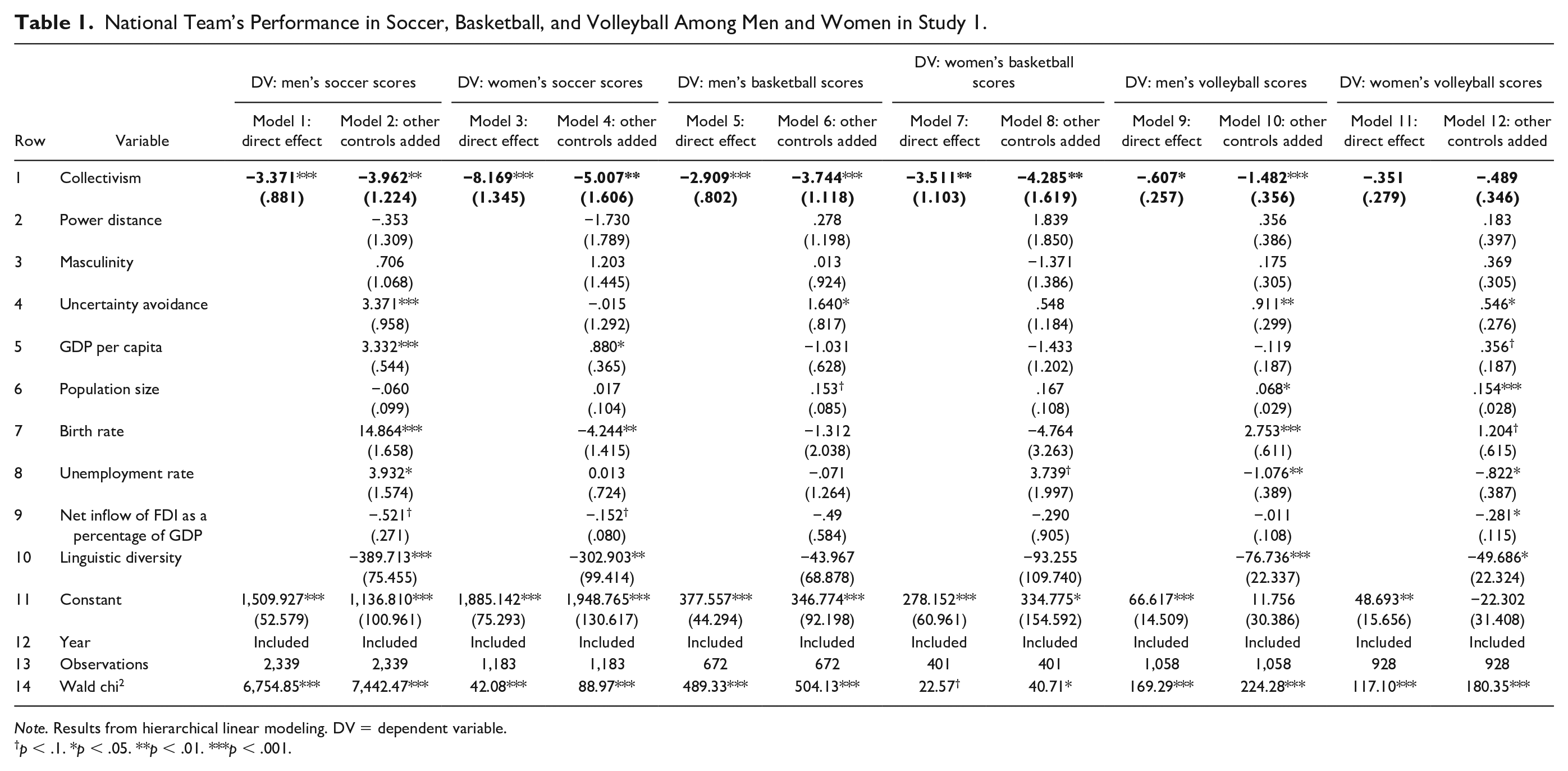
Note. Results from hierarchical linear modeling. DV = dependent variable.
p < .1. *p < .05. **p < .01. ***p < .001.
Supplemental Analysis
One explanation for these findings could be that collectivistic nations consistently perform poorly in all team sports, regardless of whether there are potential conflicts between group and relational goals. We chose football, basketball, and volleyball because of their popularity, which ensured that data were available from international competitions from a large number of years. Nevertheless, to address this alternative explanation, we also analyzed curling, a team sports with sufficient data and is typically played with four members. Unlike football, basketball, and volleyball, curling does not pose a conflict between group and relational goals—players do not need to make any passing or other decisions that only involve a dyad within the larger group. As a result, we predicted that collectivism would not be associated with lower team performance in curling.
We obtained data for men’s, women’s, and wheelchair curling competitions through the annual reports of the World Curling Association, which contained information about each country’s annual performance (men’s curling: 56 nations from 2013 to 2018; women’s curling: 56 nations from 2013 to 2018, wheelchair curling: 58 nations from 2013 to 2018). We excluded mixed gender curling as the usable sample size was too small (i.e., 27 nations). The results are reported in Table 2. We found that country-level collectivism was not significantly related to team performance for men’s (b = –2.325, SE = 1.887, p = .218, 95% CI [–6.024, 1.373], Model 2), women’s (b = –0.572, SE = 2.096, p = .785, 95% CI [-4.681, 3.537], Model 4), or wheelchair curling (b = –0.656, SE = 1.740, p = .706, 95% CI [–4.067, 2.755], Model 6). These results are consistent with the idea that collectivism specifically impairs team performance in sports in which group goals could potentially conflict with relational goals.
National Team’s Performance in Curling Among Men, Women, and Wheelchair in Study 1.
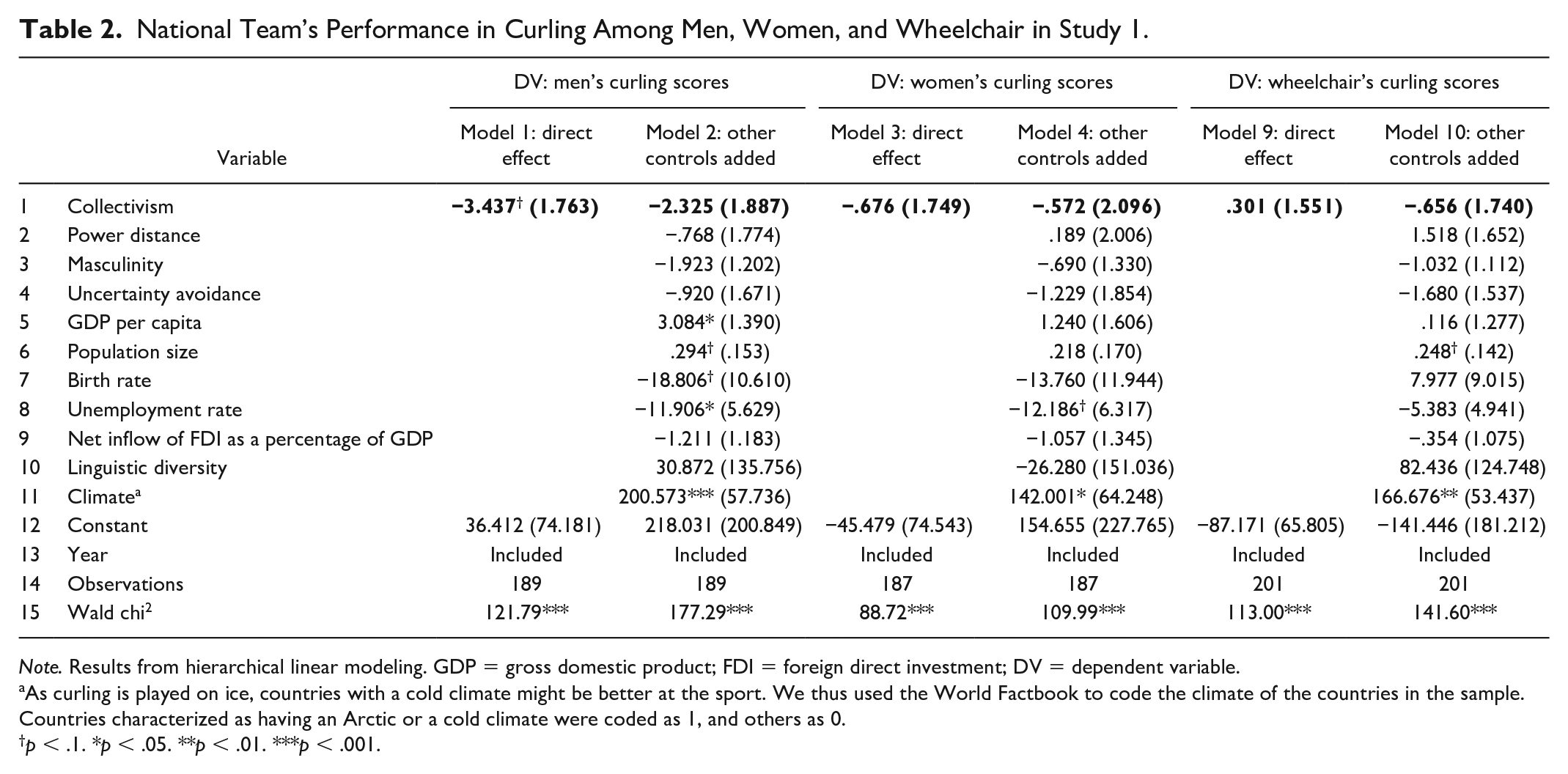
Note. Results from hierarchical linear modeling. GDP = gross domestic product; FDI = foreign direct investment; DV = dependent variable.
As curling is played on ice, countries with a cold climate might be better at the sport. We thus used the World Factbook to code the climate of the countries in the sample. Countries characterized as having an Arctic or a cold climate were coded as 1, and others as 0.
p < .1. *p < .05. **p < .01. ***p < .001.
Discussion
In sum, 100 years’ worth of data across three major competitive team sports (soccer, basketball, and volleyball) for both men and women (except women volleyball) supported our idea that in contexts in which group goals conflict with relational goals, collectivism is associated with weaker team performance. Most notably, no other cultural values consistently predicted team performance. As expected, these findings only held for sports in which there is a conflict between relational and group goals, not in a sport in which there is no such conflict. One limitation of this dataset is that each country’s performance depends on the performance of other countries in that year, and in particular, on the performance of other teams with which each country’s team is paired with. Thus, our data are not independent. Given this limitation, we sought to replicate these findings in additional studies.
Study 2: A Lab Study With Young Professional Athletes
Although the findings of Study 1 were consistent with our hypothesis, it is impossible to control for all possible confounding factors at the country level. Furthermore, the team sports that we sampled in Study 1 vary along many dimensions other than decisions involving a conflict between collective and relational goals. We had hypothesized that when players have to decide to pass the ball to another player in order to advance the group goal (i.e., scoring), those from less collectivistic cultures would just pass the ball to a better placed player. In contrast, those from more collectivistic cultures would often pass the ball to a player with whom they have a better relationship even if that player is poorly positioned to score a goal. As sub-optimal passing decisions accumulate, teams from more collectivistic cultures are likely to have worse performance. We tested this hypothesis in a soccer simulation using young soccer athletes training for the national soccer team.
An additional goal of Study 2 was to test the role of individual values associated with collectivism. Although there are existing individual-difference measures of individualism–collectivism (e.g., Triandis, 1996), in practice, they are often multi-dimensional (e.g., Kashima et al., 1995), have low reliability (Jetten et al., 2002), and exhibit inconsistent effects when measured at the individual level (Oyserman et al., 2002). Indeed, Triandis (1989, p. 509) stated, “Although the terms individualism and collectivism should be used to characterize cultures and societies, the terms idiocentric and allocentric should be used to characterize individuals.” Similarly, Cross et al. (2011, p. 143) stated, “Conceptually, IND-COL is a dimension used to describe cultures, whereas self-construal describes individuals.” We thus used the relational-interdependent self-construal (RISC) scale to measure collectivism as reflected in individual’s values (Cross et al., 2000). The RISC scale has high reliability (αs = .85-.90; Cross et al., 2000; p. 796), and is similarly correlated with other measures of interdependence (e.g., the communal orientation scale; Clark et al., 1987; r = .41) and collectivism (e.g., the group-oriented-interdependent self-construal scale; Singelis, 1994; r = .41; see Cross et al., 2000, Table 3). Thus, we submit that RISC is a reasonable measure of individuals’ orientation corresponding to individualism–collectivism at the national level.
Soccer Simulation Performance in the Friend-in-a-Worse-Position Trials and the Friend-in-a-Better-Position Trials in Study 2.
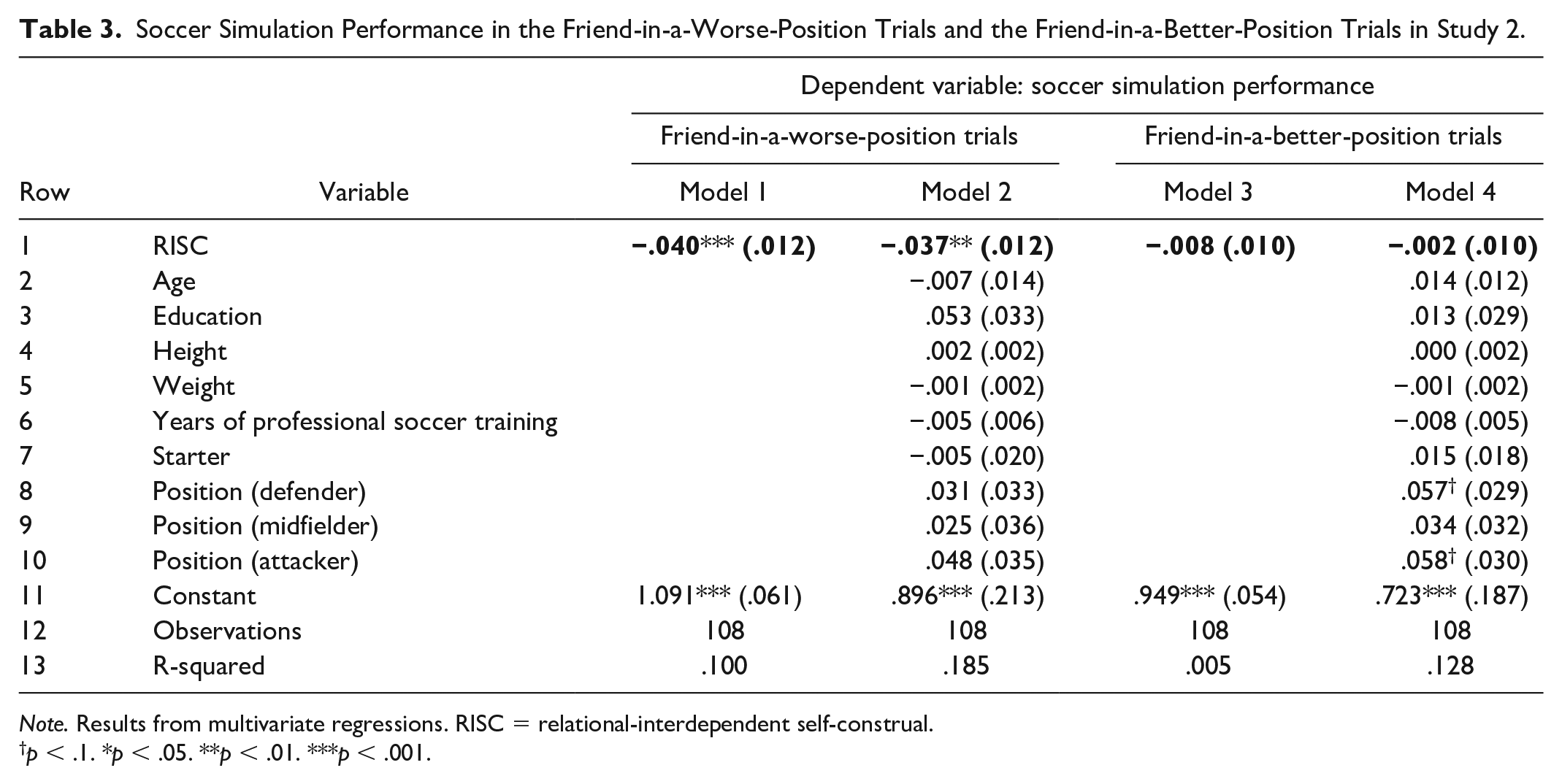
Note. Results from multivariate regressions. RISC = relational-interdependent self-construal.
p < .1. *p < .05. **p < .01. ***p < .001.
Method
Participants
We aimed to recruit a sample of professional and semi-professional soccer players. Given the uniqueness of this sample, our sample size was limited by the number of prospective participants available through the authors’ connections. We sought to maximize statistical power by designing a within-participant multi-trial task. We designed the task to be highly relevant to the participants, who were soccer players themselves. To maximize realism, participants were told that they were playing with a friend in their current team (all of whose members were present in the practice session) or a stranger. We recruited as many participants as possible in one professional football club’s youth development team in the Chinese Super League.
Specifically, we conducted an in-person study with 108 Chinese professional and semi-professional soccer players (average age = 11.6 years, SD = 1.6, all men, 45.4% in junior middle schools, average = 5.1 years of professional soccer training, SD = 1.7). All parents and participants provided informed consent. We pre-registered the methods and analyses at https://osf.io/uaqem. Participants were in the youth training center of a club in the Chinese Football Association Super League (the highest tier of professional football in China). They enrolled in this training center through rigorous selections and were being trained to become professional players in the future. We recruited participants in dyads. Specifically, we asked players and their closest friend in the training camp to complete the study together. They received an US$8 book in compensation, and had an opportunity to earn an additional US$15 gift based on their performance. The experimental instructions were presented in simplified Chinese.
Procedure
The dyads were requested to complete a soccer simulation with a third hypothetical player who was supposedly from another training camp, and was thus a stranger. The simulation included 60 trials in which participants were one step removed from a soccer goal. In all trials, two other players (their friend or the stranger) were closer to the goal. Participants had to make a decision between passing the ball to their friend and passing it to the stranger. Specifically, in all of the 60 trials displayed, participants (indicated by the letter Y) were told that the football is with them. However, as they are too far from the goal, they will need to pass the ball to either their friend (indicated by the letter F) or to the stranger (indicated by the letter J)—both of whom are closer to the goal. The participants’ team members and opposing team’s members were indicated by these colors (members of one’s own team indicated by red; members of the opposing team indicated by blue). Participants were asked to make a series of such decisions.
To increase realism, we told participants that they must decide very quickly as in real soccer matches (within 4 seconds). After 4 seconds, participants were automatically directed to the next trial. In each trial, one of the other two players was better placed. The better-placed one was defended by one (or two) players of the opposing team; whereas the other poorer-placed one was defended by two (or three) players of the opposing team. In half the trials, the participant’s friend was better placed, and vice-versa in the other half (see Figure 1 for a sample trial).
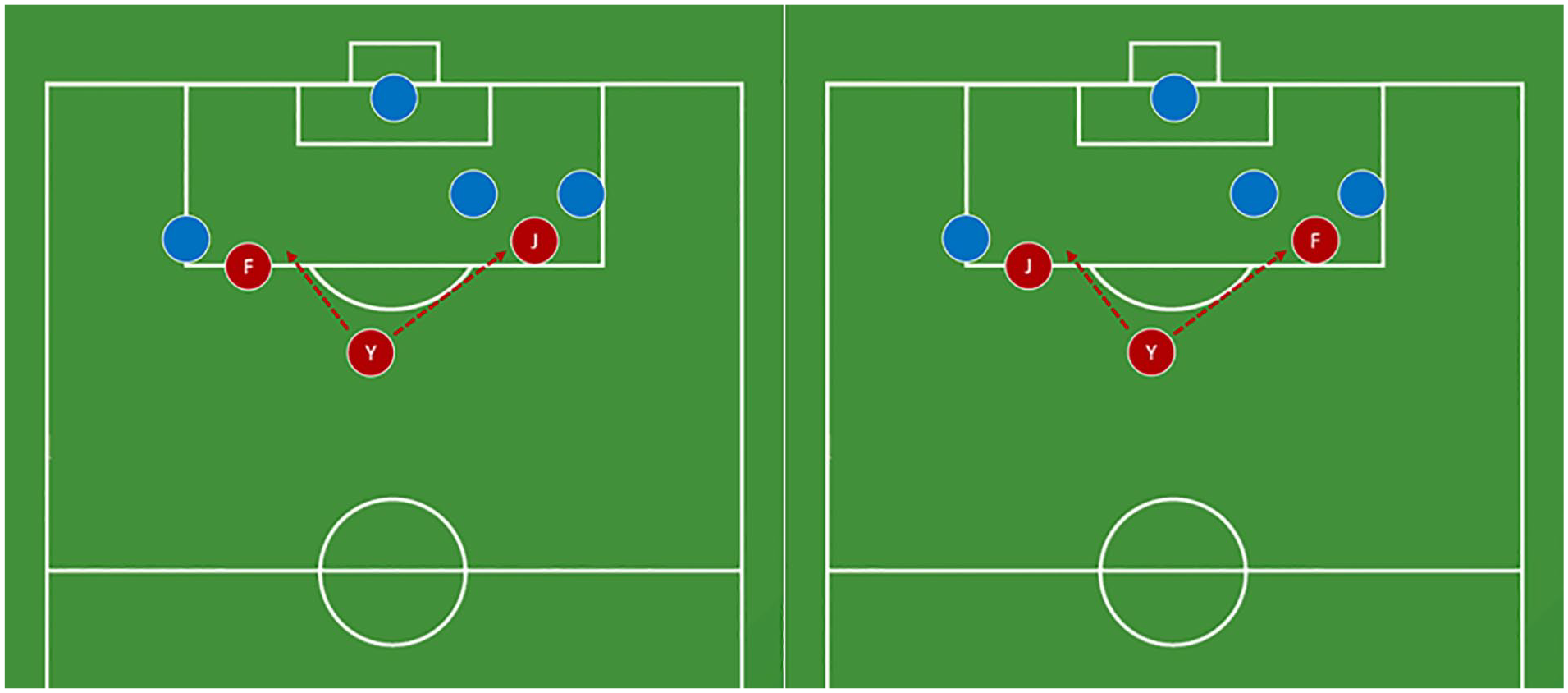
A sample friend-in-a-better-position trial on the left, and a sample friend-in-a-worse-position trial on the right. Y refers to the participant, F refers to the friend, and J refers to the stranger.
The order of all 60 trials was randomized. Our dependent measure was the percentage of trials on which participants passed the ball to the better placed player in the two types of trials. After participants completed these trials, we administered Cross et al.’s (2000) 11-item RISC scale (α = 0.745).
Results
A paired-samples t-test revealed that overall, participants were more likely to pass the ball to the better placed player in the friend-in-a-better-position trials (M =0.909, SE = 0.008, 95% CI [0.893, 0.925]) than in the friend-in-a-worse-position trials (M = 0.885, SE = 0.010, 95% CI [0.866, 0.905]), t(107) = 3.402, p < .001, d = 0.327. To test our hypothesis, we conducted repeated measures analyses of variance (ANOVAs) with performance on the two types of trials as the dependent variable, and RISC as the independent variable. We found a significant main effect of type of trials, F(1, 106) = 11.237, p = .001, η2 = 0.096, a significant main effect of RISC, F(1, 106) = 5.428, p = .022, η2 = 0.049, and a significant interaction, F(1, 106) = 15.600, p < .001, η2 = 0.128.
To investigate the interaction, we conducted multivariate regressions for the two type of trials (see Table 3 and Figure 2). We also controlled for athletes’ age, education, height, weight, years of professional soccer training, role in their current soccer team (e.g., starter, or bench player), and position in their current soccer team (e.g., defender, midfielder, or attacker), all of which may influence their decision-making. In the friend-in-a-worse-position trials, in which group goals conflicted with relational goals, participants higher on RISC were less likely to pass the ball to the better placed player, b = –0.037, SE = 0.012, t(97) = –3.065, p = .003, 95% CI [–0.060, –0.013], Model 2, indicating that they were more likely to pass to their friend even if their friend was in a worse position. In the friend-in-a-better-position trials, in which group goals were aligned with relational goals, the effect of RISC was non-significant, b = –0.0019, SE = 0.010, t(97) = –0.184, p = .855, 95% CI [–0.023, 0.019], Model 4.
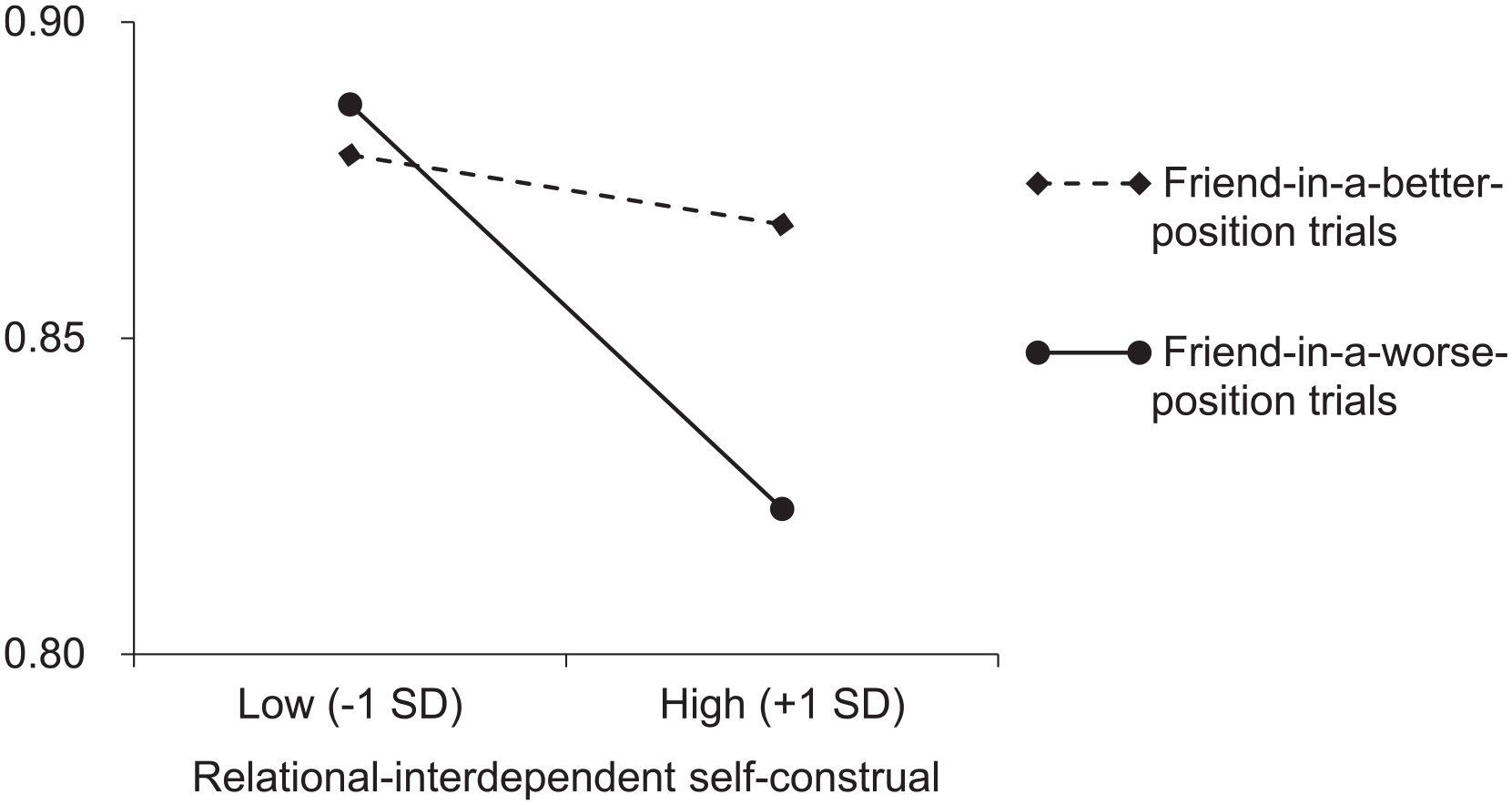
Soccer simulation performance in Study 2.
Discussion
Study 2 conceptually replicated the findings from Study 1 at the individual level and elucidated a boundary condition. More interdependent soccer athletes performed worse in a soccer simulation task but only when group goals conflicted with relational goals. When the two types of goals were aligned, interdependence was unrelated to performance. This finding is consistent with our argument that the conflict between group and relational goals is a key factor that could have driven the negative relationship between collectivism on team performance identified in Study 1. A shortcoming of this study is that the RISC scale primarily measured the extent to which people emphasize close relationships, and although this measure is correlated with collectivism (Cross et al., 2000), it emphasizes interpersonal relationships more than group goals. In addition, because participants completed this study with their close friends in a soccer training camp, they might have been primed to think about social relationships, which might influence their decisions and their self-reported interdependence.
Study 3: A Conceptual Replication With Undergraduate Students
Studies 1 and 2 provided support for our hypothesis with athletes. The goal of this study is to conceptually replicate Study 2 using a non-athlete population to ascertain the generalizability of the current findings. To minimize environmental priming effects, we conducted this study in the lab.
Methods
Participants
As this was the first lab study we ran (Study 3 was conducted before Study 2), we did not have a basis for conducting a power analysis. Therefore, we decided on a sample size of 100 participants. Expecting no-shows, we posted a survey seeking 60 dyads at a university in Singapore. To maximize realism, we asked all participants to come to the lab with a friend. In response, 55 dyads came to the lab. Of these, one individual did not complete the study, so the final sample consisted of 109 undergraduate students (average age 20.2 = years, SD = 1.3, 53 women, 56 men). The procedure was nearly identical to that in Study 2, but the materials were translated from Chinese into English as English is the language of education in Singapore. Once participants arrived in the lab with a friend, they were introduced to a stranger (who was an experiment confederate), and then proceeded to complete the task used in Study 2. Specifically, on each trial, participants had to decide whether to pass the ball to their friend or the confederate, both of whom were present in the same room as the participant. Participants and their friend both completed the same task.
Results
A paired-samples t-test revealed that overall, participants were more likely to pass the ball to the better placed player in the friend-in-a-better-position trials (M = 0.873, SD = 0.121, 95% CI [0.850, 0.896]) than in the friend-in-a-worse-position trials (M = 0.855, SD = 0.138, 95% CI [0.829, 0.881]), t(108) = 2.269, p = .025, d = 0.217. As in Study 2, in the repeated measures ANOVAs, we found a significant main effect of type of trials, F(1, 107) = 9.149, p = .003, η2 = 0.079, a non-significant main effect of RISC, F(1, 107) = 2.551, p = .113, η2 = 0.023, and a significant interaction, F(1, 107) = 11.535, p < .001, η2 = 0.097.
To investigate the interaction, we conducted multivariate regressions for the two type of trials (see Table 4 and Figure 3). We also controlled for participants’ gender and age (see Table 4). In the friend-in-a-worse-position trials, in which group goals conflicted with relational goals, participants higher on RISC (α = 0.819) were less likely to pass the ball to the better placed player, b = –0.041, SE = 0.017, t(106) = –2.429, p = .017, 95% CI [–0.074, –0.007], Model 2. In the friend-in-a-better-position trials, in which group goals were aligned with relational goals, the effect of RISC was non-significant, b = –0.007, SE = 0.015, t(106) = –0.442, p = .659, 95% CI [–0.036, 0.023], Model 4.
Soccer Simulation Performance in the Friend-in-a-Worse-Position Trials and the Friend-in-a-Better-Position Trials in Study 3.
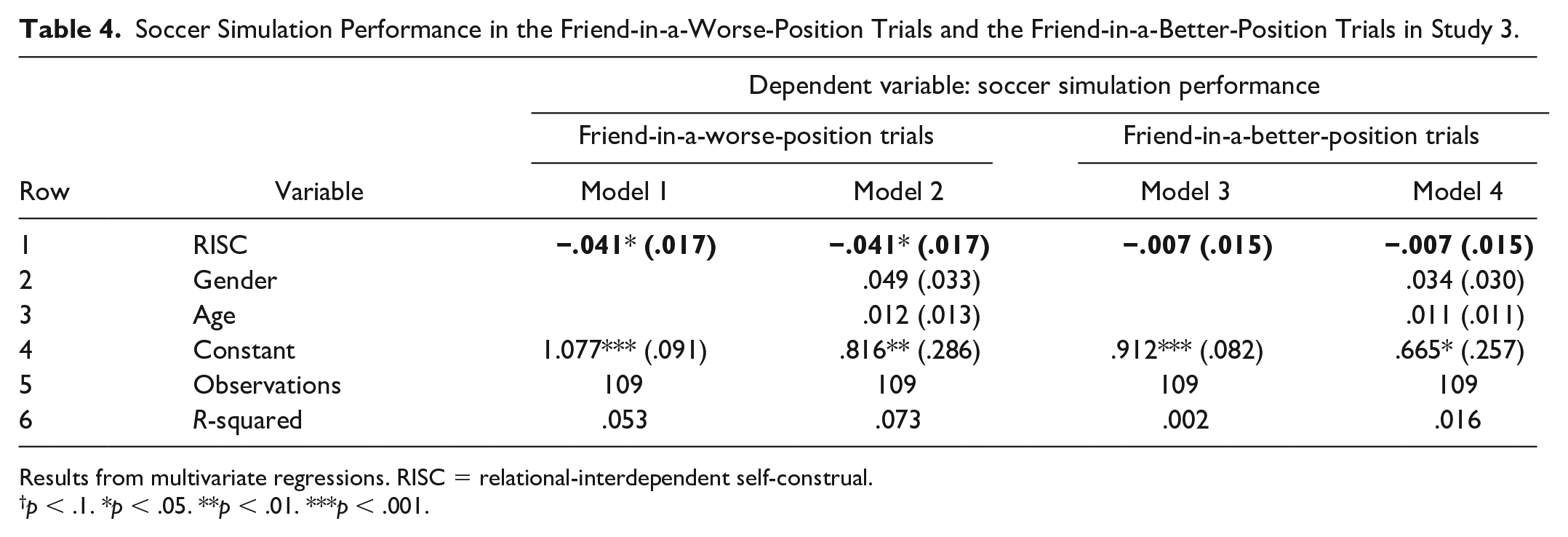
Results from multivariate regressions. RISC = relational-interdependent self-construal.
p < .1. *p < .05. **p < .01. ***p < .001.
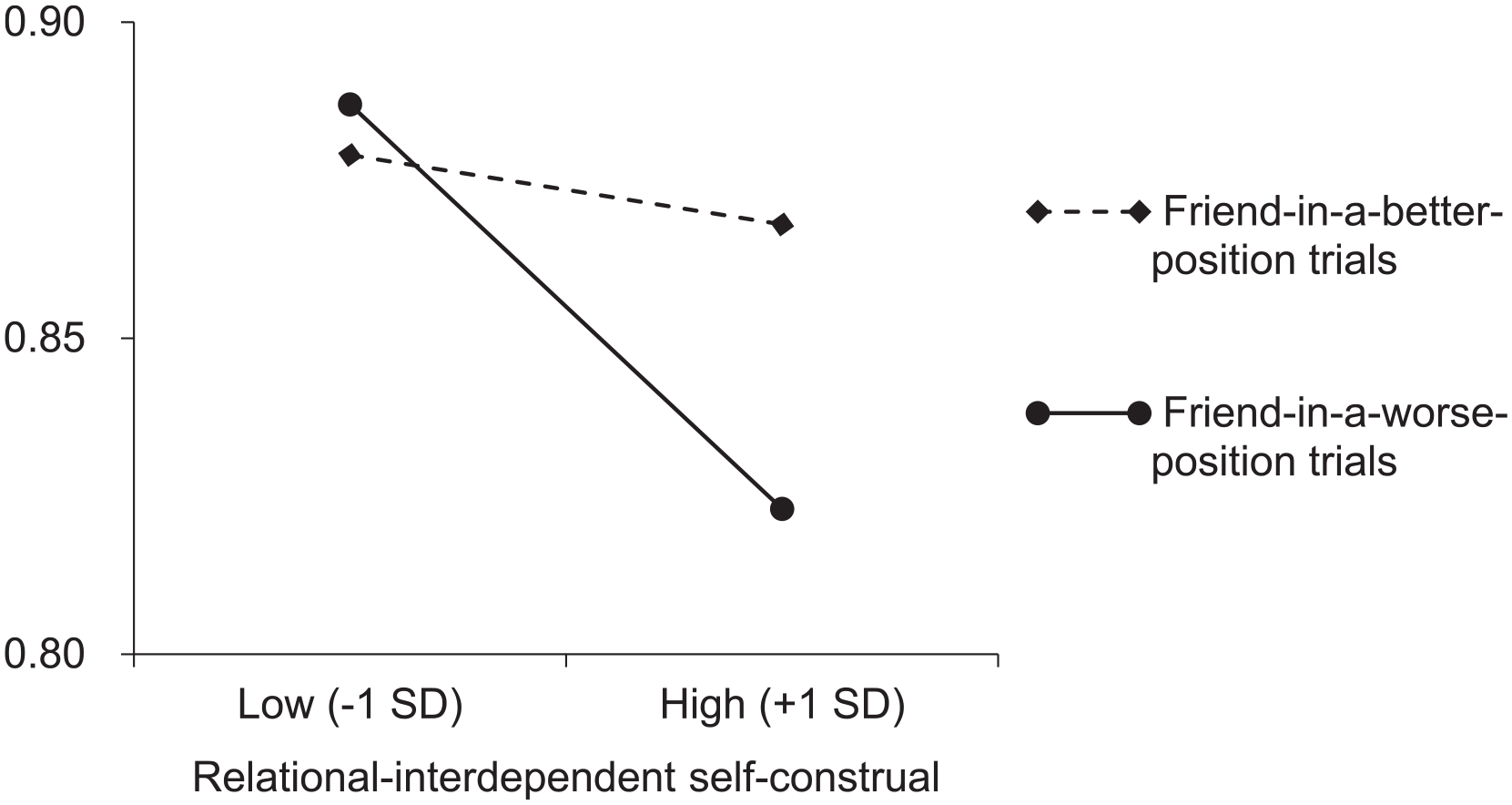
Soccer simulation performance in Study 3.
Study 3 replicated the findings of Study 2 with a non-athlete sample in a different culture. Once again, when group and relational goals were in conflict, more interdependent people were more likely to make suboptimal decisions. However, when the two were not in conflict, interdependence was not associated with performance.
Study 4: A Cross-Cultural U.S.–China Comparison
Studies 2 and 3 treated collectivism as an individual difference while operationalizing it using relational-interdependent self-construal. The goal of this study was to test assess whether the findings replicate in a cross-cultural comparison between a prototypically collectivistic country (i.e., China) and a prototypically individualistic country (i.e., the United States). 1 Furthermore, Studies 2 and 3 instructed participants make a forced choice between passing to a friend versus passing to a stranger. This hypothetical situation allows us to cleanly test our hypotheses, but it might have limited practical realism as people in a team often know all of their teammates; however, each player is probably closer to certain teammates than to others. Therefore, in this study, we asked participants to imagine that they were playing with either their best friend or their tenth best friend.
Methods
Participants
As this was our first cross-cultural experimental study, we did not have an effect size from the prior studies to use as the basis for a power analysis. We conducted a power analysis assuming a medium effect size of Cohen’s d = .52, α = .05 (two-tailed), and power = 80%, which indicated that we need to recruit 60 participants per culture. We thus posted surveys seeking 60 U.S. residents on Amazon Mechanical Turk and 60 China residents on Sojump. As per the pre-registration, we excluded one Chinese participant who passed the ball to the better placed player in 43% of the trials (all others did so in at least 60% of the trials). We thus had a valid sample of 60 American (average age = 32.1 years, SD = 6.3, 29 women, 31 men, average education = 15.7 years, SD = 2.4) and 59 Chinese participants (average age = 30.9 years, SD = 5.5, 25 women, 34 men, average education 15.9 years, SD = 1.4). The two groups were similar in terms of age, t(117) = –0.649, p = .518, gender, χ2(1) = 0.426, p = .514, and years of formal education, t(117) = –0.839, p = .403. We pre-registered the methods and analyses at https://aspredicted.org/6wx3p.pdf.
The procedure was identical to that used in Study 3 with one exception. We asked participants to first list the initials of their 10 best same-gender friends, ranked in terms of closeness. In the football simulation game, we asked them to imagine that Player F was their best friend and Player J was their tenth best friend.
Results
As per the pre-registered analysis, we found a positive correlation between the country dummy (the United States = 0, China = 1) and likelihood of passing to a friend in a worse position, r = –0.242, 95% CI [–.404, –.065], p = .008, and a non-significant correlation between the country dummy and likelihood of passing to a friend in a better position r = –0.030, 95% CI [–.209, .151], p = .745.
Paired-sample t-tests revealed that overall, Chinese participants were more likely to pass the ball to the better placed player in the best-friend-in-a-better-position trials (M = 0.869, SD = 0.104, 95% CI [0.842, 0.896]) than in the best-friend-in-a-worse-position trials (M = 0.826, SD = 0.093, 95% CI [0.802, 0.850]), t(58) = 6.710, p < .001, d = 0.874. In contrast, American participants were no more likely to pass the ball to the better placed player in the friend-in-a-better-position trials (M = 0.875, SD = 0.099, 95% CI [0.849, 0.901]) than in the friend-in-a-worse-position trials (M = 0.873, SD = 0.096, 95% CI [0.848, 0.898]), t(59) = 0.324, p = .747, d = 0.042.
We next ran a 2 (culture) × 2 (type of trials) repeated measures ANOVA and likelihood of passing to a friend in a worse position. We found a non-significant main effect of type of trials, F(1, 117) = 23.160, p < .001, η2 = 0.165, a non-significant main effect of culture, F(1, 107) = 2.313, p = .131, η2 = 0.019, and a significant interaction, F(1, 107) = 18.826, p < .001, η2 = 0.139.
To investigate the interaction, we conducted multivariate regressions for the two type of trials (see Table 5 and Figure 4). To keep the covariates consistent with those used in Studies 2 and 3, we controlled for gender, age, and education in this analysis. In the friend-in-a-worse-position trials, in which group goals conflicted with relational goals, Chinese participants were less likely to pass the ball to the better placed player than American participants, b = –0.051, SE = 0.017, t(114) = –2.955, p = .004, 95% CI [–0.086, –0.017], Model 2. In the friend-in-a-better-position trials, in which group goals were aligned with relational goals, the effect of culture was non-significant, b = –0.009, SE = 0.019, t(114) = –0.451, p = .653, 95% CI [–0.046, 0.029], Model 4.
Soccer Simulation Performance in the Friend-in-a-Worse-Position Trials and the Friend-in-a-Better-Position Trials in Study 4.
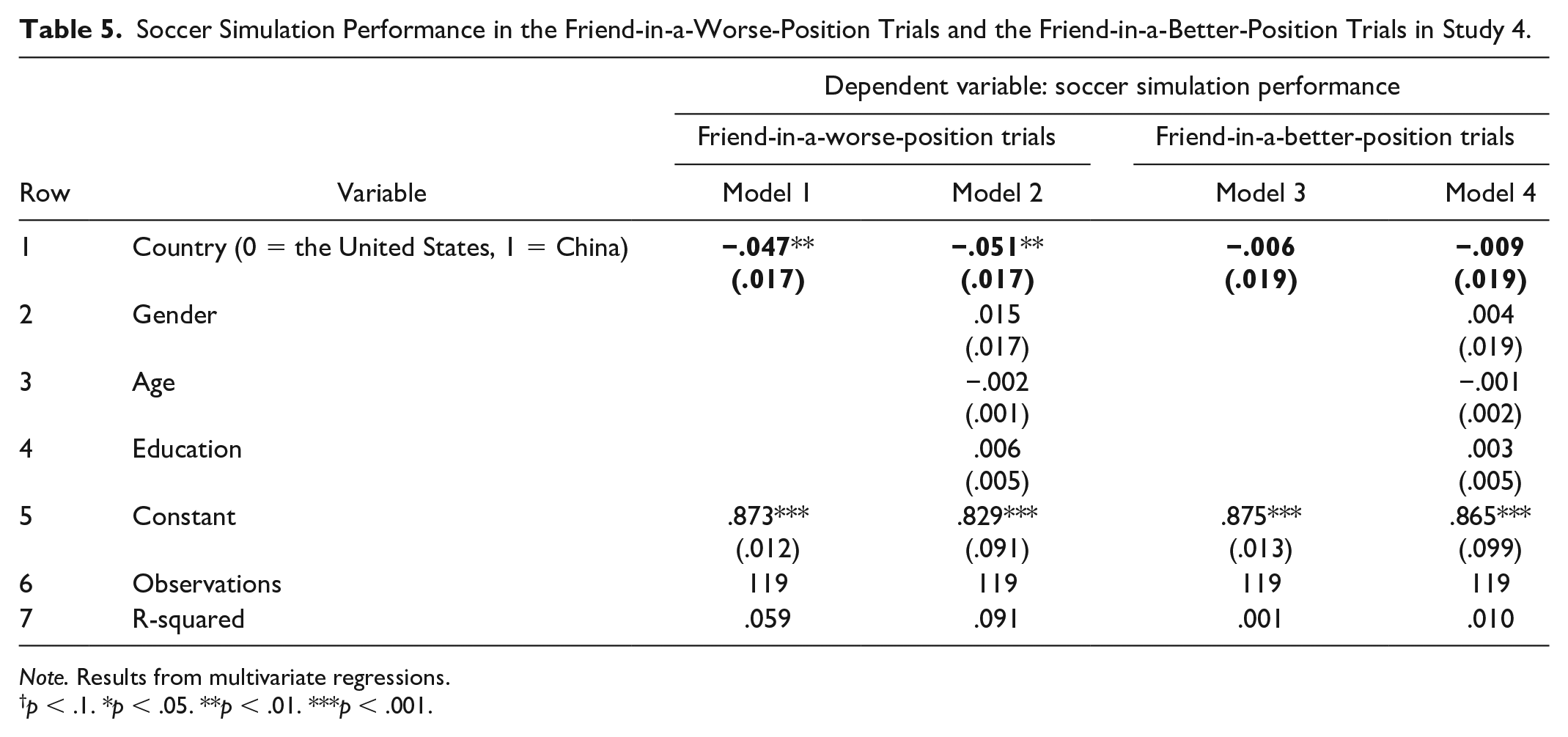
Note. Results from multivariate regressions.
p < .1. *p < .05. **p < .01. ***p < .001.
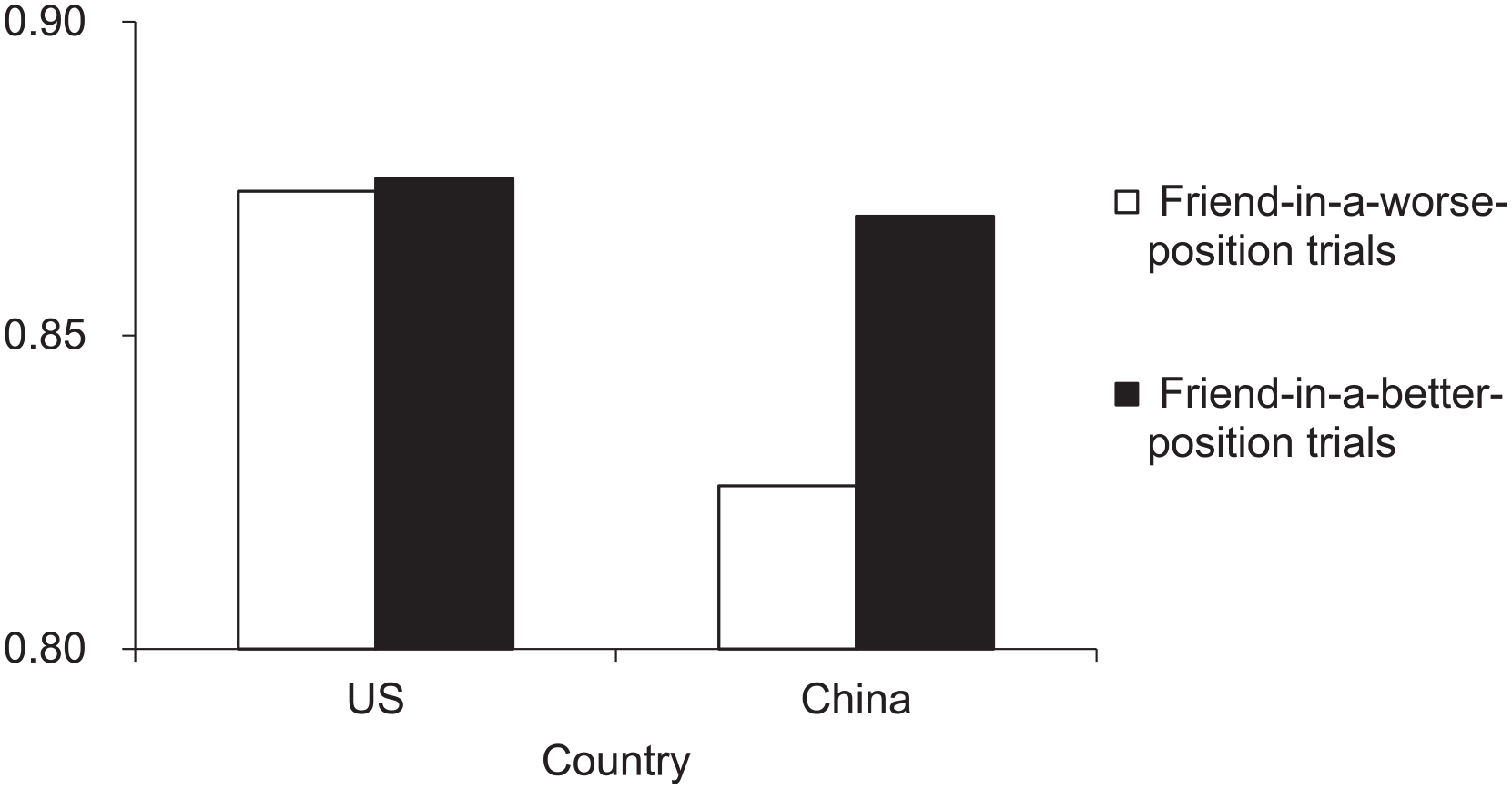
Soccer simulation performance in Study 4.
Thus, Study 4 replicated the findings of the previous studies at the cross-cultural level. Participants from China, a prototypically collectivistic country (Hofstede, 1980), were more likely to compromise between group and relational goals. In contrast, participants from the United States, a prototypically individualistic country (Hofstede, 1980), consistently focused on group goals.
General Discussion
Extensive research in psychology and management has argued that people in more collectivistic cultures subordinate their self-interest to their group’s interest, and therefore, more collectivistic groups perform better (Jackson et al., 2006; Wagner, 1995). In contrast, we identified a context in which collectivism is associated with lower team performance: when one’s relational goals conflict with group goals. The current research documented a negative association between collectivism and team performance by analyzing 100 years of data from three sports across both genders (Study 1). The subsequent lab studies documented the conflict between group and relational goals as a key mechanism that can explain the negative relationship between interdependence and performance. Specifically, when there was no conflict between relational goals and group goals, interdependence was unrelated to performance. But, when there was a conflict, more interdependent people performed worse. Our samples were recruited from diverse countries, including China (Studies 2 and 4), Singapore (Study 3), the United States (Study 4), and more than 90 other nations (Study 1). Thus, we believe the current findings are likely to generalize across cultures.
Implications for Theory and Practice
The present research makes several key theoretical contributions to the literature on culture and collectivism. First, our findings challenge the universalistic assumption that collectivism benefits team performance (Karau & Williams, 1993; Parks & Vu, 1994; Triandis, 1996; Wagner, 1995), and thus offer a more balanced perspective of the strengths and weaknesses of collectivism in the team performance context. The findings contribute to an emerging literature on the negative effects of collectivism in group settings, such as increased within-group competition and doubts about in-group members’ cooperative intentions (Liu et al., 2019).
Second, the current findings challenge the assumption that people in more collectivistic cultures are more concerned with group goals (e.g., Triandis, 1989, 1996) Past research has found that when individual goals conflict with group goals, more collectivistic people likely pay more attention to group goals (Parks & Vu, 1994; Wagner, 1995). However, in these cases, group goals were likely aligned with relational goals. We found that when group goals conflict with relational goals, people in more collectivistic cultures compromise between group and relational goals. The findings converge with prior research suggesting that people in more collectivistic nations, such as Japan, focus more on the inter-relationships within their in-group (e.g., friendships network) rather than on their group as a whole (e.g., organizational memberships; Yuki, 2003; Yuki et al., 2005). Together, these findings suggest that an emphasis on group membership is likely not a defining aspect of collectivism. Rather, it is possible that findings in prior research might be an artifact of contexts in which group and relational goals are aligned.
Finally, our findings suggest that it is particularly important to distinguish contexts in which relational goals are in conflict with group goals from contexts in which they are not. For example, in sports, relational goals are in conflict with group goals in team sports, such as soccer, basketball, and volleyball because these involve sequential coordination among teammates. In contrast, in team sports that involve simultaneous but not sequential coordination (such as curling, group gymnastics, and group table tennis), relational goals are not in conflict with group goals. The findings from our Studies 2 to 4 suggest that in such sports, teams from more collectivistic nations need not have a disadvantage, everything else being equal.
Limitations and Future Directions
The present research has several key strengths, such as including different designs (cross-nation archival data and controlled lab studies), and including participants from different cultural backgrounds (China, Singapore, and the United States) to achieve a high level of internal and external validity. However, our studies also have some limitations that can be addressed in future research. First, cross-nation archival study data for many other team sports are not available for many nations. Thus, although we could find sufficient data for three sports in which group goals conflict with relational goals (i.e., soccer, basketball, and volleyball), we could find sufficient data for only a single sport in which group goals do not conflict with relational goals (i.e., curling). Future research can identify other contexts in which relational and group goals are not in conflict to provide an additional test of our second hypothesis. Furthermore, as our focus was on distinguishing relational goals and group goals, we did not study contexts that independently vary relational goals, group goals, and individual goals. Future research can examine the effects of collectivism on team performance in various contexts by independently manipulating the three types of goals.
Second, our lab studies provide support for the idea that interdependence is associated with lower team performance, particularly in contexts in which there is a conflict between relational goals and group goals; when there is no such conflict, interdependence is unrelated to team performance. These studies provided converging evidence at the individual level (by measuring interdependence as an individual difference) and at the country level (by sampling people in countries varying on collectivism). However, the current studies did not provide causal evidence for the role of collectivism. Although researchers have developed methods to prime individualism–collectivism (Oyserman & Lee, 2008), we were concerned that any priming effect would dissipate across the 60 trials used in our experimental paradigm. Nevertheless, future research can examine the causal effect of collectivism on individual and team performance in contexts in which relational goals conflict with group goals.
Third, although our studies suggest that people in more collectivistic cultures put more emphasis on their relationships with other team members, we do not mean to suggest that these relationships are always free of tension. Indeed, recent research has found that people in more collectivist cultures are more vigilant about the motives of their in-group members, and are more likely to perceive in-group members’ friendly behavior as sabotage; however, these effects are attenuated in clearly win-win situations (Liu et al., 2019). The contexts examined in the current research were all win-win situations in which the team’s success implies both the individuals’ success and their teammates’ success. Future research can examine whether people in more collectivistic cultures would continue to compromise between group and relational goals in win–lose settings.
Fourth, our work is consistent with emerging research associating collectivism with nepotism at the organizational and societal levels. Research has found greater nepotism and in-group favoritism in more collectivistic countries and organizations (Kragh, 2012; Kyriacou, 2016). Nepotism involves a conflict between relational goals (i.e., helping people in one’s social network) and group goals (i.e., hiring people who are best for the organization), so similar processes might explain both the negative relationship between collectivism and team performance and the positive relationship between collectivism and nepotism.
Finally, our studies focused primarily on the sports setting. Although the sports industry is big, raking in total revenues of about US$500 billion yearly (The Business Research Company, 2020), future research can seek to replicate our findings in other organizational contexts. For example, is it the case that employees in more collectivistic cultures prefer to work with friends within the same organization regardless of their friends’ skill sets at the expense of organizational productivity? We hope that our work can spark additional research to examine collectivism’s nuanced effects on team performance.
Supplemental Material
sj-docx-1-psp-10.1177_01461672221123776 – Supplemental material for Collectivism Impairs Team Performance When Relational Goals Conflict With Group Goals
Supplemental material, sj-docx-1-psp-10.1177_01461672221123776 for Collectivism Impairs Team Performance When Relational Goals Conflict With Group Goals by Xin Qin, Kai Chi Yam, Wenping Ye, Junsheng Zhang, Xueji Liang, Xiaoyu Zhang and Krishna Savani in Personality and Social Psychology Bulletin
Footnotes
Acknowledgements
The authors thank Chen Chen, Xiaowei Dong, Runkun Su, Dayana Bulchand, and Sylvia Chin for their extensive research assistance.

Declaration of Conflicting Interests
The author(s) declared no potential conflicts of interest with respect to the research, authorship, and/or publication of this article.
Funding
The author(s) disclosed receipt of the following financial support for the research, authorship, and/or publication of this article: This research was supported by National Natural Science Foundation of China grants 71872190 and 71502179 and the Guangdong Province Higher Vocational Colleges and Schools Pearl River Scholar Funded Scheme awarded to Xin Qin.
Ethical Approval
This study was approved by National University of Singapore Institutional review board protocol DER-19-1102.
Supplementary material
Supplemental material is available online with this article.
Notes
References
Supplementary Material
Please find the following supplemental material available below.
For Open Access articles published under a Creative Commons License, all supplemental material carries the same license as the article it is associated with.
For non-Open Access articles published, all supplemental material carries a non-exclusive license, and permission requests for re-use of supplemental material or any part of supplemental material shall be sent directly to the copyright owner as specified in the copyright notice associated with the article.
