



Abstract
Past studies on how political value (i.e., ideology) and identity (i.e., party identity) predict support for candidates often fail to consider both the perspectives of citizens and candidates, introducing omitted variable problems. To address them, this paper introduces the multiple matching perspective, which considers how citizens’ ideology and political identity are matched (i.e., moderated) by a candidate’s ideology and party affiliation. Four studies using this approach reveal: 1. The effect of ideology match is large, robust, and consistent. 2. candidates’ ideology plays more role than candidates’ party identity except during the final stage of a presidential race. 3. Citizens’ party identity can guide them to support a candidate based on the candidate’s ideology (Republicans will support conservatives), but it is less so for the reverse of it (conservatives do not always support Republicans). Therefore, this approach helps theory-building in political psychology by uncovering novel effects of ideology and partisanship.
Value (e.g., Schwartz, 2013) and identity (e.g., Tajfel & Turner, 1979) are powerful psychological variables that shape preferences and behaviors. In political psychology, political ideology (or ideological orientation; e.g., Jost et al., 2009) and party identity (or party identification; e.g., Green et al., 2004) are perhaps the most discussed types of value and identity. Many have studied how they might guide citizens to form sociopolitical preferences, such as support for political candidates. Nonetheless, a critical issue from existing studies is that they often fail to simultaneously consider the political ideology and party identity of citizens and that of candidates when predicting support for candidates. This article introduces a novel approach that addresses the issue. Using this approach, this article compares the relative roles of ideology and party identity, uncovering novel and subtle effects that were previously overlooked in the literature, demonstrating this approach’s benefits in theory-building in political psychology.
Party Identity: A Social Identity With Important Consequences
Party identity is a social identity about how much people see themselves as partisans. Earlier scholars believed that it merely reflected citizens’ agreement with parties (Downs, 1957) or evaluation of parties (i.e., the instrumental perspective; Fiorina, 1976; Franklin & Jackson, 1983). Recent scholars view it as citizens’ beliefs about who they are, whom they feel loyal to (Campbell et al., 1960; Green et al., 2004), and psychologically attached to (i.e., the expressive perspective; see also Fowler & Kam, 2007). Partisans identify with their parties to fulfill two fundamental needs: inclusion, or belonging to a group, and exclusion, or distinguishing from others (Brewer, 1991). In a way, citizens’ party identity is like sports fans’ identification with their favorite sports team (Mason, 2015): Partisans support their party because they root for their team while at the same time rooting against the other (Green et al., 2004).
Many factors contribute to one’s development of partisanship. On the individual level, they include genetic dispositions (Settle et al., 2009; Dawes & Fowler, 2009), demographic background (Green et al., 2004), and personality (Gerber et al., 2011). On the social level, they include social networks (Lupton et al., 2015), uncertainty (Hohman et al., 2010), and threat perception (Craig & Richeson, 2014). In turn, party identity shapes the perception and evaluation of information, and, as a result, political attitudes (Bartels, 2002; Bisgaard, 2015; Bolsen & Druckman, 2018; Campbell et al., 1960; Carsey & Layman, 2006; Druckman et al., 2013). Just like how sports fans judge games in ways that fit their own narratives (Hastorf & Cantril, 1954), partisans can see political information in ways that favor their own parties. The mutual hostility between rival partisans is large, growing, and observable in multiple domains of social life (e.g., Hui, 2013; Iyengar et al., 2012), and remarkably, partisans are more hostile toward each other than people from different racial groups (Iyengar & Westwood, 2015). However, a common limitation of this line of work is the omitted variable problem: The studies comparing Republicans and Democrats may, in fact, be comparing conservatives and liberals given that many Republicans are also conservatives and many Democrats are liberals. This issue is instrumental in the motivation of the current research as will be discussed more later.
Political Ideology as an Important Domain of Value System
Political ideology is a set of organized beliefs (Knight, 2006, p. 622) about the role of government (Converse, 2006; Peffley & Hurwitz, 1985), the proper order of society, and the means to bring about it (Adorno et al., 2019; Campbell et al., 1960; Erikson & Tedin, 2019; Kerlinger, 1984). Although citizens understand ideology differently, many people rely on a general left–right continuum to make sense of politics (Jost et al., 2009, though contra Kinder & Kalmoe, 2017). According to Jost and colleagues (2003) ideology has two related psychological components: (a) the acceptance of inequality and (b) resistance to change (in a related vein, it may have an economic dimension and a social dimension that are conceptually related to these two factors; see Feldman & Johnston, 2014), and it is motivated by psychological (e.g., epistemic, existential, and relational) needs that shape attitudes and beliefs such as specific issue positions, evaluations of parties, and political candidates.
Just like research on party identity, scholars found many demographics (e.g., Jacoby, 1991), personality (e.g., Duckitt et al., 2002; Gerber et al., 2011), and situation variables (e.g., Bai & Federico, 2020) that shape ideology (also see Jost, 2006 for a review) as well as what life outcomes and personal preferences political ideology can consequently shape (Carney et al., 2008; Eastwick et al., 2009; Klofstad et al., 2013). Nevertheless, the omitted variable problem about party identity is applicable to ideology too: Studies comparing conservatives and liberals may in fact be comparing Republicans and Democrats instead.
Party Identity, Ideology, and Support for Political Candidates
Both party identity and ideology remain the most potent predictors of political preferences (Erikson & Tedin, 2019; Jacoby, 1991; Jost, 2006; Lyons & Scheb, 1992), including the evaluation of candidates (see Barber & Pope, 2019; Mondak, 1993; Rahn, 1993 for findings of party identity and Blais & Bodet, 2006; Golder & Stramski, 2010; MacDonald & Rabinowitz, 1993 for findings of ideology). Yet, scholars continue debating about whether party identity or ideology is more fundamental, powerful, meaningful, relevant, or “real” (e.g., see Converse & Pierce, 1986; Fleury & Lewis-Beck, 1993; Markus & Converse, 1979; Page & Jones, 1979, for earlier discussions; see Azevedo et al., 2019; Cohen, 2003; Kalmoe, 2020; Kinder & Kalmoe, 2017, for more recent discussions to this debate). Part of the reason that the debate is yet to be resolved is that party identity and ideology are theoretically related and empirically entangled (Barber & Pope, 2019). Indeed, party identity and ideology (expressed as issue positions in some cases) can dynamically shape each other (Abramowitz & Saunders, 2006; Goren et al., 2009; Luskin et al., 1989; Page & Jones, 1979) under different situations and historical circumstances (e.g., Abramowitz & Saunders, 1998; Carmines et al., 1987; Pierce, 1970) for different types of people (e.g., (Carsey & Layman, 2006; Franklin & Jackson, 1983; Highton & Kam, 2011). Therefore, researchers who study the effects of partisanship often do not consider the effect of the ideology and vice versa as discussed earlier. Consequently, comparing the effect of party identity and ideology is challenging.
There is another often overlooked source of challenge. When evaluating party identity and ideology, researchers rarely consider the party identity and ideology variables from citizens and the attitudinal object. In the current context of candidate evaluation, the party and ideology of the citizens, and the party and ideology of the candidates they evaluate, should all be considered. The lack of this consideration in prior studies, therefore, poses another omitted variable problem in the existing literature, rendering it difficult to understand the effects of party identity and ideology.
Two Omitted Variable Problems
To be clear, there are two omitted variable problems from prior studies that use party identity or ideology to predict sociopolitical outcomes. Because of the association between ideology and party identity, it was unclear if differences between Democrats and Republicans are actually about differences between liberals and conservatives, or vice versa, resulting in the first omitted variable problem. Because of not considering the variables from both perceivers and targets separately, it is unclear how much citizens’ or candidates’ ideology and partisanship play a role, resulting in the second omitted variable problem. The two omitted variable problems jointly contribute to the difficulties in disentangling the role of party identity and ideology in prior studies.
The Multiple-Matching Perspective
The current article introduces a novel approach that addresses these issues. The multiple-matching perspective is an approach that tests a set of variables when the variables describe or are nested in both perceivers and targets. It does so by considering all possible roles of (a) all variables from the perceivers’ side and targets’ side and (b) their matches and interactions with each other. In the context of using party identity and ideology to predict candidate support, this approach considers the main effects and interactions between citizens’ ideology, citizens’ party identity, candidates’ ideology, and candidates’ party affiliation. Consequently, this approach reveals more fully how party identity and ideology shape citizens’ evaluation of candidates and address the aforementioned omitted variable problems, as it incorporates both ideology and party identity (addressing the first omitted variable problem) and considers them from the sides of citizens and candidates (addressing the second omitted variable problem).
Beyond the main effects of citizen’s ideology, citizens’ party identity, candidates’ ideology, and candidates’ party affiliation, the most central idea of this approach is considering how all four possible types of matches (or statistical interactions) between them can jointly contribute to citizens’ support for candidates (see Figure 1).
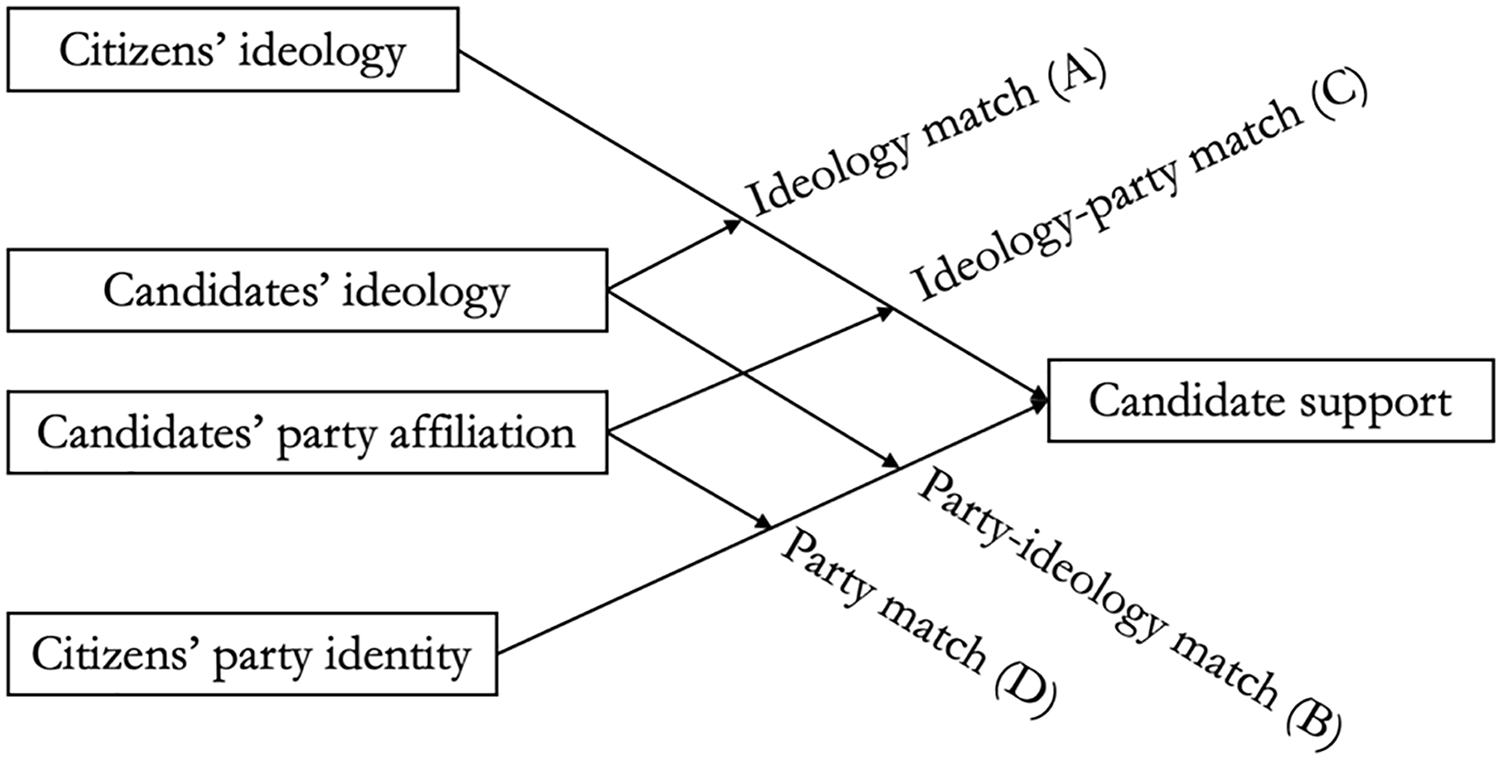
Graphical representation of the four types of matches.
The first match, citizen’s ideology-candidates’ ideology match (“ideology match”), is the match between citizens’ ideology and that of a candidate. Theoretically, it is the degree to which one’s support of a candidate is explained by the similarity of ideology between oneself and a candidate that they evaluate, or the extent to which the predictive effect of citizens’ ideology is moderated by the candidate’s ideology (e.g., “I will support you if both of us have liberal beliefs”). This match is statistically expressed as the interaction between Citizens’ ideology and Candidates’ ideology or “Citizens’ ideology × Candidates’ ideology.” If this term is used to predict candidate support, this match’s significance would not only suggest that citizens’ ideology is meaningful and relevant in shaping their political opinion but also that citizens are attuned to the political beliefs and values of the candidates. That is, citizens’ support for political candidates reflects their own values and beliefs (similar to “spatial voting”).
The conceptual parallel for party identity is the citizens’ party-candidate’s party match (“party match”). It reflects the degree to which citizens support a candidate merely because they share a partisan background (i.e., “I will support you if we are from the same party”). So, statistically, it is “Citizens’ party × Candidates’ party.” The larger the effect of this term, the more “sports fans” citizens behave—if one identifies with a party, they root for any candidate who is affiliated with that party, regardless of the candidate’s values and ideological beliefs.
The remaining two are “cross-matches” that can be interpreted similarly. Citizen’s party-candidate’s ideology cross-match (“party-ideology match”) reflects the effects of whether a candidate shares the political values that are endorsed by the party that citizens identify with (i.e., “I will support you if you value what my party values”). So it is expressed as “Citizens’ party × Candidates’ ideology” statistically. The larger its effect, the more partisans prefer a candidate who “sounds like” someone from their party, regardless of whether the candidate actually is from that party. Its effect occurs when a Democrat supports a liberal candidate, regardless of whether the candidate is actually a Democrat. Thus, the significance of this term suggests that citizens’ party identity is symbolic and reflective of their values and beliefs, and citizens tune in to candidates’ ideology in the expression of their own party identity.
The final type of match is citizen’s ideology-candidate’s party cross-match (“ideology-party match”), expressed as “Citizens’ ideology × Candidates’ party.” This match is harder to make sense of because it “should” not have very much predictive power beyond other types of matches. Conceptually, this match reflects the following: How much a citizen’s support for a candidate is guided by whether the citizen’s ideology matches well with the ideology endorsed by the party the candidate is affiliated with (“I will support you if you are in a party that values what I value”). So it occurs, for example, when a liberal supports a Democratic candidate, regardless of whether the candidate is actually liberal. For this effect to occur, citizens have to use a candidate’s party affiliation as a cue to infer the candidate’s ideology and then compare it against their own ideology. However, if a candidate’s ideology is already considered by citizens when all four matches are considered together, it would not make very much sense for this term to have predictive power above and beyond the ideology match.
In short, a citizen’s support for a candidate may be guided by their own party identity and ideology, each conditioned by the candidate’s party and ideology. To make sense of the roles of party identity and ideology, that of citizens and candidates needs to be considered. Hence, four types of matches were conceptualized. The elaborations above are also summarized in the first four columns of Table 1.
Comparing the Effect of the Four Types of Matches When Predicting Candidate Support.
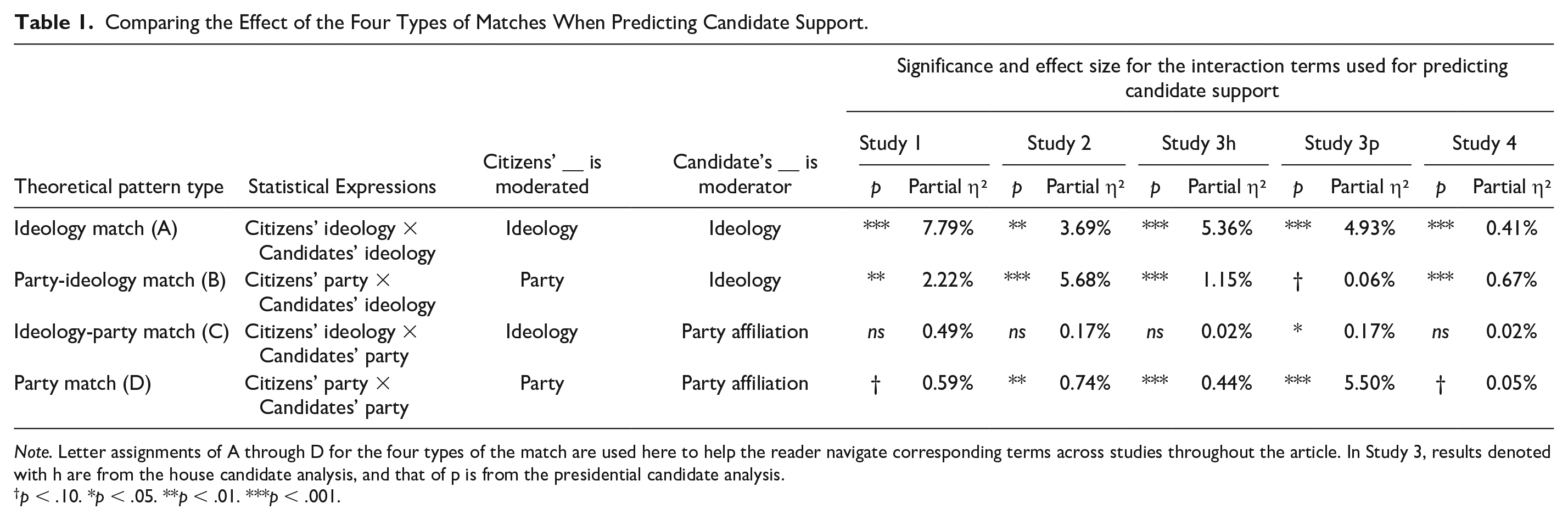
Note. Letter assignments of A through D for the four types of the match are used here to help the reader navigate corresponding terms across studies throughout the article. In Study 3, results denoted with h are from the house candidate analysis, and that of p is from the presidential candidate analysis.
p < .10. *p < .05. **p < .01. ***p < .001.
Current Studies
Four studies investigate the roles of the four types of matches in the American political context, where ideology and partisanship are often aligned in a two-party system and therefore the omitted variables issue discussed earlier is most applicable. The studies are exploratory and do not test specific hypotheses on which effect exists or which effect is greater than which other ones. This is because prior literature cannot be used to inform hypotheses about these four types of matches, as their specific effects could not have been investigated previously without the current approach. As such, the primary goal of this article is to clarify and disentangle the roles of ideology and party identity on citizens’ support for political candidates, which in turn demonstrates the merit of the multiple-matching perspective.
All studies share the same following features: in surveys, participants reported their own ideology and party identities and then indicated their level of support for candidates. The candidates’ ideology and party vary either experimentally or “naturally.” Statistically, all studies use the interaction terms corresponding to the four types of matches to predict support for candidates in the models. The key differences are: Studies 1 and 2 used hypothetical candidates whose ideology and party affiliation were manipulated between-subject. Study 3 used real candidates from different parties with different levels of perceived symbolic ideology. Study 4 is similar to Study 3 but uses objective measures of candidates’ ideology.
A statistically informed reader may point out that multicollinearity must not be present in the base models before the interactions are introduced. Otherwise, the interactions can be compromised. Of all predictors, the correlation between party identity and the ideology of participants may be of concern. As such, variance inflation factors (VIF) were computed for the main effect terms from base models and summarized in Table A1 in the online supplemental material. Across all studies, their VIFs are below 5, suggesting that multicollinearity of party identity and the ideology of participants are unlikely a concern. Nonetheless, there was a multicollinearity issue in Study 4 based on its VIFs (although due to the correlation of the party identity and ideology of the candidates, not participants). This issue is discussed separately in Study 4.
Measures
Both party identity (e.g., Alvarez, 1990; Greene, 2004; Weisberg, 1980) and political ideology (e.g., Azevedo et al., 2019; Stimson, 1975) can be treated as multidimensional constructs and measured with multiple items. Nonetheless, researchers most often measure party identity and ideology with single 7-point scales anchoring from “Strong Democrat” to “Strong Republican” or from “Extremely liberal” to “Extremely conservative,” because measuring them as a single-dimensional construct can usually capture sufficiently meaningful variances (e.g., Campbell et al., 1960; Conover & Feldman, 1981; Macdonald & Rabinowitz, 1993). Therefore, with somewhat different wordings across studies, citizens’ party identity and ideology are both measured as such.
Researchers often measure ideology either “operationally” as one’s support for concrete policies (e.g., Stimson, 1975) or “symbolically” as a global endorsement of liberalism or conservatism (e.g., Conover & Feldman, 1981; Ellis & Stimson, 2012). The current studies rely on symbolic ideology out of the following key considerations. Theoretically, individual policies can often be framed to fit different ideological narratives and introduced by different parties. Therefore, individual policies have configurations much like individual political candidates such that they have an ideology attribute and a party attribute. For this reason, policy supports should be treated as outcome variables as opposed to ideology measures in the current approach. Methodologically, measuring ideology on a 7-point scale like party identity can ensure that the two constructs are measured in a roughly equivalent format and therefore measured with a roughly similar amount of errors. Although using a scale of policy support for ideology can provide greater reliability, doing so may “stack the deck” against party identity and leaves it as an alternative explanation for findings that ideology outperforms party identity.
Open Science and Technicalities
All models across studies are ordinary least square linear regressions. The samples are described in Table 2. All studies use preexisting survey data. Data for Studies 1 and 2 and all analytical scripts are in https://osf.io/empkz. Data for Studies 3 and 4 are from https://electionstudies.org/data-center. All experimental stimuli and question wordings and correlation tables (Tables A2 through A5) are shown in Appendix A. No study was preregistered. The effect size of the four interaction terms throughout the studies is summarized in Table 1, which will be discussed in the general discussion section. All variables were linearly transformed to run from 0 to 1, whereas 1 represents a higher level of that construct before analyses.
Sample Characteristics Across Studies.
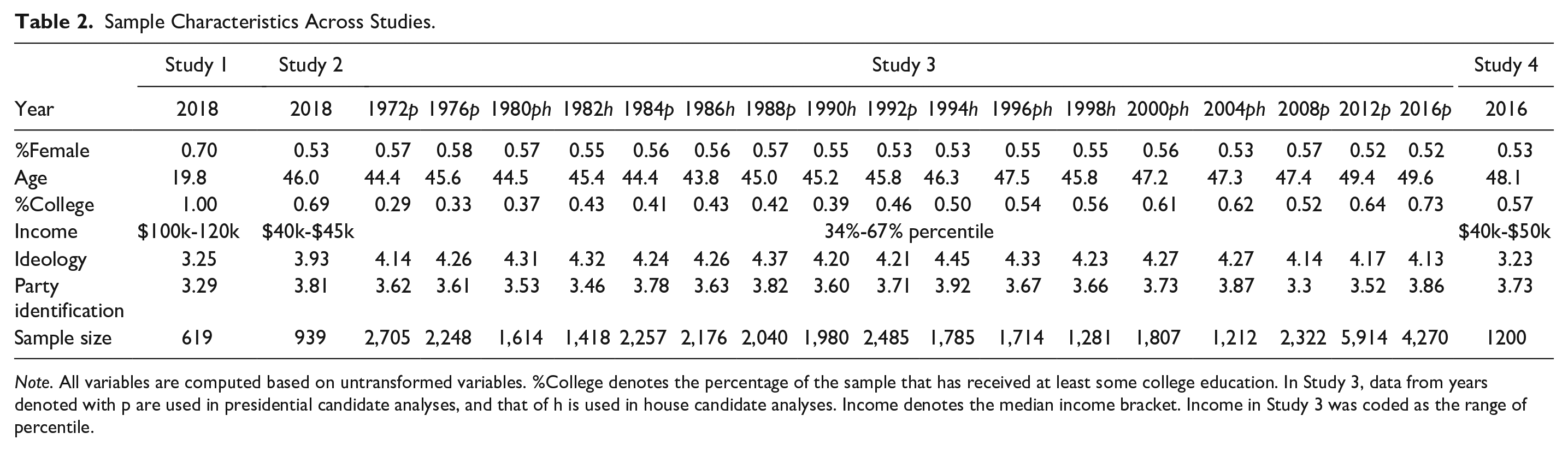
Note. All variables are computed based on untransformed variables. %College denotes the percentage of the sample that has received at least some college education. In Study 3, data from years denoted with p are used in presidential candidate analyses, and that of h is used in house candidate analyses. Income denotes the median income bracket. Income in Study 3 was coded as the range of percentile.
Studies 1 and 2
Method
Due to similarity in design and word limits, Studies 1 and 2 are described together. Participants were undergraduates in a large Midwestern university in Study 1 and Lucid participants in Study 2 (see Table 2 for samples). In both studies, participants were asked a question measuring their ideology as “citizens’ ideology” (1 = Extremely liberal; 7= Extremely conservative) and a question measuring their party identity as “citizens’ party” (1 = Very strong Democrat; 7 = Very strong Republican), and the responses were transformed to run from 0 to 1.
Participants were randomly assigned to review a hypothetical candidate’s profile. In Study 1, the description of the candidate’s party affiliation and ideology were manipulated independently using a 2 (Democrat vs. Republican) × 2 (Liberal vs. Conservative) between-subject design. The candidate’s party identity was manipulated by a description (“Political Party Affiliation: Democratic Party vs. Republican Party”). The candidate’s ideology was manipulated by a description of the candidate’s stance on several issues without any explicit references to “liberal” or “conservative.” The liberal candidate stated “[. . .] we should help undocumented immigrants [. . .] become citizens [. . .]. I support a fairer tax system that benefits everyday people, rather than billionaires and corporate fat cats.” The conservative candidate stated “[. . .] we should [. . .] deport undocumented immigrants [. . .] I support a fairer tax system that cuts taxes for everyone [. . .].”
Study 2 uses a similar procedure to that of Study 1 except that the candidate’s gender and race were also manipulated independently with the profile pictures, so the design is 2 (Democrat versus Republican) × 2 (liberal versus conservative) × 2 (female versus male) × 2 (Black versus White) between-subject. The candidate’s gender and race were theoretically treated as random variables, as they are not related to the four types of matches (see further discussion in Appendix A due to word limit). Although no manipulation check was used, the manipulation from Study 2 was pretested in the past (see Bai, 2021 Appendix B). Finally, participants indicated their feeling (0.00 = degree/least favorable, 1.00 = 100 degree/most favorable) and the likelihood of voting (0.00 = 0% of chance, 1.00 = 100% of chance) for the candidate on 101-point scales. Their average forms the dependent variable, candidate support (α = .96, ρ = .91 in Study 1; α = .95, ρ = .89 in Study 2).
Results
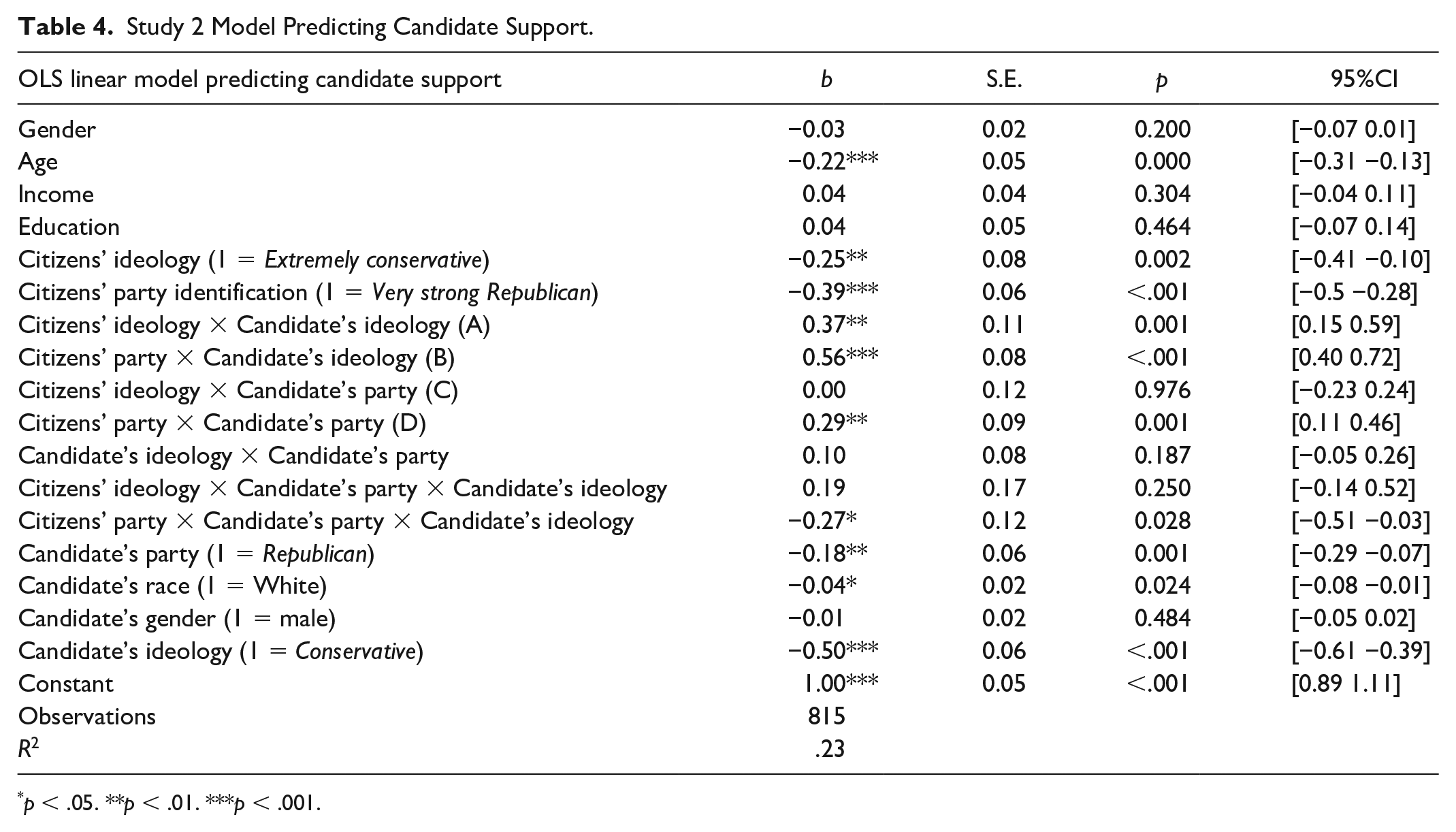
In both studies, “candidate’s ideology” (0 = liberal; 1 = conservative) and “candidate’s party” (0 = Democrat; 1 = Republican) variables were created based on the conditions that participants were assigned to. In Study 2, “candidate’s gender” (0 = female; 1 = male) and “candidate’s race” (0 = Black; 1 = White) were also created. In both studies, the candidate support variable was predicted by participants’ ideology, participants’ party identification, candidate’s ideology, candidate’s party, and participants’ gender, age, and income as controls. In Study 2, the candidate’s gender and race were also added. Importantly, in both studies, four interactions were included: Citizens’ ideology × Candidate’ ideology (ideology match), Citizens’ party × Candidate’s ideology (party-ideology match), Citizens’ ideology × Candidate’s party (ideology-party match), and Citizens’ party × Candidate’s party (party match). These terms test and compare the four types of matches discussed earlier. Finally, Candidate’s ideology × Candidate’s party, Participants’ ideology × Candidate’s party × Candidate’s ideology, and Participants’ party × Candidate’s party × Candidate’s ideology were included to test for potential three-way interactions. The results are summarized in Tables 3 and 4 and visualized in Figures 2A through 3B.
Study 1 Model Predicting Candidate Support.
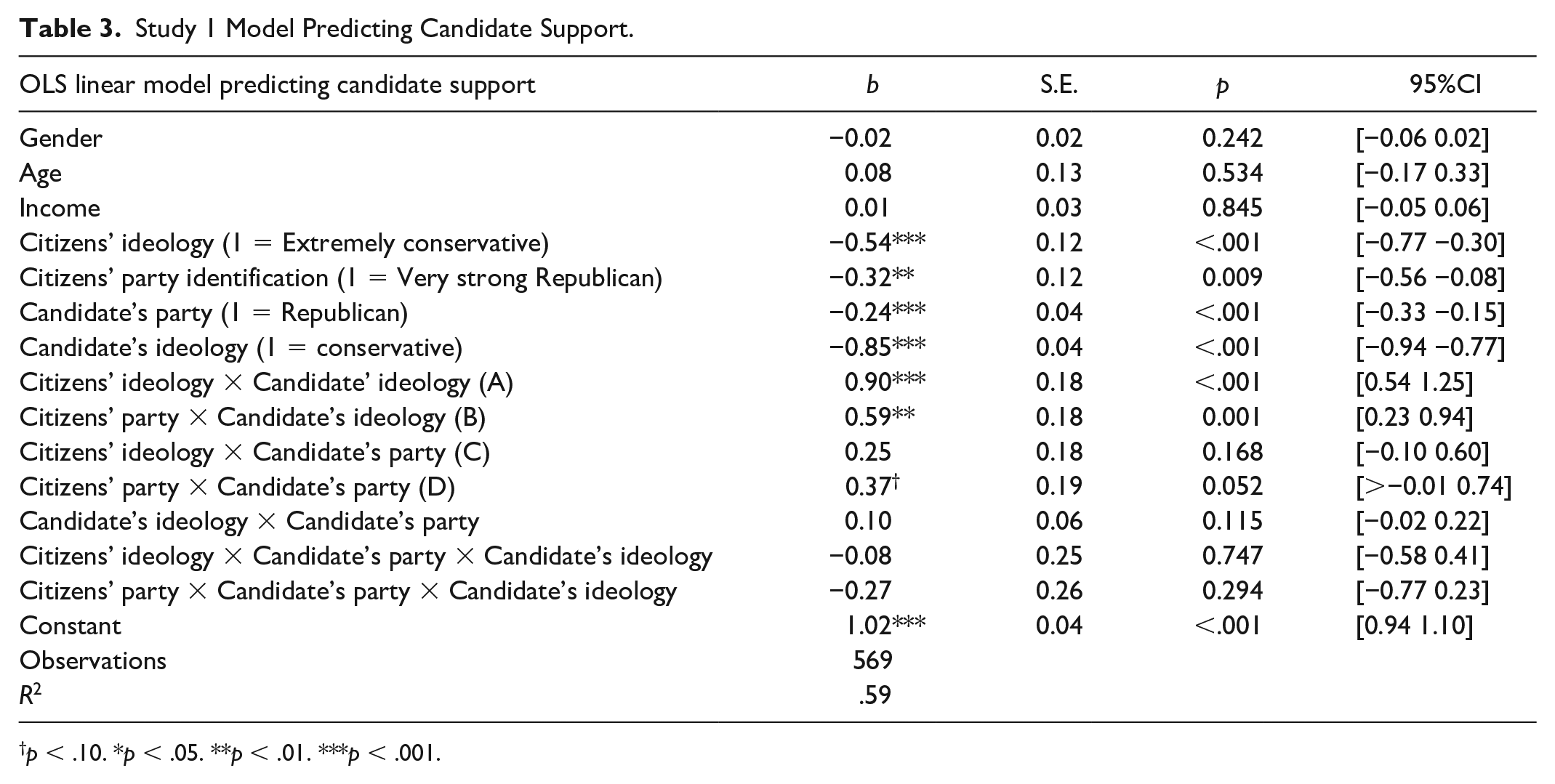
p < .10. *p < .05. **p < .01. ***p < .001.
Study 2 Model Predicting Candidate Support.
p < .05. **p < .01. ***p < .001.
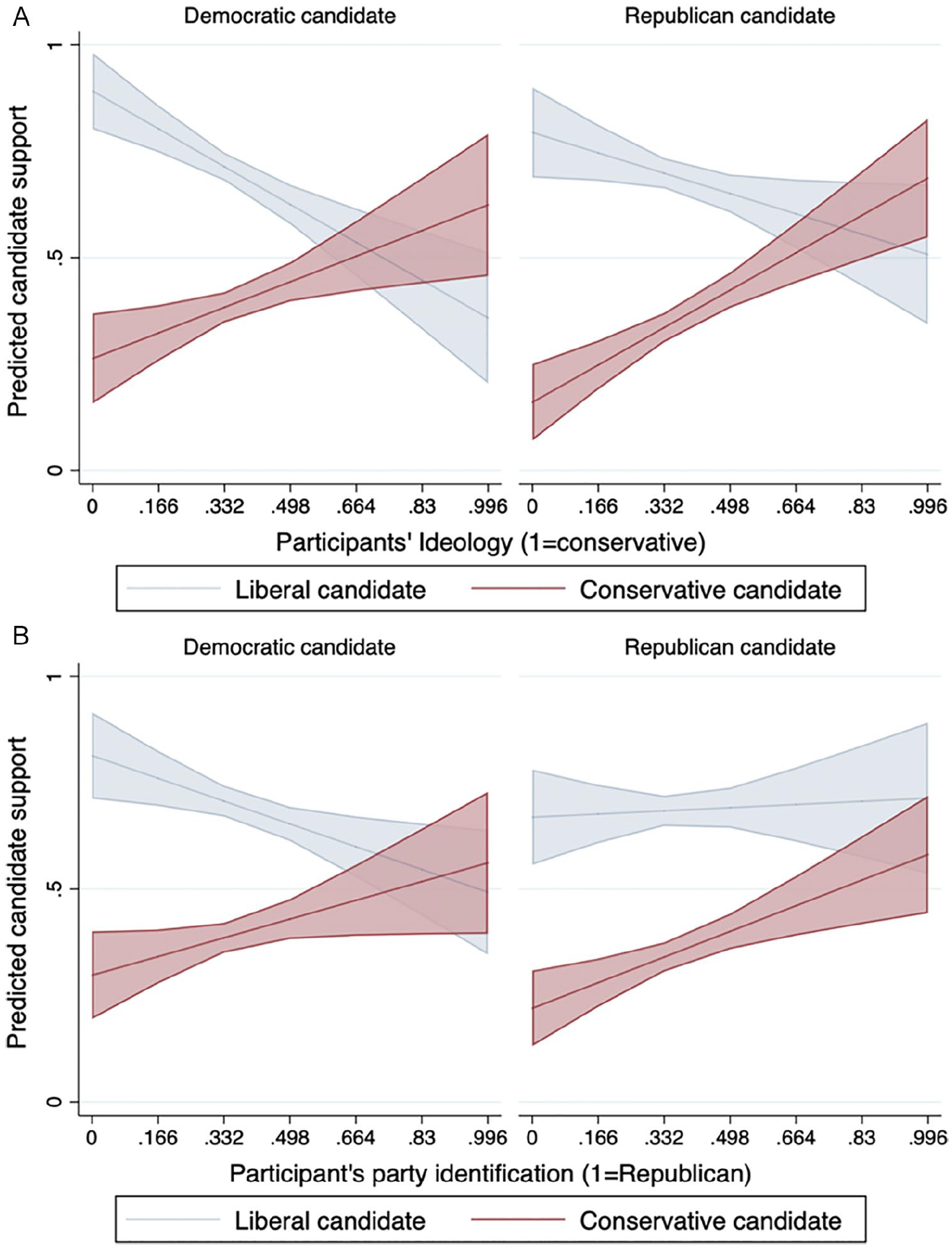
(A) Study 1 participant’s ideology’s predictive effect on candidate evaluation by candidate’s ideology and party affiliation. (B) Study 1 participant’s party identity’s predictive effect on candidate evaluation by candidate’s ideology and party affiliation.
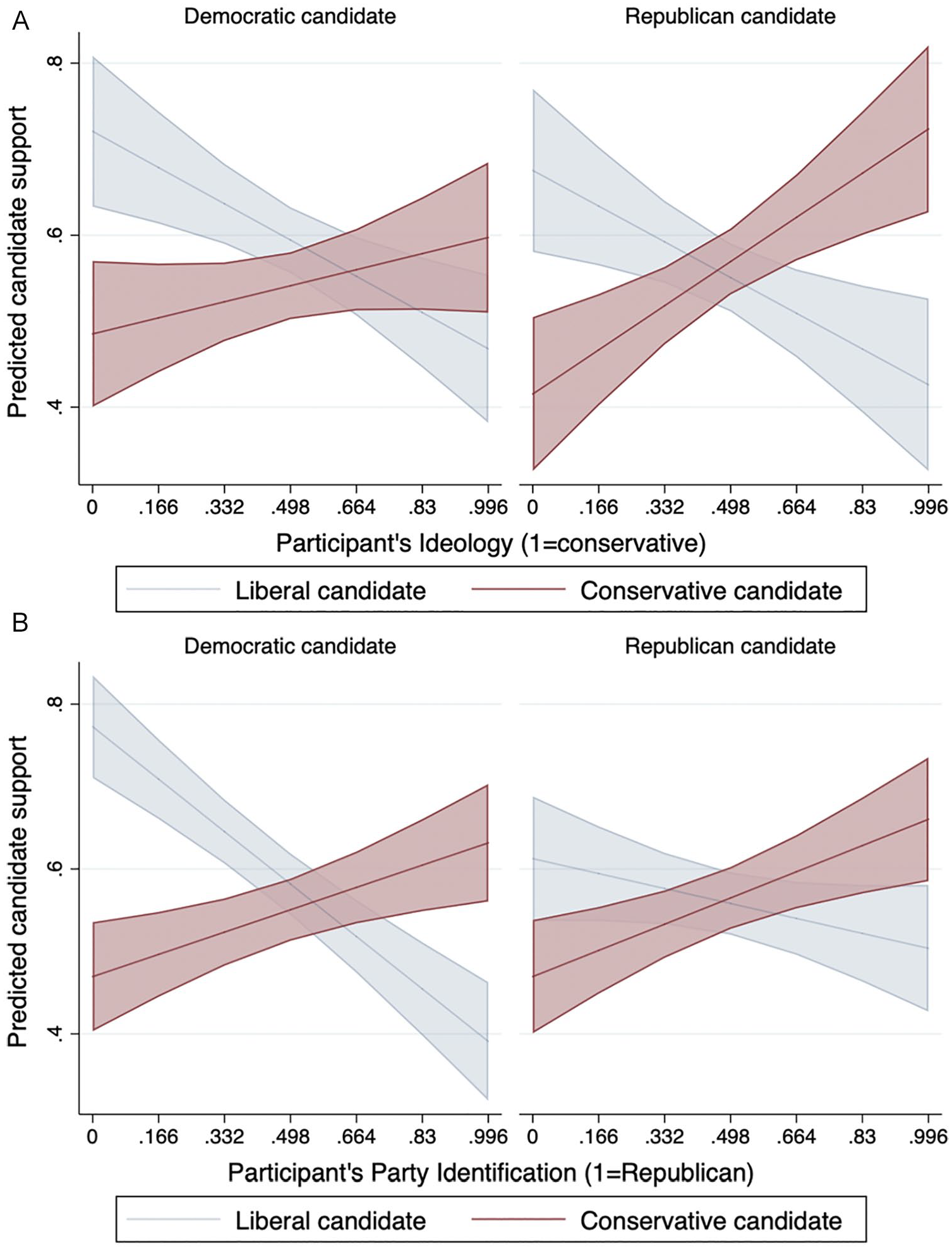
(A) Study 2 participant’s ideology’s predictive effect on candidate evaluation by candidate’s ideology and party affiliation. (B) Study 2 participant’s party identification’s predictive effect on candidate evaluation by candidate’s ideology and party affiliation.
Studies 1 and 2 have similar results: According to Tables 3 and 4, Citizens’ ideology × Candidates’ ideology (“A”) and Citizens’ party × Candidates’ ideology (“B”) are both significant, revealing ideology match and party-ideology match effects. Reviewing their effect size summarized in Table 1, their effects are large when compared with the ideology-party match effect (i.e., Citizens’ ideology × Candidates’ party, “C”, which is not significant) and the party match effect (i.e., Citizens’ party × Candidates’ party, “D”, which is marginally significant in Study 1 but significant in Study 2). These patterns are elaborated further by studies below.
Study 1
Figure 2A shows that participants’ conservatism is associated with support for the candidate if the candidate is conservative but opposition if liberal, regardless of the candidate’s party affiliation. Figure 2B shows that the pattern is similar for the effect of participants’ party identification, except that it seems to be muted for the liberal Republican target. Neither three-way interaction was significant—graphically, it means that the interactions in the left panels are not significantly different from that of the right panels in Figure 2A and B, although the right panel of Figure 2B appears to show that party identity does not have much effect on support for a liberal Republican candidate.
Study 2
Like in Study 1, Citizens’ ideology × Candidate’s party × Candidate’s ideology is not significant in Study 2, so the left and right panels of Figure 3A are not significantly different. Therefore, although the left panel appears to indicate that the positive slope for the conservative candidate is not significant, this lack of significance is not significantly different from the corresponding positive slope in the right panel of Figure 3A. Different from Study 1, Citizens’ party × Candidate’s party × Candidate’s ideology is significant, so the left and right panels of Figure 3B are significantly different. Specifically, the predictive effect of party identity does not seem to have much to do with the support for a candidate who is a liberal Republican (the negative slope in Figure 3B’s right panel), but it does have a predictive effect on the support for a candidate who is a liberal Democrat (the corresponding negative slope in the left panel). This pattern will be discussed in the general discussion section.
Discussion
Therefore, the two studies provide initial evidence for ideology match and citizens’ party-candidates’ ideology (“A”) cross-match. As expected, there is no citizen’s ideology-candidate’s party cross-match effect, but there is some party identity match effect. Reviewing the effect size of the coefficients for the four types of matches summarized in Table 1, the expressions of citizens’ ideology and party identity in the form of support for a candidate depend a lot more on the candidate’s ideology than the candidate’s party affiliation.
Study 3
Although Studies 1 and 2 provide internal validity regarding the roles of candidates’ party identity and ideology by experimentally manipulating them, it is unclear if the results are externally valid. Furthermore, Studies 1 and 2 do not distinguish the political context in terms of whether the evaluated target is a candidate for a local office (such as one in the House of Representatives) or a more national and prominent position (such as the presidency). Study 3 will address these remaining questions.
Method
Study 3 uses nationally representative data from the American National Election Studies time series collected across 17 election cycles. The cross-section surveys in this series correspond to each presidential election between 1972 and 2016 and some midterm elections (i.e., the Time Series Cumulative Data File; see Table 2 for sample).
Participants’ ideology and party identity were measured in a similar way as in Study 2. Candidates’ ideology and party in Study 3 were not manipulated—instead, candidates’ ideology was measured using a question about the perceived ideology of the candidates (i.e., “ideology placement”), which asks participants to place a target candidate on a 7-point scale (and transformed to run from 0 = extreme liberal to 1 = extreme conservative; see Appendix A for wordings). Candidates’ party affiliation was coded with their actual affiliations (0 = Democrat; 1 = Republican).
The candidate support variable was measured using the feeling thermometers and coded like in Studies 1 and 2. Participants rated both Democratic and Republican candidates in all years. However, in some years, participants only rated House of Representatives candidates of their own district with the ideological placement and feeling thermometer, and in other years, the participants only rated presidential candidates, as summarized in the second row of Table 2.
Results
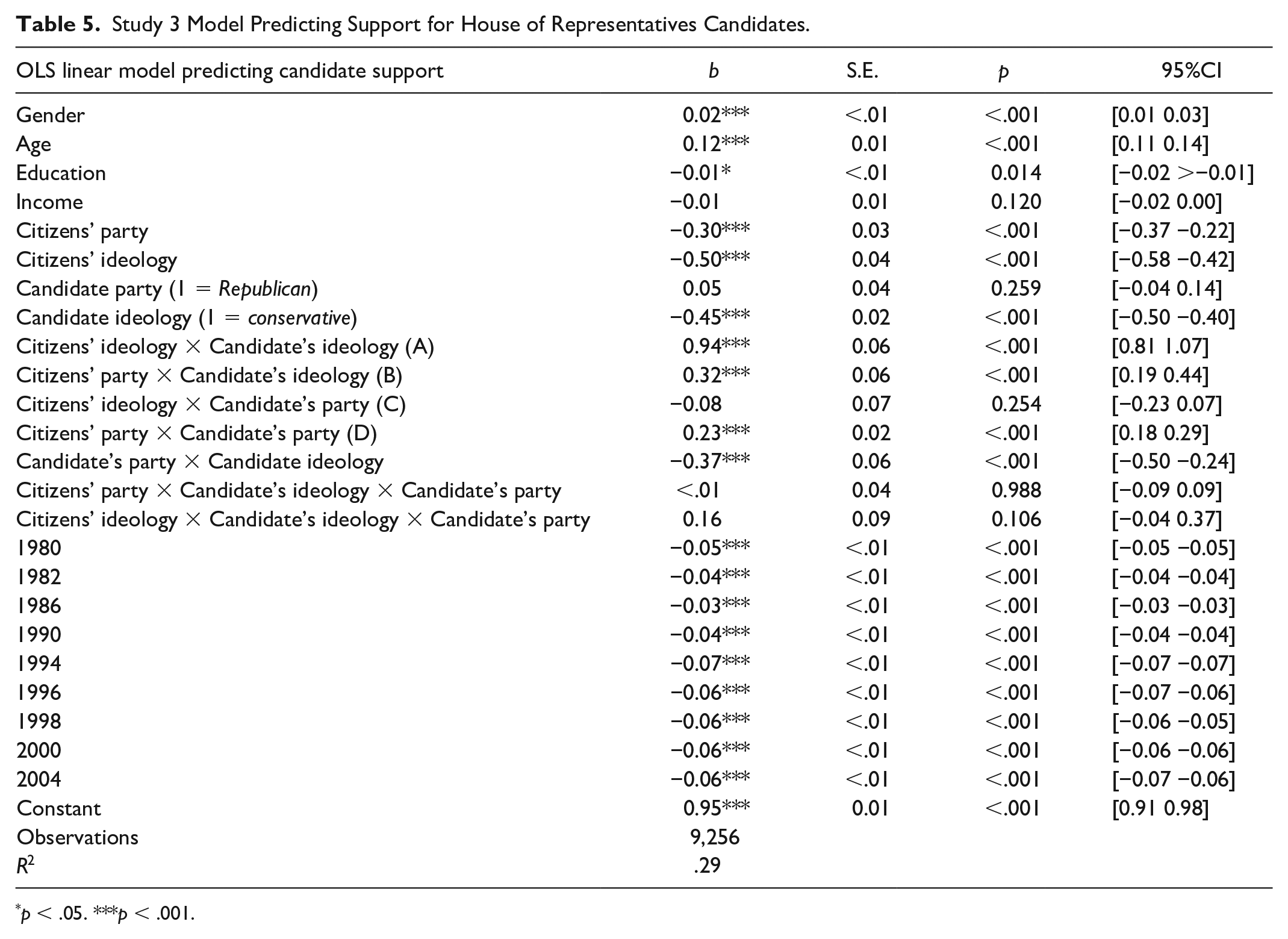
Two separate analyses were conducted for support for House of Representatives candidates and support for presidential candidates. The variable for candidate support was treated as a repeated measure, as each participant rated the Democratic and Republican candidates in pairs. The candidate support variable was then predicted by participants’ ideology, party identification, the perceived ideology of the corresponding candidate, and participants’ gender, age, income, education, and survey year indicator variables (the baseline year is 1978 for the House of Representatives model and 1972 for the president model) as covariates. The survey year variables were added to account for the fact that in each election a different set of candidates were evaluated. Standard errors were clustered by survey year. 1 Importantly, to test the four types of the match and potential three-way interactions, the exact same interaction terms used in Studies 1 and 2 were also used in Study 3, so they can be interpreted in the same way. The results of these analyses are summarized in Tables 5 and 6 and visualized in Figure 4A to D.
Study 3 Model Predicting Support for House of Representatives Candidates.
p < .05. ***p < .001.
Study 3 Model Predicting Support for Presidential Candidates.
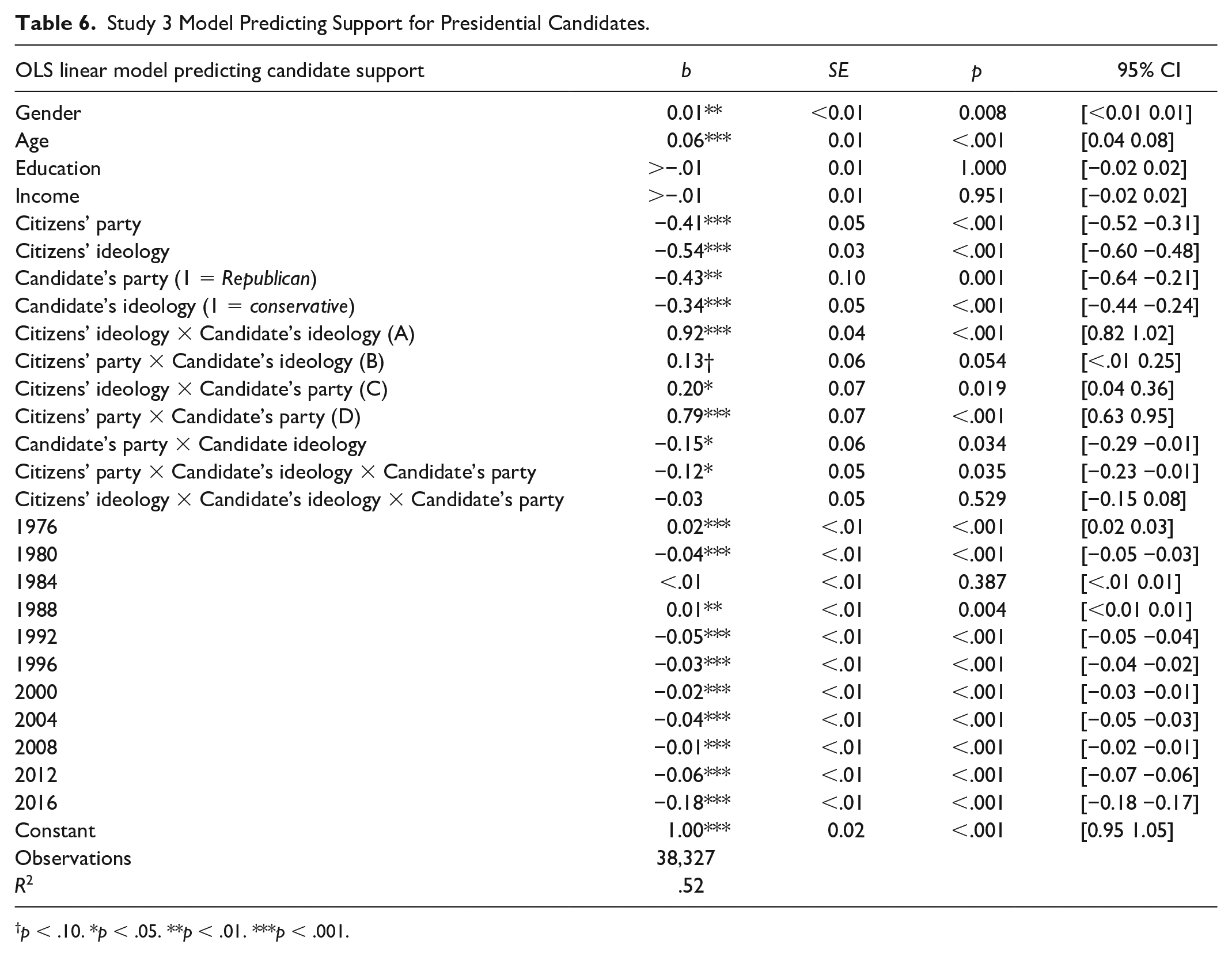
p < .10. *p < .05. **p < .01. ***p < .001.
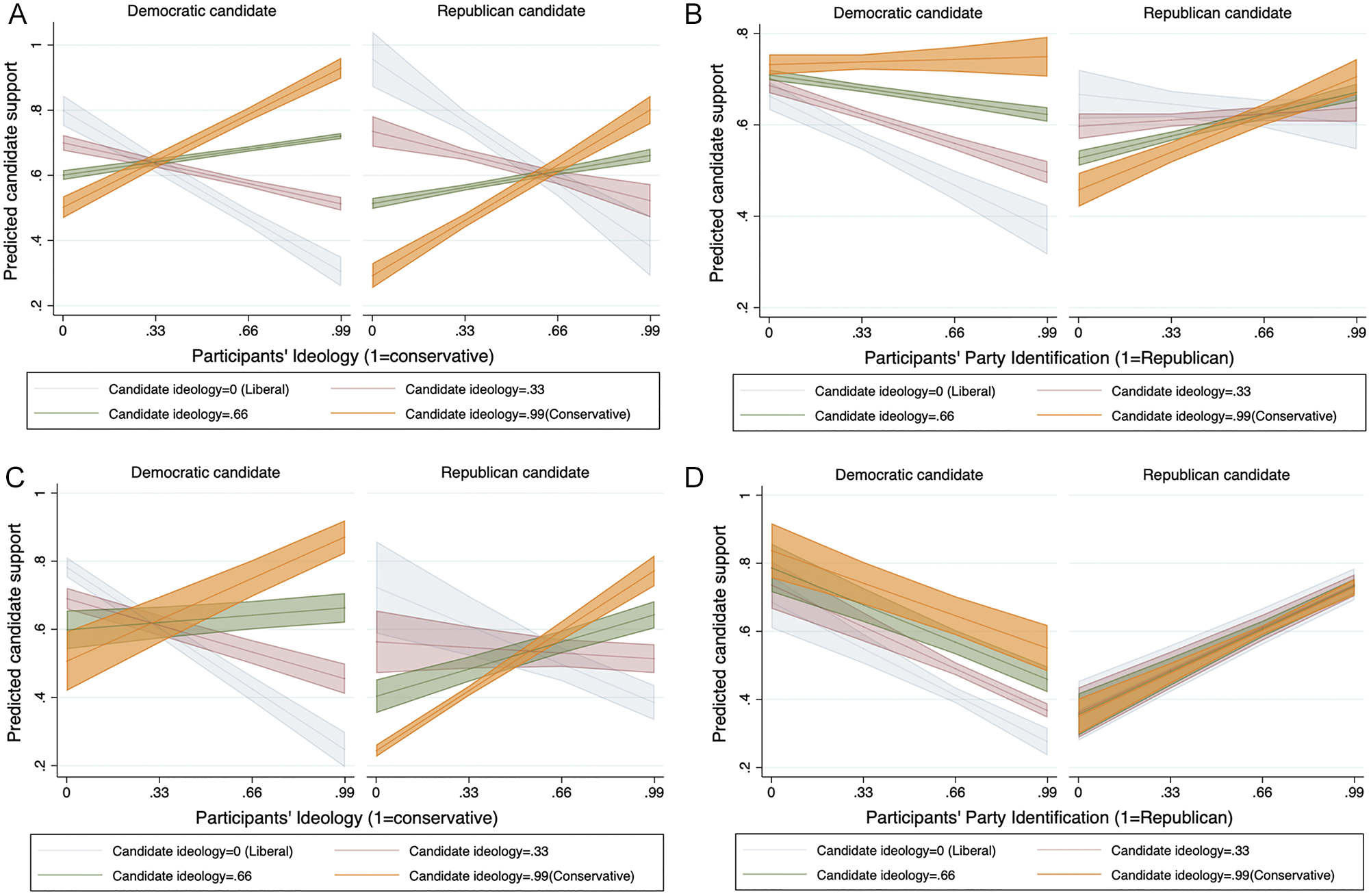
(A) Participant’s ideology on evaluation for the House of Representatives candidates by candidate’s ideology. (B) Participant’s party identification on evaluation for the House of Representatives candidates by candidate’s ideology. (C) Participant’s ideology on evaluation for presidential candidates by candidate’s Ideology. (D) Participant’s party identification on evaluation for presidential candidates by candidate’s ideology.
House of Representatives Candidates
Reviewing Table 5, Citizens’ ideology × Candidate’s ideology (ideology match) and Citizens’ party × Candidate’s ideology (party-ideology match) effects are again both significant and large compared with the other two. In contrast, Citizens’ ideology × Candidate’s party (ideology-party match) is not significant, and Citizens’ party × Candidate’s party (party match) is significant. According to Figure 4A, participants’ conservatism is associated with support for candidates that are perceived to be conservative but opposition to candidates that are perceived to be liberal, and this pattern does not differ based on the candidates’ party, as Citizens’ ideology × Candidate’s ideology × Candidate’s party is not significant. The patterns are similar for the effects of participants’ party identification. Although the left and right panels in Figure 4B seem to be somewhat different, the term for Citizens’ party × Candidate’s ideology × Candidate’s party is not significant, suggesting that these differences are not significant.
Presidential Candidates
The results about presidential candidates are less similar to that of Studies 1 and 2 when compared with that of House of Representatives candidates. The terms for ideology match and party match are significant, like that of Studies 1 and 2, but unlike them, that of the party-ideology match is only marginally significant. Unlike Studies 1 and 2, the term for the ideology-party match is significant. Reviewing Figure 4C, the effects of participants’ ideology (ideology match and ideology-party match) are very similar to that of House of Representatives candidates—their effects are not conditioned by candidates’ party affiliation, as Citizens’ ideology × Candidate’s ideology × Candidate’s party is not significant. However, reviewing Figure 4D, the effect related to participants’ party identity is heavily driven by the candidates’ party affiliation—participants who are more identified with Republicans evaluate Democratic candidates negatively but Republican candidates positively (also indicated by the significant term for Citizens’ party × Candidate’s ideology × Candidate’s party).
Discussion
Comparing the two analyses, the ideology match’s effect is consistent and large. There is also some evidence for the party-ideology match, although it is more limited in the context of a presidential race. There is some evidence for the effect of the ideology-party match in the context of a presidential race, but it is absent from the support for the House of Representatives. Finally, there is a relatively large effect of party match in the results for presidential candidates (in fact it is the largest among the four types of matches), a pattern that is very different from results from Studies 1 and 2 and that of the House of Representatives in Study 3. Thus, the main difference between Study 3 and the first two studies is that the party affiliation of the candidates (as shown in the ideology-party match and party match) plays a much greater role in the case of presidential candidates when compared with House of Representative candidates and candidates for unspecified office. These comparisons will be discussed more in the general discussion section.
A limitation is that candidates’ ideology in this study is measured using perceived ideology, as opposed to actual ideology, so participants may have placed the ideology of their favorite candidate closer to their own ideology (e.g., Page & Jones, 1979). Study 4 will address this limitation. There may be another criticism for the use of the perceived ideology measure (i.e., the perceived ideology of a candidate may be shaped by the partisanship of the candidate) and that criticism is addressed in Appendix A due to word limit.
Study 4
Study 4 has two goals. The first is to address the “motivated ideology placement” issue of Study 3. Although Studies 1 and 2 addressed this issue experimentally, the data are not nationally representative or collected in a “natural” context. Therefore, in this study, an objective measure of candidates’ ideology, as opposed to perceived ideology, is used. Second, Study 3 suggests that candidates’ party affiliation (in the ideology-party match and the party match) starts to play a more prominent role in citizens’ support for candidates as the context elevates from the local context (House of Representatives elections) to the national context (presidential elections). However, it is unclear if this effect is true for all candidates who are competing for the presidency at any stage, or if it is unique at the last stage of the campaign when the two major parties already nominated their candidates who are competing against with each other only. Therefore, Study 4 will triangulate the boundary effect by focusing on presidential candidates who were still competing for nominations from their own parties.
Method
Study 4 uses nationally representative data from American National Election 2016 Pilot Study (see Table 2 for sample). The data were collected in January 2016 when presidential candidates were still competing for nominations within their own parties. Participants responded to ideology and party identification questions about themselves like in other studies and their responses were coded like in other studies as well. They rated Bernie Sanders, Hillary Clinton, Ben Carson, Donald Trump, Carly Fiorina, Jeb Bush, Marco Rubio, and Ted Cruz on feeling thermometers using items like in Study 3. The candidates’ ideology was measured objectively using Crowdpac’s (n.d.) ideology scores based on the “public statements, voting records and campaign contributions including contributions to the candidate as well as contributions from the candidate.” (Crowdpac’s coding of −10 = most liberal and 10 = most conservative were transformed to run from 0 = most liberal to 1 = most conservative; see Appendix B for details).
Results
Comparing four types of matches
Like in Study 3, the candidate support variable was treated as a repeated measure and was predicted by participants’ ideology, party identification, the objectively measured ideology of the corresponding candidates, and party affiliation of the candidates. Participants’ gender, age, income, and education as well as dummy-coded variables for candidate identity were included because individual candidates may be evaluated differently due to who they are beyond their party affiliation and ideology information. The terms for Sanders, Clinton, Carson, and Cruz were designated as omitted terms due to dependency. 2 The interaction terms included in this model are the same as that of other studies, and they have the same meaning and lend themselves to similar interpretations. The results are summarized in Table 7.
Study 4 Model Predicting Support for Presidential Candidates.
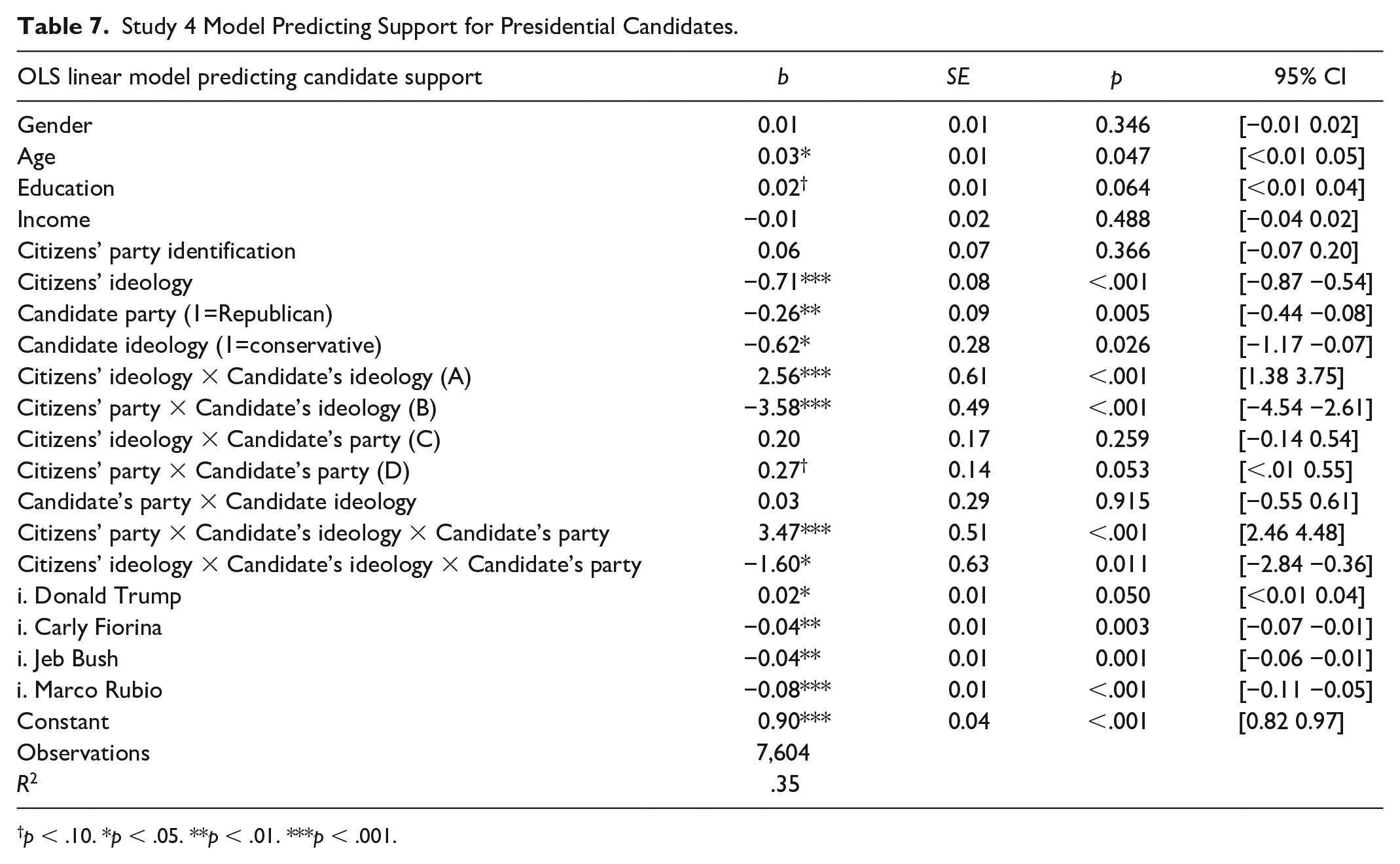
p < .10. *p < .05. **p < .01. ***p < .001.
Ideology match
Additional analyses were conducted to specifically address the issue of the motivated placement of candidates’ ideology. These analyses do so by testing the moderating effect of candidates’ ideology on the effect of participants’ ideology on predicting candidate support. To do so, first, separate linear regression models were estimated using participants’ ideology, party identification, gender, age, income, and education to predict feelings toward each candidate individually, and the coefficients for participants’ ideology were extracted from each model. Then, in a new model, this set of coefficients was used as dependent variables to be predicted by each of the candidates’ ideologies that were measured objectively. The coefficients can be found in Appendix B. The result is significant, b = .94, SE =.08, p < .001, 95% confidence interval (CI) = [0.76, 1.13],
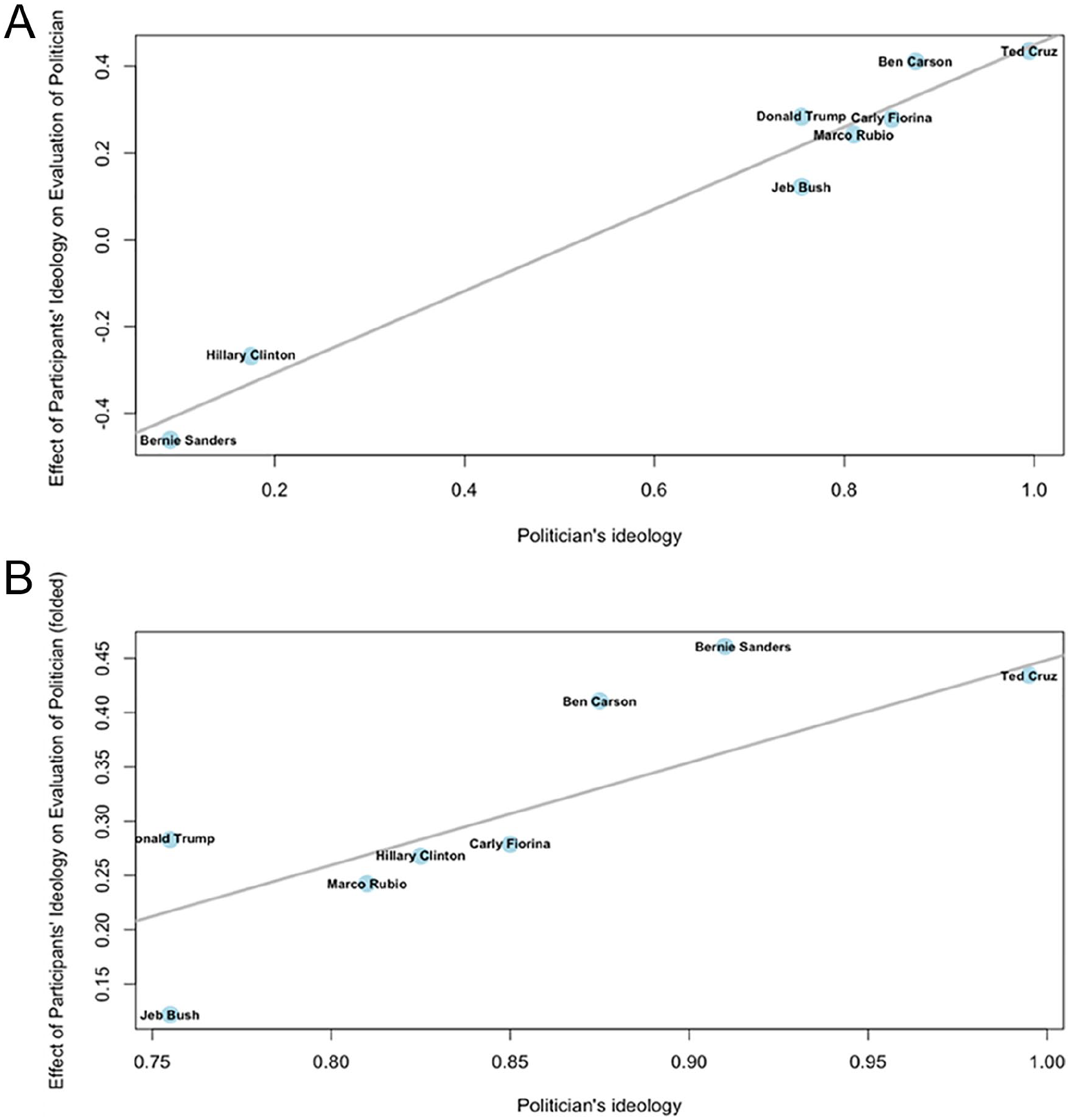
(A) Effect of candidates’ ideology on the predictive effect of participant’s ideology on candidate support. (B) Effect of candidates’ ideology on the predictive effect of participant’s ideology on candidate support (folded).
Discussion
The results of Study 4 for all matches other than the party ideology match are similar to that of Studies 1 and 2 and the analysis related to candidates for the House of Representatives in Study 3 (the unexpected effects of the party-ideology match is discussed in Appendix A due to word limit). Like in the other studies, the ideology match is significant and large. Participants’ conservatism is associated with support for candidates that are perceived to be conservative but opposition to candidates that are perceived to be liberal. This pattern seems to be attenuated for Republican candidates, as Citizens’ ideology × Candidate’s ideology × Candidate’s party is significant and negative. However, these differences between candidates of different affiliations should be taken more cautiously. This is because the analysis includes only two Democrats (i.e., Sanders and Clinton), and participants’ evaluation of them may disproportionately contribute to the significant three-way interaction. Furthermore, the effect size of the four interaction terms in this study is much smaller than that of the other ones. One possibility is that the candidate variable may have “crowded out” the model by explaining the vast majority of 26.03% of variances out of the 34.6% that is accounted for by the entire model.
Also like the other studies, the ideology-party match is not significant and the party match is only marginally significant, suggesting that their roles are very limited in predicting people’s support for the candidates. Reviewing these results in conjunction with that of Study 3, the effects of candidates’ party affiliation (in the ideology-party match and the party match) do not seem to be universally prominent for any presidential candidates. Instead, it seems that it is unique for presidential candidates who are competing at the stage after the two major parties nominated for their candidates.
Finally, focusing on the ideology match and addressing the limitation of using perceived ideology in Study 3, this study shows that the predictive effect of citizens’ ideology on the support of a candidate is moderated by the candidate’s objectively measured ideology, either modeled using the multiple-matching perspective (i.e., including all possible interaction terms in the same model) or comparing coefficients of individual ideology term. Thus, the prominent and powerful effect of ideology matching found throughout the studies is unlikely due to the motivated placement of candidates’ ideology.
General Discussion
Although past studies tested the effects of political value (i.e., ideology) and identity (i.e., party identity) on support for political candidates, little has considered both, and none, to the knowledge of the author, has considered them from citizens and candidates simultaneously, resulting in two omitted variable problems. To address these, four types of matches were introduced using the multiple-matching perspective. Hence, this article contributes to the literature and theories about party identity and ideology by uncovering nuanced roles of political ideology and party identity using a novel perspective, which will be elaborated on next.
Theoretical Contributions and Implications for Candidate Support
Reviewing the first row of Table 1, the ideology match most often has the largest effect among all four types of matches. Therefore, comparing its effect size to that of the other ones, its effect is large, robust, and consistent across studies. Theoretically, it suggests that citizens’ political value plays a powerful role in shaping their support for political candidates, as they heed their own ideology, as well as that of political candidates, even after considering other possible roles of party identity.
Furthermore, comparing the effect size reported on the first two rows of Table 1 against the last two rows, the moderating effect of candidates’ ideology is often more powerful than a candidate’s party affiliation. Theoretically, these patterns suggest that most of the time, for most political candidates, a candidate’s ideology can play a more important role than the candidate’s party affiliation in determining what types of citizens they will appeal to. In other words, candidates’ political values matter to voters above and beyond (and in some cases, more than) which party the candidates are affiliated with. Again, there is an exception during the final stage of a presidential race, in which case the moderating role of the candidate’s party is a lot more prominent.
Comparing the two types of cross-match effects (ideology-party match and party-ideology match) in the corresponding rows of Table 1, citizens’ party identity may guide them to support a candidate whose ideology is consistent with the citizens’ party (ideology-party match). However, it is less so for the reverse of it (less evidence for party-ideology match), although this pattern is somewhat expected given that it does not make much sense to have a strong effect beyond other types of matches. Nonetheless, these results, combined with the discussions above, suggest that citizens’ party identity can play a more sophisticated role than the “sports fan” view of its effect and citizens do have a more informed understanding of their ideology (Ellis & Stimson, 2012). In contrast, it is unlikely that citizens use their ideology merely as a rationalization of their political group loyalty.
Reviewing all comparisons together, when evaluating a political candidate, citizens can attune to their values as well as behave like “sports fans,” depending on the context. Nonetheless, overall, Studies 1 through 4 suggest that the ideology match effect is somewhat more prominent than that of the party match. Therefore, when accounting for all possible matching effects, the current studies suggest that in most cases, people do rely on their political values more than their political identity to decide their support for a political candidate.
Finally, citizens’ political preferences tend to be more ideologically constrained (i.e., having more coherent or consistent political beliefs) if they are politically sophisticated or politically engaged (Converse, 2006). Is it possible that the effect of the ideology match is only applicable to politically engaged citizens? An additional set of analyses using Study 3 data shows that its effect is similar among both engaged and disengaged citizens (see Appendix C), revealing the robustness of the findings.
Methodological Contributions
Methodologically, this article contributes to the literature by proposing the multiple-matching perspective as a method of studying the effect of conceptually related predictors. As discussed in the introduction, the effects of party identity and political ideology are two variables that are often difficult to disentangle because they are not only conceptually and statistically related to each other but also “nested” in perceivers as well as the perceived, resulting in two omitted variable problems. By using the multiple-matching approach, researchers will be equipped to consider alternative explanations for past findings and understand the roles of the predictors more fully. For example, Druckman and colleagues (2013) showed that citizens’ support for an issue is predominantly dependent on which political party was said to support it or oppose it. The conventional interpretation is that party identity is the underlying mechanism responsible for the pattern. However, when considering their studies using the multiple-matching perspective, it is possible that which party was said to support the policy provided an ideological cue for participants to make sense of how their issue stance should fit into their ideology or value systems (an ideology match effect). 3 Relatedly, when researchers attempt to determine the effect of party identity and ideology on citizens’ support of a particular policy, it may be worthwhile to consider the party’s “ownership” of the issue (i.e., which party advocates it) as well as the ideological framing (i.e., whether it is saliently positioned as fitting liberal or conservative values) together to understand the role of ideology and party identity. Future research should further explore these questions using the multiple-matching perspective.
Therefore, using the multiple-matching perspective allows researchers to disentangle the effects of related predictors that reside in perceivers as well as targets, helping arbitrate the predictors’ contributions that are corrected for the omitted variable bias. Researchers in the future should consider this approach when researching questions with similar challenges.
Why Does Ideology Play a More Important Role?
The results overall suggest that ideology can play an important role after all, and to some extent, it plays a more powerful role than party identity. However, what is it that makes values so special relative to their group identity? One speculation could be that citizens’ values and beliefs are more central to their self-concept and moral character than their group identity, at least in the political context. Although extended discussions on this topic may be narratively unrelated to the focus of this article, a supplemental study was still conducted to help shed light on this question. The goal of this supplemental study is to invite further deliberation and investigations from researchers in the future, and hence these results are relegated to Appendix E. Overall, the results indeed suggest that citizens generally consider their ideology, more than their party identity, reflective of their self-concepts and morality. Thus, it is possible that ideology plays an overall prominent role because citizens find their political ideology more central to their self-concept and moral character than their party identity. Regardless, the novel pattern discovered using the multiple-matching perspective that was subsequently investigated in these supplemental analyses further demonstrates that the adoption of this approach can help researchers identify novel hypotheses and build new theories.
Is Ideology an Identity?
Historically, what is perceived to be liberal or conservative can change because of political discourse from party elites (e.g., Hopkins & Noel, 2022). Is it possible that the ideological self-placement measures in current studies reflect an identity instead of a substantive value? Inspecting the results, the way ideology measures behave in the current datasets is unlike an identity—specifically, how one’s ideology relates to their evaluation of a candidate throughout the studies is driven not by whom the candidate is said to be (no ideology-party match) but by what they are said to value (ideology match). It is the case even in Studies 1 and 2 where the ideology manipulation does not mention ideological labels, suggesting that the effect of participants’ ideology relies on the candidates’ substantive values as opposed to their identity category (if anything, the results suggest that party identity function much like a value). Of course, one might still argue that participants may presume an ideological identity from candidates based on what they say they value (“If they say they value XYZ, they would have a liberal identity”). However, in that case, an ideology identity is defined precisely by the underlying value beliefs, and the “ideology identity” becomes tantamount to value. With all of these considerations, the ideology measured in the current studies is unlikely an identity. Regardless, the primary objective of this article is to demonstrate the utility of the multiple-matching perspective in revealing the roles of entangled variables, and it concerns less with what ideology and party identity each is than how they work. To this end, the conclusion that a political candidate’s ideology, regardless of what it is, can play an important role remains substantiated.
Limitations and Future Directions
The current studies rely on a variety of methods and datasets. Studies 1 and 2 are limited by their reliance on hypothetical candidates for an unspecified office and binary (rather than continuous) treatment of candidates’ ideology. However, these studies address internal validity for the roles of candidates’ party identity and ideology by experimentally manipulating them. Complementing Studies 1 and 2, Studies 3 and 4 use representative surveys on support for real candidates for local and national political offices and treat the candidates’ ideology as a continuum, addressing external validity. Although candidates’ ideology measure in Study 3 relies on a subjective measure of perceived candidate ideology, the remaining studies suggest that the strong effect of ideology match is unlikely to result from motivated placement of ideology discussed earlier. Nonetheless, the current studies entirely focus on the context of the United States, which is governed by a two-party system. It is unclear if the results may be similar in other political contexts (i.e., single-party system and multiparty system). Future research should consider examining the generalizability of these results under other political systems.
In Studies 1 and 2, party identity’s effect seems to be somewhat muted on political candidates whose ideology and party affiliation are “inconsistent” (in particular, the liberal Republican candidates). The pattern is also observed in Study 3 (in particular, the analyses related to the House of Representatives). Although it is unclear whether these effects are merely artifactual (as these interactions patterns are not significantly different from corresponding effects on Democratic candidates), one possibility for this pattern is that a liberal Republican may appear to be less prototypical of Republicans than a conservative Democrat as to Democrats given that Republicans tend to be more ideological (see Grossmann & Hopkins, 2015). Future studies should further investigate these patterns in greater detail.
Future studies should also consider contextual variables that may activate or deactivate the effects of the matches. For example, Study 3 suggests that citizens’ party identity begins to play a more prominent role in presidential elections, and Study 4 reveals that this may only be the case in the final stage of the presidential election. One possibility is that in the final stage, presidential nominees from each party are considered as individuals that are most representative of the will and the characters of the parties. Therefore, before that point, partisans would either have detached from their party because they do not like the candidate (or party), or double down on their support for the candidate to win for their partisan in-group (or to make a partisan out-group loss). Therefore, the effect of party identity may be particularly prominent at that stage. Regardless, these nuanced patterns about ideology and party, again, further illustrate the utility of the multiple-matching approach and how it helps generate novel hypotheses for theory-building in political psychology, and future researchers are encouraged to investigate these further.
Conclusion
Researchers have investigated the role of political values (in particular, ideology) and political identity (in particular, party identity). However, our understanding of their effects is incomplete without considering both and from the side of the perceivers and targets. This article introduces the multiple-matching perspective, which considers all possible roles and interactions between ideology and party identity, and by using this approach, this article uncovers many nuanced and complex roles of ideology and party identity, which affords more opportunities for theory-building in political psychology.
Supplemental Material
sj-docx-1-psp-10.1177_01461672221121381 – Supplemental material for The Multiple-Matching Perspective on Value Versus Identity: Investigating How Political Ideology and Party Identity Contribute to Citizens’ Support for Political Candidates
Supplemental material, sj-docx-1-psp-10.1177_01461672221121381 for The Multiple-Matching Perspective on Value Versus Identity: Investigating How Political Ideology and Party Identity Contribute to Citizens’ Support for Political Candidates by Hui Bai in Personality and Social Psychology Bulletin
Footnotes
Declaration of Conflicting Interests
The author(s) declared no potential conflicts of interest with respect to the research, authorship, and/or publication of this article.
Funding
The author(s) received no financial support for the research, authorship, and/or publication of this article.

Supplemental Material
Supplemental material is available online with this article.
Notes
References
Supplementary Material
Please find the following supplemental material available below.
For Open Access articles published under a Creative Commons License, all supplemental material carries the same license as the article it is associated with.
For non-Open Access articles published, all supplemental material carries a non-exclusive license, and permission requests for re-use of supplemental material or any part of supplemental material shall be sent directly to the copyright owner as specified in the copyright notice associated with the article.
