




Abstract
Whether and which university to attend are among the most financially consequential choices most people make. Universities with relatively larger endowments can offer better education experiences, which can drive inequality in students’ subsequent outcomes. We first explore three interrelated questions: the current educational inequality across U.S. universities, people’s perceptions of this inequality, and their desired inequality. Educational inequality is large: the top 20% of universities have 80% of the total university endowment wealth while the bottom 20% have around 1%. Studies 1 to 3 demonstrated that people underestimate university endowment inequality and desire more equality. These perceptions and ideals were mostly unaffected by contextual factors (e.g., salience of endowment consequences, distribution range) and were not well explained by participants’ demographics. Finally, Study 4 revealed that learning about current endowment inequality decreased tolerance of the distribution of university wealth. We discuss the implications of awareness of educational inequality for behaviors and educational policies.
Equal opportunity is a commonly shared value. In practice, people believe that a main vehicle of opportunity is a university education (Bullock & Limbert, 2003). Indeed, university graduates fair better than high school graduates across several indicators, including higher earnings (Hout, 2012). Higher quality university education also appears to relate to better post-university outcomes (Eide et al., 2016; Zhang, 2005). Some institutions of higher learning, such as Ivy-League universities, are known to be more prestigious and offer more opportunities to their students than less well-off universities. But across society, how equivalent are the opportunities provided by universities? That is, how large is the gap among university education experiences, and how unequal should it be?
While there are admittedly a variety of metrics that could be used to assess educational inequality, we focus on one consequential form: inequality in university and college endowment wealth. University endowments are funded from donations, gifts, and investment earnings, and can be a significant source of funding (Sherlock et al., 2015). Universities with relatively higher endowments per student can also provide more funding for a variety of university operations (e.g., more scholarships, professorships, health care, facilities, work and travel opportunities). In other words, they can offer higher quality education environments and more educational opportunities than universities with smaller endowments per student. This issue is concerning as the children of wealthy parents are overrepresented in elite, wealthy universities, while lower class and underrepresented minority students largely attend less wealthy universities (Chetty et al., 2017). Moreover, as the costs of going to university have risen widely, students from typically non-wealthy families are faced with record-setting student debt, which has doubled in the last decade alone (Tanzi, 2018).
To investigate these pressing issues further, we first assess the actual level of university endowment inequality in the United States. We then examine people’s perceptions, desired levels, and tolerance of endowment inequality. Although some may not be well informed about university endowments and around 58% of the population aged 25 and older do not have a post-secondary degree (U.S. Census Bureau, 2020), the vast majority likely contemplate this consequential possibility—a decision that may be partly grounded in their beliefs about the costs, financial aid offered, and opportunities that an education from a university may afford (Eccles, 2011), that is, factors that are determined in part by variation in university endowments. Providing insight into these judgments is also critical, given research suggesting that perceptions of inequality—in domains such as wealth and income—serve as independent predictors of people’s attitudes and behaviors beyond objective inequality in their societies (Gimpelson & Treisman, 2018).
University Endowment Inequality
To assess the actual level of educational endowment inequality, we examined a national database of endowments for almost 800 U.S. universities that offered undergraduate degrees (National Association of College and University and Business Officers [NACUBO], 2015). Although representing only a portion of all U.S. colleges and universities, the database provides approximate objective data for comparison purposes. The total endowment wealth of these universities was approximately US$492 billion, equivalent to being the 44th wealthiest country (Shorrocks et al., 2018). Beyond a university’s total wealth, endowment per student is informative for comparisons because of variance in the size of student populations. Thus, we identified student enrollments for the near 800 universities for the 2015/2016 year and ranked them from the largest-to-smallest endowment per student. Based on these rankings, we then arranged universities into quintiles so that each group had roughly the same number of students (i.e., top 20%, 2nd 20%, middle 20%, 4th 20%, bottom 20%).
Our analysis indicates that the distribution of university wealth is extremely unequal. The top 20% of universities have approximately 80% of the total endowment wealth, whereas the bottom 20% have only 0.6%—a tiny fraction of the total wealth. For the top 20%, this means that the average endowment per student is around US$209,000. Meanwhile, universities in the bottom 20% have a mere US$1,500 average endowment per student.
Perceptions, Ideals, and Tolerance of Inequality
Judgments about education inequality have been scarcely examined, but some parallels exist with judgments about the inequality of outcomes. People’s intuitive perceptions of the gap between the rich and poor generally do not match objective conditions (Son Hing et al., 2019). Although occasionally overestimated (Hauser & Norton, 2017), there appears to be a tendency to perceive less economic inequality than objective levels and hold ideals of greater equality (e.g., Arsenio & Willems, 2017; Kelley & Evans, 1993; Kiatpongsan & Norton, 2014; Kraus et al., 2017; Norton & Ariely, 2011; Osberg & Smeeding, 2006). A variety of societal, group and individual factors have been proposed to explain economic inequality judgments and related behaviors, including one’s culture, socioeconomic group, and ideological beliefs (Son Hing et al., 2019). Some of these factors have been tested. For example, holding stronger just-world beliefs (Lerner, 1980) can partly explain perceptions of less economic inequality (e.g., Kraus et al., 2017), and consistent with the motivation to legitimize the status quo (Jost & Hunyady, 2005; Kay et al., 2009), perceptions of existing inequality can partly explain ideal levels (e.g., García-Sánchez et al., 2018).
Will the general public also misperceive university endowment inequality? How much inequality do they desire and will the actual level be tolerated? Similar to other inequalities, people likely have some preexisting perceptions about disparities in post-secondary education and may thus ground their ideals on their beliefs of the status quo (Son Hing et al., 2019). Consistent with prior research in America, the public may underestimate the large degree of university endowment inequality and desire relatively more equality. This general pattern would also be consistent with judgments about inequality of opportunity in society, in which Americans tend to perceive more equal chances of changing socioeconomic positions (i.e., social mobility) than objective conditions (e.g., Davidai & Gilovich, 2015) and desire approximately equal chances among different economic groups (see Day & Fiske, 2019, for a review). As this domain remains untested, we first seek to document answers to the above questions and examine whether lay beliefs are also influenced by contextual factors—a theorized predictor of inequality attitudes (Kluegel & Smith, 1986).
Recently, a framework grounded in perceptual processes proposes that economic inequality judgments stem from an intertwined five-component process that involves and depends on people’s access to inequality-relevant cues (e.g., discrepancies in housing, incomes, services), their attention to and comprehension of such information, as well as their motivated processing and meaningful summary of it (see Phillips et al., 2021). This framework, which also considers variations among individuals, sheds some light on when psychological factors may affect inequality attitudes (e.g., depending on access or attention to relevant information). However, many questions remain, including the consistency of lay perceptions of inequality and how the judgment context may specifically influence perceptions and ideals (Phillips et al., 2021). While most people are exposed to some cues relevant to the wealth and opportunity at universities, such as through social and education experiences, and media representation (e.g., in TV shows, novels, and films) of college students, professors, and varied university environments (Son Hing et al., 2019; Taylor, 2018), factual information about university endowment inequality is not readily accessible. Thus, university endowment inequality may offer a unique setting to study contextual influences on inequality judgments, which we provide details on below.
Finally, to understand the gravity and potential implications of university endowment inequality, we also assess people’s tolerance when informed of it. Although few tests have been conducted, information about economic inequality alone may be insufficient to alter support for redistribution (Kuziemko et al., 2015; Son Hing et al., 2019). Some inequality among universities may also be tolerated because of meritocratic rationalizations, for instance, the notion that higher achieving students should go to better universities (Ledgerwood et al., 2011). Alternatively, extensive differences in educational opportunities offered to students, such as those stemming from some universities being very rich and many universities being relatively poor, may not be easily rationalized or tolerated given the importance of equality of opportunity and related ideals (McCall, 2013; Reed, 2001). To clarify, although people’s inequality ideals may partly be grounded in what they perceive to exist, if an inequality far exceeds current ideals, it could still be rejected (Son Hing et al., 2019). To provide some clarification on this issue, we examine the impact of learning about the extent of endowment inequality, including ways to rationalize it.
Overview of Present Research
In three studies, we assess perceptions and ideal levels of university endowment inequality. For example, we measure the perceived and ideal percentages of the total endowment wealth owned by the top 20% and bottom 20% of universities. We hypothesize there will be tendencies to (a) perceive less university endowment inequality compared with the actual level, and (b) desire more equal distributions of university endowment wealth than both actual and perceived levels.
In addition to examining the consistency of perceptions and ideals across these studies, we sought to take advantage of this novel domain by exploring several factors that may influence inequality judgments. The presentation and framing of information immediately preceding judgments can sometimes be influential (e.g., LeBoeuf & Shafir, 2003; Tversky & Kahneman, 1974) and although limited tests have been conducted, they may affect inequality-related judgments. For example, when income inequality was construed as the rich having more money (vs. the poor having less), conservative respondents were relatively more supportive of new taxes for millionaires (Chow & Galak, 2012; see also Ordabayeva & Fernandes, 2017). Similar to the examination of statistical information in everyday thinking (Nisbett et al., 1983), in Study 1 we explore whether inequality judgments vary depending on the range considered. For instance, individuals can sometimes focus on the broader group (e.g., a range from wealthy to poor universities) or a subset within that group (e.g., only wealthy universities). Compared with the broader group, inequality is reduced when examining a subset that has a more limited range from top to bottom (e.g., the very rich to the rich), but it is unclear if individuals will appropriately adjust for these changes. Thus, we examine whether lay perceptions and ideals are sensitive to variations in the range of the distribution being considered or show range-neglect. In Study 1, we also explore whether perceptions and ideals are influenced by the presence of exemplars (i.e., specific university examples). Beyond using category labels (e.g., specific job types) to help elicit judgments relevant to inequality (e.g., Kiatpongsan & Norton, 2014), we test the potential effect of the presence of exemplars throughout the distribution. As the notion of inequality is somewhat abstract (Day & Fiske, 2019), exemplars may help bring attention to the categories considered as well as possibly assist recall of information relevant to the judgments being made (Jachimowicz et al., 2020). They may also impact inequality judgments, as recently demonstrated in unequal group comparisons (e.g., Asian vs. White wealth), whereby exposure to status-based exemplars (e.g., a model minority) exacerbated equality perceptions (Kuo et al., 2020).
In Studies 2 and 3, we explore whether the perceived consequences of university endowments—such as student educational experiences—affect judgments, particularly ideals of how much each university should have. Although scarcely examined, consideration of economic inequality hardships during focus groups has been linked with desires for more equality (Bamfield & Horton, 2009). We also use a number of different methodologies to assess the robustness of our results. In Study 3, we examine whether judgments are sensitive to using averages, rather than percentages (Hauser & Norton, 2017). Consistent with recent efforts to better understand individual variations in inequality perceptions (Phillips et al., 2021; Son Hing et al., 2019), across Studies 1 to 3 we also examine whether individual-level factors (e.g., gender, education, rank of university attended, income, political orientation) help explain perceptions of inequality, and whether perceptions and background factors help explain ideals (García-Sánchez et al., 2018; Kay et al., 2009). Examination of these individual differences is exploratory and we do not have strong predictions. Sometimes background factors notably relate to wealth perceptions (e.g., income: Dawtry et al., 2015) or inequality preferences (e.g., political orientation: Jost et al., 2013), and sometimes these patterns are weak or inconsistent (e.g., gender: Garcia-Sánchez et al., 2020; Sprong et al., 2019). However, given that this topic is untested, it seems useful to determine whether some factors (e.g., education experience: Son Hing et al., 2019) provide important insight into people’s university endowment judgments.
In a fourth study, we test whether Americans tolerate the actual level of inequality as fair and acceptable. We explore whether this tolerance is affected by additional information that may be used to rationalize the inequality (e.g., the notion that higher ranked universities should have larger endowments).
Together, this research can provide initial insight into the accuracy of people’s beliefs about the university education system, its desired state, and current evaluation, in addition to broadly informing our understanding of inequality judgments.
Studies 1 to 4
Summaries of Studies 1 to 4 are provided in the following sections. See the Supplemental File and link (https://osf.io/xh4z8/) for endowment calculations, full study materials, additional details and analyses for all studies, data availability, as well as preregistration information for Studies 2 and 4. In general, our results hold when participant data listed as excluded are included in the main analyses. Across studies, we aimed to collect samples of 500 or more participants, which allows the detection of at least small-to-medium effect sizes (d = 0.22) between two groups with 80% power. For consistency and ease, we use the term “university” throughout this article, but “college” was viewed by participants.
Study 1
In Study 1, we examine people’s perceptions and their ideals of the spread of university endowment wealth from the top to the bottom 20% of universities. To examine whether these judgments are susceptible to contextual effects, we test whether the range of distribution (i.e., the full distribution of universities or an arbitrary subset), or making specific universities salient with exemplars, affects perceptions or ideals. Finally, we examine whether perceptions and ideals are explained by participant characteristics.
Method
Participants
We recruited 504 American participants for a study involving “Opinions on Societal Issues” through Amazon’s Mechanical Turk (Paolacci & Chandler, 2014). Three participants declined the use of their data, leaving an effective sample of 501 participants. See Table 1 for background characteristics. In general, the sample had approximately equal numbers of men and women, tended to be White, well educated, and had median household incomes slightly under U.S. census data (US$67,521; Shrider et al., 2021).
Participant Demographics, Studies 1 to 4.
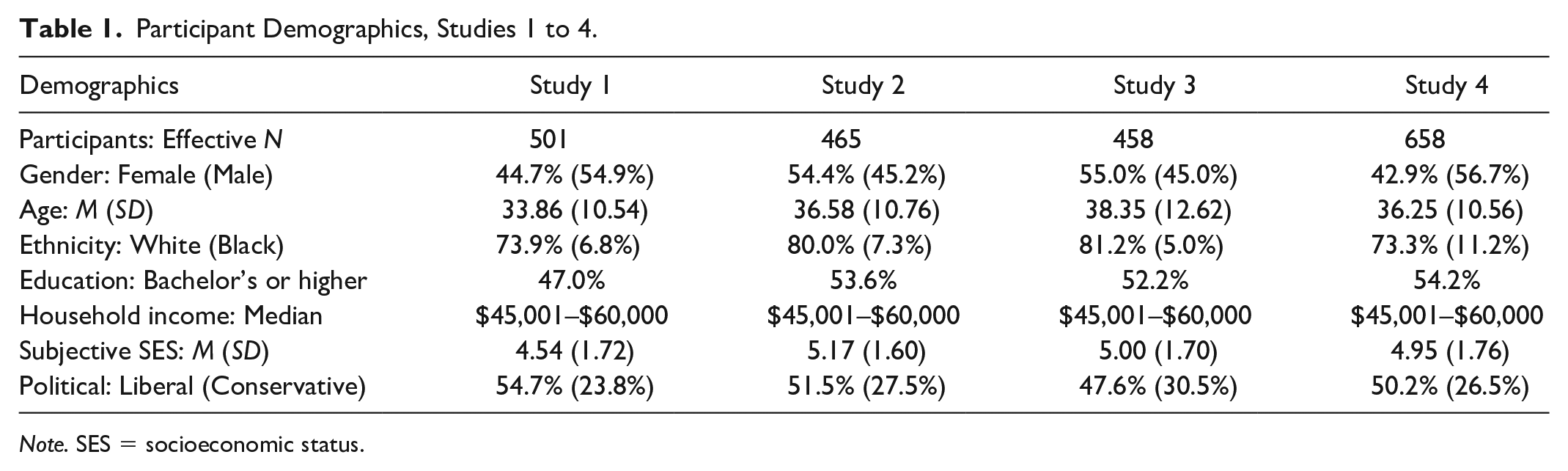
Note. SES = socioeconomic status.
Procedure and materials
We employed a 2 (distribution range: full vs. limited range) × 2 (university exemplar: present vs. absent) between-subjects design. Participants read a description of university endowments and were randomly assigned to one of the distribution range and university exemplar conditions described below. Next, they indicated their perceptions and ideals of the distribution of university endowments and provided demographic information.
University endowment description
Participants first read how university endowments operate and their consequences. For example, participants were informed about the source of endowment funding (e.g., donations, investment interest). They also read that universities with larger endowments can better fund experiences that may substantially affect students (e.g., scholarships, professorships, work and travel opportunities) than universities with smaller endowments.
Manipulation of distribution range
Participants were randomly assigned to focus on the full or limited range of the distribution (i.e., top 800 or 100 universities). This included information about the total endowment wealth of these universities (US$492 billion or US$381 billion) and the overall average endowment per enrolled student (US$52,000 or US$331,000), respectively. Participants also completed university endowment judgments (described below) that focused on the top 800 or 100 universities. The endowment statistics presented were based on our calculations and U.S. university endowment information (NACUBO, 2015).
Manipulation of university exemplars
We also varied whether participants were exposed to examples of universities (i.e., exemplars present vs. absent), within the university endowment perception and ideal questions. We provided participants with either two university examples (e.g., Harvard University, Stanford University) for each quintile (e.g., top 20%), or no specific examples.
University endowment perceptions and ideals
We assessed beliefs about the degree of university endowment inequality by adjusting prior measures (Norton & Ariely, 2011). Participants were informed that the top 800 (or 100) universities were arranged from largest to smallest endowment per student and placed into quintiles (top 20%, 2nd 20%, 3rd 20%, 4th 20%, bottom 20%). Participants indicated the percentage of the total university endowment wealth perceived to be owned by each quintile by using sliders represented by a labeled column (e.g., top 20%) ranging from 0% to 100%. Totals were required to equal 100%. Improving upon the Norton and Ariely (2011) measure, restrictions were programmed to prevent logically impossible perceptions (e.g., the top 20% could not be less than the 2nd 20%). Participants also indicated their ideals about how much wealth each quintile should own with a similar measure, but without restrictions on their preferred distributions. University endowment perceptions and ideals were counterbalanced. As this order variable did not lead to meaningful effects across studies, it is not discussed further.
Reading checks
Two questions assessed how well participants attended to the university endowment information. Participants provided a summary of what they read about university endowments and answered a question that assessed recognition of the assigned distribution range (100 or 800 universities) using a 10-point scale (1 = 100 colleges, 10 = 1,000 colleges).
Demographics
Participants indicated their highest level of education (eight levels). Current university students or graduates also indicated their university name and state. Additional background information included gender, age, ethnicity, political orientation (three items: general, economic, social; α = .92), household income (12 levels), and subjective socioeconomic status (SES) on a 10-point ladder (Adler et al., 2000).
Results
Accuracy and ideals
We used one-sample t tests and 95% confidence intervals (CIs) to test whether participants’ perceptions and ideals differed from our data on the objective distribution of university endowment wealth. We conducted separate tests for the top 800 and 100 universities because the objective data for these groups differ. As seen in Figure 1, for the top 800 universities (i.e., the full distribution), participants perceived that the top 20% of universities own 47.14% (CI = [45.30, 48.98]) of the endowment wealth, but ideally would own 24.39% (CI = [23.07, 25.71]). Both judgments are far less than the 80.49% owned by the top 20% (ts > 35.726, ps < .001, ds > 2.228). Participants also perceived that the bottom 20% of universities own 5.98% (CI = [5.44, 6.52]) and ideally would own 17.25% (CI = [16.20, 18.31]), which is much more than the 0.60% actually owned (ts > 19.562, ps < .001, ds > 1.219). Within t-test analyses revealed that ideals for the top 20% were significantly lower than perceptions, and ideals for the bottom 20% were significantly higher than perceptions (ts > 19.116, ps < .001, ds > 0.574). In other words, the wealth of the top 20% was underestimated, the wealth of the bottom 20% overestimated, and ideals were much more equal than reality and perceptions.
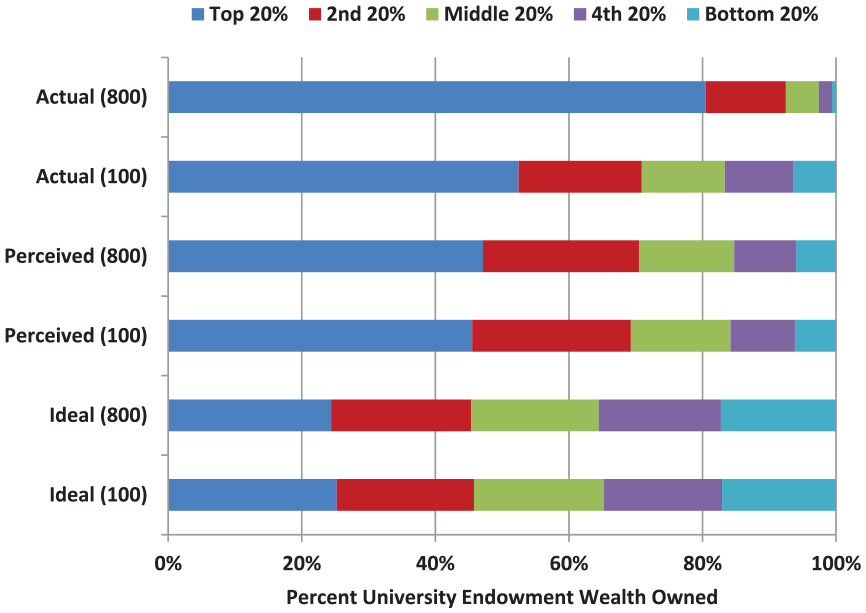
Actual, perceived, and ideal distribution of university wealth by quintile for the top 800 and top 100 universities, Study 1.
A very similar pattern emerged for the top 100 universities, which was an arbitrary subset selected to compare with the full distribution range. These 100 universities have a relatively limited range of wealth and lower proportion owned by the top 20% (52.46%). But perceptions were still lower, 45.53% (CI = [43.73, 47.33]), as were ideals, 25.23% (CI = [23.64, 26.82]), ts > 7.595, ps < .001, ds > 0.485. For the bottom 20%, the amount owned (6.34%) was somewhat similar to perceptions, 6.16% (CI = [5.55, 6.77]), t = 0.581, p = .562, d = 0.037, but much lower than ideals, 17.06% (CI = [15.95, 18.17]), t = 19.045, p < .001, d = 1.219. Ideals for the top 20% were also lower than perceptions, and ideals for the bottom 20% were higher than perceptions (ts > 18.50, ps < .001, ds > 0.511). Again, participants underestimated university endowment inequality and believed there should be a much more equal distribution of wealth, even lower than their underestimates.
Manipulated variables
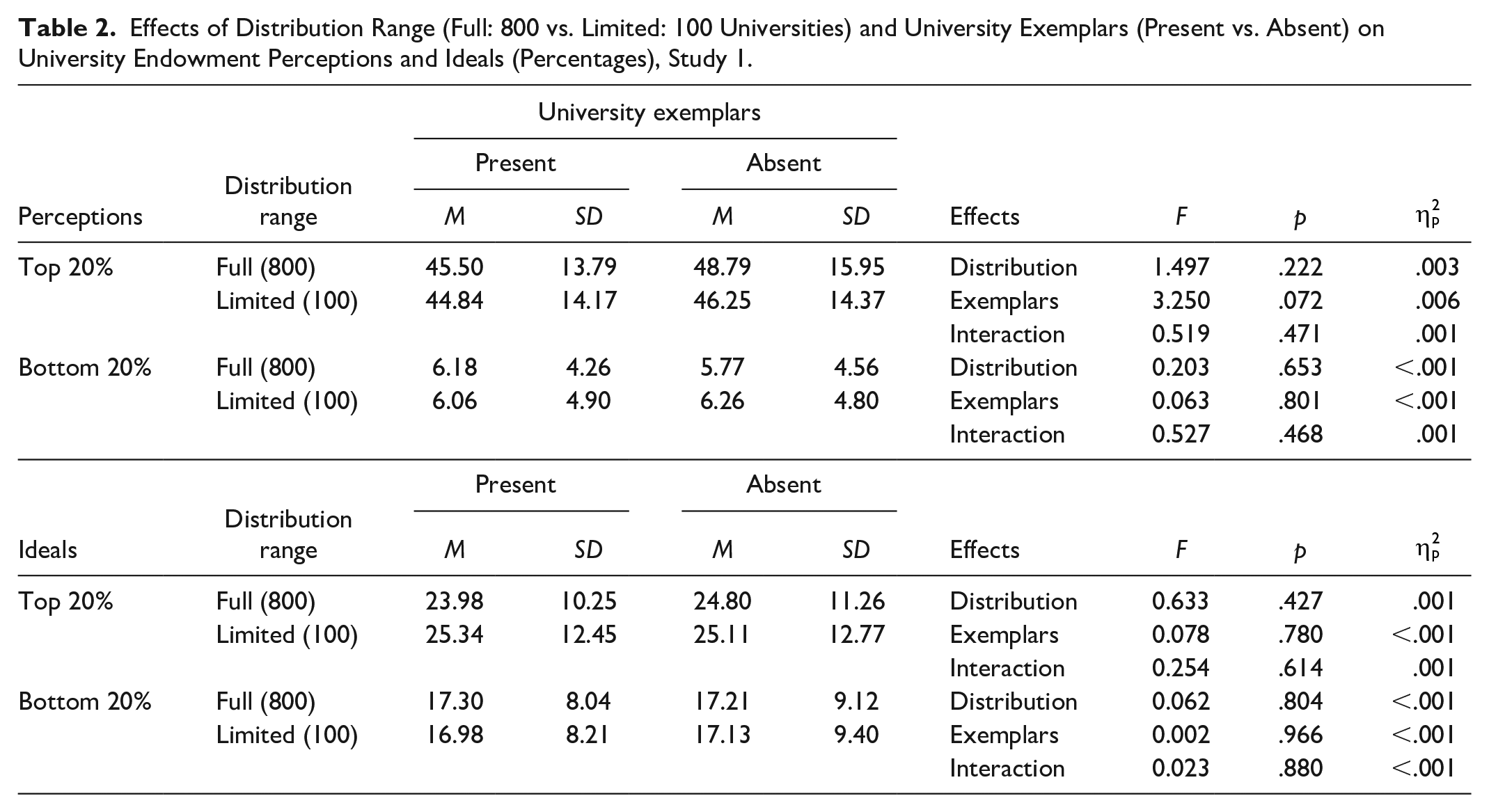
Next we examined whether the study manipulations affected perceptions and ideals. We focused on responses for the top and bottom 20% as beliefs and desires can sometimes vary at the top or bottom of the distribution (Page & Goldstein, 2016). As seen in Table 2, our analyses indicated that the two manipulated variables, range of the distribution and the presence of university exemplars, did not meaningfully affect endowment judgments. For example, the between condition means varied by less than 3.3% when university exemplars were present or absent. In addition, participants did not significantly adjust their perceptions or ideals for the top or bottom 20% when focusing on the full as compared with limited distribution of universities (means differed by less than 2.6%), despite objective differences between these groups.
Effects of Distribution Range (Full: 800 vs. Limited: 100 Universities) and University Exemplars (Present vs. Absent) on University Endowment Perceptions and Ideals (Percentages), Study 1.
University alumni judgments
As university experience may matter, we explored the possible role of attending differently ranked universities on judgments across conditions, for example, whether the perceived wealth of the top 20% of universities varied for participants that attended universities higher or lower in rank. Almost half of the sample (45.3%, n = 227) attended a university ranked in the database as identified by two trained coders, k = .82. Quintiles from the top to bottom were reasonably represented by the subsample of participants as follows: 26.0%, 24.2%, 22.5%, 16.3%, and 11.0%. We conducted separate one-way analyses of variance (ANOVAs) on each quintile for perceptions and ideals, with the between-subjects factor the university-attended quintile (top 20%, 2nd 20%, middle 20%, 4th 20%, bottom 20%). Neither perceptions nor ideals were significantly different among alumni (all Fs < 1.688, ps > .153). Thus, where participants attended university in the distribution did not noticeably affect their judgments. There were also no significant effects of participants’ attended university status detected in Studies 2 and 3.
Demographic variables
In exploratory analyses, we examined whether other participant characteristics (gender, age, ethnicity, education level, household income, subjective SES, and political orientation) were related to perceptions. That is, in two linear multiple regressions, we entered the above seven predictors of the perceived top and bottom 20%. We also conducted regressions for the ideal top and bottom 20%, each with the same predictors as above, but with participants’ endowment perceptions added (e.g., perceived top 20% predicting top 20% ideals), given their potential role in explaining inequality ideals (García-Sánchez et al., 2018). Most background variables were unrelated or inconsistently related to these judgments (in Study 1 and across Studies 1–3) and tended to minimally account for participants’ responses (e.g., total variance explained for perceptions: 2.5%–9.4%; for ideals: 5.8%–15.9%). However, some patterns emerged. Endowment perceptions (but not ideals) were partly explained by participants’ education level (βtop20% = .17, p < .001, βbottom20% = −.08, p = .082) and their gender (βtop20% = .17, p < .001, βbottom20% = −.09, p = .060). That is, more advanced education and male identification were related to perceptions of slightly higher inequality. For example, the top 20% was perceived to be 44.0% by women and 48.8% by men—both below the objective data. Endowment ideals were also related to perceptions of endowment wealth and political orientation. Specifically, perceptions for the top and bottom 20% positively predicted their respective ideals (βtop20% = .24, p < .001; βbottom20% = .14, p = .002) and stronger conservative political views helped explain larger ideal wealth for the top (βtop20% = .29, p < .001) and less for the bottom (βbottom20% = −.29, p < .001). For example, liberals desired the top 20% to own 22.9% of the wealth, whereas conservatives desired 29.5%. Both represent a reduction from the objective data. When conducting identical regression analyses involving the same predictors of perceptions and ideals in Studies 2 and 3, we detect the same patterns as described above for these four variables, with the exception that perceptions of the bottom 20% weakly relate to ideals (βbottom20% = .08, p = .101) in Study 2 (see the Supplemental File for full analyses).
Reading checks
To shore up confidence in these findings, we explored how well participants processed the endowment information provided. Open-ended summaries examined by two coders (k = .77) revealed that 96.2% of participants described information generally consistent with what was supplied. Moreover, in a memory question near the study end, the vast majority correctly identified the number of universities described exactly (78.0%). In general, it appears that participants attended to the endowment details moderately well. See the Supplemental File for additional validity checks across studies.
Discussion
Study 1 demonstrated that individuals perceive university endowment inequality as less unequal than objective conditions and prefer a more equal distribution of university wealth. Perceptions and ideals were also unaffected by changes in the judgment context. Neither outcomes were adjusted for the limited range and smaller inequality (top 100 universities) relative to the larger inequality for the full distribution (top 800 universities), despite access and attention to this range information. Although speculative, this may be due to a failure to comprehend the usefulness of this information (Nisbett et al., 1983). Regardless, the apparent distribution range-neglect suggests that similar inequality judgments may be provided for a group with an even larger range and inequality (e.g., over 1,400 ranked post-secondary U.S. institutions), and a similar neglect may occur for other domains that vary in inequality (e.g., top 50 or top 100 wealthy countries). Judgments were also unaffected by the presence of university exemplars, rather than, for example, leading to higher estimates for the top 20% when reminded of prestigious universities. Although research has found that reading about a status-based exemplar can influence judgments of inequality between two groups (Kuo et al., 2020), the present findings suggest that there may be limits, such as when exemplars are not a central focus or when multiple exemplars are present.
Study 1 also revealed similar perceptions and ideals by participants that attended universities from the top to bottom 20%. Although it is possible that alumni may not be aware of their university’s precise endowment ranking, even those that attended the top versus bottom 20% provided similar responses. Ideals for the top and bottom were also partly grounded in participants’ perceptions, similar to patterns for economic inequality (García-Sánchez et al., 2018; Trump, 2018). Endowment judgments were not well explained by other background characteristics and showed little variation in the patterns detected. Higher education was partly related to more accurate endowment perceptions, consistent with the suggested role of experience with the university education system (Son Hing et al., 2019). It was less clear why endowment perceptions were partly related to gender, given conflicting associations detected between gender and economic inequality perceptions (Garcia-Sánchez et al., 2020; Sprong et al., 2019). Higher endowment inequality ideals were also partly related to stronger conservative political views, consistent with conservative ideology (Jost et al., 2013). Despite these associations, the pattern of endowment inequality underestimation and desire for more equal distributions clearly remained.
We conducted Study 2 to examine whether the pattern of Study 1 would replicate and whether the almost equal ideal distributions in Study 1 were genuine or perhaps due to the endowment consequence information provided. Individuals sometimes care about inequality consequences (Bamfield & Horton, 2009) and degree of equality for education resources (Reed, 2001). As the endowment description emphasized that universities with relatively smaller endowments may have significantly fewer opportunities and benefits for their students, this may have exacerbated desires for equality. To explore this possibility, two coders examined whether participants’ descriptions in Study 1 included any impact of endowments (k = .88). Of those that provided descriptions, most (79.7%) listed at least one consequence of university endowments (e.g., on scholarships). Thus, in Study 2, we experimentally vary exposure to endowment consequence information to provide some insight into whether contemplating the differential impact of endowments may explain greater equality ideals. Given the lack of differences between distribution ranges in Study 1, we focus on the full distribution of 800 universities.
Study 2
Method
Participants
We recruited 504 American participants through Mechanical Turk. Following our preregistered study plan, we removed four participants who declined data use and 35 participants because they did not follow the judgment task instructions. Thus, 465 participants were in the final sample with similar characteristics as in Study 1 (Table 1).
Procedure and materials
Unless where indicated, the procedure and materials were similar to Study 1.
Endowment consequences manipulation
Participants were randomly assigned to read a description that explained university endowments and some of their potential impacts as in Study 1 (consequences present), or that explained endowments but not their impacts (consequences absent).
University endowment perceptions and ideals
The endowment measures were similar to Study 1, but with a few changes. As before, participants provided their perceptions and ideals for the distribution of university endowments across five quintiles composed of 800 universities (i.e., top–bottom 20%). To vary the presentation from Study 1, each quintile was presented horizontally from 0% to 100%, rather than vertically. Perceptions were again required to be logically sound (e.g., top 20% = largest). Although reminders were provided if this rule was violated, participants were not forced to follow it before continuing.
Manipulation check and demographics
As a manipulation check, we assessed the perceived impact of university endowments (seven items, α = .88). For example, “In your opinion, how much does the size of a university’s endowment affect students’ experiences?” (1 = not at all, 7 = very much). Demographic questions matched those in Study 1.
Results
Accuracy and ideals
Although Study 2 focused on only the full distribution of 800 universities, in general, the pattern of perceptions and ideals was very similar to Study 1. As predicted, participants underestimated university endowment inequality and desired more equality among universities (Figure 2). Across conditions, participants perceived the top 20% of universities to own 47.35% (CI = [45.73, 48.97]) of the wealth, with ideals of owning 24.96% (CI = [23.87, 26.05]). These judgments significantly differed from what is owned by the top 20% (ts > 40.245, ps < .001, ds > 1.865). For the bottom 20%, participants perceived they owned 6.42% (CI = [5.92, 6.91]) and ideally would own 17.27% (CI = [16.36, 18.19]), which also differed from the actual wealth of the bottom 20% (ts > 23.124, ps < .001, ds > 1.071). As hypothesized, people’s ideals for the top 20% were lower than their perceptions, and their ideals for the bottom 20% were higher than their perceptions (ts > 21.454, ps < .001, ds > 0.994). That is, participants desired a relatively flatter distribution of university wealth than they thought existed.
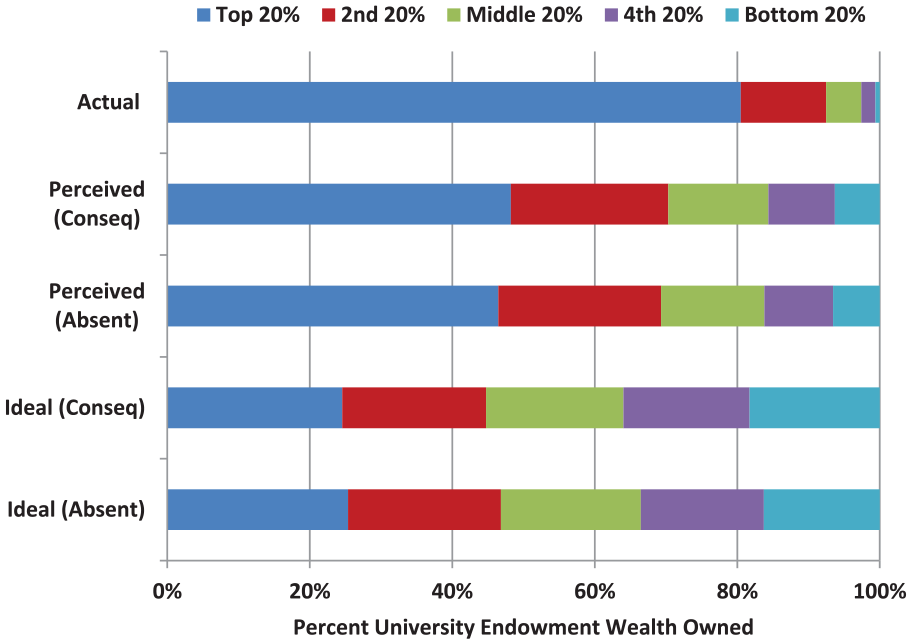
Actual, perceived, and ideal distribution of university wealth by quintile when endowment consequence information was present or absent, Study 2.
Consequences manipulation
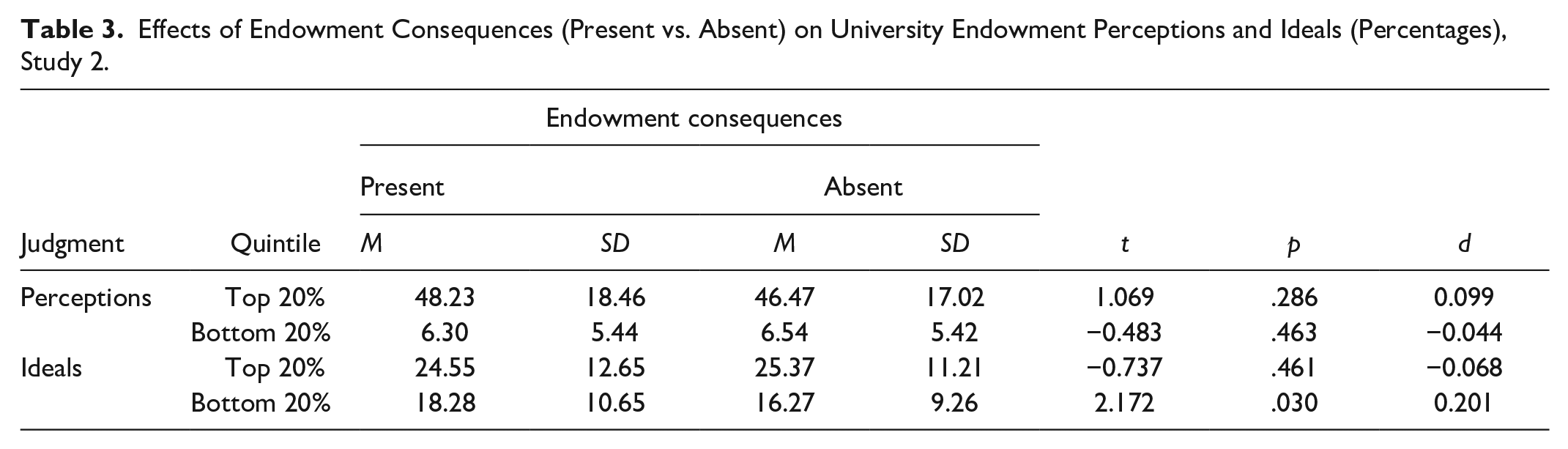
The endowment consequences information significantly increased beliefs that endowment size affects educational experiences (M = 5.50, SD = 0.98), compared with when absent (M = 5.11, SD = 1.06), t(463) = 4.070, p < .001, d = 0.382. We explored whether the manipulation affected endowment judgments. As seen in Table 3, perceptions for the top and bottom 20%, and ideals for the top 20%, did not significantly differ between consequence conditions. However, exposure to endowment consequences led to significantly higher ideals for the bottom 20% (around 2% higher) relative to basic endowment information.
Effects of Endowment Consequences (Present vs. Absent) on University Endowment Perceptions and Ideals (Percentages), Study 2.
Discussion
University endowment inequality was again underestimated and more equal endowment conditions were desired. Although our manipulation successfully altered beliefs about impact of endowments on university opportunities and experiences, it mostly did not affect endowment judgments. It led to slightly higher ideals of endowment wealth for the bottom 20%, relative to no consequence information. To clarify this finding, we re-examine the potential effects of endowment consequence information in Study 3.
A consistent pattern of perceptions and ideals emerged in Studies 1 and 2 using similar methods. However, assessment methods sometimes affect perceptions of inequality. For example, national wealth inequality was less strongly underestimated when participants focused on average as compared with total wealth (Eriksson & Simpson, 2012; Norton & Ariely, 2013; see also Davidai & Gilovich, 2018). Thus, in Study 3, we additionally sought to examine whether perceptions and ideals made using averages, rather than percentages, would affect our conclusions.
Study 3
Method
Participants
Participants were 507 American residents recruited through Mechanical Turk. Using the same criteria as Study 2, we excluded four participants that did not wish their data used and 45 that incorrectly followed the judgment instructions, leaving an effective sample of 458 (Table 1).
Procedure and materials
The setup of Study 3 was similar to Study 2. We manipulated exposure to university endowment consequences (present vs. absent). Participants then completed endowment judgments, except they indicated average endowment per student for each quintile. As total university endowment wealth is finite and the average endowment per student for the top 800 universities is around US$50,000, participants’ judgments were grounded in reality. Each quintile had a horizontal sliding bar ($0–$250,000) with the overall average across the five groups (top–bottom 20%) equal to $50,000. Thus, as participants moved a slider for one quintile group, the other groups would adjust to maintain the overall average. To attain intended averages, this task was slightly more involved (e.g., more slider movements) than the percentage task. The average task was completed for perceptions and ideals. The remaining study materials (e.g., manipulation check, demographics) were identical to Study 2.
Results
Accuracy and ideals
Judging average endowment per student, participants still underestimated university endowment inequality and desired more equality than actual levels and their perceptions (Figure 3). Across conditions, perceived endowment per student for the top 20% was $90,975.55 (CI = [$88,482.80, $93,468.31]) and the ideal endowment per student was $63,571.05 (CI = [$61,442.95, $65,699.14]). Both were lower than the $209,089 actual average for the top 20% (ts > 93.114, ps < .001, ds > 4.350). For the bottom 20%, the perceived average was $20,610.32 (CI = [$19,385.63, $21,385.64]), and the ideal was $39,545.77 (CI = [$37,639.45, $41,452.10]). These exceeded the actual bottom 20% endowment per student of $1,537 (ts > 30.181, ps < .001, ds > 1.429). Participants also indicated endowment inequality ideals for the top 20% that were lower than their perceptions, and ideals for the bottom 20% that were higher than their perceptions (ts > 18.363, ps < .001, ds > 0.857).
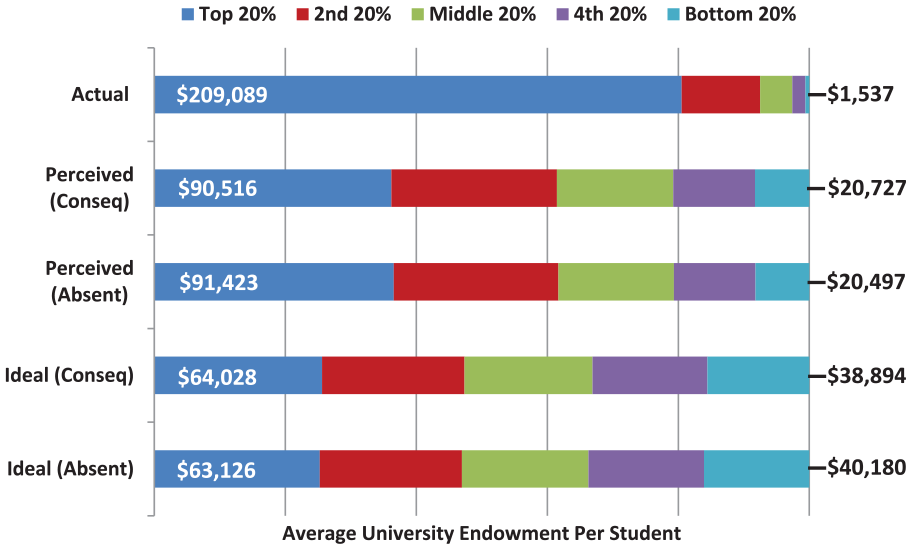
Actual, perceived, and ideal university wealth by quintile when endowment consequence information was present or absent, Study 3.
Consequences manipulation
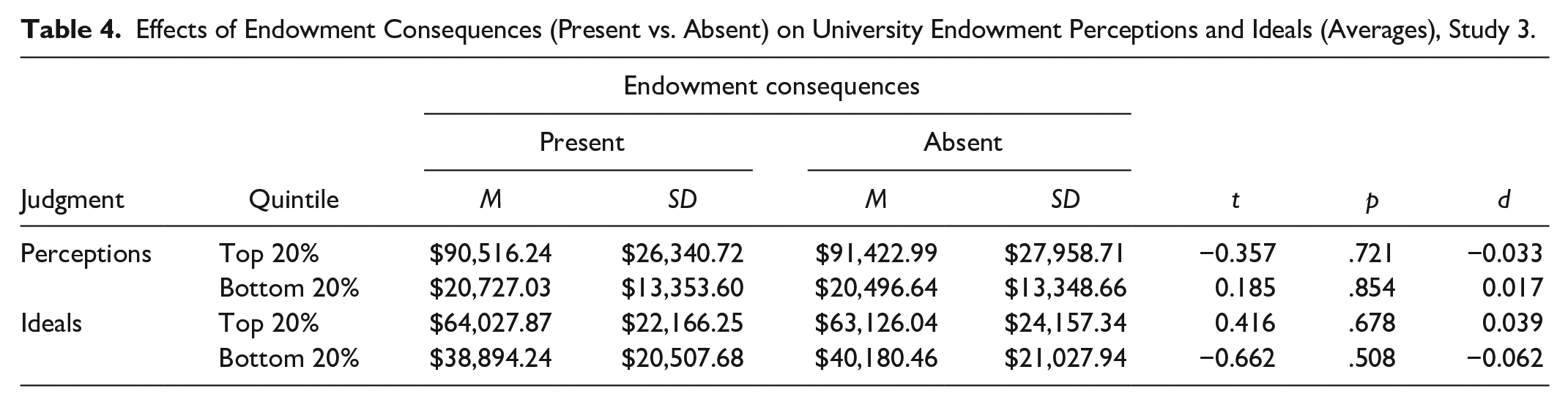
Endowment consequence information led to stronger beliefs that endowments affect educational experiences (M = 5.80, SD = 0.94), compared with when absent (M = 5.29, SD = 0.96), t(455) = 5.703, p < .001, d = 0.537. However, there were no significant differences based on consequence condition for perceptions or ideals (Table 4).
Effects of Endowment Consequences (Present vs. Absent) on University Endowment Perceptions and Ideals (Averages), Study 3.
Discussion
Using a different method of assessing judgments about university endowments than Studies 1 and 2, a similar pattern was observed in Study 3. University endowment inequality was underestimated and a more equal spread of endowment wealth was desired. Whereas one judgment was affected by endowment consequence information in Study 2, perceptions and ideals in Study 3 were not. Overall, the relatively consistent responses suggest that participants’ ideals may represent an approximation of their true preferences for a notably low level of university endowment inequality.
Although establishing inequality preferences is important, it is also useful to determine whether any inequality is viewed as unfair or not (Starmans et al., 2017; Trump, 2020). Thus, in Study 4, we sought to examine whether exposure to objective information on university endowment inequality may affect fairness beliefs. Exposure to high economic inequality information on attitudes toward inequality and related policies has occasionally led to select effects, for example, on estate taxes but also those that are minor or non-significant (Kuziemko et al., 2015; Trump, 2018). Although the positive association between perceptions and ideals in Studies 1 to 3 may be partly due to shared assessment methods, it is consistent with an “is to ought” tendency (Kay et al., 2009) that can occur for economic inequality judgments (García-Sánchez et al., 2018) and suggests preference for levels of inequality believed to chronically exist (Son Hing et al., 2019). However, as endowment inequality appears to be perceived as much less than reality and ideals are far more equal than objective conditions, a relatively larger inequality may be viewed as unfair and unacceptable—if known. If the level of inequality is interpreted as violating values of equal opportunity, then a negative reaction may especially occur because universities tend to be viewed as opportunity enablers (Bullock & Limbert, 2003) and systems that do not offer sufficient levels of opportunity may not be supported (Kluegel & Smith, 1986). Thus, we hypothesized that exposure to information on university endowment inequality will lead to relatively lower fairness beliefs. To help increase confidence in any inequality information effect, we examine how four inequality information conditions compare with a control condition.
Individuals may also rationalize endowment inequality to make sense of any perceived inequity (Ledgerwood et al., 2011; Lerner, 1980). To gain insight into this possibility, we explore whether learning that endowment wealth may be deserved (in addition to information on inequality) will lead to its justification. That is, in one inequality condition in Study 4, we include additional information that highlights the positive association between university rank (a commonly discussed factor) and endowment size, to examine whether this leads to relatively higher fairness evaluations. To help rule out that this rationalization is not simply due to exposure to university ranks or endowment sizes, but their positive association, the remaining three inequality conditions also include information designed to help control for the presence of the separate elements presented (e.g., only university rank information). If fairness beliefs are higher after an emphasized link between university rank and endowment size than the additional three inequality conditions, this would suggest some rationalization of the inequality occurred. Finally, as a robustness check, we explore whether any experimental effects hold when accounting for a general tendency to rationalize individual outcomes (i.e., endorsement of meritocratic beliefs), political orientation, and background characteristics.
Study 4
Method
Participants
We recruited 800 American residents through Mechanical Turk. We removed six participants because of simultaneous or duplicate responding. Following our preregistered exclusion criteria, we removed an additional 128 (seven did not wish their data analyzed, 116 failed an attention check, and 13 spent less than 5 s reading the manipulation). The effective sample included 658 participants, with characteristics similar to Studies 1 to 3 (Table 1).
Procedure and materials
Participants first completed the endowment inequality manipulation. They were randomly assigned to one of five conditions (one control and four inequality conditions) and read the information provided. Afterward, they completed measures concerning the fairness of the distribution of university wealth, beliefs about the association between university ranking and endowment size, meritocratic beliefs, reading checks, and demographic information.
Endowment inequality manipulation
We exposed all participants to information about university endowments. In the control condition, participants read a brief paragraph about university endowments. One sentence mentioned that some of the top 800 universities have larger endowments than others, without describing the size or extent of inequality. In all four endowment inequality conditions (i.e., A–D), participants read the same information as above as well as details about endowment inequality among universities. This included a graphic of the distribution of endowment wealth, which depicted the top 20% as having 80% of the wealth and the four lower quintiles owning portions of the remainder. Participants also read how much the top and bottom 20% of universities have in terms of endowment per student (i.e., US$210,000 and US$1,500, respectively). They were requested to enter these amounts into textboxes.
Inequality Condition A included additional information that conveyed a relationship between university rank and endowment rank, to explore one way individuals may rationalize the high level of university endowment inequality. This involved factual information about 20 universities, 10 of which were in the top 10 of the 2015–2016 U.S. College and News rankings and 10 that were between 99 and 108 in the rankings. Participants read that universities with higher rankings typically have larger endowments and universities with lower rankings have smaller endowments. This was supported by a table that listed the top 10 ranked universities and the generally high rank of their endowment size based on the NACUBO database (e.g., University of Chicago: #4 US News rank, #13 endowment rank). A second table listed a similar pattern for the 10 relatively lower ranked universities (e.g., Auburn University: #102 US News rank, #140 endowment rank).
In addition to testing for the effect of exposing participants to endowment inequality described above, Inequality Conditions B to D included information to control for some of the information presented in Inequality Condition A (e.g., university rankings). That is, these conditions were also designed to help discern whether any rationalization effect due to Inequality Condition A was because of the association between university achievement and wealth, and not simply exposure to the separate elements involved in this association.
Inequality Condition B controlled for the presentation of endowment rank information. Participants saw two tables with the same universities as above, but with only endowment rank information, presented in order from higher to lower endowment rank.
Inequality Condition C also controlled for the endowment rank information but by further obfuscating a link between university rank and endowment size. Participants were exposed to the same universities and their endowment ranks, but in a single table, with the universities not listed in a distinct order.
Inequality Condition D controlled for university rank information. Participants saw university rank information about the same 20 universities in two tables (higher to lower university ranking).
University wealth fairness
We assessed how much the distribution of university endowment wealth was believed to be fair and appropriate (six items, α = .91). For example, “How fair is the distribution of college endowment wealth?” Item scales had 7 points and anchors that matched the content of each item (e.g., 1 = very unfair, 7 = very fair).
Meritocratic beliefs
Participants also indicated their beliefs about the role of effort, talent, and self-reliance in determining people’s outcomes (six items, α = .92), with items based on prior research (Day & Fiske, 2017; Quinn & Crocker, 1999). For example, “Getting ahead is a matter of working hard and relying on yourself” (1 = strongly disagree, 7 = strongly agree).
Reading checks, manipulation check, and demographics
Two questions assessed whether participants attended to the endowment inequality information that was either present (inequality conditions) or absent (control condition). This included entering the endowment per student amount for the top and bottom 20% (inequality conditions) and later on identifying this for the top and bottom 20% (1 = $1,500/student, 8 = $500,000/student). As a manipulation check of whether Inequality Condition A differed from the other conditions, we measured beliefs about the association between endowment size and university ranking (four items, α = .76). For example, “Colleges with the largest endowments are usually the highest ranked” (1 = strongly disagree, 7 = strongly agree). Finally, participants provided demographic information.
Results
Manipulation and reading checks
In the inequality conditions, most participants (93.4%) correctly entered the exact endowment information for both the top and bottom 20%. Moreover, those in the inequality conditions were more likely to correctly identify the endowment per student amount for the top and bottom 20% compared with the control condition (χ2s > 122.06, ps < .001). As a manipulation check, a one-way ANOVA indicated that Inequality Condition A (that included rationalization information) increased the belief that university rank and endowment rank are related, relative to the other conditions, F(4, 653) = 3.842, p = .004. Specifically, follow-up contrasts revealed that Inequality Condition A (M = 6.04, SD = 0.98) led to stronger beliefs of this relationship as compared with the control condition (M = 5.61, SD = 1.07), Inequality Condition B (M = 5.69, SD = 0.97), and Inequality Condition C (M = 5.77, SD = 0.93), ts > 2.300, ps < .023, ds > 0.179, but did not significantly differ from Inequality Condition D (that included university rank information), M = 5.87, SD = 0.88; t(653) = 1.416, p = .157, d = 0.111.
University wealth fairness
To test our main hypothesis, we examined whether exposure to endowment inequality information affected beliefs about the fairness of university wealth. A one-way ANOVA revealed significant between condition differences, F(4, 653) = 11.785, p < .001. As expected, in a planned contrast, the inequality conditions together led to significantly lower fairness beliefs of the distribution of university wealth compared with the control condition, t(653) = 6.537, p < .001 (Figure 4). In exploratory contrasts, each inequality condition was also significantly lower on fairness beliefs compared with the control condition (ts > 4.415, ps < .001, ds > 0.580). Additional exploratory contrasts revealed that fairness beliefs did not significantly differ between Inequality Condition A and Inequality Conditions B to D (ts < 1.796, ps >.072, ds < 0.220).
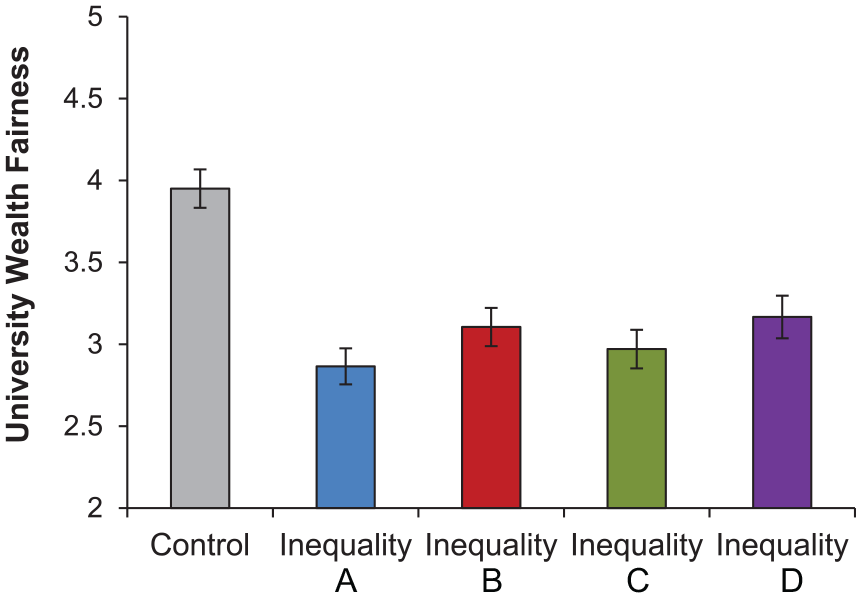
Mean fairness of the distribution of university wealth depending on exposure to university endowment inequality information.
We also examined whether the overall effect of the inequality information on fairness beliefs would be maintained when controlling for meritocratic beliefs and political orientation because each may affect the rationalization of the status quo (Jost & Hunyady, 2005), as well as background characteristics. In a regression predicting fairness beliefs, we entered the background and ideological variables in Step 1 and the inequality manipulation in Step 2 (Table 5). After controlling for other factors, exposure to endowment inequality information still predicted relatively lower fairness beliefs compared with the control condition, β = −.265, p < .001, ΔR2 = .07. Neither meritocratic beliefs nor political orientation were significantly affected by the inequality manipulation.
Regression of Inequality Condition, Meritocratic Beliefs, and Background Variables on University Wealth Fairness, Study 4.
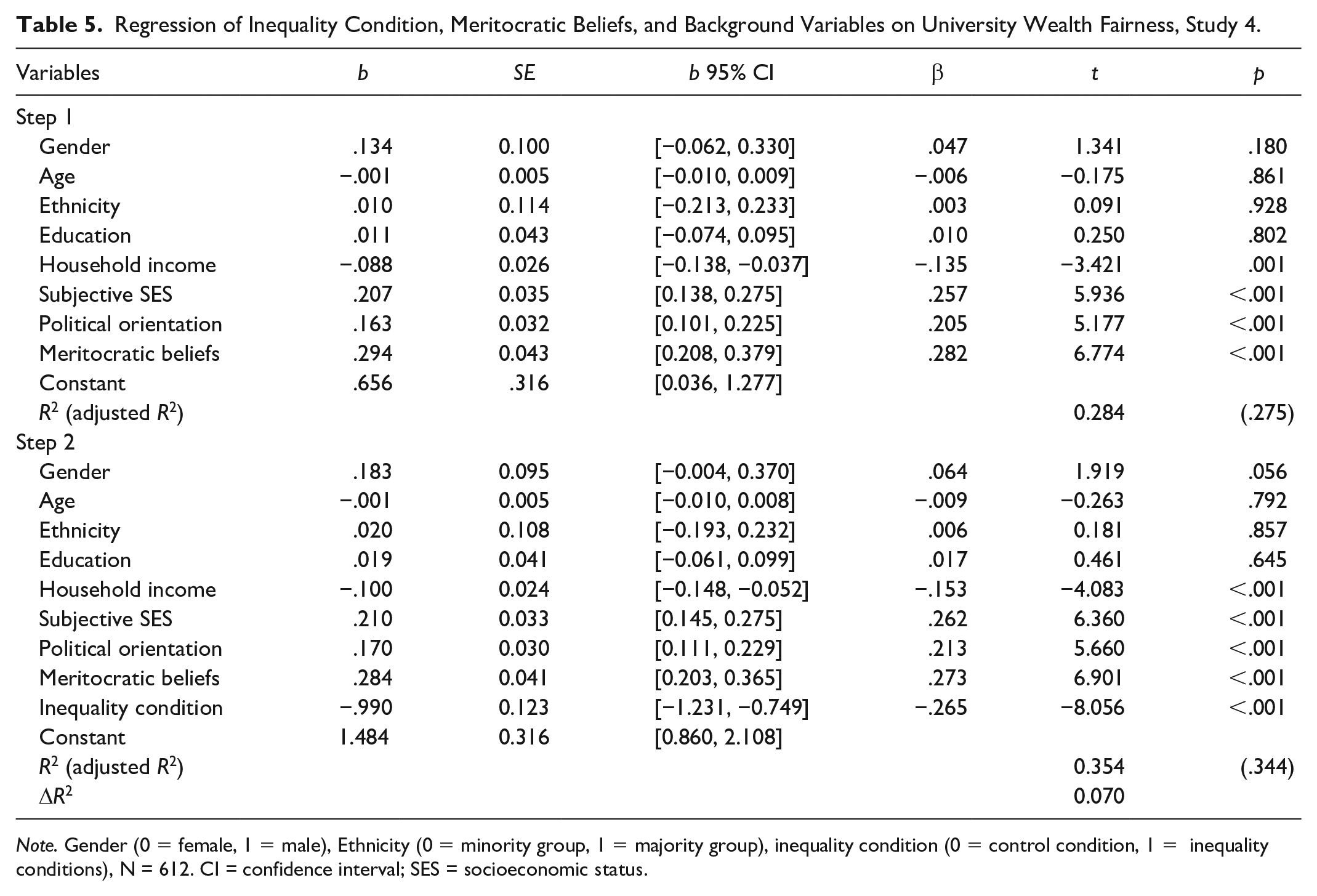
Note. Gender (0 = female, 1 = male), Ethnicity (0 = minority group, 1 = majority group), inequality condition (0 = control condition, 1 = inequality conditions), N = 612. CI = confidence interval; SES = socioeconomic status.
Discussion
Study 4 demonstrated that information on university endowment inequality increased the perceived unfairness of the distribution of university wealth relative to being uninformed. A consistent pattern of unfairness evaluations was observed across four endowment inequality conditions as compared with a control condition. This finding remained even when controlling for background variables, meritocratic beliefs, and political positions. People’s negative evaluations indicate that the current state of endowment inequality is weakly tolerated and suggest that individuals may be willing to support changes in line with the relatively more equal ideals established in Studies 1 to 3.
Unfairness beliefs were not meaningfully affected by information regarding the positive association between university ranks and endowment size that could have helped justify the endowment disparity among universities. Although additional research may reveal other ways to rationalize this inequality or other factors that may affect fairness perceptions of the distribution of university wealth, this finding is informative to inequality judgments (Phillips et al., 2021; Son Hing et al., 2019) because it suggests that even access to an intuitive explanation of inequality immediately before an inequality evaluation is not necessarily influential.
General Discussion
University endowments can vastly enrich educational environments and various student opportunities. In terms of wealth and potential impact, there is also a dramatic difference among American universities at the top compared with the bottom. Our research suggests that, if anything, people misperceive education inequality between higher and lower ranked universities: they are clearly aware there is inequality in endowment wealth, but their perceptions undershoot reality. The present research also reveals that people robustly desire greater endowment equality, for example, by preferring endowment inequality ranging only from 25% of the total wealth for the top 20% of universities to 17% for the bottom 20%. Generally, endowment judgments were also minimally explained by participants’ demographics. Although the underestimation pattern is similar to research on beliefs about economic inequality (e.g., Norton & Ariely, 2011), the desire for more equality of university endowments appears to be stronger than for personal income or wealth.
Critically, this research also provided insight into how much the inequality judgment context may impact assessments. Despite the potential influence of framing (e.g., Tversky & Kahneman, 1974), and in particular, immediate access and attention to inequality-relevant information (Phillips et al., 2021), university endowment perceptions and ideals were remarkably unaffected by several factors, including how questions were asked, whether a full or limited distribution range was targeted (i.e., 800 or 100 universities), whether university exemplars were present, and whether downstream consequences of the disparity among university endowments were considered. Although psychological factors sometimes affect inequality perceptions, ideals, and related opinions (Chow & Galak, 2012; Kuo et al., 2020; Trump, 2018), they may not affect inequality judgments broadly.
Our research also demonstrated that when confronted with the reality of a sizable wealth gap among American universities, the distribution of university wealth is viewed as relatively unfair and unacceptable. This contrasts somewhat with the limited effects of learning about high economic inequality found in prior research (Kuziemko et al., 2015; Trump, 2018). Additional research could clarify whether the intolerance is due to the high level of university endowment inequality far exceeding average perceptions and ideals, specific values attached to opportunity-enabling institutions, or other explanations such as those involving fairness of wealth allocation processes (Trump, 2020).
Limitations and Future Directions
Although the findings were reasonably consistent across studies, there are limitations to this research. For instance, we used two methods to examine university endowment perceptions and ideals, but additional tests, with other assessments grounded in how people perceive inequality, could further increase confidence in our findings, including the consistency of the underestimation of inequality and limited contextual effects.
Our research also focused only on U.S. respondents. Endowment inequality, however, may extend beyond America. A brief scan of university endowments in other countries, such as in the United Kingdom and Canada, reveals sizable education inequalities (see Supplemental File). Thus, tests of citizens of other countries could determine whether they also misperceive university wealth inequality and experience a divergence between their values and the gap among post-secondary institutions.
There are also several potential implications of the present research. Increasing awareness of the extent of endowment inequality may affect individuals and institutions in several ways. For example, this information may be influential to students’ attitudes about various universities and decisions on which to attend. Awareness of high endowment inequality may also affect gifts or donations to universities and perceptions of these acts. Attention to relatively large university endowments has sparked scrutiny of new donations to wealthy universities, in which the charitable nature and societal value of such acts is questioned (Gladwell, 2016). Based on the present research, individuals may be surprised at the high disparity of endowment wealth, believe it does not match their ideals, and perceive it as unfair. This suggests that endowment inequality information could lead to inequality-reducing outcomes. In some cases, targeted information about high economic inequality (e.g., company CEO-to-worker pay ratios) can negatively affect attitudes and purchase decisions (Benedetti & Chen, 2018; Mohan et al., 2015). However, the association between inequality information and related behavior is believed to be complex and may depend on context-specific moderating factors (Son Hing et al., 2019; for example, Hideg & Wilson, 2020). Therefore, additional research in this area seems warranted.
While it may be possible to redistribute some portion of university endowments to match people’s ideals, alternative solutions have been suggested. For example, changing the charitable status of university endowments or taxing large corporations (e.g., Amazon, Google) that benefit from highly educated workers could reduce endowment inequality (Rueb, 2019). Recently, there has also been a small tax (1.4%) on the investment income of the wealthiest university endowments. Although the effectiveness of such policies requires testing, there are other models of redistribution programs designed to specifically ameliorate inequality in educational settings, such as by reallocating excess donations from rich public schools to relatively poorer schools in a Californian school district (Goldstein, 2017; see also Grusky et al., 2019). In short, several paths may exist to better align the objective state of university endowment inequality with the preferences of Americans revealed by our research.
Supplemental Material
sj-docx-1-psp-10.1177_01461672221083766 – Supplemental material for Perceived and Ideal Inequality in University Endowments in the United States
Supplemental material, sj-docx-1-psp-10.1177_01461672221083766 for Perceived and Ideal Inequality in University Endowments in the United States by Martin V. Day and Michael I. Norton in Personality and Social Psychology Bulletin
Footnotes
Acknowledgements
We would like to thank Julia Clarke, Fiery Cushman, Kathleen Daly, Liam Foley, Joshua Greene, Oliver Hauser, Mark Hewitt, Gregory Hynes, Maria Learning, Rachel Lee, David Levari, Jason McDonald, Alysha Renouf, Nicole Rodriguez, and Julia Rose for their feedback or assistance with this project.
Declaration of Conflicting Interests
The author(s) declared no potential conflicts of interest with respect to the research, authorship, and/or publication of this article.
Funding
The author(s) received no financial support for the research, authorship, and/or publication of this article.

Supplemental Material
Supplemental material is available online with this article.
References
Supplementary Material
Please find the following supplemental material available below.
For Open Access articles published under a Creative Commons License, all supplemental material carries the same license as the article it is associated with.
For non-Open Access articles published, all supplemental material carries a non-exclusive license, and permission requests for re-use of supplemental material or any part of supplemental material shall be sent directly to the copyright owner as specified in the copyright notice associated with the article.
