




Abstract
Unfortunately, some people are perceived as boring. Despite the potential relevance that these perceptions might have in everyday life, the underlying psychological processes and consequences of perceiving a person as “boring” have been largely unexplored. We examined the stereotypical features of boring others by having people generate (Study 1) and then rate (Study 2) these. We focused on occupations (e.g., data analytics, taxation, and accounting), hobbies (e.g., sleeping, religion, and watching TV), and personal characteristics (e.g., lacking humor and opinions, being negative) that people ascribed to stereotypically boring others. Experiments then showed that those who were ascribed boring characteristics were seen as lacking interpersonal warmth and competence (Study 3), were socially avoided (Study 4), and enduring their company required compensation (Study 5). These results suggest that being stereotyped as a bore may come with substantially negative interpersonal consequences.
“Perhaps the world’s second worst crime is boredom. The first is being a bore.”
What constitutes a stereotypically boring person, and what reactions do they incur? While the study of boredom as an emotional response to adverse tasks has become increasingly popular (e.g., see Velasco, 2019), the stereotypical beliefs about bores—that is, perceptions of people as stereotypically boring—have hardly received empirical attention. Related research has focused on the characteristics people ascribe to boring relationships (e.g., Harasymchuk et al., 2012, 2013) or has investigated the stereotype of boring people from the perspective of speech in social interactions (Leary et al., 1986). For the first time, we investigated the boring people stereotype across relevant domains: beliefs about their interpersonal attributes, occupations, interests, and the subsequent reactions to stereotypically boring people. This investigation helps to integrate and complement past work on stereotypes of boring people in light of existing theoretical models (e.g., Fiske et al., 2002). It also helps to identify and predict the interpersonal challenges and mistreatments that people may incur who possess stereotypically boring personal characteristics (e.g., lacking strong opinions), stereotypically boring interests or hobbies (e.g., religiosity), or work in stereotypically boring occupations (e.g., accounting and cleaning). To be clear, we thus set out to examine the stereotype that people hold about boring people, not the actual individual characteristics that boring people possess.
Boring People: Considering the Social Contexts
Boredom is often conceptualized as the adverse experience of wanting but being unable to pursue satisfactory activity (Eastwood et al., 2012). It is an unpleasant emotion characterized by low or mixed arousal (Merrifield & Danckert, 2014; Smith & Ellsworth, 1985; Van Tilburg & Igou, 2017), a lack of interest in the situation (Farmer & Sundberg, 1986), the perception that time is passing slowly (Danckert & Allman, 2005), failure to sustain attention (Danckert & Merrifield, 2016; Eastwood et al., 2012; Hunter & Eastwood, 2018), and a lack of perceived purpose (Van Tilburg & Igou, 2012). Boredom, an affective experience, signals that current (in)activity fails to offer a sense of meaningfulness (Van Tilburg & Igou, 2011, 2019) and propels the pursuit of actions that, for example, offer a sense of purpose (Van Tilburg & Igou, 2019), novelty (Bench & Lench, 2019), or might temporarily distract from one’s immediate predicament (Moynihan et al., 2015, 2017, 2021).
Two primary lines of empirical research examined boredom as an interpersonal attribute. The first examined what beliefs people hold of stereotypically boring people in general. Leary and colleagues (1986) conducted three studies to investigate how people believed stereotypically boring others behave in social encounters. Their work focused on the impressions allegedly boring people made and the (speech) behaviors they produced while interacting with other persons. In their first study, Leary and colleagues asked participants to rate how much a stereotypically boring person would exhibit 43 social behaviors in social encounters. In their second study, the authors examined the conversation styles exhibited by people who were rated as “boring” in 52 unstructured conversations. In their third study, they asked participants to evaluate boring versus interesting speakers (e.g., [dis]liking). Their results indicated that stereotypically boring people are characterized by negative egocentrism in interactions (e.g., lack of interest in the other person’s contributions and constant complaining) and banality (e.g., interest in a single topic only; repeating jokes); they talked less and shared relatively little subjective information. These results offered initial insights into the behavior of stereotypically boring people in social settings (e.g., conversations) and the style of speech they adopt.
The second line of research examined boredom in romantic couples. The self-expansionist model (Aron & Aron, 1986) proposes that the initial stages of relationships are characterized by “infrequent, intense conversations with considerable risk-taking and self-disclosure” (Aron et al., 2000, p. 282). This process facilitates the merging of identities, perceptions, and resources, labeled “self-expansion.” Successful self-expansion is marked by positive affect and high arousal. However, cases of nonexpansion may involve perceiving the relationship as boring, to its detriment. To understand better what characterizes such boring relations, Harasymchuk and Fehr (2013; see also Harasymchuk & Fehr, 2012) examined the prototype of boredom in close relationships (e.g., romantic couples). They asked married and dating couples to describe what it meant to be bored in a romantic relationship, rated on their prototypicality by a second sample, and served as items for a relational boredom scale. Prominent themes emerging from this prototype analysis were a lack of interest in one’s partner, disengagement from the relationship, failure to communicate, and the “loss of positive, high-arousal, satisfying qualities that once characterized the relationship, but no longer held true” (Harasymchuk & Fehr, 2013, p. 6), such as passion and surprises. Of course, while the work by Harasymchuk and Fehr (2012, 2013) offers us an impression of what the prototypical features of boring relationships are, it is an open question whether this characterizes perceptions of stereotypically boring people in general.
The earlier work by Leary and colleagues (1986) and Harasymchuk and Fehr (2012, 2013) shows that common beliefs about boredom in social relationships may have significant impacts, such as the deterioration of romantic relationships (Aron et al., 2000) and dislike of those seen as stereotypically boring in social encounters (Leary et al., 1986). Yet, important issues remain unaddressed. Aside from specific behaviors (e.g., speech patterns), who are those stereotyped as boring? What occupations do they hold? In what activities are they allegedly engaged? Aside from the social attributes assigned to stereotypically boring people in personal interactions, what reactions do they elicit in others? Can people believe that someone is stereotypically boring without actually interacting with them, for example, based on the work they do? Would people go out of their way to avoid these stereotyped people altogether, effectively rendering stereotypically boring people unable to socialize and disprove the stereotype? Are the tentatively negative social implications of being perceived as stereotypically boring offset by the perception that they are nonetheless highly competent (e.g., a cold but skilled accountant), or do negative reactions generalize across domains (e.g., a cold and incompetent accountant)?
Chief among these unaccounted issues is that investigations of boring people have not been integrated within more general models on stereotyping, such as the stereotype content model (Fiske et al., 2002)—which focuses on interpersonal warmth and competence—and the complementary intergroup affect and stereotypes map (Cuddy et al., 2008). This potential theoretical integration is, however, critical: not only does it offer the prospect of connecting the stereotype about boring people within the literature, but it may also allow for informed predictions of personal and interpersonal behavior in the face of persons who possess stereotypically boring features.
Boring People as a Social Stereotype
Social stereotypes are defined as an “individual’s set of beliefs about the characteristics or attributes of a group” (Judd & Park, 1993, p. 110). Stereotypes can be, but need not be, wholly or partially inaccurate. Stereotypes contribute to fast judgment and decision-making and may offer reasonable accuracy when cognitive resources, motivation, or time are limited, in doing so, serving as a heuristic (e.g., Bodenhausen et al., 2016). Stereotypes represent lay or naive theories of social groups’ characteristics (Wittenbrink et al., 1998). Once believed to be relatively stable over time, research shows that stereotypes are sensitive to context (Garcia-Marques et al., 2006) and their use is conditional on perceivers’ goals (Wheeler & Fiske, 2005).
While stereotypes fulfill a psychological function, their use can have detrimental effects on interpersonal and intergroup behavior, for example, in the form of prejudice and discrimination based on race and gender (Bodenhausen & Richeson, 2010; Cuddy et al., 2008; Fiske & Stevens, 1993). In fact, people’s use of stereotypes is a key variable in intergroup biases and conflict (Haslam et al., 1997; Reynolds et al., 2000).
The stereotypes that people hold of others may vary widely in their specific content. Yet, research has discovered a fundamental structure that stereotypes have in common, aiding their systematic study. The stereotype content model (Fiske et al., 2002) posits that there are two fundamental dimensions along which stereotypes vary: interpersonal warmth—perceiving others as, for example, “good-natured, trustworthy, tolerant, friendly, and sincere” (Cuddy et al., 2008, p. 65)—and competence—perceiving others as, for example, “capable, skillful, intelligent, and confident” (p. 65). These two dimensions are theoretically orthogonal but often a negative evaluation of an outgroup on one dimension is complemented by a positive one on the other.
While the stereotype content model describes the architecture of stereotype beliefs, the complementary behavior from intergroup affect and stereotypes map (Cuddy et al., 2008) delineates the affective and behavioral reactions. Specifically, this model proposes that specific configurations of warmth and competence perceptions hold dedicated emotional and behavioral responses. Perceptions of warmth covary with responses that are actively facilitative (e.g., helping high warmth groups) and actively harmful (e.g., attacking low warmth groups); competence positions covary with their passive equivalents (e.g., convenient cooperation with high competence groups, neglecting low competence groups). For example, while groups that are stereotypically high on both dimensions tend to be admired and encourage association, groups low on these dimensions are viewed with contempt instead and may be actively attacked or neglected. Cuddy and colleagues further propose that the combinations of high warmth and low competence tend to facilitate pity and patronization, causing excessive helping or neglect; stereotypically low warmth, high competence groups tend to be envied and may cause others to both affiliate with them or harm them (see Cuddy et al., 2008, for a detailed discussion of these processes and their contingencies).
While the work on boredom in romantic relationships by Harasymchuk and Fehr (2012, 2013) did not rely on the stereotype content model, and the work by Leary and colleagues (1986) preceded its existence, their findings suggest that stereotypically boring people are perceived as low in interpersonal warmth (e.g., evident from low friendliness and liking; Leary et al., 1986). This issue is less clear for competence. Some of Leary and colleagues’ (1986) findings may suggest that stereotypically boring people are also perceived as low in competence (e.g., evident from low ratings on leadership and intelligence). Yet, research shows that, while not impossible, it is uncommon for stereotypes to be rated low on both domains. Instead, research shows that groups stereotyped as low in warmth are usually granted high competence and vice versa (Kervyn et al., 2009; Swencionis et al., 2017). Thus, based on these typical empirical patterns, stereotypically boring people may be well perceived as low in warmth but high in competence. Furthermore, whether stereotypically boring people are seen as high or low in competence (alongside low warmth) is critical for understanding how people may treat or respond to them (Cuddy et al., 2008). High competence and low warmth can elicit envy, self-serving cooperation with the stereotypically boring person, and scapegoating in the face of societal instability. Research suggests that this position is shared with stereotypes of groups such as Jews and Asian minorities. Low competence and warmth, however, feature others’ contempt and being harmed through both active behavior (e.g., aggression) and passive means (e.g., being neglected). This position may be shared with marginalized groups such as the homeless and welfare recipients (Cuddy et al., 2007). Thus, to understand how people engage with stereotypically boring people, it is crucial to assess whether they are perceived as high or low in competence, besides being perceived as low in interpersonal warmth.
Study Overview
We sought to identify who stereotypically boring others are believed to be (e.g., personal characteristics, occupations, and interests), how they are evaluated in warmth and competence (Cuddy et al., 2008; Fiske et al., 2002; Judd et al., 2005), and how people react to them. We started with identifying and ranking stereotypical occupations, hobbies, and personal characteristics (Study 1 and Study 2). Then, we tested the impact of the features in person descriptions on perceived warmth and competence (Study 3; Fiske et al., 2002). In addition, we measured the behavioral tendencies in response to stereotypically boring others (Cuddy et al., 2008): willingness to avoid them (Study 4) and willingness to pay to leave their presence (Study 5). 1
Study 1: Stereotype Feature Generation
The first study served to identify the features that people associate with stereotypically boring others. We examined this using a procedure that borrowed elements from prototype analyses (Gregg et al., 2008; Hepper et al., 2012; Maher et al., 2020): First, we asked people to freely generate features they believed to be particularly applicably to boring people. Specifically, we asked participants to list stereotypical occupations, hobbies, and personal characteristics they believed to be typical of boring people. We then grouped these features into larger feature categories. A different group of participants then rated how stereotypical each of these was of boring people (see Study 2).
Method
Participants and design
Participants were 115 people (64 women, 49 men; 2 undisclosed; Mage = 35.90, SD = 11.80) residing in the United States and recruited online through MTurk (www.MTurk.com). The main body of the study consisted of open-ended questions and was exploratory in design.
Materials and procedure
Participants read an information sheet and gave consent before taking part in the study. Next, participants gave up to three short descriptions of “a boring person.” They were allowed to describe people that were real (e.g., “Jamie never has anything interesting to say,” “Al Gore, really monotone speech, no emotion,” “Sarah, David’s wife”) or fictitious (e.g., “Someone who does not like to have fun,” “Someone who never wants to do anything,” “Ned Flanders in the Simpsons”). We asked them to bring to mind these individuals to facilitate subsequent questions about specific features that these boring individuals possessed. Participants then noted up to 10 “typical features of a boring person,” indicated up to “three occupations you associate with boring people,” and up to “three hobbies you associate with boring people.” After doing so, they selected from four options the location they expected a stereotypically boring person to be residing (village, town, small city, large city). Participants then reported their demographics, were thanked, and rewarded.
Results and Discussion
Participants generated a total of 920 personal characteristics (e.g., “close-minded,” “uninspired,” “lacks creativity”), 336 occupations (e.g., “accountant,” “lawyer,” “exterminator”), and 338 hobbies (e.g., “doll collecting,” “shopping,” “going to church”). We grouped similar personal characteristics, occupations, and hobbies in a two-stage process. A first investigator created initial groups of features; a second investigator reviewed these allocations. Any discrepancies were resolved through discussion. This process resulted in a total of 45 personal characteristics categories (Table 1; excluding a miscellaneous group with 175 unmatched features; e.g., “too young,” “stories are too long,” “small hands”), 28 occupations categories (Table 2; excluding a miscellaneous group with 20 unmatched occupations, e.g., “phone talker,” “busboy,” “graveyard watcher”), and 19 hobby categories (Table 3; excluding a miscellaneous group with 27 unmatched hobbies, e.g., “geocaching,” “going to gales,” “porn”). People anticipated boring others to live in towns (33.3%) and small cities (32.5%), being the numerically largest categories, relative to the less frequently selected village (17.5%) and large city (16.7%). The data-driven procedure we employed provided a comprehensive representation of the boring people stereotype.
Stereotypical Personal Characteristics of Boring People (Study 1 and Study 2).
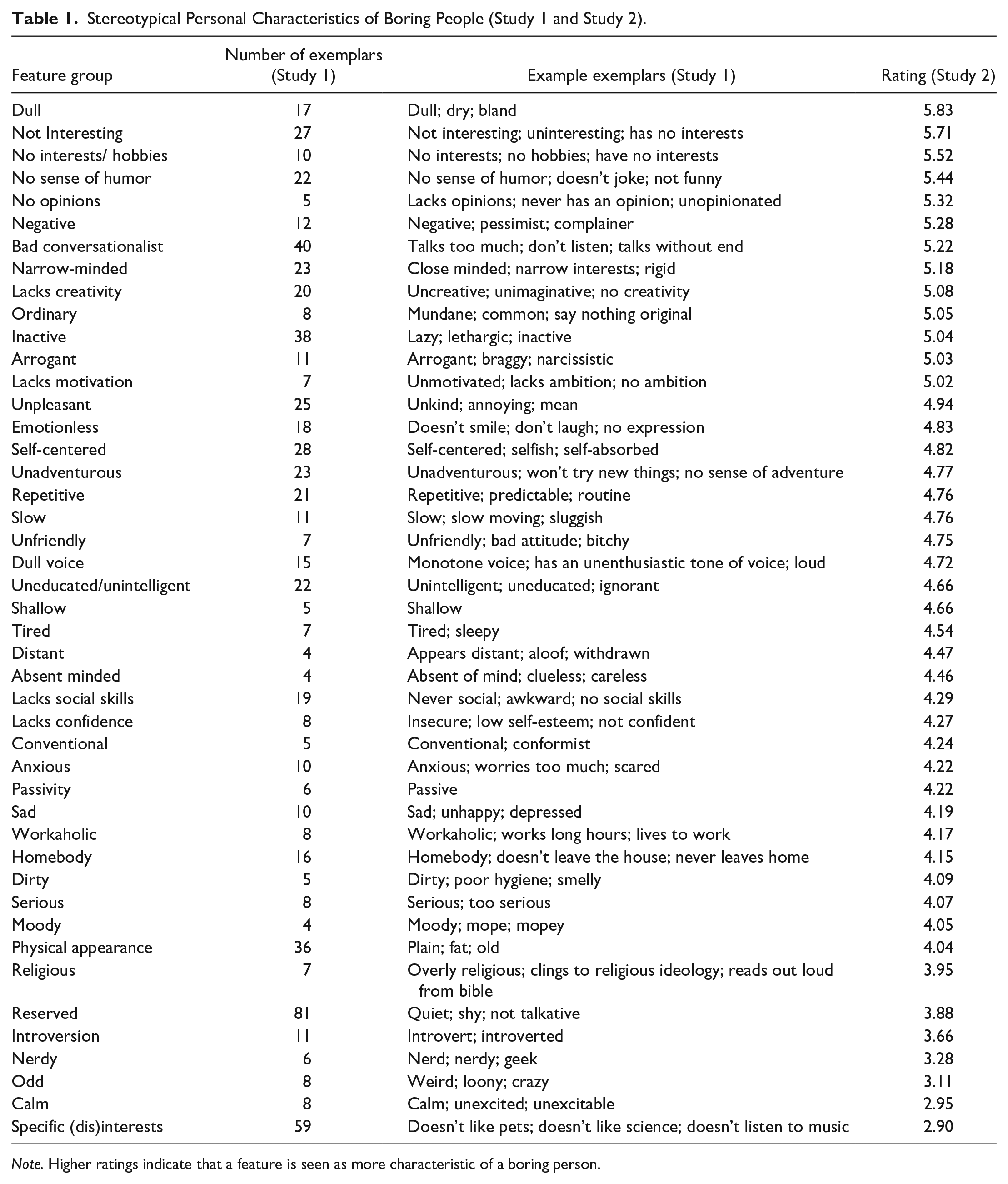
Note. Higher ratings indicate that a feature is seen as more characteristic of a boring person.
Stereotypical Occupations of Boring People (Study 1 and Study 2).
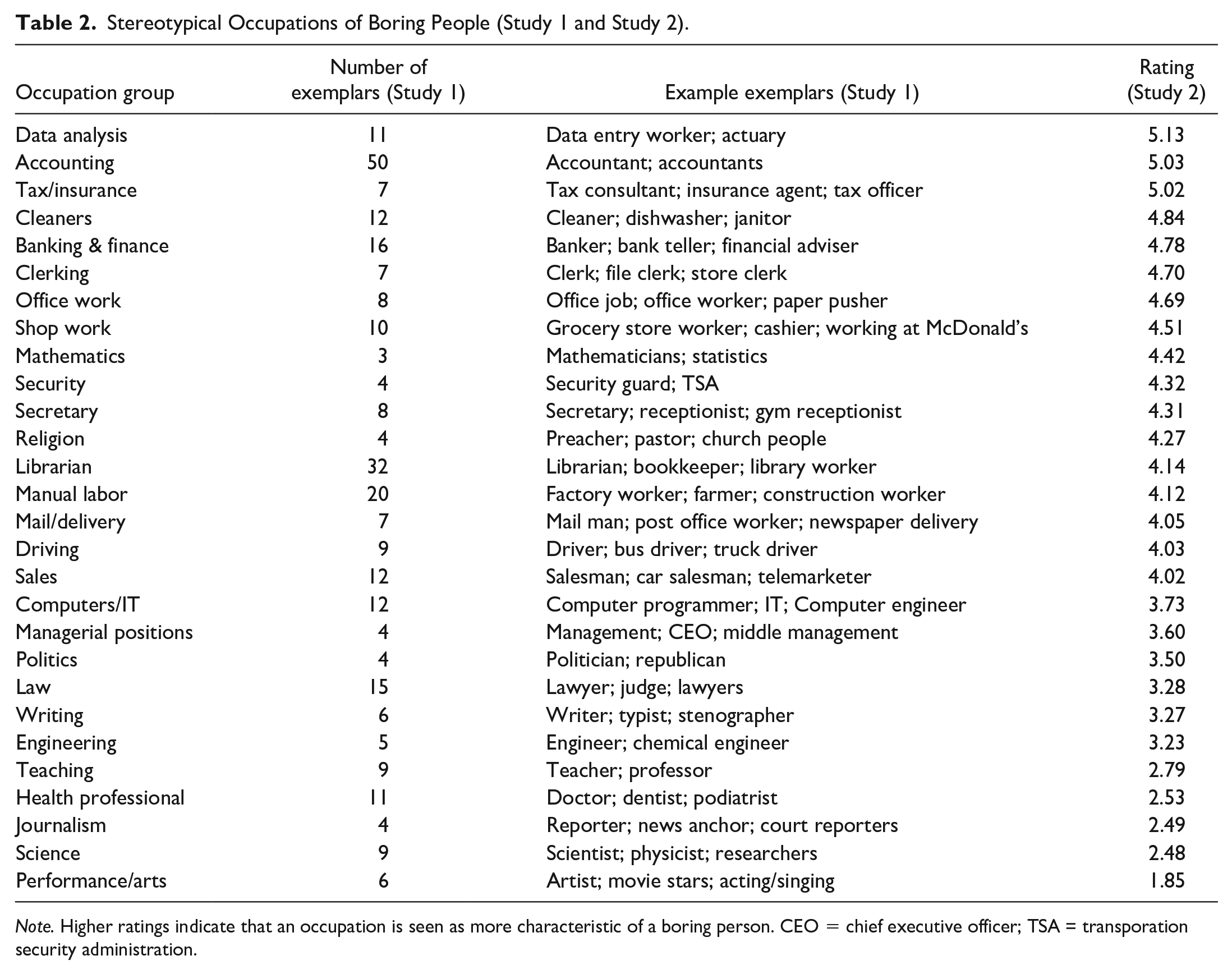
Note. Higher ratings indicate that an occupation is seen as more characteristic of a boring person. CEO = chief executive officer; TSA = transporation security administration.
Stereotypical Hobbies of Boring People (Study 1 and Study 2).
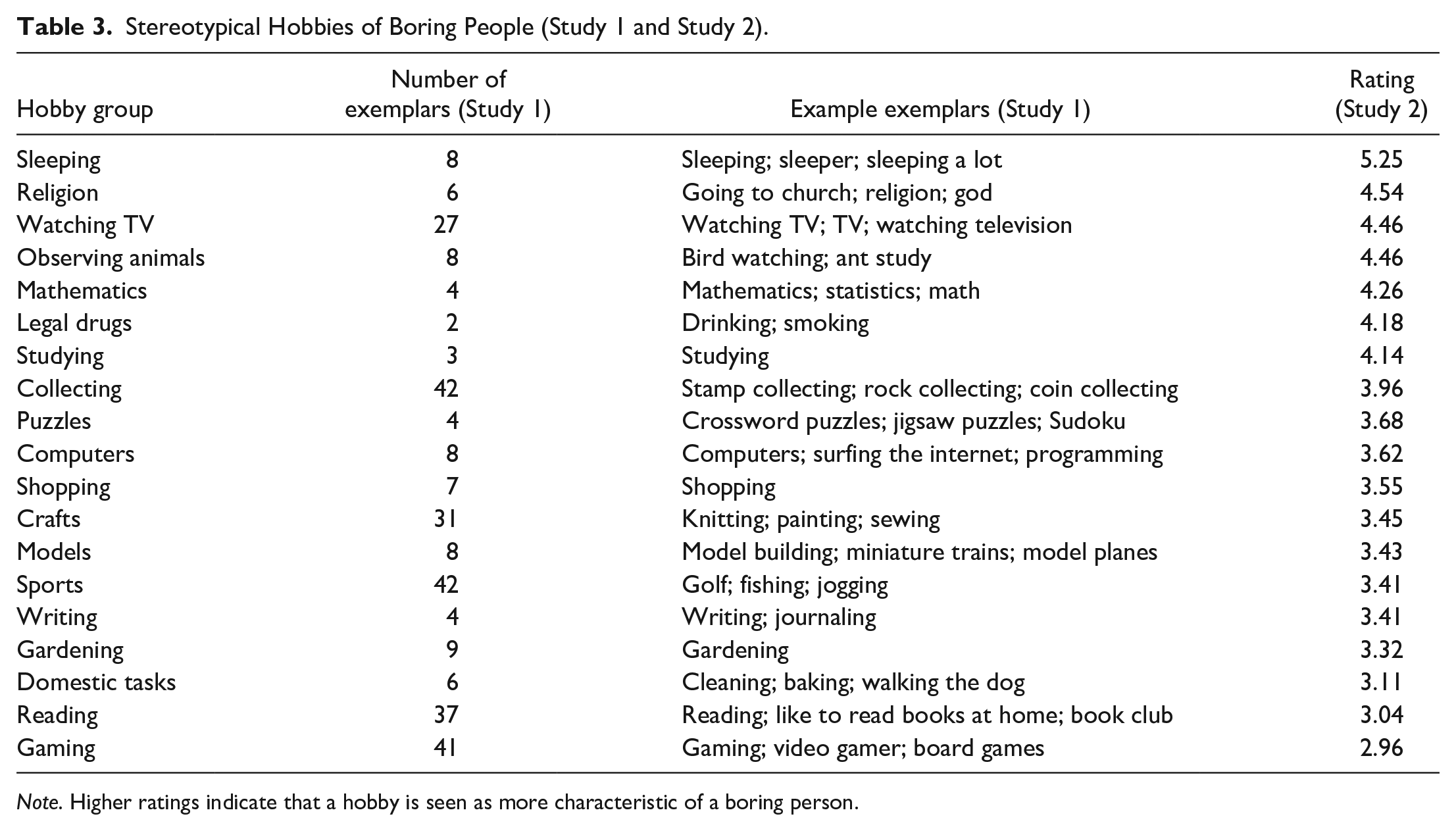
Note. Higher ratings indicate that a hobby is seen as more characteristic of a boring person.
Study 2: Stereotype Feature Ratings
The previous study generated a large number of grouped personal characteristics, occupations, and hobbies that were considered stereotypical of boring people. In Study 2, we examined how strongly these characterized stereotypically boring people. Given the large number of features identified in Study 1, we used three separate samples to evaluate the 45 personal characteristics (Sample A), 28 occupations (Sample B), and 19 hobbies (Sample C), respectively, to avoid participant boredom.
Method
Participants and design
Sample A comprised 116 people (55 women, 50 men; 1 nonbinary; Mage = 35.84, SD = 11.72), Sample B included 118 people (56 women, 50 men; 2 nonbinary; Mage = 36.97, SD = 13.21), and Sample C had 114 people (52 women, 59 men; 3 undisclosed; Mage = 36.49, SD = 11.67). All participants resided in the United States and were recruited online through MTurk. The exploratory study was correlational.
Materials and procedure
Participants read an information sheet and gave consent before taking part in the study. Sample A evaluated, in random order, how typical 45 personal characteristics were of stereotypically boring people. For example, for the “lacks creativity” characteristics group, we told them, “A person is described as unimaginative and lacking creativity. Please rate how boring they seem to you.” (1 = not boring at all; 7 = extremely boring). Sample B instead rated the 28 occupations in random order (e.g., “A person works as a librarian. Please rate how boring they seem to you; 1 = not boring at all; 7 = extremely boring), and Sample C rated the randomly ordered 19 hobbies (e.g., “A person enjoys playing video games and board games. Please rate how boring you find them” 1 = not boring at all; 7 = extremely boring). Participants then reported their demographics and were thanked, rewarded, and debriefed.
Results and Discussion
We computed average ratings for each of the features that participants of Samples A, B, and C evaluated. Tables 1 through 3 list personal characteristics, occupations, and hobbies in descending order of being perceived as stereotypical of boring individuals.
Among the personal characteristics believed to be most stereotypical of boring people were some generic features nearly synonymous with boredom, namely, people being dull and not interesting. Furthermore, those who lack hobbies, lack a sense of humor, and lack opinions were among the top stereotypically boring individuals. Among the occupations, participants assigned the highest ratings (i.e., most characteristic of stereotypically boring people) to data analysts, accountants, and those involved in taxation. The hobbies that participants considered most stereotypical of boring people were sleeping, religious activities, watching TV, animal observation, and mathematics. Study 2 provided a quantification of feature typicality associated with stereotypically boring people.
Study 3: Attributions of Warmth and Competence
Studies 1 and 2 assessed the content of the stereotype that people hold of boring people. Next, we tested how these stereotypical features shape person perception and people’s behavior. In Study 3, we created vignettes that embedded features rated in Study 2 as highly, intermediately, or hardly stereotypically boring, without any explicit reference to boring people. A similar method has been successfully employed in research on lay conceptions of nostalgia (Hepper et al., 2012), heroes (Kinsella et al., 2015), and disillusionment (Maher et al., 2020). Using these vignette-based person descriptions, we examined whether these elicited impressions of boringness. Crucially, we also assessed the perceived interpersonal warmth and competence (Cuddy et al., 2008).
Method
Participants and design
We recruited 55 people through MTurk. We excluded five participants who completed the study in less than a third of the median completion time of 299 s, and one participant who took longer than triple median completion time (Mahadevan et al., 2016). The final sample contained 49 participants (27 women, 22 men; Mage = 38.35, SD = 11.82). The study followed a within-subjects design (high boredom, intermediate boredom, low boredom). Our sample afforded power of 1 – β = .90, to detect effects sized, f = 0.20, with Type I error of, α = .05 (two-tailed) and assuming moderate correlations among the three measurements occasions.
Procedure and materials
After participants gave their informed consent, they read three vignettes. Each vignette described a hypothetical person using terms that were drawn from (a) the most boring features, occupations, and hobbies (high boredom vignette); (b) moderately boring features, occupations, and hobbies (intermediate boredom vignette); or (c) the least boring features, occupations, and hobbies (low boredom vignette). We created two different vignettes for each condition, one featuring a female protagonist and one featuring a male one. For each vignette, we inserted one occupation, three hobbies (or mentioning of lack thereof), and three generic features. Each of the used pieces of stereotype content featured only once in the resultant six vignettes.
Participants read one high boredom vignette, one intermediate boredom vignette, and one low boredom vignette in random order. For each vignette, we randomly selected the female or male protagonist version. A single-item measure of perceived boredom followed each vignette (e.g., “How boring do you think that Phoebe is?”; 1 = not at all, 7 = extremely) as well as measures of perceived competence, e.g., “How competent do you think that Phoebe is? (skilled, hard-working)”; 1 = not at all, 7 = extremely, and perceived interpersonal warmth, “How warm do you think that Phoebe is? (friendly, caring)”; 1 = not at all, 7 = extremely. Participants then reported demographics and were rewarded and thanked for their participation.
Results and Discussion
Perceived boringness
A within-subject analysis of variance (ANOVA) revealed significant and substantial differences in boringness attributed to the persons in the high, intermediate, and low boringness vignettes, F(2, 96) = 29.51, p < .001,
Social Attributions (Study 3).
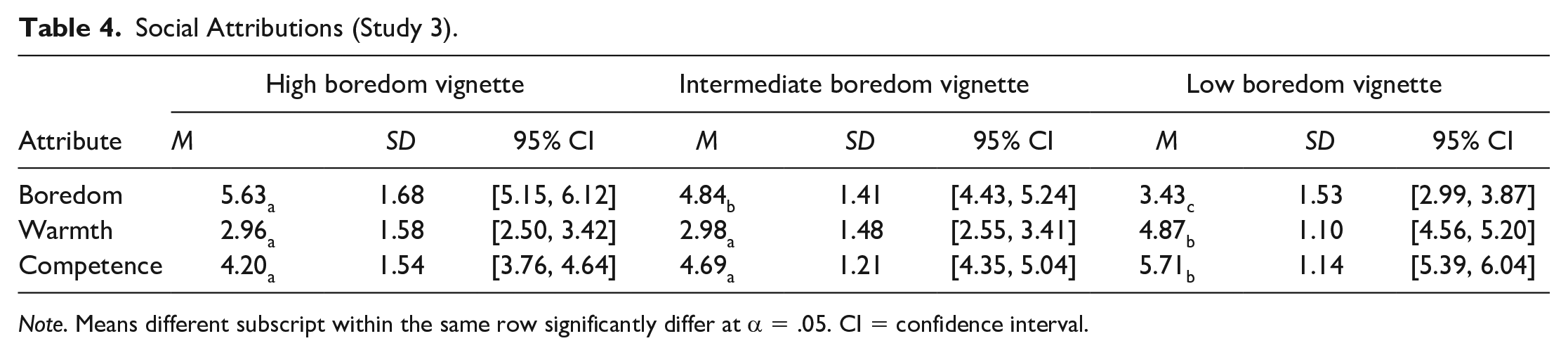
Note. Means different subscript within the same row significantly differ at α = .05. CI = confidence interval.
Interpersonal Warmth and Competence
A within-subject ANOVA revealed significant and substantial differences in the interpersonal warmth attributed to the persons, F(2, 94) = 34.22, p < .001,
We also found significant and substantial differences in perceived competence, F(2, 96) = 17.62, p < .001,
The results of Study 3 indicate that the stereotypical boringness of people described in vignettes based on the features gleaned in Studies 1 and 2 affected person perception as expected. The more typical the features of stereotypical boringness described a person, the more the person was perceived as boring. Furthermore, and important for the social consequences of such perception, stereotypical boringness affected perceptions of interpersonal warmth and competence. Stereotypically boring people are perceived as less warm and as less competent. Next, we examined an important social consequence of boringness perceptions: interpersonal avoidance.
Study 4: Interpersonal Avoidance
The results of Study 3 show that others described using stereotypically boring features are seen as less interpersonally warm and less competent. Plausibly, people who are perceived as boring are liked less. Indeed, we suggest that the dislike for stereotypically boring people motivates avoidance toward them. Literature documented that avoidance of people at the individual and the group level can have profound personal and social consequences (e.g., Baumeister et al., 2005). We thus examined whether the negative stereotype of boring people motivates avoidance toward people who are perceived as boring.
Participants and Design
Participants were 100 people residing in the United Kingdom recruited through the online crowdsourcing service Prolific.co. We excluded one participant who completed the study in less than a third of the median completion time of 297 s. The final sample contained 99 participants (74 women, 25 men; Mage = 34.16, SD = 11.60). The study had a within-subjects design (high boredom, intermediate boredom, and low boredom). Our sample afforded power of 1 – β = .90, to detect effects sized, f = 0.15, with Type I error of α = .05 (two-tailed), assuming moderate correlations among the three measurements occasions.
Procedure and Materials
We used the identical vignettes and the boringness measure as in Study 3. We developed 6 self-report items to measure social avoidance: “It would take me effort to hang out with this person,” “I would be willing to lie that I don’t have time to avoid being with this person,” “I want to hang out with this person” (reversed), “I would like to introduce this person to my friends” (reversed), “I would like to befriend or follow this person on social media” (reversed), and “If this person were to contact me by phone then I would be likely to call back” (reversed). These items were evaluated on a 7-point scale (1 = Not at all, 7 = Very much) and yielded appropriate internal consistency for the high (α = .72), intermediate (α = .73), and low (α = .77) boredom conditions. 2
Results and Discussion
Perceived boringness
A within-subject ANOVA indicated that the persons described in the high, intermediate, and low boredom vignettes were attributed significantly, and substantially, different levels of boringness, F(2, 192) = 103.00, p < .001,
Social Attributions (Study 4).
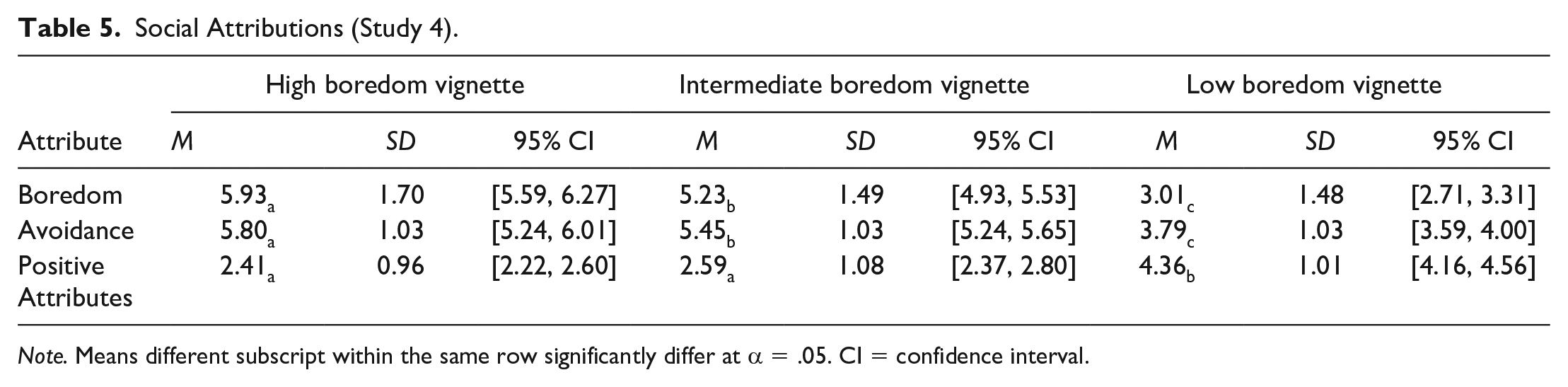
Note. Means different subscript within the same row significantly differ at α = .05. CI = confidence interval.
Interpersonal avoidance
A within-subject ANOVA revealed significant and substantial differences in how strongly participants wanted to socially avoid the persons from the three vignettes, F(2, 196) = 144.64, p < .001,
Overall, these results demonstrate that the boringness of people increases social avoidance by others. These results are consistent with those of Study 3 that boringness transfers to overall negative perceptions and add that people try to avoid stereotypically boring people, construed as a passive act of harm within stereotyping literature (Cuddy et al., 2008). Next, we examined how much people try to actively avoid people in monetary terms.
Study 5: Enduring Boring Others as a Costly Burden
Studies 3 and 4 confirmed that features of boringness used in person descriptions affected person perception and how people relate to these people. Specifically, we found that persons who were considered more stereotypically boring were also considered less interpersonally warm and less competent, and people wish to avoid them. We next tested if people are willing to avoid more actively the company of stereotypically boring others by asking participants how much they would need to be compensated, in monetary amounts, for being a company to a stereotypical bore. In so doing, we sought to extend the self-reported attitudes into a quantified domain (monetary compensation), offering insight into the lengths to which people were willing to go to avoid a boring person in more real-life standards.
Method
Participants and design
We recruited 116 people through MTurk. We excluded four participants who completed the study in less than a third of the median completion time of 306.5 s and two participants took longer than triple the median. The final sample contained 110 participants (58 women, 52 men; Mage = 35.79, SD = 10.79). The study followed a within-subjects design (high boredom, intermediate boredom, and low boredom). Our sample had a power of 1 – β = .90, to detect effects sized, f = 0.14, with Type I error of, α = .05 (two-tailed) and assuming moderate correlations among the three measurements.
Materials and procedure
Participants gave informed consent and reported demographics. They then read three vignettes (high boredom vignette, intermediate boredom vignette, and low boredom vignette) in random order. The vignette procedure mimicked that of Study 3. Participants indicated after each vignette how boring they thought that the described person was, as in Study 3. We then probed their social reaction to this person. Specifically, participants read Imagine that you are asked to spend time hanging out with this person. Below, you find different periods of time you might be asked to spend with them. Indicate for each period of time how much you would need to be paid in order to accept spending this amount of time with this person. Please indicate this in US Dollars ($).
Participants accordingly indicated how much they felt they needed to be compensated for hanging out with the person described in the vignette for 1 through 7 days. Participants were then rewarded and thanked for their participation.
Results and Discussion
Perceived boredom
A within-subject ANOVA revealed significant and substantial differences in boredom attributed to the high, intermediate, and low boredom persons, F(2, 210) = 40.57, p < .001,
Required monetary compensation
Participants evaluated the persons in the vignettes for seven durations each, with these durations spanning 1 through 7 days. To analyze these nested data, we conducted a random intercept multilevel analysis with as predictors the categorical boredom condition (high, intermediate, low), the duration of spending time with the described person (1 through 7, as a continuous variable), and their interaction. A random intercept was assigned to participants. We included the natural logarithm of participants’ required monetary compensation to remedy the high positive skew that monetary responses without an upper limit tend to produce, after adding the value of $1 to all responses to avoid missing values produced by taking the natural logarithm of 0. 3 We excluded one participant from this analysis who demanded compensations that were in the order of billions of dollars―an obvious outlier. Figure 1A displays the predicted values corresponding to this analysis. Figure 1B displays the same results after transforming them back into regular monetary values to ease interpretation.
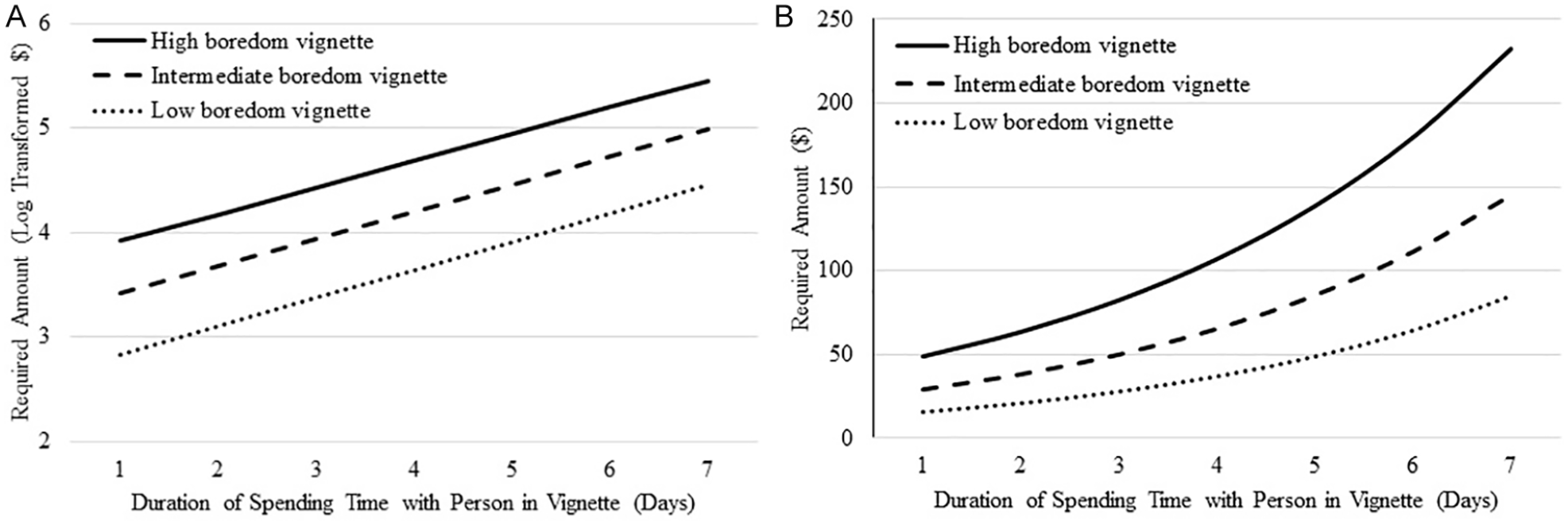
(A) Predicted values for log-transformed required compensation (Study 5). (B) Predicted values for untransformed required compensation (Study 5).
The results evidenced a significant effect of duration, F(1, 2169) = 769.92, p < .001, indicating that participants required higher monetary compensation for each additional day spent with the persons described in the vignettes. We also found the predicted significant effect of the level of boredom corresponding to the persons described in the vignettes, F(2, 2169) = 56.94, p < .001. The duration × boredom condition interaction was not significant, F(2, 2169) = 0.22, p = .805.
Participants required significantly higher compensation for spending time with the stereotypically highly boring person compared with the intermediately boring person, B = −0.22, SE = 0.05, t(2,169) = 4.94, p < .001, 95% CI = [−0.31, −0.13], and compared with the little boring person, B = −0.48 SE = 0.05, t(2,169) = 10.66, p < .001, 95%CI = [−0.57, −0.39]. The required compensation for spending time with intermediately and little boring persons also significantly differed, B = 0.26, SE = 0.05, t(2,169) = 5.73, p < .001, 95% CI = [0.17, 0.35]. These results indicate an increasing social aversion to others when they possess characteristics that make them stereotypically boring.
The results of Study 5 further demonstrate that stereotypically boring people are unpopular, consistent with the person perception results of Study 3 and the social avoidance results of Study 4. Specifically, the results show that compensation is needed to endure the presence of stereotypically boring people The study also hints at social dynamics, namely, that stereotypically boring people might be able to counter the tendencies of their avoidance with financial compensations.
General Discussion
Being a bore is hardly a crime; yet, our studies suggest that those who are stereotypically boring incur negative attributions of warmth and competence, face social disapproval, and test the endurance of people’s company. Study 1 explored the occupations, hobbies, and personal characteristics that people stereotypically associate with boring others. Participants generated these features freely and we grouped this stereotype content into categories. We tested, in Study 2, how well they describe stereotypically boring others. Together, these studies suggested that people with occupations in data analysis, accounting, and taxation seemed particularly boring to our participants. Those whose “hobbies” included sleeping, religion, and watching TV were also considered particularly boring, as were those who lacked humor, expressed no opinions, and came across as negative. Boring people stereotypically congregate in small cities and towns as opposed to villages and large cities.
Studies 3 to 5 examined attributions and reactions that those who possess these features may incur. Participants reacted to persons described in vignettes embedded with features that characterized stereotypically boring others to various degrees. This method allowed us to examine social perceptions of boring others without the need to refer to boredom in their descriptions explicitly, reducing demand effects. Results confirmed that more boredom was attributed to those described using more, versus less, stereotypically boring features. Furthermore, Study 3 showed that possessing stereotypically boring features comes with less perceived interpersonal warmth and less competence. Study 4 further indicated that conforming to the boring person stereotype came with increased social avoidance. Consistently, Study 5 showed that keeping company with a stereotypical bore is psychologically costly, evident from the suggested compensation that participants asked for. Finally, in a supplementary study (S1; Research Supplement), we explored if stereotypically boring people are perceived in a more positive light when they occupy a job that requires a stereotypically boring person relative to the same job performed by a less stereotypically boring person. We did not find evidence for this potential moderation, suggesting that even when a stereotypically boring person is the best fit for a job, people still prefer a stereotypically less boring alternative.
Overall, our results fit well within research on the stereotype content model (Fiske et al., 2002) and the behavior from intergroup affect and stereotypes map (Cuddy et al., 2008). As with other group stereotypes, the stereotype of boring people could be helpfully described based on warmth and competence dimensions and corresponding responses (avoidance). The stereotype of boring people, different from many other stereotypes, is characterized by both low warmth and low competence.
Contributions
Our research shows that being perceived as boring likely conveys low competence and low warmth, being a social burden, thus causing avoidance by others. Rather than innocuous, such social reactions can lead to social isolation, for example, in the form of loneliness or ostracism (Weiss, 1973; Williams, 2002) with profound psychological consequences (Cacioppo et al., 2003; Williams, 2012). Those perceived as boring may thus be at greater risk of harm. Furthermore, despite the negative stereotype that those who perform jobs in, for example, accounting, taxation, and data analysis may accordingly face, society needs people to perform those roles. Rather than perceiving them as performing a social “crime,” as Cecil Beaton may have joked, perhaps those seen as boring should receive some sympathy and support instead.
The stereotype content model (Fiske et al., 2002) characterizes groups within a space characterized by low or high warmth and competence. Group stereotypes are most typically located in areas where one quality is relatively low while the other is relatively high. (Fiske et al., 2002). Low attributed competence and warmth rarely occur in conjunction (Kervyn et al., 2009; Swencionis et al., 2017). These perceptions apply to most marginalized and disenfranchised groups in society (e.g., immigrants, the poor, the homeless; Fiske, 2018), including stereotypically boring people. This positioning is theoretically intriguing: groups perceived as low in warmth and competence are often characterized as having relatively low power in society (Fiske & Cuddy, 2006). Yet, various features of the stereotype associated with boring people seem at odds with a low power position (e.g., high education/income occupations, such as banking and finance). While people might, unfortunately, get away with the avoidance or poor treatment of relatively low power groups such as the homeless, the same seems unlikely to apply when dealing with stereotypically boring people in positions of financial or social power. Their potential marginalization offers an intriguing avenue for theoretical refinement of relevant theory. At the same time, the boring people stereotype seems distinct concerning its characteristics and the social consequences it could evoke.
Most models of boredom seem to converge on the important role that the adverse experience plays in guiding cognition and behavior (Elpidorou, 2014, 2018a, 2018b; Moynihan et al., 2020; Struk et al., 2016; Van Tilburg & Igou, 2012, 2019; Velasco, 2019). For example, Eastwood and Gorelik’s (2019) unused cognitive potential model (see also Eastwood et al., 2012) proposes that boredom can be understood as “the feeling associated with a failure to engage our cognitive capacity (desire bind) such that cognitive capacity remains under-utilized (unoccupied mind)” (p. 57). Van Tilburg and Igou’s (2011, 2019) pragmatic meaning-regulation approach characterized boredom as an emotion that signals a lack of meaning in the task at hand and encourages an active search for more meaningful alternatives or a withdrawal from the situations (see also Moynihan et al., 2021). Combining these ideas, Westgate and Wilson’s (2018) MAC model proposed that boredom is characterized by low attention or a lack of meaning and that these two factors contribute to boredom independently. Further integrating these models, Tam and colleagues (2021) suggest that a range of cognitive appraisals—meaning, control, and challenge—help to understand attentional engagement. What all these approaches share, however, is the notion that boredom is key to understanding cognition and behavior: It casts boredom in the reactionary role of causing aversion to, disengagement from, or avoidance of, the cause of boredom, consistent with the social reactions that stereotypically boring persons seem to incur.
Our research portrays boredom as a protagonist in person perceptions and interactions. This treatment is consistent with work on boredom in other disciplines, such as sociology. For example, Brissett and Snow (1993) argue that boredom is an interactional phenomenon characterized by people feeling “being out of synch with the ongoing rhythms of social life” (p. 239). Boredom marks the perception that one’s contribution to the future is insignificant, casting one’s life as a rather meaningless part of society at large. In this sense, boredom may be the product of a consumer-oriented and affluent society. Brissett and Snow further highlight that expressions of boredom can serve dedicated communication purposes. For example, stating that one is bored, as opposed to depressed, may portray the self as more superior or to save face.
Ohlmeier and colleagues (2020) likewise emphasize the socially constructed side of this emotion. They highlight that, historically, scholars have suggested that modernity has caused failures to find meaning in life, work, or other activities, which in turn renders people bored. Schopenhauer (1851) even suggested that achieving all we aspire to in life merely renders us bored. In a similar vein, Ohlmeier and colleagues propose that “The easier and more predictable modern life becomes, the more boring it seems.” (p. 212). The notion that boredom is an indicator of an “easy” life might, at the surface, seem to suggest that expressing boredom ought to signal one’s success or status in life. However, Ohlmeier and colleagues (2020) note that the construct of boredom may be associated with marginalized groups as well; they propose that social inequalities within a particular society can play an important role in how people understand boredom.
Consistently, Ohlmeier and colleagues note that social norms currently discourage expressing boredom (Hochschild, 1983) in interactional settings and that the term is considered a sign of social disapproval (see also Conrad, 1997). Boredom, in this sense, signals a disjunction from one’s social role (Goffman, 1956, 1982), such as talking excessively in a context that requires one to be a careful listener (e.g., Leary et al., 1986). In work settings, expressions of boredom may be suppressed or discouraged if cultural norms emphasize achievement-orientation, where boredom may be taken as an indication of poor person-situation fit.
Limitations and Future Directions
We examined the stereotypical features of boring people in United States (Studies 1–3 and 5) and United Kingdom (Study 4) samples recruited online. Readers may legitimately question whether these stereotype content features generalize to other populations. We suspect that there are cultural variations in these stereotype features (see also Henrich et al., 2010). For example, societies likely differ in the degree to which religious activities—in our current samples typically siding with being perceived as “boring”—are seen like that elsewhere, given the substantial variation in religious beliefs and practices worldwide and the links that religiosity has with boredom (Van Tilburg et al., 2019). Furthermore, it is possible that some stereotype features have limited temporal generalizability, with technological and broader societal developments likely altering the content of hobbies and occupations. As a case in point, perceptions of jobs in computing and IT—currently ranked mid-boring among our occupations—may change over time, with activities such as coding and gaming perhaps gradually becoming more mainstream (see Kowert & Oldmeadow, 2012).
Thus, the specific stereotype content will likely apply increasingly less as the degree of deviations from these specific settings increases. We assure the reader, however, that this is not necessarily a limiting factor. While the content of the boring person stereotype likely varies somewhat across societies and time, it might well be that the (negative) social perceptions generalize much better. For example, we replicated the lack of perceived warmth that Leary and colleagues’ (1986) study found, conducted more than 30 years ago. While generalizability across societies, not to mention time, requires further empirical verification, we are cautiously optimistic that the negative social implications of being perceived as a bore are found in other settings.
By examining the content of the boring people stereotype, we focused on the stereotype content model (Fiske et al., 2002). Yet, our research also has implications for models that highlight the importance of agency and communion (e.g., Abele & Wojciszke, 2014; Koch et al., 2016). We reason that boring people are unlikely to be seen as agentic given the centrality of the laziness trait within the stereotype. Furthermore, given the perceived lack of social skills and not being liked, boring people are unlikely to be perceived as communal. Research would benefit from examining the fit of the boring people across the content models that highlight alternative dimensions (e.g., agency/communion; e.g., Abele & Wojciszke, 2014; Koch et al., 2016). We assume that the boring people stereotype will occupy a salient and distinct place across the various stereotype content dimensions.
We examined boredom using vignettes that described people with features that were rated differently in how stereotypically boring they were. There was considerable variation in the level of boredom that these features signaled, and we could hence examine responses to people who appeared as highly, intermediately, or a little boring. However, we did not have a truly “nonboring” control, and results should hence be interpreted as reflecting reactions to others who differ in degree of boredom rather than presence versus absence of boring features. Furthermore, we did not assess whether or to what degree features ascribed to stereotypically boring people overlap with those of other stereotyped groups, or if, perhaps, other labels (e.g., stereotypically unfriendly people, stereotypically unsociable people) fit as well. These are limitations that could be addressed in future research.
Studies 4 and 5 examined the tentative avoidance of stereotypically boring persons. Is this avoidance primarily associated with a corresponding lack of warmth or competence attributed to stereotypically boring individuals? Perhaps the relative roles of warmth versus competence in interpersonal avoidance may be context-dependent. In a context where people prioritize affiliation with others (e.g., a party), it might well be that avoidance is primarily predicted by (lack of) perceived warmth. In a context where, on the other hand, people seek out others with competency skills (e.g., expert advice and tech support), avoidance may be predicted primarily by (lack of) perceived competence instead. Future research should examine the roles that warmth and competence may independently, or perhaps interactively, play in avoidance.
Our research confirms that the boring people stereotype exists, and it creates clarity about the typical features of the stereotype and the social consequences of being perceived as boring. We assume that this stereotype is more likely to affect impression formation under conditions of low capacity and low accuracy motivation (e.g., Fiske & Neuberg, 1990; Petty & Cacioppo, 1986). That said, given the negativity of its content across features of competence and interpersonal warmth, we speculate that the stereotype is especially likely to be applied when people are negatively biased toward targets, whether they be individuals or groups, for example, in situations of psychological threat and conflict (e.g., Brown, 2000; Eagly & Chaiken, 1993). Work on stereotypes and motivated reasoning shows that the activation and use of stereotypes when forming impressions of others is in part shaped by the goals that people have (Kundra & Sinclair, 1999). A particularly interesting case emerges in situations where the use or inhibition of a particular stereotype may serve to boost some aspect of the self. For example, research shows that the application of negative out-group stereotypes helps improve one’s own self-worth (e.g., Greenberg et al., 1990). Perhaps the application of the boring people stereotype offers people an opportunity to flatter their self-perceived, or socially communicated, creativity or uniqueness. Interestingly, if such strategic use of stereotyping others occurs especially under self-threat, it is possible that precisely those individuals who are suspect of being bores themselves will stereotype others. If true, such compensatory stereotyping gives new meaning to the popular belief that “only boring people get bored”: only (or especially) boring people get bored with others. Relatedly, it is plausible that in some contexts the boring people stereotype is more relevant than in others, especially when being boring is highly inconsistent with the contextual demands (e.g., book clubs, dating, and entertainment). Future research should examine more closely the conditions under which the boring people stereotype comes into play.
Conclusion
Stereotypically boring people are genuinely disliked. Specifically, our research shows that people who possess stereotypically boring features are perceived as both less interpersonally warm and less competent, and they elicit social avoidance by others—coming across as boring is thus rooted in stereotypes that people hold, which are likely to materialize in social repercussions.
Supplemental Material
sj-docx-1-psp-10.1177_01461672221079104 – Supplemental material for Boring People: Stereotype Characteristics, Interpersonal Attributions, and Social Reactions
Supplemental material, sj-docx-1-psp-10.1177_01461672221079104 for Boring People: Stereotype Characteristics, Interpersonal Attributions, and Social Reactions by Wijnand A. P. van Tilburg, Eric R. Igou and Mehr Panjwani in Personality and Social Psychology Bulletin
Footnotes
Acknowledgements
We thank Ying Lin for her help with conducting Study 4.
Declaration of Conflicting Interests
The author(s) declared no potential conflicts of interest with respect to the research, authorship, and/or publication of this article.
Funding
The author(s) received no financial support for the research, authorship, and/or publication of this article.

Supplemental Material
Supplemental material is available online with this article.
Notes
References
Supplementary Material
Please find the following supplemental material available below.
For Open Access articles published under a Creative Commons License, all supplemental material carries the same license as the article it is associated with.
For non-Open Access articles published, all supplemental material carries a non-exclusive license, and permission requests for re-use of supplemental material or any part of supplemental material shall be sent directly to the copyright owner as specified in the copyright notice associated with the article.
