




Abstract
Do people know how their romantic partner (i.e., the perceiver) views the self’s (i.e., the metaperceiver’s) emotions, displaying emotion meta-accuracy? Is it relevant to relationship quality? Using a sample of romantic couples (Ncouples = 189), we found evidence for two types of emotion meta-accuracy across three different interactions: (a) normative emotion meta-accuracy, knowing perceivers’ impressions of metaperceivers’ emotions that are in line with how the average person may feel, and (b) distinctive emotion meta-accuracy, knowing perceivers’ unique impression of metaperceivers’ emotions. Furthermore, across interactions, normative emotion meta-accuracy was positively related to momentary relationship quality for metaperceivers and perceivers and this link was especially strong in the conflict interaction. Distinctive emotion meta-accuracy was negatively related to momentary relationship quality across interactions for perceivers and in the conflict interaction for metaperceivers. Overall, it may be adaptive for metaperceivers to accurately infer perceivers’ normative impressions and to remain blissfully unaware of their unique impressions.
Keywords
Meta-accuracy is the ability to correctly infer how others see us. Past work suggests that people display meta-accuracy of personality (Carlson & Furr, 2009) and relational constructs such as trust (Brion et al., 2015; Campagna et al., 2020) and perceived value (Elfenbein et al., 2009). But are people also aware of others’ judgments on less stable constructs, such as one’s emotions, exhibiting emotion meta-accuracy? Furthermore, given that meta-accuracy in other domains has been linked to important relationship processes such as relationship quality (e.g., Carlson, 2016b; Tissera et al., 2021), is emotion meta-accuracy similarly relevant to relationship quality? The present research addressed these questions by examining whether romantic partners demonstrate emotion meta-accuracy across three types of interactions (unstructured, conflict, and positive) and its links with momentary relationship quality in each context.
What Is Emotion Meta-Accuracy?
To display emotion meta-accuracy is to correctly understand a romantic partner’s (i.e., a perceiver’s) impressions of the self’s (i.e., the metaperceiver’s) emotions. For instance, does Maya, the metaperceiver, correctly recognize that Pete, the perceiver, sees her as feeling more anxious than relaxed? In other words, emotion meta-accuracy is the extent to which metaperceptions (i.e., beliefs about how perceivers view metaperceivers’ emotions) correctly map onto perceivers’ actual reports about metaperceivers’ emotions. This is different from other commonly studied concepts, including empathic accuracy, which is concerned with the congruence between targets’ (or metaperceivers’) actual thoughts and feelings and perceivers’ impressions of these (e.g., does Pete correctly recognize that Maya is feeling more anxious than relaxed?) and perspective taking, which is concerned with adopting someone else’s viewpoint to look at a situation (e.g., can Pete understand Maya’s perspective of a specific situation, such as a conflict?). Thus, the present work focuses on understanding whether metaperceivers have awareness of how perceivers view metaperceivers’ emotions, and the interpersonal correlates of emotion meta-accuracy, such as whether (and how) it may relate to romantic relationship quality in different contexts. 1
Indexing Emotion Meta-Accuracy
There are different approaches for indexing meta-accuracy (Donnelly et al., 2021). The present study employed the profile approach (see Back & Nestler, 2016; Borkenau & Leising, 2016), more common in the personality judgment literature (but see Levavi-Francy et al., 2020, for a recent application of the profile approach to examine emotional similarity). We first requested participants to provide self-, partner-, and metaperception ratings on a series of emotions (e.g., relaxed, disappointed, anxious) following each of the interactions. Then, we defined emotion meta-accuracy as the correspondence between metaperceptions and perceivers’ impressions across this predetermined range of emotions. That is, emotion meta-accuracy refers to whether metaperceivers understood perceivers’ impressions of metaperceivers’ pattern of feelings across a series of emotions (e.g., more anxious than relaxed). As such, this method provides a holistic indicator of meta-accuracy across emotions.
Components of Emotion Meta-Accuracy
Another unique benefit of the profile approach is that it affords the possibility of decomposing emotion meta-accuracy into different independent components. The first component we explored is normative emotion meta-accuracy, which is the extent to which metaperceivers correctly recognize how perceivers’ impressions of the metaperceivers’ emotions are in line with how someone might typically feel in a given context. In other words, Maya displays normative emotion meta-accuracy to the extent that she correctly realizes that Pete sees her as experiencing greater contentment than disappointment during their conversation, consistent with how people typically tend to feel. As is the case with normative accuracy more generally (Wood & Furr, 2016), and normative meta-accuracy of personality traits (e.g., Carlson, 2016a, 2016b), normative emotion meta-accuracy is considered an index of positivity. This is because the normative profile of emotions has been found to be strongly related to the socially desirable profile of emotions (Wood & Furr, 2016). As such, in the present study, we conceptualize normative emotion meta-accuracy both as an indicator of accuracy and positivity of metaperceptions (see the Supplementary Online Materials [SOM] for the normative profiles of emotions from the present sample).
Although normative emotion meta-accuracy statistically indexes and is interpreted as an accurate metaperception, it is not clear what drives normative emotion meta-accuracy. Maya could display normative emotion meta-accuracy because she actually recognizes Pete’s normative and positive impression of her, which could suggest that normative emotion meta-accuracy is driven by accuracy. However, she may also recognize Pete’s normative impressions because she assumes he sees her in a positive way, in which case normative emotion meta-accuracy could be driven by bias. She may also recognize Pete’s normative impressions simply by chance, which could be considered a statistical artifact. As such, normative emotion meta-accuracy could be driven by several different forces.
For this reason, we also explored a more stringent index of emotion meta-accuracy: distinctive emotion meta-accuracy. This index captures whether metaperceivers correctly recognize perceivers’ unique impression of metaperceivers’ feelings that are different from the normative profile, which may also be more difficult for metaperceivers to achieve as it is less likely to be achieved by chance and is independent of positivity bias. For example, Maya exhibits distinctive emotion meta-accuracy to the extent to which she correctly infers that Pete sees her as feeling even more relaxed than anxious relative to the average person (i.e., Pete’s distinct impression of her). As discussed elsewhere (see Kerr et al., 2020; Leising et al., 2015), the distinctive component of accuracy (and meta-accuracy) tends to be evaluatively neutral and is not necessarily negative. In other words, knowing perceivers’ distinct impressions does not automatically imply that metaperceivers believe they are seen negatively by perceivers; rather, it implies that metaperceivers correctly identify how perceivers’ impressions deviate from the normative profile.
In the present research, we examined whether metaperceivers displayed normative and distinctive emotion meta-accuracy. Past research has demonstrated that normative and distinctive components of meta-accuracy are related to different interpersonal correlates (e.g., liking, relationship quality) across different contexts (e.g., Carlson, 2016a, 2016b; Carlson & Oltmanns, 2018; Tissera et al., 2021). Therefore, we also examined how each of these components of emotion meta-accuracy related to momentary relationship quality for perceivers and metaperceivers and whether these associations were dependent on the type of interaction.
Is Emotion Meta-Accuracy Related to Romantic Relationship Quality?
Normative Emotion Meta-Accuracy
Could knowing perceivers’ normative and positive impressions of metaperceivers’ emotions benefit relationship quality? First, for metaperceivers, in past work, normative meta-accuracy of personality traits has been positively linked with relationship quality (Carlson, 2016b; Tissera et al., 2021). This may be because metaperceivers, in general, desire to be seen in more positive ways (Taylor & Brown, 1994) and better enjoy their relationships when they believe perceivers’ impressions of them are more positive (e.g., Murray et al., 1998). This finding may also extend to normative emotion meta-accuracy. Metaperceivers’ beliefs about being viewed normatively and positively by perceivers may help metaperceivers maintain positive self-views and, in turn, may enhance their enjoyment of the relationship. This may be especially the case in more emotionally loaded interactions, such as conflict interactions, which may otherwise negatively impact relationship quality.
Second, could normative emotion meta-accuracy also be related to perceivers’ relationship quality? There is some evidence supporting that normative meta-accuracy of personality is linked to greater relationship quality for perceivers in platonic, first impressions contexts. For example, perceivers better liked new acquaintances who accurately detected perceivers’ normative impressions of them (Carlson, 2016b; Tissera et al., 2021). One reason may be that metaperceivers may feel more relaxed and confident in their interactions when they believe they are seen positively by perceivers, allowing for more pleasant interactions. Accurately understanding perceivers’ normative impression could also allow for smoother conversations, which may also promote perceivers’ relationship quality. That said, past work examining this link in romantic contexts has observed null associations. Perceivers did not report greater relationship quality with a romantic partner (Carlson, 2016b) or romantic interest in a first date (Tissera et al., 2021) who believed that perceivers viewed their personality more normatively.
Taken together, there is reason to believe that normative emotion meta-accuracy will be related to greater relationship quality for metaperceivers. For perceivers, in light of these null associations in romantic contexts, it is less clear whether normative emotion meta-accuracy would be positively associated with relationship quality.
Distinctive Emotion Meta-Accuracy
How might accurately seeing perceivers’ distinctive impressions of metaperceivers relate to relationship quality? First, for metaperceivers, based on previous research in personality, distinctive meta-accuracy does not appear to be related to romantic relationship quality (Carlson, 2016b; Tissera et al., 2021). However, in one instance, Carlson (2016b) found a negative association between distinctive meta-accuracy and metaperceivers’ relationship quality in a platonic getting-acquainted setting. Given the negative association between distinctive meta-accuracy and relationship quality was not replicated in later research on first impressions (Tissera et al., 2021), it is not clear how reliable it is. Nonetheless, a negative association is conceivable in the context of emotion meta-accuracy. Drawing from the empathic accuracy literature, people are motivated to remain blissfully unaware of information that may threaten the relationship as greater accuracy of relationship threatening information could undermine relationship quality (Simpson et al., 1995, 2003). Understanding how perceivers see metaperceivers’ emotions in ways that deviate from the norm could undermine metaperceivers’ relationship quality, especially in more tense and conflictual contexts, where more distinctive impressions could contain more threatening information. This is possible even though distinctively accurate metaperceptions should be affectively neutral. Furthermore, to the extent that distinctive emotion meta-accuracy is driven by recognizing the extent to which perceivers’ impressions diverge from metaperceivers’ actual feelings (i.e., distinctive emotion meta-insight), it could lead to feelings of misunderstanding, which may be especially salient and harmful in conflictual contexts. 2
Second, how might distinctive emotion meta-accuracy be related to perceivers’ relationship quality? Distinctive meta-accuracy of personality has been found to be related to greater perceiver relationship quality in both first-impression contexts (Carlson, 2016b; Tissera et al., 2021) and in established relationships (Carlson, 2016b). This may be because distinctive meta-accuracy demonstrates self-knowledge, which is an appealing quality that is associated with greater perceiver relationship quality (Tenney et al., 2013). Distinctive emotion meta-accuracy could also allow metaperceivers to better navigate interactions and manage the impression they want to convey. Thus, there is reason to believe that distinctive emotion meta-accuracy could be positively related to perceivers’ relationship quality. That said, consistent with research on empathic accuracy (Simpson et al., 1995, 2003), it is also possible that distinctive emotion meta-accuracy is negatively related to perceivers’ relationship quality, especially in contexts that may give rise to more threatening impressions such as in conflict interactions. Distinctive emotion meta-accuracy could lead metaperceivers to engage in more defensive and closed off interaction styles, which could hinder perceivers’ relationship quality.
Thus, based on past work, distinctive emotion meta-accuracy may not be related to metaperceivers’ relationship quality, although a negative association could be plausible. For perceivers, there are two possibilities. Distinctive emotion meta-accuracy could positively relate to relationship quality if it allows for smoother interactions. However, distinctive emotion meta-accuracy could be negatively related to relationship quality if perceivers’ impressions are interpreted as threatening by metaperceivers.
Study Overview
In the present study (Ncouples = 189), we examined (a) whether people displayed normative and distinctive emotion meta-accuracy, (b) whether these levels varied by the type of interaction (unstructured, conflict, and positive), and (c) whether normative and distinctive components of emotion meta-accuracy were related to metaperceivers’ and perceivers’ momentary relationship quality across the three interactions. The present research included three types of interactions, unstructured, conflict, and positive, in an attempt to capture a larger variety of affective responses that couples may engage in their daily interactions with their partner. Although we were unable to establish the directionality of these links due to the cross-sectional study design, we controlled for participants’ baseline relationship satisfaction, which allowed us to parse out unique associations between distinctive and normative emotion meta-accuracy and relationship quality for a given interaction. While we provide some preliminary predictions above based on previous research, these were not preregistered and therefore should be considered exploratory.
Method
We report on all manipulations, measures, and exclusions in this study (see Note 2). A full list of measures collected in this study, as well as the data and R code necessary to replicate all primary analyses are available online at https://osf.io/7jqps/.
Sample
Participants were recruited through flyers posted around campus, and in the community (e.g., grocery stores, cafés), as well as through the social psychology participant paid pool. Participants who were at least 18 years old and had been in a relationship with the same partner for at least 3 months were deemed eligible to participate. A total of 433 participants completed the initial questionnaire (Mage = 22.72, SDage = 3.77, 198 males, 228 females, seven did not specify). Of these, only 388 participants came to the lab session of the study. Others failed to schedule a time slot for the lab portion or did not show up to their scheduled time slot. Furthermore, for five participants, we were not able to record their lab data due to a technical failure. Given the dyadic nature of the present analyses, their partners’ responses were also excluded from analyses with listwise deletion. This resulted in 378 participants being included in the analyses (Ndyad = 189, Mage = 22.90, SDage = 3.82, 175 males, 196 females, seven other). Participants were compensated US$20.00 each for completing the initial questionnaire and the lab visit. Most participants were dating exclusively (62.2%), while others were dating non-exclusively (4.2%), cohabiting (17.5%), engaged (4.5%), married (6.6%), in long-distance relationships (4.0%), or did not specify (0.8%). On average, participants were in their relationship for 25.78 months (SD = 25.28). 3
The present sample size was determined based on recommendations in the field (Fraley & Vazire, 2014; Vazire, 2014). That is, a sample of 200 to 250 participants affords sufficient power to detect the average effect size observed in personality and social psychology research (r = .21: Fraley & Marks, 2007). Given the repeated measures study design and the use of the profile approach, which enhances power, the current sample size (N = 378, Ndyads = 189) is expected to provide sufficient power to detect the average published effect size. Furthermore, recent research employing the profile approach found correlations ranging between r = .22 and .32 between emotional similarity and relationship quality (Levavi-Francy et al., 2020). Therefore, being able to detect an effect of at least r = .21 in the present study was deemed appropriate.
Procedure
All study procedures were approved by the institutional research ethics board. As part of a larger study examining the influence of technology on the accuracy of impressions (see Note 1), romantic couples completed an online questionnaire, including relationship well-being measures. They were then brought into the lab and were asked to engage in three 10-min discussions: (a) an unstructured discussion whereby they discussed any topic of their choosing, (b) a conflict discussion whereby they discussed a recurring conflict in their relationship, and (c) a positive discussion whereby they discussed a positive aspect of their relationship. The setup for the three interactions followed the procedures outlined by Gottman et al. (1998). The discussions were always experienced in the same order (Gottman & Levenson, 1999). The topic for the conflict and the positive interactions were chosen by the participants. A list of common conflict and positive topics was provided to participants by the researcher to help generate ideas. After each discussion, the participants provided self-, partner- and metaperception ratings of emotions experienced during the interaction. They also provided ratings on their relationship quality after each interaction.
Measures
Baseline relationship satisfaction
To measure participants’ general relationship satisfaction, as part of the initial questionnaire, participants completed the Assessment of Relationship Commitment (ARC) Scale consisting of 14 items (Gagné & Lydon, 2003). All items were rated on a 9-point Likert-type scale ranging from not at all (1) to completely (9). Relationship satisfaction was indexed using the three-item subscale (e.g., Linardatos & Lydon, 2011), which assesses the extent to which participants felt enthusiastic about the relationship, satisfied with the relationship, and enjoyed the relationship (M = 8.03; SD = 1.02; range = 3.7–9.0, α = .87). As a correction for skewness, this variable was log-transformed prior to analyses. 4
Affect
After each interaction, participants provided self-, partner-, and metaperception ratings on 11 emotion items. 5 Specifically, participants indicated the extent to which they felt (i.e., self-reports), their partner felt (i.e., partner-reports), and their partner thought they felt (i.e., metaperceptions) each emotion during the interaction. Items were adapted from the Positive and Negative Affect Schedule (PANAS; Watson et al., 1988) and included “sad,” “anxious,” and “warm.” In total, six negative and five positive items were chosen to reflect the most commonly felt emotions during the types of interactions studied here. Items were rated on a 7-point Likert-type scale ranging from not at all (1) to extremely (7).
Momentary relationship quality
Participants’ state-level relationship quality was measured following each interaction and was indexed by averaging across three items: “to what extent did you feel positive, happy in your interaction,” “to what extent did you feel satisfied with your relationship,” and “to what extent did you feel close to your partner” (M = 6.00, SD = 0.94, range = 1–7, α = .86). All items were rated on a 7-point Likert-type scale ranging from not at all (1) to extremely (7). As with relationship satisfaction, as a correction for skewness, this variable was log-transformed prior to analyses.
Analytic Approach
Multilevel analyses were conducted using R’s (R Development Core Team, 2016) lme4 package (Bates et al., 2015). To examine distinctive and normative emotion meta-accuracy, we followed the guidelines outlined by the Social Accuracy Model (SAM; Biesanz, 2010), adapted for metaperceptions (see Tissera et al., 2021, for an empirical example) and dyadic pairs (Rogers et al., 2018; see Huelsnitz et al., 2020, for an empirical example). The data were structured such that items were nested within perceivers and targets who were nested within the dyad. At the within-metaperceiver part of the model, we predicted metaperceptions of each item from (a) the normative emotion meta-accuracy criterion (the average self-reported emotion profile of the sample), (b) the within-interaction distinctive emotion meta-accuracy criterion (the perceiver’s unique ratings of the metaperceiver, after subtracting the normative mean and the mean perceiver rating of the metaperceiver on average across interactions), and (c) the general distinctive emotion meta-accuracy criterion (the mean perceiver ratings of the metaperceiver on average across interactions). 6 The latter criterion (c) was included to be able to obtain a cleaner interpretation of within-interaction distinctive emotion meta-accuracy (b) in the present study—that is, whether the metaperceiver understands how their romantic partner’s (i.e., the perceiver’s) impressions of the metaperceiver’s emotions changed across interactions, independent of that perceiver’s general impressions of them on average across interactions (see Tissera et al., 2021, for a parallel approach). Across-interaction distinctive emotion accuracy (also referred to as “general distinctive emotion meta-accuracy”) captured whether metaperceivers’ impressions correspond to perceivers’ unique impressions of metaperceivers on average across interactions, and is not of primary interest. Therefore, due to space limitations, it is not discussed in the results. Instead, a detailed summary of the associations with general distinctive emotion meta-accuracy appears in the SOM. We also ran a separate set of analyses controlling for metaperceivers’ self-rated emotions, which also appears in the SOM (also see Note 3).
In line with standard SAM procedures, items were not reverse coded prior to analyses to maintain the spread of the profile of emotions. Meta-accuracy slopes were allowed to vary randomly by perceivers, which reflect unique perceiver–metaperceiver pairs and therefore a combination of perceiver and metaperceiver effects. Given that all metaperceivers only rated and were rated by one perceiver, perceiver and metaperceiver effects cannot be disentangled. Because metaperceivers were nested within dyads (all participants were both a metaperceiver and a perceiver), it was also possible to model dyadic random effects. That is, we were able to allow random effects to vary by couple. Allowing random effects to vary by dyad (i.e., couple) in addition to perceivers contributed to convergence issues and the dyadic variances were very small. We, therefore, followed recent guidelines (Rogers & Biesanz, 2015) and research (Huelsnitz et al., 2020) and only included perceiver random effects in the final models. Nevertheless, the pattern of results was very similar when dyadic random effects were included.
Equation 1.1. was as follows:
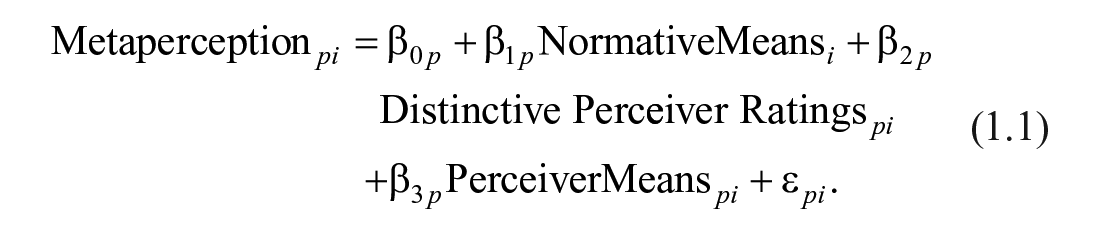
In Equation 1.1,
To obtain the validity criterion for distinctive emotion meta-accuracy, in line with recommendations (Biesanz, 2020), we first subtracted the average self-report for item i (
Furthermore, to cleanly parse out the within- and across-interaction effects of emotion meta-accuracy, grand-mean centered perceiver p’s means for each item i across interactions (
To examine whether the levels of distinctive and normative emotion meta-accuracy differed across the three interaction types, we included two dummy-coded variables in the between-interactions (Level 2) part of the model, as outlined in Equation 1.2 below, which builds on Equation 1.1 outlined above:
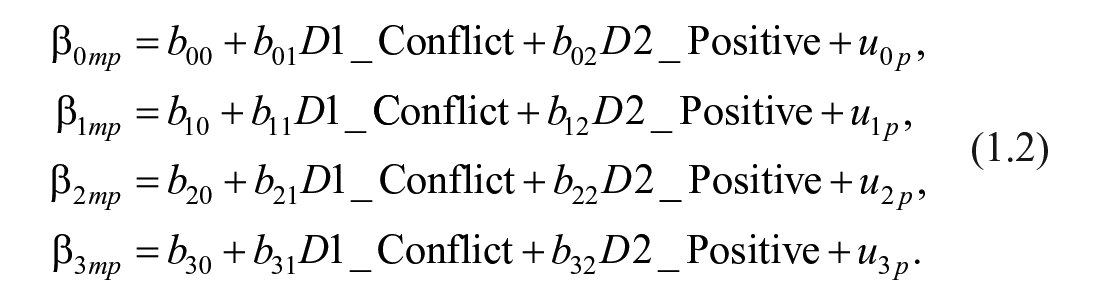
We ran a first set of analyses containing the dummy variables for the conflict interaction (
Next, we conducted similar analyses to examine whether the average distinctive and normative emotion meta-accuracy across all three interactions were related to metaperceiver and perceiver momentary relationship quality. Relationship quality was person-mean centered by subtracting out the person’s average relationship quality across the three interactions. Although, theoretically, relationship quality was interpreted as an outcome of emotion meta-accuracy, the modeling approach required it to be included as a predictor of the emotion meta-accuracy slopes. A similar approach has been adopted in previous work using this analytical method (for an example, see Human et al., 2020). Thus, to examine whether relationship quality for metaperceivers was related to distinctive and normative emotion meta-accuracy levels, we included relationship quality as a Level 2 predictor of the distinctive and normative emotion meta-accuracy slopes (similar to the analyses outlined in Equation 1.2). We ran parallel analyses to examine whether relationship quality for perceivers was also related to distinctive and normative emotion meta-accuracy. For all analyses, we also included grand-mean centered baseline relationship satisfaction as a covariate by adding it as a separate predictor of the distinctive and normative emotion meta-accuracy slopes.7,8
We also examined whether the association between meta-accuracy slopes and momentary relationship quality was dependent on the type of interaction. For these analyses, in Level 2 of the model, momentary relationship quality and the dummy variables for interaction type were allowed to interact with each other to predict the emotion meta-accuracy slopes. A significant interaction coefficient indicated whether the link between emotion meta-accuracy slope and momentary relationship quality was significantly different in a specific interaction (e.g., positive interaction) compared with the reference group (e.g., unstructured interaction). 9
Finally, in additional analyses, we also explored whether distinctive and normative emotion meta-accuracy were related to grand-mean centered baseline relationship satisfaction by including it as the sole predictor of the meta-accuracy slopes.
Effect size estimates
For the primary Level 2 associations with relationship quality, we provide standardized effect size estimates (ds). These effect sizes were calculated as the change in standard deviations in the meta-accuracy slopes (dependent variable) for a two standard deviation change in the continuous predictors (independent variables). This rescaling procedure makes the effect sizes comparable to those with binary predictors (Gelman, 2008). For binary predictors, meta-accuracy slope coefficients were simply divided by random effect standard deviation for that slope to obtain an estimated d. R’s boot package (Davison & Hinkley, 1997) was used to calculate the ds and the 95% confidence intervals with 1,000 simulations of parametric resampling. These scores are comparable with more commonly used Cohen’s ds (Gelman, 2008) and other research employing the social accuracy model (e.g., Human et al., 2020; Kerr et al., 2020).
Results
Normative and Distinctive Emotion Meta-Accuracy Levels
In general, across all interactions, metaperceivers exhibited significant normative, b = 0.94, z = 53.19, p < .001, and distinctive, b = 0.26, z = 11.88, p < .001, emotion meta-accuracy. That is, they recognized perceivers’ positive and unique impressions of their emotions on average within interactions. These levels, however, were dependent on the type of interaction. Normative emotion meta-accuracy in the conflict interaction was significantly lower than in the positive interaction, b = −0.04, d = −0.11, 95% confidence interval (CI) = [−0.21, −0.01], z = −2.14, p = .032. There was no significant difference in normative emotion meta-accuracy between the conflict interaction and unstructured interaction, b = −0.02, d = 0.07, 95% CI = [−0.03, 0.17], z = −1.37, p = .170, and the positive and the unstructured interaction, b = 0.01, d = 0.04, 95% CI = [−0.03, 0.11], z = 1.04, p = .297 (see Figure 1 for baseline levels of normative emotion meta-accuracy in each interaction). Distinctive emotion meta-accuracy levels were higher in the conflict interaction compared with both the positive, b = 0.18, d = 0.54, 95% CI = [0.33, 0.76], z = 4.92, p < .001, and the unstructured interactions, b = 0.12, d = 0.34, 95% CI = [0.14, 0.55], z = 3.23, p = .001 (see Figure 1). Distinctive emotion meta-accuracy did not significantly differ between the unstructured interaction and the positive interaction, b = 0.07, d = 0.20, 95% CI = [−0.42, 0.03], z = 1.74, p = .081. Thus, metaperceivers were less accurate at gauging perceivers’ positive and normative impressions of their emotions and more accurate at gauging perceivers’ unique impressions of their emotions in a conflictual context compared with more neutral and positive contexts. 10
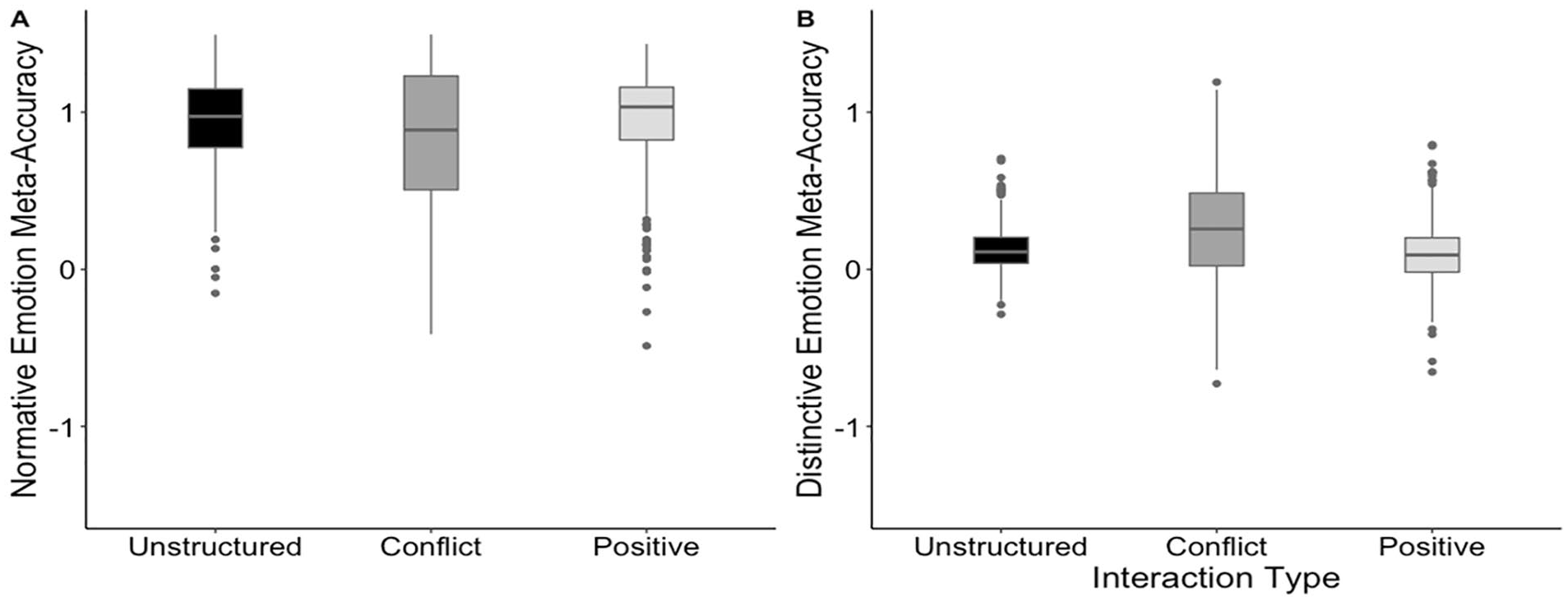
Baseline levels of the different emotion meta-accuracy components for each interaction type: (A) Normative emotion meta-accuracy levels. (B) Distinctive emotion meta-accuracy levels across interactions.
Normative Emotion Meta-Accuracy and Momentary Relationship Quality
Controlling for baseline satisfaction, normative emotion meta-accuracy was related to greater metaperceiver, b = 0.63, d = 0.94, 95% CI = [0.86, 1.02], z = 23.79, p < .001, and perceiver, b = 0.20, d = 0.31, 95% CI = [0.22, 0.39], z = 7.33, p < .001, relationship quality across interactions. Therefore, believing perceivers viewed metaperceivers’ profile of emotions in a normative way was related to greater momentary relationship quality for both members of the couple. The strength of these associations depended on the type of interaction people engaged in (see Table 1 for the moderation effects by interaction type). For both members of the couple, the link between normative emotion meta-accuracy and momentary relationship quality was significantly stronger in the conflict interaction compared with the other interactions. The associations in the positive and the unstructured interactions did not significantly differ from each other (see Table 1). Across all interactions, the associations between normative emotion meta-accuracy, and momentary relationship quality were significant, except for perceivers in the positive interaction, which did not reach statistical significance (see Figure 2 for the associations within each interaction type). Taken together, these findings are in line with the idea that knowing that perceivers see metaperceivers’ emotions in line with the socially desirable, average persons’ profile could be beneficial for both perceivers and metaperceivers across different interactions. In particular, knowing perceivers’ positive impressions of metaperceivers’ feelings in the conflict interaction could be especially beneficial, although this link was still positive and significant in the other contexts.
Moderation Effects of Interaction Type on the Association Between Emotion Meta-Accuracy and Momentary Relationship Quality.
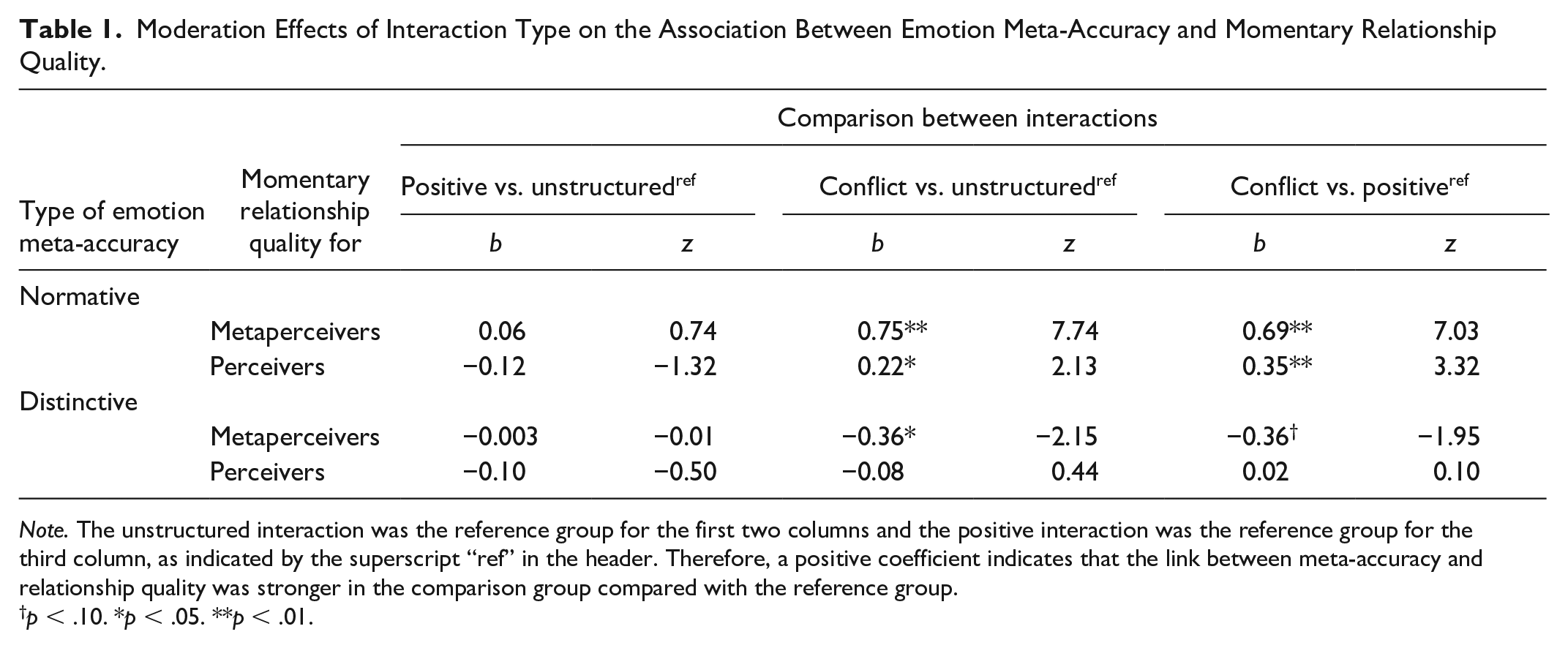
Note. The unstructured interaction was the reference group for the first two columns and the positive interaction was the reference group for the third column, as indicated by the superscript “ref” in the header. Therefore, a positive coefficient indicates that the link between meta-accuracy and relationship quality was stronger in the comparison group compared with the reference group.
p < .10. *p < .05. **p < .01.
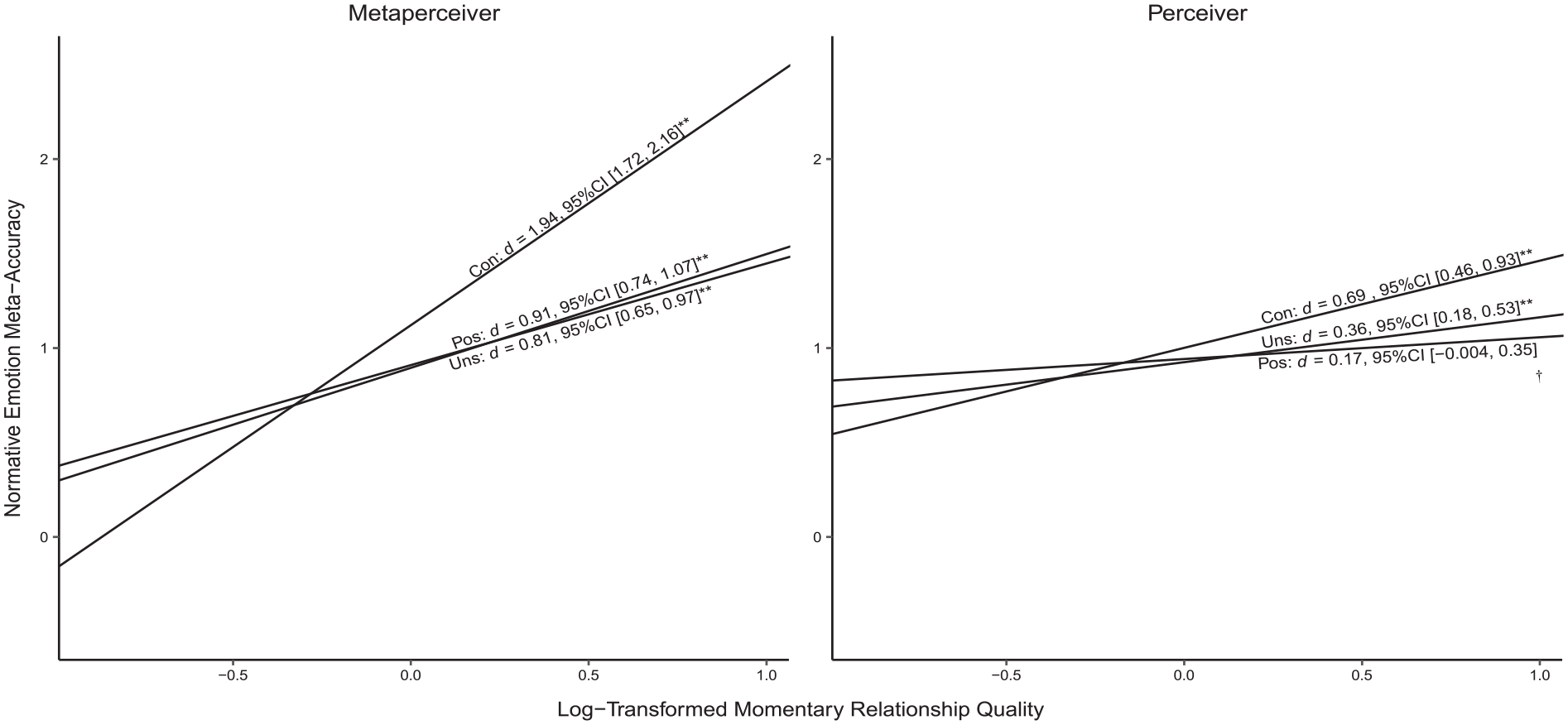
Associations between normative emotion meta-accuracy and momentary relationship quality for each interaction type.
Distinctive Emotion Meta-Accuracy and Momentary Relationship Quality
Distinctive emotion meta-accuracy was significantly associated with lower momentary relationship quality for metaperceivers, b = −0.35, d = −0.53, 95% CI = [−0.69, −0.36], z = −6.29, p < .001, and perceivers, b = −0.28, d = −0.42, 95% CI = [−0.59, −0.26], z = −5.11, p < .001. Therefore, both metaperceivers and perceivers reported lower momentary relationship quality when metaperceiver correctly recognized perceivers’ unique impression of metaperceivers’ emotions. Did the type of interaction qualify this negative association between distinctive emotion meta-accuracy and momentary relationship quality? For metaperceivers, the negative link between distinctive emotion meta-accuracy and momentary relationship quality was only significant in the conflict interaction. This was different from the null associations observed in the unstructured and the positive interactions, although only the difference between the unstructured and the conflict interaction reached statistical significance (see Figure 3 for the links within each interaction, and Table 1 for the moderation effects). There was no significant difference between the positive and the unstructured interactions (see Table 1). For perceivers, the association between distinctive emotion meta-accuracy and momentary relationship quality was not significantly moderated by interaction type (see Table 1 and Figure 3). Overall, these findings suggest that correctly inferring perceivers’ distinct impressions of metaperceivers’ emotions could be detrimental for perceivers across different interaction types. However, for metaperceivers, this negative link appeared to be limited to conflictual interactions.
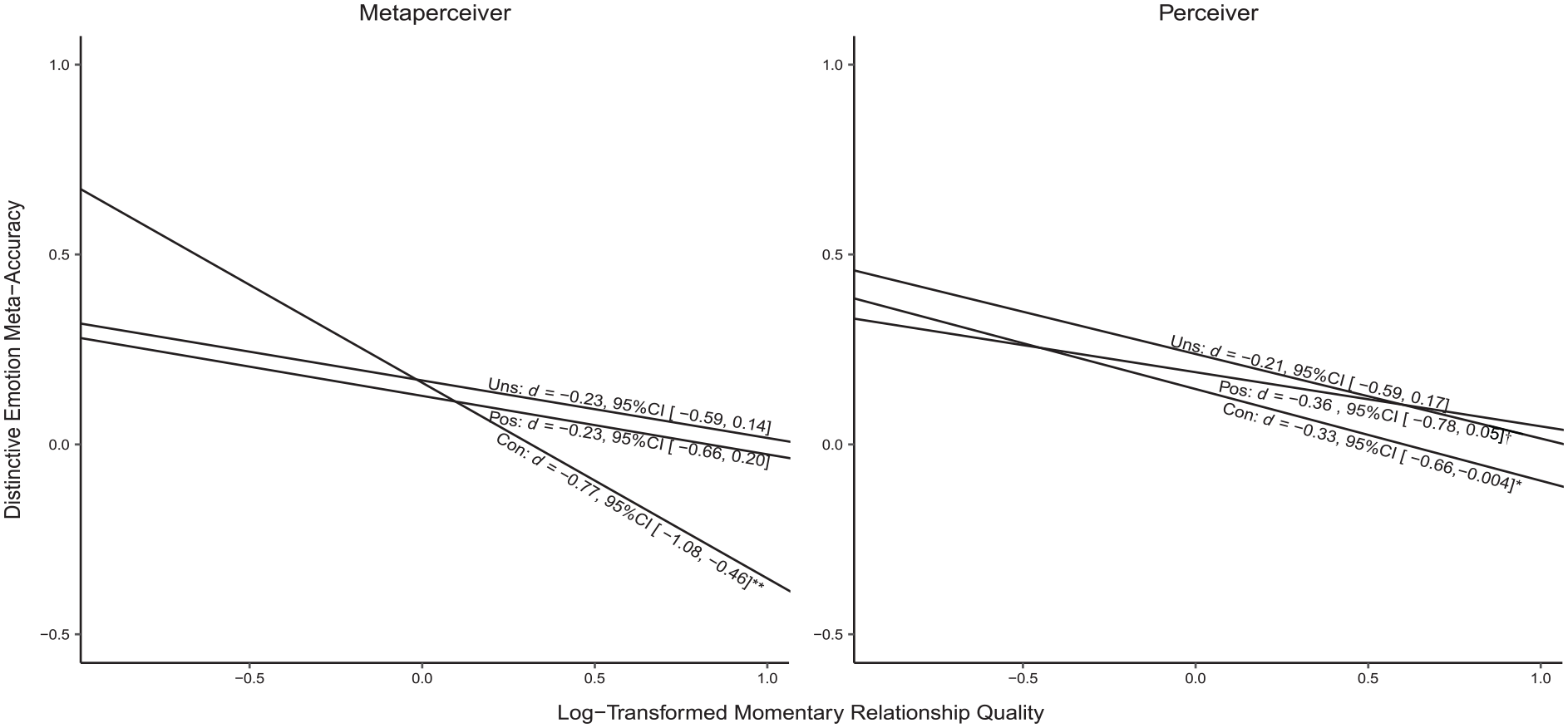
Associations between distinctive emotion meta-accuracy and momentary relationship quality for each interaction type.
Additional Analyses: Links With Baseline Relationship Satisfaction
Finally, we explored whether baseline metaperceiver and perceiver relationship satisfaction was associated with emotion meta-accuracy across interactions. Normative emotion meta-accuracy across interactions was related to greater baseline relationship satisfaction for both metaperceivers, b = 0.23, d = 0.69, 95% CI = [0.48, 0.90], z = 6.43, p < .001, and perceivers, b = 0.07, d = 0.22, 95% CI = [0.003, 0.44], z = 1.99, p = .048. Distinctive emotion meta-accuracy across interactions was not related to metaperceiver, b = 0.02, d = 0.06, 95% CI = [−0.20, 0.33], z = 0.46, p = .649, or perceiver, b = 0.01, d = 0.03, 95% CI = [−0.24, 0.29], z = 0.19, p = .846, relationship satisfaction. As such, recognizing perceivers’ normative impressions of the metaperceivers’ emotions is related to being generally happy in the relationship for both metaperceivers and perceivers.
Discussion
Using a dyadic and repeated measures study design, the present study explored (a) whether metaperceivers demonstrated normative emotion meta-accuracy (accurately inferring the extent to which their romantic partner’s—the perceiver’s—impressions of the metaperceiver’s emotions were typical and positive) and distinctive emotion meta-accuracy (accurately inferring the extent to which the perceiver’s impressions of the metaperceiver’s emotions deviated from the norm), (b) whether these levels vary across interactions, and (c) whether each component of meta-accuracy related to momentary romantic relationship quality. We discuss the findings relating to each of these aims below.
Emotion Meta-Accuracy Levels Across Different Interaction Types
In general, metaperceivers displayed significant levels of normative and distinctive emotion meta-accuracy, which were quite comparable with those observed in the personality literature (e.g., see Carlson, 2016b: Study 4). However, these levels also varied by interaction. First, metaperceivers were less accurate about perceivers’ more positive impressions in the context of a conflict interaction, displaying lower normative emotion meta-accuracy compared with the more neutral and positive interactions. Perhaps metaperceivers expected to be seen less positively by perceivers in the conflict interaction. As such, they may have relied less on the normative profile of emotions, which is characterized by greater levels of positive affect relative to negative affect emotions, even in a conflict interaction (see Figure S1 in SOM). As such, people’s negative expectations may have resulted in lower levels of normative emotion meta-accuracy in the conflict interaction. Moreover, given that conflict interactions are less frequent in daily life, people may have a less clear idea of how the average person would react in a similar situation, which could have also undermined normative emotion meta-accuracy levels.
Second, metaperceivers were more accurate about perceivers’ more unique impressions of their emotions when engaging in a conflict discussion, displaying higher levels of distinctive emotion meta-accuracy compared with other contexts. Given that conflict interactions, by design, involve divergent views, metaperceivers may have been more motivated, than usual, to understand how the perceivers viewed their emotions.
Links Between Emotion Meta-Accuracy and Momentary Relationship Quality
Normative emotion meta-accuracy
Consistent with previous research in personality (Carlson, 2016b; Tissera et al., 2021), metaperceivers reported greater momentary relationship quality when they were aware of perceivers’ normative and more positive impressions of their emotions. This link was especially strong in the conflict context, although it was still positive and significant in the neutral and positive contexts. Perhaps knowing that perceivers viewed metaperceivers’ emotions in line with how people typically reacted in such situations could be reassuring and validating, which may help to explain why this link was stronger in the conflict interaction, where relationship quality may be especially contingent on being seen positively by the partner (Murray et al., 2003).
Perceivers also reported greater momentary enjoyment of their relationship when metaperceivers were aware of perceivers’ normative impressions of metaperceivers’ emotions and this link was especially strong in the conflict interaction. This significant and positive, yet relatively weak, effect replicates the significant, positive, and small effect observed in past work between normative personality meta-accuracy and perceiver liking in platonic contexts (Carlson, 2016b; Tissera et al., 2021). However, it was not consistent with the previously observed null associations between normative personality meta-accuracy and romantic relationship quality (Carlson, 2016b; Tissera et al., 2021). Why would normative emotion meta-accuracy contribute to greater momentary relationship quality for perceivers? Given the normative profile of emotions reflects a more positive and desirable profile of emotions (Wood & Furr, 2016; see Figure S1 in SOM), correctly understanding how perceivers viewed the metaperceivers’ emotions in a positive light may have elicited a more positive reaction from metaperceivers. If metaperceivers felt at ease and comfortable during the interaction, this could have in turn contributed to a more positive experience for perceivers and paved the way for smoother interactions, which may have been especially critical in a conflictual context. Together, these reasons may help to explain why normative emotion meta-accuracy was related to greater momentary relationship quality for both romantic partners.
Distinctive emotion meta-accuracy
Distinctive emotion meta-accuracy was negatively related to momentary relationship quality for metaperceivers in the conflict interaction. This is consistent with the previous literature on empathic accuracy where awareness of the romantic partner’s (i.e., the perceiver’s) more threatening thoughts and feelings was related to lower relationship quality (Simpson et al., 1995, 2003). Especially in conflictual interactions, distinctive emotion meta-accuracy could reveal more threatening information, although the content of distinctive metaperceptions is likely to be affectively neutral. More precisely, distinctive emotion meta-accuracy could be threatening if it reveals to metaperceivers that perceiver impressions do not correspond with one’s own. Consistent with this explanation, our supplementary analyses support the idea that the negative link between distinctive emotion meta-accuracy and relationship quality could be driven by distinctive emotion meta-insight, which is the extent to which metaperceivers know perceivers’ impressions that are different from the normative profile and from the metaperceivers’ self-reported emotions (see SOM for more details). As such, distinctive emotion meta-insight may signal to metaperceivers that the perceiver does not “see” how the metaperceiver is actually feeling, which could threaten the well-being of the relationship, which may be especially hurtful in conflict interactions (Gordon & Chen, 2016). This could explain why we observed a negative link between distinctive emotion meta-accuracy and metaperceivers momentary relationship quality in the conflict interaction.
Perceivers also reported lower momentary relationship quality across interaction types when the metaperceivers knew perceivers’ distinct impressions of their emotions in a given interaction, exhibiting distinctive emotion meta-accuracy. This finding is consistent with the empathic accuracy literature (Simpson et al., 1995, 2003). One possibility is that, in light of relationship threatening information, metaperceivers may engage in less constructive behaviors (e.g., disengage from conversation), which could negatively impact perceivers’ relationship quality. Further supporting this idea, we also found that distinctive emotion meta-insight was also negatively related to perceivers’ relationship quality (see SOM), suggesting that the negative link between distinctive emotion meta-accuracy and perceivers’ relationship quality could have been driven by distinctive emotion meta-insight. Perhaps this is because it reveals that perceivers do not accurately understand metaperceivers’ feelings, which may be interpreted as threatening to the relationship. That said, it is noteworthy that this result is different from the previously observed positive links in the personality literature (Carlson, 2016b; Tissera et al., 2021) and future work should aim to better understand the unique processes relating to personality and emotion meta-accuracy.
Contextualizing the links with momentary relationship quality
One way to interpret effect sizes is in comparison with previous related work. Here, we consider the overall association between empathic accuracy and relationship quality as a possible benchmark (d = 0.26; Sened et al., 2017), which is considered as a small-to-moderate effect (Funder & Ozer, 2019). In the present work, for normative meta-accuracy, the effect sizes for the links with relationship quality were larger than those observed for empathic accuracy (metaperceivers—across interactions: d = 0.94, range between interactions: ds = 0.81–1.94; perceivers—across interactions: d = 0.31). In terms of distinctive emotion meta-accuracy, although we observed a negative link, the absolute magnitude of the effect size appeared to be larger than those observed for empathic accuracy (metaperceivers: d = −0.53; perceivers: d = −0.42). Although the effect sizes ranged widely, these can be interpreted as mostly large effect sizes compared with those typically observed in psychology literature (Fraley & Marks, 2007: d = 0.43; Funder & Ozer, 2019), suggesting that emotion meta-accuracy could carry meaningful interpersonal implications both at the short and at the long term.
Limitations and Future Directions
One limitation of the present study is that, despite having controlled for baseline relationship satisfaction, we were unable to establish causality between emotion meta-accuracy and momentary relationship quality. For example, metaperceivers who enjoyed their relationship during that interaction may be more likely to believe they were seen more positively by perceivers and may have been less attentive to perceiver impressions of their emotions differed from the average person’s profile, increasing normative and decreasing distinctive emotion meta-accuracy. Thus, future research is needed to disentangle the causality of these associations.
Furthermore, due to ethical concerns and in line with previous work (Gottman & Levenson, 1999), the conflict interaction consistently preceded the positive interaction in the current study with the intention of bringing the couples back to their baseline affect by the end of the study. As such, it is possible that having engaged in a conflict interaction could have dampened the level of positive affect in the positive interaction, and therefore, it may not have faithfully represented a typical positive interaction. That said, descriptively, participants appeared to experience greater positive affect during the positive interaction than during the conflict interaction (see Figure S1 in SOM). However, we encourage future research to replicate these associations in a purer positive interaction.
Moreover, in the present study, participants were requested to recall and report on the extent to which they felt a range of emotions during the interaction immediately after each interaction. At the same time, they also reported on their partner’s emotions and their metaperceptions. One limitation of self-reported data is that people may not be recalling their emotions in an impartial way. It may also be easier to make inferences about the general emotions felt, as opposed to how someone felt in a specific instance.
Furthermore, due to feasibility reasons, we were not able to have participants engage in a paradigm that would allow us to capture greater variability in emotions, such as the “dyadic interaction paradigm” (Ickes et al., 1990), which involves reporting on the self’s and partner’s thoughts and feelings at multiple points during a given discussion. Given that in the present study, participants engaged in three interactions and made three sets of ratings (self-, partner-, and metaperception ratings), the dyadic interaction paradigm would have required participants to review all three videos 3 times following every interaction, which can be burdensome for participants. Although the profile approach employed here does not enable the assessment of whether a partner can track changes in a given emotion (or valence of emotions) throughout a single interaction, it allows for the assessment of a broader range of predetermined emotional states and provides a holistic indicator of meta-accuracy across those emotions. It would be interesting for future work to focus on each of these interaction types to understand how people track emotion meta-accuracy over the course of a particular interaction.
Having to recall all three perspectives could have also biased people’s responses and may have inflated the levels of emotion meta-accuracy, perhaps by increasing metaperceivers’ reliance on their self-views when forming their metaperceptions. Therefore, it would be interesting for future work to measure these constructs by having participants provide ratings after separately reviewing the video recording. That said, we did observe a similar pattern of results between distinctive emotion meta-accuracy and meta-insight (see SOM), the latter of which controls for metaperceiver self-views, suggesting that the present results were not driven by an overreliance on one’s own self-reports. Metaperceivers may be relying on other sources to achieve emotion meta-accuracy, such as feedback from the partner or momentary self-observations. Although the present work was not able to test for the different contributions of these various sources, it may be a worthwhile endeavor for future research.
The present research was focused on the associations between emotion meta-accuracy and momentary relationship quality, but it remains unclear whether these processes generalize to relationship quality at a more global level and over time. For example, knowing that the perceiver misunderstands the metaperceiver’s emotions may be hurtful in the moment, but it could signal to the metaperceivers that there is an issue to be addressed, which could be adaptive in the long term (McNulty, 2010). Future research might wish to explore whether and how these short-term correlates may translate to long-term outcomes.
Finally, the present sample largely consisted of younger couples in their early 20s and the majority were in dating relationships, of at least 3 months and lasting over 2 years on average. Moreover, our sample reported high levels of baseline satisfaction, possibly as a result of sampling bias as happier couples may more readily sign up for studies together (Barton et al., 2020). As a result, it is not clear how the levels of normative and distinctive emotion meta-accuracy and its associations may translate to married couples, other types of relationships (e.g., close friends) and contexts (e.g., first impressions), and other more diverse samples (e.g., older individuals, couples in distress). Thus, future research may wish to examine how these associations observed in the lab translate to daily life, perhaps using experiencing sampling methods.
Overall, these results provide preliminary evidence that people (i.e., metaperceivers) know their partners’ (i.e., perceivers) impressions of their own emotions as metaperceivers displayed both normative and distinctive emotion meta-accuracy in range of contexts. In turn, these components of emotion meta-accuracy could have implications for romantic couples’ relationship quality, at least momentarily. Specifically, both members of the couple experienced greater momentary relationship quality when the metaperceiver more accurately gauged their partner’s normative impressions of the self’s feelings. For metaperceivers, this link was especially strong in the conflictual context than in neutral or positive contexts. In contrast, both members reported lower momentary relationship quality when metaperceivers accurately inferred their partner’s more unique (i.e., distinctive) impressions of the metaperceiver’s feelings on average across interactions. For metaperceivers, however, this link was limited to the conflictual context. Accurately understanding the partner’s distinctive impressions of the metaperceiver’s emotions could be harmful by potentially giving rise to more threatening impressions, which may undermine momentary relationship quality. As such, at least in the short term, it might be adaptive for people to accurately recognize their romantic partner’s normative impressions of their emotions and to remain blissfully unaware of the distinctive and potentially threatening impressions the partner may hold.
Supplemental Material
sj-docx-1-psp-10.1177_01461672211068225 – Supplemental material for Do People Know How Their Romantic Partner Views Their Emotions? Evidence for Emotion Meta-Accuray and Links with Momentary Romantic Relationship Quality
Supplemental material, sj-docx-1-psp-10.1177_01461672211068225 for Do People Know How Their Romantic Partner Views Their Emotions? Evidence for Emotion Meta-Accuray and Links with Momentary Romantic Relationship Quality by Hasagani Tissera, Jennifer L. Heyman and Lauren J. Human in Personality and Social Psychology Bulletin
Footnotes
Declaration of Conflicting Interests
The author(s) declared no potential conflicts of interest with respect to the research, authorship, and/or publication of this article.
Funding
The author(s) disclosed receipt of the following financial support for the research, authorship, and/or publication of this article: The present research was supported by a Social Sciences and Humanities Research Council (SSHRC) of Canada Insight Grant (435-2016-0499) and a Fonds de Recherche du Québec—Société et Culture (FRQSC) New Research Professors Grant (197450). The preparation of the manuscript was supported in part by funding from the Canada Research Chair’s program to Lauren J. Human, the SSHRC’s Joseph-Armand Bombardier Canada Graduate Scholarship for the Doctoral Program to H.T., and an FRQSC doctoral research scholarship to J.L.H.

Supplemental Material
Supplemental material is available online with this article.
Notes
References
Supplementary Material
Please find the following supplemental material available below.
For Open Access articles published under a Creative Commons License, all supplemental material carries the same license as the article it is associated with.
For non-Open Access articles published, all supplemental material carries a non-exclusive license, and permission requests for re-use of supplemental material or any part of supplemental material shall be sent directly to the copyright owner as specified in the copyright notice associated with the article.
