




Abstract
Researchers have recently drawn a contrast between two forms of envy: benign and malicious envy. In three studies (total N = 3,123), we challenge the assumption that malicious envy is destructive, whereas benign envy is entirely constructive. Instead, both forms have links with the Dark Triad of personality. Benign envy is associated with Machiavellian behaviors, whereas malicious envy is associated with both Machiavellian and psychopathic behaviors. In Study 1, this pattern emerged from meta-analyzed trait correlations. In Study 2, a manipulation affecting the envy forms mediated an effect on antisocial behavioral intentions. Study 3 replicated these patterns by linking envy to specific antisocial behaviors and their impact on status in the workplace. Together, our correlational and experimental results suggest that the two forms of envy can both be malevolent. Instead of evaluating envy’s morality, we propose to focus on its functional value.
Envy is commonly characterized as a hostile emotion with mostly negative consequences for the envier and the envied person (for a review, see R. H. Smith & Kim, 2007). Envy prompts deception (Moran & Schweitzer, 2008), dampens cooperation (Parks, Rumble, & Posey, 2002), and fosters schadenfreude when others fail (R. H. Smith et al., 1996). Although this characterization portrays envy as a maladaptive emotion, recent theorizing and evidence emphasize that envy can also manifest in a benign form directed at personal advancement (Van de Ven, Zeelenberg, & Pieters, 2009). One proposed interpretation of this distinction is that envy’s malicious form represents envy’s dark side, whereas its benign manifestation is largely constructive (Cohen-Charash & Larson, 2017; Tai, Narayanan, & McAllister, 2012).
We believe that this simplistic moral conclusion is unwarranted. Instead, we argue that envy is neither constructive nor destructive but can, first and foremost, be a functional emotion. If this reasoning is correct, any form of envy may relate to antisocial consequences that nevertheless serve envy’s goals. The objective of the present manuscript is to systematically investigate the dark sides of envy by establishing its distinctive links with the personality traits known as the Dark Triad (Paulhus, 2014).
Envy
Envy has been defined as a painful emotion ensuing from the envier’s lack of another’s quality, achievement, or possession (Lange, Weidman, & Crusius, in press; Parrott & Smith, 1993). Undoubtedly, it is a common experience (R. H. Smith & Kim, 2007) that can even be a dispositional inclination (Lange, Blatz, & Crusius, in press). Evidence suggests that envy entails various affective, cognitive, and motivational tendencies (Parrott & Smith, 1993). A growing body of research converges on the notion that these tendencies lead to consequences that contribute to the regulation of status hierarchies (Crusius & Lange, 2017; Fiske, 2010; Lange, Blatz, & Crusius, in press; Lange & Crusius, 2015b; Lange, Crusius, & Hagemeyer, 2016) by leveling differences between the self and the envied person (Van de Ven et al., 2009). According to this perspective, the initial painful reaction following a status comparison motivates the envier to redress this loss of respect and social influence (Crusius & Lange, 2017). Notably, there are at least two emotional reactions that may serve to overcome this status differential. These qualitatively different reactions have come to be labeled benign and malicious envy (Falcon, 2015; Lange & Crusius, 2015a; Lange, Weidman, & Crusius, in press; Van de Ven et al., 2009).
According to this reasoning, benign envy elicits consequences that level status differences by elevating personal status. In particular, it relates to more positive thoughts about the envied person (Van de Ven et al., 2009), attentional focus on means to improve performance (Crusius & Lange, 2014), and behaviors directed at self-advancement (Lange & Crusius, 2015b; Van de Ven, Zeelenberg, & Pieters, 2011). As a disposition, benign envy correlates with greater hope for success and higher goal setting, mediating higher performance (Lange & Crusius, 2015a).
In contrast, malicious envy elicits consequences that level status differences by undermining the envied person’s position. In particular, it relates to negative thoughts about the envied person (Van de Ven et al., 2009), attentional focus on the competitor (Crusius & Lange, 2014), and behaviors directed at undermining the other’s performance (Lange & Crusius, 2015b; Van de Ven et al., 2015). Scales capturing dispositional malicious envy correlate with increased disagreeableness (R. H. Smith, Parrott, Diener, Hoyle, & Kim, 1999), hostility (Rentzsch, Schröder-Abé, & Schütz, 2015), or schadenfreude (James, Kavanagh, Jonason, Chonody, & Scrutton, 2014).
Overall, this pattern of findings may convey the impression that all consequences of envy that are socially desirable map onto benign envy and all undesirable consequences map onto malicious envy (Cohen-Charash & Larson, 2017; Tai et al., 2012). However, even though benign envy’s goal to improve performance may seem more constructive, the means to pursue this goal may not necessarily be prosocial. To cast some light down these dark avenues, we propose to integrate the distinction between benign and malicious envy with research on two members of the Dark Triad—Machiavellianism and psychopathy (Paulhus & Williams, 2002).
Envy, Machiavellianism, and Psychopathy
Even though benign and malicious envy are qualitatively distinct (Falcon, 2015; Lange & Crusius, 2015a; Van de Ven et al., 2009), they both constitute negative emotional states. For example, in studies in which participants recalled either benign or malicious envy, ratings of negative affect were similar across conditions and positively correlated with scales assessing the envy forms (Crusius & Lange, 2014; Lange & Crusius, 2015b). Moreover, there is evidence that state as well as dispositional benign and malicious envy are positively correlated with negative affect following an upward comparison (Lange & Crusius, 2015a; Lange, Weidman, & Crusius, in press). These data suggest that psychological pain is a shared aspect of benign and malicious envy.
The pain of envy is largely a feeling of inferiority (Lange, Weidman, & Crusius, in press). Feelings of inferiority, in turn, can engender depression (R. H. Smith, Parrott, Ozer, & Moniz, 1994), accompanied by (indirect) aggression (Card, Stucky, Sawalani, & Little, 2008; Radloff, 1977). Furthermore, inferiority can lead to anger toward the more fortunate (Leach, 2008) and trigger schadenfreude when the other person fails (Leach & Spears, 2008). In short, psychological pain may promote malevolent behavior in benign as well as malicious envy.
The distress of benign envy involves an intense longing to improve the self and emulate the envied person (Lange, Weidman, & Crusius, in press). As part of the self-threatening experience of envy, such tendencies may manifest in unconditional efforts to improve personal status. However, any direct aggression may undermine the envier’s chances to rise in the hierarchy. Therefore, tactics that are subtle and indirect should be more beneficial. Such strategies are most clearly reflected in the behavioral patterns of Machiavellianism (Jones & Paulhus, 2009).
Machiavellian behavior is characterized by pragmatic ethics that justify any means to become successful. In particular, this pattern involves long-term-oriented, duplicitous, and manipulative tactics, often at the expense of other people (Jones & Paulhus, 2009, 2017; Rauthmann & Will, 2011). Nevertheless, Machiavellian tactics can promote higher status (Hawley, 2003) as well as superior performance in loosely structured environments (Shultz, 1993). If so, such behaviors might also be functional for the benignly envious. In sum, we anticipate an association of benign envy with Machiavellian strategies that, in turn, should foster status attainment.
The dark side of malicious envy is already well established. Many of its malevolent behaviors map onto Machiavellian tactics such as strategic deception (Moran & Schweitzer, 2008), sabotage (Khan, Quratulain, & Bell, 2014), and destructive gossip (Lange et al., 2016). Thus, malicious envy should also predict Machiavellian behaviors. Moreover, malicious envy has been linked to impulsivity (Shoham, Gavish, & Segev, 2015). This impulsivity might be responsible for the fact that envy can trigger such immediate retaliation as “burning” of the envied person’s money, even at the expense of costs for the self (Zizzo & Oswald, 2001) or disparagement of others following ego threats (Rentzsch et al., 2015). Such tactics better reflect the behavioral patterns of psychopathy (Jones & Paulhus, 2011b; LeBreton, Binning, & Adorno, 2006).
Psychopaths are characterized by callous manipulation conducted in an impulsive and irresponsible fashion (LeBreton et al., 2006). Research suggests that they are more likely to show aggression toward competitors (Jones & Paulhus, 2010; Williams & Paulhus, 2004). In this way, they try to decrease the status of successful competitors. Given that this tactic is also the focal goal of malicious envy (Crusius & Lange, 2017; Lange, Blatz, & Crusius, in press), psychopathic behaviors might be functional for the maliciously envious, at least in the short term. Although psychopaths continually attempt exploitation, people with expertise can determine their malintent (LeBreton et al., 2006). Together with their inability to delay gratification, psychopaths therefore tend to be unsuccessful in the long term (Jones & Paulhus, 2011b; LeBreton et al., 2006; S. F. Smith & Lilienfeld, 2013).
Together, these arguments suggest that malicious envy is related to psychopathic behaviors—a strategy that should have a negative effect on status attainment and might therefore override the otherwise positive effect of malicious envy on status via Machiavellian behaviors.
The Current Research
We propose to clarify the functions of envy by linking them to the Dark Triad of personalities. The only previous research investigating this connection used a general measure of envy focusing on malicious elements. It found links to both Machiavellianism and psychopathy (Veselka, Giammarco, & Vernon, 2014). Once the two envy forms are distinguished, we hypothesize that (a) benign envy relates to Machiavellian behavioral strategies, whereas (b) malicious envy relates to Machiavellian and psychopathic behavioral strategies. As a downstream consequence, we hypothesize that these strategies are linked to status in different ways. Machiavellian behavioral strategies should be reflected in higher status, whereas psychopathic strategies should be negatively linked to status.
We deliberately decided to focus on Machiavellianism and psychopathy rather than narcissism (the third member of the Dark Triad) in the current studies. Prior research (Krizan & Johar, 2012; Lange et al., 2016) suggests that the relationship between narcissism and envy is complex, and requires to take specific facets of narcissism into account. In particular, benign envy is distinctively related to narcissistic admiration—the assertive facet of narcissism (Lange et al., 2016). In contrast, malicious envy is distinctively related to narcissistic rivalry—the antagonistic facet of narcissism (Lange et al., 2016) and to vulnerable narcissism (Krizan & Johar, 2012). Narcissism as conceptualized under the Dark Triad covers only its assertive facet (Back et al., 2013). Therefore, we decided that replicating the complexities of the relationship between envy and narcissism was beyond the scope of the current research. Instead, we focused on investigating the unknown relationships of envy with Machiavellianism and psychopathy.
Study 1
Study 1 investigated whether (a) benign envy is associated with Machiavellian behavioral strategies, and whether (b) malicious envy is associated with Machiavellian and psychopathic behavioral strategies. To this end, we meta-analytically combined five samples that included trait measures of the two envy forms and the Dark Triad. In Sample 5, we also investigated whether our predicted effects remain stable when controlling for social desirability. For Sample 5, these predictions were preregistered on AsPredicted.org (https://aspredicted.org/y8n63.pdf).
Method
Participants
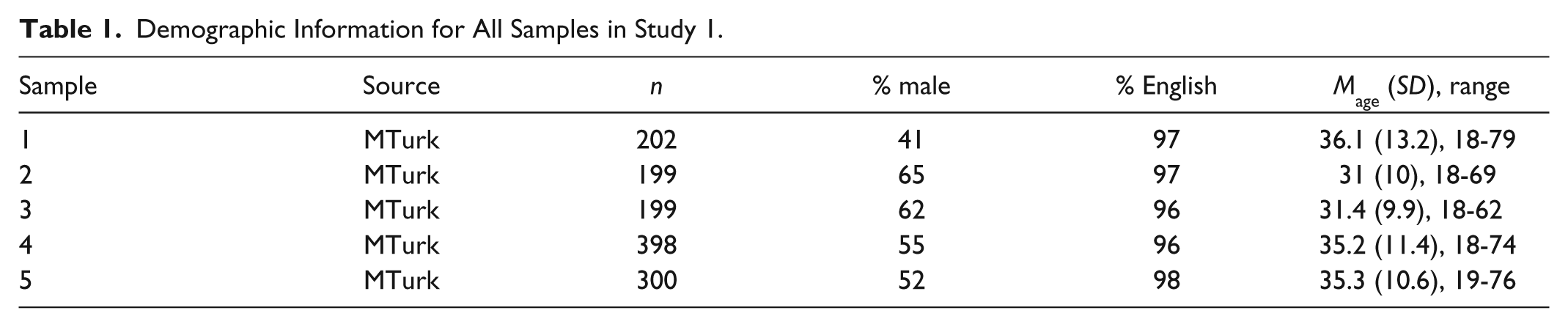
We integrated data from five different samples collected on Amazon’s Mechanical Turk (MTurk) partly stemming from research whose primary purpose was unrelated to the current work. In each sample, we collected data from at least 199 participants, allowing stable estimates of correlation coefficients (Schönbrodt & Perugini, 2013). Detailed demographic information on the four samples is provided in Table 1. In total, Study 1 included 1,298 U.S. MTurk workers. 1 Note that the sample has a slight male majority and a wide age range.
Demographic Information for All Samples in Study 1.
Materials and procedure
In all samples, participants completed the Benign and Malicious Envy Scale (BeMaS; Lange & Crusius, 2015a). The BeMaS assesses dispositional forms of benign (e.g., “When I envy others, I focus on how I can become equally successful in the future”) and malicious envy (e.g., “I wish that superior people lose their advantage”) on a scale from 1 (strongly disagree) to 6 (strongly agree) with five items each. Moreover, participants completed the Short Dark Triad (SD3; Jones & Paulhus, 2014) scale. The SD3 measures Machiavellianism (e.g., “It’s not wise to tell your secrets”), narcissism (e.g., “People see me as a natural leader”), and psychopathy (e.g., “Payback needs to be quick and nasty”) on a scale from 1 (strongly disagree), 2 (disagree), 3 (neither agree nor disagree), 4 (agree), to 5 (strongly agree) with nine items each.
In Sample 1, one item from the Psychopathy scale was accidentally displayed as “It’s true that I can be mean to others (or I enjoy having sex with people I hardly know)” instead of “It’s true that I can be mean to others” for the first 36 participants because of a programming error. This mistake was corrected for the other participants. Results remain unchanged if these participants are excluded.
In Sample 5, we also assessed social desirability with the MC-Form C (Reynolds, 1982). Furthermore, participants completed a number of other scales unrelated to the current research in all samples. All materials are available in the online supplementary and on the Open Science Framework (OSF) website.
Results
Correlational analyses
Descriptive statistics and zero-order correlations are displayed in Table 2. Similar to previous research (Lange & Crusius, 2015a; Lange et al., 2016), benign and malicious envy were only weakly positively related. In line with theoretical considerations and empirical evidence (Jones & Paulhus, 2014; Paulhus & Williams, 2002), the Dark Triad were moderately positively correlated (sample-size-weighted mean r = .35).
Descriptive Statistics, Zero-Order Correlations, and Unstandardized Regression Coefficients Taken From Regressions of Benign and Malicious Envy on the Dark Triad in Study 1.
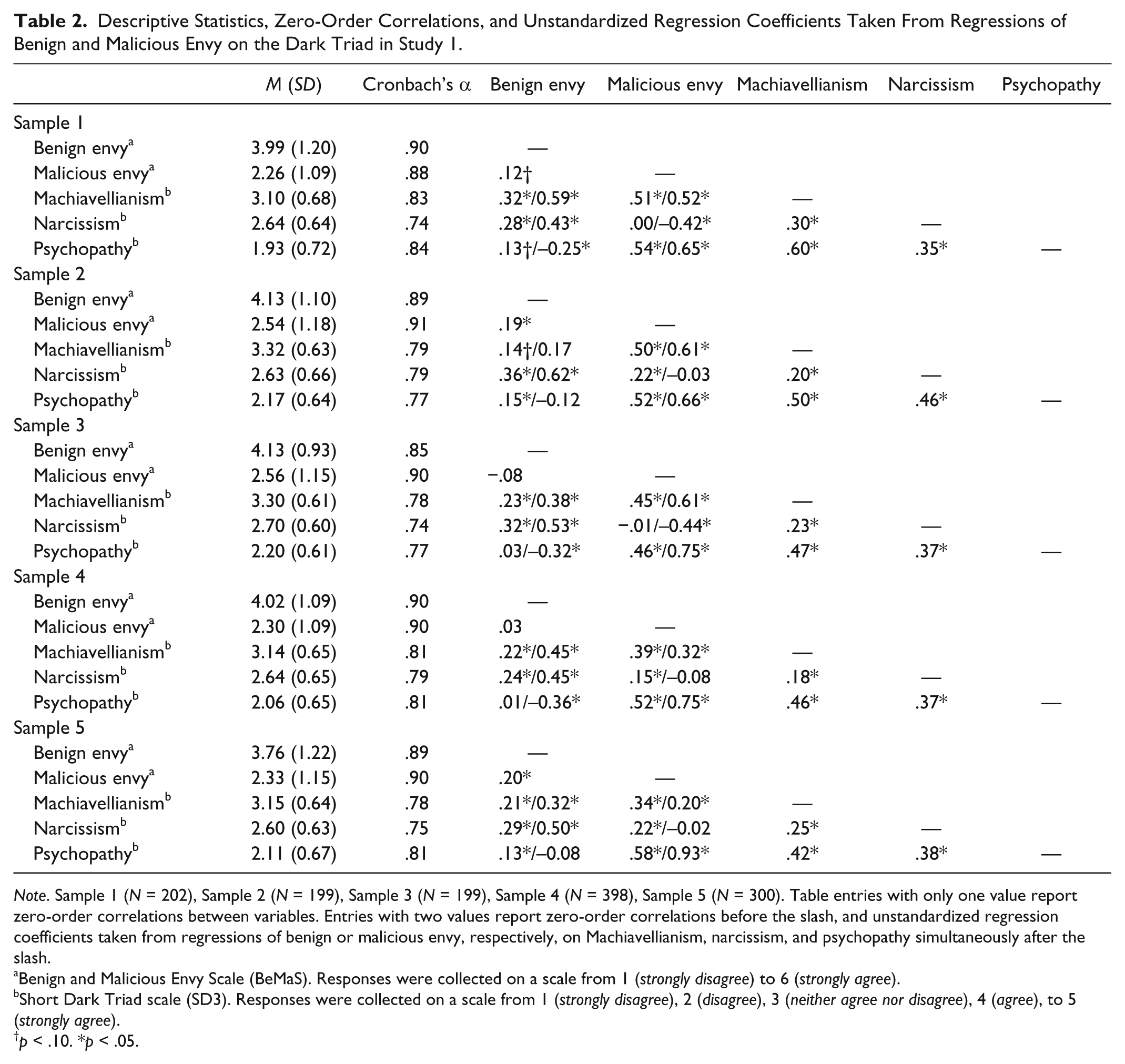
Note. Sample 1 (N = 202), Sample 2 (N = 199), Sample 3 (N = 199), Sample 4 (N = 398), Sample 5 (N = 300). Table entries with only one value report zero-order correlations between variables. Entries with two values report zero-order correlations before the slash, and unstandardized regression coefficients taken from regressions of benign or malicious envy, respectively, on Machiavellianism, narcissism, and psychopathy simultaneously after the slash.
Benign and Malicious Envy Scale (BeMaS). Responses were collected on a scale from 1 (strongly disagree) to 6 (strongly agree).
Short Dark Triad scale (SD3). Responses were collected on a scale from 1 (strongly disagree), 2 (disagree), 3 (neither agree nor disagree), 4 (agree), to 5 (strongly agree).
p < .10. *p < .05.
To test our predictions, we pooled the zero-order correlations of the predicted relationships by converting the values into Fisher’s Z and using them in random-effects meta-analyses with maximum-likelihood estimation. We then converted the Fisher’s Z values back into r. As predicted, benign envy correlated with Machiavellianism, Z = 0.23, SE = 0.03, p < .001, r = .22, and malicious envy correlated with both Machiavellianism, Z = 0.46, SE = 0.04, p < .001, r = .43, and psychopathy, Z = 0.59, SE = 0.03, p < .001, r = .53.
Less important for the present purposes, narcissism correlated consistently with benign but not with malicious envy. This is consistent with the notion that the SD3 conceptualizes narcissism similarly to narcissistic admiration (Back et al., 2013) which is correlated with benign but not with malicious envy (Lange et al., 2016).
Regression analyses
In Table 2, next to the correlation coefficients, we also present unstandardized regression coefficients taken from regressions of the envy forms on all Dark Triad variables simultaneously. We present these because the Dark Triad members have a shared core (Book, Visser, & Volk, 2015) that may mask unique contributions. The results mirror the zero-order correlations.
We meta-analytically combined the unstandardized regression coefficients. To this end, we converted them into correlation coefficients and then to Fisher’s Z. Finally, the meta-analytic Z values were translated back into r. Complementing the previous analyses, benign envy was associated with Machiavellianism, Z = 0.23, SE = 0.04, p < .001, r = .23, whereas malicious envy was associated with both Machiavellianism, Z = 0.25, SE = 0.04, p < .001, r = .25, and psychopathy, Z = 0.48, SE = 0.04, p < .001, r = .44.
Social desirability
In Sample 5, we regressed the envy forms on the Dark Triad and social desirability simultaneously. The relationships of Machiavellianism with benign, B = 0.24, SE = 0.12, p = .04, and malicious envy, B = 0.17, SE = 0.10, p = .07, as well as that of psychopathy and malicious envy, B = 0.88, SE = 0.10, p < .001, were largely unchanged.
Discussion
Study 1 supports that (a) benign envy is associated with Machiavellian tendencies, whereas (b) malicious envy relates to both Machiavellian and psychopathic tendencies. These effects remained stable when controlling for social desirability. In short, both envy forms can be linked to well-established dark personalities, namely the Dark Triad, contradicting previous theorizing that benign envy relates only to constructive consequences (Cohen-Charash & Larson, 2017). Instead, the evidence implies that both benign and malicious envy may go along with antisocial, but nevertheless functional, behaviors.
Study 2
In Study 1, envy predicted the Dark Triad at the trait level. This suggests that stable tendencies to experience envy and general inclinations toward dark behaviors are associated. If envy drives dark behaviors, this association should manifest in envy-eliciting situations. That is, envy and dark behaviors should also be related at the state level. To investigate this notion, Study 2 used an experimental methodology designed to investigate whether the patterns found in Study 1 hold in envy situations. Specifically, we elicited episodic benign and malicious envy by manipulating them in the situation. If our theorizing is correct, any manipulation of envy should mediate effects on dark behaviors. Testing this was the goal of Study 2. Thus, in Study 2, we focused only on state envy and state manifestations of dark behavioral intentions.
To manipulate envy, we had participants react to different videos of successful competitors. The experimental conditions relied on research showing that envy reactions depend on how competitors achieved their success. If individuals attribute success to internal, unstable, controllable causes (i.e., effort), they experience authentic pride (Tracy & Robins, 2007). This emotion is related to the attainment of status as prestige (through skills and abilities; Cheng, Tracy, & Henrich, 2010). Such displays by successful individuals foster benign envy in inferiors (Lange & Crusius, 2015b). In contrast, if individuals attribute success to internal, stable, uncontrollable causes (i.e., talent), they experience hubristic pride (Tracy & Robins, 2007). This emotion is related to the attainment of status as dominance (through intimidation of subordinates; Cheng et al., 2010). Such displays foster malicious envy in inferiors (Lange & Crusius, 2015b).
This theorizing led to two hypotheses for Study 2: First, an authentic pride display should promote benign envy, mediating an effect on Machiavellian behaviors. Second, a hubristic pride display should promote malicious envy, mediating effects on Machiavellian and psychopathic behaviors. As a control condition, we used an emotion that is also frequently displayed after success but is associated with low status, namely embarrassment (Shariff & Tracy, 2009). We preregistered the study on AsPredicted.org (https://aspredicted.org/sq39q.pdf).
Method
Participants
Five hundred eighty-two U.S. respondents on MTurk participated in Study 2. This sample size yields sufficient power to detect multiple mediation effects with small to medium paths (Fritz & MacKinnon, 2007). Their mean age was 34.9 years (SD = 11.1, range = 18-73), 52% were male, and 99% indicated English as their native language.
Materials and procedure
Participants imagined being in a seminar which required to complete several exams (Lange & Crusius, 2015b). They wanted to succeed in these exams. However, in the latest exam their grade was much worse than they had expected. In contrast, a gender-matched competitor (Hillary/Joe) was among the best in the exam. Moreover, she or he was generally among the best in the seminar. To manipulate benign and malicious envy, we used previously validated videos of the competitor. The videos were supposedly taken from a conversation following the announcement of the exam results (Lange & Crusius, 2015b). Participants were randomly assigned to one of three conditions varying the competitor’s emotional display. In the videos, Hillary/Joe displayed either authentic pride (n = 200), hubristic pride (n = 197), or embarrassment (n = 185). As a manipulation check, participants indicated whether Hillary/Joe feels either accomplished, achieving, confident, fulfilled, productive, has self-worth, successful (authentic pride), arrogant, conceited, egotistical, pompous, smug, snobbish, stuck-up (hubristic pride), embarrassed, shy, abashed, rueful, ashamed, affected (embarrassment), or none of these. As preregistered, we excluded participants who indicated the latter option, in line with previous research (Lange & Crusius, 2015b; Tracy & Prehn, 2012; see Footnote 1 for all exclusions).
Afterward, participants indicated how likely it would be that they would experience certain states in this situation. Specifically, they rated benign (e.g., “I want to work harder to also obtain a good grade in the next exam”; α = .69) and malicious envy (e.g., “I feel hostile towards Hillary/Joe”; α = .88) with four items each, and pain (e.g., “I feel depressed”; α = .80) with three items. These state measures of envy are based on the Pain-driven Dual Envy Theory (Lange, Weidman, & Crusius, in press). With respect to the measurement of envy, it implies that pain has to relate positively to benign and malicious envy. This constitutes a necessary condition to conclude that envy is present. If this condition is fulfilled, benign and malicious envy can be linked to other variables—in the current case, to dark strategies.
Then, to measure participants’ dark intentions in this situation, they responded to items reflecting Machiavellian and psychopathic behaviors. As our predictions focused on these members of the Dark Triad, we did not include narcissistic behaviors. We adapted items from Study 3 in which we developed them based on theoretical depictions of Machiavellian and psychopathic persons. In Study 3, these state items were correlated more strongly with the respective trait Dark Triad variables in regression analyses controlling for their shared variance. Moreover, they loaded together with the items of their intended factor > |.67| and not higher than |.15| on the respective other factor in factor analysis. Some of the items in Study 3 were irrelevant for the current context and therefore excluded. This led to the inclusion of four items reflecting Machiavellian behaviors (e.g., “I fake a friendship to Hillary/Joe as a tactic for my own advantage”; α = .71) and three items reflecting psychopathic behaviors (e.g., “I immediately react with violence”; α = .85). The items ranged from 1 (not at all likely) to 7 (very likely). All materials are available in the online supplementary and on the OSF website.
Results
Manipulation check
As intended, participants indeed categorized the authentic pride video as authentic pride in 91% of the cases, the hubristic pride video as hubristic pride in 79% of the cases, and the embarrassment video as embarrassment in 52% of the cases. This pattern was significant, χ2(4) = 497.07, p < .001, φc = .42. The embarrassment video was sometimes categorized as hubristic pride, 38%, but significantly less so than embarrassment, χ2(1) = 4.07, p = .04, φ = .16. In short, the manipulation was successful.
Main analyses
Table 3 displays descriptive statistics and zero-order correlations of all variables. In line with previous research (Lange, Weidman, & Crusius, in press), benign and malicious envy were only weakly correlated, whereas they both correlated positively with psychological pain. This fulfills the necessary condition for concluding that envy was present, allowing us to link benign and malicious envy to dark behaviors. As hypothesized, benign envy predicted Machiavellian behaviors, and malicious envy predicted Machiavellian and psychopathic behaviors. Furthermore, benign envy correlated negatively with psychopathic behaviors.
Descriptive Statistics and Zero-Order Correlations of All Variables in Study 2.
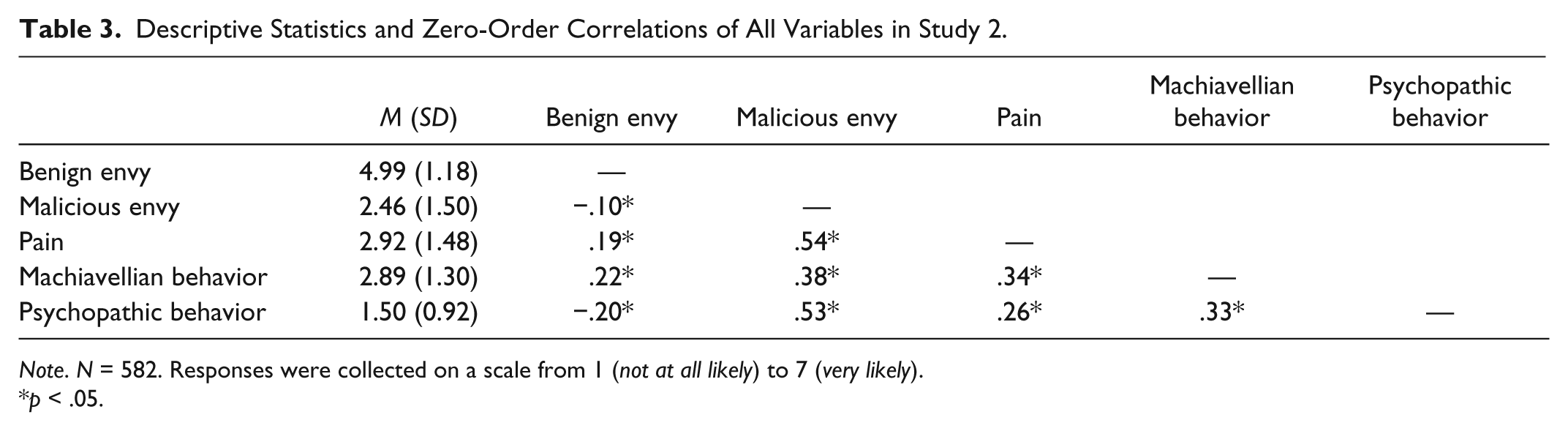
Note. N = 582. Responses were collected on a scale from 1 (not at all likely) to 7 (very likely).
p < .05.
Subsequently, we conducted a MANOVA with Condition (authentic pride vs. hubristic pride vs. embarrassment) as the independent variable and benign envy, malicious envy, pain, Machiavellian behaviors, and psychopathic behaviors as dependent variables. The multivariate effect of Condition was significant, F(10, 1152) = 12.36, p < .001, h2p = .10. Table 4 displays descriptive statistics and univariate tests. Analyses with pain were exploratory, but we had predictions for the other variables.
Univariate Effects of Condition on Benign Envy, Malicious Envy, Pain, Machiavellian Behaviors, and Psychopathic Behaviors in Study 2.
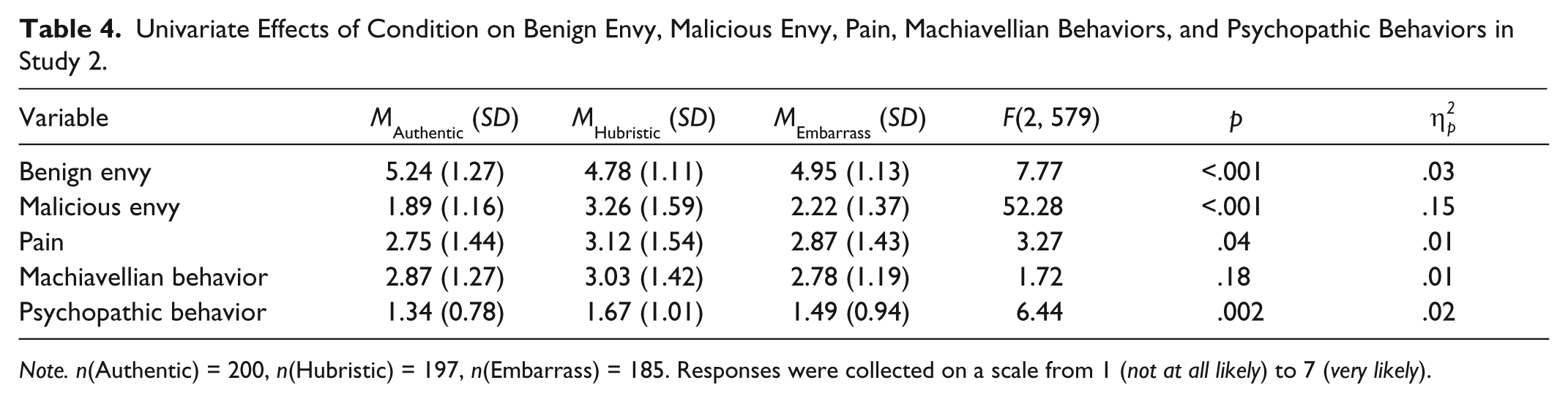
Note. n(Authentic) = 200, n(Hubristic) = 197, n(Embarrass) = 185. Responses were collected on a scale from 1 (not at all likely) to 7 (very likely).
Effect of condition on benign envy
We expected that authentic pride would elicit more benign envy than hubristic pride and embarrassment. Indeed, a contrast comparing the authentic pride condition to both the hubristic pride and embarrassment conditions for benign envy was significant, F(1, 579) = 13.5, p < .001, h2p = .02, whereas the orthogonal contrast comparing the hubristic pride and embarrassment conditions was not, F(1, 579) = 1.85, p = .17, h2p = .003.
Effect of condition on malicious envy
We expected that hubristic pride would elicit more malicious envy than authentic pride and embarrassment. Indeed, a contrast comparing the hubristic pride condition to both the authentic pride and embarrassment conditions for malicious envy was significant, F(1, 579) = 97.96, p < .001, h2p = .15. Unexpectedly, the orthogonal contrast comparing the authentic pride and embarrassment conditions was also significant. However, the effect size was considerably smaller, F(1, 579) = 5.5, p = .02, h2p = .01.
Effect of condition on Machiavellian behaviors
We expected that authentic and hubristic pride would lead to more Machiavellian behaviors than embarrassment. Although the pattern was in line with this prediction, a contrast comparing both the authentic and hubristic pride conditions to the embarrassment condition for Machiavellian behaviors did not reach significance, F(1, 579) = 1.98, p = .16, h2p = .003, nor did the orthogonal contrast comparing the authentic and hubristic pride conditions, F(1, 579) = 1.47, p = .23, h2p = .003.
Effect of condition on psychopathic behaviors
We expected that hubristic pride would lead to more psychopathic behaviors than authentic pride and embarrassment. In line with this prediction, a contrast comparing the hubristic pride condition to both the authentic pride and embarrassment conditions for psychopathic behaviors was significant, F(1, 579) = 9.89, p = .002, h2p = .02, whereas the orthogonal contrast comparing the authentic pride and embarrassment conditions was not, F(1, 579) = 2.75, p = .10, h2p = .01. Thus, our expectations were largely confirmed.
Path analyses
As a focal test of our predictions, we investigated our hypothesized indirect effects with path analyses. We specified a model with (a) an indirect effect of a dummy variable comparing the authentic pride condition to both the hubristic pride and embarrassment conditions via benign envy on Machiavellian behaviors. Furthermore, we specified (b) indirect effects of a dummy variable comparing the hubristic pride condition to both the authentic pride and embarrassment conditions via malicious envy on Machiavellian and psychopathic behaviors. The dummy variables were free to covary as were the error terms of benign and malicious envy as well as Machiavellian and psychopathic behaviors. The model fit was satisfactory, χ2(7) = 36.34, p < .001, comparative fit index (CFI) = .96, root mean square error of approximation (RMSEA) = .085, 90% confidence interval (CI) = [0.059, 0.113]. The model is depicted in Figure 1. We tested the indirect effects with 5,000 bootstrap resamples and bias-corrected CIs (Preacher & Hayes, 2008). As predicted, the indirect effect of the authentic pride dummy variable via benign envy on Machiavellian behaviors was significant, ab = 0.04, SE = 0.01, 95% CI = [0.02, 0.07], p = .001. Furthermore, the indirect effects of the hubristic pride dummy variable via malicious envy on both Machiavellian, ab = 0.14, SE = 0.02, 95% CI = [0.11, 0.18], p < .001, and psychopathic behaviors, ab = 0.13, SE = 0.02, 95% CI = [0.10, 0.17], p < .001, were significant.
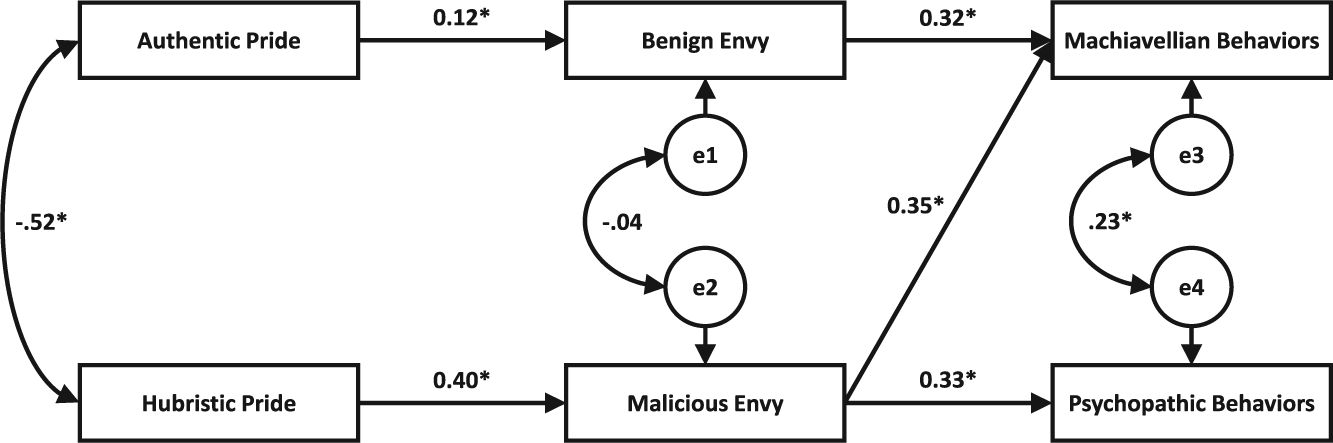
Path model in Study 2.
None of the preregistered potential analysis steps improved model fit. For exploratory reasons, we also tested another model including a path from benign envy to psychopathic behaviors given the zero-order correlation (Table 3). Adding this path improved the model fit, Δχ2(1) = 19.54, p < .001. Model fit was satisfactory, χ2(6) = 16.8, p = .01, CFI = .98, RMSEA = .056, 90% CI = [0.025, 0.088]. The path from benign envy to psychopathic behaviors was negative, B = −0.12, SE = 0.03, p < .001. Furthermore, the indirect effect of the authentic pride dummy variable via benign envy on psychopathic behaviors was significant, ab = −0.02, SE = 0.01, 95% CI = [−0.03, −0.01], p < .001. This pattern fits the findings of Study 1 in which benign envy also correlated negatively with psychopathy in regressions controlling for the shared variance with the other Dark Triad variables (see Table 2). Nevertheless, our predicted indirect effects had the same level of significance in the new model.
Discussion
Study 2 provides evidence for an association between the envy forms and dark behaviors on the state level. Specifically, a display of authentic pride increased benign envy, mediating an effect on Machiavellian behaviors. Furthermore, a display of hubristic pride increased malicious envy, mediating an effect on Machiavellian and psychopathic behaviors. Study 2 therefore extends Study 1, in which we investigated these relationships at the trait level. Dark behaviors are more likely to occur in situations that increase benign and malicious envy.
Unexpectedly, there was no total effect of authentic and hubristic pride displays on Machiavellian behaviors as compared to an embarrassment display. However, the pattern was in line with our predictions. Possibly, other mediating processes reduced the total effect. For instance, authentic pride displays are more likable (Lange & Crusius, 2015b) potentially diminishing the use of manipulative strategies. Furthermore, the association between malicious envy and psychopathy is larger across the studies than that between malicious envy and Machiavellianism. Therefore, the effect of a hubristic pride display on others’ psychopathic behavior might be larger than its effect on others’ Machiavellian behavior.
Together, Studies 1 and 2 indicate distinctive associations of (a) benign envy with Machiavellian tendencies, and (b) malicious envy with both Machiavellian and psychopathic tendencies at both the trait and state levels. But do these relationships, as we hypothesize, contribute to envy’s functional goal of regulating status hierarchies? And do these patterns occur in everyday behaviors?
Study 3
Study 3 investigated whether benign and malicious envy predict concrete Machiavellian and psychopathic behaviors in a real-world context—namely relationships at work. Furthermore, we investigated whether these relationships translate into status differences. To this end, we asked a diverse sample of participants about the frequency of specific Machiavellian and psychopathic behaviors and their status at work.
Machiavellians are successful in life domains only to the extent that these domains have a loose structure (Shultz, 1993). Given that status hierarchies are perceived as mutable (Hays & Bendersky, 2015), we considered the occupational context as a domain where Machiavellian behaviors could increase status. In contrast, the blatantly offensive character of psychopathic behaviors should be socially undesirable and consequently undermine status at work. Hence, we predicted that (a) benign envy predicts Machiavellian behaviors, whereas (b) malicious envy predicts both Machiavellian and psychopathic behaviors. Moreover, Machiavellian behaviors should mediate the positive effect of envy on status, whereas psychopathic behaviors should mediate a negative effect.
Method
Participants
We invited participants via advertisements on the website of a popular British science magazine, and advertisements and postings in social media. We stopped data collection after an a priori time limit and a minimum of 1,000 participants following all exclusions. We reasoned that this procedure would provide sufficient power—enough to find even the small effects that were expected given the social undesirability of dark behaviors. The resulting sample comprised of 1,243 people from the general population. They participated in return for personal feedback regarding their dark personalities. Their mean age was 28.4 years (SD = 13.5, range = 11-79, 18 unreported), 48% (11 unreported) were male, and 76% indicated English as their native language. Participants were mostly from the United States (43%), Great Britain (23%), Canada (9%), Australia (5%), India (2%), and Germany (2%).
Materials and procedure
As before, participants completed the SD3 (Jones & Paulhus, 2014) to measure their Dark Triad tendencies. We included this questionnaire to validate the behavioral expressions of Machiavellianism and psychopathy. Then, participants completed the BeMaS (Lange & Crusius, 2015a) assessing benign and malicious envy. The scales measuring Machiavellianism (α = .77), narcissism (α = .74), psychopathy (α = .76), benign envy (α = .81), and malicious envy (α = .84) were all acceptably reliable.
Afterward, participants indicated how often they engaged in various work behaviors on a scale from 1 (never), 2 (rarely), 3 (occasionally), 4 (often) to 5 (very often). We designed the items to capture seven broad classes of behaviors conceptualized to be indicators of Machiavellianism and psychopathy in previous research (e.g., Jones & Paulhus, 2009, 2011a; LeBreton et al., 2006; Paulhus, 2014; Paulhus & Williams, 2002; Rauthmann & Will, 2011). For Machiavellian behaviors, we included items assessing manipulative strategies (e.g., “. . . blackmail someone to get ahead”), self-presentation (e.g., “. . . strategically exaggerate your own personal abilities to impress others”), concealment (e.g., “. . . hide your true intentions from others to achieve a long-term goal”), ingratiation (e.g., “. . . compliment others to later have them as allies”), and strategic compliance (e.g., “. . . tell others what they want to hear to gain their compliance”). For psychopathic behaviors, we included items assessing impulsive manipulation (e.g., “. . . get back at others the quick and nasty way”) and antisocial actions (e.g., “. . . sexually harass a coworker”).
A factor analysis with principal components analysis to extract factors with oblimin rotation (delta = 0) on the work behaviors yielded three factors with eigenvalues >1. Note, however, that factoring a large number of items can lead even trivial factors to exceed this cutoff (Russell, 2002). Therefore, we followed up with a parallel analysis. We generated 1,000 data sets using permutations of the raw data set as some variables were skewed. Using a strict criterion (99th percentile), we found that only two factors surpassed the criterion: Their eigenvalues were 6.66 and 1.38.
Subsequently, we correlated each behavior with the trait measures of Machiavellianism and psychopathy, and regressed each behavior on both Dark Triad variables simultaneously. For the final scales, we selected items loading onto the intended factor (>|.30|) but not the respective other factor (<|.20|) and that also related more strongly to the intended Dark Triad variable. For Machiavellian behaviors, this resulted in a set of four items covering concealment (“. . . hide your true intentions from others to achieve a long-term goal”), ingratiation (“. . . compliment others to later have them as allies,” “. . . fake a friendship to someone as a tactic for my own advantage”), and strategic compliance (“. . . tell others what they want to hear to gain their compliance”). The composite of four items was acceptably reliable (α = .84).
For psychopathic behaviors, the procedure yielded five items covering impulsive manipulation (“. . . get back at others the quick and nasty way,” “. . . react with violence in an argument”) and antisocial actions (“sabotage somebody’s work in the heat of the moment,” “. . . steal office supplies,” “. . . sexually harass a coworker”). The reliability of the composite for psychopathic behaviors (α = .68) was acceptable.
Finally, participants indicated their position in their occupational hierarchy on a slider ranging from 0 (bottom %) to 100 (top %) as a measure of status (similar to Zitek & Jordan, 2016). 2 In short, a higher value indicated higher status. All materials are available in the online supplementary and on the OSF website.
Results
Table 5 displays descriptive statistics and zero-order correlations of all variables. Benign and malicious envy were moderately correlated as were the Dark Triad variables and behavioral composites. As predicted, benign envy was associated most strongly with Machiavellianism and Machiavellian behaviors. Benign envy had weaker links to psychopathy and psychopathic behaviors. Further in line with our hypotheses, malicious envy was associated most strongly with Machiavellianism, psychopathy, Machiavellian behaviors, and psychopathic behaviors. Benign envy and Machiavellian behaviors showed small positive correlations with status in the occupational hierarchy. In contrast, malicious envy had a small negative correlation with higher status.
Descriptive Statistics and Zero-Order Correlations of All Variables in Study 3.
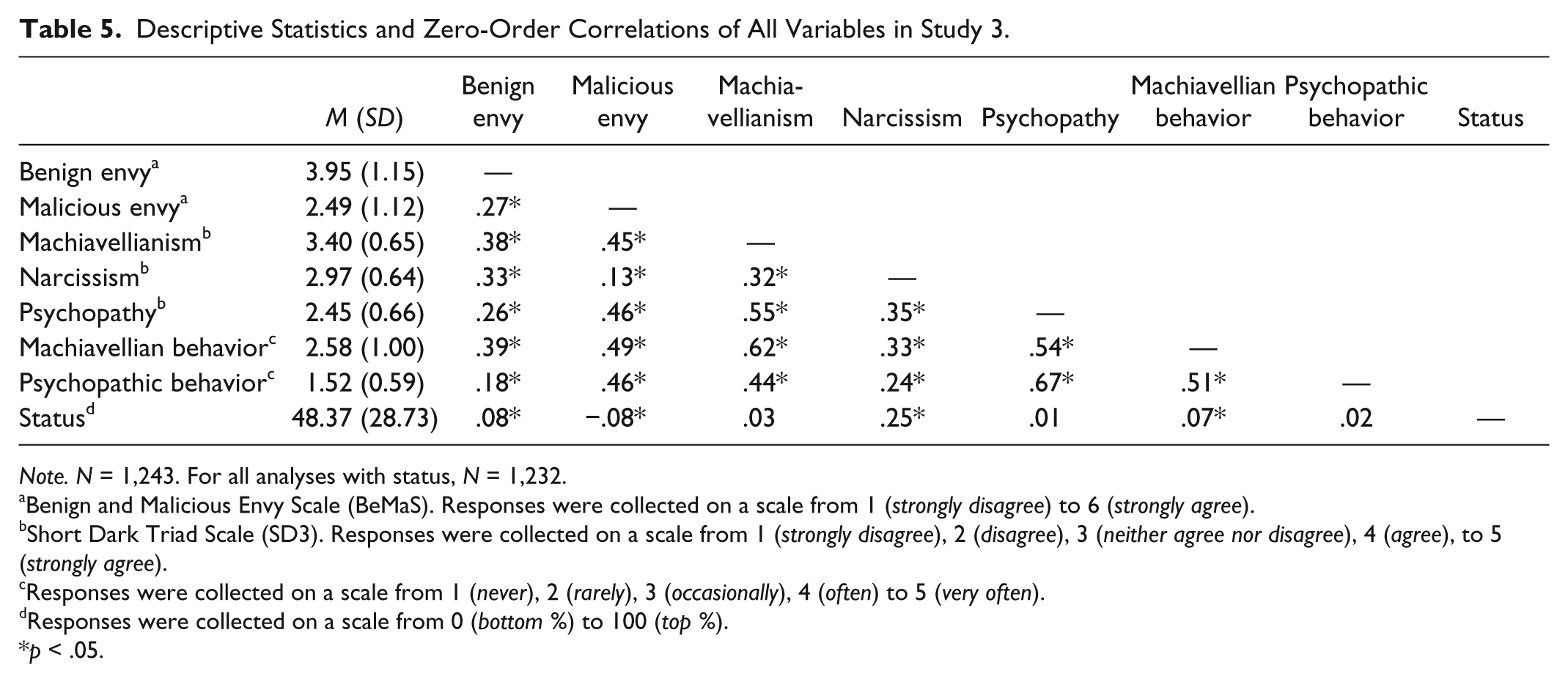
Note. N = 1,243. For all analyses with status, N = 1,232.
Benign and Malicious Envy Scale (BeMaS). Responses were collected on a scale from 1 (strongly disagree) to 6 (strongly agree).
Short Dark Triad Scale (SD3). Responses were collected on a scale from 1 (strongly disagree), 2 (disagree), 3 (neither agree nor disagree), 4 (agree), to 5 (strongly agree).
Responses were collected on a scale from 1 (never), 2 (rarely), 3 (occasionally), 4 (often) to 5 (very often).
Responses were collected on a scale from 0 (bottom %) to 100 (top %).
p < .05.
Next, we investigated our focal hypotheses with path analyses. We specified a model with (a) an indirect effect of benign envy via Machiavellian behaviors on status, and (b) indirect effects of malicious envy via Machiavellian and psychopathic behaviors on status. Benign and malicious envy were free to covary as were the error terms of Machiavellian and psychopathic behaviors. The model fit was satisfactory, χ2(3) = 32.63, p < .001, CFI = .97, RMSEA = .090, 90% CI = [0.063, 0.118]. We nevertheless explored whether including the direct effects of benign and malicious envy on status would improve model fit. It did, Δχ2(2) = 26.78, p < .001, with the new model showing satisfactory fit to the data, χ2(1) = 5.85, p = .02, CFI = 1.00, RMSEA = .063, 90% CI = [0.022, 0.116]. The model is depicted in Figure 2. We tested the indirect effects with 5,000 bootstrap resamples and bias-corrected CIs (Preacher & Hayes, 2008). As predicted, the indirect effect of benign envy via Machiavellian behaviors on status was significant, ab = 0.65, SE = 0.24, 95% CI = [0.19, 1.16], p = .005, as was the indirect effect of malicious envy via Machiavellian behaviors on status, ab = 0.70, SE = 0.27, 95% CI = [0.21, 1.23], p = .004. Unexpectedly, the indirect effect of malicious envy via psychopathic behaviors on status was not significant and, if anything, positive, ab = 0.23, SE = 0.27, 95% CI = [−0.29, 0.77], p = .38. As expected, the direct effect of benign envy on status was positive, whereas the direct effect of malicious envy on status was negative. The pattern and significance of the predicted indirect effects were unchanged from the initial model.
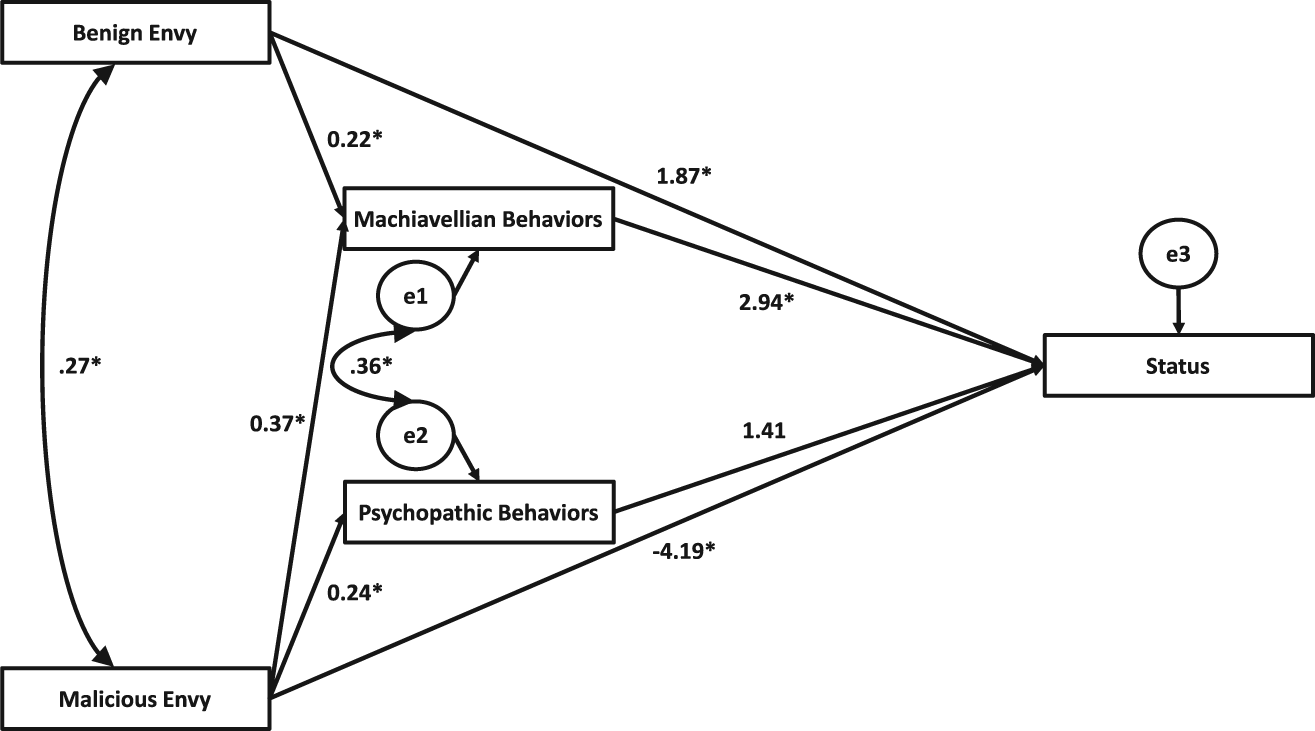
Path model in Study 3.
Discussion
Study 3 conceptually replicates Studies 1 and 2 by indicating that (a) benign envy relates to the frequency of engaging in Machiavellian behaviors at work, whereas (b) malicious envy relates to the frequency of engaging in both Machiavellian and psychopathic behaviors. Study 3 also extends Studies 1 and 2 by providing evidence that the associations of the envy forms with Machiavellian behaviors mediate an effect on status in the occupational hierarchy. These results suggest that dark behavioral patterns connected to benign and malicious envy at least partly drive status-related outcomes.
Unexpectedly, psychopathic behaviors had little effect on status. This might be explained by theory and evidence, suggesting that psychopathic behaviors constitute a double-edged sword (S. F. Smith & Lilienfeld, 2013). Some components of a psychopathic strategy such as fearless dominance may promote success at work, whereas self-centered impulsivity may undermine it.
Finally, benign and malicious envy also directly predicted more and less status, respectively. These findings are in line with the notion that benign and malicious envy contribute to the regulation of status via processes beyond dark behaviors. 3
General Discussion
Three studies contradict the common interpretation that malicious envy represents envy’s dark side, whereas benign envy is entirely constructive (e.g., Cohen-Charash & Larson, 2017). Instead, they provide evidence that both have malevolent and socially undesirable elements that can nevertheless be functional. Specifically, (a) benign envy is associated with Machiavellian behavioral tactics, whereas (b) malicious envy is associated with both Machiavellian and psychopathic behavioral tactics. Specifically, in Study 1, across five samples, correlations between dispositional envy and the Dark Triad supported the hypothesized pattern. In Study 2, a manipulation that increased state benign envy mediated an effect on Machiavellian behaviors, whereas a manipulation that increased state malicious envy mediated effects on Machiavellian and psychopathic behaviors in a vignette. In Study 3, dispositional benign and malicious envy predicted the frequency of Machiavellian and psychopathic behaviors at work in a large online sample. Furthermore, Machiavellian behaviors predicted higher status in the occupational hierarchy. Finally, dispositional benign and malicious envy were linked to higher and lower positions in the hierarchy, respectively.
The current findings help clarify several key issues regarding theorizing and research on envy. Most of the previous approaches portray envy as a malevolent and interpersonally maladaptive emotion (R. H. Smith & Kim, 2007). Other evidence, however, highlights envy’s benign side (Van de Ven et al., 2009). The most frequent criticism is that this work splits envy into socially desirable and undesirable manifestations (Cohen-Charash & Larson, 2017; Tai et al., 2012). In contrast to this reasoning, the present evidence shows that both envy forms relate to dark behaviors. The focal question is whether these behaviors are functional. Any consequence of envy may be perceived as socially desirable by some but as undesirable by others. Independent of such evaluative judgments, they can be functional for the envier as well as society in regulating status. In line with this reasoning, the current evidence underlines that a one-sided moral interpretation of the envy forms is unwarranted and limits theorizing.
Moreover, the relations of envy and the Dark Triad could help derive hypotheses for still unexplored outcomes of envy. For instance, Machiavellianism has been related to deliberate cheating, whereas psychopathy has been related to impulsive cheating (Jones & Paulhus, 2017). One possibility to improve personal status in benign envy could be to cheat in performance situations in such a way that it goes unnoticed by others. This strategy would thus support status attainment. In contrast, malicious envy might also foster improvement motivation that manifests in cheating. As malicious envy relates to Machiavellian and psychopathic strategies, it could lead to impulsive cheating in the short term and strategic cheating in the long term. Such hypotheses await empirical scrutiny.
Another possible extension of research on envy through the lens of the Dark Triad could result from the link of malicious envy with psychopathy. Psychopaths are characterized by a deficient affective experience that translates into a lack of remorse for actions (LeBreton et al., 2006). Remorseful individuals try to make amends (Fisher & Exline, 2006). If the maliciously envious lack remorse, this could, on the one hand, be a protective factor against personal distress following direct aggression toward the envied person. On the other hand, this should be socially dysfunctional. A lack of remorse keeps victims of a perpetrator’s actions dissatisfied (Funk, McGeer, & Gollwitzer, 2014). This dissatisfaction might explain how the maliciously envious lose status in the eyes of others.
Limitations and Future Directions
One limitation of the current research is that the studies relied on self-report. This approach allowed us to assess a multitude of the diverse manifestations of Machiavellian and psychopathic behavioral strategies. Use of MTurk and a broad Internet sample also permitted generalizations to a wider age range than students. Furthermore, the technique of asking participants how often they engage in a range of dark-side work behaviors is subtler than assessing the global personality constructs of Machiavellianism and psychopathy. Nevertheless, future research may benefit from assessing independent, concrete manifestations of dark personality, and should include objective indicators or peer ratings of status.
Second, we investigated our hypotheses cross-sectionally. Even though our findings strongly contradict a one-sided interpretation of benign and malicious envy, it would be worthwhile to investigate their relationship with malevolent behaviors using a longitudinal design. Such an approach would be valuable because behavioral and social effects of the Dark Triad can change over time (see, for instance, research on narcissism by Leckelt, Küfner, Nestler, & Back, 2015; Paulhus, 1998). An event that elicits benign envy and corresponding Machiavellian behaviors might initially foster ingratiation designed to close the social comparison gap. If this strategy fails to lead to status attainment, the benignly envious could turn to more duplicitous behaviors. Similarly, an event eliciting malicious envy might foster impulsive manipulation that—if unsuccessful in undermining the envied person’s status—may eventually escalate into aggression and, perhaps, criminal behavior.
Finally, even though we tested hypotheses relating benign and malicious envy to dark behaviors, we had no a priori predictions concerning the pain component of envy. Pain, benign envy, and malicious envy constitute separate, yet interrelated elements of envy (Lange, Weidman, & Crusius, in press). Pain relates positively to benign and malicious envy, and decreases more quickly in its intensity. This implies that it may temporally precede benign and malicious envy, and could therefore mediate their effects (Tai et al., 2012). This may be investigated in longitudinal studies.
Conclusion
We have taken the unique approach of integrating previously isolated bodies of work on envy and dark personalities. As a result, the present data add to the extant literature by indicating that both benign and malicious envy can be as malevolent as they are functional. In short, benign envy involves subtle social manipulation, whereas malicious envy can extend to blatant aggression. Elucidating the dark side of envy challenges a simple moral distinction of its two forms and directs future research toward its complex role in social interactions.
Footnotes
Authors’ Note

Declaration of Conflicting Interests
The author(s) declared no potential conflicts of interest with respect to the research, authorship, and/or publication of this article.
Funding
The author(s) disclosed receipt of the following financial support for the research, authorship, and/or publication of this article: The research reported in this article was supported by grants from the German Academic Exchange Service (DAAD) as well as the German Research Foundation (DFG; LA 4029/1-1) awarded to Jens Lange, and grants from the German Research foundation (DFG; CR 489/1-1) as well as the University of Cologne (Advanced PostDoc Grant) awarded to Jan Crusius.
Notes
Supplemental Material
Supplementary material is available online with this article.
References
Supplementary Material
Please find the following supplemental material available below.
For Open Access articles published under a Creative Commons License, all supplemental material carries the same license as the article it is associated with.
For non-Open Access articles published, all supplemental material carries a non-exclusive license, and permission requests for re-use of supplemental material or any part of supplemental material shall be sent directly to the copyright owner as specified in the copyright notice associated with the article.
