




Abstract
Armed conflict situations are more than just sites of violence, destruction, scars, torture, rape, and death; they are also sites of disability production through direct causes and indirectly through disruption of societal services, which would otherwise prevent disabilities. In this paper, the David Narrative in 2 Samuel is reread as an armed conflict text centered on power, disempowerment, and control issues. In this rereading, the imagery of disability is viewed as a symbol of terror to instill fear and deter rebels and traitors.
Armed conflicts are a constant reality in the African continent. According to the SIPRI Yearbook 2021, in sub-Saharan Africa, there were twenty states with armed conflicts in 2020. While finalizing this paper, armed conflict broke out in Sudan. This was akin to adding salt to the wound, considering the armed conflict in Ethiopia’s Tigray region had recently subsided. Armed conflicts or wars, to use Puar’s words (2017, p. 65), require “bodies that are preordained for injury and maiming.”
Armed conflicts are also an imperial tool to establish relationships of subordination and domination by causing harm to others through killing, injuring, and weakening them. The majority of people with disabilities are located in the developing world or the global South, which implies that they find themselves caught in the web of complex inequalities produced by the socio-politico relations of global power (Grech, 2012; Meekosha, 2011; Meekosha & Soldatic, 2011). The powerful, particularly the imperial states with advanced weaponry, have a long history of killing and disabling civilians. In her book, The Right to Maim: Debility, Capacity, Disability (2017, xvii–xix), Jabir K. Puar describes the right to maim as follows:
a right expressive of sovereign power that is linked to, but not the same as, “the right to kill.” Maiming is a source of value extraction from populations that would otherwise be disposable. The right to maim exemplifies the most intensive practice of the biopolitics of debilitation, where maiming is a sanctioned tactic of settler colonial rule, justified in protectionist terms and soliciting disability rights solutions that, while absolutely crucial to aiding some individuals, unfortunately, lead to a further perpetuation of debilitation.
For Puar, the two interlocking concepts of “disability” and “debility” provide a conceptual frame beyond the binary of disabled/non-disabled. As Puar (2017, p. 67) argues, the two concepts require theorizing the bio-politics of disability and the biopolitics of debilitation, which demand challenging the local and global structures that give rise to the world’s disability.
The concept of biopolitics of disability allows for theorizing on disability as a “complex embodiment” which requires attention to be paid not only to the maintenance of disabled bodies but also to how disabled bodies are solicited and manufactured and the demands placed on them (Mitchell & Snyder, 2015; Siebers, 2008, 2016). As Siebers states, “disability is not a pathological condition, only analyzable via individual psychology, but a social location complexly embodied” (Siebers, 2016, p. 318). On the other hand, the politics of debilitation considers the dynamics which render certain people or populations as targets for injury and inevitably tied to poverty, war, racism, imperialism and colonialism (Puar, 2017, p. 69). The concept of debilitation focuses on social injustice and oppressive structures that enable disability. In this view, disability should not be viewed as a universal challenge affecting everyone without considering the geopolitical issues that allow certain populations’ debilitation (Meekosha, 2011; Puar, 2017). As Meekosha argues that disability in the global South is intricately linked to northern imperialism, colonialism, and globalization, which requires the interrogation of who is disabled and profits from such (Meekosha, 2011, p. 671)
In this article, I analyze the David narrative from the perspective of Africa’s struggles with disability caused by armed conflicts and the challenges faced by disabled individuals on the continent. I examine the intersection of politics, empire, war, and disability in search of ways to promote liberation. My focus is not so much on how disabled bodies are maintained in society but on how they are produced. This reading demands a decolonial-disability justice approach which strives for a just society which is anti-racist, anti-war, and anti-imperial (see Puar, 2017, p. 67).
This paper is structured as follows: first, I paint a picture a brief picture of the terror of armed conflicts in Africa, and second, I engage in the reading of the David narrative in light of the armed conflicts in Africa, taking into consideration of the biopolitics of disability in which disability is employed for oppressive purpose.
The Terror of Armed Conflicts in Africa: Disability
While armed conflicts do flare up occasionally in other continents, the African continent is partly marked or marred by ongoing armed conflicts. Most of the armed conflicts in the African continent involve non-state actors, such as militia groups, warlords, and extremist groups, who use uncontrolled arms (Adeniyi, 2017). The non-state actors involved in armed conflicts often acquire their weaponry illegally in the black market and through diversions from state stockpiles (Adeniyi, 2017). The following African countries are listed among the least performing in terms of the Global Peace Index: Mali, Libya, Sudan, Central African Republic, Somalia, the Central African Republic (CAR), and the Democratic Republic of the Congo (DRC) (IEP, 2022). According to the SIPRI Yearbook 2021, in sub-Saharan Africa, there were twenty states with armed conflicts in 2020 (SIPRI, 2022). In 2022, the following African countries experienced instability resulting in coups: Burkina Faso, Guinea, Chad, Sudan, and Mali.
The armed conflicts in most of Africa may be classified as post-colonial wars, which, as Zeleza (2008, p. 6) argues, mainly take two forms—intra-state and inter-state. The intra-state wars also take different forms, such as secessionist wars (e.g., Somali-Ethiopian wars), irredentist wars (e.g., claims of Greater Morocco and Greater Mauritania), wars of devolution (e.g. Sudanese Civil War which resulted in two independent states Sudan and South Sudan), wars of regime change (e.g., in the 1980s, the capture of power by National Resistance Movement-Army, the military coups which are a recurring phenomenon in several states in Africa), wars of social banditry (e.g., organize groups of warlords and terrorist groups in Sierra Leone, Liberia, Democratic Republic of Congo, Nigeria), and armed inter-communal insurrections (e.g., genocidal explosions in Burundi and Rwanda). Africa has also had several inter-state conflicts such as the Kenyan-Somali war (1963), Somali-Ethiopian war (1978-79), Tanzania-Ugandan war (1978-79), Eritrea-Ethiopian war (1998-2000) (Bereketeab, 2013; Nhema & Zeleza, 2008). The ISS (2013) made the following observation ten years ago:
Since the 1990s, the number of wars has halved, and the nature of conflict has changed.
Today conflict in Africa is increasingly fragmented, tending to be fought on a smaller scale and the peripheries of states. More non-state actors are involved, and generally, insurgents are militarily weak and often divided. Some of these features are evident in places such as Darfur, Sudan, the Central African Republic, northern Mali or the eastern provinces of the Democratic Republic of Congo.
Moreover, the lines between criminal and political violence are getting increasingly blurred, and insurgents are often connected to illicit transnational networks.
The continuing armed conflicts on the continent cost human lives. For example, the armed conflict in the Democratic Republic of Congo has since 1996 claimed over 6 million people. The War in Tigray (Ethiopia) is estimated to have claimed over 600,000 people (Naranjo, 2023). According to Adeniyi (2017, p. 17), “most of the deaths recorded in conflict and security-challenged environments in the continent are caused by uncontrolled arms.” The armed conflicts in Africa are not only protracted but also happen in civilian centers, which places civilian lives at risk of becoming targets in the conflicts. Wild et al. (2020, p. 1864) note that the loss of lives is exacerbated by disruptions and destructions of health systems resulting in the wounded having to be treated through “uncoordinated, ad hoc patchwork of actors including local hospitals and international humanitarian non-governmental organizations (NGOs) that are rarely able to meet the needs of affected populations.”
The International Institute for Strategic Studies’ report entitled “The Armed Conflict Survey 2022: Sub-Saharan Africa Regional Analysis” highlights that in Africa, there is also an increasing trend of third-party states’ involvement in internal conflicts (IISS, 2022).
Twelve so-called internationalised-internal conflicts (i.e., civil wars with external intervention by a state) were recorded in the two decades between 1991 and 2010 (counting each conflict that occurred across multiple years only once). In the following 11-year period (2011–21), 27 such conflicts were recorded. Most of these conflicts were recurring year after year. In 2021, there were 17 internationalised civil wars in sub-Saharan Africa – more than twice the number of internal conflicts without external intervention.
The IISS report also highlights that the interventions of external states in armed conflicts can undermine multilateral initiatives and peacemaking efforts as the external states often support one party in the conflict (IISS, 2022). Moreover, as Zeleza (2008, p. 2) argues, the armed conflicts in Africa “are rooted in the complex constructions and conjunctures of Africa’s political economies, social identities, and cultural ecologies as configured out of specific local, national, and regional historical experiences and patterns of insertion into, and engagement with, an everchanging world system.”
Armed conflicts are costly: human cost and economic cost. I am not interested here in the economic costs of armed conflicts in the African continent but rather with the human cost with a focus on injuries resulting from such conflicts.
Injuries: Disabilities and Scars
Armed conflicts put able and healthy people at risk of being maimed, injured, and psychologically traumatized. Those in danger of injury are not only the combatants—army personnel, militia groups, and rebel groups. Civilians in armed conflicts are wounded in various ways: caught in the crossfire, targeted attack on civilians, bombings by improvised explosives, and suicide bombings.
The disability ensuing from armed conflicts is not only about the effects on the human body, but wars also take away people’s ability to work towards self-sufficiency and national development, as people become displaced and refugees who have to rely on relief programs and handouts (Wild et al., 2020). In Africa, many risk crossing borders to seek shelter in other African countries, and others risk crossing the Mediterranean Ocean into Europe. It is reported that over 1500 people died in the Mediterranean Ocean in 2022, adding to the over 25 000 deaths since 2014 (Sunderland, 2022). The armed conflicts in the continent contribute to the continent’s underdevelopment as able human beings flee the continent to find refugees elsewhere.
Rape (Genital-Anal Injury and Sexual Trauma)
In armed conflict contexts, rape is used as a weapon of war (Mukwege, 2022) and thus inflicts genital-anal injury and leaves sexual trauma (Sommers, 2007). Sexual violence acts are perpetrated by various actors in the conflict, like state actors (army and peacekeeping forces) and non-state actors (rebels, militia groups, criminal organizations, and opportunists). However, acts of sexual violence, as Arieff (2010) notes, are perpetrated mainly by the combatants in the conflict as a tool to intimidate and humiliate the opposing group or the civilians caught in the crossfire. During the Rwandan genocide, it is estimated that between 250 000 and 500 000 women were raped (Amnesty International, n.d.; Banyanga et al., 2017; Des Forges, 1999; Haffajee, 2006). In the Democratic Republic of Congo, rape is used against both males and females. Armed combatants often perpetrate such rapes (Bartels et al., 2013). In the ongoing conflict in the DRC, it was at some point reported that 48 women were raped every hour, and countless surgeries had to be done to address complications stemming from rape (Bradley, 2013).
Psychological Trauma and Stress (Invisible Injuries)
Armed conflicts not only leave open and visible wounds—destruction to property, land, and human bodies. People in war zones also suffer from post-traumatic stress disorder symptoms affecting the young and the old (Crawford, 2013). Factors contributing to psychological trauma and stress include, among other things, violence, imprisonment, torture, rape, displacement, loss of family members, and loss of property. Furthermore, the ripple effects of ongoing wars continue to be felt even years after (Njenga et al., 2003, 2006). For example, the Rwandan genocide of 1994 resulted in the loss of life of about 800 0000 people within 100 days and 4 million people displaced. Many Rwandans had to live with the trauma inflicted by the genocide (Banyanga et al., 2017; Pham et al., 2004).
The injuries and disabilities from armed conflicts symbolize the terror of armed conflicts. As Murray et al. (2002) highlight:
In most cases, disabilities due to war have been assessed by patients attending health facilities. Even though these sources may underestimate the non-fatal health outcomes, the overall impact of these health effects is likely to be substantial. The reported ratio of people injured to those killed in modern conflicts ranges from 1.9 to 13.0. In 1990 the Global Burden of Disease study estimated that non-fatal outcomes of war resulted in 4.8 million disability-adjusted life years worldwide, about the same as fires and more than half that caused by road traffic injuries.
Armed conflicts are not just sites of production of disabilities; they are also sites at which persons with disabilities are at even greater risk and often become targets for killing and, in other instances, used as human shields (Priddy, 2019). Disabled people in conflict zones often have to rely on others in case they have to flee from conflict. Many places of refuge to which people run on the flight from conflict zones are ill-equipped and therefore fail to provide the necessary and essential services to disabled people (Priddy, 2019). Furthermore, conflict zones are also sites where disabilities are exacerbated due to the increased risk. Disabled people in conflict zones are at risk of sustaining injuries and worsening their plight. Those unable to flee on their own are at risk of abandonment in the conflict zones. When caught in the crossfire, the disabled risk, among others, death, enslavement, and abuse. Priddy (2019) also highlights that “persons with disabilities remain the forgotten victims of armed conflict.”
In the next section, I turn my attention to the David narrative. Within this analysis, my central focus will be on disability, which I interpret as a symbol of terror within the story.
Disability: Symbol of Terror in the David Narrative
The David narrative is a complex narrative intertwined with other narratives, and it also gave birth to myths and legends about the Davidic figure. As Alter (2009, p. ix) notes, the David narrative:
is probably the greatest single narrative representation in antiquity of a human life evolving by slow stages through time, shaped and altered by the pressures of political life by the pressures of political life, public institutions, family, impulses of body and spirit, the eventual sad decay of the flesh. It also provides the most unflinching insight into the cruel processes of history and into human behavior warped by the pursuit of power.
In the broader literary context, the Davidic character is embroiled in armed conflicts and is also remembered as a man of war. In the Deuteronomistic History, David is among others introduced into Saul’s royal court as follows:
Then answered one of the young men, and said: ‘Behold, I have seen a son of Jesse the Beth-lehemite, that is skilful in playing,
For Chronicler, David is remembered as a man of armed conflicts/wars and having spilt a lot of blood:
But the word of the LORD came to me, saying, ‘You have
“But God said to me, ‘You shall not build a house for My name, because you have been
The Davidic character is, thus, embroiled in armed conflicts through and through in the narrative. The impression one gets in Deuteronomistic History is that David already stood out as a soldier, more specifically as a mercenary from Judah, before he caught the attention of the royal house. But David’s reputation as a warrior is predicated on his victory over the Philistine hero Goliath (1 Samuel 17), after which he rose to fame and was regarded as a superior warrior to King Saul (1 Sam 18:7). Then, the story develops into one fraught with tensions between Saul and David, as Saul starts seeing David as a political threat (a man ambitious for the throne) considering his continual successes in inter armed conflicts (1Sam 18:16, 30). The intra-armed conflict between Saul and David had started leading David to escape and find refuge among Saul’s enemy, Samuel (1 Sam 19:18-24), among his fellow Judahites, in the desert, and among the enemies of Israel (e.g., Philistines, see 1 Sam 27). As Strine (2021) notes, “it is reasonable to frame David, when he takes flight from Saul, as a person seeking asylum.” While I agree with Strine, David should first be viewed as a migrant laborer in Israel who made his way into Israel’s kingdom either as a military recruit from Judah or as a voluntary migrant laborer who went into the kingdom of Israel seeking opportunities. In any way, his brothers were already in Israel, making their living there as hired soldiers.
When David escaped from Israel, it was an involuntary migration necessitated by fear of injury and death. In the process, those who associated with David or appeared to be supporting David were also persecuted. Therefore, Saul’s killing of the priests at Nob, women and children, ox, donkeys and sheep at Nob with only one person, Abiatar, Ahimelech’s son, manages to escape speaks to the terror of war (1 Sam 22:16-23). While Abiathar escaped with his life, he could not escape the psychological trauma of the conflict. This conflict initially had nothing to the with the priests and their family members. Abiathar also became an involuntary immigrant joining the company of other displaced people in the land.
What started as an intra-state armed conflict developed into inter-state armed conflict when David established himself as a king among his fellow Judahites, founding a small kingdom of Judah alongside the kingdom of Israel, which Saul, a Benjamite, founded. Scholars have noted that 1 and 2 Samuel brings together traditions of the formation of Israelite monarchy and Judahite monarchy, with the traditions of the former stemming from the north (Israelite) and the traditions of the latter originating from the South (Judahite). Therefore, the two traditions were brought together to present David as a legitimate successor of Saul through the stories of David’s rise (see (Dietrich & Naumann, 2000). From an archaeological perspective, others argue that the two kingdoms, Israel and Judah, were at no point a united kingdom. Underlying the combinations of the two traditions were probably conflicts which embroiled the two kingdoms in the struggle to expand territory. Therefore, as portrayed in the David narrative, the struggle between Judah and Israel may be characterized as an inter-state armed conflict.
In times of armed conflict, innocent civilians are often coerced into taking sides, which can lead to dire consequences. The tragic massacre of priests in Nob by Saul was intended to discourage any further support for David from those within Saul’s reach. Unfortunately, there may not be a better alternative in such situations, and even taking sides can come at a great cost. The biblical narrative presents two instances where David is portrayed as killing individuals who supported his quest for the throne of Israel. Although the text attempts to distance David from the killings of Saul and his successor, Ish-Bosheth, his actions against those who aided him reveal the harsh reality of conflict for ordinary people caught in the crossfire. First, David killed an Amalekite, who brought him the crown of Saul following Saul’s death (2 Sam 1:1-16). Second, David maimed and killed Baanah and Recab, the sons of Rimmon the Beerothite, who killed Ish-Bosheth, the reigning king of Israel after Saul (2 Sam 4). David’s maiming and killing of those who handed him the crown highlight the underlying mistrust, often a prevalent theme in armed conflicts. If someone can be bold enough to kill a reigning king, they can also kill you; therefore, they are better off dead. Taking sides in armed conflict offers no guarantee of life for the civilians caught in the conflict—you are damned if you do, and you are damned if you do not.
Injuries in Armed Conflict: A Wounded King, the Case of Saul
In the ancient Near East, a king was a warrior who was supposed to maintain order by defeating enemies. The king was supposed to lead the army in inter-monarch battles. Thus, as a warrior, the king risked his life in fighting with the enemies. However, unlike any ordinary army personnel, kings also had royal guards, who served as their shield. Yet, the danger of getting wounded, defeated, captured, and killed remained.
In 1 Samuel 31, the narrative relates Saul’s final armed conflict with the Philistines. Saul got wounded in the battle and realized there was no way to escape from his enemies. In 1 Sam 31:4, Saul describes the treatment that he will receive from his enemies as follows: “lest these uncircumcised will come and stab me, and make a mockery of me.” Thus, for Saul, the treatment he would receive from his enemies would be further injuries on his already wounded body. He would be shamed at the hands of his enemies. Saul took his own life by falling on his sword to escape that shame. Therefore, King Saul met his fateful end in the battle with the Philistines—a neighboring nation. In this case, David is presented as being far away from these events, as though he had no hand in the fall of Saul. However, reading against the grain, David played a role in the events. First, he was part of the Philistine army that was going to fight Saul. The Philistine’s army would have relied on David for intelligence on how to best defeat the army in which he used to be a high-ranking official (see 1 Sam 18:5, 14, 30). Second, an Amalekite delivers Saul’s crown to David instead of taking it to the rightful heirs of the kingdom. Such a move can hardly be a coincidence. While the narrative is at pains to portray David as a man who had no intention of killing Saul even if he had the opportunity (1 Sam 24:7; 26:9-11), it is hard to rule out his involvement in the act (see Baden, 2014, pp. 104–115; Halpern, 2001, pp. 78–80). Third, the death of Saul was just the beginning of the many deaths to follow in Saul’s house. Saul’s progeny, apart from those who died together with him, were also killed—Ish-Bosheth was killed in a move that made David king over Israel (2 Sam 3-5), and the rest of Saul’s progeny were killed to eliminate rivalry and establish a Davidic dynasty (2 Sam 21:1-14). The text raises the possibility that David was involved in the murder of Saul and his descendants, but the pro-David narrative always places the blame for the murders on someone else (see also Brenner, 2005, pp. 124–128; Brueggemann, 1988).
The fateful end of Saul evokes his first inter-monarchs armed conflict as king of Israel. In Sam 11:1-11, Saul springs to action to save the besieged town of Jabesh-Gilead, which was invaded by Nahash the Ammonite. In that story, Nahash threatened to make a covenant with the Jabesh-Gileadites through mutilation: “On this condition, I will make a treaty with you, namely that I gouge out everyone’s right eye, and thus put disgrace upon all Israel” (1Sa 11:2 NRS). As Lemon (2006, p. 229) notes, “[t]his text explicitly states that it is a desire to shame the Israelites that moves Nahash to mutilate them.” Thus, in the ancient Near Eastern context of armed conflict, the mutilation was intended to bring shame to the conquered and to serve as a symbol of terror for the rebellious. For example, the Balawat gate of Shalmaneser III (858-824 BC) depicts prisoners of war being tortured and mutilated.
Balawat Gate of Shalmaneser III (ca. 858-824), British Museum
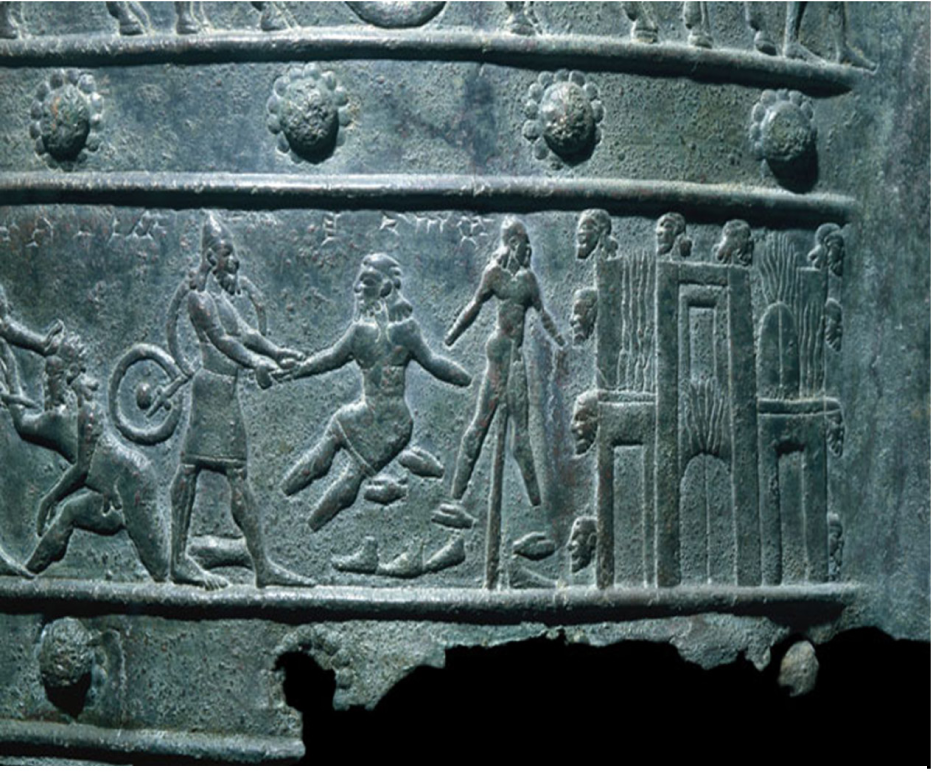
The inhumane treatment of those captured by the Assyrians led others to consider ending their lives rather than facing torture and shame. Just as King Saul before the Philistines, King Urartu, when faced defeated by Sargon II, committed suicide: “The splendor of Assur, my lord, overwhelmed him [the king of Urartu], and with his own iron dagger, he stabbed himself through the heart, like a pig, and ended his life” (see Bleibtreu, 1991). The battle with the Elamite monarch and his army, which shows a cruel and degrading treatment of the defeated, is described in Sennacherib’s inscription:
I cut their throats like lambs. I cut off their precious lives (as one cuts) a string. Like the many waters of a storm, I made (the contents of) their gullets and entrails run down upon the wide earth. My prancing steeds harnessed for my riding, plunged into the streams of their blood as (into) a river. The wheels of my war chariot, which brings low the wicked and the evil, were bespattered with blood and filth. With the bodies of their warriors I filled the plain, like grass. (Their) testicles I cut off, and tore out their privates like the seeds of cucumbers. (see Bleibtreu, 1991)
These descriptions of the treatment by imperial powers of those conquered provide a foundation for not viewing Saul’s death as a cowardly death; instead, as an attempt to save Israel from humiliation and shame from their enemies. Moreover, it is also likely that the composers of Israel’s (mythical) origins were drawing their experiences with the Assyrian empire and the later Babylonian empire. King Saul thus becomes a prefigure of the experiences of later kings who suffered at the hands of imperial forces. From the Northern Kingdom of Israel, Ahab died from the wounds in battle (1 Kgs 22); Joram was wounded in battle but recovered (2 Kgs 8:28-29), and from the South, the Kingdom of Judah (Ahaziah died from the wound when Israel and Judah were at war with each other), Josiah died from injuries sustained in battle with the Egyptians (2 Kgs 23:28-30, cf. 2 Chron 35:20-24), Zedekiah is captured, and his eyes were gouged out (2 Kgs 25:7).
The violence of imperial power then and now is in the production of mass disability. The ancient imperial forces sought to disempower and instill fear in the conquered populations to gain control over the conquered. The modern imperial violence, as Erevelles (Erevelles, 2011, p. 22) argues, “is instrumental not only in the creation of disability but also in the absence of public recognition of the impact of disability in the third world.” Thus, disability should also be viewed as a by-product of structural violence in the global scheme. As Meekosha (2011, p. 677) argues, “Maybe it is too confronting to deal with the disabling of people in the global South because in trying to claim the positives of a disability identity, it becomes difficult to acknowledge the overwhelming suffering that results from colonization, war, famine, and poverty.” The armed conflicts in the post-colonial states continue the colonial culture of violence (Fanon, 1968; Ndlovu-Gatsheni, 2012).
Disability of Mephibosheth: A Product of Armed Conflict
The death of Saul and his son Jonathan in the armed conflict with the Philistines would have brought chaos to the royal house at various levels. First, chaos would have erupted within the royal house regarding who would take over the reign. The king and his other potential successors, Jonathan and the other two unnamed sons, were dead, leaving the other sons to contend for the throne. The installation of Ish-Bosheth by the army commander, who went on to rule all of Israel, was likely to end the power struggle. This considering that other brothers may have annexed some areas and crowned themselves kings (2 Sam 2:8-9). Second, the houses of Saul and David kept engaging in violent confrontations. The story also switches its focus from Saul’s royal house to David following the demise of King Saul. When Saul passed away, it was also a good opportunity for David to establish himself as king.
After advancing the David character, the narrative returns to Saul’s royal house to inform the reader of the succession. The narrative also highlights that there was a continuing armed conflict between the royal house of Saul and the royal house of David (2 Samuel 2:8–3:1). In 2 Sam 3:1, the reader is informed that “the war between the house of Saul and the house of David lasted a long time. David grew stronger and stronger, while the house of Saul grew weaker and weaker” (NIV).
The narrative then introduces the Mephibosheth character as a digression to the main plot, when Ish-Bosheth was murdered and his head delivered to king David, who was ruling from Hebron. The murder of King Ish-Bosheth finally opened room for David to take over the kingship of all the tribes of Israel (2 Sam 5:1). At this point, the reader is informed of Mephibosheth’s disability which happened when he was five—the time when Saul and Jonathan died in the war with the Philistines. The disability of Mephibosheth was not a temporary injury but a permanent injury, which implied that from that point, he was lame his entire life (Schipper, 2009). Mephibosheth’s disability does not have to be seen as merely the result of an accident; his nurse dropped him, resulting in a crippling injury. The context within which Mephibosheth, an able child at the time, became disabled matters. It was in the context of armed conflict that Mephibosheth became paralyzed. While the introduction of the Mephibosheth in the plot of David’s story serves other purposes, this reader cries for attention to be paid to the children as victims of war. Therefore, the Mephibosheth incident, which occurred among the privileged in society, may just as well be viewed as a tip of an iceberg suffered by the many children during armed conflicts. In the ancient context of war, children lost their parents and their abilities, and those who escaped with their lives in case of defeat were not just displaced but were turned into enslaved people, with the girl children having to suffer from sexual violations and rape and forced marriages (cf. Num 31:17-18; Jdg 21:11-12).
In our contemporary context, while there is some attention to the issue of the rights of people with disabilities in the war context, not much is done to highlight the terror of armed conflicts in producing disabled children. The six significant violations of children in the context of war, as underlined by UNICEF (2022), are: death, maiming, recruitment and use of children as soldiers, attacks on children, rape or sexual violence, abduction, and denial of access to humanitarian assistance. UNICEF (2022) notes the following:
In 2020 alone, explosive weapons and explosive remnants of war were responsible for at least 47 per cent of all child casualties. Between 2005 and 2020, more than 104,100 children were verified as killed or maimed in situations of armed conflict, with more than two-thirds of these verified since 2014.
A recent study on the Libyan conflict found that between 2012 and 2017, there was a total of 16 126 death and 43 633 injuries resulting from the conflict, with most disabilities attributed to blasts (Daw et al., 2019). Another study on the epidemiology of injuries sustained in armed conflicts highlights that civilians suffer immensely, with children accounting for 34.7% of the injured, with blasts the primary cause of extreme injuries (Wild et al., 2020).
Children living in armed conflict situations, like Mephibosheth, get injured, and some eventually die. Therefore, the disabilities of children emanating from war stand out as a symbol of terror. The underreporting and non-reporting of the impact of wars on children prevent us from realizing the costs of war. Just as Mephibosheth was kept in hiding, many of the child victims of our modern wars are kept out of our sight.
The later actions of David towards Mephibosheth, while they are presented as an act of kindness on the part of David and as a way of fulfilling his oath to Jonathan (see 2 Sam 9; 16:1-4; 21:7), also have troubling aspects. When Mephibosheth is invited into the royal house, the psychological damage is already done. Mephibosheth considered himself “a dead dog” (2 Sam 9:8)—a non-threat to David. With his disabilities, it would be impossible to marshal an army to rival David. Furthermore, Mephibosheth being brought so close to the king was for him to live on a knife’s edge.
David’s kindness towards Mephibosheth exhibits an imperial tactic of war: disabling (more than just physical) so that the disabled person would be reliant on and consume the imperial goods. As Sidel (1995, p. 1677) notes, “[s]ome military leaders may find it more advantageous to wound rather than to kill enemy personnel, military or civilian since the opponents then consume valuable resources to take care of their wounded.” David’s actions were intended to keep Mephibosheth under constant check, reliant, and, where possible, set him up for failure to render him killable (compare 2 Sam 16:1-4 and 19:24-30). Indeed, Mephibosheth vanishes from the story setup after the betrayal from his servant Ziba, who notified David that Mephibosheth was hoping for the kingdom to be restored to Saul’s house (2 Sam 16:3). Thus, the accusation was that Mephibosheth wanted to seize the opportunity of the dysfunctionality within David’s royal house, and be declared king over Israel. With the accusation, the parcels of land restored to Mephibosheth are transferred to Ziba (2 Sam 16:4), and in so doing, the kindness is reversed. As Rouse (2008, p. 191) notes, David’s later actions toward Mephibosheth render his earlier benevolent actions questionable, as the disabled Mephibosheth becomes a victim yet again.
Following Puar’s biopolitics of debilitation, the disability of Mephibosheth should not be merely viewed as an individual’s trait but as a collective experience. The biopolitics of debilitation resists the idea of individualizing disability as simply identifying people with disabilities in society to be cared for while ignoring “the material conditions of deliberate populations debilitation” (Puar, 2017, p. 72). The concept of debilitation, as Puar argues, requires the rethinking of disability by framing it within the tactical practice of creating and precarities populations and maintaining them as such (Puar, 2017, p. 73). If Mephibosheth, Saul’s grandson, who probably had one of the best care in the kingdom, was injured. In that case, the question becomes: How many more injuries happened on the day and lost the estates, and subsequently, when Ishbosheth was assassinated, how many were injured and lost their estate as the victors moved in to grab land and properties the habiru style?
The empire had the right to maim, take property, and kill as a tactic to manage the population. For David, the Benjamite population, with its claim to kingship, required special attention to managing it through maiming, giving and taking property and life (Shimei is another example, 2 Sam 16 and 1 Kgs 2). As a result, David uses imperialist tactics to kill and maim, but he also presents himself as kind while looking for solutions for Mephibosheth, who is crippled. While his hand was also involved in the action that rendered Mephibosheth disabled. The benevolence towards Mephibosheth was intended to keep David in power while debilitating Saul’s household.
For some scholars, the disability of Mephibosheth is linked with the interpretation of 2 Sam 5:8b, “The ‘blind and lame’ will not enter the house” (Ceresko, 2001; Schipper, 2005, 2009). It is argued on the one hand that “the lame”, that is, Mephibosheth, represent the failure of the northern kingdom of Israel, and on the other hand “, the blind” represents the failure of the southern kingdom of Israel (Judah), that is Zedekiah, an heir of David. The blindness of Zedekiah is thus interpreted as representing the failure of the Davidic dynasty. In this view, the Samuel-Kings narrative is built on the imagery of disability to highlight the fall of both Israel and Judah. It is often overlooked that David’s treatment of Mephibosheth, to some extent, reflects a tactic used by the Babylonian empire of injury and benevolence as a tool for subordination and domination. The empire inflicts injury while at the same time showing kindness to keep the conquered under submission. The empire has the power over life and death; therefore, it can injure and let live (Mephibosheth, Jehoiachin, and Zedekiah). The David-Mephibosheth story is based on the imperial ideology of injury and benevolence. Therefore, the Davidic figure is constructed in the image of the Babylonian empire. This requires readers to tread with care in appropriating David’s actions as exemplary or a paradigm for treating people with disabilities.
In the African context, some of the armed conflicts which have riddled the continent and produced so many disabilities similarly resulted from such imperial tactics of disabling to further the debilitation to keep African states backwards and rely on the previous colonizers. Armed conflicts in Africa are also funded and supported by external players. Most African countries are not producers of arms but consumers of arms, so the guns do not remain silent. Therefore, the biopolitics of debilitation should also consider the issue of international arms trade. The major suppliers of weapons which produce disability and render the continent backwards are the so-called developed nations—the USA, the United Kingdom, China, and Russia, among others (Sabbe, 2022). Therefore, Africans must keep their eyes open to the imperialistic tendencies of some Euro-West and rising superpowers whose intentions may be to disable rather than empower them. This biblical story serves as a reminder of such tactics. As Rouse (2008, p. 197) also argues, “[r]edeeming Mephibosheth’s identity requires that the voice of the marginalized be rescued from the manipulation by external forces.” In decolonial terms, the disabilities of children resulting from armed conflicts are, to a great extent, the doings of the imperial powers of our time. This, however, does not imply a denial of the self-inflicted realities due to power mongering, dictatorship, power grabs through coup d’états, corruption, securing illegal trade by some elites, gangs, and cartels.
Conclusion
The issue of disability in the context of armed conflict is, to a large extent, a neglected aspect in the studies on disability. A myopic focus on the rights of disabled persons in the context of armed conflicts fails to account for the reality that such armed conflicts are sites of the production of disabled persons in the first place. It is essential to distinguish between persons born with disabilities and those who become disabled due to armed conflicts. Pace Garland-Thomson’s idea of “randomness of fate” suggests that anyone may be disabled through things such as illness, diseases, old age, failure, and dysfunction, and so, there are people whose disability is not a result of misfortune but a consequence of targeted injury (see Garland-Thomson, 2009, p. 19).
The David narrative is ideologically enthused with imperial ideology. Therefore, the disabilities highlighted in the narrative are not innocent disabilities but rather reflect a violent imperial logic. The injury and death of Saul in the context of armed conflict with the Philistines is a tip of an iceberg of the imperial violence done on the conquered, whose bodies could be mutilated and dead bodies set up for display. The Mephibosheth disability highlights another level of production of disability—children’s disability in armed conflicts. In both the injury and death of Saul and the disability of Mephibosheth, the David character looms in the background as who sheds blood and a man of war.