




Abstract
Objective:
To explore public perceptions of thyroidectomy on TikTok by analyzing post-content, creator type, postoperative concerns, content accuracy, and understandability.
Study Design:
Mixed-methods study utilizing qualitative and quantitative analyses.
Setting:
The TikTok social media platform.
Methods:
In October 2023, the top 100 public TikTok videos were collected using the search terms “thyroidectomy,” “thyroid removal,” and “thyroid surgery.” Videos were analyzed for engagement metrics (likes, comments, shares, views, length) and scored using the Video Power Index (VPI). Creator type (patient, physician, non-MD/DO healthcare provider, or non-medical), content themes, and tone were categorized. Content accuracy was evaluated based on American Thyroid Association (ATA) guidelines. Patient complaints and postoperative symptoms were noted. Videos offering education or medical advice were assessed for understandability and actionability using the Patient Education Materials Assessment Tool (PEMAT).
Results:
Most videos (63%) were created by patients; 27% by physicians, 8% by non-MD/DO providers, and 2% by non-medical creators. Negative portrayals of thyroidectomy (39%) were exclusively from patient accounts. Common complaints included neck pain (19%), low energy (9%), hormone imbalance (7%), weight gain (7%), dysphagia (7%), and cosmetic concerns (7%). The most common themes were post-op experiences (36%) and medical education (36%). Physician-created content was 100% accurate per ATA guidelines, while non-medical accuracy was 65%. PEMAT scores from MD/DO videos showed 78.69% understandability and 26.61% actionability. Patient videos had the highest VPI (0.93 and 0.79).
Conclusion:
TikTok content on thyroidectomy is largely patient-driven, often reflecting negative postoperative experiences. Physicians should increase social media engagement with accurate and actionable content to improve patient education and address prevalent misconceptions.
Keywords
Introduction
With the rise of digital communication, social media platforms such as TikTok have become increasingly influential in shaping public discourse on health. These platforms allow patients to share their personal experiences, document their recovery, and provide informal advice—often becoming a source of information for others navigating similar diagnoses. 1 Thyroidectomy, a common surgical intervention for thyroid disorders, is one such procedure that patients frequently discuss online. 2
Recent literature has explored the role of social media in otolaryngology, particularly in understanding public perceptions and evaluating the quality of online health content.3,4 Studies have analyzed YouTube, Instagram, and Facebook posts related to cochlear implants, sinus surgery, and pediatric tonsillectomy.5-8 However, TikTok—a platform dominated by short-form videos and rapid engagement—remains relatively understudied in this context.
To our knowledge, no prior study has analyzed TikTok content pertaining to thyroidectomy. This study seeks to fill that gap by characterizing the most popular thyroidectomy-related posts on TikTok, categorizing the types of content, identifying types of content creators, evaluating the accuracy and understandability of medical information, and assessing the perceived tone and patient-reported symptoms. Our goal is to gain insight into how thyroidectomy is represented on TikTok and what this reveals about the public’s perception of the procedure.
Materials and Methods
Search Strategy
In October 2023, a comprehensive search was conducted on TikTok using the hashtags “#thyroidectomy,” “#thyroidremoval,” and “#thyroidsurgery.” Searches were performed on a newly created account during a single day to minimize personalization bias. A total of 100 public English-language posts were selected for analysis based on TikTok’s algorithmic ranking, with 34 posts from “#thyroidectomy,” 33 posts from “#thyroidremoval,” and 33 posts from “#thyroidsurgery.” All selected posts were exported on the same day to ensure consistency of the dataset.
Inclusion and Exclusion Criteria
The included videos contained explicit reference to thyroidectomy and were original, public, and in English. Reposts and content not directly related to thyroid surgery were excluded.
Data Collection and Analysis
This study employed both quantitative and qualitative methodologies to analyze content. Data were collected and reviewed by 3 independent reviewers (Arianna V. Ramirez, Janisah Amirah I. Saripada, and Ogechukwu Anwaegbu). To minimize variability in data collection, a standardized data collection protocol was developed prior to analysis. Account type was determined based on self-disclosure within the videos, information available in user bios, and/or manual review of user profiles when necessary. If there was a disagreement regarding tone classification between the initial 2 reviewers, the third reviewer served as a tiebreaker to determine the final categorization.
Each post was evaluated across the following variables:
(1) Account type (patient, physician, healthcare provider, non-medical); (2) Media format (video length, presence of captions); (3) Post engagement (likes, comments, shares, views); (4) Video Power Index (VPI); (5) Timeframe of the post (preoperative, perioperative, postoperative); (6) Themes (education, patient experience, medical advice); (7) Tone (positive, negative, neutral); (8) Postoperative symptoms (neck pain, fatigue, hormone imbalance, etc.).
VPI
Similar validity measures have been used in other previous video assessment studies on social media, specifically YouTube.9,10 Our study captured TikTok metrics on each video, including Website URL, video title, duration, upload date, number of views, likes, comments, and shares. Based on these metrics, the VPI, which assesses video popularity, was calculated as VPI = (# of likes + # of comments + # of shares)/(# of views).
No posts were excluded for interrater variability
All data analysis was performed using Microsoft Excel 2016 (Microsoft Corporation, Redmond, WA, USA). Content accuracy was assessed using the American Thyroid Association (ATA) guidelines. 11 Understandability and actionability were evaluated using the Patient Education Materials Assessment Tool for Audiovisual Materials (PEMAT-A/V). 12 The PEMAT-A/V is a validated instrument that assesses 2 critical dimensions of audiovisual health education materials: understandability (how easily consumers of varying health literacy levels can process the information) and actionability (whether consumers can identify clear steps to take based on the information provided). This is particularly important for individuals undergoing thyroid surgery, as appropriate comprehension and adherence to perioperative instructions are essential for optimizing surgical outcomes, managing postoperative complications, and promoting patient confidence during recovery.13,14
Results
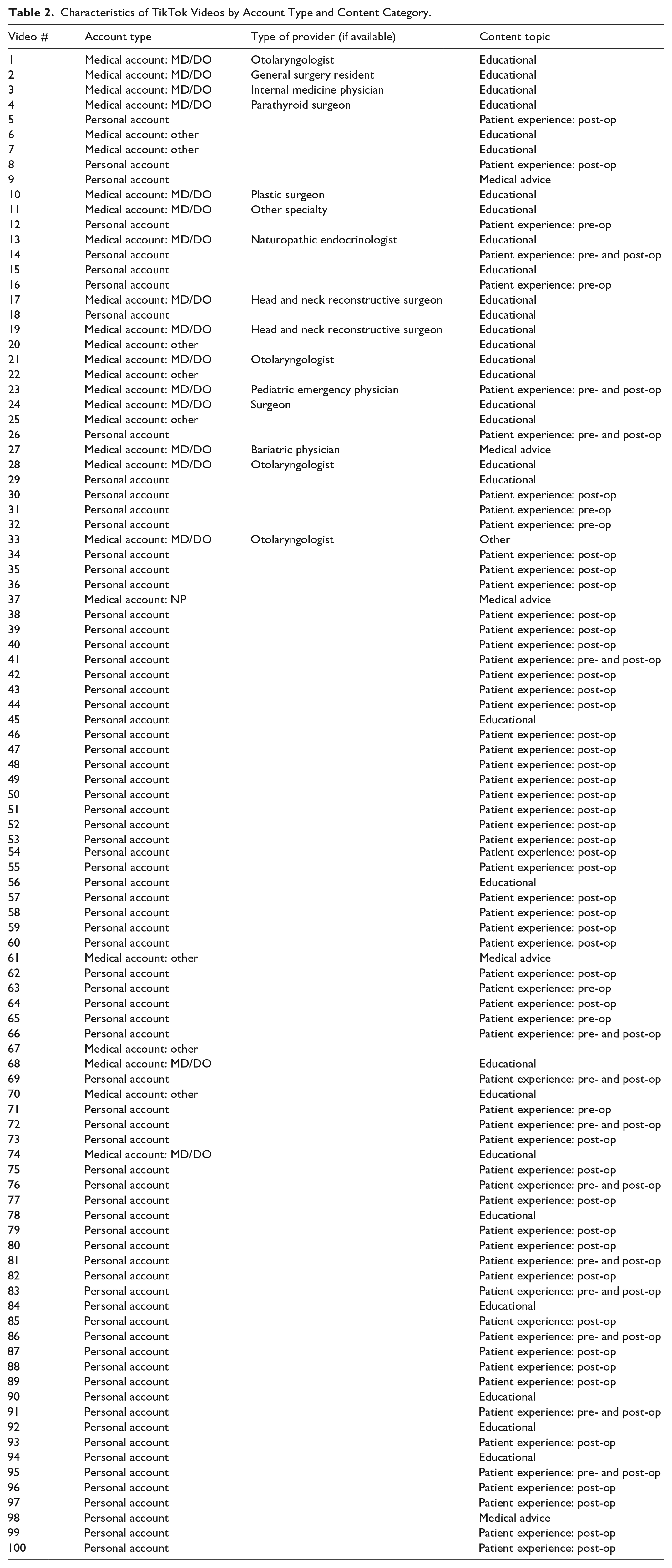
We collected 100 TikTok posts that fit our inclusion and exclusion criteria. Account demographics were primarily from personal/patient accounts (63%), followed by physician accounts (27%), non-MD/DO healthcare accounts (8%), and non-medical health practitioners (2%).
Content themes were primarily a combination of preoperative and postoperative experiences (36%) and medical education (36%). No videos focused exclusively on postoperative experiences; less popular themes were followed by preoperative and postoperative experiences (14%), physician/healthcare advice (7%), and preoperative experiences (6%). 41.0% of posts were uploaded by patients, whereas companies and physicians authored 22.6% and 9.8% of posts, respectively.
When evaluating thyroid-related TikTok content against ATA guidelines, MD/DO medical accounts demonstrated 100% content accuracy, compared to just 65% accuracy among non-medical health practitioners. However, videos from physician accounts—while highly accurate—scored a PEMAT understandability rating of 78.69% but only 26.61% in actionability, indicating a lack of practical guidance for viewers. In terms of engagement, the most popular videos originated from patient or personal accounts, with VPIs of 93% and 79%. On average, the total VPI across all content was 6.4%, with posts receiving ~1646 likes, 115 comments, 67,032 views, and 95 shares. Notably, personal accounts had a higher average VPI of 9.6%, while physician accounts trailed behind at just 4.3%. Interestingly, inaccurate content from non-medical practitioners still yielded relatively high VPIs of 5.3% and 6.2%, surpassing those of accurate physician-generated posts. Patient-generated content dominated the platform, comprising 63% of the videos, with 39% of those sharing negative surgical experiences. Although provider-created content tended to focus on healthcare or education and maintained greater accuracy, it garnered less engagement and offered limited actionable information.
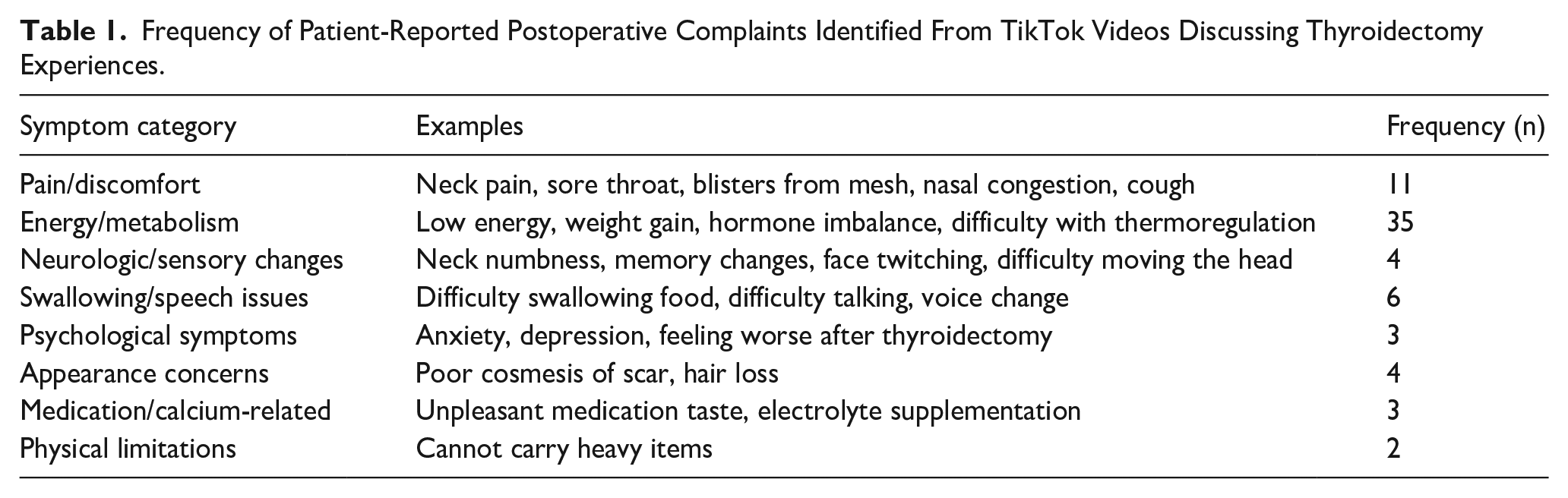
As far as tone and perception, 39% of posts were negative toward thyroidectomy, with 100% of negative posts originating from patient accounts. Postoperative complaints included neck pain (19%), low energy (9%), hormone imbalance (7%), weight gain (7%), dysphagia (7%), and poor cosmesis (7%; Tables 1 and 2).
Frequency of Patient-Reported Postoperative Complaints Identified From TikTok Videos Discussing Thyroidectomy Experiences.
Characteristics of TikTok Videos by Account Type and Content Category.
Patient experiences were predominantly negative (39.4%), followed by neutral (34.8%) and positive (25.7%). Statistical analysis revealed a trend toward higher VPI among patient-created posts compared to physician posts, though this difference did not reach statistical significance (mean VPI 0.86 vs 0.05; P = .054). There was no significant association between poster type and tone classification (positive, neutral, or negative; P = .865). Physician-generated videos demonstrated higher average PEMAT-AV understandability and actionability scores than those created by patients, with mean differences of +13.69 and +6.61 points, respectively.
Discussion
This study evaluated the quality, understandability, and actionability of thyroidectomy-related content on TikTok, a platform increasingly used by patients for health information. These findings highlight a critical gap: there is a pressing need for more physician presence on TikTok, alongside improvements in the actionability of educational content. Given the current underrepresentation of providers, the platform also presents a unique opportunity to serve as a tool for anticipatory guidance, particularly for post-thyroidectomy patients.
Patient Versus Physician-Generated Content
A major finding of this study was the predominance of patient-generated content over physician-created videos on TikTok related to thyroidectomy. This reflects a significant gap in authoritative, evidence-based information available to patients on social media platforms. Prior analyses of health-related content have similarly found that user-generated posts often outnumber those produced by healthcare professionals, raising concerns about the accuracy and completeness of information being consumed by patients. 15 Furthermore, these observations align with recent work from Irfan and Yaqoob, 16 who introduced the ENT-Content Engagement and Quality Index as a method to assess the quality and engagement of sinus health-related content on TikTok. Their findings underscore the importance of physician-created content, highlighting higher accuracy and viewer engagement compared to non-expert-generated material. 16 Recent findings by Kirkpatrick and Lawrie, 17 young women frequently turn to TikTok for health information but express concerns about misinformation. Importantly, these users strongly prefer content created by health professionals, underscoring the value and influence that physician-generated health information can have on social media platforms. 17 In the context of thyroidectomy, where patients are navigating complex decisions and managing postoperative symptoms, the scarcity of provider-led educational content presents a missed opportunity for anticipatory guidance and myth correction. Increasing physician presence on platforms like TikTok could help address misinformation, provide emotional support, and foster more informed surgical decision-making.
Quantitative analysis supported these qualitative trends. Patient-generated content had a higher mean VPI than physician-created posts (0.86 vs 0.05), suggesting greater algorithmic visibility and viewer engagement, though this difference narrowly missed statistical significance (P = .054). Despite lower visibility, physician-generated content scored substantially higher in understandability (+13.7 points) and actionability (+6.6 points) based on PEMAT criteria. These differences emphasize a trade-off between emotional relatability and clinical utility, suggesting that while patients drive platform engagement, physician content remains essential for delivering accurate, actionable health education.
Actionability and Understandability
Although the understandability of thyroidectomy-related content on TikTok was generally reasonable, the actionability scores were notably low. This gap suggests that while patients may comprehend the information presented, they are often left without clear, practical steps to apply it to their care. Low actionability can hinder patient preparedness, diminish the effectiveness of shared decision-making, and increase anxiety prior to surgery. Prior health communication research emphasizes that action-oriented educational materials are critical for empowering patients to participate actively in their healthcare and to adhere to recommended treatment plans.18-20 Without actionable guidance, patients may struggle to navigate their postoperative recovery effectively, ultimately impacting surgical outcomes and satisfaction.
Postoperative Complaints and Anticipatory
Our analysis also identified that fatigue, neck pain, and hormonal imbalances were the most commonly reported postoperative complaints among TikTok users. This finding aligns with prior studies that describe diminished physical and psychosocial functioning following thyroidectomy, particularly during the early stages of recovery.14,18 These symptoms can significantly affect a patient’s quality of life (QOL) and may not always be adequately addressed during routine preoperative counseling. The prominence of these complaints on social media underscores the need for anticipatory guidance that prepares patients for the common challenges they may encounter post-surgery. Proactive communication about expected symptoms, recovery timelines, and management strategies could help set more realistic expectations, alleviate anxiety, and improve overall satisfaction with care.
Emotional Tone and Visibility
In addition, the emotional tone of content appeared to strongly influence visibility and engagement. However, our chi-square analysis found no significant association between poster type and tone classification (P = .865), suggesting that emotionally charged content may be a general characteristic of thyroidectomy-related posts regardless of author. Posts that conveyed strong emotions—whether positive or negative—garnered higher levels of interaction compared to neutral or purely informational videos. This observation is consistent with previous social media behavior studies, which demonstrate that emotionally charged content tends to be prioritized by platform algorithms and shared more widely among users.19,21 In the context of surgical education, this trend presents both a challenge and an opportunity: while emotionally resonant posts can enhance relatability and reach, there is a risk that emotionally skewed narratives may distort patient expectations if not balanced by accurate, actionable information provided by healthcare professionals.
Existing literature has evaluated societal and patient perspectives of thyroidectomy. A retrospective study examined 100 patients focusing on scar cosmesis and QOL. 22 Another nationwide longitudinal study of patients with differentiated thyroid cancer found that while mental QOL gradually improves over 5 years post-treatment, several psychosocial domains—including vitality, social functioning, and mental health—remain significantly reduced compared to the general population. Notably, these reductions were not associated with TSH suppression, highlighting the importance of addressing psychosocial well-being and fatigue during survivorship care. Typically, overall QOL was measured with questionnaires, so although QOL was generally observed to decrease after thyroidectomy, the strength of this evidence remains weak.
Compared to previously published work by Kim et al on thyroidectomy-related content on TikTok, our study offers a more comprehensive and patient-centered perspective. 15 While prior analyses have relied primarily on the DISCERN tool to assess informational quality, our mixed-methods approach incorporated both qualitative and quantitative analyses, enabling a deeper exploration of patient experiences, tone, and postoperative symptom reporting. By using the ATA guidelines and the PEMAT, we evaluated not only the accuracy but also the understandability and actionability of educational content—offering a more practical assessment of patient-facing resources. Unlike previous studies that oversampled physician-created content to ensure statistical power—often resulting in sampling bias—our study retained the natural distribution of content as encountered by users, which was predominantly patient-generated.
In addition, we quantified specific postoperative complaints, such as neck pain, fatigue, and hormone imbalance, allowing for clinically relevant insights into the concerns most frequently shared on the platform. Our inclusion of the VPI also highlights how engagement correlates with tone and content type, offering further understanding of what resonates with viewers. Overall, our findings reflect not only the gaps in medical accuracy but also patients’ emotional and educational needs, positioning this study as a unique contribution to the growing body of literature on social media and surgical education. This study adds a new dimension using social media analysis to assess patient perspectives. Social media serves as an informal, real-time repository of patient experiences and opinions; thus, such posts can affect patients’ emotions and expectations before undergoing surgery. Prior studies suggest the internet influences surgical decision-making alongside interpersonal sources. 18
Understanding what postoperative complaints patients feel most negative about can guide physicians with preoperative and postoperative counseling and therapies. The PEMAT criteria also point out several deficits so that physicians can improve educational materials that are provided on social media platforms. Patient-created content may be favored by the TikTok algorithm as other patients are more likely to interact with these videos due to emotional relatability.
To improve actionability, physicians should adopt patient-centered communication, using clear and jargon-free language, and implement shared decision-making to enhance understanding and trust.19-21 These strategies improve communication effectiveness and support better patient outcomes. In addition, there may be more actionability if the accounts are getting posted by reputable medical entities. Furthermore, understandability and actionability scores that are lower indicate that the educational/informational videos that physicians are creating can be adjusted to address the broad spectrum of patient health literacy levels.
Limitations, Considerations, and Future Research
This study has several limitations. First, it represents a single-platform, cross-sectional snapshot of TikTok content, which is subject to change over time due to the platform’s evolving algorithm. What appears as a “top post” may vary depending on the timing and user-specific factors. To mitigate this, we searched using a newly created account and curated the selected videos into a fixed dataset for analysis. However, variability in search results remains a potential confounder. In addition, TikTok’s algorithmic feed is influenced by multiple factors beyond account curation, including geographic location, time of day, and user behavior patterns. Although a newly created account was used to minimize personalization bias, these dynamic factors may have affected the visibility and ranking of videos in ways beyond our control.23,24 In addition, there may be engagement bias, as emotionally charged or negatively toned content tends to gain more traction and visibility, potentially skewing perception toward adverse experiences.
Furthermore, physician engagement on the platform presents both an opportunity and a challenge. Physicians can offer accurate, evidence-based content to counter misinformation and provide anticipatory guidance in an accessible format, especially to underserved audiences. However, this requires careful navigation of professionalism, patient privacy, health literacy, and the platform’s preference for emotionally charged content, which may limit the visibility of educational posts. Despite these challenges, thoughtful and strategic physician involvement—supported by institutional guidance and media training—has the potential to improve health literacy, shape public perception, and foster more informed surgical decision-making. Patient-led storytelling, while powerful and relatable, may unintentionally amplify misinformation or rare complications when shared without clinical context. Without guidance from healthcare professionals, such narratives can distort public perception, heighten anxiety, and lead to misinformed decision-making.
Future research should explore a broader range of platforms—such as YouTube, Facebook, and Instagram—to gain a more comprehensive understanding of the digital landscape surrounding thyroidectomy. Moreover, interventional studies are warranted to assess the effectiveness and engagement potential of physician-generated content designed specifically for social media audiences, such as producing videos with high PEMAT scores and measuring their impact. An analysis of audience comments for sentiment or questions can also be done to create more tailored videos.
Conclusion
Thyroidectomy-related content on TikTok is predominantly shaped by patient narratives, many of which portray the procedure in a negative light. Otolaryngologists have a critical opportunity to enhance the educational value and accuracy of TikTok thyroidectomy content, potentially improving patient preparedness and reducing misconceptions. In particular, improving the actionability of videos—as measured by PEMAT—may empower patients with clearer, more practical information to guide their surgical journey. Strategic, accurate, and engaging content created by physicians can serve not only to correct misinformation but also to support informed decision-making and improve overall patient outcomes.
Footnotes

Ethical Considerations
This study utilized publicly accessible social media content from TikTok and did not involve human participants or protected patient data; thus, Institutional Review Board approval was not required.
Author Contributions
All authors contributed equally to the conceptualization, literature review, data collection, data analysis, manuscript drafting, and revision. Janisah Amirah I. Saripada, Arianna V. Ramirez, and Ogechukwu Anwaegbu conducted the primary literature search and synthesis. Dr Viran J. Ranasinghe provided critical revisions and expert guidance. All authors reviewed and approved the final manuscript.
Funding
The author(s) received no financial support for the research, authorship, and/or publication of this article.
Declaration of Conflicting Interests
The author(s) declared no potential conflicts of interest with respect to the research, authorship, and/or publication of this article.
Data Availability Statement
Data supporting the findings of this study are available from the corresponding author upon request.
Prior Presentation
This work was previously presented as a poster at the Combined Otolaryngology Spring Meeting (COSM) in Chicago, IL, in May 2024.