



Abstract
Introduction
Raw or minced garlic’s characteristic aroma and flavor come from allicin, a sulfur-containing natural chemical with numerous biological uses. People often believe that natural products are safer and healthier than their synthetically made equivalents, and this belief is also spreading in the medical field. 1
Allicin is a defense molecule with a broad spectrum of biological actions. It is derived from the garlic plant (Allium sativum L.). After tissue injury, the enzyme alliinase catalyzes a process involving the nonproteinogenic amino acid alliin (S-allyl cysteine sulfoxide) to create allicin. 1
Research has shown that allicin has a wide range of antibacterial effects on both Gram-negative and Gram-positive bacteria. This includes species of Escherichia, Salmonella, Staphylococcus, Streptococcus, Klebsiella, Proteus, Bacillus, and Clostridium. 2 Garlic kills even acid-resistant microorganisms, such as Mycobacterium tuberculosis. The Helicobacter pylori bacteria is responsible for stomach ulcers, and garlic extracts also work well against this infection. 3
There has been evidence of antiviral action in laboratory and animal studies using fresh garlic extracts containing allicin as the primary active ingredient. Herpes simplex virus types 1, 2, and 3, parainfluenza virus types 1, 2, and 5, vaccinia virus, vesicular stomatitis virus, and human rhinovirus type 2 are among the viruses that are susceptible to garlic extracts.4,5
Allicin’s biological activity is believed to depend on a redox reaction it conducts with the thiol groups in glutathione and proteins since it is a thiosulfinate and a reactive sulfur species (RSS). Microscopic organisms, plants, and mammals can utilize allicin for physiological purposes. Allicin can kill cells directly or prevent the growth of bacteria and fungi, including antibiotic-resistant varieties such as methicillin-resistant Staphylococcus aureus, depending on the dosage. In addition, allicin suppresses cell proliferation and promotes cell death in mammalian cell lines, including cancer cells. 1
According to some research, allicin inhibits the growth of various tumor types and binds to numerous signaling pathways linked to cancer progression. Regarding allicin’s impact on stomach cancer, this quality is detailed in the published works. 6 Unfortunately, no evidence-based information was available about its effects on the nose and nasal mucosa. Understanding how allicin affects the nasal mucosa is the primary goal of this research.
Materials and Methods
This experimental investigation took place at the Eskisehir Osmangazi University Medical Surgical Experimental Animals Application and Research Center (TICAM). On January 22, 2024, with reference number 979/2024, the Eskisehir Osmangazi University Local Ethics Committee on Animal Experiments (HADYEK) approved it.
Study Animals
Sixteen male New Zealand Albino rabbits weighing 2.5 and 4.5 kg participated in the research. Two groups of 8 rabbits were used for this experiment: one served as a control (Group 1, n = 8), and the other served as a study (Group 2, n = 8).
Methods
Following the start of the study, for 3 days (the first to third days of the study), the rabbits of the study and control groups were given an intramuscular injection of 0.2 mg/kg cefazolin.
In the study group (Group 2), a Merocel tampon soaked in Allicin (Alli Tech; Dulwich Health) (0.5 mg/kg) was placed in the right nasal passage for 3 days (the first to third days of the study). In the control group (Group 1), a Merocel tampon soaked in serum physiologic was placed in the right nasal passage for 3 days.
On the fourth day, after decapitation under anesthesia/tranquilization, nasal mucosa was excised for histopathological examination. Histopathological evaluation was performed using hematoxylin-eosin staining under a light microscope.
The histopathological examination assessed the nasal mucosa as 0: None, 1: Mild, 2: Moderate, and 3: Severe for the following criteria. • Bleeding (ranging from 0 to 3) • Congestion (ranging from 0 to 3) • Inflammation (ranging from 0 to 3) • Ulcer (0: Absent, 1: Present) • Fibrosis (ranging from 0 to 3) • Calcification (0: Absent, 1: Present) • Density of seromucous glands (ranging from 0 to 3)
The Statistical Analysis
We utilized IBM SPSS for Windows 21 for data analysis. It is a product of SPSS, INC, an IBM Company based in Chicago, Illinois. The cross-tabulated tables were analyzed using chi-square tests. The data were summarized using number (%) statistics.
For statistical purposes, a P value less than .05 was deemed significant.
Results
The following are the results of the histopathological examination of the nasal mucosa:
Bleeding (Ranging From 0 to 3)
There was 1 case of bleeding (12.5%) in the study group; and 1 case (12.5%) in the control groups. There was no statistically significant difference when comparing the groups’ bleeding rates (P > .05).
Congestion Levels (Ranging From 0 to 3)
Of the patients in the study group, 1 (12.5% of the total) had moderate congestion and 5 (62.5%) had mild congestion. Five cases (62.5%) in the control group showed mild congestion, whereas 2 cases (25.0%) had moderate congestion. There was no statistically significant difference when comparing the groups’ congestion distributions (P > .05).
Inflammation Levels (Ranging From 0 to 3)
Six cases (75%) in the study group and 2 cases (25%) in the control group had mild inflammation, whereas 2 cases (25%) showed moderate inflammation. Regarding the location of inflammation, there was no significant difference between the groups (P > .05).
Ulcer (0: Absent, 1: Present)
There was no evidence of ulcers in either the experimental or control groups.
Fibrosis Levels (Range From 0 to 3)
There was no evidence of fibrosis in either the experimental or control groups.
Calcification (0: Absent, 1: Present)
No calcification was observed in the study group. Three instances (37.5%) in the control group had calcification. Comparing the groups’ calcification distributions, we found no statistically significant differences (P > .05).
Seromucous Gland Density (Ranging From 0 to 3)
Seromucous gland density (SGD) was found to be mild in 2 cases (25.0%), moderate in 4 cases (50.0%), and severe in 2 cases (25.0%) among the subjects analyzed in the study group. Three instances (37.5%) of mild SGD, 1 case (12.5% of moderate SGD), and 4 cases (50.0%) of severe SGD were noted in the control group. The distribution of SGD was not significantly different between the groups (P > .05).
Histopathological Examination Results
In the study group, moderate density of lymphocytic cells beneath the surface epithelium, and further down, seromucous gland structures (Figure 2), and dense seromucous glands and occasional ductal structures (Figure 3) are observed. In the control group, congested vascular structures beneath the respiratory epithelium (Figure 1), and adjacent to a thick-walled vascular structure, coarse calcification (Figure 4) is observed.
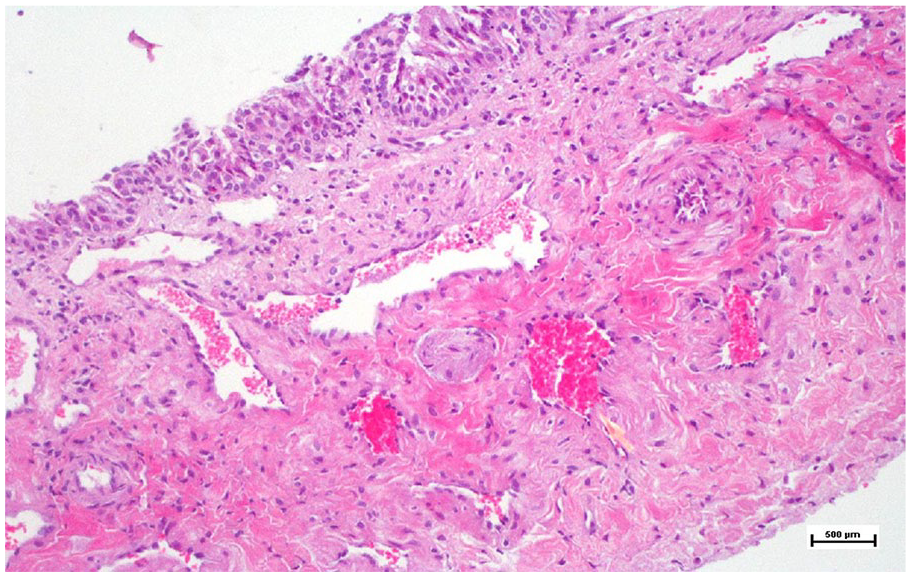
Congested vascular structures (arrow) are observed beneath the respiratory epithelium (upper left) (HE ×200) (Control group, case 5). HE, hematoxylin and eosin.
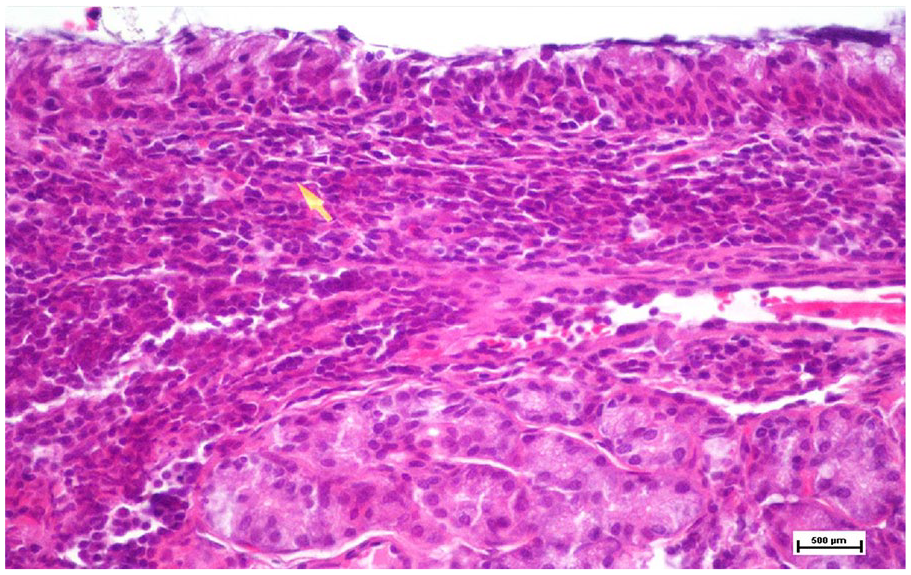
A moderate density of lymphocytic cells (arrow) is seen beneath the surface epithelium, and further down, seromucous gland structures are observed (HE ×200) (Study group, case 16). HE, hematoxylin and eosin.
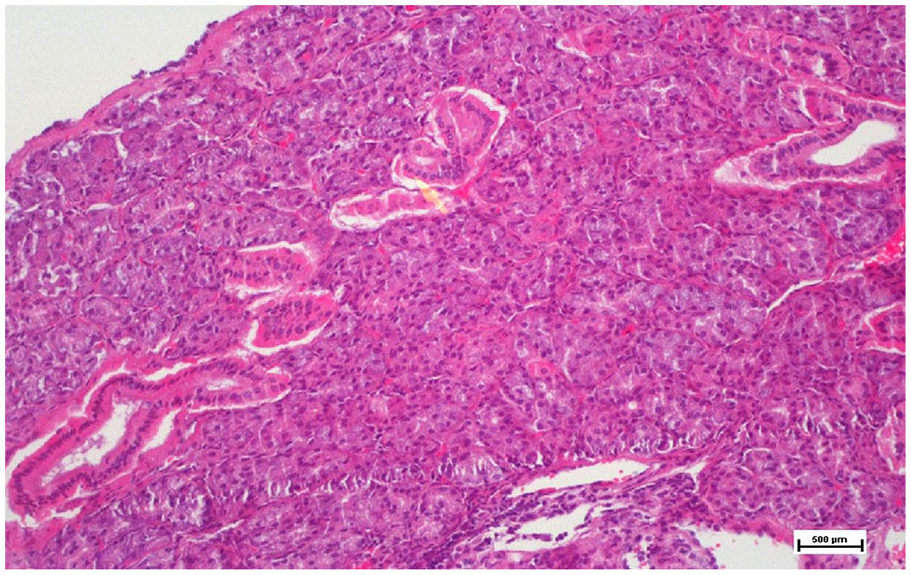
Dense seromucous glands and occasional ductal structures (arrow) are observed in the sections (HE ×200) (Study group, case 15). HE, hematoxylin and eosin.
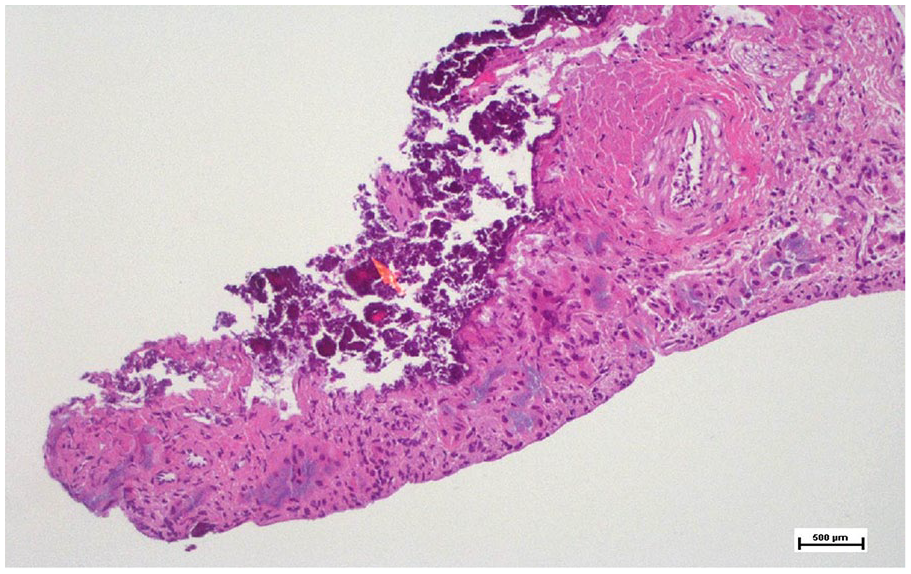
Adjacent to a thick-walled vascular structure, coarse calcification (arrow) is observed (HE ×200) (Control group, case 8). HE, hematoxylin and eosin.
Discussion
Garlic gets its distinctive flavor and aroma from allicin, a sulfur-containing natural chemical with a wide range of health effects. Natural products are gaining popularity in medicine and agriculture, and one reason for this is the general (though not entirely accurate) belief that they are milder and generally harmless than their chemically synthesized alternatives. 7 For several decades, the pharmaceutical industry has developed novel pharmaceuticals using high-throughput biochemical screening programs. However, using natural compounds as medicines and antimicrobials has been around for a long time.1,8
We used an experimental study to examine how allicin affected nasal mucosa. Neither the study nor control groups differed significantly regarding bleeding, congestion, inflammation, calcification, or SGD. Under light microscopy, the research group showed a moderate density of lymphocytic cells just under the surface epithelium, seromucous gland structures deeper down, dense seromucous glands, and infrequent ductal structures. The control group’s coarse calcification is close to a thick-walled and congested vascular structure beneath the respiratory epithelium.
Three nasal sprays containing hydroxypropyl methylcellulose (HPMC) were tested by Bentley and Stanton 9 for their ability to prevent in vitro SARS-CoV-2 infection. The sprays were as follows: 93% HPMC, 2% peppermint powder, and 5% European wild garlic powder; 95% HPMC, 2% peppermint powder, and 3% allicin powder; and 98.5% HPMC and 1.5% peppermint powder. 7 Not only did these chemicals successfully reduce SARS-CoV-2 infection when applied to ACE2-expressing VeroE6 cells in advance at a dosage of 6.4 mg/3.5 cm2, but they also virtually entirely blocked viral release from infected cells.
Crushed garlic contains organosulfur compounds, and Koch and Lawson 10 found the lowest dose necessary to suppress the growth of S. aureus and Escherichia coli. Their findings indicated that 6.15 mM of Diallyl disulfide (DADS), which is around 35 times more potent than allicin (0.17 mM), was required to limit the development of these 2 bacteria.
The antibacterial ingredient of garlic (allicin) represents the prototype of thiosulfinates, chemically synthesized by Small et al, 11 who also produced other thiosulfinates, including allicin. The alkyl groups connected to the thiosulfate group varied in chain length and branching among the thiosulfate derivatives. They tested 20 distinct bacterial isolates by determining the lowest dose required for a bacteriostatic effect in liquid culture. As the carbon chain length of thiosulfinates increased, their bacteriostatic action against Gram-positive bacteria got stronger, whereas its effect against Gram-negative bacteria was weaker. 12 In addition to its toxic effects on fungal cells, allicin can decrease hyphal development and spore germination in both vivo and in vitro settings. 12
Allicin’s ability to prevent neutrophil transendothelial migration has been demonstrated. Notably, various biological systems have shown that allicin influences the cytoskeleton. Take mouse fibroblasts (NIH-3T3) as an example. Research has shown that at a low concentration of 2 µM, allicin depolymerizes the tubulin cytoskeleton within minutes, while the actin cytoskeleton is unaffected. 13
Allicin’s anticancer effects were determined to rely heavily on its ability to induce cell death. In human cell cultures, allicin similarly induces a redox shift. 14 As a result, both caspase-dependent 15 and caspase-independent 16 cell death mechanisms are activated.
Various investigations have demonstrated allicin’s antioxidant action. Allicin neutralizes oxygen radicals in several ways: directly, 17 through thiol-disulfide exchange processes,18,19 or by inhibiting the production of messenger RNA. 20 Another way allicin has shown antioxidant effects is by boosting the expression of genes that code for phase II detoxification enzymes. 21
About 90% of cancer deaths are attributable to metastasis formation, making it one of the most perplexing and disturbing features of cancer disease. Metastasis occurs when cancer cells spread from the original tumor to other tissues, organs, and the body. When cancer cells begin this process, they first invade the areas around the primary tumor after separating from it. Migration, breakdown of the extracellular matrix, loss of intercellular connections, and adhesion to matrix components are all steps in the invasion process. The tumor cells will spread to other body parts through the circulatory and lymphatic systems. Tumor cells will metastasize when they extravasate and establish colonies in the new organ. 22 Research shows that allicin can inhibit migration, invasion, and angiogenesis.23,24 This compound also decreased the number of cells in the 2 stomach cell lines that could pass through a porous membrane in a transwell assay. 23 This meant that tumor cells could not move or invade. 6
Conclusion
The results show that the rabbit nasal 25 mucosa is unaffected by the allicin-soaked Merocel pack and does not cause any changes in the density of the seromucous glands, inflammation, congestion, or bleeding of the mucosa. It is reasonable to organize human studies to assess the efficacy of allicin nasal packs used in endoscopic sinus surgery, rhinoplasty, septoplasty, and epistaxis due to their antimicrobial and antiviral properties.
Footnotes
Acknowledgements
None.
Author Contributions
Zeynel Öztürk: Planning, designing, literature survey, active intellectual support. Nuray Bayar Muluk: Planning, designing, literature survey, interpretation of the results, active intellectual support, writing, submission. Oğuzhan Oğuz: Planning, designing, literature survey, active intellectual support. Mehmet Özgür Pinarbaşli: Planning, designing, literature survey, data collection, active intellectual support. Enes Güngör: Planning, designing, literature survey, data collection, active intellectual support. Deniz Arik: Planning, designing, literature survey, data collection, active intellectual support. Cengiz Bal: Planning, designing, statistical analysis, active intellectual support. Cemal Cingi: Planning, designing, literature survey, data collection, active intellectual support, English editing.
Availability of Data and Materials
All data for this study are presented in this article.
Declaration of Conflicting Interests
The author(s) declared no potential conflicts of interest with respect to the research, authorship, and/or publication of this article.
Funding
The author(s) received no financial support for the research, authorship, and/or publication of this article.
Ethics Committee Approval
On January 22, 2024, with reference number 979/2024, the Eskisehir Osmangazi University Local Ethics Committee on Animal Experiments (HADYEK) approved it.
Informed Consent
There is no need for informed consent because this is an experimental study.
