




Abstract

Significance Statement
Congenital absence of the common carotid artery (CCA) is a very rare vascular anomaly. It is often associated with separate origins of the internal carotid artery (ICA) and external carotid artery (ECA). We described unusual magnetic resonance angiography findings of the right CCA absence with separate origins of the ICA and ECA from the brachiocephalic truncus, and also reported the right hypoplastic vertebral artery. Carotid artery origin and course anomalies have critical importance in neck surgery and diagnostic angiography.
Introduction
Congenital absence of the common carotid artery (CCA) is a very rare vascular anomaly with fewer than 25 cases reported in the literature. 1 -10 Congenital absence of the right CCA has been reported less frequently than on the left. Absence of the right CCA with separate origins of the internal carotid artery (ICA) and external carotid artery (ECA) from the brachiocephalic truncus is an extremely rare vascular anomaly with few cases reported in the English literature. 4,6 -9
We describe herein an unusual case of the right CCA absence associated with separate origins of the ICA and ECA from the brachiocephalic truncus. Our patient also had hypoplasia of the right vertebral artery. To our knowledge, this is the first report of magnetic resonance (MR) evidence of this rare association.
Case Presentation
A 51-year-old woman presented with a 7-year history of headaches and intermittent tingling sensations in her left upper extremity. The patient had no other medical history. The physical examination was normal. Her vital signs were stable. Cerebral brain computed tomography (CT) revealed a few lacunar infarct foci in the left centrum semiovale. Conventional cerebral MR imaging and contrast-enhanced head and neck MR angiography protocol was performed with a 3T MR scanner. MR imaging of brain revealed multiple chronic infarctions in the left corona radiate and centrum semiovale. The right CCA absence with separate origins of the ICA and ECA from the brachiocephalic truncus was detected by MR angiography of the head and neck (Figure 1A and B). MR angiographic images also revealed hypoplasia of the right vertebral artery.
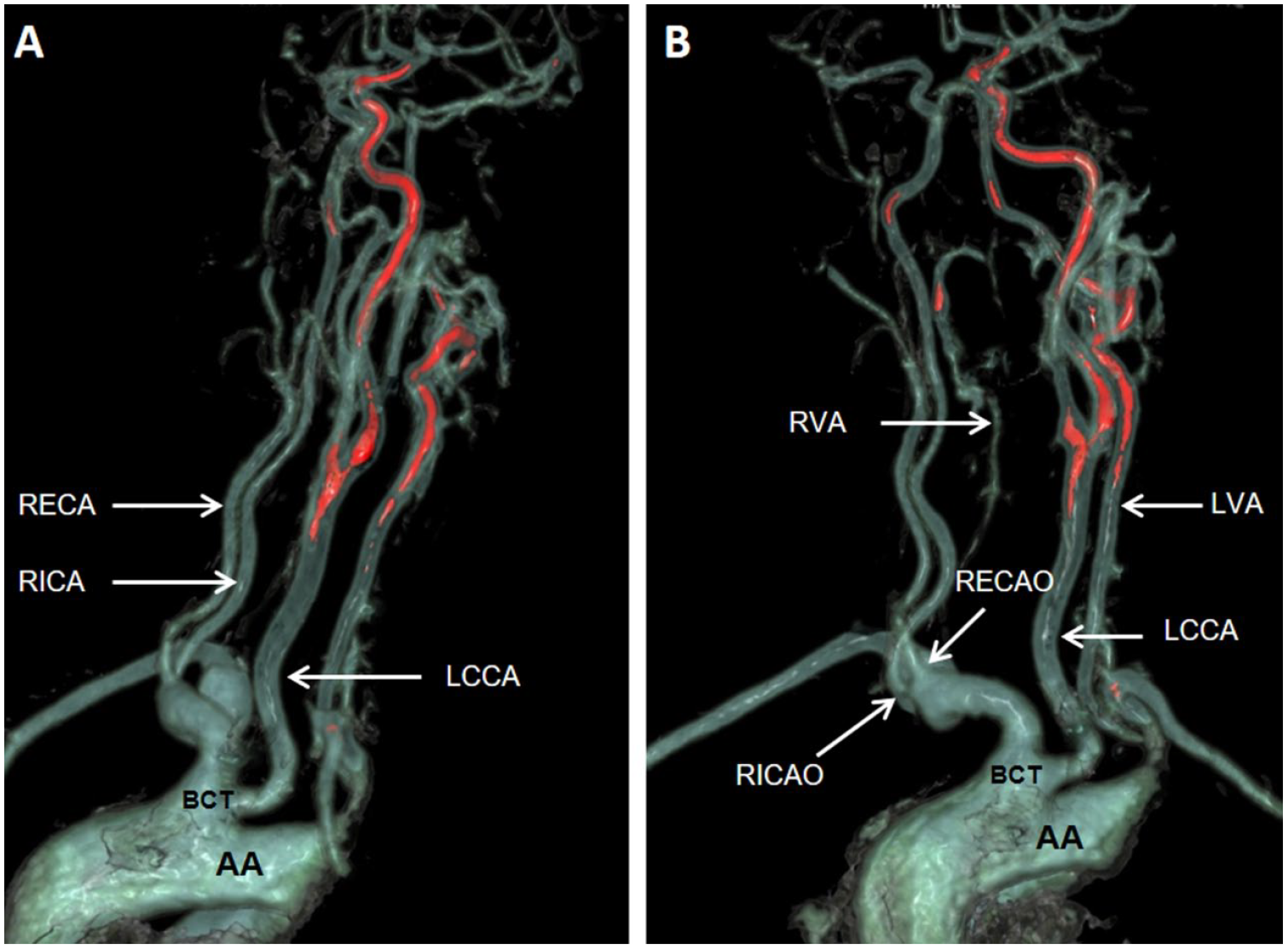
3D reformatted MR angiography images with anterolateral (A) and lateral (B) views show the right CCA absence with separate origins of the ICA and ECA from the brachiocephalic truncus, as well as the left common carotid artery originating from the brachiocephalic truncus.
Conclusion
Separate origins of the right ICA and ECA from the brachiocephalic truncus is an extremely rare anomaly. 4,6 -9 The widespread use of MR or CT angiography has led to an increase in the incidental detection of vascular anomalies such as CCA agenesis.
To establish the diagnosis of neck vascular anomalies, imaging modalities such as Doppler ultrasonography, CT angiography, MR angiography, and digital subtraction angiography are important. 11 -14 Contrast-enhanced MR angiography is becoming increasingly common. 3 We preferred the MR imaging and MR angiography for detection of this vascular anomaly, because of high soft tissue resolution and nonionizing radiation.
To the best of our knowledge, MR angiography evidence of vertebral artery hypoplasia associated with CCA absence has not been previously reported. Our case is the first report of this unusual association. Being aware of this abnormal vascular relationship is very important to avoid undesirable results of the neck surgery and interventional procedures.
Footnotes
Declaration of Conflicting Interests
The author(s) declared no potential conflicts of interest with respect to the research, authorship, and/or publication of this article.
Funding
The author(s) received no financial support for the research, authorship, and/or publication of this article.
