




Abstract
Extracardiac rhabdomyoma is a tumor that rarely occurs in head and neck region. Adult and fetal types of extracardiac rhabdomyoma are diagnosed only by histopathological examination. In the oral cavity, this lesion usually affects the mouth floor and tongue. Despite the low incidence, adult rhabdomyoma should be considered in the differential diagnosis of oral cavity lesions, and histopathological evaluation might be helpful for the final diagnosis. This study aims to report a rare case of rhabdomyoma mimicking reactive lesions and review the literature. A 34-year-old male was referred to the pathology department with a yellowish sessile lesion in the labial maxillary vestibule. During an excisional biopsy, a mass of unencapsulated soft tissue beneath the vestibular mucosa was observed. The yellowish color in clinical features has led to lipoma as the initial clinical diagnosis. The histological examination exhibited an encapsulated, well-circumscribed benign neoplasm composed of multiple lobules of large polygonal cells with prominent abundant granular eosinophilic cytoplasm. No cellular atypia was observed. Diagnosis of the adult type of rhabdomyoma was made by collective agreement. Rhabdomyoma can be mistaken for other reactive lesions and may resemble their appearance.
Introduction
Rhabdomyomas (RMs) are rare and benign mesenchymal neoplasms of striated muscle with different degrees of mutation and differentiation, which are divided into intracardiac and extracardiac varieties. The intracardiac lesion is regarded as a hamartoma affecting children and infants and is correlated with tuberous sclerosis. 1 Extracardiac RM is considered as a tumor that shows a predilection for the head and neck region and affects patients of all ages from 5 weeks to 61 years of age. Based on histopathology, extracardiac RM is categorized into fetal, genital, and adult types, depending on the degree of differentiation. 2 The fetal type is found mainly in children and is divided into the juvenile and classic subtypes. The genital type manifests as a polypoid mass on the vulva and vagina and commonly affects young women. 3 Head and neck region accounts for 90% of adult extracardiac rhabdomyoma (AERM) cases. As a result, it is crucial to consider these rare tumors as a differential diagnosis in this area. Especially, AERM shows a predilection for anatomic sites of the head and neck, including palate, pharynx, larynx, soft tissues of the neck, sublingual, and submandibular regions. 2 Predominantly, it affects the male gender in the age range of 55 to 60 years old and can happen as a solitary, multinodular, or multifocal lesion. 4 Clinically, AERM appears as an asymptomatic, slow-growing, well-defined, homogeneous, and mobile submucosal nodule. Besides, several signs and symptoms, such as tongue displacement, dysphagia, dyspnea, and facial asymmetry, might be observed when it occurs in the mouth or pharynx. The clinical differential diagnoses of AERM depend on the location and may include benign or malignant salivary gland tumors and benign mesenchymal neoplasms. 5
According to the literature, the occurrence of an AERM mimicking a reactive lesion in the maxillary vestibule has yet to be reported. Therefore, this study aims to present our findings of this case with an appraisal of the related literature on the AERMs reported in the head and neck region since 2000.
Case Report
A 34-year-old male was referred to the Faculty of Dentistry, Department of Pathology, to assess an oral and yellow lesion in the maxillary vestibule. The patient was aware of the presence of this mass, but he did not have any complaints. Intraoral examination revealed an asymptomatic, painless, slow-growing, well-circumscribed, nontender, and solid nodule on the labial side of the maxillary vestibule. The lesion was recovered by intact and smooth mucosa (Figure 1). The clinical impression diagnosis was a lipoma because of the yellow hue of the lesion. Subsequently, the Department of Oral Medicine carried out an excisional biopsy. A mass of unencapsulated but well-defined soft tissue beneath the vestibular mucosa with minor bleeding was observed during the operation.
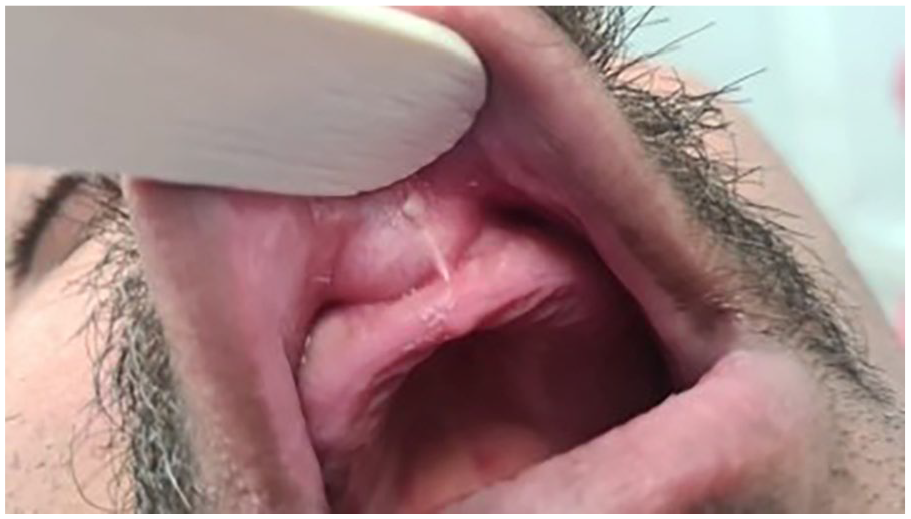
A painless solid yellow nodule covered by intact mucosa was observed in the maxillary anterior vestibule.
A multilobulated nodule, 15 × 10 × 6 mm in size, with creamy white coloring and round margins, was described on gross examination. Microscopically, the lesion appeared as an encapsulated, well-circumscribed benign neoplasm composed of multiple lobules. The tumor comprised large polygonal cells with prominent abundant granular eosinophilic cytoplasm arranged in the fibrovascular stroma with mixed foci of eosinophils, polymorphs, macrophages, and lymphocytes. Eccentric and centrally placed, round, and small nuclei demonstrated finely dispersed chromatin and small nucleoli. Cross-striations in the cytoplasm were also observed, and there were no atypical mitosis and necrosis (Figure 2). From the immunohistochemical point of view, the tumor cells expressed muscle-specific actin and desmin; however, they were negative for S-100 protein and cytokeratin (Figure 3).
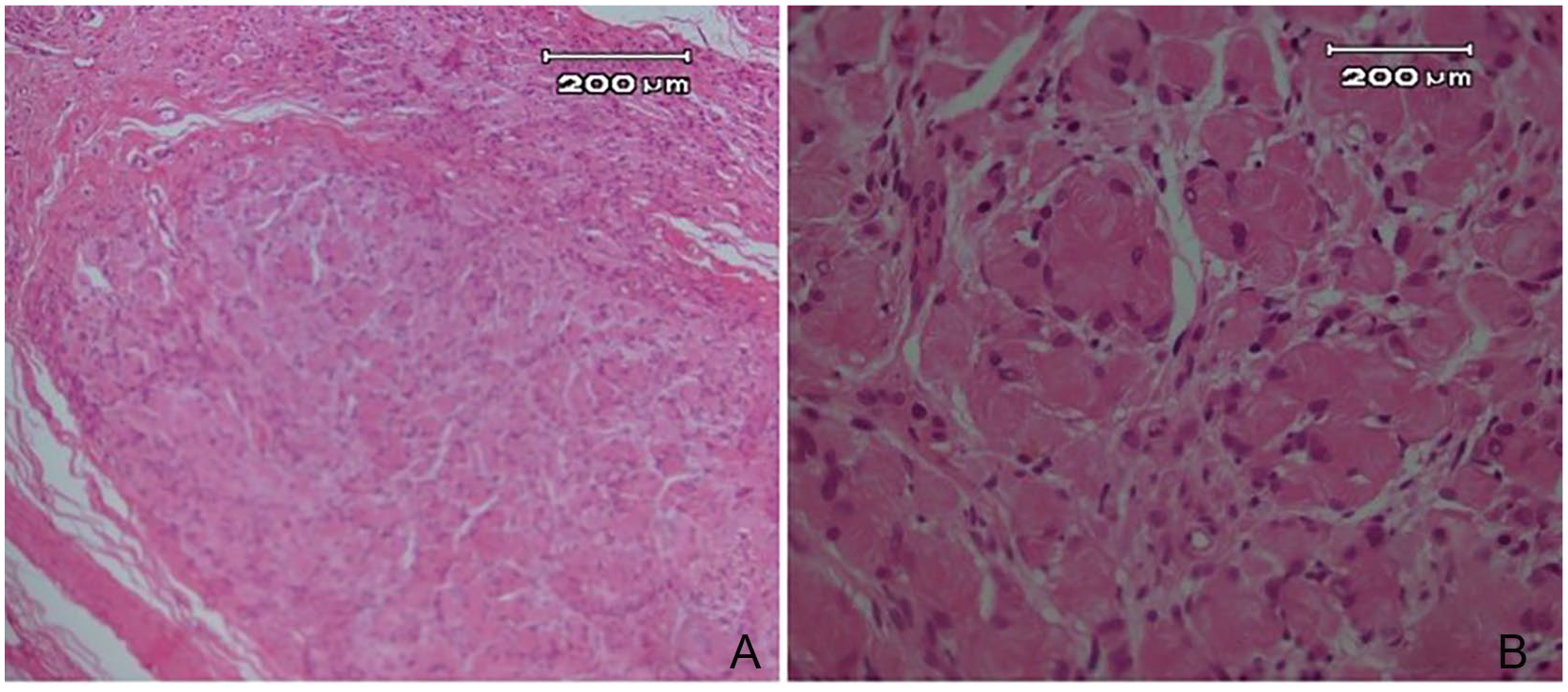
(A) Hematoxylin and eosin (H&E) staining of the lesion in the low-power field of the section shows polygonal cells with granular eosinophilic cytoplasm. (B) The high-power field demonstrates cross-striations in the cytoplasm.
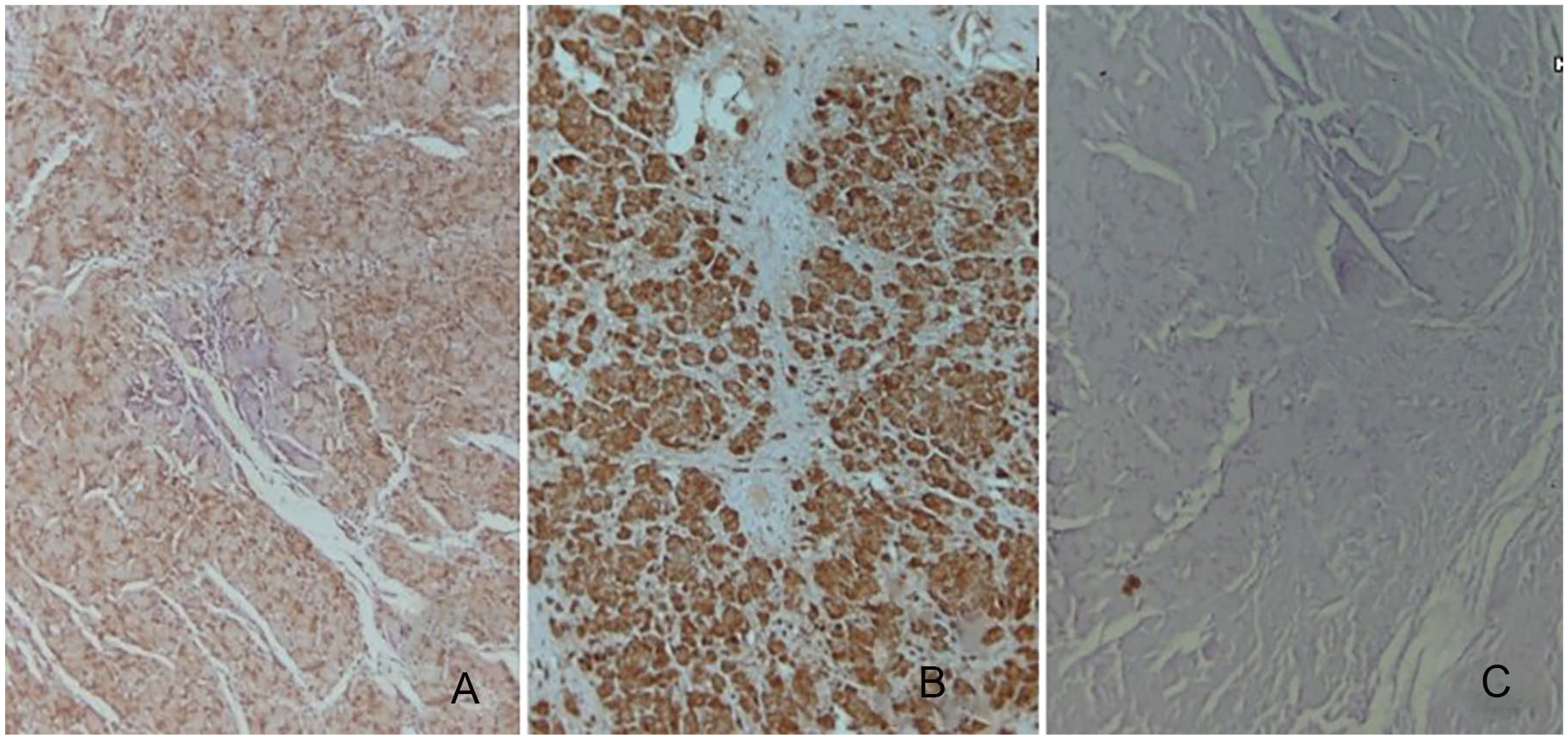
Immunohistochemistry (IHC) staining of the tumor shows; (A, B) Positive staining for muscle-specific actin and desmin, and (C) negative for S100.
Due to the yellow color of the lesion, the initial clinical diagnosis was a lipoma. Although, RM can be mistaken for other reactive lesions and may mimic the appearance of many soft tissue lesions. The findings mentioned above addressed a diagnosis of adult-type RM.
The patient received clinical and imaging follow-ups, and he has been well with no evidence of recurrence after a year of follow-up.
Discussion
RMs are rare benign neoplasms derived from skeletal muscle cells, which are classified into extracardiac and intracardiac categories in terms of location. These tumors are the most prevalent primary cardiac tumor in infants. Intracardiac RM is believed to be a hamartoma that leads to diffused deformation of the heart muscle and is related to tuberous sclerosis in 50% to 80% of the cases. The incidence of intracardiac RM is higher than that of extracardiac type. 6 Extracardiac RM predominantly affects the head and neck region and usually happens as a solitary and rarely as a multifocal lesion. The most widespread involved locations are the pharynx and oral cavity. 7
AERM is a subtype of this category. It can grow slowly in the submucosa as a painless, smooth, round, well-defined, and polypoid nodule that steadily causes dyspnea, hoarseness, dysphagia, and other symptoms. 7 Since the AERM origins are the muscles of the third and fourth branchial arches, it has a remarkable tendency to the head and neck area. 2 Generally, it affects the head and neck region, followed by the extremities, esophagus, stomach, and mediastinum, and shows a predilection for men over 50 years of age. The most common oral site of occurrence is the mouth floor and submandibular region, followed by the tongue base, soft palate, buccal mucosa, and lip. 5 Its cytologic findings demonstrate large polygonal to oval cells with plentiful eosinophilic to granular cytoplasm, unclear cell borders, and round peripheral nuclei containing apparent nucleoli. Immunohistochemical analysis is helpful for AERM diagnosis, which shows positivity for muscle-specific actin, desmin, and myoglobin. 8 Besides, in electron microscopy, actin and myosin filaments with Z-bands, ample mitochondria, and cytoplasmic glycogen can be detected. 9 It is suggested that magnetic resonance imaging (MRI) is a preferable imaging method for diagnosing these tumors compared to computed tomography (CT) scans as it provides superior delimitation. MRI reveals a well-defined lesion that is isointense compared to the musculature on T1-weighted images and isointense or hyperintense on T2-weighted ones. 2
The current study systematically reviewed the literature through PubMed, Scopus, Embase, and Web of Science databases. A search was conducted using the keywords “Rhabdomyoma” AND “Head and Neck Neoplasms” in these databases since 2000, which yielded 376 results. Of these, 67 articles were included, and others were excluded due to nonrelevancy. The present study is the 74th case of AERM in the head and neck region since 2000 (Table 1). According to these case reports, AERM has more commonly affected men (53 out of 74 cases), with a male:female ratio of 2.5:1. Predominantly, this tumor has appeared solitarily. Also, it has occurred as a multicentric or multifocal lesion only in 13 (17.5%) cases. Furthermore, the multilobulated, multilocular, and multinodular forms of this lesion were observed in 2 patients each. The most prevalent affected areas of AERM in the head and neck have been the larynx (20), the floor of the mouth and submandibular region (17), the base of the tongue (13), parapharyngeal area (7), and oropharynx (5). The chief complaint of the patients varied from dysphagia, hoarseness, and aspiration to globulus, burning sensation, and painless swelling. In addition, the preferred treatment for AERM includes surgical resection, tumor removal, and excisional biopsy (Table 1). The recurrence of this lesion after primary treatment has been reported only in 2 cases, by Koutsimpelas et al. in 2008 and Schlittenbauer et al. in 2013.10,11
Literature Review of Adult-Type Extracardiac Rhabdomyoma in the Head and Neck Since 2000.
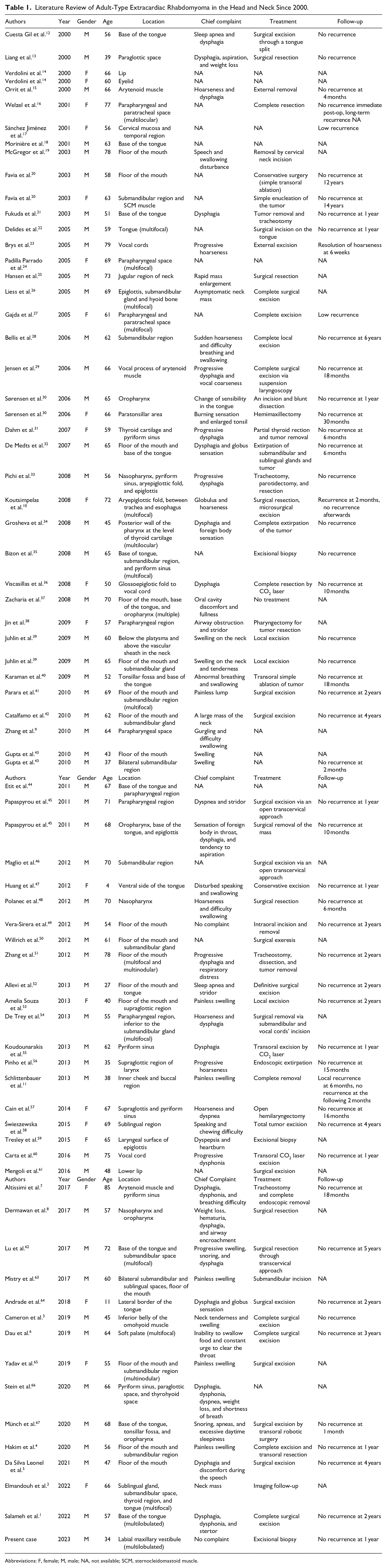
Abbreviations: F, female; M, male; NA, not available; SCM, sternocleidomastoid muscle.
The possible pathogenesis of AERM is still disputable. Several studies have considered this type of RM as a hamartomatous, nonneoplastic, or reactive lesion due to its slow growth and various histological views. On the other hand, recent articles suggest that it may have a true neoplastic nature because of clonal chromosomal aberrations. 11 The differential diagnosis of AERM comprises paraganglioma, granular cell tumor, oncocytoma, acinic cell carcinoma, rhabdomyosarcoma, metastatic renal cell carcinoma, and normal skeletal muscle. 8 The diagnosis of RM is usually established only after the removal of the tumor since distinctive clinical and radiologic features suggestive of the true nature are generally lacking. 68 The accepted treatment for AERM is surgical excision with preservation of the surrounding tissue. Although malignant degeneration has not been reported, the local recurrence rate is 42%, mainly because of incomplete resection. It indicates that long-term follow-up is important. 19
According to the available literature, 34 cases of oral adult-type RM has been reported in the present century, and the submandibular region and floor of the mouth (50.0%), followed by the base of the tongue (38.2%) have been the most frequent sites of occurrence (Table 1). The last case of oral AERM, before the current study, was reported by Salameh et al. 1 They described a 57-year-old man with complaints of dysphonia, dysphagia, and stertor whose head and neck endoscopy revealed a smooth mass located at the tongue base. CT scan exhibited a significant lobulated lesion measured 7 × 5 × 6 cm in size, and immunohistochemically, the desmin markers were positive. Finally, the patient underwent complete surgical excision, and the tumor had not recurred in the last year. 1 Mengoli et al. reported that an AERM affected a 48-year-old man located on the lip in 2016. The cuneiform vermilionectomy was conducted with a clinical diagnosis of oral squamous cell carcinoma. Histological findings demonstrated a nodule containing uniform large polygonal cells with peripheral or central nuclei and eosinophilic and granular cytoplasm, forming an unencapsulated and well-delimited tumor below the keratinized epidermis. The immunohistochemical assessment showed positive results for desmin and muscle-specific actin; however, the tumor cells did not express cytokeratin and S-100 protein. 61 Exclusively, Schlittenbauer et al. disclosed the recurrence of oral AERM following the first-stage treatment in 2013. This study described a 38-year-old man complaining of a long-lasting, painless swelling in the inner cheek. The initial diagnosis was mucocele based on the clinical features. Initially, this solid and well-defined mass was removed by surgical excision. However, the local recurrence of this lesion in the perimandibular area was observed 6 months later. Subsequently, the tumor was excised through a transoral approach. No recurrence was observed.
In this article, we presented a rare case of an intraoral adult-type extracardiac RM, a benign mesenchymal tumor resembling a reactive lesion clinically, and conducted a systematic review of the related literature. In summary, AERM is a rare lesion with a predilection for middle-aged men in the head and neck region. Complete surgical excision is the most recommended treatment for this tumor, resulting in a relatively low recurrence rate. As a clinician, it is always noteworthy to consider that reactive lesions are relatively common in the oral cavity, and both benign and malignant tumors can mimic their clinical presentation of them. As a result, RM can be mistaken for other reactive lesions and may imitate the appearance of many soft tissue lesions. To perform a definitive diagnosis, histopathological analysis is necessary. This study highlights the importance of precise diagnosis that affects the step-by-step treatment related to adult-type RM resembling reactive lesions.
Footnotes
Acknowledgements
The authors want to thank the Department of Medicine, Tehran University of Medical Sciences, for referring and handing over the clinical photos of the patient.
Declaration of Conflicting Interests
The author(s) declared no potential conflicts of interest with respect to the research, authorship, and/or publication of this article.
Funding
The author(s) received no financial support for the research, authorship, and/or publication of this article.
Statement of Informed Consent
Written informed consent was obtained from the patient(s) for their anonymized information to be published in this article.
Statement of Human and Animal Rights
This article does not contain any studies with human or animal subjects.
Data Availability Statement
The data that support the findings of this study are available from the corresponding author, upon reasonable request.
