



Abstract
Keywords
Introduction
The novel coronavirus disease-2019 (COVID-19) is a respiratory illness that has rapidly spread, infecting many individuals and posing a serious threat to human health. 1 COVID-19 has been reported to transmit from person-to-person through respiratory droplets or items contaminated by infected person.2,3 Until July 8, 2022, there were more than 5 million individuals infected with COVID-19 in China (2,733 in Shandong Province) and 21857 deaths (World Health Organization (WHO), https://covid19.who.int/). The COVID-19 lineages are classified into different variants: Alpha, Beta, Gamma, Delta, Epsilon, Eta, Iota, Kappa, Mu, Zeta, and Omicron. 4 Recently, the Omicron variant has appeared and rapidly spread globally. It has been reported that the transmission rate of the Omicron variant is 2–3 times higher than that of the Delta variant.5-7 In China, the Omicron variant has also caused sporadic outbreaks in Shanghai and many other cities since 2022.
Clinical manifestations of COVID-19 can vary from no symptoms to critical illness. Previous studies found that 50% to 75% of people with positive nucleic acid had no symptoms. 8 The infection can begin with flu-like symptoms, such as fever, cough, nasal congestion, sneezing, and sore throat. 9 It may progress to a more serious illness in some individuals, especially in patients aged ≥ 65 years or those with chronic diseases, making them immunocompromised. The mortality rate of the disease in China was about 3%. 8 The COVID-19 infection is characterized by a significant burden of inflammation, with the Omicron variant evading the immune system more efficiently. 10 Vaccination can provide some protection against the infection; however, the increased number and complexity of spike mutations in the Omicron strain amplify the difficulty of treatment and reduce antibody activity elicited by vaccination. 11 At present, the prevention and/or treatment of COVID-19 is the focus of many researchers at home and abroad.
Traditional Chinese medicine Lianhua Qingwen (LhQw) has been reported to exert broad-spectrum effects on a series of influenza viruses. 12 The Chinese National Health Commission has also recommended it for treating mild or moderate COVID-19. 13 It was also found to be beneficial for asymptomatic COVID-19 patients. 14 The LhQw comprises 13 medicinal materials, including forsythia, honeysuckle, licorice, and rhubarb. The pharmacological characteristics of LhQw include a strong inhibitory effect on angiotensin-converting enzyme 2 (ACE2) and a reduction of pro-inflammatory cytokines. 15 LhQw was also associated with certain gastrointestinal dysfunction and skin injuries, including diarrhea, gastrointestinal discomfort, rash, and itching. Nonetheless, most of these adverse effects were mild and well tolerated by patients. 16 Retrospectively, using LhQw alone or in combination with other treatments is clinically effective in improving the clinical symptoms, shortening the duration of hospitalization and reducing the overall mortality rate. 17 Strains preceding Omicron mainly affected the lower respiratory tract, while Omicron mostly affected the upper airways. 18 Nasal irrigation is a simple and inexpensive procedure that rinses the nasal cavity with isotonic or hypertonic saline solutions,19,20 thus physically removing viscous mucus that impairs the clearance of debris and bacteria. 21 In addition, nasal irrigation has a significant role in cleaning antigens and inflammatory mediators in the nasal cavity, especially in reducing the viral load in the nasal cavity and improving the mucociliary clearance of COVID-19.22,23 Notably, a previous study suggested that nasal irrigation can mitigate substantial symptoms in patients with COVID-19 without acute respiratory distress syndrome. 24 Expert consensus has also recommended nasal irrigation to prevent 2019 novel coronavirus (nCoV) infection. 25 It has been reported that nasal irrigation could shorten the infection period of nCoV by an average of 2.5 days. 26 Our previous work also showed that early nasal irrigation combined with LhQw granules could promote the nucleic acid conversion time by about 5 days in adults Omicron infection. 27 However, the therapeutic effect of nasal irrigation on Omicron infection in children remains unclear.
This study aimed to explore the effect of nasal irrigation on the disappearance of symptoms and nucleic acid conversion in children with the Omicron variant.
Methods
Study Design and Patients
This quasi-experimental study enrolled children (native children aged 3 to 13 years) diagnosed with the Omicron variant infection during the isolation observation period in Shandong Public Health Clinical Center between April 1, 2022 and May 1, 2022.
Exclusion criteria were the following: (1) severe/critically ill children; (2) patients with severe heart, liver and kidney dysfunction; (3) patients with nasal tumors and other nasal diseases not suitable for nasal irrigation; (4) patients with coagulation dysfunction and those prone to bleeding; (5) patients with severe upper respiratory tract infection and acute middle ear infection; (6) patients with nasal diseases not suitable for nasal irrigation; (7) patients allergic to LhQw granules or other unsuitable applications.
This work has been carried out in accordance with the Declaration of Helsinki (2000) of the World Medical Association. This study was approved by the ethics committee of Shandong Public Health Clinical Center (GWLCZXEC2022-65). None of the children had any known confirmed infections in the past. All legal guardians signed informed consent for the participation of their children.
Diagnosis of Omicron Variant
The virus strain detection was confirmed to be all BA.2.2 mutants by the Jinan Center for Disease Control and Prevention. Diagnostic criteria referred to the diagnostic criteria in the “New Coronary Virus Pneumonia Diagnosis and Treatment Program (Trial Ninth Edition).” 13 The final diagnosis was made after discussion by the expert group of our hospital. Omicron variant was classified into 3 types as follows: (1) asymptomatic infection: the patient was positive for the 2019-nCoV nucleic acid with no clinical symptoms and no abnormal imaging; (2) mild type: the clinical symptoms were mild, and there was no pneumonia on imaging; (3) moderate type: there were symptoms such as fever and respiratory tract, and the imaging showed pneumonia.
Intervention
According to age, gender, infection type, and baseline Ct (cycle threshold) value of nasopharyngeal swab nucleic acid, the children were divided into routine group, isotonic saline group, and hypertonic saline group. LhQw has been used in over 90% of COVID-19 treatments across China. 28 Routine treatment generally consisted of the supportive treatment such as oxygen therapy, symptomatic therapy, and LhQw granules. In the present study, patients treated with LhQw granules were defined as the routine group. For a child weighing 15 to 30 kilograms (kg), a dose of 1.5 g of LhQw Granules (1/4 bag) was given each time; for a child weighing > 30 kg, a dose of 3 g of LhQw Granules was given each time (half a bag); a dose was taken with warm water, after meals, 3 times a day. The isotonic saline group was treated with LhQw granules combined with isotonic saline nasal irrigation, and the hypertonic saline group was treated with LhQw granules combined with 3% hypertonic saline nasal irrigation. The Electric Children’s SEAWATER NASAL CAVITY SPRAYER (Aide medical Co, Ltd, Guizhou, China) was used to rinse the nasal cavity. The patient was seated, the nasal washer was vertical, and 10 ml normal saline or hypertonic saline was added. The sprayer nozzle was stuffed into 1 side of the nasal cavity, and the switch was turned on for about 10 s. After spraying the nostril, the rinse solution was blown out, and the other side of the nostril was treated in the same way. Rinse was done once every morning after washing and before going to bed at night until the nucleic acid detection resulted negative.
Outcomes
Primary outcomes were the treatment effects, including the time of symptoms disappearance and nucleic acid conversion time. DAAN reagent (Daan gene Co, Ltd, Guangzhou, China) was used to detect the 2019-nCoV nucleic acid. Detection was started on the 7th day of admission, and patients with negative results for nucleic acid were detected again on the 2nd day (the interval needed to exceed 24 h). Two consecutive negative results were judged as negative. Patients with positive results were detected at 1-day intervals until they turned negative. Secondary outcomes focused on routine outcome monitoring, including peripheral blood white blood cell count (WBC), lymphocyte count (LYM), neutrophil count (NEU), and C-reactive protein level (CRP). The occurrence and severity of adverse events during the application of nasal irrigation were also recorded.
Statistical Analysis
SPSS20.0 (IBM Corp., Armonk, N.Y, USA) was used for statistical analysis. Student t test, chi-square test, Fisher exact test, one-way ANOVA and Mann–Whitney U test were used to compare the groups according to data distribution. LSD-t test was used for further pairwise comparison. Values are presented as mean ± standard deviation (SD) or median (lower quartile, upper quartile) according to data distribution. P value <0.05 indicated statistical significance.
Results
Baseline Characteristics of Enrolled Children.
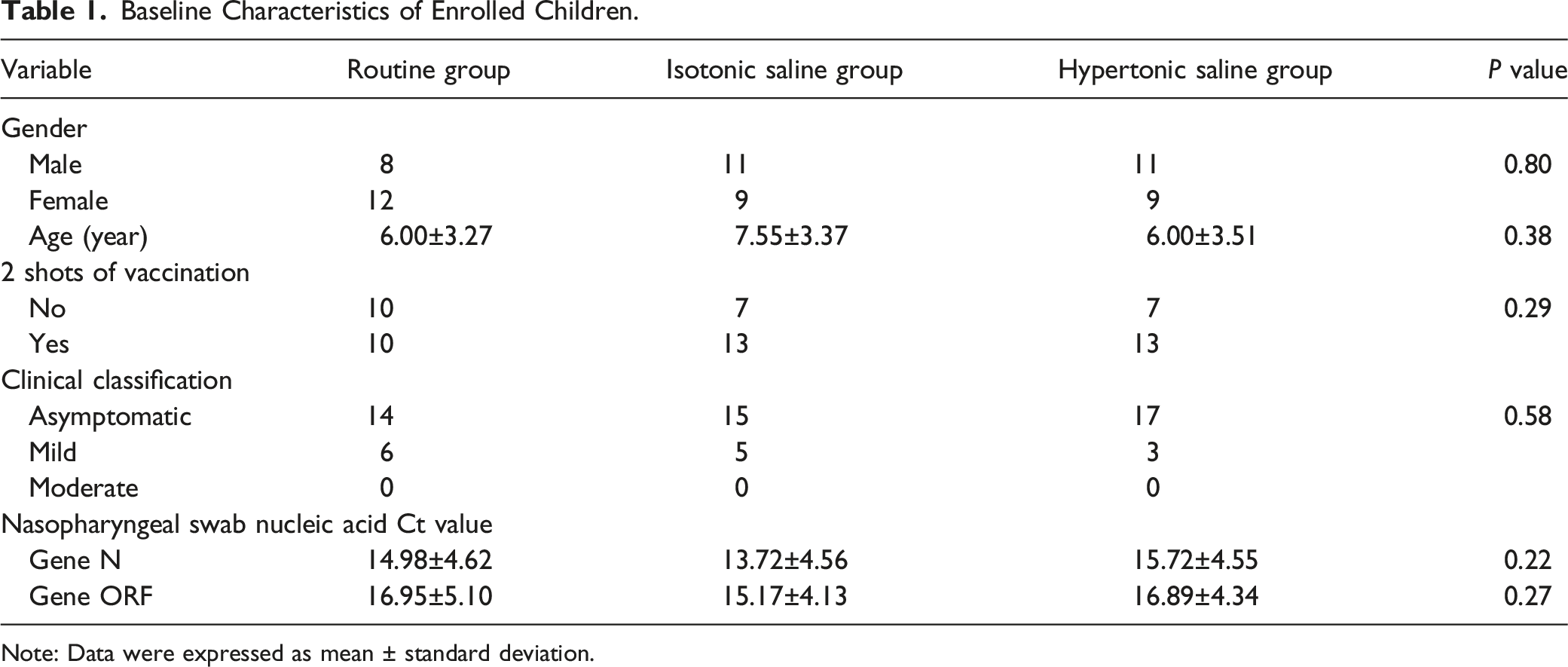
Note: Data were expressed as mean ± standard deviation.
Patient’s Symptom Persistence and Nucleic Acid Conversion Time (Days).

Note: Data were expressed as mean ± standard deviation.
Changes in Blood Routine and CRP Indexes Before and After Treatment.
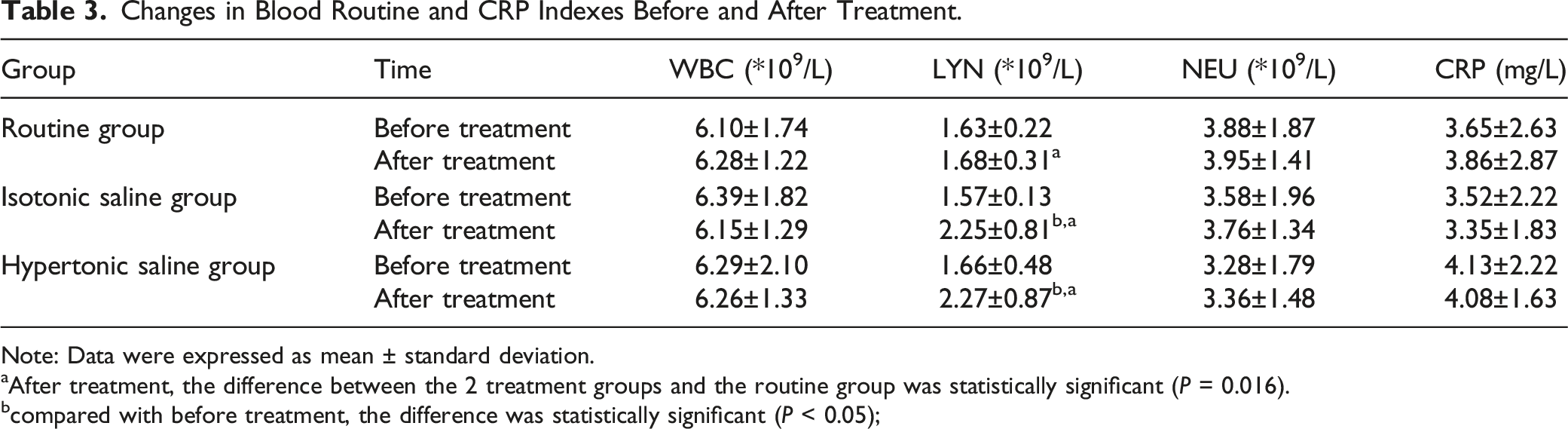
Note: Data were expressed as mean ± standard deviation.
aAfter treatment, the difference between the 2 treatment groups and the routine group was statistically significant (P = 0.016).
bcompared with before treatment, the difference was statistically significant (P < 0.05);
In addition, children in the isotonic saline group tolerated the treatment well, and there were no adverse events. In the hypertonic saline group, 3 children (15%) had nasal itching, and 2 children (10%) complained of mild pain, which were all tolerated.
Discussion
The present study showed that saline nasal irrigation might reduce the average time of nucleic acid conversion and increase the LYM count in children with Omicron infection, with good tolerance. Nasal irrigation may presumably promote recovery of children with Omicron virus infection.
BA.2 is a sub-variant of the Omicron variant, also known as the “stealth Omicron” due to the lack of “S gene shedding” feature. 29 It has been reported that BA.2 is more transmissible than the original Omicron BA.1 strain and more prone to break through the defense line of vaccines. 30 Currently, the prevalent strain BA2.2 in Jinan belongs to the evolutionary branch of Omicron BA.2, a variant strain with an enhanced ability to evade vaccine immunity. Although 60% of the children were vaccinated with the 2019-nCoV vaccine in this study, the vaccinated individuals were ultimately infected with Omicron BA.2. The clinical manifestations of Omicron infection include fever, poor response, shortness of breath, frequent convulsions and gastrointestinal symptoms such as vomiting and diarrhea. 31 Our results showed that 76.60% of children had asymptomatic infections, with the most common symptoms including fever and cough. Also, a small number of children had nasal congestion and diarrhea, which suggested that the clinical symptoms of Omicron strain infection were mild.
The nasal mucosa creates a powerful environment for virus infection and proliferation, considering it contains blood vessels, mucous glands and serous glands. 32 Mucocilia in the nasal cavity can prevent various inhaled pathogens from entering the body. 33 A previous study suggested that the 2019-nCoV infection mainly invades the upper respiratory tract, and the virus titer in the nasal cavity is significantly higher than that in the throat. 33 Omicron variant infection can disrupt the ciliary epithelium, resulting in ciliary dyskinesia. Recently, studies indicated that nasal irrigation with hypertonic saline could relieve COVID-19 symptoms such as nasal congestion and cough, and reduce the time of the 2019-nCoV clearance.24,33 Our results showed that after treatment with nasal irrigation, the virus-negative time was reduced by an average of 5-6 days in children infected with Omicron; however, the duration of fever and cough did not improve. It has been reported that the adverse reactions of nasal irrigation, such as pain, nasal congestion and runny nose, worsen in response to an increase in saline concentration, partly due to the release of histamine and substance P. 33 Moreover, 3% hypertonic saline nasal irrigation was used to treat allergic rhinitis in children without significant adverse events. 34 In this study, we found that 3% of hypertonic saline nasal irrigation had mild adverse reactions in the treatment of Omicron infection, which mainly manifested as nasal itching and mild pain. No obvious adverse reactions occurred following saline nasal irrigation.
We carried out another study to explore the effect of nasal irrigation in adults infected with the Omicron variant, finding that patients using nasal irrigation were more likely to get lower nucleic acid-negative conversion time without improvements in symptom disappearance time, 27 which is consistent with the outcomes of this study. Accordingly, early use of nasal irrigation in both adults and children infected with the Omicron variant may shorten nucleic acid conversion time.
The present study has certain limitations. First, as LhQw was incorporated and widely used in the management of COVID-19 in China, we did not set the untreated control group or group that was only treated with nasal irrigation. Whether there are synergetic effects between LhQw and nasal irrigation remains yet to be investigated. Second, the sample size of this study was relatively small, and the observation time was short. The effects of nasal irrigation on the Omicron infection need to be further validated. Also, the mechanisms should be further elucidated in future studies.
Conclusion
Timely use of saline nasal irrigation may promote nucleic acid conversion in children with Omicron virus infection, with good tolerance. This study may provide a valid reference for treating Omicron infection in children.
Footnotes
Acknowledgments
We thank all individuals who participated in this study and Dr Li Qiang, Shandong Public Health Clinical Center, for his advice.
Author Contributions
Study concept and design: LS and LL, acquisition of data: CW, Analysis and interpretation of data: SX, Drafting of the manuscript: LL. Critical revision of the manuscript for important intellectual content and study supervision: CW. All authors read and approved the final manuscript.
Declaration of Conflicting Interests
The author(s) declared no potential conflicts of interest with respect to the research, authorship, and/or publication of this article.
Funding
The author(s) disclosed receipt of the following financial support for the research, authorship, and/or publication of this article: This work was supported by the Grant from Department of Science and Technology of Shandong Province, China (No. 2021SFGC0504).
Ethical Approval
This work has been carried out in accordance with the Declaration of Helsinki (2000) of the World Medical Association. This study was approved by the ethics committee of Shandong Public Health Clinical Center (GWLCZXEC2022-65). None of the children had any known confirmed infection in the past, and informed consent was signed by their legal guardians.
