




Abstract

Dear Editor
Since the COVID-19 pandemic outbreak in the latter months of 2019, physicians and researchers have rushed to develop effective and safe vaccinal procedures as quickly as possible. Without any doubt, vaccination is the most effective strategy against the spread of the COVID-19 infection. With an unprecedented acceleration in industrial production times, the combination of global scientific and medical efforts yielded numerous vaccination strategies. However, a number of adverse events have been reported for the Pfizer, Moderna, and AstraZeneca vaccines, which are considered the major players in the global vaccination protocols.
The objective of this paper is an initial assessment on the reported post-vaccination adverse effects, involving the auditory and vestibular system. Published on-line data were consulted from two databases: (i) The Italian Drug Agency (Agenzia Italiana del Farmaco—AIFA) 1 and (ii) the Medicines and Healthcare Products Regulatory Agency (MHRA) of the United Kingdom. 2 AIFA strongly recommends that the adverse effects cited in the database should be considered as reports of “suspected” adverse reactions in relation to the COVID-19 vaccination. In this context, the AIFA and the MHRA data represent only a warning of a possible correlation between the vaccination and the reported symptoms. The available information does not constitute clear evidence for a cause-and-effect relationship, between a vaccine and the reported adverse effects.
Incidence of Adverse Reactions Reported by MHRA and AIFA.
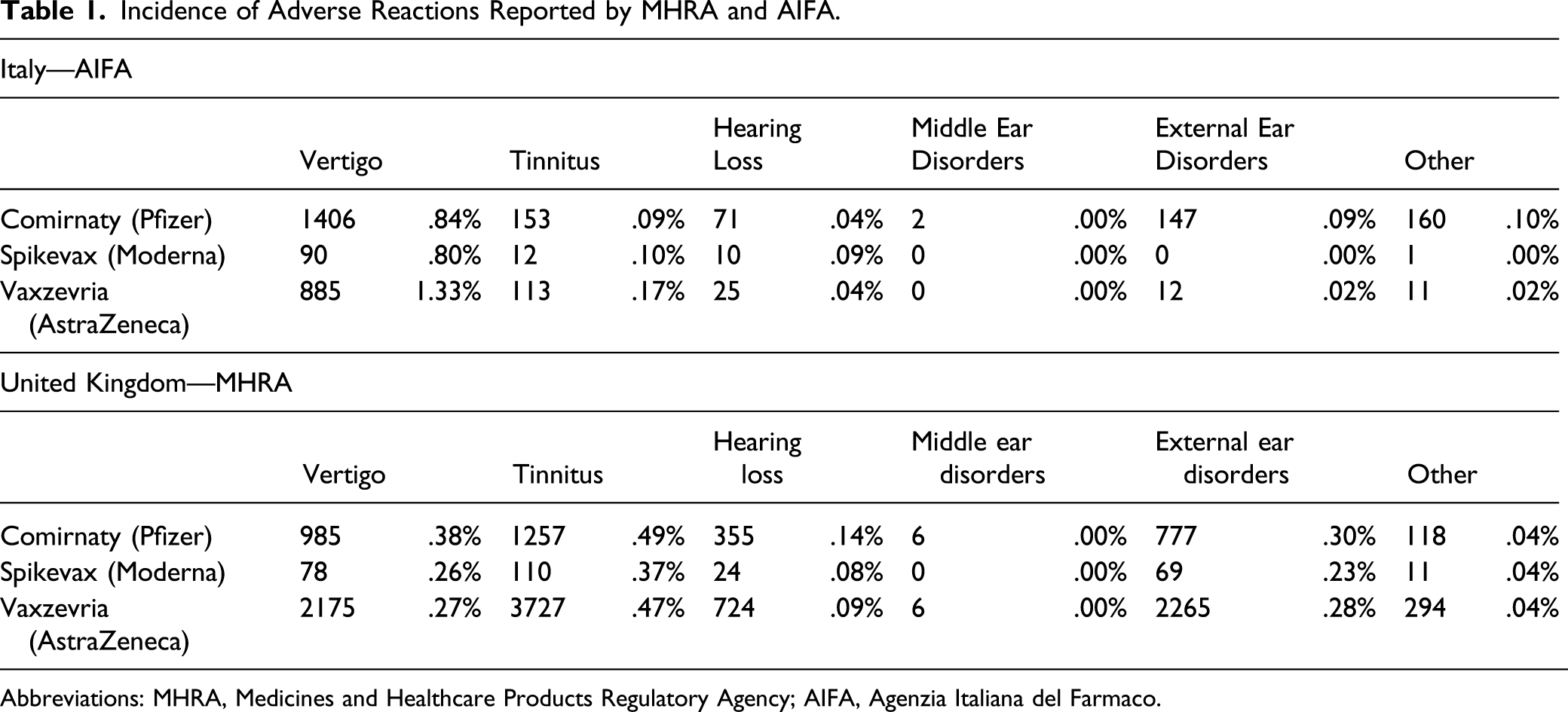
Abbreviations: MHRA, Medicines and Healthcare Products Regulatory Agency; AIFA, Agenzia Italiana del Farmaco.
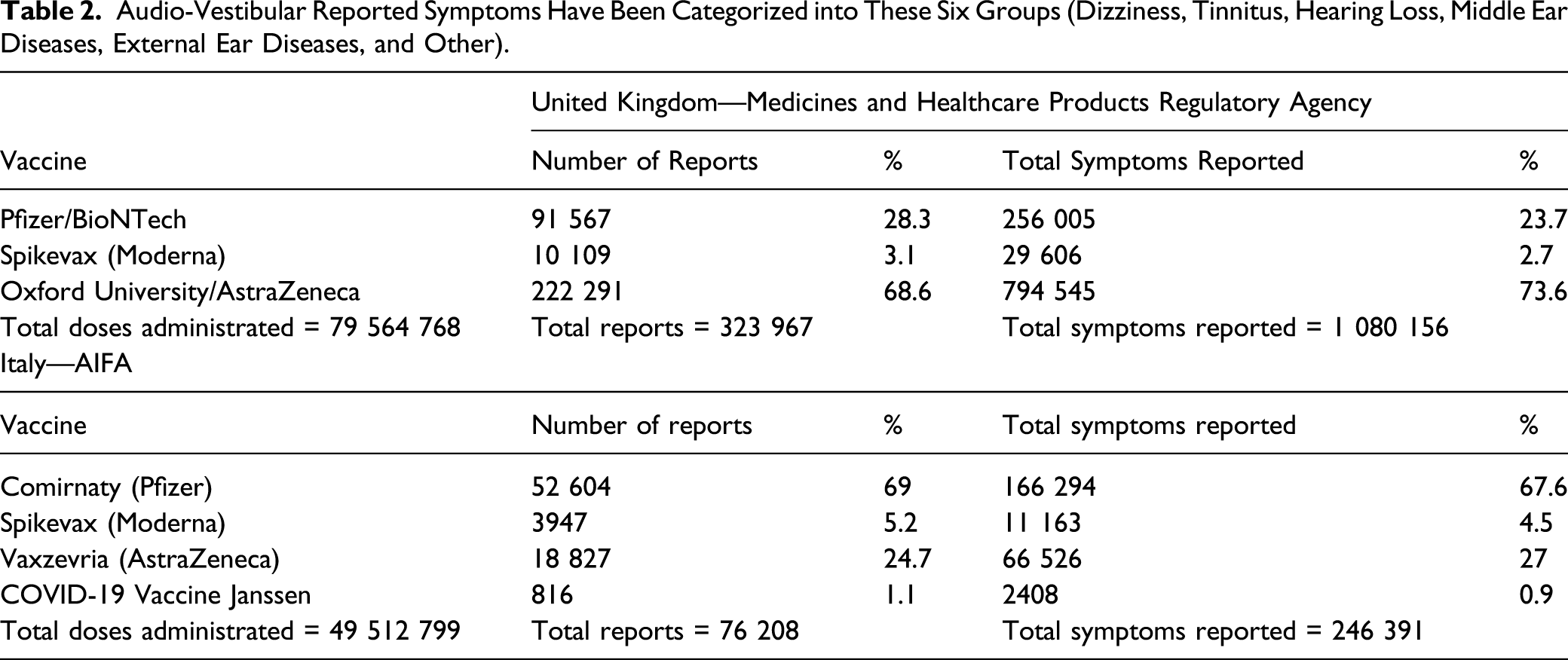
Among the symptoms reported, only selected audio-vestibular disorders were considered (including hearing loss, tinnitus, dizziness, middle ear diseases, external ear diseases, and other) both from Italian and UK’s reports. The category “other” included Eustachian tube disorders, hyperacusia, and inner ear inflammation. The reported symptoms were categorized into these six sub-groups, named Dizziness, Tinnitus, Hearing Loss, Middle Ear Diseases, External Ear Diseases, and Other, for each of the three different vaccines (Pfizer, Moderna, and AstraZeneca) in Italy and in the UK.
Audio-Vestibular Reported Symptoms Have Been Categorized into These Six Groups (Dizziness, Tinnitus, Hearing Loss, Middle Ear Diseases, External Ear Diseases, and Other).
A closing note on the topic, despite the importance of the vaccination adverse effects on the various human systems, the available literature in the area of hearing and balance is rather poor. The available studies refer to preliminary pilot observation attempts on small datasets of subjects. For example, in a recent retrospective study, Wichova et al 4 presented a cohort of 30 patients affected by otologic symptoms shortly after COVID-19 vaccination but without any evidence of a real correlation. Formeister et al, in a cross-sectional study 5 evaluating the data by the American CDC Vaccine Adverse Events Reporting System, attempted to establish a relationship between the incidence of sudden sensorineural hearing loss (SSHL) in those vaccinated against the COVID-19 and those non-vaccinated; they reported a similar incidence of SSHL in both sub-groups.
In conclusion, we would like to remark that according to the AIFA recommendation, the available data should be considered as “reported adverse effects” and they do not offer evidence for a real clinical correlation between the symptoms reported and the COVID-19 vaccine mechanisms. Nevertheless, the fact that numerous adverse effects have been reported should be an initiative to investigate in more detail future cases reporting various adverse symptoms. Even a randomized protocol (ie, not including all reported cases, a limit imposed by the available economic resources) would benefit the knowledge which can be acquired on the true performance of these vaccines, in the populations under COVID-19 health surveillance.
