




Abstract
Though a common symptom, epistaxis should never be overlooked as the implications may be consequential. Nasal leech infestation represents an unusual etiology of recurrent epistaxis. The leeches release enzymes to anaesthetize the attachment site to facilitate the feeding process. Given the inconspicuous area of infestation and the absence of pain, there is often a delayed treatment. A detailed history taking and physical examination remain paramount in the assessment of recurrent epistaxis.
Clinics
A 9-year-old girl was referred for recurrent epistaxis from the right nostril for the past 1 week. The child experienced intermittent nasal bleed almost daily, with an estimated amount of 1 teaspoon full on each episode. Other associated symptoms such as fever, nasal obstruction, purulent discharge, or smell disturbance were absent. The family denied trauma or hematological disorder. Further history revealed the epistaxis only occurred after a recent jungle trekking activity. Upon clinical assessment, she appeared pink with stable vital signs. Cold spatula test revealed an absence of mist over the right nostril, indicative of nasal obstruction. Anterior rhinoscopy revealed a living leech infesting the right nostril, which was successfully removed with forceps under endoscopic guidance (Figure 1).
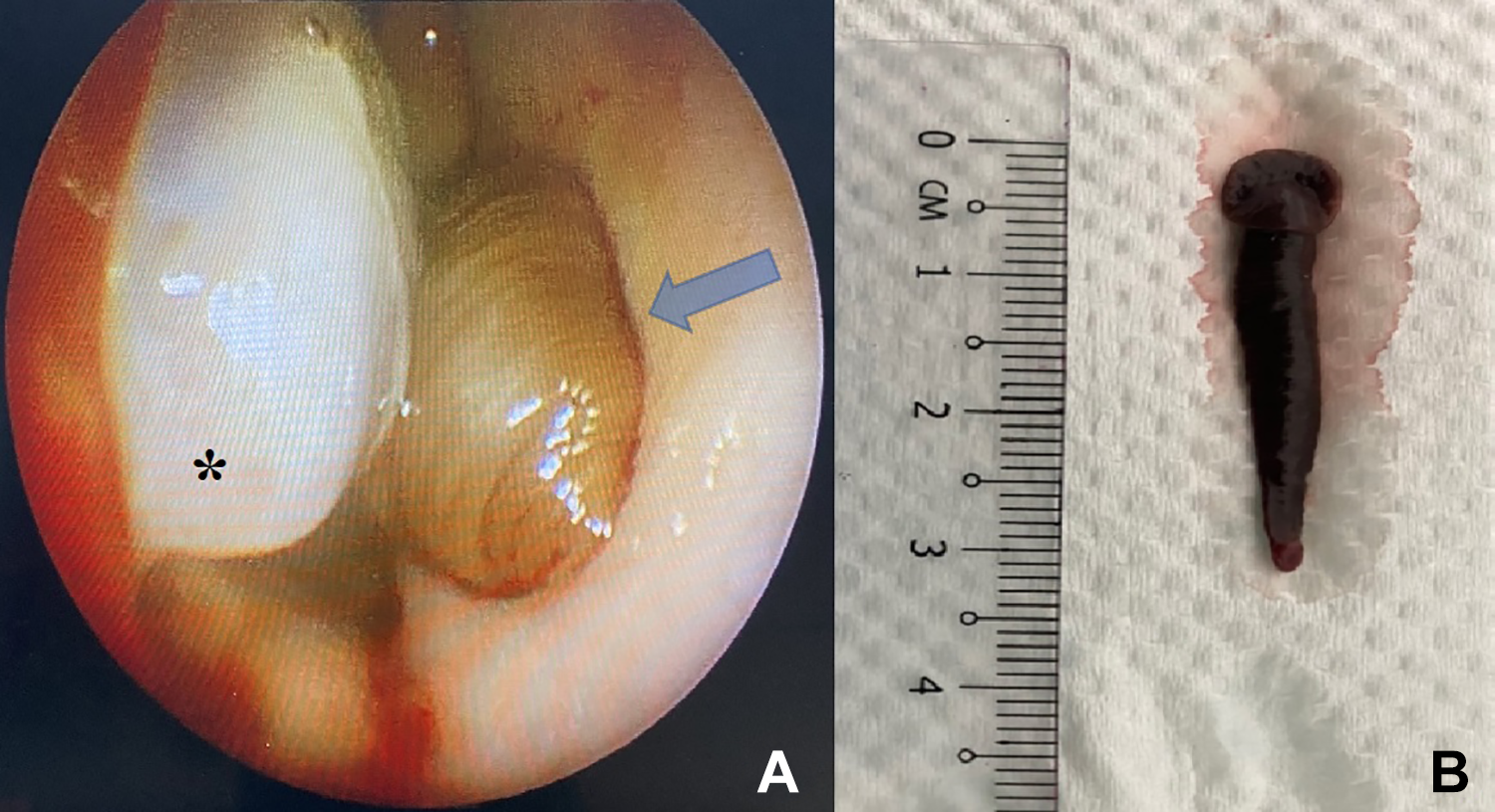
A, Nasal endoscopic view of the right nasal cavity reveals a leech (arrow in blue) located between the right inferior turbinate (*) and nasal septum. B, The length of the leech measures 3.2 centimeter.
Epistaxis among the pediatric age-group is a common clinical condition, in which a majority of cases resulted from vascular fragility in the nasal vestibule aggravated by digital trauma. 1 Occasionally, an impacted foreign body in the nasal cavity can manifest as recurrent unilateral epistaxis, however, often with accompanying foul-smelling purulent discharge. On the other hand, the infestation of living leech in body orifices, better known as orificial hirudiniasis, represents an unusual etiology of epistaxis, especially in Western countries. 2
Leeches are blood-sucking endoparasites which utilize anterior and posterior sucker to feed onto the host. Once attached, the leeches release enzymes to anesthetize the attachment site as well as to interfere with the coagulation process to facilitate the feeding process. Due to the anticoagulant enzyme hirudin, the bites may often bleed more than a normal wound, even after the leech is removed. 2 In the head and neck region, leeches commonly infest the nasal cavity, followed by the nasopharynx and oropharynx. 2 Given the inconspicuous site of infestation and the absence of pain, there is often a delayed treatment. Complications such as anemia, airway obstruction, and hemoptysis have been reported.2,3
Though a common symptom, recurrent epistaxis should never be overlooked as the implications may be consequential. The possibility of a nasal leech infestation should be suspected especially with a recent travel history to the tropics. Characteristics habit of drinking water in endemic area or swimming in polluted water may also give a clue. The removal is relatively straightforward and can often be performed in an outpatient setting without significant postoperative hemorrhage.
Footnotes
Declaration of Conflicting Interests
The author(s) declared no potential conflicts of interest with respect to the research, authorship, and/or publication of this article.
Funding
The author(s) received no financial support for the research, authorship, and/or publication of this article.
