




Abstract

Hearing loss following viral infection has been reiterated for years. Viral-induced hearing loss is known to cause from mild to profound hearing loss, either unilateral or bilateral, conductive or sensorineural type of hearing loss. Interestingly, the effects of hearing loss accruing viral infection differ greatly according to the type of virus. Accordingly, hearing loss may occur ensuing a few postulations including direct or indirect damage to inner ear structures as well as host immune-mediated damage. Outcome of the hearing loss also varies greatly, as some viral infections are reversible with appropriate antiviral drugs.
The recent pandemic, severe acute respiratory syndrome coronavirus 2 (SARS-CoV-2), has opened a Pandora’s box of novel intriguing clinical manifestations that are being unfolded perpetually. Although respiratory, cardiologic, and gastrointestinal symptoms are the main focus, recently olfactory and gustatory symptoms have successfully made it to the list. Recent studies have unveiled neurotrophic and neuroinvasive characteristics possessed by the novel coronavirus. 1 The notion of SARS-CoV-2 infection as a precursor of hearing loss has recently been lauded. 2 This has ignited the search on the evidence available on the prevalence of hearing loss among patients infected with SARS-CoV-2.
Interestingly, a previous report on coronavirus discovered the involvement of brainstem, which could explain the auditory involvement. 3 Myriad theories have been postulated on the mechanism of hearing loss following SARS-CoV-2 infection. Among them, hematogenic transmission posits the basis of hearing loss in these groups of patients. Severe acute respiratory syndrome coronavirus 2 attaches to the hemoglobin via β chain, gaining entry into erythrocytes, which acts as a transporter ergo, infecting all tissues by binding to the surface receptor, angiotensin-converting enzyme 2 (ACE2). As ACE2 has been reported to be abundant in the brain, medulla oblongata, 4 and temporal lobe, the hearing center becomes affected, paving the way to hearing loss. Severe acute respiratory syndrome coronavirus 2 causes cytokine release once it binds to the surface receptor, ACE2. Therefore, the hearing center becomes affected by the inflammatory mediators released upon binding to the surface receptors in the temporal lobe. Additionally, as SARS-CoV-2 deoxygenates the erythrocytes, possibility of hypoxia of the hearing center may lead to permanent damage, causing permanent hearing loss.
Another plausible hypothesis of hearing loss is ensuing reduced perfusion to the hearing organs due to ischemia. 5 When ACE2 found in vascular smooth muscle becomes infected, and clot formation diminishes blood supply, thus causing ischemic damage, which may contribute to the hearing loss. The elderly group, which has been the main target population of severe SARS-CoV-2 infection, is prone to hearing loss, especially following the ischemia theory. We postulate that the reason behind scantily reported cases on hearing loss among patients infected with SARS-CoV-2 is that the infected patients with hearing loss present in grave conditions require urgent resuscitation.
In the past, viral infection has been associated with sudden sensorineural hearing loss (SSNHL). Inflammation of the auditory pathway, including cochlear nerve, cochlea, and perilymphatic tissue, as well as cross-reaction between the antigens in the inner ear and virus have all been linked as the culprit in causing SSNHL. 6 Additionally, indirect virus transmission from cerebrospinal fluid to the inner ear structures can also explain the cause behind SSNHL. 7
Many reports have linked SARS-CoV-2 infection to a number of peripheral neuropathies; therefore, the possibility of impairment of transmission of auditory pathway is high among patients infected with SARS-CoV-2. Interestingly, recent articles on the association between Guillain-Barre syndrome (GBS) and SARS-CoV-2 infection have emerged. While auditory spectrum neural disorder has been linked with GBS, immune-mediated complex accruing SARS-CoV-2 infection may lead to permanent hearing loss in these group of patients. 8
The conductive element of the hearing pathway can become affected ensuing ascending infection from the nasopharynx, which could lead to fluid built behind the middle ear causing middle ear effusion. Initial presentation of SARS-CoV-2 infection with otalgia and tinnitus has been reported. 9
A literature search of articles published in PubMed was conducted on July 7, 2020, using the following search terms: hearing loss, sensorineural hearing loss, SSNHL, conductive hearing loss, SARS CoV 2, and COVID 19 to investigate the association between hearing loss in SARS-CoV-2 infection.
A total of 7 articles were obtained, of which 3 cross-sectional study and 4 case reports (Table 1). 2,9 -14 A total of 35 patients with age ranging from 20 to 60 years were included. All patients included had hearing loss as a primary symptom and the accompanying symptoms were tinnitus, vertigo, and otalgia. The most common audiological test includes pure-tone audiometry, tympanometry, and otoacoustic emission. Interestingly, SSNHL was noted in 1 case, 13 and 1 patient presented with acute otitis media revealed conductive hearing. 9 None of the authors mentioned on the outcome of hearing loss. However, it is noteworthy, in 1 study cochlear implant was performed under local anesthesia in a patient who developed SSNHL.
Summary of Characteristics and Main Findings Included in This Study.
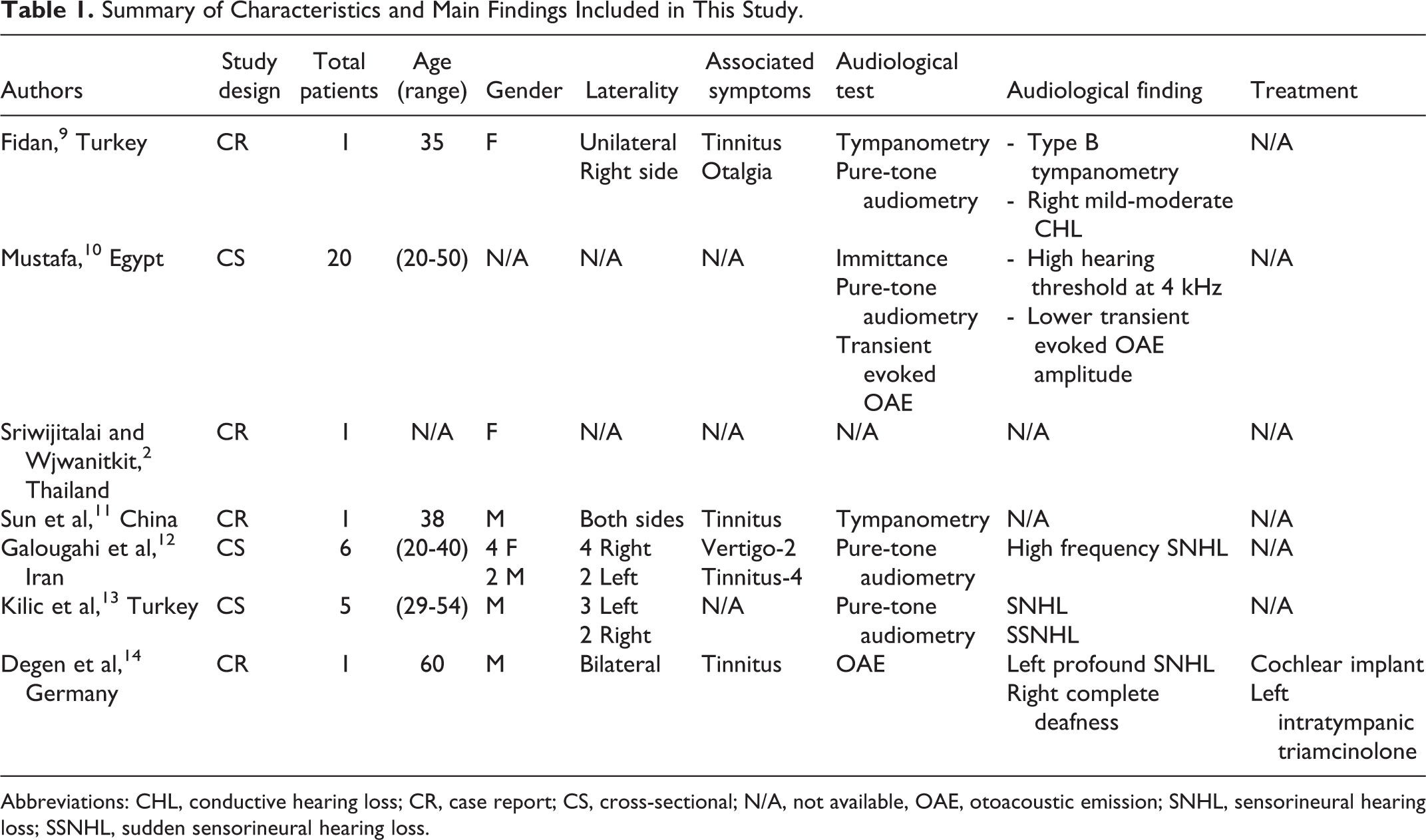
Abbreviations: CHL, conductive hearing loss; CR, case report; CS, cross-sectional; N/A, not available, OAE, otoacoustic emission; SNHL, sensorineural hearing loss; SSNHL, sudden sensorineural hearing loss.
It is now important that hearing loss needs to be investigated among patients positive for SARS-CoV-2 infection and especially the patients who have recovered from SARS-CoV-2 infection as the possibility of permanent hearing loss cannot be ignored.
We would like to highlight on hearing loss as one of the clinical manifestations of SARS-CoV-2 infection, notably sensorineural hearing loss. Early detection of hearing loss is imperative as early intervention of viral-induced hearing loss has positive outcome. In the same vein, permanent hearing loss has been known to have detrimental effect on the quality of life of the affected individuals.
Footnotes
Authors’ Note
Jeyasakthy Saniasiaya is the sole author in planning, conducting, reporting the work.
Declaration of Conflicting Interests
The author declared no potential conflicts of interest with respect to the research, authorship, and/or publication of this article.
Funding
The author received no financial support for the research, authorship, and/or publication of this article.
