




Abstract
Sinonasal inverted papilloma is a benign lesion that occurs in the nasal cavity and paranasal sinuses. Fungiform papillomas have been described as arising from the septum or the nasal vestibule, while inverted and cylindrical papillomas have been characterized as developing from an attachment site on the lateral nasal wall or a mucosal surface in the paranasal sinuses. Here, we present a rare case of an inverted papilloma that completely obstructed the anterior nasal orifice.
A 24-year-old man, presented with a 1-year history of left-sided nasal obstruction with progressive aggravation, was referred to the Department of Otolaryngology of our university hospital. Nasal endoscopy demonstrated a papillomatous mass which completely obstructing anterior nasal orifice. The site of mass origin could not find out due to very large-sized mass with its easy touched bleeding at the outpatient department (Figure 1 A). Computed tomography scan of the sinus revealed a soft tissue opacity that filled the left anterior nasal cavity without any signs of sinus invasion and bone destruction and measured by 35 × 17 mm. The patient denied any history of underlying systemic disease, bleeding disorders, or nasal surgery.
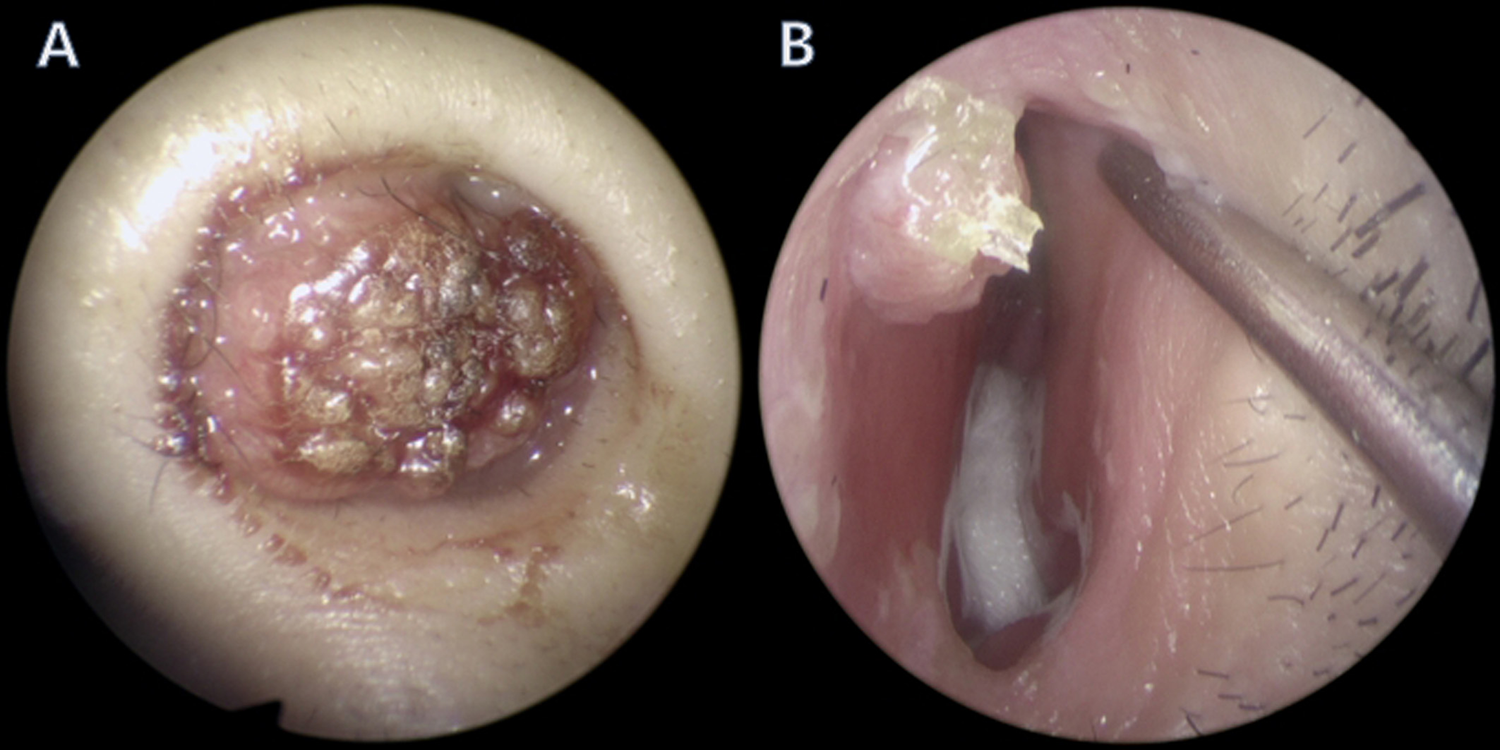
A, Nasal endoscopy shows a papillomatous mass which completely obstructing the left anterior nasal orifice. B, Endoscopy finding reveals the tumor recurrence 3 months after operation.
The mass was endoscopically excised under local anesthesia. After the left nasal vestibule was retracted, the mass was excised and controlled bleeding with an electrocautery. The mass was broadly attached to the left vestibule and anterior septum. Pathological examination of the excised mass showed confirmed the diagnosis of an inverted papilloma. Thickened squamous epithelium showed an endophytic or inverted growth pattern (Figure 2). The patient did not complain of nasal obstruction any more immediately after surgery. Endoscopy findings revealed tumor recurrence 3 months after operation (Figure 1 B). Therefore, the tumor was endoscopically excised under local anesthesia. After removing the tumor, the patient was on outpatient follow-up for a year and a half, but there was no recurrence.
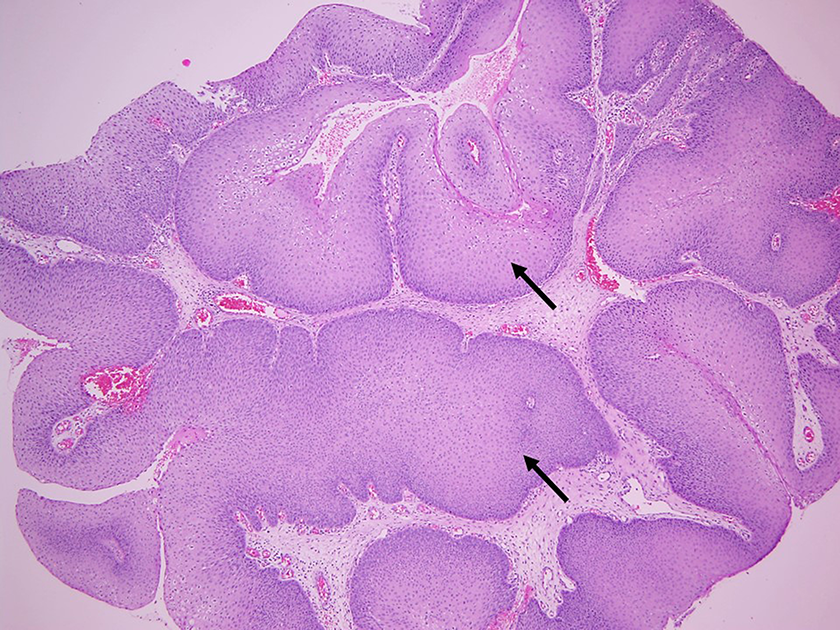
Pathological examination reveals the diagnosis of an inverted papilloma. Thickened squamous epithelium shows an endophytic or inverted growth pattern (arrows; H&E stain, ×40).
Sinonasal inverted papilloma is a benign lesion that developing from the paranasal sinuses or the lateral nasal wall. Associated 2 features include a high tendency for recurrence and malignant transformation into squamous cell carcinoma. It is divided into 3 histopathologic subtypes: inverted, exophytic (fungiform), and oncocytic (columnar or cylindrical). 1 The exact cause of it was not clearly identified, but human papilloma virus has been probable.
A study of Schneyer et al identified with 90 sites of attachment of 83 patients. 2 For inverted/cylindrical papilloma, maxillary sinus is the most common sites of attachment, followed by ethmoid sinus, nasal cavity, middle/superior turbinate, frontal sinus, and sphenoid sinus. For fungiform papilloma, the septum is the most frequent site of pedicle location, followed by vestibule, nasal cavity floor, inferior turbinate, middle turbinate, and superior turbinate. Fungiform papillomas have been described as originating from the septum or the nasal vestibule, whereas inverted and cylindrical papillomas have been identified as developing from the paranasal sinuses or the lateral nasal wall.
The goal of surgical treatment of sinonasal inverted papilloma is to identify the site of its origin and remove the tumor completely. Surgical options such as endoscopic and external approaches can be selected depending on the location and degree of progression of the disease. 3
If the tumor has not been completely removed, it recurs within a short period of time. 4 Most recurrence of tumors occurs at the base of the original tumor, strongly suggesting incomplete local resection as the main cause of recurrence. The predominant malignancy associated with inverted papilloma is synchronous or metachronous squamous cell carcinoma, although verrucous carcinoma and adenocarcinoma have also been reported. 5 The malignant ratios accompanied by the researchers have been varied according to them. We present a rare case of an inverted papilloma completely obstructing anterior nasal orifice.
Footnotes
Declaration of Conflicting Interests
The author(s) declared no potential conflicts of interest with respect to the research, authorship, and/or publication of this article.
Funding
The author(s) received no financial support for the research, authorship, and/or publication of this article.
