



Abstract
Introduction:
Concha bullosa (CB), which is pneumatization of the concha, is one of the most commonly seen anatomic variations of the lateral nasal wall.
Objective:
To investigate the effects on olfactory function of lateral turbinectomy and crushing methods used in the surgical treatment of CB.
Methods:
The study included a total of 47 patients operated on for a diagnosis of CB and nasal septum deviation. The patients comprised 22 females and 25 males, with bilateral CB in 18 cases and unilateral in 29 cases. Intervention was made to a total of 65 CB. The cases were separated as those applied with septoplasty and lateral turbinectomy in group 1 (n = 34) and those applied with the septoplasty and crushing method in group 2 (n = 31). The olfactory function of the patients was evaluated preoperatively and at 3 months postoperatively with the Brief Smell Identification Test.
Results:
A statistically significant increase was determined in the postoperative smell test results compared with the preoperative values in both group 1 (P = .021) and group 2 (P = .001). When the change in the smell test results from preoperative to postoperative was compared between the groups, the increase in group 2 was determined to be statistically significantly greater (P = .002).
Conclusion:
The results of this study showed that the crushing method in surgical treatment of CB increased olfactory functions more than the lateral resection method, and as the improvement in olfactory functions was greater, this demonstrated that only increasing the nasal cavity is not sufficient and the nasal mucosa should be protected as far as possible.
Introduction
Concha bullosa (CB), which is pneumatization of the concha, is one of the most commonly seen anatomic variations of the lateral nasal wall, not a pathological process. It is generally seen in the middle concha and occasionally in the upper and lower concha. 1 The size of the CB, related to the septum and lateral wall, can cause the development of sinusitis by blocking the osteomeatal complex or disrupting mucociliary clearance and mucosal formation by disrupting the drainage. 2,3
The functions of the middle concha are to provide nasal resistance, warm and humidify the inhaled air, and perceive odors. 4 Concha bullosa may be unilateral or bilateral and is usually asymptomatic, only noticed incidentally on radiological examinations. In symptomatic patients, there may be complaints of the feeling of nasal blockage, headache, or inability to smell. Medical treatment is insufficient in symptomatic patients, and they are usually treated surgically. The methods generally used in surgical treatment are lateral/medial partial resection, crushing, submucoperiosteal resection, and total concha resection. 5 Olfactory cells are located in the olfactory cleft of the nasal cavity and show distribution to the anterior and middle regions of the upper and middle concha in the upper part of the septum at various rates. 6 Intranasal surgical interventions involving these regions can affect the olfactory functions.
One of the tests used in the objective evaluation of the sense of smell is the Brief Smell Identification Test (BSIT). The test is formed of 12 odors embedded in strips that are exposed when rubbed with a pen tip and is a short, easy to apply test with results rapidly obtained. The patients are instructed to respond to items on a questionnaire with four options of the smell perceived. After evaluation of 12 strips by the patients, scores are calculated according to the correct responses. High points indicate a good olfactory function, and low points indicate a poor olfactory function. A score of ≥10 points is evaluated as normal olfactory function. The test has been proven to have good validity and reliability and is not affected by educational level, ethnicity or language. 7,8
To the best of our knowledge, this is the first study in literature to have investigated the effect on olfactory function of the surgical methods of lateral turbinectomy and crushing method in the surgical treatment of CB. The aim of this study was to evaluate and compare the effects of lateral turbinectomy and the crushing method on the olfactory function using the BSIT.
Material and Method
Study Design
This prospective study was conducted at the University of Health Science, Ankara Training and Research Hospital, Department of Otorhinolaryngology, between April 2017 and June 2018. Approval for the study was granted by the Local Ethics Committee (protocol no: 25.05.2016-5406). Informed consent was obtained from all the study participants.
The study included a total of 47 patients, comprising 22 females and 25 males, who presented at our clinic with complaints of nasal blockage, headache, or snoring, were diagnosed with CB and nasal septum deviation from the findings of examination and paranasal computed tomography (CT) and were planned to undergo surgical treatment.
The septoplasty operation and surgical intervention for CB were applied to all patients under general anesthesia by the same surgeon. No local or systemic steroid treatment was applied as it could affect olfactory functions before and after the treatment. Patients were excluded from the study if they had maxillofacial trauma, a malignant or benign tumour in the nose, nasal polyp, any congenital anomaly, a history of nasal surgery (paranasal sinus or hypophysis surgery), dependence on intranasal medication, allergic rhinitis, olfactory disorder, a history of systemic disease, or were cigarette smokers. In the total 47 patients evaluated in the study, bilateral CB was present in 18 cases and unilateral in 29 cases. Surgical intervention was made to a total of 65 CB. Lateral turbinectomy was applied to 34 CB and the crushing method to 31 CB. The patients were separated into 2 groups according to the surgical method applied. Group 1 comprised patients applied with lateral turbinectomy and group 2, those applied with the crushing method.
Evaluation Methods
Preoperatively, a detailed ENT examination, anterior rhinoscopy, and nasal endoscopic examinations were applied to all the patients. Computed tomography (CT) examinations were made on paranasal sinus CT slices obtained at 0.625 mm (GE Brightspeed CT device [Aquillon64, Toshiba, Otawara, Japan], tension 100 Kv and current 60 mAs) with the patient in a prone position and the head in hyperextension. Coronal CT slices were used for diagnosis. The preoperative smell test was applied in the nostril determined with CB. In patients determined with bilateral CB, the smell test was applied by closing 1 nostril, then half an hour later, the test was repeated on the other side with the strips in a mixed order (by closing the other nostril). At 3 months after surgery, the smell tests were repeated. The patients were instructed to scratch off the BSIT strips and identify 12 different odors. Scores were calculated according to the responses given by the patients.
Surgical Technique
With the patient under general anesthesia, preoperatively a 1:100 000 epinephrine injection was administered and septoplasty was applied with the Cottle technique. Then the surgical procedure for CB was started. The CB surgery was applied endoscopically using a 4 mm, 0°, rigid telescope (Karl Storz, Tuttlingen, Germany). The lateral turbinectomy method was preferred in cases where the CB was totally obliterating the nasal passage. In the lateral turbinectomy method, the concha is entered with a hooked knife from the point where there is the most evident ventilation, without applying much pressure. The incision is continued with concha scissors along the free lower edge as far as the posterior border of ventilation. Two-thirds of the lateral lamella, separated from the middle concha with an elevator, are held with straight forceps, and then excised by making a slight turning movement. In the crushing method, starting from the upper edge of the middle concha, crushing is applied with Bruening forceps toward the anterior then to the posterior and is completed without mucosal damage. At the end of the operation, a Doyle splint tampon was applied to all patients and the splint was removed 5 days postoperatively.
Statistical Analysis
Data obtained in the study were analyzed statistically using SPSS version 20.0 software (SPSS Inc, Chicago, Illinois). Descriptive statistics related to continuous data were stated as mean ± standard deviation, median, minimum, and maximum values. Categorical data were stated as number (n) and percentage (%). Conformity of the continuous data to normal distribution was evaluated with the Shapiro–Wilk test. In the comparison between 2 groups of continuous data, the t test and the Mann–Whitney test were used and in the comparison of nominal variables, the χ2 test was applied. In the evaluation of the preoperative and postoperative olfactory function, the Wilcoxon test was applied. A value of P < .05 was accepted as statistically significant.
Results
Group 1 comprised 15 (44.1%) females and 19 (55.9%) males with a mean age of 35.12 ± 12 years. Group 2 comprised 17 (54.8%) females and 14 (45.2%) males with a mean age of 33.22 ± 11.88 years. No difference was determined between the groups in respect of age or gender (P > .05). An increase was determined in olfactory functions according to the BSIT results in both groups postoperatively (Figure 1).
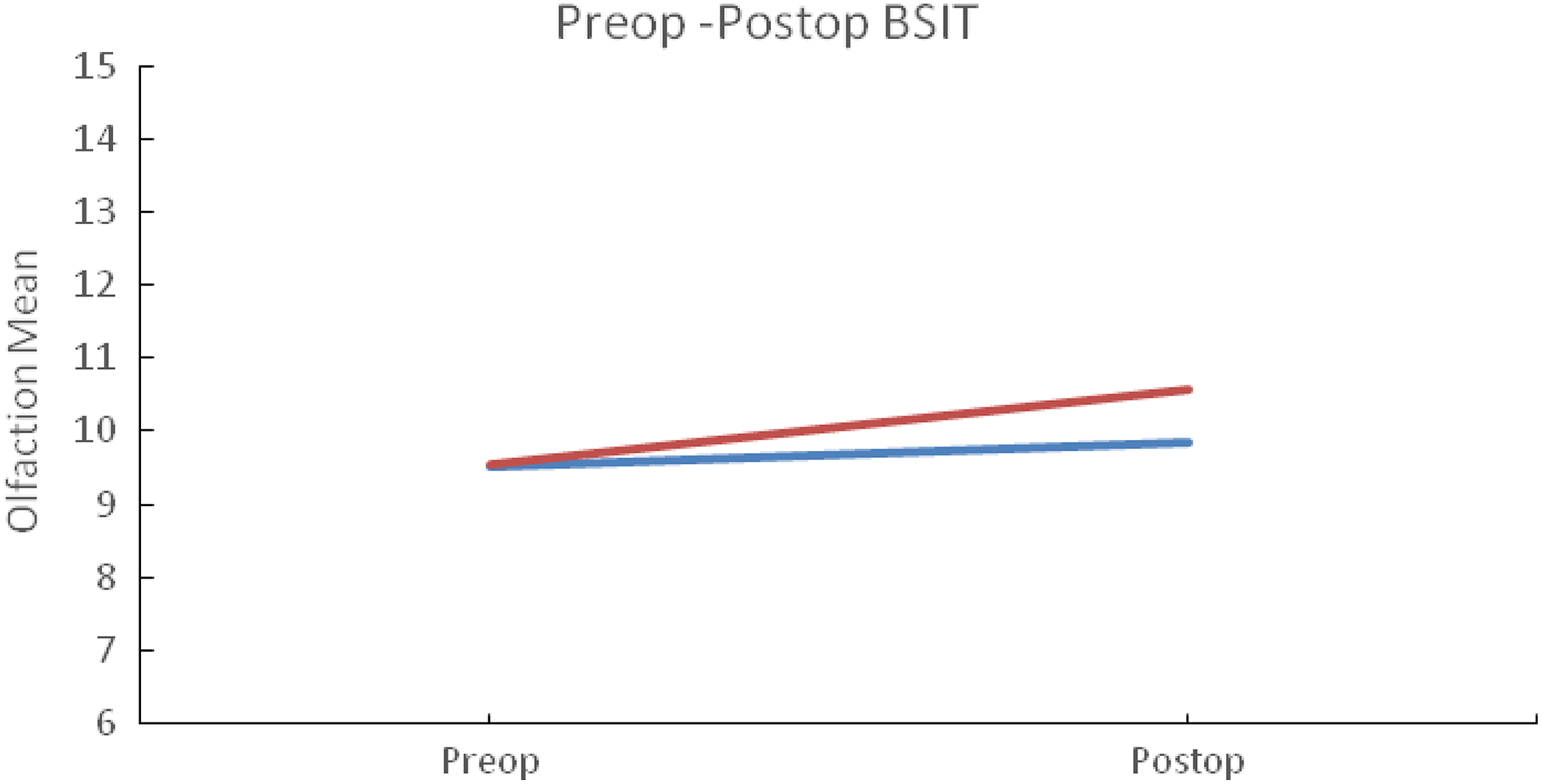
Olfactory functions according to the BSIT results in both groups (group 1, blue line and group 2, red line). BSIT indicates Brief Smell Identification Test.
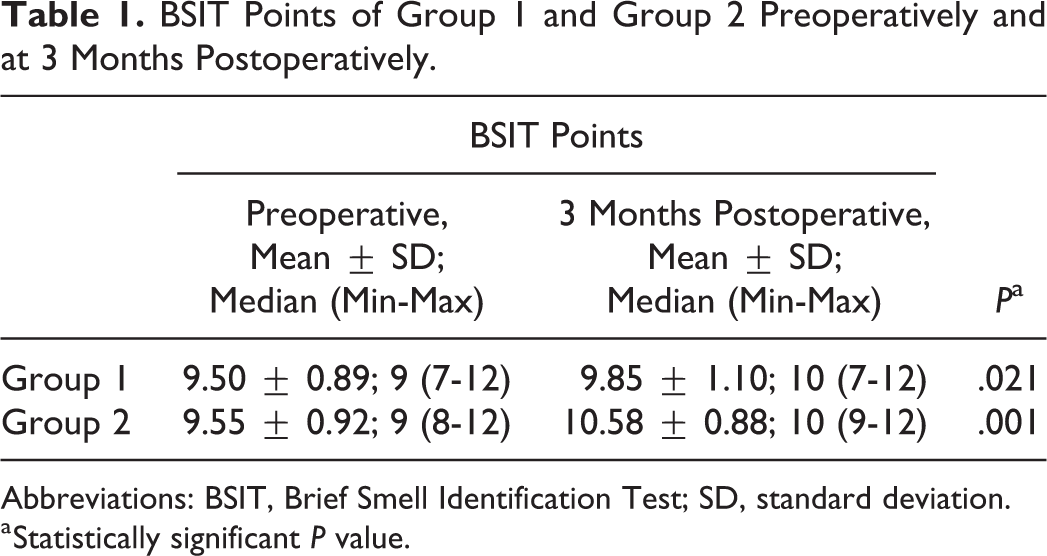
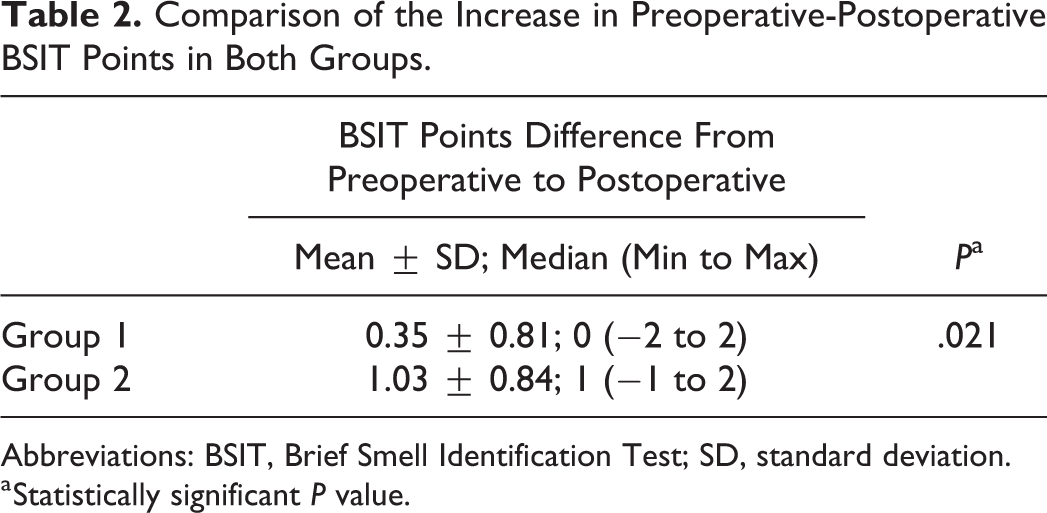
A statistically significant increase was determined in the postoperative smell test results compared with the preoperative values in both group 1 (P = .021) and group 2 (P = .001; Table 1). When the change in the smell test results from preoperative to postoperative was compared between the groups, the increase in group 2 was determined to be statistically significantly greater (P = .002; Table 2).
BSIT Points of Group 1 and Group 2 Preoperatively and at 3 Months Postoperatively.
Abbreviations: BSIT, Brief Smell Identification Test; SD, standard deviation.
a Statistically significant P value.
Comparison of the Increase in Preoperative-Postoperative BSIT Points in Both Groups.
Abbreviations: BSIT, Brief Smell Identification Test; SD, standard deviation.
a Statistically significant P value.
Discussion
Concha bullosa lays the ground for paranasal sinus infections by disrupting mucociliary clearance or creating osteomeatal complex obstruction and is sometimes a disease in itself or causes various symptoms such as nasal obstruction because of the size, uncomfortable postnasal discharge, inability to smell, or headache. The frequency of CB has been reported as 5.7% to 55% in symptomatic patients, as 10% to 20% in asymptomatic patients, and is observed bilaterally at the rate of 45%. 9 -12 The treatment for CB is surgery in symptomatic patients. The aim of treatment is to remove nasal obstruction, provide the best level of nasal airflow and mucociliary clearance, and protect olfactory functions. 13
Of CB surgical treatment methods, total resection is applied least often, and partial resection of the medial surface of the concha is preferred much more because adhesions to the septum can be visualized. The most widely used method is lateral turbinectomy. 14 This method has been reported to be useful in providing sufficient airflow in the treatment of large CB that completely fills the osteomeatal complex. 4,14 The crushing technique is a method that is less invasive and can be applied more quickly and easily. In addition, the nasal anatomy and physiology are more protected in this surgical intervention. 15,16 Koçak et al reported that the crushing technique was an effective treatment method in all CB types, which provided a sufficient reduction in middle concha volume, and did not cause any subjective deterioration in the perception of smell. 4 In the current study, the lateral turbinectomy method was preferred in the treatment of CB fully obstructing the nasal passage, and the crushing method was selected for cases where the CB did not fully obstruct the nasal passage.
The perception of smell occurs as a result of olfactory molecules entering from the nasal cavity and reaching the olfactory epithelium. Septal deviation of the nasal cavity, structural disorders such as CB, and inflammatory and tumoral diseases can prevent smell perception by preventing airflow and the transmission of odor molecules to the olfactory epithelium. 17,18 There are studies in literature that have reported olfactory disorders forming in the early period after nasal surgery that have recovered in the long term with the elimination of edema and inflammation. 17,19 In a study by Apuhan et al, biopsies taken from lateral, anterior, and medial surfaces of concha of patients operated on for a diagnosis of CB were found to include nerve tissue at rates of 81.4%, 60%, and 32.8%, respectively, and it was also stated that lateral turbinectomy could cause loss of the sense of smell. 1
The BSIT is an easily completed test with proven objectivity, validity, and reliability, not affected by the educational level, ethnicity, or language of the respondents. 7,8 Other previous studies that have researched the effect of CB surgery on olfactory functions have been conducted using different CB surgical methods such as resection, medialization, and crushing, but to the best of our knowledge, no previous study has compared the effect of CB surgical methods on olfactory functions. 4,18,20 In this study, the effect on olfactory functions of lateral turbinectomy and crushing methods applied CB surgery were investigated for the first time with the BSIT test.
The most important limitation of this study was that the CB surgery was applied together with septoplasty and could not be isolated. The olfactory functions of the patients applied with both surgical methods were determined to have improved at 3-month postoperatively compared with the preoperative values (P = .021, P = .001; Table 1). The rate of improvement in olfactory functions was determined to be greater in the patients applied with the crushing method (P = .002; Table 2). This improvement in olfactory functions is thought to be due to the septoplasty and CB treatment applied with lateral turbinectomy or the crushing method increasing the nasal cavity between the septum and the middle concha, thereby allowing the odor molecules to reach the olfactory epithelium more easily. As the lateral turbinectomy method was selected for patients where CB was totally obliterating the nasal passage, the nasal cavity obtained in these patients was greater than in those operated on with the crushing method. The higher rate of improvement in olfactory functions obtained in the crushing method is thought to be related to the protection of the middle concha mucosa and that no resection was applied, and to the loss of olfactory neurons, even if limited, associated with resection in the lateral turbinectomy method.
Conclusion
The results of this study showed that the crushing method in surgical treatment of CB increased olfactory functions more than the lateral resection method, and as the improvement in olfactory functions was greater, this demonstrated that only increasing the nasal cavity is not sufficient and the nasal mucosa should be protected as far as possible. The crushing technique is a less invasive, easily applied technique, which is also more advantageous in respect of olfactory functions. Therefore, with suitable indications, it should be the primary selection in middle concha surgery.
Footnotes
Declaration of Conflicting Interests
The author(s) declared no potential conflicts of interest with respect to the research, authorship, and/or publication of this article.
Funding
The author(s) received no financial support for the research, authorship, and/or publication of this article.
