




Abstract

An 18-year-old girl presented to the department of Otolaryngology of The Third Affiliated Hospital of Sun Yat-sen University with a 2-month history of severe recurrent epistaxis on December 12, 2013. She had no other signs or symptoms of a systemic illness. No family history of bone metabolic disorders was reported. The symptom of epistaxis had started after septoplasty in other hospital and could be controlled by conservative treatment such as anterior nasal packing. She told us there were no images of paranasal sinus preoperatively and very little information about the treatment of septoplasty was known.
After her hospital admission, physical examination was done and it showed hemorrhage of nasal mucosa, along with septum perforation and adhesion to the inferior turbinate by endoscopy(Figure 1A and B). Laboratory evaluation indicated the level of hemoglobin 11.2g per deciliter (reference range: 11.5-15 g per deciliter), the level of serum calcium 2.35 mmol/L (reference range: 2.25-2.75 mmol/L), and the level of alkaline phosphatase 75 U/L (reference range: 50-135 U/L). Computed tomography (CT) of paranasal sinus revealed extensive ground-glass bone abnormalities involving the whole craniofacial bone (Figure 2A-C), especially the bone of paranasal sinus. The skin and mucosal did not show any signs of pigmentation and no endocrinopathies were detected. All these indicated that patient has craniofacial fibrous dysplasia, and the symptom of recurrent epistaxis may related to morphology change of the nasal mucosa after septoplasty. Because of the inefficient conservative treatment, submucosal bony inferior turbinectomy was performed and the nasal mucosa was repaired. The bone of the inferior turbinate was sent to pathology and the diagnosis of craniofacial fibrous dysplasia was confirmed.
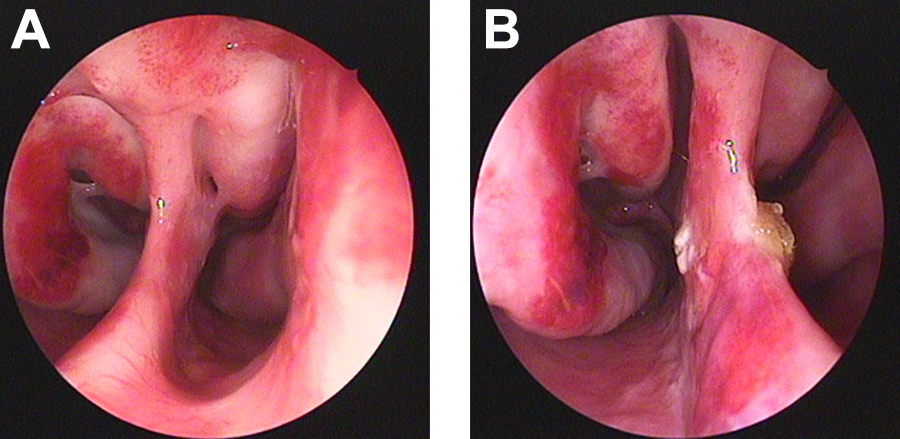
Endoscopic view of the (A) left nasal cavity and (B) right nasal cavity.
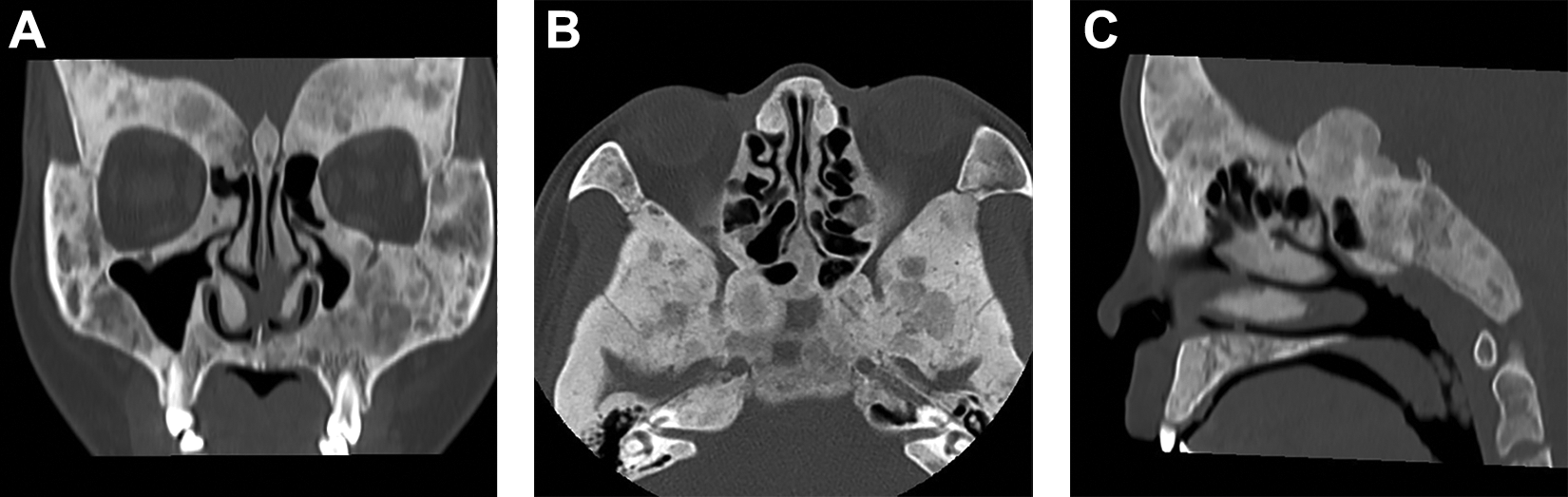
Computed tomography of paranasal sinus (A) coronal view, (B) horizontal view, (C) sagittal view.
Fibrous dysplasia as defined by Eversole is a benign, non-neoplastic intramedullary cellular proliferation of fibroblasts, with the normal bone matrix replaced by fibroblastic proliferation, for mutation in the Gsα gene that is located at chromosome 20q13.2-13.3. Fibrous dysplasia is broadly classified into 2 forms, monostotic and polyostotic, depending on the number of bones involved. The craniofacial bone is the most common site and craniofacial fibrous dysplasia is considered a separate entity by some authors, others believe it to be a form of polyostotic form of fibrous dysplasia involving multiple cranial bones. The diagnostic gold standard for disease is histopathology, but in the case of craniofacial fibrous dysplasia, the radiography and CT play a remarkable role in diagnosis, and the biomarkers such as alkaline phosphatase is not effective for diagnosis. However, it has potential to cause significant functional disturbance, and surgery is recommended only for symptomatic patients. 1,2 Bone osteoplasty at the site of involvement is adequate in some cases, while complete excision with graft reconstruction should be considered in other cases. On the other hand, patients of fibrous dysplasia should be made aware with its potential for recurrence and malignant transformation.
Fortunately, there was no epistaxis recurrence after the treatment during follow-up. Also the patient had no other symptom, such as vision loss, auditory function impairment, and no disease progression during the 5 past years.
Footnotes
Acknowledgments
The authors thank Professors Gehua Zhang and Qintai Yang (Department of Otolaryngology, The Third Affiliated Hospital of Sun Yat-sen University) for their assistance in preparing this article.
Declaration of Conflicting Interests
The author(s) declared no potential conflicts of interests with respect to the research, authorship, and publication of this article.
Funding
The author(s) disclosed receipt of the following financial support for the research, authorship, and/or publication of this article: This research was supported by Undergraduate Teaching Reform Research Project of Sun Yat-sen University in 2019 (No. 82000-18842502).
