




Abstract
Vinca alkaloids are known to cause bilateral jaw pain that occurs once during the chemotherapy course. We report a patient with first bite syndrome (FBS) during active treatment with chemotherapy. A patient with Hodgkin lymphoma presented with unilateral jaw pain after beginning his chemotherapy regimen. Pain was worse with the first bite of each meal and dissipated over subsequent bites. Workup was negative for any lesions in the parotid, parapharyngeal space, or infratemporal fossa. Pain was timed closely with chemotherapy administration and would improve prior to next cycle. A trial of botulinum chemodenervation failed to completely relieve symptoms. The patient noted resolution of symptoms after the completion of chemotherapy. We report a case of FBS, which may represent the jaw pain seen commonly with administration of vinca alkaloids. There appears to be a correlation between onset and duration of first bite symptoms with chemotherapy administration.
Introduction
Vincristine has well-reported side effects of jaw pain, but its characteristics are not well described. 1,2 Vincristine-induced jaw pain typically occurs within hours of chemotherapy administration and resolves over a few days. 3 In this study, we report a case of jaw pain consistent with first bite syndrome (FBS) occurring in a patient actively undergoing chemotherapy for Hodgkin lymphoma, with symptoms correlated with timing of chemotherapy administration.
Case Report
An 89-year-old male was referred to our institution for anemia of unclear source. He underwent a computed tomography (CT) and positron emission tomography CT scan that demonstrated diffuse adenopathy, consistent with classical Hodgkin lymphoma. His cervical adenopathy was not located near the superior cervical ganglion (Figure 1A and B). He was subsequently diagnosed with classical Hodgkin lymphoma stage IIIA and initiated chemotherapy the following week with plans for 6 cycles.
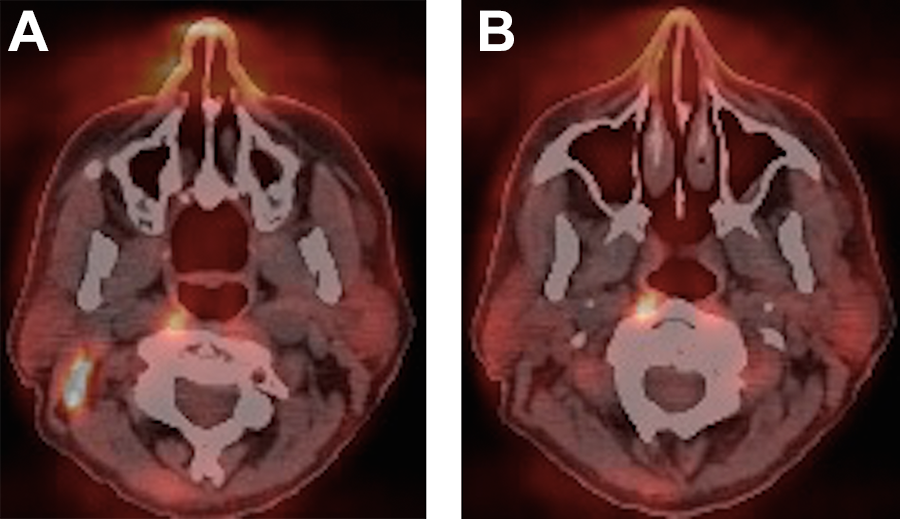
A and B, Positron emission tomography–computed tomography scan demonstrating no evidence of lesions in the deep parotid space (A) and parapharyngeal space (B) of the current patient described.
His chemotherapy regimen consisted of doxorubicin, vinblastine, and dacarbazine administered every 14 days. During the course of his chemotherapy regimen, the patient reported unilateral jaw pain while eating the first bite of a meal. He described an intense pain, directly over the parotid tail, which dissipated over subsequent bites. The overall quality of pain was intense immediately after each chemotherapy treatment and would then gradually improve until the next treatment started.
A panorex was performed and returned negative for fractures or other pathologies. His symptoms appeared consistent with FBS, and he was treated with a trial of botulinum chemodenervation prior to his next chemotherapy session. While the intensity of the pain did not change following the infusion, he noted a reduction in pain by 50% 2 weeks later. Following the conclusion of chemotherapy, he noted complete resolution of symptoms.
Discussion
Vinca alkaloids are known to cause jaw pain in patients. 3 This jaw pain typically occurs within hours to days after the first dose, resolves over a few days, and does not recur with subsequent doses. 3 It is characterized as an ache or throb that can be excruciating, and it is typically bilateral. 4 It frequently occurs independently of chewing or swallowing unlike classic First Bite syndrome, but may be worsened by these activities. 4
First bite syndrome, on the other hand, is known to cause an intense pain focally located along the parotid gland or jaw, which commences with the first bite of a meal. 5 The intensity of pain diminishes with subsequent bites of food. 5 Risk factors for developing FBS include parapharyngeal space surgeries, presence of deep lobe parotid tumors, or iatrogenic injury to the sympathetic chain/plexus. 6
To date, there are no published cases in the literature describing the symptoms of FBS in a patient without aforementioned risk factors. In the case described above, our patient developed unilateral jaw pain with meals following chemotherapy administration, which was worse with the first bite of each meal and improved with subsequent bites. His pain would then recur with subsequent doses of chemotherapy administration. This patient’s clinical course was thus atypical for vinca alkaloid-induced jaw pain, which typically occurs approximately days after chemotherapy, is not exacerbated by eating, resolves over a few days, and does not recur with subsequent doses. 4
There appears to be a clear association between the onset and duration of his first bite symptoms with his chemotherapy regimen. It is possible that other patients may have experienced FBS, but it was simply categorized as jaw pain. This case, therefore, serves to describe FBS associated with chemotherapy administration.
Footnotes
Authors’ Note
This work was done in the Department of Otolaryngology—Head & Neck Surgery, Washington University School of Medicine in St Louis, St Louis, Missouri. This work was presented as a poster presentation at the 2017 Triological Society Annual Meeting in San Diego, California, on April 28, 2017.
Declaration of Conflicting Interests
The author(s) declared no potential conflicts of interest with respect to the research, authorship, and/or publication of this article.
Funding
The author(s) received no financial support for the research, authorship, and/or publication of this article.