




Abstract

A 59-year-old male presented for evaluation of a 4-year history of dysphonia. Strobovideolaryngoscopy revealed laryngeal papillomatosis involving the true and false vocal folds. The patient was taken to the operating room for microdirect laryngoscopy, staged excision of papillomata, and cidofovir injection. Prior to excision, meticulous intraoperative endoscopic examination was performed using 0° and 70° rigid endoscopes and contact endoscopy.
Diverse endoscopic equipment is invaluable for mapping 3-dimensional structure of laryngeal pathology. A 0° telescopic examination has the ability to illustrate laryngeal pathological changes (Figure 1). The same perspective achieved in the office but cannot assess fully hidden sites of the larynx or microvascular or cellular changes. A 70° endoscopic examination of the anterior infraglottis (Figure 2) and the left ventricle (Figure 3) demonstrates hidden papillomatous changes otherwise unseen on 0° evaluation. The use of contact endoscopy (Figure 4) allows evaluation of the microvascular and cellular changes and allows confirmation of the diagnosis.
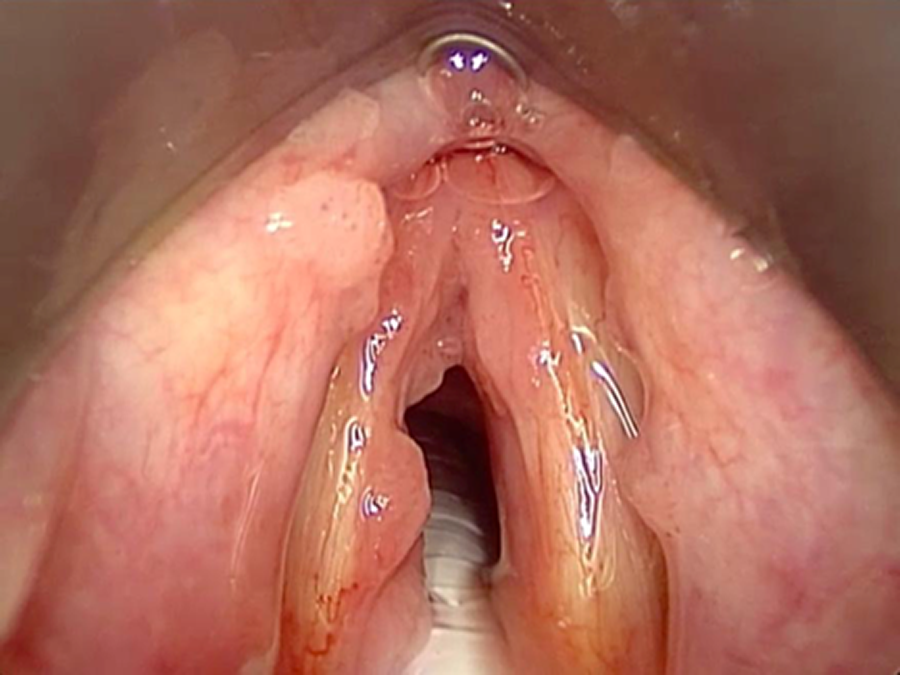
A 0° endoscopic intraoperative view of the larynx demonstrating papillomatosis of false and true vocal folds bilaterally.

A 70° endoscopic view of anterior infraglottic papillomatous disease otherwise unseen on 0° endoscopic view.

A 70° endoscopic view of left true vocal fold, false vocal fold, and anterior commissure demonstrating hidden papillomatous disease in the left ventricle, as well as papillomata on the true and false vocal folds.

Contact endoscopy performed on laryngeal papilloma showing vascular changes and poikilocytosis typical of papilloma.
The papilloma along the right vocal fold was resected under direct vision and sent to pathology for permanent section and viral typing. There was substantial infraglottic extension under the anterior commissure and right vocal fold (Figure 2). There was also bulky papilloma extending from the right vocal fold, indenting the left vocal fold anteriorly. Posteriorly, papilloma was resected from the left true vocal fold using a micro flap. Several lesions were resected (separately) from the right false vocal fold and several more from the left false vocal fold. The bases of the lesions were injected with cidofovir, and the masses were sent to pathology. Biopsy showed human papilloma virus (HPV) types 6 and 11 and was negative for any high-risk viral types and dysplasia.
Recurrent respiratory papillomatosis (RRP) is an uncommon infection that causes recurrent growth of papillomas throughout the upper aerodigestive tract. The RRP is caused by HPV. 1 The treatment of RRP is very difficult due to the high propensity for recurrence, as well as the location of disease. The features of the disease necessitate close follow-up, staged excision from the larynx, and pathologic examination of the tissue including viral typing.
Contact endoscopy is a minimally invasive visualization technique first described by Hamou in 1985 as an alternative, highly precise method of evaluating uterine cervical intraepithelial dysplasia. 2 Direct contact of the tip of the endoscope along a mucosal surface enables high magnification (×150) and examination of cells and blood vessels unstained or pretreated with methylene blue. This technology was introduced for use in otolaryngology by Andrea et al to examine the superficial layers of the vocal fold across various conditions, including papilloma. 3 Contact endoscopy has the advantage of providing immediate results, instant availability, and in the hands of an experienced user, high sensitivity and specificity relative to the gold standard histopathological examination. 4 This case highlights the value of diverse endoscopic techniques in diagnosis and treatment of laryngeal disease.
Footnotes
Declaration of Conflicting Interests
The author(s) declared no potential conflicts of interest with respect to the research, authorship, and/or publication of this article.
Funding
The author(s) received no financial support for the research, authorship, and/or publication of this article.