




Abstract
Parenting behavior is pivotal for the development of young children, as evidenced by previous research (Jeong et al., 2021; Madigan et al., 2019). Studies demonstrated positive correlations with key developmental outcomes such as language development (Rivero et al., 2023) and motor development (Shi et al., 2020). However, these studies primarily focused on children with typical development. Children with visual impairments (i.e., blindness or low vision) may experience developmental delays (Dale et al., 2022b), for example, in language, communication, cognitive, or motor development (Brambring, 2006; Dale et al., 2017; Dale & Sonksen, 2002; Perez-Pereira & Conti-Ramsden, 2019). Although parenting can help mitigate developmental delays, it also presents challenges for parents of children with visual impairments (van den Broek et al., 2017). Before providing support (Platje et al., 2018), it is important to determine whether specific parenting behaviors are related to the development of children with visual impairments. The current study represents a crucial step in exploring the relationship between specific parenting behaviors and developmental outcomes in children with visual impairments. Some research has been done on the association between parenting behavior and developmental outcomes of toddlers with visual impairments (Grumi et al., 2021; Hughes et al., 1999), but it was mostly conducted two or three decades ago. The current research aims to update our understanding of the possible parenting effects on the developmental outcomes in children with visual impairments without additional cognitive, sensory, or motor disabilities, specifically focusing on domains in language, cognition, social adaptation, and exploration. Importantly, this study focuses on a group of children with visual impairments and their individual variations and differences, rather than comparing them with children with typical development (Warren, 1994). This focus on individual differences provides more information for effective early interventions tailored specifically to the needs of children with visual impairments (Ravenscroft, 2019). Effective parenting encompasses various dimensions, with responsiveness being a key element. It involves acknowledging and reacting appropriately to a child's signals (Tamis-LeMonda et al., 2014). Researchers often employ the concept of sensitive-responsive parenting, which combines responsiveness with affection (Madigan et al., 2019; Rivero et al., 2023). This affection or sensitivity is manifested through the expression of positive emotions toward the child. Sensitivity, as shown by affection and responsiveness, facilitates exploratory behavior and attachment (Bretherton, 1992; Platje et al., 2018; van den Broek et al., 2017). Parental behaviors aiming at promoting exploration and cognitive development are examples of encouragement and teaching that built upon affection and sensitivity (Roggman et al., 2013a). These parenting behaviors, if focused on positive behaviors, fall within the realm of positive parenting (Platje et al., 2018; Provenzi et al., 2020).
An atypical course of child development can challenge parenting behaviors and parent–child interactions (Dale et al., 2022a; Ravenscroft, 2019). Due to their child's visual impairment, parents may face unique challenges in parenting compared to those of whose children are sighted (Dale et al., 2014; Sakkalou et al., 2021; van den Broek et al., 2017). Limited expression of typical cues by the child with visual impairment, such as making eye contact and showing reciprocal smiles and emotional expressions (Platje et al., 2018), along with reduced or delayed joint attention (Bigelow, 2003), can pose difficulties in interaction between child and parent. Additionally, studies have shown difficulties in establishing effective mutual communication (Howe, 2006; Loots et al., 2003; Preisler, 1991). To overcome these difficulties in development, effective parenting is needed (Dyches et al., 2012; Vilaseca et al., 2019), which helps in mitigating adverse effects on children's development (Provenzi et al., 2020; van den Broek et al., 2017).
In answer to the challenges faced by parents of children with visual impairments (van den Broek et al., 2017), parenting behavior has become a focal point within several early intervention programs tailored for children with visual impairments (Dyzel et al., 2021; Platje et al., 2018). Studies focusing on children with visual impairments have examined the relation between parenting behavior and child development in the specific context of intervention programs (Dale et al., 2018; Platje et al., 2018; van den Broek et al., 2017), rather than in natural parenting contexts. In contrast, prior investigations exploring the relation between parenting in natural contexts and child development have predominantly focused on other target groups, such as children with typical development (Rivero et al., 2023) or those with intellectual disabilities (Vilaseca et al., 2019). Although it is known that particular intervention programs that targeted specific skills were effective in stimulating the development of children with visual impairments (Dale et al., 2018; Elsman et al., 2019), the specific relation between parenting behavior and the development of children with visual impairments is scarcely studied and warrants further investigation.
Although parenting behavior can be assessed most easily with questionnaires (Cardinali & D'Allura, 2001), differences in reflective skills by the respondents and socially desirable answers are risks that invalidate outcomes (Morsbach & Prinz, 2006). The current study observed “real” parenting behavior in natural situations via video recordings of parent–child play, coded by using the instrument Parenting Interactions with Children: Checklist of Observations Linked to Outcomes (PICCOLO) by Roggman et al. (2013a). Although socially desirable behavior cannot be completely avoided in observational studies, since parents may do their very best when interacting with their child while being videotaped, this effect is less present in video recordings than it is in questionnaires. In previous studies on children with visual impairments, just a few developmental domains were studied (e.g., Dale & Sonksen, 2002). In the present study, we looked at a broader palette of developmental domains, namely language, cognitive, social adaptive, and explorative development.
The current study was guided by the research question: What is the association between observed parenting behavior and developmental outcomes in toddlers with visual impairments? Parenting behavior was categorized as affection, responsiveness, encouragement, and teaching (Roggman et al., 2013a). Developmental outcomes included language, cognition, social adaptation, and explorative behavior (Reynell, 1979). The research question evolved from the experienced lack in knowledge on the role of parenting in the development of toddlers with visual impairments. Children with visual impairments face challenges in their development, which parenting might alleviate. This study aimed to provide insights into the associations between parenting behaviors and the developmental outcomes of children with visual impairments. These insights in parenting behavior, as a potentially changeable behavior, can be targeted in intervention programs to influence the children's development for the better.
Method
Design
This study is part of a longitudinal study (Prospective Longitudinal Cohort study Children with Vision Impairments). The study adhered to the ethical principles of the Declaration of Helsinki (World Medical Association, 2022) and obtained approval from the Medical Ethical Committee Eastern Netherlands, Nijmegen, the Netherlands (No. NL74630.091.20). Data collection took place in home visits from 2021 until 2024. Each participating family was visited five to eight times. The number of visits varied depending on how soon after the study began each family started participating. The present investigation is cross-sectional in nature and relies on data obtained during the second wave of home visits. Because parental differences and home language might affect children's developmental outcomes, sex of the parents and bilingualism were added as control variables in the final analyses. Children were considered bilingual if an additional language was spoken in the home by at least one parent.
Procedure
Participants were recruited via regional centers of two Dutch organizations for people with visual impairments. Parents of children that met the inclusion criteria received a flyer from their service provider. Parents who were interested in participating initiated contact with the primary investigator and were provided with digital information and a consent letter. A reminder was sent 2 weeks later. Upon agreeing to participate, the parents of the children with visual impairments had to grant their consent for both themselves and their child.
Data collection took place in home visits conducted by the first author or one of the research assistants, who were trained by the first author. These home visits included the administration of the Reynell–Zinkin Developmental scales. For this purpose, the researcher carried with her a suitcase with materials required to administer the Reynell–Zinkin scales (see Vervloed et al., 2000). The suitcase contained everyday items such as dishware, children's shoes, and boxes in different sizes. The researcher went through the tasks of the Reynell–Zinkin scales one by one, in playful interaction. Tasks included, for example, pointing to the correct item out of three items (language assessment), or placing the correct lids on boxes (adaptive behavior assessment). Subsequent tasks increased in difficulty. Parents were present throughout the session. Additionally, a 15 min videotape was made of a play session between one parent and the child during the same home visit. Prior to this home visit, parents had been asked to choose age-appropriate problem-solving games to play during the home visit. Games were, therefore, performed with the child's own familiar toys. Puzzles or activity centers are examples of the games that were used. During the video recording, a parent, child, and researcher were present. The researcher was present only to record the play session; they were not involved in and did not interfere with the play. After recording, all videos were scored by the first author according to the PICCOLO criteria (Roggman et al., 2013a). Research assistants double coded 41% of the videotapes to establish interrater agreement. All coders were trained beforehand by material included with the PICCOLO materials (Roggman et al., 2013a). Interrater reliability scores were adequate to good, with interclass correlation coefficients ranging from .72 to .93.
Participants
Toddlers with visual impairments and their parents participated in dyads in the study. To be eligible for inclusion, children needed to have a medical diagnosis of visual impairment (either ocular or cerebral), fall within the age range of 8 and 32 months at the start of the study, and be registered at one of the regional centers supporting people with visual impairments in the Netherlands. Furthermore, the participating parent was required to be proficient in either Dutch or the English language. Children with evident multiple disabilities in cognition, sensory perception, or motor development at the start of the study were excluded. The current study sample consisted of 22 children aged 12 to 38 months (M = 25.73) at the second home visit. Children were divided into two groups using the ophthalmological data obtained from the regional centers: moderate low vision (n = 18) and severe low vision (n = 4), based on the guidelines of the World Health Organization (2019). Parents were between 29 and 45 years of age (M = 35.27) at the start of the study. Further demographic information about the participants is presented in Table 1.
Sociodemographic Characteristics of the Participants.
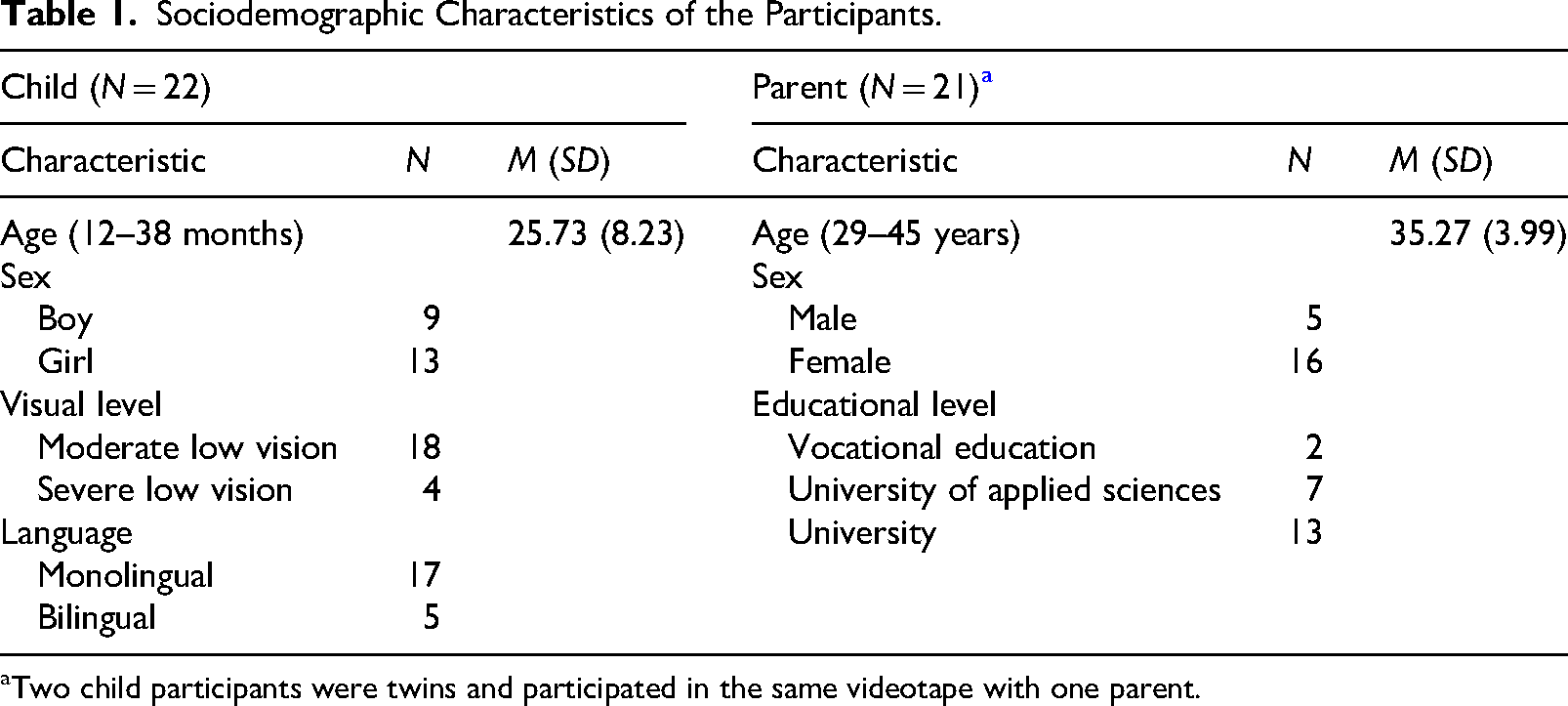
Two child participants were twins and participated in the same videotape with one parent.
Measures
Parenting Behavior
The English version of PICCOLO was used to measure parenting (Roggman et al., 2013a). The PICCOLO is user-friendly, allowing for quick observations (15 min) without the need for counting or timing behaviors (Roggman et al., 2013b; Vilaseca et al., 2020). It is an observational measure of parenting interactions, consisting of 29 items across four domains: affection (seven items), responsiveness (seven items), encouragement (seven items), and teaching (eight items). Examples of items are: “Smiles at child” (affection), “Looks at child when child talks or makes sounds” (responsiveness), “Offers suggestions to help child” (encouragement), and “Explains reasons for something to child” (teaching). The rating scale is similar to a behavior checklist, with scores assigned based on the frequency of observed behaviors, ranging from 0 (absent), 1 (barely), to 2 (clearly). For instance, regarding the second item on the affection scale “smiles at child,” a score of 0 indicates the complete absence of this behavior by the parent; a score of 1 reflects occasional performance without responding to many of the child's utterances; and a score of 2 denotes its consistent presence. Scores on all items per subscale were totaled to a sum score. The instrument demonstrates good reliability, established by Roggman et al. (2013a) and sufficient construct and predictive validity among parents of children with a disability (Innocenti et al., 2013). The internal consistency analysis for the PICCOLO subscales measured with Cronbach's α in the current study was: .60 for affection, .69 for responsiveness, .71 for encouragement, .74 for teaching, and .86 for the total PICCOLO score. These scores were consistent with findings from other studies (Rivero et al., 2023; Vilaseca et al., 2019). Previously the scales were used in children with intellectual disabilities (Vilaseca et al., 2019) and children with typical development (Rivero et al., 2023). To our knowledge, the present study represents the first time the PICCOLO has been used with children who have visual impairments. A content analysis by the authors showed that no additions to the scales had to be made for the population of people with visual impairments.
Developmental Outcomes
Children's developmental outcomes were assessed with the Reynell–Zinkin Developmental scales, which were specifically designed for children with visual impairments (Reynell, 1979). The Reynell–Zinkin scales offer a semistandardized approach and have norms for children who are blind or have low vision. For the current research, we used the revised Dutch edition of the Reynell–Zinkin scales, with reference scores for children who have low vision (Vervloed et al., 2000). The Reynell–Zinkin scales have been employed before in research investigating the developmental trajectories of children with visual impairments (Dale et al., 2018; Dale & Sonksen, 2002). The subscales cover various aspects of children's development, namely social adaptation; sensorimotor understanding; exploration of the environment; response to sound and verbal comprehension; vocalization and expressive language structure; and expressive language, vocabulary, and content. Examples of items are: “can put lids on large and small round box” (sensorimotor understanding) and “vocalizing as if he were talking” (vocalization and expressive language structure). Each scale indicates which items a child has mastered. These raw scores on the Reynell–Zinkin scales were converted to age-equivalent levels based on reference values from the revised Dutch edition of the Reynell–Zinkin scales (Vervloed et al., 2000), representing the developmental age on that specific scale for the child. Because children were of different ages when the measurements were taken, developmental quotients were calculated to correct for differences in age at the same measurement point. Developmental quotients were calculated as described by Dale et al. (2018), by dividing the raw age equivalent levels by chronological age and multiplying the result by 100.
Data Analysis
To study the relation between observed parenting behavior and child development, data analyses were conducted in several steps. After descriptive analyses, correlations between the PICCOLO domains and the Reynell–Zinkin scales were examined by using Spearman's correlation coefficients. To exclude possible confounding effects of demographic variables that were not of primary interest in this study, the effect of the sex of the parent on the visually impaired child's developmental outcomes and the presence or absence of bilingualism in the family were checked with Mann–Whitney U tests. Finally, a series of linear mixed-effect models were fitted to examine the relationship between parenting and the developmental outcomes on all scales of the Reynell–Zinkin scales. These models were used to understand how different aspects of parenting uniquely and interactively contributed to developmental outcomes, beyond simple correlations. The models included a random intercept for each dyad to account for nested data (i.e., each child and parent form a fixed pair). IBM SPSS statistical software (version 27.0 for Windows) and RStudio (version 4.3.1 for Windows) were used for the statistical analyses.
Results
Descriptives
Descriptive statistics for the parenting behaviors on the PICCOLO domains and child development using the Reynell–Zinkin scales are presented in Table 2. All developmental quotients observed on the Reynell–Zinkin scales exceeded a mean score of 100 for their age, suggesting notably elevated levels of developmental outcomes.
Descriptives for Parenting Behavior on PICCOLO Domains and Children's Developmental Quotients on RZS (N = 22).
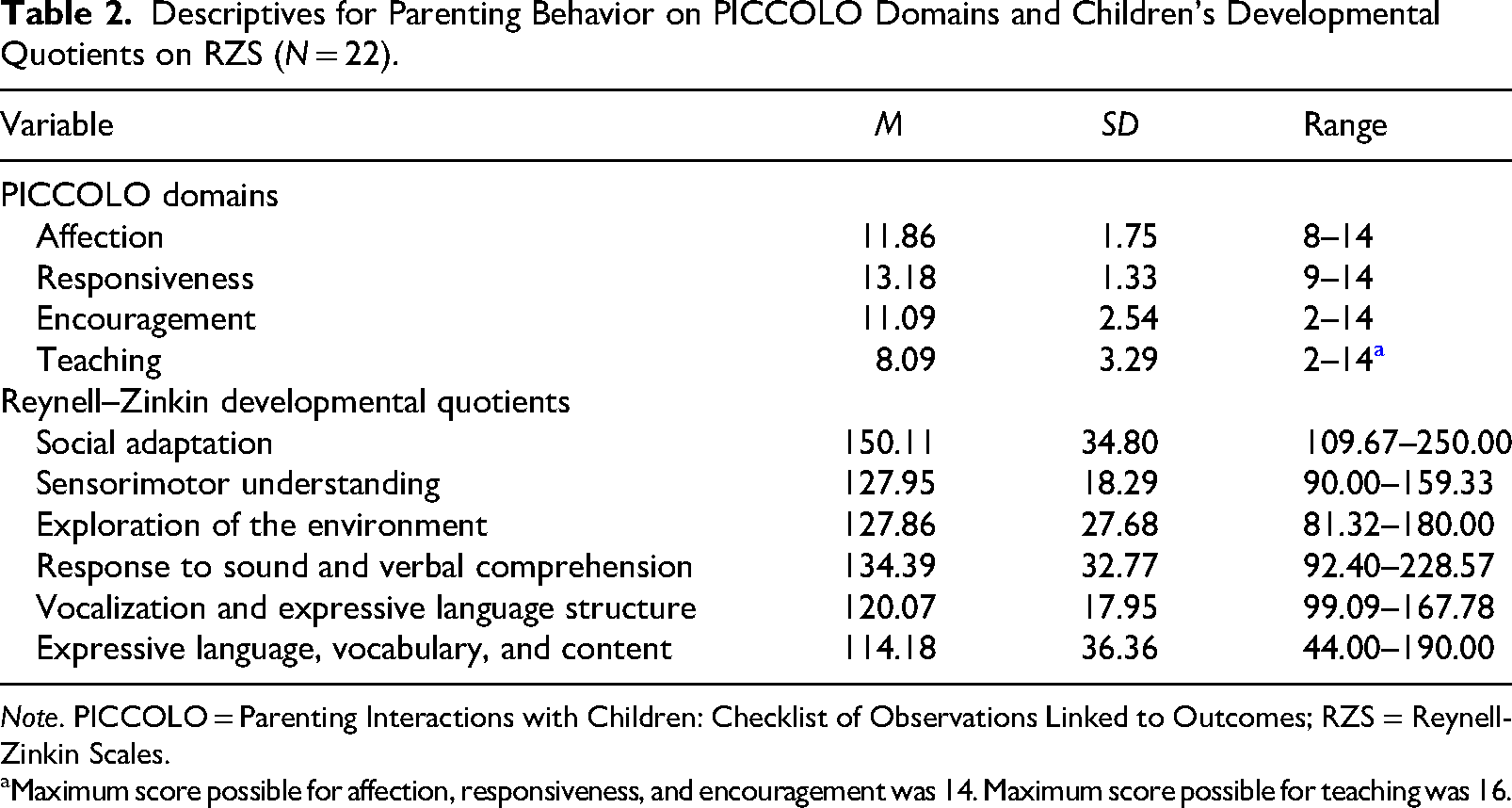
Note. PICCOLO = Parenting Interactions with Children: Checklist of Observations Linked to Outcomes; RZS = Reynell-Zinkin Scales.
Maximum score possible for affection, responsiveness, and encouragement was 14. Maximum score possible for teaching was 16.
Correlations Parenting Behavior and Developmental Outcomes of Toddlers Visual Impairments
The relationship between PICCOLO domain parenting scores and Reynell–Zinkin Developmental scales toddler outcomes was assessed using Spearman's correlation coefficients. Significant correlations were found between the PICCOLO domain teaching and social adaptation (r = −.44, p < .05) and responsiveness and expressive language, vocabulary, and content (r = −.51, p < .05). No significant correlations were found between other PICCOLO domains and Reynell–Zinkin scales (see Table 3).
Spearman's Correlations Between Parenting Behavior on PICCOLO Domains and Children's DQ on RZS (N = 22).
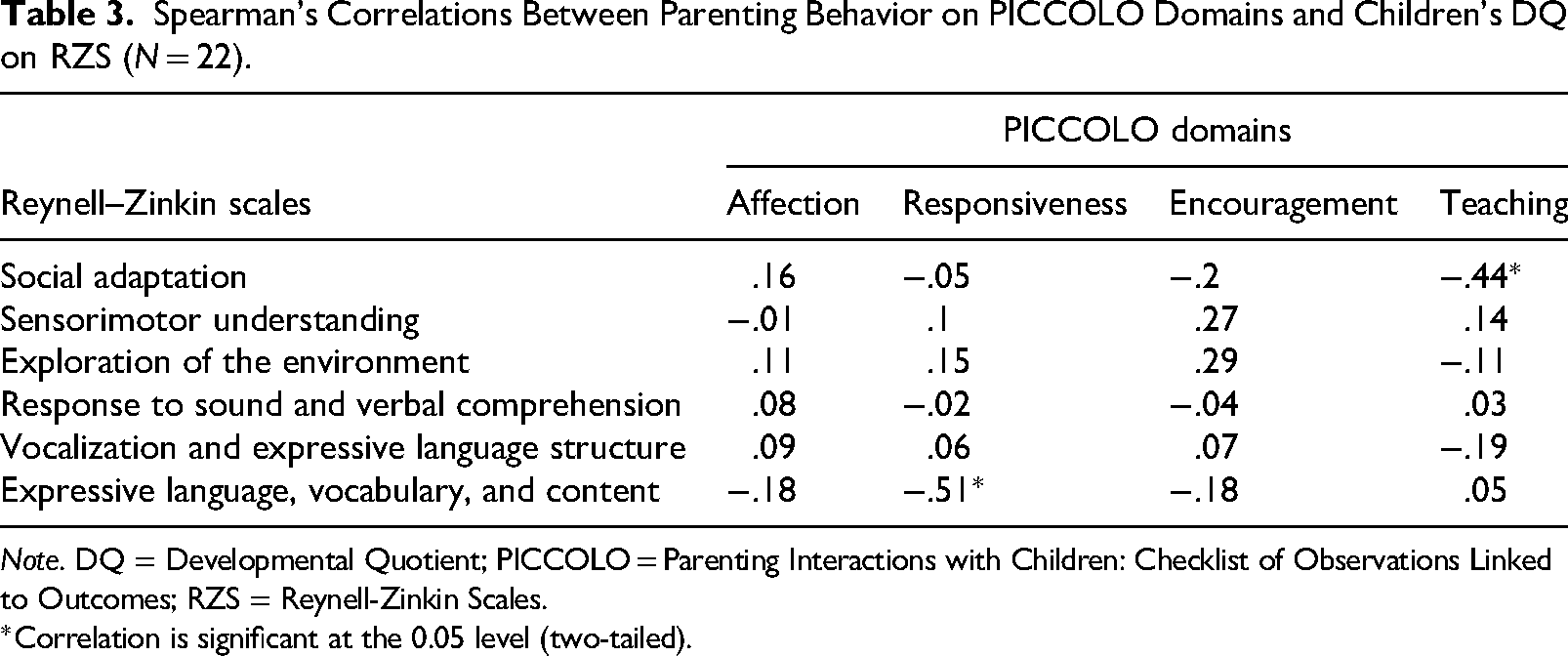
Note. DQ = Developmental Quotient; PICCOLO = Parenting Interactions with Children: Checklist of Observations Linked to Outcomes; RZS = Reynell-Zinkin Scales.
*Correlation is significant at the 0.05 level (two-tailed).
Control Variables: Sex of the Parent, Sex of the Child, and Bilingualism
Mann–Whitney U tests were performed to check whether the scores on the PICCOLO domains differed for fathers and mothers and to check whether the scores on the Reynell–Zinkin scales differed for males and females. In both cases, the results showed no sex differences. Subsequently, a Mann–Whitney U test was also performed to check whether the scores on the Reynell–Zinkin scales differed for monolingual and bilingual children. The results indicated significant lower scores for bilingual children on the scales social adaptation (U = 15.00, p = .03) and response to sound and verbal comprehension (U = 15.00, p = .03), compared to monolingual children. Therefore, we added bilingualism in the subsequent linear mixed-effect model.
Linear Mixed-Effect Models Developmental Outcomes
Given that we found some effects of bilingualism and significant correlations with responsiveness and teaching, these three predictors were included as fixed effects. Teaching and responsiveness were centered to reduce multicollinearity and facilitate the interpretation of interaction effects in the models. After standardizing, we also calculated effect sizes and associated confidence intervals. The results are shown in Table 4. The model fit was compared with simpler models using the Bayesian information criterion, see Table 5.
Fixed Effects Estimates for the Linear Mixed-Effects Model and Effect Sizes for Predicting Developmental Outcomes.
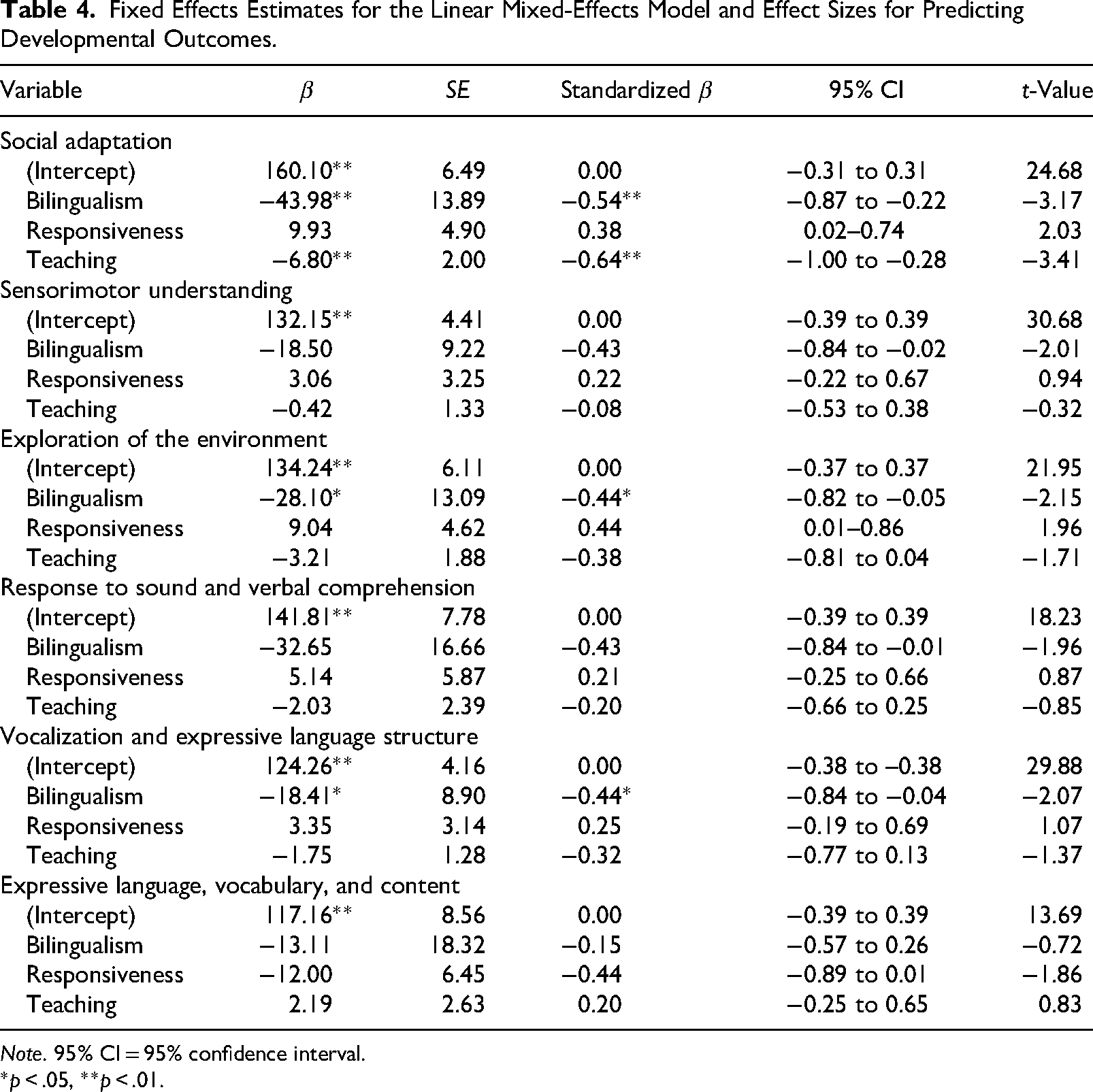
Note. 95% CI = 95% confidence interval.
*p < .05, **p < .01.
Model Comparison Between Random Intercept Only and Models Including Fixed Effects.
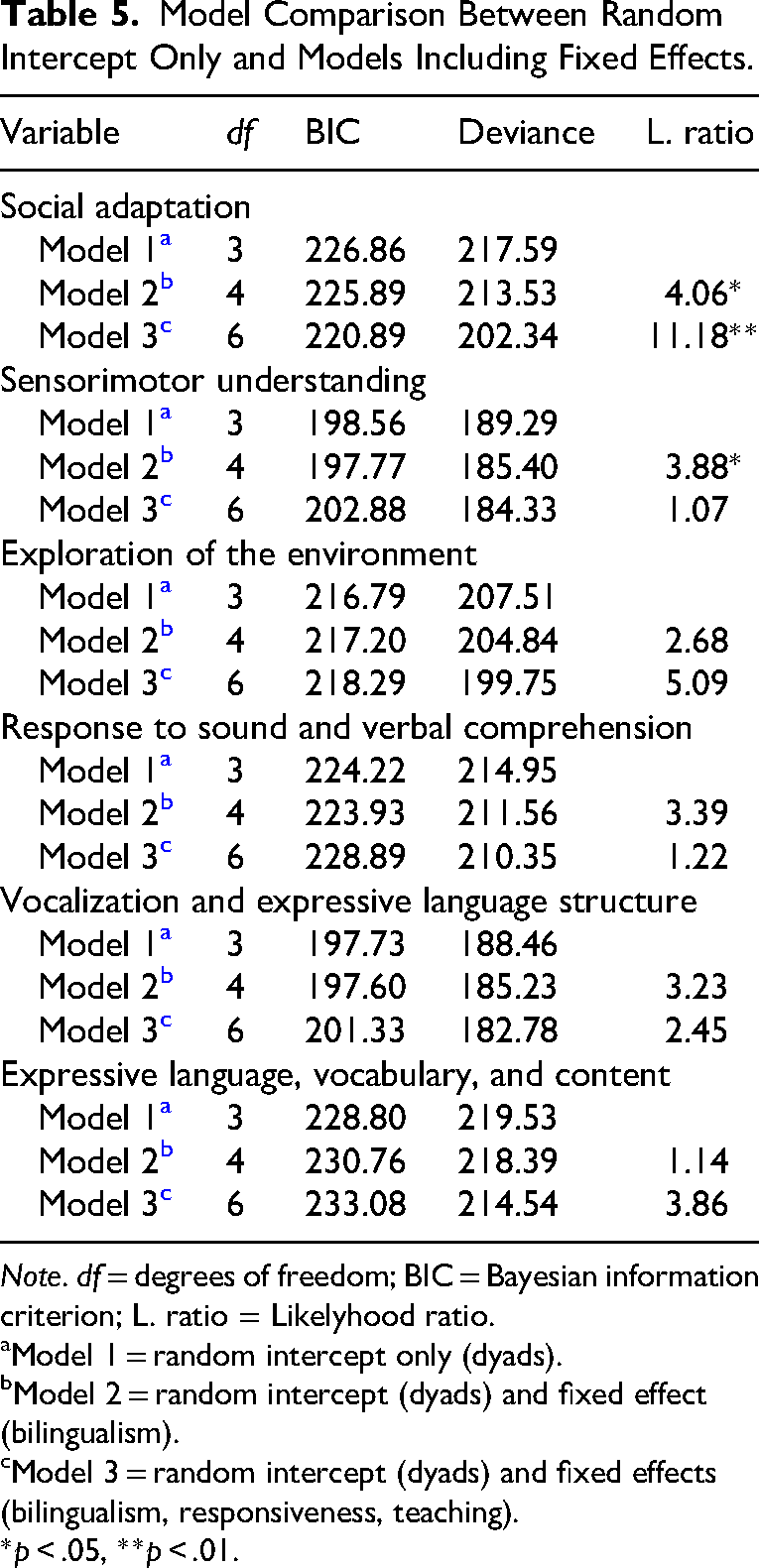
Note. df = degrees of freedom; BIC = Bayesian information criterion; L. ratio = Likelyhood ratio.
Model 1 = random intercept only (dyads).
Model 2 = random intercept (dyads) and fixed effect (bilingualism).
Model 3 = random intercept (dyads) and fixed effects (bilingualism, responsiveness, teaching).
*p < .05, **p < .01.
The linear mixed-effects model showed the best significant fit with the model including the fixed effects of bilingualism, responsiveness, and teaching for social adaptation: χ2(1) = 11.17, p < .01. Bilingualism—β = −43.98, SE = 13.89, t(18) = −3.17, p < .01—and teaching—β = −6.80, SE = 2.00, t(18) = −3.41, p < .01—were significant predictors for social adaptation. Although including the fixed effect for bilingualism showed a significantly better fit compared to the model with only a random intercept for the dyad—χ2(1) = 4.07, p < .01—none of the parenting variables were significant predictors for sensorimotor understanding. Furthermore, bilingualism was a significant predictor for exploration of the environment—β = −28.10, SE = 13.09, t(18) = −2.15, p < .05—and vocalization and expressive language structure—β = −18.41, SE = 8.90, t(18) = −2.07, p = .05. However, for both domains the overall models were not significant, indicating that the combination of bilingualism, responsiveness, and teaching did not improve the model fit. For response to sound and verbal comprehension and expressive language, vocabulary, and content, no overall models were significant.
Discussion
This study was a first examination into the association between observed parenting behavior of fathers and mothers and developmental outcomes on language, cognition, social adaptation, and exploration of their toddlers with visual impairments without evident multiple disabilities in cognition, sensory perception, and motor development. Twenty-two toddler–parent dyads participated in 15 min videotaped play sessions using their own toys. These sessions were scored using the PICCOLO to assess the parenting behaviors: affection, responsiveness, encouragement, and teaching. Child development in language, cognition, social adaptation, and exploration was evaluated by using the Reynell–Zinkin scales, which was administered in a playful manner.
To address the research question, Spearman's correlation analyses were first employed to examine the associations between parenting behavior and developmental outcomes. Two negative correlations were identified: between responsiveness and expressive language, vocabulary, and content and between teaching and social adaptation. These findings contrast with other studies that have found positive relations between positive parenting behaviors and cognitive and language development in children with intellectual disabilities (Dyches et al., 2012). A closer examination of the Reynell–Zinkin scales showed that younger children had higher developmental quotients compared to older children, possibly due to a ceiling effect among the latter. This discovery suggests that parents of older children might exhibit more teaching and responsive behavior than parents of younger children. To determine whether these ceiling effects explain the negative associations, the norms of the Reynell–Zinkin scales need updating (Rose et al., 2022). This issue also influenced the subsequent linear mixed-effect models, where responsiveness and teaching were included as fixed effects, along with bilingualism as a control variable. A significant model was found only for social adaptation, indicating that bilingualism, responsiveness, and teaching explained some variance. However, these results should be interpreted with caution. No significant models were found for the other developmental domains, suggesting that parenting behaviors did not account for variance in those domains.
The association between parenting behavior and developmental outcomes in children with visual impairments differs from previous research involving other groups of children. This discrepancy may be attributed to characteristics of the current sample. First, all parents had relatively high scores on parenting compared to other groups (Roggman et al., 2013b), with minimal variability, particularly in affection and responsiveness. High levels of affection and responsiveness were consistent among parents, regardless of their children's developmental status. Although there was more variance in encouragement and teaching, these behaviors still contributed minimally to the developmental outcomes. This finding is consistent with previous research on children with visual impairments (Vacaru et al., 2022). The lack of variability may be associated with the parents’ high educational levels (Magnuson et al., 2009), which were considerably lower in the study of Roggman et al. (2013b).
In addition, the pattern of parenting behavior may be influenced by the high-quality care and early intervention available for children with visual impairments in the Netherlands (Platje et al., 2018). Specifically, all participating toddlers received care and early intervention from one of the two Dutch national organizations that support individuals with visual impairments. These early intervention services emphasize parental involvement and strategies to enhance their behaviors, as demonstrated by Dutch programs such as Video-feedback Intervention to promote Positive Parenting in parents of children with Visual or Visual-and-intellectual disabilities (Platje et al., 2018) and the Barti-mat (Dyzel et al., 2021). We expect that in countries with less support for families of children with visual impairments, parents might exhibit greater variation in parenting behaviors (Platje et al., 2018).
The differential susceptibility hypothesis suggests that, although effective parenting is crucial for all children, those with more severe disabilities may derive even greater benefits from it (Innocenti et al., 2013; Stoltz et al., 2017). For instance, Vilaseca et al. (2019) identified more significant predictors for development in their study. However, they focused on children with intellectual disabilities, a group that may encounter more developmental challenges than children with a singular visual impairment (Vervloed et al., 2019). The children with visual impairments in the present study exhibited less severe disabilities and achieved relatively high developmental levels, with some showing ceiling effects. Consequently, the effect of parenting behaviors may be less pronounced.
The sample had some notable characteristics. Specifically, our sample included a considerable amount of fathers, which is uncommon in most research, and there were bilingual children in the sample. Although bilingualism is common in many countries, it is often disregarded by excluding bilingual families from studies. Consequently, we included parental sex and the number of languages spoken at home as control variables in the analyses. The latter variable notably affected the results.
We found that bilingual children scored lower on social adaptation and response to sound and verbal comprehension. In the subsequent linear mixed-effect models, bilingualism was included as a fixed effect, alongside responsiveness and teaching. Bilingualism had a significant contribution in the full model for social adaptation. Additionally, including bilingualism improved the model fit for sensorimotor understanding compared to the model with only the random intercept. Moreover, bilingualism was a significant negative predictor for exploration of the environment and expressive language structure, indicating that bilingual children had lower scores than monolingual children.
Given that many children are raised bilingually (Schmeets & Cornips, 2021), we included bilingualism as a control variable. Our analysis revealed that bilingualism had a greater effect on the variance in developmental outcomes than parenting behavior did. This difference can be explained by the fact that, in general, young bilingual children often experience developmental delays in cognitive and language development compared to monolingual children; although these delays typically diminish with age (Cobb-Clark et al., 2021). Besides, the Reynell–Zinkin scales are highly linguistic (Reynell, 1979), meaning that the language skills of the toddlers were heavily assessed through the use of this instrument. Although this finding was unexpected, it appears that bilingualism is an important factor to consider in the development of children with visual impairments.
Suggestions for Future Directions
The current study has both unique aspects and limitations highlighting the necessity for additional research. Primarily, the population of children with visual impairments in the Netherlands is small, which had certain methodological implications for our sample. We conducted linear mixed-effect models due to their robustness (Bolker et al., 2009) and their suitability for our nested structure of parent–child dyads (Garson, 2013a). Furthermore, linear mixed-effect models allowed us to account for individual differences, given the heterogeneity in the population of people with visual impairments, despite the limited sample size. However, the small size limits the generalizability of the findings and statistical power. The effect sizes observed in the current study were comparable with previous research utilizing PICCOLO (Rivero et al., 2021, 2023; Vilaseca et al., 2019, 2020), suggesting that this study serves as a valuable initial exploration and a significant foundation for further research. However, the confidence intervals around these effect sizes indicate a degree of uncertainty, since the parenting variables include both negative and positive values. This finding implies that, although the observed effects are consistent with prior findings, the true magnitude and direction of the relationships are not yet fully clear. Larger samples are required to corroborate the findings and ensure greater robustness (Bolker et al., 2009; Garson, 2013b). In addition to statistical improvements, it is also valuable to observe the results in light of the population's heterogeneity (Heppe et al., 2024). Specifically, the wide confidence intervals may reflect the individual differences within population (Ravenscroft, 2019; Warren, 1994).
Further, our study included a significant proportion of father–child dyads (37.5%), while previous research often focused on mother–child dyads (Dale et al., 2018; Roggman et al., 2013b; Sakkalou et al., 2021) or included a small number of fathers (Platje et al., 2018). As contemporary caregiving responsibilities become more balanced between parents, it is crucial to acknowledge the positive contributions of both parents (Rivero et al., 2023; Vilaseca et al., 2020). However, the present study evaluated parenting behavior only by one parent, leaving the effect of the nonparticipating parent unexamined. Examining parenting of both parents can provide a more nuanced understanding of the role of parenting, especially considering that all toddlers in the study were part of two-parent families.
Knowledge about the development of children with visual impairments is often based on children who are blind, while the majority of children with visual impairments have low vision (Boonstra et al., 2012). The current study was specifically aimed at children with low vision, since the distinction between blindness and low vision is critical. Children with blindness often face more developmental challenges and risks than children with low vision (Vervloed et al., 2019). A notable proportion of the toddlers in our study had moderate low vision, which may facilitate better interactions with parents compared to children with severe low vision or blindness (Sakkalou et al., 2021). However, due to uneven sample distribution, we were unable to assess whether the degree of vision affected parenting or developmental outcomes. Despite this limitation, our study supports the rationale that focusing on individual differences of children with visual impairments, rather than comparing them to typically developing children, provides more valuable insights for early intervention (Ravenscroft, 2019; Warren, 1994).
It should be noted, however, that the availability of developmental tests for toddlers with visual impairments is still limited. The choice to use the Reynell–Zinkin scales (Reynell, 1978) in the present study was based on its use in other research on young children with visual impairments (Cass et al., 1994; Dale et al., 2018; Sakkalou et al., 2021) and the availability of a Dutch version (Vervloed et al., 2000). Nonetheless, the instrument has limitations, including large age ranges for calculating norms for the Dutch version compared to the English version, which reduces accuracy (Vervloed et al., 2000). Additionally, the Dutch Reynell–Zinkin scales show varying levels of reliability for the distinctive age groups for which norms have been established. Re-standardization of the instrument is desirable (Rose et al., 2022) to precisely assess the development of young children with visual impairments in further research. The current standards of the Reynell–Zinkin scales may also have contributed to lower developmental quotients in older children, even when their development may have been appropriate. This possible misestimation of developmental outcomes could have influenced the lack of significant findings.
Practical Implications
The relatively small number of significant findings found between parenting behavior and the developmental outcomes of toddlers with visual impairments in this study is noteworthy. However, it is important to acknowledge that the study revealed relatively high developmental scores among the toddlers with visual impairments, alongside elevated scores on PICCOLO domains by their parents. Framed positively, this finding suggests that the care and early intervention provided in the Netherlands are producing positive outcomes (Platje et al., 2018). Therefore, we recommend that the current standards of care for children with visual impairments be maintained and continued, while further elaborating on best practices to enhance these efforts.
Regarding specific parenting behaviors, more attention could be given to encouraging and teaching behaviors in early intervention programs. Although most interventions focus on affective, responsive, and sensitive parenting (e.g., Platje et al., 2018), teaching and encouragement showed the most variation in the current study. These particular behaviors can be crucial in supporting the development of children with visual impairments (Dale et al., 2022b).
Although only a few associations between parenting (encouragement and teaching) and developmental outcomes were found in this study, it still has the potential to enhance support for children with visual impairments. Unlike a child's visual impairment, parenting behavior is modifiable (Choi & Van Riper, 2013), which implies that parents could adapt their behaviors to directly or indirectly foster their child's development. Moreover, focusing on parenting behaviors may contribute to the well-being of parents of children who are blind or have low vision, since raising children with visual impairments can be stressful (Tröster, 2001). Implementing effective parenting behaviors that stimulate the development of children can help alleviate this strain (van den Broek et al., 2017).
Footnotes
Acknowledgments
This research was conducted in collaboration with Royal Visio and Bartiméus. The authors wish to thank the research assistants for assisting with the data collection and the participants for their time and effort.
Declaration of Conflicting Interests
The author(s) declared no potential conflicts of interest with respect to the research, authorship, and/or publication of this article.
Funding
The author(s) disclosed receipt of the following financial support for the research, authorship, and/or publication of this article: This work was supported by Stichting ter Verbetering van het Lot der Blinden [Foundation for the Improvement of the Lot of the Blind].
