




Abstract

Keywords
Over the years, numerous intervention programs have been designed and published to help service providers of children and adults with auditory and visual impairments with or without additional disabilities. At the Department of Pedagogical and Educational Science, Behavioural Science Institute, Radboud University, we have been collecting these programs for our courses in special education and rehabilitation. It is not mandatory for service providers in the Netherlands to use a formal program or a written individualized education program, as it is in the United States. However, university teachers advocate the use of methodologically sound, reliable, and empirically tested programs in intervention services for children and adults with sensory and multiple impairments. For this reason, bachelor students at the Department of Pedagogical and Educational Science, Behavioural Science Institute, Radboud University, review intervention programs as part of their training in order to become a scientist practitioner. Our policy is that an academically trained behavioral scientist should be able to value the content and use of intervention programs, whether they are best practices or empirically supported treatments.
After conducting this assignment in our courses for over 15 years, we noticed that clinical colleagues servicing families with children with disabilities were mostly unfamiliar with the intervention programs our students reviewed. As we noticed, by looking for these programs ourselves, it took considerable time, effort, and money to collect the programs covered in the Database Intervention Programs for People with Sensory Impairments (DIPPSI). Well-known publishing companies have published several intervention programs, which makes ordering and buying them easy. Other programs are privately published by schools, universities, hospitals, interest groups, and governmental and non-governmental organizations. These informal publishers do not always advertise their products actively, at least not to an international audience. Moreover, library databases such as PsychINFO, Web of Science, PubMed, or ERIC do not index these products. To assist professional service providers working with people with sensory disabilities the student assignments were transformed into an online database in an easy-to-access format, so that anyone interested in these groups can access them freely.
Before including programs in DIPPSI, two requirements were checked during the reviewing process. First, intervention programs needed to be designed to advance the overall development of children with sensory disabilities or specific aspects of their development. Instructions for the treatment of pathologies were not a requirement. The second requirement was that the program should be publicly available in print or online format.
Four disclaimers should be made about DIPPSI. Firstly, our intention was never to write systematic reviews about intervention programs. DIPPSI is a first start to disclose available knowledge and expertise to service providers. We hope that, with increased awareness of the database, others will contribute to it by suggesting intervention programs that could be included in the database. Secondly, empirically supported treatments that are not publicly available are not covered in DIPPSI. The readers interested in intervention programs for treating pathologies or improving mental health, either in the children or in their caretakers, are referred to the meta-analysis of Van de Aa et al. (2016), and for visual stimulation programs to reviews by Micheletti et al., (2022) and Vervloed et al. (2006). Excluded from the database were experimental studies whose results were published in scientific literature, but no printed copy of the program itself is publicly available. An overview of these experimental studies can be found in Elsman et al. (2019). Thirdly, the final collection of programs in the database, varying from best practice to empirically supported treatment, is merely a convenience sample of programs gathered after 15 years of teaching courses on children with disabilities. Lastly, ordering the program from the website is not possible; the authors do not have any commercial interest in the interventions covered in the database.
The format for DIPPSI became an online database with simple search options. The original database was designed by students in computer science at Avans University of Applied Science, and it was later finished by a professional programmer. The latter programming work was made possible by a grant from a foundation that supports projects concerning people with visual impairment, Stichting ter verbetering van het lot der blinden [Foundation for the Enhancement of the Fate of the Blind]. For German-speaking countries there is a comparable initiative, the ISAR-project (https://www.isar-projekt.de/neuigkeiten.html). Here one can find literature, materials, and didactic techniques. Most of the sources are in German and intervention programs are just a small part of the ISAR-project.
How to use DIPPSI
Figure 1 shows a screenshot of DIPPSI's homepage. It is possible to look for a distinct intervention program by typing words from the title or the name of an author in the search field. On the left side, it is possible to select intervention programs by age of the child, developmental domain, kind of impairment, publication language, where the intervention must be performed (e.g., at home, school, or residential facility), who will perform the intervention (e.g., parents, teachers, early interventionists, etc.), and what kind of program one is looking for (assessment, method, training, intervention, sourcebook, or self-help book). After clicking on a program, an overview page is shown, see Figure 2 for a partial example. These search findings can be easily converted into a PDF document and saved or printed. Bibliographical information about the programs is available as much as possible. The tab “programs” at the top of the website's homepage makes it possible to suggest a program for incorporation in DIPPSI. Remarks about the content and any errors or omissions can be sent via this tab as well, but also by sending an email to the address mentioned under the “about us” tab.
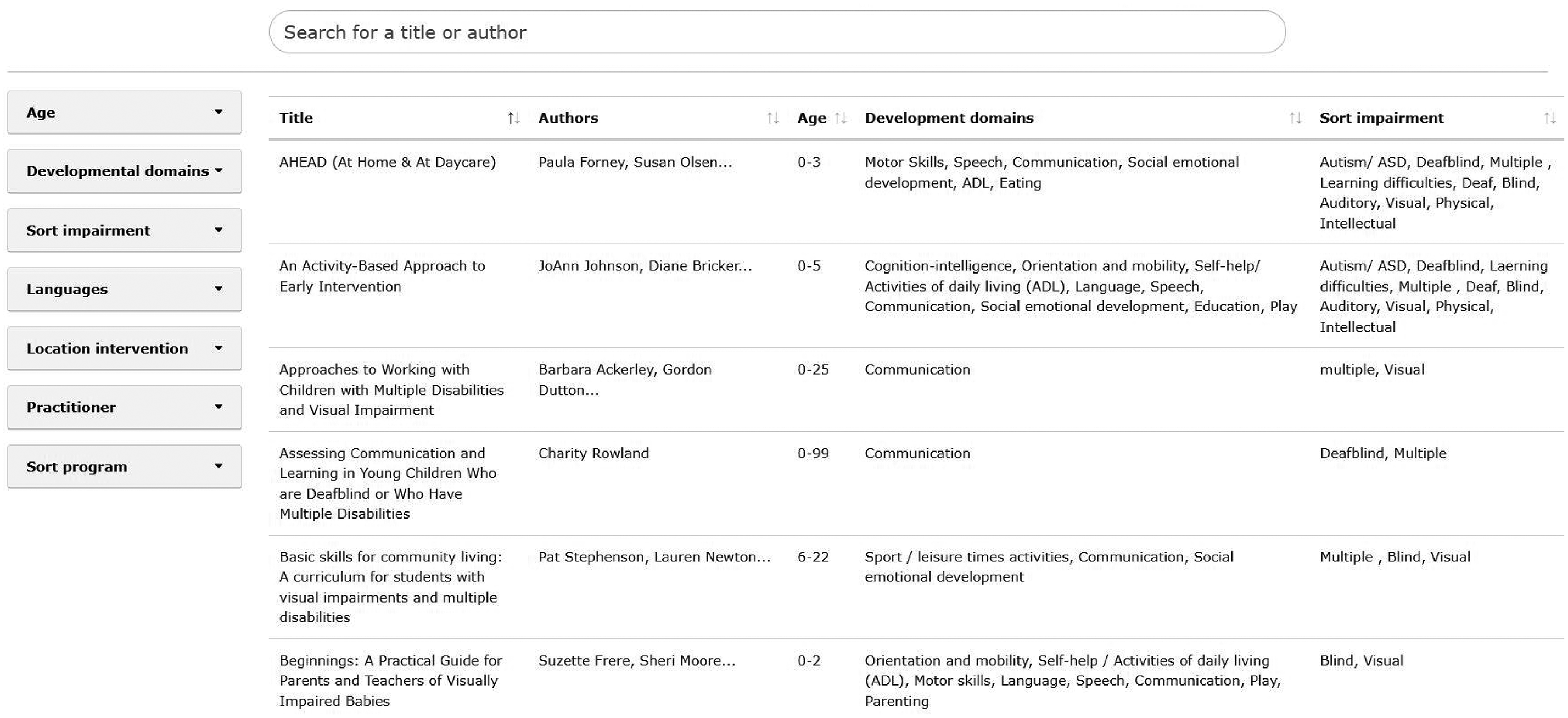
Screenshot of the Homepage for the Database Intervention Programs for People With Sensory Impairments (DIPPSI) Initiative.
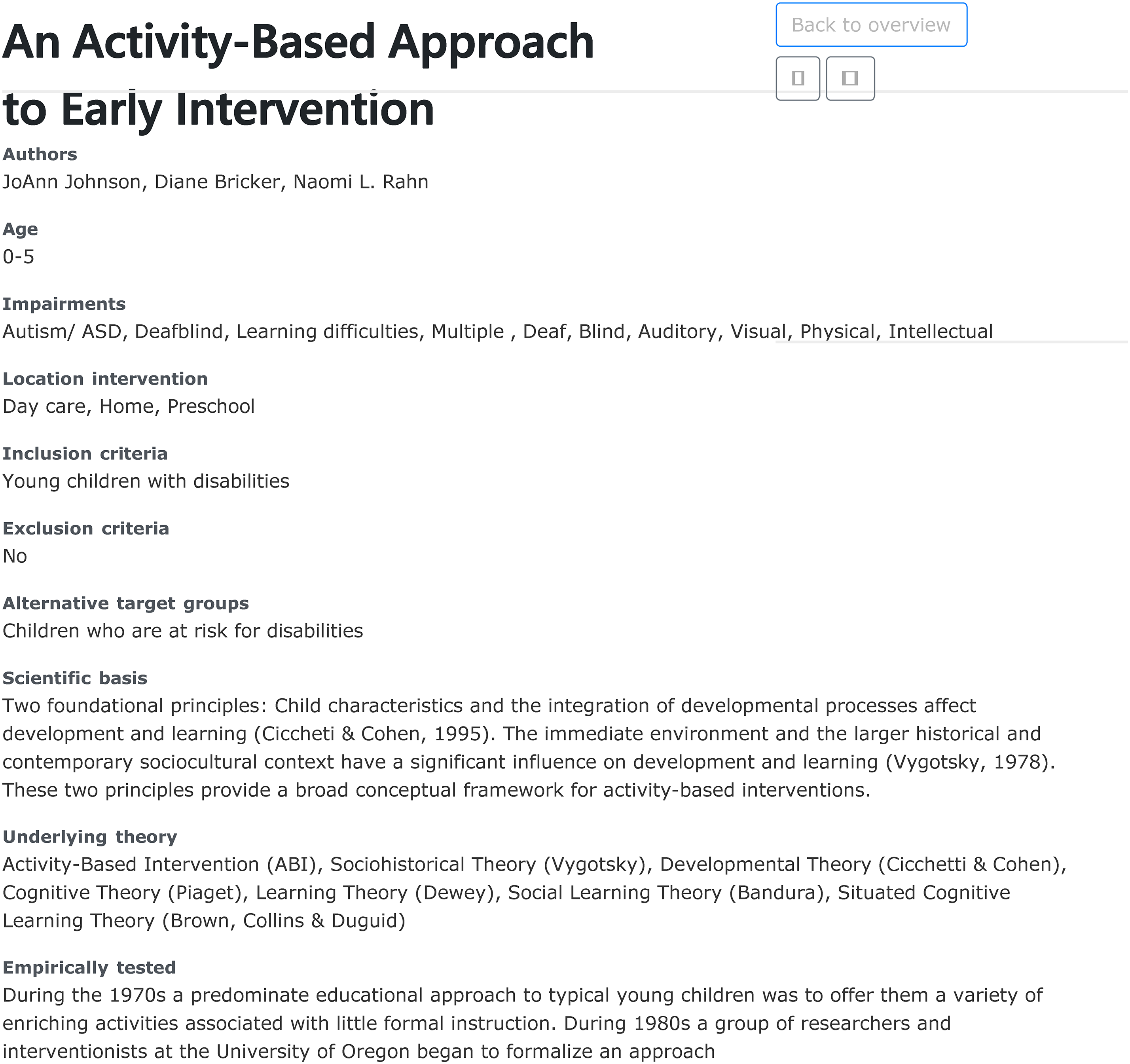
A Screenshot Example of an Overview Page or Search Result in Database Intervention Programs for People with Sensory Impairments (DIPPSI).
About Programs in DIPPSI
This section will present a short impression of the intervention programs in DIPPSI. Of the 89 programs, 81 are in English, of which five are also published in Spanish. DIPPSI also covers five programs published in German, three in Dutch, and one in French and Danish. Although the publication language is determined by the languages the authors can read, the abundance of programs in English is also caused by the American custom and tradition to develop and publish intervention programs. In Figure 3, the publication years are depicted. Maybe not so surprisingly, most programs were published in the 1990s. In this time period, rehabilitation practices for people with disabilities were dominated by the “development paradigm” (Van Gennep, 2017), the idea that people with disabilities had to be taught various skills to be able to live independently in society.
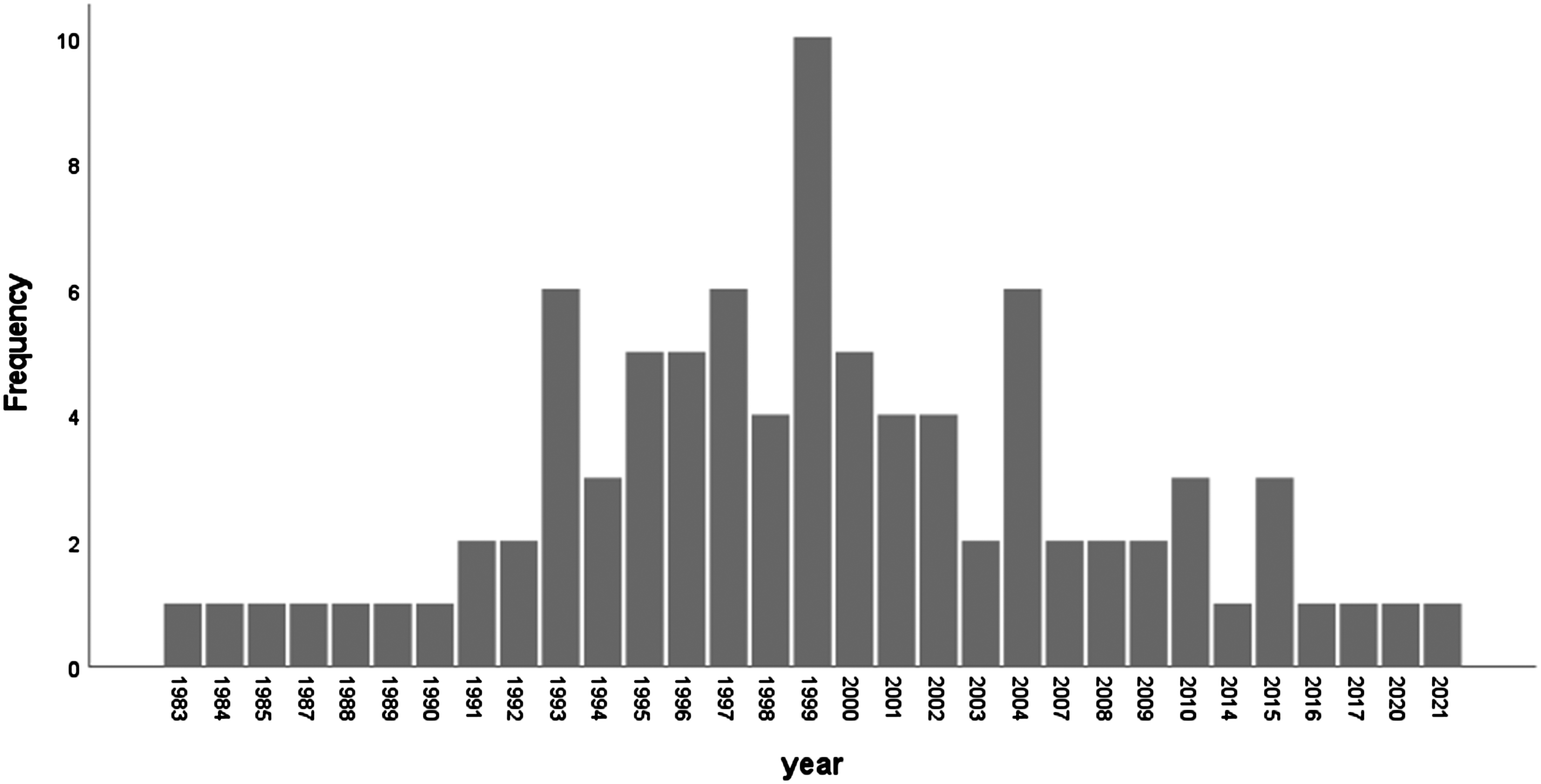
Year of Publication of Interventions.
Table 1 shows the disability type for which the programs were designed, as well as the location of execution of the intervention programs. Note that an intervention can be designed to be performed at several locations, and with different disability groups. All of the programs in DIPPSI involve at least one group with sensory disabilities, since intervention programs for children and adults with low vision, blindness, deafness, and deafblindness were at the start of the development of DIPPSI.
Clinical Groups and Treatment Location.
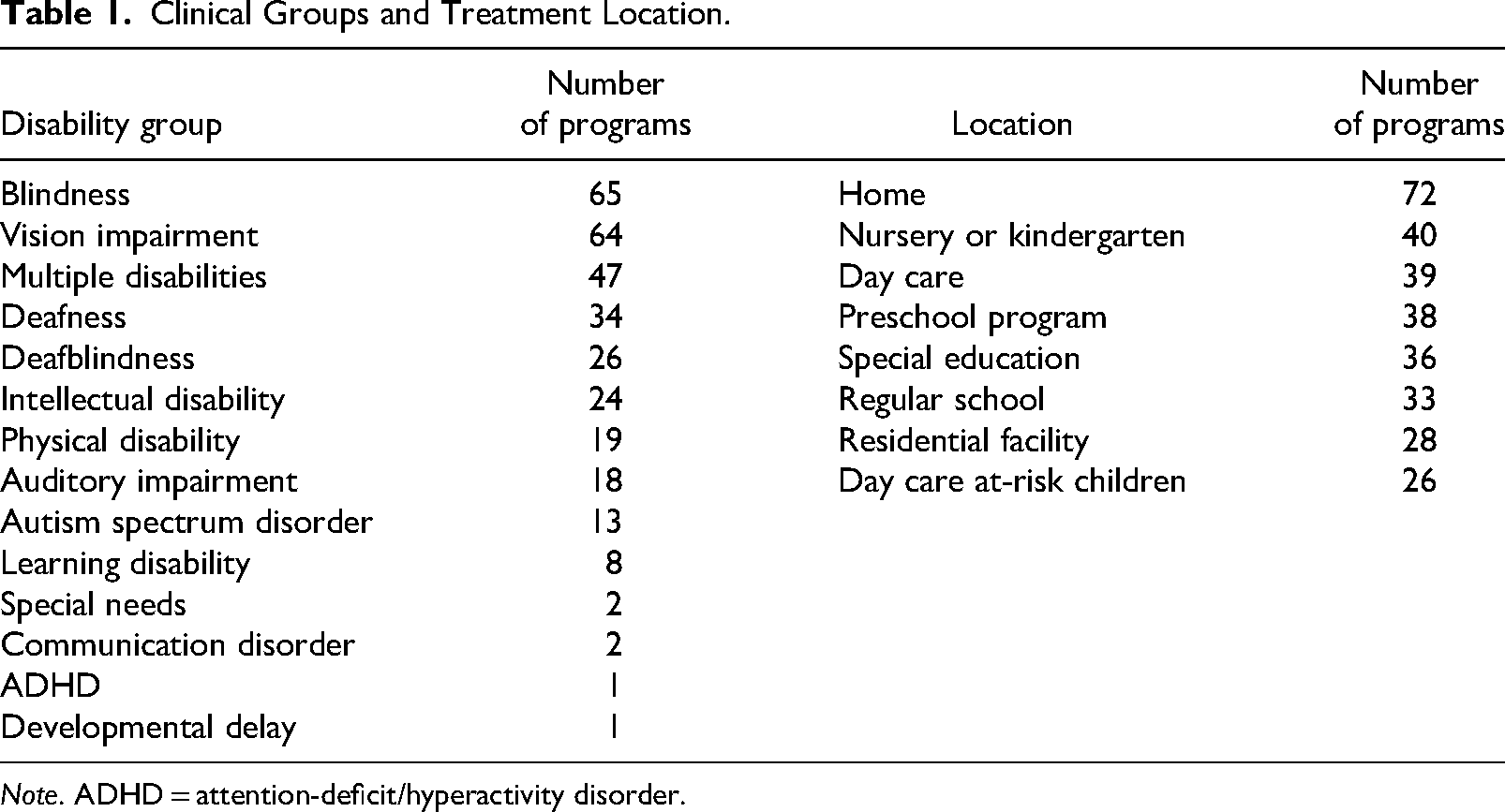
Note. ADHD = attention-deficit/hyperactivity disorder.
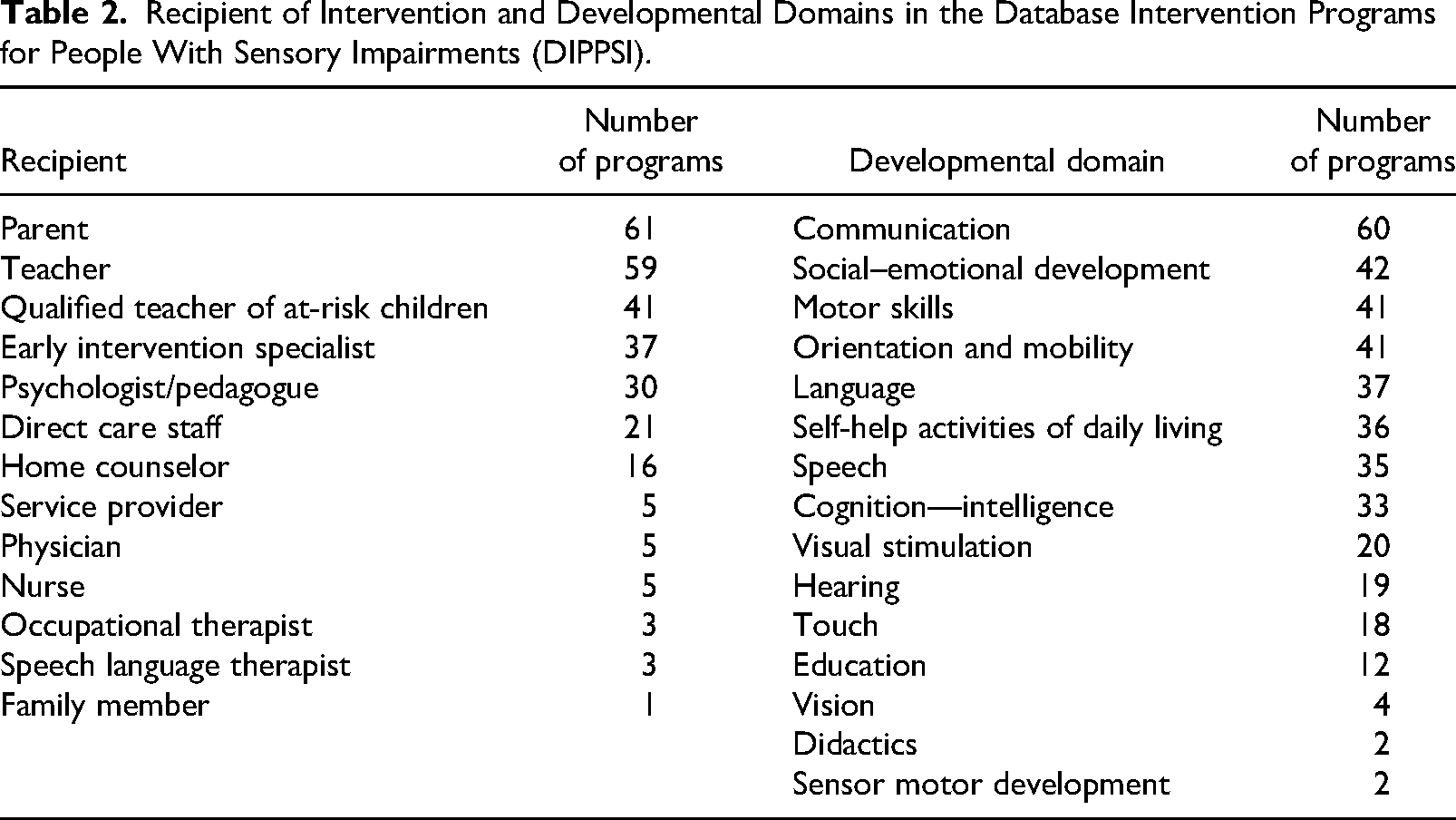
Table 2 shows the main recipients of the intervention and the developmental domains covered in the programs. By far, the most intended recipients are parents and teachers (both teachers in mainstream education, as well as in inclusive or special education settings). Regarding developmental domains, communication, language, and speech are among the most described topics in the intervention programs. Intervention programs at the level of the senses are covered less, most interventions aim at changing behavior in the developmental domains described above and do not try to improve the functioning of touch, hearing, or vision.
Recipient of Intervention and Developmental Domains in the Database Intervention Programs for People With Sensory Impairments (DIPPSI).
As to the scientific value of the programs, most of the intervention programs are not empirically supported (n = 65), or it is unclear (n = 2) or unknown (n = 11) whether they are. The manuals of only 11 intervention programs provide information on outcomes, effectiveness, and reliability. According to the hierarchy of levels of evidence designed by Veerman and van Yperen (2007), most of the intervention programs are at the descriptive or theoretical level of evidence, none were at the indicative or causal level. At the descriptive level, “the essential elements of the intervention (goals, target group, methods, activities, and requirements) should all be made explicit” (Veerman & van Yperen, 2007, p. 215). The intervention is potentially effective. At the theoretical level, “the intervention now also has a plausible rationale (i.e., a program theory) to explain why it should work with whom” (Veerman & van Yperen, 2007, p. 216). The 11 interventions that provided empirical data are at the indicative level. They demonstrate that “the intervention clearly leads to the desired outcomes (e.g., goals are attained, problem behaviors decrease, competencies increase, or clients are satisfied)” (Veerman & van Yperen, 2007, p. 216). In these cases, one of the following methodologies mentioned by Veerman and Van Yperen (2007) was used: “Quasi-experimental studies, Theory of Change studies, Norm referenced approaches, Benchmark studies, Client satisfaction studies, Goal attainment studies, Monitoring studies, or Quality assurance studies” (p. 216). No intervention at the causal level was found, that is, proof that the intervention is efficacious. This type of level of evidence would require a randomized controlled trial or repeated case studies. Two of the better-studied intervention programs are Brambing's “Entwicklungsbeobachtung und Förderung blinder Klein- und Vorschulkinder” [Developmental assessment and stimulation of blind infants and toddlers] (Brambring, 2005, 2006, 2007a, 2007b; Tröster et al., 1994) and the “Developmental journal for babies and children with visual impairment” (Dale et al., 2019). These programs were systematically studied in quasi-experimental designs with empirical support for effectiveness.
By publishing DIPPSI, the international community of experts, consisting of teachers, early interventionists, counselors, researchers, clinicians, all other service providers, and parents and caregivers, are invited to provide their feedback on DIPPSI and to send in suggestions for missing programs, potential errors, and omissions. DIPPSI is meant to be the “wiki” for finding intervention programs for children and adults with sensory impairments. Most of all, we hope that DIPPSI is a useful asset to service providers’ toolbox of intervention services.
Footnotes
Acknowledgments
We thank all the bachelor students of Radboud University who have provided us with the data that formed the foundation of DIPPSI. We appreciate the work done by Loes de Leijer, Franka Witlox, and Sena Öz, Erasmus exchange student from Turkey, who double-checked the programs. The initial website was developed as part of a learning project by students from the Avans University of Applied Science, Department of Computer Science: Stef Bakker, Nick van Ballegooijen, Lennart Bronner, Jordy van Ekelen, Sam Fober, Rade Grbic, and Melvin Mol. Lastly, we thank Gideon Hoogeveen, software engineer, for finalizing and launching DIPPSI.org. We thank the Radboud University Library and the Foundation for the improvement of the fate of the blind, who, through their financial support, made it possible to acquire the intervention programs covered in DIPPSI.
Declaration of Conflicting Interests
The author(s) declared no potential conflicts of interest with respect to the research, authorship, and/or publication of this article. The authors of DIPPSI.org have no commercial interest in any of the programs covered in DIPPSI.
Funding
The author(s) disclosed receipt of the following financial support for the research, authorship, and/or publication of this article: This project was supported by a grant to Mathijs P. J. Vervloed by the Stichting tot verbetering van het lot der Blinden [Foundation for the improvement of the fate of the blind].
