




Abstract
Keywords
Being able to see provides individuals with the ability to visually perceive the size and features of their bodies and to read cues indicative of body shapes, proportions, and physical appearance (Azañón et al., 2018; Longo & Haggard, 2012; Pasqualotto & Proulx, 2012; Peelen & Downing, 2007). More specifically, body image denotes a person's internal body representation, encompassing their perception, knowledge, and evaluation of it, whereas an ideal body image relates to a desirable body template (e.g., the one presented in media or social circles). These two concepts are fundamentally different: one describes an actual perception of the body, whereas the latter portrays an imaginative template (Heider et al., 2015). To gain acceptance, people compare their looks to the societally enforced standards, reinforcing an ideal body model (Aparicio-Martinez et al., 2019; Grabe et al., 2008; Hoyt & Kogan, 2001; Phillips & de Man, 2010; Wolf, 1991).
The perception of an ideal body image might be endorsed differently by the visually impaired (i.e., those who are blind or have low vision) versus sighted individuals. Yet, being visually impaired does not preclude the development of an ideal body image, since mainstream ideals may bypass vision and affect a person through other sensory modalities (Kaplan-Myrth, 2000; Nava et al., 2021), such as tactile, proprioceptive, auditory information, and from comments made by family and friends (Pazzaglia & Zantedeschi, 2016). Similarly, a lack of visual input does not prevent individuals from being exposed to societal pressures.
A large proportion of influence originates from visual media (Birkeland et al., 2005; Fallon, 1990; Grogan & Richards, 2002; Lee & Lee, 2021; Mishkind et al., 1986; Nichter & Bordo, 1995; Wolf, 1991). Television, magazines, photography, and smartphone applications (apps) play a dominant role in how the “ideal body” is conveyed (Grabe et al., 2008; Lee & Lee, 2021). However, the degree to which visual depictions of ideals directly affect satisfaction and body esteem is not entirely clear. Previous research showed that congenitally blind women, who are unable to access visual images of body ideals, have higher body satisfaction than sighted women, implying that limited exposure to visual media may offer some protection from developing concerns around body image (Ashikali & Dittmar, 2012; Baker et al., 1998; Gebauer et al., 2019). Other findings suggest that women with congenital and adventitious blindness may be as prone to internalizing messages on sociocultural idealizations as sighted women (Page & Papps, 2018; Simeunovic Ostojic & Hansen, 2013), confirming that the negative effect of social comparison does not require visual input (Gaudio et al., 2014; Touyz et al., 1988) and may be enhanced through other psychosocial factors (Simeunovic Ostojic & Hansen, 2013). Hence, the notion that restricted access to visual beauty idealizations results in decreased internalization of unhealthy messages and consequently higher body satisfaction is undoubtedly in question.
Various representations of an ideal body may exist regardless of an individual's visual experience (Cicmil & Eli, 2014; Fernández-Aranda et al., 2006; Gaudio et al., 2014; Kocourkova et al., 2011; Nava et al., 2021; Touyz et al., 1988). However, what are the most prominent channels through which visually impaired individuals access potentially triggering messages? Studies investigating internalization and body esteem in men with visual impairments are lacking. There is no evidence on the extent to which previous visual experience suffices to shape a person's own body image in relation to idealized images (Nava et al., 2021). Further, there is a lack of evidence about whether previous visual experiences lead individuals to internalize idealized body images and promote low body esteem in women.
Women are thought to experience a greater desire than men to conform to beauty standards (Green & Pritchard, 2003; Grogan & Richards, 2002; Wolf, 1991). Studies describe body dissatisfaction among women as “normative,” contrasted with mixed findings in men (Betz et al., 1994; Grabe et al., 2008; Mishkind et al., 1986). The consensus is that women are more likely to be displeased with their bodies (Gebauer et al., 2019; Pinquart & Pfeiffer, 2012), since their looks are more frequently idealized and societal influences forge greater emphasis on their appearance (Bech-Sørensen & Pollet, 2016; Kenrick & Gutierres, 1980; Morgan, 1993; Scheller et al., 2021).
Most research points to the “thin ideal” as being the prominent trigger for the dissatisfaction women feel toward their bodies (Cusumano & Thompson, 1997; Homan, 2010; Knobloch-Westerwick, 2015; Lee & Lee, 2021; Presnell et al., 2004). More recently, women may also desire a more “muscular,” “toned,” and “athletic” physiques (Homan, 2010; Robinson et al., 2017; Tiggemann & Zaccardo, 2015). Additionally, the male body has become systematically more “visible” in media, leading to increased effects of muscularity-oriented body ideals on men's body satisfaction (Grogan & Richards, 2002; Karazsia & Crowther, 2009). Research demonstrates how sociocultural prejudices favor an athletic mesomorph body shape, and men who display this specific body type are generally described with more positive attributes such as strength, power, and happiness (Edwards & Launder, 2000; Grogan & Richards, 2002; Jacobi & Cash, 1994; Tovée et al., 1999). The attainment of these body ideals may negatively affect individuals’ mental health, triggering body-related conflicts, and eating disorders in both sexes (Cafri et al., 2005; Homan, 2010).
Women who are visually impaired also experience eating disorders (Simeunovic Ostojic & Hansen, 2013), displaying analogous significance of appearance, with the thin-ideal awareness and internalization in the expansion of eating disorders as their sighted counterparts (Fernández-Aranda et al., 2006; Simeunovic Ostojic & Hansen, 2013). Research has included reported triggers like premature exposure to a Barbie doll (Dittmar et al., 2006; Simeunovic Ostojic & Hansen, 2013) and auditory information about appearance stereotyping and discrimination (Lavin & Cash, 2001).
In this article, we explore the role of visual experience in shaping ideal body images, by researching how information gathered from the environment is internalized and affects body esteem. We recruited sighted women and men, as well as those with congenital and adventitious blindness, and assessed internalization and pressures to conform to body ideals that are popularized through mass media. We hypothesized that men place less emphasis on factors related to self-acceptance, internalization, and comparison of their body image, and that they display less concern on idealized body characteristics (Gebauer et al., 2019). Additionally, sighted individuals were expected to have lower body satisfaction as a result of increased contact to sociocultural pressures (mass media) compared to individuals with visual impairments.
Method
Participants
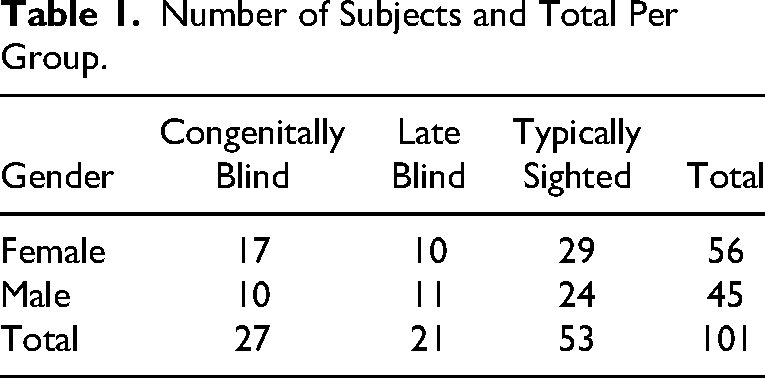
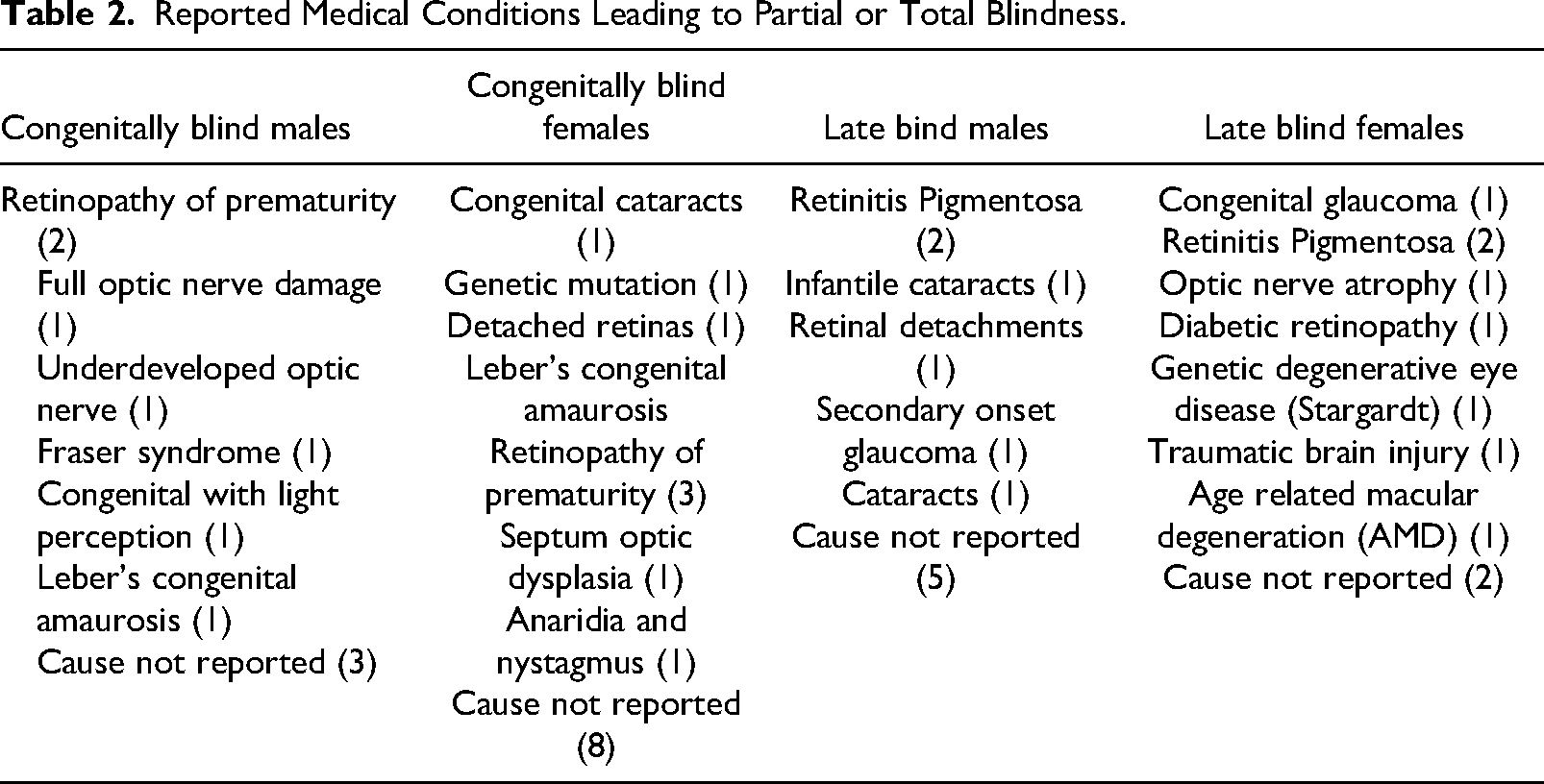
A total of 56 sighted and visually impaired women and 45 sighted and visually impaired men participated in this study (mean age 34.15 + 1.40 years; see Table 1). Participants with congenital and adventitious blindness were recruited from online forums dedicated to people with visual impairments, including those of the Royal National Institute for Blind People (RNIB), Guide Dogs for the Blind Association, and other nonprofit groups. Sighted participants were reached via email, Facebook, Twitter, and the university notice board. The survey was hosted on Bristol Online Surveys. Accessibility with screen readers was ascertained prior to the launch of the study. Ethical approval was gained from the University of Bath ethics committee (reference 14-049) and informed consent was obtained. All congenitally blind subjects reported that they had been completely blind since birth. Blindness onset in the adventitiously visually impaired group ranged between 2 and 50 years of age. Visual ability was based on self-report, as indicated by participants and multiple conditions that lead to low vision or total blindness were recorded (Table 2).
Number of Subjects and Total Per Group.
Reported Medical Conditions Leading to Partial or Total Blindness.
SATAQ-3
To assess awareness, perceived pressure, and internalization to conform to ideals, participants completed the Sociocultural Attitudes Toward Appearance Questionnaire-3 (SATAQ-3; Thompson et al., 2004). SATAQ-3 has four subscales: regarding mass media as an informational source (INFO, e.g., “Magazine advertisements are an important source of information about being attractive”); perceived burden to adapt to ideals conveyed by the media (PRESS, e.g., “I’ve felt pressure from TV to have a perfect body”); tendency to internalize body ideals as displayed by media (INT-GEN, e.g., “I wish I looked like the models in music videos”); and internalization to athletic body ideals (INT-ATH, e.g., “I try to look like sports athletes”). Further, to control whether blind and sighted participants differed in the extent of awareness regarding enforced societal appearance norms we included (AWAR, e.g., “People who are thin are better looking than people who are overweight”) and a subscale assessing social comparison tendencies (INT-COMP, e.g., “I compare my body to that of people in ‘good shape’”).
BESQ
The Body-Esteem Scale Questionnaire (BESQ; Franzoi & Shields, 1984) was used to explore body esteem and dissatisfaction. The survey included 17 items from the Body Cathexis Scale and 16 items rating different measures for men and women (Franzoi & Shields, 1984). Feelings related to each part or bodily function were measured using a scale ranging from Have strong negative feelings (1) to Have strong positive feelings (5). Three major scales were to be considered in this test; (1) physical attractiveness (PA) for males or sexual attractiveness (SA) for females, (2) upper body strength (UBS) for males or weight concern (WC) for females, and (3) physical condition (PC) for both males and females. Note that the number and items on each subscale differed for men and women, since not all items were relevant for each sex and we omitted the item “eyes appearance” to adapt the survey to our targeted population.
Data Analysis
Raw data were extracted and processed in R (version 4.0.3). Bartlett tests were conducted for male and female participants separately to ascertain homogeneity of variances across the different vision groups, suggesting variance homogeneity in all cases (p ≥ .10). The scales used appeared to be appropriate for the variables the research wanted to measure showing high reliability (α = .95) and positive face validity, r (98) = 0.5, p = .195. Shapiro–Wilk tests denoted that all SATAQ scores were not normally distributed, while all BESQ scores were normally distributed (p ≥ .133). Hence, SATAQ scores were analyzed with Kruskal–Wallis one-way ANOVA, while BESQ scores using a one-way ANOVA with type III sums of squares to account for unequal group sizes across the three vision groups. Level-based post hoc contrasts were led with Mann–Whitney U tests and independent samples t-tests, respectively.
Sociodemographic Survey
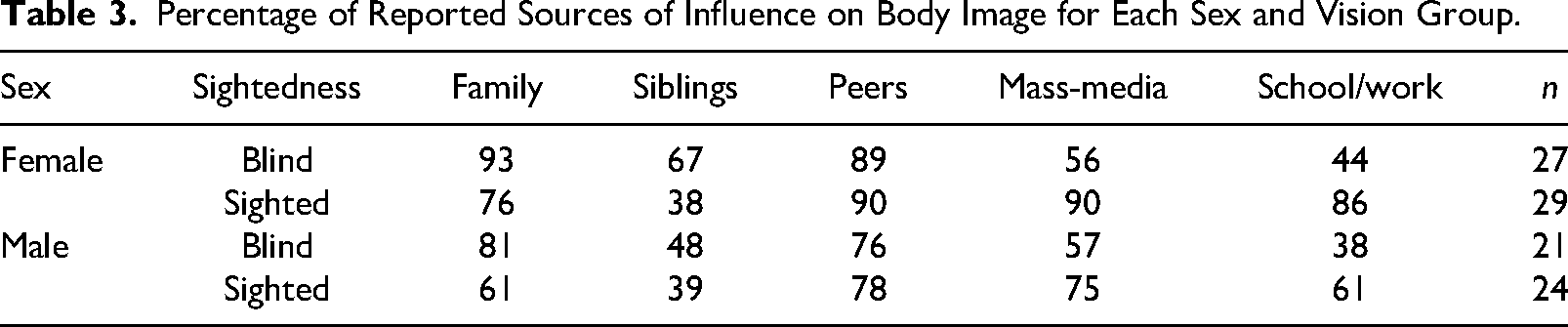
To investigate body image and the potential influencing role of external references, we created a questionnaire that combined direct and open responses exploring: “mass media,” “family,” “school,” “peers,” and “siblings” (see Table 3). Respondents were presented with three answers: “Yes,” “No,” and “I don’t know”; there was also an additional open-comment box. Degree of visual impairment was measured by asking the following questions:
Are you blind? Were you born blind? and At what age did you become totally blind?
Percentage of Reported Sources of Influence on Body Image for Each Sex and Vision Group.
We added questions to measure body satisfaction (i.e., “I feel happy with the way they look,” “I compare myself to others,” and “I wish I could look different”) recording them from definitely disagree (1) to definitely agree (5). Presence of changes in eating patterns and influence on body perception were assessed with the question: “Which of these factors do you think have had an influence on your Eating Patterns/Body perception?” Participants answered by rating the items: “media, family, peers, siblings” and “school.” For the purpose of this part of the research, participants with adventitious and congenital blindness were grouped for analysis.
Results
Sociocultural Attitudes Toward Appearance and Body Esteem
Males
In the male group, vision level had a significant effect on internalization of the athletic ideal: H (2) = 8.58, p = .013, η² = 0.16, with sighted males scoring significantly higher than congenitally blind (U = 54, p = .012) and late-blind males (U = 57, p = .039). This finding suggests that males may be more influenced by visually conveyed sociocultural ideals regarding how athletic they perceive their bodies to be (see Figure 1). There was no significant influence of vision status on any of the other SATAQ factors (p ≥ .172). (See Supplemental Table 3 for the full details and Supplemental Table 1 for group-specific descriptions.) Furthermore, vision status did not affect body esteem regarding upper body strength (p = .250) nor self-rated physical attractiveness (p = .701).
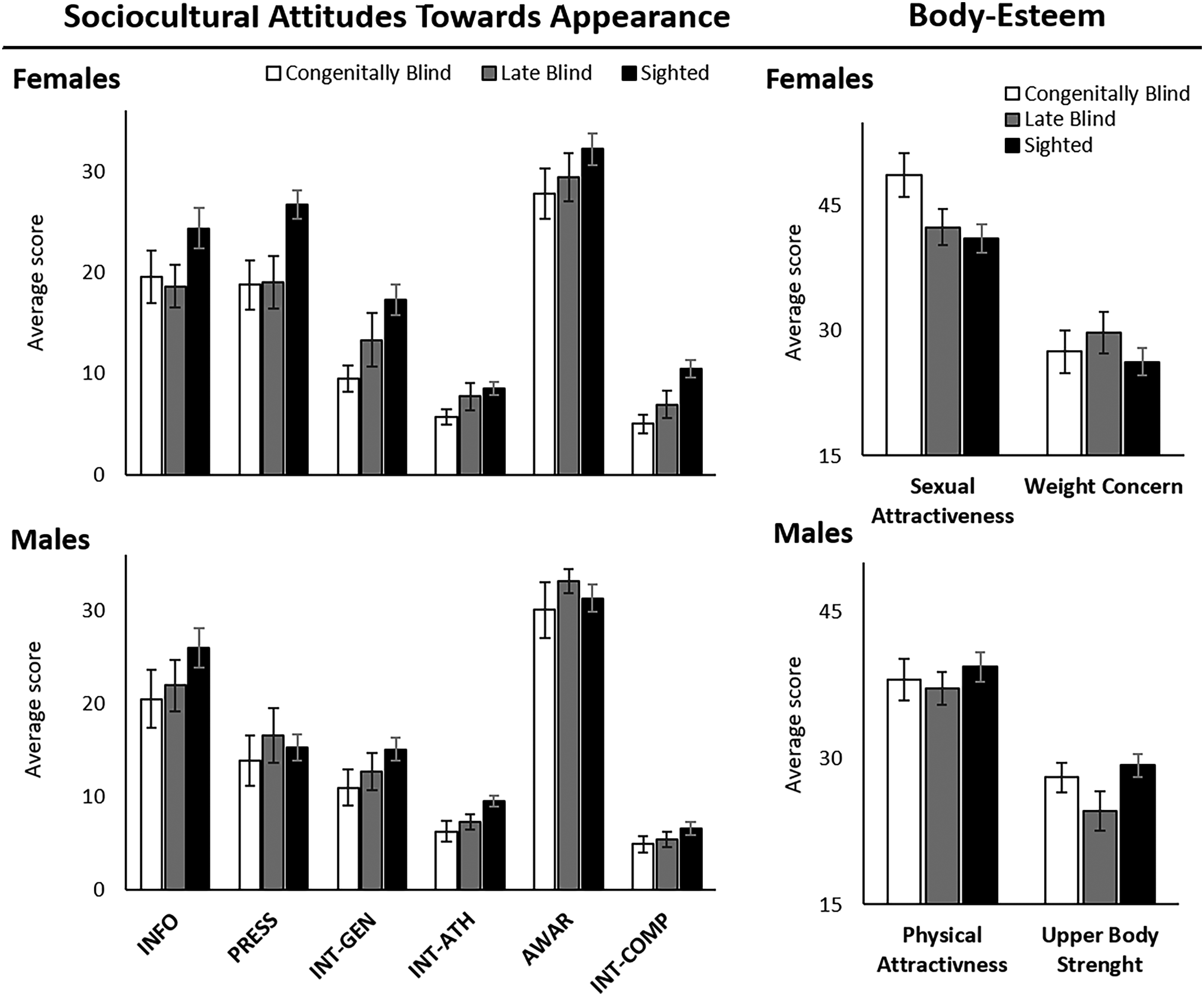
Average Scores for Male and Female Participants, Split by Vision Status, On the SATAQ and BESQ measures. Error Bars Indicate the Standard Error of the Mean. AWAR = awareness of social appearance norms, INFO = recognizing mass media as an important source of beauty ideals, PRESS = perceived pressure to conform to beauty ideals, INT-GEN = internalization of a generic media influence (TV, magazines, and movies), INT-ATH = internalization of the athlete ideal, INT-COMP = tendency to engage in social comparison of perceived body appearance.
Females
Females exhibited statistically significant differences in the perceived pressure to conform with ideal body appearances conveyed through the media depending on vision level: H (2) = 8.993, p = .011, η² = 0.13. Follow-up contrasts revealed that congenitally blind and late-blind women reported lower pressure than sighted women (congenitally blind: U = 123.5, p = .011; late blind: U = 68.5, p = .023). Internalization through TV, magazines, and movies also showed significant difference between vision groups, H (2) = 11.144, p = .004, η² = 0.17; higher mean scores were found for sighted compared to congenitally blind (U = 85, p < .001), but not late-blind (p = .18). The same pattern was found for internalization of athletic ideals, H (2) = 7.108, p = .029, η² = 0.10; the main differences arose between sighted and congenitally blind women (U = 117.5, p = .006) but not sighted and late-blind (p = .559). Vision level also affected the extent to which women exhibited tendencies of social comparison, H (2) = 14.312, p < .001, η² = 0.23; sighted women scored significantly higher than both congenitally blind (U = 81.5, p < .001) and late-blind (U = 72.5, p = .041), as seen in Figure 1. In contrast, awareness of media-enforced societal appearance norms did not differ between vision groups: H (2) = 1.348, p = .51, η² = 0.01.
Regarding body esteem, vision level significantly modulated women's self-rated sexual attractiveness, F (2, 52) = 3.627, p = .034, η² = 0.12; but not weight concern, F (2, 52) = 0.555, p = .265, η² = 0.02. Follow-up contrasts indicated that sexual attractiveness was rated significantly higher in the congenitally blind in comparison to sighted women, t (30) = 2.445, p = .021; while late-blind and sighted women did not differ: t (21) = 0.476, p = .639.
Sociodemographic Survey
To assess whether sighted and blind individuals relied on different sources of information on body image, the relationship between visual experiences and information sources was assessed via a Chi-squared test of independence for both female and male groups separately. As seen in Table 3, a significant relationship between visual experience information sources was evident in the female group, showing that sighted females predominantly relied on information conveyed through mass media, X2 (4, N = 56) = 19, p < .01; and school or work, X2 (4, N = 56) = 15.23, p < . 01.
Although fewer blind females used mass media to gain information about beauty ideals, they were nevertheless affected by societally enforced ideal body standards, as conveyed through mass media. One congenitally blind woman stated: Being blind doesn’t rid you of societal views whether that be on race or beauty. It's not merely about physically seeing images, but constant exposure to conversation about those images and understanding that celebrities are extremely thin/beautiful. Mass media is not supportive and didn’t help me gain confidence in myself. I’ve struggled with not being perfect, the movie image of what a woman should be. [I’m] not tall, not blonde, not thin and I’m blind too.
Emphasizing exposure to same-sex comparison and opposite-sex judgment through colleagues and friends, one sighted woman stated: Peers form a natural comparison for me as to our bodies and the differences between them, sometimes making me feel more confident in my own body but they can also make me feel less confident. School is similar to peers, comparisons to other girls’ bodies but also knowing that boys are judging the way we look makes me feel more self conscious about how I look.
In the male group, we found a significant relationship between visual experience and information sources: X2 (4, N = 56) = 11, p < .01 (see Table 3). Here, blind men were more influenced by family and siblings, while sighted men were influenced by mass media and individuals at school or work. One late-blind man explained, “I’ve been made to feel by my family and friends that since I’ve lost my eyesight that I’ve lost my looks as well.” Another late-blind man stated: I rely on others’ comments about bodies—try to figure out where I fit in. I think most of my colleagues, friends and family must be slimmer than me, though not all are as strong or fit as I am.
Blind women and men mentioned triggers of body dissatisfaction. One congenitally blind woman stated: I often ate snack foods in my room and felt hungry and lonely. These were emotionally difficult [or] traumatic experiences. I wanted to have control over food options, but I know I’ve done some binge eating to try and deal with that sense of deprivation I often felt. I noticed thoughts about how eating certain foods or too much causes weight and I tend to obsess about weight loss and ways to make that happen. It's talked about so much in mass media and my ex boyfriend talked about my food intake, body shape and weight every day. This made me extremely self-conscious.
Discussion
The current research is the first to explore the effect of visual experience on sociocultural attitudes, mass media, body image satisfaction, and body esteem in congenitally blind, late blind, and sighted men and women. Our data allow us to better understand the extent to which visual experience influences body satisfaction and body esteem through the construction and internalization of idealized images conveyed through social channels, such as media, family, peers, and school. We measured sociocultural attitudes toward appearance as well as sources of influence on the perceived body image in congenitally and late-blind individuals, to gain insight into whether visual experience impacts body satisfaction and ultimately triggers eating disorders symptomatology.
In a recent study, Nava et al., (2021) found that late-blind individuals did not display any difference in their own body representation compared to their sighted counterparts, while congenitally blind individuals strongly differed in the metric representation of physical features. These differences, however, did not extend to metric features of the ideal body image. This supports previous findings suggesting that one's internal body representation depends on visual experience in the first years of life (Ley et al., 2013; Nava et al., 2021), while learning an ideal body template may not require visual experience.
Compared to blind women, sighted women reported considering mass media a crucial information source of ideals. In addition, they reported enhanced perceived pressure to conform to these ideals, as well as stronger internalization, which was unobserved in blind individuals. Late-blind women showed comparable levels of internalization of general and athletic body ideals typically conveyed through the media, suggesting that previous visual experience is sufficient to prime metric body representations (Longo & Haggard, 2012) that may serve at a level of social comparison (Longo & Haggard, 2012; Nava et al., 2021; Page & Papps, 2018). It further highlights the idea that females living with vision impairment are as predisposed to internalizing unhealthy ideals as sighted females. Indeed, while body esteem was significantly higher in congenitally blind women than their sighted counterparts, in line with previous findings (Ashikali & Dittmar, 2012; Gebauer et al., 2019), late-blind women did not differ from sighted women in self-rated sexual attraction.
We found no difference in body esteem between blind and sighted men. Sighted males showed higher internalization of athletic ideals, however, when they were compared to their blind counterparts, and influence for this group was mostly attributed to family and peers. For children, dolls offer an image of the body that is likely to be internalized as part of the child's perception of the “correct” body image (Kuther & McDonald, 2004). Hence, boys, who are generally less often exposed to these models, are more prone to wishing to look different based on comparisons and feedback given by siblings and peers, rather than dolls (Dunkley et al., 2001).
Limitations
There are some limitations to consider when interpreting these findings. Firstly, since this study was conducted online, vision status was based on self-report. Secondly, the small sample size and low ethnic diversity limited generalizability. Thirdly, using a voluntary sample of participants and a self-constructed questionnaire includes susceptibility to bias and lack of evidence supporting adaptability of the materials. Lastly, not all visually impaired subjects were equally trained in the use of screen readers and other assistive technologies, therefore, a multi-structured survey might have been challenging to some of the participants.
Future Research
The study provides base for further research, it also suggests the need for inclusive resources and accessible intervention and prevention programs that are aimed at detrimental social influences among the blind population. Furthermore, future examination could help researchers in developing tailored approaches for effectively improving integration of communities of blind and sighted people in the context of body image and societal pressures, as well as examining the psychological aspects of internalization.
In summary, our results suggest that the role of visual experience and the sources through which a person obtains information about body ideals and their own body image are important in shaping the construct of personal body image, further confirming that pressures to conform to an ideal standard of beauty transpose across sexes.
Supplemental Material
sj-docx-1-jvb-10.1177_0145482X241235167 - Supplemental material for Sociocultural Pressures, Internalization, and Body Esteem in Congenitally Blind, Late-Blind, and Sighted Men and Women
Supplemental material, sj-docx-1-jvb-10.1177_0145482X241235167 for Sociocultural Pressures, Internalization, and Body Esteem in Congenitally Blind, Late-Blind, and Sighted Men and Women by Sara Dell’Erba, Meike Scheller, Alexandra A. de Sousa and Michael J. Proulx in Journal of Visual Impairment & Blindness
Footnotes
Declaration of Conflicting Interests
The author(s) declared no potential conflicts of interest with respect to the research, authorship, and/or publication of this article.
Funding
The author(s) disclosed receipt of the following financial support for the research, authorship, and/or publication of this article: Michael J. Proulx is partly funded by CAMERA 2.0, the UKRI [UK Research and Innovation] Centre for the Analysis of Motion, Entertainment Research and Applications (EP/T014865/1).

Supplemental Material
Supplemental material for this article is available online.
References
Supplementary Material
Please find the following supplemental material available below.
For Open Access articles published under a Creative Commons License, all supplemental material carries the same license as the article it is associated with.
For non-Open Access articles published, all supplemental material carries a non-exclusive license, and permission requests for re-use of supplemental material or any part of supplemental material shall be sent directly to the copyright owner as specified in the copyright notice associated with the article.
