




Abstract
Introduction:
Audio description (AD) in museums is crucial for making them accessible for people with visual impairments. Nevertheless, there are limited museum-specific AD guidelines currently available. This research examines current varied international practitioner perspectives on museum AD, focusing on imagery, meaning, emotion and degrees of objectivity, and the regional differences (Europe and United States) in AD traditions, in order to better understand how AD can be used to enhance access to museums.
Methods:
Forty-two museum describers from 12 countries responded to a questionnaire requiring fixed-choice and free-text responses about the purpose and construction of museum AD.
Results:
Inference tests showed that European describers agreed more strongly than American describers that AD should “explore meaning” (U = 91.00, N1 = 24, N2 = 14, p = .03), and “create an emotional experience” (U = 89.50, N1 = 24, N2 = 14, p = .03), rating the use of cognitive prompts as more important (U = 85.50, N1 = 21, N2 = 14, p = .04). Qualitative data enriched this understanding by exploring participant responses on the themes of mental imagery, objectivity and interpretation and cognitive prompts. This highlighted broader agreement between regions on mental imagery, but more acceptance of interpretation in AD from the European respondents.
Discussion:
American and European describers’ opinions differ regarding the purpose of AD: whether it is about conveying visual information or whether broader interpretations should be incorporated into descriptions for audiences with visual impairments.
Implications for practitioners:
These findings indicate that further discussion is needed regarding the purpose of museum AD and, in particular, the way in which objectivity is contextualized. They raise questions about AD providing visual information and/or seeking to address a wider museum experience, including the stimulation of curiosity or emotion.
Museum visitors are expected to rely heavily on vision to access exhibits, which may be behind glass and rarely available to touch, traditionally making museums inaccessible to visitors with visual impairments. Following legislation such as the UK Equality Act (2010) and the Americans with Disabilities Act (1990), museums are required to offer accessible services. Audio description (AD) is therefore crucial. AD seeks to make visual information accessible using verbal description. It can be delivered live by an audio describer or trained guide, or in recorded form, either online or through a listening device in the museum. Despite the importance of AD as an access tool, an audit within the United Kingdom showed that only 5% of museum websites mentioned live AD tours and only 3% of museum websites mentioned recorded AD guides (Cock et al., 2018). Enhancing AD provision is crucial to making collections accessible to people with visual impairments.
Although AD developed as a practice in the United States and the United Kingdom in the 1980s, for theater and screen, with descriptions for the visual arts in the United Kingdom following in the 1990s (Fryer, 2016), AD for museums is a relatively new discipline. Screen AD is professionalized and UK legislation requires the provision of guidelines for screen audio describers. There are substantial differences between screen AD and museum AD (e.g., Eardley et al., 2017; Fryer, 2016; Hutchinson & Eardley, 2018). Screen AD is primarily concerned with issues of timing and coherence (Braun, 2011); advice for screen describers typically emphasizes the need for strict objectivity (Royal National Institute of Blind People, RNIB, 2010), which is reflected by the widely quoted maxim of “what you see is what you say” (WYSIWYS) in the United States’ AD tradition (Snyder, 2014).
In contrast, museum AD is not regulated. Practitioners face important questions regarding not only which content within a museum should be selected for description but also what the salient features of a particular piece may be and how to address them. They must decide whether to describe exclusively colors, shapes, and spatial content or whether to explore information that goes beyond these visual aspects such as meaning. If AD seeks to promote parity of experience with sighted people, then it requires an understanding of what the overall museum experience may be, and the cognitive, social, and emotional aspects of it (Hutchinson & Eardley, 2018; Pekarik et al., 1999). Learning about exhibits is just one aspect of the “experience” of the museum. The visitor experience can also be about escapism, having fun, and spending time with others (e.g., Prentice, 2001, Slater, 2007). Thus, museum AD exists within a complex set of parameters.
Despite the complexity of the museum experience, only a small number of international guidelines provide any museum-specific advice for AD. European guidelines that address museums come from the pan-European ADLAB project (Remael et al., 2014) and the Spanish Standard UNE (RNIB, 2010). In the United States, there are recommendations from the Audio Description Coalition (ADC, 2009) and from Audio Description International (ADI). ADI’s material incorporates input from Art Beyond Sight and Art Education for the Blind (RNIB, 2010). Comparison of these guidelines reveals points of regional commonality and differences.
First, there is limited advice about the optimal length of a description. The American ADC recommendations emphasize that it takes more time to listen to information than it does to view or read it, and they encourage selection and focus on details that are pertinent to understanding and appreciation of the work (ADC, 2009). The ADLAB (Remael et al., 2014) project suggests that a recorded description should be 1–2 minutes in length (Remael et al., 2014) in order to take account of visitors’ attention span.
Specific advice on content suggests that AD should present a variety of information including factual information (Remael et al., 2014); information about the artist’s technique, such as brushwork (Remael et al., 2014; ADI, cited in RNIB, 2010); and use of color and tone (ADI, cited in RNIB, 2010; ADC, 2009; Remael et al., 2014). ADLAB (Remael et al., 2014) recommend putting facts before description, saying that “description brings facts to life” (Remael et al., 2014, p. 81) although the authors recognize that sometimes different types of information should be interwoven. The U.S. guidelines, in contrast, tend to recommend keeping the verbal description distinct from other kinds of information (Art Beyond Sight, 2014; ADI, cited in RNIB, 2010).
The guidelines also address language and how best to structure a description. Language should be clear, simple, direct, and precise (Remael et al., 2014; ADI, cited in RNIB, 2010), but simultaneously vivid and diverse (Remael et al., 2014). Interestingly, the U.S. ADI recommendations for general AD practice describe it as a “literary art form…a type of poetry, a haiku” (ADI, cited in RNIB, 2010, p. 75), which seems to be at odds with the principle of objectivity. Nevertheless, the use of literary devices is not widely discussed, although ADC (2009) does caution describers only to use metaphor if it is likely to be familiar to the audience. All guidelines (excepting the Spanish Standard UNE 153020) explicitly state that the description should move from the general to the specific. Various ways to structure a description are proposed (ADI, cited in RNIB, 2010; ADC, 2009; Remael et al., 2014). ADC (2009) explains that it is important to help people to understand the “spatial relationship between things” (p. 21).
This emphasis on structure is related in some guidelines to the construction of mental imagery (ADC, 2009; Remael et al., 2014), and ADI explains that the sequencing of information will allow “a blind person to assemble, piece by piece, an image of a highly complex work” (ADI, cited in RNIB, 2010, p. 99). The ADLAB (Remael et al., 2014) recommendations refer to helping visitors with visual impairments to “see,” stating: “at times, the DG (descriptive guide) will lead to “seeing” through positioning, movement or touch” (Remael et al., 2014, p. 70). Likewise, ADI refer to appealing to other senses such as touch or hearing to help construct highly detailed impressions. All the guidelines cited here furthermore advocate the accompanying use of touch in AD practice, where possible.
Finally, the guidelines reveal contradictory advice regarding the level of subjectivity within museum AD. The Spanish standards explicitly state that personal interpretations should be avoided (UNE 153020, cited in RNIB, 2010). This statement is complicated, however, by the advice that describers should focus on the most significant information for understanding the work, which is necessarily a matter of subjective interpretation. ADLAB (Remael et al., 2014) recommends “deconstructing” a work and “recreating through suggestive language, sounds effects and music” and explicitly states that interpretation is required along with contextualization and selection (Remael et al., 2014, p. 71; see also Neves, 2012). Some U.S. guidelines encourage describers to include subjective aspects, such as the mood or atmosphere of a piece (ADI, cited in RNIB, 2010; ADC, 2009), or to explore interpretative approaches to a work such as soundscapes (ADI, cited in RNIB, 2010). ADC (2009) also suggests its readers consider verbal description, which they distinguish from objective audio description owing to the inclusion of evocative information. However, objectivity is still urged in some U.S. training materials (Art Beyond Sight, 2014). The broader U.S. emphasis on objectivity has been noted by researchers (Fryer, 2016; Mazur & Chmiel, 2011).
The guidelines recognize that offering visitors with visual impairments a rewarding museum experience involves balancing a number of practicalities and artistic decisions. The advice is contradictory, however, between and within regions regarding interpretation in AD practice. Furthermore, the limited museum-specific advice means that museum AD is necessarily contextualized by a broader AD tradition with governing principles of objectivity. These objectivity principles could prove problematic, considering the complex and ambiguous nature of museums. In order to develop and extend the provision of museum AD within these complex parameters, it is necessary to examine current practices. This research comprises of the most comprehensive international exploration of museum AD practitioner experiences to date. We explored the role of AD, as part of the museum experience, and the content of AD. Based on the different developments of AD in Europe and the United States, we compared responses from regions to establish the degree of practitioner agreement.
Method
Design
This study drew on a mixed methods approach, using qualitative findings to enrich understanding of the quantitative findings. A questionnaire, comprising of fixed-choice and free-text responses, examined the experience and approaches of museum audio describers. Quantitative analysis grouped participants into “Europe” and “United States,” comparing responses to questions based on a 5-point Likert-type scale. Where multiple tests were carried out, the Bonferroni–Holm correction was used. Thematic analysis was used to analyze the qualitative data recorded in the free-text response boxes due to its potential to uncover patterns of meaning across a data set in a relatively under researched area (Braun & Clarke, 2006).
Participants
Forty-one describers and one AD trainer responded to an online survey. Describers were recruited through convenience sampling via VocalEyes (UK), through Audio Description Association directories (UK), the U.S.-based Audio Description Project, and via snowball sampling. Respondents were from 12 countries: United Kingdom (16), United States (14), Spain (two), and Portugal (two); in addition, one response came from each of the following countries: Belgium, Brazil, Canada, France, Ireland, Italy, New Zealand, and Poland. For the regional quantitative analysis, participants were grouped into Europe (25) and United States (14), with insufficient data to permit a “rest of world” category. All nationalities were included in the qualitative analysis. All participants were active and current practitioners of museum AD, and one offered training only. The research followed British Psychological Society ethical guidelines and was approved by the University of Westminster Psychology Department Ethics Committee.
Measures
An online questionnaire (available upon request from the corresponding author) requested basic demographic information, and respondents were asked for the ideal duration for an individual description or “stop” (live or recorded) and for an entire AD tour. Describers were asked to comment on the use of touch to accompany AD.
A series of statements about the role of AD were rated using a 5-point Likert-type agreement scale. These addressed AD as a way of “seeing” or “understanding” an artwork or artifact and whether AD should explore meaning, give background information, create an emotional experience or an engaging narrative.
Participants used a 5-point Likert-type scale to rate the importance of aspects of content and style such as references to color, use of factual and contextual information, use of multisensory imagery, inclusion of technical information, use of literary devices such as simile or metaphor, building a narrative, addressing measurements (either by using standard metrics or by relating the item to part of the body), and use of “thinking” or “conceptual” prompts for the listener. Respondents were given the opportunity to add comments and reflections in free-response boxes.
Procedure
Participants completed the questionnaire online via Qualtrics XM. Once informed consent had been given, participants completed the questionnaire. No time limit was given, and the duration depended on the amount of free-text response that was provided. Further, although names were not requested, if participants wanted to receive a summary of the research findings, they were asked to leave their e-mail address.
Qualitative analysis
Online questionnaires were transferred into NVivo 11 data-analysis software for coding. Thematic analysis was carried out within a constructivist framework, whereby it is not assumed that one “truth” can be extracted from the data. Rather, knowledge is constructed by drawing patterns from the individual experiences and meaning described by participants. The creation of themes was nevertheless driven by a deductive approach (Braun & Clarke, 2006). Specifically, the areas of difference identified within the quantitative analysis were used as a starting point for the creation of themes within the qualitative data. As such, the qualitative analysis is used to elaborate on and enrich understanding of the quantitative analysis.
Data were first broadly examined in the context of areas of agreement and disagreement between audio describers. A second phase of analysis explored subthemes within agreement and disagreement. Within agreement, these included themes of “selection for description,” “information sources,” integration of information,” “role of curators,” “describing gallery space,” “structuring a description,” and “language and narrative.” Within disagreement, the themes included the following: “neutrality and objectivity” and “cognitive prompts.” The final stage of analysis extracted a broad theme of “interpretation,” which incorporated all the subthemes from the “disagreement” category and the subtheme of “imagery” within the agreement category.
Results
AD duration
There was a wide range of responses on the duration of AD, although the median and range for both a single stop and a full tour suggest that live descriptions could be longer than recorded ones (see Table 1). Mann–Whitney U pairwise inferences tests for full tours and single stops for live and recorded indicated no significant differences between the U.S. and European groups (all p > .40).
Median (range) recommended durations in minutes for live and recorded AD (single stops and full tours) by region.
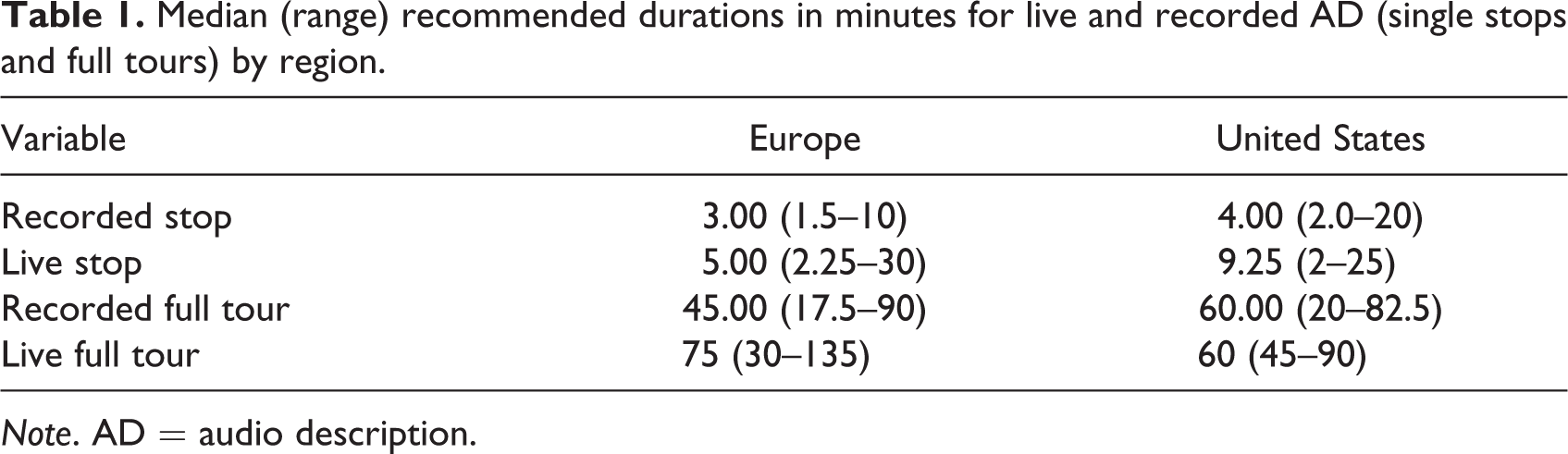
Note. AD = audio description.
Use of touch
Over half of the respondents in both the European and U.S. groups commented on the importance of touch alongside AD. Both groups emphasized its sequential nature and the time needed to allow people to discover through touch. The European group recognized some practical difficulties but emphasized that touch could “make objects come alive” and enhance the tour’s narrative when well executed.
Role of museum AD
Table 2 shows that no differences were identified between U.S. and European describers with respect to their beliefs that AD should substitute for visual information, create an engaging narrative, provide background about the artwork, and offer the listener with a way of “seeing” the art. Statistical inference tests (Mann–Whitney U test) confirmed a lack of difference between these ratings (all p > .1).
Agreement ratings (median, range) for the role of AD for a museum visitor, where 5 = strongly agree and 1 = strongly disagree.
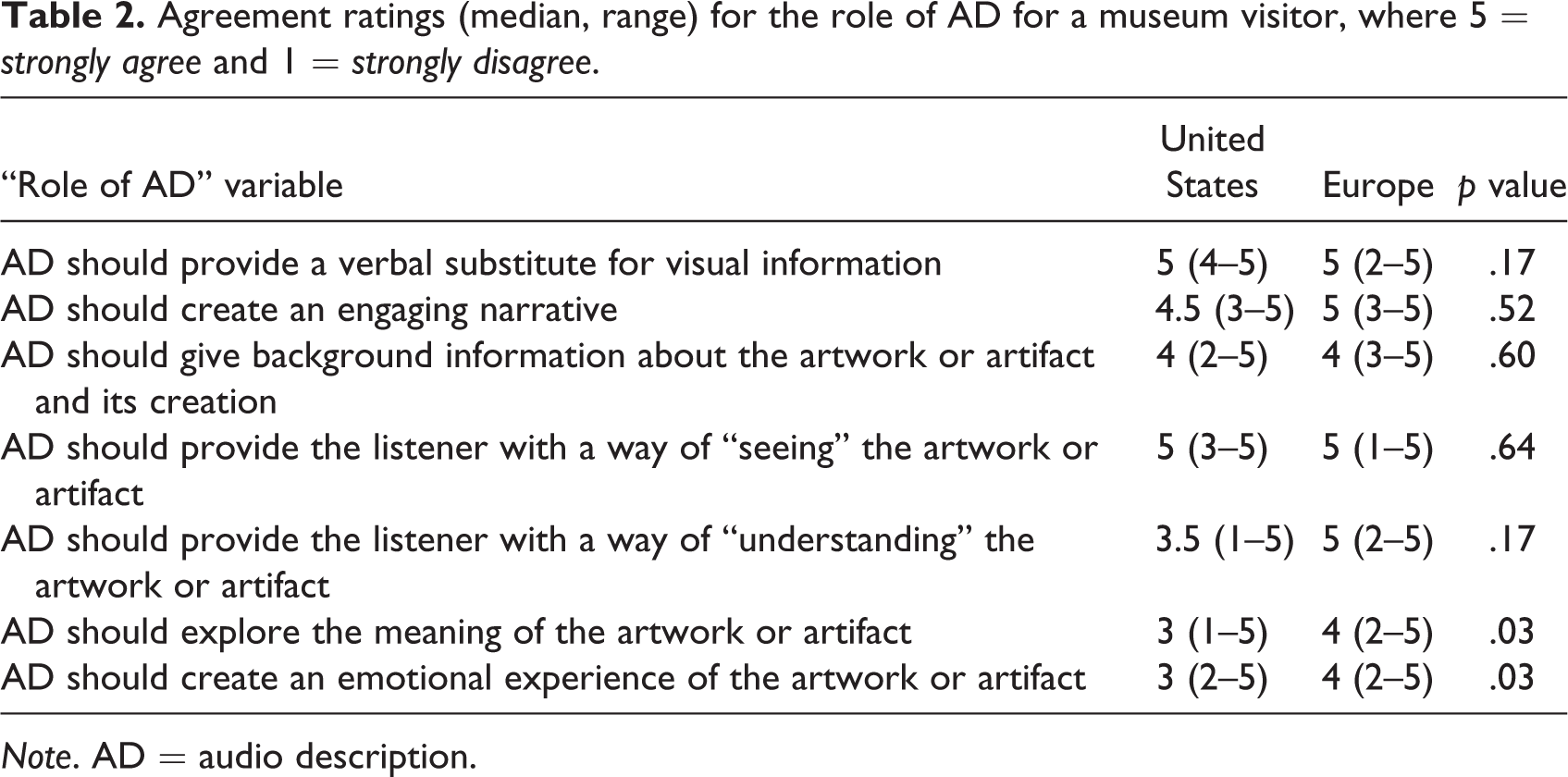
Note. AD = audio description.
The statement “AD should provide understanding” had a higher median value for European respondents, but a larger range of responses in the American respondents, and it did not reach the conventions for statistical significance: (U = 122.50, N1 = 24, N2 = 14, p = .17). The Europeans attributed greater importance to the role of both meaning and emotions in AD. Mann–Whitney U tests confirmed these differences were significant (meaning: U = 91.00, N1 = 24, N2 = 14, p = .03; emotion: U = 89.50, N1 = 24, N2 = 14, p = .03).
Within the qualitative theme of “interpretation,” subthemes relevant to the role of AD were “imagery” and “objectivity versus interpretation.”
Imagery
There was broad international agreement that the primary function of AD was to facilitate the creation of a “mental picture” of the artwork or object in the listener’s mind. Many comments referred to concise, vivid language that would be able to “create a full picture in the listener’s mind’s eye” (#36, United States). One European describer warned that other aspects of style should not be prioritized at the expense of the creation of imagery: “If it creates an engaging narrative but it doesn’t give the listener a picture of the object, it’s failed as AD even if it’s succeeded as a narrative” (#25, UK). Another European respondent mentioned that creating mental imagery required a certain structure in the description, with each piece of information adding incrementally to the construction of a mental image: “It is important to keep a logical order in the description of the different elements, building relationships through them, in order to make a composition, or a mental image” (#35, Spain). Various structures were proposed, with the clock numerals method favored by American respondents. Discussions about mental imagery were, for some, at the heart of what AD should set out to do. One such respondent was careful to distinguish the creation of imagery, which was specific to AD, as entirely distinct to discussions of context and meaning, which were considered the domain of the museum staff, not the describer: The work of the audio describer is to audio describe. He or she is not there to replace the work of a docent. The describer must tell what the work looks like, he must use the tools to elucidate the image in the mind’s eye of the constituent. (#18, AD trainer, rest of world) The idea of AD…is not to say “If you could see, you would see this.” That is terribly disabling. It’s not possible for everyone to have the same picture in their mind, and AD will never achieve that, even if all blind and partially sighted people were making pictures in their minds, which they tell me they’re not. It’s not to remind them what they’ve lost, surely it’s to introduce them to something they’ve never encountered before. (#1, UK)
Objectivity versus interpretation
As shown in the quantitative data, there were significant regional differences of opinion regarding interpretative aspects of AD. However, the qualitative data revealed worldwide concern about keeping the right balance between objectivity and interpretation. Despite higher ratings in Europe for statements about meaning, understanding, and emotion, there was still focus on maintaining objectivity and creating minimal “interference” in the listener’s assimilation of an artwork: “I would go easy on the creation of an emotional experience—the artwork does that, not the describer” (#23, UK). However, there was more emphasis among European describers on the role of storytelling in AD, with all mentions of narrative coming from European describers.
Describers from the United States held much stronger views on objectivity, with many defining the role of the describer exclusively as a “translator” of visual information, separating this translation entirely from a creative or artistic process as expressed here: The task of the describer is to describe the visual aspects of an object, production, or experience. Creating emotion alters the experience and is inappropriate for the describer. The describer is providing an assistive service and should not attempt to create or influence the artistic effect. (#12, United States)
Content and style
Table 3 shows broad agreement between the American and European respondents on the importance of the majority of content and style variables. Only “cognitive prompts” was identified as significantly different by Mann–Whitney U tests; and these were considered to be more important by European respondents (cognitive prompts: U = 85.50, N1 = 21, N2 = 14, p = .04; all other differences p > .1).
Importance of content and style variables by region (median, range), where 5 = extremely important and 1 = not at all important.
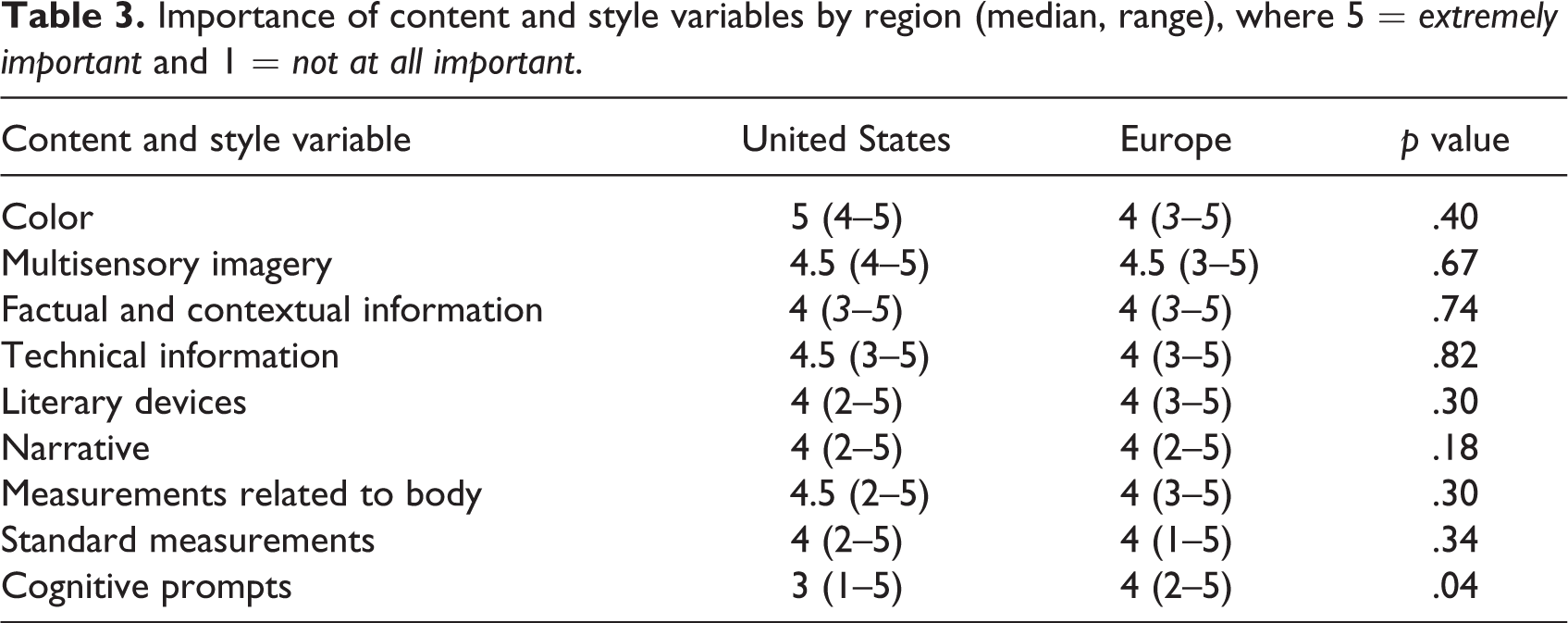
European and American agreement across the majority of variables of content and style was broadly supported by the qualitative data. Specifically, there was agreement between describers in all regions that language in audio descriptions must be simultaneously evocative and concise and that vivid language would best generate mental imagery. There was also agreement between regions that the use of literary devices such as metaphor could be problematic, as they could generate competing mental images. However, there were interesting regional differences in the emerging theme “interpretation,” within the subtheme “cognitive prompts.”
Cognitive prompts
Comments from the United States indicated that cognitive prompts were not a recognized part of AD. One American describer, for example, rejected the idea of “thinking prompts” because they were outside the remit of an audio describer and too close to interpretation: Incorporating “thinking” and “conceptual” questions is not, in my opinion, appropriate for a describer; that lies in the domain of a docent. (Keep in mind that I describe in the United States, and we emphasize respecting the integrity of the original material and avoiding attempts to interpret it for the person who’s listening to the description.) (#12, United States)
Discussion
The aim of this study was to understand similarities and differences across international museum AD practices, with particular reference to the role of museum AD and its optimum content, style, and duration. The quantitative analysis incorporated contributions from American and European describers, and the qualitative analysis incorporated comments from all respondents across different nationalities. The findings suggested that where guidelines agree, for example, on structure and language, international museum AD practices have much in common. European and American practitioners tended to agree that the average duration of a description should be longer than the 1- to 2-minute recommendation in the guidelines (Remael et al., 2014). The aspects of AD that were most contentious, such as observing strict objectivity, reflected some contradictory recommendations in the guidelines. The discussions on these issues highlighted some crucial international differences about what museum AD should set out to achieve.
Quantitative and qualitative responses from describers from the United States indicated that most describers prefer to reduce subjective interpretation as far as possible. These describers considered their role to be the “translation” of visual perceptual information (e.g., the colors, the shapes, the structure). This approach is more consistent with the American tradition of objectivity (i.e., WYSIWYS). On the other hand, Europeans were more likely to reference strategies that might evoke a deeper sense of meaning, for example, cognitive prompts, narrative, or seeking to evoke emotion. These findings are interesting in the light of research that suggests AD users respond favorably to creative techniques in description which go beyond the WYSIWYS principle (Szarkowska, 2013; Walczak, 2017). European describers also placed more emphasis on touch as part of the AD experience in museums and its potential to tie in to the storytelling function of a description.
Interestingly, the qualitative data suggested that one of the objectives underlying the use of cognitive prompts or emotions was to make the experience more memorable. Curiosity has been shown to be instrumental in helping us to remember, since curiosity enhances memory for novel information (Kang et al., 2009). The use of cognitive prompts, if they stimulate curiosity, may therefore aid memorability. The use of emotions also relates to the generation of meaning, and it enhances memorability (e.g., McGaugh, 2003). The question of whether or not providing meaning is a didactic process or a way of encouraging a deeper level of processing is consistent with the broader museum interpretation debates. Such debates continue to question how much explanation is necessary or appropriate in a museum (Pekarik, 2004). Empirical research is needed to explore what effect this trade-off between objectivity, intervention, and curiosity might have on the listener experience and the resulting levels of engagement.
Although the use of mental imagery attracted much agreement internationally, it is interesting to note that many describers discussed enabling their listeners to create mental images of objects (i.e., “having a picture” in one’s mind). This phrase, commonly used by respondents, is generally understood to mean a visual image. The focus on visuo-centric imagery is an interesting one. People who become blind later in life may have ongoing access to residual visual imagery in the form of memories, and people with low vision may continue to form new visual imagery as they access new visual information through their residual sight. For individuals who are congenitally blind with no residual vision from birth, visual imagery is not possible. One might argue that the purpose of AD is not simply to provide people who have had vision with access to information which may be stored within memory, it is also to provide information to people that can be understood without ever having had access to vision. As with our perceptual experience, mental imagery is experienced in all sensory modalities, including auditory, haptic, kinesthetic, and olfactory (Cattaneo et al., 2008; Eardley & Pring, 2006; Eardley & Pring, 2014). Within AD, imagery, like perception, can be multisensory. For example, grass has a visual form, but it also has a tactile form, a spatial form (covering a surface), and an olfactory form. Agreement with this approach is reflected in the international consensus about the use of multisensory imagery in AD. These views are consistent with the U.S. guidelines, which discuss ways in which tactile or auditory imagery can be embedded in order to create a richer description. However, in recommendations and materials for describers, it would be valuable to expand upon and illustrate the multisensory nature of imagery and its role in description wherever possible.
The role of spatial imagery was reflected in the findings by the comments of many on how they structure an AD. Research has demonstrated that people who are congenitally blind perform similarly on spatial imagery tasks compared to sighted individuals (Eardley et al., 2016; Eardley & Pring, 2007). How this spatial representation can then be enriched or, “brought to life,” can be achieved through the spectrum of nonvisual sensory imagery (taste, smell, touch, and movement) that is experienced by people with visual impairments and sighted alike (Eardley & Pring, 2014). However, providing the structure to facilitate a mental representation can take significant time and word count within the text of an AD or live delivery (Jiménez Hurtado & Soler Gallego, 2013). Keeping in mind the challenges of retaining attention and not overloading the listener with information, it would be interesting to explore the tolerance of AD users in terms of the time and effort needed to process structural information in sufficient detail to form a mental representation. Some individuals may wish to do so, and others may prefer to experience the artwork in a way that does not require them to invest significant mental effort in forming such a representation. Other tools such as simplified tactile images can help provide access to basic spatial representations, with AD then enriching the spatial structure.
Mental imagery formation has also been shown to aid memorability (e.g., Svoboda et al., 2006), and an AD text that generates strong and enduring mental images could, therefore, provide a longer lasting and potentially more fulfilling experience. This approach may help AD to facilitate a richer and more multifaceted museum experience for visitors with visual impairments. However, although multisensory engagement, such as enrichment with additional sounds, has the potential to explore meaning and evoke emotion, it requires a more interpretative approach and moves beyond a strict provision of visual information. Upholding the objectivity principle should therefore be critically reviewed in the context of providing a rich and engaging experience.
The majority of respondents within this study came from the United States or Europe. This sample reflects the current strength of AD practice within these areas. Future research will be able to explore the development of AD more broadly around the world as the practice grows.
Conclusions
The results of the present research demonstrate broad international agreement on the building blocks of museum AD, such as the use of color, multisensory imagery, and the generation of mental imagery. At the same time, the conflicting views between regional approaches to AD emphasize the many different things that AD can aim to do in a museum: provide verbal description of visual elements, create mental imagery, tell a story, explore meaning, and evoke emotions. Approaches to description will vary according to whether AD is understood as a visual to verbal translation or as a museum interpretation tool which seeks to facilitate an experience. Balancing the emphasis given to these different elements is challenging and merits further research attention. As guidelines for museum describers develop and the role of the describer continues to be professionalized (ADLAB PRO, 2017), exploring these tensions, which are so central to museums and galleries, will be crucial in the development of museum AD. Keeping the emphasis on the full spectrum of what the museum experience can be, and how it can be facilitated through AD, will no doubt lead to new directions and creative possibilities.
Footnotes
Acknowledgments
The authors thank Vocaleyes for their help in drafting the questionnaire and in its distribution, Dr. Josélia Neves and Dr. Louise Fryer for their advice on the questionnaire, and all audio describers who responded to the questionnaire.
Declaration of conflicting interests
The author(s) declared no potential conflicts of interest with respect to the research, authorship, and/or publication of this article.
Funding
The author(s) received no financial support for the research, authorship, and/or publication of this article.