




Abstract
Introduction:
Youths with visual impairments (i.e., blindness or low vision) experience difficulties with forming and maintaining social relationships with peers. These difficulties challenge their psychosocial functioning and put them at risk of being lonelier later in life. The study’s primary goal was to investigate how intra- and interpersonal factors during adolescence influence Loneliness in young adulthood.
Methods:
Analyses were conducted on data from a national data set. Participants (N = 96) were interviewed at two different time points. General linear regression and mediation analyses were used to examine the role of social competence, personality, and satisfaction with social support, measured at mean age 17.83, and on Loneliness measured at mean age 23.45.
Results:
Analyses showed that adolescents with visual impairments who were more emotionally stable and had higher social competence during adolescence were less lonely later in life. In addition, the results showed that emotionally unstable adolescents reported lower social competence and, therefore, were lonelier in young adulthood.
Discussion:
These findings indicate that factors connected to Loneliness in young adulthood include people’s personality traits and their level of social competence at a younger age.
Implications for practitioners:
Knowing the underlying causes of an individual’s Loneliness assists practitioners in selecting what type of intervention would be suitable for addressing these issues. Those with low social skills benefit more from social skills training and those with negative biases of their own functioning profit more from interventions based on cognitive approaches. Screening methods could be used in order to determine these underlying issues and personality structure, before assigning persons to specific interventions.
Loneliness is described by Matthews et al. (2016) as a subjective feeling of distress that emerges when social connections are regarded in a way that are inadequate or unfulfilling. Frequent and long-lasting feelings of Loneliness can have negative effects on several mental health outcomes, such as psychosis, cognitive decline, and depression. Loneliness also diminishes psychological factors such as well-being and self-esteem (Hawkley & Cacioppo, 2010; Matthews et al., 2016). Furthermore, Loneliness increases the risk of physical problems like elevated blood pressure, hormonal disturbance, and even mortality (Cacioppo, Hawkley, Norman, & Berntson, 2011; Caspi, Harrington, Moffitt, Milne, & Poulton, 2006; Shiovitz-Ezra & Ayalon 2010). A variety of intra- and interpersonal factors can explain the experience of Loneliness, but less is known about these associations among people with visual impairments (i.e., those who are blind or have low vision).
Whereas studies have shown that Loneliness is a frequent experience among elderly people, recent research has shown that young people also experience Loneliness (Yang & Victor, 2011). These findings are disturbing since the need for social engagement is especially important during adolescence and young adulthood because of the many stressful turning points that take place during this period of a person’s life. Social support is vital for one’s ability to regulate physiological stress and for one’s overall mental well-being (Kawachi & Berkman, 2001). Research among typically developing persons showed that higher perceived and enacted social support is predictive of higher life satisfaction and lower negative affect (Siedlecki, Salthouse, Oishi, & Jeswani, 2014).
☑ Earn CEs Online
by answering questions on this article.
For more information, visit: http://my.aerbvi.org/AER-Store/Publications/BKctl/ViewDetails/SKU/AER.
During adolescence, restructuring of social networks takes place and peers take a more central role as families become less influential (Woodhouse, Dykas, & Cassidy, 2012). In this transition phase, social competence is essential for success in social interactions with significant others and for the ability to build up and maintain successful peer relationships (Cillessen & Bellmore, 2011). It reduces the risk of being excluded by peers, becoming less integrated, and growing lonely (Teppers et al., 2013). Those with low social competence have a higher chance of experiencing Loneliness (DiTommaso, Brannen-McNulty, Ross, & Burgess, 2003; Woodhouse et al., 2012).
Besides the interpersonal factors social competence and perceived social support, some intrapersonal factors, such as personality traits, are also predictive of the experience of Loneliness (Mund & Neyer, 2015; Teppers et al., 2013; Vanhalst, Goossens, Luyckx, Scholte, & Engels, 2013). Personality traits are often measured using five factors referred to as “the Big Five” (McCrae & Costa, 1987). Being more extroverted, more emotionally stable, and more agreeable have been associated with lower degrees of Loneliness and better social functioning because these traits are more socially desired (Jensen-Campbell et al., 2002; Mund & Neyer, 2015; Roberts, Walton, & Bogg, 2005). Those with a more neurotic personality tend to be more socially anxious, which is a disadvantage for one’s social functioning (Kaplan, Levinson, Rodebaugh, Menatti, & Weeks, 2015).
Visual impairment and Loneliness
Among older individuals, research has found that those with visual impairments experience more Loneliness than do those without (La Grow, Yeung, Alpass, & Stephens, 2015). Among young people with visual impairments, mixed results have been found. Some studies found that youngsters with visual impairments experience more Loneliness than their peers without impairments do (Huurre & Aro, 1998; Pinquart & Pfeiffer, 2011b), while other studies found no difference in Loneliness scores between the two groups (Kef, 2002, 1999). However, Kef (2005, 2002, 1999) did find that young people with visual impairments experience other difficulties in social life such as a smaller social network.
Due to restrictions in such activities as moving about and stigmatization, young people with visual impairments have a high risk of being less engaged in social activities and spending more time at home alone; therefore, they lack experiences to develop efficacious social competence (Gold, Shaw, & Wolffe, 2010; Kef, 2002). Also, their inability to see facial and physical gestures during social interactions increases the chance of demonstrating socially inappropriate behavior, since social norms cannot be learned by visual cues. With these social challenges in mind, it is not surprising that research demonstrates that young people with visual impairments have fewer friends and smaller social networks (Huurre & Aro, 1998; Kef, 2002; Pinquart & Pfeiffer, 2011b). One study conducted by Kef (1999) showed that 41% of Dutch adolescents with visual impairments are unsatisfied with their social networks and 60% of them want to have more social contact. Another study by Kef and Deković (2004) of young people with visual impairments showed that being less supported, especially by peers, related to lower psychosocial well-being. All such social challenges and the associated compromised social development, crucial for establishing and maintaining social relationships at a young age, contribute to the risk among people of experiencing Loneliness later in life.
Less is known with respect to the role of different personality traits on the social development of young people with visual impairments. One study showed that adolescents with visual impairments who are extroverts are better at making close friends (Pinquart & Pfeiffer, 2011a). The same study also showed that young people with visual impairments are less extroverted than are their peers without impairments. However, no studies have yet explored the direct role of personality traits in young people with visual impairments and their association with Loneliness later in life.
The current study
The current study aimed to assess the role of personality traits, social competence, and satisfaction with social supports in adolescence on Loneliness in young adulthood. The main hypothesis was that social competence would operate as a mediator in the relationship between personality traits and Loneliness and that both personality traits (intrapersonal factors) and satisfaction with social support (interpersonal factors) during adolescence are associated with Loneliness later in life.
Method
Procedure
The data used in the current study were part of a longitudinal research project. The study was executed in compliance with a research design that has been developed and approved by a committee consisting of several professionals working in two national rehabilitation organizations and two persons with visual impairments as representatives of the perspectives of persons with visual impairments. Participants were recruited via organizations that provide support or education to adolescents with visual impairments. A brief description of the study in the form of an informational letter was send to eligible participants and informed consent was obtained. According to National Legislation in the Netherlands, this type of study did not require ethical medical approval. At the first measurement, all participants were interviewed individually at their homes by the researcher and several trained research assistants using the method computer-assisted personal interviewing. The overall duration of the interviews was about 90 minutes. After the first interview, the participants could notify the interviewer or researcher if they wanted to be part of future measurements. These participants were contacted again in 2010. During the second round of interviews, due to limited financial resources and time constraints, the interviews took place via telephone, again using computer-assisted personal interviewing techniques.
Participants
The sample in the current study consisted of 96 participants. In 2005, 154 participants entered the study. In 2010, however, 58 participants dropped out for several reasons such as lack of time, reduced interest, no available up-to-date contact information, or death. No significant differences were found on demographic or visual impairment characteristics between those who dropped out and participants in the current sample. At the first measurement (T1, 2005), those participants were aged 14–21 years (M = 17.83, SD = 1.99), and at the second measurement (T2, 2010), they were aged 20–27 years (M = 23.45, SD = 1.90). Fifty-four percent of the participants were male. A minority of the participants had origins outside of Western Europe (8%), in countries such as Moroccan or Surinam, and the majority had a Western-European origin.
At T1, 15% of the participants were totally blind, 27% had severe low vision, and 58% moderate low vision. The biggest proportion of the sample consisted of students (56%). Also, many participants both studied and worked (42%). Only a few participants neither studied nor worked (2%). At T2, 6 years later, 57% of the participants had graduated from secondary education or intermediate vocational education and 25% had a college degree. Around half of the participants were involved in a long-term romantic relationship (51%) and 2% of the participants had children.
Measurements
Loneliness
Loneliness was measured by an adapted self-report version of the Loneliness Scale of De Jong-Gierveld and Van Tilburg (1999). This scale consists of 11 items with response categories on a 3-point Likert-type scale (yes, more or less, and no). Total scores on the scale can vary between 0 and 11. The response category “more or less” was each time reversed to either “yes” or “no” depending on the direction of the statement. In the current sample, the internal consistency of the total scale was acceptable to good (2004: alpha = .83; 2010: alpha = .74).
Social competence
Social competence was measured using three subscales of the Dutch translated version of the Self-Perception Profile for Adolescents (Harter, 2012). The subscales we used were Social Acceptance, Close Friendship, and Romantic Appeal, each consisting of 5 items. The subscale Social Acceptance concerns satisfaction with one’s own social skills. The subscale Close Friendship concerns the ability to make close friends. Finally, the subscale Romantic Appeal concerns the perception of one’s own romantic attractiveness. Each item consists of two contradicting statements describing different types of people. The respondents had to choose between the statements and mention if this was either “sort of true for me” or “really true for me.” In the current study, the three used subscales were combined into one single variable. This was possible because the subscales correlated (r = 0.56, 0.48, 0.38). The internal consistency of the total scale was acceptable (alpha = .75).
Personality
Personality was measured using a Big Five Self-Report Scale. The five personality traits that were measured were Emotional Stability (being able to cope with negative emotions), Extroversion (strong social orientation and high social activity and positive emotions), Agreeableness (showing behavior focused on keeping and strengthening social relationships), Conscientiousness (showing orderly and responsive behavior), and Openness to Experience (curiosity and creativity). The total questionnaire consists of 30 items, 6 items per subscale, each mentioning a trait. Participants were asked to which extent they possessed these traits. They could answer on a 7-point Likert-type scale (1 = completely incorrect for me to 7 = completely correct for me). Mean scores for each subscale were used as a separate variable based on the scores of the 6 corresponding items. The internal consistency of the subscales turned out to be acceptable to good in the current sample (Emotional Stability: alpha = .81, Extroversion: alpha = .87, Agreeableness: alpha = .85, Conscientiousness: alpha = .88, Openness to Experience: alpha = .68).
Satisfaction with social support
Satisfaction with social support was measured using two questions: one about the satisfaction with emotional support from the social network (“How satisfied are you with the help you receive when you have personal problems?”) and one about the satisfaction with practical support from the social network (“How satisfied are you with the help you receive when you have practical issues?”). The two questions have response categories on a 5-point scale varying from 1 = not satisfied to 5 = very much satisfied. Mean scores of these two questions formed the variable of satisfaction with social support. The internal consistency was acceptable (alpha = .74).
Statistical analyses and power
To analyze the data, the researchers used the software program IBM SPSS Statistics 24 (2016), with the addition PROCESS V2.15 (2016).
For all analyses, an alpha level of .05 was used. First, preliminary analyses were executed. The relationships between the variables were determined using the correlation coefficient (r) and with linear regression analyses. The separate mediation models for the possible role of social competence were tested using PROCESS (Hayes, 2016). To measure the indirect effect of the mediation model, the bias-corrected Bootstrap method was used, with a Bootstrap sample size of 10,000. The statistical power was calculated using G*Power 3.1. The analysis was executed using the statistical test Linear multiple regression: fixed model, R2 deviation from zero. The found power was 0.76 (sample size = 96, E = 0.15, alpha = .05, predictors = 7) which means that the chance to find a significant effect in this sample, when a true effect is present in the total population, was 76%. The chance of a Type 2 error thus was 24%.
Results
First, the distribution of the data was examined (see Table 1). The Kolmogorov–Smirnov test was used to determine the normality of the variables. Results showed that most of the variables, except the variables Emotional Stability and Openness to Experience, did not show a typical distribution (p < .05 to p < .001). The distribution of the dependent variable was somewhat skewed to the right. On the dependent variable, two outliers were found, with scores of 10 and 9. However, these were not deleted because the Cook’s distance values showed that the outliers did not affect the results of the regression analyses. The correlations between the different variables were calculated, as is summarized in Table 1. The dependent variable of Loneliness showed small to moderate correlations with the independent variables of social competence, Emotional Stability, and Extroversion. The control variables age, gender, and degree of visual impairment were tested. No significant relationships with Loneliness were found.
Descriptives and pearson correlations coefficients (r) for all study variables.
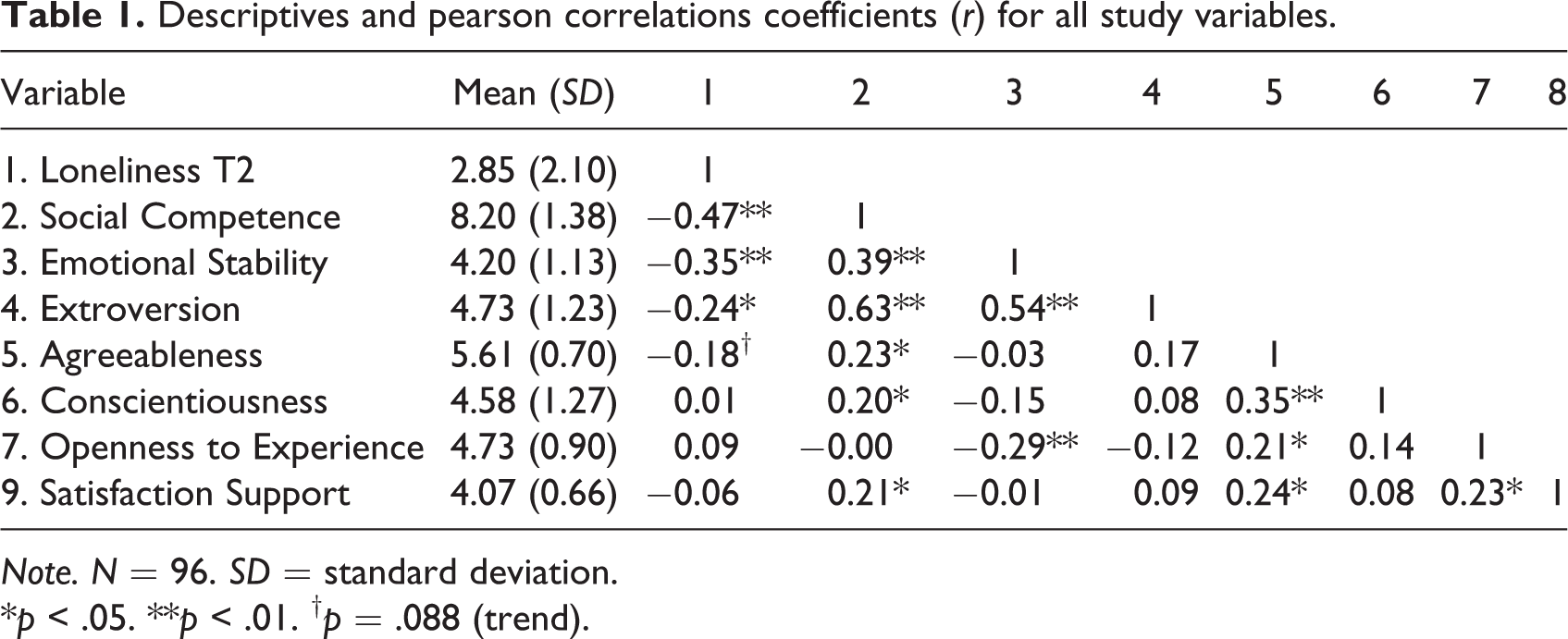
Note. N = 96. SD = standard deviation.
*p < .05. **p < .01. †p = .088 (trend).
Next, a multiple linear regression analysis was executed. The results showed that only the variables of Social Competence and Emotional Stability were significant predictors of Loneliness (see Table 2). The total multiple regression model explained 30% of the variance in the scores on Loneliness.
Predictors of Loneliness T2.
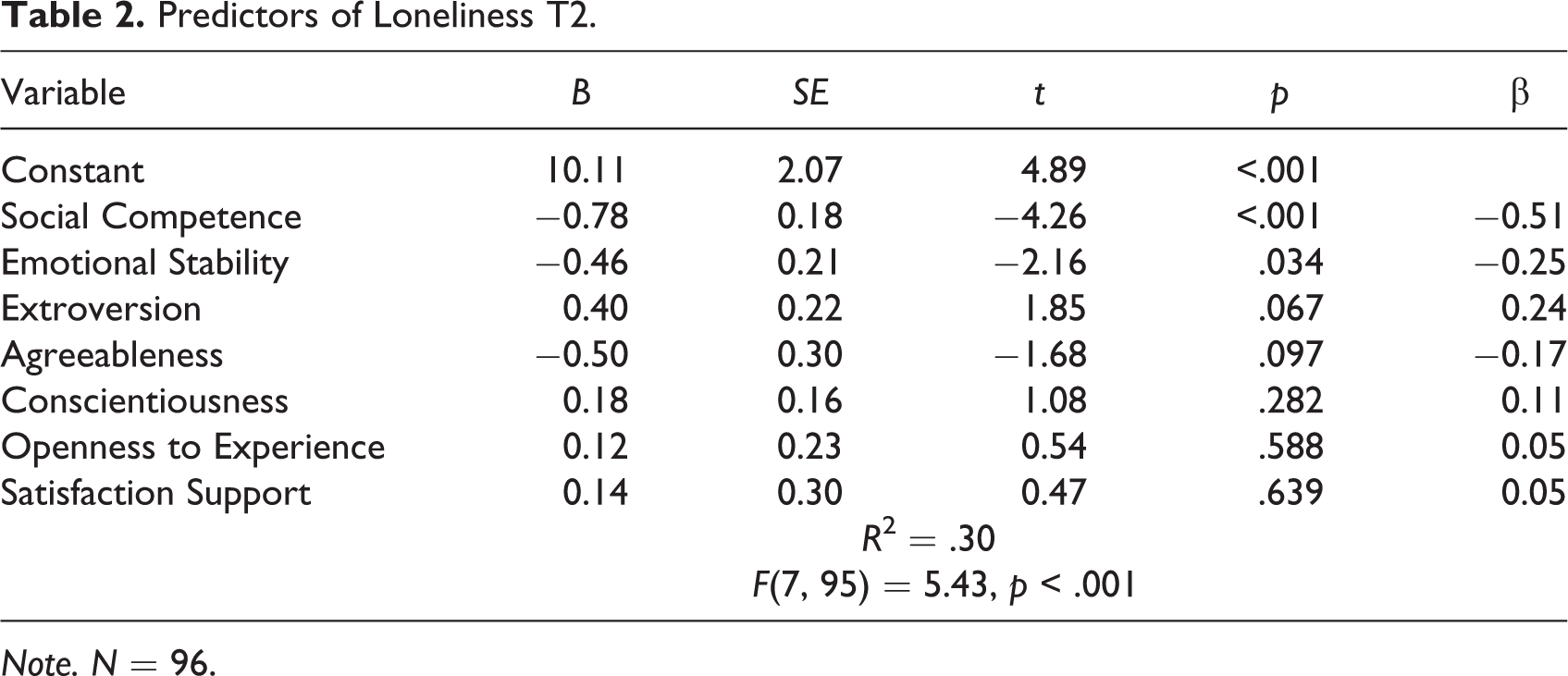
Note. N = 96.
For Emotional Stability, which was shown to be predictive of Loneliness, a mediation model was computed to analyze the role of Social Competence between emotional stability and Loneliness. It was found that social competence functions as a full mediator in the relation between Emotional Stability and Loneliness (see Table 3; Figure 1). This finding means that the direct effect between Emotional Stability and Loneliness disappeared when Social Competence was added to the statistical model. The relationship between Emotional Stability and Loneliness can, thus, be fully explained by level of social competence. The indirect effect was significant, ab = −0.29, SE = 0.10, Bootstrap CI [−0.53, −0.12]. The total effect of the mediation model was also significant, b = −0.64, SE = 0.18, t = −3.58, p < .001. The model explained 25% of the variance in the scores on Loneliness.
Model Summary information for the mediation model with Emotional Stability as predictor and Social Competence as a mediator.
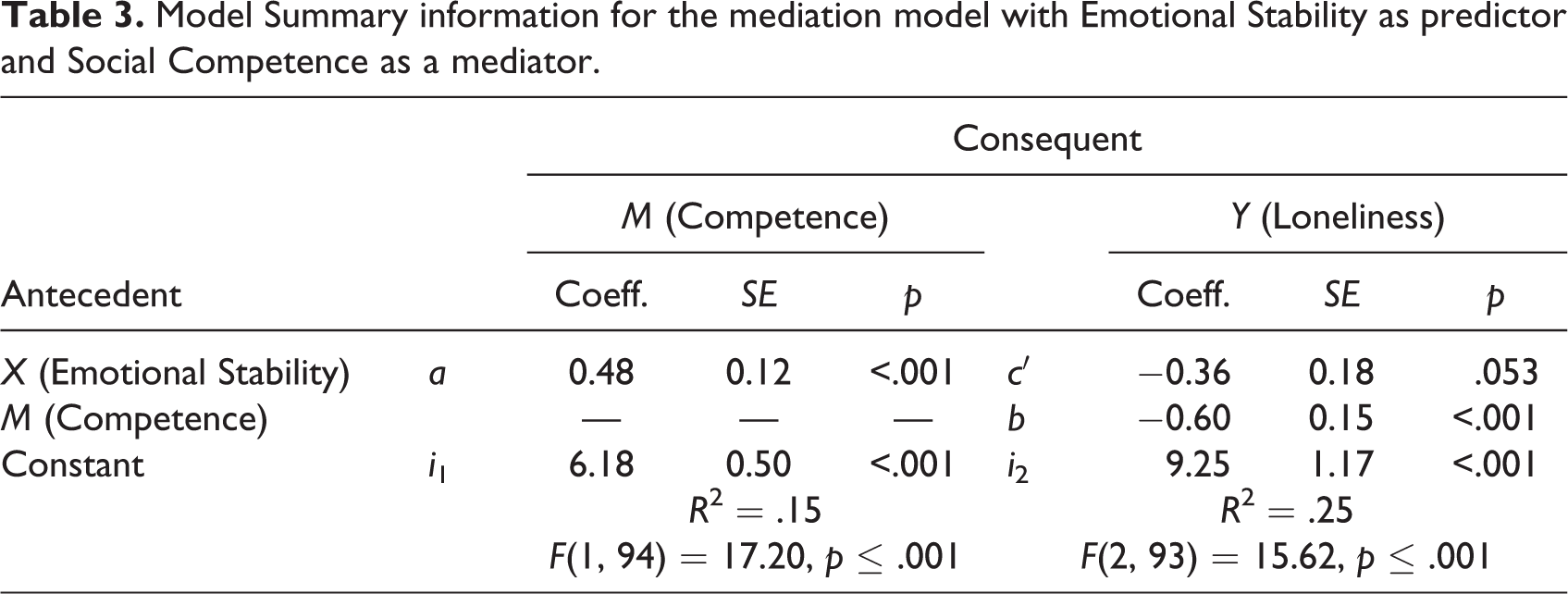
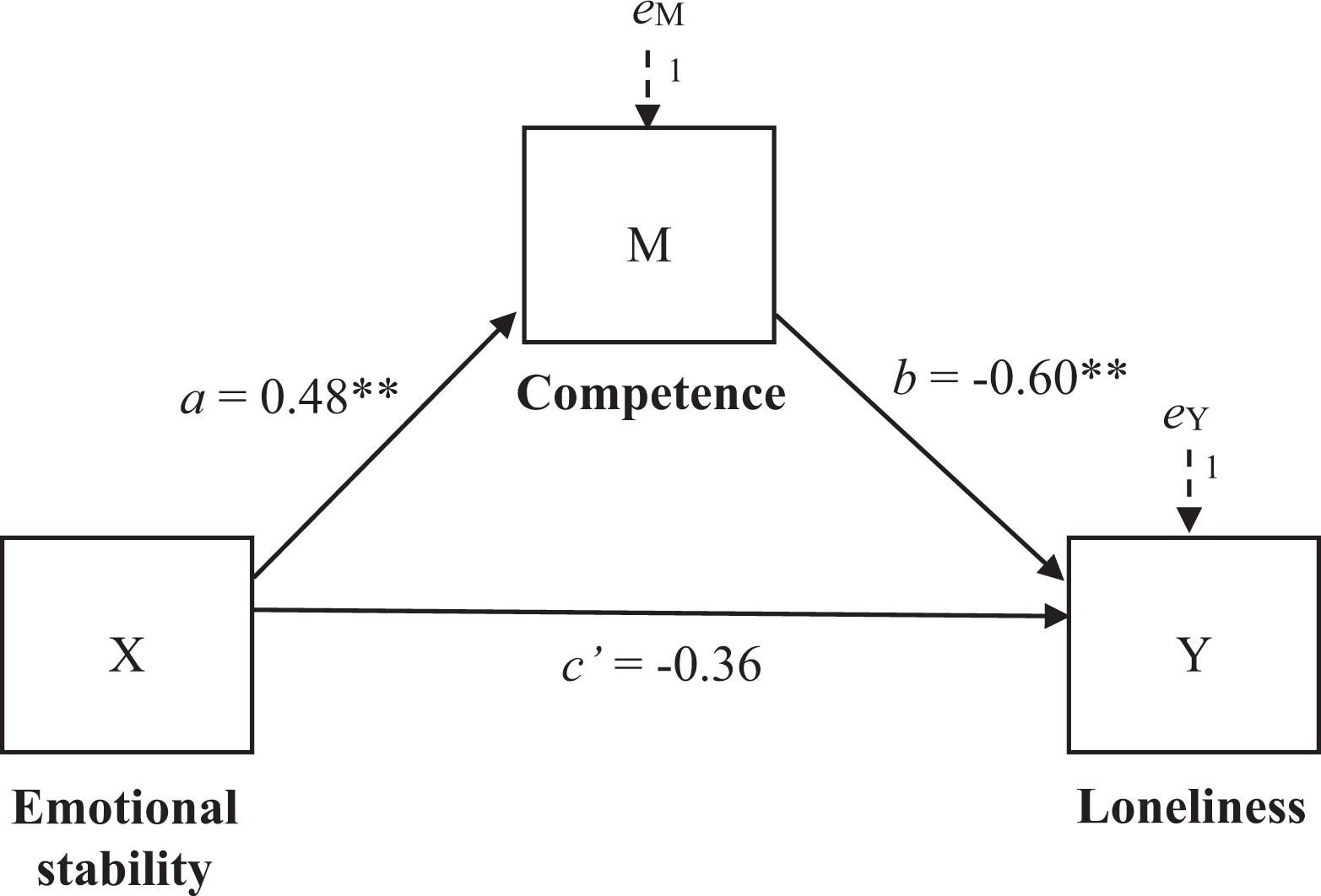
Simple mediation model with Emotional Stability as predictor in the form of a statistical diagram. **p < .010.
Discussion
The present study showed that lower social competence and low scores on the personality trait Emotional Stability are predictive of experiencing Loneliness later in life. Our results are in line with previous results from research among persons without visual impairment (Teppers et al., 2013; Vanhalst et al., 2013).
Moreover, this research found that social competence fully explains the relationship between Emotional Stability and Loneliness. This finding means that those who are less emotionally stable are less likely to be socially competent and also appear to experience more Loneliness later in life. Possibly, because emotionally unstable persons experience more social anxiety, which makes them less socially active, it is harder for them to form close relationships that can protect them from feelings of Loneliness.
The personality traits Extroversion, Agreeableness, Conscientiousness, and Openness to Experience did not predict Loneliness. For the personality traits Conscientiousness and Openness to Experience, this finding is not unexpected, because previous research found that these traits show small to no relationship with Loneliness (Teppers et al., 2013; Vanhalst et al., 2013). This lack of a relationship could be explained by the fact that these traits are less associated with a person's social functioning and development.
Further, also, no association was found between satisfaction with social support and feeling lonely. Previous research among young people with visual impairments showed that the actual amount of social support was especially predictive of psychosocial well-being (Kef & Deković, 2004). There might, thus, be a difference between the effect of amount of social support and satisfaction with social support on Loneliness. Those with satisfying levels of social support could still experience challenges with social engagement and, thus, be receiving lower levels of social support, the increasing the likelihood of their being lonely. This indirect effect could be an important direction for research in the future.
The current results show that intrapersonal factors, in this study personality traits, are only slightly important for the degree of Loneliness one experiences later in life. Flexible, interpersonal factors–in this case, social competence–do appear to be of greater importance. This result is in line with the theoretical model of De Jong-Gierveld (1987), in which it becomes clear that intrapersonal factors have little to no impact on the experience of Loneliness in contrast to the subjective evaluation of one’s social environment, which is more influential. The findings also fit well with the socioecological theory around the microsystem as it is described in the model of Bronfenbrenner (1979). In the microsystem the experienced activities, roles, and interpersonal relationships, the proximal factors, are especially influential on one’s functioning. Direct contact within relationships and interactions are important and have the greatest impact on the development of young people. Thus, lower social competence might lead to fewer social interactions and reduce the positive effects of the microsystem.
Limitations
It should be noted that there may be confounders of influence on the results. For example, low self-esteem could influence the way persons score on both Social Competence and Loneliness. However, the power of the present study is too small to test a model with more predictors. The small sample size (N = 96), caused by a low prevalence of visual impairments in the population, can thereby also be noted as a limitation, which makes the generalizability of the findings more challenging. Another methodological limitation of the study is that most of the measured variables were not normally distributed. For example, Agreeableness and Social Support were skewed to the right, meaning that the majority of the sample judged themselves as agreeable and that most of them were rather satisfied with the Social Support they received. The variable Loneliness was also skewed, with less people reporting being lonely. Also, the mean degree of Loneliness in this current sample did not go beyond the threshold of 3.00, which means that on mean level, the participants were not very lonely.
Although the exact same interview protocols were used during the first (2005) and second (2010) measurement, it is not clear how the change in interview method, from face-to-face in the first measurement to computer-assisted telephone interviews in the second measurement, might have led to differences in responses of participants. At both measurements, interviewers received extensive preinterview training and were constantly supervised during data collection by the project supervisors. No differences in participants’ experiences were reported during the postmeasurement evaluation interviews, and interviewers did not experience changes in participant responsiveness, which might be explained by the fact that face-to-face interactions may not provide additional information for most of the participants because they are not able to recognize facial expressions or physical gestures.
Implications for research and practice
Little research has been done on the predictors of Loneliness among young people with visual impairments using multiple measurement time points. The present study has presented a preliminary profile of adolescents with visual impairments who are at risk of being lonely later in life. However, other personal factors, such as job status, number of close relationships, and place of residence, could be investigated as predictors of Loneliness. Also, factors of the social context (the macro- and exosystem, described by Bronfenbrenner 1979), such as facilities and acceptance in society, have not been taken into account but are subjects of interest for future research.
The results of this study also implicate some directions for practice. Since it can be concluded that young people with visual impairments who are less emotionally stable, have low social competence, or both, are at higher risk of being lonely, attention should be paid to these individuals. They could benefit from interventions focused on improving social functioning, during adolescence, to enhance their chances of being more socially enmeshed when they reach adulthood. Being socially active provides opportunities to develop social skills and social competence. What type of intervention would be suitable for individuals with low social competence depends on the underlying causes for this social deficit. Those with low social skills benefit more from social skills training, but those with negative biases of their own social functioning profit more from interventions based on cognitive approaches that strengthen their self-confidence (Lodder, Goossens, Scholte, Engels, & Verhagen, 2016). Screening methods could be used in order to determine these issues before assigning individuals to specific interventions.
One example of an intervention focusing on social skills training could be the use of a mentoring program, since those programs are social, based on relationships, and imply many social interactions. Currently, a mentoring program for adolescents with visual impairments, Mentor Support, is being studied for its effectiveness (Heppe, Kef, & Schuengel, 2015). This intervention focuses on improving social participation and enhancing engagement in social activities. By doing activities together with a mentor and experiencing successful experiences within their social lives, it is suggested that the social competencies are stimulated and psychosocial factors such as self-esteem are enhanced. For older people with visual impairments who already experience Loneliness, an effective rehabilitation intervention, Actively Participating (“Actief Meedoen”), was developed in order to decrease Loneliness (Alma, 2012). The intervention promotes social participation and factors that are of influence on it, such as psychosocial functioning.
Other types of existing interventions that have been shown to strengthen social competence include universal social school programs for young children (Domitrovich, Durlak, Staley, &Weissberg, 2017), peer-led group meetings, and family-oriented social skills training (Amrai, Hassanzadeh, Afrooz, & Pirzadi, 2012). Cognitive bias modification procedures are suitable for those who have low social self-confidence and are socially anxious (Sportel, de Hullu, De Jong, & Nauta, 2013).
Conclusion
Adolescents with visual impairments who are less emotionally stable and have lower social competence tend to experience more Loneliness later in life. The intrapersonal factor “personality” appears only important in its relationship to Loneliness through the more interpersonal factor of “social competence.” Since interpersonal factors are easier to adjust, support should be provided for those at risk. Therefore, support is needed to enhance the social competence of young people with visual impairments in order to reduce the likelihood that they will experience Loneliness later in life.
Footnotes
Declaration of conflicting interests
The author(s) declared no potential conflicts of interest with respect to the research, authorship, and/or publication of this article.
Funding
The author(s) received no financial support for the research, authorship, and/or publication of this article.