




Abstract
Research has shown that instructive feedback (IF) facilitates the generalization of tacts in individuals with autism spectrum disorder (ASD). However, no study to date has examined the effects of IF on the emergence of tacts across primary and secondary languages with both trained and non-trained exemplars. This study evaluated the efficacy of IF in promoting the generalization of tacts across languages using a nonconcurrent multiple baseline design with four participants with ASD from Spanish-speaking families. The results demonstrated that IF was effective at producing generalization across novel stimuli exemplars in primary and secondary targets for two of the four participants. Additional training components (i.e., rehearsals and no-no prompts) were effective in producing the same generalization outcomes with the remaining two participants.
Keywords
Introduction
In recent years, both parents and scholars have shown an increased interest in teaching secondary languages 1 to individuals with autism spectrum disorder (ASD; e.g., Jegatheesan, 2011; Yu, 2013). To that end, Skinner’s (1957) analysis of verbal behavior has served as the theoretical framework for behavior-analytic research aimed at teaching foreign languages (e.g., Cao & Greer, 2019; Cortez et al., 2020, 2022; Daly & Dounavi, 2020; Petursdottir et al., 2008; Wu et al., 2019). Skinner’s analysis categorizes verbal behavior into operants, such as mands, tacts, echoics, and intraverbals, which form the foundation for language acquisition. Among these, tact training has emerged as a highly useful verbal operant in foreign language instruction, as research suggests it facilitates the production of more advanced secondary language responses, such as native-to-foreign and foreign-to-native intraverbal responses, more effectively than other operants (e.g., Cortez et al., 2020).
While research highlights the utility of tact training, culturally and linguistically diverse (CLD) children with ASD are likely to face barriers in accessing secondary language training (Kangas, 2018), such as limited exposure to effective language instruction in their native or secondary language. Consequently, CLD children with ASD may benefit from strategies designed to enhance generalization during limited instructional time. One such strategy is instructive feedback (IF), a method with well-documented generative properties and substantial empirical support (e.g., Frampton & Shillingsburg, 2020). IF has been defined as the use of additional nontargeted stimuli (i.e., targets that do not require a response) within trial-based training to expand a student’s number of learning opportunities (Werts et al., 1995). For example, when provided with an instruction (e.g., “What’s this?”), an individual may be directly taught to name an item (e.g., a car) when access to a preferred item is made contingent on the utterance of the name; while another response (e.g., feature, function, class) is concurrently and indirectly taught via the embedding of additional language by the therapist immediately after the delivery of reinforcement (e.g., “It’s a car and you can drive it!”).
Previous research has called for a deeper evaluation of the “range of generalization measures” in IF research (Werts et al., 1995, p. 72). Although numerous studies have demonstrated the capacity of IF to promote stimulus generalization (e.g., Schnell et al., 2018), little research has examined its effects on response generalization. Existing research on response generalization has suggested that children who demonstrate bidirectional naming (BiN; Miguel, 2018) often exhibit response generalization when secondary targets join the same stimulus class as primary targets. BiN may promote the production of novel responses without a specific learning history (e.g., Tullis et al., 2022). If this is the case, IF may be a valuable teaching strategy to explore for developing secondary language tacts, as it could help refine efficient teaching practices (e.g., strategies that reduce the number of trials to mastery; Frampton & Shillingsburg, 2020). Furthermore, in the context of culturally responsive practices, it may facilitate the acquisition of culturally relevant responses (i.e., secondary language) that might otherwise be difficult for individuals with disabilities to access (Kangas, 2018). Thus, evaluating whether IF promotes generalization to untrained tacts (e.g., in secondary languages) and stimuli (e.g., in both primary and secondary languages) may be valuable. To our knowledge, no prior research has explored the use of IF to promote generalization in this way, highlighting the importance of further investigation.
To date, only two studies have used IF to teach secondary language responses to individuals with disabilities. Appelman et al. (2014) taught four students with developmental delays English sight words directly, while embedding Spanish sight words as secondary targets via IF during dyad trial-based training. Jimenez-Gomez et al. (2022) subsequently taught three participants listener discriminations to Spanish stimuli via IF during English trial-based learning. In the former study, participants learned 85% of the Spanish sight words through IF, while in the latter, one of the three participants acquired Spanish listener discriminations via IF, with the other two requiring remedial training. Although prior IF studies show promise, discrepancies remain regarding secondary language acquisition, particularly when comparing findings for typically developing children and children with ASD. Research with typically developing children suggests that tact training may lead to better long-term outcomes for secondary language instruction (Cortez et al., 2020). However, IF studies involving individuals with ASD have focused on sight word reading (Appelman et al., 2014) and listener responding (Jimenez-Gomez et al., 2022), rather than tact training. Therefore, additional research is needed to explore the use of IF specifically for teaching secondary language tacting responses in children with ASD, which may yield better long-term outcomes. To that end, the purpose of the current study was to evaluate the effects of IF on the production of primary language and secondary language tact targets across both trained and non-trained exemplars with children with ASD from primarily Spanish-speaking families.
Method
Participants, Setting, and Materials
Four participants with confirmed ASD diagnoses participated in the study. Three identified as Hispanic, and one identified as both Hispanic and White. All participants were enrolled in public education and received special education services concurrently during the study. We selected the participants for the following reasons: (a) the parents of the participants primarily spoke Spanish at home; (b) their parents indicated meaningful interest in secondary language development; (c) they had an ASD diagnosis that was confirmed using the Childhood Autism Rating Scale (2nd ed.; CARS-2; Schopler & Bourgondien, 2010); and (d) they demonstrated the ability to vocally imitate sounds with the Early Echoic Skills Assessment (EESA; Esch, 2014). The EESA is a criterion-referenced assessment tool for evaluating a child’s ability to repeat sounds across simple syllables, reduplicated syllables, two-syllable combinations, and three-syllable combinations. The EESA score can range from 0 to 100, with a high score indicating stronger echoic skills across various two- and three-syllable combinations. The EESA was selected because an echoic repertoire (or lack thereof) can influence an individual’s ability to acquire secondary languages (e.g., Cao & Greer, 2019) through IF (e.g., Haq et al., 2017), thus confirmation of the participant’s ability to imitate vocal models was warranted. All participants demonstrated a strong echoic repertoire (see Table 1).
Participants’ Ages and Assessment Results.
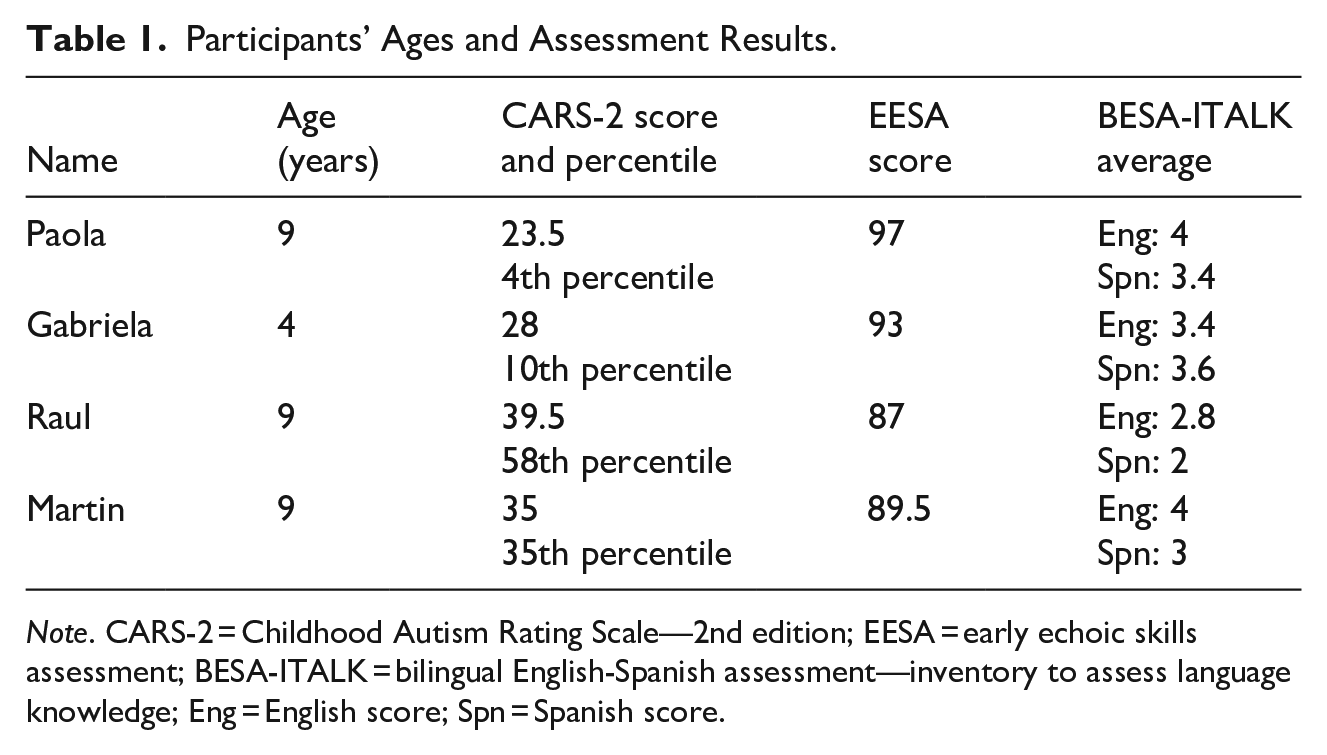
Note. CARS-2 = Childhood Autism Rating Scale—2nd edition; EESA = early echoic skills assessment; BESA-ITALK = bilingual English-Spanish assessment—inventory to assess language knowledge; Eng = English score; Spn = Spanish score.
The experimenters assessed the parent’s language proficiency through an interview conducted by the first author, who is fluent in both English and Spanish. Sample questions asked during the interview included: “¿Cuál es su idioma primario?” [What is your primary language?], “¿Cómo habla usted con su hijo(a) en casa?” [How do you speak with your child at home?], “¿Qué palabras sabe su hijo(a)?” [What words does your child know?], and “¿Qué nombres de objetos sabe su hijo(a)?” [What item names does your child know?]. All four participants’ parents reported that Spanish was the primary language used to communicate with their children at home. Next, we assessed the participants’ English-Spanish language proficiency and impairments using the Inventory to Assess Language Knowledge (ITALK) parent questionnaire from the Bilingual English-Spanish Assessment (BESA; Peña et al., 2018) to help determine whether the participants were more proficient in English or Spanish. Research has indicated that the ITALK possesses strong psychometric properties (Pratt et al., 2022). The first author completed the ITALK as an interview with the parents and included the presentation of five questions per language (10 questions total) determined the participants’ speech intelligibility, vocabulary knowledge, sentence length, grammaticality, and language comprehension across English and Spanish (Pratt et al., 2022). Scores can range between 0 and 5 for each language. A higher score in English when compared to Spanish indicates the participant is more proficient English versus Spanish (i.e., English is their primary language and Spanish is their secondary language). All participants received instruction in English at their respective schools. The participants’ parents had received behavioral support in the form of applied behavior analysis in the past. All participants were provided a pseudonym to maintain their confidentiality. All participant characteristics are depicted in Table 1.
The experimenters conducted all baseline, training, and maintenance/generalization sessions in the participants’ respective homes. We held sessions in a room that included various chairs, tables, couches, preferred items, and a GoPro Hero 7 camera, which recorded all sessions. A laptop presented all stimulus exemplars using PowerPoint. Before initiating training trials, the experimenter identified preferred items by asking participants what they would like to earn. We did not conduct a preference assessment because all participants had prior experience selecting preferred items in this manner. Paola, Gabriela, Raul, and Martin indicated preference for Sky: Children of the Light on the Nintendo Switch, pretend play with a toy tea set, a tornado video game iPad application, and an American football video game iPad application, respectively. The experimenters used the selected items across sessions as putative reinforcers. We seated the participants on the same floor area or table prior to the beginning of probe or training trials. Parents were occasionally present during sessions.
Stimuli
The experimenters selected three exemplars of three items for each participant, for a total of nine digital images. One exemplar from each item was directly taught (for a total of three trained exemplars) and the other two exemplars from each item were reserved to test stimulus generalization (for a total of six non-trained exemplars). Three exemplars from one additional item were designated from training to control for history and maturation effects (Schnell et al., 2018) during probe sessions. We selected items for training if the participants did not know the name of the items in English and Spanish; and if the parents indicated that the non-mastered stimuli were relevant and meaningful to the participant’s development. We taught the primary targets in the participants’ primary language, and the secondary targets in the participants’ secondary language (as determined by the BESA-ITALK scores). A list of the set of items used are depicted in Table 2. An example of how stimulus exemplar sets were used to train and test stimulus and response generalization outcomes can be found in Table 3.
Training and Control Sets for Primary and Secondary Languages.
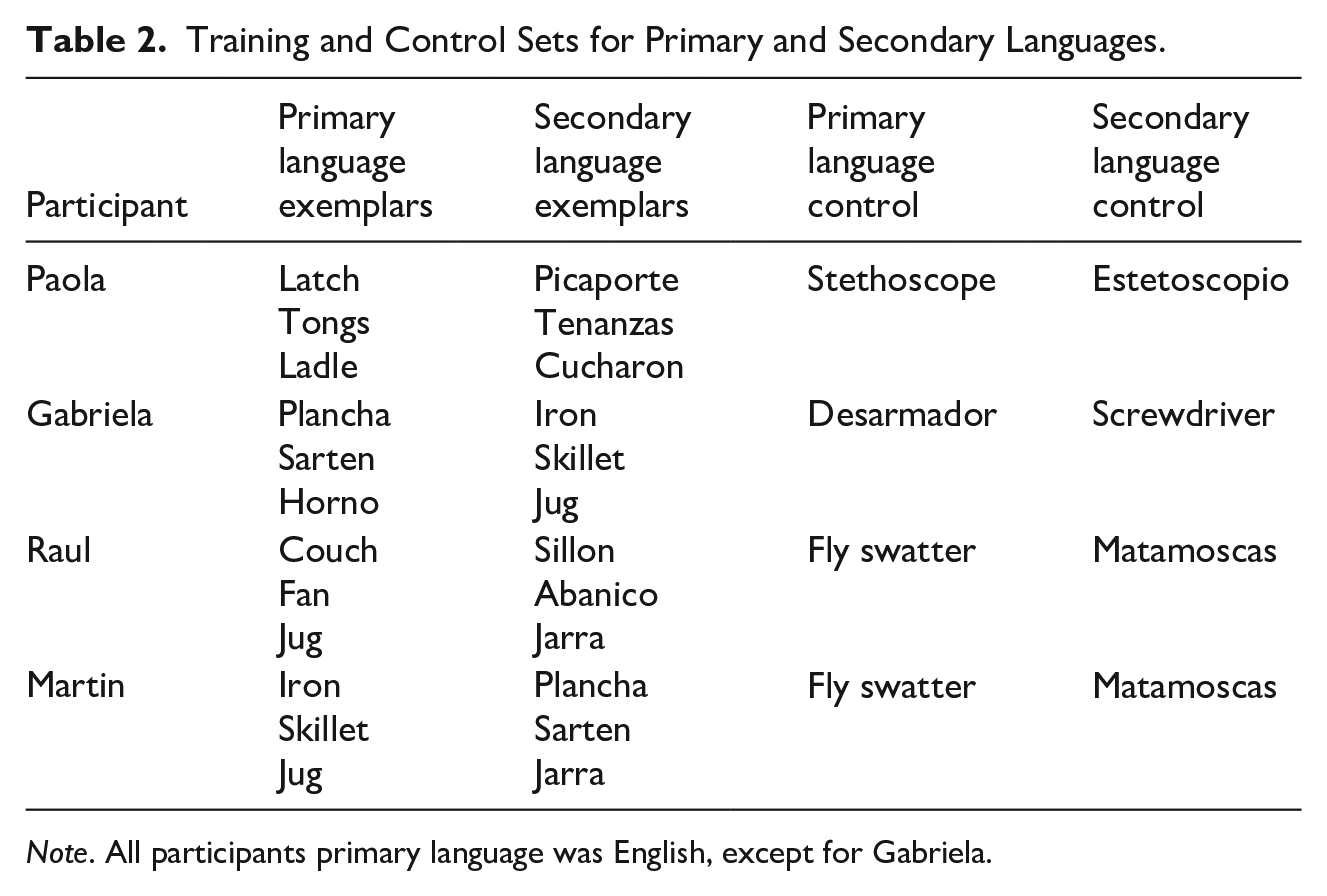
Note. All participants primary language was English, except for Gabriela.
Example of Stimulus Sets Used in Relation to Primary and Secondary Target Outcomes.
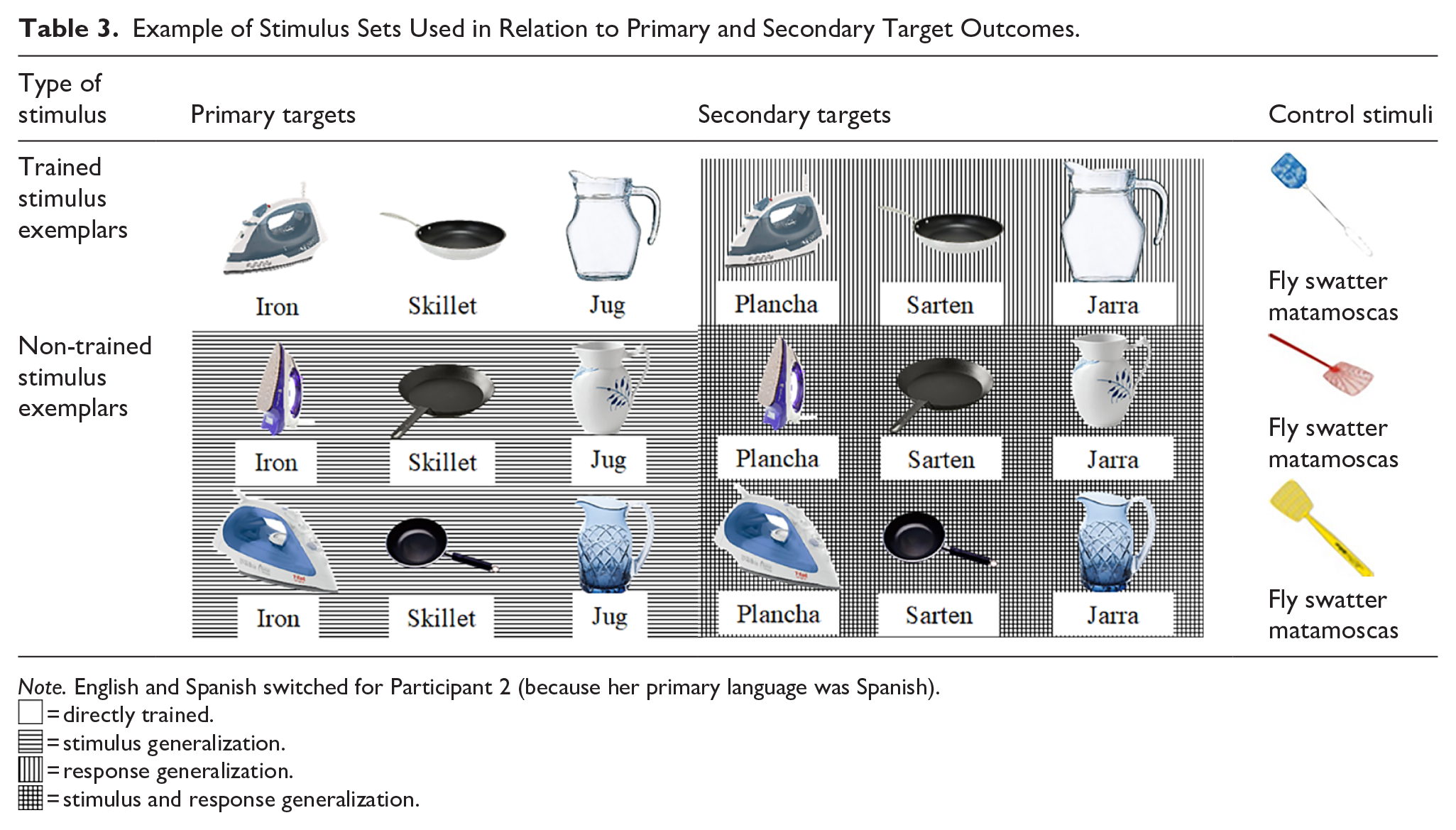
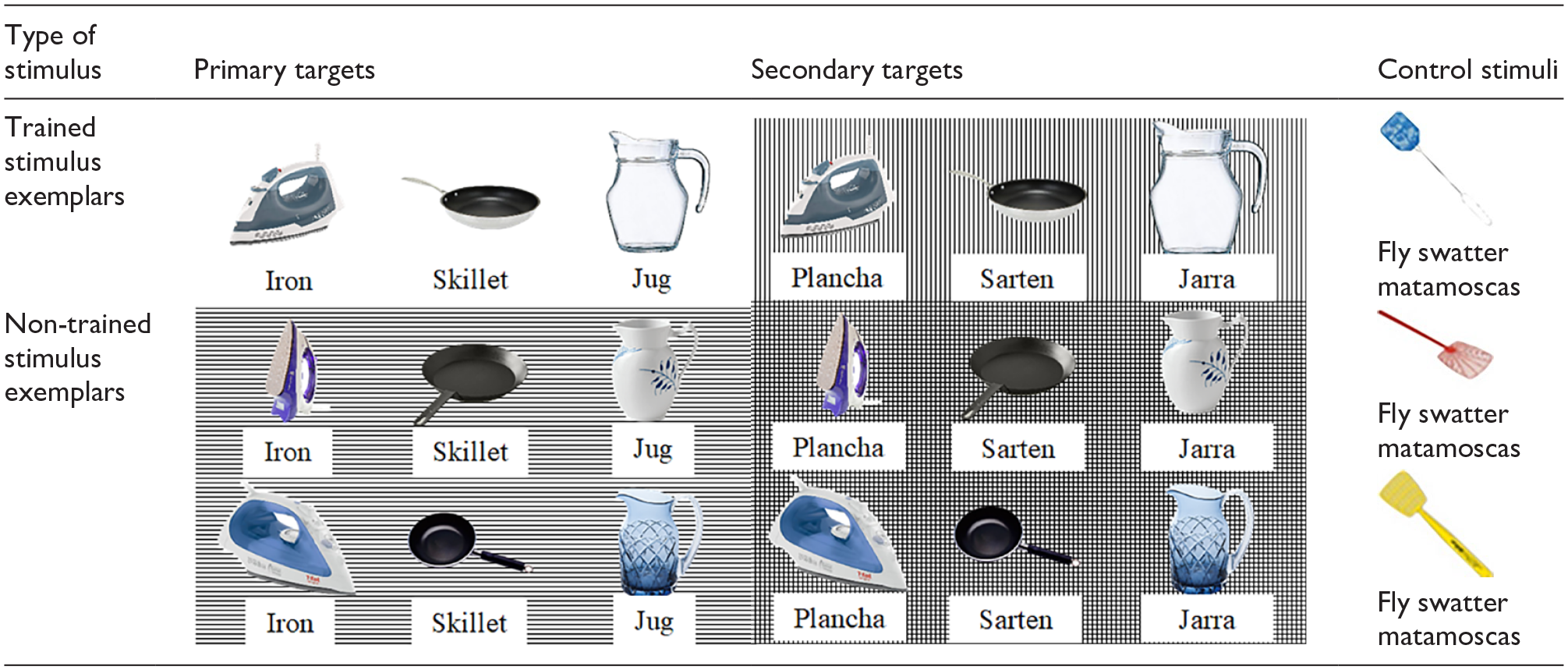
Note. English and Spanish switched for Participant 2 (because her primary language was Spanish).
 = directly trained.
 = stimulus generalization.
 = response generalization.
 = stimulus and response generalization.
Dependent Variable and Measurement
The dependent variables included correct responding with (a) primary targets tacts with trained exemplars (i.e., participants named items in their primary language using images that were directly trained); (b) secondary targets expansion tacts with trained exemplars (i.e., participants named items in their secondary language with images that were directly taught); (c) primary targets with non-trained exemplars (i.e., participants named items in their primary language with images that were not directly taught); and (d) secondary targets expansion tacts with non-trained exemplars (i.e., participants named items in their secondary language when presented with images that were not directly taught).
A correct response for any of the dependent variables during probe sessions was defined as vocalizing the name of the item when presented with the image of the item within 5 s of the instruction “What is this?” or “¿Qué es esto?” (Leaf et al., 2017). If the participant named a different item, stated “No sé” or “I don’t know,” or did not respond before the time requirement, an incorrect response was marked. If the participant responded to the question in another language, an incorrect response was marked as well (e.g., an incorrect response was marked if the participant responded in English when asked “¿Que es esto?” and vice versa). We made this decision to produce practically meaningful responses in the presence of secondary language speakers. That is, it was likely that the participants would encounter stakeholders that do not speak their primary language, therefore it was practically meaningful to teach discrimination between languages. For the intraverbal tact to occur in a naturalistic context, they would need to know the discriminative stimulus for emitting the tact in Spanish versus English. Thus, the addition of this instruction to IF was warranted. Children as young as 10 to 12 months of age can begin to discriminate between two languages (Burns et al., 2007; Grosjean, 2010). Data were converted to percent correct by dividing the total number of correct responses by the number of opportunities to respond and then multiplying by 100 for each session.
Interobserver Agreement
The fourth and fifth authors conducted observations and data collection during baseline, training, and posttraining sessions to determine interobserver agreement (IOA), which was calculated by dividing the number of agreements by the total number of agreements and disagreements and multiplying by 100. IOA data were collected from 35.29%, 50%, 37.93%, and 29.41% of probe sessions with Paola, Gabriela, Raul, and Martin, respectively. Mean IOA during probe sessions was 97.92% (range = 87.5%–100%) for Paola, 100% for Gabriela, 96.97% (range = 91.67%–100%) for Raul, and 98.33% (range = 91.67%–100%) for Martin. It is worth noting that Martin had Although the overall percentage of IOA sessions scored for Martin was lower relative to other participants, the absolute number of IOA-scored sessions was higher due to his greater total number of sessions.
Procedural Integrity
The third author scored baseline, training, modifications, and posttraining sessions to assess procedural integrity, which was calculated by reviewing a task list of necessary steps and scoring whether these steps occurred during the sessions. We collected procedural integrity data during probe sessions for 100%, 100%, 91.3%, and 91.18% of sessions for Paola, Gabriela, Raul and Martin, respectively. Mean procedural integrity was 100% for Paola, 97.32% (range = 76.67%–100%) for Gabriela, 99.59% for Raul (range = 99.15%–100%), and 99.78% (range = 91.67%–100%) for Martin. One session with Paola was under 80% (viz., 76.67%).
Experimental Design
A nonconcurrent multiple baseline design (Watson & Workman, 1981) across participants was implemented to examine the effects of IF on the emergence of primary targets and secondary targets across trained and non-trained stimulus exemplars. A set of control stimuli was included as an additional design component (e.g., to detect possible history and maturation effects; Schnell et al., 2018).
Procedure
Sessions were conducted 1 to 3 times per week, based on the availability of participants. Sessions lasted approximately 30 to 60 mins per day (i.e., shorter sessions occurred during baseline and posttraining, longer sessions occurred when participants received training). Upon arrival at the participants’ homes, they were provided with play time for approximately 5 min, prior to, and after, baseline, training, and post-training sessions.
Pre-Experiment Assessment
The experimenter completed 2 to 3 initial assessment sessions. During the initial assessment sessions, the experimenter administered the CARS-2, BESA-ITALK, and EESA. Next, the experimenter identified non-mastered stimuli by asking the parents which household items were unknown to the participant. Next, the experimenter confirmed whether those stimuli were unknown to the participant by asking, “what is this” or “¿qué es esto?” Based on the assessment, we identified four items to use during the experiment.
Probes
The experimenters conducted probes throughout each phase of the study (baseline, training, modifications, and posttraining phases). We conducted probes at the beginning of each session, across experimental phases, to measure (a) emergence of primary and secondary targets and (b) emergence of responses to trained and non-trained stimulus exemplars (Table 3). Prior to probe sessions, we provided the participants with access to play materials. To initiate probes, the experimenter prompted the participants from play by asking them to relinquish their toys or to place them down. Next, the experimenter asked the participants, “are you ready?” or “¿estas lista?” to prompt the participants to attend to the images of stimuli. Next, the experimenter presented the laptop containing the images of stimuli and tested three exemplars from each of the four items, for primary and secondary targets, for a total of 24 trials (i.e., 3 exemplars × 4 items × 2 languages = 24 trials). No feedback (praise, corrective) was provided for correct or incorrect responses. Additionally, to control for potential sequence effects, we randomized the order of presentation of the 24 stimuli via an online random number generator (available at www.random.org). During the training phase, we conducted probes prior to the training trials.
Baseline
The baseline procedures were identical to the probe session procedures described above (i.e., we provided no instruction regarding targets during baseline).
Training
During each training session, the experimenter implemented five training trials for one of the exemplars of each of the three items, for a total of 15 training trials (5 × 3 = 15 trials). At the beginning of each training session, the experimenter first acquired the participant’s attention, as described in the probe section above. The experimenter next presented the image of a stimulus to the participant along with the discriminative stimulus in the primary language (“What’s this” or “qué es esto?”). The experimenters provided a 0 s prompt delay (i.e., 0 s PD) in the form of a vocal model prompt of the primary target during the first training session for each of the 15 trials. If the participant vocally imitated the vocal model prompt, the experimenter provided (1) praise in the primary language (e.g., “That’s right! It’s a hammer!”); (2) IF in the secondary language (e.g., “¿Qué es esto? Es un martillo!”), and (3) access to a preferred item/action for 30 s. If the participant emitted a vocalization that did not match the vocal model prompt, or did not respond, the experimenter re-presented the instruction and a vocal model prompt. If the participant responded to the re-presented prompt and imitated the vocalization, the experimenter provided the participant with praise in the primary language, IF in the secondary language, and access to a preferred item/action for 30 s. All participants were responsive to the vocal model prompt; however, if no response had occurred after three re-presentations, the experimenter would have terminated the trial, and no reinforcer would have been provided.
After the first training session, the experimenter faded the PD to 3 s (i.e., constant time delay; Snell & Gast, 1981). That is, the experimenter waited 3 s after the presentation of the discriminative stimuli (the image of the item and the instruction “what’s this?”) for the participant to respond. If the participant independently vocalized the name of the item within those 3 s, the experimenter provided (1) praise in the primary language; (2) IF in the secondary language; and (3) access to a preferred item/action for 30 s. If the participant responded with an answer that was unintelligible, in a different language, or if there was no response after 3 s elapsed, the experimenter implemented an error correction procedure. The error correction involved re-presenting the instruction and providing an echoic prompt until the participant imitated the echoic prompt. When the participant imitated the echoic prompt, the experimenter re-presented the instruction with a 3 s PD. If the participant responded with the correct name of the item, the experimenter provided (1) praise in the primary language; (2) IF in the secondary language, and (3) access to a preferred item/action for 30 s. Training data are available upon request.
Modification 1 (Mod 1)
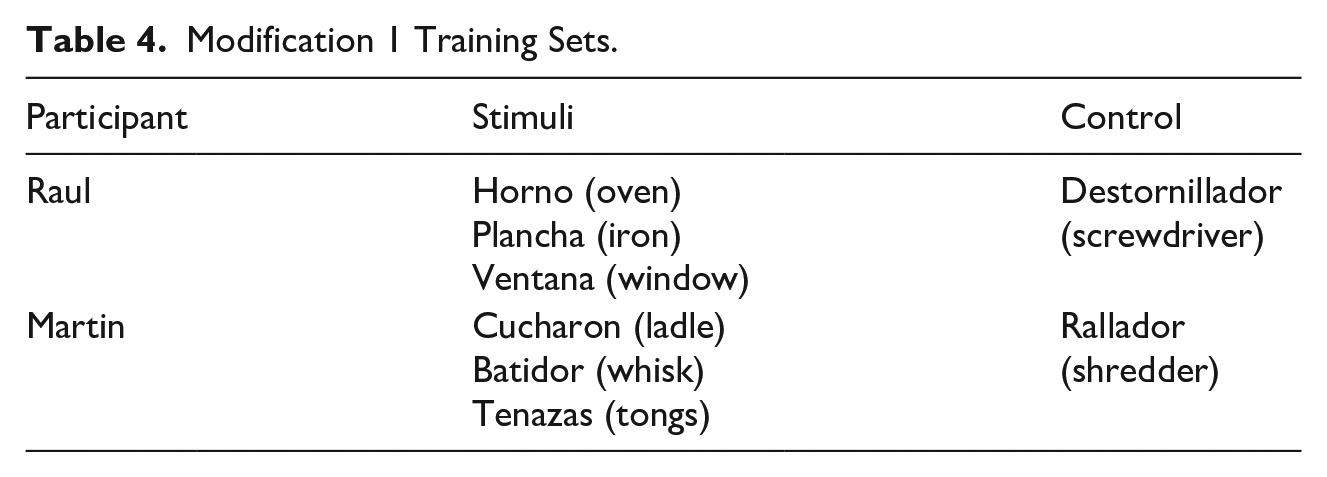
Data indicated that Raul and Martin did not acquire secondary targets across trained and non-trained exemplars (i.e., they always emitted responses in their primary language regardless of whether instructions were presented in English or Spanish during probes). As such, we modified the training procedure by adding additional training sessions following the original probe and training sessions, in which the experimenter trained Raul and Martin on a new set of items, and their corresponding exemplars, solely in the secondary language while continuing to implement training and testing with the original target stimuli. Table 4 summarizes the new set of items and the controls we utilized with Raul and Martin during Modification 1 (Mod 1). The purpose of the modified procedure was to establish stimulus discrimination of secondary language instruction and stronger stimulus control over secondary language responses by creating a history of reinforcement during secondary language instruction via the direct training of the additional stimuli in the secondary language. Because we did not directly teach the stimuli that we targeted in the initial training phase during Mod 1 (i.e., we used novel stimuli during Mod 1 that were distinct from those utilized in the initial training phase), nor the secondary language responses that were presented as IF, we were still able to evaluate generalization with the original stimuli. The procedures for Mod 1 were identical to the Probe Sessions and Training Sessions procedures described above except the training sessions did not include IF and we utilized novel stimuli. Again, Mod 1 probes and training sessions were implemented following the Probe Sessions and Training Sessions for the initial set of stimuli and exemplars (with IF). Data from the Mod 1 training sessions are available upon request.
Modification 1 Training Sets.
Post-COVID 19 Probes/Baseline (P-C19)
The Coronavirus Disease of 2019 (hereafter referred to as COVID-19) interrupted Raul’s Mod 1 condition and resulted in a 13-month pause with his participation. Participation resumed upon approval from the Institutional Review Board (IRB) and Office of the Vice President for Research that in-person research could continue. During this phase, we re-implemented the initial Baseline condition (labeled as P-C19 in Figures 1 and 2) to assess maintenance of responses (i.e., we reversed from Mod 1 to P-C19 procedures). Data from three sessions indicated (a) responding in the primary targets across trained and non-trained exemplars remained elevated and (b) secondary targets did not emerge across trained and non-trained exemplars. Thus, we resumed training conditions.
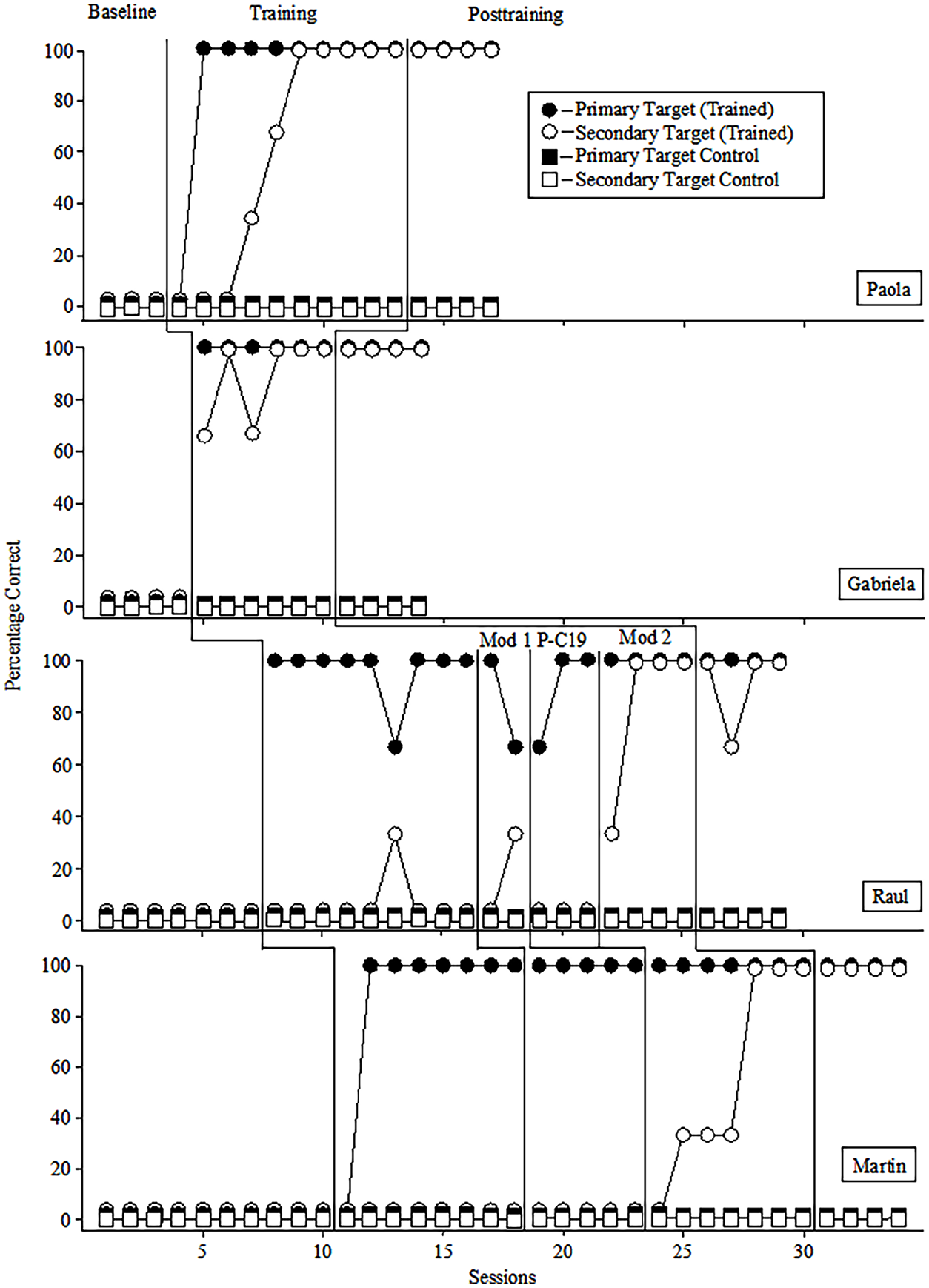
Probe data of the participants’ responses to trained exemplars in primary and secondary targets.
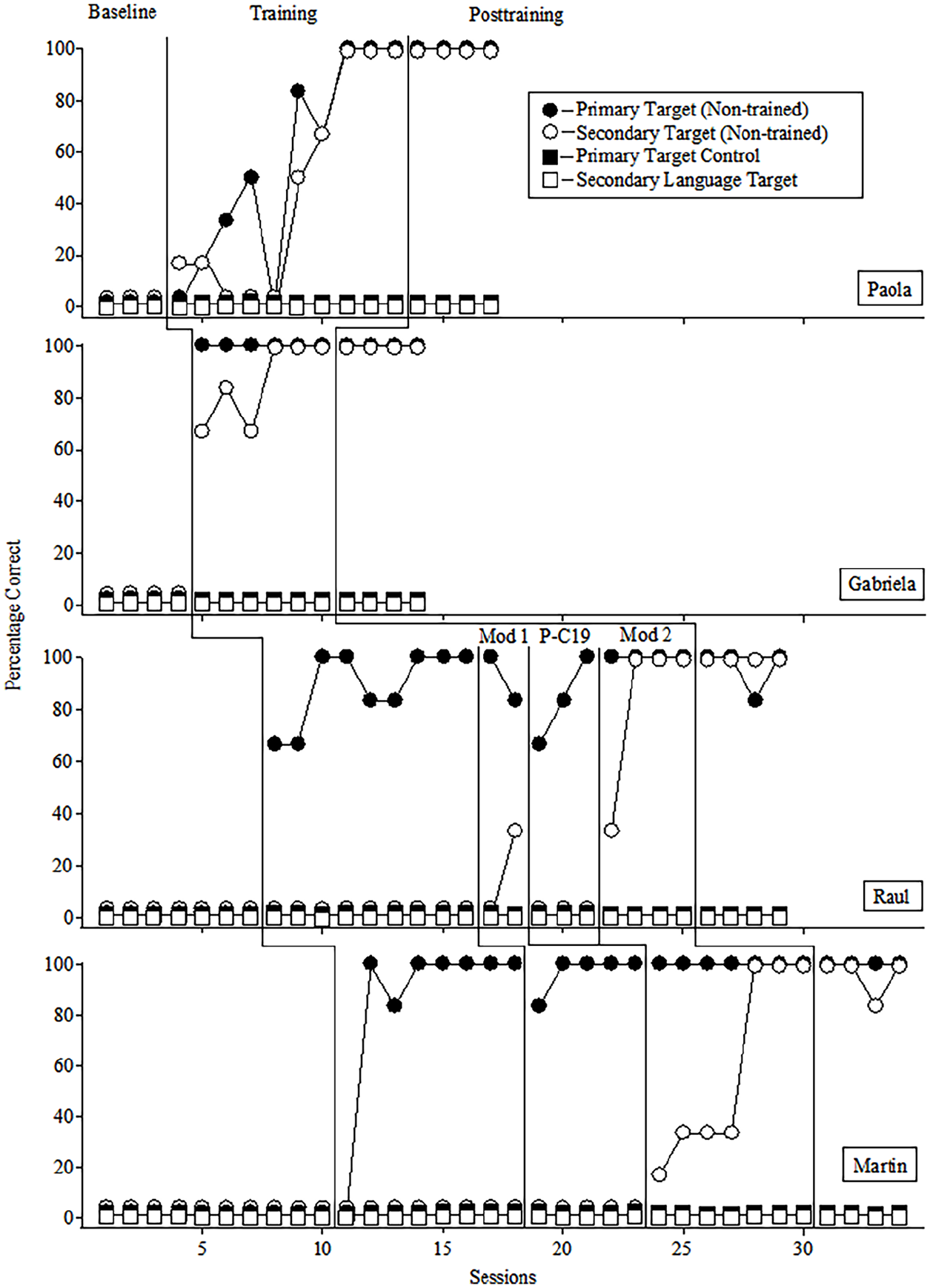
Probe data of the participants’ responses to non-trained exemplars in primary and secondary targets.
Modification 2 (Mod 2)
Raul was unable to resume the Mod 1 phase of the study due to COVID-19 concerns. Although the Office of the Vice President for Research had granted approval to resume our research, concerns regarding COVID-19 contamination were still actively present at that time (e.g., risks could be mitigated with proper equipment, but vaccines were not readily available to the population of interest at that time). The presence of concerns pertaining to COVID-19 compelled us to further adapt Mod 1 (which appeared to be ineffective based on the few data collected) with an additional procedural component that might increase the overall likelihood that the participants would acquire the generalized responses as quickly as possible. Thus, we further modified the procedures to promote acquisition and reduce the number of sessions it may require reaching mastery criterion (thereby reducing the possible number of opportunities for COVID-19 contamination to occur), labeled as Modification 2 (Mod 2 on the figure). Specifically, the experimenter (a) incorporated a no-no prompt (NNP; e.g., “That’s not it, try again”; Fentress & Lerman, 2012) during probe sessions and (b) conducted a rehearsal immediately after the training sessions involving IF. The NNP was introduced to deliver corrective feedback to the participants and address the occurrences of primary language responses during secondary language probes (given that both participants emitted primary language responses in response to secondary language prompts). An NNP was introduced as a generalization strategy (i.e., modification of maladaptive consequences, Stokes & Osnes, 1989), by aiming to delimit responses emitted that did not match the instructions provided. Previous research has suggested that NNPs may lead to faster skill acquisition (Fentress & Lerman, 2012) indicating the use of the strategy with Raul and Martin given their patterns of responding with IF alone. We also introduced a rehearsal component to provide the participants with an opportunity to emit the previously presented responses. Previous research has suggested that “overt rehearsal” (Jimenez-Gomez et al., 2022, p. 25) of nontarget responses can lead to generalized responding in some cases. For example, previous research has shown that echoic responding to nontarget stimuli could be associated with improved acquisition of IF (e.g., Nottingham et al., 2017; Vladescu & Kodak, 2013). Lastly, given that the procedures used during Mod 2 were effective for Raul, we sought to replicate their effects with Martin.
The procedures for sessions that included NNPs were similar to baseline except that when participant emitted an incorrect response (e.g., stating the name of the item in English if the instruction was delivered in Spanish or stating the wrong name of the stimulus), the experimenter delivered the NNP. If the participant responded to the NNP using the language that matched the language of instruction and with the correct name of the item, the experimenter implemented the next trial with the subsequent stimulus. If the participant emitted an incorrect response again following the NNP, we represented the NNP. If the second NNP did not occasion a response in the language that matched the language of instruction, nor in the correct name of the stimulus, the trial was terminated, and the experimenter proceeded to the next trial. Responses that were emitted following a NNP were marked as incorrect.
Upon the completion of Training sessions, the participants in Mod 2 were presented with opportunities to rehearse the stimuli that were recently presented via IF by replicating the conditions and procedures described above (see Probe section). No NNPs or vocal model prompts were provided during the rehearsals.
Posttraining/Maintenance
The experimenter followed-up with each participant once-per-week for 4 weeks. The procedures were identical to those used during the baseline probe sessions. Participation in the study was terminated if the participant demonstrated 100% accuracy during three out of the four sessions across primary and secondary targets with trained and non-trained exemplars.
Social Validity
The participants’ mothers were provided with a social validity form (see Supplementary Materials) that was adapted from the Treatment Evaluation inventory – Short Form (TEI-SF; Kelley et al., 1989) to include some items from the culturally responsive research rubric described by Bal and Trainor (2016). The scale was rated using a 5-point Likert scale (1 = Strongly disagree, 2 = Disagree, 3 = Neutral, 4 = Agree, 5 = Strongly agree). Because some of the mothers’ primary language was Spanish, the adapted form was also translated into Spanish by an English-Spanish translator with more than 10 years’ experience translating.
Results
Figure 1 displays data from probe sessions across primary and secondary targets with trained stimulus exemplars. Figure 2 displays data from probe sessions across primary and secondary targets with non-trained exemplars. Before intervention was implemented, the four participants emitted 0% correct targets during probes with trained and non-trained exemplars, as well as with primary and secondary targets.
Following the implementation of the intervention, Paola’s responding accuracy increased above baseline levels for primary targets with trained exemplars (M = 90%, range = 0%–100%), secondary targets with trained exemplars (M = 59.99%, range = 0%–100%; i.e., response generalization), primary targets with non-trained exemplars (M = 55%, range = 0%–100%; i.e., stimulus generalization), and secondary targets with non-trained exemplars (M = 45%, range = 0%–100%; response and stimulus generalization). Paola reached mastery criterion (i.e., 100% responding accuracy across three consecutive sessions with primary and secondary targets) after 10 sessions. During posttraining, Paola maintained elevated levels of responding for primary targets with trained exemplars (M = 100%), secondary targets with trained exemplars (M = 100%), primary targets with non-trained exemplars (M = 100%), secondary targets with non-trained exemplars (M = 100%).
After Gabriela received the first training, we observed increased responding accuracy during the probe session. Specifically, responding accuracy increased above baseline levels for primary targets with trained exemplars (M = 100%), secondary targets with trained exemplars (M = 88.9%, range = 66.7%–100%), primary targets with non-trained exemplars (M = 100%), and secondary targets with non-trained exemplars (M = 86.1%, range = 66.7%–100%). Gabriela reached mastery criterion after six sessions. During posttraining, Gabriela maintained the same levels of responding for primary targets with trained exemplars (M = 100%), secondary targets with trained exemplars (M = 100%), primary targets with non-trained exemplars (M = 100%), and secondary targets with non-trained exemplars (M = 100%).
For Raul, responding accuracy increased for some of the dependent variables during the first training phase. Specifically, responding accuracy increased above baseline levels for primary targets with trained exemplars (M = 92.3%, range = 66.7%–100%) and primary targets with non-trained exemplars (M = 88.9%, range = 66.7%–100%). However, we observed no change in responding levels for secondary targets with trained exemplars (M = 3.7%, range = 0%–33.3%) and secondary targets with non-trained exemplars (M = 0%). During Modification 1, Raul’s responding levels did not show a substantial change for primary targets with trained exemplars (M = 83.3%; range = 66.7%–100%), secondary targets with trained exemplars (M = 16.7%, range = 0%–33.3%), primary targets with non-trained exemplars (M = 91.7%, range = 83.3%–100%), and secondary targets with non-trained exemplars (M = 16.7%, range = 0%–33%). During Modification 2, we observed an increase in responding accuracy across primary targets with trained exemplars (M = 100%), secondary targets with trained exemplars (M = 83.3%, range = 33.3%–100%), primary targets with non-trained exemplars (M = 100%), and secondary targets with non-trained exemplars (M = 83.3%, range = 33.3%–100%). Raul reached mastery criterion in during Modification 2 after four sessions. During posttraining, Raul maintained the same levels of responding for primary targets with trained exemplars (M = 100%), secondary targets with trained exemplars (M = 91.7%, range = 66.7%–100%), primary targets with non-trained exemplars (M = 95.8%, range = 83.3%–100%), and secondary targets with non-trained exemplars (M = 100%).
Martin also demonstrated an increase in responding accuracy for some of the dependent variables during the first training phase. Specifically, responding accuracy increased above baseline levels for primary targets with trained exemplars (M = 87.5%, range = 0%–100%) and primary targets with non-trained exemplars (M = 85.4%, range = 0%–100%). However, similar to Raul, we observed no change in responding levels for secondary targets with trained exemplars (M = 0%) and secondary targets with non-trained exemplars (M = 0%). During Modification 1, Martin’s responding levels did not show a large change for primary targets with trained exemplars (M = 100%), secondary targets with trained exemplars (M = 0%), non-primary targets with trained exemplars (M = 96.66%, range = 83.3%–100%), and secondary targets with non-trained exemplars (M = 0%). During Modification 2, we observed an increase in responding accuracy across primary targets with trained exemplars (M = 100%), secondary targets with trained exemplars (M = 57.1%, range = 0%–100%), primary targets with non-trained exemplars (M = 100%), and secondary targets with non-trained exemplars (M = 59.52%, range = 16.7%–100%). Martin reached mastery criterion in the Modification 2 after seven sessions. During posttraining, Martin maintained the same levels of responding for primary targets with trained exemplars (M = 100%), secondary targets with trained exemplars (M = 100%), primary targets with non-trained exemplars (M = 100%), and secondary targets with non-trained exemplars (M = 95.8%, range = 83.3%–100%).
Social Validity
The parents of Paola (M = 4.68), Gabriela (M = 4.74), Raul (M = 4.58), and Martin (M = 4.74) indicated that the procedures and outcomes of the study were well-received and meaningful. Some notable responses (i.e., all items rated as 5 = Strongly agree) by the parents included, “I believe this treatment to be an acceptable way of teaching the names of items in Spanish/English to a child,” “I believe this treatment is likely to be effective,” “I believe the treatment respected my family’s cultural background,” “I believe the plan fits well with our values and beliefs about raising our child with a disability and creating a meaningful life together,” and “overall, I have a positive reaction to this treatment.” Ratings by the parents indicated that the intervention was well-received and meaningful.
Discussion
Our study aimed to evaluate whether IF would produce generalization of tacts across primary targets (i.e., primary language) and secondary targets (i.e., secondary language) with trained and non-trained stimulus exemplars. With Paola and Gabriela, IF alone was sufficient to produce (a) skill acquisition in their primary language, (b) generalization across stimuli in their primary language, (c) generalization in their secondary language, and (d) generalization across stimuli in their secondary language. In contrast, with Raul and Martin, IF alone produced (a) skill acquisition in their primary language and (b) generalization across stimuli in their primary language, but generalization in their secondary language and across stimuli in their secondary language required NNPs and rehearsals. One possible explanation for these differences could be related to participants’ skill repertoires. Research suggests that skill repertoires influence the likelihood of acquiring secondary targets through IF alone (e.g., Leaf et al., 2017; Nottingham et al., 2015). Additionally, observational learning may be necessary for IF to produce generalized responding (e.g., Werts et al., 2003). Consistent with this, Raul and Martin, who scored lower on the CARS-2 and EESA assessments compared to Paola and Gabriela, may have lacked the requisite skill repertoires for IF alone to be effective. Future studies could collect CARS-2 and EESA scores to further explore this potential relationship.
Another notable aspect of the results from Raul and Martin pertains to the emergence of code switching (Scotton & Ury, 1977; Tulloch & Hoff, 2023) during the first phase of training (i.e., IF alone). Code-switching, a pervasive aspect of multilinguals’ use of language (Tulloch & Hoff, 2023), has been defined as the use of multiple linguistic varieties during verbal interactions (Scotton & Ury, 1977) that may or may not be “accidental” or “deliberate” (Nicoladis & Genesee, 1997). Theories exist in non-ABA fields and disciplines pertaining to code-switching that include (but are not limited to) compensation for lack of language proficiency, memory issues with “retrieval” of “correct” words, and cognitive-based issues with language processing (Heredia & Altarriba, 2001). When considering code-switching within a behavioral framework, instances may be “deliberate” in some cases. For example, when requesting an item that has a specific name in another language (“yo quiero un hot dog” / “I want a hot dog”). “Deliberate” might be interpreted within a behavioral framework as resulting from a history of reinforcement of secondary language-based responses to non-secondary-language-based contexts. In other instances, code-switching may be “unintentional.” For example, an adult pointing to a chair and instructing to “sit down” and the student mistakenly replying “sientate” (sit down), which would be a foreign-to-native language intraverbal tact with faulty stimulus control in this case. That is, “unintentional” might be interpreted within a behavioral framework as resulting from a lack of stimulus control or from stimulus overselectivity (Lovaas & Schreibman, 1971).
A factor that may contribute to the observed code-switching is audience control, a concept from verbal behavior literature (Skinner, 1957). From a behavioral perspective, audience control refers to discriminative control exerted by the presence or characteristics of a listener, which may evoke specific verbal topographies or language use (e.g., speaking Spanish in the presence of a Spanish-speaking teacher). It is possible that Raul and Martin’s responses in their primary language, despite a secondary-language discriminative stimulus, may have been influenced by prior reinforcement histories where their primary language was more frequently reinforced regardless of the instructional language, if the characteristics of primary language audiences were present. This would suggest that audience variables may have competed with, or overshadowed, control by the formal properties of the secondary-language discriminative stimuli resulting in apparent code-switching. We attempted to address this possibility by establishing a reinforcement history for the secondary language in Mod 1, which produced no meaningful change in response accuracy with Martin. Future research studies may benefit from embedding pre-trainings in the primary and secondary language with familiar stimuli to help control for this potential confound. Furthermore, the context in which sessions were conducted (e.g., bilingual environments, presence of bilingual adults) could have enhanced the salience of certain primary language cues, which may have occasioned shifts in language mode even without direct instructional prompts. It may be worthwhile for future research to explore whether manipulating audience variables (e.g., switching therapists, explicitly contrasting language reinforcement histories) or physical environment variables (e.g., conducting sessions in a heritage-language home versus a secondary-language classroom) alters the likelihood of code-switching, thereby providing insight into the functional independence, or possible interdependence, of audience characters and stimulus control.
The current results are consistent with prior research demonstrating the positive effects of overt rehearsals (Jimenez-Gomez et al., 2022) and BiN on generalization of non-target responses during IF. Specifically, previous studies (e.g., Jimenez-Gomez et al., 2022; Nottingham et al., 2017; Vladescu & Kodak, 2013) have indicated that an imitative repertoire may facilitate acquisition of secondary targets, as accurate echoic responding was associated with successful IF outcomes. Additionally, Frampton and Shillingsburg (2020) noted that listener and speaker behavior may influence the emergence of secondary responses. In the current study, participants with a BiN repertoire may have covertly tacted stimuli in the secondary language during IF, potentially strengthening responses in both languages. Future research could evaluate the role of echoic repertoires and BiN by comparing participants with and without BiN repertoires and by measuring overt rehearsals of secondary targets.
The results also support prior research on the effectiveness of NNPs as a consequence-based strategy for improving skill acquisition (e.g., Fentress & Lerman, 2012; Leaf et al., 2019). For example, Raul and Martin’s secondary language responses emerged only after the introduction of NNPs and overt rehearsals. Both participants met mastery criteria more rapidly with the addition of these procedures compared to instructive feedback (IF) alone. These findings align with prior research demonstrating the efficiency of NNPs relative to other strategies, such as most-to-least (MTL) prompting alone versus MTL with NNPs (Fentress & Lerman, 2012). However, it remained unclear whether NNP, or NNP and rehearsals, resulted in the increase in response accuracy. Moreover, it is uncertain if other forms of feedback may be more effective than NNPs. For example, Tullis et al. (2017) used problem explanation training to promote secondary target responses when IF alone was insufficient. Using a multiple baseline design across sets, they demonstrated that explicit explanation of problems helped produce secondary responses with trained sets, and demonstrated emergence of secondary responses across other non-trained stimuli. Future research could isolate the individual and combined effects of NNPs and rehearsals during IF using experimental designs that allow for component analyses. Future studies could also compare the effects between various forms of feedback (e.g., NNPs vs. explicit explanations).
The results of the present study should be considered in the presence of some limitations. First, although experimental control was demonstrated with regards to IF via the results of two participants (i.e., Paola and Gabriela) within the top two tiers of the multiple baseline (i.e., prediction, verification, and replication [Cooper et al., 2019] were achieved within the top two tiers with regards to instructional feedback), replication/demonstration of the effects of the IF was limited to two participants (i.e., Paola and Gabriela). Thus, the lack of replication beyond a second participant was mitigated by the demonstration of functional relations via the results of Paola and Gabriela (i.e., the demonstration of prediction, verification, and replication). The failure to replicate the effects of IF with Raul and Martin was also mitigated by a demonstration of functional relations within the current experimental design with regards to the Modification 2 procedures. Specifically, experimental control was demonstrated with regards to Modification 2 via the results of Raul and Martin within the bottom two tiers of the multiple baseline design (i.e., prediction, verification, and replication were achieved within the bottom two tiers with regards to Modification 2). Additionally, lack of replication beyond Paola and Gabriela for IF, as well as beyond Raul and Martin for Mod 2, was also mitigated by the within-study controls. That is, the controls embedded across conditions and participants further strengthened prediction, verification, and replication by directly verifying that the changes in responding were not due to maturation or history effects. However, future research should seek to replicate the current results with regards to the effects of (a) IF and (b) the combination of IF, rehearsals, and/or NNP on acquisition, stimulus generalization, and response generalization of communication skills within and across primary and secondary languages for the purpose of establishment of external validity.
Second, the study was interrupted during the Modification 1 phase with Raul due to COVID-19, resulting in procedural adjustments (e.g., increased distancing, mask use) and a reduction in training sessions. As a result, Mod 1 was not completed, limiting our ability to evaluate its effects on the dependent variables. Further, Raul experienced a 13-month gap in treatment due to COVID-19, which may have contributed to his idiosyncratic results.
Third, we did not equate stimuli for syllable length across languages, which may have influenced the results (Cariveau et al., 2022). Although this does not represent a threat to internal validity, future research should consider equating stimuli to strengthen experimental control. Controlling for syllable length may help mitigate potential confounding effects related to differential effort required to produce item names.
Fourth, the authors did not collect data on whether participants emitted echoic responses when secondary responses were presented. Future research may benefit from systematically measuring responding to determine if these could influence the acquisition of the secondary targets. Additionally, we were unable to assess the participants’ naming skills, bidirectional naming abilities, and full VB-MAPP scores. Future research should aim to obtain this information, as the presence or absence of these repertoires may moderate the effectiveness of IF.
Last, Martin had a lower percentage of sessions scored for IOA (29.41%) when compared to other participants. While this percentage aligns with minimum standards for IOA reporting in single-case research (e.g., ≥20% per phase), the discrepancy is attributable to Martin’s higher total number of sessions. Resource constraints prevented the scoring of additional IOA sessions for this participant. However, IOA data were collected across all experimental phases to preserve internal validity. Future research should consider strategies for increasing IOA sampling in cases where phase durations vary significantly across participants.
The current study extends the literature in several ways. First, findings from the current study supported the use of IF as a training strategy for promoting the emergence of primary and secondary language tacts. Second, our study provides a deeper evaluation of the range of generalization measures as they relate to IF by demonstrating stimulus and response generalization across non-trained stimuli and across primary and secondary languages. Third, this study is the first of its kind to demonstrate that NNPs and overt rehearsals can be combined with IF to produce responding across primary and secondary targets. Last, the current study is one of few that has evaluated social validity of procedures aimed at increasing language skills across languages with individuals with ASD.
Finally, the current study and results may be considered within broader contexts, including efforts relative to culturally responsive procedures. Although research has indicated that secondary language development may be beneficial for people with ASD (e.g., people with ASD that learn a language spoken by their family are able access social interactions with friends and family that align with related cultures; Lim et al., 2019), questions exist regarding the extent to which sufficient resources are available to promote the development of secondary language skills for individuals with disabilities. For example, U.S. law has established that English learners with disabilities (ELSWDs) are to be ensured of access to English as a Second Language (ESL) and special education services; or what is referred to in the literature as “dual services” (i.e., Every Student Succeeds Act, 2015). However, studies have indicated that U.S. schools often fail to comply to ESSA standards. For example, Kangas (2018) found that schools often have ESL staff shortages, implement “no dual service” policies, and fail to utilize surplus funds directly intended for ESL services. Another study by Sullivan (2011) noted that ELSWDs may be disproportionately represented in special education because (a) schools may lack valid assessment tools; (b) personnel may not fully understand the educational needs of ELSWDs; and/or (c) personnel have a general hesitation to refer ELs for a disability identification. Thus, when considering these potential constraints, it is likely that ESLWD students regularly encounter barriers to dual services. Thus, research is warranted to identify effective procedures (e.g., procedures themselves; training methods for helping therapists and educators implement effective procedures) that produce generative secondary language.
In totality, the results from this study expand the evidence base of effective teaching strategies for a growing but under-researched, under-funded, and under-supported population (i.e., people at the intersection of ASD that are from families that speak a secondary language; Kangas, 2018). However, more research is warranted to elucidate the generality of the strategies used in the current study. More research in this area could help identify and refine more efficient strategies to teach socially significant skills (e.g., communication skills across languages) with people with ASD, thereby helping them make more meaningful connections with friends and family from various cultures. As such, future investigation, and use of IF, rehearsals, and NNPs are warranted.
Supplemental Material
sj-docx-1-bmo-10.1177_01454455251364284 – Supplemental material for Evaluation of Instructive Feedback as a Strategy for Generalizing Tacts Across Primary and Secondary Languages
Supplemental material, sj-docx-1-bmo-10.1177_01454455251364284 for Evaluation of Instructive Feedback as a Strategy for Generalizing Tacts Across Primary and Secondary Languages by Patricio Erhard, Terry S. Falcomata, Ross Nesselrode, Fabiola Vargas Londoño and Andrea Ramirez-Cristoforo in Behavior Modification
Footnotes

Funding
The author(s) received no financial support for the research, authorship, and/or publication of this article.
Declaration of Conflicting Interests
The author(s) declared no potential conflicts of interest with respect to the research, authorship, and/or publication of this article.
Supplemental Material
Supplemental material for this article is available online.
Notes
Author Biographies
References
Supplementary Material
Please find the following supplemental material available below.
For Open Access articles published under a Creative Commons License, all supplemental material carries the same license as the article it is associated with.
For non-Open Access articles published, all supplemental material carries a non-exclusive license, and permission requests for re-use of supplemental material or any part of supplemental material shall be sent directly to the copyright owner as specified in the copyright notice associated with the article.
