




Abstract
The rapid global expansion of Public Administration (PA) education has raised pressing questions about whether PA curricula are converging towards uniformity or adapting to distinct regional contexts—a tension amplified by calls to foreground Global South perspectives and decolonise the field. This study is among the first to conduct a comparative analysis of PA programmes in top-ranked policy schools across the Global North and South. Using Quantitative Text Comparative Analysis (QCTA), we identify the prevalence of a canonised Western-centric curriculum, where traditional, technical, and governance-focused elements are embedded to a similar degree across geographies and institutions. However, while PA curricula in the Global South primarily emulate the technical and instrumental aspects of their Northern counterparts, reinforcing ‘coloniality of knowledge’, Global North programmes exhibit greater thematic diversity. These findings point to a widening geographical divergence in PA education, as universities increasingly tailor their curricula to reflect institutional contexts and historical legacies—yet still within a dominant Western-centric framework. Finally, we argue for a more diverse and contextually grounded approach to PA education, one that moves beyond Western-centric uniformity towards a more pluralistic curricular landscape.
Introduction
The discipline of public administration (PA) continues to grapple with its entrenched West/Eurocentric foundations, evident in both its scholarship and teaching practices. Bureaucratic and policymaking theories remain rooted in Global North institutional contexts. Students and readers from the Global South are often taught universal PA theories that fail to align with their historically situated geographies, institutional frameworks, postcolonial administrative laws, and social realities (Bentancur et al., 2023; Nnadozie, 2015). This contradiction is striking, given that PA is inherently ‘context-sensitive’ and shaped by local institutional frameworks (Hildreth et al., 2021).
The historical North-South divide reinforces this paradox 1 . Euro/Western PA epistemologies, derived from urban, Christian, industrialised, and liberal contexts of the Global North (Dadze-Arthur, 2022; Mignolo, 2012), have been normalised as the modern canon. These frameworks often fail to address the realities of the Global South, whose nations are shaped by colonialism, inequality, racism, gender discrimination, and segregation—factors influencing their state structures, citizenship, and bureaucratic systems (Berda, 2022; Kirk-Greene, 1999). Global North PA theories overlook these histories and divisions (Berda, 2022; Dadze-Arthur, 2022).
Key areas such as bureaucratic quality, institutional capacity, policy evaluation, and formulation are dominated by curricula rooted in Global North references and examples (Uwizeyimana and Maphunye, 2014). These materials often reflect the positionality of White, male, Euro/Western academics, ignoring local scholarship produced by Global South institutions and scholars –which is deemed less valuable for generalisation (Eiró and Lotta, 2023; Ekekwe, 1977; Quijano, 2007). Paradoxically, the internationalisation of higher education has not led to a sufficient diversification of the PA curricula but reinforced the dominance of Global North frameworks and authors, marginalising Global South perspectives.
Since 2000, nearly 50 policy schools have been established across Africa, the Middle East, Latin America, and Asia to train public servants (El-Taliawi et al., 2021). However, these institutions predominantly rely on Anglo-Saxon and European literature (Dadze-Arthur, 2022; Dadze-Arthur and Mangai, 2024). When this literature is applied without critical reflection to the institutional complexities of Global South contexts or without integrating it meaningfully with local scholarship, it perpetuates a disconnect between theory and the local challenges these institutions aim to address. This misalignment creates ‘anomalies’ when practitioners attempt to apply Western PA theories directly to their own contexts (Ko, 2013). Moreover, scholars and students are further influenced by academic promotion metrics that prioritise English-language publications in journals dominated by Euro/Western editorial boards, favouring Western-centric topics (Bentancur et al., 2023).
In the Global North, despite the increasing internationalisation of education—with 5.5% of US students being foreign (Statista, 2023), 82% of international students in the UK coming from non-EU countries such as China, Nigeria, and India (ONS, 2024), and 18% of international students in the Netherlands being non-EU (CBS, 2019)—teaching practices remain grounded in North-centric experiences (Bertelli et al., 2020). This Eurocentric focus often neglects the geographical diversity, postcolonial realities, and racialised or gendered perspectives of an increasingly international student and faculty body. While there has been a gradual, albeit limited, incorporation of international and comparative perspectives into mainstream PA curricula (Elliott et al., 2024), these efforts remain insufficient to address persisting epistemological biases.
Despite these dynamics, few studies have documented the curricular divides or the teaching of PA across Global North and South contexts (Grimm 2019; Van Jaarsveldt et al., 2019; Kroukamp and De Vries 2014; El-Taliawi et al., 2021; Elliott et al., 2024; Ko 2013; Liu et al., 2024). Consequently, this paper asks: What are the thematic divides in PA curricula between the Global North and South? How can these differences and similarities in PA education be understood?
These questions are crucial because the classroom serves as a locus for disseminating PA knowledge, shaping its broader application in society. As PA graduates enter the workforce, their training reinforces Global North-centric approaches, often leading to incomplete diagnostics of complex policy issues and the implementation of unsuitable policy instruments (Farrell et al., 2022). Such biases might disproportionately harm vulnerable and racialised populations, who are frequently overlooked in Global North PA theorisation 2 .
To address this gap, we employ a Quantitative Text Comparative Analysis (QTCA) of Global North policy schools ranked among the most influential by the Shanghai Academic Subject Ranking. We compare these schools with similar peers from the Global South, as documented by El-Taliawi et al. (2021), analysing a total of N = 95 curricula. This methodological approach allows us to systematically explore and highlight the differences and similarities in PA education between these regions.
Our findings suggest that there is a major North-South divide in curricular themes of interest: countries in the Global South are more focused on tools and policies of development closely related to public social services, while countries in the Global North exhibit a predominant focus on the administration of topics related to migration governance, welfare allocation, and the politics of policymaking. Moreover, we found that despite these marked divides, there is a global predominance of rationalist and instrumentally oriented curricula, cementing the still modernist/colonial nature of the discipline’s teaching and study. We also observe that Global North countries present some ‘critical elements’ in their curricula.
We consider that these initial exploratory results provide an overview of how the PA discipline is taught worldwide, its predominant topics, and major geographical divisions in terms of North-South. The remainder of the paper is organised as follows. We start by discussing what we identified as the main debates in PA teaching and describe what we termed a ‘canonised’ PA curriculum. We then move on to revisit existing studies on teaching the discipline in Global North and Global South countries. After we discuss our methodology, we present the results and further discuss our findings.
The teaching of public administration and its links to bureaucracy and society
The (colonial) origins of public administration’s ‘canonised’ curriculum
Traditional studies on PA curricula have emphasised their alignment with the practice of ‘administration and management’ (Schott, 1976). Historically, scholars and policy schools focused on forming ‘men’ who would directly participate in public life, prioritising ‘how to do it’ courses aimed at equipping future policymakers with practical skills (Liebman, 1963). These curricula emphasised technical and comparative approaches relevant to Western, particularly American, contexts, while dismissing topics from ‘developing countries’ as neither generalisable nor practically useful (Jreisat, 1975). Consequently, PA curricula were designed to be ‘technical, essentially managerial’, ‘removed from politics’ (Frederickson, 1982) and reflective of ‘Western and American values’ (Jreisat, 1975).
These claims stem from late 19th and 20th-century western modernity, when PA scholars created a ‘canonised’ curriculum shaped by industrialisation, urbanisation, and technological innovation, requiring advanced organisational management in Global North countries (Bogason and Brans, 2008; Farrell et al., 2022). This era shaped PA teaching through the adoption of Wilson’s distinction between ‘politics and administration’ and Weber’s rationalist framework of bureaucratic activities (Berda, 2022). Wilson (1887) argued that administration must be distinct from politics, highlighting the need for a technically skilled civil service: ‘A technically schooled civil service will presently have become indispensable’ (Wilson 1887, 216). This laid the foundation for curricula focused on technical decision-making and policy design, preparing PA students as future policy designers.
Simultaneously, the PA ‘canonised’ curriculum aligned closely with the Weberian rationalist approach, which framed the study of PA as a science of managing populations through rationality and efficiency (Farrell et al., 2022; Ray, 2019). This approach, combined with Wilson’s separation of politics and administration and Weber’s rational-legal authority model, created a curriculum that prioritised technical and instrumental knowledge essential for managing the complex bureaucracies of the time (Berda, 2022; Eiró and Lotta, 2023). This structure aimed to advance public servants’ proficiency in ‘theory and (advanced) numeracy,’ equipping them to operate within bureaucratic tasks and legal frameworks across diverse contexts and political environments (Farrell et al., 2022; Liebman, 1963; Raadschelders, 2022). The emphasis on ‘command and control,’ ‘performance evaluation,’ and ‘benchmarking’ was a direct result of the intertwining of Wilsonian and Weberian principles, shaping the curriculum to address public issues through measurable outcomes and administrative efficiency (Frederickson, 1982). This curriculum further solidified in Western institutions through the German Kameralismus and the French grandes écoles, which catered to the professionalisation of public sector expertise. In the US, Simon’s technocratic and positivist ideas, alongside Waldo’s democratic and liberal values, also influenced the development of PA teaching, further embedding the technocratic nature of American PA (Harmon, 1989; Waldo, 1965).
Yet PA education further extended beyond Western countries. It targeted colonial elites, preparing them to administer European colonies through bureaucracies rooted in racial superiority and the belief that ‘civilised’ nations had a duty to govern ‘uncivilised’ peoples (Roberts, 2020). The curricula combined technical training with the notion that administrators were advancing the public good in a neutral, disinterested manner (Farrell et al., 2022). Knowledge production in this period was dominated by colonisers, who established journals like the Journal of African Administration, prioritising Western academics and their interests in land reform, development, and ‘modernisation’ of colonies (Elliott et al., 2024) over local autochthonous interests like pre-and-post-independence PA in African colonies. This trend persisted until the 1990s (Elliott et al., 2024, 299) 3 , perpetuating a disconnect between Western theories and local administrative realities.
This disconnect caused policies based on Western principles to fail due to misdiagnosed problems in non-Western countries, suggesting the need for research into ‘autochthonous’ PA principles (Bosch and Manacorda, 2012; Fischer, 1993; Welch and Wong, 1998). Across the Global South, despite its growing economic significance, studies on local contexts remain scarce (Ko, 2013; Liu et al., 2024). Editorial initiatives originating from journals and scholars in Southern contexts (e.g., Brazilian Journal of Public Administration, Revista de Administração Pública, Gestión y Política Pública, Asia-Pacific Journal of Public Administration, African Journal of Public Affairs, among others) remain inadequately represented in the canonical PA curriculum. Moreover, knowledge and PA theories developed in these outlets are largely ignored by schools in the Global North (Didier, 2025; Gomes et al., 2016). In practice, PA knowledge developed for Western needs, theorised by Global North scholars and exported to postcolonial states, reproduces colonial practices under the guise of neutrality and technicality (Ekekwe, 1977). Notably, PA as a discipline, and its teaching continue to reinforce the core ‘canonised’ curriculum as global ‘productive knowledge’ (Bertelli et al., 2020; Bogason and Brans, 2008; Didier, 2025). So, we formulate:
The tripartite composition of public administration’s ‘canonised’ curriculum
Scholars have examined the components of the ‘core/canonised’ PA curriculum to unpack its key topics. Hildreth et al. (2021), Samier (2005), Raadschelders (2022), Ongaro and Van Thiel (2018), Hewins-Maroney and Williams (2018) identify a tripartite framework, each with its own interrelated aim: (i) As a professional and technical discipline. This dimension focuses on the codes of conduct and instrumental deontology of PA, aimed at serving and developing policy solutions (Harmon, 1989). PA here is primordially interested in acquiring and teaching instrumental knowledge in the spirit of engineering and medicine (Bogason and Brans, 2008). It encompasses the knowledge and expertise necessary for public servants across various sectors, embodying the professional essence of the discipline. (ii) As a regime of governance. In this second aim, PA engages with the mechanisms and instruments of yielding power on communities, being its primordial concern that of steering different ranks of institutions, in distinctive ways that fit policy sectors and jurisdictions (Raadschelders, 2022; Stewart, 1985; Waldo, 1965). In this framework, PA is also concerned with the exercise of authority, administering different ‘wicked problems’, attaining crisis, and managing a variety of circumstances obtaining an ‘adequate level of performance’ for bureaucracies (Rubaii, 2016). (iii) As a critical discipline linked to humanism. Finally, as a critical and humanistic discipline – albeit rooted in Euro-American traditions – PA adopts a normative stance, emphasizing value-laden decisions and judgment shaped by an ‘ontology of human action’ that assigns meaning to bureaucracies and public action (Samier, 2005). It embodies the ‘art’ of decision-making, guided by (Western) liberal and public value principles, to allocate public goods in a legitimate, rigorous, and democratic manner (Rhodes, 2016).
These elements are expected to feature across curricula globally, with technical, legal, and economic topics dominating and reinforcing PA’s ‘technico-professional’ orientation (Farrell et al., 2022; Onder and Brower, 2013). Governance topics, such as population management and classifications, likely rank second in relevance (Raadschelders, 2022). Although a Euro-American critical perspective is emerging to challenge PA’s positivist foundations, its recent development suggests limited curricular representation (Ongaro and Van Thiel, 2018). Therefore, we suggest that:
There is more to this discussion. The deontology of the PA curricula acquired a global dimension through the proliferation of colonial bureaucracies and specialised disciplines focused on colonial administration (Berda, 2022; Ray et al., 2023; Roberts, 2020). This globalisation was reinforced by structural dynamics rooted in unequal legacies of knowledge production, shaping the hierarchy of themes in PA curricula. Liu et al. (2024) found that 94.25% of editors across 45 PA journals are affiliated with institutions in the United States and the United Kingdom, resulting in limited focus on issues relevant to developing countries. Similarly, Bertelli et al. (2020) observed that leading journals dedicate less than 10% of their publications to studies on developing nations. Career progression and academic training continue to favour degrees and publications aligned with Western, English-speaking institutions, further entrenching the dominance of Global North knowledge.
These global structural conditions reflect what Quijano (2007) terms the ‘coloniality of knowledge’—a historical process rooted in colonialism that elevates Euro-American PA knowledge as universal standard while relegating knowledge from the Global South to a subaltern status. Within this framework, the validity of a PA programme is measured by its alignment with the hierarchies, topics, methodologies, and publication practices established by Euro-American scholars. This dynamic reinforces the dominance of Global North knowledge production, systematically marginalising local PA knowledge and rendering it peripheral to the discipline’s intellectual and institutional frameworks.
At the same time, PA remains a discipline shaped by the political systems, legacies, and institutional contexts in which it operates (Bogason and Brans, 2008; Bertelli et al., 2020). Franklin and Raadschelders (2023) highlight how varying politics, contexts, and jurisdictions influence the exercise of authority and governance, rendering the discipline isomorphic to the environmental legacies and demands of the countries in which it is taught. In (post)colonial settings, canonical curricula often coexist with local adaptations to address context-specific public issues.
Amid the tension between PA’s isomorphism and the global trends arising from its ‘coloniality of knowledge,’ it is expected that PA curricula in Global South countries will largely mirror the standards of their Euro-American counterparts, perpetuating the discipline’s elitist and colonial foundations. However, policy schools in the Global South might also incorporate local complexities and nuances into their curricula, though often without challenging the discipline’s epistemological underpinnings or pursuing critical or decolonial approaches. Thus, we posit:
North–South thematic divides in public administration curricula
In the previous section, we established that the Global North’s PA curriculum is characterised by a technico-legal and ‘morally neutral’ stance, emphasising technical education on policy design and formulation. This curriculum has struggled to address twenty-first-century societal shifts, particularly following the civil rights movements of the 1960s in the West (Fischer et al., 2015), and has instead coexisted with systemic constraints on citizenship rights, including restricted voting access, segregation, apartheid, and sexism (Nisar, 2023).
When imported into Global South contexts, the Global North’s PA canonised curriculum fails to account for the structural inequalities shaping local populations and the chronic undercapacity of developing countries’ bureaucracies. This creates a paradox: Euro/Western PA curricula is treated as a global reference point, yet it marginalises the socio-historically situated contexts of racialised and gendered populations in its own geographies, let alone in the Global South, that import these theories. As a result, Northern curricula remain poorly equipped to address how policies disproportionately impact vulnerable populations (e.g. indigenous peoples, Roma, Black, undocumented migrants, etc) or to engage meaningfully with the realities of those implementing them (Eiró and Lotta, 2023; Ray et al., 2023). Matsiliza (2020) explains this epistemic violence in the African context, arguing that Western-centric PA curricula ‘…has robbed African scholars of their heritage which could be a resource for teaching in governance studies...’ (296).
While there have been efforts to recover more ‘relevant knowledge’ and address the epistemic gap in PA (Elliott et al., 2024), these initiatives typically, as we mentioned in the previous section, take the form of partial adaptations of Global North curricula, tokenistic modifications or the inclusion of local examples without integrating Indigenous or alternative PA knowledge frameworks. Rather than fostering a unified and thematically diverse discipline, such approaches might solidify existing divides in PA education. Hence, the following hypothesis is proposed:
Methodology
To address the motivating question of this paper, we employ a Quantitative Text Comparative Analysis (QTCA) (Benoit et al., 2018). This method allows us to process large amounts of textual data, transforming it into concrete tokens for statistical analysis. In our case, this approach is relevant as it facilitates the identification of values, topics, and themes embedded in the collected PA curricula. The method involves three crucial steps: firstly, selecting comparable documents for our analysis (curricula of PA programs); secondly, identifying the unit of our analysis (in our case, unigrams); and thirdly, building a Document Feature Matrix (DFM). The DFM, which excludes stop-words and follows classification criteria based on our theoretical framework, represents the foundation of our quantitative textual analysis (see Roberts 2000). It presents our data as a vector of words, with each collected curriculum serving as an identification unit.
Our approach also incorporates a theoretical comparative aspect. Our aim is to identify significant tokenistic divides between the Global North and the Global South. This has been achieved through multiple iterations between the theory presented in this paper and the DFM, culminating in a balanced dataset. Additional steps have been taken in constructing our units of analysis and in refining our document feature matrix to accurately reflect the North-South divide, as well as to identify the main ‘core’ PA curriculum. Below, we detail these aforementioned steps thoroughly.
Data collection and corpus
The central documentary corpus for our QTCA comprises curricular (academic) programmes published on university website profiles, including course descriptions, objectives and contents – where available. We selected those universities based on the 2023 Shanghai Global Ranking of Academic Subjects (Shanghai, 2023), which features the most influential policy schools in PA predominantly in the Global North. We selected the Shanghai Global Ranking for its rigour in classifying and documenting mainstream and influential PA programmes. This ranking considers academic diversity and international collaboration, and specifically measures the reach of PA teaching and theory by evaluating the ratio of publications in selected journals pertinent to the discipline. However, the Shanghai Global Ranking primarily reflects Global North institutions and tends to overlook policy schools located in the Global South. To address this, we have also included policy schools and programmes as classified by El-Taliawi et al. (2021), which rigorously documents the most relevant and comprehensive PA programmes in Global South countries. In total, we have collected curricula from N = 95 schools, constituting the central corpus of this paper. Table A1 in the appendix summarises the countries, programmes, and curricula based on their country of origin and geographic position, as outlined by El-Taliawi et al. (2021). This classification has enabled a comparison among PA programmes, allowing us to identify the main markers of thematic differences in terms of relevance and interests within the PA curricula.
Unit of analysis and dictionaries
Dictionary of public administration curricular themes.
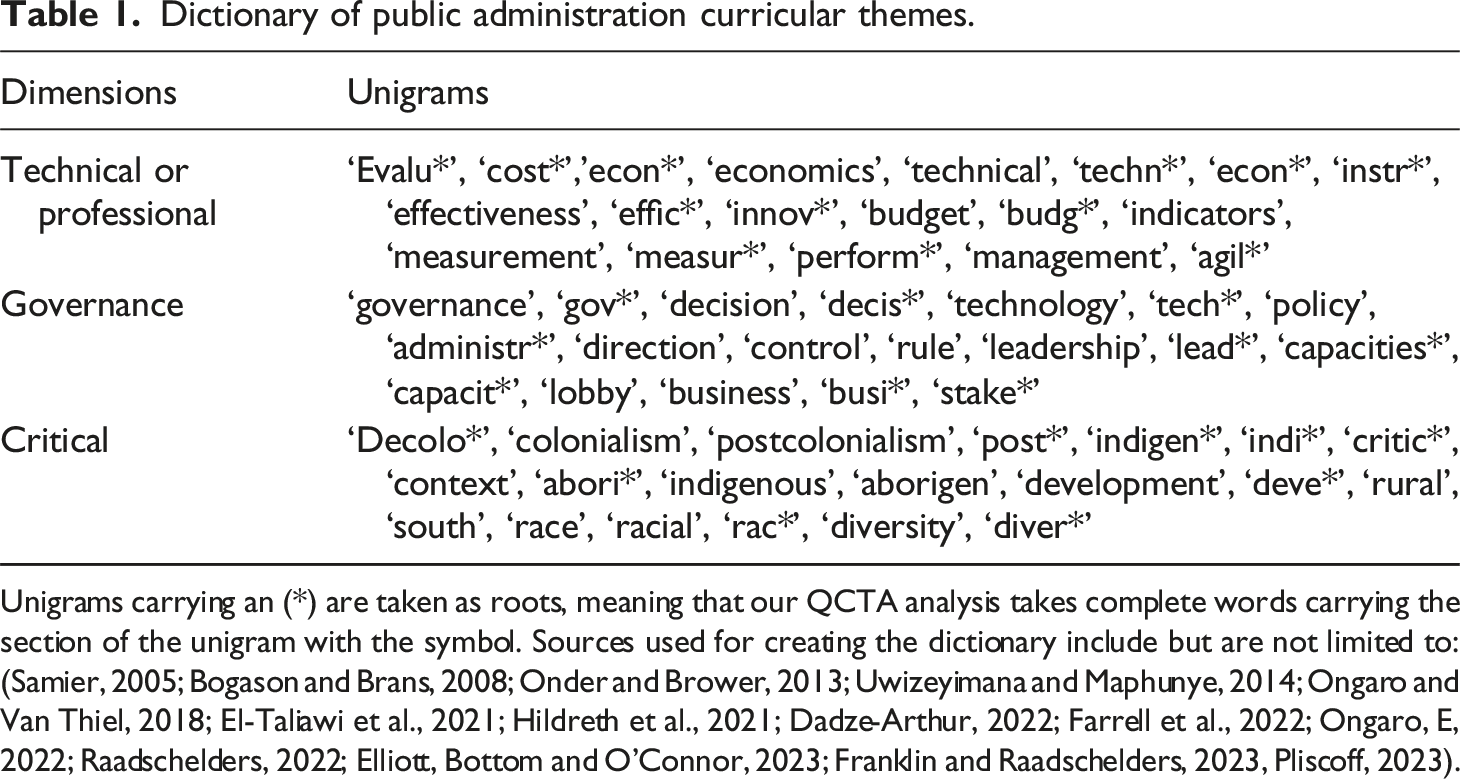
Unigrams carrying an (*) are taken as roots, meaning that our QCTA analysis takes complete words carrying the section of the unigram with the symbol. Sources used for creating the dictionary include but are not limited to: (Samier, 2005; Bogason and Brans, 2008; Onder and Brower, 2013; Uwizeyimana and Maphunye, 2014; Ongaro and Van Thiel, 2018; El-Taliawi et al., 2021; Hildreth et al., 2021; Dadze-Arthur, 2022; Farrell et al., 2022; Ongaro, E, 2022; Raadschelders, 2022; Elliott, Bottom and O’Connor, 2023; Franklin and Raadschelders, 2023, Pliscoff, 2023).
Finally, we have carefully applied our dictionaries to evaluate markers of difference among PA programmes worldwide. This classification has permitted us to uncover themes and approaches dominating PA teaching globally.
Document feature matrix (DFM)
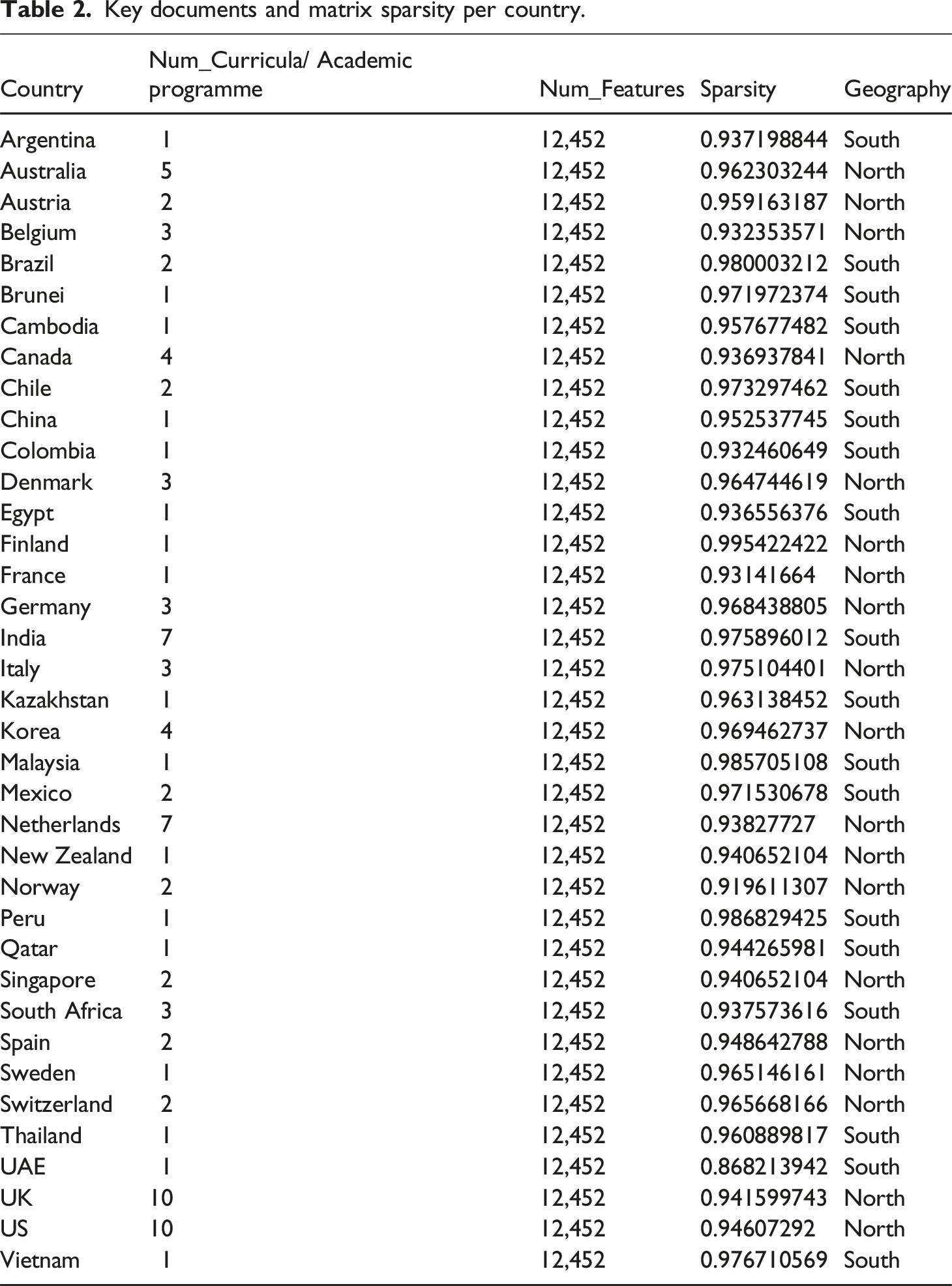
Key documents and matrix sparsity per country.
Results
The predominance of the ‘canonised’ public administration curriculum
Figure 1 confirms H.1, demonstrating the global prevalence of the ‘canonised’ PA curriculum across both Global North and South geographies. While the absolute frequency of such curricula is higher in Global North countries (due to their greater number of listed programmes, as reflected in Table 2), the proportional distribution of canonical content remains comparably similar worldwide. Frequencies of topics in public administration curricula by dimension (Global South in bold).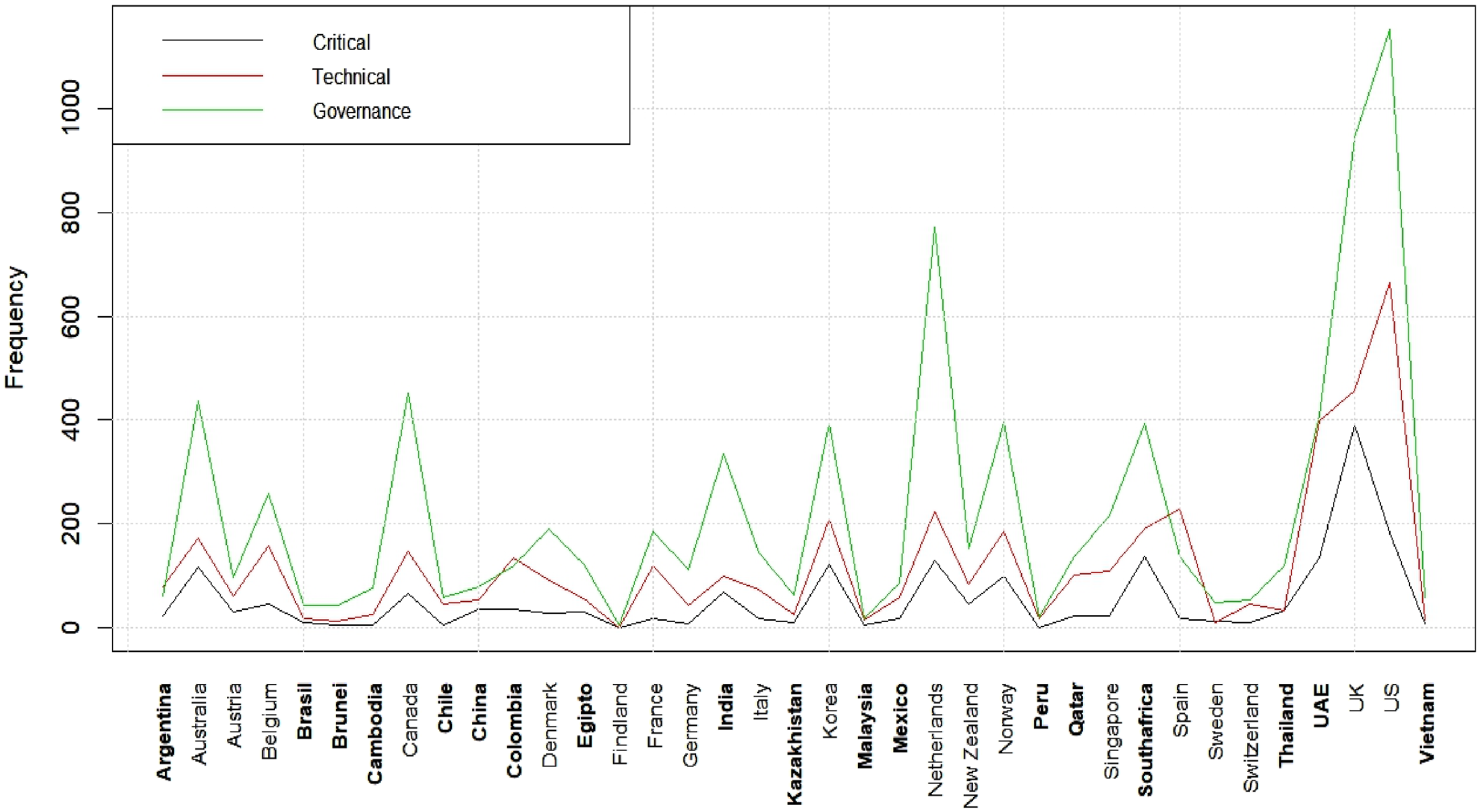
Figure 1 further reveals that ‘governance’-related themes – focused on governing populations – prevail globally over ‘technico-professional’ content in PA curricula. This dominance might stem from the post-1990s institutionalisation of ‘governance’ by international organisations (e.g., the World Bank), which reframed aid agendas and embedded governance-centric frameworks in public affairs education (Carr, 2013). Technical training/skills rank second in prevalence, with critical approaches markedly underrepresented.
While this observed hierarchy (governance > technical > critical) appears to invert H2a′s expected order (technical > governance > critical), this order rather reflects structural biases: Global North institutions (e.g., US, UK, Netherlands) dominate knowledge production, overrepresenting their programs in our dataset. Their curricular hegemony – producing more governance-focused content— amplifies this theme globally, potentially masking regional variations. A weighted analysis is required to disentangle whether this hierarchy reflects true global trends, as we do next.
An heterogeneous Global North and South public administration curricula
To ensure robustness, we apply Latent Semantic Scaling (LSX) analysis (Watanabe, 2021) using the dictionaries in Table 1. As programmes with a higher frequency of unigrams from specific categories receive higher ranks, especially these overrepresented in developed countries (Figure 1), we weight these rankings by the number of programmes per country (Num_curricula column in Table 2).
Results in Figure 2 confirm H2a, showing that when weighted by programme, ‘technico-professional’ curricula (and their components) are the most predominant in Global South countries, with 14 programmes ranking as more technical compared to only 4 in the less technical category. Countries such as Argentina, Chile, Colombia, Mexico, Brazil, and Peru rank among the highest, reflecting a strong adoption of a ‘technico-professional’ approach in their PA programmes. This prevalence might stem from the ‘elite’ nature of PA training in these countries and the emulation of leading Global North policy schools with predominantly economic and institutionalist traditions (Raadschelders, 2022). Additionally, as Centeno and Ferraro (2023) explain, the adoption of these approaches can be linked to the neoliberal reforms these countries experienced from the late 1970s onward. These reforms facilitated the spread of managerialist and economist doctrines in PA, promoting technically oriented disciplines. This trend has been reinforced by international partners such as the IMF, World Bank, and IADB, which condition loans on the implementation of performance- and results-based evaluations of policy reforms (Clark and Dolan, 2021). Weight of the technical dimension in public administration curricula by country.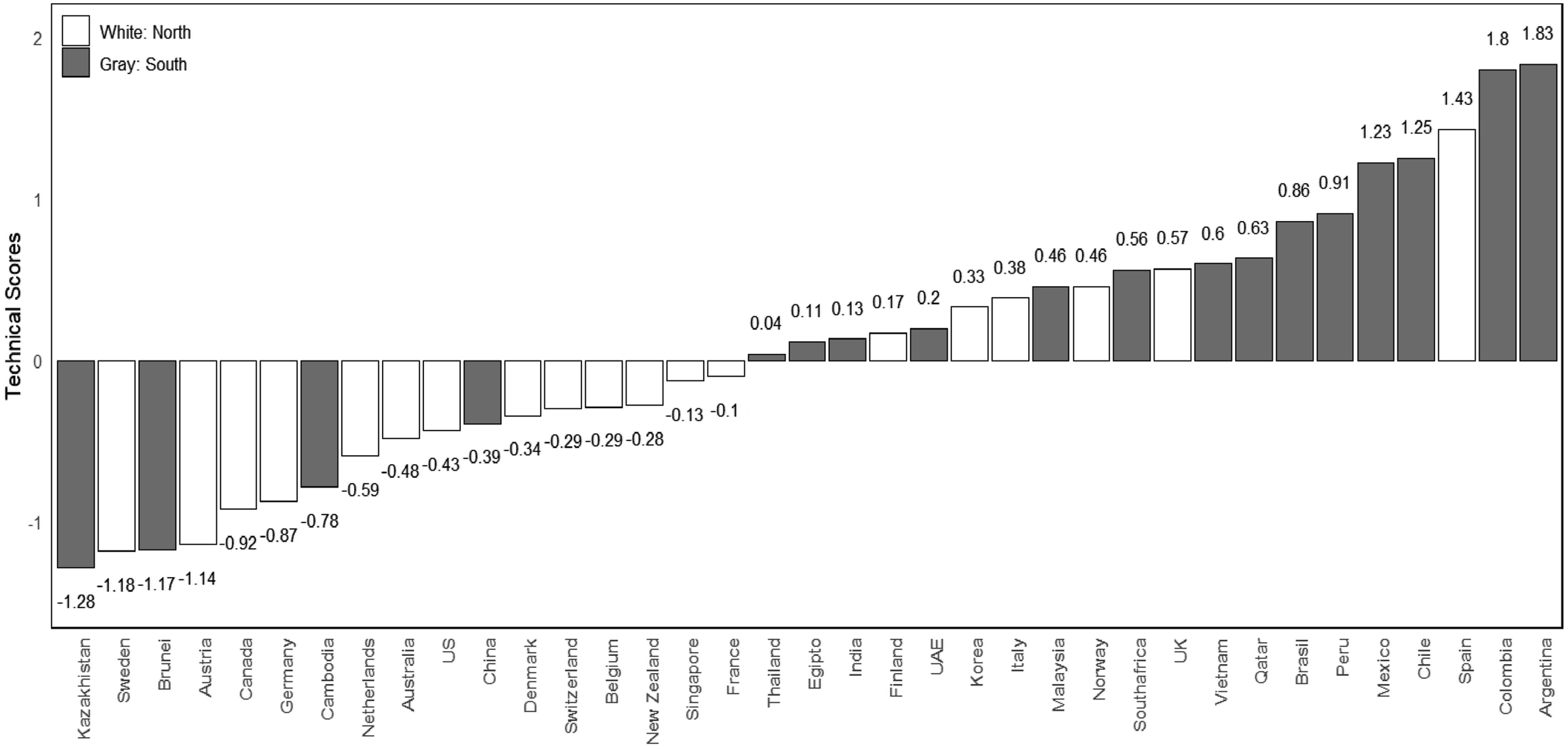
In contrast, Figure 3 indicates that Global North countries appear more inclined to adopt ‘governance’-oriented curricula, predominantly focusing on the ‘craft’ dimension of PA. These programmes display notable governance-oriented interests, encompassing themes such as the rule of law, welfare distribution, migration governance, EU governance, lobbying, the influence of business on policy, and overall the politics of policymaking (Dadze-Arthur 2022; Ongaro and Van Thiel 2018). The countries with the highest ranks in this category are South Korea, France, Germany, Switzerland, Sweden, and the United States. Notably, the findings in Figure 3 align with our earlier frequency analysis (Figure 1), which shows that Global North PA curricula privilege a thematic distribution focused on ‘governance’-related topics. Weight of the governance dimension in public administration curricula by country.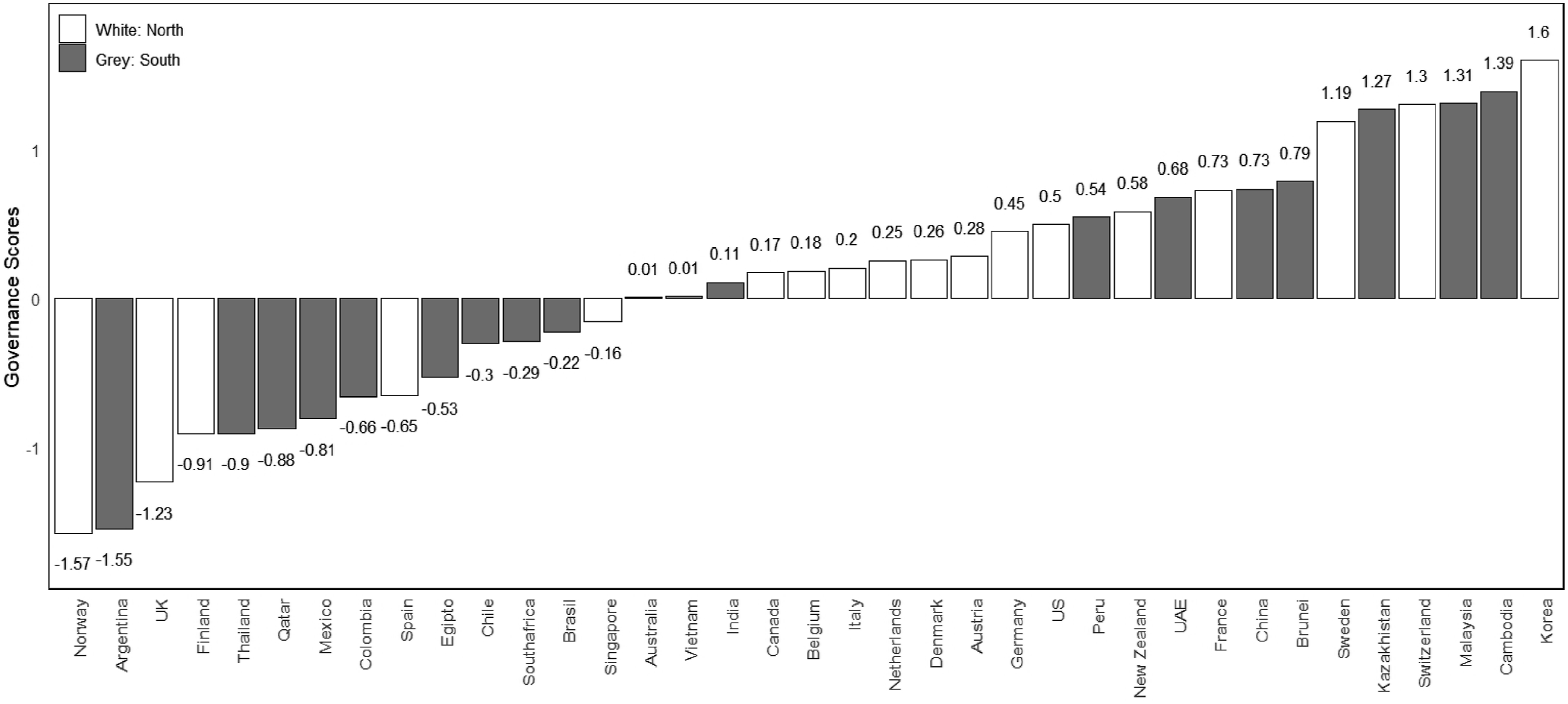
Figure 4 supports our H.2.b indicating that although local adaptations are evident in Global South PA curricula, they seldom contest the colonial epistemological underpinnings of the canonised/core curriculum. Weight of the critical dimension in public administration curricula by country.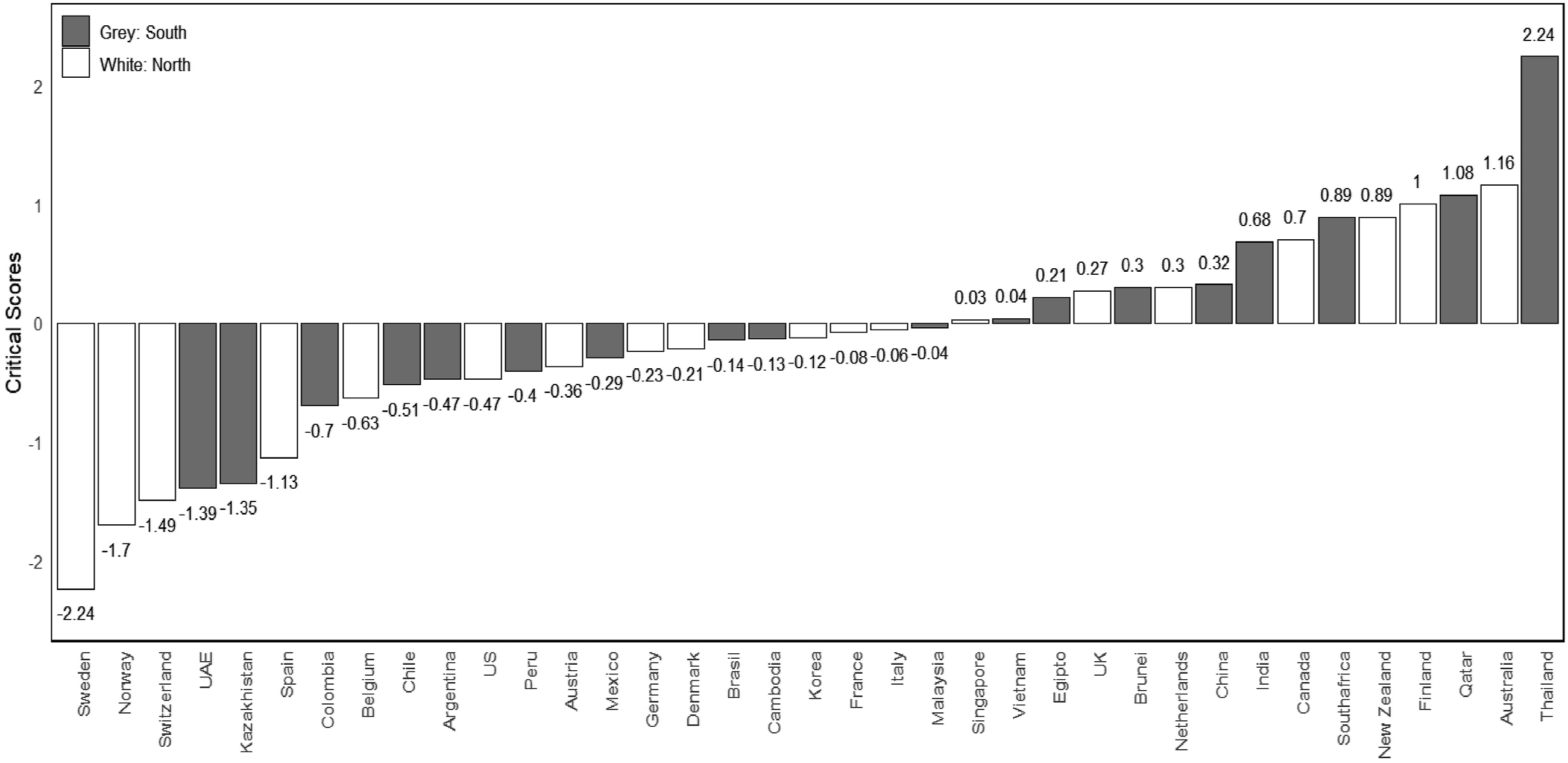
Our findings reveal that while no geographical region exhibits a clear majority of ‘critical or humanist’ curricula (Dadze-Arthur 2022) challenging the canonical PA framework, we found a notable paradox: Northern countries—particularly those with colonial legacies and sizeable Indigenous populations, such as Australia, New Zealand, and Canada—substantially incorporate more ‘critical’ themes into their programmes. Upon closer scrutiny, it appears that these programmes include objectives, references, and courses designed to address the role of their diverse populations (especially Indigenous Peoples) within PA. However, these elements often remain focused on ways to ‘govern’ these groups, rather than advancing alternative, decolonial epistemological approaches.
We also identified a number of European countries—including the Netherlands, the UK, and Finland—whose curricula rank more highly in ‘critical’ content. Our analysis suggests that these programmes engage with areas such as urban studies and city management, with particular attention to migration and vulnerability. Yet again, this orientation seems away from genuinely ‘decolonial’ objectives.
Meanwhile, the Global South countries ranking higher in the ‘critical’ category—Thailand, South Africa, Qatar, India, Egypt, and Brunei—offer programmes tailored to the ‘realities of their regions’, encompassing narrative and critical examinations of policy analysis. Several also adopt a comparative PA approach oriented towards their respective geographic spheres of influence. Collectively, these features make their curricula and teaching among the most distinctive in the field of PA.
The most ‘technical’, ‘governance-oriented’ and ‘critical’ public administration curricula
We move onto a more granular analysis to evaluate and identify the most distinct curricular programmes in the combination of categories obtained via our LSX analysis. To do so, we join together our dictionary scores of Table 1 and annotate the most extreme values, this time also identifying university and country. Figure 5 reflects the countries where curricular programmes (universities) are found to be the most polar in each of the PA curricular categories, and further Table 3 identifies the universities and their specific scores. Universities (per country) position in dictionary scores (technical v governance v critical) with extreme values highlighted. Universities ranking extreme values in dictionary scores.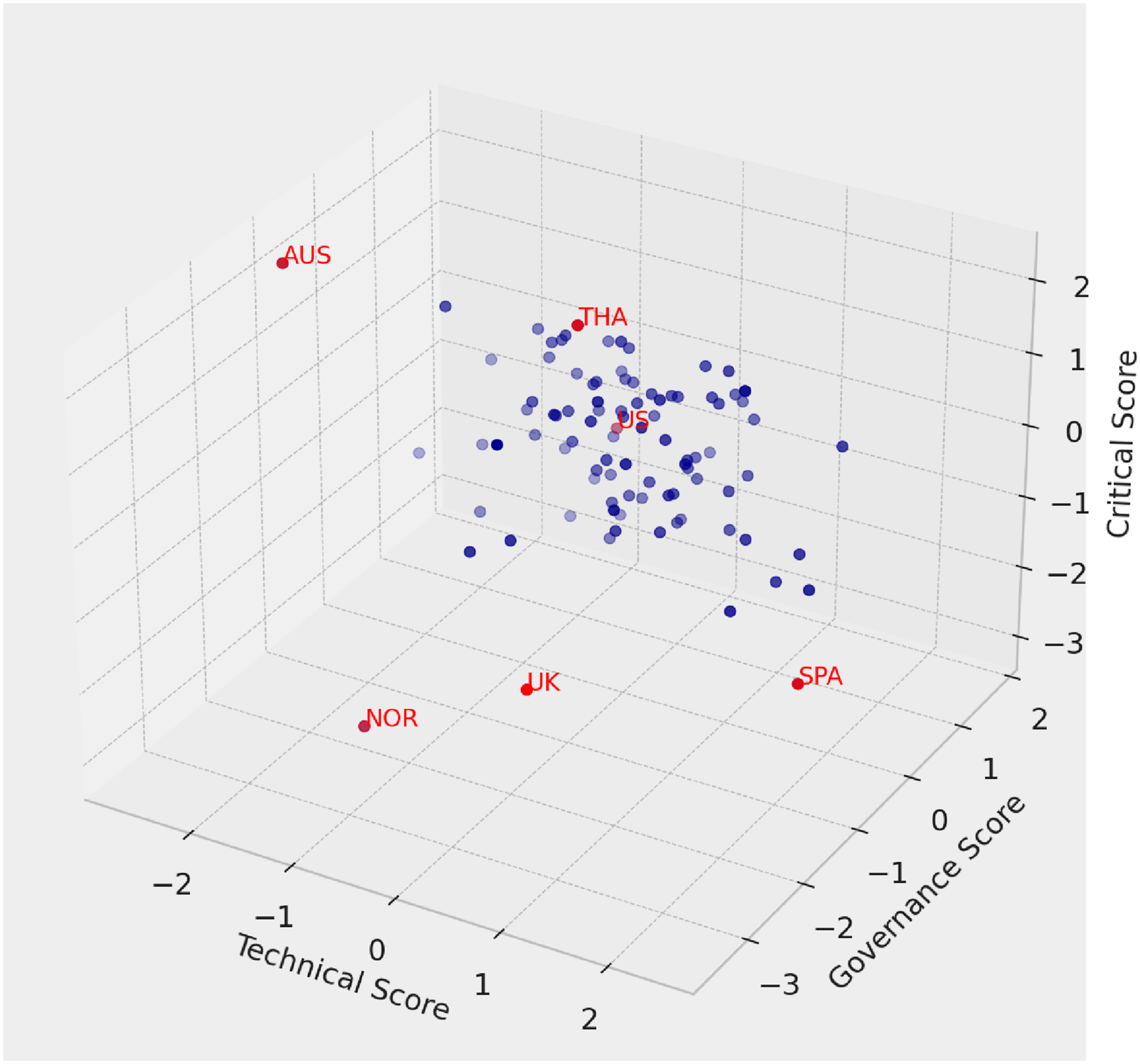
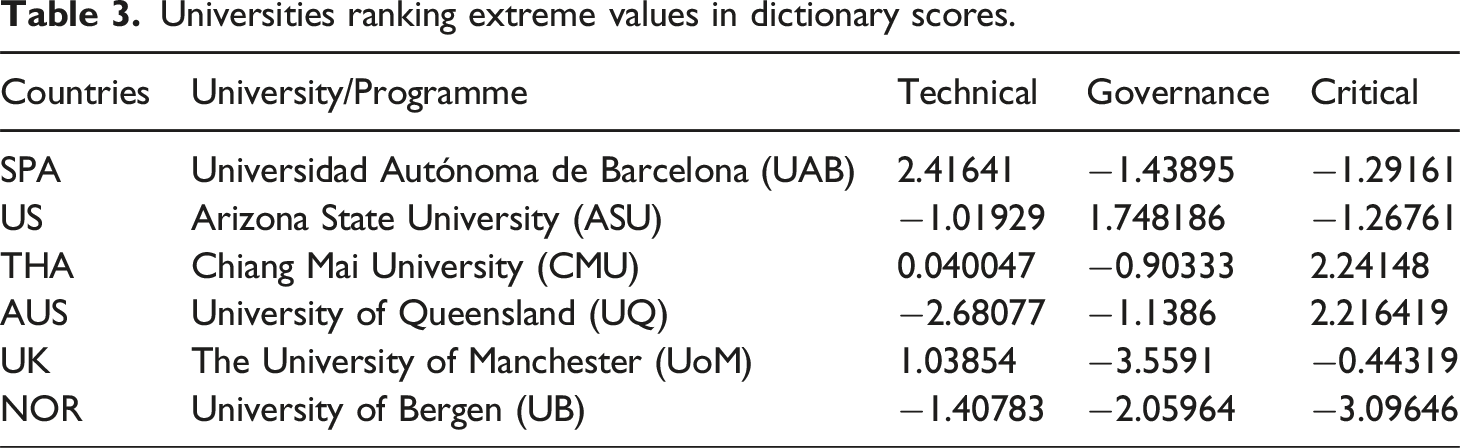
Both Figure 5 and Table 3 show that the UAB of Spain occupies the highest rank in terms of technico-professional oriented PA curriculum. A closer look at UAB’s curriculum further confirms that it offers overwhelmingly courses on ‘economics for the public sector’ which addresses topics such as ‘financing strategies for the public sector’, with an emphasis on budgeting and ‘financial cycles’ including a ‘rationality for public intervention’ looking for the impacts on policy making. This approach is combined with a unique course on ‘instruments’ for PA and management which is also oriented towards procurement, accounting and other mechanisms of budgetary control. All together, these particular elements found in UAB’s curriculum positions it as leading in the ‘technical’ dimension of PA’s curriculum.
In terms of ‘governance’, ASU located in the US ranks the highest. ASU’s curriculum objective indeed directly states that its aim is to foster ‘public service professionals to address key issues of democratic governance’. This ambitious programme also involves students’ internships in ‘governmental’ and ‘non-governmental organisations’ further ensuring high quality training in abilities to solve ‘public problems’, which aims at building a strong competence in ‘American government’. Our revision of ASU’s curriculum confirms indeed its strong ‘governance’ oriented spirit.
In turn, the university showcasing the highest rank in the critical component of PA comes from Thailand. Our revision confirms that CMU’s offers a ‘world class’ curriculum with an innovative ‘Narrative Policy Analysis’ course which trains students in critical interpretation, argumentation and deliberation for/in policymaking. The course further advances understanding in ‘emotional’ policy narratives and deliberative processes in the policy arena. That our LSX analysis codes CMU’s curriculum as the highest in the critical category has also to do with its critical approach to the entire programmes (rather than a critical course only), CMU’s programme in fact seeks to ‘critically assess’ the PA tools for ‘development’.
Our LSX analysis also identifies curricula ranking lower in our dictionaries’ categories (see Table 3). For instance, the UQ from Australia, ranks low in ‘technical’ aspects, but is only second in more critical curricula, with courses such as ‘Global South Cities’, ‘Gender and Politics of Development’ and most relevantly ‘Knowledge and Public Policy’, which critically ‘questions knowledge and rationality in policy and governance systems’ and rather focus on how ideas and discourses shape the world’. The UoM in the UK, while offering the least courses related to governance, still champions technical courses such as ‘econometric methods for development’, ‘behavioural experiments for policy’, and a wide range of economic and managerial methods oriented toward development. Lastly, UB shows a more diversified content ranging from research oriented courses, governance, knowledge, politics with a particular emphasis on organisational analysis. This is all to say that universities ranking lower in one category might have a more balanced approach to PA curriculum rather than focusing overwhelmingly on one aspect only.
Marked thematic differences between North-South public administration curricula
Finally, and to address our H3, we further pool the frequencies of the typical words in the groups we previously termed in Table 2 as Global North and Global South to apply a wordscore (word-cloud) frequency analysis. The results show that Figure 6 partially confirms our H3: we see that both geographies display different thematic interests with the North more preoccupied in issues like ‘administration’, ‘politics’, ‘welfare’ and the ‘environment’, whereas the South is more concerned with topics such as ‘public policy’, ‘tools’, ‘innovation’, ‘development’, ‘impact and implementation’. Wordcloud of most frequent words in public administration curricula by geographical location.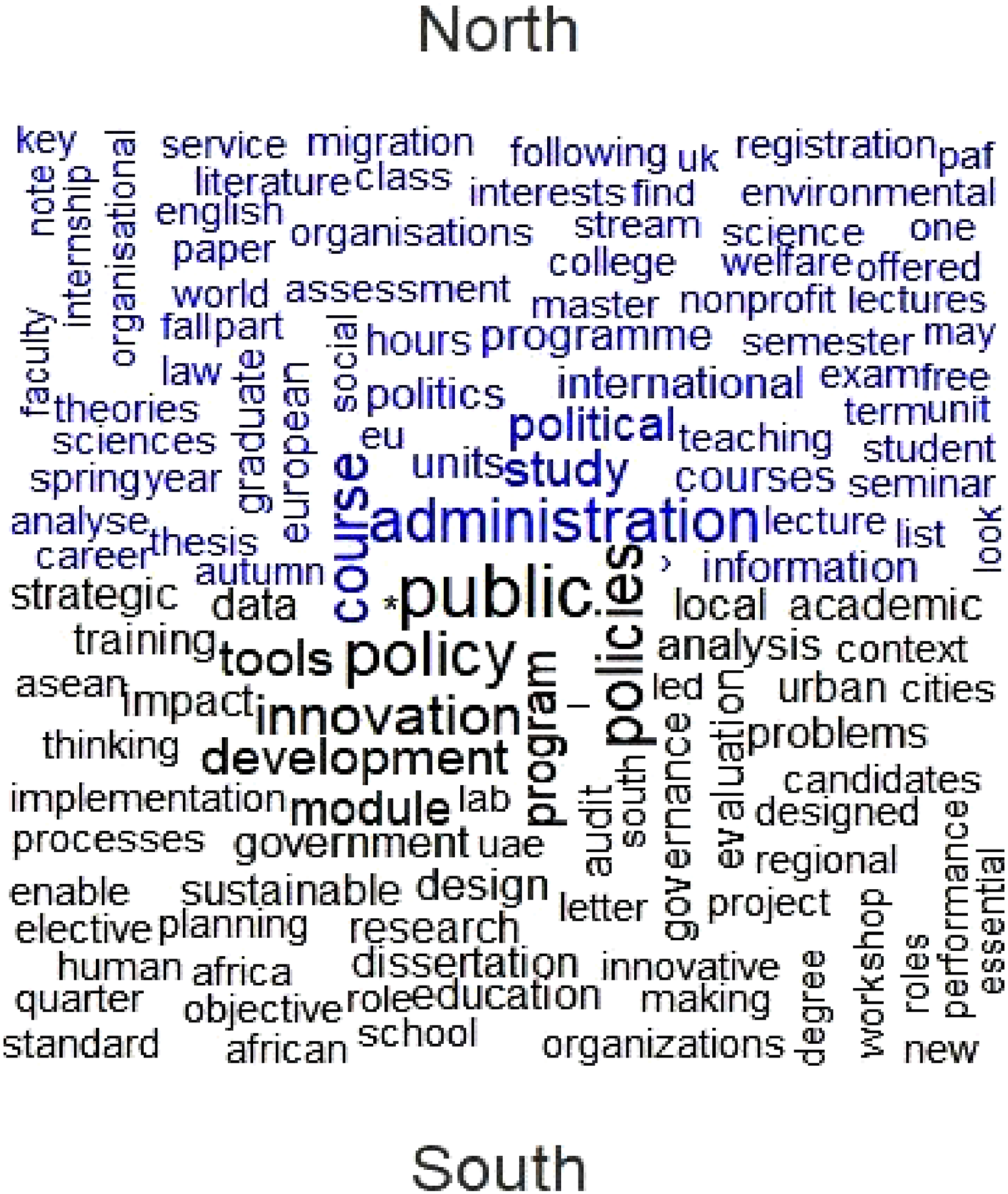
These are not only tokenistic differences but rather represent significant divides and interests in the North-South blocs. Arguably, PA teaching is entrenched with the socioeconomic and institutional context where it operates (Franklin and Raadschelders, 2023), for this reason, we note that canonical Global North PA reflects pressing issues in advanced democracies like migration, and welfare distribution, meanwhile Global South countries are more preoccupied in finding sound policy solutions directed at fostering economic development (also see Bertelli et al., 2020).
Moreover, this divide reflects recent scholarly research already suggesting that topics of interest of Global South countries are different from those of the Global North (Farrell et al. 2022; Roberts 2020; Bertelli et al., 2020). These are linked to making policies work, ‘policy tools selection’, and arguably how to obtain successful policy results amid weak, patrimonialist and less meritocratic bureaucracies (see Grindle 2012). A close inspection to our results in Figure 6 further suggest topics foregrounded in the Global South such as ‘planning’, ‘evaluation’, ‘design’, ‘audit’ and ‘problems’ in contrast to Global North orientations towards ‘politics’, ‘organisational’, and ‘social’. This divide further reinforces the interest of Global South scholars in sound policy cycle comprehension as a means to support a more developmentalist approach, in contrast to the governance-oriented administrative approach seen in the Global North. Moreover, Global North curricula tend to emphasise the ‘European’ context, whereas in the Global South, references to ASEAN, Africa, and to ‘context’ in general are more commonplace.
We extend our analysis by conducting a ‘keyness’ assessment to determine the statistical significance of topic usage across the two geographies. We define our target corpus as the text of curricula of policy schools in the Global North, while the reference corpus comprises those from policy schools in the Global South. To account for differences in text length and ensure comparability across curricula, our keyness analysis calculates expected frequencies based on corpus sizes, effectively normalising term frequencies. Consequently, identified differences in word usage between the target and reference corpora reflect statistically meaningful lexical distinctions rather than mere differences in corpus size. Figure 7 shows the words that are significantly (p < .05) more frequent in one geography than the other, with the corresponding chi-square (X2) tests provided in Appendix Table A2. These findings complement our initial results by highlighting a second marked divide between key themes. In the Global North, terms such as ‘administration’, ‘european’, and ‘politics’ predominate, whereas in the Global South, ‘innovation’, ‘policies’, ‘tools’, and ‘african’ are more prevalent. Keyness analysis displaying significant differences in curricular topics in the Global North (blue) versus South (grey).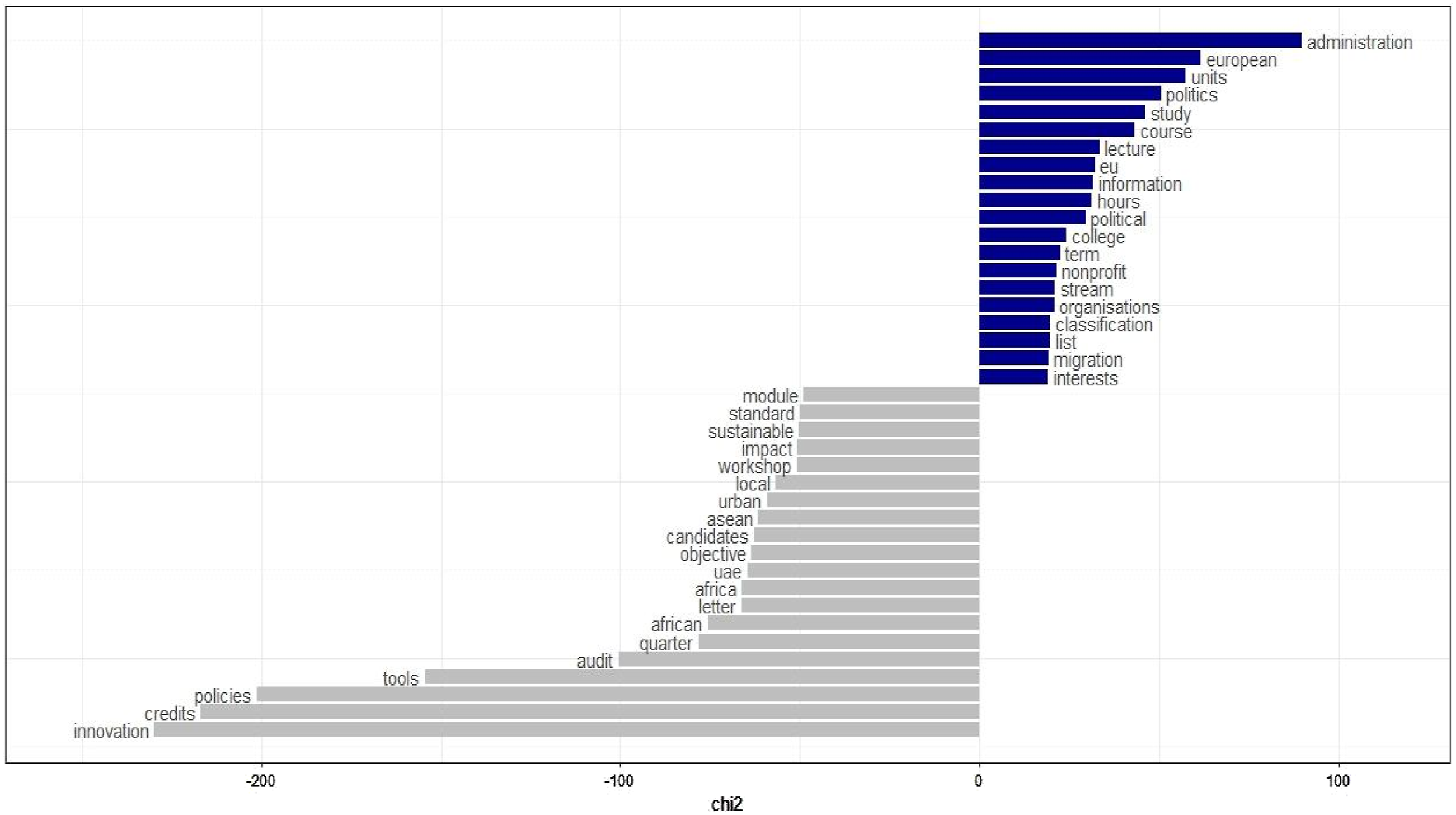
Discussion
Our exploratory analysis has uncovered significant geographical disparities in the thematic focus of PA curricula between the Global North and South. These divisions reflect the influence of institutional context, legacies, inherited administrative structures, and established practices on how PA is taught (see Farrell et al., 2022; Raadschelders, 2022). However, while these differences are prevalent and shape the discipline within its teaching institutions, they coexist with what we identify as the ‘canonised’ PA curriculum. This curriculum preserves the discipline’s core rationalist and technical components, partly because policy schools in the Global South try to emulate the elite nature of the Western-centric discipline while adapting it to their socioeconomic and institutional constraints, even as Global North institutions prefer ‘governance’-related topics.
Arguably, this process stems from the colonial origins of the discipline but is also shaped by the enduring ‘coloniality of knowledge’ (Quijano, 2007), which influences curriculum design in developing nations. This dynamic relegates local governance knowledge to a subaltern position and favours the benchmarks established in Euro-American centres of knowledge production. A key driver of this ‘coloniality of PA knowledge’ is the growing pressure on universities and academic staff worldwide to conform to common metrics, promotion standards, and publishing expectations, which remain predominantly dominated by Euro-Western institutions and journals. Given these constraints, it is understandable that many policy schools in the Global South (e.g., Peru, Colombia, Argentina, Brazil, and Mexico) emphasize the discipline’s more ‘rational’ and ‘technical’ dimensions in their PA curricula, sometimes even more than their counterparts in the Global North.
Paradoxically, some Global North institutions, particularly those with colonial histories (e.g., Australia, New Zealand, Canada), include in their curricula alternative understandings of PA that engage with ‘critical’ themes such as issues affecting vulnerable populations, gender, and urban governance. These curricular inclusions reflect context-dependent academic and institutional dynamics. In some cases, this has led to the presence of a more self-reflexive strand of PA—drawing on interpretive approaches, power-sensitive analysis, and critical theories—within teaching programs in the Global North. However, it is important to note that critical approaches in Western PA curricula do not necessarily imply post-colonial or decolonial commitments (Dadze-Arthur 2022; Matsiliza 2020), but rather respond to the predominantly technical and positivist profiles of Western PA programs.
In sum, we found that the ethos of PA in the Global South is entangled in enduring patterns of knowledge coloniality (Berda 2022; Farrell et al. 2022; Kirk-Greene 1999; Quijano 2007). The legacies of technocratic colonial expertise and governance persist in PA thinking and teaching in many Global South countries, even after formal decolonisation (Baffoe and Roy, 2023). This perpetuates a focus on training administrators in the juridico-legal craft of administration and its associated technical skills – often described as ‘instrumental’ –reflecting institutional foundations shaped by colonial rule. Consequently, bureaucracies and the public service profession often hold an elite status, which programmes may seek to replicate in their curricula, as illustrated by our findings on the preference for more technical training in these contexts. One notable exception in our analysis is Thailand’s CMU, whose curriculum ranks as the most critical.
Finally, while curricula and policy schools in the Global South replicate technico-professional canonised themes, we also find that these topics often adapt to local settings and address contextual problems. In practice, our findings in Figures 6 and 7 indicate that while PA’s ‘canonised’ curriculum influences knowledge production and hierarchy within the discipline, it is also adapted by Global South counterparts. This adaptation might lead to significant thematic differences in courses/programs that are sensitive to the diverse socioeconomic and political contexts of Global South regions. This suggests a more complex narrative than a simple North-South divide, reinforcing the idea that PA has evolved alongside the complexity, interrelatedness, and challenges of public problems in the countries where it is taught and studied.
Concluding remarks and limitations
Our exploratory analysis has uncovered key geographical differences in PA curricula between the Global North and South. These findings highlight the influence of institutional context, legacies, and administrative practices in PA education. Despite these disparities, a common ‘canonised’ PA curriculum prevails, blending rationalist and technical aspects with adaptations to local socioeconomic and institutional contexts. This study highlights PA’s lingering modernist/colonial frameworks and the need for more inclusive, responsive education systems. Our analysis also reveals a more nuanced story than a mere North-South divide, with complex sub-regional dynamics and thematic emphasis, that policy schools present in our study (e.g., Thailand stress critical narrative approaches or Latin American countries emphasise technical PA curricula due to contextual isomorphic pressures or neoliberal influences in the region). Further research will need to move beyond the North-South classification, opting for comparative, regionally-based analysis that can better reflect the global diversity of PA’s curricula.
This is a first, initial attempt to analyse the teleology of PA curricula and presents limitations. The unigrams used in our dictionaries reflect a proxy choice for the thematic divisions present in the curricula examined. We resorted to them by revising articles and reflections published in PA journals concerning the evolution of the discipline, and they are, of course, also subject to the contextual biases as most of them have been produced in Global North institutions, while also reflecting the positionalities of the authors that produce them. Concretely, the dictionaries presented in Table 1 are subject to refinement, especially considering that some terminologies might have differing signifiers in different contexts and that the classroom-society scope also showcases different divisions beyond, for instance, race, ethnicity and sex. Also, terminologies such as ‘rural’ and ‘administration’ can be employed in different curricular dimensions (either technical, governance, or critical) depending on associated unigrams linked to their semantic meaning. A more detailed analysis might require a careful and long-term project of revisiting unigrams of every curriculum as it interacts with its context worldwide to determine the signifiers and comparative power of the unigrams in question.
Footnotes
Declaration of conflicting interests
The authors declared no potential conflicts of interest with respect to the research, authorship, and/or publication of this article.
Funding
The authors received no financial support for the research, authorship, and/or publication of this article.

Data Availability Statement
Data collected for this article comes from the curricula of the universities listed in appendix A-1 and it has followed the General Data Protection Regulation and Regulation 2018/1725 of the European Union. We also followed the data protection regulations of every country included in our sample. Datasets (curricula) cannot be shared in public since they are the intellectual property of universities and cannot be dissociated from the academic staff that prepared them. The collection process started in December 2023 and concluded in June 2024. Further changes and modifications in the curricula due to updates and/or programme withdrawals remain exclusively the responsibility of universities.
Notes
Appendix
Complete list of universities and curricular programmes for analysis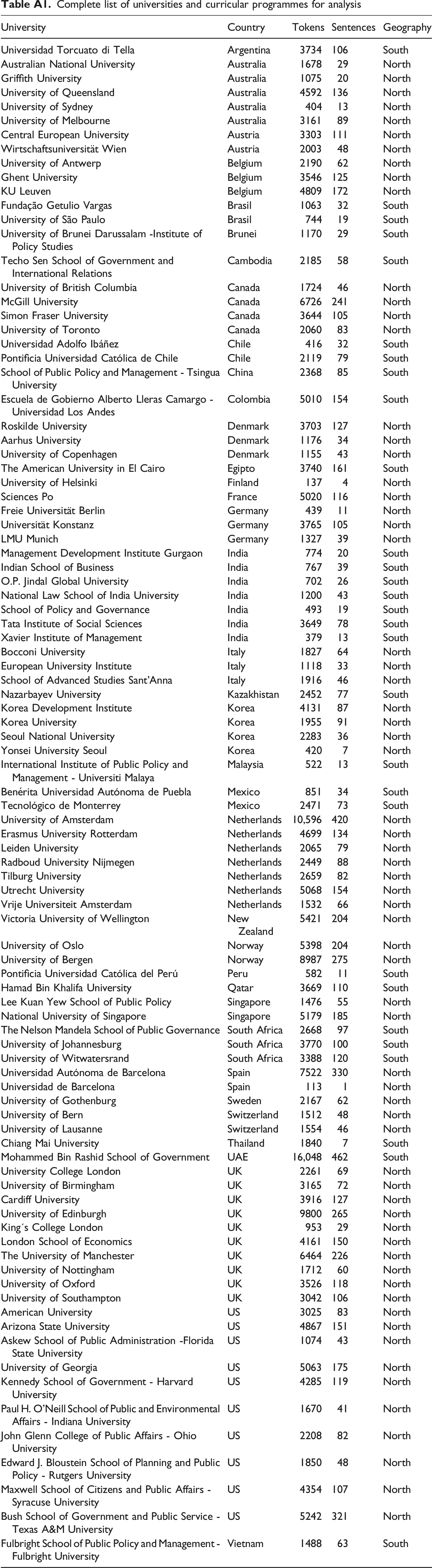
University
Country
Tokens
Sentences
Geography
Universidad Torcuato di Tella
Argentina
3734
106
South
Australian National University
Australia
1678
29
North
Griffith University
Australia
1075
20
North
University of Queensland
Australia
4592
136
North
University of Sydney
Australia
404
13
North
University of Melbourne
Australia
3161
89
North
Central European University
Austria
3303
111
North
Wirtschaftsuniversität Wien
Austria
2003
48
North
University of Antwerp
Belgium
2190
62
North
Ghent University
Belgium
3546
125
North
KU Leuven
Belgium
4809
172
North
Fundação Getulio Vargas
Brasil
1063
32
South
University of São Paulo
Brasil
744
19
South
University of Brunei Darussalam -Institute of Policy Studies
Brunei
1170
29
South
Techo Sen School of Government and International Relations
Cambodia
2185
58
South
University of British Columbia
Canada
1724
46
North
McGill University
Canada
6726
241
North
Simon Fraser University
Canada
3644
105
North
University of Toronto
Canada
2060
83
North
Universidad Adolfo Ibáñez
Chile
416
32
South
Pontificia Universidad Católica de Chile
Chile
2119
79
South
School of Public Policy and Management - Tsingua University
China
2368
85
South
Escuela de Gobierno Alberto Lleras Camargo - Universidad Los Andes
Colombia
5010
154
South
Roskilde University
Denmark
3703
127
North
Aarhus University
Denmark
1176
34
North
University of Copenhagen
Denmark
1155
43
North
The American University in El Cairo
Egipto
3740
161
South
University of Helsinki
Finland
137
4
North
Sciences Po
France
5020
116
North
Freie Universität Berlin
Germany
439
11
North
Universität Konstanz
Germany
3765
105
North
LMU Munich
Germany
1327
39
North
Management Development Institute Gurgaon
India
774
20
South
Indian School of Business
India
767
39
South
O.P. Jindal Global University
India
702
26
South
National Law School of India University
India
1200
43
South
School of Policy and Governance
India
493
19
South
Tata Institute of Social Sciences
India
3649
78
South
Xavier Institute of Management
India
379
13
South
Bocconi University
Italy
1827
64
North
European University Institute
Italy
1118
33
North
School of Advanced Studies Sant'Anna
Italy
1916
46
North
Nazarbayev University
Kazakhistan
2452
77
South
Korea Development Institute
Korea
4131
87
North
Korea University
Korea
1955
91
North
Seoul National University
Korea
2283
36
North
Yonsei University Seoul
Korea
420
7
North
International Institute of Public Policy and Management - Universiti Malaya
Malaysia
522
13
South
Benérita Universidad Autónoma de Puebla
Mexico
851
34
South
Tecnológico de Monterrey
Mexico
2471
73
South
University of Amsterdam
Netherlands
10,596
420
North
Erasmus University Rotterdam
Netherlands
4699
134
North
Leiden University
Netherlands
2065
79
North
Radboud University Nijmegen
Netherlands
2449
88
North
Tilburg University
Netherlands
2659
82
North
Utrecht University
Netherlands
5068
154
North
Vrije Universiteit Amsterdam
Netherlands
1532
66
North
Victoria University of Wellington
New Zealand
5421
204
North
University of Oslo
Norway
5398
204
North
University of Bergen
Norway
8987
275
North
Pontificia Universidad Católica del Perú
Peru
582
11
South
Hamad Bin Khalifa University
Qatar
3669
110
South
Lee Kuan Yew School of Public Policy
Singapore
1476
55
North
National University of Singapore
Singapore
5179
185
North
The Nelson Mandela School of Public Governance
South Africa
2668
97
South
University of Johannesburg
South Africa
3770
100
South
University of Witwatersrand
South Africa
3388
120
South
Universidad Autónoma de Barcelona
Spain
7522
330
North
Universidad de Barcelona
Spain
113
1
North
University of Gothenburg
Sweden
2167
62
North
University of Bern
Switzerland
1512
48
North
University of Lausanne
Switzerland
1554
46
North
Chiang Mai University
Thailand
1840
7
South
Mohammed Bin Rashid School of Government
UAE
16,048
462
South
University College London
UK
2261
69
North
University of Birmingham
UK
3165
72
North
Cardiff University
UK
3916
127
North
University of Edinburgh
UK
9800
265
North
King´s College London
UK
953
29
North
London School of Economics
UK
4161
150
North
The University of Manchester
UK
6464
226
North
University of Nottingham
UK
1712
60
North
University of Oxford
UK
3526
118
North
University of Southampton
UK
3042
106
North
American University
US
3025
83
North
Arizona State University
US
4867
151
North
Askew School of Public Administration -Florida State University
US
1074
43
North
University of Georgia
US
5063
175
North
Kennedy School of Government - Harvard University
US
4285
119
North
Paul H. O’Neill School of Public and Environmental Affairs - Indiana University
US
1670
41
North
John Glenn College of Public Affairs - Ohio University
US
2208
82
North
Edward J. Bloustein School of Planning and Public Policy - Rutgers University
US
1850
48
North
Maxwell School of Citizens and Public Affairs - Syracuse University
US
4354
107
North
Bush School of Government and Public Service - Texas A&M University
US
5242
321
North
Fulbright School of Public Policy and Management - Fulbright University
Vietnam
1488
63
South
Keyness X2 analysis with the Ho: the frequency of two corpora are the same? Please note that in all cases we reject the Ho at the significance level with 99% confidence.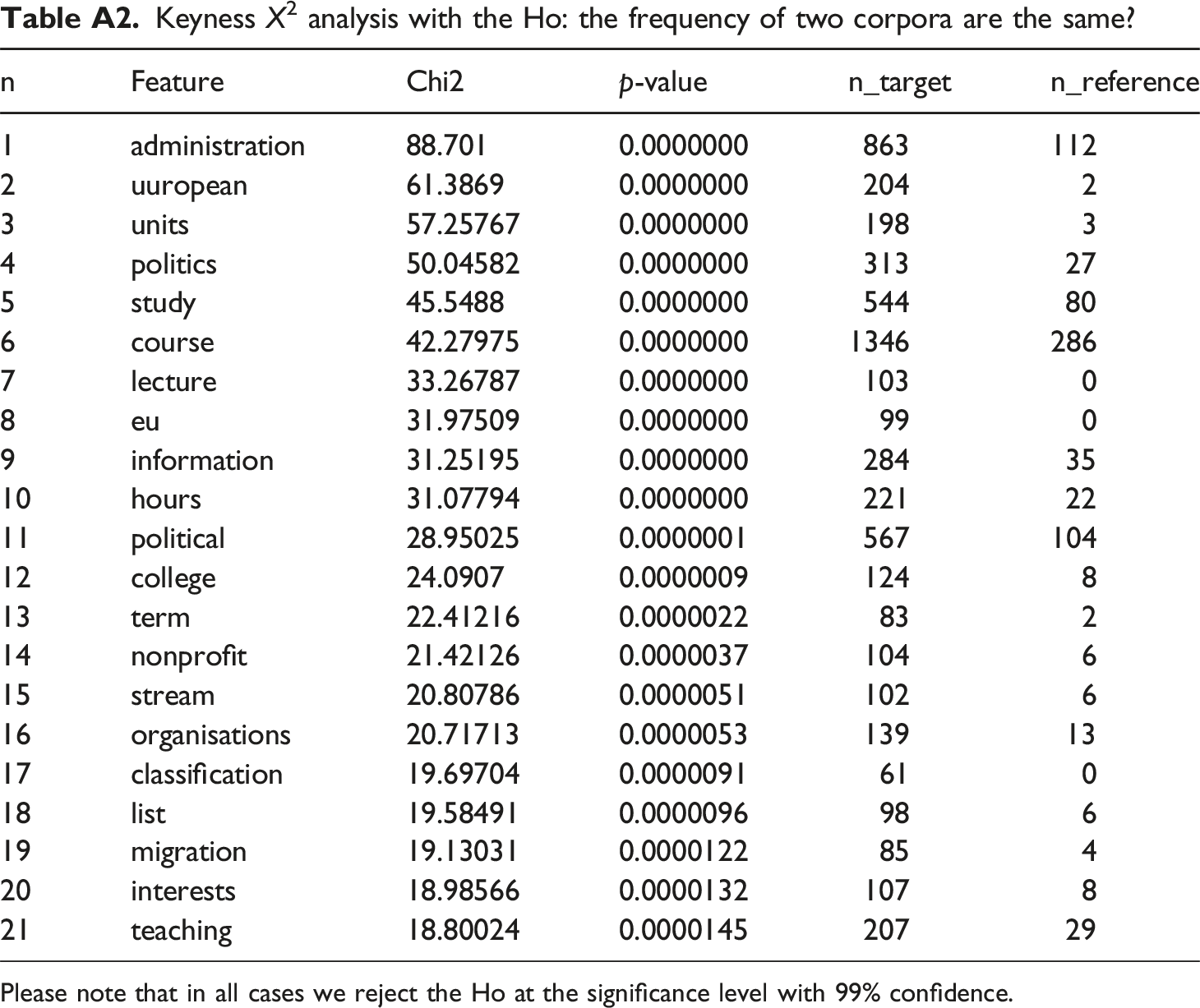
n
Feature
Chi2
p-value
n_target
n_reference
1
administration
88.701
0.0000000
863
112
2
uuropean
61.3869
0.0000000
204
2
3
units
57.25767
0.0000000
198
3
4
politics
50.04582
0.0000000
313
27
5
study
45.5488
0.0000000
544
80
6
course
42.27975
0.0000000
1346
286
7
lecture
33.26787
0.0000000
103
0
8
eu
31.97509
0.0000000
99
0
9
information
31.25195
0.0000000
284
35
10
hours
31.07794
0.0000000
221
22
11
political
28.95025
0.0000001
567
104
12
college
24.0907
0.0000009
124
8
13
term
22.41216
0.0000022
83
2
14
nonprofit
21.42126
0.0000037
104
6
15
stream
20.80786
0.0000051
102
6
16
organisations
20.71713
0.0000053
139
13
17
classification
19.69704
0.0000091
61
0
18
list
19.58491
0.0000096
98
6
19
migration
19.13031
0.0000122
85
4
20
interests
18.98566
0.0000132
107
8
21
teaching
18.80024
0.0000145
207
29